Slashdot Mirror
Domain: f9.co.uk
Stories and comments across the archive that link to f9.co.uk.
Comments · 58
-
Re:Emulation
Nowadays, there are emulators and roms for just about every piece of older hardware, including the "Speccy".
There must be plenty of dead Speccys around, and a Raspberry Pi would fit inside the box nicely. Hooking up the Speccy keyboard to the Pi's I/O pins and knocking up a driver can't be rocket science, then you could...
...install a BBC Micro emulator on it and have a decent computer (ducks and runs for cover...!)
Aaah, we had proper platform loyalty wars back in the good old days - so much better than all this cissy modern Fanbois vs. Fandroids rubbish. Tim Cook and Eric Schmitt might talk up a storm but you wouldn't see them in a pub sorting it out like men (See about half way down the page...) Anyway Tim Cook would probably have ended up in the wrong pub.
-
Re:Excellent!
Oh, the benefit of hindsight.
There are some typical future-prediction gems: like the assumption that we would continue to use cassettes way into the future;
And this:
...the first clues to the ZX-83 being that it will take Sinclair further up-market... will have its own screen
But the letters page (Over-heating stops printer) is hilarious.
-
Re:Excellent!
Of course it were all fields around here back then...
Back in the early 80s when Clive Sinclair's little 8-bit 'micros' were all the rage in the UK, when data storage was on cassette and portable TVs stood in for monitors, 'Sinclair User' magazine used to run a column called 'Sinclairvoyance' (geddit?), which predicted how the White Heat of cheap British computer technology would revolutionise all our lives:
Their predictions about educations were rather wide of the mark (at least so far):
http://www.sincuser.f9.co.uk/006/sincvoy.htm
'Once the home [computer] schooling idea was accepted, however, the costs of providing education would fall dramatically. Almost the whole of the present system would no longer be needed, with consequent savings in wages and building and maintenance costs. Teachers would be replaced by a handful of people responsible for setting and updating the cassettes and marking the examination cassettes. None of the thousands of ancillary staff - caretakers, cleaners and cooks - would be needed. School transport would become a thing of the past and crossing patrols would no longer halt traffic at the busy times of the day. Additionally, vast areas of land would become available for development.'
To be fair, they recognised some of the problems with this idea:
'Schools are much more than places for learning the subjects which appear in the curriculum. They are a major stage in learning social skills. All children make friends in their neighbourhood but most friends are made at school. They also gain by having contact with others from different backgrounds. There are sufficient problems in the world caused by a lack of understanding between groups of people without increasing the divisions by removing an effective way of bringing people together.'
Some of their other predictions seem rather more prescient, if you replace 'Prestel' with 'Web' and 'Sinclair' with 'PC'. From 1982:
http://www.sincuser.f9.co.uk/005/sincvoy.htm
'The Typical-Sinclair-Users select a group of holidays in which they are interested and request more details. Those arrive on the screen immediately and are printed out...They make their booking, paying the deposit by debiting their bank account directly by Prestel...As the time for the holiday approaches the TSU family, between playing the latest game of aliens and keeping their household accounts in order, check the weather conditions at their chosen resort and the strength of the peseta against the pound - all available through Prestel...As the TSUs hate shopping, having to push their way through the crowds, they decide to buy all their holiday clothes and equipment by mail order, again using Prestel...The luggage consists of the usual suitcases but also includes a large black briefcase. When they arrive at the airport, they find many other families have the same black briefcases. All are treated with great care, are taken inside the aircraft as hand luggage and stored carefully under the seats...On reaching their hotel everyone immediately rushes to their rooms, where the secret of the black box is revealed. Inside there is a complete Sinclair computer system...The following day the TSU family goes to the beach and, in common with many others, they take their briefcase and spend half the day enjoying the sun, sea and sand and the other half playing with the Sinclair...The case also contains a device which allows the Typical-Sinclair-Users to contact their neighbours via the telephone service or collect any recorded messages on their telephone answering service...If this sounds a little far-fetched, as though the Sinclairvoyance crystal ball is even less clear than usual, consider that most of the items are already in existence and are available either for the Sinclair machines or can be adapted from hardware available with other computers.'
-
Re:Excellent!
Of course it were all fields around here back then...
Back in the early 80s when Clive Sinclair's little 8-bit 'micros' were all the rage in the UK, when data storage was on cassette and portable TVs stood in for monitors, 'Sinclair User' magazine used to run a column called 'Sinclairvoyance' (geddit?), which predicted how the White Heat of cheap British computer technology would revolutionise all our lives:
Their predictions about educations were rather wide of the mark (at least so far):
http://www.sincuser.f9.co.uk/006/sincvoy.htm
'Once the home [computer] schooling idea was accepted, however, the costs of providing education would fall dramatically. Almost the whole of the present system would no longer be needed, with consequent savings in wages and building and maintenance costs. Teachers would be replaced by a handful of people responsible for setting and updating the cassettes and marking the examination cassettes. None of the thousands of ancillary staff - caretakers, cleaners and cooks - would be needed. School transport would become a thing of the past and crossing patrols would no longer halt traffic at the busy times of the day. Additionally, vast areas of land would become available for development.'
To be fair, they recognised some of the problems with this idea:
'Schools are much more than places for learning the subjects which appear in the curriculum. They are a major stage in learning social skills. All children make friends in their neighbourhood but most friends are made at school. They also gain by having contact with others from different backgrounds. There are sufficient problems in the world caused by a lack of understanding between groups of people without increasing the divisions by removing an effective way of bringing people together.'
Some of their other predictions seem rather more prescient, if you replace 'Prestel' with 'Web' and 'Sinclair' with 'PC'. From 1982:
http://www.sincuser.f9.co.uk/005/sincvoy.htm
'The Typical-Sinclair-Users select a group of holidays in which they are interested and request more details. Those arrive on the screen immediately and are printed out...They make their booking, paying the deposit by debiting their bank account directly by Prestel...As the time for the holiday approaches the TSU family, between playing the latest game of aliens and keeping their household accounts in order, check the weather conditions at their chosen resort and the strength of the peseta against the pound - all available through Prestel...As the TSUs hate shopping, having to push their way through the crowds, they decide to buy all their holiday clothes and equipment by mail order, again using Prestel...The luggage consists of the usual suitcases but also includes a large black briefcase. When they arrive at the airport, they find many other families have the same black briefcases. All are treated with great care, are taken inside the aircraft as hand luggage and stored carefully under the seats...On reaching their hotel everyone immediately rushes to their rooms, where the secret of the black box is revealed. Inside there is a complete Sinclair computer system...The following day the TSU family goes to the beach and, in common with many others, they take their briefcase and spend half the day enjoying the sun, sea and sand and the other half playing with the Sinclair...The case also contains a device which allows the Typical-Sinclair-Users to contact their neighbours via the telephone service or collect any recorded messages on their telephone answering service...If this sounds a little far-fetched, as though the Sinclairvoyance crystal ball is even less clear than usual, consider that most of the items are already in existence and are available either for the Sinclair machines or can be adapted from hardware available with other computers.'
-
Re:Excellent!
Of course it were all fields around here back then...
Back in the early 80s when Clive Sinclair's little 8-bit 'micros' were all the rage in the UK, when data storage was on cassette and portable TVs stood in for monitors, 'Sinclair User' magazine used to run a column called 'Sinclairvoyance' (geddit?), which predicted how the White Heat of cheap British computer technology would revolutionise all our lives:
Their predictions about educations were rather wide of the mark (at least so far):
http://www.sincuser.f9.co.uk/006/sincvoy.htm
'Once the home [computer] schooling idea was accepted, however, the costs of providing education would fall dramatically. Almost the whole of the present system would no longer be needed, with consequent savings in wages and building and maintenance costs. Teachers would be replaced by a handful of people responsible for setting and updating the cassettes and marking the examination cassettes. None of the thousands of ancillary staff - caretakers, cleaners and cooks - would be needed. School transport would become a thing of the past and crossing patrols would no longer halt traffic at the busy times of the day. Additionally, vast areas of land would become available for development.'
To be fair, they recognised some of the problems with this idea:
'Schools are much more than places for learning the subjects which appear in the curriculum. They are a major stage in learning social skills. All children make friends in their neighbourhood but most friends are made at school. They also gain by having contact with others from different backgrounds. There are sufficient problems in the world caused by a lack of understanding between groups of people without increasing the divisions by removing an effective way of bringing people together.'
Some of their other predictions seem rather more prescient, if you replace 'Prestel' with 'Web' and 'Sinclair' with 'PC'. From 1982:
http://www.sincuser.f9.co.uk/005/sincvoy.htm
'The Typical-Sinclair-Users select a group of holidays in which they are interested and request more details. Those arrive on the screen immediately and are printed out...They make their booking, paying the deposit by debiting their bank account directly by Prestel...As the time for the holiday approaches the TSU family, between playing the latest game of aliens and keeping their household accounts in order, check the weather conditions at their chosen resort and the strength of the peseta against the pound - all available through Prestel...As the TSUs hate shopping, having to push their way through the crowds, they decide to buy all their holiday clothes and equipment by mail order, again using Prestel...The luggage consists of the usual suitcases but also includes a large black briefcase. When they arrive at the airport, they find many other families have the same black briefcases. All are treated with great care, are taken inside the aircraft as hand luggage and stored carefully under the seats...On reaching their hotel everyone immediately rushes to their rooms, where the secret of the black box is revealed. Inside there is a complete Sinclair computer system...The following day the TSU family goes to the beach and, in common with many others, they take their briefcase and spend half the day enjoying the sun, sea and sand and the other half playing with the Sinclair...The case also contains a device which allows the Typical-Sinclair-Users to contact their neighbours via the telephone service or collect any recorded messages on their telephone answering service...If this sounds a little far-fetched, as though the Sinclairvoyance crystal ball is even less clear than usual, consider that most of the items are already in existence and are available either for the Sinclair machines or can be adapted from hardware available with other computers.'
-
Re:So much for pirate ethics
Actually if they are using the company's servers without paying then they are taking a limited resource.
From what I've read the pirate copies are effectively DDOSing the servers so the people who paid can't play, and the company had to spend time and money improving their server infrastructure to let paying customers play.
Funnily enough back in the 80's in the UK, before hacking into servers was illegal the hackers were prosecuted for theft of electricity because of the additional load they put on servers. Or trespass, or later on fraud.
http://www.sincuser.f9.co.uk/048/hacker.htm
The law surrounding hacking is vague. Two men were arrested in March last year, in connection with the long-running problems at Prestel involving hackers, and charged with forgery.
The use of the Forgery and Counterfeiting Act of 1981 against the pair came as a shock to the hacking community, one of whom commented at the time: "Theft of electricity would have been a more appropriate charge. In the USA, hackers have been charged with theft of computer time and trespass, but nothing like this." The case has yet to come to trial.
Since no ruling on hacking has yet reached the statute book, it is hard for hackers to know where they stand. What are they allowed to do? We asked Scotland Yard.
Spokesman Nick Jordan says: "We have a problem with this sort of query as we have one man who is an expert in hacking and he has a list of queries the length of his arm. He is a detective inspector in the fraud squad and all queries go to him."
Maggie Adams, at Scotland Yard, comments: "There is no specific legislation to cover hacking, so it's very much a grey area. The view of the police is that they consider hacking a crime rather than a prank, and if anyone was found to be indulging in it we would charge them with a criminal offence.
"People would be charged under existing legislation, like forgery or false accounting. We consider hacking very much a crime, as do many other people. We discourage it altogether."
Eventually the Computer Misuse Act was passed to make unauthorized use of a server explicitly criminal
-
Re:A Great Camera?
TouCam is dirt cheap and perfect for entry level astrophotography. Just google around, there's lots of literature on modifying/using the camera. I myself have taken some nice pictures of jupiter and moon(with filter) using a Toucam and 114mm maksutov-newtonian telescope. After you capture a video w/ the camera you can boot up registax to process it and make a compilation of multiple video frames for a nice still image. If you want to go for imaging deep objects like M31 or other galaxies, you will probably need to invest in a "real" astrophotography CCD.
One of the many sites about the TouCam
Registax -
Re:Media believes it is above the law ...
Marconi did not invent the radio. Nikola Tesla did.
http://www.rocknroll.f9.co.uk/science/tesla.htm
http://www.wolfradio.com/tesla.htm
Any number of books and sites could tell you that. -
911TS
I am deeply disappointed that Elite's landmark "911TS" did not make this list. For a review, see the last piece on this page, with accompanying glorious screenshot. I'd be interested to learn of a less innovative game.
-
Re:We are helping them. Windows is their ailment.
At least on British trawlers, it was customary to scrub any mold off of meat before cooking it. (Search for "funny coloured".).
If it was done there, it was probably done in many places. -
Re:And for the Sinclair owners...
Actually, I'm pretty sure Sinclair User was bigger than Crash, at least towards the end. Though it wasn't my favourite: it may be nostalgia speaking, but I'm pretty sure YS was the best computer mag I've ever read...
(heh...Poke Cards....that brings back some memories!) -
Criminal ommissions
It's not much of an article! OK, so it covers the very beginning, and is only a short column, but there's an awful lot it misses out. Sure, it mentions C&VG, and indeed, the whole industry read it at the time, here in the UK. But Sinclair User came along shortly afterwards and garnered a sizeable following. There's also no mention of the Newsfield publications. Crash and Zzap!64 really were the defining magazines of the 1980s computer gaming scene.
-
Re:The Pictures
Here you go giant squid
-
Re:So what we have so far?
You forgot MS Linux Edition, the one they will fail to distribute properly, so they can say they tried, but people weren't interested in Linux (apologies to Dvorak)
How about: Windows Vista Home Automation Edition
It would come with the X-10 controller software and two X10 modules, so you can build "The Home of the Future" in true Microsoft fashion, using 25 year old technology.
Or you could use what I use, and run Heyu and Bluelava on Apache and Linux (or BSD), I suppose.
Also, NEVER try upgrading your Windows Vista Kiddie Edition with Windows Vista Porn Edition. To say there are conflicts is an understatement. -
Re:Whoops
I think the subject was supposed to read, "Why I hate PDF files."
And the subtitle should've been "Why I use this most annoying font ever, Comic." There's even a couple of sites tributed to this magnificent font.
There's a load of much more readable fonts. Of course, if you don't want people to read your text then go for it!
-
Re:Tandy 286
-
Disney and intellectual property
There's much irony in the fact that in his heroic years, Disney used to be a victim of intellectual property rights abuse. First, he was "outlawyered" by his coworker Charles Mintz who basically stole rights to Oswald, The Lucky Rabbit, leaving Disney seemingly without any chance. To get out of this predicament, Disney had to hastily invent another character and thus Mickey was born. But even then, major Hollywood studios have had a virtual monopoly on sound and Disney had no option but use a patent-infringing system known as Cinephone to create the first Mickey Mouse cartoon.
One might expect that being a victim of abuse, Disney should never be abusive to the others. However, in real life it's almost always the opposite. When you are a victim, you don't dream about the perfect world, where nobody is a victim - you dream of the world where YOU are no longer a victim. I think this could partially explain this company's attitude to patents, copyright and trademark. "There was no mercy for me - why should I have it now for anyone?" -
Re:Hyundai Excel
No, the Lotus SmartSuite had a spreadsheet program named 123. And we were still buying it in the mid 90s in the military.
Actually he was talking about the car.
This Brief History of Spreadsheets might be of interest to other readers. It talks about Visicalc, Lotus 1-2-3, and MS Excel. -
Re:Popularity?
Can't help you with 1K chess but here is a commented disassembly of Jet Set Willy:
linkee -
Sinclair C5 - Ahead of its Time
In my day, these things were going to be the next big thing. They were so ahead of their time, that French car maker Citroen saw fit to name one of their newer models after it.
-
Re:Tube != distortion, jackassSorry, you are wrong. Tubes have significant THD (total hamonic distortion), but some people like the sound.
Cheap opamps used in highend amplifiers and by hobbyists have a THD of 0.02%
-
Re:This should go without saying, but ...
Even better, subject to the terms and conditions of their individual licenses, they are free to use each of those packages if they wish.
Oh, and how the hell could they be upset about sendmail? It predates DOS 5 for cryin' out loud!
Ha! No! Sendmail (proper) even predates DOS 3.0!
Dorks... makes me think the whole thing is a hoax. -
Re:kind of old fashioned but,...unless said parents are nuts on the road!
Here in the UK, there's all sorts of levels of courses labelled as "Pass Plus" that go into the things that you normally gain with experience on the road. I think they vary from a bog standard set of driving lessons that go a little bit beyond how to pass the test, all the way up to the expensive ones where ex-police drivers visit you and take you out in high performance motors. Usually, they'll also stand you in good stead with the insurance bloodsuckers too, and you may get a discount for having taken them.
Secondly, get them something they can't speed in!
-
Re:Just to be clear..
-
Re:A first in a new genre?What I was hoping for from the title of the story was something like Galatea 2.2 by Richard Powers. To sum up part of the story there, a professor has a smart AI which drives an interface allowing the user to engage in realistic emails to literary characters. So, the user is able to figure out the story interactively and be part of their own epistolary work (not just read someone else's letters). Obviously, we aren't anywhere near that, and I guess the disappointment leaves me underwhelmed.
It seems like the innovation here is that instead of chapters, the user has days of the week they can click on to look at the formatted messages. And the vaunted interactivity is that the user can read the story out of sequence, not really in a nonlinear fiction sense (that can be hard), but really just in the same way I can skip forwards and backwards in a book if I want. Wow. I agree that while the interface is cute I suppose, the style really is more like a "game" version of a book. You might as well try interactive fiction instead.
-
Please don't forget the following...
- X10 controller
- GNU Automaton
- an established IPv6 tunnel with your own IPv6 address subnet (it's a whole new world out there)
- SMS server for your cell-phone (good with X10)
- Mobile IP server for your roving laptop
Coffee Maker (this one needs an Java-Dispenser SNMP agent badly)
We're almost there...
-
I have been doing this for years...Duh. Where have you been? This is old news. And not just in the way that things usually are old news on Slashdot- but really, really old.
I've been getting all sorts of super-secret space out of my drives for over 10 years.
The secret to this? Nothing fancy... Just MICROSOFT DOUBLESPACE!
Haha. Just kidding. I never used that shit, way too flaky. Although it did almost effectively double the size of your drive for a pretty normal end user. But there were drawbacks, and I never used it more than to say "wow!" M$: DRVSPACE.BIN 0wnZ j00! -
Re:XBox2 to be world's most expensive console...
ALR Revolution 6x6 - a 6 way system. From what I've read, there are 2 processor cards with 3 processors each. Each processor sees the two local ones and the other card, which is seen as a single processor.
-
Re:Magnusson Moss Warranty Act
I couldn't agree more. You need at least 550BHP
-
Re:Only solution
-
No, no, no...
Cripes. You'd had thought that a company as big as Microsoft would have considered a better way, but no.
from the article, Microsoft's Robert Scoble:
But, WinFS goes further than X1 and other file search tools do today. It lets you (and developers of apps you'll use) add metadata to your files. So, even if you don't change the name of your files, you might click on one of the faces in a picture application and get prompted to type a name and occasion. So, you would click on your cousin Joe's face, type in "Joe Smith" and "Wedding."
So Microsoft, who have sold many more graphical interfaces that anyone else on the planet, require you to "type in" Joe Smith for each and every photo of Joe you have !
Oh, sure, there'll be a dropdown list, but it'll surely list every last irrelevant person and topic you ever defined in WinFS.
Instead consider the following scenario: -
You've uploaded your latest batch of photos from your camera to your PC and have them in thumnails view in a file manager of your choice. -
Now you want to add your metadata, so you open up your "Meta topics" folder and select a number of graphical icons representing the subject matter of your photos, e.g. "Wedding", "Uncle Jim", "Mary-Jane" and some others. You then drag'n'drop these into a "Scratch" folder and close the "Meta topics" folder. So you now have the freshly-uploaded photos, and the relevant meta topics. -
Now select all the photos in the folder - they're all wedding photos, so drag'n'drop 'em onto the Wedding topic icon. -
Now select the photo of Uncle Jim staggering across the reception with a pint of special, and
Now the picture of Mary-Jane in her wedding hat - yeah, that's it baby - drop it on the pretty icon.. -
Now you can access all the Wedding photos by clicking on the wedding icon all the pictues of Uncle Jim by clicking the uncle jim icon and so on. -
There's even an interface to combine filters, e.g. Wedding AND (Uncle Jim OR Mary-Jane), simply by dragging and dropping the icons onto AND and OR icons in a cumulative fashion.
Now you can do all of this (bar the interface combine filters interface) TODAY, albeit in a fairly crude way, with a file system that supports symlinks (such as ext3), and a graphical file manager (say, Rox-FILER..). And here is my claim to prior art in respect of this "graphical metadata manipulation" concept. Of course, I had to hold down Shift+Ctrl to make it do the symlinks when I dropped the photos on the relevent icon, which a proper interface wouldn't require. Also, a posix filesystem is not as elegant as say, a relational database for the purposes of storing the metadata. But hey, not bad for 5 minutes work. How long have Microsoft been working on this exactly ? -
Smarter than the average bear
I'll second that, except to say that I use OpenBox instead of BlackBox. OpenBox2 was based on the BlackBox code, OpenBox3 is a ground-up rewrite. If you love BlackBox, give OpenBox3 a try - you'll definitely be able to configure your keybindings the way you want, and it's just as fast as BlackBox. I've some screenshots up at http://www.savoy.f9.co.uk/ take a look at the OpenBox site at http://www.icculus.org/openbox/
-
Yep, you're right.
-
What ever happened to the Wafer Chip project?
Forget the C5 or C6, and Segway.
Clive Sinclair did have a few sharp ideas and one of them was the the wafer chip project:
"What you have is a wafer of silicon a few inches in diameter and instead of chopping that up and putting all the bits that work into packages and then putting them all together again on a circuit board, you keep them on the wafer. The problem is that you've got to have some system to test for the good areas. Essentially we divide the memory up into blocks about the size of an ordinary chip and put a bit of extra logic on which uses a mathematical algorithm to connect up the good chips and not the bad. If one bit fails you can power-down and reconfigure it so it has an extended lifetime."
This was a genuinely good idea. Reduce the cost of chip manufacture and extend the life of computers by many years. Just replace the odd power supply every 3 or 4 years. The reconfigure of faulty chips could even be done on the fly.
Using this proposed method, Memory & Processor chips aren't just "Good" or "Dead", they can last many years in a very slow state of hardly noticable decay.
Heat is a problem I hear you say for processors? Well if you have 20 of them on one wafer you don't need them to all be P4s.
Intel will probably jump onto this idea when Moore's law starts to flatten out.
Cheap slabs of ram and CPU, that don't fail all at once - yeah!! -
Re:build your own
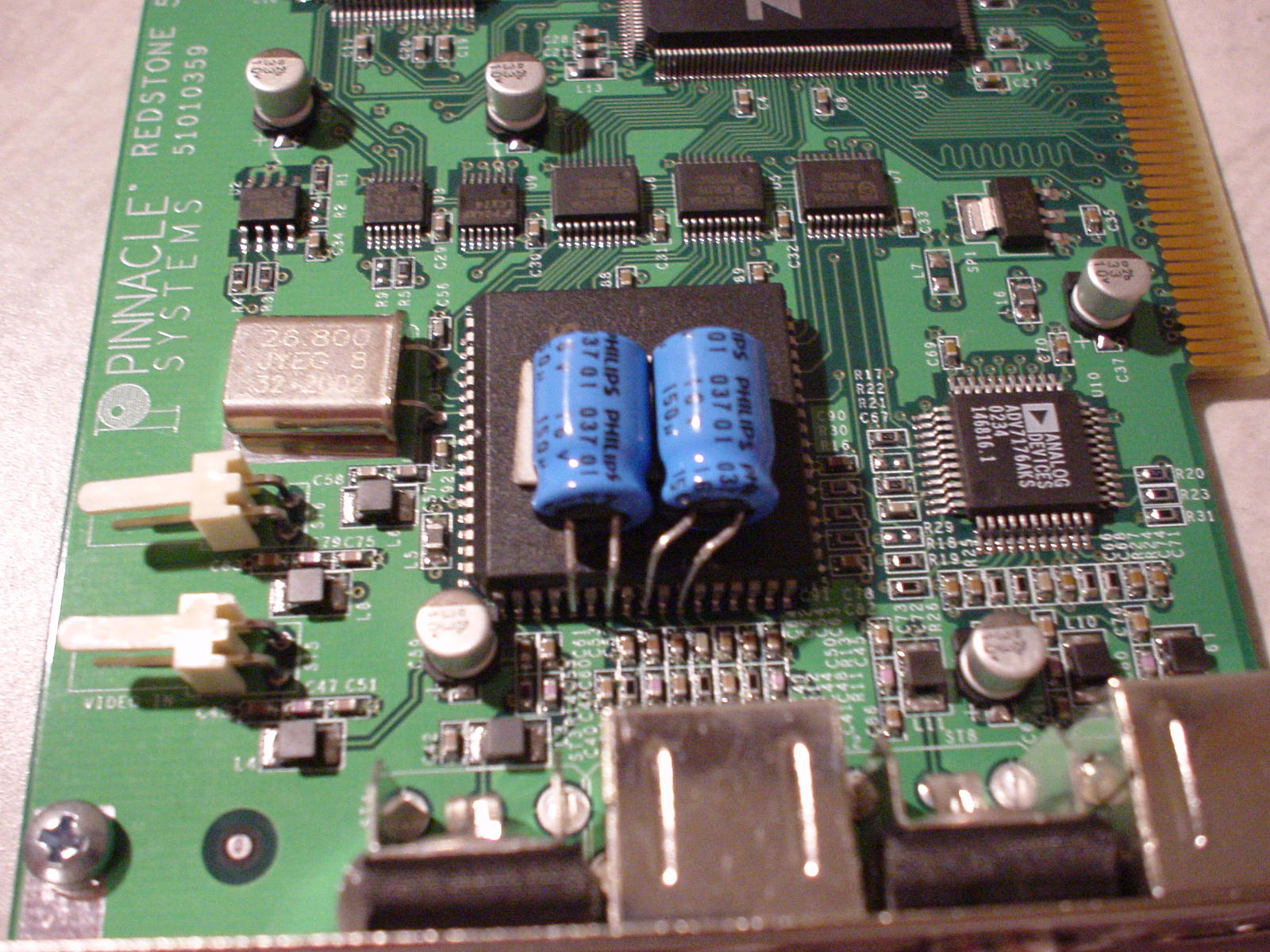
I use a Pinnacle DC10+. It creates HUGE but beautiful mjpeg files at 768x576 (PAL) using lavrec (mjpegtools), gobbling 8.1 Gbytes/hour(!), but with mencoder I can shrink these files down to manageable DiVX size. Nice thing is, the DC10+ -always- gets video and audio in sync, it does not load the CPU or gobble memory bandwidth (it has hardware compression), and it can playback to the TV. It supports NTSC and PAL. It can't do pause while recording unfortunately but I prefer nice quality recordings to such features so I'm happy. At least it's a different approach for Linux PVRs. There's a catch, diagonal lines interference in some machines (see Pinnacle webboard) but there's an easy fix if you can solder.
-
Re:Keys to the (water cooled) castle...
Where do you think the one DOS uses came from?
I have found multiple documents stating that the first DOS version to support harddisks were MSDOS 3.0 from 1984. But the partition support in that version was so bad, that it might as well have been absent. It looks as it was something Microsoft added because they were somehow forced to, not because it was something they intended to use for anything reasonable.
I did a litle more search and found what apears to be the original assembler source code for the partition table and parsing code. Notice the comment that indicates this was written by IBM two years before a DOS version with harddisk support were released. -
Re:long time...Here's some "prior art" for you (EGA / CGA / 8-bit micros)
Domino's Pizza - Avoid the noid
Ford - Ford Simulator
Dunlop - Dunlop 911 TS
KP skips - Action Biker
The last link is to a review. A few choice words:
Action Biker signifies a depressing trend to link grotty software with expensive advertising campaigns. Let's kill this off instantly by refusing to buy such garbage.
Software like this gives junk food a bad name.
-
Misterhouse and alternatives
MisterHouse has been around for a while now and mainly relies on X10 modules. It works fairly well but as one other poster noted it really does need a dedicated box with a bit of muscle or it's a bit slow and frustrating to use. I came across it while looking for X10 software for linux, which it runs on as well as OSX and most versions of Windows. There are many similar products out there for Windows, Mac and even a few simple ones for linux. The most popular/commercial product was a piece of software for the ActiveHome module that came as part of IBM's Home Director kit (I can't remember what the old version was now it comes with HomeVoice). In all my years of using X10 I'd still have to say XTension for the Mac was one of the coolest products out there as it let you create a floorplan pretty easily and it ran well on an old 75Mhz PPC. Lately I've just been using Heyu which is a simple command line interface for linux that supports macros. Anything I want to do I can set a cron job to do automagically or start an ssh session and do from work or wherever. Sure there's no voice control, but personally I always felt a little weird even using speech recognition on the Mac, it could never quite understand "Who's your daddy?" -peel
-
It's a trap!
-
Re:Shocking arrogance
Apache is a (sic) "IIS Killer"
I think you have it backwards. IIRC, httpd was originally written by NCSA at the University of Illinois at Urbana, on some flavor or another of BSD or SYSV Unix (BSD, if I remember right...), and is older than NT3.1, at least for purposes of availability. Apache is the end result of a bunch of server admins patching the NCSA sources after NCSA quit supporting httpd (A Patchy Web Server).
The concept of the GUI (and the mouse, for that matter) date back to Xerox PARC in 1975. Incidentally, that was the same time MSwas founded. IIRC, they were selling a BASIC interpreter for some architecture or another of Intel 8008 or 8080 (anybody know the answer to that one?), probably for PL/1, out of Albuquerque, NM. Apple released the first real GUI desktop machine with the LISA in 1983. Windows 1.0 was released around '85 or '86 (the "look-and-feel" suit of Apple vs. MS was basically tossed out because Apple's UI was too close to the PARC Star UI).
As far as invention and innovation go, look to Universities and pure R&D shops. Don't look to Microsoft, unless you want accounting and marketing innovation. DOS has a rather interesting history, as does IE, at least as far as the licensing deals go.
"Do you want to live in a world where things like the GUI, 3D graphics, wordprocessing, webserving, and other commercial products were never developed?"
Most, if not all, of these technologies, originated either on pure proprietary platforms, long since extinct, or on some flavor or another of unix. Word processing in its most raw form has existed since computing cycles became cheap enough for it to be practical. 3D really took off with SGI IRIX and SGI GL, and moreso with OpenGL. In all fairness, MS did join the OpenGL steering council, but they needed to find a way to get around the limitations of the Windows GDI under NT 3.1 so that they could go after the CAD/engineering market.
I will credit you with your point about the arrogance, and to a lesser degree, the "chasing taillights" syndrome. Many people will not try something presented to them with the "[insert commercial product here] Killer" as the main advertising point.
-
Re:I can do that for a fraction of the cost......
For anyone wanting to go the x10 route instead of this hyped up x10 replacement, check out bottlerocket and BlueLava. Set up a linux server as secure as you want, access it from your handheld, phone, desk, etc. You can probably put it on a port that you broadband provider doesn't block. Or hack it run over email.
-
Re:I dunnoConsidering I got my first computer in 1980 (A 4Mhz Z80-based TRS-80), I think I can say with some credibility that there would not have been a delay computing that, even using interpreted Basic.
Yes well, those of us using more modest and affordable kit rather than the veritable supercomputer you were using can verify the delay and prove it.
I was using a Sinclair ZX80 in 1981 and it was painfully slow. I don't know of any ZX80 emulators out there, but here are some ZX81 emulators for various systems, so you can see for yourself:
-
Sinclaire
-
Crash and Sinclair User
-
Ancient History
It's not that new an idea. British Rail's experimental APT-E train was gas turbine powered, back in 1972. However the line they were intended to be used on was electrified, and so this part of the project was abandoned.
-
1sq m per person?
Hmmm... wonder where could we put that?
-
Re:I have the way out!
3. Use your favourite partintioning software to delete all partitions and replace it with one large FAT32 "C" drive.
When one large partition has an operating system that fails, it can be irritating to save files stored on it.
4. Get a copy of windows XP $179, which is cheaper than the phone bills for "FREE" software.
You can order a CD of whatever "FREE" operating system you want to be sent to you for under $10 if you don't have a fast internet connection. Besides, would you want an operating system that has a huge market share and no reason to compete, or one made by people with making something better as their main motivation. This is a tough on to think about....
7. USE YOUR COMPUTER WITH EASE
This really depends on your definition of what "EASE" really is. If you want to watch everything using Windows Mediaplayer then things are easy. If you want to chose other software that impoves itself over releases instead of just adding backwards incompatable technology to squeeze a couple more bucks out of my poor bank account, then you may want to stay with the "FREE" OS.
8. If you really want the command line, install DOS, the original and best!
If DOS was the original, then who originally wrote it? A quick look at the history shows that unlike what is popularly believed, Bill Gates didn't author DOS himself. Another thought, DOS may be a command line, but it doesn't have that much power. If someone wants to write a script, they use VB. And VB isn't much of an improvement on anything, except that its the chosen virus writing language because of its ease of allowing stupid people to do stupid things.
Oh yeah, and being the first doesn't really mean being the best anyways. -
This was my final year project thesis
This was my final year project thesis. Just remember the golden rule unstructured 2 structured == convert 2 XML I wrote a [very bad] program in C++/Perl/tcsh IPC=pipes to add XML tags to English, and then index them into a search engine which would use the lingual data stored in the XML tags to help the search.
NIST does a MASSIVE competition on this annually. I don't want to be an XML-buzzword whore <Arnold Schwarzenegger accent> (XML commando eats Green berets, C++, Java, Perl, COBOL for breakfast)</Arnold Schwarzenegger accent> but you can't beat XML for easily converting anything that you can make sense out of into computer readable format. Real h3cKoRs use SGML, but us underlings have to stick with things we can understand like XML. As for expandability, if we want to encode something else into the document, then just tag-it-and-go
It took me 200 hours to fish out all these links (before the Google days), I don't want anyone to have to waste as much time as I did feeding the search engines exotic foods. It's a year old so pardon me for the odd broken link, armed with these you could probably turn jello into XML
My favourite bookmarx
PROJect[21 links]
Beginners' Guide[13 links]
Berkeley Linguistics Dept. Course Summaries, general stuffzzzzzzzzzzzzzzCryptic IR Vocabulary defined
Explanations of weird words like hypernym zzzzzzzzzzzzzzHow do we produce and understand speech
How Inverted Files are Created - Univeristy of Berkeley zzzzzzzzzzzzzzNLP Univ. of Indiana, very good basics e.g. word sense d
Simple langauge - useful.... zzzzzzzzzzzzzzWhat is Natural Language Processing, links
What is POS tagging........ zzzzzzzzzzzzzzWord Sense Disambiguation defined
Word Sense Disambiguation in detail, scroll down far zzzzzzzzzzzzzzWord Sense Disambiguator - LOLITA (tested at MUC-7 and SENSEVAL competition as best)
XML for the absolute beginner
HTML, XML stuff + parsers[19 links]
Apache plug-in that uhhh does stuff with XML zzzzzzzzzzzzzzConvert COM to XML
convert XML, HTML to Unix pipeable formats zzzzzzzzzzzzzzconverters to and from HTML
expat XML parser zzzzzzzzzzzzzzHTML Tidy - converts HTML 2 XML + source code!!
Parse DB (RDBMS, whatever) to XML zzzzzzzzzzzzzzPerl-XML Module List
PHP Manual XML parser functions - what the hell are they talking about, PHP Virtual M... zzzzzzzzzzzzzzPublic SGML-XML Software
Pyxie - XML Processor for Python, Perl, etc. zzzzzzzzzzzzzzSGML+XML tools.org
The XML Resource Centre - massive number of links zzzzzzzzzzzzzzW4F wrapper - wrapper converts XML to HTML
XFlat - convert flat file into XML zzzzzzzzzzzzzzXML Parsers and other XML stuff
XML.com - Parsers, etc. zzzzzzzzzzzzzzXML-Data Catalog System - uhhhh looks close
XTAL's general converter - convert anything 2 XML
other Background[8 links]
Is Linux ready for the Enterprise, scalable... zzzzzzzzzzzzzzLinux reliability
Linux Versus Windows NT, Mark(sysinternals bloke) zzzzzzzzzzzzzzPC reliability (pcworld)
SPEC - Standard Performance Evaluation Corp. zzzzzzzzzzzzzzSystems benchmarks
TPC - Transaction Processing Performance Council zzzzzzzzzzzzzzUnix Beats Back NT In EDA Workstation Arena
Proper TREC(-8) QA systems[2 links]
pg. 387 LIMSI-CNRS pretty deep parsing[2 links]
More links....
NLP, IR links - lots to corpii, etc.
pg. 575 U. of Ottawa and NRL (shit system, got 0%)[1 links]
LAKE Lab
pg. 607! University of Sheffield (crap system, but OPEN SOURCE!)[2 links]
GATE - FREE IE app w`source code
LaSIE - ER, coreference, template (cv)
pg. 617 Univ of Surrey (inconclusive matches)[2 links]
System Quirk - Or is this their search system..... Hmmmmmm
Univ of Surrey - pointers (hopefully this is their WILDER search system...)
SMU - Pg. 65[1 links]
Natural Language Processing Laboratory at SMU
Textract[2 links]
Cymfony - Technology
Textract - State of the Art Information Extraction
Xerox uhhhhh maybe[1 links]
Xerox Palo Alto Research Center
(OVERVIEW) 1999 TREC-8 Q&A Track Home Page
NLP bloke, Univ Sussex
Tcl-Tk[4 links] Tcl tutorial
Tcl-Tk Contributed Programs Index
Tcl-Tk Resources, sources
TclXML - manipulating XML using Tcl-Tk
Artificial Natural Language - Is this what I'm trying to parse into...
Comparison of Indexers - Prise vs. Inquery vs. MG, etc.
Eagles - Language Engineering Standards
Language Technology Group - lots of modules!
LDC - Linguistic Data Consortium, lots of corpora
Lexical Resources
Links 2 resources, indexers.....
Lots of IR stuff, University of uhhh
Managing Gigabytes Indexer
Managing Gigabytes Manuals and stuff
Htdig search system
NLP & IR (NLPIR, NIST) Group
OVERVIEW OF MUC-7-MET-2
Perl XML Indexing - XML search engine type thing
Phrasys Language Processing Software Components (money)
QA HCI bullshit
SIGIR - TREC-type thing, resources
SMART indexer system documentation
Text REtrieval Conference (TREC) Home Page
The Natural Language Software Registry
Thunderstone IE and IR products
WordNet - FREE DOWNLOADABLE lexical English database
Page created with URL+, nice utility for working with internet shortcuts -
Re:They'll screw this one up too...
-
Dead? I doubt it.SPARC dead? I'm not sure where you come across that idea. Having listened to a few talks down at JavaOne and chatted briefly with Marc Tremblay (head chip dude down there, father of MAJC and one designer of SPARC) they've already got design down on the next two levels of SPARC as the IV is experimental, and the V is the next production level as I understand it. MAJC seems to be the experimental platform they are using for smaller implementations and alternative ideas to be tried, based on some of Tremblay's theories.
I may be off base on some of the details, but Sun has a unified approach from top to bottom, from tools to silicon for the systems they plan to deliver. I doubt it will just throw in the towel. Ultimately, Sun ships iron, and they lead the market in their segment.
I don't see the basis for your assertion, and where you pulled 1B out of for cost I also don't know.
Alpha is AMD now, as that's where a good chunk of the people went. MIPS is still kicking, with the 14000 so far, but I won't speak to the future of that chip line. There's a lot of chip heads on this site with much better info than I on many of the lines.
One decent, although dated summary is here
Please tell me there's more information you're basing this on than consumer workstation marketshare....