Slashdot Mirror
Domain: fujitsu.com
Stories and comments across the archive that link to fujitsu.com.
Comments · 181
-
If you want a small but full function subnotebook
. . . Ignore this guy and check out Fujitsu's Lifebook P Series.. Very small form factor, but included CD burner/DVD player. Also, I would bet its a lot zippier than this Sharp.
I first owned one of the P Series right after they came out and were equipped with transmetas. The performance was a shade up on terrible, and the battery life merely ok. Since then, they've shifted to Intel chips. My brother bought one recently, and the machine is easily capable of running multiple adobe applications, and he is able to get design work done anywhere with his pressure-sensitive drawing pad attached.
This new machine is smaller, yes, but are the sacrifices in functionality worth shedding the extra pound? -
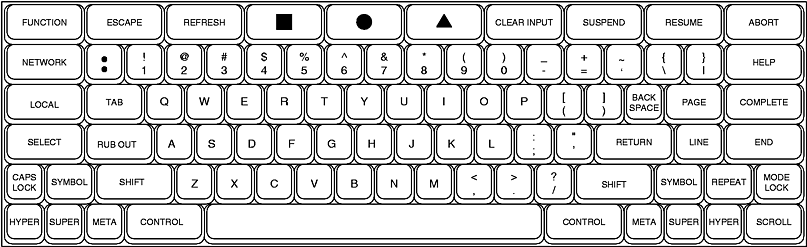
MIT/Symbolics "Space Cadet" keyboardNow here's the ultimate geek keyboard, from the Symbolics 3600 LISP machine. This is what Stallman wanted before he got carpal tunnel. Designed for EMACS, it has six shift keys: SHIFT, CONTROL, SYMBOL, META, SUPER, and HYPER. They can be used in combination, allowing 64 different shift modes, which can be applied to any key on the keyboard. You can then bind any of these combinations to any function in EMACS.
This was called the "Space Cadet" keyboard at MIT. Stanford had keyboards for SAIL with four shift keys: SHIFT, CONTROL, META, and TOP. MIT wanted to one-up Stanford. Hence this gadget.
-
12in Apple small?
While a 12 ibook was considered small 3 years ago, there are a lot better options when considering a portable laptop. The IBM x40, Fujitsu P series, or the Sony Picturebook are just a few examples.
-
Re:Disappointing
So much for Intel's Commitment to LCOS and the Future of HDTV.
But seriously, what does this mean for LCOS? Manufacturers (e.g., Philips and Fujitsu) are still making and selling LCOS TVs or working on the technology. Does it just mean that they won't get as cheap as fast? -
Re:Fujitsu Lifebook P-5020D - 8-11 hours
Yep the 5020 is a great little machine, I often get 8-9 hours on a single main battery. Fujitsu just recently released the updated P7010 version, that ups the ante to 1.1Ghz, and is slightly lighter at 3.4lbs, and is in a more subdued 'corporate black' color. http://www.computers.us.fujitsu.com/www/productbr
i dge_pseries.shtml and can be purchased at http://www.portableone.com/ -
Re:Fujitso
I do believe you mean Fujitsu not Fujitso....
-
Re:What would I do with this much bandwidth?
-
For our clinic, it's notebooks not tablets
At our medical clinic, we have an Electronic Medical Records system, which the clinical staff access mainly through handheld computers. Every time there's a new story about tablets, we look into them, and every time we've reached the same conclusion: not yet.
For our usage, we really like wireless, pen-enabled notebook PCs. While our EMR system allows a tremendous amount of data to be entered easily with a point-and-click interface, nurses and docs still need to do some free-text entry. That pretty much ties us to a device with a keyboard. (I have heard that the handwriting recognition in XP is really good, but we're skeptical about it being good enough. I guess I should actually test it, huh?)
If the tablets come down well below touchscreen notebooks in price, maybe we'll try one and see if we can live without the keyboard.
For those that are interested, we've been using the Fujitsu Lifebook P-series (P1120) which is a great little machine. It's about 2.2 lb, and its Transmeta processor squeezes 4-5 hours out of the standard battery, while running Win2k or XP and a Windows terminal session over the built-in 802.11b. We went 18 months of daily use before we had a single significant hardware failure. (But then two of our first four went out nearly simultaneously... $225 to repair each. Considering they each see about 60 hours of use every week, I think that's not too shabby.)
We first bought them with the extended-life batteries and some spares with chargers, and those spares never left the shelf. The next ones we got with the standard battery and no spares, and we've never had a problem with battery life during our staff's 12-hour shifts. Our staff is pretty good about plugging them in when they can, though.
The big complaint with the P-series is that the screen is really dinky, which is hard on staff with older eyes.
So we tried an iBook. While it's possible to get a touchscreen retrofit for an iBook, we decided to try it without the touchscreen. It works okay, but the lack of touchscreen is a problem for staff. Some staff are willing to trade the touchscreen for the Mac's bigger and sharper monitor, though. On the down side, it's had two main logic boards go out and it's pretty heavy by comparison. There are a few staff who love it, but most prefer the Fujitsus.
About a week ago, we purchased a Fujitsu B-series Lifebook (B3020D) and (so far) it looks spectacular for our usage. It has a 10.4" touchscreen, Atheros A+B+G wireless built-in, it's only 3 pounds, and it claims a battery life of several hours with its Pentium-M processor. (I'm guessing three hours under our conditions, but I haven't really tested it for that.) Staff loves it so far, and I suspect we'll be getting more of 'em. -
Re:Typical /.
Which way should I wank off while watching tentacle-rape Anime? Thumbs in or thumbs out?
Depends on the shape of your tentacle.How can I make the most of ramen?
http://mattfischer.com/ramen/recipe.htmlIs this g0t r00t? T-shirt too dirty, or too small for my belly to wear?
Photos please, we can't make a good sugestion without enough data... On the other hand... Forget it, nobody wants to see that.The other day I was using Emacs on Gentoo under X11R6 to edit
Yea are thinking to much about the strange shapes on your keyboard. Get a better keyboard. -
Re:Static or dynamic?
I got a friend at the lab here that is working with the HOAP-2 . I'm pretty sure that it handles dynamic balancing. Though the price is rather hefty, $80,000, that gets you buggy software, a robot, a Japanese engineer and translator to setup the robot the first time, and a LOT of headaches. Did I mention the buggy software.
-
Re:How would this help?
Foreigners could simply obtain SPARC or MIPS specs and fab a multi-GHz version of those.
Already been done. Fujitsu has been making their own SPARC64 chip and servers for years, and it even outperforms Sun's offerings.
When Congress can lock down a Japanese company, I'll actually take their hot air seriously. -
Re:Why?
Novell is putting a lot of money and engineers behind Openswan. Other vendors are getting on board too.
Will it be as big as KAME's list of corporations? KAME's list:
Fujitsu Limited
Hitachi, Ltd.
Internet Initiative Japan Inc.
NEC Corporation
Toshiba Corporation
Yokogawa Electric Corporation -
Re:Happy hacker? I have one
First of all, it's Happy Hacking, second of all, the Happy Hacking Lite is grossly inferior for the original more expensive Happy Hacking.
They do sell the original model with USB , but only in Japan. It's brand new, and not available in the US. The most notable difference is much higher quality construction and higher quality contact mechanism. The non-Lite Happy Hackings are much heavier than the Lite ones and much cheaper for very good reasons.
Another popular keyboard is the Linux 101 from Unicomp, the IBM/Lexmark mechanicial keyboard business unit that got spun off years ago. They promise to sell a USB version of their EnduraPro which is programmable some time this year.
I was looking to buy one of these keyboards to be all 1337 with L1nu>in software and saved myself $70-$250. -
Was this a Happy Hacking?
If this was a Happy Hacking they do sell a USB model but only in Japan
It's quite expensive, almost $250, but you can order it from Amazon Japan
Although it is Japanese the layout is US as you can see from the pictures. I understand it is quite a nice keyboard if just a little overpriced. They even sell some accesories like a "hand made" wooden wrist rest and a custom carrying case for a for about the price you'd pay for a really nice domestic keyboard -
Was this a Happy Hacking?
If this was a Happy Hacking they do sell a USB model but only in Japan
It's quite expensive, almost $250, but you can order it from Amazon Japan
Although it is Japanese the layout is US as you can see from the pictures. I understand it is quite a nice keyboard if just a little overpriced. They even sell some accesories like a "hand made" wooden wrist rest and a custom carrying case for a for about the price you'd pay for a really nice domestic keyboard -
Re:20 years?
And you seem to not do your research.
http://www.wordiq.com/definition/Fujitsu
The company was established in 1935 under the name Fuji Tsshinki Seiz, a spinoff of the Fuji Electric company, this in turn being a joint venture between the Furukawa mining company and German conglomerate Siemens.
Or how about more obviously....
http://pr.fujitsu.com/en/profile/profile.html
Fujitsu is a leading provider of customer-focused information technology and communications solutions for the global marketplace. Since Fujitsu's establishment in 1935, we have maintained a commitment to cutting-edge technological innovation and uncompromising product quality.
So only 50 years out there old chap.
-
Re:Wonder how this fits into the free hardware
no problem for Fujitsu. they are customer oriented people.
so they will not find it diffcult to adapt to the innovative "giving away hardware" teminology, i guess. they will concentrate more on what happens after customers get free hardware. -
Re:Wonder how this fits into the free hardware
no problem for Fujitsu. they are customer oriented people.
so they will not find it diffcult to adapt to the innovative "giving away hardware" teminology, i guess. they will concentrate more on what happens after customers get free hardware. -
ScanSnap
ScanSnap may be just what you need if the notes are on a uniform-sized paper (e.g. A4 or letter). You need Acrobat (included) on a Windows machine, but you just set the notes on the scanner and click a mouse then it scans 50 sheets (both sides in one-pass) without human intervention and gives you an Acrobat file in a few minutes. It is small and weighs light so you can easily bring it into the secretary's office. The price is also reasonable ($495 with Acrobat 6.0), and it seems they are even offering a $100 rebate now.
The specified resolution is for a colored documents. For a b/w one, you will get a better resolution. You can obtain scan samples from a Japanese page (pdf files at the bottom).
Actually, a newer model, fi-5110EOX, has already been available in Japan, and I think that is why they are offering a rebate now. The new model have usb2.0 connection and a higher resolution mode (excellent) that is not possible with fi-4110. -
Re:The Year of the Linux Desktop
This reminds me of some similar hardware predictions (which I sincerely hope won't be analogous to this case): 1. Researchers have continually predicted that we will reach the fundamental limit of Moore's law in about ten years. (i.e. in 1970, it was ~1980, now, it's ~2014). You can look at a chart of the predicted end of Moore's Law as a function of time, and it's almost a straight line! The thing is that we've continuously found ways around it, seemingly in the nick of time.
I suppose the scary analogy here is that Microsoft will continually innovate just a little bit faster than the open-source community. While I'd like to say that the open-source community can out-innovate MS, let's not forget that MS has a LOT of money to throw at it, and they'll do whatever it takes if they feel threatened. 2. Gallium arsenide is the silicon of tomorrow, and it always will be. The carrier mobilities in GaAs are MUCH higher than silicon (i.e. the electrons move quicker), and we can incorporate several similar (III-V) semiconductors on a single chip to make ridiculously high frequency HEMTs (can you say 400GHz?), but it never caught on for VLSI applications. Primarily, this is because silicon has a nice native oxide (SiO2) layer that allows us to make high quality MOSFETs, which are better for VLSI integration for various reasons. GaAs can make some REALLY fast transistors and lasers, and gets plenty of use in cell phones and optics, but it's just too hard to integrate into VLSI, and all-optical processors are a long way off, so we're still using silicon in our processors.
The analogy here is that Linux may be well suited to the server environment, where it's more configurable and secure, but may never catch on on the desktop because of its the very same complexity that makes it so useful for servers. -
Re:hype
I have no sources here, but I believe the majority of solder used in consumer electronics (including PCs) is of the lead-free variety (mostly silver and nickel, I believe)
This might take the place of lead solder, rather than silver, as it can use similar temperatures as lead solder.
Lead free soldering represents a minority in manufacturing, with companies now only starting to switch over with pressure from Japan and eventually the EU.
-
Re:Power FailureAll it takes is a small battery and a couple of diodes and you can hold SRAM for weeks/years after power out, cos these chips only consume a few uA at standby. Whereas DRAM consumes mA so you need a an unfeasibly large battery for any reasonable length of time.
'Non-Volatile' chips such as EEPROM or Flash have problems with limited writes (10^3 to 10^5) before they loose their ability to be non-volatile. See this guide to Non-Volatile Memory chips. And a nice diagram of all the families
Also write speeds for flash are very slow, (order of 10s-100s of milliseconds rather than order of 10-100 nano seconds for SRAM, however reads are fast, so for a static RAM disc that is loaded once and then searched this may not be a problem. There is also FRAM which is non-volatile but has 200 nano-sec read and writes, but write time is not infinite (about 10^8 to 10^9).
Also note that most electronically re-writable non-volatile techonologies are only guaranteed for 10 years. So it ain't forever.
-
Re:Power FailureAll it takes is a small battery and a couple of diodes and you can hold SRAM for weeks/years after power out, cos these chips only consume a few uA at standby. Whereas DRAM consumes mA so you need a an unfeasibly large battery for any reasonable length of time.
'Non-Volatile' chips such as EEPROM or Flash have problems with limited writes (10^3 to 10^5) before they loose their ability to be non-volatile. See this guide to Non-Volatile Memory chips. And a nice diagram of all the families
Also write speeds for flash are very slow, (order of 10s-100s of milliseconds rather than order of 10-100 nano seconds for SRAM, however reads are fast, so for a static RAM disc that is loaded once and then searched this may not be a problem. There is also FRAM which is non-volatile but has 200 nano-sec read and writes, but write time is not infinite (about 10^8 to 10^9).
Also note that most electronically re-writable non-volatile techonologies are only guaranteed for 10 years. So it ain't forever.
-
Just in case your HD fails..
Having worked on many bad HDs, I keep this list of links to all the manufacturers HD testing programs:
Maxtor/Quantum
http://www.maxtor.com/en/support/downloads/powerma x.htm
IBM/Hitachi
http://www.hgst.com/hdd/support/download.htm
Seagate
http://www.seagate.com/support/seatools/index.html
Western Digital
http://support.wdc.com/download/#dlgtools
Fujitsu
http://www.fcpa.fujitsu.com/download/hard-drives/ -
Re:The state of PCsThat clunking noise may be a due to a head crash or a drive mechanism failure - in either case reformatting may only provide a temporary solution. It would be safer to consider your disk as being on borrowed time and plan to replace it.
Depending on the make of disk, try running the manufacturer's diagnostic utilities - they may give a better idea of any problems.
IBM http://www.storage.ibm.com/hdd/support/download.ht m
Fujitsu http://www.fujitsu.com/au/support/hdd/warranty/
Maxtor http://www.maxtor.com/en/support/downloads/index.h tm
Seagate http://www.seagate.com/support/disc/index.html
Western Digital http://support.wdc.com/download/index.asp
Samsung http://www.samsung.com/Support/ProductSupport/inde x.htm -
Save yourself!
Seriously. I've had one and tried two others. I hated them all. Well, I'll be kind and just say they didn't meet my expectations (performance, quality, stability, etc). I finally bought a nice sub-notebook that is working out nicely. I recommend you forget the tablet thing unless you have a specific use for it (e.g. medical or something). If you do, try for a Fujitsu tablet (at least they are not total garbage, imho)...
-
Re:AMD Athlon Processor Build & Installation Ghmmm, those numbers still don't add up. I personally had a RAID 5 array with 10 10k rpm drives in it and the psu was rated at 145 watts. Granted this was about five years ago but the 8 dvd-rw tower I built last week still only had a 200 watt psu in it and that includes powering the motherboard and pci cards with the exception of my management card which has an independent power source so I can turn the machine on remotely from a web browser.
Here is some figures on a typical scsi drive
It requires 6.7 watts idle and 8.1 watts full power. Types 5 drives and you are not talking about needing anything close to 350 watts.For cross reference sake another manufacturer also uses 8 watts. You can find the info here
-
Troll, troll, troll your boat!
"Where are the modern fanless low power fast processors?"
Why, they're in Transmeta-powered laptops.
An x86 laptop like Toshiba makes gets about 1.5 - 2 hours of battery life. 3 if you only use things like Word, which let Speedstep and the like kick in. A 17" TiBook gets about 3-4 hours, again dependant on load.
Practically every Transmeta-based x86 laptop gets 5 hours, up to 7 if you're using Word. That is nothing to sneeze at. Fujitsu has an optional battery pack for their laptops which nets you 7 to 9 hours of battery life on their Lifestyle series. True x86 laptops are a joke in comparison.
Naturally, trolls ignore these facts when trolling. If you repeat a lie often enough, some moderators will believe it true enough to mod you up... -
Re:MO drives.
They do.
Media's still expensive, but you're paying for reliability. Sure, use CD-R for your MP3 collection, but all that priceless porn? -
2.3GB MO not exactly new
Fujitsu have had this tech out for over two years. But sadly, outside of Japan, hardly anyone has heard about it.
MO, for me, is a story of 'if only'. MO storage has always beat the pants off of removable tape, Zip and Jazz, and CD-RW. It's only recently, with DVD-RAM, that MO had a true competitor.
MO has always been robust and (compared to other removable storage) quick. High end tapes have since eclipsed MO in write performance, but are still more fragile and certainly not random access.
MO has the advantage of standards too. There are a whole series of MO disc capacities, both in the 5.25" andd 3.5" formats, ranging from 230MB and smaller up to 5GB (in the large format.) But pretty much every drive can read discs from way back in the sub 300MB days, and write to discs from the previous 2 or 3 generations.
Watching such inferior technology as Zip and even floppies drive MO out of the market has been a form of geek torture. So why did it happen?
I think as always, it has been a combination of cost and marketing. Judging from the previous comments here, even among the
If we could do it all over again, I think MO should have been marketed like zip, and with the media manufacturers even selling below cost in order to get market penetration (and then reaping profits when they can take advantage of economies of scale.) Note that the first NeXT cube had an MO drive. At 600 MB per disc (300 per side), in 1988. With speeds comparable to a slow hard drive of the time for reading (and about twice as slow at writing.)
Sad, so sad. -
Re:so where is my cheap but slow long-battery lapt
Here ya go. Fujitsu has a line of notebooks that should be up your alley. With the expansion bay occupied by a second battery you can get 9-11 hours battery life (5-6 hours with one battery).
-
Re:Videos!!!
The link has good videos, but there's an extra space in the second products.
http://www.automation.fujitsu.com/en/products/prod ucts092.html -
Who would want this?...when you have alternatives that beat the device on all fronts?
The Fujitsu P1000 is lighter, smaller in all dimensions, has a larger screen, higher resulution, twice the memory, significantly more storage space (hard drive instead of 32mb flash), comparable battery life, also a touch screen, and it's even cheaper to boot too. Oh, and it runs Windows 2000 or XP instead of CE.NET, or potentially your alternative OS of choice if you spend enough effort in it. -
Re:YES TEHRE IS!
Actually, it's `Happy Hacking,' but yeah, they're great -- I've got two of them!
The original HH keyboard and the `HH Keyboard Lite' (basically, the Lite reduced the price so that mortals can enjoy it too) were the best; the `HH Keyboard Lite 2' is still great, but they compromised slightly on their principles, and added (tiny) cursor keys -- unfortunately these cursor keys resulted in a little 10mm lip being added to the bottom edge of the keyboard, which makes it rather uglier than the original HHK Lite (which was, like the HHK, essentially `frameless').
Here's a place where you can buy them, and a link to the manufacturer's japanese page (can't find an english page, sorry). -
Magneto Optical Is The Way To Go
According to this site that was linked to from Fujitsu's site magneto optical drives are nearly indestructable, they have a minimum life of 30 years (good enough for me) they don't lose their magentic properties until they reach 180C so you can spill as much coffee on them that you want. =P
The drives can be had for roughly $257 for internal IDE. I didn't shop around hard, but you can get a 5pack of 1.3GB disks for $95 that's about $0.014/MB, not too shabby. They also make high end solutions with 9.1GB disks but the drives are remarkably expensive. If I were more serious about doing backups, magneto optical would be the way to go. -
Fujitsu
I have been using this mouse for over two years, and there is no stupit tilting or rolling required, you just sliiide your finger a bit.
(Sorry for the PDF link, there was no other decent picture to be found.) -
Re:Is this new?
Exactly, and of course there is their membership and adoption of Gnome, involvement with Apache, etc. Not to mention that they were the most open of the Unix companies, they effectively open sourced SPARC right at the beginning. Fujitsu make and sell their own line of SPARC chips and servers, because of this, and www.sparc.org is still a real entity because Sun continues to support it. NFS, NIS, Java, and a whole host of core unix things we take for granted today all came about because Sun invented them and open sourced the specifications if not the code. Sun goes on about Open Systems, and are one of the few that really mean it, even if they don't go as far as a lot of people, including some insiders, would like.
-
We already have...
Suprisingly enough, we already have rolled out IPv6 at my office. At the moment we mostly use it to ping the other 3 or 4 machines out there:P, but we also use it to send high quality streaming video over seas using Fujitsu Comet cards. So far we're routing over a slimmed down linux router though, so we don't really get all of the benefits.
-
SPARC vs SPARC
At any rate, the SPARC has for a long time been the least impressive of the 64-bit architectures.
I think you mean UltraSparc is unimpressive. By comparison, SPARC64 V is very competitive with the others, though not quite at the front.Sun emphacises instruction bandwidth over multiple threads, rather than single-thread performance. Makes for bad benchmarks, but good overall throughput (same idea as IBM mainframes, which have slow CPUs, but giant I/O bandwidth that dwarfs any bus-based sytem).
-
Why isn't Fujitsu on the list of possible buyers ?Hmm. They already sell their own high end Sparc servers, and they were, in the recent past, a Sun reseller and service partner
Other tidbits:
- a "cheatsheet" for Sun sales droids on how to compete against Fujitsu
- An article at The Register suggests that Fujitsu is growing in market share, where Sun is not.
-
The Press ReleasePress Release
And what I feel is a better article.
-
Three short mpegs
Three short mpegs of this strange thing. http://www.automation.fujitsu.com/products/produc
t s092.html (click on the screenshots) -
Tethered?My understanding was that this robot (actually the HOAP-2, a sucessor to the HOAP-1) was to be tethered for both power and datacomm to a remote computer running linux. If this is the case, don't expect it to be wandering too far.
Note that the HOAP-1 ran about $48,000.00USD; unless the price drops significanty, it'll probably not be your next tech toy.
More info and video (in Japanese) from Fujitsu here.
-
New Programming Languages and Small ComputersThere is still lots of time to think about keyboards. Starting with Fujitsu's single hand keyboard in 1998, an impressive design is the Fitaly One-Finger Keyboard which has generated at least one one-finger speed typing contest.
There was recently a discussion on the perl6 list (laugh but all your bases will belong to parrot real soon now) about what keys could be used to represent some new functions people might like to add if there were some reasonable one to three character symbols that could be made out of them. As long as they're going to change the concatenation operator anything goes right?
All which I would not have known if it were not for the wonderful summaries of the discussions on perl.com.
I'm thinking it might be useful if you could buy extra usb keyboardlets - like numeric keypads - with keys that would make your programming more powerful (otherwise you have to spell things out in english phrases). No danger of APL-ness since the system will be able to translate between the idioms effortlessly. Doubtlessly emacs scripts and something wierd for vi would be possible.
But something tells me the future of computing is going to have more to do with being able to get a heck of a lot done with a lot less typing, either because of a plethora of great snap together libraries, semi-intelligent self-programming programs, or just plain telling the thing what you mean in english (or interlingua) and having a system that will just do it. It is not critical that we add more cryptic things to our programming prose, but I'd certainly welcome more powerful idioms and innovative input solutions that don't penalize their adopters. (I certainly will check out the Kinesis keyboard, earlier poster.. thanks.)
FYI:
this article: unicode operators, supercommas, french quotation marks.. shades of APL
-
Sun is going down
_ALL_ Sun servers are very stable, but slow. SPARC speed is poor, take a look at SPEC CPU2000 Results. The memory bandwidthis _very_ low. In Linpack-top500 you won't see SUN in the 100 first places.
The Fujitsu SPARC64 V is better chip and 100% compatible with SUN solaris/SPARC. And better servers with 128 CPUs !!!!
LiNUX is a better alternative below 8 CPUs: Migrating Oracle9i - Based Sun Servers to Dell Servers Running Linux and Migrating Oracle9i - Based Sun Servers to Dell Servers Running Linux, Part 2. LiNUX+x86/ia64 , and soon AMD x86-64, is cheaper and faster than Solaris/SPARC
DEC/Compaq/HP have the best chip (Alpha EV7) and the best UNIX servers (ES47,ES80,GS1280) in RISC arch. It's a pity that Alpha is going to die to put intel ia64 instead.
And if you need NUMA machine, SGI Altix is for you.
Why do you need to buy a SUN server? -
Sun is going down
_ALL_ Sun servers are very stable, but slow. SPARC speed is poor, take a look at SPEC CPU2000 Results. The memory bandwidthis _very_ low. In Linpack-top500 you won't see SUN in the 100 first places.
The Fujitsu SPARC64 V is better chip and 100% compatible with SUN solaris/SPARC. And better servers with 128 CPUs !!!!
LiNUX is a better alternative below 8 CPUs: Migrating Oracle9i - Based Sun Servers to Dell Servers Running Linux and Migrating Oracle9i - Based Sun Servers to Dell Servers Running Linux, Part 2. LiNUX+x86/ia64 , and soon AMD x86-64, is cheaper and faster than Solaris/SPARC
DEC/Compaq/HP have the best chip (Alpha EV7) and the best UNIX servers (ES47,ES80,GS1280) in RISC arch. It's a pity that Alpha is going to die to put intel ia64 instead.
And if you need NUMA machine, SGI Altix is for you.
Why do you need to buy a SUN server? -
Re:why is he sad?I don't see why anyone should mourn the passing of proprietary hardware,[...]
The SPARC processor is covered by IEEE Standard 1754-1994 and licensed by the non-profit organization SPARC International Inc.. You can, for example, buy SPARC-compliant hardware from Fujitsu and run Solaris on it.
-
Likely buyout partner...Lots of horsesh*t in the article, but it doesn't change the main point.
If you are wondering who might buy them out, here's my guess: Fujitsu.
As for what they have in common, see: . 'Tis ironic though, that the former Amdahl mainframe company could end up engulfing Sun. Heh.
-
Re:Sunset a long, long ways off.
If a customer wants the Fujitsu Sparc V, they can just buy a Fujitsu PrimePower NOW. We've got a server room full of junk Suns containing USII 400 Mhzs (with the nice crashing flaw that Sun support blames on Cosmic Rays), so we've happily starting buying PrimePowers instead. Fast as hell (1.35 Ghz SPARC V!), full ECC memory correction, and less expensive than the Suns to boot. Did I mention they run Solaris natively and thus also run every application we use on our Suns?
Fujitsu Primepower Site
These guys have taken the SPARC performance crown from Sun, their support is better, and their machines are more stable. I can't wait to shitcan our crashy UE10000, hopefully in favor of a Fujitsu PP 2500. -
Cons Pros
Pros:
Super-cool look and feel; perfect laptop for your favorite stuffed animal
Useable keyboard
Bright clear screen (amazing, actually)
Fits easily in shirt or jacket pocket
Cons:
Expensive ($700 from Dynamism for English version)
Limited software availability
Shortish battery life
No manual yet, PC setup a mystic adventure
Until it comes down in price, the cons are (in my opinion) a big deal.
My advice is: pick a laptop or pick a PDA. Make sure that either of them does their respective job well. Don't expect your PDA to be a laptop, and don't expect your laptop to be small enough to put in your pocket (yet!).
On a side note, Fujitsu makes a killer laptop! I've seen it in action...perhaps one of the best laptops for its size...