Slashdot Mirror
Domain: gizmodo.com
Stories and comments across the archive that link to gizmodo.com.
Stories · 717
-
Amazon To Stop Accepting Flash Ads
An anonymous reader writes: Starting on September 1, Amazon will no longer support Flash across its advertising platform. The online retailer sites changes to browser support and a desire for customers to have a better experience as their reasons for blocking it. Google has been quite active recently in efforts to kill Flash; the Chrome beta channel has begun automatically pausing Flash, Google has converted ads from Flash to HTML5, and YouTube uses HTML5 by default now as well. Safari and Firefox also place limits on Flash content. Is Flash finally on its way out? -
'Pluto Truthers' Are Pretty Sure That the NASA New Horizons Mission Was Faked
MarkWhittington writes: Forget about Apollo moon landing hoax theories. That is so 20th Century. Gizmodo reported that the "Pluto Truthers" have followed the astonishing images being sent back by NASA's New Horizons probe and have come to the conclusion that they are faked. After all, if the space agency could fake the entire moon landing, it would be child's play to fake a robotic probe to the edge of the Solar System. -
There Aren't a Trillion Different Smells After All
New submitter Neuronaut137 writes: Last year a paper in Science magazine reported that humans can distinguish a trillion different odors, a result that had already made its way into neuroscience and psychology textbooks. Two new papers just published in eLife overturn that result, pointing to fatal flaws in experimental design and data analysis. Oh, well; thinking I had a superpower was fun while it lasted. -
A Real-Time Map of All the Objects In Earth's Orbit
rastos1 writes: It started as a passion project in April for 18-year-old James Yoder, an alum of FIRST Robotics, the high school robotics competition. He wanted to learn more about 3D graphics programming and WebGL, a JavaScript API. It's stuffin.space, a real-time, 3D-visualized map of all objects looping around Earth, from satellites to orbital trash. In total, stuffin.space tracks 150,000 objects. Type in a satellite name to scope out its altitude, figure out its age, group satellites by type, and so on. -
How Television Is Fighting Off the Internet
HughPickens.com writes: Michael Wolff writes in the NY Times that online-media revolutionaries once figured they could eat TV's lunch by stealing TV's business model with free content supported by advertising. But online media is now drowning in free, and internet traffic has glutted the ad market, forcing down rates. Digital publishers, from The Guardian to BuzzFeed, can stay ahead only by chasing more traffic — not loyal readers, but millions of passing eyeballs, so fleeting that advertisers naturally pay less and less for them. Meanwhile, the television industry has been steadily weaning itself off advertising — like an addict in recovery, starting a new life built on fees from cable providers and all those monthly credit-card debits from consumers. Today, half of broadcast and cable's income is non-advertising based. And since adult household members pay the cable bills, TV content has to be grown-up content: "The Sopranos," "Mad Men," "Breaking Bad," "The Wire," "The Good Wife."
So how did this tired, postwar technology seize back the crown? Television, not digital media, is mastering the model of the future: Make 'em pay. And the corollary: Make a product that they'll pay for. BuzzFeed has only its traffic to sell — and can only sell it once. Television shows can be sold again and again, with streaming now a third leg to broadcast and cable, offering a vast new market for licensing and syndication. Television is colonizing the Internet and people still spend more time watching television than they do on the Internet and more time on the Internet watching television. "The fundamental recipe for media success, in other words, is the same as it used to be," concludes Wolff, "a premium product that people pay attention to and pay money for. Credit cards, not eyeballs." -
Billboard Advertising Banned Products In Russia Hides If It Recognizes Cops
m.alessandrini writes: In response to a ban of food imported from the European Union, an Italian grocery in Russia hired an ad agency to create a billboard with a camera and facial recognition software, that's able to change to a different ad when it recognizes the uniform of Russian cops. Gizmodo reports: "With the aid of a camera and facial recognition software, the technology was slightly tweaked to instead recognize the official symbols and logos on the uniforms worn by Russian police. And as they approached the billboard featuring the advertisement for Don Giulio Salumeria’s imported Italian goods, it would automatically change to an ad for a Matryoshka doll shop instead." -
Does Using an AOL Email Address Suggest You're a Tech Dinosaur?
Nerval's Lobster writes: Despite years of layoffs and tumbling net worth, AOL seemed to get a new lease on life this week when Verizon bought it for $4.4 billion. But even if AOL's still alive, using an AOL email address has long been seen as a way of signaling that you're stuck in the 1990s. A recent analysis of Dice data found that a mere 1.8 percent of those registering for the site used an AOL address, versus 55 percent for Gmail. For the past several years, Websites from Gizmodo to Lifehacker have all declared that still using an AOL email address is counterproductive, to put it mildly. But is that actually true? Do the people in your life and work actually care whether you use AOL, Hotmail, Gmail, or a custom address, or is the idea of 'email bias' an overblown myth? -
NSA Reform Bill Backed By Both Parties Set To Pass House of Representatives
HughPickens.com writes: The NY Times reports that after more than a decade of wrenching national debate over the intrusiveness of government intelligence agencies, a bipartisan wave of support has gathered to sharply limit the federal government's sweeps of phone and Internet records. A bill that would overhaul the Patriot Act and curtail the metadata surveillance exposed by Edward Snowden overwhelmingly passed the House Judiciary Committee by a vote of a 25-2, and is heading to almost certain passage in the House of Representatives. An identical bill in the Senate — introduced with the support of five Republicans — is gaining support over the objection of Senate Majority Leader Mitch McConnell, who is facing the prospect of his first policy defeat since ascending this year to majority leader. "The bill ends bulk collection, it ends secret law," says Rep. Jim Sensenbrenner, the original author of the Patriot Act who has now helped author the Freedom Act. "It increases the transparency of our intelligence community and it does all this without compromising national security."
The Patriot Act is up for its first reauthorization since the revelations about bulk data collection. The impending June 1 deadline for reauthorization, coupled with an increase of support among members of both parties, pressure from technology companies and a push from the White House, have combined to make changes to the provisions more likely. The Snowden disclosures, along with data breaches at Sony Pictures, Target and the insurance giant Anthem, have unsettled voters and empowered those in Congress arguing for greater civil liberties protection — who a few years ago "could have met in a couple of phone booths," says Senator Ron Wyden. The Freedom Act very nearly passed both chambers of Congress last year, but it failed to garner the 60 votes to break a filibuster in the Senate. It fell short by two votes.
However some say the bill doesn't go far enough. The bill leaves intact surveillance programs conducted by the Drug Enforcement Agency and levies high penalties against those offering "material support" to terrorists. It also renews the expiring parts of the Patriot Act through 2019. "This bill would make only incremental improvements, and at least one provision – the material-support provision – would represent a significant step backwards," says American Civil Liberties Union Deputy Legal Director Jameel Jaffer. "The disclosures of the last two years make clear that we need wholesale reform." -
DOJ Could Nix Comcast-Time Warner Merger
jriding (1076733) writes The Comcast-Time Warner Cable merger has been in the works for so long, it's starting to feel like the impending monopolistic telecom Frankenbaby was inevitable. But the Justice Department may kibosh the deal for violating antitrust laws, according to a report from Bloomberg. -
Smart Homes Often Dumb, Never Simple
An anonymous reader writes: Writer Adam Estes has tested over a thousand dollars worth of smart home gear from companies like Wink, GE, Lutron, Cree, and Leviton. Most of it worked correctly out of the box — which he said was great. But almost immediately, devices stopped responding and defects manifested themselves. Even after getting replacements and reconfiguring the devices, he found himself wondering if it was worth the effort to wrestle with all these devices, and ended up appreciating the simplicity of a plain old light switch.
Estes says, "Installation woes and bugs aside, my smart home never seemed handy. I had to tape off the regular switches so that the power would stay on and the bulbs' smart features would work. Even then, I had to pull out a smartphone or a tablet any time I wanted to dim the lights. That was never convenient. I could turn the lights on from my office, but that didn't really make my life better. I could impress my friends with a stray smart home feature here and there, but more often than not, I found myself embarrassed by the glitches of my smart home gone dumb." He concludes that while many smart home products can and do work, the biggest lie their marketers tell us is that it'll be simple and easy to set up and operate all these gadgets. Those of you who have wired up parts of your home, how has it worked out so far? -
Why Gmail Has Better Security Than Your Bank
Gizmodo gives some insight to a strange situation that many of us have -- at least in the U.S. -- when it comes to online security: Gmail, while free, offers two-factor authentication, while many banks don't use security tools that would make online financial transactions safer, contenting themselves with single-factor, weak password systems, or lackluster secondary screens. It's certainly true at one bank I use, which even now allows short, all-alphabetical, all lower-case passwords. U.S. banks could certainly use multi-factor authentication, and some do, but it's nothing like universal. -
Silk Road Case: Prosecution Reads Alleged Transcript of DPR Arranging 5 Murders
New submitter BenBoy points out an article at Wired about the most recent developments in the trial of Ross Ulbricht, alleged to be the man behind the Silk Road digital black market, going by the alias Dread Pirate Roberts. The prosecution has now rested its case, but one of their last presentations was a series of communications between DPR and a supposed member of the Hell's Angels motorcycle club in which he arranged for hitmen to kill five different people. Wired notes, Ulbricht, who the prosecutors have sought to prove is that Dread Pirate Roberts, hasn't been charged with murder-for-hire in his Southern District of New York case, though he faces charges that include conspiracies to sell narcotics, launder money and more. (He does, however, face murder-for-hire charges in a separate case in Baltimore.) In fact, the prosecution admitted in court that the purported victims of the Silk Road killings were never found, and that Canadian police couldn't even locate records for anyone with their names. ... Even so, the prosecution took pains to read the entire conversation to the jury because it’s intended to show them the darkest side of the Silk Road’s short history. If genuine, the transcript shows that members of the Hell's Angels organization are familiar with using encryption to shield their communications from law enforcement. Forbes has a detailed update on how the rest of the case has progressed, and Ars has a brief article on today's closing arguments. -
Silicon Valley Security Experts Give 'Blackhat' a Thumbs-Up; Do You?
HughPickens.com writes Cade Metz writes that last week Parisa Tabriz, head of Google's Chrome security team, helped arrange an early screening of Michael Mann's Blackhat in San Francisco for 200-odd security specialists from Google, Facebook, Apple, Tesla, Twitter, Square, Cisco, and other parts of Silicon Valley's close-knit security community, and their response to the film was shockingly positive. "Judging from the screening Q&A—and the pointed ways this audience reacted during the screening—you could certainly argue Blackhat is the best hacking movie ever made," writes Metz. "Many info-sec specialists will tell you how much they like Sneakers—the 1992 film with Robert Redford, Sidney Poitier, Dan Ackroyd, Ben Kingsley, and River Phoenix—but few films have so closely hewed to info-sec reality as Mann's new movie, fashioned in his characteristic pseudo-documentary style." "Unlike others, this is a film about a real person, not a stereotype—a real guy with real problems thrust into a real situation," says Mark Abene. "The technology—and the disasters—in the film were real, or at least plausible.
Director Michael Mann worked closely with Kevin Poulsen in researching, writing, and shooting the film. Like Hemsworth's character, Poulsen spent time in prison for his hacking exploits, and Mann says his input was invaluable. "It's the first crime-thriller to hinge so heavily on hacking without becoming silly." says Poulson. "We put a lot of work into finding plausible ways that malware and hosting arrangements and all these other things could be used to advance the plot and all of that I think turned out pretty nice." I'm a fan of Michael Mann, and the previews I've seen of Blackhat make it look at least like a passable thriller. For anyone who's seen the film already, what did you think? -
Your High School Wants You To Install Snapchat
Bennett Haselton writes: They would never admit it, but your high school admins would probably breathe a sigh of relief if all of their sexting-mad students would go ahead and install Snapchat so that evidence of (sometimes) illegal sexting would disappear into the ether. They can't recommend that you do this, because it would sound like an implicit endorsement, just like they can't recommend designated drivers for teen drinking parties -- but it's a good bet they would be grateful. Read on for the rest.Five teenagers at Warren Township High School in Gurnee, Illinois were arrested in November in conjunction with a girl's topless photo being distributed throughout the school. Last Thursday, in Rochester Hills, Michigan, a prosecutor announced that contemplating filing child pornography charges against "dozens" of students for distributing explicit pictures to other students at Rochester Adams High School. In Portland, Oregon, police are investigating a group of Grant High School students for making videos of each other having sex at the school and off campus. (And, of course, these are just the incidents that police found out about.) Naturally, schools everywhere have been falling over themselves to institute strict anti-cyber-bullying and anti-sexting policies (not to mention that sending and forwarding sexually explicit pictures of children under 18 is a federal crime as well).
Schools have rules for reasons that are a mixture of cynical protection against lawsuits and sincere concern for the students. When education system teach students not to smoke cigarettes, they're presumably doing that out of genuine concern for students' welfare, since it would be hard to sue the school for not teaching about the dangers of smoking. When a school installs a railing by the side of a walkway to keep students safe from passing cars, they're probably motivated by a mixture of concern over being sued, and legitimate concern for students' safety. When the school installs software on their computers to block Facebook and Reddit (even outside of class time, when computers are sitting idle and students have nothing else to do), they're probably motivated entirely by liability concerns - because they know virtually all of those students can get on those websites at home, so they're not affecting the students' long-term welfare by keeping them off of those websites, but they just don't want to be liable for anything if the students access those sites at school.
In the case of anti-sexting policies, I'm not cynical enough to think that schools are motivated entirely by liability concerns. There are actual risks to sexting pictures of yourself, even if you're never charged with violating child pornography laws: the embarrassment of your picture being forwarded around the school, or ending up in the archive of a porn site. On the other hand, worse things happen to dozens of high school students every month, but only a handful of schools get dragged into the national spotlight as a result of a child porn investigation. So let's call it about 25% due to legitimate concern for students and 75% due to liability reasons and concern for adverse publicity.
But sexting students could vastly reduce schools' concerns about both issues, by sending pictures using an app like Snapchat, which automatically deletes photos after the recipient has viewed them -- in order to greatly reduce the chance of a picture being saved or forwarded after it's sent. Please note, I'm not saying the photos can't be saved anyway, or recovered by computer forensics. And take heed: I'm not saying you should do it either way! But if you greatly reduce the chances of an image being saved, you greatly reduce the chances of it leading to a scandal that engulfs the school, or leads to a federal child pornography charge.
Of course there are cases where teens were arrested for sending child pornography through Snapchat as well. But these high-profile stories don't address the relevant question, which is: Are you less likely to get arrested (or expelled, or humiliated) for sending these pictures if you do it through Snapchat, even if the likelihood doesn't drop to zero? Obviously, yes.
Now even someone with no phone-hacking knowledge can figure out that if they receive an image over Snapchat, they can "save" it by taking a photo of their screen with another phone or camera, and the sender won't know. (You can also take a normal screen shot with the phone, but that will notify the sender that you took a screen shot, unless you download a third-party app or try some other hack which may or may not even work by the time you read this.) However, this assumes that the trust relationship between the sender and the recipient is already broken at the time the message is being sent, if the recipient is saving the message without the knowledge or consent of the sender. Some of these sexts are presumably being sent in the context of a relationship in which some (sweet, naive, misguided) trust still exists, so that if the sender sends the message and the recipient doesn't use some sneaky workaround, the picture will get deleted on schedule. If trust only falls apart later, then the recipient won't have a copy of the image any more if it was sent by Snapchat, but they will if it was sent via text.
Actually, it may be possible for the recipient to recover a snapchat image after their smartphone Snapchat app has supposedly "deleted" it -- a company called Digital Forensics offers Snapchat image recovery as a service, but they charge $300-$500 per incident, and even they haven't figured out how to do it on an iPhone yet.
So, in terms of boolean logic, if you send an explicit photo via Snapchat, it might end up being saved permanently and forwarded if:
(
the recipient is already being dishonest with you (saving pics without your permission) at the time that you send the picture
AND
the recipient is smart enough to figure out how to save Snapchat pictures without notifying you -- not that hard, but eliminates some people
)
OR
(
you later go through a nasty breakup with the recipient and they're determined to humiliate you or get you in trouble with the law
AND
they don't mind the fact that they could also get in trouble with the law, for saving or forwarding the picture
AND
they're willing to spend $300 to recover the image
AND
they don't have an iPhone
)Whereas if you send a photo via regular text, all it takes to get in trouble is either (a) the recipient going through a nasty breakup with you, that puts them in a vindictive frame of mind, while they still have a copy on their phone, or (b) the recipient's family member snooping through their messages.
Your high school would never tell you so out loud, but between Snapchat and texting, you can guess which they would prefer you to use.
Of course, this advice wouldn't have done much good for the Portland students who made and distributed their own sex videos, since creating the illegal permanent recording was their entire goal. Snapchat can help protect people from mild levels of stupid, but it's a barrier you can overcome if you aim high and truly believe in yourself.
Got something to say about privacy, technology, or other topics of interest? Long-form submissions are welcome.
-
Sony Thinks You'll Pay $1200 For a Digital Walkman
An anonymous reader writes: The Walkman is one of the most recognizable pieces of technology from the 1980s. Unfortunately for Sony, it didn't survive the switch to digital, and they discontinued it in 2010. Last year, they quietly reintroduced the Walkman brand as a "high-resolution audio player," supporting lossless codecs and better audio-related hardware. At $300, it seemed a bit pricey. But now, at the Consumer Electronics Show, Sony has loudly introduced its high-end digital Walkman, and somehow decided to price it at an astronomical $1,200.
What will all that money get you? 128GB of onboard storage and a microSD slot to go with it. There's a large touchscreen, and the device runs Android — but it uses version 4.2 Jelly Bean, which came out in 2012. It also supports Bluetooth and NFC. Sony claims the device has 33 hours of battery life when playing FLAC files, and 60 hours when playing MP3s. They appear to be targeting audiophiles — their press release includes phrasing about how pedestrian MP3 encoding will "compromise the purity of the original signal." -
Lizard Squad Targets Tor
mrspoonsi tips news that Lizard Squad, the hacker group who knocked Xbox Live and the PlayStation Network offline on Christmas morning, has now turned its attention to Tor. After tweeting that they were targeting a Tor-related zero-day flaw, the group is now in control of 3,000 exit nodes — almost half of them. "If one group is controlling the majority of the nodes, it could be able to eavesdrop on a substantial number of vulnerable users. Which means Lizard Squad could gain the power to track Tor users if it infiltrates enough of the network." -
The History of the NORAD/Microsoft and Google Santa Trackers
theodp writes: Marketing Land's Danny Sullivan has a pretty epic post on How Google Became A Santa Tracker Tradition To Rival NORAD, and wonders if future generations will think of Santa tracking as synonymous with Google, just as past ones have felt about NORAD. Until it split with Google in 2012 (for unknown reasons) and hooked up with Microsoft, Sullivan explains, NORAD had really been the only place to go for a serious, dependable Santa tracking service. "There's a big part of me that wishes Google had gotten out of Santa tracking when it split from NORAD," says Sullivan of the divorce. "The NORAD Santa tracker brings back memories from my childhood; it brings back memories of me being a father with young kids checking in on Santa's progress. In contrast, Google feels to me like an upstart interloper messing with my nostalgic memories. But maybe Google's a welcome alternative to others. It's not uncommon to see the occasional complaint about a NORAD "Santa Cam" video showing Santa being accompanied by fighter jets. Some might prefer a Santa tracker that's not connected to a military organization. Of course, some might not feel one connected to a giant company is necessarily preferable. Part of me is also sad that when I go to NORAD's own site, I get a big Internet Explorer icon in the top right corner, which effectively opens up an ad for Microsoft. I guess I feel it's too blatant. Of course, complaining about the commercialization of something Christmas-related, I suppose, is kind of useless." Sullivan adds, "Overall, I'm thankful to the many people who are involved with both operations [NORAD Tracks Santa and Google Santa Tracker], who work hard to make children smile on Christmas Eve."" -
North Korean Internet Is Down
First time accepted submitter opentunings writes "Engadget and many others are reporting that North Korea's external Internet access is down. No information yet regrading whether anyone's taking responsibility. From the NYT: "Doug Madory, the director of Internet analysis at Dyn Research, an Internet performance management company, said that North Korean Internet access first became unstable late Friday. The situation worsened over the weekend, and by Monday, North Korea’s Internet was completely offline. 'Their networks are under duress,' Mr. Madory said. 'This is consistent with a DDoS attack on their routers,' he said, referring to a distributed denial of service attack, in which attackers flood a network with traffic until it collapses under the load." -
The Sony Pictures Hack Was Even Worse Than Everyone Thought
An anonymous reader writes with today's installment of Sony hack news. "It's time to take a moment of silence for Sony Pictures, because more startling revelations about leaked information just came out and employees are starting to panic. BuzzFeed raked through some 40 gigabytes of data and found everything from medical records to unreleased scripts. This is probably the worst corporate hack in history. Meanwhile, Fusion's Kevin Roose is reporting on what exactly happened at Sony Pictures when the hack went down. The hack was evidently so extensive that even the company gym had to shut down. And once the hackers started releasing the data, people started 'freaking out,' one employee said. That saddest part about all of this is that the very worst is probably still to come. Hackers say they stole 100 terabytes of data in total. If only 40 gigabytes contained all of this damning information, just imagine what 100 terabytes contains." -
First Star War Episode 7 Trailer Released
Midnight Thunder writes: The first trailer for Star Wars Episode VII: The Force Awakens has been released. (YouTube link.) This is the first real opportunity to get a feeling for whether childhood dreams will be crushed or Disney, with the help of JJ Abrams, will be able to breath new life into the story without making it feel like a merchandising excuse. -
Extreme Shrimp May Hold Clues To Alien Life On Europa
HughPickens.com writes: Scientists at NASA's Jet Propulsion Laboratory are studying a mysterious ecosystem at one of the world's deepest undersea hydrothermal vents to get clues about what life could be like on other planetary bodies, such as Jupiter's icy moon Europa, which has a subsurface ocean. At the vents, tiny shrimp are piled on top of each other, layer upon layer, crawling on rock chimneys that spew hot water. "You go along the ocean bottom and there's nothing, effectively," says Max Coleman. "And then suddenly we get these hydrothermal vents and a massive ecosystem. It's just literally teeming with life." Bacteria, inside the shrimps' mouths and in specially evolved gill covers, produce organic matter that feed the crustaceans. The particular bacteria in the vents are able to survive in extreme environments because of chemosynthesis, a process that works in the absence of sunlight and involves organisms getting energy from chemical reactions. In this case, the bacteria use hydrogen sulfide, a chemical abundant at the vents, to make organic matter. The temperatures at the vents can climb up to a scorching 842 degrees Fahrenheit (450 degrees Celsius), but waters just an inch away are cool enough to support the shrimp. The shrimp are blind, but have thermal receptors in the backs of their heads.
According to the exobiologists, these mysterious shrimps and its symbiotic bacterium may hold clues "about what life could be like on other planetary bodies." It's life that may be similar—at the basic level—to what could be lurking in the oceans of Europa, deep under the icy crust of the Jupiter moon. According to Emma Versteegh "whether an animal like this could exist on Europa heavily depends on the actual amount of energy that's released there, through hydrothermal vents." Nobody is seriously planning a landing mission on Europa yet. But the European Space Agency aims to launch its JUpiter ICy moons Explorer mission (JUICE) to make the first thickness measurements of Europa's icy crust starting in 2030 and NASA also has begun planning a Europa Clipper mission that would study the icy moon while doing flybys in a Jupiter orbit. -
"Barbie: I Can Be a Computer Engineer" Pulled From Amazon
New submitter clcto writes Back in 2010, Computer Engineer Barbie was released. Now, with the attention brought to the Frozen themed programming game from Disney and Code.org, unwanted attention has been given to the surprisingly real book "Barbie: I Can Be a Computer Engineer". So much so, that Mattel has pulled the book from Amazon. The book shows Barbie attempting to write a computer game. However, instead of writing the code, she enlists two boys to write the code as she just does the design. She then proceeds to infect her computer and her sister's computer with a virus and must enlist the boys to fix that for her as well. In the end she takes all the credit, and proclaims "I guess I can be a computer engineer!" A blog post commenting on the book (as well as giving pictures of the book and its text) has been moved to Gizmodo due to high demand. -
New Website Offers Provably Fair Solutions To Everyday Problems
An anonymous reader writes Carnegie Mellon researchers have just launched Spliddit, a website that offers methods for helping people split rent, divide goods, and share credit. The novelty is that these methods are all "provably fair": there are mathematical proofs showing that each algorithm on the site provides rigorous fairness guarantees. For example, the method for splitting rent is guaranteed to be envy free: the assignment of rooms and division of rent is such that a housemate would never want to swap places with another housemate. All it takes is a pair of siblings to prove that there's no such thing as "provably fair," non-mathematically. -
The Era of Saturday Morning Cartoons Is Dead
An anonymous reader writes Gizmodo published an article on Saturday pointing out that, with The CW having aired its last episodes of Vortexx cartoons last weekend, this is the first weekend in the United States with no Saturday morning cartoons playing on national broadcast stations. NBC stopped airing Saturday morning cartoons in 1992, CBS stopped shortly after, and ABC followed suit in 2004. Gizmodo failed to take into account the Public Broadcast Station (PBS), but during an age of instant online media access...and cable...the oversight is understandable because everyone has already moved on. TV is dead. Long live the Internet. -
FBI Completes New Face Recognition System
Advocatus Diaboli writes: According to a report from Gizmodo, "After six years and over one billion dollars in development, the FBI has just announced that its new biometric facial recognition software system is finally complete. Meaning that, starting soon, photos of tens of millions of U.S. citizen's faces will be captured by the national system on a daily basis. The Next Generation Identification (NGI) program will logs all of those faces, and will reference them against its growing database in the event of a crime. It's not just faces, though. Thanks to the shared database dubbed the Interstate Photo System (IPS), everything from tattoos to scars to a person's irises could be enough to secure an ID. What's more, the FBI is estimating that NGI will include as many as 52 million individual faces by next year, collecting identified faces from mug shots and some job applications." Techdirt points out that an assessment of how this system affects privacy was supposed to have preceded the actual rollout. Unfortunately, that assessment is nowhere to be found.
Two recent news items are related. First, at a music festival in Boston last year, face recognition software was tested on festival-goers. Boston police denied involvement, but were seen using the software, and much of the data was carelessly made available online. Second, both Ford and GM are working on bringing face recognition software to cars. It's intended for safety and security — it can act as authentication and to make sure the driver is paying attention to the road. -
Egypt's Oldest Pyramid Is Being Destroyed By Its Own Restoration Team
Taffykay writes The oldest pyramid in Egypt, the Pyramid of Djoserat Saqqara, is being destroyed by the very company the Egyptian government has hired to restore it. The roughly 4,600-year-old structure has been in trouble since an earthquake hit the region in 1992, but in a difficult political and economic climate for the country, those now tasked with preserving the pyramid are said to be doing more harm than good. -
Xiaomi's Next OS Looks Strikingly Similar To iOS
stephendavion writes Looks like Chinese device maker, Xiaomi, is taking its "Apple of the East" tag too literally. First, their CEO brazenly copies Steve Jobs' signature look, sitting cross-legged on the floor. And now, Xiaomi's latest version of Android shamelessly rips off iOS 7. MIUI 6, which is Xiaomi's upcoming edition of Android for its latest phones and tablets, looks almost exactly like Apple's operating system for iPhones, iPads and the iPod Touch. It features the same bright color palette and a flat design. Heck, it even does away with Google's "app drawer" and puts all apps on your home screen. It's like the CEO handed iPhones to the design team and barked: "Here, copy this!" -
Cable Companies: We're Afraid Netflix Will Demand Payment From ISPs
Dega704 (1454673) writes While the network neutrality debate has focused primarily on whether ISPs should be able to charge companies like Netflix for faster access to consumers, cable companies are now arguing that it's really Netflix who holds the market power to charge them. This argument popped up in comments submitted to the FCC by Time Warner Cable and industry groups that represent cable companies. (National Journal writer Brendan Sasso pointed this out.) The National Cable & Telecommunications Association (NCTA), which represents many companies including Comcast, Time Warner Cable, Cablevision, Cox, and Charter wrote to the FCC:
"Even if broadband providers had an incentive to degrade their customers' online experience in some circumstances, they have no practical ability to act on such an incentive. Today's Internet ecosystem is dominated by a number of "hyper-giants" with growing power over key aspects of the Internet experience—including Google in search, Netflix and Google (YouTube) in online video, Amazon and eBay in e-commerce, and Facebook in social media. If a broadband provider were to approach one of these hyper-giants and threaten to block or degrade access to its site if it refused to pay a significant fee, such a strategy almost certainly would be self-defeating, in light of the immediately hostile reaction of consumers to such conduct. Indeed, it is more likely that these large edge providers would seek to extract payment from ISPs for delivery of video over last-mile networks." Related: an article at Gizmodo explains that it takes surprisingly little hardware to replicate (at least most of) Netflix's current online catalog in a local data center. -
Amazon Fire Phone Reviews: Solid But Overly Ambitious
An anonymous reader writes: Amazon's Fire Phone launches later this week, and the reviews have started to come in. The hardware: "There's nothing terribly special about the Fire Phone's hardware, but there's very little to turn you off either." "The nice-looking IPS display in the Fire Phone gets bright enough for outdoor viewing, and it has nice viewing angles—a necessity for a phone that's meant to be tilted around and looked at from every which way." "An indistinct slab of glass and plastic, the Fire Phone looks more like a minimalist prototype than a finished product."
Software: "Firefly can recognize lots of things, but it's incredibly, hilariously inconsistent." "Firefly is the one Fire Phone feature you'll want on any phone you're currently using. Let's hope that it gets enough developer support that it isn't just a link to Amazon's storefronts." "First, and to be absolutely clear, Dynamic Perspective will impress you the first time you see it, and Amazon is pretty good at showing it off. ... But if there's some cool, useful functionality to be had from super-aggressive, super-accurate face tracking, the Fire Phone doesn't have it." Conclusion: "Smartphones are for work, for life. They're not toys, they're tools. Amazon doesn't understand that, and the Fire Phone doesn't reflect it." -
Slashdot Asks: Do You Want a Smart Watch?
Watches that do more than tell the time have been around for a long time. (And in fiction, James Bond, Dick Tracey, and Michael Knight all had notably high-tech watches.) The new smart watches from Samsung and LG, without a phone connected via Bluetooth as backhaul, can still serve to show the time and to serve as alarms (and Samsung's can measure your pulse, too), but all the magic features (like searching by voice via the watch) do require a connection. They can't play MP3s or take pictures on their own, and they don't have built-in GPS. Even so, compared to the polarizing Google Glass, the new breed of smart watches are wearables that probably are an easier sell, even if this far the trend has been to replace watches with smart phones. (Android Wear has gotten a lot of attention, but Microsoft has their own upcoming, and Apple almost certainly does, too.) Are you interested in a smart watch, and if so, what uses do you want it for? If they have no appeal to you now, are there functions that would make you change your mind on that front? -
Privacy Worries For 'Smart' Smoke Alarms
Advocatus Diaboli sends this excerpt from an article about the data collection capabilities of the Nest Protect 'smart' smoke alarms, and how they could become a privacy concern: Consider that each Protect is packed full of sensors, some of which are capable of much more than they're doing right now: From heat and light sensors to motion sensors and ultrasonic wave sensors. This simple little device could scrape an incredible amount of data about your life if Nest asked it to: From when you get home, to when you go to bed, to your daily routine, to when you cook dinner. Now imagine how a device like that would interlock with another that you keep on your wrist, like the forthcoming Android Wear. Together, they would create a seamless mesh of connectivity where every detail of what you do and where you go is recorded into a living, breathing algorithm based on your life.
Neither Nest nor Google has stated any intention to turn Nest's hardware into more than it is right now. Protect is an alarm, the Thermostat is a thermostat. But as Google ramps up its vision to connect every aspect of our world, from Android Wear to its acquisition of a company that specializes in high-res, near-instantaneous satellite imagery of Earth, it's easier than ever to see why it would cough up billions for a company that has installed hundreds of thousands of Wi-Fi connected devices in the homes of Google users." -
If Ridesharing Is Banned, What About Ride-Trading?
Bennett Haselton writes "The city of Seattle just imposed new limits on commercial app-based ride-sharing companies like Uber and Lyft, effectively protecting taxi companies from low-cost competition in the form of smartphone apps. If other cities follow suit, could a company help ridesharers circumvent the restrictions by creating a ride-trading app, allowing drivers to earn 'miles' by driving passengers, and redeem those miles later to get rides for themselves?" Continue reading below to see what Bennett has to say.The cab companies got Seattle to crack down on ridesharing companies by arguing that by letting drivers charge money for rides, they were essentially operating illegal unlicensed taxi services. So it's not hard to imagine other cities taking similar action on the same ambiguous legal grounds, as Los Angeles did in sending cease-and-desist notices to Uber, Lyft and Sidecar, ordering them to stop operating entirely.
I tried some of these services and actually never saw what the big deal was. Much of the time, they were almost as expensive as taxis, much too pricey to use on a regular basis, and I would never use them unless my own poor planning left me somewhere without my own car and desperate somewhere faster than public transit could take me. Perhaps cab companies were afraid of where the services were eventually headed -- especially towards a model where drivers could set their own prices. As far as I know, currently all ridesharing services set a minimum price per mile and don't let drivers set their rate any lower. But many drivers would probably be willing to drive at a price lower than what the app allows, and a set-your-own-price model probably really would put the cab companies out of business.
Perhaps some cities will take a more benign view of ridesharing in the long run, but as long as money is changing hands, (1) the city will certainly view it as within their rights to regulate the ridesharing industry, and (2) taxi companies will be able to argue, not unreasonably, that the companies are effectively running unlicensed taxi services. Of course the real solution would be for cities to stop limiting the supply of taxi medallions and artificially enriching cab companies at everyone else's expense (if the city's concern is with rider "safety", they could increase the number of taxi medallions while still requiring all drivers to take safety training). But that doesn't seem likely to happen any time soon. So instead, what if a company created an app that attempted to circumvent the legal restrictions, by allowing users to trade rides -- not for cash, but for returning the favor?
Here's how it could work: When you sign up as a new user, you have a "miles" balance of zero. (The very first users of the system would have to start out with a nonzero balance, so that there are some units in the system to trade, but everyone who joins after that starts at zero.) You have to earn miles by giving someone else a ride before you can redeem your miles by getting a ride yourself. So you log in as a driver, and some other user "hails" you through their smartphone app, much as riders hail drivers through Uber or Lyft. You pick up a passenger and give them a ride to their destination, and at the end of the journey, they transfer a number of "miles" to you indicating how far you drove them. You now have a positive miles balance, and you can "spend" it by hailing a ride yourself later on. Drivers and riders could leave ratings for each other just as they do on Uber and Lyft. What Couchsurfing is to Airbnb, this service would be to Uber.
Since no money is changing hands, the arrangements would presumably not be covered by existing taxi statutes. You could even make an argument that a city couldn't pass a law regulating these ride-trades even if they wanted to, because as voluntary arrangements between consenting parties, they're protected under our First Amendment right of freedom of association! Of course, libertarians believe all commercial transactions between consenting parties ought to be exempt from regulation as well, but most state and local governments take a dim view of that premise. However, take money out of the equation, and you're on much stronger ground that your ride-trading arrangements aren't covered by existing laws.
(It is of course silly and inconsistent that the law often forbids selling something for money, but allows trading it for something of "value", or permits it if the nature of the trade is not made explicitly clear. If a girl sleeps with you and you occasionally "lend" her money, she's a high-maintenance girlfriend, but if she ever does you the courtesy of spelling out the arrangement explicitly, she's a prostitute and can go to jail. But as long as the government makes those silly and arbitrary distinctions, we might as well use them when they count in our favor.)
Would ride-trading with strangers be safe? Well, when a rider pages a driver, the system could tell the rider the license plate of the car associated with that driver's profile, so unless the driver was in a stolen car, the system would always have a record of the license plate (and, hence, the owner) of any car that picked up a passenger. More generally, if I were a user in a system like this and someone told me it sounded unsafe, I would just say the same thing I always say about Couchsurfing (where I've hosted over 50 people with no bad experiences). Namely: "Look, have you or any of your friends ever gone home with someone you met at a bar? And that's fine, I'm not judging you, I'm just saying that was a hell of a lot more risky than meeting up with someone in a system where you can read other people's references." Besides, in many cities there's already thriving subculture of slugging -- picking up total strangers so you can use the carpool lane and they get a free ride.
I feel like I would be happy to have this ride-trading service available if I ever wanted a quick ride across town and didn't have my car. The only "cost" to me would be the cost of giving someone an equal-length ride at some other point in time when I wasn't in a hurry. (Or even giving someone a lift to a place that I was already going.) It's an efficient transaction because it lets me spend miles when my time is valuable, and then rack up the miles later on when I have some time to kill that's not as valuable. You can realize even more efficiencies by letting people pay "premium rates" for periods when demand is high (Friday and Saturday nights) or supply is low (early mornings when people need rides to the airport), so that the balance of miles that you pay for a ride may be greater than the actual number of miles traveled.
On the other hand, there's an inefficiency in that the system cannot serve the needs of people who want a ride, but whose time is too valuable to spend it driving in order to "earn" the miles to redeem for the ride. This is a limitation in any system that bans money as a means of trade and only lets you trade a service for a repayment-in-kind of the same service.
To environmentalists who would object that this promotes greater car usage: First of all, it might result in more impromptu car pooling over routes that were being inadequately served by buses, in which case the passengers were going to have to take cars anyway, so they might as well be piled into fewer of them. But in any case, I would actually take the bus more if a service like this existed. I live in Bellevue, about a 20-minute bus ride outside of Seattle, and I'd gladly take the bus in to Seattle if I was going to a specific destination close to the bus line, and knew I was coming right back afterwards. The problem is that once I'm in Seattle, if I want to get to some other arbitrary destination in Seattle, taking public transit is slow and annoying (and, you may have heard, often involves some waiting around in the rain). I drive my car in to Seattle not because I want to drive to the city, but in order to have a car while I'm there. If I could summon a ride in under two minutes to take me anywhere else in the city (with the only price being to return the favor to someone else later), I wouldn't need my car and could take the bus downtown.
So, even assuming a service like this would be useful, why would a company create it? We know how Airbnb and Uber make money, by skimming a cut off of each transaction. But how would a company make money just by connecting riders and drivers for complimentary rides through a free app? Well, Couchsurfing connects users for free stays in each other's houses, and they got venture capitalists to invest $22 million. The thinking seems to be that if even a free a service has enough users, it must be worth something.
The major obstacle to deploying the system, is that the system would require a critical mass of users in any given city, before it could become effective. If there aren't enough drivers active in the city, then hailing a ride would take so long that after factoring in the delay, you might as well have taken the bus. You'd need enough drivers active to be reasonably sure that in any given neighborhood, you can catch a ride quickly -- and for the drivers have to be out in force, they have to know that there's a critical mass of riders who are ready to offer some miles in their balance for rides. Services that require a critical mass of users in order to be successful, are notoriously hard to get off the ground. If the project had the feeling of a social movement behind it -- in the spirit of resource sharing, as well as environmental friendliness insofar as people like me would be more likely to start using the bus -- perhaps the founders could sign up a base of users over time, prior to actually launching the service. And then once the number of enrolled users was large enough, could launch the live service with a critical mass of users already in place. (Of course, if they tried that out here, this being Seattle, most of those enrolled users who said they would show up, would probably flake out.)
-
L.A. Police: All Cars In L.A. Are Under Investigation
An anonymous reader writes with a link to an article by the EFF's Jennifer Lynch, carried by Gizmodo, which reports that the L.A. Police Department and L.A. Sheriff's Department "took a novel approach in the briefs they filed in EFF and the ACLU of Southern California's California Public Records Act lawsuit seeking a week's worth of Automatic License Plate Reader (ALPR) data. They have argued that 'All [license plate] data is investigatory.' The fact that it may never be associated with a specific crime doesn't matter. This argument is completely counter to our criminal justice system, in which we assume law enforcement will not conduct an investigation unless there are some indicia of criminal activity. In fact, the Fourth Amendment was added to the U.S. Constitution exactly to prevent law enforcement from conducting mass, suspicionless investigations under "general warrants" that targeted no specific person or place and never expired.
ALPR systems operate in just this way. The cameras are not triggered by any suspicion of criminal wrongdoing; instead, they automatically and indiscriminately photograph all license plates (and cars) that come into view. ... Taken to an extreme, the agencies' arguments would allow law enforcement to conduct around-the-clock surveillance on every aspect of our lives and store those records indefinitely on the off-chance they may aid in solving a crime at some previously undetermined date in the future. If the court accepts their arguments, the agencies would then be able to hide all this data from the public." -
Fly an Aerobatic Quadcopter with Curtis Youngblood (Video)
It goes up, it goes down, it goes upside down and keeps on flying. We're talking about Curtis Youngblood's latest quadcopter prototype, but as his website says, "Curtis has been flying and competing with RC Helicopters since the early 1980s and is a Multi-time World Champion and Multi-time 3D Champion." This lucky dog has managed to turn his hobby into a business; he makes and sells radio controlled helicopters -- not the $60 ones from Harbor Freight, but sophisticated aerial beasts that can carry still and video cameras and could easily be used as short-range drones, except that these are hobbyists' toys -- for hobbyists who can afford to spend hundreds and even thousands of dollars, anyway. There are plenty of quadcopter kits on the market for lots less than Youngblood's creations, along with build-it-yourself guides. But these won't fly upside down. For that, you need variable-pitch rotors and sophisticated control systems. "But what about 3-D printing?" you ask. Of *course* you can use a 3-D printer to make a quadcopter. That was an inevitable development. Here are open source instructions for building one. Enjoy the ride! -
Invention Makes Citibikes Electric
An anonymous reader writes "Inventor Jeff Guida has come up with a way to turn any Citibike into an electric scooter. His ShareRoller is about the size of a small briefcase, weighs just seven pounds, and has a 12- to 20-mile range. From the article: '"Years ago, I would've needed a giant engineering company and several million dollars in development research and it still would've taken two years or more," Guida said. But 3D printing has changed all that. In the coming months, Guida hopes to design a universal bracket so that the ShareRoller can be used on any bike. He has some competition there, as there are a few companies that make wheels that convert regular bikes into electric bikes, but he says the ShareRoller is more convenient.'" -
How Russia Transformed a Subtropical Beach Resort To Host the Winter Olympics
Hugh Pickens DOT Com writes "Duncan Geere reports at The Verge that Russian resort as Sochi, on the eastern shore of the Black Sea, is humid and subtropical with temperatures averaging about 52 degrees Fahrenheit (12 C) in the winter, and 75 degrees (24 C) in the summer. "There is almost no snow here — at the moment it's raining," says Olga Mironova, a local resident. It's estimated that the cost of staging the Olympics in Sochi has been greater than the previous three Winter Games combined — ballooning to a whopping $51 billion including the cost of implementing an extensive system of safeguards to ensure there'll be sufficient snow in Sochi for the games including the cost of implementing one of the largest snowmaking systems in Europe. The system includes two huge water reservoirs that feed 400 snow cannons installed along the slopes that can generate snow in temperatures of up to 60 degrees fahrenheit (16 C). If that snow isn't enough, then the authorities will fall back on 710,000 cubic meters of snow collected during the winters of previous years leading up to the games. To keep it from melting in the region's hot summers, 10 separate stockpiles have been kept packed tight under insulating covers high up in the mountains, safe from the sun's rays. Down in Sochi itself the other half of the games will be held in five indoor arenas that will host figure skating, speed skating, hockey, and curling, and an additional outdoor area will host the opening and closing ceremonies. In each of these indoor arenas, underfloor cooling systems are installed so that the ice stays frozen above it using propylene glycol, which doesn't freeze until temperatures reach 8.6 F (-13 C). Climatologists predict that even under a best-case scenario, almost half the venues that have hosted the Winter Olympics over the last century would be unable to do so by 2080 without resorting to extensive and expensive artificial snowmaking techniques."" -
Non-Coders As the Face of the Learn-to-Code Movements
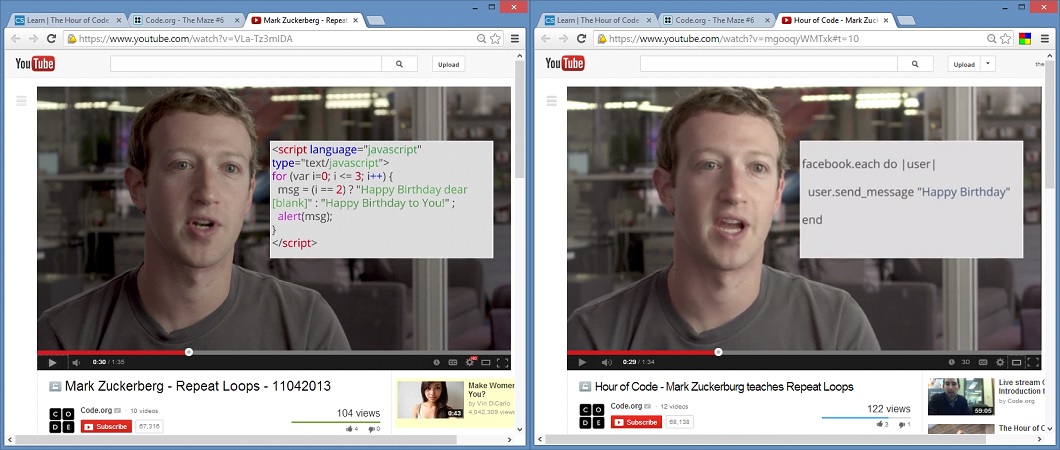
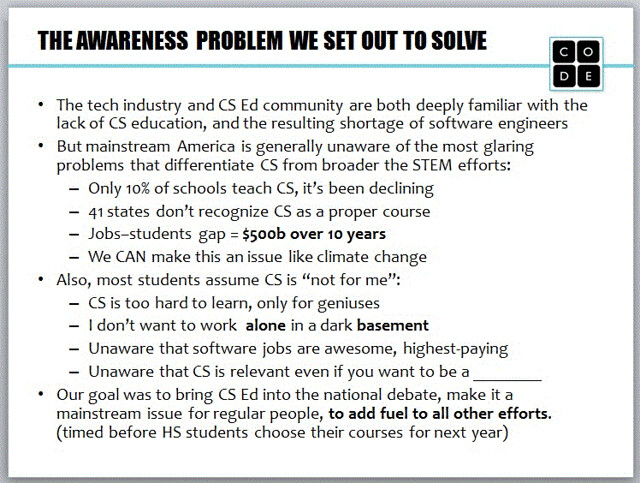
theodp writes "You wouldn't select Linus Torvalds to be the public face for the 'Year of Basketball.' So, why tap someone who doesn't code to be the face of 'The Year of Code'? Slate's Lily Hay Newman reports on the UK's Year of Code initiative to promote interest in programming and train teachers, which launched last week with a Director who freely admits that she doesn't know how to code. "I'm going to put my cards on the table," Lottie Dexter told Newsnight host Jeremy Paxman on national TV. I've committed this year to learning to code...so over this year I'm going to see exactly what I can achieve. So who knows, I might be the next Zuckerberg." "You can always dream," quipped the curmudgeonly Paxman, who was also unimpressed with Dexter's argument that the national initiative could teach people to make virtual birthday cards, an example straight out of Mark Zuckerberg's Hour of Code playbook (coming soon to the UK). Back in the States, YouTube chief and Hour of Code headliner Susan Wojcicki — one of many non-coder Code.org spokespersons — can be seen on YouTube fumbling for words to answer a little girl's straightforward question, "What is one way you apply Computer Science to your job at Google?". While it's understandable that companies and tech leaders probably couldn't make CS education "an issue like climate change" (for better or worse) without embracing politicians and celebrities, it'd be nice if they'd at least showcase a few more real-life coders in their campaigns." -
Sound System Simulates the Roar of a Rocket Launch
retroworks writes "Located in Noordwijk, Netherlands, and part of ESA's ESTEDC Test Center, is the Large European Acoustic Facility (LEAF), a sound amplification system 'powerful enough to kill a human being.' LEAF is capable of generating more than 154 decibels, the sound equivalent to standing next to several jets taking off. It is used to blast satellites and spacecraft with sound. Large horns are housed in a sound-proofed room that is 16.4meters tall. One wall of horns stands 11 m wide by 9 m deep and 16.4 m high. LEAF requires all the doors to be closed, operating in steel-reinforced concrete walls to contain the noise. The walls are coated with an epoxy resin to reflect noise, producing a uniform sound field within the chamber." -
Federal Court Kills Net Neutrality, Says FCC Lacks Authority.
An anonymous reader writes "According to a report from Gizmodo, a U.S. Appeals Court has invalidated the FCC's Net Neutrality rules. From the decision: 'Given that the Commission has chosen to classify broadband providers in a manner that exempts them from treatment as common carriers, the Communications Act expressly prohibits the Commission from nonetheless regulating them as such. Because the Commission has failed to establish that the anti-discrimination and anti-blocking rules do not impose per se common carrier obligations, we vacate those portions of the Open Internet Order.' Could this be the final nail in the coffin for Net Neutrality? Or will the FCC fight back? This submitter really, really hopes they fight back..." -
New Oculus Rift Prototype Features Head Tracking, Reduced Motion Blur, HD AMOLED
crabel writes "The Oculus rift prototype Crystal Cove shown at CES uses a camera to track over two dozen infrared dots placed all over the headset. With the new tracking system, you can lean and crouch because the system knows where your head is in 3D space, which can also help reduce motion sickness by accurately reflecting motions that previously weren't detected. On top of that, the new 'low persistence' display practically removes motion blur." The new low-persistence AMOLEDs also achieve 1920x1080 across the field of vision. Reports are that immersion was greatly enhanced with head tracking. -
Steam Controller Hands-on
Ars Technica has posted their impressions from a hands-on session with Valve's new Steam Controller. The controller notably departs from standard practice of relying on two thumbsticks for precise movement, instead replacing them with concave touchpads. From the article: "When used as a kind of virtual trackball, as most games did with the right pad, it was a revelation. When used as a virtual d-pad, as it was on the left pad, it was an exercise in frustration. Let's focus on the right pad first. There's definitely a learning curve to using this side of the pad properly; years of muscle memory had me trying to use it like an analog stick (minus the stick) at first. It only really began to click when I started swiping my thumb over the pad, as I've seen in previous videos (there was no one on hand to really explain the controller to me, so I was left figuring it out on my own, just like a new Steam Machine owner). When I say it "started to click," I mean that literally. The subtle clicking in your hands as you swipe along the pad is an incredible tactile experience, as if there was an actual weighted ball inside the controller that's rolling in the direction you swipe. And like a trackball slowly losing its inertia, the clicking slows its pace after you lift your thumb off the pad, giving important contextual information for the momentum imparted by your swipe." More write-ups are available about the controller from Gamespot, Gizmodo, and Joystiq. -
One Year Since John McAfee Fled Belize
Velcroman1 writes "It has been a year since fallen software magnate John McAfee fled his adopted home and country — wanted by police for questioning in connection to the murder of his neighbor. In that year, the often eccentric programming pioneer led the media and the public on a wild ride with his outlandish behavior and off-the-wall statements during a catch-me-if you-can escape from the small Central American country. McAfee is a person of interest in the investigation surrounding the murder of his neighbor, American ex-pat Gregory Faull, near his compound in San Pedro Town on the island of Ambergris Caye. No headway has been made in the investigation — and authorities in Belize are still looking to speak with McAfee. 'Nothing has really changed. It's not a closed case,' police spokesman Raphael Martinez said. 'He is still a person of interest.'" -
Massive New CT Scanner Assesses Car Crash Data
cartechboy writes "If you've ever been in a serious car accident, you've probably had a CT scan to give doctors a clearer idea of your injuries. Soon, your car might get a CT scan, too. Scientists at the Fraunhofer Institute have developed a giant new CT scanner (dubbed, yes, XXL CT) that can scan very large objects, like cars. It Turns out a CT scan of a post-crash vehicle offers an unprecedented precision look at the internal damage details, without disturbing the wreckage further. A crashed car is hoisted onto a turntable, and as it turns, two X-ray detectors on either side scan it. Then multiple images are merged into a single, three-dimensional CT scan. The scanner also can handle airplane wings and shipping containers, which means there may be possible anti-terrorism uses in the future." -
New Real Life Laser-Rifle Cuts Through Metal Like a Blowtorch
dryriver writes "We've seen real laser guns before pulling off tricks like starting small fires, or popping black balloons. That's cool, sure, but it's got nothing—on this handheld laser rifle. Developed by TWI this laser-cutter was initially designed for use by robots, but a few recent tweaks including a pistol-grip and a trigger made it into a human-sized rifle. It is designed specifically with nuclear decommission in mind, specifically chopping up huge pieces of metal infrastructure into bite-sized bits that are easily disposed of. And while it's definitely suited for that, it has some short-comings compared typical rifles. That range is pretty low, for instance, and it's not exactly mobile." -
Apple Isn't the Next Microsoft (and That's a Good Thing)
Nerval's Lobster writes "In a new Gizmodo column, Andreas Goeldi calls it the 'frosted glass' effect: when a prominent tech company's latest upgrade to its flagship operating system features frosted-glass highlights as its primary innovation, you know that company is facing a period of severe stagnation. That's what happened to Microsoft around the time of Windows Vista, Goeldi wrote, and Apple's going down the same road with iOS 7. In light of what he views as Apple's sclerosis, it wasn't difficult for him to abandon his iPhone in favor of a Google Android ecosystem. But is Apple really becoming the next Microsoft? In short: no. Apple seems to recognize everything that seemed to elude Microsoft's corporate thinking six years ago: namely, that even the most successful companies need to keep breaking into new categories, and keep innovating, if they want to stay ahead of hungry rivals. Rumors have persisted for quite some time that Apple is prepping big pushes into wearable electronics and televisions, both of which could prove lucrative strategies if executed correctly. Goeldi faults iOS 7 for its frosted-glass effects, which he compares to those of Vista; but similar graphical elements aside, it's unlikely that iOS 7 will run into the same complaints over hardware requirements, compatibility, security, and so much more that greeted Vista upon its release. In fact, iOS 7 isn't even finished." -
FAA OKs US UAVs
Two unmanned aerial vehicles have received approval from the Federal Aviation Administration to perform commercial operations in United States airspace. The Scan Eagle 200 from Insitu will be launched from a ship and used to monitor icebergs and migrating whales in parts of the Arctic where companies are looking for oil. The PUMA from Aerovironment will be used by emergency response teams for monitoring oil spills. (Both are referred to as unmanned aircraft systems, or UAS, by the Administration.) "Issuing the type certificates is an important step toward the FAA's goal of integrating UAS into the nation's airspace. These flights will also meet requirements in the FAA Modernization and Reform Act of 2012 that define Arctic operational areas and include a mandate to increase Arctic UAS commercial operations." -
Xbox One: No Always-Online Requirement, But Needs To Phone Home
An anonymous reader writes "The Xbox One was revealed earlier, and Kotaku was able to get some answers about the always-online rumors that plagued the console before its announcement. Microsoft VP Phil Harrison said Xbox One doesn't need a constant connection in order to play games, and you won't be dropped from single-player games if your connection cuts out. However, it does require check-ins with Microsoft servers. This echoes the Xbox One FAQ, which cryptically says, "No, it does not have to be always connected, but Xbox One does require a connection to the Internet." The number Harrison gave was once every 24 hours, but Microsoft's PR department was quick to say that was just one potential scenario, not a certainty. Microsoft also provided half-answers about how used games and game sharing would work. Players will be able to take a game to a friend's house and play it (using their profile, at least). Players will also have some mechanism to trade and sell used games, but it's not yet clear exactly how it would work. If one player uses a disc to install a game on their Xbox One, then gives the disc to a friend, the friend will be able to install it, but needs to pay full price to play it. That scenario, however, assumes both players want to own the game — the second one would essentially be a unique copy. Microsoft said they have a plan for trading used games, which would involve deactivating the game on the original owner's console, but they aren't willing to elaborate yet." Several publications have hands-on reports with the new hardware: Engadget, Ars Technica, Gizmodo. -
Ask Slashdot: Can Yahoo Actually Stage a Comeback?
Nerval's Lobster writes "Fresh off purchasing Tumblr for $1.1 billion, Yahoo has moved to the next stage of what's becoming a company-wide reboot: fixing Flickr, the photo-sharing service that it acquired in 2005 and subsequently allowed to languish. Yahoo boosted Flickr accounts' individual storage capacity to one free terabyte, revamped the Website's overall look, and launched a new Flickr app for Google Android, among other tweaks. Yahoo CEO Marissa Mayer clearly wants her company to fight toe-to-toe on features with Google and Facebook, but she faces a long road ahead of her: not only does she need to streamline Yahoo's cumbersome corporate structure and product portfolio into something that resembles fighting shape, but she needs to reverse the general perception that Yahoo is teetering on the edge of history's trash-bin, with an aging customer base and unexciting features. The question is, could anyone actually pull it off? Is Yahoo capable of an Apple-style turnaround, or are its current actions merely delaying the inevitable?" -
John McAfee's Belize Home Burns To Ground
Velcroman1 writes "The former island home of anti-virus software pioneer John McAfee burned down Thursday afternoon under circumstance he told FoxNews.com were 'suspicious.' It's an odd choice of words from a man whom the Belize police found suspicious, following the November 2012 murder of American expatriate Gregory Faull, a well-liked builder from Florida who was shot at his home in San Pedro Town on the island of Ambergris Caye. 'I believe that there are a select few with great power in Belize that will go to great lengths to harm me,' McAfee said. 'This fire was not just a strange coincidence.'" Watch for more from McAfee soon. -
Google Forbids Advertising On Glass
An anonymous reader writes "Contrary to widespread thought, Google Glass will not be an advertising platform: 'Google Inc has lately told app developers that they are not allowed to present ads to Google Glass users and they are also not permitted to sell users' personal and private information for the fulfillment of advertising needs. The internet company has explicitly and openly said that the Glass platform should and must be clean and clear of any ads whatsoever, because the technology is designed to facilitate internet browsing and other related activities, therefore, the featured podium cannot be used to advertise products as it will cause the user experience to diminish.' Seems like Google is going for hardware-only revenue on this one." You're not supposed to resell the Glass hardware, either.