Slashdot Mirror
Domain: hybridcars.com
Stories and comments across the archive that link to hybridcars.com.
Comments · 94
-
Re:a bit too quick to declare it a rival.
other companies have already engineered their cars, built battery plants
A list of car companies with their battery plants would be nice if you're making such claims.
Like this Or this Or this Or this
And keep in mind those articles are a couple of years old. The other car companies just don't blab and have publicists that inflate their CEO's and company's reputation like Musk does.
Tesla fanboys live in a bubble and know nothing of the auto-industry or its trends. They believe all the hype and Musk's bullshit.
-
Where are you going to get the fuel?
https://www.hybridcars.com/fue...
Hydrogen is just fossil fuel in disguise.
-
Scare quotes "opened" - Ooooooo
And there's Nissan's battery pant here in the USA. Not being built - but fully functional ( Notice the date on the article).
-
Re:Once Fords, GMs, Toyotas seriously push electri
Didn't you hear Ford plans to have sixteen electric vehicles (including hybrids, plug-in hybrids and full EVs) by 2022?
-
Re:Good, because Obama was unrealistic
No one actually makes a hybrid truck yet because hybrid trucks have been notoriously slower than their V8 counterparts, tow far less and cost far more so it was a lose lose lose scenario. Ironically, none of the most efficient trucks on hybridcars.com are hybrid trucks http://www.hybridcars.com/amer...
-
Re:Good, because Obama was unrealistic
Regular mid-sized sedans do not average 35-40mpg. Midsized hybrid sedans do not average 50-70mpg. Electric vehicles only account for 1% of sales and hybrids only account for 2% of sales so I don't know why you believe those numbers will grow from 3% to 40% in only 7 years http://www.hybridcars.com/dece...
-
Re:Okay....
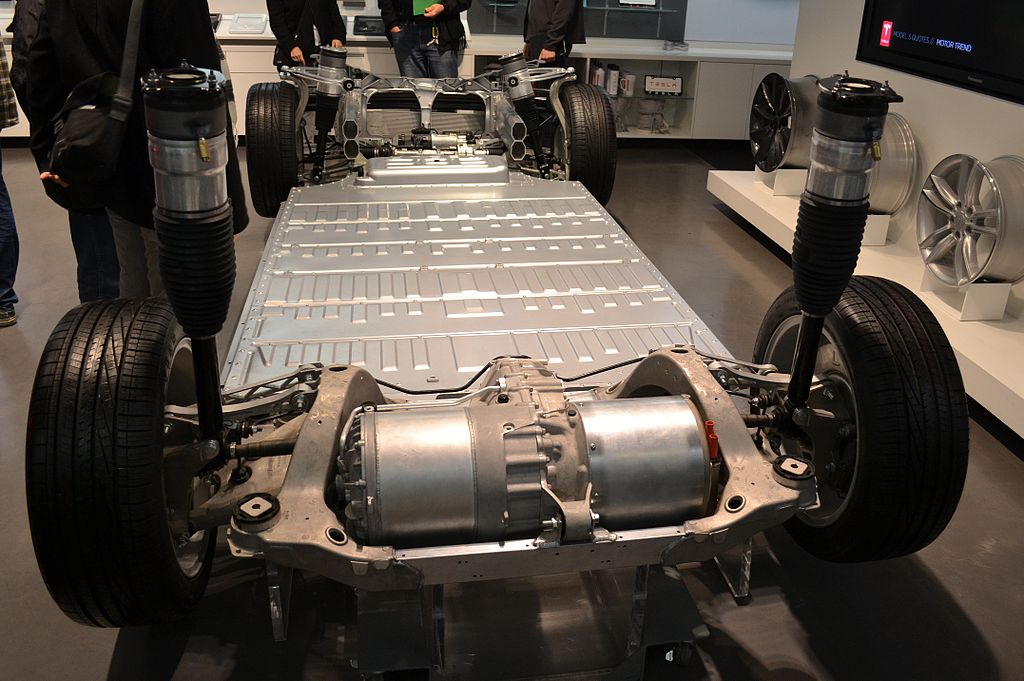
My mistake. Apparently gasoline vehicles are built around a skateboard like this. Silly me for not knowing that!
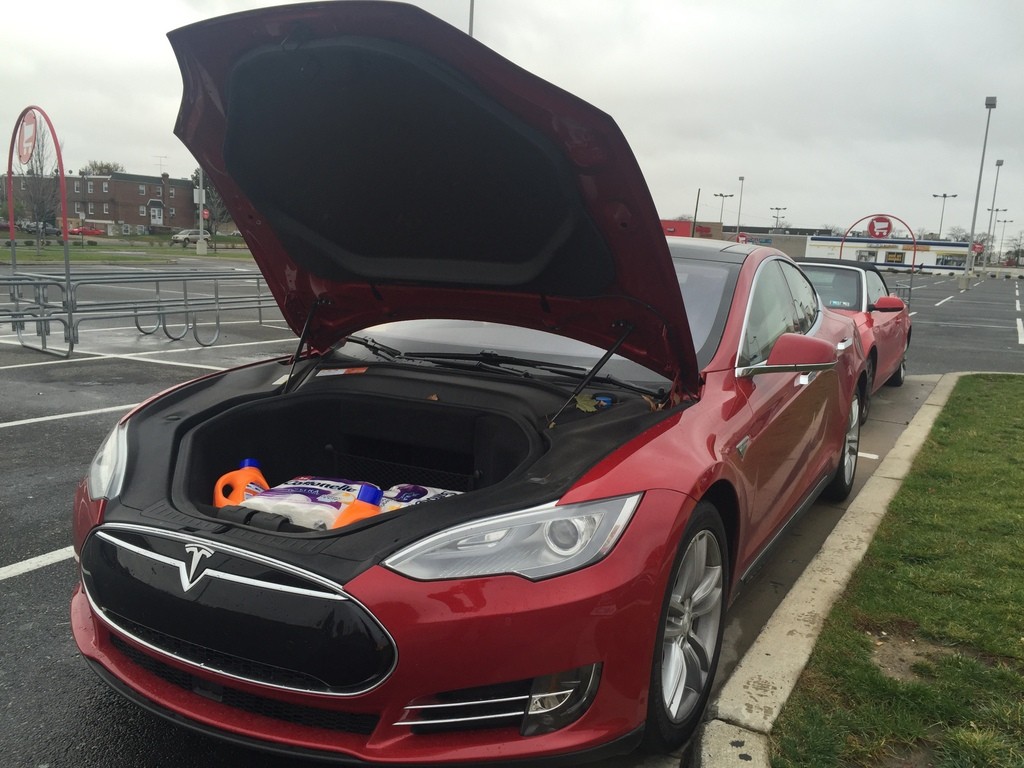
My mistake. "The engines are in front" - my dang lying eyes convinced me that they were built into the skateboard between the wheels. Silly me for trusting them! My dang eyes also lied to me about there being a frunk where you'd normally find an engine on an ICE. I better have them checked out.
Silly, silly me.
And you're right. It totally makes sense to continue to build highly suboptimal vehicles, with poorer handling, space usage, assembly economics, and shorter range, indefinitely, rather than designing for an entirely different powertrain and using that as the basis for all of your upcoming EVs. Your logic is impeccable: spend a fortune developing and refining the new powertrain, making huge gigafactories, etc, but then jam all your hardware developed at high cost into a vehicle that wasn't designed for it because you can't be bothered to do a design refresh.
It's so obvious now. I'm such a fool.
-
Re:at what priceI don't hate birds (with the exception of the one that shat on my lunch that time), but your level of misinformation is astounding. Why don't we break down this bullshit.
Only about 70% of migratory birds are surviving one annual migration at the moment.
In 2003, wind turbines killed 33,000 birds a year. Glass windows killed 97 million.
The mass extinction of birds is currently on the way.
Due to habitat loss. Wind turbines don't even register on the scale.
Loosing large birds gliding magnificently above a town is the same loss as loosing the trees, bees, rivers, etc.
That's "Losing". To your point: trees are necessary for temperature control and erosion resistance. Bees are necessary to pollinate fruit trees. Rivers power dams and harbors fish. Large birds... they eat small animals, just like foxes, cats, snakes, wolves and bears. They're not necessary.
Limiting power consumption via LED lamps,
CFL's, which people already use, are almost as efficient (8-12% vs. 8-15%). Lighting is only 7% of electric usage anyways.
lighter vehicles,
99.85% of cars don't even use electricity.
smaller heated (air-conditioned) areas in houses
Heating is usually natural gas. But even if you include it, residential heating plus air conditioning only accounts for 6% of all energy use.
...could produce more than enough electricity for decades
Yeah no. Not when the world population is set to reach 8 billion by 2025 (a 14% growth).
-
Re:Hey GM, how about that EV1?
-
Re:Tax Breaks for the Wealthy
I just bought a 2013 Chevrolet Volt for $11,000 plus fees ($12,295 total). The car is in excellent condition, even at 68,000 miles; the internal combustion engine has been run way more than necessary, with only 3% of its lifetime drive being on battery.
The 2013 Volt is an excellent car. The battery lasts about 38 miles, and I have a 13 mile commute; I use 66% of the battery both ways. The generation-2 Volt has a 53 mile all-electric range; 90% of commutes are below 60 miles, and 68% are below 15 miles, so the 2016 and later Chevrolet Volt runs all-electric nearly 100% of the time for over 90% of daily commuters, and the 2015 and earlier Volt runs all-electric nearly 100% of the time for over 75% of daily commuters.
The 2013 Chevrolet Volt had an MSRP of $41,000. I got mine for $11,000. The car was bought by my dealer in October, 2016.
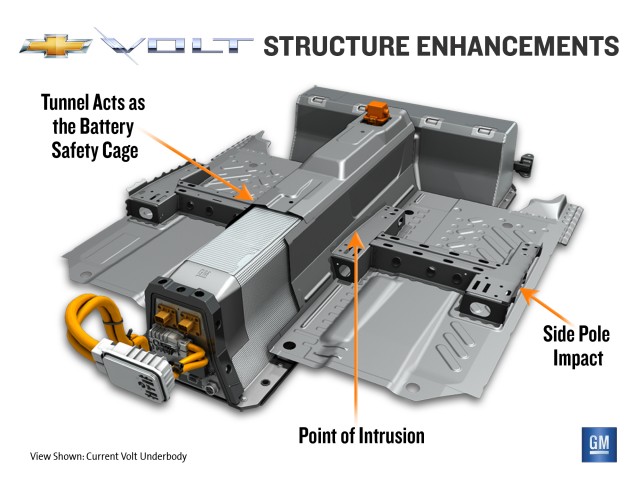
Rich people's cars go out the door in 3 years for newer, fancier cars. Look at the Chevrolet Volt battery and structural support members, and compare that to the Chevrolet Bolt battery and its base panel. By re-enginering the Chevy Volt battery base panel to be a stressed member battery pack, like the Bolt, you could get another 50-75 miles of range--raising the 58 mile range of the Generation 2 Volt to a 108 or 133 mile range without crowding out the existing supports. This would add several thousand dollars to the cost, although newer technology (including more automation in factories) will bring that down.
The end result: a PHEV with 108+ miles of all-electric range and a total 475+ miles of combined range, with an electric recharge time (at 3.3kW, 240V at 13.75A) of under 8 hours (under 4 hours with a 6.6kW circuit--240V on a 30A circuit). Recharge rate at 3.3kW is 14.5 miles per each hour of charging; if the charge circuit were re-specced to 6.6kW for this hypothetical vehicle, it would recharge 29 miles of range per each hour--nearly the full range of the Generation 1 Volt.
Note that upgrading my home electrical to add a 40 amp, 240V charging station (9.6kW) for the Volt and future EVs will cost me under $1,000. Using a Level 1 charger plugged into a normal 15-amp receptacle (no electrical upgrade) restores 4 miles per hour of charge, making an overnight charge (8pm to 8am) a 48-mile top-off. The Chevrolet Volt includes such a charger.
So rich people are eating the cost of these new, high-end cars (okay, GM made a non-shitty vehicle; I'm impressed); and non-rich people are purchasing them for around $10k-$15k (I actually saw a 2015 Volt with under 5,000 miles for $16k! They're over $30k MSRP!). Essentially, some rich guy bought me a $30,000 car, and I bought the other $11,000. I got my last car (a 2004 Mazda 3) for $14,000.
The total pollution produced by a Chevy Volt is lower than the total pollution produced by a Toyota Prius, including its total manufacture and electrical refueling. My utility offers me EV charging rates with 3.8 cents distribution, plus taxes, plus 20 cents per kWh peak electrical rate and 9.3 cents per kWh off-peak; I currently pay 8.79 cents per kWh at all times (no off-peak advantage) to an electrical supplier who ensures generation of 100% solar, wind, hydro, and geothermal for every kWh I consume, which is less than the off-peak rate. My total current electricity cost is 15 cents per kWh, versus EV rates (using 70% coal, 5% oil, and a lot of natural gas) of 15.51 cents per kWh.
Currently I'm driving on 100% clean energy. The Generation 1 Voltec platform, from 2011 vehicles, has seen regular lifecycles in excess of 90% electrical miles and 100,000 miles, including several samples exceeding
-
Re:Whatever
Within two years apparently.
-
Re:What's the ROI on any $80K+ car?
I also noticed this when I was in HK. But really it probably has less to do with prestige and more the fact that you can buy it for half of its pricetag with guaranteed buyback of up to 75%. That's a crazy good deal.
-
Re:Does anyone really use these numbers?
You wont have to replace your hybrid battery. That's myth brought on by cheap laptop & cell phones horrible power managements. Further propagated by the Cock Brothers (typo intended).
Sparkie raked up more than 118,000 EV miles, on a car with more than 330,000 miles with no loss of charge on his 2012 Chevy Volt.
Chevy has recently mentioned is has replaced exactly NONE of it's > 100,000 Volt batteries out there du to degradation.
-
Re:Get ready
an internal combustion engine - as used in a petrol-driven vehicle - gets around 20% efficiency
Actually, the engines themselves are 30% to 40% efficient on modern gasoline-powered cars. There are some additional losses in the transmission, which is something like 95 to 98% efficient. Running outside the optimal load range also makes the engine a lot less efficient, but that's only relevant in stop-and-go traffic, and hybrid electric systems largely solve the issue. Even non-hybrid cars do a lot better in this respect than they used to, by automatically stopping and starting the engine at lights, and having more gears.
The efficiency of the complete drivetrain of a new ICE vehicle is 20% (standard) to 35% (efficient hybrid) for stop-and-go, and considerably better on the highway.
That's 6.189km per kWh, or about 162 grams of carbon dioxide of emissions - using worst case carbon generation - per km travelled.
Electric cars aren't 100% efficient, either; total up the losses in charging and discharging (86% efficient), power conversion (97%), and the motor(s) themselves (91%), and the total efficiency of the drive train is more like 76%.
An electric car? The infrastructure is already in place; there is negligible marginal cost in getting the power from the plant to the car.
That's not true. Even in the USA, grid transmission is only about 94% efficient. (It's much worse in developing countries; for India it's estimated at 70%. The huge difference is because building and maintaining reliable, efficient power transmission and distribution is not cheap, and some places are too poor to do it well.)
So best case, with a diesel S-class vehicle, you're about one third better than the Model S; worst case (5+ litre petrol engine), you're 50% worse.
We must adjust your 162 g/km estimate upward by 40% to account for the EV inefficiencies that you ignored, which gives us a revised estimate of 227 g/km - worse than all but the most over-powered of the four Mercedes models found in the document that you linked.
Another factor to consider as well is the cost of transporting the fuel: trucks have to carry that fuel (diesel, petrol, etc.) to the station, and you have to drive to the station to refuel.
You can't pretend this is a useful or fair comparison if you only consider the supply chain for the contents of the ICE car's gas tank, and ignore everything else. Mining and moving coal has a substantial environmental and economic impact as well. So does mining Lithium for batteries, or refining and doping Silicon for solar panels, etc.
There are really only two reasonable ways to estimate the true environmental impact of a product:
1) Start from nothing but labour and raw natural resources (think minerals still in the ground, not steel) and work your way up every stage of the production, supply, and maintenance chain - you can't assume trains are moving coal, until you've figured out the full impact of making and running trains from scratch.
2) Or, assume that the selling price of an item already accounts for its environmental impact (partially true).(1) is probably more accurate, but if you're going to do it you need to do it for everything, or at least apply
-
Re:Awesome
I'm sure they're on it. They've gotten some interesting data recently.
-
Re:And this despite lower gasoline prices
Well I saw lower figures but also found this while discussing this post.
http://www.hybridcars.com/stud...
Summary is 20% loss after a little less than 3 years (like losing 5mpg to 10mpg in a gasoline car).
Also, a substantial group losing 30% in 800 days.
And with a dozen losing 40% in only 800 days.And this is a pro electric car site using actual data.
I'm skeptical. My battery powered electric devices have shorter lifespans.
If it's as good as they say, I'd want an extended warranty from the manufacturer backing up the promise with a replacement battery.
-
Re:And this despite lower gasoline prices
90% is crazy talk. No battery lasts 20 years with 90% capacity.
I think the other person responding with 20% after 100k miles is more reasonable. But even that is high compared to figures I've seen discussed on some Tesla boards and may be a 'best case'.
This site shows 80% capacity after three years (900 days) with MANY data points near 60% capacity.
http://www.hybridcars.com/stud... -
Re:Combustion Engines Are Inefficient
An ICE might be around 20%, half as efficient as a power plant.
A modern automotive ICE can be way better than 20% efficient - the cylinder engine in the Honda Prius is 38.5% efficient.
The whole chain of transmission, charging, battery and electric engine is still around 90% if not more efficiency.
Each of those stages individually is about 90% efficient, meaning that the chain in aggregate is much worse than that.
Grid distribution of power is something like 90% efficient (actually worse than that in India, due to their lousy infrastructure). Charge/discharge efficiency for large Lithium-Ion battery packs is about 85%. A high-powered electric motor + controller is about 90% efficient.
90% of 85% of 90% of 42% = 29%, versus 38.5% for a good ICE
Any economic/environmental benefits to the electric car are entirely due to other factors, such as regenerative braking and the greater range of power sources available to the grid (nuclear, hydro, solar, etc.).
-
Re:wake me...
All the time. You just don't see it in press releases and it doesn't appear here on
-
Re:Tweet today from Elon Musk
I'd lay odds that's more the entire combined output of all rechargeable batteries in the country.
I'll take that bet. If you add all the batteries in Tesla model S, Chevy Volt Nissan Leaf, Toyota, Prias, Mitsu i-MiEV, Ford Focus Electric, etc they account for more than 5MWh. Just 2/3rd of the Tesla production accounts for over half the 5MWh.
-
Re:Hm, Prius="Before" vs Mirai="Future"
Contrast this with Nissan, another Japanese automobile manufacturer, which has invested so deeply into battery technology that if the Leaf were to fail, it's quite likely that they'd become a battery company. (A while back, I read (or watched?) a really compelling article/documentary on Nissan's battery research. It concluded that Nissan was gambling so heavily on both its own future with the Leaf and the future of automobiles as being electric that the company would likely stop making cars if the Leaf were to fail. Sorry I can't find a good citation to that.)
You cant find a citation because it isn't true.
Nissan sells 5,000,000 cars per year and made US$3 billion in profit last FY. Nissan makes good cars that sell well, pretty much the antithesis of American car corporations, so they're quite safe.
The Leaf has sold 100,000 units worldwide since 2010... which is actually 45% of the total EV's sold in that time.
Besides, I wouldn't read too much into names. Nissan made a car called the Skyline that was pretty low to the ground and the Pulsar doesn't emit radiation. Mostly they're picked because it sounds good, Mirai just happens to be good in English as well as Japanese. -
Hm, Prius="Before" vs Mirai="Future"
"Prius" is Latin for "before" while "Mirai" is Japanese for "Future." Kind of sets a bold statement; an old language for hybrids and a new language (Japanese roughly dates back to the 8th century) for the purported future of cars
Contrast this with Nissan, another Japanese automobile manufacturer, which has invested so deeply into battery technology that if the Leaf were to fail, it's quite likely that they'd become a battery company. (A while back, I read (or watched?) a really compelling article/documentary on Nissan's battery research. It concluded that Nissan was gambling so heavily on both its own future with the Leaf and the future of automobiles as being electric that the company would likely stop making cars if the Leaf were to fail. Sorry I can't find a good citation to that.)
The presumption that Hydrogen Fuel Cells will be the "next" car fuel (after either gas or after electric) is still quite a strong one. I've seen it painted (iirc, by the documentary Who Killed the Electric Car?) as something the oil companies latched onto because it competed with electric cars (which are ready now) and because hydrogen fuel cell cars are still quite a distant future prospect.
-
Chicago has buses
http://www.hybridcars.com/all-...
they are ridiculously expensive, but, they are not mass produced, yet. -
Better article
There's a much better article here, with numbers (including side-by-side comparisons of efficiencies of battery cars, fuel cell cars and internal combustion cars for fuel processing, fuel usage and total) and interviews with both Toyota, Plug in America etc.
-
Re:I wonder what Elon's rebuttal to this will be..
Trick question! GM recalled several thousand chevy volts due to fire risk~
http://www.thedetroitbureau.com/2013/06/chevy-volt-recall-may-set-new-record/
Joking aside: http://www.hybridcars.com/young-woman-in-chevy-volt-survives-severe-drunk-driver-crash/
No fire. -
Re:This just in...
Fat or not, agile or not... it's sure a heck of a lot easier (and cheaper) to buy a GM vehicle than it is a Tesla. GM dealerships are near everywhere (as is their quick fueling options)... not so much with Tesla.
Yeah... that couldn't be because of political pressure to deny them permits, could it? Great argument you got there.
Tesla has a great bit of tech behind them, they are still the new comer and have a great deal of mindshare to win with regards to 'the big three'.
You say that like they're all playing the same game, and under the same rules. You couldn't be more wrong.
-
Re:you want to look at all details and aspects?
Some still do. IIRC Prius used to, but has switched. But this article says (2010) that Toyota uses Ni-Cd for hybrids, Li Ion for pure electrics. According to a quote in this article,
Geoffrey May, a UK based consultant to the battery industry, is more sceptical. 'More than 95 per cent of hybrid electric vehicles on the road today use nickel metal hydride batteries and that is not going to change any time soon because the main manufacturers of HEVs have invested huge amounts of money in production facilities. It is a technology that works and it is safe: there have been no reported incidents of battery fires with nickel metal hydride as have happened with lithium ion.'
Also, mining and refining lithium (or any material) has its environmental costs. Then there's this:
“The Metal Mining Effluent Regulations do not specifically regulate all of the individual substances of concern that might be released from the mining or processing of rare earth elements and lithium,” says the report.
The regulations “were not specifically designed to manage the environmental aspects of these mining processes.”
And this
Around the turn of this century, China began to separate the mixed salts of Tsaidam Basin lake beds on a large-scale. Separating naturally crystallised sodium, potassium, magnesium and lithium salts requires heavy-duty toxic solvents (such as isobutanol and chloroform), known to cause cancer. Since the Qinghai authorities were keen to industrialise their province – known for its poverty, remoteness and cold climate – land-use controls and environmental regulations were not a priority. From the provincial capital Xining, spreading out to the famous Kumbum Monastery, industrial plants took up land, pouring effluents into nearby streams. Potash and magnesium plants were built and expanded in Gormo, Xining and along the connecting railway line.
Bottom line: At this point the environmental impact of lithium mining and processing (especially at the new higher volumes to be expected) is not well understood, and apparently not yet subject to sufficient mitigation. We just don't yet know. But my point remains - over time, all these externalities will be applied to every one of these resources, to approximately the same extent, and as such their actual cost will reflect those externalities, to approximately the same extent. That is, if we go about this sanely - a dubious prospect!
-
Re:Sadly, it is solid evidence against him.
The oil companies are subsidized by US taxpayers to the total of 20 BILLion dollars a year.
Give that twenty billion to electric battery producers to subsidize their costs, and you'll see $19,0000 cars that get 500 miles per charge. It's all a matter of what we think is a "subsidy".
Yea I can't imagine anything going wrong with that...
Oh, wait, yes I can, because it's happened.
Oil powered cars are subsidized by direct payouts to oil companies for drilling. We don't charge oil companies for the direct damage they do to the planet; that's "external" cost, not slapped on the price of your car. The cost of global warming will be hundreds of trillions. Your car company will not have to pay that. We have gone to war in Kuwait, Iraq, and soon Iran and Africa to secure oil fields, at the cost of trillions; that cost, for decades to come, is carried by taxpayers, and never charged on the pump or in the cost of your car.
I take it, then, that you don't know where the lithium for those batteries comes from, or the environmental damage done in order to make them?
Perspective - it matters.
-
Both mistaken and thoroughly disproven.
I was under the impression that the manufacturing processes to make the power plant / batteries for *POPULAR BRAND OF HYBRID VEHICLE* released the equivalent quantity of CO2 into the atmosphere as would be saved by the reduced CO2 released by the hybrid drive over it's serviceable life.
That's neo-con disinformation, operating at several levels, that is being distributed by marketing organizations like CNW. Not only is it factually incorrect, it also implies CO2 is the most significant car exhaust pollution issue, which it certainly isn't, and ignores the fact that auto batteries are recycled (in the USA) at a rate exceeding 95%.
There's also the issue of "service life". We all heard the stories of how buying a new Prius battery would cost more than the car, and we'd have to do it every three years - yet I have 130,000+ miles on my ten year old battery pack and it has had zero maintenance and zero problems. Other people have gone 300,000 miles with no issues. Good quality electric motors, such as the traction motors in Japanese hybrids, have a 40 year service life before rebuilding - and if the bearings are replaced at the first sign of heat or noise brushless motors can last over a hundred years. I have an 80 year old electric fan in my house (it has hand-wound coils and hand-cut steel gears in the oscillating mechanism) and it works better than modern plastic chinese-made fans - pushes more air and uses less energy, because it's extremely well made. Service life estimates based on worst-case fantasies of hybrid haters are clearly not realistic.
The net being a loss to society, as the process for making the batteries released toxic elements not used in making regular combustion engine cars.
Again, this is factually incorrect. Even if you accept the ridiculous definitions of pollution and service life, it's still just plain not true, and has been repeatedly debunked in peer-reviewed literature and in journals. Of course the Wall Street Journal and Fox News will keep repeating absurd anti-environment propaganda forever, but those are not reality-based news sources.
-
Re:Largely Demand Driven
The one I think has the most potential is the liquid battery. Here the "electrodes" are in liquid form and stored in tanks. When depleted they can be pumped out and new liquid pumped in. The benefit is each vehicle could have it's own tank configuration and size as long as the liquids are the same.
http://www.hybridcars.com/news/mits-liquid-battery-could-refuel-minutes-30157.html
-
Re:More hot air from pompous politicians.
Yes, but vehicle mileage in this range is not a scientific problem. We already know how to build these.
http://www.hybridcars.com/news/ford-fiesta-diesel-its-most-fuel-efficient-car-ever-43574.html
-
Re:Gasoline-like energy density
Or make the electrode in fluid form and instead of recharging onboard just pump out the electrode and replace it.
http://www.hybridcars.com/news/mits-liquid-battery-could-refuel-minutes-30157.html
-
Lovely stats, there.That article's real knee-jerker. My favorite part: "If you factor out the super-loyal Toyota Prius buyers, the repurchase rate drops to under 25%" Let's rephrase that to what it really says: "If you ignore 58% of all hybrid-buyers, the statistics becomes more inflammatory."
- A couple fun facts not included in their stats:
- * As of March 2012, 3.44% of all car sales were hybrids. Higher than the 2.4% included in the article, and even higher than the 2.8 "high mark" from 2008 that the survey was using to give the impression of impending doom.
- * Total hybrid sales in March 2012 was +39.6% over the last year. Total vehicle sales over the same period was +12.7%.
- * 27,800 of the 48,206 hybrid cars sold in March were Toyota Prius's, those "super-loyal" customers that were so easily waved away.
Source: Baum & Associates, via http://www.hybridcars.com/news/march-2012-dashboard-44059.html
-
Super loyal!
If you factor out the super-loyal Toyota Prius buyers, the repurchase rate drops to under 25%.
The numbers are interesting indeed... but factoring out "the super-loyal Toyota Prius buyers" just to drop it from 35% to 25% doesn't really help the argument as much as make the reader question the research methods involved.. considering any laymen already has in the notion hiding in the back of their mind that that Pri'i make up for quite a bit of the cumulative hybrid market share (it's got ~3 generations head start on all other "mainstream" hybrids).
And when said laymen goes to google such a statistic and finds that even last year ( http://www.hybridcars.com/market-dashboard.html ):
Regular Prius and Prius V combined [represent] 58 percent of total hybrid sales.
... Well it's like saying death rates are dropping, if we factor out the "super deadly" causes of death such as heart disease and cancer.
The super-loyal-ty-ness-ess of Pri'i owners here obviously shouldn't be considered a factor that would affect the results, as much as they are a key metric in determining such a result (loyalty begets repurchase as it is an indicator of some set of factors said survey is attempting to measure in the first place... duh?) -
Secret plot to capture federal funds?
I wonder if they are hoping to get these new super-power USB ports classified as Electric Vehicle charging stations, thus eligible for several thousand dollars in federal subsidies and grants? Imagine charging your Chevy Volt from your laptop USB port!
-
Re:Sorry to sound apologetic...
On one hand, you chastise people for being a consumer, and give scatological examples like gas guzzling cars, and commercial airline flights.
Scatalogical? I know there are poop-powered cars, but I didn't know there were airlines powering planes with poop.
-
Re:hydrogen ftw
Do you really care what the station looks like?
yes people care what the station looks like. This is why it will never work.
when people think of getting gas, they think of going to the clean shell station on the corner with the TVs and candy bars. A level III charger is like parking at an electrical substation and plugging in. it's not going to be adopted, even in pilot phases.
Have you seen a Level III charge station?
http://www.hybridcars.com/news/coulomb-promises-gas-pump-style-ev-rapid-charging-26436.html
http://www.teslamotorsclub.com/showthread.php/4092-TEPCO-CHAdeMO-Level-III-quot-quick-quot-charging-station-connectorIs it really any worse than a modern gas pump?: http://travis.kroh.net/archives/003205.jpg
During normal EV use, you'll never have to visit a charging station
I agree with you that level III charging is as unneccesary as it is impractical. Everybody will charge at home, and nobody will buy an EV unless they have the capability for home charging.
I completely agree that everyone with an EV will charge at home (or work).
However, the fast-charge stations will still be necessary for longer trips. 90% of my trips are less than 100 miles (probably 80% are less than 12 miles). But for those occasions when I want to make the 150 mile trip to grandma's house, I'd like the ability to charge up on the way there. a 20 minute charge stop on a 3 hour, 150 mile trip is just an extra 10%. And while I'm at grandmas, I can plug into her 120VAC outlet and charge up overnight.
The nice thing about EV charge stations is that they don't have to be limited to gas stations since there are no big tanks of flammable fuels to store - anywhere that can handle a high power electrical feed (Shopping centers, business parks, etc) can put in a charge station. McDonalds could put in a few Level III chargers to let patrons charge while they eat. Shopping malls could put in dozens of Level II chargers to let shoppers charge for a few hours while they shop.
Another solution that I've seen proposed is to come up with a standard "generator pod"
I've never heard of this. Sounds like weasel words. I imagine one of those uhaul tows, except with a diesel generator inside! The idea is essentially the same as a Chevy Volt - a plug in hybrid or extended range EV. a gasoline engine maintains state of charge after 40 miles.
Here are some home made examples:
http://evmaine.org/html/ev_trailers.html
And one commissioned by Toyota:
http://www.evnut.com/rav_longranger.htm
And you're right, it's exactly like a u-haul trailer with a generator inside. Why should I pay for and maintan an Internal Combustion Engine when nearly all of my trips are short enough to run on batteries alone? I'd rather rent an engine when I need it. I don't understand your "weasel words" comment?
-
Re:Al Gore is not going to be happy to hear this
-
Re:why not both?
Speaking of removing the drive train, what about removing it altogether? I remember seeing a show where a bus had 4 electric motors - 1 in each wheel - resulting in much less wasted energy than a conventional drive shaft + differential design.
http://www.hybridcars.com/components/michelins-reinvents-wheel-with-motors-25308.html
-
Re:Excellent news
Smiths Electric Vehicles in the UK has been *continuously* making electric vehicles for over 70 years. If you want experience, go talk to Smiths, if you want marketing bullshit, go talk to Tesla.
Were you aware that Smith (not Smiths) already has a partnership with Ford? Furthermore, Smith already works with Ford in Europe to produce commercial electric vehicles on the Ford Transit and Ford Transit Connect chassis.
And maybe (likely) it is an exclusive contract?
Toyota clearly knows what it doing, sir.
-
Re:Diesel?
Toyota has a CNG hybrid Camry concept. Would love to see it built.
http://www.hybridcars.com/fuels/toyota-camry-cng-hybrid-concept-25044.html
-
Re:Damn, I wish they partnered with Aptera
True, the classic automobile was designed for a monolithic engine, drive train and fuel tank. The balance of the vehicle handling and safety was all formed around the big blocks of metal. Today, Michelin has the entire drive train in the wheel - http://www.hybridcars.com/components/michelins-reinvents-wheel-with-motors-25308.html. This is just version 1.0. Now the elephant in the auto is the battery. Batteries can be distributed for weight and heat dissipation.
-
Top 5 Myths About Prius Runaway Acceleration
Apparently shifting to Neutral on the transmission is the suggested way to go:
"...the first thing a driver should do is to put the transmission in Neutral. A driver can place the Prius in Neutral by moving the shift lever to the “N” position—to the left side of the shift gate, and hold it there for a second. This stops the torque to the wheels, and gives the driver instant speed control over the vehicle, and allows the driver time to assess what is happening. Shifting into Neutral at full throttle will not damage the engine. "
http://www.hybridcars.com/safety/top-5-myths-about-prius-runaway-acceleration-27507.html
-
Re:Vaporware
If you're not going to do the most basic research before you respond, why even bother? It's a full 10 year, 150,000 mile warranty, as required by California law to meet pzev criteria. Leno's Baker Electric does run on its original batteries. Tell me your "personal experience" with nickel-iron and lithium iron phosphate batteries. Go on, give me the complete rundown. Every last detail. I'm waiting. While you're at it, go ahead and explain how your "personal experience" with large, actively-cooled 50% DoD NiMH packs explains why so many people are deluding themselves into thinking that they never had their Prius pack replaced.
After all, your experience with high-DoD, non-cooled 18650 cobalt cells and similarly managed lead-acid batteries has oh so much bearing on actively cooled nickel-iron, LiP, manganese spinel, or NiMH packs with low DoD.
Tell we where I can go buy one of these cars with the 10 year battery warranty?
Obviously the Volt is not on sale yet, but you can get a Prius today with an 8 year warranty and a near-zero battery failure rate.
-
Re:Physics?
Yeah, it's not like Toyota would pay you $200 for a dead Prius battery...
Oh, wait, they do.
-
But the purpose of research and development...
...is to research and develop products for the future, not the present. It's called having "vision" and being able to (correctly) see where the industry was heading, and having products available when they're wanted.
Toyota's understanding of what buyers will value in the future enabled it to identify low emissions as a key selling feature as early as 1992, in the first version of its Earth Charter. Unlike US automakers, who likely would send this announcement (if it existed at all) to their PR firm to be published and forgotten, this program was acted upon by Toyota's R&D organization, as a bet on how the industry would change in the future.
One of the most frustrating parts of US auto companies is their apparently ingrained belief that their industry doesn't change. You hear it from their laid-off workers all the time -- "I thought I would always have a job here. My father worked at this plant, and his father, and
-
Re:*sigh*
Chevron spun the technology off to a subsidiary who markets batteries:
http://www.cobasys.com/products/transportation.shtml
Of course, they are under fire, so that isn't going to be a sufficient explanation:
http://www.hybridcars.com/components/cobasys-ceo-defends-his-battery-company-0811.html
Anyway, between your assertion that there was a market and the internal GM assertion that there wasn't a market, I'll take GM every time.
-
Re:Obligatory
-
Re:The economics of it....
To date, Toyota, Honda, and the rest of them have never sold a replacement hybrid battery for non collision related reasons. You can order one from the parts department, sure, but no one ever has.
Depending on the manufacturer, hybrid batteries are covered by warranty for 8-10 years. And so far, not one hybrid on the road has worn out its battery.
There have been some corrosion problems on a few connectors, which can be misdiagnosed as a bad battery, but those connectors are easily cleaned.Battery life on hybrids is significantly extended by the on board computer's careful management. They are never allowed to fully charge or fully discharge; charge rates and discharge rates are carefully managed. Not the same as the battery in your cell phone or laptop.
-
Making batteries pollutes, but easily Recycled.
Although it is less than 20% of the total footprint of life-cycle of the car. I understand that refining the metal to make the batteries is fairly polluting. However it is very easy to recycle the metal, and since the metal is reasonably valuable there is a significant financial incentive to do so. I am not sure how much the metal is worth but Toyota pays $200 for hybrid batteries (Toyota may be subsiding this so the actual metal is worth less).