Slashdot Mirror
Domain: lowendmac.com
Stories and comments across the archive that link to lowendmac.com.
Comments · 581
-
Re: "Stupid" is making the same mistake 3+ times
Without that the Mac would be dead.
We don't know that. That's mere speculation. Perhaps Apple would borrow even more Unix & OSS if Next not around.
It is speculation, but the next best alternative was BeOS and from what I know of it, it didn't seem like a great option. The Unix underpinnings of OpenStep was a very real strength and combining that with a generally good UI and top level stack was another strength. Adding Steve Jobs into the mix further helped cement the advantages. I am not convinced that Jean-Louis Gassée would have been the right person for the job?
Developing an operating system is hard. Developing a great operating system takes many iterations, and therefore years. Apple was not in a position to plan for many years.
One article comparing BeOS to OpenStep: http://lowendmac.com/myturn/02...
-
Re:Not surprising
And Mac share of the "Desktop" market is over 10%, twice what you claim.
I doubt it. Mac, 5.03%
Try to post without the insults, ok, to avoid being called out as the clown you come across as by not being able to support your argument after heaving out a lame ad hominem.
That article is 10 years old. Please continue post shit like this to prove you more than deserve all the insults we could ever throw at you.
-
Re:Not surprising
Hardly fair. In 2009, there really wasn't any real competition for the iPhone.
It's more than fair. iPhone's market slide looks way worse when compared to Android alone, instead of including RIM.
Android certainly had to compete, but it didn't just compete, it slaughtered. Why? Three big factors: more value for money; Google brand was more more trusted than Apple; Google's services such as maps and email were better than Apple's. All three remain in effect today,
And Mac share of the "Desktop" market is over 10%, twice what you claim.
I doubt it. Mac, 5.03%
Try to post without the insults, ok, to avoid being called out as the clown you come across as by not being able to support your argument after heaving out a lame ad hominem.
Android only "wins" because of the plethora of cheap-shit low-end "giveaway" phones. If you restrict your view to the "Flagship" models, the numbers look QUITE different. And speaking of "Quite Different", I don't know where you got the 12% marketshare number for iPhones; but this source quotes it earlier this year at a whopping 51%:
-
Re:Not surprising
Hardly fair. In 2009, there really wasn't any real competition for the iPhone.
It's more than fair. iPhone's market slide looks way worse when compared to Android alone, instead of including RIM.
Android certainly had to compete, but it didn't just compete, it slaughtered. Why? Three big factors: more value for money; Google brand was more more trusted than Apple; Google's services such as maps and email were better than Apple's. All three remain in effect today,
And Mac share of the "Desktop" market is over 10%, twice what you claim.
I doubt it. Mac, 5.03%
Try to post without the insults, ok, to avoid being called out as the clown you come across as by not being able to support your argument after heaving out a lame ad hominem.
-
Re:horrid mouse
Yes. That was some really stupid design.
There were several third-party adaptors that snapped onto the mouse to make it longer so that you could tell which direction it was facing. The iCatch sat on the back.
The Contour Unitrap encased the mouse.
I think there was also a third one that replaced the coloured plastic side parts.Still, it was not as bad as Digital Equipment's puck mouse that had two wheels on the bottom. That one was not just round but also difficult to move where you wanted.
-
Re:Are you sure about your CPU?
Core 2 Duo is 64-bit. You must be thinking of Core Duo.
http://lowendmac.com/2008/aluminum-macbook-late-2008/
http://lowendmac.com/2010/unibody-macbook-mid-2010/ -
Re:Are you sure about your CPU?
Core 2 Duo is 64-bit. You must be thinking of Core Duo.
http://lowendmac.com/2008/aluminum-macbook-late-2008/
http://lowendmac.com/2010/unibody-macbook-mid-2010/ -
Re:Bullshit
What 15 year old data did I use?
http://lowendmac.com/2015/clas... details Mac virii dating from 1997-1998. It's not 15 years old it's _19_ year old data.
As most modern malware uses the Internet, supervision of what exactly is being accessed is a useful proxy. Backtracking to the malware agent once the traffic has been identified again shows that the vast majority is Windows based (exceptions made for the IP Camera & Firewall botnets that aren't Macs or Windows anyway).
For someone who supposedly works in security, you sure are and ignorant shit. And I mean that as a statement of fact based on my own observations, not as an insult.
Aww gee snookers has run plain out of coherent arguments & is now resorting to ad homonyms. Grow up junior.
When you say "supervision of what exactly is being accessed is a useful proxy", you clearly imply that you are monitoring for known threats. Since most known threats affect Windows (and for the good reasons on which we both agree), surely you see how confirmation bias might play a role in your perception, no? Just in case, I'll explain: if you're monitoring an IP address belonging to a C&C server for Windows malware, you probably wouldn't expect to see non-Windows machines connecting back to it. You're stating the obvious as an attempt to show that you're right, while hoping that nobody will point out that what you've just said is not relevant.
Your malware knowledge is just as dated as your Mac AV info. Talos, Checkpoint etc are not just looking for known threats. They keep track of signatures of infectable elements and regularly re-examine what has been transmitted/received and to/from whom. Thus when a 0day is used it'll pass through. However when someone analyses the malware (AV vendor, side effects of it activating anywhere that gets it noticed at any of their client's sites, etc), they can then notify every one of their other clients that saw the signature.
How much malware is found and analyzed only because it was identified by heuristic detection routines in antimalware software? You work in security, you should know this. Here's a hint: the vast majority. We'll circle back around to that, though, because it rolls right from what you said above to what I'm about to quote.
Go try and teach your grandmother how to suck an egg junior. You're clearly in no position to believe you have any hints to give.
Presence/absence of AV software is NOT a useful data point for Malware infection rates.
Bingo. That was my point. Thanks for letting me know you got it! I'm so proud of you!
Err, _you_ argued that "most people do not run any sort of security software on their Macs" as is it made a difference, not me. You're incoherent.
The truth is that you have infection rate numbers for Windows because the means to detect those infections is widely deployed; you don't have those numbers for Mac because the means to detect those infections is not widely deployed.
Accesses to known & discovered botnet adresses, modification of files on servers, analysis of baselined network traffic Data loss prevention monitors that trigger on the discovery of critical data are all discovery techniques that you didn't know of because they didn't exist 20 years ago. None of these are Mac specific oh ignorant one.
I think you overestimate your influence if you think that Apple is "taking it on the chin"
I think we simply define "taking it on the chin" differently.
I think that you (re)define it as it suits your ego, moving the goalposts as needed.
-
Re:Bullshit
My advice for the Windows malware refugees (like most of my family) is to practice some common sense.
That would have been good advice for them when they were on Windows, as well.
My advice is generally platform agnostic so yeah, Windows/Linux/Mac, all need some some common sense. The difficulty being what qualifies as common sense of course.
Do Mac owners believe in general that they are invulnerable? No, that's just another straw man you're setting up to knock down.
Of course, after meeting me, most Mac users no longer believe that; and those who still do deserve whatever they get. But I do get in arguments over whether Macs have malware issues at least half the time someone tries to tell me how much more safe and secure macOS is than Windows.
Doesn't change that it's a strawman. Apple doesn't claim that Macs are invulnerable, I don't claim that they are. _You_ are and then saying subsequently that they aren't. Strawman arguments prove nothing. That most malware has been developed to target Windows is a fact, not an opinion.
Your sample size appears to be your family and Slashdot. My sampling of Mac users is different, so we 're going to have to agree to disagree on this point.
You're conflating personal experience and sample size. I work in the domain of IT security and thus have a larger sample size than just family. Slashdot is irrelevant in any case.
Using a mac an iron clad gives no guarantee of malware invulnerability but renders much _fewer_ problems. I haven't been called to reinstall my relative's Macs every 2-3 months the way I was with windows, so there's that.
My experience shows that, had you instilled that computing common sense into them while they were still on Windows, you wouldn't have been reinstalling their Windows machines every 2-3 months, either. As someone who uses both platforms daily (I'm typing this on the aforementioned MacBook, which I use when I'm not at my desk -- and later, after a massive plate of turkey, I'll probably sit at the powerful Windows workstation in my office and work for an hour or two), I can tell you that the same common sense keeps both of them safe.
Well then I question your experience as most of the malware risks are clearly Windows targeted and thus Macs will generally pass through unscathed. Different OS, no Flash installed, No Java installed & use of non-MS application suites all help to make the Macs less vulnerable even when one of them ignores my advice & clicks on a "invoice.docx" sent by an unverified source. The same mistake on a windows machine will not be so benign.
That might not have been the case in the first year after XP came out (longer, if you insisted on doing fresh installs from a pre-SP1 CD) and I seem to recall somewhat severe issues if you used IE or went online without at least closed NAT between you and the internet before that, but Windows hasn't been the swiss cheese you imply since the end of 2002. Of course, it's not like MacOS was so clean in 2002, either.
Again, I'm not claiming that Macs are invulnerable, just less targeted, so less exploited. Any streaming site that bothers can find exploits for old versions on MacOS browsers. That _the_streaming_sites_ & other malware generally don't is because almost all of them just don't bother.
Using 15 year old data doesn't help your case as it is hopelessly out of date and immaterial to almost everyone anyway.
If you only consider the types of malware listed in that list, there aren't alarmingly more for Windows than there are for macOS (pre-OSX). When you adjust for target size, the Mac took a disproportionate number of hits; I mean, Apple only held 5.8% of the market in 2006, and that was
-
Re:Bullshit
My advice for the Windows malware refugees (like most of my family) is to practice some common sense.
That would have been good advice for them when they were on Windows, as well.
Do Mac owners believe in general that they are invulnerable? No, that's just another straw man you're setting up to knock down.
Of course, after meeting me, most Mac users no longer believe that; and those who still do deserve whatever they get. But I do get in arguments over whether Macs have malware issues at least half the time someone tries to tell me how much more safe and secure macOS is than Windows.
Your sample size appears to be your family and Slashdot. My sampling of Mac users is different, so we 're going to have to agree to disagree on this point.Using a mac an iron clad gives no guarantee of malware invulnerability but renders much _fewer_ problems. I haven't been called to reinstall my relative's Macs every 2-3 months the way I was with windows, so there's that.
My experience shows that, had you instilled that computing common sense into them while they were still on Windows, you wouldn't have been reinstalling their Windows machines every 2-3 months, either. As someone who uses both platforms daily (I'm typing this on the aforementioned MacBook, which I use when I'm not at my desk -- and later, after a massive plate of turkey, I'll probably sit at the powerful Windows workstation in my office and work for an hour or two), I can tell you that the same common sense keeps both of them safe.
That might not have been the case in the first year after XP came out (longer, if you insisted on doing fresh installs from a pre-SP1 CD) and I seem to recall somewhat severe issues if you used IE or went online without at least closed NAT between you and the internet before that, but Windows hasn't been the swiss cheese you imply since the end of 2002. Of course, it's not like macOS was so clean in 2002, either.
If you only consider the types of malware listed in that list, there aren't alarmingly more for Windows than there are for macOS (pre-OSX). When you adjust for target size, the Mac took a disproportionate number of hits; I mean, Apple only held 5.8% of the market in 2006, and that was after OSX had been released and they had been had been blowing up for a while. I can't find market share numbers for OS 9, but
I'd say we should compare infection rates but, again, since most people just don't run any sort of antimalware on their Macs, well... we can't.
Contracting for a company that primarily writes Mac software, we do gather those statistics and I have a large enough sample size (over 300k) to say that no, most people do not run any sort of security software on their Macs. Call it a strawman all you want, but reality disagrees with you.Re taking it on the chin: You used the expression in referring to Apple. That kind of makes people thing that you thought that when writing it.
I had to search through posts as I did not remember having said that. Yes, I'll fully stand behind my words; it's difficult to take it on the chin if you don't stick your chin out there. When you start getting all smug (which you have to admit Apple has been since OSX came out) and keep looking up, your chin just sticks out there, ready to catch a fist or a load of -- something -- whenever someone wants to throw one your way. Microsoft used to have the same attitude, also unwarranted, and took just as much crap for it.
Re Jobs the Angel/Cook the Devil: You do remember the Lisa, the Newton & the Mac Cube right? Jobs had his share of missteps.
So 3 failures you can quote over his entire career and he's as bad as Cook, who's been destroying product lines for 6 years solid? Cook has made more missteps in 6 years than Jobs did in his entire career; yes, Jobs
-
Re:One of the "1977 Trinity"
>> Apple may have been the market leader (at least in the US), but...
> Apple was not the leader per units sold until VisiCalc came along.
Not even then:
-
Re:Lots of 32bit-only Virtual Instruments/Audio Un
Then purchase the 64-bit version of Sylenth 18 months from now once Lennar Digital finishes it. I thought Mac users were used to re-buying software periodically after architecture transitions, that is, those from 68K-24 to 68K-32 to PowerPC to PowerPC (OS X) to x86 to x86-64.
-
Re:Idiocy
Anyone else out there remember MacCharlie?
-
Re:Fighting what they once were
Sure it did. I had a Mac Color Classic, it had an expansion slot, ports for accessories, and extra RAM slots.
Oh, my sweet, summer child. If you became familar with doorstop Macintoshes with the Color Classic, you came very, very late to the Apple party. My first three computers were a C= 16, an Amiga 500... and an Apple ][+ with an 80 column card. I didn't personally have a Macintosh 128k, but a friend (still one of my best friends actually) had one at home. The Macintosh 128k did not have any expansion slot; hell, it did not even have SCSI, which is broadly considered to have been a major defining feature of Macintosh computers of the era, and for quite some time thereafter. The only way to expand the system was, as stated previously, to get in between the CPU and the CPU socket. This approach was very commonly used on computers built with the MC68000 processor, because you could swap either to the MC68010 (which had a couple of additional instructions that could speed up some operations) or even to the 68020. The 68020 was pin-compatible with the 68000 but wasn't available in a DIP package, as most 68000s (and the 68010) were; it was PGA (as were some 68010s) so in order to slot one into a machine with a 68000 you had to use a daughterboard. The same approach could be used to add peripherals to a computer, at need; since the Macintosh 128k had no expansion bus, there was need.
Anyway, you don't have to take my word for it, you can go to a reputable source. Then you can be better educated than the legions of iFanboys who cry when you point out true negative facts about Apple.
Today, I still own a Mac SE with an accelerator in it (IIRC it's a 68020, too) as well as a Radius display card. I also own the very last Dome-shaped iMac, the one with 1GB RAM and a halfway decent discrete GPU.
-
1904 'year zero' on Macs
A lot of the things above are very familiar (physical text terminals, jumpers, serial ports
Of course for backwards compatibility MS Excel for Macintosh continued to use this as the default for many years afterwards, causing confusion among those unfamiliar with it when transferring files with dates even quite recently, and there is still an option in Excel to set this.
Differences between the 1900 and the 1904 date system in Excel
-
Re:oh goody!
I think that Apple's engineering staff is not sufficiently resourced to "value stream" their designs to fail just after warranty - some stuff (like the iPad 1 physical case and screen) is bulletproof, but later iPads have gotten more and more fragile, even as they advertise using stronger materials. But, they did manage to kill the iPad 1 with OS upgrades.
I also have a pre-Intel (was that G5?) MacMini that "works as well as it ever did", but again the software has left it in the dust, kids run TuxPaint on it just fine, but it can't browse the modern internet.
So, summing up my experience of the last decade or so: 3 computers have lasted forever, but become useless due to inadequate processor/RAM/etc., a notebook, and several iPad minis have died due to weak hardware design, and a couple of intel generation mac minis are still spinning strong - but they're roughly equivalent to double-priced intel NUCs...
The PowerPC minis were G4, not G5.
Try TenFourFox for a more modern Browser. It works a treat, and even has Altivec acceleration! About the only thing that it doesn't support is Flash past the last PPC version Adobe released (10.1, IIRC) (unless they've added that, too).
Oh, but wait! Someone updated Flash Player for PPC to version 16.1!!! -
Re:I'll be skipping this generation ...
Fuck me you're easy to please. I want everything, I want it all powerful, and I want it the size of a tablet?
Your big problem is you think professional laptops include a use case which they simply don't do. 13" "professional" laptop? Hell no. You'll alienate more users with than then not.
This is a reasonable professional laptop, and what I've been using for coding and data analysis for the last few years. Tons of ports, upgradable SSD/RAM, and easy to constantly lug around at 4.5 lbs. I don't need a huge monitor in the field and just because someone doesn't want to drag one around doesn't mean that they're not doing real work on the laptop.
If Apple refreshed this system, I'd stay with them. That model is also the last system that is easily upgradable, too.
-
If Steve Jobs were still around...
... I would actually be expecting something pretty amazing right now.
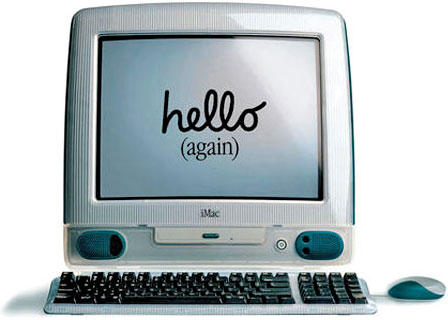
The "Pro. Go. Whoa." tagline of the introduction of the original (Bondi Blue) iMac was something that was actually pretty astonishing and well worth the -- rather low-key, in retrospect -- hype going into it. The iMac itself was advertised displaying the infamous 1984 "hello" image on its front:
http://lowendmac.com/wp-content/uploads/hello-again-imac.jpg via
http://lowendmac.com/1998/1998-good-bye-newton-hello-os-8-1-wallstreet-and-imac/Since we don't have Jobs around any more, I'm not really sure what to expect. New form factors, perhaps, but it's weird to think of Apple caring much about its Mac line nowadays.
Whatever it is, it better be good.
-
If Steve Jobs were still around...
... I would actually be expecting something pretty amazing right now.
The "Pro. Go. Whoa." tagline of the introduction of the original (Bondi Blue) iMac was something that was actually pretty astonishing and well worth the -- rather low-key, in retrospect -- hype going into it. The iMac itself was advertised displaying the infamous 1984 "hello" image on its front:
http://lowendmac.com/wp-content/uploads/hello-again-imac.jpg via
http://lowendmac.com/1998/1998-good-bye-newton-hello-os-8-1-wallstreet-and-imac/Since we don't have Jobs around any more, I'm not really sure what to expect. New form factors, perhaps, but it's weird to think of Apple caring much about its Mac line nowadays.
Whatever it is, it better be good.
-
Re:Doll. Fin.
Learning the American style of trying to stuff all punctuation inside quotes always seemed like a sort of madness to me.
Here is an interesting read that might broaden your stylo-linguistic horizons.
There are so many instances when placing punctuation outside the quotation punctuation makes infinitely more sense, 'style guides' be damned.
-
The lamp, or the Apple ][
The first lamps were a candle or something. These days, electric with LED lights or whatever, but either way: light when you want it, not just when the sun is up? Light where you want it... for example, in a cave, or in a building? Pretty huge.
Does "lamp" qualify as a gadget? From TFS:
Rather than rank technologies—writing, electricity, and so on—we chose to rank gadgets, the devices by with consumers let the future creep into their present.
Huh, all their choices were brand name items and all recent technological items.
Okay, more influential than anything else on their list: the original Apple ][ computer, which (combined with VisiCalc) jump-started the personal computer revolution. It deserves a place on that list more than whatever fine model of ThinkPad they picked, more than Raspberry Pi, more even than the Commodore 64.
-
Re:Tired it a few weeks ago
Absurd?
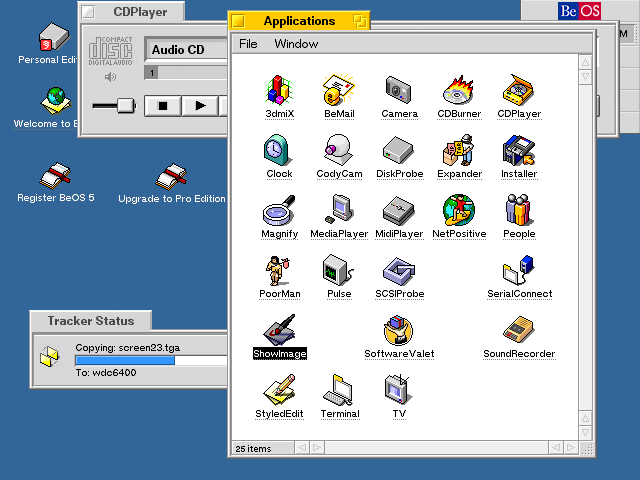
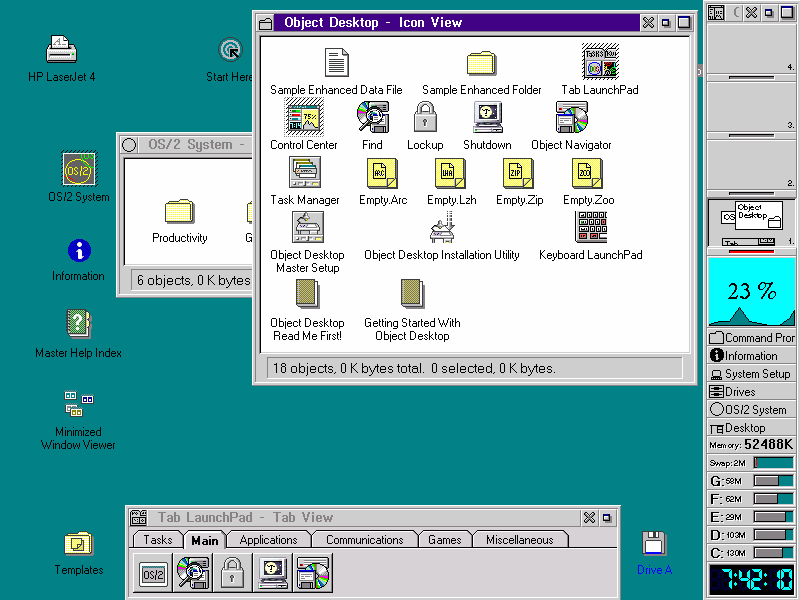
No. The ones I know which worked just fine.I used MUI + MagicWB because it's an improvement over AmigaOS Workbench but still about the same. Afterstep because Next, NextStep, Steve Jobs and that it was a decent UI. I guess BeOS and OS/2 could had been thrown in too:
http://lowendmac.com/wp-conten...
http://ps-2.kev009.com/michaln...
CDE because it's the standard(?) or was on Solaris machines(?), I don't know what it replaced if anything.
FVWM is very configurable so I don't know if any of the looks are standard but it's old, known and look typical enough.All those in total are six different examples of user-interfaces I think look pretty decent. They are all "complete different" which was kinda a joke with saying "the standard" but on the other hand looking at them like this they kinda all is very similar with highlightened and shaded buttons to give them a 3D feel / separate them, and lines and grey. Maybe it's not the best user-interface but it's very clear were everything is.
Like now I use Chrome but if I minimize this window then Steam sit behinds with it's completely own user-interface with much smaller buttons so I can't simply press on the same spot multiple times to minimize all my windows because they don't line up. How much of a crappy design isn't that?
Also the damn close button which sit in the corner of the window where if the window for whatever reason isn't fully maximized you may accidentally close some other window behind it or whatever it is which may happen. Also in Windows the close button sit together with the rest and even up until this day not all programs KNOW TO ASK WHATEVER ONE REALLY WANT TO CLOSE THEM DOWN!! Something like Chrome will just close the window / shut down and that's it. No "Do you really want to close this window with 35 tabs?" - no such thing, just close it all down!! No worries!
One the one hand I've kinda liked custom user interfaces when they are done right - like with Adobe Lightroom maybe I can accept it - I guess the difference is within whatever they live on a separate full screen themselves and have their own work-space or whatever they are windowed applications sharing the environment and space with other programs.
I guess in general I'm against non-standard user-interfaces AS LONG AS THE STANDARD IS A GOOD ONE.
Take KDE for instance - tool-bars, large tabs, vertical text written in rotated mode! Tree structures for selections here and there. I hate it. I'm ok with KDE as such but the user-interface is shit. I like that it's one environment but the user-interface used for it all isn't the best it could be IMHO.
In Windows I hate that I can't pull a drawer from explorer into a file selector dialog to enter that directory (or a file either I guess), I have to navigate through their explorer within the file selector dialog.I don't really know how this is on topic on the user-interfaces above let alone the
Oh well, back to topic then I guess:
I liked the old Opera - I like clever features and Opera was the inventor of many of them. The new Opera (and Edge) lost capabilities and I hate that. However Opera doesn't follow the native user-interface and I don't like that. I dislike tabs which somehow holds close gadgets within them which will be really cramped and when you want to switch tab you may eventually close one instead because supposedly it also held a close gadget.
So much poor design in user-interfaces. But I like the FEATURES of the good old Opera and Vivaldi. -
Re:Is it the year of the Linux desktop yet?
Yup, only with a Mac you fall out of support entirely - a Mac Pro released in 2006 wasnt supported by an OS Apple released just 6 years later. Runs Windows 10 fine however. Hows that for stupidity?!
However, for the savvy Slashdot reader, you can easily make that first-revision 2006-2007 Mac Pro run later versions of OS X than 10.7 (Lion). I will admit, there are a few gotchas; but all in all, it works.
Here's another article that goes beyond the first one, giving Yosemite (and very likely beyond) compatibility. Oh, and the next Mac Pro hardware revision, 2008, apparently has no problems running the latest OS X. So, that would be eight years of support for that model (so far). -
Re:This now removes all doubt...
Jobs got the idea for NeXT from the Big Mac project, when he discovered the 128k Mac wasn't "insanely great" after all.
Savvy? He didn't even know what a "http://www.folklore.org/StoryView.py?story=Whats_A_Megaflop?.txt">megaflop was.
-
MenuChoice and HAM (1992)
System 7, introduced in 1991, had an Apple menu, which held shortcuts (called "aliases") to applications. Third-party extensions such as MenuChoice and HAM, released the following year, allowed aliases to be grouped into folders. (This is exactly the behavior that Microsoft would later implement in the "Programs" section of Windows 95's Start menu.) Apple later bought the rights to HAM and integrated it in System 7.5 (1995) under the name Apple Menu Options.
-
Re:Win7 is likely to be my last Windows
LOL, that looks like shit compared to Dexpot.
Are you high?
Not only does that look almost exactly like Apple's first incarnation of Spaces in OS X 10.5 (Leopard), almost a decade ago; but the video I watched warned about Dexpot wanting to install a "Speed Up My PC" application. Nice touch.
Unimpressed. Totally. -
Re:Why?
Actually this is hilarious. I remember the first version of MS Word that ran on the PPC Macs, it used a translation layer so they could use the Windows code on the Mac. It was a Dog, it ran slow and crashed often.
Sorry, sonny; that isn't even close to being correct.
The abomination that you are thinking of was MS Word 6.0 (IIRC) for Mac. Notice the "6.0" part of the name. That really does mean that it was the sixth major version of MS Word for the Mac. And it was truly horrible.
What you apparently don't know is that MS Word (and Excel) were available in GUI form for MacOS for at least two major revisions before a fully-GUI version was released for Windows.
Sorry for the Mac-centric link; but it was the only place that I could find that had the dates correct. I personally used MS Word 4.0 for Mac pretty much until the end of MacOS (Classic) in 2001, and it was very stable and "just the right size". Note that this article confirms that the awful, "ported" (emulated) version is Word 6.0...
I didn't know about the Xenix version, or that it was designed by Xerox PARC guys. So, technically, the Mac version was the second GUI version, I guess, then Windows was the third.
Now, get off my lawn! -
Re:It helps to actually use the thing.
The "specs" on RAM limits usually under-represent the maximum possible. The reason is that when the specs are released, the chip sizes needed for that maximum likely do not exist, and Apple doesn't want to advertise something it can't test. If you check the lowendmac page (assuming I found the right one), it says there's a 16GB limit.
I vaguely recall that the reason Apple is pretty strict about this is because of the Mac SE/30, which didn't have 32-bit clean ROMs, limiting it to 8MB. The physical limitation was 32MB with 4MB simms, or 128MB with the very rare 16MB simms. (16MB simms were very expensive when new, the most memory you can put on a 30-pin simm, and only came out right before everyone switched to dimms.) They bought out the Mode32 product from Connectix, rather than produce a new ROM module, to avoid a class-action lawsuit. (FWIW, you can install a Mac IIfx ROM into an SE/30, removing this limit. If you ever find a IIfx, putting its ROM in an SE/30 is a better idea than trying to upgrade IIfx's unusual RAM.)
-
Re:Not mysterious. Just lousy.
To address some of your concerns:
You really need to get a hackintosh. Go to tonymacx86 and read up the most recent recommended hardware. When installing, make sure you start with the latest Mavericks, and the early versions required bootloader trickery with integrated Intel graphics. The most recent release doesn't need anything special besides the usual multibeast treatment. I have one and I'm not looking back.
You probably have a Lion-compatible MBP, with something like AMD X1xxx graphics, right? If there's a 64 bit graphics driver kext for it in Lion, then you can run Mountain Lion via tiamo's boot.efi - simply copy the driver over from Lion. It'll work fine (BTDT). For original Mac Pro, it's even easier, all you need is the new boot.efi, a compatible graphics card, and you can boot Mavericks. Read here for details. In all cases, though, don't use Mavericks or Yosemite without an SSD for the OS itself. Even a 100GB SSD will be sufficient. I have nothing but stellar performance on "old" machines that were the first ones that still support Mavericks, but without an SSD it's essentially unusable.
Now THAT'S what Just Works(tm) means!
-
Re:Not mysterious. Just lousy.
To address some of your concerns:
You really need to get a hackintosh. Go to tonymacx86 and read up the most recent recommended hardware. When installing, make sure you start with the latest Mavericks, and the early versions required bootloader trickery with integrated Intel graphics. The most recent release doesn't need anything special besides the usual multibeast treatment. I have one and I'm not looking back.
There's simply no hardware I could buy from Apple to give me the same functionality at any realistic price point - especially that I really like to reap benefits of all-in-one testing done during hardware and software development at Apple. The new Mac Pro is fine and dandy if you have all of your storage and PCIe cards in a single external enclosure, but that makes it just too expensive, and you're shelling lots of money to someone else but Apple, the warranty doesn't cover the enclosure, it's not tested and validated during the OS X development, etc. Even then, if you bump the tiny thunderbolt cable, you crash. It's not that hard to put it all in one case, as the "old" Mac Pro demonstrates. They could have slimmed it down and modernized it. With some clever engineering, a modern Mac Pro with drive caddies and card slots could have still been very, very compact.
You probably have a Lion-compatible MBP, with something like AMD X1xxx graphics, right? If there's a 64 bit graphics driver kext for it in Lion, then you can run Mountain Lion via tiamo's boot.efi - simply copy the driver over from Lion. It'll work fine (BTDT). For original Mac Pro, it's even easier, all you need is the new boot.efi, a compatible graphics card, and you can boot Mavericks. Read here for details. In all cases, though, don't use Mavericks or Yosemite without an SSD for the OS itself. Even a 100GB SSD will be sufficient. I have nothing but stellar performance on "old" machines that were the first ones that still support Mavericks, but without an SSD it's essentially unusable.
-
Re:Tesla's taking a cue from Apple
One word: Performa
But there were still some pretty bad models sold without the Performa mark of crapulence. I once got a Power Mac 4400, one of the ten worst Macs ever, from a CompUSSR and realized how bad it was, so a few weeks later I sold it to a friend. I still feel bad about that.
-
Re:Hardware age
Indeed. Per Low End Mac the last G5 iMacs were released in October 2005.
-
Online gaming prior to Xbox Live (also Macs)
[Microsoft] came up with the XBox, and established online gaming as a serious thing
Xbox Live came out in the fourth quarter of 2002. By that time, EverQuest had already been out for three and a half years. So I must be misunderstanding what you mean by "serious thing".
MS came up with a completely new UI.
If you call At Ease "new".
Everyone complained and bitched because they removed the "start" menu
That's because the new Start screen in Windows 8 was full-screen, completely covering up the windows of the task you're working on and removing any context for an additional application that you're adding to a particular task. In Mac terms, it was like going back from MultiFinder to Switcher or like having At Ease forced on you.
which incidentally was another MS innovation
Nope, that was Kerry Clendinning in 1992. In System 7, Apple made each "desk accessory" run in its own process and stored them in separate files within the Apple Menu items folder instead of resources in the System file. By doing this, Apple turned the Mac's Apple menu into a rudimentary quick launch menu. A third-party extension called MenuChoice allowed the creation of program groups inside the Apple menu, and Apple acquired one of MenuChoice's competitors to incorporate the functionality into System 7.5.
-
Re:Well
They were around in 94, but they were relatively expensive and rare. That res usually required a fancier video card too to get a better DAC.
Here's a good example from the Mac world c. 1995, offering accelerated 1600x1200 resolution and multimonitor support. It was definitely high-end (~$3500) if you wanted true color at that resolution.
-
Re:It's not about innovation
The design is OBVIOUS.
this argument is invalidated by Samsung successfully carving niches for a 5" note, a 7" tablet, and phones with wider and taller screens than the iphone's. the iphone itself has also grown an extra row of icons in height. there are criteria regarding screen size selection that have outgrown the original 'human hand' argument.
Rounded edges. Wow. Not having rounded edges are uncomfortable in your pocket. Oblong, well oval or round phones are not comfortable in your pocket either and you'd also like something that doesn't use more space other than to house the required components, of which the size of the touch screen is probably the most important factor.
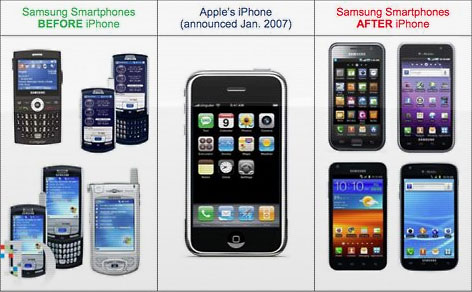
I too, have 20/20 hindsight. You also focus on the hardware design, and fail to acknowledge the blatant copying of the the IOS look and feel. it wasn't accidental, there are 132 pages which look at every aspect of the iphone with the intention to copy software features wholesale.
Most people handed the same components would come up with the same generic design.
This is precisely the argument, except the components were proprietary at the time. During the development of the phones in dispute, Samsung was responsible for mfg. parts for the iphone and ipad, including screen. of course they would have intimate access to the components ahead of the competition, which is how apple stays ahead. Samsung abused their agreements with apple, and were given an unfair competitive advantage./p
-
Two-page monitor helps you RTFA
in an era where almost all monitors are WIDESCREEN
Modern desktop PC monitors have 1920x1080 pixels. This is bigger in both dimensions than the 1152x870 pixel, 19" VIS "two-page monitors" sold from 1989 to 1992. So if your monitor is as big as a two-page monitor, you can unmaximize your and display two web pages in 960-pixel-wide windows: one with Slashdot and one with the featured article. Being able to refer to the article in replies to other Slashdot users' comments is a one-way ticket to more (Score:5, Informative) posts.
-
Re:Wow, they managed to break the idea of a cable!
The mac 128k and 512k had proprietary de-9 ports for mouse, printer and modem and iirc, an Rj-11 port for the keyboard. The mac plus introduced the mini-din 8 ports for the modem/printer, which had the advantage of being small enough that the designers could squeeze in a db25 for SCSI though that miniature connection ended up being the cause of much SCSI voodoo. The proper connection for SCSI is huge.
At some point, apple started using the RS422 standard for serial. The printer port was rather fast (230kbs) and could be used for LocalTalk, a crude network interface.
The. Mac SE and later macs used a miniDIN4 for the Apple Desktop bus, usually used for daisychaining a mouse to the keyboard, but other things such as joysticks (if you could find one) or dongles could be attached. Kind of like a slower, less exasperating version of SCSI. (I recall programming a gameSprocket driver for my. macAlly Joystick) Don't recall the exact details, but each device had an device id along the same lines as a USB manufacturer id/device Id. -
Re:CEOs are overrated
Good Ol' Spindler. Apple really hit rock bottom with him and almost sold to Sun. Don't forget Gil Amelio, the guy Steve Jobs back stabbed to take over Apple again. http://lowendmac.com/2013/the-rise-and-fall-of-apples-gil-amelio/
-
Re:RAM data retention
I don't recall any of my early Macs (starting with the Mac Plus) bootable to Mac OS in ROM, although large parts of what we'd now call system libraries (Mac OS Toolbox) were in ROM but were commonly relocated to RAM with patches and upgrades. I still think they required booting from an OS boot media and I don't think Finder was in ROM.
The bootable ROM was something exclusive to the Mac Classic. From Low End Mac:
A feature unique to the Classic is the ability to boot from ROM by holding down command-option-x-o at startup. The ROM Disk is called "Boot Disk" and is 357 KB in size. The ROM Disk uses Finder 6.1.x and System 6.0.3 -- this combination is specifically designed for the Classic. The only control panels are General, Brightness, and Startup Disk. MacsBug and AppleShare Prep are also part of the System, which loads into 294 KB of the Classic's RAM. Because this is in ROM, there is no way to add anything to the ROM Disk.
It was a neat little feature. The machine was underpowered for its time, but it had this one thing that nothing else did. (And sometimes I still miss the compact form factor). -
The NeXT CyLINDER
So, Steve Jobs gives us the NeXT CUBE and Cook and Co. give us the Mac Pro CyLINDER.
-
Re:And...
Your aren't alone. A lot of people are sticking with Snow Leopard due to its speed, stability, and more importantly, its ability to run PowerPC apps. http://lowendmac.com/roundtable/12rt/038-snow-leopard.html
A similar situation exists with Tiger, the last PowerPC version of OS X that can run Classic and runs much faster than Leopard ever did on those machines. -
Re:Doorway amnesia, gorilla arm, and 2-page monito
How would these 720p-class displays (1280x720 WXGA and 1280x1024 SXGA) not admit two Word documents? Word existed in the 640x480 era, and at a nominal 96 dpi, 640 pixels cover 6.67 inches (169 mm), or the width of a US letter or A4 sized page minus standard 1" or 25 mm margins. Heck, back in the day, an XGA+ (1152x870) display was considered two-page.
You forget that applications have changed. Have you actually tried looking at two word documents side by side on a 1280 screen? It's the same with the web -- back when smaller displays were common, pages were designed for smaller pages, but as displays have grown, so has the standard width of a page, which then interferes with the ability of the larger displays to accommodate two pages side-by-side.
-
Doorway amnesia, gorilla arm, and 2-page monitors
I'd say any task in which you traditionally would have overlapping windows rather than side-by-side windows would be a case where switching between full screen views wouldn't be so bad. The utility of the overlapping windows is to give you an easy way to remember what else you were doing and how to get back to it
In an overlapping mode, the user can always see at least a sliver of the other window, which prevents doorway amnesia by giving the user's subconscious mind a continuous cue that the thing in the other window still exists. Preventing something from ever being completely out of sight prevents it from being out of mind. It also gives a drag and drop target when moving or copying an object from one window to another, which is faster than long-pressing an object (where a short press is bound to Open), tapping Share, and selecting the correct application from a long list.
getting to your "last" task is especially fast w/ touch on Windows 8
Which sucks for devices without a touch screen. It also sucks for laptop and desktop computers with a touch screen because of the gorilla arm issue.
Finally, I'd add that on most laptops, side-by-side screens aren't really that great: a typical laptop at 1280 or 1360 pixels wide doesn't really allow two standard webpages or word documents to be displayed next to each other
How would these 720p-class displays (1280x720 WXGA and 1280x1024 SXGA) not admit two Word documents? Word existed in the 640x480 era, and at a nominal 96 dpi, 640 pixels cover 6.67 inches (169 mm), or the width of a US letter or A4 sized page minus standard 1" or 25 mm margins. Heck, back in the day, an XGA+ (1152x870) display was considered two-page.
-
Re:When things lasted
Back in the 90s, a company called Northgate Computer Systems,
You're looking for a CVT Avant Prime or Avant Stellaris. CVT bought out Northgate and continued to sell the keyboards but appear to have stopped selling them as of last year (yes, 2011.) Your best bet today is Bob Tibbets or Matt Morse, who have kept the Northgate flame alive. (A recent review.) Tibbets and Morse maintain a small stock of keyboards for sale.
-
How About an Entire Operating System?
Someone handed you a Macintosh Classic with a corrupted OS and no system discs?
Turn it on and hold down Command-Option-X-O. There's a fully bootable copy of System 6 in the ROM. -
Re:At first I thought the Judge was biased
The iPhone has never been more than 20-30% of total smartphone sales.
Perhaps, but what I actually said was that Apple fans *claimed* it was higher, and they would link to some page like this as evidence ("If you look at this January 2009 data, The iPhone was actually less than half of a percentage point away from owning 70 percent of the mobile browsing market.") or "iPhone grabbed 72% of smartphone market share in Japan" or "iPad owns 96% of enterprise market and iPhone share climbs to 53%". And even now we are seeing stuff like "Apple's iPhone Has Staged A Monster Comeback, Android Is Now Dead In The Water". Yes, a platform that with almost a million phones being activated every day is apparently now "dead in the water". Those Apple marketing guys are good at getting their message broadcast.
Apple's share has never amounted to a large percentage of computing device sales.
According to this, Apples market share in 1980 was 15%. Okay, that is "huge" on the scale of all PC clones combined, but it beats out the market share of individual manufacturers like Dell and Lenovo today. This article says "In 1984, the Apple II had 15% of the market, Apple's best showing ever. (When combined with the Mac, Apple had over 20% of the market that year.)". The same page says that Apple's low point in 2001 was 2.3%. So from a high of 20% to a low of 2.3%... that's a big fall, losing 88.5% of the market, which was my real point.
-
Re:These are secrets?
Choosing colors for code names has been done at least since WWII. Apple used to work on an operating system project called Pink which was a disaster. Then there are the Yellow Box and Blue Box monickers they used a couple of years ago. These quaint little details of how Apple works are besides the point however it does show Apple's paranoid tendency towards secrecy. Remember that Foxconn employee who died after losing an iPhone prototype a couple of years back?
-
Re:Apple must be trembling with fear
Apple was never in that shape. They had billions in the bank. The issue was MS continuing Office support
“We were 90 days from going bankrupt.” - Steve Jobs.
More details. and from a Mac fan site perspective
So basically, yes, they were in that shape, no, they did not have billions in the bank.
-
Re:N00b
56k modems in the US are/were limited by FCC regs to about 53k.
From this url:
The chilling news came just days before U.S. Robotics shipped its x2 modems: the FCC won't let modems transfer data at a rate faster than 53 kbps. The legal snafu has to do with a long-standing FCC regulation known as Part 68, which was never intended to affect modems. The problem is that if you send too much power through the phone line, your conversation can get loud enough to creep into neighboring lines. This is called crosstalk, and Part 68 was meant to prevent it. But to reach 56 kbps, the new modems must send more power down the line.
-
Re:Cultists
http://hardware.slashdot.org/comments.pl?sid=2982693&cid=40667911 (Exactly one post up from yours in response to the very same thread question).
But thanks for playing.
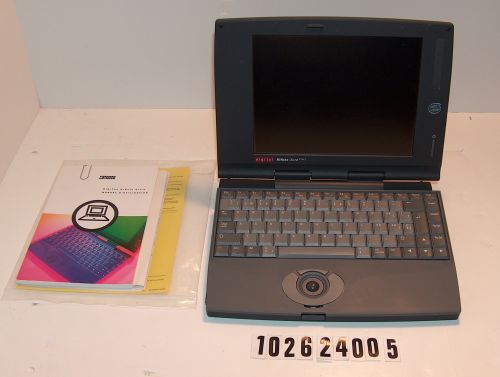
Allow me to retort and prove you a liar and the venerable slashdot post you cite as mistaken. I can't help but notice there is no actual reference to a DEC model number that could be checked... but I did notice there is an "Intel Inside" sticker on the laptop in the picture. Observe the powers of the mighty Google search and the humblest of internet research (my emphasis):
In 1991 Carter launched the Intel Inside® coop marketing program. The heart of the program was an incentive-based cooperative advertising program. Intel would create a co-op fund where it would take a percentage of the purchase price of processors and put it in a pool for advertising funds. Available to all computer makers, it offered to cooperatively share advertising costs for PC print ads that included the Intel logo. The benefits were clear. Adding the Intel logo not only made the OEM's advertising dollar stretch farther, but it also conveyed an assurance that their systems were powered by the latest technology. The program launched in July 1991. By the end of that year, 300 PC OEMs had signed on to support the program.
Source: 11th paragraph down
The PowerBook was launched in October of 1991. I can't see what model laptop that is, nor do you or the cited slashdot poster offer this guarded information. In the late summar of 1991, Intel was scrambling to get their now famous (or infamous) "Intel Inside" campaign off the ground and find computer manufacturers to adopt the campaign and use the sticker. Considering DEC and Intel were invoved in a bitter patent dispute concerining the chips until it was finally settled in 1997, I suspect that the DEC laptop pictured was not released within the three months between July and October of 1991. Suffice to say, it is enough to prove the OP was mistaken... that computer could not have been released in 1990.
Apple indeed was the originator of this wrist-rest laptop design, and the design was very rapidly duplicated by all manufacturers of laptops. It is not cult, attempt at deception or self-delusion. It is a verifiable fact.
Thanks for playing.