Slashdot Mirror
Domain: nature.com
Stories and comments across the archive that link to nature.com.
Comments · 2,953
-
Re:The only thing I agree on with the conservative
The science here is quite clear, as this Nature piece explains. If you choose to ignore the science, then of course you're free to do so. But that doesn't make the science wrong and the conservatives right.
-
Re:Cue the science deniers in ...
A simpler thought experiment is to consider a cessation of emissions (which is what we ultimately need to achieve). If you're curious then you should read this paper: https://www.nature.com/article...
It includes this quote on thermal inertia: "A widely held misconception is that given the approximately 1 C warming to date, and considering the committed warming (warming that will inevitably happen) concealed by ocean thermal inertia, the 1.5 C target of the Paris Agreement is already impossible. However, it is cumulative emissions that define peak warming. When carbon emissions cease, terrestrial and marine sinks are projected to draw down atmospheric carbon dioxide (CO2), approximately cancelling the lagging warming. Although the sign of this ‘zero emissions commitment’ is uncertain, its contribution can be neglected for low-CO2 scenarios. Therefore, at least when considering CO2 emissions in isolation, keeping below 1.5 C of warming will remain physically achievable until the point that it is reached."
-
Re: Uh oh.
I wouldn't call them anti-science so much as anti-progress of any type.
Indeed: they are anti-science because they are anti-progress.
It blows my mind that such people can thing of themselves as "green". Bronze-age farmers clear-cut forests for farmland everywhere they lived. E.g., the Scottish highlands used to be heavily forested, but were almost entirely clear-cut. Meanwhile, thanks to progress, US forested area increased dramatically in the last hundred years. Even though it's a mix worldwide (third world nations are still clear-cutting in some places), worldwide forest corverage has increased more than 7% since the 1980s.
Progress makes life better. That's why we call it progress.
-
First???
China has succeed achieving this years ago and from space too. When have American scientists got in the culture of making false and exaggerated claims?
-
Re:i mean, is this trustworthy?
the closest thing to reportage here is links to a blog and also a graph of some sort i honestly don't have time to bother figuring out.
The graph is showing that every available temperature data set, whether it be it from USA or UK, land or satellite, and even those by skeptics - all show the same thing. Temperature is warming by about 0.2C/decade. The later period is warmer than the former. The climate modeler had greater insights into the mechanisms that affect global mean temperature than the solar physicists. The winner is clear.
For more authoritative reportage, you can read this nature article from when the bet was made, this New Scientist's article on Five scientific theories decided by wager, or this Russian article on why the losers welched, even though they lost.
-
Re:and this is news because...
Is that what the news on slashdot is now... every time two random dudes make a bet, if one does not pay up, it's an article on slashdot?
This wager was written up in Nature at the time of the bet. It was included in New Scientist's Five scientific theories decided by wager It is included in Wikipedia's article on scientific wager.
If your wager is literally included in the definition of a scientific wager, then I would not be shocked to find it written about.
-
Re:The environment has too little CO2
What has been happening however is that plants are getting bigger from the increases in CO2, and their nutritional value has been rapidly decreasing, which has a knock-on effect.
That is only half the story. - and the scare-mongering side at that.
Yes, increasing CO2 does decrease nutritional value per unit volume by about 8%. However, increasing CO2 also cuts water use by 5-20% and increases plant volume by 40%.
So yes, you need to eat 8% more to get the same nutritional value, but you end up with 40% more to start with, so it's not an issue. You can, in fact, feed more people (approximately 28% more people) and also increase your freshwater reserves significantly as well. A higher CO2 level would, in fact, provide a solid food/water bump for the world.
-
Meat Made US What We Are
As a new study in Nature makes clear, not only did processing and eating meat come naturally to humans, it’s entirely possible that without an early diet that included generous amounts of animal protein, we wouldn’t even have become human—at least not the modern, verbal, intelligent humans we are.
-
Science vs Existential Threat
It's interesting that the comments have skewed toward a fear, an existential fear, of this research. MIT Tech Review (https://www.technologyreview.com/s/612124/clearing-out-old-cells-might-help-the-brain/) on 9/19/2018 first caught my eye. The goal seems less about extending one's lifespan as retaining 'vigor' as we age. The diseases, age-related impairments, that are within the scope of this research are considerable. I haven't seen any documentation about the possible benefit of longer life. Doesn't sound unreasonable, however. We have a serious problem with ageism in the States. In the Bay Area, the 40's can be more than just a bump in the road for your career. More like a concrete barricade. We take for granted that there'll be a decline in our quality of life rather early on.
For those with the appropriate science background, here's a relevant article from Nature: https://go.nature.com/2PkZqLR (hope this shortened url works, the original was tremendously long). Also, under patent 9,980,962 May 2018, the abstract states, "Methods are provided herein for selectively killing senescent cells and for treating senescence-associated diseases and disorders by administering a senolytic agent. Senescence-associated diseases and disorders treatable by the methods using the senolytic agents described herein include cardiovascular diseases and disorders associated with or caused by arteriosclerosis, such as atherosclerosis; idiopathic pulmonary fibrosis; chronic obstructive pulmonary disease; osteoarthritis; senescence-associated ophthalmic diseases and disorders; and senescence-associated dermatological diseases and disorders."
In sum, not scary at all. At least to those with related conditions or the possibility of same. And that's just about all of us.
-
Re:Europeans saving the world with superior genes?
Graph of populations with neanderthal DNA and without vs average IQ would be an interesting one.
That would be best, though we could make some progress without that because natural geographic boundaries have produced step function in DNA mixing by isolating human sub-populations, making geographic location a good proxy for Neanderthal DNA admixture. The genetic makeup of the Americas is complex because of their complex recent histories of migration, but for the old world (Europe, China, Africa) geographic location of populations is a reasonable proxy. Europe and Asia have a few percent admixture while sub-Saharan Africa has about no neanderthal-specific DNA. Here is a map of IQ by nation.
There are a few important caveats about drawing from those comparisons any inferences about the influence of Neanderthal DNA on IQ:
There have been isolated ancient backmigrations into Africa which presumably introduced some Neanderthal DNA into at least Ethiopia, but who knows what the dilution has been over the millennia?
There is a lot of conjecture about how much IQ could be boosted in Africa as a result of improvements in medicine and nutrition and consequent gains from the Flynn Effect. (Comparison between native Africans and those of pure African descent raised in western nations might be the best predictor.)
Selective pressures in Europe and Asia wold have applied to immigrating African populations after their arrival, so that the higher IQs seen in more northern regions could be the result of selection for adaptive genetics pre-existing in the arriving population, as opposed to genetics introduced by admixture from native Neanderthals. Your graph suggestion would help to tease apart those two hypotheses except that it would need to be a graph of individuals, not of populations.
-
Re:Why?
Except that the research shows that psilocybin works well, without the ongoing side effects typical of standard drugs, and it works in situations where other treatments fail.
-
Re:science not emotion
Big claims. Where's your sources?
Everywhere.
"China's Emissions: More Than U.S. Plus Europe, and Still Rising". New York Times. 2018-01-25.
"Chinese coal fuels rise in global carbon emissions". The Times. 2017-11-14.
"Yes, The U.S. Leads All Countries In Reducing Carbon Emissions". Forbes. 2017-10-24.
"World carbon dioxide emissions data by country: China speeds ahead of the rest". The Guardian. 2011-01-31.
"China now no. 1 in CO2 emissions; USA in second position". PBL Netherlands Environmental Assessment Agency.
"China CO2 emission accounts 1997–2015". Nature. 2018-01-16.The most recent numbers are for 2016.
Country Fossil fuel CO2 emissions (kt) in 2016
China 10,432,751
United States 5,011,687See how that first number is bigger than the second one? See how that first number is in fact double the second one? The title of the first link is correct: add up US emissions and the emissions of every single EU country and combined they're still less than China. You can also perform the same exercise with the Americas. Add up US, Canadian, and Mexican emissions, plus the emissions of every single country in Central and South America, and that total is still less than China.
China is improving their standard of living. China has improved, past tense, their standard of living. They have gigawatts of electrical generation they didn't have 20 years ago. And before you start whinging about how other countries have outsourced their pollution to China, read the live link on Nature.com. Between 1980 and 2002, China's emissions were growing at 8% per year. Those were the outsourcing years. At the end of that period, they were only emitting 3,694,000 kt annually. After 2002, the number jumped to 13% per year, and sustained that through 2007. Those were their standard of living improvements. In 2018, China is estimated to emit 30% of all CO2 globally. The US is estimated to emit 15% of all CO2 globally.
The big emitter is China.
-
Re:Oh boy, so much fail in one post.
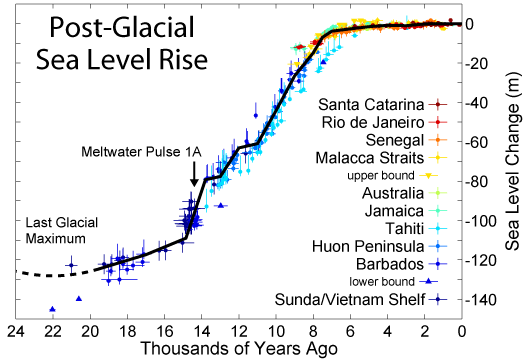
So you don't dispute sea rise has been negative for about six years?
That's a start I guess.
The rest of your argument pretty much doesn't matter after that now does it? You haven't found fault with either the data or the logic here, and merely sought clarification of one part you don't understand.
So in case you don't resistant quite what what you're looking at, here goes.
Because nominal sea was was unchanged for about 8000 years, never went up, that was an error, and six years ago flipped when ice began growing again.
Perhaps I explained that badly in my post. Please allow me to try again.
If you look at the longer term map you can see the sea rise for the past 8000 years was pretty constant. Then, six years ago it began falling. I did not try to make a graph like that with only six years but if you were t try the tool at nasa to get just the last 10 years it gives you this, at least it did with my browser, why don't you try it?
Now, there were spurious reports of "sea rise" in Miami but not, only 50 miles away, in the Florida Keys it was not rising. This was found out to be because Miami was sinking, as was Beijing, by about four inches a year because the silly fucks pumped all the groundwater out. You know how nature abhors a vacuum.
Here's the long history of sea rise:
http://rs79.vrx.palo-alto.ca.u...
Look around 8000 years back. See that? That's the 33,3 century nominal sea rise.That stopped a few years ago.
Now, if you look at the same time period in the NSIDC graph is ice, you'll see there's a corresponding uptick in sea ice:
http://rs79.vrx.palo-alto.ca.u...Ok? So uptick in ice, seas fall. Got that now?
Nore that carbon dioxide also flarlines 6 years ago.Here's the stuff on the error in sea rise measurement in Miami:
Here's a picture of it:
http://geologylearn.blogspot.c...
Here's thr article in Nature about Florida.
http://www.nature.com/news/sou...
Here's the article about Beijing.
http://www.theweek.co.uk/73907...Here's the Co2 flatline stuff:
2015 CO2 has flatlined.
13 March 2015 Data from the International Energy Agency (IEA) indicate that global emissions of carbon dioxide from the energy sector stalled in 2014, marking the first time in 40 years in which there was a halt or reduction in emissions of the greenhouse gas that was not tied to an economic downturn.
http://www.iea.org/newsroomand...2016 CO2 flatlined for a second year in a row.
"The IEA reports that for the second year in a row, the world economy has grown while energy-related CO2 emissionsremained flat."
http://thinkprogress.org/clima...2017 CO2 emissions remain flat for a third year.
IEA finds CO2 emissions flat for third straight year even as global economy grew in 2016 17 March 2017.
https://www.iea.org/newsroom/n...MIT Technology Review also reported the fact CO2 stopped rising as well.
https://www.iea.org/newsroom/n...It doesn't matter what you "believe". The facts are, seas a falling, ice is growing and coe
-
Re:Caution
Actually, people have thought carefully about the ramifications. Firstly, note that only ~200/3500 mosquito species actually target humans. Probably, not even all these 200 human-biting mosquito types carry malaria, and not all of those carrying malaria have that high risk of transmission. If you drive the specific malaria-carrying human-biting mosquitoes extinct, it's not unlikely that other mosquito species will naturally fill their void, and that most predators will happily eat other mosquitoes too. We could even help them on their way, by releasing "safe mosquitos" in the same regions where we release "sterilized mosquitos".
Secondly, note that for many species, mosquitoes are not as large a part of their diet as people think, it's more of an opportunistic food source since they're slow and stupid. For instance, while many species of bats eat a lot of mosquitoes, it only constitutes ~2% of their food, since moths are larger and more nutritious.
Finally, it's estimated that malaria has killed roughly half of all people that ever lived. And that's just malaria; the same mosquitos tend to spread dengue fever, yellow fever, Japanese encephalitis, Rift Valley fever, Chikungunya virus, West Nile virus, and so on. We should also ask how much damage to specific ecosystems we are willing to accept to save a ridiculous number of human lives. -
Re:Caution
Actually, people have thought carefully about the ramifications. Firstly, note that only ~200/3500 mosquito species actually target humans. Probably, not even all these 200 human-biting mosquito types carry malaria, and not all of those carrying malaria have that high risk of transmission. If you drive the specific malaria-carrying human-biting mosquitoes extinct, it's not unlikely that other mosquito species will naturally fill their void, and that most predators will happily eat other mosquitoes too. We could even help them on their way, by releasing "safe mosquitos" in the same regions where we release "sterilized mosquitos".
Secondly, note that for many species, mosquitoes are not as large a part of their diet as people think, it's more of an opportunistic food source since they're slow and stupid. For instance, while many species of bats eat a lot of mosquitoes, it only constitutes ~2% of their food, since moths are larger and more nutritious.
Finally, it's estimated that malaria has killed roughly half of all people that ever lived. And that's just malaria; the same mosquitos tend to spread dengue fever, yellow fever, Japanese encephalitis, Rift Valley fever, Chikungunya virus, West Nile virus, and so on. We should also ask how much damage to specific ecosystems we are willing to accept to save a ridiculous number of human lives. -
quantity does not equal quality
That's nice, the largest nation in the world produces the most reseach papers got it. But are they mostly crap papers? https://qz.com/978037/china-pu... https://www.nytimes.com/2017/1... https://www.nature.com/news/20... Did the author of that peper just use numbers of papers written, just as they only used email addresses from within China to count Chinese papers?
-
Re:Why have nocotine at all?
Let me guess, you read to paragraph 4 and stopped.
While I doubt nicotine alone has zero addictive qualities, it almost certainly has a much weaker addictive effect by itself.
aaaaaannnnnnnnd Sssssscitation required!
It's nearly impossible to find any study on harmful effects of "nicotine" that don't turn out to actually mean smoking or occasionally chewing tobacco. So difficult, in fact, that OP's question isn't actually unreasonable at all.
Except the chemical effect of nicotine is readily known (and also explained in the link). And there are plenty of studies on the raw chemical itself. All it takes is a bit of Google, and if you need then a subscription to a journal or two.
The science is sloppy to say the least
I take it you're an AGW denier too? Just because you don't look for the specific science you're after doesn't mean it doesn't exist. It just means you have bad google-fu, or nature-fu if you're searching for a journal.
But hey, I'm at work so I didn't dedicate more than 10 second to the first search result: https://www.nature.com/article... a study on the isolated nicotine chemical and it's affect on the dopamine nurons. Better still, it compares it to cocaine! How do I get to be part of that study!
-
Re:Weatherbug says otherwise
Ok, here are a couple of non-Wikipedia sources on Arctic amplification:
Arctic amplification dominated by temperature feedbacks in contemporary climate models
Processes and impacts of Arctic amplification: A research synthesis
-
Re: We're hosed
modern environmentalism
I consider myself a level-headed person who sees the world reported to me by scientific study. I think you'd call me, therefore, a rabid environmentalist, and I'd call you a dogmatic, biased, neanderthal, stuck in the past, promoting buggy-whips.
But just in case you're capable of discussing topics like grownups, here's some real commentary:
I want to say thanks for opening my eyes a little about shale gas. I previously only knew that it probably caused local environmental damage like minor earthquakes and some correlation to flammable sink water. However, I'm not sure those effects are large-scale enough to dismiss the technology, given the real costly gorilla issue: climate change. Your comment and those above made me think more about it and look it up. I found, so far, that the real thing to consider with shale gas is methane leakage. The latest study I found says if it's kept below 3.2%, it's better than coal, and a 2009 study says it was at 2.4%, so I'm already on board with using shale to replace coal. I wonder if anyone can reply with more recent and definitive data.
However, "better than coal" is not necessarily good enough. I've lived through Hurricane Harvey. If that's indicating what the future holds, then the current cost of any fossil fuel is way higher than we think, we're just not paying for it yet. I therefore believe the best idea I've heard, is that we have to try and estimate that cost, and actually charge it so that we know what we're getting. A carbon tax that is calculated to cost less than 3% of GDP sounds right to me. I'm not mad if gas companies accidentally release methane, as long as they're paying the appropriate price for it. -
Re:Yes, but other property is increasing in value.
Meaning that if that were to occur, the lowest level in Missouri (230 feet above sea level) wouldn't be flooded.
By seawater.
Mississippi River flooding worse now than any time in past 500 years -
Re:Conflation of plastic and microplastic
I see a lot of claims with no sources or evaluations of magnitude or probability
Yeah but but pulling the claim that micro and nano plastics are completely harmless in every way out of your ass without a shred of evidence to back it up is just fine?
https://www.lunduniversity.lu....
https://www.nature.com/article...
https://www.iflscience.com/env...
https://phys.org/news/2018-02-...
https://www.sciencedirect.com/...
https://www.iflscience.com/pla... -
Re:The true cost of mining
Not only has millions of tonnes of greenhouses gases been produced due to mining
Where did THAT come from?
There were a couple of articles about Bitcoin and emissions last year.
-
End emissions and end warming
"stop burning fossil fuels", when before it was going to take eliminating CO2 emissions.
It's the same thing.
Your link was to a blog at wordpress
It's a quote from Holden et al. 2018. . The wordpress link is to spare you from having to buy the paper.
Well, it's nice that you notice. I'm echoing some of the crazier concepts that some climate change zealots pronounce.
Way to elevate the conversation.
It is caused by the heat trapped by the CO2 that comes from converting C and O to CO2.
What???
It is caused by the heat trapped by the CO2 that comes from converting C and O to CO2. That CO2 does not magically disappear at the end of the century, so warming caused by trapped heat will continue -- until the CO2 is actually reduced.
That all makes no sense.
Animals are not a carbon sequestering method. We take carbon and oxygen and emit it as CO2.
That carbon came from eating plants which got it from the atmosphere. That atmospheric carbon ends up sequestered (for a time) in the animal.
Just stopping the use of fossil fuels doesn't remove CO2,
Yes it does. Atmospheric CO2 will begin to drop when we stop burning fossil fuels. Read Holden et al. 2018 and it will become clear why. Read the paper.
-
Re:emissions determine warming.
I have never, as you well know, tried to pass off the "article" in no trick zone blog as scientific literature,
No, but the no tricks zone does. Some of the data points on that graph refer to blogs!
A graph, I might add, which WAS published in science litterature
I should hope not, given that it tries to pass off blog posts as scientific literature.
Here's one from April of 2017 which "produces a current best estimate of equilibrium climate sensitivity of 2.9C (1.7–7.1C, 90% confidence). " Included in the no tricks zone? Nope. Doesn't fit the narrative.
-
Re:emissions determine warming.
Wrong, but if you are interested in tricks you could carefully select a subset of studies to paint that narrative. Rather than tricks, I've cited the literature. For example, here's a study from this year that confirms a central figure of around 3C, and reduces uncertainty to the point where the probability of ECS being less than 1.5 degrees Celsius to less than 3 per cent, and the probability of ECS exceeding 4.5 degrees Celsius to less than 1 per cent.
-
Re:Severe bleaching is now 5x more frequent
It is not a recognized term by the ICS, who are the arbiters of what geologic epochs actually are.
If a term isn't a recognized epoch then it has no meaning? Google scholar returns about 59,200 papers.
Here's more research on the accelerating trend towards bleaching. This time in Nature:
Coral reefs across the world’s oceans are in the midst of the longest bleaching event on record (from 2014 to at least 2016). As many of the world’s reefs are remote, there is limited information on how past thermal conditions have influenced reef composition and current stress responses. Using satellite temperature data for 1985–2012, the analysis we present is the first to quantify, for global reef locations, spatial variations in warming trends, thermal stress events and temperature variability at reef-scale (~4km). Among over 60,000 reef pixels globally, 97% show positive SST trends during the study period with 60% warming significantly. Annual trends exceeded summertime trends at most locations. This indicates that the period of summer-like temperatures has become longer through the record, with a corresponding shortening of the ‘winter’ reprieve from warm temperatures. The frequency of bleaching-level thermal stress increased three-fold between 1985–91 and 2006–12 – a trend climate model projections suggest will continue. The thermal history data products developed enable needed studies relating thermal history to bleaching resistance and community composition. Such analyses can help identify reefs more resilient to thermal stress.
Got anything better than a conspiracy blog showing otherwise?
-
Re:Universal anticancer
they do not tell us how they managed to target cancer cells only.
The Nature article might tell how they did it. (I tried to read the article, but it was way over my head.)
-
To get less emissions, go after the worst emitters
...a 0.1% reduction in car emissions is much better for the total environment then if all emissions were eliminated from leaf blowers, lawn mowers, construction vehicles, etc.
A slight bit of critical thinking would do you a world of good.
A slight bit of researching the issue is also a great idea.
Motor scooters with 2-stroke engines pollute about three orders of magnitude more than a modern gasoline car. There are enough of these scooters that in many cities they are now a worse problem than gasoline cars yet they remain barely regulated.
Two-stroke scooters are a dominant source of air pollution in many cities
Scooters: Europe's Pollution Machines
If the scooters by themselves are enough to be a problem, it can only be worse if we add up all the 2-stroke engines of all sorts.
I pretty much hate 2-stroke engines. I am in favor of allowing them where nothing else will do, like professional chain saws. But modern battery tech has gotten to a place where an electric scooter ought to be a practical replacement for a 2-stroke scooter and I'd like to see the 2-stroke scooters aggressively taxed or outright banned.
Also, I am now very dubious about the value of additional restrictions on cars. If the goal is to maximize the net benefits to society, then it's better to take old clunkers off the road than to have the new cars pollute 0.1% less.
It's literally true that one old clunker pollutes more than dozens of new cars. (A study found that the worst 25% of cars produce over 90% of pollution!) If you can get clunkers off the road, and their owners start driving anything even remotely modern, it's a huge win for air quality. Making new cars more expensive will only encourage people to keep their clunkers running as long as possible, so I am dubious about anything that makes new cars more expensive. Is it better for new cars to cost $3000 more each but pollute 0.1% less? Or is it better to leave the standards alone, let the car makers get their factories well set up to make cars to that standard, and let the costs of new cars gradually fall over time? My gut instinct says the latter is preferable.
I first started thinking along these lines when I read this essay in 2009: https://keithhennessey.com/2009/05/19/understanding-the-presidents-cafe-announcement/
On the other hand, if the government forces insane emissions standards, the only way to meet them will be electric cars. So companies like GM that make the minimum number of electric cars they can get away with will be forced to make more electric cars. So maybe it's better in the really long run?
Just as I'd like to ban 2-stroke scooters I would like to see aggressive taxes on old clunkers that make them no-longer-affordable to run. However, I am well aware that the burden of those taxes would fall on the poorest people in our society. That's a problem. But it's also a problem that old horribly-polluting clunkers are exempted from emissions standards.
P.S. I don't actually care if the Trump Administration wants to do the right thing for the wrong reasons. If it's the right thing I want to stand back and let it happen. IMHO, leaving standards where they are is the right thing.
-
Re: And we still hear how global warming is a hoax
Approximately 1 in 300,000 according to this article (Nature article).
Assuming temperatures were random (and thus the climate isn't affecting the results) and independent, I think you'd be looking at much worse odds. Let's say there were actually 1,000 record cold events as previously claimed, that means there were about 1,970 record warm events (using the 1 to 1.97 ratio). I tried to calculate the probability using those numbers, but the best answer I could get was less than a 0.0001% chance of it being random. Most of my attempts failed because the calculator couldn't handle size of the numbers involved. So, you should probably go with the actually published research in the Nature article, but I thought I'd try to ballpark the "it's a coincidence" odds. The odds are, I think, quite a bit smaller than a 0.0001% chance, but I can't figure out how much smaller right now.
-
Re:Simple: Sunset all internal combustion engines
Why would I be joking?
-
Still talking about eliminating emissions?
Climate discussions typically center on the need to replace fossil-fuel power plants with technologies like wind turbines and solar panels. But a new paper in Science offers a stark reminder that there are still huge parts of the global energy system where we simply don't have affordable ways of halting greenhouse-gas emissions.
Climate change is absolutely real, and the median forecast for the harm caused is significant.
As a purely empirical matter, the world does not appear likely to greatly curb emissions. Lament this all you want, as a scientist confronted with the need to make a prediction, this is undoubtedly the case. We don't have all the means, the means we do have are expensive and there is not the political will in a number of important countries to do it, nor the geopolitical or diplomatic strength to force it upon them against their wills.
What's more, we are already at the point that negative carbon emissions are physically necessary to limit warming. That is to say, not only do we need the means and will to reduce emissions greatly, we need to as-yet-undeveloped (let alone economically scaled) ways to have gigaton-range negative emissions.
We are well past the point where we need to start researching active climate engineering as an alternative to reducing emissions. To those that say there are dangers associated with climate engineering, I would argue that the sooner we start focus on it, the better a handle of those dangers we will have before the shit hits the fan.
And while I applaud the scientific rigor and dedication of those trying to reduce emissions, I am baffled by how people that are scientifically inclined can see our repeated failure to meet each carbon target and predict that somehow next time, it will be different.
-
some quotes
https://www.nature.com/article...
The data constrain the macromolecular structure of organics detected in the ice grains
This makes this sound almost like we can do a long distance crystallography on these.
Luckily in the article itself it explains that what they mean is the presence of peaks characteristic of aromatic rings and
hydroxyl (CH2OH+, CH3–CH-OH+), ethoxy or carbonyl functional groups or nitrogen-bearing ions (for example, CH2NH+2 and CH3–CH–NH+..... abundant cationic forms of a benzene ring, phenyl (C6H5+, 77 u) and benzenium (C6H7+, 79 u).
-
upgrading the hardware isn't the problem
i've been studying alternative theories to the Standard Model for years. by amateurs, semi-amateurs, "professionals" operating outside of the peer-reviewed process for "some reason" (see below), as well as academics operating within the peer-reviewed community: piotr zenczykowski, sundance osland bilson-thompson (yes a real person!), and many more.
the amateurs... dang. there's a lot of crap out there.
the semi-amateurs... yyeah they actually get somewhere, generally, but they tend to want to contribute to the Standard Model because that's what everyone else is doing.
professionals operating outside of the peer-reviewed process: i'll describe these below. they're extremely rare (as in: there's only really one group, led by one person)
academics: these tend to focus on the Standard Model. the two that i mentioned - piotr and sundance - actually based their work on Haim Harari's "Rishon Model": https://en.wikipedia.org/wiki/... - it was extremely popular in the 1980s but unfortunately did not go anywhere.
there's also "String Theory" which has taken literally decades of extremely talented mathematicians (reducing - or wasting - the world-wide available pool of mathematical talent in the process, was one complaint i saw made by other academics, a few years ago).
all this means we basically have a lot of effort being spent on a theory with at least TWENTY SIX completely unexplained "magic constants"! https://spinor.info/weblog/?p=...
the one exception to this is work by someone called dr randall mills, whose work started somewhere in the 1990s, and, after 30 consistent self-referencing papers (because no peer-reviewed journal would accept them) he and his team published a whopping 1750-page book containing the material. it's *dynamite*. it's the *only* one of the theories that i cannot dismiss "out of hand". it makes sense, it's consistent, it's self-consistent, there *are* mistakes, there *are* "missing pieces"... but the core makes perfect sense even to me with A-Level maths.
now, we can *claim* that increasing the power of the particle colliders would increase the detection rate of particles, thus giving a larger statistical analysis base to work from, but with the near-terminal focus being on the Standard Model, where funding is ONLY available if you are working on the STANDARD MODEL, and where deviations from the STANDARD MODEL result in you never receiving funding again... you see where this is going?
basically i am trying to point out that upgrading the hardware really isn't going to help. the academic peer-reviewed system is so broken that i have really not a lot of hope that things will change. if you are not familiar with this concept, you can google it for yourself: https://www.google.co.uk/searc...
this article - which i had never seen until now - is particularly fascinating: https://www.nature.com/news/pe... which points out that peer-review is "a response to political demands for public accountability". whilst we may claim that, in concert with internet searches and connectivity arxiv (and vixra) are helping to bypass that and allow "public comments" over time to help spot mistakes, it doesn't help with the top journals, which is what most academics read and take seriously. and if those journals are biased....
-
Re:Alarmist much?
wrong, article is equivalent of saying 50 +/- 50 soldiers are coming.
The article says 1330 to 4110.
Why make up numbers when they're right there?
You should be able to tell that since 2720 is larger than 1390 that zero can not fall into the range of 2720 +/- 1390.
Since this is basic addition and subtraction, it's practically inconceivable that you screwed it up instead of simply choosing to lie to people. Of course, if you did screw it up, then you are so incompetent that you should think long and hard about whether you should post anything anywhere ever again. It might be for the best if you simply destroyed your keyboard, so you can prevent yourself from giving those nice Nigerian Princes all the money that you have left.
in other words, it is useless bullshit.
No as demonstrated above, you are useless bullshit.
credible studies show antarctic ice *growing*,
I'll believe NASA over *nature* alarmist hippies any day of the week
If you think Nature is run by "hippies" then you're both ignorant and delusional.
-
Re:Alarmist much?
Okay, I'll bite.
The two studies do indeed contradict each other. They use different methodologies. The Journal of Glaciology "Antarctica has been gaining mass" presser linked there (here's the paper, I believe) appears to use altimeter measurements alone, while the Nature paper uses a combination of altimeter data, gravimetry, and the "input-output" method which appears to estimate glacier melt and snow accumulation more directly. (You may have paywalls, I'm at a university.) Which paper to trust? I'm not a glaciologist, I can't answer that.
And yeah, the confidence intervals in the Nature paper are kind of wide. Measuring the mass of ice on a sparsely-populated continent is actually pretty hard, I suspect. But an estimate at either end of the CI still means you're losing a bunch of ice. With your engineer... I'd hope your response would depend on what question you were asking. Are 0 and 100 both numbers you can deal with? Is your acceptable range 40 – 60, or -1000 – 1000? Raw numbers are meaningless without context.
The main takeaway from the two papers are kind of similar, though. There's a LOT of ice in Antarctica. Sea levels are, right now, measurably rising — I mean, "FLOODING" is happening in coastal communities now. Dealing with it is really expensive. If Antarctica's ice melts faster, we'll see more flooding, sooner. If your argument is "increased global temperatures will increase Antarctic snowfall enough to more than offset faster melting," sure, make that argument, but the scientist in the NASA press release you linked to says the exact opposite:
If the losses of the Antarctic Peninsula and parts of West Antarctica continue to increase at the same rate they’ve been increasing for the last two decades, the losses will catch up with the long-term gain in East Antarctica in 20 or 30 years -- I don’t think there will be enough snowfall increase to offset these losses.
-
Re:A silver lining?
P53 is well-studied - if not completely understood - and the "checksum" comparison is a very loose metaphor. You might also usefully compare it to a 9-1-1 dispatcher: It receives reports of things gone wrong from many different sources, and passes the message along to many different emergency responders.
-
Not the Volcano in Hawaii
Don't volcanoes release mass quantities of CFC's?
No, volcanoes emit a large amount of many noxious gases (most notably sulfur oxides), but CFCs aren't among them-- these are man made, and have no natural sources.
The original article https://www.nature.com/article... (which would have been a better reference) said that the increase in northern hemisphere CFC-11 started in 2012, which is years before the current Hawaiian eruption.
-
Troll [Re:Fake story]
Oh, he knows it, the anonymous coward is simply trolling. The fact that the greenhouse gas in question is CFC-11 is clear in the article linked, and it takes some very deliberate misreading to not see that it is in the summary.
CFC-11 is trichlorofluoromethane, for what it's worth. A better reference is here: https://www.nature.com/article...
-
Re:The reef is not 13,000 years old
We show that reefs migrated seaward as sea level fell to its lowest level during the most recent glaciation (~20.5–20.7 thousand years ago (ka)), then landward as the shelf flooded and ocean temperatures increased during the subsequent deglacial period (~20–10ka).
They didn't just look at where the reef is now, but where it has been in the past. It has an ability to migrate at 0.2-1.5m/year. The reef is older, but it wasn't always in the same place. Source
-
Rice farming contributes to climate changeIronic but true, rice actually contributes more to global warming than the other grain varieties. Just do a web search on "rice methane". The "root" cause of this is that rice requires more water than the other types of "dry" grain. To get rice to sprout, rice paddies (fields) have to be flooded, which produces an environment conducive to the production of methane. Here's an extract from a paywalled science journal abstract:
Increased atmospheric CO2 and rising temperatures are expected to affect rice yields and greenhouse-gas (GHG) emissions from rice paddies. This is important, because rice cultivation is one of the largest human-induced sources of the potent GHG methane5 (CH4) and rice is the world’s second-most produced staple crop.
So what we have here is a classic chicken-and-egg dilemma. Perhaps the only solution is to export all the excess calories that the West produces in forms like junk food and breakfast cereal to the poorer rice-farming nations. Junk food is junk only when taken in the excessive super-sized amounts found in, for example, the standard American diet that leads to obesity and diseases like diabetes and heart attack.
From a purely biophysical point of view, the calories found in junk food is the same calories you'd get from eating rice. Of course, the rice has to be supplemented by more nutritious vegetables and fruits. Food sufficiency has already been solved. It's a distribution not a production problem, if only politics, ideology, and corporate greed didn't get in the way.
-
Re: Probably start of a new strategy
Which success? https://www.nature.com/article...
-
Re:Maybe... big maybe
Uh, you must've missed the proof of concept quantum computers which used Shor's algorithm to factor large numbers, which is the only requisite step to break traditional asymmetrical encryption like RSA. The proof worked with 21 as a "large" number, but since it's been shown to work, the rest is just scaling up.
The scaling up is probably going to take longer than five years, but on the other hand we are not aware of what the NSA is doing in secret. Funding is the big deal there and that's one thing they're not short on. -
Re:So of course, they just ASSUME it is a water pl
My objection is to conclude that it is something like a plume of water when they didn't actually, you know, detect any friggen plume of water. It just so happens that a plume of water fits the data they have.
Of course, if you'd actually read the article you'd have noticed that the Hubble Space Telescope has repeatedly detected plumes of what appeared to be water-ice, so it's not as if the hypothesis was pulled out of nowhere.
As it sits, their claim looks no different than if they had just said they didn't know what it was, except that admitting as much would at least be far more honest.
That's now how science works. That's not how any of this works. Try actually reading the paper - I'll even hand it to you on a silver platter.
-
Re:This isn't good
Your talking point is decades out of date. Worst case estimates have break-even for both power and greenhouse gas emission for production of PV cells produced, to date, as this year. Best case was 1997. Briefly (from the abstract) every doubling of PV cell production reduces energy consumed by 12-13% and greenshouse gas by 17% and 24% for poly- and monocrystalline systems.
PV 'pay' for themselves in terms of energy production many times over. Total PV production, to date, has already 'paid' for the energy used to produce them by the most conservative estimates.
Now, do you have any evidence to base your claims on, or do you prefer to cling to your 'BigSolar' narrative?
-
Re:I have my own cure
You might want to educate yourself before you go around correcting others.
Chromosome 20 (p11) is covered in multiple studies. We don't fully understand the mechanisms, but the data is there and has been reproduced.
Enjoy!
-
Re:I have my own cure
You might want to educate yourself before you go around correcting others.
Chromosome 20 (p11) is covered in multiple studies. We don't fully understand the mechanisms, but the data is there and has been reproduced.
Enjoy!
-
Re: Duh
From 2000 to 2010 they ran an experiment measuring the effect of CO2 on temperature forcing from the surface. They found that the increase in CO2 levels of 22 ppm during that time caused and increase in forcing of 0.2 W/m^2 per decade (+/- 0.07 per decade).
Observational determination of surface radiative forcing by CO2 from 2000 to 2010
Other greenhouse gases such as methane have been increasing too. Then because of the warming caused by non-condensing greenhouse gases the level of water vapor has also increased (it increases about 7% per degree C of warming).
All of that together is responsible for the warming but CO2 is the biggest part of it.
-
Interesting combo with this: Graphene from air.
https://www.nature.com/article...
Results
Controlled synthesis of graphene in ambient-air environmentCurrently, graphene synthesis involves several key factors need to be improved: (i) lengthy high-temperature annealing processes to increase the grain size of the metal catalyst used to form graphene; (ii) utilization of purified and compressed gases to offer a homogenous and controlled delivery of carbon source materials; and (iii) the use of lengthy vacuum operation to avoid the presence of any detrimental reactive oxygen species from air2,4. To overcome these problems, we have designed a thermal CVD process to produce graphene in an ambient-air environment that is completely free of compressed or purified gases and requires minimum processing time.
-
Mechanism of action
I'm always astonished that our current medical field requires knowledge of the mechanism of action before allowing a drug on the market.
First off your statement is factually false. There is NO requirement that we understand the mechanism of action of a drug before bringing it to market. But there is a HUGE benefit to understanding the mechanism of action first. If you don't know how a drug works then you are basically doing science by guess and check which is usually stupid, slow, and frequently counterproductive. If you don't know how it works then you can't predict what sort of effects and side effects it might have on the body. You can waste huge amounts of money, brains, and time trying to test treatments that have no chance of success because you don't understand the underlying mechanism of action. Science is based on understanding what is happening so you can make testable predictions. Without that information you are basically trusting to luck.
There are many drugs on the market for which we do not have a complete understanding of their mechanism of action. Most drugs aimed at treating mental disorders fall into this category. We don't actually know why many of them work, just that they do. There is NO legal requirement that we understand the mechanism of action prior to approving a drug. Furthermore drugs can be used for off label purposes by a physician.
I've come across treatments and potential cures that appear to work when based only on the evidence, yet can't be marketed because their mechanism of action is unknown.
No you haven't because that isn't a requirement by the FDA. What cures? What "evidence"? Stop making up strawmen to support your bogus claims.
Medical research has stagnated, for about the last 30 years.
Complete bullshit. Medical research has made astonishing gains in the last thirty years. You could only believe this if you have not bothered to look for actual facts or if you are making an argument from ignorance.
-
Re:Don't Get Played
The pattern is pretty clear: Actual attempts to reproduce research tend to produce shockingly low reproducibility rates. For those who have been paying attention to the situation, this is not actually news. It seems to only be news for those who refuse to track these types of problems.
More than 70% of researchers have tried and failed to reproduce another scientist's experiments, and more than half have failed to reproduce their own experiments. Those are some of the telling figures that emerged from Nature's survey of 1,576 researchers who took a brief online questionnaire on reproducibility in research
Data on how much of the scientific literature is reproducible are rare and generally bleak. The best-known analyses, from psychology and cancer biology, found rates of around 40% and 10%, respectively. Our survey respondents were more optimistic: 73% said that they think that at least half of the papers in their field can be trusted, with physicists and chemists generally showing the most confidence.