Slashdot Mirror
Domain: old-computers.com
Stories and comments across the archive that link to old-computers.com.
Comments · 337
-
Less than it cost new
Amusingly, $2300 is less than the MSRP of $4498 in 1991, even if you don't adjust for inflation. (Accounting for inflation, it works out to $8400 in 2018 dollars.)
-
Re:List of CPUs
Even nicer if it was MP/M. Or OS8MT.
-
Triumph-Adler Alphatronic PC
IOW, something with a Basic interpreter but none of those silly games of the Commodore machines some of my friends had (though it came with ROMs for chess and a Pacman-like game). Also, a manual in German which was great fun as in that year 1987 I had just started to study it as my second language.
-
Basis 108
An at the time "high-end" Apple ][ compatible Basis 108, parents-funded, when I still went to school. I really missed the excellent keyboard when I moved on to an IBM compatible PC two or three years later.
-
Re:Commodore Amiga or Commodore PC?
As proof of my claim, I present the "NEC PC-8001," which preceded the IBM PC by 2 years. "PC" does not refer exclusively to IBM PCs, although after they were introduced they were often called just "PCs." Then there were "PC clones," and "PC compatibles," and "PC" most often referred to that architecture, because most of the PCs were that type. But not exclusively, and such usage was clear from context. The Amiga can properly be referred to as a PC.
-
Re:It's a classic...
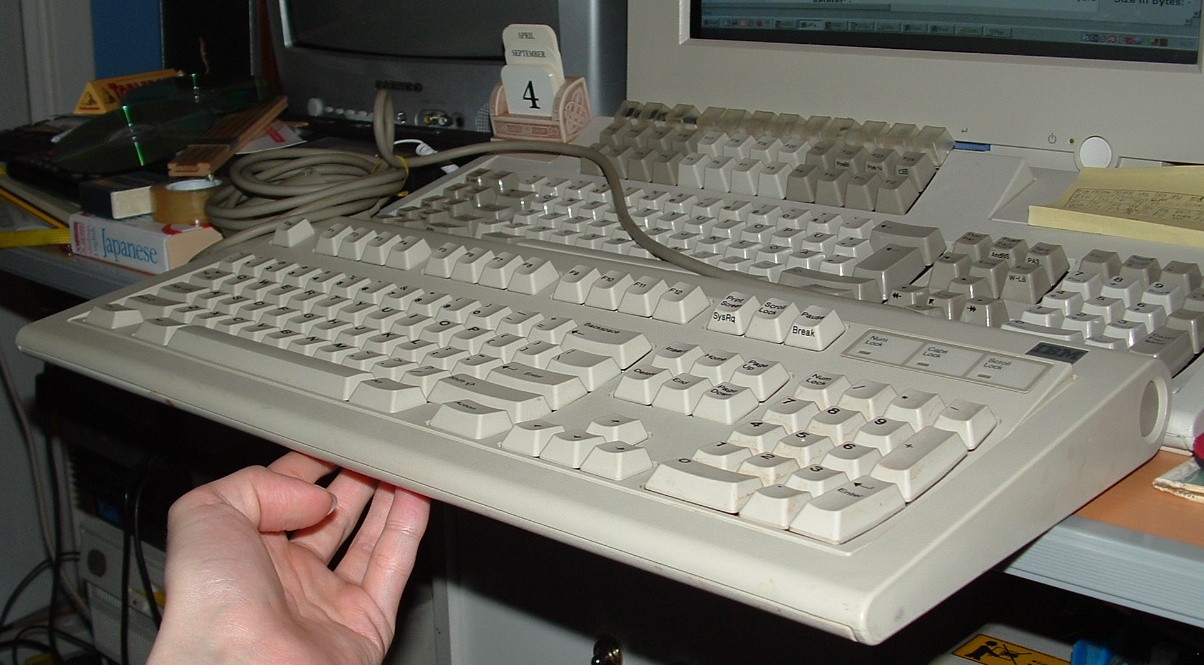
Funny thing is, I always found the gaps between the keys problematic. If your fingers weren't right on the keys, you'd slip through or press two.
My favorite keyboard was the one that came with the IBM 6150 (aka, the IBM PC-RT). Soft keys but with great tactile feel, and completely programmable so you could easily swap the CTRL and CAPS LOCK keys. It was IBM's take on a silent keyboard but will all their (then) quality thrown in.
Got some serious WPM out of it, but I hold no hope for getting one working today
-
Re:Good
I really loved the COPYRIGHT INFRINGEMENT they have committed by stealing the images they use on their web site. See here:
Their site and the source -
Re:Quantum Cryptography
Pfft... next you'll be telling me that my "Quantum Leap" isn't a genuine quantum computer at all!
-
Pick Fail
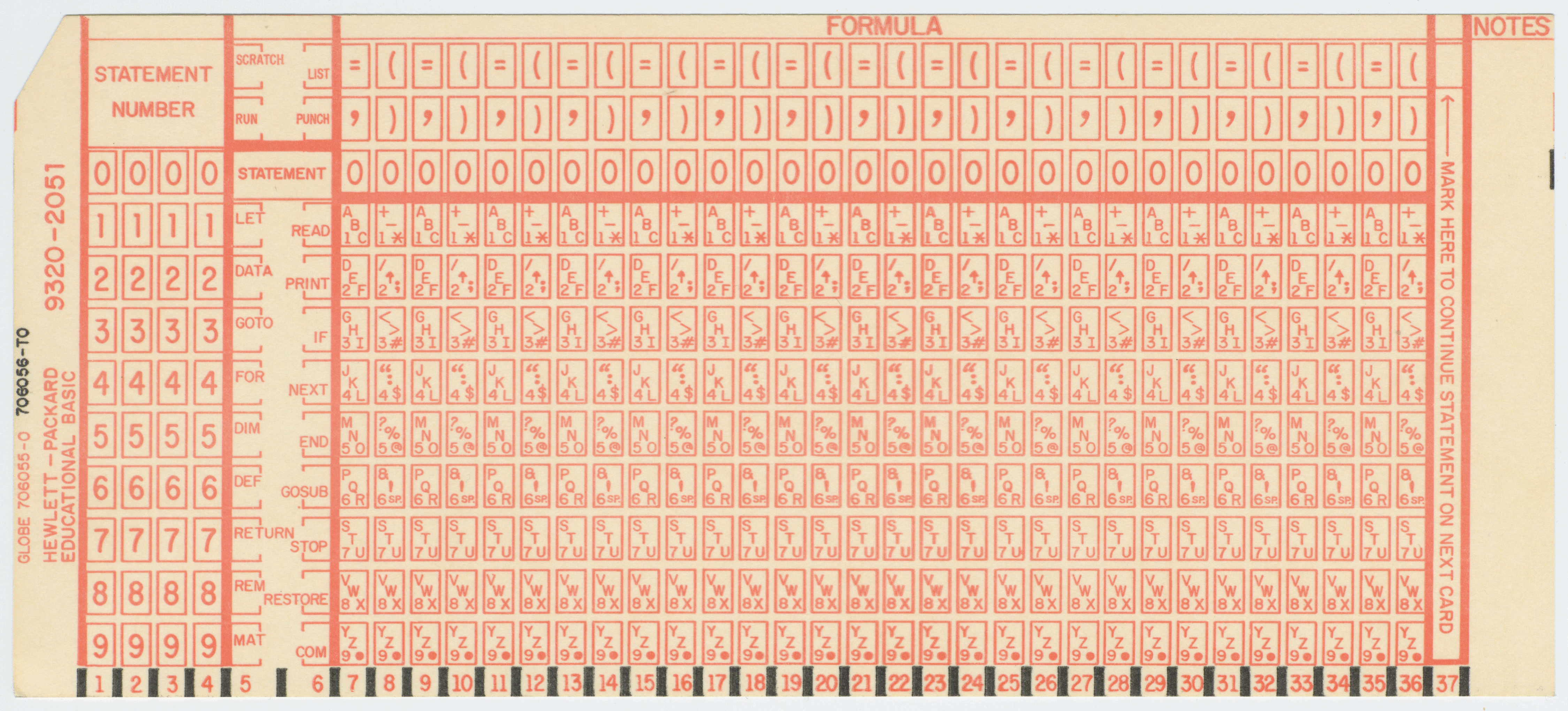
In Arlington County, Virginia of the mid-1970's, 7th and 8th grade math students were treated to a week-long exploration of BASIC programming, complete with access to a
HP 9830A, and an HP 7260A Optical Mark Reader. We used HP Educational BASIC Cards.
So, the drill was: write your program on paper, transcribe it to the cards with #2 pencil, then get in line to put your cards in the reader. Inevitably the Reader would choke on a card, and issue a "Pick Fail" error. That could be due to a damaged card or to the number of erasures and rewrites on a card. Pick Fails were always accompanied by three honks from an alarm inside the Reader. Moans from students waiting in line for card reading usually followed. The best you could hope for was one iteration of your program per day, but realistically you got 2 or 3 runs during programming week, what with all the Pick Fails. -
Re:RIP for a slow death
No Trash 80s had a 8 inch floppy stock
I present to you, the TRS-80 Model *2* with a Shugart *8-inch* drive -
http://www.old-computers.com/m...
Complete with the 'orange button' referenced by the GP.
Who's "trash" now, punk? Now get off my lawn. -
CLI's Are Not Walled?
I've been seeing the love for CLI's in a couple of articles here lately, and I'm wondering... why are GUI's "walled gardens", and CLI's are not? The CLI's have their definite boundaries as well. You can't run a function using a system utility that doesn't support it.
At best, I'd call GUI's walled gardens, and CLI's (larger) fenced in fields with rocks and weeds along with the trees and flowers. Definitely more versatile, not as friendly for some uses.
To get out of the boundaries of either a GUI or a CLI, you can just write your own code, to create... a GUI or CLI application. You can write a script, or put the equivalent function into a GUI app.
Disclosure; I've been computing since the Olivetti P-6060 was a cutting edge machine. http://www.old-computers.com/museum/computer.asp?st=1&c=407 -
AN/FSQ-7 forever!
Some of the the AN/FSQ-7 consoles keep showing up in movies because they're available for rental at Woody's Props in LA.
Those aren't even the control panels for the computer. Those are just the modems and serial ports. Here are the much larger AN/FSQ-7 maintenance control panels.
Those are just the control panels. Here's the CPU, with all the racks of tubes. Full-sized 12AX7 tubes (still used in some guitar amps), not even minature tubes.
-
Re:the more things change...
I am from a European country, and I can assure you that there was a thriving clone market - you could get any at a much more affordable price basically everywhere. These were probably under the radar for Apple - or maybe they prosecuted only American-based makers/resellers because they couldn't afford international cases, but the fact is that, even if this was surely not part of Apple's plan - Apple ][ had a larger share of the market than what you would expect by just comparing "official" Apple numbers to Tandy or Commodore.
-
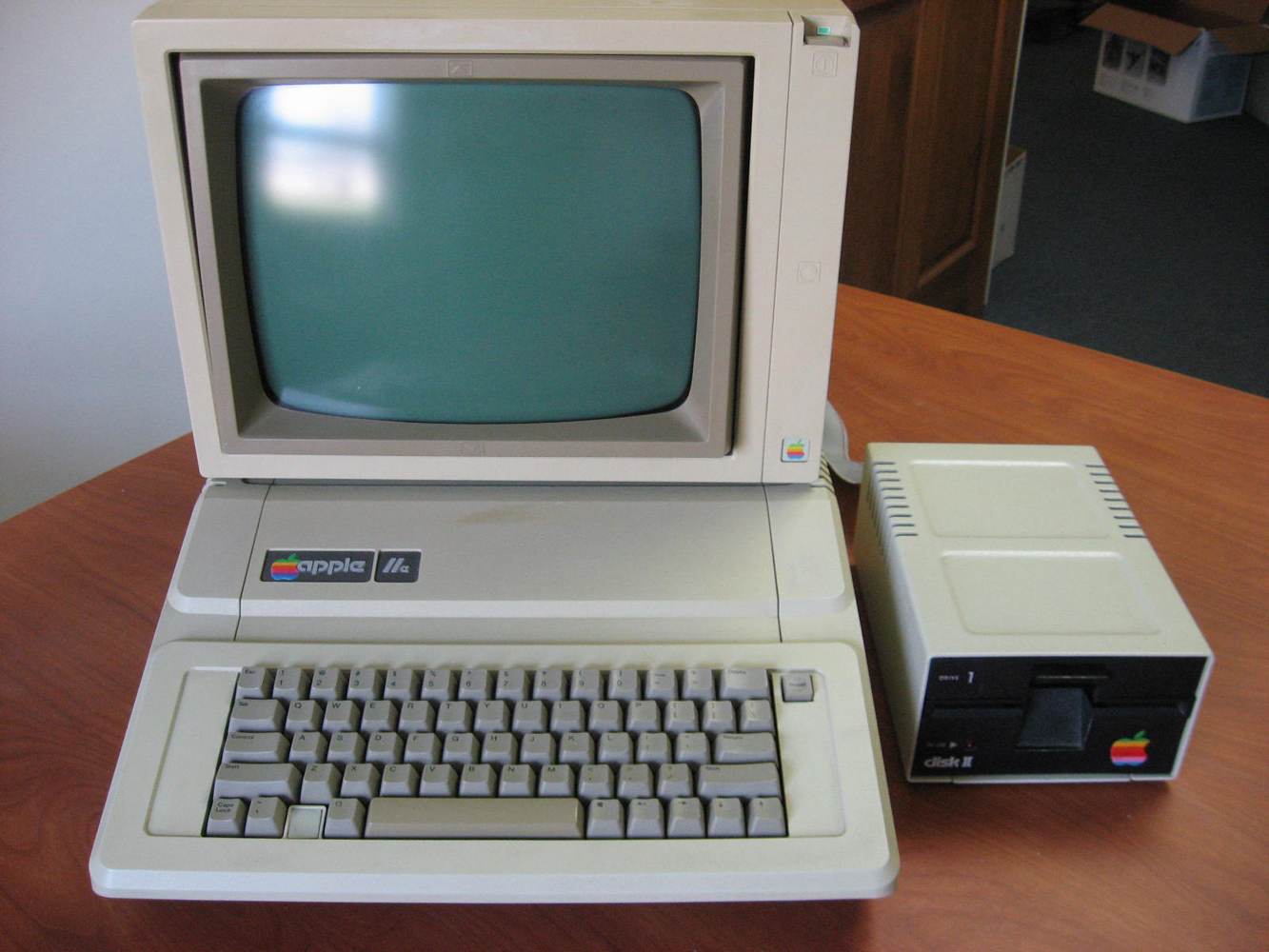
Re:if the apple //e is 30 years old
You'd be wrong then. I've seen it as
http://www.old-computers.com/museum/photos/Apple_2e_Logo_s1.jpg
http://www.myoldcomputers.com/museum/comp/picture_pages/apple/apple_pics/iielogo.jpg
http://en.wikipedia.org/wiki/Apple_IIeAnd there's also the IIgs: http://en.wikipedia.org/wiki/File:Apple_IIgs_001.jpg
-
Re:crap article is crap
The submitter of that article obviously had never tried an Oric 1 or Sharp MZ-80K keyboard.
The Oric had really hard "line" keys.
The Sharp had so sharp keys they would cut you. -
Re:crap article is crap
The submitter of that article obviously had never tried an Oric 1 or Sharp MZ-80K keyboard.
The Oric had really hard "line" keys.
The Sharp had so sharp keys they would cut you. -
Re:Different multiplayer model
That's the really funny thing to me - home computers from the 80's (like the Atari 400/800/1200, Commodore 64, etc...) had two or even four game controller ports (even more if you bought custom adapters); joysticks, paddles, keypads, even touch tablets. The simplest way of handling AI or any number of players was just to have a get-move function.
The PC has had all that time but never made it a priority - in the 80's, you'd get your Atari 2600 console with a whole set of controllers, and a couple of multi-player cartridges (Air-Sea-Battle, Video Olympics). There's the big difference here - these games were designed to be played multi-player on one screen as they were top-down, side-view or isometric views.
-
Re:Model 100
For certain values of "competition", yes
http://www.old-computers.com/museum/hardware.asp?t=1&c=233&st=1
-
Re:Nostalgia
Maybe the model 200?
-
Re:Nostalgia
perhaps one of these?
http://www.old-computers.com/museum/computer.asp?c=1083 -
Ehi, IBM!
Get your lawyers ready! RT was already taken... in the 80s: http://www.old-computers.com/museum/computer.asp?st=1&c=867 (strange beast, BTW)
-
Re:Legal loopholes
a legit question...
http://www.old-computers.com/museum/computer.asp?c=1196&st=1 -
Re:Safe(r) from corporate espionage
Back in the eighties, Brazil had a roaring microcomputer industry, based almost entirely on pirated versions of popular pcs of the time, such as the Sinclair Spectrum , Apple IIe, and Tandy Color Computer. More recently, the PT government decided to "break the patents" on essential medications, such as the AIDs cocktail and Viagra, unilaterally declaring that IP doesn't apply to them, and it's ok for the Brazilian pharmaceutical industry to sell it without any regard to internation law. Back in 2007, a popular Brazilian film, "Tropa de Elite", made its debute in Rio de Janeiros' pirated DVD vendors before it make it to the big screen. My point is saying all of this is that if anybody is stupid enough to trust their IP to a Brazilian company, they deserve what they'll get - the "Ei-Padi Dois" being sold by kids in São Paulo's Rua Santa Efigênia before the initial production run has made it through the factory's docking bay doors.
-
Re:An effort to avoid tariffs in Brazil
In fact that's a important thing, we haven't seen Apple in Brasil since that happened: http://www.old-computers.com/museum/computer.asp?c=997&st=1
-
Re:Wintel no longer cutting it?
it would likely be easier to bodge one on to an x86 motherboard
Sure, if you could find one with a proper FSB to interface with the bridge chips, instead of the vendor-specific SoC garbage you usually get. Your I/O bandwidth wouldn't be great (like Apple in the G3/G4 era when Motorola/Freescale couldn't do better than 133-166MHz FSB), but performance wouldn't really be a goal.
a full x86 laptop that can also run an embedded ARM simultaneously
Now there's a losing bet. Never in the history of personal computing has a hybrid-processor system had any long-term success*, only in video game consoles where the manufacturer forced it on developers (with the promise of manufacturing that identical system for multiple years).
However, I will admit that there has been some minor success with a hybrid GPU system. A friend of mine has a Dell laptop that can automatically switch between on-board Intel graphics and a proper GPU. But GPU stuff goes through enough abstraction layers that it basically doesn't matter what GPU you use.
*FWIW, I once worked with an Ohio Scientific C3P that was only used to run 6502 BASIC for two users.
-
Re:Option to connect to an old-school TV
You never had a Lemon?
http://www.old-computers.com/museum/computer.asp?c=1196&st=1
-
Re:Kill it Oracle
I don't really get why people emphasize to be able to program in assembler. Or machine code
Says a lot.
says nothing at all. using C++ or C# or Java is a conceptual skill quite apart from machine level programming. Everything from threading to object/data maintenance to looping is different in a fundamental way.
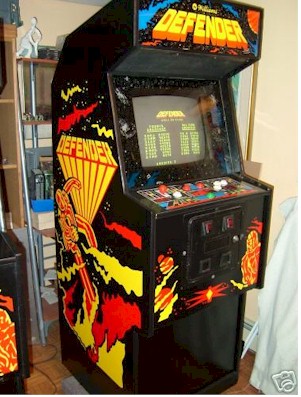
I'm one of those "uneducated" (my background is Electronics, not CompSci) java programmers doing mostly business applications. I would only assert my competence. I also entered machine code in Heathkit ET3400 as well as C= Vic20/128. I repaired arcade video games like Defender and MsPackman also.
People learn what they're interested by and what they are required. The "average" anybody is not going to excite... talk about red-herring...
Do you really believe a programmer who can program in Java or even Visual Basic is incapable of learning assembler?
Bit of a red herring there. Capable of learning? Probably they are capable of learning. Do they have a desire to learn it? Probably not. Are they capable of learning it well? Maybe. Are they capable of understand the overall implications of some of the code they may generate at this level? Its iffy if we're talking about the average Java coder.
The truth of the matter is that C and below programming is really not necessary to the majority of today's programmers. I also modified xmodem on a coherent system where I had dial up. I did that to skip the 64, 128, 256 progression it did to bring up to speed. most of my transfers were 1k or greater and starting at 1024 made a huge difference in the kind of quick transfers I needed to do. I got my first job in software programming by showing the place in that C source code that I modified... why and how.
Even today I think the better, elegant solution eluded me at the time. But it worked; both in a pragmatic and preparatory sense.
That's all starkly irrelevant to job-health today for me though.
-
Re:In other words
That had more to do with IBM using an architecture they opened up than Microsoft in a lot of ways
Indeed this is very true.
In the mid-80s there were a number of machines on the market which ran MSDOS but were not strictly PC compatible, for example the ACT Apricot F1, but these all fell by the wayside as not all software played by the rules and expected either a specific memory layout or specific type of graphics card (e.g. MDA, Hercules or CGA) to work. This was true of Lotus 1-2-3 and early versions of MS Word, where you needed specially modified versions to run on the Apricot.
-
Re:Analog joysticks
Listen, I've played Pac-Man and countless other action games using those very joysticks as well as this one written about in this article. It's not impossible or even difficult. It's simply not ideal. Even with analog sticks, there is plenty of time to hit the corners properly, which is what I was questioning. I doubt there is more than 1/10 second difference between direction changes for analog vs. digital.
-
Retro kit
I don't know about retro programming, but my first experience of hard programming is being introduced to Assembly language using a Hektor computer, originally designed for the UK's Open University. http://www.old-computers.com/museum/computer.asp?c=602&st=1
At least using it and it's plug in sensors module helped you understand what all the moving data to / from the stack and all the rest of the commands was actually doing to the hardware.
Maybe modern versions of this kind of simple kit would help people understand programming more when they start out in it?
-
Re:I think it's a good question.
On the other hand I won't take anything greater than a 486. Older computers are just more fun.
Wow. I won't take on x86 machines at all - with the occasional exception like the Atari Portfolio. What's interesting about a 486 when there's such a diverse faunæ of old 8 bit beasts to be had?
-
No blu-ray
No blu-ray, no new features, smaller, and positioned as a must-buy?
Gee, where have I seen this before? I know I have seen similar restylings that offered no real improvement.
Where is Blu-ray? I know, Ballmer, offering blu-ray would be admitting you were wrong, but getting Windows 7 out so quickly after the monstrosity known as "Vista" is a pretty loud admission that you do fuck up now and then. You're only compounding it by not embracing blu-ray while the rest of the world already has.
I'll admit, I do want an XBox 360, and while it's nice the power supply, wifi, and HDD are all now internal, what I am waiting on is blu-ray. I want it more as a media extender/STB more than anything else, primarily for Hulu and Netflix, and possibly for Rockband 3 once the "real" keyboard comes out.
-
Re:How?
Comparing them to Chrome is nothing less than comparing Apples to Oranges.
I've never heard of an Orange. Is it similar to an Apple Mac?
:P
I think it might be closer to the Frankin Ace 1000.
-
Re:Any other file systems with that feature?
You don't know the system very well.
You'd have to modify the a program for the 6502 processor that runs the drive.
What? You were going to write it for the C64 as a basic program or assembler? Both will eat up valuable memory space and be very slow. A cartridge may help some but it will still be slow.
Yes I've written machine code in 6502 for the 1541 though I used a hack to get it into ram and executed properly. I implemented a no knock routine that would load off a floppy at power on based on clues from the reference guide.
Someone decompiled and documented the rom which may allow such a scheme to be implemented. I grant there's almost no wiggle room in a 1541 so it may require some code in the C65 as well via a cartridge or a hardware mod or both to both.
http://www.flavioweb.it/c64/docs/AsmDocs/1541-diss.html and you need an adapter to use burnable roms http://ist.uwaterloo.ca/~schepers/roms.htmlWhat is this? http://www.h64.de/ could be a useful modification. I must find out!
It uses an AT29C010A flash chip a static ram chip some gal chips and discrete logic.C64 Geeking see the above links and:
http://www.c64.com/
http://ist.uwaterloo.ca/~schepers/personal.html
http://www.old-computers.com/museum/computer.asp?c=98For more google can help.
-
Re:it's got a fan!
They should release an ARM version IMO.
-
Re:Reminds me of Televideo's attempt at a PC...
http://www.old-computers.com/MUSEUM/photos.asp?t=1&c=1077&st=1
I can see where your coming from, but its really not the same thing.
-
first Nokia device to feature a full-sized keypad?
"The Nokia Booklet 3G is the first Nokia device to feature a full-sized keypad and a 10-inch display"
nope. -
WowA portable with two different CPUs to run two different operating systems?!? I haven't heard of such a forward-thinking and revolutionary idea like this since the Seequa Chameleon And that was 25 years ago!
No, there really aren't many completely new ideas in computing.
-
I found them...
this guy's got em all
http://www.old-computers.com/club/collectors/ordis.asp?c=3664 -
Re:Tron!? This aint no dangblammed Tron!
I remember some strange orange console from when I was really young (probably about 3), can't even remember what games it had. Could have been something like this.
The first console I remember probably was our Commodore 100 when I was 3 or 4, I used to type in programs from the manual to draw circles and triangles..
-
Re:first they need to fix a few things.
The closed apple (command) and open apple (option) keys were on the Apple III keyboard. The Apple III was released in 1980, which does predate MS-DOS by a year.
And my point was that "cmd" and "option" were associated with Apple long before they were a dos shell and a graphical menu. Even if the "option" key wasn't specifically labeled "option" until the Macintosh, it still predates any DOS use of "toolbars" that I'm aware of.
Regarding "return" versus "enter", I agree with the other poster: "Return" has kept its function since the typewriter days. "Backspace" has not. The average user uses the "return" key to move down and return to the beginning of the line, not to enter a command. Conversely, the average user uses the "backspace" key to delete the last character (or some other object), not to back space, to perform a leftward space in order to type another character on top of the last character. In both cases Apple's label is more accurate than IBM's.
-
Re:first they need to fix a few things.
If you're going to trot out the Apple
For what it's worth, the apple/command key predates not only the dos shell, but MS-DOS itself.
Not true. These were added on the Apple
Same with the alt/option key.
The closed-Apple key didn't become Option until the Apple IIgs. (The IIgs unit.) They weren't even on the Apple
And "backspace" is a function on a typewriter.
So is "return" (as opposed to "enter"). Your point was again? Now get off my lawn.
--Joe
(I grew up with these machines, and I remember their sometimes frustrating differences well.)
-
Re:Obligatory...
Agatha Christie would, no doubt, feel the same way. However, now that she has passed 2 billion book sales (outselling both Shakespeare & the Bible) - those first manuscripts are priceless.
If written on an Otrona Attache - well, those manuscripts might well be lost forever. http://www.old-computers.com/museum/computer.asp?st=1&c=1227
-
Re:Microsofts heritage
Had he not been fired and actually got greater control of Commodore, we might have had the cheap computers that exist today 20 years ago.
Indeed, we could have. Oh wait, that's right - we did!
Best-selling computer of all time; introduced 1982.
-
... medium size ones..?I've just spent 15 minutes screaming "wait a minute I remember something like this from a while back". So here it is - the Advance 86 These popped up in "Dixons" (UK) for a while and then magically vanished. Turns out that they were compatible in the sense that the BIOS (at least AFAIK) *was* an IBM BIOS (grins). A friend of mine claims they took the money and ran before IBM came after them... Unlike "Pear?" etc (the Apple ][ clone) this time around Apple might have more trouble pulling the plug I guess.
Andy
-
Re:The Real Motorola Split in the 90sThey were impressive back in the day, the processor of choice for Apple. I learned assembler on a 6809 (a spanking new Tandy Color Computer, if you must know, back in '84). For a 'small' computer, it was a LOT more computer than people gave it credit for. Likewise, the Atari ST and the Amiga, all killed by Lotus, which gave us the term 'killer app' in that it ran on IBMs & clones, under DOS, and was the business software of choice.
Damn, I'm getting old...
-
Re:The Real Motorola Split in the 90sThey were impressive back in the day, the processor of choice for Apple. I learned assembler on a 6809 (a spanking new Tandy Color Computer, if you must know, back in '84). For a 'small' computer, it was a LOT more computer than people gave it credit for. Likewise, the Atari ST and the Amiga, all killed by Lotus, which gave us the term 'killer app' in that it ran on IBMs & clones, under DOS, and was the business software of choice.
Damn, I'm getting old...
-
Re:The Real Motorola Split in the 90sThey were impressive back in the day, the processor of choice for Apple. I learned assembler on a 6809 (a spanking new Tandy Color Computer, if you must know, back in '84). For a 'small' computer, it was a LOT more computer than people gave it credit for. Likewise, the Atari ST and the Amiga, all killed by Lotus, which gave us the term 'killer app' in that it ran on IBMs & clones, under DOS, and was the business software of choice.
Damn, I'm getting old...
-
Re:About dang time...
Remember when DELL said they'd create the first sub-$1000 PC
Wait, did they? -
There are much worse examples
http://www.vintage-computer.com/sharppc1251.shtml
Dreadful in the extreme.
http://www.old-computers.com/museum/computer.asp?st=1&c=987
Pretty bad as well, since it is alphabetically arranged.
http://www.old-computers.com/museum/computer.asp?st=1&c=560
This is quite possibly the worst color combination in human history.
But in terms of usability, the Atari 400 was by far the worst. I had one and the lack of ANY feedback as well as the fact that speeds of typing over 5wpm were impossible rendered it the single hardest computer to EVER type on.
Oh - and the delete key didn't have a repeat function. And they annoying fake click was like some water torture. click click click click click click click.(souded a lot like a beep actually). Imagine your PC speaker's startup beep at half volume every time you press a key.
It wasn't the keyboard itself so much as the entire package - AND that the Atari 800's keyboard was one of the best at the time. The panalty yo paid for buying a 400 over an 800 was even more severe than the PC Jr was compared to the PC.





![the Apple ][+](http://www.oldapplestuff.com/Images/Apple2Computers/Apple2PlusSystem.jpg)