Slashdot Mirror
Domain: oldcomputers.net
Stories and comments across the archive that link to oldcomputers.net.
Comments · 266
-
A blast from the past
No USB drive compatibility, but instant on.
The love of newspaper field reporters for decades:
http://oldcomputers.net/trs100.html
Not bad for 1983.
-
4x20? luxury, when I were a kid...
...4x20 was the screensize of your LAPTOP!
I got a working one of those kicking about in my shed, any ideas what I could do with it? besides trying to find replacement rechargable batteries. -
Re:Extended warranties are rip-offs - no exception
-
Simple...
It aims to carve a niche among the third world's richer poor children.
Or at least the ones with better taste. More like chicken, less like monkeys.Oh and... 12$ is probably a typo. To be LIKE Apple II it should be something like US $1298.
-
Re:Love it!
That's when you upgrade him to a TRS-80 Model... 200!
-
This is what I love about computers
-
Re:About dang time...
I don't remember laughing at the idea of a personal computer costing less than $1000. I remember the early 1980s, when $200-$600 was the norm for a roughly-current-tech personal computer.
I think you're comparing what was then a toy or curio with today's "serious" computers meant to do real work. What was available in the early 80s? Well, there was the Apple II. One of those would set you back $1300--for the cheapest model, with 4K of RAM(http://oldcomputers.net/pet2001.html). For its day, that was a serious computer...and for 1977, that was a serious price. True, you could pick up a Commodore PET for a mere $800 (http://oldcomputers.net/pet2001.html)...but that was a pretty lame machine. If you're thinking of the Vic 20 or the later Commodore 64, or the various offerings by Atari, those weren't really comparable to a "serious" computer of today. They were fun, but not serious computers. My first personal computer was a Compaq "transportable" PC. It had 256K of RAM, 2 floppy drives (the "small" 5" sized ones)...and no hard drive. The screen was a grayscale monochrome about 5" diagonal. It was the size and weight of a sewing machine.
I paid $1800 for the Compaq. In 80s money, that's quite a chunk. I told my wife I needed it for "business"...but really I just wanted to play Zork, and teach myself to progam in C. (Now there's a memory: I put the Lattice C compiler on one floppy, the code and editor on another, the linker and object code on a third, and compiled on a 128K RAM "disk" that I had split off from the 256K total RAM I had available. I felt like a juggler, swapping those floppies...but I cheated by usually holding one in my teeth. I also had to run in place in hip deep snow the whole time.)
The point is that the price for "serious" machines has remained fairly steady, or declined moderately from the mid-80s, but it still costs what—to most of us—is real money to get one. (The price for gaming rigs, on the other hand, has skyrocketed.) But it's also true that some people spend too much money on laptops. If you're one of those "road warriors" who has to work spreadsheets, PhotoShop, or give live demos of bloatware, you need a $2K laptop. But if all you want is connectivity, then the $200 laptop is all you need. I don't think Sony has anything to worry about...some buyers, like parents who used to spend $1K on laptops for their kids will get the cheap ones instead. But there will still be plenty of buyers for the workhorse, expensive laptop. These cheap laptops don't replace full-featured ones. We're just seeing the creation of a new, needed, market niche: the cheap laptop for people who don't need the features and power of the expensive ones.
-
Re:About dang time...
I don't remember laughing at the idea of a personal computer costing less than $1000. I remember the early 1980s, when $200-$600 was the norm for a roughly-current-tech personal computer.
I think you're comparing what was then a toy or curio with today's "serious" computers meant to do real work. What was available in the early 80s? Well, there was the Apple II. One of those would set you back $1300--for the cheapest model, with 4K of RAM(http://oldcomputers.net/pet2001.html). For its day, that was a serious computer...and for 1977, that was a serious price. True, you could pick up a Commodore PET for a mere $800 (http://oldcomputers.net/pet2001.html)...but that was a pretty lame machine. If you're thinking of the Vic 20 or the later Commodore 64, or the various offerings by Atari, those weren't really comparable to a "serious" computer of today. They were fun, but not serious computers. My first personal computer was a Compaq "transportable" PC. It had 256K of RAM, 2 floppy drives (the "small" 5" sized ones)...and no hard drive. The screen was a grayscale monochrome about 5" diagonal. It was the size and weight of a sewing machine.
I paid $1800 for the Compaq. In 80s money, that's quite a chunk. I told my wife I needed it for "business"...but really I just wanted to play Zork, and teach myself to progam in C. (Now there's a memory: I put the Lattice C compiler on one floppy, the code and editor on another, the linker and object code on a third, and compiled on a 128K RAM "disk" that I had split off from the 256K total RAM I had available. I felt like a juggler, swapping those floppies...but I cheated by usually holding one in my teeth. I also had to run in place in hip deep snow the whole time.)
The point is that the price for "serious" machines has remained fairly steady, or declined moderately from the mid-80s, but it still costs what—to most of us—is real money to get one. (The price for gaming rigs, on the other hand, has skyrocketed.) But it's also true that some people spend too much money on laptops. If you're one of those "road warriors" who has to work spreadsheets, PhotoShop, or give live demos of bloatware, you need a $2K laptop. But if all you want is connectivity, then the $200 laptop is all you need. I don't think Sony has anything to worry about...some buyers, like parents who used to spend $1K on laptops for their kids will get the cheap ones instead. But there will still be plenty of buyers for the workhorse, expensive laptop. These cheap laptops don't replace full-featured ones. We're just seeing the creation of a new, needed, market niche: the cheap laptop for people who don't need the features and power of the expensive ones.
-
Re:100% of the PC-compatible business computer mar
They were, extensively, until the IBM 5150 started making serious market share inroads. (Of course, it's true that more "serious businesses" ran CP/M systems, and that's the market the IBM system ate up. But there were business TRS-80s as well as "home PC" TRS-80s used in businesses.
And let's face it, it's a bit disingenuous to say had "IBM had 100% of the PC-compatible market" when there was only one system compatible with the 5150 in the world at the time and it was the 5150. That stage lasted only about a year.
-
Re:100% of the PC-compatible business computer mar
They were, extensively, until the IBM 5150 started making serious market share inroads. (Of course, it's true that more "serious businesses" ran CP/M systems, and that's the market the IBM system ate up. But there were business TRS-80s as well as "home PC" TRS-80s used in businesses.
And let's face it, it's a bit disingenuous to say had "IBM had 100% of the PC-compatible market" when there was only one system compatible with the 5150 in the world at the time and it was the 5150. That stage lasted only about a year.
-
TI-99/4A
Parsec on the Texas Instruments TI-99/4A. And we had a cassette deck for the system so my Dad + I could save the BASIC programs we wrote. Good times.
-
Pong
It was either the Magnavox Oddyssey 3000 pong clone or a game called "Duck" on my Dad's Osborne 1.
-
Re:C64 - 3rd PC - Most loved.we got to feel smug despite the rubber keyboard You are being overly generous. The first sinclairs had a membrane keyboard. I also know of many a man that lusted after the 16K expansion module. That's what made the C64 so great. It came with a real keyboard, and a full 64K of address space that an 8 bit cpu could address. Truly visionary.
-
Re:Next up:Delusion_ wrote:
Next up:
the Lisa II
sorry, already done. The Lisa II (or Lisa 2 or Mac XL) was the follow on to the original Lisa. It replaced the Lisa's dual 5.25-inch "Twiggy" floppies with a single 400KB 3.5-inch floppy and came bundled with a Macintosh emulation program (MacWorks XL: basically Mac ROM code adapted to run on the Lisa hardware). It was released around the same time as the original Mac and cost slightly more, but had a larger display, hard disk drive, expandable memory (up to 2MB) and an internal I/O expansion bus. The processor was slower (6MHz for the Lisa vs. 8MHz for the Macintosh) but there was a custom memory protection/memory management chip that was, unfortunately, never used in Macintosh mode.
What you're looking for is the (dreaded) Lisa -
First thing that came to my mind
Old luggable computers: http://oldcomputers.net/compaqi.html
-
Re:Can't use in sunlight
-
Re:It's still the parent's responsibility.
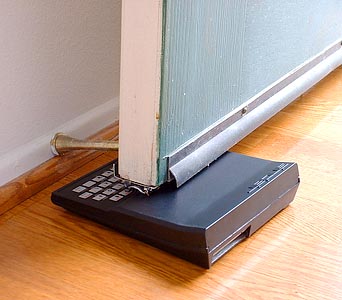
us half-gifted only got TimexSinclar 1000 doorstops
Here's the link I really wanted to give:
http://oldcomputers.net/pics/ZX81-doorstop.jpg -
Re:It's still the parent's responsibility.
If you've got a gifted child, you have to know they are only going to get so much from their school. I was lucky. My parents knew what they were doing. They let me explore...The best thing they did was buy [me]
TRS-80? Oy, us half-gifted only got TimexSinclar 1000 doorstops -
Re:A good thing for the software industry
That's just showing off.
You don't need anything faster than the ZX81's 3.25MHz processor with a full complement of 1Kb of RAM.
http://oldcomputers.net/zx81.html
Read that and weep. -
This is really just ....
a updated version of the Commodore Vic-20 or the Atari 400/800 systems. Similar price point, and the market in China is 25 years behind North America,so it makes sense
-
CoherentMan, I'm so glad this article got posted. It led to comments about Coherent, so now I can maybe put Linux on my Compaq Portable III.
Will that increase my geek cred?
-
Re:Apple II, TRS-80, and Commodore Pet
Claim 3 is wrong..
LOL. Claim is indisputably correct and the fact that you don't know this leads me to believe you weren't even born when the Apple II was released. Not only could one program the Apple II in machine language, but Woz built a debugger and disassembler into the ROM to make it easier to do so.
The TRS-80 was limited ito 4K and 8K DRAM configurations, and the Apple II could be expanded to 48K DRAM on the motherboard and even more via the expandable slots (which the TRS-80 and PET lacked).
And the only "real-world" application that mattered was VisiCalc which was only available for the Apple II.
Clearly you hate today's Apple, but don't confuse Woz's groundbreaking machine with today's company. -
Off-topic - 8088-2 board
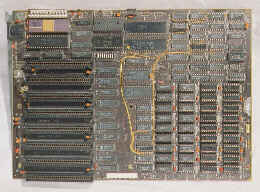
That doesn't look like a PCjr board to me, by the way.
The PCjr had various nonstandard connectors on the back. Also there were two slots on the board itself, for the optional 64K upgrade and the optional disk drive controller. Finally there was another large connector on the one side for the sidecar (I'm not sure if that connector was physically on the motherboard or not - it may have been a ribbon cable to the side - but obviously there was some connection for the sidecars on the motherboard).
-
Re:side note: , it's been done!
-
Re:Your problem is caused by the "keyword" systemNote that the US version had 2k, not 1k. I know, I said that myself:- they could have added more RAM to the US ZX81 (it originally came with 2K) Anyway, I don't see why a membrane keyboard is significantly cheaper to manufacture than a "chicklet" keyboard. Maybe the printing is simpler? How much diff does it make? I'm not an expert in manufacturing, but since you ask I'll guess. Remember that dirt-cheap Chinese manufacturing wasn't around then. Most of the ZX81s- at least those meant for its original UK market- were made in the UK (actually, most of them were made at a plant in my home town, along with the early Spectrums). Although the rubber keyboard itself wouldn't have cost too much, there would also have been extra labour and Quality Control costs. My gut reaction is that it still wouldn't have cost that much more, but Atari released the Atari 400 with a touch-sensitive keyboard too, and that was a far more expensive machine. (OTOH, it could have been said that Atari were emphasising the difference between the 400 and the more expensive 800 with its real keyboard and increased expandability).
One other issue with the ZX81 is that it originally came in the choice of kit or ready-built; though I don't see that a rubber keyboard would be harder to assemble (the one in the Spectrum was really just an all-in-one rubber moulding that sat on top of a ZX81-style membrane keyboard below, and poked through holes in the case above).
Anyway, I had originally assumed that what you had wanted was a real "push button" keyboard, which certainly would have been expensive.
FWIW, they actually did release a version of the ZX81 in a Spectrum-type case with "real" rubber keyboard, with 16K built in; it was called the TS-1500. Unfortunately, I think it flopped; which might prove my arguments against your "improved ZX81" proposal. Or- just as likely- it was because it wasn't released until 1983, at which stage it probably didn't look that attractive on the US market. My 8k suggestion was not so much about price, but more about getting rid of the wiggle-zap problem The rampack wobble (AKA "wiggle-zap"... nice description, ha ha -
Re:Yeah, but...
Nutria already gave some examples, but I've got more for you.
Tandy 1000, HP's 95LX (and 200LX) palmtop PC with DOS (the 200 had MS-DOS 5.0), the HP 1000CX DOS palmtop, some of the early IBM Aptivas, the HP model 110 line of desktops, the rather famous GRiDLite (my GRiD laptops all loaded DOS from hardrive -- always wanted a GRiDLite too though), the IBM EduQuest Model 30 and Model 40 (I have a few model 40s, but only one still boots -- into OS/2 Warp because I'm not using the on-chip DOS), the Sharp PC-5000 portable, the IBM PCJr, certain IBM PS/1 machines, the Tandy 2500 XL, and some others.
Also, Franklin, Commodore, TI, and Atari had systems with some form of OS in the ROM. Some Franklin systems had something called F-DOS in ROM which I think was mostly a ripoff of AppleDOS.
Notice that these examples are not modern hacks to try it out at home, but all commercially shipped systems from the late 1970s to early 1990s.
AMD and Intel still have documentation on DOS in ROM for embedded systems on their websites, and AMD even recommends Datalight's solution. -
Timex Sinclair 1500 - Excellent Little Computer!
TS1000 Emulator .
The Computer community could use a $99 Linux 'Timex Sinclair' type computer -
With enough memory and fuctionality to use web applications, print things, and save stuff to an external USB hard drive. All solid state with no moving parts. (add optional USB hard drive, USB cd-writer, USB printer, etc)
Have it come with a 2GB flash stick loaded into a USB 2.0 slot, and hook up to your TV/VGA monitor.
The TS2007 - Runs Linux!
The Timex Sinclair 1500 is an awesome little design.
I bought the 'Learn Computers' TS 1500 suitcase kits on Ebay - Mint condition no less. Everything works flawlessly.
I want to buy a TS 1500 form factor Linux machine right now! -
Re:The Essentials
I concur. This is a good list of the dawn of personal computing. I disagree with other posters about vintage mainframes and minicomputers (such as PDP/11) since they were not widely accessible. For those system not available, emulators are a good choice:
http://en.wikipedia.org/wiki/Emulator
http://www.emulator-zone.com/
These sites have good descriptions of the history and the classics (my favorites at top):
http://oldcomputers.net/
http://www.old-computers.com/news/default.asp
http://www.vintage-computer.com/
http://www.obsoletecomputermuseum.org/
http://www.computercloset.org/
http://www.sinasohn.com/clascomp/
It is important to keep the history alive. Although for us old timers, it just seems like yesterday, many youngsters do not realize the history of their shiny new laptops, etc.
-
Computer and display
Now wait. You're probably all thinking "What's so cool about that? Just go to Fry's/MicroCenter/your favorite electronics dealer, buy a motherboard, case, power supply, components, etc. and you're done." That's not what I'm talking about.
I'm talking about building an IMSAI 8080. The processor was a 2 MHz Intel 8080A 8-bit processor. RAM? You had to build a separate S-100 bus card using 1Kx1 chips to have RAM in the computer. Power supply? Here are a bunch of capacitors, diodes, resistors, a circuit diagram and a printed circuit board. Go nuts. Hope you're good with a soldering iron.
I spent several weeks putting one of these together in 1976. Once I had it together and working, well, you needed something to get your results on other than the LED panel, so I built a Lear Siegler ADM-3A video terminal. Again, the logic board was a big printed circuit board and you had a couple hundred chips, resistors, diodes and capacitors that you had to solder on it. I used that terminal all throughout college to connect to Boston University's time sharing system.
<sigh>Those were the days.</sigh> -
Re:Dell 5150
When you said "Classic" and 5150, I thought of this. I was wondering how you managed to hold that on your lap, considering the 70 pound weight, then I read the subject.
-
bus evolution
I think the problem may have to do with the fundamental concept of a computer being an exposed motherboard with a series of slots that house exposed cards. This goes all the way back 30 years to the first micro bus standard (S-100) through most subsequent computers.
http://www.geocities.com/SiliconValley/Lakes/6757/ images/chassistop.jpg
http://www.oldcomputers.arcula.co.uk/files/images/ intl103t.jpg
http://www.infodip.com/pages/axiom/bus-passif/imag es/ATX60206.jpg
http://www.infodip.com/pages/axiom/bus-passif/imag es/ATX6021_4.jpg
http://www.ixbt.com/mainboard/epox/8npa-sli/board. jpg
This is indeed a practical and economical solution to the idea of putting together and updating your computer. It's really a holdover from the hobbyist days and people have gotten used to it, but it's not really consumer-friendly.
The cartridge approach as used with videogame consoles is better.
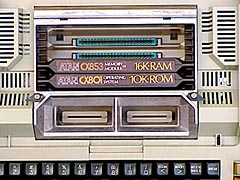
I think Atari had the right idea with how it implemented expansion on the 800.
http://oldcomputers.net/pics/cartports3.JPG
The only exposed surfaces were the card edges and the slot. Then you just close the lid.
You see this kind of design approach applied currently to flash memory. If you follow the evolution of the MMC card up through SD and into MINI SD and MICRO SD adapters, imagine the same approach taken with bus specifications. Older cards could be used with newer bus specifications via adapter sleeves. But you'd standardize on a singular form-factor. When you open up your PC, all of the guts would be hidden behind the casing except for the mating surfaces for the cards. All cards would be enclosed.
I don't see this happening because computer technology is by definition transient, disposeable. So nobody wastes money on ergonomics like this. Bus standards change so frequently that you can't even keep your motherboard that long anymore let alone your cards. So you might not even swap cards that much for the lifecycle of the PC beyond the initial system setup.
What I'd really like to see is more effort spent on coming up with a universal backplane that would be more future-proof, maybe something more passive where the glue that binds everything together was itself a module you could swap out. That way maybe the underlying frame could last much longer before becoming obsolete. -
Re:99er MagazineI too am perplexed by their decision to ignore the TI-99/4a. It was cheap enough for just about any family to afford and supported both BASIC (for the kids) and assembler(for the dad). My dad wrote the code and I spent hours designing sprite graphics and translating sheet music into sound() funcs for use in a Frogger game (Toader). We sold enough tapes of that game to just about pay for a 32K memory upgrade cartridge.
Another great one that is missing is the Timex/Sinclar 1000, a $99 machine with 1k of RAM. -
Re:iMac? 'scuse me??
How about even before Apple:
http://oldcomputers.net/compaqi.html -
Re:This article is full of errors
Franklin didn't clone the Mac, but they did clone the Apple II. http://oldcomputers.net/ace500.html
I own one of these. -
Re:Yes
It's already been done: http://oldcomputers.net/atari400.html
-
Re:weigh 20 punds?
This was actually the computer I took to the dorms my freshman year. Yep, 30 lbs.
The sad part is that I'm still in school. -
The Osborne 1I don't know if anyone has mentioned or remembered The Osborne 1 portable computer.
I fondly remembered how cool it was that you could actually carry a computer home from work.
I am getting old.
http://oldcomputers.net/osborne.html -
Re:weigh 20 punds?
That's not a portable! My laptop is heavy at 8lbs and it sucks to carry around with all of the gadgets and gizmos. Heck... even my SFF is lighter than 20 pounds. I love the concept but the weight has to improve big time.
Methinks you are missing the point of TFA. They're comparing apples-to-oranges; like comparing Compaq Portable PC, or luggable, to the laptops (or "ultra-portibles") of the time. I can't cite specific articles, but I do remember reading about the luggable-portable debates in early issues of PC magazine, back around 1987 or so.
-Scott -
C=
This thing's almost as heavy as the Commodore SX-64, though I suppose its features are a little better.
-
Kaypro II is even heavier
I've got one of these sitting in my basement.
26 pounds. Feels twice that heavy if you move it more than a few dozen feet. It's like a tank. The metal case adds some weight over the Osborne's plastic
A few years later they added a hard drive and brought the weight up to 31 pounds. -
Re:Prices never go down, only up
How much did a car cost in 1920?
In 1924 a Model-T cost about $265
source
How much did a color TV with a remote cost in 1965?
around $400 for a good one
source
How much did a computer cost in 1984 or a VCR?
in 1984 you could get a commodore 16 for about $100
source
How much did a DVD player cost in 1997?
in 1999 it was just below $300
source
Today a nice car is around $30,000. A good tv about $1000. 2006's equivalent to 1984's commodore 16 I guess would be a couple hundred bucks. You can get an okay progressive scan dvd player for about $100 today.
The relative prices of things change dramatically over the years due to tons of economic and social variables. Inflation hides this fact a little bit. -
Amazing!
Wow! This virus can infect PET computers? That really is cross-platform!
-
They missed Apple's worst dud
They forgot the Apple III Computer Of course, this was an emminently forgetable computer anyway (only on the market for 4 months), so I can forgive them for forgetting.
-
Competition for RadioShack TRS-80 Pocket Computer
"This new TRS-80 Computer is another "first" from the company which brought you the best-selling, world renowned TRS-80. A truly pocket-sized Computer (not a programmable calculator). Of course it is an ultra-powerful calculator too... And it "speaks" BASIC - - the most common computer language, and the easiest to learn. You'll soon be impressed by the phenomenal computing power of this hand-held TRS-80 - - ideal for mathematics, engineering and business application."
http://oldcomputers.net/trs80pc1.html -
Re:Put a layer of indirection
Yes, essentially:
http://oldcomputers.net/compaqi.html -
Re:In other wordsAnd guess where IBM got the idea of calling their (then) new machine "The IBM PC"?
There were a number of PC's before IBM got into the fray. The Radio Shack Pocket Computer was often referred to as "The Pocket PC". In this case, PC coulde be said to refer to either Personal Computer or Pocket Computer.
Again: Wintel is it's still the most pervasive example of what is now considered a PC, but it's not the only one.
Try doing a google for "define: PC", then "define: Personal Computer". If you have a Linux/BSD box with kdict, try 'kdict pc'. -
It wasn't mine but an IMSAI 8080
When I was in 8th grade, my school had an IMSAI 8080 http://oldcomputers.net/imsai8080.html that had 8K of RAM, ran BASIC, and had 2 TTY's with paper tape punch/readers. When it crashed, the teacher had to reload the OS with a paper tape that took about 30-45 mins to load.
Then, in high school, we had an Interdata something or other. It had 36K, 2 8.5 inch floppy drives, 7 TTY's and 3 CRTs, ran BASIC and had a Centronix dot matrix printer, and man, that printer was fast. The TTY's had paper tape punch/readers, so you could punch your program and take it home with you! To boot the Interdata, you had to enter a series of codes into an octal keypad on the front panel, the last of which caused the read/write head to move into position on the floppy drive, with a loud clunk. I always that that was really cool!
The first computer I actually owned was an ATARI 800XL that when you entered "print SQRT(4)," it said 1.9. I don't recall the exact details, but it was some goofy bug in the built-in BASIC. In those days, there were magazines that had programs in them that you entered into your computer by keying thousands of (decimal) machine codes into some little BASIC program. I keyed in a word processing program that worked pretty darn well--it got me through my first college career--for the cost of a $2.00 magazine. -
IMSAI 8080
The one and only. A beautiful machine that got me started (along with an old TRS) in programming way back in 197DSFhee,...#@$!
CARRIER LOST, CONNECTION DROPPED
http://oldcomputers.net/imsai8080.html
Hehe.. -
RadioShack Pocket Computer (PC-1)My first computer was a PC-1. I got it for my high school graduation. It came in very handy for any problems that required inverting a matrix or doing a least squares fit. (I can't imagine how people did that stuff with a pocket calculator or a slide rule.)
A set of four hearing aid batteries powered the damn thing for about 5 years. How long do your PDA's batteries last?
Of course I had been writing programs for years before I saw my first computer. I taught myself BASIC about 2 years before I sat down at a computer keyboard. That computer was a TRS-80 Model 1 with level 1 BASIC. Then again, I taught myself FORTRAN about 7 years before I got to use a computer with a FORTRAN compiler (a VAX 11/730).
-
The "Portable" Osborne-1
I still remember loading WordStar on our Osborne-1 from 5-1/4 floppies.
What a machine!
http://oldcomputers.net/osborne.html