Slashdot Mirror
Domain: physorg.com
Stories and comments across the archive that link to physorg.com.
Comments · 719
-
Re:I never really hear what is wrong with plastic.
Giant garbage patch floating in Pacific
An enormous island of trash twice the size of Texas is floating in the Pacific Ocean somewhere between San Francisco and Hawaii. Chris Parry with the California Coastal Commission in San Francisco said the so-called Great Pacific Garbage Patch, has been growing a brisk rate since the 1950s, The San Francisco Chronicle reported Friday. The trash stew is 80 percent plastic and weighs more than 3.5 million tons. "At this point, cleaning it up isn't an option," Parry said. "It's just going to get bigger as our reliance on plastics continues." Parry said using canvas bags to cart groceries instead of using plastic bags is a good first step to reducing reliance on plastics, the newspaper said. Source: http://www.physorg.com/news112248742.html
-
Re:Slashdot..
Stuff that matters, to people who don't think.
PhysOrg and Science Daily will fill your need for hard news.
-
Re:wrong, too
I was just reading that Microwaves can activate enzymes: http://pubs.acs.org/cgi-bin/abstract.cgi/jacsat/asap/abs/ja802404g.html (although I found more on the article here: http://www.physorg.com/news135962124.html ). I could be confused about the non-ionizing part: http://en.wikipedia.org/wiki/Microwave#Power
-
Re:With GMs luck.
Not as absurd as you might think, as you can use aluminum alloy to produce hydrogen...
And if that doesn't float your boat you can always use aluminum to enhance your rocket fuel...
Iron isn't quite as sexy, apparently it can help to enhance diesel fuel... -
"LV-426 Shake-and-bake" Terraforming...
"floating trees to convert all the CO2 to oxygen"
You would need to develop a way to filter out the acids but trees on their own, don't seem a likely way to remove that much CO2. However I think you are on to something about finding a way to deal with its CO2. One solution to Venus maybe to engineer a way to deal with its overall chemistry rather than trying to endure its current state. The planet is in some ways similar to Earth, but would require some awesome advances in technology, not least terraforming to alter its chemical composition.
Maybe in the distant future, humans could combine billions of tonnes of lime with an artificially created seawater like solution and then bombard/rain the planet with it, over the course of a few centuries. (Its an idea thats been suggested to deal with CO2 on earth
Its engineering way beyond anything we could do I guess for many centuries, but its theoretically possible to deal with the CO2, plus it would give us small ocean like lakes over time. Plus once there are more favorable conditions for some life on the surface, then I think plant life, like your ideas about trees, would then add to the process of terraforming the planet. It would be an awesome engineering project. -
You're an idiot.
Things like nanotubes, buckyballs and nanosilver particles DON'T EXIST IN NATURE. How do you think nature (even our own cells) will react to them?
I read another article in physorg concerning nanosilver, and how it has the potential to kill soil bacteria, which are a fundamental part of the ecosystem.
It's not the atoms you moron - it's how they're artificially combined and exposed to the environment.
Want a more common example: chromium picolinate, which is sold as the perfect solution for losing weight. The truth is, in tests done with fruit flies, it generates chromosomal aberrations, impedes progeny development,[13] and causes sterility and lethal mutations (http://en.wikipedia.org/wiki/Chromium_picolinate#Health_claims_and_debates). And it's already being sold commercially!
I don't have a problem with nanomaterials being manufactured for, say, microprocessors. But adding nanoparticles to common household items like refrigerators, stoves, and even the socks you wear, that's going too far.
Just look where the industry and big corporations have situated us. Without proper safety research in antibiotics, we now have to cope with drug-resistant "superbacteria". Well, these bacteria didn't exist 50 years ago! And yet antibacterial soap, shampoos and whatnot are STILL being sold in mass quantities.
Mankind is destroying the planet because of greedy idiots who only see money. Anyone who says "where are the safety studies?" is called a fearmonger who opposes progress.
-
Re:lifespans
....We see no evidence of such a global flood....
If you can name ONE place on this entire planet that was NOT covered with water at one time, then you could say there was not a global flood. If you look at a globe even today, you would see that three fourths of this planet is covered with water even still. If you flattened out the earth, it would be covered uniformly to over a mile with water. We know that the land masses of Earth are still moving up and down and along the surface. Apparently, this movement was much greater in the past.
Furthermore, the quantities of water in the mantle of the earth could far exceed that in the crust and the oceans combined. There is some evidence of this here:
http://www.physorg.com/news90171847.html
Since it is rather difficult to put seismometers on the bottom of the oceans, the evidence is confined mostly to the parts of the mantle which underlies the large land the masses of the earth. There is no reason to believe that the mantle which underlies the oceans contains proportionately less water. The Bible mentions to sources of water for the flood. One was from above in the form of rain and the other was from below. We are told that the fountains of the great deep broke open and flooded the Earth. It is of course speculation to determine what may have caused all that water or a significant portion of it to well up out of the mantle and then a return. If a sponge saturated with water is squeezed, the water will come out of it, but returned once the pressure is eased. It is possible, although unknown and unknowable, that a large gravitational object, such as a planet sized body passed close to the earth, putting the gravitational squeeze on the planet. In short, there is evidence that there was indeed a worldwide flood. It is certainly not impossible, judging from the amount of water available.
There is no way to make a fossil by any known as slow, gradual process. When an organism dies, it immediately begins to decay never making a fossil. To make a fossil, all microorganisms also must be immediately killed. Only a sudden catastrophe can do this.
It is clear to me that you have never read the biblical account of the flood even once. If you had, you would have noticed that Noah did not go out to collect animals and that the word species is not used.
We humans intensely dislike sudden events beyond our control, rather thinking that current processes can always be extrapolated into the past. We know from events, such as the eruption of Mount St. Helens, that geological processes, specifically petrification can take place in a very short amount of time. The Toutle River carved a miniature version of the Grand Canyon in hours, as the snow waters melted by the eruption raged through the canyon, obliterating everything in its path and transporting millions of tons of silt, rock, trees and other things in its way.
How do historians judge the accuracy or fiction of ancient records? Can written historical accounts, no matter where they appear be trusted? Did Alexander the great really live? Were the Roman emperors, such as Nero or Caligula as terrible and corrupt as we read in historical accounts? How credible are the witnesses that wrote these things? There are people today who will deny even the relatively recent history, such as the Holocaust of World War II.
(...Our lifespans, like those of all organisms, are a result of the ability of their DNA to copy itself reliably...)
The lifetime of any organism is determined by the number of times its cells can divide before apoptosis, that is cell death occurs. DNA contains code which tells each cell when to die. In humans, a complete turnover of cells occurs about every seven years. When this code fails or is corrupted, cells divide without limit and that is what we call cancer.
(...The Bible is no more historically accurate...)
So far at least, the Bible is 100% correct in the accuracy of its historical p
-
Re:An offshoot of the penny stock spam?
On a serious note i saw a cool article at physorg yesterday about speculation in the oil market. From the article it would appear there is a major oil bubble about to burst. Though I'm certainly no expert in the matter.
I suspect they just figured a way around some spam filters for a little while. Most anything novel should get by for a while, once it starts getting flagged it should dissipate. -
Re:Save for the fact...
...that hydrogen is extremely flammable, often explosive, and very dangerous to work with, sounds like a smashing idea!
I would never use it in a million years. Way to dangerous. Quite simply put, the risk is not worth the reward.
Seriously though, I think a home fueling station would be a great start. Not only because it provides a convenient source of fuel, but also because it pushes the energy requirements to the grid. (Which isn't a bad thing if we finally build more nuclear power plants!) As long as the safety concerns of generating hydrogen at home are worked out, I'm all for it.
Hmmmm. There is a couple of things in the statement I have a problem with:
1) Pushing the energy requirements to the grid is not a good thing. It is a little shortsighted. Don't get me wrong, I am not insulting you at all. You clearly want to do something to help the environment and I love your motivations. It's just that even IF everyone used hydrogen cars and had the home fueling stations it would cause a huge increase in demand from the grid. The energy has to come from somewhere, and that might not be as clean. You are not only pushing the energy requirements to the grid, but also the environmental responsibilities to the grid too. There are just not that many ways to cleanly generate that much power which brings me to....
2) Build more nuclear power plants. I have to admit I am on the fence about this one. Newer reactor technology is a heck of lot safer and there have been some developments in other technologies to handle the nuclear waste better. However, the controversy, security concerns, and costs of deploying enough nuclear reactors in the US makes the whole idea wishful thinking. You would need a lot of reactors too, which means several dozen "not in my backyard" battles between the states.
3) Safety of generating and storing hydrogen in the home. Well it's not safe. I don't think it can be worked out either. The average American is a "fucking idiot". I am not trolling here, but SERIOUSLY very few people can deal with the technology they have safely. I am reminded of Tim Allen and Foxworthy. I include myself in this statement as well. I have only a basic idea of how combustion engine works and would be nervous about messing around with my water heater. Compressed hydrogen is just too dangerous of a responsibility for most people. An accident is inevitable and it will be spectacular.
This reminds me of the Ford Pinto. Any car running off compressed hydrogen is a BOMB. This is not FUD either. I may be wrong, but the reason why the cars that are coming out with this only go 15 miles is that they have kept the container small and for good reason.
I would wait for some other technologies to be fully realized. I recently read about metal hydrides storing hydrogen safely and with vastly increased densities. Even more interesting is foregoing the need to store hydrogen altogether and produce it on demand.
Now if we did use the on demand hydrogen production technology it would require tremendous amounts of energy which would put us back to step one which is ultimately pushing the energy requirement to the grid. More nuclear power plants would be required. It would have to nuclear since an alternative non-renewable source like coal is a "stupid" resource. I say stupid since it's really a step backwards and counterproductive towards the goal of preserving the environment. The only real alternatives are natural gas, hydroelectric, wind, solar, and geothermal.
Natural gas is also non-renewable and there is quite a nasty secret surrounding it as well. It will be gone in 15-20 years. Natural gas is worse than hydrogen as far as transporting is concerned. We don't transport natural gas by truc -
Re:Big Deal!
A better picture might help put things into... perspective.
There's no way in hell something like that will ever be able to enter regular traffic. -
Re:Texting vs. Hubble
A professor at my university was recently asked by a British TV program to calculate the cost of retrieving data from the HST, and it came out quite a lot cheaper than sending text messages.
From the physorg article:
Dr Bannister estimated the cost of the data from Hubble could vary between £8.85 and £85 per MB- much cheaper than the £374.49 per MB cost of transmitting one MB of text.
-
carbon carbon carbon
there's work underway to replace the light emitting components of flat panel displays with carbon nanotubes. Carbon nanotubes are much better conductors of electricity than copper. Graphene (flat carbon) could potentially replace silicon. the nanotubes are also incredibly strong, potentially replacing steel and concrete as a building material. Seeing as carbon is so good for making tubes, it could replace the entire internet AS WELL!!!!!!
-
Only one possible redefinition
They want to have the standards bureau to define the kilogram this way. This is is only one possible redefinition. From what I have read, there is another strong contender which is based on electromagnetic force.
The new paper proposes that the next General Conference on Weights and Measures adopt either one of two definitions for the kilogram to effectively fix its value by selecting a specific value for either the Planck constant or the Avogadro constant. Two types of experiments are leading the effort to realize either of these definitions. The first one measures a kilogram against the amount of magnetic force required to balance a 1-kilogram mass against the pull of Earth's gravity. The experimental apparatus used to make the measurement is called a watt balance. A kilogram mass is placed on a balance plate that is surrounded by a coil of copper wire, which in turn is surrounded by a coil of superconducting wire. Magnetic fields produced by sending electricity through the coils push on the balance plate to offset the artifact's weight. The amount of electric current and its voltage then is used in defining a kilogram. Electrical power can be related to the Planck constant, defined as the ratio between the frequency of an electromagnetic particle such as a photon of light and its energy. This experimental method of defining the kilogram relies on selecting a fixed value for the Planck constant, which is currently determined experimentally based on the fixed value of the kilogram artifact.
This comes from here. Here is another article that talks about the same thing. TFA also links to an article that talks of this (I assume), but that article requires a subscription.
These articles also talk about why it is good to redefine the standard -- basically, by doing so, a bunch of other measurements/definitions immediately have less uncertainty.
-
Re:Don't crash their party
Citysense
"CitySense is attempting to use real time location data from those who download its client software as well as GPS enabled cabs and other "sensors." The goal is a near real time thematic map of activity in the city."Eg. go and download this application and we'll mash it up with some other data to tell you where people are.
Cool concept but the issue of "data access" is the real killer here. Getting access to "where handsets are" is the real problem....and carriers are stuck in the mud about sharing.
I've seen some really great web services but these all rely in some form of another from opt-in services which suffer from "inertia issues".
There have been some traffic related cell phone projects like http://www.physorg.com/news76178303.html and http://www.edmunds.com/ownership/audio/articles/123531/article.html
but none of these 'subsidised the end user'. So i think there needs to be a new solution the same way there is for Virgin SugarMama Minutes - so the proposal is this, allow your cell phone to be 'tracked' and data from this to be sold to anonymized data services like Citysense in return for a 10% reduction in your cell phone costs.
BUT the carriers cant sell your location data without you signing up for this program. I know that for $10-15 a month discount I dont care if you use my location data, but if you are selling it and I dont get anything from it then I'm pissed.
Just look at what happened with BT and Phorm, they could have got that adopted in like 1 month if they paid people for their data, lol wouldn't have cost more than a few glass beads like wallpapers or mp3 downloads etc. They just chose to take the easy route.
Lol I love this comment
http://www.citysense.com/moreInfo.php
"The company plans to profit primarily from business clients purchasing deeper data from the Macrosense platform; Citysense and all future consumer applications are intended to be strictly icing on the cake".In other words we got some vc funding and we are going to work out later how to make money.
Cheers,
DeanP.S. If location apps "float your boat" then you might also like to check out Cityware a bluetooth application I blogged about last year.
http://deancollinsblog.blogspot.com/2007/10/cityware-facebook-bluetooth-application.html -
Re:Why no rising sea level
That is only correct for fresh water bodies, such as the oft-mentioned glass of water. The oceans are salt water. The sea level increase isn't substantial, but it is greater than zero.
http://www.physorg.com/news5619.html
The common misconception that floating ice won't increase sea level when it melts occurs because the difference in density between fresh water and salt water is not taken into consideration.
http://home.comcast.net/~pdnoerd/NoerdlingerBrower.pdf (the paper, provided by the author, that is referenced in the physorg article)
If all the extant sea ice and floating shelf ice melted, the global sea level would rise about 4 cm.
-
Melting of Floating Ice Will Raise Sea Level
That is a false analogy, because the glass isn't filled with salt water. The sea level increase isn't substantial, but it is greater than zero.
http://www.physorg.com/news5619.html
The common misconception that floating ice won't increase sea level when it melts occurs because the difference in density between fresh water and salt water is not taken into consideration.
http://home.comcast.net/~pdnoerd/NoerdlingerBrower.pdf (the paper, provided by the author, that is referenced in the physorg article)
If all the extant sea ice and floating shelf ice melted, the global sea level would rise about 4 cm.
-
Re:That's nice
http://www.msnbc.msn.com/id/19374216/
29% of men 9% of women have had 15 or more partners. (meaning 71% have had less)http://www.durex.com/cm/gss2004Content.asp?intQid=401
average around the world 10.5http://www.physorg.com/news10824.html
this ones neat because men claimed an average of 31. but 21% of those admitted to lying, to boost their numbers on the the same survey, and of the group that claimed more than 50 partners over 50% of them also admitted to lying.http://aspe.hhs.gov/HSP/97trends/sd4-4.htm
69% of sexually active teen males reported http://www.denverpost.com/ci_6204119
"Almost one in three American men say they've had sex with at least 15 partners in their lives, triple the rate of similar behavior found in interviews with women, according to a government survey. "Meaning 2 in 3 have had less.
"The average number of female sexual partners for men was 6.8, said Kathryn Porter, a medical officer for the CDC's National Center for Health Statistics in Hyattsville, Maryland, and one of the study's co-authors. Women reported an average of 3.7 male sexual partners, she said."
http://www.data360.org/dsg.aspx?Data_Set_Group_Id=1100
This one is neat too, because it breaks down by country, the USA is ~10.5 (it apparently is based on the same data as the durex link.) Turkey ranks highest at 14.5.The numbers are apparently going up though, when you compare 1960s and 70s surveys to more recent surveys... or maybe people just lie more. After all the sixty's was the era of 'free love'.
Apparently it also varies heavily based on where you live. I think I read somewhere that New York city is apparently double or triple the national average.
-
Here are some better articles
Because the one in the submission was fairly content free. You can come to your own conclusions about what its unattributed original source is.
Exciton-based circuits eliminate a 'speed trap' between computing and communication signals
A wikipedia article, but still better than the submissionI'm still scratching my head, but at least it's not drawing blood anymore.
-
Suggestion for Data Center Design(ers)
Sound proof booth!
That way, the server dude who is wrangling my server issue CAN HEAR ME when he calls me, elbow deep in whirring fans, spinning disks and humming thingees. Even if he listens, gives me a BRB, puts me on hold and dives into the machines.
Or if not feasible, maybe the server dudes could wear priestly robes made of this stuff -
Re:Water & Pure AluminumNo. The oxide layer on Al already exists before submersion, preventing further oxidation. Thanks for playing, though. Not if you add some gallium.
-
Arecibo, Lunar Lawn Mowers, & multiple scopes
... you'll have to keep your mirror looking up, at all times. So you either place it on the pole, in which case it will be looking at the same place for a very, very long time (until precession slowly moves it around). This is good for doing very deep fields, but hasn't much use otherwise since if there's nothing interesting to look at there, you're stuck there anyways. Or you can place it anywhere else than the pole, but then you're never gonna look at a given object for more than a couple seconds.
A couple of thoughts on this...
First off, I'm reminded of the Lunar Lawn Mower which was proposed as a way to fuse lunar regolith using microwaves. I'll come back to that, later.
Arecibo: As for the mirror being immobile, What about the 305m-diameter Arecibo Observatory in Puerto Rico? Instead of moving the mirror, they move the receiver's location WRT to the mirror, to wit:
it is a spherical reflector (as opposed to a parabolic reflector). This form is due to the method used to aim the telescope: the telescope's dish is fixed in place, but the receiver at its focal point is repositioned to intercept signals reflected from different directions by the spherical dish surface. The receiver is located on a 900-ton platform which is suspended 150 m (500 ft) in the air above the dish by 18 cables running from three reinforced concrete towers, one of which is 110 m (365 ft) high and the other two of which are 80 m (265 ft) high (the tops of the three towers are at the same elevation). The platform has a 93 m long rotating bow-shaped track called the azimuth arm on which receiving antennas, secondary and tertiary reflectors are mounted. This allows the telescope to observe any region of the sky within a forty degree cone of visibility about the local zenith (between -1 and 38 degrees of declination). Puerto Rico's location near the equator allows Arecibo to view all of the planets in the solar system, though the round trip light time to objects beyond Saturn is longer than the time the telescope can track it, preventing radar observations of more distant objects.
Granted, that would then entail creating and operating machinery to move the receiver. That requires power and equipment to construct it as well as operate it. OTOH, nothing says it has to be a 305m dish like Arecibo, or 50m as mentioned in TFA; I'm sure a single 5m or 10m dish, could provide much useful science to start off with.
Array of scopes: As the skills and techniques are developed to construct and operate, say, one 10m telescope on the moon are developed, an array of these could be constructed. Some would aim at the same point overhead so as to provide a larger apparent aperture. Others could point at nearby points overhead so that, as an object under investigation sweeps out of view from one scope, it would already be in view of the next one. This would permit longer-term continuous observation of an object. Then, as more scopes are constructed, one could get both increased apparent aperture AND longer-term observation.
Because gravity on the moon is 1/6th that of the earth, it would take much less infrastructure to support the receiver. This, in turn, suggests less power would be required to move the receiver, too.
Lunar Lawn Mower: This was proposed by Larry Taylor, Distinguished Professor of Planetary Sciences at the University of Tennessee. It was discussed here a while ago: (Slashdot | Lunar 'Lawnmower' Devised for Moon Colonists).
"I'm one of those weird people who like to stick things in ordinary kitchen microwave ovens to see what happens," Taylor confessed to several hundred scientists at the Lunar Exploration Advisory Group (LEAG) conference at NASA's Johnson S
-
Beware
Professor Cooperman will be avenged.
-
Backups are forever.
Sure, you don't save every daily incremental, but you need to keep permanent copies of full backups on, say, a monthly basis. Permanent as in: you're not too cheap to overwrite them when you run out of room. Otherwise you're not really backing your stuff up.
Backups are not forever, media fails as does hardware. The best thing to do is to make and keep multiple copies of backups, on different media or hardware. And if you have a lot of data, that may mean a number of external hdds. Then as new technology comes along transferring old backups to new media or hardware. Here's a story about a "Computer Tech Accidentally Erases Info on Alaska's $38 Billion Oil Fund". No problem they thought, they had a backup. The backup, tape, had 9 months of data yet it was unreadable, it linked to a Physorg.com article but articles "expires 15 days after original publication date."
Falcon -
Alternate Link With Electron MIcroscopic Image
Same exact text, but with a picture, from physorg.
http://www.physorg.com/news131712233.html -
Probably not
Probably not.
Otherwise these guys would certainly have noticed and made a big noise about it:
http://www.physorg.com/news4703.html
"Responses among the eight subjects varied with the person and stimulus. "
"For example, a single neuron in the left posterior hippocampus of one subject responded to 30 out of 87 images, firing in response to all pictures of actress Jennifer Aniston, but not, or only very weakly, to other famous and non-famous faces, landmarks, animals or objects. The neuron also did not respond to pictures of Jennifer Aniston together with actor Brad Pitt.
In another instance, pictures of actress Halle Berry activated a neuron in the right anterior hippocampus of a different patient, as did a caricature of the actress, images of her in the lead role of the film "Catwoman" and a letter sequence spelling her name."
So to me it indicates their brains organize stuff a bit differently. -
Re:Move along
At least they seem to have moved on from the stupidity that was the "hydrogen economy". Basic back-of-the-envelope maths shows that hydrogen is a clear loser compared to battery electric vehicles etc.
PhysOrg says I'm right, too. -
Re:Are we SO sure?
...Citation needed...
Your are on
http://www.physorg.com/news90171847.html
If you want more, google this: "water in the mantle"
Now that you know how to use Google, I'm sure you can find material on why living things decay rather quickly today, after they die. You can also learn what must be done to prevent this decay.
To turn a living creature into a fossil, it has to be killed quickly and the remains must be prevented from decaying. Tell me the process you propose to use that will make a fossil in a million years or even a week before decay destroys the remains or it gets eaten by some scavenger? -
had to check myself
Apparently the trick is not too close and not too far. Low orbits bring down the sat due to grav differences.
OTH, if you are too high or orbit is wrong, then earth plays with it as well.
Thanx for pointing that out. I like to learn. -
Similar but Different: Grow them in Space?
I always like to point to this article: Terraforming: Human Destiny or Hubris
It argues Konstantin Tsiolkovsky's vision: that we should learn how to grow plants in Space first, and stay the hell away from all gravity sinks (such as moons, such as planets,) for a very long time.
That said, if we can grow plants on the moon, that's great!
(older article) -
Re:A million times brighter than black?Like this? Scientists make Darkest material ever made Oh... can it be true? A nugget of purest Black?
-
Other news stories on this
NASA previously estimated the chance "Apophis" the asteroid would strike earth in 2027 was 1 in 45,000. But a german schoolboy, Nico Marquardt, pointed out that NASA overlooked the probability the asteroid would strike one of the 40,000 sattelites orbiting Earth and enter a new solar orbit intersecting Earth in 2036. A german newspaper reports that NASA now concurs the chance this will happen is about 1 in 450. If the 200 billion tonne ball of iridium and iron stikes the planet then it's literally light's out for earth: 800 foot tidal waves followed by an indefinite period of dust cloud covered darkness, not to mention metal vapor in the atmosphere. The original Slashdot discussion was in 2007 when the odds were better. At that time it was known that there was a small risk of a gravitational slingshot dropping it into the 2036 collisional orbit, however, to do so the asteroid had to pass through an improbable 400 meter wide strike zone to be properly deflected, as described in 2006 in Popular Science from 2006. Today's announcement of the new finding is here and here.
-
Re:A million times brighter than black?
Like this? Scientists make Darkest material ever made
-
Re:A million times brighter than black?
I think he's right, there is something about this, that's...that's so black, it's like; "How much more black could this be?" and the answer is: "None, none... more black." Seriously, though, the term "black hole" is descriptive in some ways, but is not to be taken literally. There are a lot of interactions which radiate near the event horizon. In short Black holes aren't so black
-
Re:Matter ingestion
This is what I think you are looking for. The black hole is essentially working as a particle accelerator. The article I linked to mentions that the forces involved can can produce rays in the trillions of electron volts.
-
Re:Amazing but worthless
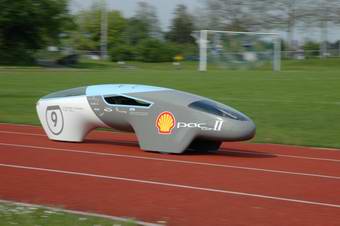
Well, I'm not sure you'd call it "normal", but if what you meant was "streetlegal, typical vehicle performance, and not cramped", I'd say the answer is now. Compare the Aptera with Pac Car II. And yes, it's competing in the X-Prize.
Sure, the results of these extreme efficiency competitions aren't directly applicable, but the engineering can make its way into mainstream cars. Mainstream cars have to deal with a *lot* of things other than just efficiency -- everything from how you turn on the high beams to the motor for the windshield wipers. These sorts of contests simplify things. -
Re:Predict the prediction.
I know at least one study attempted to find out if the perceived slowing of time leads to faster reaction time. While subjects generally remembered the situation to have lasted about one third longer than it actually did, they were not able to process information any faster than they normally would. http://www.physorg.com/news116655680.html
Regardless, I don't see how this study has anything to do with what I consider free will; just because my mind may subconsciously come to a decision before I'm consciously aware of it doesn't mean I wasn't the one making the choice. -
Re:Only 10% of oil goes to automotive gasoline?The environmental impact of plastic bags goes far beyond the petroleum used to make them.
- They kill sea turtles and other wildlife.
- They can spread malaria, and have been banned due to this in Uganda
and other African countries. - They are very unsightly.
- They require people to clean them up.
Several countries have banned the use of plastic bags completly. As usual with anything relating to the environment most of the US trails behind, clinging to outdated views.
1. Sea Turtles are going to go extinct anyway.
2. Malaria was a problem long before plastic bags. The solution to malaria does not have anything to do with plastic bags.
3. Then don't look at them.
4. Employment is a wonderful thing.
Plastic bags have a much smaller environmental impact than paper bags. So long as people insist on disposable bags they are the best alternative. -
Re:Only 10% of oil goes to automotive gasoline?The environmental impact of plastic bags goes far beyond the petroleum used to make them.
- They kill sea turtles and other wildlife.
- They can spread malaria, and have been banned due to this in Uganda and other African countries.
- They are very unsightly.
- They require people to clean them up.
On a personal note, I was on a road trip through Texas & Mexico recently, and all along the highways and roads there were lots of plastic bags clinging to trees and bushes. Many beautiful desert scenes were completely ruined by them.
Granted, there were more in Mexico, but it didn't look like they pay people to clean up along the side of the road like they do in TX. -
Add this to.....
-
Actually, I've been wondering...I'm too lazy to find the slashdot link from a few months back, but FTA:
The report explained several types of non-lethal laser applications, including microwave hearing, disrupted neural control, and microwave heating. For the first type, short pulses of RF energy (2450 MHz) can generate a pressure wave in solids and liquids. When exposed to pulsed RF energy, humans experience the immediate sensation of "microwave hearing" - sounds that may include buzzing, ticking, hissing, or knocking that originate within the head.
I've always wondered if this is why people feel some kind of effect from these 2.4Ghz devices. It also makes me wonder why that's the unlicensed band that we play with so much O.o
Then again, I'm no conspiracy theorist, but I do love coincidences and patterns...The bit about the hissing/ticking/knocking I swear I've been hearing more over recent years than I ever did, but that's hardly scientific evidence for any harmful effect, it is however an effect nonetheless. I believe that this deserves more study, honestly enough.
-
Re:COLOR temperature, not thermal temp
In this case, they really do mean 6000K. See: http://www.physorg.com/news125238861.html It sounds like this thing gives off a black body spectrum, and operates at the same temperature as the surface of the sun. The sun gives off (almost) a black body spectrum too, so they have similar colours. This is probably how your colour chart above is defined, and why you talk about "colour temperature" in the first place: it's the colour of a black body at that temperature.
-
LEDs a better choice
This article repeats the 6000K figure for the Luxim device's operating temperature, which seems a bit toasty for widespread consumer adoption.
Most incandescents and CFLs operate at half this temperature.
LED-based lighting is safer and far more efficient than the Luxim device. -
the common wisdomI doubt there will be any real problems for the lighting industry...
You could make the same argument about low-flow showerheads or toilets or plumbing fixtures in general (how long to those last).
People still remodel, new houses are built, old houses are destroyed, people break them, someone will come up with a new lighting mechanism (maybe that aluminum foil micro plasma lighting will become popular), and people will go through another replacement cycle. -
Re:Intel Nehalem
http://www.physorg.com/news117212815.html
Well, maybe only 10 times... -
Re:sounds like a way to re-startHere's an abstract that contains a little more info:
The EPR (European Pressurised Water Reactor) developed by AREVA is a new nuclear reactor designed to achieve greater output (1600 MW) and longer plant life (60 years) than conventional nuclear reactors. The first one is currently under construction in Finland at Olkiluoto. For this new design, an integrated forging was applied for the nozzle shell, including an integral flange (Fig. 1). A 500 t ingot is necessary to manufacture this part, which was the first large part manufactured on a new 14 kt press installed at JSW in 2003. The part was completed 11 months after pouring. The technologies of each manufacturing step and the properties of the part are described.
The full text costs $48 to purchase.According to this, Russia can produce two reactor pressure vessel forgings per year, with plans to double by 2011.
But all this delay in "evolutionary" boiling water reactors could be good news for pebble bed reactors. This Blog has a handy summary of the advantages and disadvantages of pebble beds. Last November, Westinghouse bought a pebble bed company called IST Nuclear. Some nice diagrams.
-
Carriers need to work together
That is the most bullshittest bullshitting bullshit. I mean, apart from the other bullshit, pointed out in abundance above.
The entire roaming issue, at least in Europe, is a scam. Carriers do not need to work together at all. He makes it sound like there are all these small carriers that are separate from all the other small carriers and when abroad, you're marooned. There are no more small carriers. All the little fish have been eaten by the big fish. It's either Vodafone, Orange or T-mobile. If I'm on Vodafone, I can use their network in pretty much all of Europe, or at least in the countries I'm likely to visit. Still, they charge a ton, because some imaginary line was crossed. There is no difference in the network, there is no difference in carrier, there is no difference in service or speed or whatever. Just in the bill at the end of the month.
The EC looked into this, but it's not better. See for example: http://www.physorg.com/news12195.html -
Discourage cooperation for the common good
By increasing the paranoia in the U.S., and inviting even more partisan usage of this type of "intelligence sharing" for political gains, this will engender an even more crass, selfish and base society in the U.S. Things are already heading in that direction.
Research has discovered, as if common sense weren't enough, that "free" societies that are governed by transparency and the rule of law have much more cooperation in regards to helping others and the common good.
See http://www.physorg.com/news124046352.html
As technology and legislation continue to erode the societal norms and Constitutional Righst that Americans(over 30) have been used to, you will continue to see a degrading of the American social fabric.
Fear, and the quest for personal gain above all else will be the new norms. -
Re:Ray Tracing is *not* DOA
Memory bandwidth isn't a problem with the appropriate architecture. The local cache memories for each group of N massively parallel cores can be updated via a broadcast. Heck, page-flipping (unfortunately using 2x the ram) would allow pipelining of the geometry updates so that access would be uninterrupted.
SRAM can be made smaller too... -
Interferon?This article http://www.physorg.com/news123505489.html says that messing with the gene disables interferon:
"the normal response of interferon, a protein that co-ordinates attacks against viral infections, became useless at blocking HIV infection."
That seems like a bad thing doesn't it?
-
Re:Boycott ScienceDaily
it's much worse than that, the article was pretty much mirrored from the source university of south hampton article here: http://www.soton.ac.uk/mediacentre/news/2008/feb/08_31.shtml which has absolutely nothing to add on the subject. three years of work and they don't even say what it is that they were modeling... what exactly was the point? perhaps a better article is required like the one here: http://www.physorg.com/news121963192.html