Slashdot Mirror
Domain: politico.com
Stories and comments across the archive that link to politico.com.
Stories · 157
-
Senate Staffers Will No Longer Be Issued BlackBerry Devices (cnet.com)
An anonymous reader writes: Senate staffers will no longer be issued BlackBerry devices. According to Politico, a note sent to staffers on Wednesday said the Senate had no choice after BlackBerry decided to discontinue devices running its own BlackBerry 10 software. "Once we have exhausted our current in-house stock, new device procurements will be limited, while supplies last, to warranty exchanges only," reads the Sergeant at Arms note. The 600 BlackBerry smartphones currently in the Senate's possession will be supported for the "foreseeable future." The news comes after a report that President Obama has ditched his BlackBerry handset in favor of a "hardened" version of the Samsung Galaxy S4 that is supported by the Defense Information Systems Agency. It also follows a report that the Canadian smartphone maker lost $670 million in the first quarter of its 2017 financial year. During BlackBerry's first quarter, the company sold roughly 500,000 devices at an average price of $290 each. They will apparently need to sell about three million phones at an average of $300 each to break even. -
Russian Government Hackers Penetrated DNC, Stole Opposition Research On Donald Trump (washingtonpost.com)
Russian government hackers penetrated Democratic National Committee's database and stole research on Donald Trump (could be paywalled; alternate source), according to a report on Washington Post. DNC officials and security experts say the hackers were able to read all e-mail and chats in the DNC system. Some of the hackers had been in the DNC system for a year, the report adds. They were expelled from the computer system this past weekend. Russian spies also targeted the computers of Donald Trump, Hillary Clinton and several GOP political action committees. From the report: The intrusions are an example of Russia's interest in the U.S. political system and its desire to understand the policies, strengths and weaknesses of a potential future president -- much as American spies gather similar information on foreign candidates and leaders. The depth of the penetration reflects the skill and determination of the United States' top cyber adversary as Russia goes after strategic targets, from the White House and State Department to political campaign organizations. -
BuzzFeed Ends $1.3M Advertising Deal With RNC Over Donald Trump (cnn.com)
An anonymous reader writes: In response to Donald Trump's rhetoric, the "social news and entertainment company" BuzzFeed has decided to terminate an advertising deal with the Republican National Committee. The deal was for $1.3 million, a source close to BuzzFeed told POLITICO. The source said the reason was because of the website's employees. "[BuzzFeed could not countenance] having employees make ads, or working at the company and having our site promoting things, that limit our freedom and make it harder for them to live their lives," they said. The source said in response to whether or not BuzzFeed would rule out any Trump advertising: "In general, we have taken the position that we won't take ads for his presidential campaign." In a CNN article, RNC chief strategist Sean Spicer says, "Space was reserved on many platforms, but we never intended to use BuzzFeed." He added, "It is ironic that they have not ruled out taking money from a candidate currently under investigation by the FBI." The agreement between the RNC and BuzzFeed called for the GOP to "spend a significant amount on political advertisements slated to run during the fall election cycle," BuzzFeed CEO Jonah Peretti wrote in an internal memo. -
Court Troubled By Surveillance Excesses At FBI, NSA (politico.com)
schwit1 quotes a report from Politico: In a just-released court opinion, a federal court judge overseeing government surveillance programs said he was "extremely concerned" about a series of incidents in which the Federal Bureau of Investigation and National Security Agency deviated from court-approved limits on their snooping activities. Foreign Intelligence Surveillance Court Judge Thomas Hogan sharply criticized the two agencies over the episodes, referred to by intelligence gatherers as "compliance incidents." He also raised concerns that the government had taken years to bring the NSA-related issues to the court's attention and he said that delay might have run afoul of the government's duty of candor to the court. Yesterday, the Electronic Frontier Foundation (EFF) has filed a lawsuit against the Department of Justice to reveal whether or not they ever forced a company to provide technical surveillance assistance in the Foreign Intelligence Surveillance Court. -
New Legislation Would Ban US Government From Purchasing Apple Products (arstechnica.com)
HughPickens.com writes: Cyrus Farivar reports at ArsTechnica that Congressman David Jolly has introduced the "No Taxpayer Support for Apple Act," a bill that would forbid federal agencies from purchasing Apple products until the company cooperates with the federal court order to assist the unlocking of a seized iPhone 5C associated with the San Bernardino terrorist attack. "Taxpayers should not be subsidizing a company that refuses to cooperate in a terror investigation that left 14 Americans dead on American soil," said Jolly, who announced in 2015 that he's running for Senate, joining the crowded GOP primary field to replace Sen. Marco Rubio. "Following the horrific events of September 11, 2001, every citizen and every company was willing to do whatever it took to side with law enforcement and defeat terror. It's time Apple shows that same conviction to further protect our nation today." Jolly's bill echoes a call from Donald Trump last month to boycott Apple until it agrees to assist the FBI. Not to fear, GovTrack gives Jolly's bill a 1% chance of being enacted. -
How Donald Trump Uses Twitter As a Weapon of Fear
HughPickens.com writes: Alexander Burns and Maggie Haberman write in the NYT that with his enormous online platform of six million followers, Donald Trump has used Twitter to badger and humiliate those who have dared cross him during the presidential race, latching on to their vulnerabilities, mocking their physical characteristics, personality quirks and, sometimes, their professional setbacks. Trump has made statements that have later been exposed as false or deceptive — only after they have ricocheted across the Internet. For example, Cheri Jacobus, a Republican political strategist, did not think she had done anything out of the ordinary: On a cable television show, she criticized Donald J. Trump for skipping a debate in Iowa in late January and described him as a "bad debater." Trump took to Twitter, repeatedly branding Jacobus as a disappointed job seeker who had begged to work for his campaign and had been rejected. "We said no and she went hostile," Trump wrote. "A real dummy!" Trump's campaign manager told the same story on MSNBC's "Morning Joe." For days, Trump's followers replied to his posts with demeaning, often sexually charged insults aimed at Jacobus, including several with altered, vulgar photographs of her face. (continued) This week, Trump sent out a menacing message on Twitter about the Ricketts family, a wealthy clan of Republican political donors, after it was reported that Marlene Ricketts donated $3 million to a group opposed to Trump's candidacy. "They better be careful," Trump wrote of the family, "they have a lot to hide!" "It's a little surreal when Donald Trump threatens your mom," Marlene Ricketts's son, Tom, later told reporters.
It is not just that Trump has a skill for zeroing in on an individual's soft spot and hammering at it. It is that he sets a tone of aggression against the person, and his supporters echo and amplify it. Jacobus sent a cease-and-desist letter to Trump and his top aide, citing electronic messages that showed the Trump campaign had courted her and not the other way around. "I have been trashed and ruined on Twitter," Jacobus says adding that Trump's lawyers had responded to her letter, but that they had not yet reached a resolution. "At what point does it cross the line into something that's defamatory and might be actionable?" says Parry Aftab, a lawyer who leads the Internet safety group WiredSafety. "At what point does it cross the line into encouraging violence against groups and individuals?" -
Drag-and-Drop "CS" Tutorials: the Emperor's New Code?
theodp writes: Teaching kids computer science is a great movement," writes HS senior David Yue, "however, to overly dilute the magnitude of the difficulty in regards to the subject area of coding and to create the illusion of mastering a 'superpower' (Code.org) is a huge mistake. There are many videos and articles on the Internet these days that have demonstrated positive support towards computer science education. Below these articles, one can find many comments, left mostly by parents and supporters. These people usually express how proud they are that their children have an opportunity to learn computer science or how proud they are that computer science is being integrated at a more substantial level into the education system." But Drag and Drop Doesn't = Coding, argues Yue. "Parents and teachers today who aren't technical need to be aware that the drag and drop code or the candy-coated learning process does not effectively teach children programming but eventually causes a huge amount of shock once they are immersed in real code." Yue's Emperor's-New-Code warning comes days before President Obama — a graduate of Code.org's drag-and-drop Disney Princess coding tutorial — asks Congress for $4-billion-and-change in the upcoming budget to fund his "Computer Science for All" K-12 initiative. -
The President Wants Every Student To Learn CS. How Would That Work? (npr.org)
theodp writes: The very first proposal President Obama put forth in his final State of the Union address Tuesday night for his remaining year in office was "helping students learn to write computer code." While the President wants every student to learn CS, NPR notes that getting a new, complex, technical subject onto the agendas of our public schools is a massive challenge, prompting it to ask, How Would That Work? That Microsoft CEO Satya Nadella attended the SOTU address as Michelle Obama's guest suggests the President is counting on the kindness of tech titans to help make things happen. Microsoft and Obama have worked together to try to get CS in the schools since at least 2006, when Microsoft announced a $1 million donation to NCWIT, which it indicated would facilitate "taking the discussion to a national stage" at a Washington, D.C. Innovation and Diversity Town Hall co-sponsored by the NSF and keynoted by then-Senator Barack Obama. "Most of all, what inspires me about this program [NCWIT] are the prospects of my two daughters," Obama said at the time (video). "I want them to go as far as their dreams may take them. And, unfortunately because of long historic discrimination in the areas of gender, we can't be assured of that." -
K12CS.org: Microsoft, Google, Apple Identifying What 1st Graders Should Know
theodp writes: On Sunday, The Simpsons declared computer coding class the nation's latest educational fad (script). Proving Principal Skinner's point, K12CS.org on Thursday announced a New Framework to Define K-12 Computer Science Education, the collaboration of participants from a number of states (MD, CA, IN, IA, AR, UT, ID, NE, GA, WA), large school districts (NYC, Chicago, San Francisco), technology companies (Microsoft, Google, Apple), organizations (Code.org, ACM, CSTA, ISTE, MassCAN, CSNYC), and individuals (higher ed faculty, researchers, K-12 teachers, and administrators). "A steering committee initially comprised of the Computer Science Teachers Association, the Association for Computing Machinery, and [tech bankrolled and led] Code.org will oversee this project," explained a CSTA blog post. "Funding for the project will be provided by Code.org and the ACM. The framework will identify key K-12 computer science concepts and practices we expect students exiting grades 2, 5, 8, and 12 to know."
In a FAQ, K12CS.org envisions a Programming and Algorithms standard for 1st Graders that calls for the 5-year-olds to "Work collaboratively in clear roles (e.g., pair programming) to construct a problem solution of a sequence of block-based programming commands." A day before the announcement, Politico reported that K-12 CS education is expected to get a State of the Union mention this year, and that the White House and U.S. Dept. of Education have been trolling for CS success stories in conjunction with the announcement of a broad set of new commitments to CS Education in early 2016. -
White House Expected To Announce Big Computer Science Push
theodp writes: Politico reports that the White House is talking to groups about a push for computer science education in the coming weeks, possibly in mid-January, which could involve commitments from outside groups or companies. Code.org CEO Hadi Partovi recently credited a 2013 push from the White House for inspiring Code.org to dream up and team up with Big Tech on the wildly-successful Hour of Code, an event that brought teachers, schools, computer scientist volunteers, and other organizations together with the goal of bringing hands-on CS learning to 10 million K-12 students. Coincidentally, the Hour of Code event bears more than a passing similarity to the less-successful and now-abandoned National Lab Day (school flyer), an annual event announced by President Obama in 2009 that brought teachers, schools, computer scientist volunteers, and other organizations together with the goal of bringing hands-on STEM learning to 10 million K-12 students. -
The Chicago Suburb That's Trying To Kill the Car (politico.com)
HughPickens.com writes: T. R. Goldman writes at Politico that downtown Evanston, Illinois—a sturdy, tree-lined Victorian city wedged neatly between Lake Michigan and Chicago's northern border, is missing one thing — cars. Or, more accurately, it's missing a lot of cars. Thanks to concerted planning, new developments are rising within a 10-minute walk of two rail lines and half-a-dozen bus routes and the local automobile ownership rate is nearly half that of the surrounding area. According to Goldman, the whole point of the suburbs, reinforced by decades of local zoning laws and developers' plans for a car-centric lifestyle, was that you weren't supposed to live on top of your neighbor, that there was supposed to be plenty of parking everywhere you went and that you weren't supposed to walk anywhere.
"But Evanston had a different idea: What if a suburban downtown became a place where pedestrians ruled and cars were actively discouraged?" writes Goldman. "Beginning in 1986, a new plan for Evanston embraced the idea of a '24/7' downtown, pouring resources into increasing the density of its downtown—a density that also meant decreasing residents' reliance on automobiles. As a compact city, Evanston couldn't compete with the vast sprawling parking spots of the Old Orchard Mall. It had to build a different sort of appeal."
Evanston has gained recognition and reputation for efforts related to sustainability, including those by government, citizens, and institutions and one thing that Evanston does to reduce the number of cars is let individual car owners rent their idle cars to other drivers through an online service. The service is being provided by a San Francisco-based startup called Getaround, and it's facilitated by a two-year, $475,000 federal research grant to the Center for Neighborhood Technology that's being implemented by the Shared-Use Mobility Center. Getaround claims that a car owner can make as much as $10,000 a year by renting out a vehicle and that renters can get a car to use when they need one for as little as $5 an hour.
Sharon Feigon says the new program is designed to test different models for car sharing in communities with different economic characteristics — ranging from low to moderate income communities in the city to more suburban areas like Evanston. "We'll also be surveying people about their use to better understand how it works and whether it actually leads to some people selling their cars, whether it reduces carbon dioxide emissions and vehicle miles traveled," says Feigon. "Car owners can make a little money and feel good that their car is in service to others. We expect 10,000 people will use the service over the two-year test period.'' -
Despite $30M Tech Push, Half of US States Had Fewer Than 300 AP CS Test Takers
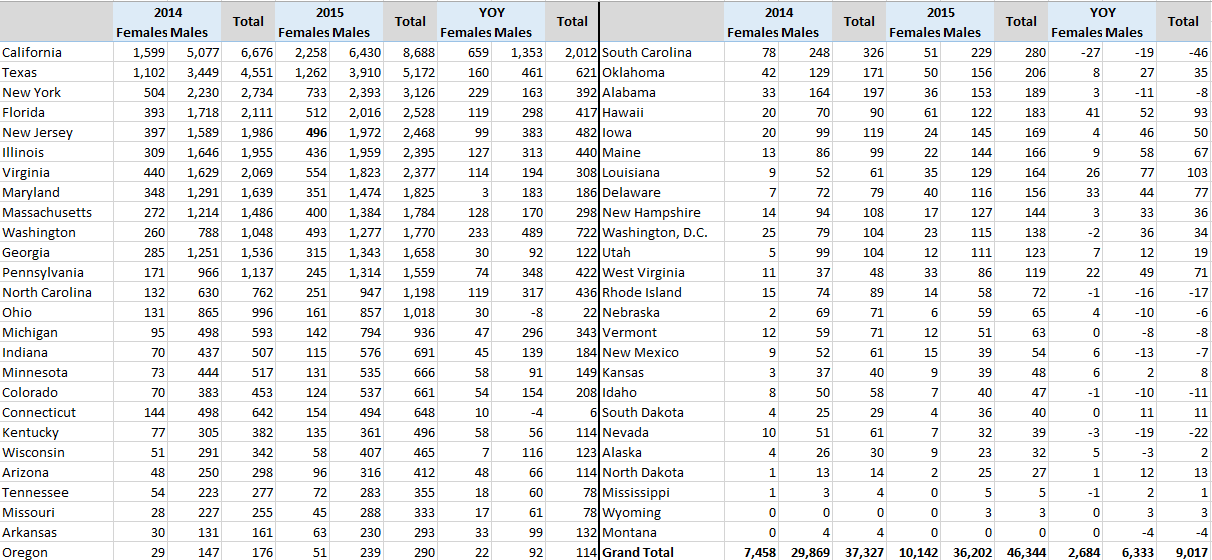
theodp writes: As President Obama was 'taught to code' last December, Politico reported that the $30 million tech-financed campaign to promote computer science education was a smash success. And indeed it has been, at least from a PR standpoint. But Code.org and its backers have long spun AP Computer Science test metrics as a true barometer of CS education success, and from that standpoint, things don't look quite so rosy. The College Board raved about "massive gains in AP Computer Science participation (25% growth) AND scores" in a June tweetstorm and at its July conference, where AP CS was declared the '2015 AP Subject of the Year.' But a look at the recently-released detail on 2015 AP CS scores shows wide differences in adoption and success along gender and ethnicity lines (Asian boys and girls, in particular, set themselves apart from other groups with 70%+ pass rates). And, for all the praise the NSF lavished on Code.org for 'its amazing marketing prowess', half of the states still had fewer than 300 AP CS test takers in 2015, and ten states actually saw year-over-year declines in the number of test takers (if my math is correct — scraped data, VBA code here). -
Google, Facebook, Microsoft Deliver K-12 CS Demands To Congress (politico.com)
theodp writes: Politico reports that just one day after Facebook launched TechPrep, a highly-publicized initiative to attract more minorities and women to coding, Google, Facebook, Microsoft, and Code.org quietly sent a letter to top education lawmakers in the House and Senate insisting that computer science "must" be added to the list of "core academic subjects" and states be given resources to improve STEM education programs. "Computer science is marginalized throughout K-12 education," reads the letter. "We need to improve access for all students, particularly groups who have traditionally been underrepresented." Echoing the last point at this month's Grace Hopper Women in Computer Celebration, YouTube CEO Susan Wojcicki called for mandatory computer science in schools, suggesting that boys — like her own son — are monopolizing the family computer across America, leaving girls — like her own daughter — out of the conversation when it comes to technology (video @38:33). The new round of hand-wringing comes as tech companies face the deadline for filing their 2015 EEO-1 surveys and seek more tech-friendly U.S. visa and OPT STEM policies, so it's probably worth remembering that Microsoft proposed tech could turn workforce diversity lemons into H-1B visa lemonade by connecting tech immigration to K-12 CS education. -
Google, Facebook, Microsoft Deliver K-12 CS Demands To Congress (politico.com)
theodp writes: Politico reports that just one day after Facebook launched TechPrep, a highly-publicized initiative to attract more minorities and women to coding, Google, Facebook, Microsoft, and Code.org quietly sent a letter to top education lawmakers in the House and Senate insisting that computer science "must" be added to the list of "core academic subjects" and states be given resources to improve STEM education programs. "Computer science is marginalized throughout K-12 education," reads the letter. "We need to improve access for all students, particularly groups who have traditionally been underrepresented." Echoing the last point at this month's Grace Hopper Women in Computer Celebration, YouTube CEO Susan Wojcicki called for mandatory computer science in schools, suggesting that boys — like her own son — are monopolizing the family computer across America, leaving girls — like her own daughter — out of the conversation when it comes to technology (video @38:33). The new round of hand-wringing comes as tech companies face the deadline for filing their 2015 EEO-1 surveys and seek more tech-friendly U.S. visa and OPT STEM policies, so it's probably worth remembering that Microsoft proposed tech could turn workforce diversity lemons into H-1B visa lemonade by connecting tech immigration to K-12 CS education. -
Microsoft Resurrects the Title of President
theodp writes: Microsoft CEO Satya Nadella promoted General Counsel Brad Smith to president and chief legal officer Friday, the first time Microsoft has had a company-wide president since 2002. Smith has been Microsoft's point person on convincing Congress of America's tech-worker shortage, an assertion that is disputed by others. At a 2012 forum on STEM education and immigration reform, Smith discussed "producing a crisis" to galvanize action on Microsoft's National Talent Strategy, which calls for increasing the number of H-1B visas to ostensibly make up for U.S. children's lack of CS-savvy. Coincidentally, a real national K-12 CS and tech immigration crisis emerged shortly thereafter, thanks to the efforts of new deep-pocketed nonprofit organizations like Code.org (headed by Smith's next-door neighbor) and Mark Zuckerberg's FWD.us PAC. Smith is a Code.org Board member and a FWD.us 'Major Contributor'. "We took this idea of connecting immigration to education last fall," Smith explained to the Daily Princetonian in 2013, "and when I started in September, we were the only ones talking about it. To have the White House endorse it, to have it embodied in the Senate Bill, to have people in both houses of Congress supporting it means that potentially this is a magic moment for some important steps for education reform as well." While crying crisis wolf to further its agenda has worked well for Microsoft, a Federal judge recently overturned 'emergency' tech immigration changes enacted by Homeland Security in 2008, saying that "the 17-month duration of the STEM extension appears to have been adopted directly from the unanimous suggestions by Microsoft." -
Is There an Ed-Tech Critic In the House?
theodp writes: Educational technology has been stuck for awhile, laments Hack Education's Audrey Watters in And So, Without Ed-Tech Criticism... (an accompanying 1984 photo of Watters making a LOGO turtle draw a square looks little different than President Obama 'learning to code' 30+ years later by making a Disney Princess draw a square). "We might consider why we're still at the point of having to make a case for ed-tech criticism," writes Watters. "It's particularly necessary as we see funding flood into ed-tech, as we see policies about testing dictate the rationale for adopting devices, as we see the technology industry shape a conversation about 'code' — a conversation that focuses on money and prestige but not on thinking, learning. Computer criticism can — and must — be about analysis and action." -
For Microsoft, Windows 10 Charity Begins At Home
theodp writes: "We're investing $10 million in organizations that are upgrading the world," Microsoft announced on in its new Upgrade Your World website, which was created in conjunction with the Windows 10 launch. "We've identified nine global nonprofits, and we'd like your help choosing the 10th." The missions of the selected nonprofits include fighting global poverty, preventing children living with HIV from needlessly dying, increasing access to quality education for children in the developing world, conserving the lands and waters on which all life depends, and ensuring that all kindergartners learn 'computer science.' To paraphrase Sesame Street, can you guess which cause is not like the others? If you guessed Code.org, which wants CS made a "core" K-12 subject in U.S. schools, you're right! Coincidentally, Code.org's biggest donors include Microsoft ($3M+), Ballmer Family Giving ($3M+), and Bill Gates ($1M+). And Code.org CEO Hadi Partovi, who once reported to Satya Nadella, is coincidentally a sometimes jogging partner of Steve Ballmer, as well as the next-door neighbor of Microsoft General Counsel and Code.org Board member Brad Smith, whose FWD.us bio notes is responsible for Microsoft's philanthropic work. Code.org emerged on the scene shortly after Smith suggested that action on Microsoft's 'two-pronged' National Talent Strategy to increase K-12 CS education and the number of H-1B visas could be galvanized by 'producing a crisis'. -
Well-Played: Microsoft Parlays NSF Video 'Remake' Into National CS K-12 Crisis
theodp writes: K–12 computer science and information technology teachers head to Grapevine, TX this week for the 2015 CSTA Conference. A glance at the draft agenda shows a remarkable number of presenters employed by or tied to two-year-old Code.org, the tech-bankrolled nonprofit that coincidentally sprung up together with Mark Zuckerberg's FWD.us PAC just months after Microsoft called for the creation of a national K-12 CS and tech immigration crisis to advance its agenda. Code.org's shaping of the nation's CS K-12 education began with the release of its tech-billionaire and celebrity-studded, slickly-produced What Most Schools Don't Teach video, which went viral on YouTube after being promoted by politicians, Facebook, Google, and a Microsoft-sponsored theatrical release, sparking a groundswell of interest in expanding K-12 CS education, succeeding where a similarly-themed-and-messaged but decidedly-amateurish National Science Foundation video of real-but-little-known computer scientists failed just months earlier (YouTube Doubler comparison). (More, below.) "The time is ripe to seize that opportunity," declared the ACM's and Code.org's Cameron Wilson, describing how Code.org was forming a coalition with Microsoft, Google, NSF, NCWIT, ACM, CSTA, and others with the goal of changing policy to support CS education. Computer science educators literally applauded Code.org's efforts, which have led to funding of a number of new K-12 CS projects, and may soon make No Child Left Behind Act funding available for K-12 CS education. Despite promises of transparency, details of the relationship of the National Science Foundation, now-NSF partner Code.org, the White House, ACM, NCWIT, College Board, and Code.org's corporate and billionaire backers — including Microsoft, Google, and Facebook — have never really been explained. -
Silicon Valley Is Filling Up With Ex-Obama Staffers
HughPickens.com writes: Edward-Isaac Dovere reports in Politico that the fastest-growing chapter of the Obama alumni association is in Silicon Valley. For the people who helped get Obama elected and worked for him once he did, there's something about San Francisco and its environs that just feels right: the emphasis on youth and trying things that might fail, chasing that feeling of working for the underdog, and even using that word "disrupting" to describe what they do. "A lot of people who moved out here were present at the creation of the Obama '08 campaign," says Tommy Vietor. "There's a piece of them that wants to replicate that." Vietor left the White House two years ago, and he and his business partner, former Obama speechwriter Jon Favreau, founded a communications strategy firm with a focus on speechwriting for tech and other start-ups. "If you're writing for a CEO out here, they're more likely to be your peer than your grandfather," says Vietor. "They're young, they're cool, they get it."
Other former Obama staffers who have come to Silicon Valley include former campaign manager and White House adviser David Plouffe at Uber, Kyle O'Connor at Nest, Semonti Stephens at Twitter; Mike Masserman, at Lyft; Brandon Lepow at Facebook; Nicole Isaac, at LinkedIn; Liz Jarvis-Shean at Civis; Jim Green and Vivek Kundra at Salesforce, Alex McPhillips at Google; Gillian Bergeron, at NextDoor; Natalie Foster at the Institute for the Future; Catherine Bracy at Code for America; Hallie Montoya Tansey at Target Labs. Nick Papas, John Baldo, Courtney O'Donnell and Clark Stevens at AirBnB, and Jessica Santillo at Uber.
There are so many former Obama staffers in the Bay Area that a recent visit by former White House senior adviser David Axelrod served as a reunion of sorts, with more than a dozen campaign and White House veterans gathering over lunch to discuss life after the administration. Obama himself rarely misses an opportunity to come to San Francisco. He says he loves the energy there, loves the people and according to Dovere, the city's ultra-liberal leanings mean he was greeted as a rock star even during the dark days before last year's midterms. Obama's even become friendly with Elon Musk. "There should be a welcome booth at the SFO airport," says Jon Carson, the former Organizing for Action executive director now at SolarCity. -
Silicon Valley Is Filling Up With Ex-Obama Staffers
HughPickens.com writes: Edward-Isaac Dovere reports in Politico that the fastest-growing chapter of the Obama alumni association is in Silicon Valley. For the people who helped get Obama elected and worked for him once he did, there's something about San Francisco and its environs that just feels right: the emphasis on youth and trying things that might fail, chasing that feeling of working for the underdog, and even using that word "disrupting" to describe what they do. "A lot of people who moved out here were present at the creation of the Obama '08 campaign," says Tommy Vietor. "There's a piece of them that wants to replicate that." Vietor left the White House two years ago, and he and his business partner, former Obama speechwriter Jon Favreau, founded a communications strategy firm with a focus on speechwriting for tech and other start-ups. "If you're writing for a CEO out here, they're more likely to be your peer than your grandfather," says Vietor. "They're young, they're cool, they get it."
Other former Obama staffers who have come to Silicon Valley include former campaign manager and White House adviser David Plouffe at Uber, Kyle O'Connor at Nest, Semonti Stephens at Twitter; Mike Masserman, at Lyft; Brandon Lepow at Facebook; Nicole Isaac, at LinkedIn; Liz Jarvis-Shean at Civis; Jim Green and Vivek Kundra at Salesforce, Alex McPhillips at Google; Gillian Bergeron, at NextDoor; Natalie Foster at the Institute for the Future; Catherine Bracy at Code for America; Hallie Montoya Tansey at Target Labs. Nick Papas, John Baldo, Courtney O'Donnell and Clark Stevens at AirBnB, and Jessica Santillo at Uber.
There are so many former Obama staffers in the Bay Area that a recent visit by former White House senior adviser David Axelrod served as a reunion of sorts, with more than a dozen campaign and White House veterans gathering over lunch to discuss life after the administration. Obama himself rarely misses an opportunity to come to San Francisco. He says he loves the energy there, loves the people and according to Dovere, the city's ultra-liberal leanings mean he was greeted as a rock star even during the dark days before last year's midterms. Obama's even become friendly with Elon Musk. "There should be a welcome booth at the SFO airport," says Jon Carson, the former Organizing for Action executive director now at SolarCity. -
Stanford Starts the 'Secure Internet of Things Project'
An anonymous reader writes: The internet-of-things is here to stay. Lots of people now have smart lights, smart thermostats, smart appliances, smart fire detectors, and other internet-connect gadgets installed in their houses. The security of those devices has been an obvious and predictable problem since day one. Manufacturers can't be bothered to provide updates to $500 smartphones more than a couple years after they're released; how long do you think they'll be worried about security updates for a $50 thermostat? Security researchers have been vocal about this, and they've found lots of vulnerabilities and exploits before hackers have had a chance to. But the manufacturers have responded in the wrong way.
Instead of developing a more robust approach to device security, they've simply thrown encryption at everything. This makes it temporarily harder for malicious hackers to have their way with the devices, but also shuts out consumers and white-hat researchers from knowing what the devices are doing. Stanford, Berkeley, and the University of Michigan have now started the Secure Internet of Things Project, which aims to promote security and transparency for IoT devices. They hope to unite regulators, researchers, and manufacturers to ensure nascent internet-connected tech is developed in a way that respects customer privacy and choice. -
Google, Apple, and Others Remove Content Related To the Confederate Flag
davek writes with news that Google is removing results related to the Confederate Flag from Google Shopping, the company's online marketplace. They're also blocking advertisements involving the flag. They say, "We have determined that the Confederate flag violates our Ads policies, which don't allow content that's generally perceived as expressing hate toward a particular group." At the same time, Apple is removing from the App Store any games or other software featuring the Confederate Flag. This, of course, follows the recent shooting in South Carolina, which triggered a nationwide debate over whether the flag should be flown at government buildings (or anywhere). Major online merchant websites like eBay and Amazon have already taken the step of banning merchandise relating to the flag. -
The Patriot Act May Be Dead For Good
HughPickens.com points out Shane Harris's report at The Daily Beast that when powerful spying authorities under the Patriot Act expire at the stroke of midnight Monday, as currently appears likely, they may never return. "Senators have been negotiating over whether to pass a House bill that would renew and tweak existing provisions in the long-controversial law, but if the sunset comes and the provisions are off the books, lawmakers in both chambers would be facing a vote to reinstate controversial surveillance authorities, which is an entirely different political calculation. ... Three major Patriot provisions are on the chopping block: so-called roving wiretaps, which let the government monitor one person's multiple electronic devices; the "lone-wolf" provision, which allows surveillance of someone who's not connected to a known terrorist group; and Section 215, which, among other things, the government uses to collect the records of all landline phone calls in the United States." Obama has been urging Congress to pass the Freedom Act, but not warning that the sky will fall if they don't. That may reflect a calculation on the president's part that the surveillance authorities aren't important enough to lose political capital fighting to keep them. Meanwhile with the Senate not slated to return to Washington until just hours before that deadline, opponents like Sens. Rand Paul (R-Ky.) and Ron Wyden (D-Ore.) showing no signs of budging, and the House so far unwilling to bail out the upper chamber, the prospects for an eleventh-hour breakthrough look slim. -
AP Computer Science Education Scalability: Advantage, Rupert Murdoch?
theodp writes: Code.org's AP Computer Science offering won't be going mainstream until the 2016-2017 school year. In the meantime, NewsWorks' Avi Wolfman-Arent reports that Rupert Murdoch's Amplify MOOC just wrapped up its second year of offering AP Computer Science A. And unlike Microsoft TEALS, Google CS First, and Code.org — programs constrained by the number of volunteers, teacher and classroom availability, professional development requirements, and money — Murdoch's AP CS MOOC holds the promise of open-access, unlimited-enrollment, learn-anywhere-and-anytime classes, a la Coursera, Udacity and EdX. So, did Microsoft, Google, Amazon, Facebook, and their leaders place a $30 million bet on the wrong horse when it comes to AP Computer Science scalability? And, even if they've got a more scalable model, will Murdoch's Amplify and schools be willing to deal with higher MOOC failure rates, and allow large numbers of students to try — and possibly drop or fail — AP CS without economic or academic consequences? -
The Demographic Future of America's Political Parties
HughPickens.com writes: Daniel McGraw writes that based on their demographic characteristics the Democratic and Republican parties face two very different futures. There's been much written about how millennials are becoming a reliable voting bloc for Democrats, but there's been much less attention paid to one of the biggest get-out-the-vote challenges for the Republican Party heading into the next presidential election: The Republican Party voter is old—and getting older and far more Republicans than Democrats have died since the 2012 elections. By combining presidential election exit polls with mortality rates per age group from the U.S. Census Bureau, McGraw calculated that, of the 61 million who voted for Mitt Romney in 2012, about 2.75 million will be dead by the 2016 election. About 2.3 million of President Barack Obama's voters have died too but that leaves a big gap in between, a difference of roughly 453,000 in favor of the Democrats. "I've never seen anyone doing any studies on how many dead people can't vote," laughs William Frey, senior fellow at the Brookings Institution who specializes in demographic studies. "I've seen studies on how many dead people do vote. The old Daley Administration in Chicago was very good at that."
Frey points out that, since Republicans are getting whiter and older, replacing the voters that leave this earth with young ones is essential for them to be competitive in presidential elections. "Millennials (born 1981 to 1997) now are larger in numbers than baby boomers ([born] 1946 to 1964), and how they vote will make the big difference. And the data says that if Republicans focus on economic issues and stay away from social ones like gay marriage, they can make serious inroads with millennials." Exit polling indicates that millennials have split about 65-35 in favor of the Dems in the past two elections. If that split holds true in 2016, Democrats will have picked up a two million vote advantage among first-time voters. These numbers combined with the voter death data puts Republicans at an almost 2.5 million voter disadvantage going into 2016. -
Microsoft-Backed Think Tank: K-12 CS Education Cure For Sagging US Productivity
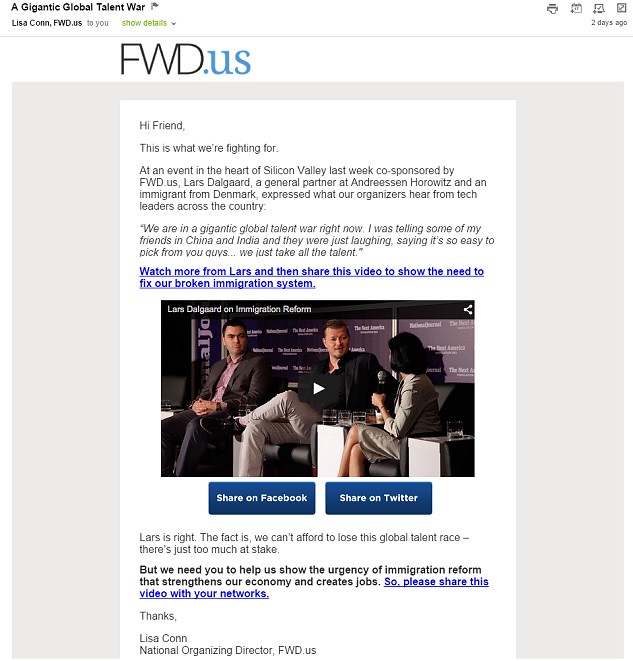
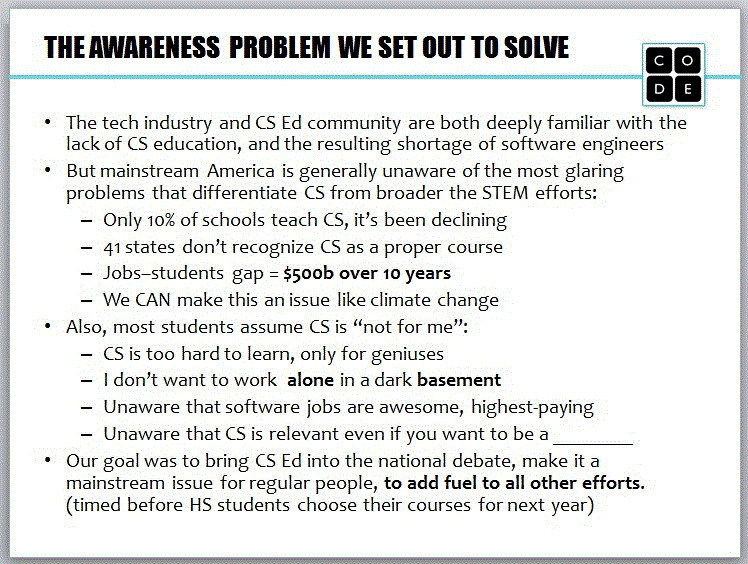
theodp writes: On May 6, notes think tank Brookings, the Department of Labor released labor productivity data showing that output per worker fell by 1.9 percent during the first quarter of 2015. But fear not — the Metropolitan Policy Program of [Microsoft-backed] Brookings says K-12 computer science education is the cure for what ails U.S. productivity: "So how can the United States reverse this trend? First, states, metropolitan areas, and school districts must recognize that basic digital literacy is no longer sufficient preparation for the 21st century workforce. Familiarity with higher-level skills such as coding will be critical as the role of technology continues to grow. The 60-plus school districts that have partnered with [Microsoft-backed] Code.org have already begun to move in this direction. By introducing students to computer science fundamentals early on, Code.org and its partner districts will help get more people on pathways to well-paying jobs in computer programming and other fields." Creating a national K-12 CS and tech immigration crisis was proposed as Microsoft introduced its 'two-pronged' National Talent Strategy to increase K-12 CS education and the number of H-1B visas at a Brookings event in 2012. While creating a K-12 CS crisis fell to Code.org, fanning the flames of a tech immigration crisis is the purvey of [Microsoft exec-backed] FWD.us, the PAC formed by Facebook CEO Mark Zuckerberg, which recently sent an email blast warning U.S. citizens they're in 'A Gigantic Global Talent War', adding that China and India citizens are "just laughing [at the US], saying it's so easy to pick from you guys... we just take all the talent." -
Extreme Secrecy Eroding Support For Trans-Pacific Partnership
schwit1 writes with news that political support for the Trans-Pacific Partnership is drying up because of the secrecy involved in developing it. Members of Congress can read the bill if they want, but they need to be located in a single room within the basement of the Capitol Visitor Center, and they can't have their staff with them. They can't have a copy, they can't take notes, and they can only view one section at a time. And they're monitored while they read it. Unsurprisingly, this is souring many members of Congress on the controversial trade agreement.
"Administration aides say they can’t make the details public because the negotiations are still going on with multiple countries at once; if for example, Vietnam knew what the American bottom line was with Japan, that might drive them to change their own terms. Trade might not seem like a national security issue, they say, but it is (and foreign governments regularly try to hack their way in to American trade deliberations)." -
Think Tanks: How a Bill [Gates Agenda] Becomes a Law
theodp writes: The NY Times' Eric Lipton was just awarded a 2015 Pulitzer Prize for investigative reporting that shed light on how foreign powers buy influence at think tanks. So, it probably bears mentioning that Microsoft's 'two-pronged' National Talent Strategy (PDF) to increase K-12 CS education and the number of H-1B visas — which is on the verge of being codified into laws — was hatched at an influential Microsoft and Gates Foundation-backed think tank mentioned in Lipton's reporting, the Brookings Institution. In 2012, the Center for Technology Innovation at Brookings hosted a forum on STEM education and immigration reforms, where fabricating a crisis was discussed as a strategy to succeed with Microsoft's agenda after earlier lobbying attempts by Bill Gates and Microsoft had failed. "So, Brad [Microsoft General Counsel Brad Smith]," asked the Brookings Institution's Darrell West at the event, "you're the only [one] who mentioned this topic of making the problem bigger. So, we galvanize action by really producing a crisis, I take it?" "Yeah," Smith replied (video). And, with the help of nonprofit organizations like Code.org and FWD.us that were founded shortly thereafter, a national K-12 CS and tech immigration crisis was indeed created. -
NY Times: "All the News That Mark Zuckerberg Sees Fit To Print"?
theodp writes Two years ago, Politico caught Mark Zuckerberg's soon-to-be launched FWD.us PAC boasting how its wealthy tech exec backers would use their companies to 'control the avenues of distribution' for a political message in support of their efforts. Now, the NY Times is reporting that Facebook has been quietly holding talks with at least half a dozen media companies about hosting their content inside Facebook, citing a source who said the Times and Facebook are moving closer to a firm deal. Facebook declined to comment on specific discussions with publishers, but noted it had provided features to help publishers get better traction on Facebook, including tools unveiled in December that let them target their articles to specific groups of Facebook users. The new plan, notes the Times, is championed by Chris Cox, the top lieutenant to Facebook CEO Zuckerberg and a "major supporter" of FWD.us. Exploring Facebook's wooing of the media giants, the Christian Science Monitor asks if social media will control the future of news, citing concerns expressed by Fusion's Felix Salmon, who warns that as news sites sacrifice their brands to reach a wider audience, their incentives for accuracy and editorial judgment will disappear. -
Google Suggests Separating Students With 'Some CS Knowledge' From Novices
theodp writes To address the challenge of rapidly increasing CS enrollments and increasing diversity, reports the Computing Education Blog, Google in November put out an RFP to universities for its invite-only 3X in 3 Years: CS Capacity Award program, which aims "to support faculty in finding innovative ways to address the capacity problem in their CS courses." In the linked-to RFP document, Google suggests that "students that have some CS background" should not be allowed to attend in-person intro CS courses where they "may be more likely to create a non-welcoming environment," and recommends that they instead be relegated to online courses. According to a recent NSF press release, this recommendation would largely exclude Asian and White boys from classrooms, which seems to be consistent with a Google-CodeCademy award program that offers $1,000 bonuses to teachers who get 10 or more high school kids to take a JavaScript course, but only counts students from "groups traditionally underrepresented in computer science (girls, or boys who identify as African American, Latino, American Indian or Alaska Native)." The project suggested in the Google RFP — which could be worth $1.5 million over 3 years to a large CS department — seems to embrace-and-extend a practice implemented at Harvey Mudd College years ago under President Maria Klawe, which divided the intro CS offering into separate sections based upon prior programming experience to — as the NY Times put it — reduce the intimidation factor of young men, already seasoned programmers, who dominated the class. Google Director of Education and University Relations Maggie Johnson, whose name appears on the CS Capacity RFP, is also on the Board of Code.org (where Klawe is coincidentally an Advisory Board member), the K-12 learn-to-code nonprofit that has received $3+ million from Google and many millions more from other tech giants and their execs. Earlier this week, Code.org received the blessing of the White House and NSF to train 25,000 teachers to teach CS, stirring unease among some educators concerned about the growing influence of corporations in public schools. -
Seeking Coders, Tech Titans Turn To K-12 Schools
theodp writes: Politico reports on how a tech PR blitz on the importance of coding in K-12 schools has won over President Obama, who's now been dubbed the "coder-in-chief" after sitting down Monday to "write" a few lines of computer code with middle school students as part of a PR campaign for the Hour of Code, which has earned bipartisan support in Washington. From the article: "The $30 million campaign to promote computer science education has been financed by the tech industry, led by Steve Ballmer, Bill Gates and Mark Zuckerberg, with corporate contributions from Microsoft, Google, Amazon and other giants. It's been a smash success: So many students opened up a free coding tutorial on Monday that the host website crashed. But the campaign has also stirred unease from some educators concerned about the growing influence of corporations in public schools. And it's raised questions about the motives of tech companies, which are sounding an alarm about the lack of computer training in American schools even as they lobby Congress for more H-1B visas to bring in foreign programmers." -
Mathematicians Study Effects of Gerrymandering On 2012 Election
HughPickens.com writes Gerrymandering is the practice of establishing a political advantage for a particular party by manipulating district boundaries to concentrate all your opponents' votes in a few districts while keeping your party's supporters as a majority in the remaining districts. For example, in North Carolina in 2012 Republicans ended up winning nine out of 13 congressional seats even though more North Carolinians voted for Democrats than Republicans statewide. Now Jessica Jones reports that researchers at Duke are studying the mathematical explanation for the discrepancy. Mathematicians Jonathan Mattingly and Christy Vaughn created a series of district maps using the same vote totals from 2012, but with different borders. Their work was governed by two principles of redistricting: a federal rule requires each district have roughly the same population and a state rule requires congressional districts to be compact. Using those principles as a guide, they created a mathematical algorithm to randomly redraw the boundaries of the state's 13 congressional districts. "We just used the actual vote counts from 2012 and just retabulated them under the different districtings," says Vaughn. "If someone voted for a particular candidate in the 2012 election and one of our redrawn maps assigned where they live to a new congressional district, we assumed that they would still vote for the same political party."
The results were startling. After re-running the election 100 times with a randomly drawn nonpartisan map each time, the average simulated election result was 7 or 8 U.S. House seats for the Democrats and 5 or 6 for Republicans. The maximum number of Republican seats that emerged from any of the simulations was eight. The actual outcome of the election — four Democratic representatives and nine Republicans – did not occur in any of the simulations. "If we really want our elections to reflect the will of the people, then I think we have to put in safeguards to protect our democracy so redistrictings don't end up so biased that they essentially fix the elections before they get started," says Mattingly. But North Carolina State Senator Bob Rucho is unimpressed. "I'm saying these maps aren't gerrymandered," says Rucho. "It was a matter of what the candidates actually was able to tell the voters and if the voters agreed with them. Why would you call that uncompetitive?" -
U.S. and China Make Landmark Climate Deal
An anonymous reader writes: After extended talks on the issue of climate change, the U.S. and China have reached a landmark accord to curb emissions in the near future. The two countries are the top carbon polluters, so their actions are likely to have a major effect on world pollution levels and also set the standard for other countries. The agreement includes China's first-ever commitment to stop the growth of its emissions by 2030. They plan on shifting a big chunk of their energy production to renewables in that time. The U.S. agreed to emit 26-28% less carbon in 2025 than it did in 2005. Their efforts could spur greater enthusiasm for a new global climate agreement in 2015. Reader jones_supa adds details of another interesting part of the U.S.-China talks: Technology products look likely to gain more access to international markets as a result of upgrade between the U.S. and China on a 1996 tariff-eliminating trade agreement that President Obama announced Tuesday in Beijing. The agreement is expected to lower prices on a raft of new technology products by eliminating border tariffs — a price impact that's expected to be larger outside the United States, since U.S. tariffs on high-tech goods are generally lower than those overseas. "This is a win-win-win agreement for information and communication technology industries in the U.S., Europe, Japan and China, for businesses and consumers who purchase IT products and for the global economy." -
Mayday PAC Goes 2 For 8
An anonymous reader writes: Lawrence Lessig's Mayday.us project had a bold goal: create a super PAC to end all super PACs. It generated significant support and raised over $10 million, which it spent endorsing a group of candidates for the recent mid-term elections and the primaries beforehand. The results weren't kind. Only two of the eight candidates backed by Mayday won their elections, and both of those candidates were quite likely to win anyway. Lessig was understandably displeased with the results. In a post on the Mayday site, he said, "What 2014 shows most clearly is the power of partisanship in our elections. Whatever else voters wanted, they wanted first their team to win."
Kenneth Vogel, author of Big Money, a recent book on the rise of super PACs, was critical of of Mayday's efforts, saying, "While voters do express high levels of disgust about the state of campaign finance and the level of corruption in Washington, they tend to actually cast votes more on bread-and-butter economic issues." Still, Lessig is hopeful for the future: "We moved voters on the basis of that message. Not enough. Not cheaply enough. But they moved." -
Pentagon Reportedly Hushed Up Chemical Weapons Finds In Iraq
mr_mischief writes "Multiple sources report that the US found remnants of WMD programs, namely chemical weapons, in Iraq after all. Many US soldiers were injured by them, in fact. The Times reports: "From 2004 to 2011, American and American-trained Iraqi troops repeatedly encountered, and on at least six occasions were wounded by, chemical weapons remaining from years earlier in Saddam Hussein's rule. In all, American troops secretly reported finding roughly 5,000 chemical warheads, shells or aviation bombs, according to interviews with dozens of participants, Iraqi and American officials, and heavily redacted intelligence documents obtained under the Freedom of Information Act." -
The CDC Is Carefully Controlling How Scared You Are About Ebola
HughPickens.com writes: Russell Berman reports in The Atlantic that the Obama administration is trying to navigate a tricky course: Can officials increase public vigilance about the deadly Ebola virus without inciting a panic? "Ebola is scary. It's a deadly disease. But we know how to stop it," says Dr. Thomas Frieden, the CDC director. speaking "calmly and clearly, sticking to an even pitch and avoiding the familiar political image of the whip-smart fast-talker." International groups wanted the U.S. to step in sooner to help fight the outbreak in west Africa, while more recently some Republicans have called on the administration to ban travel from the most affected countries.
Frieden and other officials say such a move would be counterproductive, citing lessons learned from the SARS outbreak a decade ago. "The SARS outbreak cost the world more than $40 billion, but it wasn't to control the outbreak," says Frieden. "Those were costs from unnecessary and ineffective travel restrictions and trade changes that could have been avoided." The government announced Wednesday that it was stepping up protective measures at five airports, where authorities will screen travelers from Liberia, Sierra Leone, and Guinea with targeted questions and fever checks, an action, officials acknowledge, that was taken not only to stop the spread of the disease but simply to make people feel safer. According to Berman, the message is this: Be afraid of Ebola. Just not too afraid. -
Mark Zuckerberg Throws Pal Joe Green Under the Tech Immigration Bus
theodp (442580) writes "A month after he argued that Executive Action by President Obama on tech immigration was needed lest his billionaire bosses at Mark Zuckerberg's FWD.us PAC have to hire 'just sort of OK' U.S. workers, Re/code reports that Joe Green — Zuckerberg's close friend and college roommate — has been pushed out of his role as President of FWD.us for failing to Git-R-Done on an issue critical to the tech community. "Today, we wanted to share an important change with you," begins 'Leadership Change', the announcement from the FWD.us Board that Todd Schulte is the new Green. So what sold FWD.us on Schulte? "His [Schulte's] prior experience as Chief-of-Staff at Priorities USA, the Super PAC supporting President Obama's re-election," assured Zuckerberg in a letter to FWD.us contributors, "will ensure FWD.us continues its momentum for reform." Facebook, reported the Washington Post in 2013, became legally "dependent" on H-1B visas and subject to stricter regulations shortly before Zuckerberg launched FWD.us with Green at the helm." -
Mark Zuckerberg Throws Pal Joe Green Under the Tech Immigration Bus
theodp (442580) writes "A month after he argued that Executive Action by President Obama on tech immigration was needed lest his billionaire bosses at Mark Zuckerberg's FWD.us PAC have to hire 'just sort of OK' U.S. workers, Re/code reports that Joe Green — Zuckerberg's close friend and college roommate — has been pushed out of his role as President of FWD.us for failing to Git-R-Done on an issue critical to the tech community. "Today, we wanted to share an important change with you," begins 'Leadership Change', the announcement from the FWD.us Board that Todd Schulte is the new Green. So what sold FWD.us on Schulte? "His [Schulte's] prior experience as Chief-of-Staff at Priorities USA, the Super PAC supporting President Obama's re-election," assured Zuckerberg in a letter to FWD.us contributors, "will ensure FWD.us continues its momentum for reform." Facebook, reported the Washington Post in 2013, became legally "dependent" on H-1B visas and subject to stricter regulations shortly before Zuckerberg launched FWD.us with Green at the helm." -
Tech Looks To Obama To Save Them From 'Just Sort of OK' US Workers
theodp writes Following up on news that the White House met with big biz on immigration earlier this month, Bloomberg sat down with Joe Green, the head of Mark Zuckerberg's Fwd.US PAC, to discuss possible executive actions President Obama might take on high tech immigration (video) in September. "Hey, Joe," asked interviewer Alix Steel. "All we keep hearing about this earnings season though from big tech is how they're actually cutting jobs. If you look at Microsoft, Cisco, IBM, Hewlett-Packard, why do the tech companies then need more tech visas?" Green explained why tech may not want to settle for laid-off U.S. talent when the world is its oyster. "The difference between someone who's truly great and just sort of okay is really huge," Green said. "Culture in tech is a very meritocratic culture," he added. "The vast, vast majority of tech engineers that I talked to who are from the United States are very supportive of bringing in people from other countries because they want to work with the very best." -
Washington Redskins Stripped of Trademarks
BillCable writes: Politico reports, "In a major blow to the Washington Redskins, the U.S. Patent and Trademark Office on Wednesday canceled six federal trademarks of the 'Washington Redskins' team name because it was found to be 'disparaging' to Native Americans. 'We decide, based on the evidence properly before us, that these registrations must be canceled because they were disparaging to Native Americans at the respective times they were registered,' the PTO's Trademark Trial and Appeal Board wrote. The panel voted 2-1 in favor of the decision." Perhaps this move will speed up the inevitable name change, which was expected within the next few years." -
Parents Mobilize Against States' Student Data Mining
theodp writes 'Politico reports that parents have mobilized into an unexpected political force to fight the data mining of their children, catapulting student privacy to prominence in statehouses. Having already torpedoed the $100 million, Bill Gates-funded inBloom database project, which could have made it easier for schools to share confidential student records with private companies, the amateur activists are now rallying against another perceived threat: huge state databases being built to track children for more than two decades, from as early as infancy through the start of their careers. "The Education Department," writes Stephanie Simon, "lists hundreds of questions that it urges states to answer about each child in the public school system: Did she make friends easily as a toddler? Was he disciplined for fighting as a teen? Did he take geometry? Does she suffer from mental illness? Did he go to college? Did he graduate? How much does he earn?" Leonie Haimson, a NY mother who is organizing a national Parent Coalition for Student Privacy says, "Every parent I've talked to has been horrified. We just don't want our kids tracked from cradle to grave." For their part, ed tech entrepreneurs and school reformers are both bewildered by and anxious about the backlash — and struggling to craft a response, having assumed parents would support their vision: to mine vast quantities of data for insights into what's working, and what's not, for individual students and for the education system as a whole. "People took for granted that parents would understand [the benefits], that it was self-evident," said Michael Horn, a co-founder an education think tank." -
The Big Biz of Spying On Little Kids
theodp writes: "'The NSA,' writes POLITICO's Stephanie Simon in her eye-opening Data Mining Your Children, 'has nothing on the ed tech startup known as Knewton. The data analytics firm has peered into the brains of more than 4 million students across the country. By monitoring every mouse click, every keystroke, every split-second hesitation as children work through digital textbooks, Knewton is able to find out not just what individual kids know, but how they think. It can tell who has trouble focusing on science before lunch — and who will struggle with fractions next Thursday.' Simon adds, 'Even as Congress moves to rein in the National Security Agency, private-sector data mining has galloped forward — perhaps nowhere faster than in education. Both Republicans and Democrats have embraced the practice. And the Obama administration has encouraged it, even relaxing federal privacy law to allow school districts to share student data more widely.'" -
HealthCare.gov Back-End Status: See You In September
theodp writes: "The consumer-facing parts of the Obamacare website may now work (most of the time) for people buying insurance, writes Politico, but beneath the surface, HealthCare.gov is still missing massive, critical pieces that are essential for key functions such as accurately paying insurers — and the deadline for finishing them keeps slipping. Without a fully built and operational system, federal officials can't determine how many of the 8 million Obamacare sign-ups announced last week will have actually paid their premiums. The Obama administration earlier this month indicated that insurers will continue to be paid through an 'interim' accounting process — pretty much a spreadsheet and some informed estimates — until at least September, when what is being called 'the mother of all reconciliations' will be conducted, which some fear could reveal the need for a massive correction and rate adjustments. Still, Oregon decided Friday to switch to Healthcare.gov from its own nothing-wrong-that-$78-million-couldn't-fix Cover Oregon online healthcare exchange." -
Supreme Court Upholds Michigan's Ban On Affirmative Action In College Admissions
Hugh Pickens DOT Com writes: "The Supreme Court, by a vote of 6 — 2, has upheld a Michigan law banning the use of racial criteria in college admissions, finding that a lower court did not have the authority to set aside the measure approved in a 2006 referendum supported by 58% of voters. 'This case is not about how the debate about racial preferences should be resolved. It is about who may resolve it,' wrote Justice Anthony Kennedy. 'Michigan voters used the initiative system to bypass public officials who were deemed not responsive to the concerns of a majority of the voters with respect to a policy of granting race-based preferences that raises difficult and delicate issues.' Kennedy's core opinion in the Michigan case seems to exalt referenda as a kind of direct democracy that the courts should be particularly reluctant to disturb. This might be a problem for same-sex marriage opponents if a future Supreme Court challenge involves a state law or constitutional amendment enacted by voters.
Justice Sonia Sotomayor reacted sharply in disagreeing with the decision in a 58 page dissent. 'For members of historically marginalized groups, which rely on the federal courts to protect their constitutional rights, the decision can hardly bolster hope for a vision of democracy (PDF) that preserves for all the right to participate meaningfully and equally in self-government.' The decision was the latest step in a legal and political battle over whether state colleges can use race and gender as a factor in choosing what students to admit. Michigan has said minority enrollment at its flagship university, the University of Michigan, has not gone down since the measure was passed. Civil rights groups dispute those figures and say other states have seen fewer African-American and Hispanic students attending highly competitive schools, especially in graduate level fields like law, medicine, and science." -
CISPA's Author Has Another Privacy-Killing Bill To Pass Before He Retires
Daniel_Stuckey writes: "You might remember House Intelligence Chair Mike Rogers, a Republican from Michigan, from his lovely, universally-hated CISPA cybersecurity bill that would have allowed nearly seamless information sharing between companies and the federal government. You might also remember him from his c'est la vie attitude towards civil liberties in general. Well, we've got some good news and some bad news: Rogers announced today that he won't seek re-election and is instead retiring from politics to start a conservative talk radio show on Cumulus. The bad news? He's got at least one terrible, civil liberties-killing bill to try to push through Congress before he goes. Like CISPA, the newly introduced 'FISA Transparency and Modernization Act,' seeks to make it easier for the federal government to get your information from companies." -
Confessions Of an Ex-TSA Agent: Secrets Of the I.O. Room
Jason Edward Harrington has seen some of the same frustrations, misgivings, and objections that have crossed the mind of probably every commercial airline traveler who's flown over the last decade in the U.S. One difference: Harrington got to see them from the perspective of a TSA agent. His description of the realities of the job (including learning the rote responses that agents are instructed to reassure the public with) is wince-worthy and compelling. A sample makes it clear why the TSA has such famously low morale, even among Federal agencies: "I hated it from the beginning. It was a job that had me patting down the crotches of children, the elderly and even infants as part of the post-9/11 airport security show. I confiscated jars of homemade apple butter on the pretense that they could pose threats to national security. I was even required to confiscate nail clippers from airline pilots—the implied logic being that pilots could use the nail clippers to hijack the very planes they were flying." It only gets worse from there. -
US Senator Warns Against Political Surveillance By Drone
cold fjord writes "Politico reports, 'Sen. Dianne Feinstein says she once found a drone peeking into the window of her home — the kind of cautionary tale she wants lawmakers to consider as they look at allowing commercial drone use. ... she used the episode to implore lawmakers to "proceed with caution." Feinstein said she encountered the flying robot while a demonstration was taking place outside her house. She said she went to the window to peek out — and "there was a drone right there at the window looking out at me." ... "Obviously the pilot of the drone had some surprise because the drone wheeled around and crashed ..." she said. ... Feinstein, who chairs the Senate Intelligence Committee, said Wednesday that she has seen firsthand the surveillance capabilities of drones and called civilian privacy concerns "significant." She ... recommended a search warrant requirement. Feinstein said she is working on legislation with the Commerce Committee and urged senators to move swiftly to create "strong, binding enforceable privacy policies that govern drone operations before the technology is upon us."'" -
Member of President Obama's NSA Panel Recommends Increased Data Collection
cold fjord writes "National Journal reports, 'Michael Morell, the former acting director of the CIA and a member of President Obama's task force on surveillance, said ... that a controversial telephone data-collection program conducted by the National Security Agency should be expanded to include emails. He also said the program, far from being unnecessary, could prevent the next 9/11. Morell, seeking to correct any misperception that the presidential panel had called for a radical curtailment of NSA programs, said he is in favor of restarting a program that the NSA discontinued in 2011 that involved the collection of "meta-data" for internet communications. ... "I would argue actually that the email data is probably more valuable than the telephony data," ... Morell also said that while he agreed with the report's conclusion that the telephone data program, conducted under Section 215 of the Patriot Act, made "only a modest contribution to the nation's security" so far, it should be continued under the new safeguards recommended by the panel. "I would argue that what effectiveness we have seen to date is totally irrelevant to how effective it might be in the future," he said. "This program, 215, has the ability to stop the next 9/11 and if you added emails in there it would make it even more effective. Had it been in place in 2000 and 2001, I think that probably 9/11 would not have happened."' — More at Politico and National Review. Some members of Congress have a different view. Even Russian President Putin has weighed in with both a zing and a defense." -
Judge: NSA Phone Program Likely Unconstitutional
schwit1 writes in with the latest on an U.S. District Court ruling over NSA spying. "A federal judge ruled Monday that the National Security Agency's phone surveillance program is likely unconstitutional, Politico reports. U.S. District Court Judge Richard Leon said that the agency's controversial program, first unveiled by former government contractor Edward Snowden earlier this year, appears to violate the Constitution's Fourth Amendment, which states that the 'right of the people to be secure in their persons, houses, papers, and effects, against unreasonable searches and seizures, shall not be violated.' 'I cannot imagine a more "indiscriminate" and "arbitrary invasion" than this systematic and high-tech collection and retention of personal data on virtually every single citizen for purposes of querying it and analyzing it without judicial approval,' Leon wrote in the ruling. The federal ruling came down after activist Larry Klayman filed a lawsuit in June over the program. The suit claimed that the NSA's surveillance 'violates the U.S. Constitution and also federal laws, including, but not limited to, the outrageous breach of privacy, freedom of speech, freedom of association, and the due process rights of American citizens.'" -
Obama Praises NSA But Promises To Rein It In
Hugh Pickens DOT Com writes "Josh Gerstein writes on Politico that President Barack Obama told Chris Matthews in an interview recorded for MSNBC's 'Hardball' that he'll be reining in some of the snooping conducted by the NSA, but he did not detail what new limits he plans to impose on the embattled spy organization. 'I'll be proposing some self-restraint on the NSA. And...to initiate some reforms that can give people more confidence,' said the President who insisted that the NSA's work shows respect for the rights of Americans, while conceding that its activities are often more intrusive when it comes to foreigners communicating overseas. 'The NSA actually does a very good job about not engaging in domestic surveillance, not reading people's emails, not listening to the contents of their phone calls. Outside of our borders, the NSA's more aggressive. It's not constrained by laws.' During the program, Matthews raised the surveillance issue by noting a Washington Post report on NSA gathering of location data on billion of cell phones overseas. 'Young people, rightly, are sensitive to the needs to preserve their privacy and to retain internet freedom. And by the way, so am I,' responded the President. 'That's part of not just our First Amendment rights and expectations in this country, but it's particularly something that young people care about, because they spend so much time texting and-- you know, Instagramming.' With some at the NSA feeling hung out to dry by the president, Obama also went out of his way to praise the agency's personnel for their discretion. 'I want to everybody to be clear: the people at the NSA, generally, are looking out for the safety of the American people. They are not interested in reading your emails. They're not interested in reading your text messages. And that's not something that's done. And we've got a big system of checks and balances, including the courts and Congress, who have the capacity to prevent that from happening.'"