Slashdot Mirror
Domain: recode.net
Stories and comments across the archive that link to recode.net.
Stories · 311
-
Girls-Only Computer Camps Formed At Behest of Top Google, Facebook Execs
theodp writes: Reporting on Google exec Susan Wojcicki's appearance at DreamForce, Inc.'s Tess Townsend writes: "The YouTube CEO said her daughter had stated point-blank that she did not like computers, so Wojcicki enrolled her in a computer camp. The camp made her daughter dislike tech even more. Wojcicki reported her daughter came back saying, 'Everyone in the class was a boy and nobody was like me and now I hate computers even more.' So, mom called the camp and spoke to the CEO, asking that the camp be made more welcoming to girls" (video). Fortune reported last July that it was the urging of Wojcicki and Facebook COO Sheryl Sandberg that prompted iD Tech Camps — which Wojcicki's and Sandberg's kids had attended — to spin off a girls-only chain of tech camps called Alexa Cafe, which was trialed in the Bay Area in 2014 and expanded to nine locations in 2015. Earlier this month, Fortune noted that Wojcicki's daughter attended the $949-a-week Alexa Cafe summer camp at Palo Alto High, which was coincidentally hosted in the multi-million dollar Media Center (video) that was built thanks to the efforts of Wojcicki's mother Esther (a long-time Paly journalism teacher) and partially furnished and equipped by sister Anne (23andMe CEO) and ex-brother-in-law Sergey Brin's charitable foundation. -
HP To Jettison Up To 30,000 Jobs As Part of Spinoff
An anonymous reader writes: Hewlett-Packard says its upcoming spinoff of its technology divisions focused on software, consulting and data analysis will eliminate up to 30,000 jobs. The cuts announced Tuesday will be within the newly formed Hewlett Packard Enterprise, which is splitting from the Palo Alto, California company's personal computer and printing operation. "The new reductions amount to about 10 percent of the new company's workforce, and will save about $2.7 billion in annual operating costs." The split is scheduled to be completed by the end of next month. "The head of the group, Mike Nefkens, outlined a plan under which it is cutting jobs in what he called 'high-cost countries' and moving them to low-cost countries. He said that by the end of HP Enterprise’s fiscal year 2018, only 40 percent of the group’s work force will be located in high-cost countries." -
Where the Tech Industry's Political Donations Are Going
An anonymous reader writes: Early estimates suggest the 2016 U.S. presidential election will result in $5-10 billion in spending by candidates and organizations — much more than ever before. To support this, they need lots of contributions, and the tech industry is becoming a significant player. (Not as much as the financial industry, of course, but tech's influence is growing.) Re/Code breaks down which candidates are getting the most money from the tech sector so far. Right now, Senator Marco Rubio (R-FL) has gotten the most tech money by far — more than the rest of the field combined, thanks in large part to Larry Ellison. Jeb Bush, former governor of Florida, is a distant second, followed closely by former Secretary of State Hillary Clinton and Senator Bernie Sanders (I-VT). New Jersey governor Chris Christie and Senator Rand Paul (R-KY) are the only other candidates with significant tech contributions so far. Carly Fiorina, a tech industry veteran, has only managed about $13,000 in donations. -
New Horizons' New Target: Kuiper Belt Ice Chunk 2014 MU69
Vox reports on the next target destination for NASA's New Horizons probe, an ice chunk in the Kuiper Belt designated 2014 MU69. The plan is not yet final; like any space mission, complications are bound to come up. But if this selection sticks, New Horizons should reach 2014 MU69 in 2019. (Re/Code has the story, too.) -
Will a Tighter Economy Rein In Startups?
Nerval's Lobster writes: It's been quite a ride for the stock market this week. In China, markets cratered; in the U.S., stocks dove for two days, only to rebound on Wednesday. That made many tech firms nervous, both about the Chinese economy (which some of them depend upon) and the continuing flow of money from VCs and investors. While the economic jitters don't seem to be affecting some tech firms' ability to implode themselves, more than one pundit is wondering whether the tech industry will shift into 'fear mode,' which could be bad for the so-called 'unicorns' that need funders to keep partying like it's 1999. Are we going to see money start drying up for startups? -
California Bill Would Dramatically Limit Commercial Drones
An anonymous reader writes: California's Senate Bill 142 would prohibit drones from flying under 350 feet over any property without express permission from the property's owner. The bill passed the California Assembly easily. Tech advocates have been battling privacy advocates to influence the inevitable regulation of private and commercial drones. Industry groups say this restriction will kill drone delivery services before they even begin. The legislation would also drastically diminish the usefulness of camera-centric drones like the ones being rolled out by GoPro. If passed, the bill could influence how other states regulate drones. The article notes that 156 different drone-related bills have been considered in 46 different states this year alone, and the FAA will issue nationwide rules in September. -
Continued Cord Cutting Hits the Pay TV Business Hard
An anonymous reader writes: Cord cutting is not a new concern for the pay TV business but a recent massive sell-off in media stocks has many in the industry worried. Cable, satellite and TV companies suffered their worst-ever quarterly subscriber declines losing more than half a million accounts, sending stocks tumbling. Researchers say this may be the beginning of the end for the pay TV business. According to analysts Craig Moffett and Michael Nathanson: "A year ago, the Pay TV sector was shrinking at an annual rate of 0.1 percent. A year later, the rate at which the Pay TV sector is declining has quickened to 0.7 percent year-over-year. That may not seem like a mass exodus, but it is a big change in a short period of time. And the rate of decline is still accelerating." -
The New Google Glass Is All Business
An anonymous reader writes: Google scrapped an early version of its smart glasses in January, but has developed another model just for businesses. The company hopes to get this newest version of Glass in the hands of healthcare, manufacturing and energy industry professionals by this fall. Recode reports: "The new model can fold up like a traditional pair of glasses and is more rugged for outdoor use. However, unlike most other smart glasses, it still sports a small screen to the upper right of the user's vision, rather than displaying an image in the center of one's view like the ODG R7 or Microsoft HoloLens." -
Twitter Stock Jumps Nearly 8 Percent After Fake Report
vivaoporto writes: As noted by Re/code and many other outlets, Twitter stock jumped nearly 8 percent after a bogus report, attributed to Bloomberg News, said Twitter had received a $31 billion buyout offer. The fake story, which cited "people with knowledge of the situation," appeared on a website (Google Cache version) made to look like Bloomberg's business news page and claimed the company had received a takeover offer worth $31 billion.
The website domain, bloomberg.market (now suspended), was registered Friday, according to a search of ICANN's records. The identity of the person or company who registered it is not publicly available. Close scrutiny flagged a number of questionable elements in the report, like the name of Twitter's former chief executive, Richard Costolo, being misspelled. By late afternoon, the web page for bloomberg.market was no longer operable. A message posted on the page said, "account suspended." A spokesman for Bloomberg confirmed the takeover article was fake.
In May, a fake bid for another company, Avon Products, sent its shares as much as 20 percent higher. That offer involved a document filed with the Securities and Exchange Commission. Last month the SEC sued a Bulgarian man, Nedko Nedev, and said he and five others worked together to violate securities laws by creating fake takeover offers. Robert Heim, a former lawyer at the SEC, said these kinds of schemes will probably persist because news spreads so fast over social media and traders have to react so quickly. -
Google, Apple, and Others Remove Content Related To the Confederate Flag
davek writes with news that Google is removing results related to the Confederate Flag from Google Shopping, the company's online marketplace. They're also blocking advertisements involving the flag. They say, "We have determined that the Confederate flag violates our Ads policies, which don't allow content that's generally perceived as expressing hate toward a particular group." At the same time, Apple is removing from the App Store any games or other software featuring the Confederate Flag. This, of course, follows the recent shooting in South Carolina, which triggered a nationwide debate over whether the flag should be flown at government buildings (or anywhere). Major online merchant websites like eBay and Amazon have already taken the step of banning merchandise relating to the flag. -
Apple To Pay Musicians For Free Streams, After All
vivaoporto writes: As reported on Re/code, Apple media boss Eddy Cue appears to have capitulated and Apple Music will be paying music owners for streaming even during customers's free trial period. He says Taylor Swift's letter, coupled with complaints from indie labels and artists, did indeed prompt the change.
Cue says Apple will pay rights holders for the entire three months of the trial period. He explains that it can't be at the same rate that Apple is paying them after free users become subscribers, since Apple is paying out a percentage of revenues once subscribers start paying. Instead, he says, Apple will pay rights holders on a per-stream basis.
No word from Swift or her camp about whether Apple's move is enough to get her to put "1989," her newest album, on Apple Music. On Twitter, she says, "I am elated and relieved. Thank you for your words of support today. They listened to us." -
Apple Will Pay More To Streaming Music Producers Than Spotify -- But Not Yet
Reader journovampire supplies a link to Music Business Worldwide (based on a re/code report) that says Apple's new Apple Music service, after a trial period during which the company has refused to pay royalties, is expected to pay a bit more than 70 percent of its subscription revenue out to the companies supplying it, rather than the 58 percent that some in the music industry had feared. Notes journovampire: "If 13% of iOS device users in the world paid $9.99-per-month for Apple Music, it would generate more cash each year than the entire recorded music biz manages right now." -
The Danger of Picking a Major Based On Where the Jobs Are
theodp writes: In his new book Will College Pay Off?, Wharton professor Peter Cappelli argues that banking on a specialized degree's usefulness is risky, especially since one reason some jobs are in high demand is that no one predicted that they would be. "A few generations ago," notes Cappelli, "the employers used to look for smart or adaptable kids on college campuses with general skills. They would convert them to what they wanted inside the company and they would retrain them and they'd get different skills. They're not doing that now. They're just expecting that the kids will show up with the skills that the employer needs when the employer needs them. That's a pretty difficult thing to expect, because of these kinds of problems. So the employers now are always complaining that they can't get the people they need, but it's pretty obvious why that's not happening." On CS-as-a-major, Cappelli says, "If you look at most of the people who are in computer programming, for example, they have no IT degree-they just learned how to program. Maybe they had a couple of courses in it, maybe they were self-taught. In Silicon Valley, the industry was built with only 10 percent of the workforce having IT degrees. You can do most of these jobs with a variety of different skills. I think what's happening now is that people have come to think that you need these degrees in order to do the jobs, which is not really true. Maybe what these degrees do for you is they shorten the job training by a bit, but that's about it. And you lose a bunch of other things along the way." One wonders what Cappelli might think of San Francisco's recent decision to pick a preschool curriculum based on where today's tech jobs are, echoing President Obama's tech industry-nurtured belief that "what you want to do is introduce this [coding] with the ABCs and the colors." -
The Dallas Cowboys Will Train Their Quarterbacks With Virtual Reality Headsets
An anonymous reader writes: The Dallas Cowboys have signed a two-year deal with a virtual reality sports startup called StriVR Lab to train quarterbacks using a VR headset according to reports. The technology was originally developed by Derek Belch, a former kicker at Stanford, and it is credited with turning around the school's football program. Besides Stanford, StriVR also signed deals with: Arkansas, Clemson, Vanderbilt, Auburn and Dartmouth. -
The Music Industry's Latest Shortsighted Plan: Killing Freemium Services
An anonymous reader notes that there have been rumblings in the music industry of trying to shut down freemium services like Spotify's free tier and YouTube's swath of free music. The record labels have realized that music downloads are gradually giving way to streaming, and they're angling for as a big a slice of that revenue as they can manage. The article argues that they're making the same mistake they always make: that converting freemium site listeners (in the past, music pirates) to subscription services will be a 1:1 transfer, and no listeners will be lost in the process. Of course, that's no more true now than it was a decade ago. But in doing trying to do so, the labels will do harm to the artists they represent, and shoot themselves in the foot for acquiring future customers by getting rid of several major sources of music discovery. -
For High-End CPUs, Qualcomm Ditches TSMC For Samsung
An anonymous reader writes: A report at Re/code says Qualcomm will have its next-gen Snapdragon 820 CPU made at Samsung's foundries, instead of TSMC's. The report points out a couple of good reasons for the switch: first of all, Samsung's plants run on a 14nm process, while TSMC still uses a 20nm process. Second — and more telling — Samsung recently ditched Qualcomm's Snapdragon processors for their new Galaxy S6 smartphone, opting to use their own Exynos chips instead. With the phone expected to sell upwards of 70 million units, that's a huge missed opportunity for Qualcomm. It's feasible Qualcomm could get Samsung to drop its own chips, because the Snapdragon 820 will have an onboard LTE modem. That would reduce the cost of assembling a phone, and also free up some space to make it smaller. -
Nokia To Buy Alcatel-Lucent for $16.6 Billion
totalcaos sends news that Nokia has announced plans to buy Alcatel-Lucent for $16.6 billion worth of stock. Both companies have approved the transaction, though now they must wait for regulatory approval. They said they expect the deal to close in the first half of 2016. The combined company is expected to become the world’s second-largest telecom equipment manufacturer behind Ericsson of Sweden, with global revenues totaling $27 billion and operations spread across Asia, Europe and North America. The companies are betting that, by joining forces, they can better compete against Chinese and European rivals bidding to provide telecom hardware and software to the world’s largest carriers, including AT&T and Verizon in the United States, Vodafone and Orange in Europe, and SoftBank in Japan. ... Analysts say that Nokia has progressively focused on its equipment unit, which now represents roughly 85 percent of the company’s annual revenue. On Wednesday, Nokia confirmed that it had put its digital maps business — a competitor for Google Maps — up for sale. -
Senate Draft of No Child Left Behind Act Draft Makes CS a 'Core' Subject
theodp (442580) writes "If at first you don't succeed, lobby, lobby again. That's a lesson to be learned from Microsoft and Google, who in 2010 launched advocacy coalition Computing in the Core, which aimed "to strengthen K-12 computer science education and ensure that computer science is one of the core academic subjects that prepares students for jobs in our digital society." In 2013, Computing in the Core "merged" with Code.org, a new nonprofit led by the next door neighbor of Microsoft's General Counsel and funded by wealthy tech execs and their companies. When Code.org 'taught President Obama to code' in a widely-publicized White House event last December, visitor records indicate that Google, Microsoft, and Code.org execs had a sitdown immediately afterwards with the head of the NSF, and a Microsoft lobbyist in attendance returned to the White House the next day with Microsoft CEO Satya Nadella and General Counsel Brad Smith (who also sits on Code.org's Board) in tow. Looks like all of that hard work may finally pay off. Education Week reports that computer science has been quietly added to the list of disciplines defined as 'core academic subjects' in the Senate draft of the rewritten No Child Left Behind Act, a status that opens the doors to a number of funding opportunities. After expressing concern that his teenage daughters hadn't taken to coding the way he'd like, President Obama added, "I think they got started a little bit late. Part of what you want to do is introduce this with the ABCs and the colors." So, don't be too surprised if your little ones are soon focusing on the four R's — reading, 'riting, 'rithmetic, and Rapunzel — in school!" -
Magic Leap's AR Demo Video
First time accepted submitter iMadeGhostzilla writes TechCrunch reports: "Magic Leap is showing what it might look like to use its hardware for augmented reality gaming in the future, with a new demo of what the team is apparently 'playing in the office' right now. The brief video shows examples of interacting with YouTube and Gmail apps, along with browsing a menu system for OS-level interaction. The person in the video from whose perspective it's apparently shot then selects a shooter game, tests out a weapon after choosing from a variety of options, does some tower-defense style stuff by placing a current and fights some visually impressive but fairly generic baddies. [...] The video was posted with an apology for Magic Leap's absence at TED." Commenters on reddit and elsewhere believe the video is fake. Magic Leap recently came into the spotlight with its recent $540M backing by Google and others. -
Lyft CEO: Self-Driving Cars Aren't the Future
Nerval's Lobster writes Google, Tesla, Mercedes and others are working hard to build the best self-driving car. But will anyone actually buy them? In a Q&A session at this year's South by Southwest, Lyft CEO Logan Green insisted the answer is "No." But does Green truly believe in this vision, or is he driven (so to speak) by other motivations? It's possible that Green's stance on self-driving cars has to do more with Uber's decision to aggressively fund research into that technology. Uber CEO Travis Kalanick announcing that self-driving cars were the future was something that greatly upset many Uber drivers, and Green may see that spasm of anger as an opportunity to differentiate Lyft in the hearts and minds of the drivers who work for his service. Whether or not Green's vision is genuine, we won't know the outcome for several more years, considering the probable timeframes before self-driving cars hit the road... if ever. -
Google Teams Up With 3 Wireless Carriers To Combat Apple Pay
HughPickens.com writes AP reports that in an effort to undercut Apple's hit service Apple Pay, Google is teaming up with three wireless carriers by building its payment service into Android smartphones sold by AT&T Inc., Verizon Wireless and T-Mobile USA. Besides trying to make it more convenient to use Wallet, Google also is hoping to improve the nearly 4-year-old service. Toward that end, Google is buying some mobile payment technology and patents from Softcard, a 5-year-old venture owned by the wireless carriers. Financial terms weren't disclosed but Apple Pay's popularity probably helped forge the unlikely alliance between Google and the wireless carriers. Google traditionally has had a prickly relationship with the carriers, largely because it doesn't believe enough has been done to upgrade wireless networks and make them cheaper so more people can spend more time online.
The biggest challenge however is one that both Apple and Google face: Only a small fraction of the 10 million or so retail outlets in the U.S.–220,000 at last count–have checkout readers that can accept payments from either system. Both wallets use a radio technology called Near Field Communication to send payment, and it's expected to take years for most stores to be upgraded. What's at play? The big tech companies and carriers seem convinced that our phones will eventually replace our wallets. For carriers, that could make mobile wallet technology table stakes over the next few years as they compete for consumers. -
Obama Says He's 'A Strong Believer In Strong Encryption'
An anonymous reader writes: U.S. President Barack Obama spoke with Re/code recently on a variety of topics relating to technology. The talk included the president's thoughts on encryption, which has been a controversial subject in tech circles lately after government officials (including Obama himself) have publicly complained about default encryption in modern communication tools. In the interview, he says he's a "strong believer in strong encryption," adding, "I lean probably further on side of strong encryption than some in law enforcement." Obama puts it another way, more bluntly: "There's no scenario in which we don't want really strong encryption." However, the president says the public itself is driving concern for leaving law enforcement a way in: "The first time that an attack takes place in which it turns out that we had a lead and we couldn't follow up on it, the public's going to demand answers." -
Obama Says He's 'A Strong Believer In Strong Encryption'
An anonymous reader writes: U.S. President Barack Obama spoke with Re/code recently on a variety of topics relating to technology. The talk included the president's thoughts on encryption, which has been a controversial subject in tech circles lately after government officials (including Obama himself) have publicly complained about default encryption in modern communication tools. In the interview, he says he's a "strong believer in strong encryption," adding, "I lean probably further on side of strong encryption than some in law enforcement." Obama puts it another way, more bluntly: "There's no scenario in which we don't want really strong encryption." However, the president says the public itself is driving concern for leaving law enforcement a way in: "The first time that an attack takes place in which it turns out that we had a lead and we couldn't follow up on it, the public's going to demand answers." -
Apple Said To Be Working On a Pay TV Service
walterbyrd writes Apple is in talks with TV programmers to put together its own over-the-top pay TV service, Recode says. According to the site's industry sources, Apple's proposed service would be comprised of bundles of programming, secured through deals with content providers and sold direct to consumers, rather than a full TV lineup. Apple has reportedly already shown demonstrations of the proposed service to people in charge of TV programming, but Recode says the talks 'seem to be in early stages,' with the pricing and release date still yet to be set. -
The World of YouTube Bubble Sort Algorithm Dancing
theodp writes In addition to The Ghost of Steve Jobs, The Codecracker, a remix of 'The Nutcracker' performed by Silicon Valley's all-girl Castilleja School during Computer Science Education Week earlier this month featured a Bubble Sort Dance. Bubble Sort dancing, it turns out, is more popular than one might imagine. Search YouTube, for example, and you'll find students from the University of Rochester to Osmania University dancing to sort algorithms. Are you a fan of Hungarian folk-dancing? Well there's a very professionally-done Bubble Sort Dance for you! Indeed, well-meaning CS teachers are pushing kids to Bubble Sort Dance to hits like Beauty and a Beat, Roar, Gentleman, Heartbeat, Under the Sea, as well as other music. -
Sony Reportedly Is Using Cyber-Attacks To Keep Leaked Files From Spreading
HughPickens.com writes Lily Hay Newman reports at Slate that Sony is counterhacking to keep its leaked files from spreading across torrent sites. According to Recode, Sony is using hundreds of computers in Asia to execute a denial of service attack on sites where its pilfered data is available, according to two people with direct knowledge of the matter. Sony used a similar approach in the early 2000s working with an anti-piracy firm called MediaDefender, when illegal file sharing exploded. The firm populated file-sharing networks with decoy files labeled with the names of such popular movies as "Spider-Man," to entice users to spend hours downloading an empty file. "Using counterattacks to contain leaks and deal with malicious hackers has been gaining legitimacy," writes Newman. "Some cybersecurity experts even feel that the Second Amendment can be interpreted as applying to 'cyber arms'." -
Chinese CEO Says "Free" Is the Right Price For Mobile Software
hackingbear writes Sheng Fu, CEO of Cheetah Mobile, a public Chinese mobile software company you probably haven't heard of, but whose products are among the top downloaded products in Android markets around the world, said that the intense competition of the Chinese market leads to products that can compete globally. Many recent university graduates are working in tech, all with their startups looking to find their place in the market, he said. Chinese companies saw the impact that piracy played in the PC software era, and China's mobile companies grew up knowing they would need to make money without getting consumers to open their wallets. "Chinese companies are so good at making free but high-quality products," he said. Sounds like we have a good race to the bottom. -
Mayday PAC Goes 2 For 8
An anonymous reader writes: Lawrence Lessig's Mayday.us project had a bold goal: create a super PAC to end all super PACs. It generated significant support and raised over $10 million, which it spent endorsing a group of candidates for the recent mid-term elections and the primaries beforehand. The results weren't kind. Only two of the eight candidates backed by Mayday won their elections, and both of those candidates were quite likely to win anyway. Lessig was understandably displeased with the results. In a post on the Mayday site, he said, "What 2014 shows most clearly is the power of partisanship in our elections. Whatever else voters wanted, they wanted first their team to win."
Kenneth Vogel, author of Big Money, a recent book on the rise of super PACs, was critical of of Mayday's efforts, saying, "While voters do express high levels of disgust about the state of campaign finance and the level of corruption in Washington, they tend to actually cast votes more on bread-and-butter economic issues." Still, Lessig is hopeful for the future: "We moved voters on the basis of that message. Not enough. Not cheaply enough. But they moved." -
YouTube Considering an Ad-Free, Subscription-Based Version
Walking The Walk writes YouTube is looking at creating a paid-subscription model that would allow users to skip the ads on their videos. (A more condensed summary from CBC.) No firm date has been announced, and it sounds like tentative steps right now, but YouTube CEO Susan Wojcicki did mention that ad-enabled music videos would still be offered. -
Samsung Paid Microsoft $1 Billion Last Year In Android Royalties
An anonymous reader writes: According to recently unsealed court filings, Samsung Electronics paid Microsoft more than $1 billion in annual fees to use patented Microsoft technology in Samsung's Android phones. The patent treasures include methods for displaying multiple windows in a Web browser. "Samsung originally signed its patent deal with Microsoft in 2011, ahead of its impressive dominance of Android shipments, but late last year Samsung decided it was tired of paying on time, or paying interest when a late payment was finally made. Microsoft has taken Samsung to court over the issues, and the Korean company insists it wants to walk away from the original deal because of Microsoft’s purchase of Nokia’s phone business. Samsung claims the acquisition invalidates the cross-licensing IP agreement, but Microsoft doesnt agree and wants the company to pay $6.9 million in unpaid interest from last year." -
Downtown Project Suicides Shock High Tech Community
HughPickens.com writes Nellie Bowles writes in Recode that three of the most prominent high tech entrepreneurs involved with Tony Hsieh's project to build a startup city in Downtown Las Vegas have recently committed suicide, sending the tight-knit community into a tailspin. In January 2013, Jody Sherman, the 48-year-old founder of Ecomom, one of the most prominent Vegas tech-funded startups, shot himself while in his car. His company had been going south. In January 2014, 24-year-old Ovik Banerjee, who was part of the first Venture for America group in Vegas and an integral member of the Downtown Project team, leapt from his Town Terrace apartment in downtown. In May 2014, Matt Berman, the 50-year-old founder of Bolt Barber, the flagship shop at the center of the Container Park, was found in his home in an apparent suicide by hanging. Whether or not the suicides are statistically significant, the deaths have clearly shaken the entrepreneurs.
According to Alyson Shontell, in a social media age where word of success and failure travels fast, entrepreneurs say it's harder than ever to run a company — and it's harder than ever to fail. "It was a hell of a lot of work for not a hell of a lot of return," says Dave McClure, an investor in Ecomom and the entrepreneur behind investment firm 500Startups. "And then there are days when you sit in a corner and cry. You can't really do anything else. You don't have a social life. You don't really want to interact with family and friends because there's just not much context for them. Your world revolves around your startup and it's all about trying to survive and not look like an idiot in front of employees." "In the past, failure was very contained," another entrepreneur says. "When you failed, you felt bad around your family, the people you raised money from, but it wasn't as public. Failure in an era of social media and social video and global events is a very public thing. Jody [Sherman] put himself out there this time and became very respected for what he was doing. That possibility of very public shame is something that didn't exist before." Brad Feld writes that if you are ever considering committing suicide, reach out to someone and ask for help. "It's ok to fail. It's ok to lose. It's ok to be depressed. If you are contemplating suicide, get help. If you have an entrepreneurial friend contemplating suicide, do your best to get them help." -
Code.org: Blame Tech Diversity On Education Pipeline, Not Hiring Discrimination
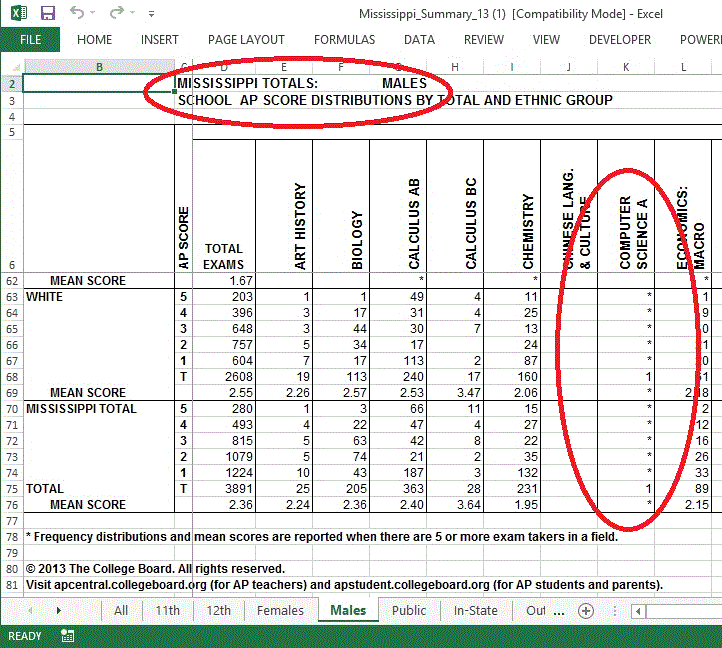
theodp writes: "The biggest reason for a lack of diversity in tech," says Code.org's Hadi Partovi in a featured Re/code story, "isn't discrimination in hiring or retention. It's the education pipeline." (Code.org just disclosed "we have no African Americans or Hispanics on our team of 30.") Supporting his argument, Partovi added: "In 2013, not one female student took the AP computer science exam in Mississippi." (Left unsaid is that only one male student took the exam in Mississippi). Microsoft earlier vilified the CS education pipeline in its U.S. Talent Strategy as it sought "targeted, short-term, high-skilled immigration reforms" from lawmakers. And Facebook COO and "Lean In" author Sheryl Sandberg recently suggested the pipeline is to blame for Facebook's lack of diversity. "Girls are at 18% of computer science college majors," Sandberg told USA Today in August. "We can't go much above 18% in our coders [Facebook has 7,185 total employees] if there's only 18% coming into the workplace." -
Intel Drops Gamasutra Sponsorship Over Controversial Editorials
An anonymous reader writes Processor firm Intel has withdrawn its advertising from Gamasutra in response to the site's decision to carry feminist articles. The articles had drawn the ire of the self-described "Gater" movement, a grass-roots campaign to discredit prominent female games journalists. Intel was apparently so inundated with criticism for sponsoring the Gamasutra site that it had no choice but to withdraw support. An Intel spokesperson explained that "We take feedback from our customers very seriously especially as it relates to contextually relevant content and placements" and as such Gamasutra was no longer an appropriate venue for their products." -
eBay To Spin Off PayPal
In 2002, eBay bought PayPal for $1.5 billion in stock. Nowadays, PayPal's yearly revenues exceed $7 billion, and investors are worried that eBay and PayPal together are too big to compete effectively. (They're also too big to be acquired, which is on their minds after the ludicrously successful Alibaba IPO.) To solve that problem, eBay today announced it will be spinning off PayPal in 2015, creating two separate publicly traded companies. eBay's current CEO is stepping down, and each of the companies will have a new CEO. "As part of the separation, eBay and PayPal will sign arm’s length commercial operating agreements to work together, with payments on both sides for various referrals and services. That’s no surprise since about 30 percent of PayPal’s business is still on eBay, although that is down from 50 percent only a few years ago." -
BlackBerry Launches Square-Screened Passport Phone
New submitter Andrewkov writes: BlackBerry released its new Passport phone today. It has a square 4.5" screen and a physical keyboard, and it's aimed at corporate users. The company hopes the larger size, Siri-like voice recognition, 30-hour battery life, and improved security will buoy its market share. Early reviews are not terribly favorable — the Wall Street Journal says BlackBerry is still behind on the software, and "The bulky, awkward design and the unfamiliar keyboard make it hard to justify finding space for it in a pocket or bag." The Verge said, "[T]he Passport got in the way of getting work done more than it helped." Re/code calls it a phone only a BlackBerry user will love. -
Mark Zuckerberg Throws Pal Joe Green Under the Tech Immigration Bus
theodp (442580) writes "A month after he argued that Executive Action by President Obama on tech immigration was needed lest his billionaire bosses at Mark Zuckerberg's FWD.us PAC have to hire 'just sort of OK' U.S. workers, Re/code reports that Joe Green — Zuckerberg's close friend and college roommate — has been pushed out of his role as President of FWD.us for failing to Git-R-Done on an issue critical to the tech community. "Today, we wanted to share an important change with you," begins 'Leadership Change', the announcement from the FWD.us Board that Todd Schulte is the new Green. So what sold FWD.us on Schulte? "His [Schulte's] prior experience as Chief-of-Staff at Priorities USA, the Super PAC supporting President Obama's re-election," assured Zuckerberg in a letter to FWD.us contributors, "will ensure FWD.us continues its momentum for reform." Facebook, reported the Washington Post in 2013, became legally "dependent" on H-1B visas and subject to stricter regulations shortly before Zuckerberg launched FWD.us with Green at the helm." -
Airbnb To Start Collecting Hotel Tax On Rentals In San Francisco
An anonymous reader writes Airbnb announced that it will begin collecting a 14% occupancy tax on behalf of its San Francisco hosts October 1. "This is the culmination of a long process that began earlier this year when we announced our intent to help collect and remit occupancy taxes in San Francisco," wrote Airbnb public policy leader David Owen. The company already collects taxes in Portland, and has discussed the possibility of collecting taxes in New York. -
Broadband Subscribers Eclipsing Cable TV Subscribers
An anonymous reader writes: High-speed internet has become an everyday tool for most people, and cord-cutters have dramatically slowed the growth of cable TV, so this had to happen eventually: broadband internet subscribers now outnumber cable TV subscribers among the top cable providers in the U.S. According to a new report, these providers account for 49,915,000 broadband subscribers, edging out the number of cable subscribers by about 5,000. As Re/code's Peter Kafka notes, this means that for better or worse, the cable guys are now the internet guys. Kafka says their future is "selling you access to data pipes, and pay TV will be one of the things you use those pipes for." -
Samsung Buys Kickstarter-Funded Internet of Things Startup For $200MM
jfruh writes: In September of 2012, SmartThings took to Kickstarter with the promise of delivering an "Internet of things" package to backers, including a hub device that would control various home gadgets via the user's smartphone. They aimed to raise $250,000. They got $1.2 million. And now they've been bought by Samsung for a reported $200 million, as the South Korean electronics market tries to get a foothold into this emerging market. -
Journalist Sues NSA For Keeping Keith Alexander's Financial History Secret
Daniel_Stuckey writes Now the NSA has yet another dilemma on its hands: Investigative journalist Jason Leopold is suing the agency for denying him the release of financial disclosure statements attributable to its former director. According to a report by Bloomberg, prospective clients of Alexander's, namely large banks, will be billed $1 million a month for his cyber-consulting services. Recode.net quipped that for an extra million, Alexander would show them the back door (state-installed spyware mechanisms) that the NSA put in consumer routers. -
Apple and IBM Announce Partnership To Bring iOS + Cloud Services To Enterprises
jmcbain writes: According to an article on Recode, Apple and IBM have announced a major partnership to bring mobile services to enterprise customers. "The deal calls for IBM and Apple to develop more than 100 industry-specific applications that will run on the iPhone and iPad. Apple will add a new class of service to its AppleCare program and support aimed at enterprise customers. IBM will also begin to sell iPhones and iPads to its corporate customers and will devote more than 100,000 people, including consultants and software developers, to the effort. Enterprise applications will in many cases run on IBM's cloud infrastructure or on private clouds that it has built for its customers. Data for those applications will co-exist with personal data like photos and personal email that will run on Apple's iCloud and other cloud services." -
Wireless Industry Lobbying Hard to Keep Net Neutrality Out
Taco Cowboy writes: The net neutrality issue has become a hot topic recently, but on the mobile side, net neutrality rules are absent. Why? The wireless companies successfully convinced regulators four years ago to keep mobile networks mostly free of net neutrality rules. Now that FCC officials are looking into whether wireless networks should remain exempt from net neutrality rules, the mobile carriers are lobbying hard to maintain the status quo. "Wireless is different ... it is dependent on finite spectrum," said Meredith Attwell Baker, the new head of CTIA, the wireless industry's lobbying arm. Baker previously served as an FCC commissioner. On the other side of the issue, net neutrality advocates are "hoping to convince regulators to include wireless networks more fully under any new proposed rules. They are pushing for the FCC to re-regulate broadband Internet under a section of the law (called Title II), which was written with old phone networks in mind. ... The FCC will be taking public comments about what it should do about new net neutrality rules through the end of July." You can comment by emailing to openinternet@fcc.gov or go to file a Consumer Informal Complaint on the FCC's wesbite. Meanwhile, AT&T says that strong net neutrality regulations will ruin the internet. -
Microsoft Demos Real-Time Translation Over Skype
Z80xxc! (1111479) writes "Today at the first annual Code Conference, Microsoft demonstrated its new real-time translation in Skype publicly for the first time. Gurdeep Pall, Microsoft's VP of Skype and Lync, compares the technology to Star Trek's Universal Translator. During the demonstration, Pall converses in English with a coworker in Germany who is speaking German. 'Skype Translator results from decades of work by the industry, years of work by our researchers, and now is being developed jointly by the Skype and Microsoft Translator teams. The demo showed near real-time audio translation from English to German and vice versa, combining Skype voice and IM technologies with Microsoft Translator, and neural network-based speech recognition.'" -
Cisco Complains To Obama About NSA Adding Spyware To Routers
pdclarry (175918) writes "Glenn Greenwald's book No Place to Hide reveals that the NSA intercepts shipments of networking gear destined for overseas and adds spyware. Cisco has responded by asking the President to intervene and stop this practice, as it has severely hurt their non-U.S. business, with shipments to other countries falling from 7% for emerging countries to over 25% for Brazil and Russia." -
Apple Reportedly Buying Beats Electronics For $3.2 Billion
An anonymous reader writes "Multiple publications report that Apple is undertaking its biggest acquisition ever, buying Beats Electronics for $3.2 billion. The deal would give Apple control over the popular 'Beats by Dre' headphones as well as a new music streaming service. Analysts suggest the headphones will open up a new series of product lines for Apple, while the streaming service will jumpstart its efforts to compete with Pandora and Spotify, as iTunes' growth slows. 'If Apple wanted to, it could certainly have built a streaming subscription service itself; the company had been floating the notion of one with label executives in recent months. But it's possible that Apple's most recent attempts to extend its music business beyond the iTunes store helped convince Cook that he was better off getting outside help.' The deal hasn't been completed yet, but a candid video of Dr. Dre was posted to Facebook in which he appeared to confirm it." -
Apple Reportedly Buying Beats Electronics For $3.2 Billion
An anonymous reader writes "Multiple publications report that Apple is undertaking its biggest acquisition ever, buying Beats Electronics for $3.2 billion. The deal would give Apple control over the popular 'Beats by Dre' headphones as well as a new music streaming service. Analysts suggest the headphones will open up a new series of product lines for Apple, while the streaming service will jumpstart its efforts to compete with Pandora and Spotify, as iTunes' growth slows. 'If Apple wanted to, it could certainly have built a streaming subscription service itself; the company had been floating the notion of one with label executives in recent months. But it's possible that Apple's most recent attempts to extend its music business beyond the iTunes store helped convince Cook that he was better off getting outside help.' The deal hasn't been completed yet, but a candid video of Dr. Dre was posted to Facebook in which he appeared to confirm it." -
Will This Flying Car Get Crowdfunded?
cartechboy (2660665) writes "We all just have too much money on our hands, and we really want a flying car, right? Well that's what Skylys thinks, as it's trying to crowdfund a flying car. According to its website, 'In detail we aim to create an urban dual-mode, hybrid flight and electric drive motorized vehicle that fits into sustainable mobility.' How much money does it need? Oh about $3,111,075. Apparently the company has run out of money and needs more to 'start construction on our two prototypes to confirm our technical specifications; pay the chaps in the legal department; industrial engineers and take up occupancy of our future offices in Silicon Valley, where our backers can of course pay us a visit.'" -
Amazon Reportedly Launching Smartphone This Year
According to a report in the Wall Street Journal, Amazon is working on a smartphone for release in the second half of the year. They're currently aiming to announce it by July and launch the end of September. One of the differentiating features of the phone is its capability to display 3-D images. "..the phone would employ retina-tracking technology embedded in four front-facing cameras, or sensors, to make some images appear to be 3-D, similar to a hologram." However, it may not be just a gimmick for 3-D movies and TV shows: "Sources tell Re/code that one advantage of this display will supposedly be that the phone can be moved from right to left to navigate, so a user can interact with the interface with only one hand." The report's sources say Amazon has been demonstrating the phone for developers in San Francisco and Seattle, but they're likely to have difficulty luring developers away from established platforms. -
Mozilla CEO Firestorm Likely Violated California Law
theodp (442580) writes "While the rise and fall of Brendan Eich at Mozilla sparked a debate over how to properly strike a balance between an employee's political free speech and his employer's desire to communicate a particular corporate 'culture,' notes Brian Van Vleck at the California Workforce Resource Blog, the California Labor Code has already resolved this debate. 'Under California law,' Van Vleck explains, 'it is blatantly illegal to fire an employee because he has donated money to a political campaign. This rule is clearly set forth in Labor Code sections 1101-1102.' Section 1102 begins, 'No employer shall coerce or influence or attempt to coerce or influence his employees through or by means of threat of discharge or loss of employment to adopt or follow or refrain from adopting or following any particular course or line of political action or political activity.' Corporate Counsel's Marlisse Silver Sweeney adds, 'Mozilla is adamant that the board did not force Eich to resign, and asked him to stay on in another role. It also says that although some employees tweeted for his resignation, support for his leadership was expressed by a larger group of employees. And this is all a good thing for the company from a legal standpoint.' As Eich stepped down, Re/code reported that Mozilla Executive Chairwoman Mitchell Baker said Eich's ability to lead the company had been badly damaged by the continued scrutiny over the hot-button issue. 'It's clear that Brendan cannot lead Mozilla in this setting,' Baker was quoted as saying. 'I think there has been pressure from all sides, of course, but this is Brendan's decision. Given the circumstances, this is not surprising.' Van Vleck offers these closing words of advice, 'To the extent employers want to follow in Mozilla's footsteps by policing their employees' politics in the interests of 'culture,' 'inclusiveness,' or corporate branding, they should be aware that their efforts will violate California law.'" -
Was Eich a Threat To Mozilla's $1B Google "Trust Fund"?
theodp (442580) writes "Over the years, Mozilla's reliance on Google has continued to grow. Indeed, in its report on Brendan Eich's promotion to CEO of Mozilla, the WSJ noted that "Google accounted for nearly 90% of Mozilla's $311 million in revenue." So, with its Sugar Daddy having also gone on record as being virulently opposed to Proposition 8, to think that that Google's support didn't enter into discussions of whether Prop 8 backer Eich should stay or go seems, well, pretty much unthinkable. "It is the chilling and discriminatory effect of the proposition on many of our employees that brings Google to publicly oppose Proposition 8," explained Google co-founder Sergey Brin in 2008. "We should not eliminate anyone's fundamental rights, whatever their sexuality, to marry the person they love." Interestingly, breaking the news of Eich's resignation was journalist Kara Swisher, whose right to marry a top Google exec in 2008 was nearly eliminated by Prop 8. "In an interview this morning," wrote Swisher, "Mozilla Executive Chairwoman Mitchell Baker said that Eich's ability to lead the company that makes the Firefox Web browser had been badly damaged by the continued scrutiny over the hot-button issue, which had actually been known since 2012 inside the Mozilla community." Swisher, whose article was cited by the NY Times in The Campaign Against Mozilla's Brendan Eich, added that "it was not hard to get the sense that Eich really wanted to stick strongly by his views about gay marriage, which run counter to much of the tech industry and, increasingly, the general population in the U.S. For example, he repeatedly declined to answer when asked if he would donate to a similar initiative today." So, was keeping Eich aboard viewed by Mozilla — perhaps even by Eich himself — as a possible threat to the reported $1 billion minimum revenue guarantee the organization enjoys for delivering search queries for Google?"