Slashdot Mirror
Domain: spaceweather.com
Stories and comments across the archive that link to spaceweather.com.
Comments · 201
-
Re:Civil twilight
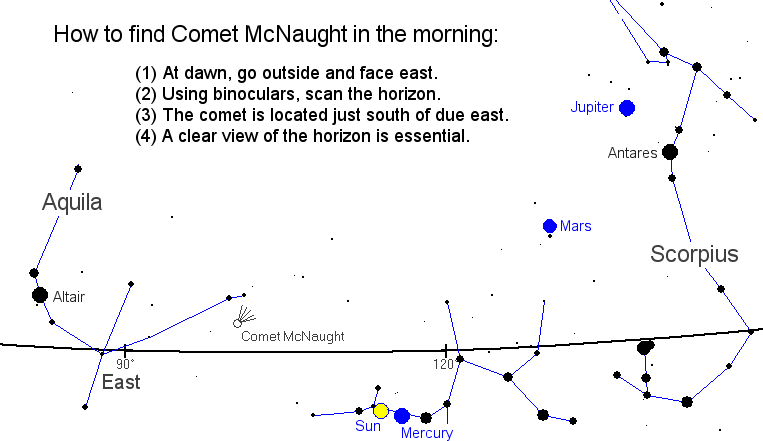
Here you are, the morning skymap: http://spaceweather.com/images2007/08jan07/skymap
_ north_m.gif -
Re:Wow, I wish I had...
I did it with a 5" telescope and a moderate-sensitivity surveillance camera from an apartment porch overlooking an flood-lit courtyard in the Washington D.C. suburbs.
http://www.spaceweather.com/meteors/leonids/1999/h ittable.html
You only get the brightest ones (mag. 6) with a set-up like that. 8-12" is quite common, and better video cameras than I used are cheap nowadays. A 14" Schmidt-Cass is within the 'serious-amateur' class. The 'insane-amateur' class is 30 inches and up. -
X-ray flux raw data
Real-time X-ray flux data is available here. A good site (for BOFHs or just curious laypeople) on this subject is SpaceWeather.
-
Re:Variable size?
Yeah, it's probably directly in proportion to the solar wind velocity in all directions. Which varies. We're currently at solar minimum right now in the 11 year cycle which means the field does not go out as far. See also Space Weather.
-
Re:No tail for you
there is a tail, http://spaceweather.com/ has some nice pictures
-
yep, scientist geeks.
There's lots of scientist geeks out there who interact with the sun. (and by 'interact with', I mean, sit in basements and look at pictures of it)
- http://www.spaceweather.com/
- http://www.lmsal.com/solarsoft/latest_events/
- http://www.sec.noaa.gov/today.html
But I've actually seen some of them go into the big blue room while the glowy thing is still out.
-
Yeah, but...
This sounds good, but you can't say that Sun's behaviour recently has been spotless...
-
Almost, you forgot about the one on Nov 4, 2003.
Depends on how you define flare... If you use X-ray intensity, the Flare on Nov 4, 2003 was the 'biggest'. Of course when you get to flares as big as this, it's really an estimate to how high the peak X-ray flux was since the detectors were saturated at the time.
Top Flares by X-ray flux -
Additional Flares May Be Coming
According to spaceweather.com, the sun spot that trigged this flare just became visible after transiting the far side of the sun for the past two weeks. Explosions later this week and next could produce some lovely September auroras.
-
5th largest in the last 30 years!
Not only the 4th largest in the last 15 years, but also the 5th largest in the last 30 years, which is from the beginning of measurements in 1976:
http://www.spaceweather.com/solarflares/topflares. html
There have also been reports, that the 10cm radio flux with 27000 sfu has been even greater, than that of the 04/11/03 event. -
SpaceWeather.
-
Re:Mr President, Dr. Evil is on the line...
Are you crazy. The article explains why people have the illusion. A theory is an explanation of sorts. Agreed that this article doesn't go into details but still. According to and article I found on http://www.spaceweather.com/ link -- http://science.nasa.gov/headlines/y2005/20jun_moo
n illusion.htm/ -
Re:Solar Weather Data
The sources of realtime data mentioned in the post by Hoi Polloi are great - if you understand space weather and how to correctly interpret these data. I would guess that the average Slashdot reader does not. spaceweather.com and the main NOAA Space Environment Center are slightly better sources for a layperson. The Education and Outreach section of the Space Environment Center gives a good overview explaining what the geomagnetic indices actually mean. I'm always excited when we can see the aurora in the continental U.S., but I'm not quite sure I understand all the buzz about this geomagnetic storm. As far as I can tell, according to NOAA, this was only a G2 storm. This is a relatively minor event! It is near solar minimum, so geomagnetic storms of any magnitude are not very common right now and this was a special event in that sense. However, I don't remember seeing anything on Slashdot last November when similar levels of geomagnetic activity occurred. I have to admit I am a little perplexed by all of the sudden interest. Unfortunately all this sudden interest in space weather is a bit too late - NASA is probably going to cut funding for a lot of the programs that fund scientists who study the Earth's magnetosphere and space weather.
-
Yes!
There are pictures from around the world (although mainly the US and Canada) at Spaceweather.com
They have pictures from California, South Dakota, Kansas and Illinois. Actually, I now see two more pages of fantastic photos. -
Re:Planetay weather
What I'd like to know is if weather.com is going to start posting forecasts for other planetary bodies anytime soon.Maybe not weather.com, but spaceweather.com already does (for the sun, at least).
-
Aurora and such
If you missed the Aurora Show this fall, you missed something special. The Aurora were intense and visible in most urban places. (Including me in Minneapolis)
For information on when flares and aurora are possible, see the following pages:
aurora alert- http://www.xs4all.nl/~carlkop/auralert.html/
for more of a daily "this is cool stuff in space" see
SpaceWeather.com http://spaceweather.com/
Fun Stuff.
-
Possible Reasons for satellite loss
- Bad luck
- Systemic design flaw
- Target practice for satellite-destroying technology
- Giant space-bat's radar fried satellites
I'd bet on 1 or 2, 3 is an outside possibility, and 4 the result of eating cold pizza for breakfast. It's worth noting that (as near as I can tell from SpaceWeather.com, there were no solar flares when the second satellite was lost. So if the satellite was lost to a design flaw, at least it's not due to poor protection from solar flares.
-
Re:Sunspot
http://spaceweather.com/ news on front page
also check out this cool picture http://spaceweather.com/swpod2005/16jan05/Koeman.j pg -
Re:Sunspot
http://spaceweather.com/ news on front page
also check out this cool picture http://spaceweather.com/swpod2005/16jan05/Koeman.j pg -
Sunspot
Could this possibly be related to the huge coronal mass ejection i read about Jan 15 sorry no story link but it found a picture
http://www.spaceweather.com/images2005/16jan05/mid i140.gif -
Map
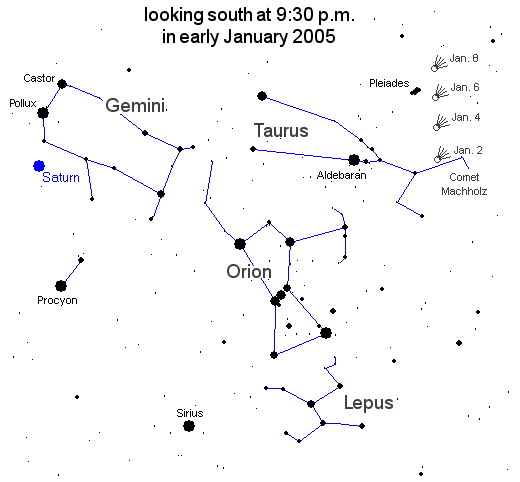
SpaceWeather has a spotting map. Should be easy to spot if you can find Orion and the Pleiades.
-
Map
SpaceWeather has a spotting map. Should be easy to spot if you can find Orion and the Pleiades.
-
Re:I've always wanted to see themThen you need to check spaceweather.com!
I used to say the same thing - but I've now had at least two l chances in 1 year to see them on Long Island - many miles to the south of you. The last opportunity was only a week ago (same event that sparked this story).
-
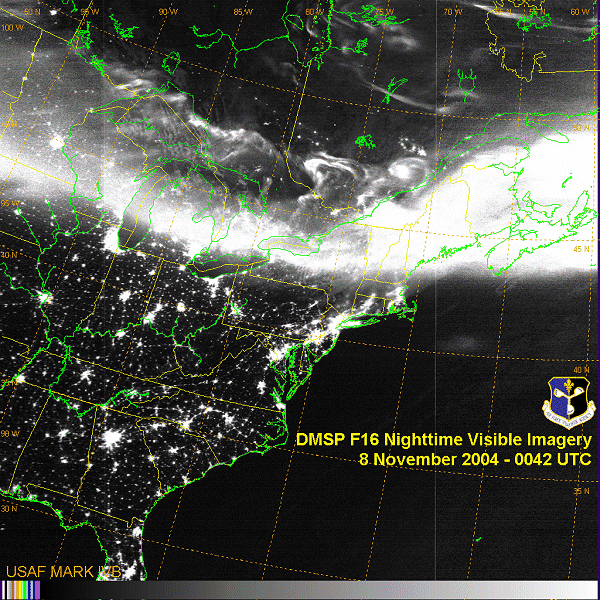
As seen from space
The auroras were spectacular from space ase well as today's photo from spaceweather.com shows:
-
Re:Best viewing point?
Also, http://www.spaceweather.com/ should have some pictures (it has some already).
--
In case of slashdot effect, please break braces, read comment.
<!--http://web.archive.org/web/*/http://www.spac eweather.com/--> -
Panic over, come out of your tinfoil shelters
It was a big, scary sunspot on July 23rd. SpaceWeather.com are currently reporting: Sunspot 652 is decaying, but it still has a "beta-gamma-delta" magnetic field that harbors energy for X-class solar flares. And it's not pointing at Earth anymore, it's on the right limb of the Sun.
-
Re:The water went into the ground..
I can't tell if you are joking or if you are serious, so let me reply as if not.
Duh. It was ejected into space.
Ejected? Like forcefully ejected in an explosive manner? No, definitely not.
On Earth the magnetic field deflects the ionized particles in the solar wind, forcing the particles to mostly fly past the Earth, but also to a smaller degree impact into the magnetic north and south poles causing aurora.
Space is a giant vacuum. Material sucked up into space and carried away at speeds approaching that of the light tend to "disappear."
As you can readily verify on spaceweather.com the solar wind travels at an average speed of around 300km/s, which is pretty far from the speed of lights 300000km/s.
And the atmosphere doesn't get "sucked" into space. There is vacuum around Earth too you know? Why doesn't Earth's atmosphere get sucked away?
When a planet has no magnetic field, the high impulse component of the solar wind blasts right into the atmosphere and blows off the outer layers little by little. It's just like those drier things in the rest room.
-
Re:what you meant to say is
Amen.
This kind of thing is in fact older than ipods OR mp3(Wow! Pre 2.0 kernel). You can listen to the sounds of many of the earths electro-magnetic field phenomena here . In REAL TIME!!! OMG!! -
I'd rather be looking out for Comet BradfieldShining searchlights into the sky is light pollution.
http://www.darksky.org/
http://spaceweather.com/If you have wake up before dawn this week for work or school, take a pair of binoculars outside and scan the eastern horizon. You might see Comet Bradfield. The comet, which had a close encounter with the sun on April 17th, is now emerging from the sun's glare. Although it's too dim to see with the unaided eye, at least for most people, by all accounts Comet Bradfield is a beautiful sight through binoculars, its long tail stretching 10 degrees above the rosy glow of the rising sun.
-
Projection
Just use the telescope to project to a flat clear surface, like they explain here with binoculars. Easy to do, and quite safe because you don't even have to get behind the telescope itself.
-
Re:A small black spot on the Sun
You might also try using your telescope to project an image of the sun onto a screen.
-
Re:Why? What is the point?
-
Re:More Followup:
Solar activity is normal. No reports of supernovae on any astronomy related sites (and believe me, there would be because they're sooooooo cool). Pulsars, quasars and most other radiative phenomena are around all the time and therefore could not cause new interference.
The only unusual astronomical activity lately has been the sudden appearance (and disappearance) of a new nebula in Orion.
I'd pretty much rule out astronomical sources. -
Re:Godspeed the Beagle, but don't count eggs yet
Spaceweather.com has a good animation of the dust as seen from NASA's Mars Global Surveyor spacecraft in orbit around Mars.
-
A Basic Knowledge of Sunspots
Those who live and work in the high latitudes - such as in those few sources the US has where there is oil pay a lot of attention to sunspots. Communication disruptions are the biggest problem. Much more rare are power failures - but they have been known to bring down entire power grids. In 1986, British Columbia had a huge power failure. Not all the evidence is in about the recent East coast power outage - They still haven't determined what caused the lines to overheat in the first place - The Ohio company appears to have made mistakes - but they may also just have been trying to keep up with too much demand on the grid all day. Solar flares affect the grid in unexpected ways. That's one of the many reasons they're being watched so closely.
I've probably seen the aurora 300-400 times. It is one of the beautiful things to my eye in nature. If it's out, in my experience - it can change in 5 minutes time from close to nothing to wild. Photos don't do it justice - but this site has some movies too, that give just a slight feel of it.
The BBC article is very simplified - A fairly new technique - called "helioseismic holography" allows astronomers to actually 'look through' the sun to image the magnetic fields of very large sunspots like the present pair (they occur in pairs - corresponding to a north and south magetic pole).
This present sunspot pair is the largest we've ever measured.
The particles themselves don't really emit the light - "the electrons that cause auroras do not come directly from the Sun"
Sunspots can be seen under certain lighting conditions when the sun is rising or setting even with the naked eye.
Chinese astonomers recorded them long before they were one of the first things that we're recorded by the inventors and early users of the telescope.
Sunspots - a reduced number of them - have been correlated with cooler weather trends.
There was about a 70 year period of fairly recent time - 1645 -1715 that apparently saw no auroras - even at high latitudes - kids thought they were mythical stories by the time they appeared.
The solar flare a few weeks ago was the strongest we've ever measured, and we can expect to see more as that same pair of sunspots rotates around to face Earth.
The solar eclipse will be tomorrow - there will be some great photos that will come out in the next few days. -
Boy, fetch me my brown trousers!Better button up your assholes!
-
Re:Too bad it isn't heading this way
spaceweather.com has some images of auroras over Orlando from late october. They did get as far south as Florida. Too bad it was cloudy where I was every night they were out here in NY.
-
Yes mod up
It saturated the detectors on the GEOS satellites and has been categorized as a X20+ flare.
The sunspot is on the limb of the sun now though so the CME is probably going to be glancing (meaning less auroral activity than a CME directed fully toward the earth).
Daily or more frequent reports can be found at Spaceweather.com -
www.spaceweather.com
The aurora activity is subsiding and there is little probabilility of northern lights at middle lattitudes. However, the sunspots were huge and it is likely they will be still somewhat active in two weeks after they transit over the far side of the sun. Check link
-
Re:Aurora CamSOLAR PAUSE? Giant sunspots 486 and 488 are about to disappear from view, carried over the western limb of the sun by our star's 27-day rotation. This means Earth-directed explosions will stop... for a while. Big sunspots often persist for many weeks. These two might reappear on the eastern side of the sun in two weeks, the time required for them to transit the far side of the sun.
Quoted from Spaceweather Perhaps those of us who missed out on the Auroras (BOTH times for me) due to bad weather/timing will get another shot? Think this is still going on in two weeks?
-
Re:Historic Period?
Since 1976, see here.
-
Re:Statistical anomaly? More like a bad modelBut isn't it true that most of records of past CMEs are based on those directed towards earth? If they weren't at least somewhat in our direction, we'd be unlinkely to know about them
True. Some indicators for solar activity have been recorded for over a hundred years; the aforementioned magnetometer data and the sunspot number: http://www.ngdc.noaa.gov/stp/IONO/sunspot.html
Also, prominences located at the edges of the visible "disk" of the sun have been observed probably as long as that: I found some nice modern day examples in here: http://www.digilife.be/club/Franky.Dubois/world.h
t mBut, none of these methods produce quantitative data of the precision or scope available today. One of the top instruments (well, intstrument platform actually)is the SOHO spacecraft launched in 1995 http://sohowww.nascom.nasa.gov/
There have probably been other solar observing satellites prior to soho, but I can't remember any specifics (anyone?).
So, yes, unless a particle storm from a CME event hit earth square in the face, so to speak, there would be no quantitative data of such an event older than... a handful of decades?
Yes, they did. The culprit is known as "sunspot 486". More data at www.spaceweather.com.
Is the sun's rotation much greater than 24 hours?
Actually, there's a latitudal variation to the angular speed of the sun's surface. The period of sun's rotation around solar equator is 29 (Earth)days. On the 60 latitude it's 25 days.
If, however, we do have 100+ years date on all CME events, we would be able to say that it's a statistical anomaly. I just think it's more likely that we don't understand enough about the sun's behavior to properly characerize this event.
I suppose it's an anomalous event in the scope of the recorded history of Earth's magnetic field data... True, to extend this probabilistic term to the entire lifespan and surface of the sun would be silly. But, you have to take in he human aspect of the situation; it's on of the biggest events monitored and recorded. It's a one thing to have the mathematical intuition that events of some magnitude are possible, and to actually witness one (ie. you know that it's possible to win lottery. But you don't, very often. At least I don't
-
Re:Noon meridian?
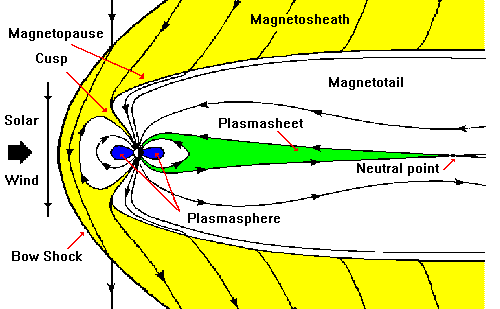
Actually the plots are based on the power flux measured by a polar satellite not by direct observation of the aurora so the light level shouldn't affect the measurement. I believe the reason the maximum activity occurs away from the noon meridian is because of the shape of the earth's magnetic field which has a long tail away from the sun because of the solar wind (as seen in this diagram)
Some additional info on the earth's magnetosphere -
Re:Pity
Er, to see the effects of this solar flare, you would be much happier looking at the Aurora Borealis. Light pollution is going to be a big concern.
-
Enough already...
...let's skip the daily reposting on this till we see one that looks like it's going to mean we really do need those tinfoil hats.
Until then, set your browser homepage to SpaceWeather.Com to keep updated. -
Aurora very likely
The gas from the flare reached us this afternoon (EST); a geomagnetic storm is now underway. Auroras are very likely to be visible as soon as it gets dark. Skies over most of the eastern U.S. should be clear tonight. Check spaceweather.com for more info.
-
Re:"It's coming right for us!" *WHOOSH* "Kick Ass!
So, the resulting aurora should be on par with the 1989 event.
Actually, we won't know if this flare and CME will cause auroras or not. If the magentic field associated with this flare is in the same direction as the Earth's, the high energy particles are largely deflected away from and past us, with no pretty light show.
But if the magnetic field is opposite to ours, then the solar wind can be funnelled directly into our upper atmosphere. I don't think there's any good predictor -- we just have to wait for it to get here.
- Peter -
Re:Solar storm in December 1991?While I can't say that I remember the storm in 1991, I certainly was taken by suprise by the displays in October of 2001.
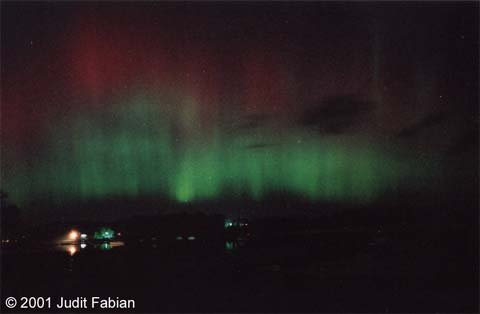
I was driving back to Cincinnati from the Carolina Renaissance Faire, and had just about reached Lexington when I noticed that the sky looking north towards Cincy was Green! Picture not taken by me, but a good representation of what I saw.
I have to admit I am truly sad to say my first thought was "Oh god, what have the terrorists done now," being that it was 2 months after 9-11, but after about 10 seconds of panic I realized it was just the northern lights.
I pulled off the road, down a few country back roads to get away from the lights, and enjoyed the show.
It really was a wonderful event, and I do credit it with getting me much more interested in space weather.
-
Re:Solar Activity and HumansNot only does solar activity follow an 11 year cycle, it also *appears* to follow an annual cycle, with solar activity (CME's, sunspots) appearing to peak in late October, early November.
Why is this so odd?
Because a year on the Sun obviously is not the same as a year on the Earth, and scientist (as of yet) have not been able to pin down why solar activity seems to peak this time of year. At the moment (at least, last time I read up on it, which was during the big Auroral display in November of 2001) scientist were at a loss to explain a 12 month cycle in solar activity.
For more information, and very up to date info on the current situation with the storms, current solar wind patterns, and a gallery of GREAT pictures, try spaceweather or also
Spaceweather Now (NOAA)Okay, typing that out made me feel stupid, so I went and re-read the article on seasonal variations, and found out I was somewhat wrong, there is a terrestrial reason dealing with OUR magnetic field that makes solar activity seem to affect us more. If you would like to read the article, it can be found Here
Anyways, keep looking up this week, (unless you live in Cincinnati like I do, and it will be cloudy most of the beginning of the week) and you might be suprised at what you see.
-
Visible in a few minutes
At 5:58 EDT, Shenzhou 5 will be visible over Boston
At 11:28 GMT, it'll be visible over Chicago.
Last chance at 5:59 PDT to see it over the West Coast.
Orbit details at space weather.