Slashdot Mirror
Domain: stanford.edu
Stories and comments across the archive that link to stanford.edu.
Comments · 4,853
-
Re:Advantages vs disadvantages
According to the following study, fruit, vegetables and fish(!) can be produced at EUR 3.50 to 4.00 per kg in vertical farms, which is surprisingly cheap:
http://large.stanford.edu/cour...I'm pretty sure that the big staple crops (wheat, rIce, etc.) aren't going to be farmed in vertical farms, but I can see the Wholefoods kind of stuff being farmed there.
-
Re:Hate Speech
It no longer is a fundamental unalienable right that you are born with.
I think that we are coming down to an argument about whether or not there exists such a thing as a 'natural right' or whether all rights are 'legal rights'.
In short, I tend to fall more to the side that does not believe that natural rights exist; that all rights are 'legal' rights and it seems that you believe that there exists a distinction. We may need to simply observe that we disagree as I think that trying to examine this more fully is well outside the scope of this discussion.You are misunderstanding those limitations that have historical common law precedent for good reasons as compared to subjective thought crime.
I'm not sure I see how. You assert that a subjective limitation on a right makes that right null.
I argue that things like slander, libel, sedition etc. are examples of limitations that are subjective.
You observe that these are defined by a history of common law. I agree. The courts provide interpretation on areas of silence or ambiguity with respect to statutory law and build a body of common law. However, I don't see how any amount of precedent can make something that is subjective, objective. It may provide a solid framework, it may provide a guide or help define something, but it is still a matter of interpretation. To that extent, the difference I see between 'hate speech' and the other examples is not one of subjective/objective, but that 'hate speech' is much newer, still poorly defined, often has overly broad legislation that attempts to address it (where it exist at all) and has had insufficient time to develop the sort of body of rulings and decisions that go into making common law.It is an ever changing thing that can be expanded ad hoc whose meaning will be divorced from any layman subjected to the whims of government interpretations.
You mention common law when I raise the issue of what I see as existing subjective limitations on free speech. The courts are a part of the government in most modern democracies. The 'whims' of the government are distributed, constrained and limited. Power is distributed with some portions handled by the legislature, other parts by the courts. The law around something like 'libel' or 'hate speech' is just as subject to these 'whims'.
I put it to you that you argue 'government' as a tyrannical and singular entity that can change the definition of 'hate speech' on a "whim", yet you seem not to recognise that same 'government' in the courts that produce and interpret common law.
Any existing limitation on speech comes down to harm.
I agree wholeheartedly. The only limitations that we should allow on any right is because it causes harm - including the harm of limiting someone else's rights.
Hate speech doesn't have that kind of harm
May I suggest that you have a look at things like Words that wound : critical race theory, assaultive speech, and the First Amendment. I've only read extracts, but it attempts to define things like racist and hate speech in a way that is compatible with recognising the rights guaranteed by the First Amendment. Importantly (to this discussion) it compares the harm caused by things like defamation and fraud to racist verbal assault.
There have been studies that have shown that things like the gap in math ability in children based on gender has a significant cultural component - 'boys are better at maths'. Being immersed in racist statements have similar negative outcomes for those raised in that environment.
We've seen reports of Facebook being used to whip people into a murderous fury; of twitter being used to influence elections. Why is it so hard to believe that as social animals the more we hear a certain message, the more ubiquitous it becomes, the more frequent then the more li
-
Re:Comp Sci
> Edsger W. Dijkstra
Computer Science is an applied science.
Wrong. Compute Science is the theoretical side of programming, and very much behaves like it. It came out of the Mathematical departments. The Applied Science is Software Engineering, which most schools fail to teach at all. It's more akin to Computer Engineering but with a higher software focus.
Dijkstra was an idiot who thought that only theory should be taught.
* In theory performance shouldn't matter * In practice it does.
Implementation details do matter regardless of many fucking cluesless profs try to handwave them. For example, how do you sort your data when it fit into available RAM? There is a reason why Map Reduce was invented.
Focus solely on theory is the wrong approach. There are 3 types of optimizations that a programmer needs to understand.
1. Micro-optimization: Bit-Twiddling I.e. https://graphics.stanford.edu/...
2. Algorithmic Spending time to optimize a bubble sort is a complete waste of time when you could use mergesort, quicksort, etc.
3. Macro-optimization (or cache-orientated) aka (Data-Orientated Design) Techniques such as Memoization exist for a reason.
A good programmer learns HOW to optimize. i.e.
Code Clinic 2015: How to Write Code the Compiler Can Actually Optimize
Ignoring optimization doesn't make it go away. That's how we end up with bloated crap where a user is forced to download a 50 MB file for a bloody printer driver.
A good Software Engineer knows how to do those things; however, it's hard to find any good Software Engineers. Software Engineering goes way way beyond those things too and it is extremely hard to find a good Software Engineer, especially since most programmers want to be about art instead of engineering.
-
Re:Comp Sci
> Edsger W. Dijkstra
Computer Science is an applied science. .
Dijkstra was an idiot who thought that only theory should be taught.
* In theory performance shouldn't matter
* In practice it does.Implementation details do matter regardless of many fucking cluesless profs try to handwave them. For example, how do you sort your data when it fit into available RAM? There is a reason why Map Reduce was invented.
Focus solely on theory is the wrong approach. There are 3 types of optimizations that a programmer needs to understand.
1. Micro-optimization: Bit-Twiddling
I.e.
https://graphics.stanford.edu/...2. Algorithmic
Spending time to optimize a bubble sort is a complete waste of time when you could use mergesort, quicksort, etc.3. Macro-optimization (or cache-orientated) aka (Data-Orientated Design)
Techniques such as Memoization exist for a reason.A good programmer learns HOW to optimize. i.e.
Code Clinic 2015: How to Write Code the Compiler Can Actually Optimize
Ignoring optimization doesn't make it go away. That's how we end up with bloated crap where a user is forced to download a 50 MB file for a bloody printer driver.
-
Re:I don’t think it’s possible
-
Re:Conflict
Thanks for digging up the real thing.
Dan Jurafsky, the 4th author, is a big deal in NLP circles. MacArthur Fellowship in 2002.
Lecture Slides from the Stanford Coursera course by Dan Jurafsky and Christopher Manning
Just might have got some of the subtle stuff right, here.
-
Could we skip the clickbait please?
This is a really poor quality Slashdot story - and I say that as a woman.
Yes of course *I* can name women who are or have been company leaders in tech (Melissa Mayer, Sheryl Sandberg)
And I can also name hands-on technologists. Grace Hopper, Ada Lovelace, Kathy Sierra and Sandi Metz all come to mind without trying.That said, "we have a problem with an absence of women in tech -- most people can only name Siri and Alexa" is a story without real merit.
If you must discuss gender imbalance in our industry could you pick something smacking a bit less of click-bait as your only link? I mean, please.If you'd like a link talking about why gender diversity is actually a boon to companies, try this one:
https://www.ncwit.org/sites/de...If you'd like a link on ways of actually getting women to take the computer science plunge, try this one:
https://cs.stanford.edu/people...I should really not allow myself to be trolled into commenting, but this is garbage and Slashdot can do better without even trying very hard.
-
Re:Millions were killed by Tetraethyl Lead
in fact, that was the single largest source of lead to Americans back in the 70s. Next came house paint, which ALL contained lead. Any house made before the 70s, has lead on the walls.
What is interesting is that back then, coal plants were a small % of our electricity and lead as well. But after 3-mile island combined with the china syndrome, Coal plants jumped to 60% of our electricity. Needless to say, by mid 80s, they were #1 source of lead and mercury around our nation. Still far less than in China, but enough to impact us. Now, with the mercury clean-up and shutting down of coal plants, I believe that our #1 emitter of lead/mercury is our steel mills. Thankfully, Project Tim in Michigan will kill that off.
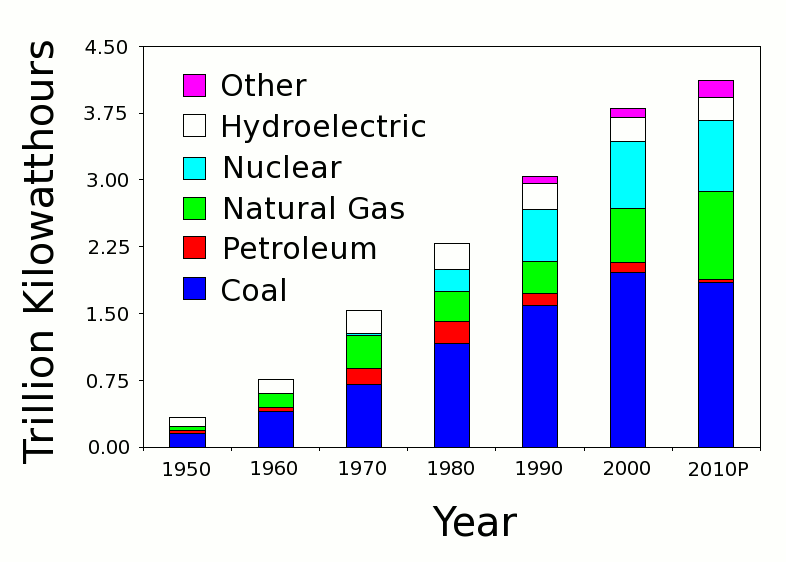
Do you have actual data to back that up? Looking at this graph and this graph, coal generation in the 70's was around 1/2 of the total generating capacity and doesn't seem to have any correlation to Three Mile Island or the release of The China Syndrome (both 1979).
-
Re:Be careful what you click
Facebook sold that data.
Not, to CA they didn't.
Facebook permitted (or forgave what was being taken without permission) Alexandr Kogan (or as he calls himself in academia Dr Spectre
At worst, CA is guilty of violating a Facebook ToS regarding the use of that data.
With all due respects your honour, CA is a stranger to the agreement between FB and GSR. If anyone has to pay restitution for theft of the data or it's subsequent use, it is GSR.
-
Re:Let's look at their Schedule Cs
-
While you're desalinating...
There's not a lot, but there is some good shit... When you automate it, it doesn't cost a dime in human effort, which is all that matters.
-
Something a little more promising is...
This.
Injecting minute amounts of two immune-stimulating agents directly into solid tumors in mice can eliminate all traces of cancer in the animals, including distant, untreated metastases, according to a study by researchers at the Stanford University School of Medicine. -
Re:Eletrical grid Energy doesn't come from oil
Straight electric resistance heating can be considered 100% efficient.
Wow!
Of course this is wrong due to energy lost in power lines:
http://insideenergy.org/2015/1...
http://large.stanford.edu/cour...
-
Re:Eletrical grid Energy doesn't come from oil
maybe the headline is a mistake
The headline accurately reports what Gov Cuomo is claiming. It is Cuomo that is spouting nonsense.
one explanation is that there are 2 ways to use the offshore area: 1) for producing wind power and 2) to drill for oil for cars.
That is technically implausible and from a legal standpoint, very unlikely. The states control out to 3 nautical miles, and the feds control from 3 miles to 200 miles. So the jurisdictions don't overlap.
( https://news.stanford.edu/news... ) He found that using solar and wind are complementary. Wind tends to be highest at night; solar by day.
This is true for on-shore wind. Offshore, the wind patterns are different, and offshore winds are stronger and rarely stop at the latitude of NY (~40N). This is why it is worth the extra expense of building offshore. It costs three times as much to install and maintain an offshore turbine
-
Re:Eletrical grid Energy doesn't come from oil
I don't know about the fuel mix in the state of New York (and maybe the headline is a mistake), but one explanation is that there are 2 ways to use the offshore area: 1) for producing wind power and 2) to drill for oil for cars. Cuomo's decision may pre-empt using the land for oil exploration and drilling. That's my two cents anyway.
Marc Jacobson has done a lot of research into the viability of renewables. (Indeed, he presented this very idea to NY a few years ago. https://news.stanford.edu/news... ) He found that using solar and wind are complementary. Wind tends to be highest at night; solar by day.
-
Re:Not good, even if I believe their numbers
Let me quote Michael Crichton
Because when you need bulletproof economic analysis, you should always go to a fiction writer.
His writing was brilliant. He was gone way too young.
This was a great speech
https://stephenschneider.stanf... -
Re:sounds like a cave man describing lightning
Stanford disagrees with you: https://simes.stanford.edu/res...
That was just the first non-video hit on Google. There are lots of others.
-
Re:He seems to like complex devices
The Organ of Don and Jill Knuth
https://www.cs.stanford.edu/~k...Wow, without Jill listed there, that would be interpreted very differently!
-
Re:Needs updating
I think you meant & instead of %.
In any case, there are better ways to do this: http://graphics.stanford.edu/~...
My favourite is the second example using only AND operations with constants. It's faster and has more predictable execution time, although it's not constant.
I seem to recall that some systems (BSD?) have a prototype function for this in their standard library too, which on some CPUs complies to a single instruction.
-
Re:Needs updating
Best solution: Use autoconf or cmake to figure out if your compiler defines __builtin_clz. If your compiler has a different name for the built-in, just add a #define __builtin_clz whatever_your_compiler_calls_it. Otherwise, add a #define __builtin_clz slow_clz so the source code doesn't have to change.
To define slow_clz(), start here, and then pick your favorite implementation under "Finding integer log base 2 of an integer (aka the position of the highest bit set)." It really doesn't matter which one you use. You could even use the while loop.
You're welcome. (Yeah, I know that's more work than the hypothetical C20 #include <builtins.h>, but this works today.)
-
Re:Needs updating
Best solution: Use autoconf or cmake to figure out if your compiler defines __builtin_clz. If your compiler has a different name for the built-in, just add a #define __builtin_clz whatever_your_compiler_calls_it. Otherwise, add a #define __builtin_clz slow_clz so the source code doesn't have to change.
To define slow_clz(), start here, and then pick your favorite implementation under "Finding integer log base 2 of an integer (aka the position of the highest bit set)." It really doesn't matter which one you use. You could even use the while loop.
You're welcome. (Yeah, I know that's more work than the hypothetical C20 #include <builtins.h>, but this works today.)
-
Re:Ancestry.com fakes results
Seemed pretty extraordinary so I thought I would validate one of those claims so I picked deborah bolnick
She does exist
https://liberalarts.utexas.edu...
I couldn't find that statement by her with dna and fraudulent
I did find an article by her on "recreational" dna testing here.
https://anthropology.stanford....I think on balance this article supports the parent post's assertions. She says that recreational dna testing is real testing and real science but that there is a low coorelation between dna and race, some of the dna companies only test 1% of the dna, spurious hits for alleged american indian dna markers are found on many different continents in four other 'races'.
She concludes...
---
We must weigh the risks and benefits of
genetic ancestry testing, and as we do so, the
scientific community must break its silence
and make clear the limitations and potential
dangers. Just as the American Society of
Human Genetics recently published a series of
recommendations regarding direct-to-consumer
genetic tests that make health-related
claims (20), we encourage ASHG and other
professional genetic and anthropological associations
to develop policy statements regarding
genetic ancestry testing.
---So- while I didn't validate the entire post, the lead point checks out so the rest would probably check out too. It's certainly credible that some testing companies in the field might have issues (esp the one that tests only 1% of the dna).
A couple points tho. The technology is going to be much better at building likely (but not certainly) family trees. The police have used the technology to solve cold case crimes by locating likely relatives to the DNA associated with the cold crime.
On the part of the medical industry- there is some corporate turf protection. They really don't want the companies that release full genetic maps to associate those with medically useful information. Many people have done so successfully however, identifying risks in time to treat them while they are still very minor.
One argument I see against genetic testing is that it might identify a high risk you will die from something. This seems like a young person's concern to me. Most everyone I know now is planning for death and has a pretty good idea of their likely maximum life span (mine's about 78). Genetic testing (by a doctor) revealed several genetic issues I have which affected my medications. The biggest is that I can't use regular B vitamins very well. My body doesn't "folate" them properly so I have much better results from folated B vitamins. The point being that yes, unsupervised genetic testing might show a high risk and some people might commit suicide but many more will identify risks that can be mitigated.
-
Sedans vs extended cab trucks
Isn't this just a subtle exit poll?
The relative number of sedans versus extended cab trucks owned in a neighborhood, can be correlated with political leanings.
Perhaps, substituting a survey of vehicles parked near a polling place makes for a better indicator still, because it reflects voter turnout? -
Re: The reason for generations (fubared my post)
The first citation shows only that the majority of persons in the bottom fifth are unemployed. It makes no claim about full time or part time, only whether they earn or not.
I think the way you phrased the original assertion is a little misleading. It would tend to suggest that poor households are poor because they are only working part time, and not full time. At an average earnings of $30k per earner in these households, that is very much not the case. For a full time job, this equates to about $15 per hour. Since part time jobs pay less not more, it is unlikely that the typical scenario is someone earning $30 per hour for 20 hour weeks. The more likely answer is the $15 per hour full time i mentioned above. I was unable to find any information either way, as the BLS seems to not know or not care.
The data in the links you provided strongly suggests that the fundamental problem is unemployment in low income households, whether it is a result of unemployability, or more likely, child rearing / eldercare.
One other thing to note is that While the Adjusted household income ha remained flat since 1965, the number of earners needed to gain that income has increased from 1.25 in 1950 to 1.7 in 1990. This means that from 1965 until 1990 real wages dropped across the board, but the decline was masked because the workforce expanded to compensate. This is the reason for the economic boom of the 80s: More workers at cheaper wages means vastly increased economic output for the country. The fundamental problem with this is that from a societal point of view, all of those extra workers were not "unemployed" before, they were homemakers. They performed childcare and eldercare as well as housekeeping and other duties. Many families, especially those without social safety nets simply cannot provide the 2 full time workers that are required to continue earning the median household income, so they fall to the bottom, and since childcare / eldercare is essentially a lifetime commitment, they are basically screwed.
There are two fundamental components to the solution to basic poverty. The first is universal health care. A person can ignore or deal with just about any bad happening, and recover to a position where they can earn a living. The only real exception is health. If you loose your helath, you have nothing, so you must do whatever you are able in order to keep your health so that you can earn a living. Without universal health care, people do what they always do when faced with a problem they cannot handle. They ignore it until it bites them, and then they die, but not before costing our healthcare system far more than the cost of universal healthcare. A $500 medical problem can easily become a $50,000 medical problem if you ignore it long enough, and hospitals are not allowed to refuse life threatening emergencies. Someone pays the bill eventually, and you can bet it isn't the person who is on deaths door.
The second part is child/elder care. For obvious reasons this causes people to loose the ability to work in most cases. The only people for whom paying for childcare while continuing to work makes financial sense are those who are already in the upper middle class or better, and they are not the problem here. Universal childcare would go a very long way to leveling the playing field for the bottom 5th.
-
Re:Tools aren't good or bad.
From the word confusion, sounds like you skipped those ethics classes. Start here:
http://plato.stanford.edu/The very short answer is that we can and have created agreeable ethical systems- look to professional organizations in your field and you will find ethical standards. Some western nations are based on Locke and Bentham. Others on Marx and Owen, others on Rousseau. All with ethical systems codified in law already. Even when people value different things, several ethical systems work adequately most of the time. The real practical problem is there are too few people following any systematized ethical standards at all. True tragedy of the commons.
-
Re: The reason for generations
Yet here we are 20 years later with a full employment economy.
This only qualifies as full employment by the badly skewed and unhelpful unemployment statistic that the US BLS uses to hide how badly dysfunctional our economy really is.
The best available metric is the U-6 rate which currently stands at about 8%. This metric still does not include those persons who were forced into early retirement by the great recession and are now permanently out of the workforce, but not willingly. Estimates are that early retirements added approximately 1.5% to the unemployment at the height of the recession, but these numbers are not counted anywhere once the affected individual reaches the official retirement age. This has nonetheless Caused permanent damage to the economy, and ruined the retirements of some 3 million baby boomers.
The simple fact is that the 2001 crash coupled with the great recession did tremendous damage to everyone who is not upper middle class or higher.
When all is said and done, the great recession never ended for those in the bottom 25% of the income bracket. That is why there is still so much hatred in this country, and why there was enough venom to elect an openly racist, misogynist, con artist to the highest office in the land.
-
Re:Put it this way
There was no free food, free house or free anything back then in the socialist countries.
http://spice.fsi.stanford.edu/...
The Soviet Union advocated a conception of human rights different from the notion of rights prevalent in the West. Western legal theory emphasized the so-called âoenegativeâ rights: that is, rights of individuals against the government. The Soviet system, on the other hand, emphasized that society as a whole, rather than individuals, were the beneficiaries of âoepositiveâ rights: that is, rights from the government. In this spirit, Soviet ideology placed a premium on economic and social rights, such as access to health care, adequate and affordable basic food supplies, housing, and education, and guaranteed employment. As it acted on these guarantees during the postwar decades, the Soviet system evolved into a giant welfare state. The Kremlin proclaimed the achievement of such rights, and the benefits that Soviet citizens received from them, as evidence of the superiority of the Soviet Communist system to that of the capitalist West, where the importance of civil and political rights was emphasized, while the notion of economic and social âoerightsâ was viewed much less favorably.2
https://en.wikipedia.org/wiki/...
Personal property was allowed, with certain limitations. Real property mostly belonged to the State.Health, housing, education, and nutrition were guaranteed through the provision of full employment and economic welfare structures implemented in the workplace.[16]
However, these guarantees were not always met in practice. For instance, over five million people lacked adequate nutrition and starved to death during the Soviet famine of 1932â"1933, one of several Soviet famines. The 1932â"33 famine was caused primarily by Soviet-mandated collectivization.
I.e. in theory many positive rights. In practice mostly famine, shortages and bread lines.
People had a duty to work wherever the state told them to, and in practice the state had no obligation to feed them. Hence the deaths from collectivisation.
-
Re:This all sounds impressive...
It can identify if something is a kitten or not with 83.4% accuracy. Sounds impressive until you realize a 3 year old can do this with 99.9% accuracy.
How many 3 year olds can tell the difference between a komondor and a bouvier des flanders ? Or would they simply classify both as "dog" ?
Here you can test yourself on some of these images:
http://cs.stanford.edu/people/...Try the hard ones.
-
Pretty common epiphany
In my line of work I use a lot of mathematical optimisation. As Stephen Boyd says in his course, everybody working in optimisation has at some point this epiphany: "everything is an optimisation problem". And this is true. However to make it work you need to be very good at mathematical modelling, you need to know your methods, and most of the time the problem is unsolvable anyway by the classic methods.
In this instance maybe a lot of programming can be modelled by some deep NN. However you have to come up with a relevant architecture for your problem, you need to train it, and you need to evaluate it. It may save you time to do so, but if you need so solve something like FizzBuzz, that may not be the best way.
-
Fusion is easy - extracting power is hard
Fusion is easy
The Farnsworth fusor is a commercially available neutron source, that is basically a fusion machine. There are ways to extract energy from it, but the math indicates it can't reach brake even, as currently conceived.Getting useful power from fusion is hard
Scientific breakeven, getting closer, some designs claim this is a potential
Engineering breakeven - No design claims this yet
Ignition
commercial breakeven - not close - once the power is created, it needs to be extracted efficiently enough to create some profit. -
Re:Lawyer payback
There's this pesky little thing called "fair use"
https://fairuse.stanford.edu/o...
https://en.wikipedia.org/wiki/... -
Alternative to advertising?
Even more reason to disable Javascript.
While I agree with that sentiment, I have to wonder why this is such a big deal?
Assuming that mining is not actually harming me or my computer - destroying files, or leaking my information to someone - why should I care? If I visit a website and read an article, maybe a minute of my time, my computer is otherwise idle and the amount of energy spent is negligible.
We've always wanted a way to monetize visiting a site, could this be a way to do it?
Suppose we had a service where people could submit computationally intensive problems which can be broken down into smaller computational units. Such as "folding at home" or "seti at home".
The answers to some of those problems could be valuable, so we could imagine research institutions paying money to use the system to solve those problems, and pay out based on the amount of computation a website brings in.
This is proportional to the number of users who view the website, and for how long. This could be a user-friendly alternative to advertising.
In fact, one can imagine the *government* paying money to use the system as a make-work program: it would encourage people to make better, more meaningful websites overall. Would the sociological benefit outweigh the extra costs?
(Assuming that people don't game the system, but it seems reasonable that we could learn all the gaming techniques over time and avoid them. Sort of how we deal with advertizing clicks currently.)
I don't see what the problem here is, and look at it as an opportunity.
Could this be a user-friendly way to monetize a website, as an alternative to advertising?
-
Re:Good luck with that
http://fairuse.stanford.edu/ov...
In fact, his pursuing rigorous legal claims over such a stupid use makes him prone to parody or satire, which opens up fair use even further.
Well played!
From your link:
In its most general sense, a fair use is any copying of copyrighted material done for a limited and “transformative” purpose, such as to comment upon, criticize, or parody a copyrighted work. Such uses can be done without permission from the copyright owner. In other words, fair use is a defense against a claim of copyright infringement. If your use qualifies as a fair use, then it would not be considered an infringement.Alt-right Pepe memes do not "comment upon, criticize, or parody a copyrighted work". They use his work to "comment upon, criticize, or parody" unrelated targets.
I can make a cartoon that parodies The Simpsons, Family Guy has an element of that.
But I can't make a cartoon parodying environmentalists staring Homer Simpson. Fox would sue me out of existence.
-
Good luck with that
http://fairuse.stanford.edu/ov...
In fact, his pursuing rigorous legal claims over such a stupid use makes him prone to parody or satire, which opens up fair use even further.
Well played!
-
Re:Don't user created memes fall under fair use?
For the same reason I can't make a movie with Disney characters, and no memes probably don't fall under fair use.
-
Anonymous survey?
FTA: https://www.gsb.stanford.edu/f...
We gathered a random sample of all individuals listed as founders or CEOs of companies in Crunchbase in 2013, 8,499 individuals in all. We then manually searched for emailaddresses for these individuals. In most cases we were able to gather personal email addresses
Most of them probably said what they thought the researchers wanted to hear.
-
pdf link on Stanford website
Skip the stupid adclick op-ed summary and go straight to the source,
https://web.stanford.edu/~chad...While msmash did successfully pull three sentences out of the actual paper to make his sensationalist headline, he really glossed over the main point, which is that overall productivity gains are steadily getting harder to achieve across a broad range of industries, which seems to be in line with most of the comments I have read so far on
-
when others do...the exceptionalism
-
Re:Seems a good site
Cite?
http://large.stanford.edu/cour...
BTW, that link doesn't support your claim. The curve it describes is net demand on non-PV generation capacity. The reason for the evening peak is not because total demand has peaked, but just that PV generation has ceased. As the article puts it:
Because variable generation resources like solar power significantly reduce the load on conventional generators during the day but not during the night, a surge in generation demand may occur as the sun sets.
This section should also be noted:
Note that CAISO does not specify how they produced the hourly net loads shown in the "duck curve" image, nor under what conditions the hourly net loads were modeled. (Some accuse CAISO of using a worst-case scenario for the spring day in which clear, sunny skies boost solar production while cold temperatures increase nighttime heating demand to exaggerate the curve's steepness.
-
Re:Seems a good site
Cite?
http://large.stanford.edu/cour...
Probably not the best source but it's what I could find quickly and does show an image from a government study on the potential impact of too much solar power production on the grid.
Further, it should be pretty easy to mitigate with smart thermostats that take the availability of maximum PV energy to run the AC a little earlier than it would otherwise be needed, cooling the house to a temperature below the selected ideal, in anticipation of the coming greater exterior temperatures and lower insolation. Utilities could provide incentives to do this easily enough.
Right, so a utility is telling people that they can't provide power when they want it so they have to freeze in their own homes at noon and then sweat it out until the air outside cools down enough. I've heard of people "storing cold" in salt water tanks for situations like this but that can't be cheap, or at least it's certainly not free.
Here's a better idea, build some nuclear power plants.
-
Re:Good, nazis need to pay
There were 20 million or more Tea Party supporters.
I wouldn't rely on that polling.
According to the SPLC, a far-Left anti-right orgranization, there are about 50,000 white supremacists (neo-Nazis, KKK, etc) in the entire US.
And mysteriously, Republicans opposed it when the FBI presented a report on them. Fortunately, there are others.
From those numbers alone, you can see your basic premise is bullshit.
Your argument is merely your opinion, it isn't especially convincing. But other opinions exist.
The fringe was ignored not because it was accepted, but because it basically DOESN'T EXIST outside of a media focus.
Nope. It wasn't just ignored. The right-wing fought hard to have it buried.
Why do you think the media always talks about Duke and Spenser?
Why do you think those are the only people they talk about?
None of the Tea Party marches endorsed racism, or supported Nazis, or advocated for oppression of opposition groups.
That long-repeated claim is about as believable as the claims that the Tea Party rallies don't leave a mess behind.
On the other hand, the Communists and Anarchists have always had a strong presence on the Left, in Occupy, BLM, and now Antifa. Antifa, which has now been declared a domestic terrorist organization for their continued use of violence against civilians in the pursuit of their political goals...
Declared by who? You? That's not convincing.
But your own condemnation reveals your lies, so I know better than to expect you to admit your mistake. I remember that the Communists, anarchists, the NAACP, the Unions, Occupy, BLM, and now AntiFa, have all been denounced by the right, and condemned, no matter what.
It loses its punch after a while. Meanwhile, you ignore the right-wing violence, and even endorse it. But "blood libel" isn't something you mind spreading to others.
-
What do you want children to learn?
As the many suggestions above attest, there are many languages and strategies for teaching children to write software.
The thing about education is that it's supposed to help children to learn stuff that they'll find useful outside of the classroom. If they learn Scratch or Logo, where will they use that? If you want them to learn the more abstract principles of programming, you'll have to explicitly teach those too but that may not transfer well to other programming languages. You see, the thing about learning is that it's very specific, and transfer, i.e. taking knowledge from one instance or domain and using it in another, isn't what most people believe it is. We tend to transfer more abstract, intangible knowledge out of one domain into another in which we're already proficient. In other words we don't magically acquire logical reasoning skills in other domains from learning to think logically about writing code.
See: Schwartz, D. L., Bransford, J. D. and Sears, D. (2005) ‘Efficiency and Innovation in Transfer’, in Transfer of Learning from a Modern Multidisciplinary Perspective, Greenwich, CT, Information Age Publishing, pp. 1–51 [Online]. Available at http://aaalab.stanford.edu/pap...
The current research suggests that learning to write software makes children good at...
-
Similar 'Wind and Solar Beat Nuclear' StudyThis post reminded me of a an old energy study linked from
https://hardware.slashdot.org/...
http://news.stanford.edu/news/...Here's TFA:
"Once you have a nuclear energy facility, it's straightforward to start refining uranium in that facility, which is what Iran is doing and Venezuela is planning to do," Jacobson said. "The potential for terrorists to obtain a nuclear weapon or for states to develop nuclear weapons that could be used in limited regional wars will certainly increase with an increase in the number of nuclear energy facilities worldwide." Jacobson calculated that if one small nuclear bomb exploded, the carbon emissions from the burning of a large city would be modest, but the death rate for one such event would be twice as large as the current vehicle air pollution death rate summed over 30 years.
So basically, to make Nuclear just fall off his chart, he assumes that building more powerplants will lead to nuclear war, and calculates how much stuff that will burn. Is that not completely absurd?
Basically, the gist of what he's saying about Nuclear is this: "We have to pretend like it's a bad idea, because if we don't, other countries will want to do it, and then they might build bombs. So, say it with me: Nuclear is a baad idea."
Does somebody want to break it to the guy that Iran and other states will pursue weapons programs no matter what sort of powerplants we build in the US? And besides, what's more likely to cause war: Clean and cost-effective nuclear powerplants that the rest of the world will want to copy, or an energy shortage which sends us looking to secure fossil fuels? I think the latter.
Anyway, this calculating methodology is so incredibly bizarre that I suspect it's bought.So I'm always hearing about how the climate science community is rigorous and weeds out bad work, but that doesn't seem to have happened here. Maybe I'm looking in the wrong place, but it's been eight years and AFAICT this study was never retracted nor the lead scientist (Mark Z. Jacobson) confronted over it.
-
Oblig
To help the fledgling journal get started, Stanford Prof. David Mazieres offers his submission.
-
Links to the phase unwrapping problem
Their paper seems to ignore that this technique isomorphic to the well known phase unwrapping problem. The hard part has always been implementing it at the pixel level. This requires extra transistors, calibrations (because every pixel needs to be the same) and perfect uniformity in manufacturing, as well as a new source of noise. Finally the mathematical problem produces nasty noise unless you can also implement hystersis at the point of the amplitude wrap. If you don't it's going to suck, and if you do then you have even more transistors to implement for each pixel since it's now having to be stateful (know it's earlier state to implement the hysteresis)
https://en.wikipedia.org/wiki/...
-
Re:This is a genuine tragedy.
> Every mammal on this planet instinctively develops a natural equilibrium with the surrounding environment; but you humans do not. Y
"Instinctively develops" such a relationship? I'd say "no". Many mammals, introduced to new environment, have no means to make such accommodation and devastate ecosystems. A very classic example is the introduction of rabbits to Australia's ecosystem: others include the introduction of goats almost anywhere, since goats are notorious for cropping plants much closer to the root and destroying the plant parts of ecosystems.
The idea that all mammals "develop a natural equilibrium" ignores the cycles of population growth and decline of simple predator/prey relationships, like the well analyzed one between wolves and rabbits described at https://stanford.edu/~ajspakow... . These equilibria don't require instinct, nor does there seem to be "insinct" involved. They only require negative feedback from the environment.
-
Re:Also Common Core
No Moron, the argument is that homeschool kids run the gamut from smart to moron (like yourself), but only the smart ones are roped into this study. When you control for socio-economic positions, US schools do great.
https://ed.stanford.edu/news/p... -
Metaphors We Live ByI think the are detecting are generic relationships, and over a larger sample there would be much less specificity. George Lakhoff in "Women, Fire, and Dangerous Things" proposes that the 'Concepts' presented in language are pretty much a certain set of metaphors ( image schema: https://en.wikipedia.org/wiki/... ) that we re-use to operate in the world.
And pretty much all those metaphors are 'embodied', i.e. they are fundamentally grounded in the physics of our bodies. But the vast portion of 'meaning' for language is in the context ( Information Flow: The Logic of Distributed Systems by Jerry Seligman and Jon Barwise ).
Human language is vastly overloaded with meanings - in "Using Language" by Herbert Clark, he suggests three parallel levels, the intellectual, the emotional, and kisceral ( which are slices of the brain not shown by the researchers). And also the meaning is mutually constructed between the sender and the receiver.
Wittgenstein ( https://plato.stanford.edu/ent... ) would probably also point out that the vast amount of human language from birth on is more or less habitual rote exchanges and not requiring hardly any thought at all.
Of course people laying in the sterile environment of a operating MRI machine ( CLUNK, CLUNK,
-
Re:The New Formula
What data do you have to the contrary?
https://web.stanford.edu/class...
Every other advanced industrial nation has virtually universal access to decent medical care, at much lower cost than in the United States.
-
Re:Not really surprising
It's a factor, but you're exaggerating. Research suggests 48 percent of children with overweight parents become overweight, compared with 13 percent of those with normal-weight parents.