Slashdot Mirror
Domain: stanford.edu
Stories and comments across the archive that link to stanford.edu.
Comments · 4,853
-
DRM that supports fair-use
The paper "Implementing Copyright Limitations in Rights Expression
Languages
" is the one I found most interesting. Mulligan and Burstein talk about how to implement the copyright act using a "Rights Expressions Language". They use XrML as a starting point, and go on to describe a whole bunch of issues.
I've often said the most complicated part of making a "fair" DRM (as opposed to one that just simply allows the copyright holder to do whatever they want) is to accomidate fair-use. After all, if the definition of fair-use requires lots of supplemental information and is hard to define even for a judge, what chance does a computer system have of making the right decision? This paper takes the bull by the horns, and starts trying to figure it out.
I wish we could get all of congressman to read the first two sections of this document! It does very through job of explaining how many existing checks-and-balances the DMCA removed, all in favor of the copyright holders! I know of few other examples where so much law has been invalidated with so little thought. -
Microsoft's take on thisFrom the Microsoft Paper:
I see three specific areas of work that are key adoption blockers today and ripe for further academic and commercial research. The lack of widely-available trustworthy computing devices, robust trust management engines and a general-purpose rights expression/authorization language all hamper industrial development and deployment of DRM systems for digital content.
Translation:
1: For DRM to work, everyone in the content must be running a secure OS (presumably Windows) on specially designed hardware AND
2: A system in place on the client (presumably the
3: All content providers must use a language (presumably MS's XRML - eXtensible Rights Management Language) to 'encode' documents and executables for number 2, above.
Basically, MS is saying: if you want DRM, OSS and 'general purpose' computing devices must go away. And of course, you must serve your media using Windows.NET Media Server.
-
The most important thing...
that I got out of the papers so far, is that if I want to rip copy protected audio CDs, I'll get a plextor drive and use CD Paranoia (see this paper for more information).
-
Re:uhu
A phaser's energy pulse doesn't travel at c--if it did, we'd never see even a little streak in any scale small enough to see the crew or the enterprise. The directed-energy weapon has at least some mass to contain the energy.
E=mc^2
Go to Stanford's SLAC page for more info on Relatvistic Effects.
And pieces of knowledge like that CAN get you laid. But if talking Trek could prevent ovulation -
Donald Knuth
Knuth killed his email address in 1990,
Knuth vs Email -
Re:mesa sucks compared to dx 9
Not in the gaming market for a while yet?
Don't be so sure -
Here's all the information in question.NAME: Burdge, Jonathan E-MAIL: jlb@io.com, jlbatdarc@w-link.net, elby@adequacy.org, darc@w-link.net ALIASES: lb, jlb, Elby
NAME: Casillas, Luis E-MAIL: casillas@stanford.edu, em@adequacy.org ALIASES: em, Estanislao Martinez, Sylvain Tremblay
NAME: Corrigan, Barry E-MAIL: barry@bjcorrigan.fsnet.co.uk, bc@adequacy.org ALIASES: bc, ktb (Kiss the Blade), Lover's Arrival, Euroderf, Erbert Paget-Paget, Anya
NAME: Dickson, Craig E-MAIL: crd@inversenet.com, mendaxveritas@yahoo.com, mendaxveritas@pacbell.net ALIASES: mv, Mendax Veritas
NAME: Flickinger, Dan E-MAIL: flikx@geekizoid.com ALIASES: flikx
NAME: Haberberger, George E-MAIL: ghaberbe@frontiernet.net, George.Haberberger@usa.xerox.com ALIASES: GeorgeHa, Hairy_Potter
NAME: Johnson, Peter E-MAIL: peter.johnson@voicestream.com, shoeboy@adequacy.org ALIASES: Shoeboy, Peter Johnson
NAME: Lockwood, Scott E-MAIL: wsl3@attbi.com, vlad@geekizoid.com ALIASES: Vladinator, Lonesome Cowboy Burt, Quick Star, Pinkerton Floyd, etc.
NAME: Linwood, Rob E-MAIL: rcl@cs.csoft.net, rcl211@is9.nyu.edu ALIASES: AuntFloyd, Con Troll
NAME: Mann, Warren E-MAIL: broken@warmann.com ALIASES: osm, OpenSourceMan
NAME: McPherson, Craig E-MAIL: craig@laceyonline.com ALIASES: craig, naked&petrified guy
NAME: Nelson, Brian E-MAIL: elenchos@adequacy.org ALIASES: Elenchos
NAME: Osborne, Michaell E-MAIL: osborm@yahoo.com, dmg@adequacy.org, michaellosborne@netscapeonline.co.uk ALIASES: dmg, Dumb Marketing Guy, Lord Hugh Toppingham
NAME: Sassaman, Esther E-MAIL: esther@antioch.edu, perdida@adequacy.org, reva_altamira@yahoo.com ALIASES: Perdida, Reva Altamira, etc.
NAME: Skinner, James E-MAIL: spiralx@spazmail.com, spiralx@adequacy.org ALIASES: SpiralX, Manifold, Jon Erikson
NAME: Stanton, Matt E-MAIL: matt@madeforchina.com, serf@adequacy.org ALIASES: Serf
NAME: Zikowski, Zachary E-MAIL: zikzak@io.com, zikzak@adequacy.org ALIASES: Zikzak, kp
NAME: ???, Ernie E-MAIL: trollmastah@hotmail.com ALIASES: Trollmastah
The lameness filter makes it impossible to post this in any sort of aesthetically-pleasing format. To paraphrase Final Fantasy Tactics, "Blame yourself or Rob."
-
Identities of Slashdot trollers exposed.These are the guys who've been ruining Slashdot for the past several years. Give them hell. NAME: Burdge, Jonathan E-MAIL: jlb@io.com, jlbatdarc@w-link.net, elby@adequacy.org, darc@w-link.net ALIASES: lb, jlb, Elby
NAME: Casillas, Luis E-MAIL: casillas@stanford.edu, em@adequacy.org ALIASES: em, Estanislao Martinez, Sylvain Tremblay
NAME: Corrigan, Barry E-MAIL: barry@bjcorrigan.fsnet.co.uk, bc@adequacy.org ALIASES: bc, ktb (Kiss the Blade), Lover's Arrival, Euroderf, Erbert Paget-Paget, Anya
NAME: Dickson, Craig E-MAIL: crd@inversenet.com, mendaxveritas@yahoo.com, mendaxveritas@pacbell.net ALIASES: mv, Mendax Veritas
NAME: Flickinger, Dan E-MAIL: flikx@geekizoid.com ALIASES: flikx
NAME: Haberberger, George E-MAIL: ghaberbe@frontiernet.net, George.Haberberger@usa.xerox.com ALIASES: GeorgeHa, Hairy_Potter
NAME: Johnson, Peter E-MAIL: peter.johnson@voicestream.com, shoeboy@adequacy.org ALIASES: Shoeboy, Peter Johnson
NAME: Lockwood, Scott E-MAIL: wsl3@attbi.com, vlad@geekizoid.com ALIASES: Vladinator, Lonesome Cowboy Burt, Quick Star, Pinkerton Floyd, etc.
NAME: Linwood, Rob E-MAIL: rcl@cs.csoft.net, rcl211@is9.nyu.edu ALIASES: AuntFloyd, Con Troll
NAME: Mann, Warren E-MAIL: broken@warmann.com ALIASES: osm, OpenSourceMan
NAME: McPherson, Craig E-MAIL: craig@laceyonline.com ALIASES: craig, naked&petrified guy
NAME: Nelson, Brian E-MAIL: elenchos@adequacy.org ALIASES: Elenchos
NAME: Osborne, Michaell E-MAIL: osborm@yahoo.com, dmg@adequacy.org, michaellosborne@netscapeonline.co.uk ALIASES: dmg, Dumb Marketing Guy, Lord Hugh Toppingham
NAME: Sassaman, Esther E-MAIL: esther@antioch.edu, perdida@adequacy.org, reva_altamira@yahoo.com ALIASES: Perdida, Reva Altamira, etc.
NAME: Skinner, James E-MAIL: spiralx@spazmail.com, spiralx@adequacy.org ALIASES: SpiralX, Manifold, Jon Erikson
NAME: Stanton, Matt E-MAIL: matt@madeforchina.com, serf@adequacy.org ALIASES: Serf
NAME: Zikowski, Zachary E-MAIL: zikzak@io.com, zikzak@adequacy.org ALIASES: Zikzak, kp
NAME: ???, Ernie E-MAIL: trollmastah@hotmail.com ALIASES: Trollmastah
The lameness filter makes it impossible to post this in any sort of aesthetically-pleasing format. To paraphrase Final Fantasy Tactics, "Blame yourself or Rob."
-
Version 2.0NAME: Burdge, Jonathan E-MAIL: jlb@io.com, jlbatdarc@w-link.net, elby@adequacy.org, darc@w-link.net ALIASES: lb, jlb, Elby
NAME: Casillas, Luis E-MAIL: casillas@stanford.edu, em@adequacy.org ALIASES: em, Estanislao Martinez, Sylvain Tremblay
NAME: Corrigan, Barry E-MAIL: barry@bjcorrigan.fsnet.co.uk, bc@adequacy.org ALIASES: bc, ktb (Kiss the Blade), Lover's Arrival, Euroderf, Erbert Paget-Paget, Anya
NAME: Dickson, Craig E-MAIL: crd@inversenet.com, mendaxveritas@yahoo.com, mendaxveritas@pacbell.net ALIASES: mv, Mendax Veritas
NAME: Flickinger, Dan E-MAIL: flikx@geekizoid.com ALIASES: flikx
NAME: Haberberger, George E-MAIL: ghaberbe@frontiernet.net, George.Haberberger@usa.xerox.com ALIASES: GeorgeHa, Hairy_Potter
NAME: Johnson, Peter E-MAIL: peter.johnson@voicestream.com, shoeboy@adequacy.org ALIASES: Shoeboy, Peter Johnson
NAME: Lockwood, Scott E-MAIL: wsl3@attbi.com, vlad@geekizoid.com ALIASES: Vladinator, Lonesome Cowboy Burt, Quick Star, Pinkerton Floyd, etc.
NAME: Linwood, Rob E-MAIL: rcl@cs.csoft.net, rcl211@is9.nyu.edu ALIASES: AuntFloyd, Con Troll
NAME: Mann, Warren E-MAIL: broken@warmann.com ALIASES: osm, OpenSourceMan
NAME: McPherson, Craig E-MAIL: craig@laceyonline.com ALIASES: craig, naked&petrified guy
NAME: Nelson, Brian E-MAIL: elenchos@adequacy.org ALIASES: Elenchos
NAME: Osborne, Michaell E-MAIL: osborm@yahoo.com, dmg@adequacy.org, michaellosborne@netscapeonline.co.uk ALIASES: dmg, Dumb Marketing Guy, Lord Hugh Toppingham
NAME: Sassaman, Esther E-MAIL: esther@antioch.edu, perdida@adequacy.org, reva_altamira@yahoo.com ALIASES: Perdida, Reva Altamira, etc.
NAME: Skinner, James E-MAIL: spiralx@spazmail.com, spiralx@adequacy.org ALIASES: SpiralX, Manifold, Jon Erikson
NAME: Stanton, Matt E-MAIL: matt@madeforchina.com, serf@adequacy.org ALIASES: Serf
NAME: Zikowski, Zachary E-MAIL: zikzak@io.com, zikzak@adequacy.org ALIASES: Zikzak, kp
NAME: ???, Ernie E-MAIL: trollmastah@hotmail.com ALIASES: Trollmastah
The lameness filter makes it impossible to post this in any sort of aesthetically-pleasing format. To paraphrase Final Fantasy Tactics, "Blame yourself or Rob!!"
-
Version 2.0.NAME: Burdge, Jonathan E-MAIL: jlb@io.com, jlbatdarc@w-link.net, elby@adequacy.org, darc@w-link.net ALIASES: lb, jlb, Elby
NAME: Casillas, Luis E-MAIL: casillas@stanford.edu, em@adequacy.org ALIASES: em, Estanislao Martinez, Sylvain Tremblay
NAME: Corrigan, Barry E-MAIL: barry@bjcorrigan.fsnet.co.uk, bc@adequacy.org ALIASES: bc, ktb (Kiss the Blade), Lover's Arrival, Euroderf, Erbert Paget-Paget, Anya
NAME: Dickson, Craig E-MAIL: crd@inversenet.com, mendaxveritas@yahoo.com, mendaxveritas@pacbell.net ALIASES: mv, Mendax Veritas
NAME: Flickinger, Dan E-MAIL: flikx@geekizoid.com ALIASES: flikx
NAME: Haberberger, George E-MAIL: ghaberbe@frontiernet.net, George.Haberberger@usa.xerox.com ALIASES: GeorgeHa, Hairy_Potter
NAME: Johnson, Peter E-MAIL: peter.johnson@voicestream.com, shoeboy@adequacy.org ALIASES: Shoeboy, Peter Johnson
NAME: Lockwood, Scott E-MAIL: wsl3@attbi.com, vlad@geekizoid.com ALIASES: Vladinator, Lonesome Cowboy Burt, Quick Star, Pinkerton Floyd, etc.
NAME: Linwood, Rob E-MAIL: rcl@cs.csoft.net, rcl211@is9.nyu.edu ALIASES: AuntFloyd, Con Troll
NAME: Mann, Warren E-MAIL: broken@warmann.com ALIASES: osm, OpenSourceMan
NAME: McPherson, Craig E-MAIL: craig@laceyonline.com ALIASES: craig, naked&petrified guy
NAME: Nelson, Brian E-MAIL: elenchos@adequacy.org ALIASES: Elenchos
NAME: Osborne, Michaell E-MAIL: osborm@yahoo.com, dmg@adequacy.org, michaellosborne@netscapeonline.co.uk ALIASES: dmg, Dumb Marketing Guy, Lord Hugh Toppingham
NAME: Sassaman, Esther E-MAIL: esther@antioch.edu, perdida@adequacy.org, reva_altamira@yahoo.com ALIASES: Perdida, Reva Altamira, etc.
NAME: Skinner, James E-MAIL: spiralx@spazmail.com, spiralx@adequacy.org ALIASES: SpiralX, Manifold, Jon Erikson
NAME: Stanton, Matt E-MAIL: matt@madeforchina.com, serf@adequacy.org ALIASES: Serf
NAME: Zikowski, Zachary E-MAIL: zikzak@io.com, zikzak@adequacy.org ALIASES: Zikzak, kp
NAME: ???, Ernie E-MAIL: trollmastah@hotmail.com ALIASES: Trollmastah
The lameness filter makes it impossible to post this in any sort of aesthetically-pleasing format. To paraphrase Final Fantasy Tactics, "Blame yourself or Rob!"
-
Version 2.0NAME: Burdge, Jonathan E-MAIL: jlb@io.com, jlbatdarc@w-link.net, elby@adequacy.org, darc@w-link.net ALIASES: lb, jlb, Elby
NAME: Casillas, Luis E-MAIL: casillas@stanford.edu, em@adequacy.org ALIASES: em, Estanislao Martinez, Sylvain Tremblay
NAME: Corrigan, Barry E-MAIL: barry@bjcorrigan.fsnet.co.uk, bc@adequacy.org ALIASES: bc, ktb (Kiss the Blade), Lover's Arrival, Euroderf, Erbert Paget-Paget, Anya
NAME: Dickson, Craig E-MAIL: crd@inversenet.com, mendaxveritas@yahoo.com, mendaxveritas@pacbell.net ALIASES: mv, Mendax Veritas
NAME: Flickinger, Dan E-MAIL: flikx@geekizoid.com ALIASES: flikx
NAME: Haberberger, George E-MAIL: ghaberbe@frontiernet.net, George.Haberberger@usa.xerox.com ALIASES: GeorgeHa, Hairy_Potter
NAME: Johnson, Peter E-MAIL: peter.johnson@voicestream.com, shoeboy@adequacy.org ALIASES: Shoeboy, Peter Johnson
NAME: Lockwood, Scott E-MAIL: wsl3@attbi.com, vlad@geekizoid.com ALIASES: Vladinator, Lonesome Cowboy Burt, Quick Star, Pinkerton Floyd, etc.
NAME: Linwood, Rob E-MAIL: rcl@cs.csoft.net, rcl211@is9.nyu.edu ALIASES: AuntFloyd, Con Troll
NAME: Mann, Warren E-MAIL: broken@warmann.com ALIASES: osm, OpenSourceMan
NAME: McPherson, Craig E-MAIL: craig@laceyonline.com ALIASES: craig, naked&petrified guy
NAME: Nelson, Brian E-MAIL: elenchos@adequacy.org ALIASES: Elenchos
NAME: Osborne, Michaell E-MAIL: osborm@yahoo.com, dmg@adequacy.org, michaellosborne@netscapeonline.co.uk ALIASES: dmg, Dumb Marketing Guy, Lord Hugh Toppingham
NAME: Sassaman, Esther E-MAIL: esther@antioch.edu, perdida@adequacy.org, reva_altamira@yahoo.com ALIASES: Perdida, Reva Altamira, etc.
NAME: Skinner, James E-MAIL: spiralx@spazmail.com, spiralx@adequacy.org ALIASES: SpiralX, Manifold, Jon Erikson
NAME: Stanton, Matt E-MAIL: matt@madeforchina.com, serf@adequacy.org ALIASES: Serf
NAME: Zikowski, Zachary E-MAIL: zikzak@io.com, zikzak@adequacy.org ALIASES: Zikzak, kp
NAME: ???, Ernie E-MAIL: trollmastah@hotmail.com ALIASES: Trollmastah
The lameness filter makes it impossible to post this in any sort of aesthetically-pleasing format. To paraphrase Final Fantasy Tactics, "Blame yourself or Rob."
-
Version 2.0NAME: Burdge, Jonathan E-MAIL: jlb@io.com, jlbatdarc@w-link.net, elby@adequacy.org, darc@w-link.net ALIASES: lb, jlb, Elby
NAME: Casillas, Luis E-MAIL: casillas@stanford.edu, em@adequacy.org ALIASES: em, Estanislao Martinez, Sylvain Tremblay
NAME: Corrigan, Barry E-MAIL: barry@bjcorrigan.fsnet.co.uk, bc@adequacy.org ALIASES: bc, ktb (Kiss the Blade), Lover's Arrival, Euroderf, Erbert Paget-Paget, Anya
NAME: Dickson, Craig E-MAIL: crd@inversenet.com, mendaxveritas@yahoo.com, mendaxveritas@pacbell.net ALIASES: mv, Mendax Veritas
NAME: Flickinger, Dan E-MAIL: flikx@geekizoid.com ALIASES: flikx
NAME: Haberberger, George E-MAIL: ghaberbe@frontiernet.net, George.Haberberger@usa.xerox.com ALIASES: GeorgeHa, Hairy_Potter
NAME: Johnson, Peter E-MAIL: peter.johnson@voicestream.com, shoeboy@adequacy.org ALIASES: Shoeboy, Peter Johnson
NAME: Lockwood, Scott E-MAIL: wsl3@attbi.com, vlad@geekizoid.com ALIASES: Vladinator, Lonesome Cowboy Burt, Quick Star, Pinkerton Floyd, etc.
NAME: Linwood, Rob E-MAIL: rcl@cs.csoft.net, rcl211@is9.nyu.edu ALIASES: AuntFloyd, Con Troll
NAME: Mann, Warren E-MAIL: broken@warmann.com ALIASES: osm, OpenSourceMan
NAME: McPherson, Craig E-MAIL: craig@laceyonline.com ALIASES: craig, naked&petrified guy
NAME: Nelson, Brian E-MAIL: elenchos@adequacy.org ALIASES: Elenchos
NAME: Osborne, Michaell E-MAIL: osborm@yahoo.com, dmg@adequacy.org, michaellosborne@netscapeonline.co.uk ALIASES: dmg, Dumb Marketing Guy, Lord Hugh Toppingham
NAME: Sassaman, Esther E-MAIL: esther@antioch.edu, perdida@adequacy.org, reva_altamira@yahoo.com ALIASES: Perdida, Reva Altamira, etc.
NAME: Skinner, James E-MAIL: spiralx@spazmail.com, spiralx@adequacy.org ALIASES: SpiralX, Manifold, Jon Erikson
NAME: Stanton, Matt E-MAIL: matt@madeforchina.com, serf@adequacy.org ALIASES: Serf
NAME: Zikowski, Zachary E-MAIL: zikzak@io.com, zikzak@adequacy.org ALIASES: Zikzak, kp
NAME: ???, Ernie E-MAIL: trollmastah@hotmail.com ALIASES: Trollmastah
The lameness filter makes it impossible to post this in any sort of aesthetically-pleasing format. To paraphrase Final Fantasy Tactics, "Blame yourself or Rob."
-
Version 2.0.NAME: Burdge, Jonathan E-MAIL: jlb@io.com, jlbatdarc@w-link.net, elby@adequacy.org, darc@w-link.net ALIASES: lb, jlb, Elby
NAME: Casillas, Luis E-MAIL: casillas@stanford.edu, em@adequacy.org ALIASES: em, Estanislao Martinez, Sylvain Tremblay
NAME: Corrigan, Barry E-MAIL: barry@bjcorrigan.fsnet.co.uk, bc@adequacy.org ALIASES: bc, ktb (Kiss the Blade), Lover's Arrival, Euroderf, Erbert Paget-Paget, Anya
NAME: Dickson, Craig E-MAIL: crd@inversenet.com, mendaxveritas@yahoo.com, mendaxveritas@pacbell.net ALIASES: mv, Mendax Veritas
NAME: Flickinger, Dan E-MAIL: flikx@geekizoid.com ALIASES: flikx
NAME: Haberberger, George E-MAIL: ghaberbe@frontiernet.net, George.Haberberger@usa.xerox.com ALIASES: GeorgeHa, Hairy_Potter
NAME: Johnson, Peter E-MAIL: peter.johnson@voicestream.com, shoeboy@adequacy.org ALIASES: Shoeboy, Peter Johnson
NAME: Lockwood, Scott E-MAIL: wsl3@attbi.com, vlad@geekizoid.com ALIASES: Vladinator, Lonesome Cowboy Burt, Quick Star, Pinkerton Floyd, etc.
NAME: Linwood, Rob E-MAIL: rcl@cs.csoft.net, rcl211@is9.nyu.edu ALIASES: AuntFloyd, Con Troll
NAME: Mann, Warren E-MAIL: broken@warmann.com ALIASES: osm, OpenSourceMan
NAME: McPherson, Craig E-MAIL: craig@laceyonline.com ALIASES: craig, naked&petrified guy
NAME: Nelson, Brian E-MAIL: elenchos@adequacy.org ALIASES: Elenchos
NAME: Osborne, Michaell E-MAIL: osborm@yahoo.com, dmg@adequacy.org, michaellosborne@netscapeonline.co.uk ALIASES: dmg, Dumb Marketing Guy, Lord Hugh Toppingham
NAME: Sassaman, Esther E-MAIL: esther@antioch.edu, perdida@adequacy.org, reva_altamira@yahoo.com ALIASES: Perdida, Reva Altamira, etc.
NAME: Skinner, James E-MAIL: spiralx@spazmail.com, spiralx@adequacy.org ALIASES: SpiralX, Manifold, Jon Erikson
NAME: Stanton, Matt E-MAIL: matt@madeforchina.com, serf@adequacy.org ALIASES: Serf
NAME: Zikowski, Zachary E-MAIL: zikzak@io.com, zikzak@adequacy.org ALIASES: Zikzak, kp
NAME: ???, Ernie E-MAIL: trollmastah@hotmail.com ALIASES: Trollmastah
The lameness filter makes it impossible to post this in any sort of aesthetically-pleasing format. To paraphrase Final Fantasy Tactics, "Blame yourself or Rob."
-
Identities of Slashdot trollers discovered.
These are the idiot trollers who have been spamming Slashdot with trolls and garbage for the past several years. Maybe it's time they get some payback. Let these people know that abusing Slashdot isn't cool.
Burdge, Jonathan - jlb@io.com
Casillas, Luis - casillas@stanford.edu
Corrigan, Barry - barry@bjcorrigan.fsnet.co.uk
Haberberger, George - ghaberbe@frontiernet.net
Johnson, Peter - shoeboy@adequacy.org
Lockwood, Scott - wsl3@attbi.com
Linwood, Rob - rcl@cs.csoft.net
Osborne, Michaell - osborm@yahoo.com
Sassaman, Esther - esther@antioch.edu
Stanton, Matt - matt@madeforchina.com
Stauffer, Marc - marc@ksac.com -
Identities of Slashdot trollers discovered!
These are the idiot trollers who have been spamming Slashdot with trolls and garbage for the past several years. Maybe it's time they get some payback. Let these people know that abusing Slashdot isn't cool.
Burdge, Jonathan - jlb@io.com
Casillas, Luis - casillas@stanford.edu
Corrigan, Barry - barry@bjcorrigan.fsnet.co.uk
Haberberger, George - ghaberbe@frontiernet.net
Johnson, Peter - shoeboy@adequacy.org
Lockwood, Scott - wsl3@attbi.com
Linwood, Rob - rcl@cs.csoft.net
Osborne, Michaell - osborm@yahoo.com
Sassaman, Esther - esther@antioch.edu
Stanton, Matt - matt@madeforchina.com
Stauffer, Marc - marc@ksac.com -
Identities of Slashdot trollers discovered.
These are the idiot trollers who have been spamming Slashdot with trolls and garbage for the past several years. Maybe it's time they get some payback.
Burdge, Jonathan - jlb@io.com
Casillas, Luis - casillas@stanford.edu
Corrigan, Barry - barry@bjcorrigan.fsnet.co.uk
Haberberger, George - ghaberbe@frontiernet.net
Johnson, Peter - shoeboy@adequacy.org
Lockwood, Scott - wsl3@attbi.com
Linwood, Rob - rcl@cs.csoft.net
Osborne, Michaell - osborm@yahoo.com
Sassaman, Esther - esther@antioch.edu
Stanton, Matt - matt@madeforchina.com
Stauffer, Marc - marc@ksac.com
Let these people know that abusing Slashdot isn't cool. -
Slashdot trollers revealed!
These are the people who have been fucking up Slashdot for years. Maybe it's time we give them a taste of their own medicine!
Burdge, Jonathan - jlb@io.com
Casillas, Luis - casillas@stanford.edu
Corrigan, Barry - barry@bjcorrigan.fsnet.co.uk
Haberberger, George - ghaberbe@frontiernet.net
Johnson, Peter - shoeboy@adequacy.org
Lockwood, Scott - wsl3@attbi.com
Linwood, Rob - rcl@cs.csoft.net
Osborne, Michaell - osborm@yahoo.com
Sassaman, Esther - esther@antioch.edu
Stanton, Matt - matt@madeforchina.com
Stauffer, Marc - marc@ksac.com -
Identities of Slashdot trollers revealed.
These are the people who have been fucking up Slashdot for years. Maybe it's time we give them a taste of their own medicine.
Burdge, Jonathan - jlb@io.com
Casillas, Luis - casillas@stanford.edu
Corrigan, Barry - barry@bjcorrigan.fsnet.co.uk
Haberberger, George - ghaberbe@frontiernet.net
Johnson, Peter - shoeboy@adequacy.org
Lockwood, Scott - wsl3@attbi.com
Linwood, Rob - rcl@cs.csoft.net
Osborne, Michaell - osborm@yahoo.com
Sassaman, Esther - esther@antioch.edu
Stanton, Matt - matt@madeforchina.com
Stauffer, Marc - marc@ksac.com -
Try this!
This should take care of the ants (and the Apple).
-
Researchers paying for what they need
From this attitude, any of the distributed computing initiatives like Folding@Home run the risk of being shut down for depriving IBM, HP, Sun, SGI, or even Dell (where the D stands for disposable, but I digress) the opportunity to profit from researchers' computing needs.
Things are severely out of whack when goodwill and generosity are no longer virtues, but obstacles to profit. Society is dead; long live the corporation <grumble>
-
Give credit where it's due
This GENRIP project is based largely in part on the STRIP project at Stanford.
(And no, the STRIP project is not the name of the film crew for Girl Geeks Gone Wild - Winter Vacation In SoCal either. It stands for STarmode Radio IP.) -
Re:dare I ask
Possibly. It's based on STRIP, which has a Mac port sort of. OSX would have a much easier time of running this than OS 9, obviously, since I think it needs slattach and net-tools. I'm not 100% sure though.
-
Re:dare I ask
Possibly. It's based on STRIP, which has a Mac port sort of. OSX would have a much easier time of running this than OS 9, obviously, since I think it needs slattach and net-tools. I'm not 100% sure though.
-
Re:Architecture matching AlgorithmIndeed - and it depends on what your cluster is supposed to be beneficial for. Ideal for "number crunch" clustering are tasks that require low bandwidth and high CPU performance - like movie rendering or testing alternative simulation parameters. For the latter projects like
SETI@home,
distributed.net or
Folding@home have become famous. Most CPU work, neglectible network load. For SETI@home I have an average network throughput of ~50 bit/second. To saturate a 100Mbit/s network (not even switched) with SETI@home you'll need approx. one million (1.000.000) PCs.
As for network - do you need throughput or low latency? Depeding on your problem small changes in algorithm can do wonders. E.g. for film rendering you might choose a few NAS and a hoard of dumb/diskless rendering slaves. If you copy the model libraries (for the included figures, textures, etc.) onto a local disk at the beginning of a scene render run, you will decrease net load a big deal (I've done that with Provray rendering myself).
If you don't have the rerssources to buy e.g. Myrinet, try alternative architectures if they might fit your problem, e.g. hypercubes (see other posts) or models like Flat Neighbourhood. -
This is bullshit and I can PROVE it.I'm not even going to talk about the ludicrous "science" behind the fabric, and I'm not going to talk about how it tends to be heavy nuclei, not electrons, that stops ionizing radiation. Even without using those arguments, I can still show that they're full of shit.
Check out their "test results." (PDF file) Go to page 3 to see the blocking power of their fabric.
Error #1: There is no such unit as a Kv. They mean KeV, as in Po-210 emits an alpha particle with 5,300 KeV of energy. But this is minor.
Error #2: X-rays and gamma rays are both photons; they're only distinguished by their energies. But the X-ray results and gamma ray results (which overlap in energy, which, in itself, makes no sense) contradict each other. For example, why does the fabric block only 52% of 60KeV gamma rays, but 82% and 72% of 50 and 70KeV X-rays respectively? Makes no sense, but this is nothing compared to...
Error #3: The real killer, and what makes me suspect this is fraud, rather than mere incompetence. They use 0.5 mm of lead as the comparison for their gamma emitter tests. The radiation-absorbing properties of lead are well known, and easily accessible in handy-dandy tables. For example, the half-value layer (the amount of material needed to block 50% of incoming radiation) for a Co-57 source is 0.15 mm of lead (ref here ), so 0.5 mm of lead should block more than 90% of the radiation, not just 52%. Proof positive that they're full of shit.
Fuck them, and fuck New Scientist. (Pardon my French.)
-
Re:Wishful thinking
That isn't true. You're forgetting about the mini ice age -- which many believe to be what knocked off the vikings.
The so called mini ice age which was a very big deal in Europe is believed to have been connected with a local reorganization of the Atlantic currents. There is no local record of this cold period in Asia or most of the Southern Hemisphere. At the global level, this period (1450-1750) represents a drop of less than 0.5 degree C from established averages.
The quoted value of 10-20 meters come from a colloquia by Prof. Stephen Schneider which I attended a few months ago. A naive calculation of thermal expansion using a coefficient of 2.1e-4 per degree C and an average ocean depth of 3.7 km comes out with an increase of about 1 meter per degree C. But because the coefficient actually depends on both pressure and temperature, the value quoted above (for room temperature and 1 atm) is too low. Not being an expert in this area I'm not sure how to arrive an appropriate coefficient, but I do respect Dr. Schnieder's judgment in that matter.
Another issue that people neglect to bring up is the enormity of the task of melting the great land-based ice shields. First, the temperature has to be above freezing for the ice to even start to melt, and it has to be well above freezing for the ice to melt fast enough to keep from being replaced by next winter's snow. One hundred years isn't going to do the job.
Keep in mind that for an ice sheet to maintain a constant size the edges must be melting at exactly the same rate that the pressure of new ice in the center is pushing it out. Hence at the edges the temperatures already get warm enough to melt significant amounts of ice. If the temperatures get warmer the place where equilibrium occurs get pushed inward and ice sheets shrink. Will we melt all of the antartic ice sheet, probably not, but we can easily shrink it a good deal. -
Re:Good ChoiceNearly every O/S out there? Their download page has clients for Windows, Linux, and OS-X. That may represent every O/S you deal with, but it's a short list when I read it.
Notably missing are clients for Solaris, AIX, HP-UX, Irix, *BSD, and DOS, just off the top of my head.
Certainly, some of these operating systems, if added, might have a negligible effect, but others could certainly contribute. One of the best advantages of these distributed efforts is cross-platform support, and while FAH has a good head start, they've got a ways to go. They're coming, though. From their site:
With the OS X client released, we are now working on porting to other unixes, including Solaris, IRIX, and AIX. At this time, we have not set a release date for these new versions.
-
Re:What's with the politically incorrect map?Yow, thanks for pointing that out. I categorically oppose usage of Mercator maps for any purpose other than nautical navigation.
Sheesh, especially for displaying geographic data about the folding clients, Equirectangular would be a much better choice, since the calculation for point placement is perfectly linear.
-
Usefull?
No!
Its pretty common knowledge that running IDLE Tasks consume nearly no CPU time. Of course the overall performance will be SLIGHTLY lower because of context switching and the time it takes for the idle process to finish its time slice (no it wont preempt after 1 op or something - will do a few usecs of processing till the OS notices something else has to be done)...
The real question, which hasnt been answered on that article is how much network bandwith does it consume? I'm running folding@home on a few machines here but never really had the time to check how much of our network bandwith its taking away...
Hopefully not that much
ps.: awake for 32 hours, this posting might not make sense at all -
Re:Leg work on /. leads to fires of speculation
There is a way to protect it from radiation though
Actualy, all solid state memory experiences errors due to cosmic ray particles, against which you CAN'T shield- eventually, some of these high-energy suckers will get through- and the problem gets worse the higher you go.
The chance for a given memory to fail due to this reason is called MTBF- Mean Time between Failures (actually, there's a broader definition, but I'm using the one related specifically to memory).
In addition, the more memory you have, the more errors you will have for the same MTBF- for example, if the MTBF is 1000 years for a single MB of your ultra-shielded memory. For 1000 MB, that means almost certain failure once a year! and you are talking about MUCH larger memory sizes!!
To conclude- in space, no one can hear you scream...
To Probe further:
Cosmic Rays
An article called "Can Hardware Be Trusted"
Despite everything I said above, there has been research on fault-tolerance in space, which might help you. You can look at the homepage of the Stanford REE project for more details
You might also be interested in these slides (PDF document) of a research project called Fault-Tolerant Computing for Radiation Environments.
Hope this helps
Astromage -
Re:Leg work on /. leads to fires of speculation
There is a way to protect it from radiation though
Actualy, all solid state memory experiences errors due to cosmic ray particles, against which you CAN'T shield- eventually, some of these high-energy suckers will get through- and the problem gets worse the higher you go.
The chance for a given memory to fail due to this reason is called MTBF- Mean Time between Failures (actually, there's a broader definition, but I'm using the one related specifically to memory).
In addition, the more memory you have, the more errors you will have for the same MTBF- for example, if the MTBF is 1000 years for a single MB of your ultra-shielded memory. For 1000 MB, that means almost certain failure once a year! and you are talking about MUCH larger memory sizes!!
To conclude- in space, no one can hear you scream...
To Probe further:
Cosmic Rays
An article called "Can Hardware Be Trusted"
Despite everything I said above, there has been research on fault-tolerance in space, which might help you. You can look at the homepage of the Stanford REE project for more details
You might also be interested in these slides (PDF document) of a research project called Fault-Tolerant Computing for Radiation Environments.
Hope this helps
Astromage -
Stanford
I'm still in high school, but last year I got a letter from Stanford inviting me to join in their Education Program for Gifted Youth as I was already accepted even before applying (they basically asked me because I got a 5 on the AP Computer Science exam, whoopde doo). It seems like a nice program. I didn't enroll because my school offers a lot of AP programs as it is, and that's basically what the school is for. There's Physics courses, Calculus courses, etc. all geared towards the AP exams.
-
Stanford
I'm still in high school, but last year I got a letter from Stanford inviting me to join in their Education Program for Gifted Youth as I was already accepted even before applying (they basically asked me because I got a 5 on the AP Computer Science exam, whoopde doo). It seems like a nice program. I didn't enroll because my school offers a lot of AP programs as it is, and that's basically what the school is for. There's Physics courses, Calculus courses, etc. all geared towards the AP exams.
-
Re:Here's an idea:
Here's the distributed computing project for you:
http://folding.stanford.edu -
Re:Monopoly Abuse?
Since discovering TeX (I'm a mathematician, so I really didn't have any choice), I've given up on all other word-processing packages
As well you shouldFor those of you working at home, try this simple exercise: create a simple word document with no less than 20 equations. We'll wait while you go get more memory, a larger hard drive, and incense to keep the anti-BSOD gods appeased.
Oh, my LaTeX document with 20 equations only takes up 5k; if I distill it to PDF, then it is 125k. What makes anyone think that MS's new xDocs will be as compact? More than likely, they will keep up the bloat, which is why professional authors (at least in the sciences) use (La)TeX.
Heck, it is good enough for Donald 'The Art of Computer Programming' Knuth.
Now who's laughing?
-
Re:Why EPS in documents?The problem of "suffering lag times" was fixed long ago. Much of the software that produces eps files also produce a low-res image for the purposes of quick viewing. (i.e., the benefits of a png/jpg without sacrificing the benefits of the eps format) Like I said, those problems have been fixed, it is not my fault that Microsoft decided that they didn't want to use the standard interchange format for graphics.
Wait--you're claiming that your complex document you made on an "ancient" Mac, which includes charts and text and all that, can be opened by both Linux and Windows, and printed out to look exactly like it did on your old ancient system? You can print it out on a mac, print it out on windows, and print it out on Linux, overlap the three, and not see any inconsistencies?
Yes I mean exactly that. You obviously know nothing about what TeX really is or what it set out to accomplish. There can be differences, but such differences are not necessary or by accident, rather they were by desire. For instance, Knuth updated some of the fonts about a decade ago to fix some deficiencies. For instance the horizontal arrows were made thicker so that they would show up when xeroxed. See here for more detail. Note that even these so called "dramatic" changes do not affect the overall document, only the indivdual characters involved are affected. I can understand that if your entire world is MS Office that such a system is unfathomable to you.Going from a working Office file to a new version of office is seamless
You do realize that the phrase "seamless" is an absolute don't you? One of the definitions of "seamless" is "perfectly consistent and coherent".btw, Linux doesn't really have anything to do with Latex. I've been using Latex since before most people (including me) knew Linux existed. Many of the software environments for latex also work better on Windows than they do on Linux. The best environment is probably on the MacOS, I forgot the name of it.
And finally, discarding the best solution for the problem simply because the current system exists can also be quite foolish.
-
[OT] Re:Since when
For the record, the previous comment was inspired by an example from Marvin Minsky illustrating what is known in AI as the qualification problem.
-
Re:Cost of publicity
>The MS/DOJ lawsuit is about illegally *maintaining* a monopoly, and concerns events in the mid-late 1990s, after Gates was already a multi-billionaire. Also, the accusations involve unfair tactics towards a competitor by giving software away, not 'stealing' anything from consumers/the public.
You only know about the near-term past? Read a little and there are many more Antitrust lawsuits that you don't know about. They are there. Ask Caldera.
>Mind you, I doubt a rational comments will have any impact on what is clearly an emotional issue to you.
Your comment is the irrational one, mate. You make no effort to look into the history of a company. Why don't you put some effort in and turn up the dirt? Or are you so lazy I have to link it for you?
This happened _before_ (according to you) Bill Gates had his pile of cash.
>I really pity people like you, who are so filled with hatred (and probably jealousy) for something or someone who doesn't even know (or care) they exist.
Damn, you're so vapid , aren't you? Seriously, you need an education. And, since you're clearly under the age of 15, read some history before you comment. You clearly don't know the first thing about Microsoft's past. -
Re:cat got my tongue
Knuth is old.
-
The point of distribute computing
That's an interesting issue. I do have my workstation working with folding@home and I'm careless of my stats.
But I know about people who stopped using it because their web site stats is ugly, sometimes it didn't work, and some problems about creating a group. That was long time ago, now it's better.
So you see, people may think it's more important ranking well in the stats that solving the protein folding issue and find the cure for alzheimer.
Human are very competitive, we want to be #1. -
Re:What about templates?
There most definitely are Lisp implementations (both Common Lisp and Scheme) that compile to machine code. Two examples are CMUCL and Bigloo. It seems clear from some benchmarks that they easily outperform the likes of Perl, Python, and Java. Note that the previous link won't work if you just click on it, but if you copy it, then put it in the location bar of a new window, it will. It seems the author of the page doesn't much like Slashdot.
You're absolutely right about the power of being able to generate source at runtime and evaluate (run) it. That's one of the things I like about Python as well. In fact, I don't think any language can be considered high-level if it doesn't have that. Guess where this concept originated? In the early implementation (around 1960) of Lisp, a function called "eval" was invented to be the definition of the Lisp interpreter. The details are in "The implementation of LISP".
The nice thing about the compiled lisps is that you also have the compiler available at runtime, which means that you can generate source code dynamically, then compile it. You are no longer bound by the traditional code/compile/run cycle.
I don't know of compilers/interpreters that can make such high level decisions about when to bind and evaluate, but I believe that Lisp allows a lot more flexibility in that area than C-like languages. Also, it looks like Self might offer something in that area. Another class of languages I have yet to explore, but may be far superior on these issues is that of pure functional languages, especially the lazily evaluated ones. I plan to learn one of the ML's eventually, like OCaml.
Unfortunately, as you pointed out, the best tools can't always be used because of external requirements like programmer or user familiarity. In fact, that's the main reason I haven't really gotten into using Lisp yet: I'm comfortable with languages I already know. But, I'm determined to try new things, especially when there's evidence that there are better tools available. -
Re:Uh, better read the fine print...
Yeah, or you can steal ideas from other people at the University, and then leave to start your own company. That's how Cisco did it, and it seems to be working out for them.
-
Re:SolutionI would answer that with a question. Are there unions of other white collar sallaried professionals?
Yes. The Society of Professional Engineering Employees in Aerospace. Local 2001 of the The International Federatation of Professional and Technical Engineers. SPEEA represents the 24,500 engineers, technical workers, and other professional employees at Boeing.
Availability of IT workers isn't the issue. This is around the cost and quality of the IT workers. They can get them better and cheaper from places like Pakistan, India, and China. They work longer hours for less pay and generally have a higher level of experience and education. The US has a history (hundreds of years) of indentured servatude. That's how my family got here from Europe.
I'm not antiimmigrant like the original poster ("Damn foriegners taken our jobs."), but I am dismayed by you apologizing for wanton exploitation of these workers.
You're right. Availabilty was just a cover story. It is just a ploy to push down wages. As far as getting them "better", I'd take exception to that. The United States is widely regarded as having one of the best higher education systems in the world. So the relavent education difference between natural born Americans and immigrants, is nothing.
Paying H1Bs less is illegal, plain and simple. Companies get away with it for a variety of reasons.
- Are ignorant of the laws
- Are ignorant of the prevailing wages
- Are afraid to speak up because they don't want to
- get fired and then sued by their previous employer for breaking the employment contract
- are afraid immigration problems
- Come from a culture where it is expected/accepted that they will be exploited unfairly.
Accepting and immoral and illegal acts is completely indefensible, but then again what should I expect from someone that just defended slavery, and has been rightfuly outlawed under the 13th Amendment. Past crimes do not justify future crimes.
You also probably think that labor laws in any form are immoral. ("Hey if he wants to dive naked in a vat of carcinogens for two cents a day, why not?" Ummm, because desperate people do desperate things? There's a social contract to protect the weakest? There a minimum standards of human dignity...)
If you think I'm full of shit perhaps you can get a nice warm feeling by reading another slavery apologist.
Besides, the company owns the computer and networks you are using for your own personal interest. They have the right to know how they are used when they are responsible for them and while they are paying for them.
This is your strongest argument, but here's a question for you. The companies own the phones. They own the wires (inside the company at least). They pay the phone bills. However they can not listen in to your phone calls? This is an illegal wiretap. What's the difference?
Dress codes are a symptom of authority and order. It would appear to me by your questions that you have issues with both.
Uniforms make sense when your dealing with the public, or when it's a safety issue (think antistatic smocks, overalls, etc.) but when you're not, its simply a petty control issue. It strikes me that those enforcing dress codes have control issues, and those that enjoy them have issues where they feel the need to be dominated. -
Roll your own...
I haven't tried it yet, but a couple of days ago a message went out on guile-user saying that the Common Music composition language has been ported to GUILE. (It is a Lisp-based program that already worked with several varieties of Lisp; see the link for more info.)
It supports ordinary composition, but its toolbox supports stuff like random selection and interpolation into envelopes, which ought to make exploitation of the mathematical properties of objects pretty easy. -
Roll your own...
I haven't tried it yet, but a couple of days ago a message went out on guile-user saying that the Common Music composition language has been ported to GUILE. (It is a Lisp-based program that already worked with several varieties of Lisp; see the link for more info.)
It supports ordinary composition, but its toolbox supports stuff like random selection and interpolation into envelopes, which ought to make exploitation of the mathematical properties of objects pretty easy. -
Lessig on the letter
Lawrence Lessig has some notes on the letter. His argument on why this rule would be bad comes down to
If that is his principle, then it follows that the government can't fund projects that result in proprietary code (since there are some entities (say, the Free Software Foundation) that can't, consistent with their business model, accept that code), or more radically, it means that the government can't fund research that results in patents (since there are some business models that can't pay the price of a patent). The only research the government could support, on this theory, is research that produces work in the public domain.
That is an interesting but radical principle. The government funds all sorts of research that results in patents, and in proprietary code. So the real question for Congressman Smith is this: Does he believe the government can't support proprietary or patented work if he believes it can't support GPLd work? Is he advancing a principle, or just FUD about GPL.
-
Excellent. Now we know what they're reading.
Okay, so now we know where they get their game plans (the BSA - they'll probably follow up with shakedown tactics, I guess, which would be amusing to see), and a fairly well put together paper exists on where to go from here (put together by the adversary, yes, but also quite useful - I await with some interest the promised quantitative analyses, as they may help in optimising a few little things).
"2.4.3 Attacks"
"Darknet hosts owned by corporations are typically easily removed. Often, these hosts are set up by individual employees without the knowledge of corporate management. Generally corporations respect intellectual property laws. This together with their reluctance to become targets of lawsuits, and their centralized network of hierarchical management makes it relatively easy to remove darknet hosts in the corporate domain.
"While the structures at universities are typically less hierarchical and strict than those of corporations, ultimately, similar rules apply. If the
-- P. Biddle, P. England, M. Peinado and B. Willman (all of Microsoft Research), "The Darknet and the Future of Content Distribution" [MS DOC], to appear at DRM 2002.
-
Excellent. Now we know what they're reading.
Okay, so now we know where they get their game plans (the BSA - they'll probably follow up with shakedown tactics, I guess, which would be amusing to see), and a fairly well put together paper exists on where to go from here (put together by the adversary, yes, but also quite useful - I await with some interest the promised quantitative analyses, as they may help in optimising a few little things).
"2.4.3 Attacks"
"Darknet hosts owned by corporations are typically easily removed. Often, these hosts are set up by individual employees without the knowledge of corporate management. Generally corporations respect intellectual property laws. This together with their reluctance to become targets of lawsuits, and their centralized network of hierarchical management makes it relatively easy to remove darknet hosts in the corporate domain.
"While the structures at universities are typically less hierarchical and strict than those of corporations, ultimately, similar rules apply. If the
-- P. Biddle, P. England, M. Peinado and B. Willman (all of Microsoft Research), "The Darknet and the Future of Content Distribution" [MS DOC], to appear at DRM 2002.
-
Good commentary
Lessig has some good commentary on this in his blog. Basically, he says that if you follow the argument of the New Democrats, then proprietary code should not be allowed either, and only code that goes straight to the Public Domain should be sanctioned by the government, as it could then be used by anyone.
Interesting -
Re:The original Google storage server
GigsVT, I've modded you up enough times to respect your opinion.
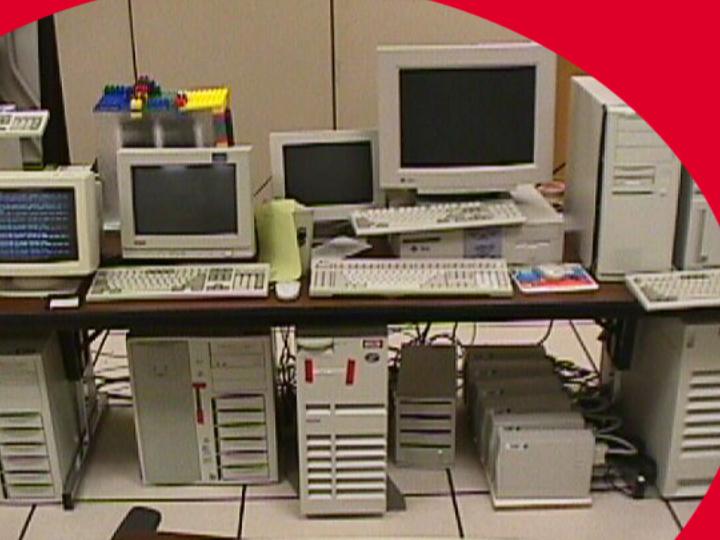
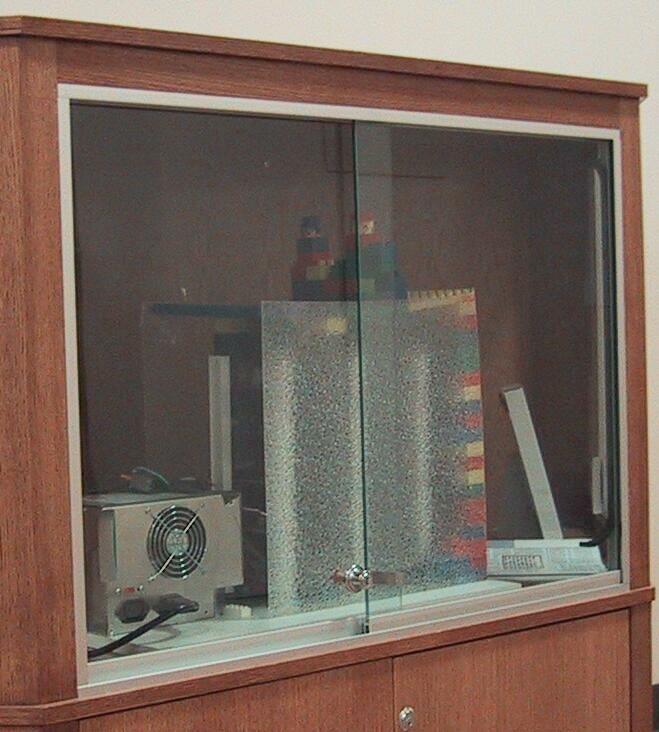
If you can honestly look at this picture and tell me that the blur that stretches all the way into the computer monitor is part of the lego case, I'll believe you.
Admittedly, looking at this picture, it appears that the lock on the display case is not blurred, supporting your theory, and maybe that first picture is because they reduced the size/aspect ratio of the RAID array, but not the plexiglass/glass.
The root of my question, I suppose, is why is the front of the array semi-transparent? Is there a censored joke in there? Some sort of concern about light patterns? Perhaps it was just the material that was available at the time. Whether it's Photoshop or a diffusing sheet isn't really the source of my curiosity.