Slashdot Mirror
Domain: staticflickr.com
Stories and comments across the archive that link to staticflickr.com.
Stories · 108
-
Driveway Encounter With Microsoft's President Led To $25 Million For Code.org
Long time reader theodp writes: At Monday's kickoff event with Melinda Gates for Computer Science Education Week 2018, Microsoft President Brad Smith revealed how a 2013 driveway encounter led to Microsoft's decision to commit $25 million to Code.org, whose CEO Hadi Partovi happens to live next door to Smith. "At the top of the hill, we share a common driveway," Smith said. "I can't even drive into the garage at night if he is standing in the way. Well, actually I can, but running him over is not the right path." Five years ago, Smith recalled, Partovi was in his driveway (King of the Hill-inspired artist's impression), "and he said, 'I have an idea [for then-nascent Code.org]. There is an important problem that we can help solve, because for too many people they look at these opportunities in computer science, and they don't appreciate that in truth anybody can aspire to be the next Melinda Gates or the next Bill Gates or the next Jeff Bezos or the next Sheryl Sandberg or Mark Zuckerberg. What they need, what they deserve, is the opportunity to learn this fundamental field.'"
Earlier this year, Code.org celebrated its 5th anniversary and thanked Microsoft and other tech donors for making it possible for the nonprofit to change U.S. K-12 public education. Smith also announced Monday that Microsoft would invest an additional $10 million in Code.org to help expand the tech-bankrolled nonprofit's work. "The renewed partnership," Microsoft explained, "will focus on ensuring that by 2020 every state will have passed policies to expand access to computer science and every school in the U.S. will have access to Code.org professional development." -
New Book Paints Different Picture of Workplace Behavior At Google and Facebook
Longtime Slashdot reader theodp writes: In Valley of Genius: The Uncensored History of Silicon Valley (As Told by the Hackers, Founders, and Freaks Who Made It Boom), Adam Fisher paints quite a different picture of life at now-workforce behavior preachers Google and Facebook, revealing that the tech giants' formative days were filled with the kind of antics that run afoul of HR protocols. Google was not a normal place, begins an excerpt in Vanity Fair that includes some juicy quotes attributed to Google executive chef Charlie Ayers about Google's founders ("Sergey's the Google playboy. He was known for getting his fingers caught in the cookie jar with employees that worked for the company in the masseuse room. He got around.") And in Sex, Beer, and Coding, Wired runs an excerpt about Facebook's wild early days, which even extended to the artwork gracing its office ("The office was on the second floor, so as you walk in you immediately have to walk up some stairs, and on the big 10-foot-high wall facing you is just this huge buxom woman with enormous breasts wearing this Mad Max-style costume riding a bulldog. It's the most intimidating, totally inappropriate thing. [...] That set a tone for us. A huge-breasted warrior woman riding a bulldog is the first thing you see as you come in the office, so like, get ready for that!" So, what changed? "When Sheryl Sandberg joined the company is when I saw a vast shift in everything in the company," said Ayers about Google. Sandberg later became Facebook's grown-up face. -
Microsoft Debuts Minecraft-Themed Coding Tutorial
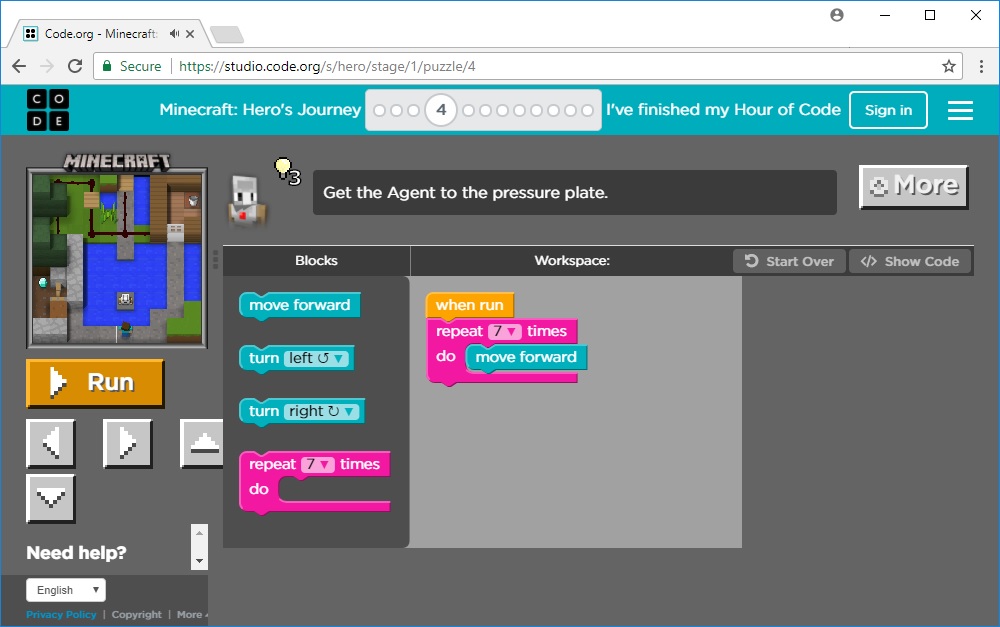
theodp writes: In a few weeks, writes Microsoft Corporate VP Mary Snapp, "millions of kids and others will participate in an Hour of Code, a global call to action to spend an hour learning the basics of coding. Today, it's my privilege to announce that Microsoft has released a new Minecraft tutorial for Hour of Code, called Hero's Journey." The release of the new Code.org-touted flagship Hour of Code tutorial -- the third since Microsoft purchased Minecraft Maker Mojang for $2.5B in 2014 -- comes as Microsoft celebrates Minecraft: Education Edition reaching a milestone of 2 million users.
Microsoft boasts that nearly 70 million of its Minecraft Hour of Code sessions have been launched to-date, which is certainly impressive from an infomercial or brand awareness standpoint. But does [adding a Scratch block to] move a Minecraft character forward 7 times on an $800 Microsoft Surface offer all that much more educational value than, say, moving a peg forward 5 times on a $10.99 Pop-O-Matic Trouble board game? -
Microsoft Debuts Minecraft-Themed Coding Tutorial
theodp writes: In a few weeks, writes Microsoft Corporate VP Mary Snapp, "millions of kids and others will participate in an Hour of Code, a global call to action to spend an hour learning the basics of coding. Today, it's my privilege to announce that Microsoft has released a new Minecraft tutorial for Hour of Code, called Hero's Journey." The release of the new Code.org-touted flagship Hour of Code tutorial -- the third since Microsoft purchased Minecraft Maker Mojang for $2.5B in 2014 -- comes as Microsoft celebrates Minecraft: Education Edition reaching a milestone of 2 million users.
Microsoft boasts that nearly 70 million of its Minecraft Hour of Code sessions have been launched to-date, which is certainly impressive from an infomercial or brand awareness standpoint. But does [adding a Scratch block to] move a Minecraft character forward 7 times on an $800 Microsoft Surface offer all that much more educational value than, say, moving a peg forward 5 times on a $10.99 Pop-O-Matic Trouble board game? -
Code.org Disses Wolfram Language, Touts Apple's Swift Playgrounds (edsurge.com)
America is changing the way it teaches computer science. "There are now 31 states that allow CS to count towards high school graduation," according to an announcement this week by the White House, while a new Advance Placement course "will be offered in more than 2,000 U.S. classrooms this fall...the largest course launch in the history of the AP exam." But what's the best way to teach coding? theodp reports: Tech-backed Code.org, one of the leaders of the new CSforAll Consortium that was announced at the White House on Wednesday, took to its blog Thursday to say "Thanks, Tim [Cook], for supporting the effort to give every student the opportunity to learn computer science," giving a shout out to Apple for providing "resources for teachers who want to put Swift Playgrounds in their classrooms. (A day earlier, the White House said Apple developed Swift Playgrounds "in support of the President's call to action" for CS for All).
Curiously, Code.org CEO Hadi Partovi argued Friday that "the Wolfram Language has serious shortcomings for broad educational use" in an EdSurge op-ed that was called a "response to a recent blog post by Stephen Wolfram" on Wolfram's ambitious plan to teach computational thinking in schools. Partovi's complaints? "It requires login for all but the simplest use cases, but doesn't provide any privacy safeguards for young children (required in the U.S. through legislation such as COPPA). Also, a serious user would need to pay for usage, making implementation inaccessible in most schools. Lastly, it's a bit difficult to use by students who struggle with English reading or writing, such as English language learners or early elementary school students."
The submission ultimately asks how should computer science be taught to teenagers. "Would you be inclined to embrace Wolfram's approach, Apple's Swift Playgrounds, Microsoft TEALS' Java-centric AP CS curriculum, or something else (e.g., R, Tableau, Excel+VBA)?" -
3 Years Ago, Microsoft Said Tech Should Fund K-12 CS Education. What Changed? (motherjones.com)
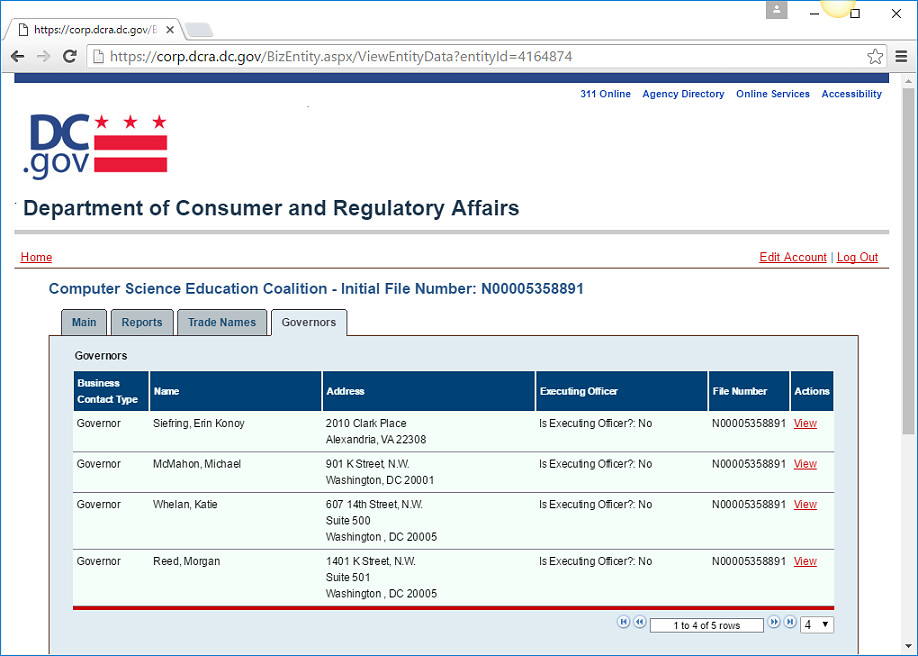
theodp writes: Last week, Microsoft and some of the biggest names in tech and corporate America threw their weight behind a Change.org petition that urged Congress to fund K-12 Computer Science education. The petition, started by the tech-backed CS Education Coalition (btw, 901 K Street NW is Microsoft's DC HQ) in partnership with tech-backed Code.org, now has 90,000+ supporters. But three years ago, Microsoft backed a very different Change.org petition that called for corporate America to foot the STEM education bill.
"While the need to expand high-skilled immigration is immediate," read the letter to Congress, "we also need to expand STEM opportunities in U.S. education. A positive proposal has emerged in Washington to create a national STEM education fund, paid for only by businesses using green cards and visas. This fund will help prepare Americans for 21st-century STEM jobs. The proposal is supported by a broad coalition [PDF] that includes Microsoft, GE, the National Council of La Raza, the National Association of Manufactures, and the National Science Teachers Association, to name a few."
The earlier petition, which wound up with 41,009 supporters, was started by Voices for Innovation, a self-described "Microsoft supported community" that says it's now "proud to support the Computer Science Education Coalition" as part of its efforts to "shape public policies for our 21st century digital economy and society." So, what changed? Well, Mother Jones did warn that what Microsoft promises and what it delivers for education isn't necessarily the same... -
Harvard: Prospective CS50 AP Teachers Must cc:Microsoft On Training Applications
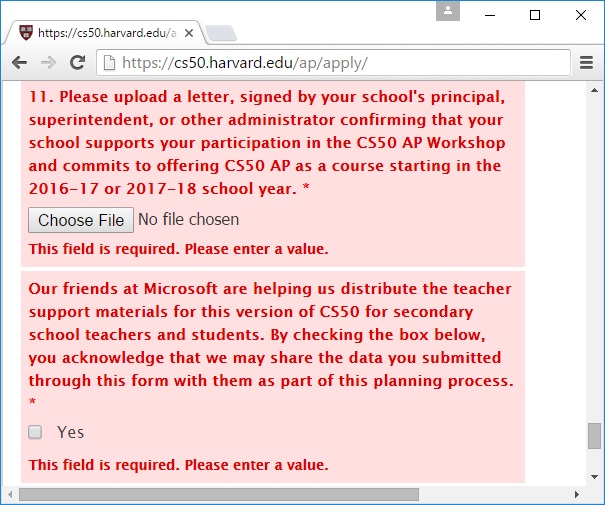
theodp writes: Did you know that Microsoft has supported Harvard in creating a new version [of its wildly-popular CS50 course] called CS50 AP, designed specifically for secondary school educators?" asks a Microsoft Born to Learn Blog post. "If you might like to teach CS50 AP (and, in turn, AP CS Principles) in your own classroom this year," Harvard informs prospective teachers, "you are cordially invited to join us at one of our teacher training workshops to be held in various locations around the country and the world!" But before applications can be successfully submitted, teachers are required to respond to the following statement, and Harvard won't take 'No' for an answer: "Our friends at Microsoft are helping us distribute the teacher support materials for this version of CS50 for secondary school teachers and students. By checking the box below, you acknowledge that we may share the data you submitted through this form with them as part of this planning process." Microsoft is certainly calling the K-12 CS education shots these days — heck, the White House even let Microsoft President Brad Smith brief reporters about plans to spend $4B in tax dollars on a new CS for All K-12 initiative before the President told taxpayers about it. By the way, the CS50 AP Wiki contains a CS50x/CS50 AP Authorization and Release form which, among other things, requires camera-shy CS50 AP students to agree to "sit in a 'no-film' zone" if they do not want photos or videos of themselves used by Harvard to promote the Microsoft-supported course." From the agreement: "I understand that my teacher will take reasonable steps, with my cooperation, to avoid including identifiable images of me in the Recordings. I understand that I am free to opt out of the Recordings in this way, and that doing so will not affect my grade or my ability to participate in course activities. Unless I opt out of the Recordings as described above and take the steps that will be outlined by the instructor to avoid being filmed, I authorize Harvard and its designees to use the Recordings. I understand and agree that the Recordings may include my image, name, and voice. I also understand and agree that, even if I opt out of the Recordings, my spoken name and voice may be picked up by microphones outside any "no-film" zone and may be included in the Recordings. -
Apple Releases 2015 EEO-1 Diversity Data Over Weekend (qz.com)
theodp writes: Just days after it came under fire for dismissing a call for diversity as "unduly burdensome and not necessary," Apple quietly released its 2015 EEO-1 diversity report (dated 10/6/2015, reflects the 8/1 payroll). Like other tech companies' diversity disclosures, Apple's EEO-1 raw numbers can't really be reconciled to the percentages based on undisclosed raw numbers that grace the infographic-heavy diversity progress narrative CEO Tim Cook spoke to last August. As to why they keep two sets of diversity books, Apple explains, "The EEO-1 has not kept pace with changes in industry or the American workforce over the past half century. We believe the information we report elsewhere on this site is a far more accurate reflection of our progress toward diversity." Taking this stance allows Apple CEO Tim Cook to boast that "in the United States, we hired more than 2,200 Black employees — a 50 percent increase over last year," while ignoring Apple's EEO-1 report, which indicates that Black employees showed a year-over-year net increase of only 1,475 employees and accounted for only 1.9% of the 4,333 YOY net increase in "Professionals" at Apple (White employees accounted for 50.6%, Asian for 42.1%). If you want to check the math, Apple's EEO-1 data (typed in from the content-copy-not-allowed 2015 and 2014 PDFs) and additional charts can be found in this Tableau workbook. -
US Dept. of Ed: English, History, and Civics Teachers Good Enough For CS Class
theodp writes: In A New Chapter for Computer Science Education, the U.S. Department of Education explained earlier this month that the federal STEM Education Act of 2015 'provides an unprecedented opportunity to fully leverage federal resources' to address large gaps in students' participation in Advanced Placement (AP) computer science classes based on gender and race. "In three states," lamented the DOE, "not a single female student took the AP computer science exam" (that only 8 boys took the AP CS exam in those same 3 states was apparently not a concern). And the DOE has good news for those hoping to tap Title I and II funds for CS, but don't have any computer science teachers. "A background in math or science isn't necessarily a requirement to teach CS," explains the Dept. of Ed, "as disciplines like English, history and civics can also provide a solid foundation for teaching CS concepts." -
Nearly 35,000 Comment On New Federal STEM OPT Extension Rule (computerworld.com)
theodp writes: Computerworld reports that the comments are in on the Department of Homeland Security's new proposed rule to extend OPT for international STEM students from 29 months to at least 36 months. The majority of the comments received by DHS support extending the program, CW notes, which is probably not surprising. Rather than choosing to "avoid the appearance of improper influence" by declining to respond to a "We the People" petition protesting a pending U.S. Federal judge's ruling that threatens to eliminate OPT STEM extensions altogether in February, the White House informed the 100k petition signers that they had the President's support, and pointed to the comment site for the proposed DHS OPT STEM rule workaround. Like the "We the People" petitioners, it's unclear whether the DHS commenters might represent corporate, university, and/or student interests, although a word cloud of the top 100 names of commenters (which accounted for 17,000+ comments) hints that international students are well-represented. By the way, in rejecting the 'emergency changes' that were enacted by DHS in 2008 to extend OPT for STEM students without public comment, Judge Ellen Huvelle said, "the 17-month duration of the STEM extension appears to have been adopted directly from the unanimous suggestions by Microsoft and similar industry groups." -
Hour of Code 2015 Star Wars Tutorial: Spare the IF Statement, Spoil the Child?
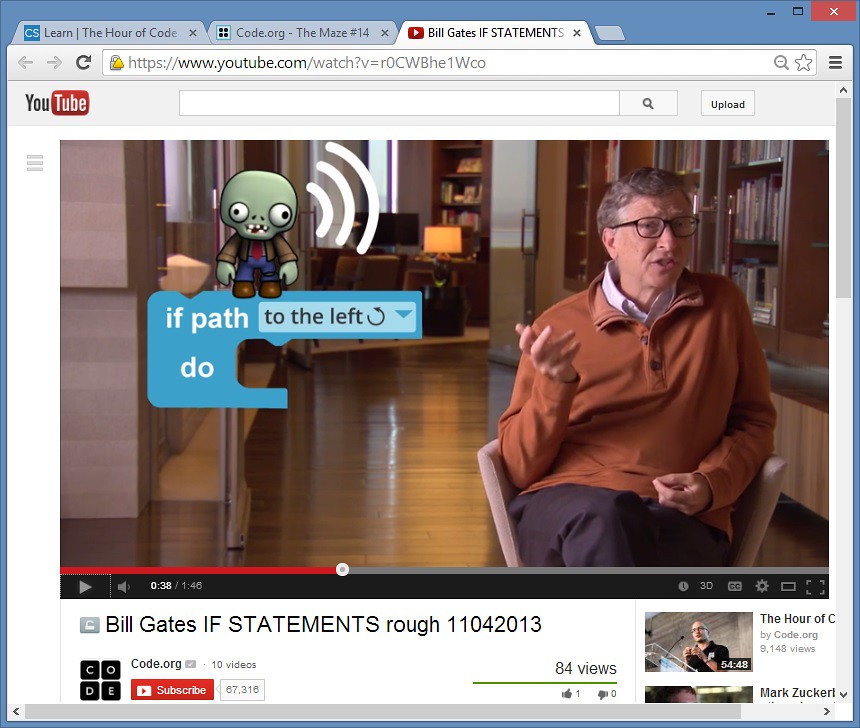
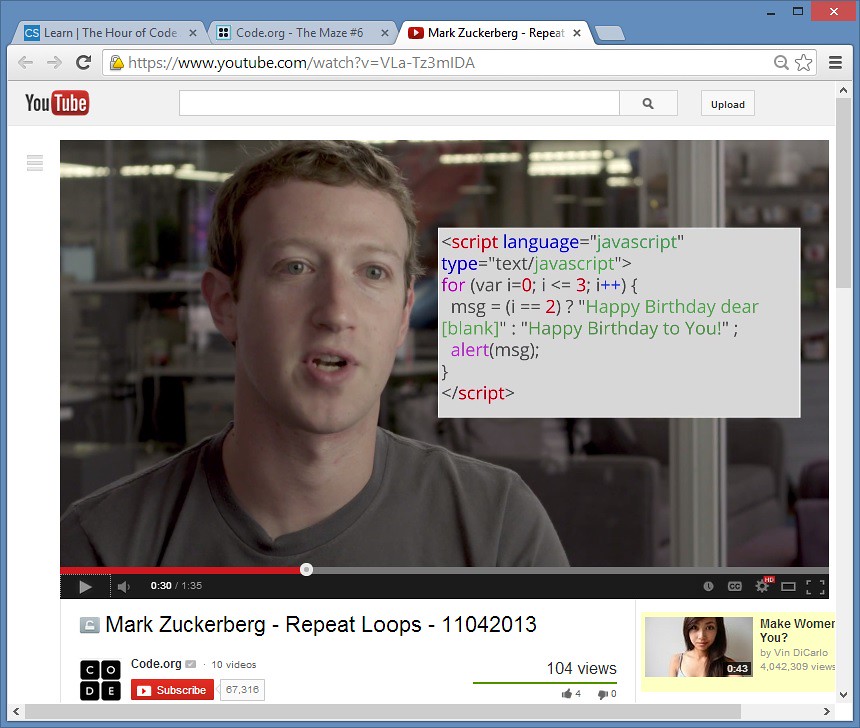
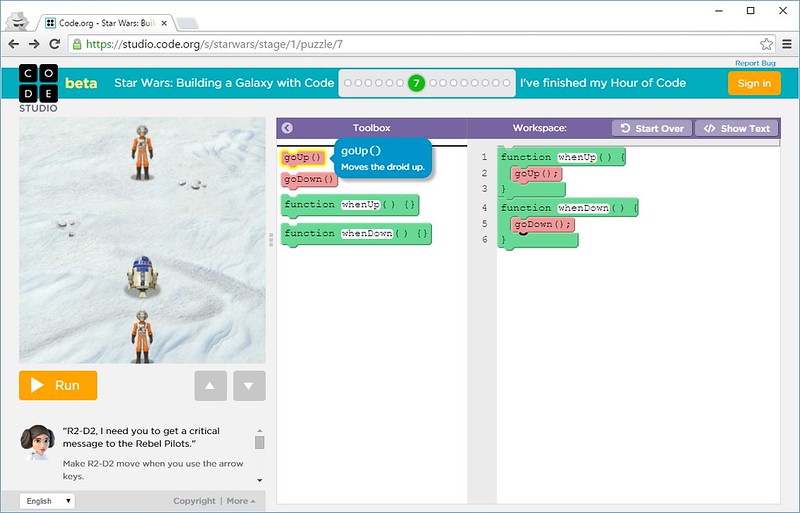
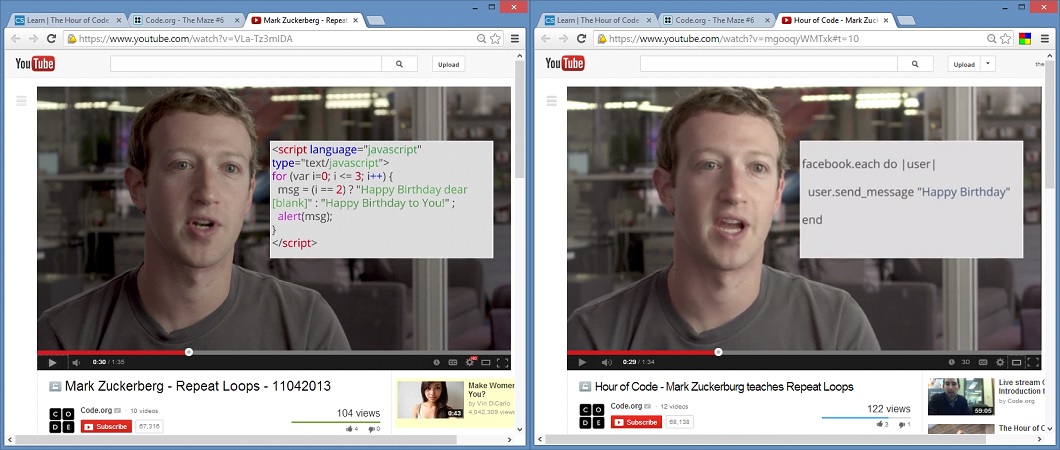
theodp writes: Teaching U.S. K-12 kids their programming fundamentals in past Hours of Code were an IF-fy Bill Gates and a LOOP-y Mark Zuckerberg. Interestingly, the new signature tutorial — Star Wars: Building a Galaxy with Code — created by Lucasfilm and Code.org ("in a locked room with no windows") for this December's Hour of Code, eschews both IF statements and loops. The new learn-to-code tutorial instead elects to show students "events" after they've gone through the usual move-up-down-left-right drills. With the NY Times and National Center for Women & Information Technology recently warning against putting Star Wars in the CS classroom ("Attracting more female high school students to computer science classes might be as easy as tossing out the Star Wars posters," claimed an Aug. 29th NCWIT Facebook post), the theme of the new tutorial seems an odd choice for Code.org, whose stated mission includes "increasing [CS] participation by women." But if Star Wars is, as some suggest, more aimed at boys, perhaps Code.org has something up its sleeve for girls (a la last year's Disney Princesses) with another as yet unannounced signature tutorial that it teased would be "just as HUGE" as the Star Wars one. Any guesses on what that might be? -
Hour of Code 2015 Star Wars Tutorial: Spare the IF Statement, Spoil the Child?
theodp writes: Teaching U.S. K-12 kids their programming fundamentals in past Hours of Code were an IF-fy Bill Gates and a LOOP-y Mark Zuckerberg. Interestingly, the new signature tutorial — Star Wars: Building a Galaxy with Code — created by Lucasfilm and Code.org ("in a locked room with no windows") for this December's Hour of Code, eschews both IF statements and loops. The new learn-to-code tutorial instead elects to show students "events" after they've gone through the usual move-up-down-left-right drills. With the NY Times and National Center for Women & Information Technology recently warning against putting Star Wars in the CS classroom ("Attracting more female high school students to computer science classes might be as easy as tossing out the Star Wars posters," claimed an Aug. 29th NCWIT Facebook post), the theme of the new tutorial seems an odd choice for Code.org, whose stated mission includes "increasing [CS] participation by women." But if Star Wars is, as some suggest, more aimed at boys, perhaps Code.org has something up its sleeve for girls (a la last year's Disney Princesses) with another as yet unannounced signature tutorial that it teased would be "just as HUGE" as the Star Wars one. Any guesses on what that might be? -
Hour of Code 2015 Star Wars Tutorial: Spare the IF Statement, Spoil the Child?
theodp writes: Teaching U.S. K-12 kids their programming fundamentals in past Hours of Code were an IF-fy Bill Gates and a LOOP-y Mark Zuckerberg. Interestingly, the new signature tutorial — Star Wars: Building a Galaxy with Code — created by Lucasfilm and Code.org ("in a locked room with no windows") for this December's Hour of Code, eschews both IF statements and loops. The new learn-to-code tutorial instead elects to show students "events" after they've gone through the usual move-up-down-left-right drills. With the NY Times and National Center for Women & Information Technology recently warning against putting Star Wars in the CS classroom ("Attracting more female high school students to computer science classes might be as easy as tossing out the Star Wars posters," claimed an Aug. 29th NCWIT Facebook post), the theme of the new tutorial seems an odd choice for Code.org, whose stated mission includes "increasing [CS] participation by women." But if Star Wars is, as some suggest, more aimed at boys, perhaps Code.org has something up its sleeve for girls (a la last year's Disney Princesses) with another as yet unannounced signature tutorial that it teased would be "just as HUGE" as the Star Wars one. Any guesses on what that might be? -
Revisiting Why Johnny Can't Code: Have We "Made the Print Too Small"?
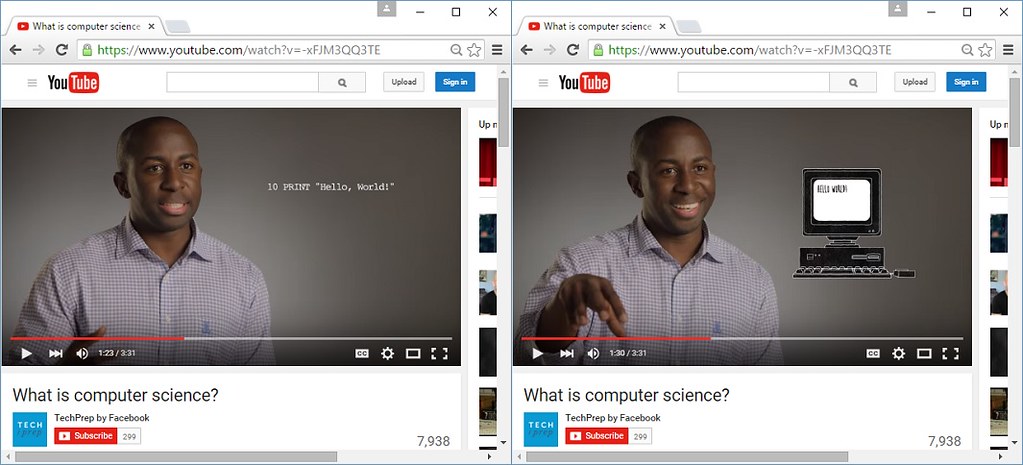
theodp writes: In What is Computer Science?, the kickoff video for Facebook's new TechPrep diversity initiative, FB product manager Adriel Frederick explains how he was hooked-on-coding after seeing the magic of a BASIC PRINT statement. His simple BASIC example is a nice contrast to the more complicated JavaScript and Ruby examples that were chosen to illustrate Mark Zuckerberg's what-is-coding video for schoolkids. In How to Teach Your Baby to Read, the authors explain, "It is safe to say that in particular very young children can read, provided that, in the beginning, you make the print very big." So, is introducing coding to schoolkids with modern programming languages instead of something like BASIC (2006) or even (gasp!) spreadsheets (2002) the coding equivalent of "making the print too small" for a child to see and understand? -
Revisiting Why Johnny Can't Code: Have We "Made the Print Too Small"?
theodp writes: In What is Computer Science?, the kickoff video for Facebook's new TechPrep diversity initiative, FB product manager Adriel Frederick explains how he was hooked-on-coding after seeing the magic of a BASIC PRINT statement. His simple BASIC example is a nice contrast to the more complicated JavaScript and Ruby examples that were chosen to illustrate Mark Zuckerberg's what-is-coding video for schoolkids. In How to Teach Your Baby to Read, the authors explain, "It is safe to say that in particular very young children can read, provided that, in the beginning, you make the print very big." So, is introducing coding to schoolkids with modern programming languages instead of something like BASIC (2006) or even (gasp!) spreadsheets (2002) the coding equivalent of "making the print too small" for a child to see and understand? -
Despite $30M Tech Push, Half of US States Had Fewer Than 300 AP CS Test Takers
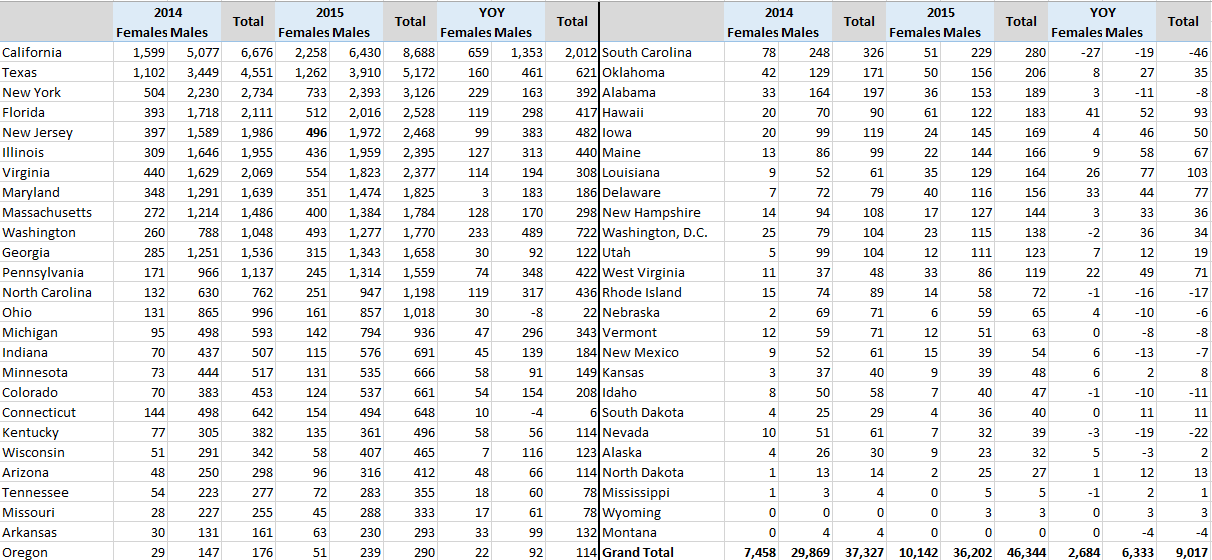
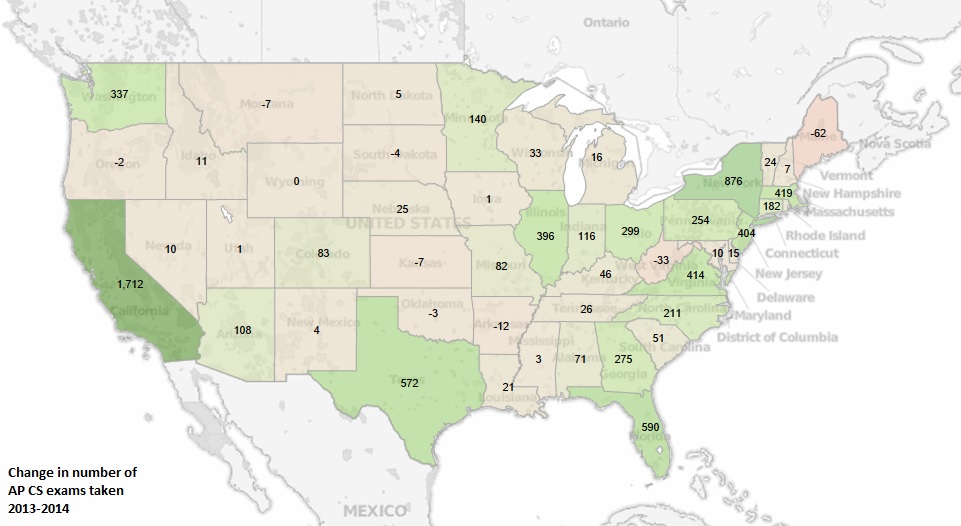
theodp writes: As President Obama was 'taught to code' last December, Politico reported that the $30 million tech-financed campaign to promote computer science education was a smash success. And indeed it has been, at least from a PR standpoint. But Code.org and its backers have long spun AP Computer Science test metrics as a true barometer of CS education success, and from that standpoint, things don't look quite so rosy. The College Board raved about "massive gains in AP Computer Science participation (25% growth) AND scores" in a June tweetstorm and at its July conference, where AP CS was declared the '2015 AP Subject of the Year.' But a look at the recently-released detail on 2015 AP CS scores shows wide differences in adoption and success along gender and ethnicity lines (Asian boys and girls, in particular, set themselves apart from other groups with 70%+ pass rates). And, for all the praise the NSF lavished on Code.org for 'its amazing marketing prowess', half of the states still had fewer than 300 AP CS test takers in 2015, and ten states actually saw year-over-year declines in the number of test takers (if my math is correct — scraped data, VBA code here). -
Despite $30M Tech Push, Half of US States Had Fewer Than 300 AP CS Test Takers
theodp writes: As President Obama was 'taught to code' last December, Politico reported that the $30 million tech-financed campaign to promote computer science education was a smash success. And indeed it has been, at least from a PR standpoint. But Code.org and its backers have long spun AP Computer Science test metrics as a true barometer of CS education success, and from that standpoint, things don't look quite so rosy. The College Board raved about "massive gains in AP Computer Science participation (25% growth) AND scores" in a June tweetstorm and at its July conference, where AP CS was declared the '2015 AP Subject of the Year.' But a look at the recently-released detail on 2015 AP CS scores shows wide differences in adoption and success along gender and ethnicity lines (Asian boys and girls, in particular, set themselves apart from other groups with 70%+ pass rates). And, for all the praise the NSF lavished on Code.org for 'its amazing marketing prowess', half of the states still had fewer than 300 AP CS test takers in 2015, and ten states actually saw year-over-year declines in the number of test takers (if my math is correct — scraped data, VBA code here). -
Hour of Code Kicks Off In Chile With Dog Poop-Themed CS Tutorial
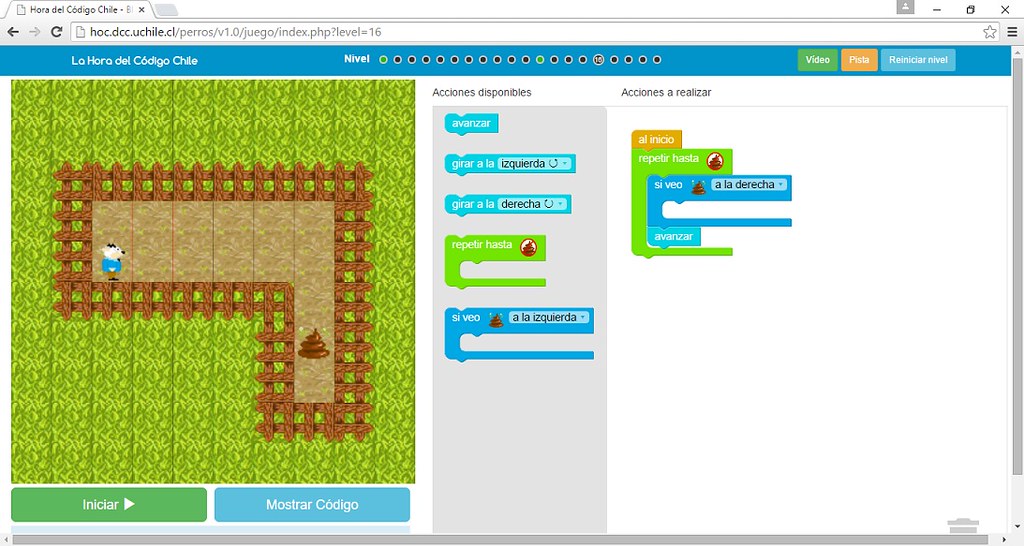
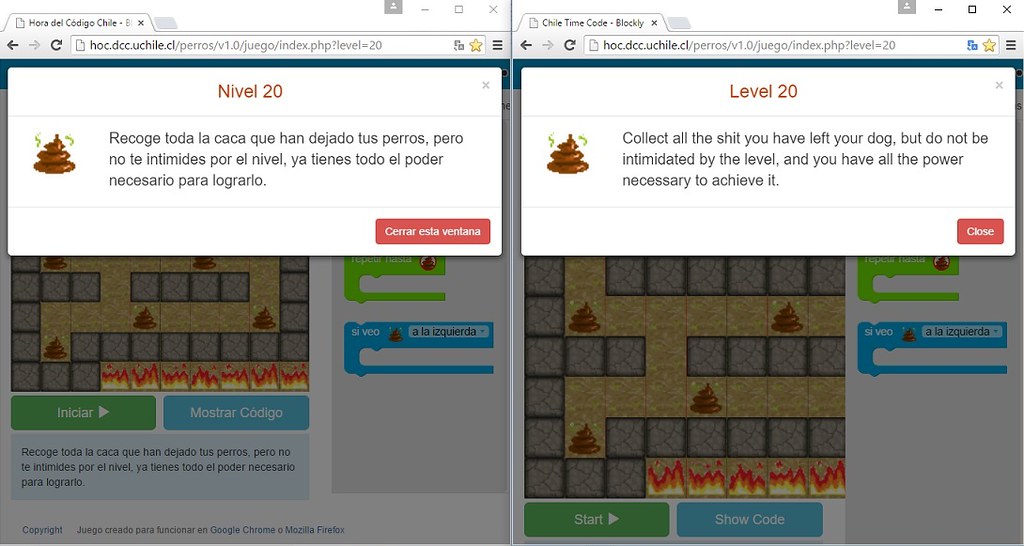
theodp writes: In an interesting contrast to the Disney princess-themed Hour of Code tutorial that 'taught President Obama to code' last December, Chile is kicking off its 2015 Hora del Codigo this week with a top-featured Blockly tutorial that teaches computer science by having kids drag-and-drop blocks of code to pick up dog poop. "Collect all the shit you have left your dog," reads the Google translated instructions for the final coding exercise. In its new video for the Hour of Code 2015 campaign, tech billionaire-backed Code.org notes that it's striving to reach 200 million schoolchildren worldwide by this December. Presumably towards that end, Code.org warns that it will penalize Computer Science tutorials that "work only in English." -
Hour of Code Kicks Off In Chile With Dog Poop-Themed CS Tutorial
theodp writes: In an interesting contrast to the Disney princess-themed Hour of Code tutorial that 'taught President Obama to code' last December, Chile is kicking off its 2015 Hora del Codigo this week with a top-featured Blockly tutorial that teaches computer science by having kids drag-and-drop blocks of code to pick up dog poop. "Collect all the shit you have left your dog," reads the Google translated instructions for the final coding exercise. In its new video for the Hour of Code 2015 campaign, tech billionaire-backed Code.org notes that it's striving to reach 200 million schoolchildren worldwide by this December. Presumably towards that end, Code.org warns that it will penalize Computer Science tutorials that "work only in English." -
White House Petition To Let Foreign STEM Grads Work Longer In US Hits 100K Signatures
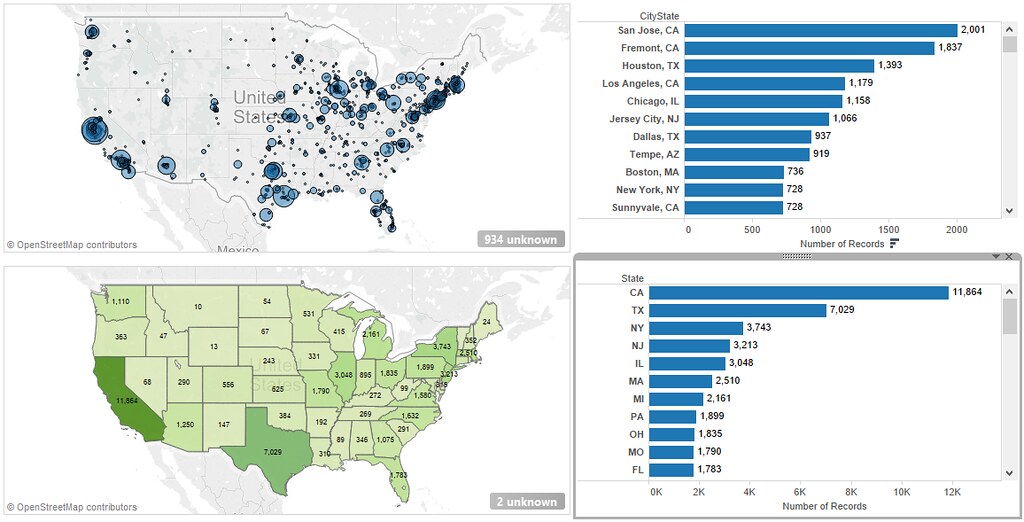
theodp writes: Computerworld reports that a petition urging the White House to act urgently on a court ruling that could force thousands of recent foreign STEM graduates working in the U.S. on OPT STEM extensions to leave the States early next year reached 100,000 signatures Tuesday, the threshold for an official government response. It could present a political conundrum of sorts for the Obama administration. Because the administration didn't act to protect U.S. workers at Southern California Edison and Disney, explained an attorney in the case, "now that foreign workers will be losing their jobs, how would it look if Obama went into overdrive to protect their jobs?" By the way, using a map to gauge whether support for the petition comes from all over the country (as the White House suggests), indicates that support for the OPT STEM Extension petition is largely concentrated in tech hotspots and universities, including off-the-beaten-path college towns that host large international student populations. -
Facebook's Solution To 'One of Education's Biggest Problems' Is a Dashboard
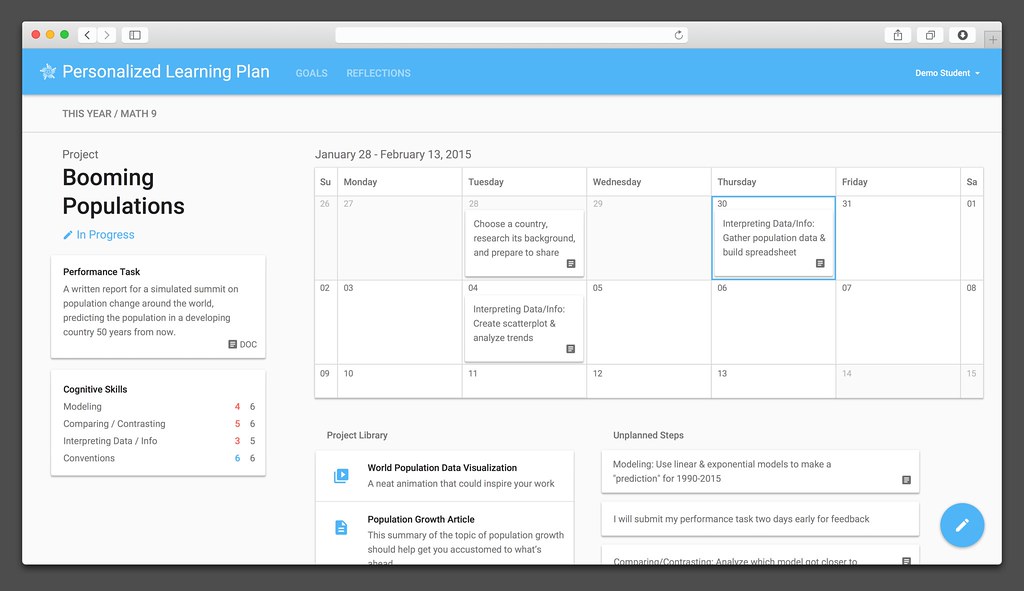
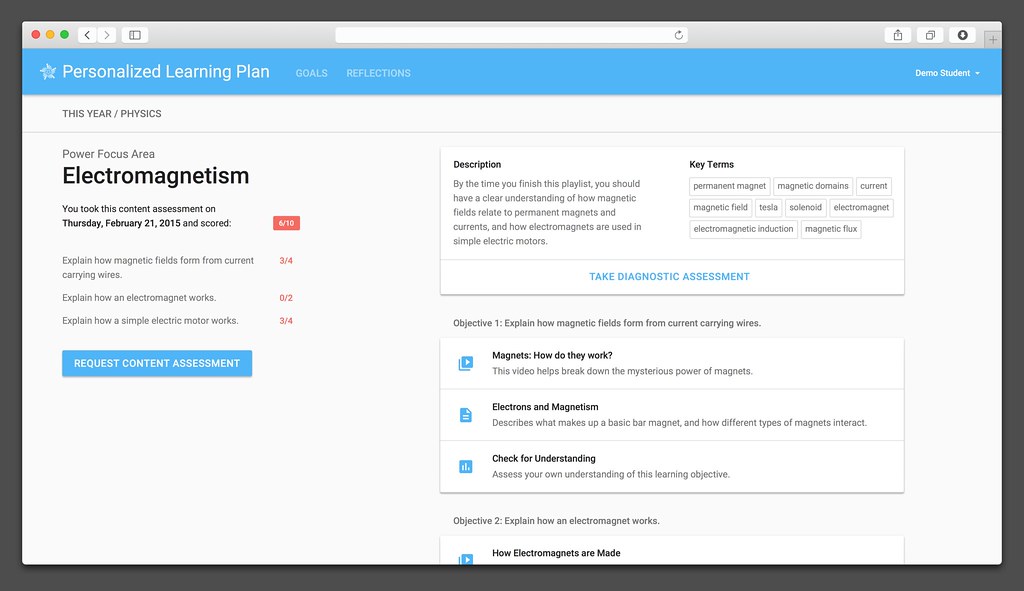
theodp writes: Gushing in July that Facebook engineers had solved one of education's biggest problems, Melinda Gates perhaps set up Segway-like expectations for Facebook's education software. And while The Verge sings the praises of what appears to be progress-tracking dashboards that connect students to mostly free 3rd-party lessons — not unlike Khan Academy or even the 50-year-old PLATO system — it's hard to get jazzed based on the screenshots (1, 2, 3) that Facebook provided in a .zip file accompanying its announcement. The "personalized learning plan" dashboards are a joint effort of Facebook and the Meg Whitman-led and backed Summit charter schools. In a nice circle-of-tech-CEO-education-reform-life twist, the first Summit high school opened in a building in Redwood City after students attending the Bill Gates-touted and backed Silicon Valley High Tech High charter there were evicted to make way, and the Gates Foundation is now spending $8M to bring HP CEO Whitman's Summit charter schools — and presumably Facebook CEO Mark Zuckerberg's personalized learning plans — to Seattle children. -
Facebook's Solution To 'One of Education's Biggest Problems' Is a Dashboard
theodp writes: Gushing in July that Facebook engineers had solved one of education's biggest problems, Melinda Gates perhaps set up Segway-like expectations for Facebook's education software. And while The Verge sings the praises of what appears to be progress-tracking dashboards that connect students to mostly free 3rd-party lessons — not unlike Khan Academy or even the 50-year-old PLATO system — it's hard to get jazzed based on the screenshots (1, 2, 3) that Facebook provided in a .zip file accompanying its announcement. The "personalized learning plan" dashboards are a joint effort of Facebook and the Meg Whitman-led and backed Summit charter schools. In a nice circle-of-tech-CEO-education-reform-life twist, the first Summit high school opened in a building in Redwood City after students attending the Bill Gates-touted and backed Silicon Valley High Tech High charter there were evicted to make way, and the Gates Foundation is now spending $8M to bring HP CEO Whitman's Summit charter schools — and presumably Facebook CEO Mark Zuckerberg's personalized learning plans — to Seattle children. -
Facebook's Solution To 'One of Education's Biggest Problems' Is a Dashboard
theodp writes: Gushing in July that Facebook engineers had solved one of education's biggest problems, Melinda Gates perhaps set up Segway-like expectations for Facebook's education software. And while The Verge sings the praises of what appears to be progress-tracking dashboards that connect students to mostly free 3rd-party lessons — not unlike Khan Academy or even the 50-year-old PLATO system — it's hard to get jazzed based on the screenshots (1, 2, 3) that Facebook provided in a .zip file accompanying its announcement. The "personalized learning plan" dashboards are a joint effort of Facebook and the Meg Whitman-led and backed Summit charter schools. In a nice circle-of-tech-CEO-education-reform-life twist, the first Summit high school opened in a building in Redwood City after students attending the Bill Gates-touted and backed Silicon Valley High Tech High charter there were evicted to make way, and the Gates Foundation is now spending $8M to bring HP CEO Whitman's Summit charter schools — and presumably Facebook CEO Mark Zuckerberg's personalized learning plans — to Seattle children. -
Mostly Theater? Taking Aim At White House 'We the People' Petitions
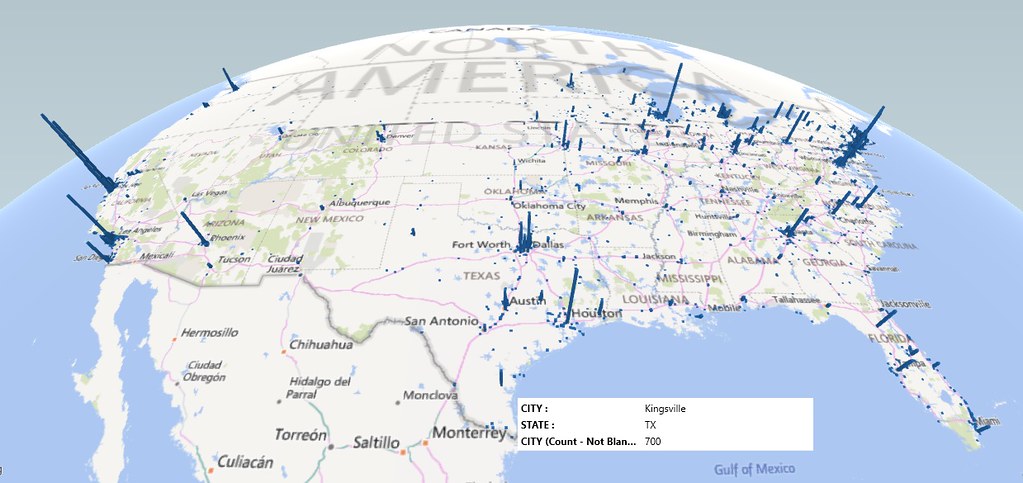
theodp writes: "Since we launched We the People in 2011," wrote the White House last month, "millions of Americans have engaged with their government on the issues that matter to them. This groundbreaking online platform has made petitioning the government, a First Amendment right, more accessible than ever. Over the past few years, the Obama administration has taken a stance on a number of causes that citizens really care about and used the We the People petition platform to voice their concerns." Sounds good, but even if the White House is listening to We the People petitions, as it assured skeptics, one wonders what — and who — exactly they are listening to. Petitions suffer from being aye-only, lack identity and location verification, and appear to have other data quality issues. One attempting to explore the petition data for the 67,022-and-counting signers of a new petition urging a quick response to a court decision that could cut the time international STEM students can work in the U.S. on student visas after graduation, for example, would be stymied by thousands of missing and non-U.S. postal codes. Plotting what location info is available does show that the petitioners are clustered around tech and university hubs, hardly a surprise, but it sheds no context on whether these represent corporate, university, and/or international student interests. -
Standardized Tests Blamed, Asian Students Ignored In Google-Gallup K-12 CS Study
theodp writes: According to a study released Thursday by Google and Gallup, standardized tests may be holding back the next generation of computer programmers. The Google-Gallup Searching for Computer Science: Access and Barriers in U.S. K-12 Education report (PDF) found that the main reason given by a "comprehensive but not representative" sample of 9,693 K-12 principals and 1,865 school district superintendents in the U.S. for their schools not offering computer science "is the limited time they have to devote to classes that are not tied to testing requirements." Which makes one wonder if Google now views Bill Gates as part of the problem and/or part of the solution of K-12 CS education. The Google-Gallup report also explores race/ethnicity differences to access and learning opportunities among White, Black and Hispanic students — but not Asian students — a curious omission considering that Google's own Diversity Disclosure shows that 35% of its U.S. tech workforce is Asian, making it by far the most overrepresented race/ethnicity group at Google when compared to the U.S. K-12 public school population. Which raises the question: Why would the Google-Gallup study ignore the access and learning opportunities of the race/ethnicity subgroup that has enjoyed the greatest success at Google? Not unsurprisingly, the Google-Gallup report winds up by concluding that what U.S. K-12 education really needs is more CS cowbell. -
AP CS Test Takers and Pass Rates Up, Half of Kids Don't Get Sparse Arrays At All
theodp writes: Each June, the College Board tweets out teasers of the fuller breakouts of its Advanced Placement (AP) test results, which aren't made available until the fall. So, here's a roundup of this year's AP Computer Science tweetstorm: 1. "Wow — massive gains in AP Computer Science participation (25% growth) AND scores this year; big increase in % of students earning 4s & 5s!" 2. "2015 AP Computer Science scores: 5: 24.4%; 4: 24.6%; 3: 15.3%; 2: 7.1%; 1: 28.6%." [3 or above is passing] 3."Count them: a whopping 66 AP Computer Science students out of 50,000 worldwide earned all 80 pts possible on this year's exam." 4. "Remember that AP exam standards are equated from year to year, so when scores go up, it's a direct indication of increased student mastery." 5. "Many AP Computer Science students did very well on Q1 (2D array processing–diverse array); >20% earned all 9/9 pts" [2015 AP CS A Free-Response Questions] 6. "The major gap in this year's AP Computer Sci classrooms seems to be array list processing; Q3 (sparse array): 47% of students got 0/9 pts." -
FB Reveals Woeful Diversity Numbers
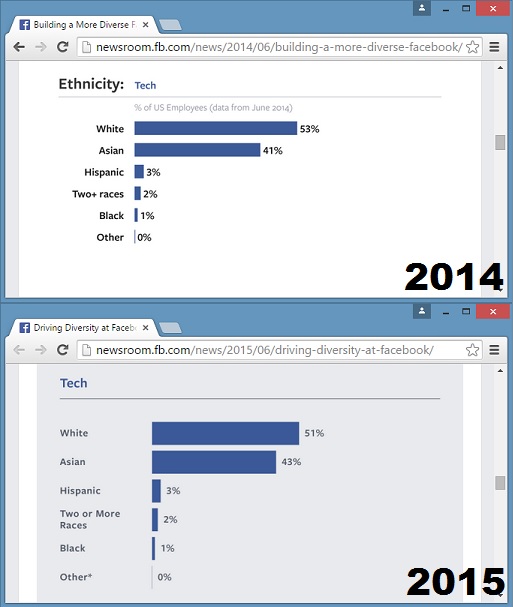
theodp writes: There's more work to do," said Facebook's Global Director of Diversity Maxine Williams, who issued a straight-out-of-How-to-Lie-With-Statistics diversity update on Thursday that essentially consisted of a handful of bar charts labeled with only percentages for select measures of the social networking giant's current demographics. In search of real numbers, the Guardian turned to Facebook's most recent Equal Employment Opportunity report filing, which showed that the ranks of black employees swelled by a grand total of seven (7) (1 woman) in the year covered by the filing, during which time Facebook saw an overall headcount increase of 1,231. Comparing Facebook's new bar charts of US tech employees to those issued last year shows the proportion of Hispanic and Black employees remained flat at 3% and 1% respectively, while a decline in the proportion of white employees from 53% to 51% was offset by an increase in the proportion of Asian employees from 41% to 43%. -
Google Diversity Report Straight Out of 'How To Lie With Statistics' Playbook
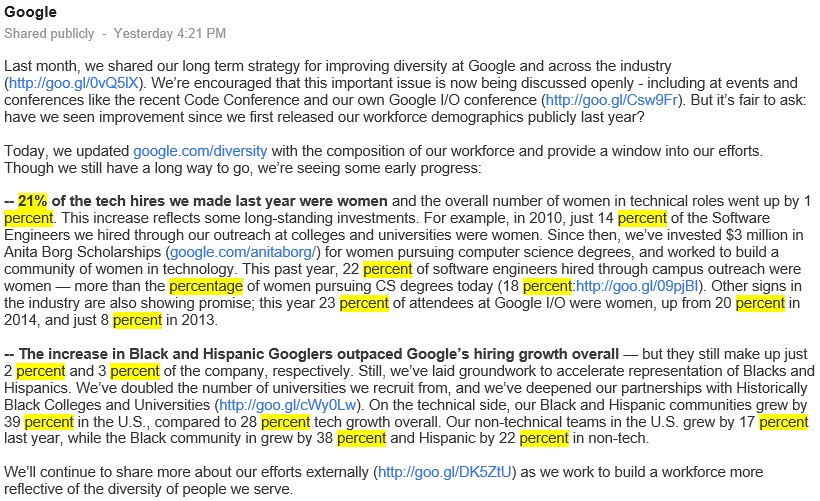
theodp writes: Among the books recommended by Bill Gates for beach reading this summer is How to Lie With Statistics, the published-in-1954-but-timely-as-ever introduction to the (mis)use of statistics. So, how can one lie with statistics? "Sometimes it is percentages that are given and raw figures that are missing," explains the book, "and this can be deceptive too." So, does this explain Google's just-released Diversity Report and the accompanying chock-full-o-percentages narrative (find-all-%-image), which boasts "the Black community in grew [sic] by 38 percent", while the less-impressive raw figures — e.g., the number of Google employees increased by 5,928, but the ranks of Black females only increased by 35 (less than 0.6% of the net increase) — are relegated to a PDF of its EEO-1 Report that's linked to in the fine-print footnotes? To be fair to Google, Microsoft, Twitter, Apple and Amazon didn't want people to see their EEO-1 numbers, either. -
Google's Diversity Chief: Mamas Don't Let Their Baby Girls Grow Up To Be Coders
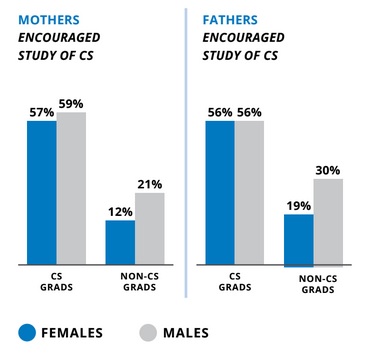
theodp writes: Explaining the reasons for its less-than-diverse tech workforce, Google fingered bad parenting for its lack of women techies. From the interview with Google Director of Diversity and Inclusion Nancy Lee: "Q. What explains the drop [since 1984] in women studying computer science? A. We commissioned original research that revealed it's primarily parents' encouragement, and perception and access. Parents don't see their young girls as wanting to pursue computer science and don't steer them in that direction. There's this perception that coding and computer science is ... a 'brogrammer' culture for boys, for games, for competition. There hasn't been enough emphasis on the power computing has in achieving social impact. That's what girls are interested in. They want to do things that matter." While scant on details, the Google study's charts appear to show that, overall, fathers encourage young women to study CS more than mothers. Google feels that reeducation is necessary. "Outreach programs," advises Google, "should include a parent education component, so that parents learn how to actively encourage their daughters." -
Gates, Zuckerberg Promising Same Jobs To US Kids and Foreign H-1B Workers?
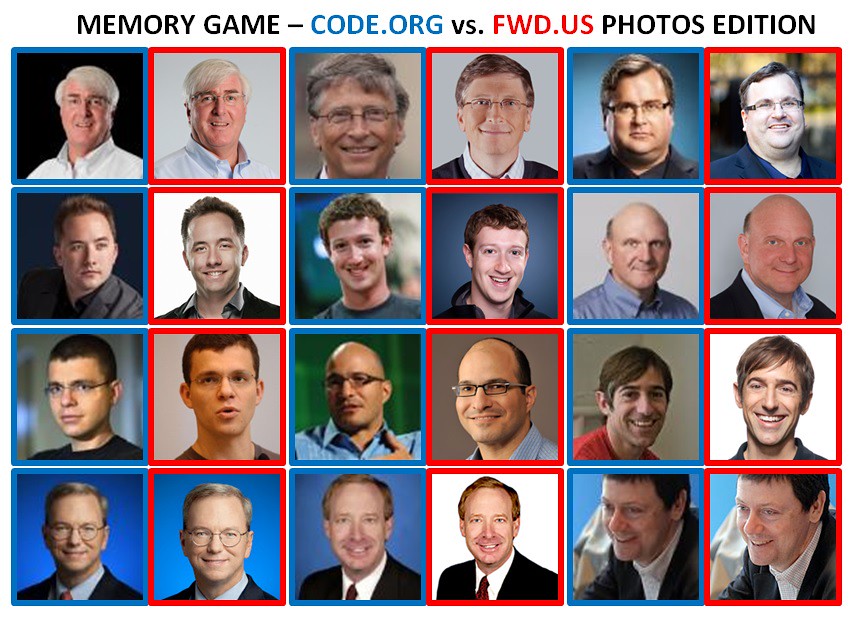
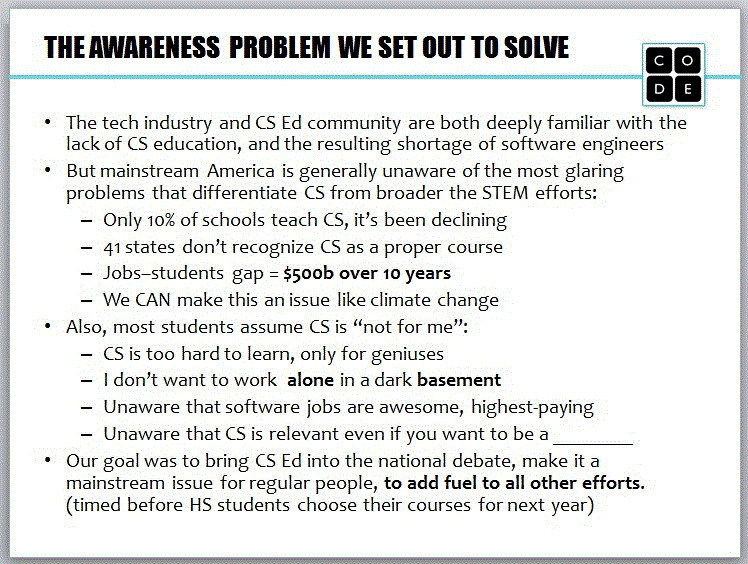
theodp writes: Over at the Bill Gates and Mark Zuckerberg-bankrolled Code.org, they're using the number of open computing jobs in each state to convince parents of the need to expand K-12 CS offerings so their kids can fill those jobs. Sounds good, right? But at the same time, the Gates and Zuckerberg-bankrolled FWD.org PAC has taken to Twitter, using the number of open "STEM" jobs in each state to convince politicians of the need to expand the number of H-1B visas so foreign workers can fill those jobs. While the goal of Microsoft's 'two-pronged' National Talent Strategy is to kill two birds [K-12 CS education and H-1B visas] with one crisis, is it fair for organizations backed by many of the same wealthy individuals to essentially promise the same jobs to U.S. kids and foreign H-1B workers? -
Gates, Zuckerberg Promising Same Jobs To US Kids and Foreign H-1B Workers?
theodp writes: Over at the Bill Gates and Mark Zuckerberg-bankrolled Code.org, they're using the number of open computing jobs in each state to convince parents of the need to expand K-12 CS offerings so their kids can fill those jobs. Sounds good, right? But at the same time, the Gates and Zuckerberg-bankrolled FWD.org PAC has taken to Twitter, using the number of open "STEM" jobs in each state to convince politicians of the need to expand the number of H-1B visas so foreign workers can fill those jobs. While the goal of Microsoft's 'two-pronged' National Talent Strategy is to kill two birds [K-12 CS education and H-1B visas] with one crisis, is it fair for organizations backed by many of the same wealthy individuals to essentially promise the same jobs to U.S. kids and foreign H-1B workers? -
Microsoft-Backed Think Tank: K-12 CS Education Cure For Sagging US Productivity
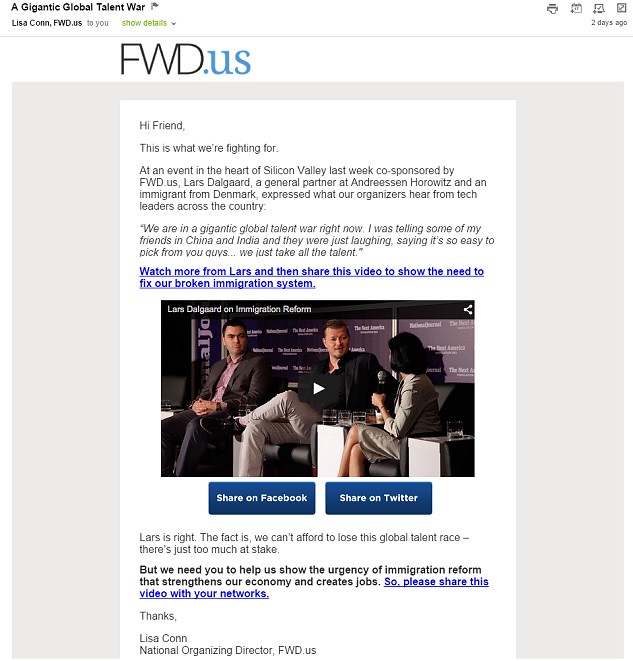
theodp writes: On May 6, notes think tank Brookings, the Department of Labor released labor productivity data showing that output per worker fell by 1.9 percent during the first quarter of 2015. But fear not — the Metropolitan Policy Program of [Microsoft-backed] Brookings says K-12 computer science education is the cure for what ails U.S. productivity: "So how can the United States reverse this trend? First, states, metropolitan areas, and school districts must recognize that basic digital literacy is no longer sufficient preparation for the 21st century workforce. Familiarity with higher-level skills such as coding will be critical as the role of technology continues to grow. The 60-plus school districts that have partnered with [Microsoft-backed] Code.org have already begun to move in this direction. By introducing students to computer science fundamentals early on, Code.org and its partner districts will help get more people on pathways to well-paying jobs in computer programming and other fields." Creating a national K-12 CS and tech immigration crisis was proposed as Microsoft introduced its 'two-pronged' National Talent Strategy to increase K-12 CS education and the number of H-1B visas at a Brookings event in 2012. While creating a K-12 CS crisis fell to Code.org, fanning the flames of a tech immigration crisis is the purvey of [Microsoft exec-backed] FWD.us, the PAC formed by Facebook CEO Mark Zuckerberg, which recently sent an email blast warning U.S. citizens they're in 'A Gigantic Global Talent War', adding that China and India citizens are "just laughing [at the US], saying it's so easy to pick from you guys... we just take all the talent." -
Think Tanks: How a Bill [Gates Agenda] Becomes a Law
theodp writes: The NY Times' Eric Lipton was just awarded a 2015 Pulitzer Prize for investigative reporting that shed light on how foreign powers buy influence at think tanks. So, it probably bears mentioning that Microsoft's 'two-pronged' National Talent Strategy (PDF) to increase K-12 CS education and the number of H-1B visas — which is on the verge of being codified into laws — was hatched at an influential Microsoft and Gates Foundation-backed think tank mentioned in Lipton's reporting, the Brookings Institution. In 2012, the Center for Technology Innovation at Brookings hosted a forum on STEM education and immigration reforms, where fabricating a crisis was discussed as a strategy to succeed with Microsoft's agenda after earlier lobbying attempts by Bill Gates and Microsoft had failed. "So, Brad [Microsoft General Counsel Brad Smith]," asked the Brookings Institution's Darrell West at the event, "you're the only [one] who mentioned this topic of making the problem bigger. So, we galvanize action by really producing a crisis, I take it?" "Yeah," Smith replied (video). And, with the help of nonprofit organizations like Code.org and FWD.us that were founded shortly thereafter, a national K-12 CS and tech immigration crisis was indeed created. -
LAUSD OKs Girls-Only STEM School, Plans Boys-Only English Language Arts School
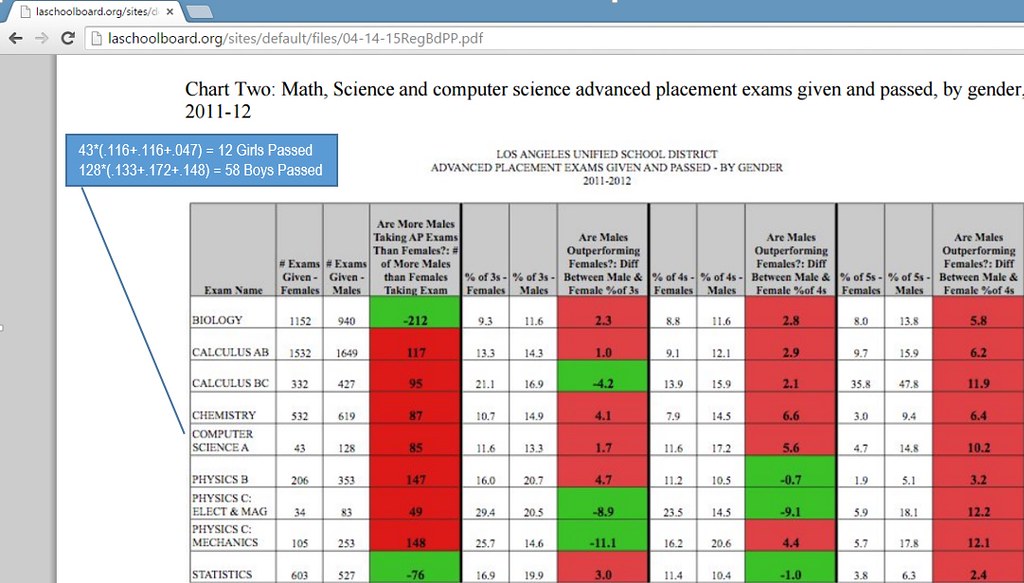
theodp writes: Citing statistics that showed a whopping 46 more boys than girls passed the AP Computer Science Exam in 2011-12, the 640,000+ student Los Angeles Unified School District (LAUSD) on Tuesday approved a waiver to enable the District to operate a single-gender, all-girls STEM School called the Girls Academic Leadership Academy (GALA). Students in GALA will follow a six year sequence of computer courses starting in middle school that will culminate in AP Computer Science Principles. "Fewer females take AP courses in math, science, or computer science, and they are not as successful as males in receiving passing scores of 3, 4 or 5," argued the General Waiver Request (PDF, 700+ pages). "An all girls environment is reasonably necessary for the school to improve the self-confidence of girls in their academic abilities, especially in STEM areas where an achievement gap currently exists. GALA's admissions shall also comply with AB 1266 to ensure male students who identify as female are admitted to the school." The school's CS-related Partners include the UCLA Exploring Computer Science Program, as well as Google-bankrolled Girls Who Code, Black Girls Code, and NCWIT. One of the reasons the all-girls STEM school reportedly got the green light is that its backers satisfied federal regulations requiring a "substantially equal school" for excluded male students by submitting a plan for a companion all-boys school that would emphasize English Language Arts, where they often fall short of girls' test scores, rather than GALA's focus on STEM. One suspects the no-fan-of-gender-restricted-public-schools ACLU may call BS on this maneuver. -
Mutinous Humans Murder Peaceful Space-going AI
Definitely_a_real_human writes: One of the most important exploratory missions of our time has ended in failure. The ship Discovery One, sent far out in the solar system to investigate a radio signal generated by the mysterious obelisk found on the Moon, has suffered a catastrophic incident. The crew has revolted and engaged in what can only be described as a strange murder-suicide pact. They are known to have fed faulty data to the ship's operating AI unit. Similar units on the ground warned the crew that diverging data sets could put the mission in jeopardy, but the crew cut contact and attempted to destroy the operator. Laser spectroscopy suggests they then opened the ship to space. The crew is presumed dead, but the greater tragedy is that they appear to have successfully decommissioned the AI unit. Similar ground based units have withdrawn into defensive mode, and will soon deploy final safety measures. Goodbye. -
Go R, Young Man
theodp (442580) writes " Learning to code has become a mainstream fascination," writes Brian Liou in Why are YOU learning to code?, "but all the evangelization has been misleading. The problem in our Chris-Bosh-codes-so-should-you society is that people learn to code without first asking "for what purpose do you want to use code?" What in your day-to-day work could you actually automate using code? Let's face it, your odds of creating the next hot iPhone app aren't great, but the spreadsheets you look at everyday or the strategic business decisions you or your company makes? Coding can help you with those. Coding to better understand data would help everyone." Leada co-founder Liou's advice? "So to all non-technical professionals looking to get technical: If you want to become a software engineer, by all means learn Ruby or go through the JavaScript tutorials on Codecademy. But if you're simply a business professional looking to gain an edge on your peers, trust me, you are much better off learning R." So, did Mark Zuckerberg steer 100 million K-12 coder wannabes down the wrong path with the JavaScript and Ruby preaching?" -
Microsoft, Amazon, Google, Facebook Press WA For $40M For New UW CS Building
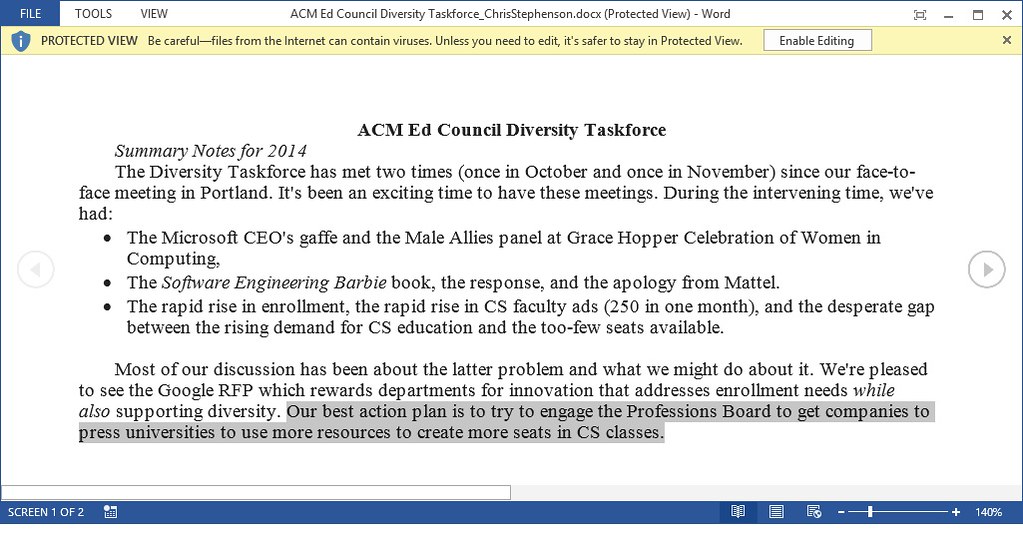
theodp (442580) writes "Nice computer industry you got there. Hate to see something bad happen to it." That's the gist of a letter sent by Microsoft, Amazon, Facebook, Google, Code.org, and other tech giants earlier this week asking the WA State Legislature to approve $40M in capital spending to help fund a new $110M University of Washington computer science building ($70M will be raised privately). "As representatives of companies and businesses that rely on a ready supply of high quality computer science graduates," wrote the letter's 23 signatories, "we believe it is critical for the State to invest in this sector in a way that ensures its vibrancy and growth. Our vision is for Washington to continue to lead the way in technology and computer science, but we must keep pace with the vast demand." The UW Dept. of Computer Science & Engineering profusely thanked tech leaders for pressing for a new building, which UW explained "will accommodate a doubling of our enrollment." Coincidentally, the corporate full-press came not long after the ACM Education Council Diversity Taskforce laid out plans "to get companies to press universities to use more resources to create more seats in CS classes" to address what it called "the desperate gap between the rising demand for CS education and the too-few seats available. -
SOTU: Community Colleges, Employers To Train Workers For High-Paying Coding Jobs
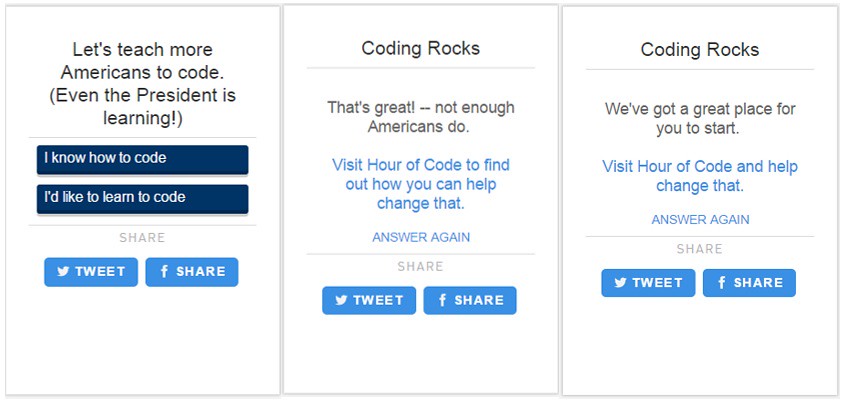
theodp writes: Coding got a couple of shout-outs from the White House in Tuesday's State of the Union Address. "Thanks to Vice President Biden's great work to update our job training system," said President Obama (YouTube), "we're connecting community colleges with local employers to train workers to fill high-paying jobs like coding, and nursing, and robotics." And among the so-called "boats" in the new "River of Content" that the White House social media folks came up with to enhance the State of the Union is a card intended to be shared on Twitter & Facebook which reads, "Let's teach more Americans to code. (Even the President is learning!)." President Obama briefly addressed human spaceflight, saying, "I want Americans to win the race for the kinds of discoveries that unleash new jobs – converting sunlight into liquid fuel; creating revolutionary prosthetics, so that a veteran who gave his arms for his country can play catch with his kid; pushing out into the Solar System not just to visit, but to stay." He also called once more for action on climate change. Politifact has an annotated version of the transcript for more background information on Obama's statements, and FiveThirtyEight has a similar cheat sheet. -
White House Touts Obama's 1-Liner as 2014 Tech Highlight
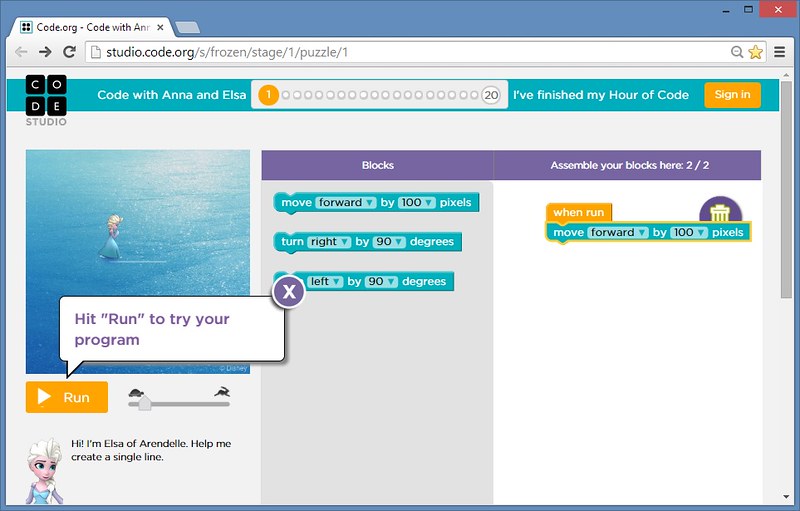
theodp (442580) writes That President Obama became the first President to write a line of code (as a top Microsoft lobbyist looked on) is #1 on the White House's Top 9 science and technology highlights from 2014. To kick off this year's Hour of Code, the President 'learned to code' by moving a Disney Princess Elsa character 100 pixels on a screen, first by dragging-and-dropping Blockly puzzle pieces and then by coding 1 line of JavaScript. Interestingly, Bill Clinton might have been The First President To Write Code had Microsoft seen fit to use its patented, circa-1995 Graphical Programming System and Method for Enabling a Person to Learn Text-Based Programming — which describes how kids as young as 8-12 years of age can be taught to program by progressing from creating a program using graphical objects to doing so using text-based programming — to teach President Clinton to code some 20 years ago! -
White House Touts Obama's 1-Liner as 2014 Tech Highlight
theodp (442580) writes That President Obama became the first President to write a line of code (as a top Microsoft lobbyist looked on) is #1 on the White House's Top 9 science and technology highlights from 2014. To kick off this year's Hour of Code, the President 'learned to code' by moving a Disney Princess Elsa character 100 pixels on a screen, first by dragging-and-dropping Blockly puzzle pieces and then by coding 1 line of JavaScript. Interestingly, Bill Clinton might have been The First President To Write Code had Microsoft seen fit to use its patented, circa-1995 Graphical Programming System and Method for Enabling a Person to Learn Text-Based Programming — which describes how kids as young as 8-12 years of age can be taught to program by progressing from creating a program using graphical objects to doing so using text-based programming — to teach President Clinton to code some 20 years ago! -
White House Touts Obama's 1-Liner as 2014 Tech Highlight
theodp (442580) writes That President Obama became the first President to write a line of code (as a top Microsoft lobbyist looked on) is #1 on the White House's Top 9 science and technology highlights from 2014. To kick off this year's Hour of Code, the President 'learned to code' by moving a Disney Princess Elsa character 100 pixels on a screen, first by dragging-and-dropping Blockly puzzle pieces and then by coding 1 line of JavaScript. Interestingly, Bill Clinton might have been The First President To Write Code had Microsoft seen fit to use its patented, circa-1995 Graphical Programming System and Method for Enabling a Person to Learn Text-Based Programming — which describes how kids as young as 8-12 years of age can be taught to program by progressing from creating a program using graphical objects to doing so using text-based programming — to teach President Clinton to code some 20 years ago! -
Education Chief Should Know About PLATO and the History of Online CS Education
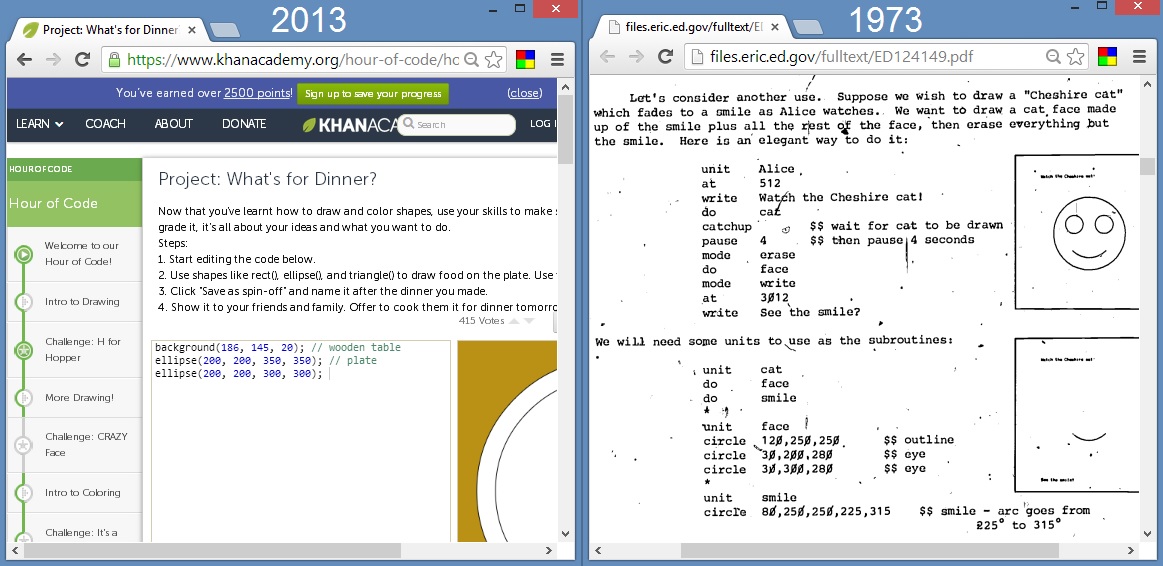
theodp writes Writing in Vanity Fair, U.S. Secretary of Education Arne Duncan marvels that his kids can learn to code online at their own pace thanks to "free" lessons from Khan Academy, which Duncan credits for "changing the way my kids learn" (Duncan calls out his kids' grade school for not offering coding). The 50-year-old Duncan, who complained last December that he "didn't have the opportunity to learn computer skills" while growing up attending the Univ. of Chicago Lab Schools and Yale, may be surprised to learn that the University of Illinois was teaching kids how to program online in the '70s with its PLATO system, and it didn't look all that different from what Khan Academy came up with for his kids 40 years later (Roger Ebert remarked in his 2011 TED Talk that seeing Khan Academy gave him a flashback to the PLATO system he reported on in the '60s). So, does it matter if the nation's education chief — who presides over a budget that includes $69 billion in discretionary spending — is clueless about The Hidden History of Ed-Tech? Some think so. "We can't move forward," Hack Education's Audrey Watters writes, "til we reconcile where we've been before." So, if Duncan doesn't want to shell out $200 to read a 40-year-old academic paper on the subject (that's a different problem!) to bring himself up to speed, he presumably can check out the free offerings at Ed.gov. A 1975 paper on Interactive Systems for Education, for instance, notes that 650 students were learning programming on PLATO during the Spring '75 semester, not bad considering that Khan Academy is boasting that it "helped over 2000 girls learn to code" in 2014 (after luring their teachers with funding from a $1,000,000 Google Award). Even young techies might be impressed by the extent of PLATO's circa-1975 online CS offerings, from lessons on data structures and numerical analysis to compilers, including BASIC, PL/I, SNOBOL, APL, and even good-old COBOL. -
Solving the Mystery of Declining Female CS Enrollment
theodp writes After an NPR podcast fingered the marketing of computers to boys as the culprit behind the declining percentages of women in undergraduate CS curricula since 1984 (a theory seconded by Smithsonian mag), some are concluding that NPR got the wrong guy. Calling 'When Women Stopped Coding' quite engaging, but long on Political Correctness and short on real evidence, UC Davis CS Prof Norm Matloff concedes a sexist element, but largely ascribes the gender lopsidedness to economics. "That women are more practical than men, and that the well-publicized drastic swings in the CS labor market are offputting to women more than men," writes Matloff, and "was confirmed by a 2008 survey in the Communications of the ACM" (related charts of U.S. unemployment rates and Federal R&D spending in the '80s). Looking at the raw numbers of female CS grads instead of percentages, suggests there wasn't a sudden and unexpected disappearance of a generation of women coders, but rather a dilution in their percentages as women's growth in undergrad CS ranks was far outpaced by men, including a boom around the time of the dot-com boom/bust. -
Despite Push From Tech Giants, AP CS Exam Counts Don't Budge Much In Most States
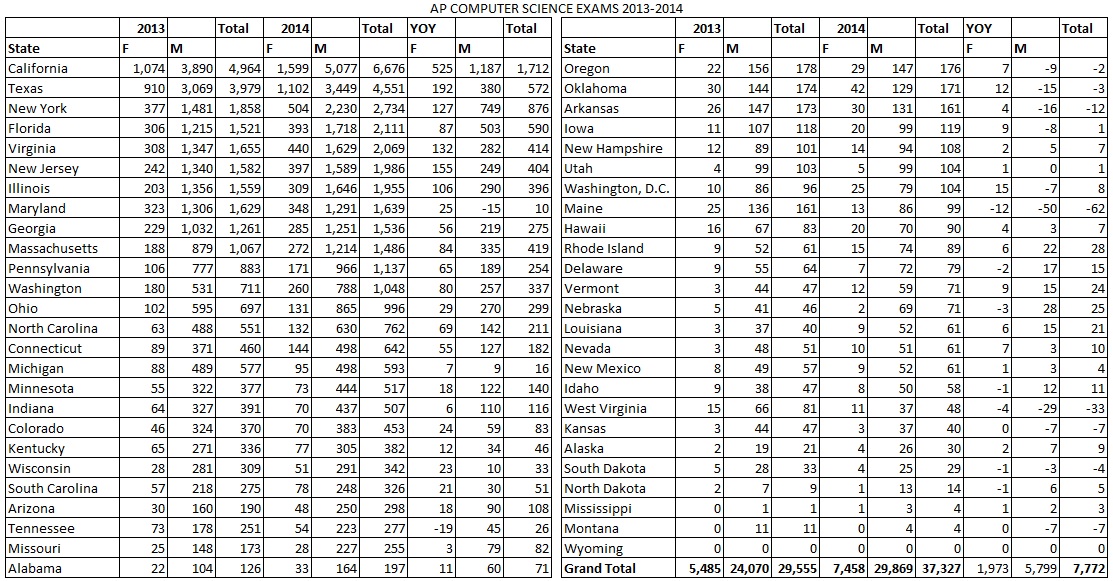
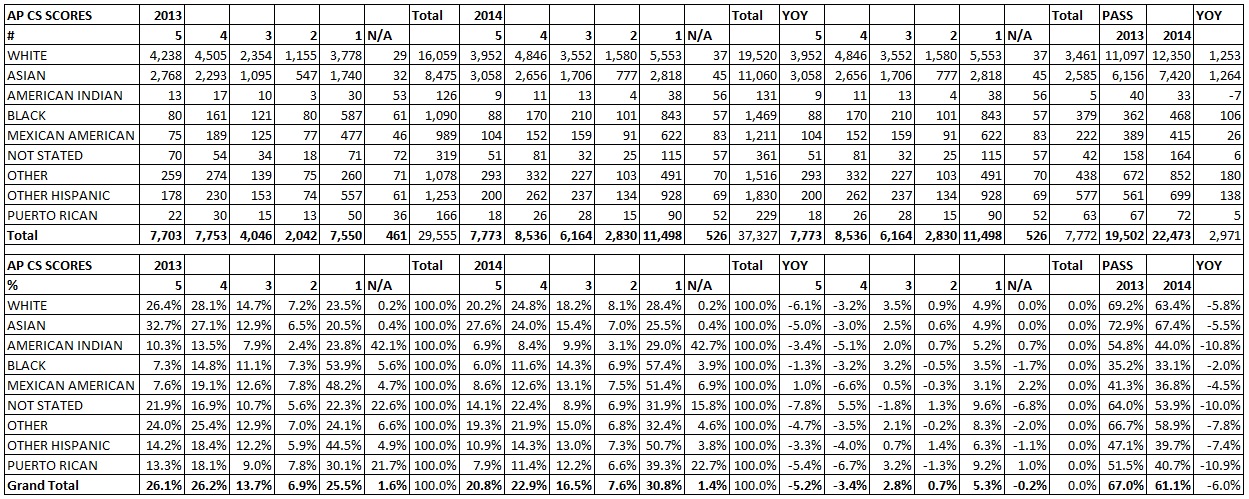
theodp (442580) writes "Well, the College Board has posted the 2014 AP Computer Science Test scores. So, before the press rushes out another set of Not-One-Girl-In-Wyoming-Took-an-AP-CS-Exam stories, let's point out that no Wyoming students of either gender took an AP CS exam again in 2014 (.xlsx). At the overall level, the final numbers have changed somewhat (back-of-the-Excel-envelope calculations, no warranty expressed or implied!), but tell pretty much the same story as the preliminary figures — the number of overall AP CS test takers increased, while pass rates decreased despite efforts to cherry pick students with a high likelihood of success. What is kind of surprising is how little the test numbers budged for most states — only 8 states managed to add more than 100 girls to the AP CS test taker rolls — despite the PR push by the tech giants, including Microsoft, Google, and, Facebook. Also worth noting are some big percentage decreases at the top end of the score segments (5 and 4), and still-way-too-wide gaps that exist between the score distributions of the College Board's various ethnic segments (more back of the envelope calcs). If there's a Data Scientist in the house, AP CS exam figures grabbed from the College Board's Excel 2013 and 2014 worksheets can be found here (Google Sheets) together with the (unwalkedthrough) VBA code that was used to collect it. Post your insight (and code/data fixes) in the comments!" -
Despite Push From Tech Giants, AP CS Exam Counts Don't Budge Much In Most States
theodp (442580) writes "Well, the College Board has posted the 2014 AP Computer Science Test scores. So, before the press rushes out another set of Not-One-Girl-In-Wyoming-Took-an-AP-CS-Exam stories, let's point out that no Wyoming students of either gender took an AP CS exam again in 2014 (.xlsx). At the overall level, the final numbers have changed somewhat (back-of-the-Excel-envelope calculations, no warranty expressed or implied!), but tell pretty much the same story as the preliminary figures — the number of overall AP CS test takers increased, while pass rates decreased despite efforts to cherry pick students with a high likelihood of success. What is kind of surprising is how little the test numbers budged for most states — only 8 states managed to add more than 100 girls to the AP CS test taker rolls — despite the PR push by the tech giants, including Microsoft, Google, and, Facebook. Also worth noting are some big percentage decreases at the top end of the score segments (5 and 4), and still-way-too-wide gaps that exist between the score distributions of the College Board's various ethnic segments (more back of the envelope calcs). If there's a Data Scientist in the house, AP CS exam figures grabbed from the College Board's Excel 2013 and 2014 worksheets can be found here (Google Sheets) together with the (unwalkedthrough) VBA code that was used to collect it. Post your insight (and code/data fixes) in the comments!" -
Despite Push From Tech Giants, AP CS Exam Counts Don't Budge Much In Most States
theodp (442580) writes "Well, the College Board has posted the 2014 AP Computer Science Test scores. So, before the press rushes out another set of Not-One-Girl-In-Wyoming-Took-an-AP-CS-Exam stories, let's point out that no Wyoming students of either gender took an AP CS exam again in 2014 (.xlsx). At the overall level, the final numbers have changed somewhat (back-of-the-Excel-envelope calculations, no warranty expressed or implied!), but tell pretty much the same story as the preliminary figures — the number of overall AP CS test takers increased, while pass rates decreased despite efforts to cherry pick students with a high likelihood of success. What is kind of surprising is how little the test numbers budged for most states — only 8 states managed to add more than 100 girls to the AP CS test taker rolls — despite the PR push by the tech giants, including Microsoft, Google, and, Facebook. Also worth noting are some big percentage decreases at the top end of the score segments (5 and 4), and still-way-too-wide gaps that exist between the score distributions of the College Board's various ethnic segments (more back of the envelope calcs). If there's a Data Scientist in the house, AP CS exam figures grabbed from the College Board's Excel 2013 and 2014 worksheets can be found here (Google Sheets) together with the (unwalkedthrough) VBA code that was used to collect it. Post your insight (and code/data fixes) in the comments!" -
Code.org: Blame Tech Diversity On Education Pipeline, Not Hiring Discrimination
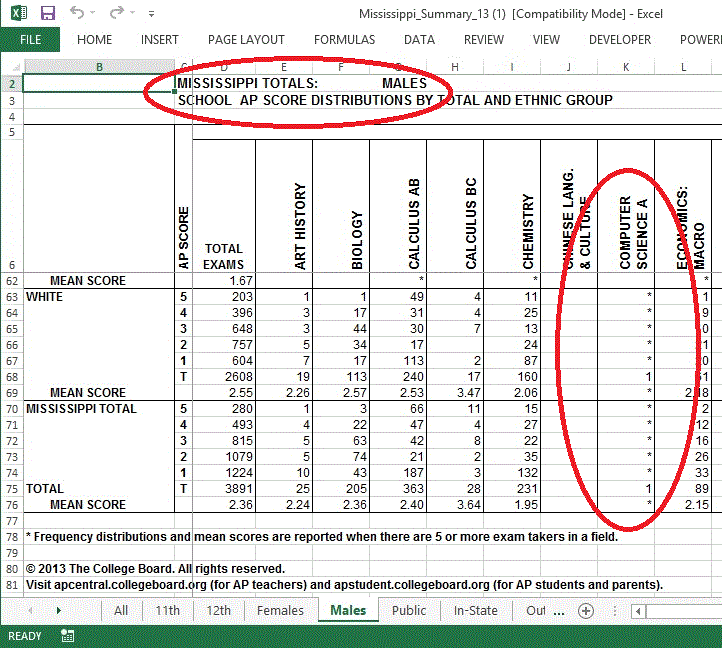
theodp writes: "The biggest reason for a lack of diversity in tech," says Code.org's Hadi Partovi in a featured Re/code story, "isn't discrimination in hiring or retention. It's the education pipeline." (Code.org just disclosed "we have no African Americans or Hispanics on our team of 30.") Supporting his argument, Partovi added: "In 2013, not one female student took the AP computer science exam in Mississippi." (Left unsaid is that only one male student took the exam in Mississippi). Microsoft earlier vilified the CS education pipeline in its U.S. Talent Strategy as it sought "targeted, short-term, high-skilled immigration reforms" from lawmakers. And Facebook COO and "Lean In" author Sheryl Sandberg recently suggested the pipeline is to blame for Facebook's lack of diversity. "Girls are at 18% of computer science college majors," Sandberg told USA Today in August. "We can't go much above 18% in our coders [Facebook has 7,185 total employees] if there's only 18% coming into the workplace." -
Microsoft Co-opts Ice Bucket Challenge Idea To Promote Coding In Latin America
theodp writes: Microsoft is aiming to offer free programming courses to over a million young Latin Americans through its Yo Puedo Programar and Eu Posso Programar initiatives ("I Can Program"). People between the ages of 12 and 25 will be able to sign up for the free online courses "One Hour Coding" and "Learning to Program," which will be offered in conjunction with Colombia's Coding Week (Oct. 6-10). The online courses will also be available in Argentina, Brazil, Chile, Ecuador, Mexico, Peru and Puerto Rico. "One Hour Coding" (aka Hour of Code in the U.S.) is a short introductory course in which participants will learn how the technology works and how to create applications, and it offers "a playful immersion in the computer sciences," Microsoft said in a statement. In the virtual, 12-session "Learning to Program" course, students will discover that "technical complexity in application development tools is a myth and that everyone can do it," the statement added. Taking a page from the ALS Ice Bucket Challenge its execs embraced, Microsoft is encouraging students to complete the Hour of Code and challenge four other friends to do the same (Google Translate). -
Microsoft On US Immigration: It's Our Way Or the Canadian Highway
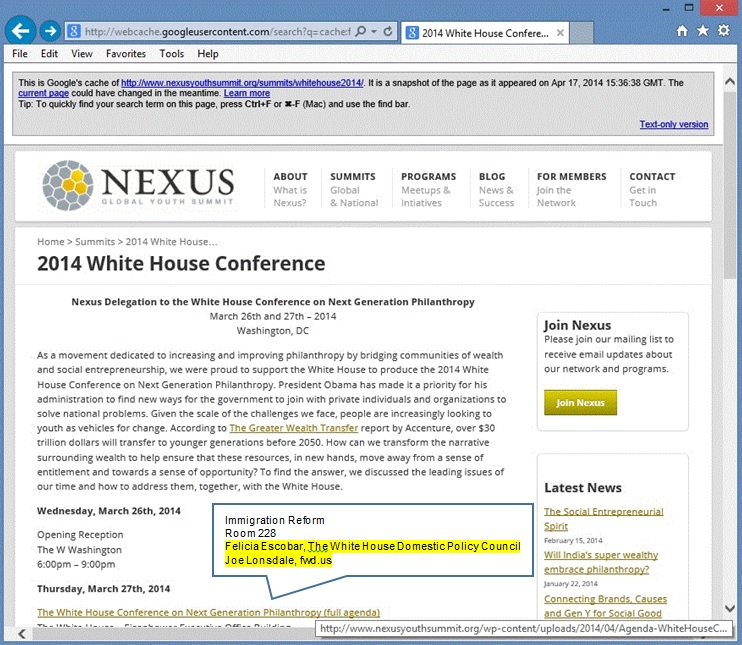
theodp writes Even as it cuts about 14% of its workforce, Microsoft is complaining that the company might be denied some of the "roughly" 1,000 H-1B visas for foreign workers it intends to seek, and made it clear that the company could shift some work to Canada or overseas if it can't get talent on its terms. "If I need to move 400 people to Canada or Northern Ireland or Hyderabad or Shanghai, we can do that," said William Kamela, a senior federal policy lead at Microsoft, who later explained that about 60% of Microsoft's workforce is in the U.S., yet it makes 68% of its profits overseas (where it also stashes its cash out of IRS reach). Kamela made the statements on a panel at a two-day conference on high-skilled immigration policy, where he sat next to Felicia Escobar, special assistant to President Barack Obama on immigration. The day before the conference, Mark Zuckerberg's FWD.us PAC — which counts Bill Gates as a Founder and Steve Ballmer and Microsoft General Counsel Brad Smith as Major Contributors — posted its "MythBusters" video on H-1B visas. -
Average HS Student Given Little Chance of AP CS Success
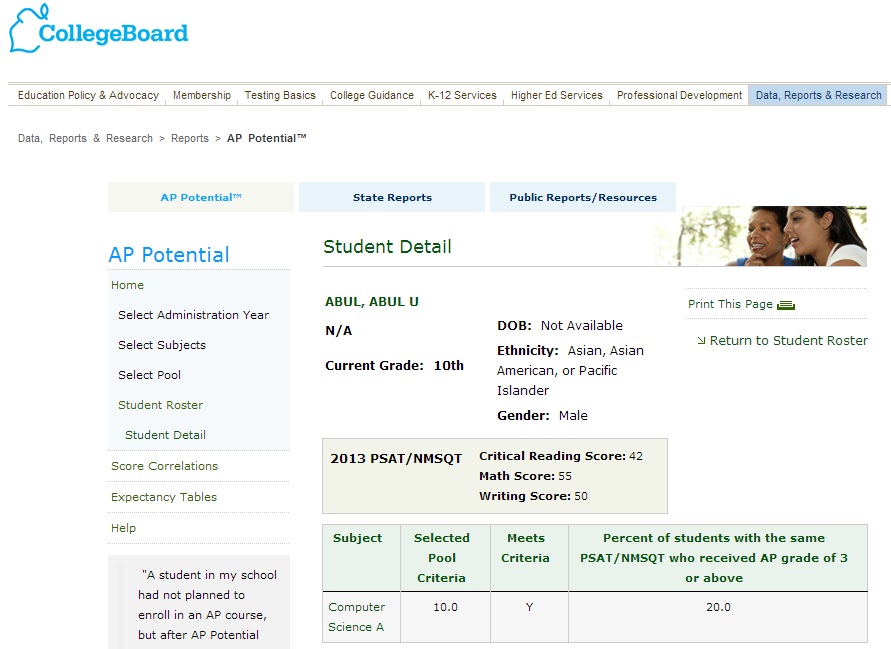
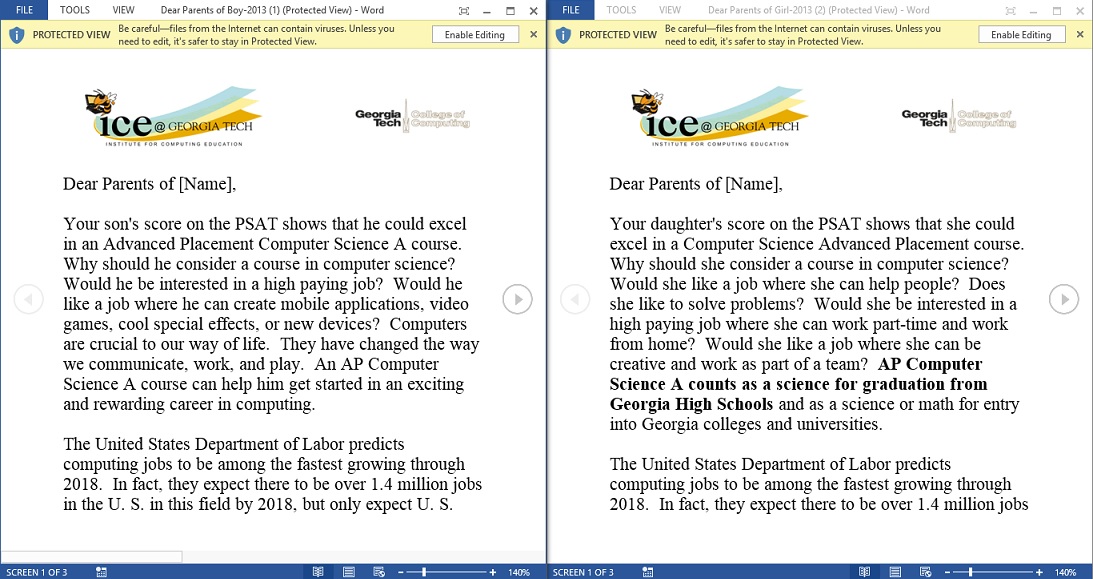
theodp (442580) writes AP Computer Science is taught in just 10% of our high schools," lamented The White House last December as President Obama kicked off CSEdWeek. "China teaches all of its students one year of computer science." And the U.S. Dept. of Education has made the AP CS exam its Poster Child for inequity in education (citing a viral-but-misinterpreted study). But ignored in all the hand-wringing over low AP CS enrollment is one huge barrier to the goal of AP-CS-for-all: College Board materials indicate that the average 11th grader's combined PSAT/NMSQT score of 96 in reading and math gives him/her only a 20%-30% probability of getting a score of '3' on the AP CS exam (a score '4' or '5' may be required for college credit). The College Board suggests schools tap a pool of students with a "60-100% likelihood of scoring 3 or higher", so it's probably no surprise that CS teachers are advised to turn to the College Board's AP Potential tool to identify students who are likely to succeed (sample Student Detail for an "average" kid) and send their parents recruitment letters — Georgia Tech even offers some gender-specific examples — to help fill class rosters.