Slashdot Mirror
Domain: staticflickr.com
Stories and comments across the archive that link to staticflickr.com.
Stories · 108
-
Average HS Student Given Little Chance of AP CS Success
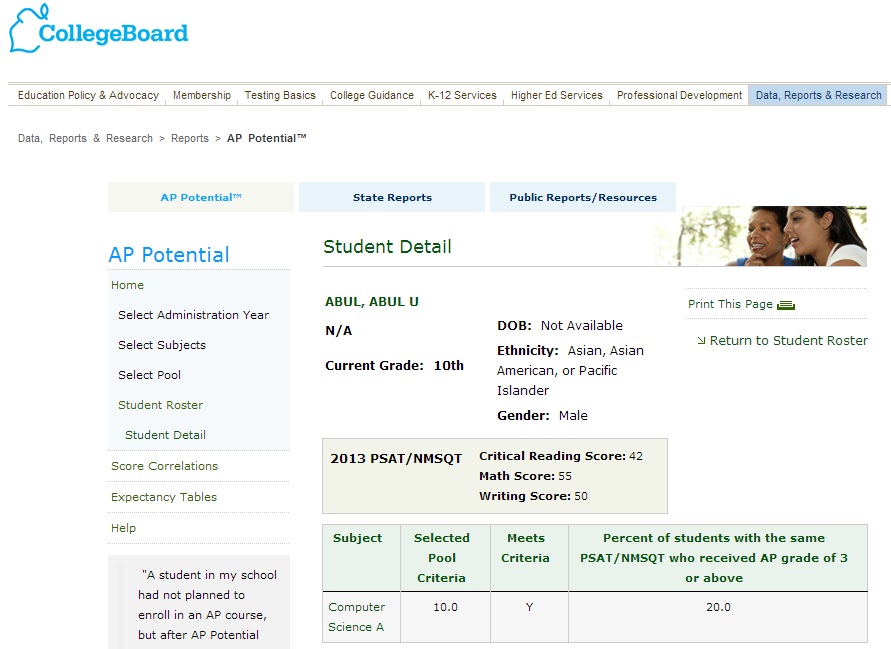
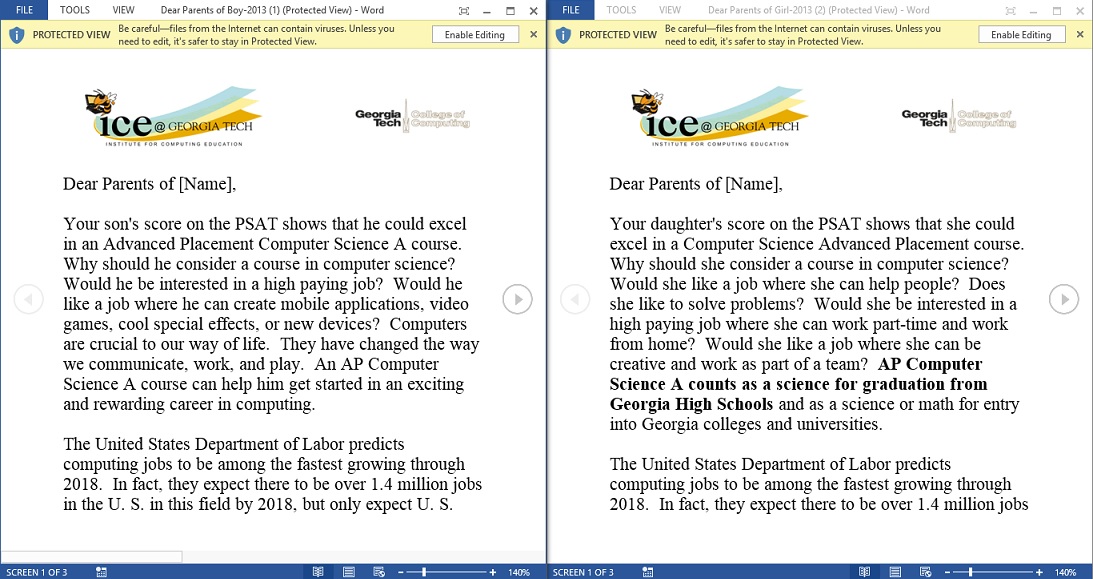
theodp (442580) writes AP Computer Science is taught in just 10% of our high schools," lamented The White House last December as President Obama kicked off CSEdWeek. "China teaches all of its students one year of computer science." And the U.S. Dept. of Education has made the AP CS exam its Poster Child for inequity in education (citing a viral-but-misinterpreted study). But ignored in all the hand-wringing over low AP CS enrollment is one huge barrier to the goal of AP-CS-for-all: College Board materials indicate that the average 11th grader's combined PSAT/NMSQT score of 96 in reading and math gives him/her only a 20%-30% probability of getting a score of '3' on the AP CS exam (a score '4' or '5' may be required for college credit). The College Board suggests schools tap a pool of students with a "60-100% likelihood of scoring 3 or higher", so it's probably no surprise that CS teachers are advised to turn to the College Board's AP Potential tool to identify students who are likely to succeed (sample Student Detail for an "average" kid) and send their parents recruitment letters — Georgia Tech even offers some gender-specific examples — to help fill class rosters. -
Is Google CEO's "Tiny Bubble Car" Yahoo CEO's "Little Bubble Car"?
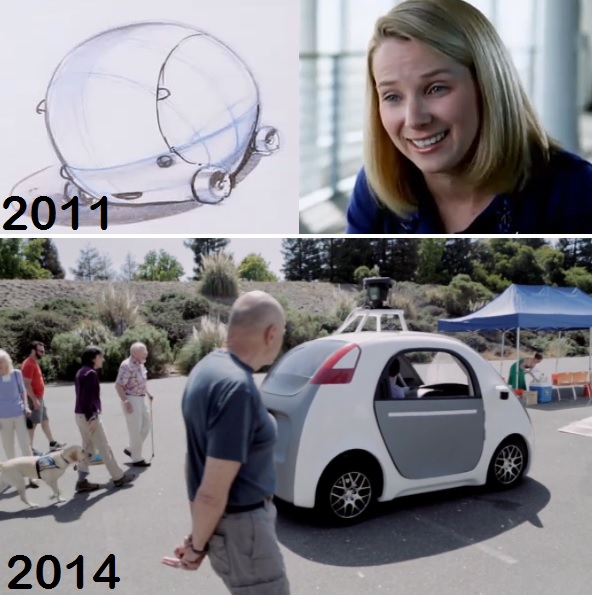
theodp (442580) writes "Back in 2011, then-Google VP and now-Yahoo CEO Marissa Mayer brainstormed with BMW to sketch out an idea she had for self-driving 'little bubbles' that could ease office commutes. Here's Mayer's pitch from a BMW film short: 'All I really need is a little bubble that drives itself and when it runs into something, it doesn't hurt that much...and...you know, like it doesn't actually take up that much fuel because it's so lightweight and it's good for the environment for that reason.' So, with Google's newly-built, steering wheel-less self-driving car being described as a 'tiny bubble-car', one wonders if Google CEO Larry Page's "Tiny Bubble Car" has its roots in Mayer's 'Little Bubble Car,' especially considering the striking similarity of Mayer's concept car sketch and Google's built vehicle." Seems to me there's been plenty of concept art (as well as actual tiny bubble-like cars, even if they generallly have had steering wheels) for car designers to draw on. -
Kids To Get the Best CS Teachers $15/Hr Can Buy
theodp (442580) writes "Billionaire-backed Code.org, enthusiastically tweets U.S. Dept. of Education Chief Arne Duncan, is 'providing tremendous leadership in bringing coding & computer science to our nation's schools.' Including bringing kids in Broward County Public Schools the best computer science teachers $15.00-an-hour can buy, according to a document on the school district's website. One wonders how the Broward teachers feel about Code.org apparently coughing up $38.33-an-hour for Chicago teachers who attend the required Code.org professional development, which ironically covers equity issues. Duncan's shout-out comes days after Code.org claimed in its Senate testimony that 'our students have voted with their actions [participating in an hour-long, Angry Birds-themed Blockly tutorial starring Mark Zuckerberg and Bill Gates]: that learning computer science is this generation's Sputnik moment, that it's part of the new American Dream, and that it should be available to every student, in every school, as part of the standard curriculum.'" -
Kids To Get the Best CS Teachers $15/Hr Can Buy
theodp (442580) writes "Billionaire-backed Code.org, enthusiastically tweets U.S. Dept. of Education Chief Arne Duncan, is 'providing tremendous leadership in bringing coding & computer science to our nation's schools.' Including bringing kids in Broward County Public Schools the best computer science teachers $15.00-an-hour can buy, according to a document on the school district's website. One wonders how the Broward teachers feel about Code.org apparently coughing up $38.33-an-hour for Chicago teachers who attend the required Code.org professional development, which ironically covers equity issues. Duncan's shout-out comes days after Code.org claimed in its Senate testimony that 'our students have voted with their actions [participating in an hour-long, Angry Birds-themed Blockly tutorial starring Mark Zuckerberg and Bill Gates]: that learning computer science is this generation's Sputnik moment, that it's part of the new American Dream, and that it should be available to every student, in every school, as part of the standard curriculum.'" -
Finding the Next Generation of Teachers With "Innovative Microsoft Ads"
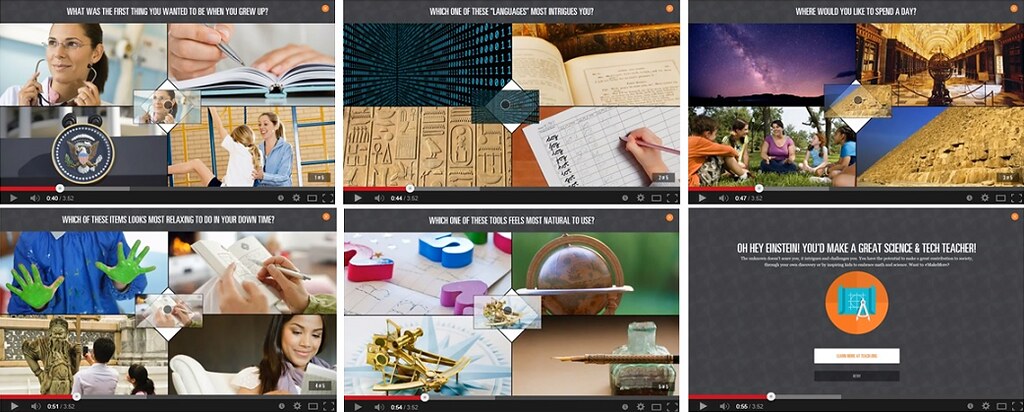
theodp (442580) writes "Back in 2011, the U.S. Dept. of Education delegated teacher recruitment to Microsoft (RFP, pdf). 'The decision to turn over TEACH to [Microsoft] Partners in Learning serves to expand the already outsized influence Gates and his fortune have on public education,' wrote the Washington Post at the time. So, 'what happens when a public institution in a democracy — the US Department of Education — outsources its goal of recruiting good teachers to a private industry?' Well, in addition to Teach.org and redundant social media efforts on Twitter, Facebook, Tumblr, Instagram, Linkedin, and YouTube, the U.S. is now relying on 'Innovative Microsoft Advertising to Recruit the next Generation of Teachers'. From the press release, 'The Ad Council and TEACH have formed a unique outreach campaign with Microsoft's Advertising team in an effort to recruit the next generation of teachers who will drive innovation and redefine teaching in K-12 classrooms. Microsoft donated over 125 million impressions across Xbox 360, Windows 8, and MSN in order to encourage consumers to rediscover teaching through interactive ad units. This media effort is an extension of the Ad Council and TEACH's public service advertising (PSA) campaign, Make More...Throughout March, consumers were able to engage with TEACH "NUads on Xbox", via gesture, voice or controller on their Xbox 360 consoles...Most recently, Microsoft leveraged their Windows 8 platform to provide a unique experience to consumers, enabling them to navigate through a series of questions to help "discover their true passion," along with the opportunity to play challenging mind and word games, such as a word scramble and tangrams.' Check out the demo of the Windows 8 platform experience [YouTube], in which a person is advised 'You'd Make a Great Science & Tech Teacher,' on the basis of a 'Personality Quiz' consisting of five dragged-and-dropped photos." -
Parents' Privacy Concerns Kill 'Personalized Learning' Initiative
theodp writes: "You may recall that inBloom is a data initiative that sought to personalize learning. GeekWire's Tricia Duryee now reports that inBloom, which was backed by $100 million from The Bill and Melinda Gates Foundation and others, is closing up shop after parents worried that its database technology was violating their children's privacy. According to NY Times coverage (reg.), the inBloom database tracked 400 different data fields about students — including family relationships ('foster parent' or 'father's significant other') and reasons for enrollment changes ('withdrawn due to illness' or 'leaving school as a victim of a serious violent incident') — that parents objected to, prompting some schools to recoil from the venture. In a statement, inBloom CEO Iwan Streichenberger said that personalized learning was still an emerging concept, and complained that the venture had been 'the subject of mischaracterizations and a lightning rod for misdirected criticism.' He added, 'It is a shame that the progress of this important innovation has been stalled because of generalized public concerns about data misuse, even though inBloom has world-class security and privacy protections that have raised the bar for school districts and the industry as a whole.' [Although it was still apparently vulnerable to Heartbleed.] Gates still has a couple of irons left in the data-driven personalized learning fire via his ties to Code.org, which seeks 7 years of participating K-12 students' data, and Khan Academy, which recently attracted scrutiny over its data-privacy policies." -
Wolfram Language Demo Impresses
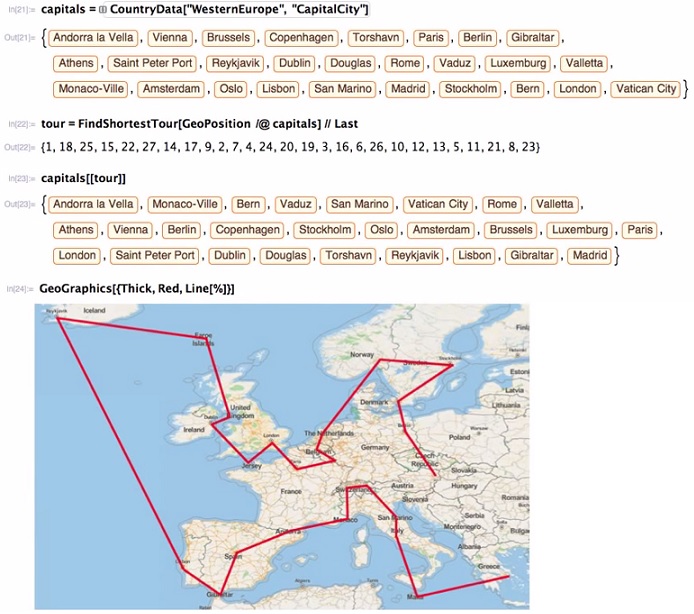
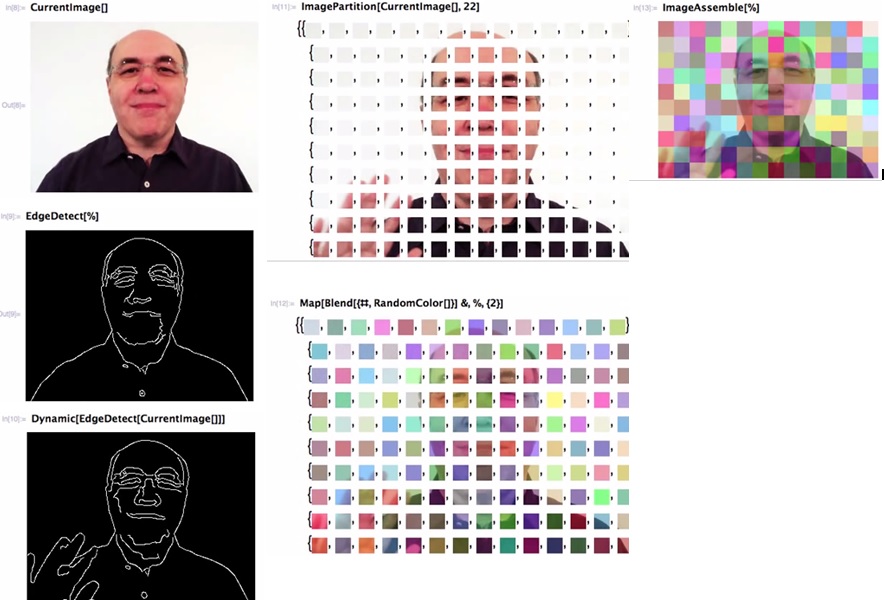
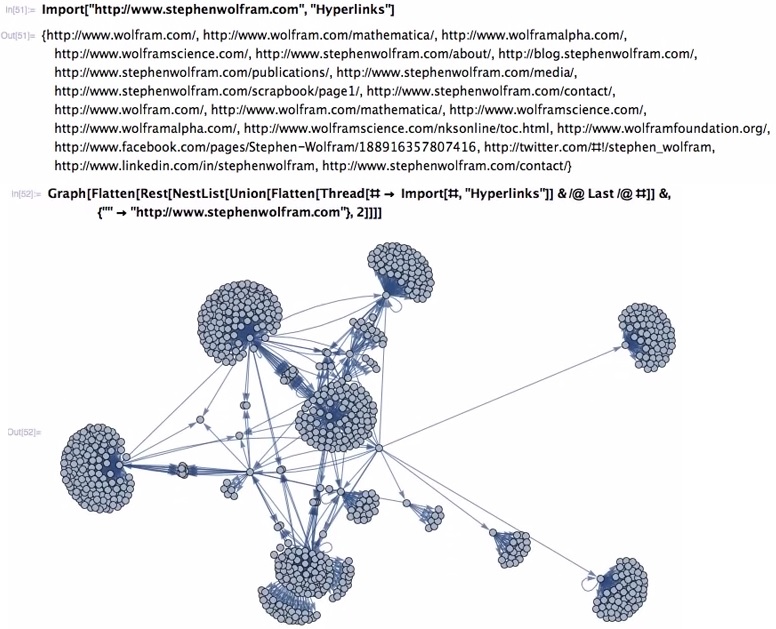
theodp writes "The devil will be in the details, but if you were stoked about last November's announcement of the Wolfram programming language, you'll be pleased to know that a just-released dry-but-insanely-great demo delivered by Stephen Wolfram does not disappoint. Even if you're not in love with the syntax or are a FOSS devotee, you'll find it hard not to be impressed by Wolfram's 4-line solution to a traveling salesman tour of the capitals of Western Europe, 6-line camera-capture-to-image-manipulation demo, or 2-line web crawling and data visualization example. And that's just for starters. So, start your Raspberry Pi engines, kids!" -
Wolfram Language Demo Impresses
theodp writes "The devil will be in the details, but if you were stoked about last November's announcement of the Wolfram programming language, you'll be pleased to know that a just-released dry-but-insanely-great demo delivered by Stephen Wolfram does not disappoint. Even if you're not in love with the syntax or are a FOSS devotee, you'll find it hard not to be impressed by Wolfram's 4-line solution to a traveling salesman tour of the capitals of Western Europe, 6-line camera-capture-to-image-manipulation demo, or 2-line web crawling and data visualization example. And that's just for starters. So, start your Raspberry Pi engines, kids!" -
Wolfram Language Demo Impresses
theodp writes "The devil will be in the details, but if you were stoked about last November's announcement of the Wolfram programming language, you'll be pleased to know that a just-released dry-but-insanely-great demo delivered by Stephen Wolfram does not disappoint. Even if you're not in love with the syntax or are a FOSS devotee, you'll find it hard not to be impressed by Wolfram's 4-line solution to a traveling salesman tour of the capitals of Western Europe, 6-line camera-capture-to-image-manipulation demo, or 2-line web crawling and data visualization example. And that's just for starters. So, start your Raspberry Pi engines, kids!" -
Non-Coders As the Face of the Learn-to-Code Movements
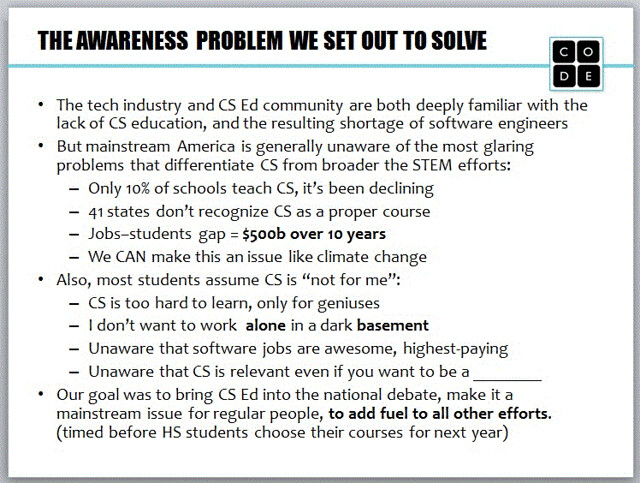
theodp writes "You wouldn't select Linus Torvalds to be the public face for the 'Year of Basketball.' So, why tap someone who doesn't code to be the face of 'The Year of Code'? Slate's Lily Hay Newman reports on the UK's Year of Code initiative to promote interest in programming and train teachers, which launched last week with a Director who freely admits that she doesn't know how to code. "I'm going to put my cards on the table," Lottie Dexter told Newsnight host Jeremy Paxman on national TV. I've committed this year to learning to code...so over this year I'm going to see exactly what I can achieve. So who knows, I might be the next Zuckerberg." "You can always dream," quipped the curmudgeonly Paxman, who was also unimpressed with Dexter's argument that the national initiative could teach people to make virtual birthday cards, an example straight out of Mark Zuckerberg's Hour of Code playbook (coming soon to the UK). Back in the States, YouTube chief and Hour of Code headliner Susan Wojcicki — one of many non-coder Code.org spokespersons — can be seen on YouTube fumbling for words to answer a little girl's straightforward question, "What is one way you apply Computer Science to your job at Google?". While it's understandable that companies and tech leaders probably couldn't make CS education "an issue like climate change" (for better or worse) without embracing politicians and celebrities, it'd be nice if they'd at least showcase a few more real-life coders in their campaigns." -
Non-Coders As the Face of the Learn-to-Code Movements
theodp writes "You wouldn't select Linus Torvalds to be the public face for the 'Year of Basketball.' So, why tap someone who doesn't code to be the face of 'The Year of Code'? Slate's Lily Hay Newman reports on the UK's Year of Code initiative to promote interest in programming and train teachers, which launched last week with a Director who freely admits that she doesn't know how to code. "I'm going to put my cards on the table," Lottie Dexter told Newsnight host Jeremy Paxman on national TV. I've committed this year to learning to code...so over this year I'm going to see exactly what I can achieve. So who knows, I might be the next Zuckerberg." "You can always dream," quipped the curmudgeonly Paxman, who was also unimpressed with Dexter's argument that the national initiative could teach people to make virtual birthday cards, an example straight out of Mark Zuckerberg's Hour of Code playbook (coming soon to the UK). Back in the States, YouTube chief and Hour of Code headliner Susan Wojcicki — one of many non-coder Code.org spokespersons — can be seen on YouTube fumbling for words to answer a little girl's straightforward question, "What is one way you apply Computer Science to your job at Google?". While it's understandable that companies and tech leaders probably couldn't make CS education "an issue like climate change" (for better or worse) without embracing politicians and celebrities, it'd be nice if they'd at least showcase a few more real-life coders in their campaigns." -
Code.org Stats: 507MM LOC, 6.8MM Kids, 2K YouTube Views
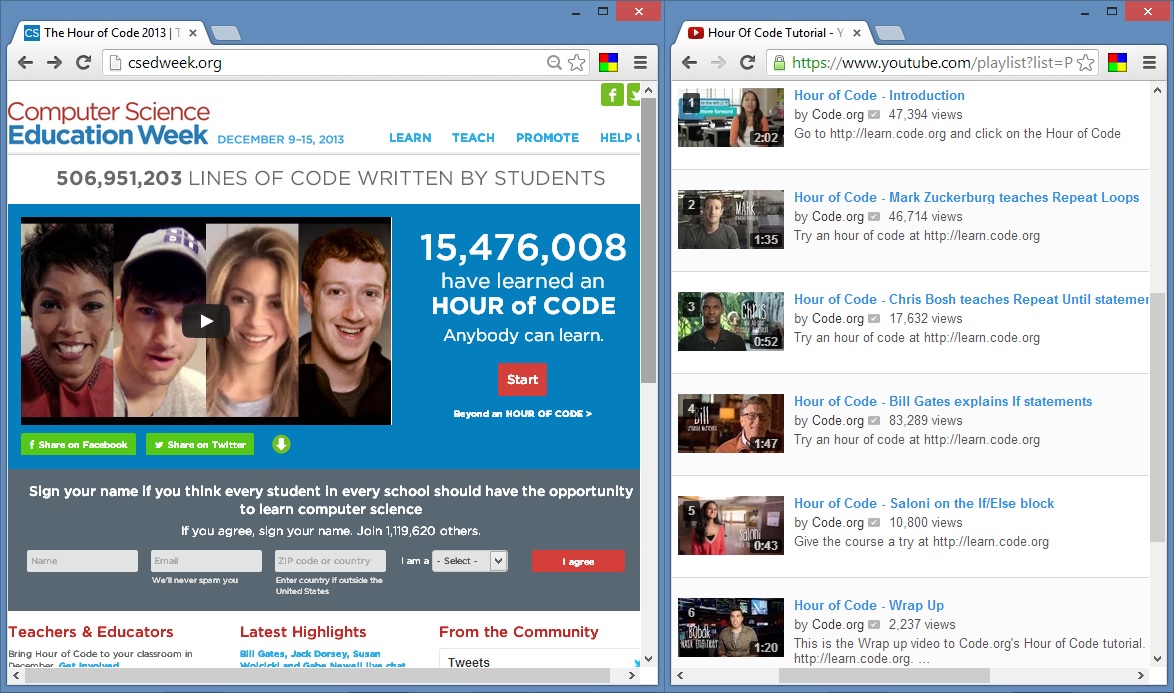
theodp writes "On the final day of Computer Science Education Week, the Hour of Code bravado continues. Around 12:30 a.m. Sunday (ET), Code.org was boasting that in just 6 days, students of its tutorials have "written" more than 10x the number of lines of code in Microsoft Windows. "Students of the Code.org tutorials have written 507,152,775 lines of code. Is this a lot? By comparison, the Microsoft Windows operating system has roughly 50 million lines of code." Code.org adds, "In total, 15,481,846 students have participated in the Hour of Code. Of this group, 6,872,757 of them used the tutorials by Code.org, and within the Code.org tutorial, they've written 507,152,775 lines of code." On YouTube, however, a playlist of the Code.org tutorial videos has distinctly lower numbers, with only 2,246 views of the Code.org Wrap Up video reported as of this writing. So, any thoughts on why the big disconnect, and how close the stats might reflect reality? Code.org does explain that an 'Hour of Code' is not necessarily an 'hour of code' ("Not everybody finishes an Hour of Code tutorial. Some students spend one hour. Some spend 10 minutes. Some spend days. Instead of counting how many students 'finish one hour'; or how much time they spent, this [LOC] is our simplest measure of progress"). So, with millions being spent on efforts to get Code.org into the nation's schools — New York and Chicago have already committed their 1.5 million K-12 students — is it important to get a better understanding of what the Hour of Code usage stats actually represent — and what their limitations might be — and not just accept as gospel reports like AllThingsD's 15 Million Students Learned to Program This Week, Thanks to Hour of Code ("every other school family in the U.S. has a child that has done the Hour of Code")?" -
Code.org Stats: 507MM LOC, 6.8MM Kids, 2K YouTube Views
theodp writes "On the final day of Computer Science Education Week, the Hour of Code bravado continues. Around 12:30 a.m. Sunday (ET), Code.org was boasting that in just 6 days, students of its tutorials have "written" more than 10x the number of lines of code in Microsoft Windows. "Students of the Code.org tutorials have written 507,152,775 lines of code. Is this a lot? By comparison, the Microsoft Windows operating system has roughly 50 million lines of code." Code.org adds, "In total, 15,481,846 students have participated in the Hour of Code. Of this group, 6,872,757 of them used the tutorials by Code.org, and within the Code.org tutorial, they've written 507,152,775 lines of code." On YouTube, however, a playlist of the Code.org tutorial videos has distinctly lower numbers, with only 2,246 views of the Code.org Wrap Up video reported as of this writing. So, any thoughts on why the big disconnect, and how close the stats might reflect reality? Code.org does explain that an 'Hour of Code' is not necessarily an 'hour of code' ("Not everybody finishes an Hour of Code tutorial. Some students spend one hour. Some spend 10 minutes. Some spend days. Instead of counting how many students 'finish one hour'; or how much time they spent, this [LOC] is our simplest measure of progress"). So, with millions being spent on efforts to get Code.org into the nation's schools — New York and Chicago have already committed their 1.5 million K-12 students — is it important to get a better understanding of what the Hour of Code usage stats actually represent — and what their limitations might be — and not just accept as gospel reports like AllThingsD's 15 Million Students Learned to Program This Week, Thanks to Hour of Code ("every other school family in the U.S. has a child that has done the Hour of Code")?" -
Zuckerberg Shows Kindergartners Ruby Instead of JavaScript
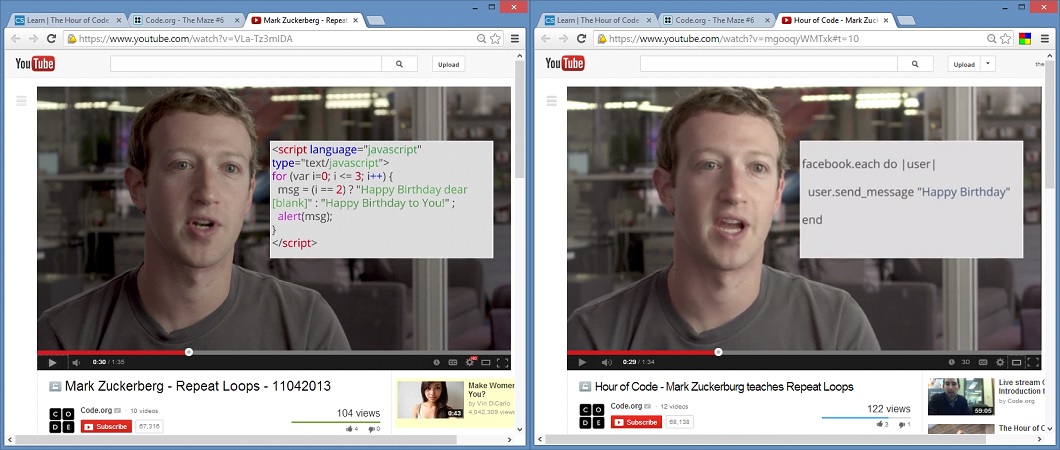
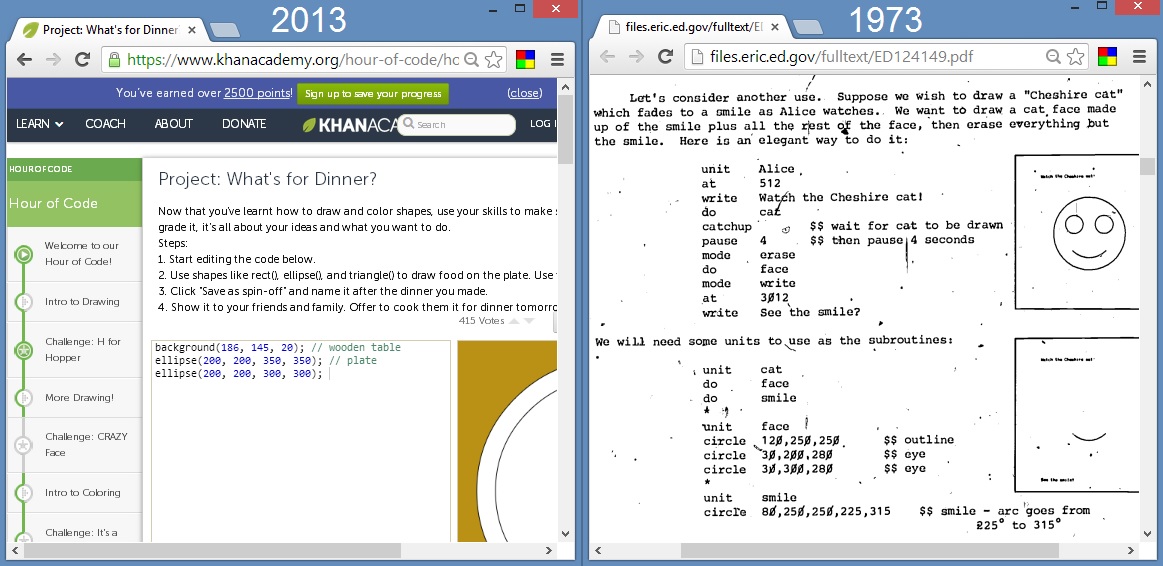
theodp writes "If one was introducing coding to 10 million K-12 kids over 5 days, one might settle on a programming language for examples more than a few weeks before D-Day. But the final tutorials for the Hour of Code aren't due now until the day they're to be taught, so Code.org was able to switch the example Facebook CEO Mark Zuckerberg uses to illustrate Repeat Loops from JavaScript to what looks like Ruby (earlier /. discussion of the JavaScript example), which will no doubt make things clearer for the kindergarten set working on the accompanying Angry Birds tutorial. Khan Academy, on the other hand, is sticking with JavaScript for its Hour of Code tutorial aimed at middle-schoolers, which culminates in a project showing the kids how they can draw a circular plate by invoking an ellipse function with equal major and minor axes. By the way, as Bret Victor might point out, the 2013 Khan Academy lesson looks a lot like circa-1973 PLATO!" -
Zuckerberg Shows Kindergartners Ruby Instead of JavaScript
theodp writes "If one was introducing coding to 10 million K-12 kids over 5 days, one might settle on a programming language for examples more than a few weeks before D-Day. But the final tutorials for the Hour of Code aren't due now until the day they're to be taught, so Code.org was able to switch the example Facebook CEO Mark Zuckerberg uses to illustrate Repeat Loops from JavaScript to what looks like Ruby (earlier /. discussion of the JavaScript example), which will no doubt make things clearer for the kindergarten set working on the accompanying Angry Birds tutorial. Khan Academy, on the other hand, is sticking with JavaScript for its Hour of Code tutorial aimed at middle-schoolers, which culminates in a project showing the kids how they can draw a circular plate by invoking an ellipse function with equal major and minor axes. By the way, as Bret Victor might point out, the 2013 Khan Academy lesson looks a lot like circa-1973 PLATO!" -
Code.org: More Money For CS Instructors Who Teach More Girls
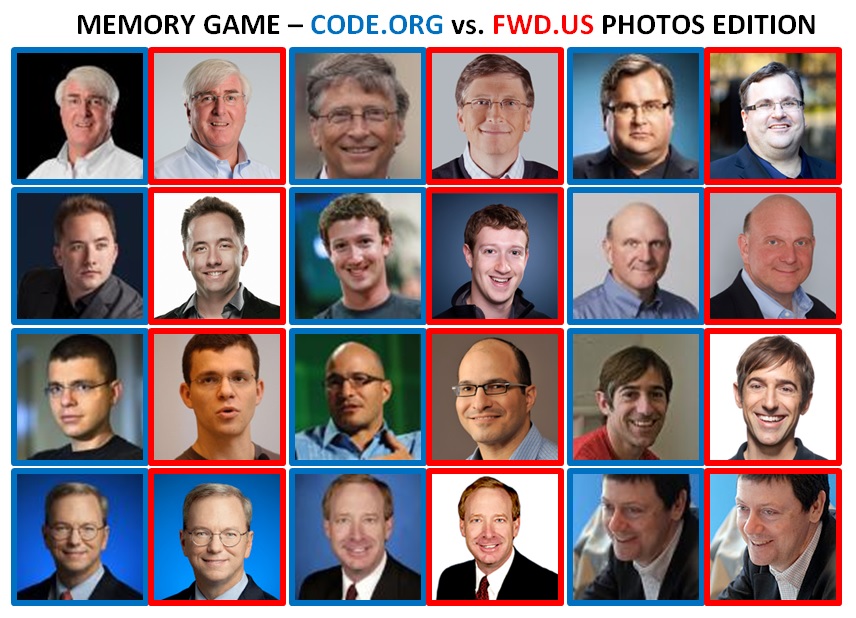
theodp writes "The same cast of billionaire characters — Mark Zuckerberg, Bill Gates, Steve Ballmer, Eric Schmidt — is backing FWD.us, which is lobbying Congress for more visas to 'meet our workforce needs,' as well as Code.org, which aims to popularize Computer Science education in the U.S. to address a projected CS job shortfall. In laying out the two-pronged strategy for the Senate, Microsoft General Counsel and Code.org Board member Brad Smith argued that providing more kids with a STEM education — particularly CS — was 'an issue of critical importance to our country.' But with its K-8 learn-to-code program which calls for teachers to receive 25% less money if fewer than 40% of their CS students are girls, Smith's Code.org is sending the message that training too many boys isn't an acceptable solution to the nation's CS crisis. 'When 10 or more students complete the course,' explains Code.org, "you will receive a $750 DonorsChoose.org gift code. If 40% or more of your participating students are female, you'll receive an additional $250, for a total gift of $1,000 in DonorsChoose.org funding!" The $1+ million Code.org-DonorsChoose CS education partnership appears to draw inspiration from a $5 million Google-DoonorsChoose STEM education partnership which includes nebulous conditions that disqualify schools from AP STEM funding if projected participation by female students in AP STEM programs is deemed insufficient. So, are Zuckerberg, Gates, Ballmer, and Schmidt walking-the-gender-diversity-talk at their own companies? Not according to the NY Times, which just reported that women still account for only about 25% of all employees at Code.org supporters Apple, Google, Facebook, and Microsoft. By the way, while not mentioning these specific programs, CNET reports that Slashdot owner Dice supports the STEM efforts of Code.org and Donors Choose." -
Zuckerberg To Teach 10 Million Kids 0-Based Counting
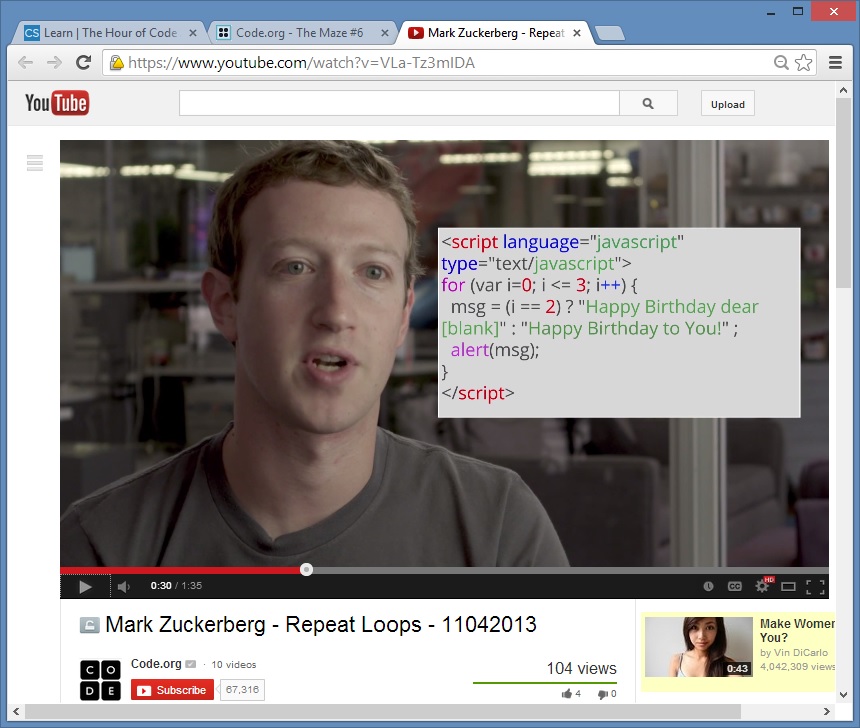
theodp writes "'Why do programmers start counting at zero?' wondered Mike Hoye, questioning the conventional programming wisdom. Code.org will soon introduce the practice to a hoped-for audience of 10 million schoolchildren as part of Computer Science Education Week's Hour of Code. In a tutorial created by engineers from Microsoft, Google, Twitter and Facebook that's intended to introduce programming to kids as young as six years old, an otherwise breezy lesson featuring look-ma-no-typing Blockly and characters out of Angry Birds and Plants vs. Zombies, a Mark Zuckerberg video introducing the concept of Repeat Loops includes an out-of-place JavaScript example that shows kids it's as easy as 0-1-2-3 to generate 4 lines of lyrics from Happy Birthday to You by using zero-based numbering with a For-loop and ternary If statement. Accompanying videos by Bill Gates on If Statements and basketball star Chris Bosh on Repeat Until Blocks show the Code.org tutorial is still a work-in-progress. That's no big deal, since CSEdWeek has pushed back the delivery date for final Hour of Code tutorials from its prior little-time-for-testing due date to Dec. 9th, the first day of a five-day period during which teachers are expected to deliver the lessons to 10 million students." -
Facebook Patented Making NSA Data Handoffs Easier
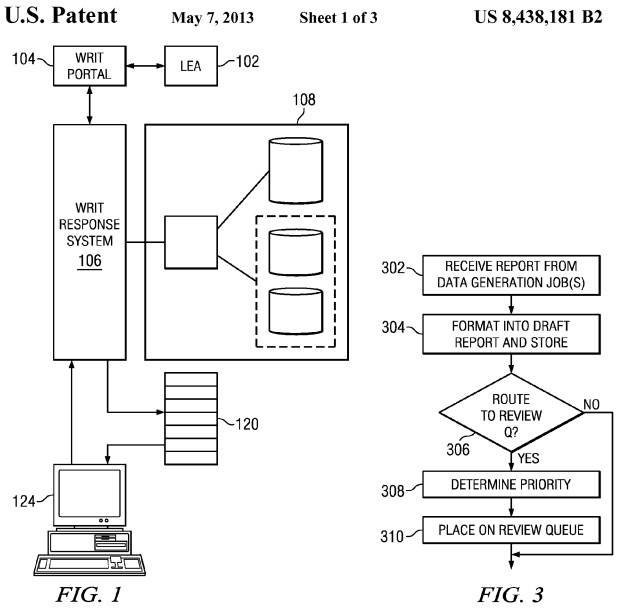
theodp writes "In June, Facebook CEO Mark Zuckerberg blasted 'outrageous press reports' about the PRISM surveillance program, denying that Facebook was ever 'part of any program to give the U.S. or any other government direct access to our servers.' What Zuckerberg didn't mention, and what the press overlooked, is that the USPTO granted Facebook a patent in May for its Automated Writ Response System. Like the NSA-enabling systems described by the NY Times on the same day Zuckerberg cried foul, the patent covers technical methods to more efficiently share the personal data of users with law enforcement agencies (LEAs) in response to lawful government requests via APIs and secured portals installed at company-controlled locations. 'While handing over data in response to a legitimate FISA request is a legal requirement,' the Times noted, 'making it easier for the government to get the information is not, which is why Twitter could decline to do so.'" -
You're Only As Hirable As Your Google+ Circles
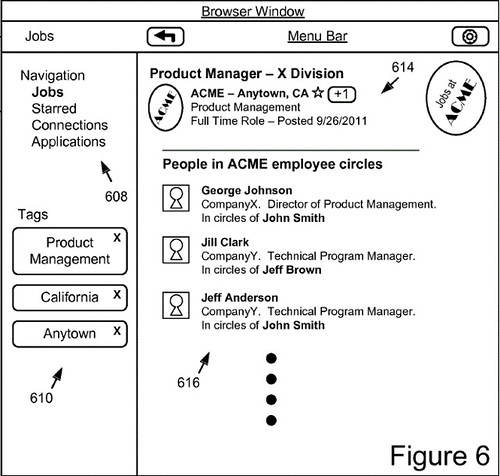
theodp writes "A pending Google patent for Identifying Prospective Employee Candidates via Employee Connections lays out plans for data mining employees' social graphs to find top job candidates. According to the patent application, the system would consider factors including the performance of the employees at the company whose circles you are in — under the assumption that the friends of top performers are more likely to be top performers themselves. It's the invention of three Googlers, including an HR VP who was quoted recently in an article that questioned the wisdom of certain Google hiring practices said to encourage 'echo chamber' hiring." -
A Math Test That's Rotten To the Common Core
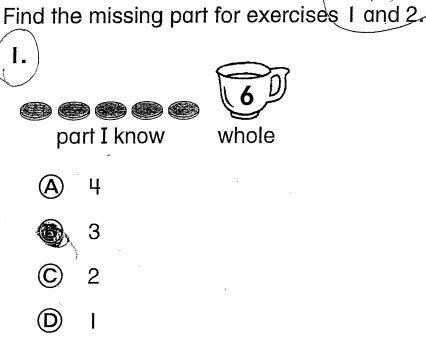
theodp writes " The Common Core State Standards Initiative," explains the project's website, ""is a state-led effort that established a single set of clear educational standards for kindergarten through 12th grade in English language arts and mathematics that states voluntarily adopt." Who could argue with such an effort? Not Bill Gates, who ponied up $150 million to help git-r-done. But the devil's in the details, notes Washington Post education reporter Valerie Strauss, who offers up a ridiculous Common Core math test for first graders as Exhibit A, which also helps to explain why the initiative is facing waning support. Explaining her frustration with the intended-for-5-and-6-year-olds test from Gates Foundation partner Pearson Education, Principal Carol Burris explains, "Take a look at question No. 1, which shows students five pennies, under which it says 'part I know,' and then a full coffee cup labeled with a '6' and, under it, the word, 'Whole.' Students are asked to find 'the missing part' from a list of four numbers. My assistant principal for mathematics was not sure what the question was asking. How could pennies be a part of a cup?" The 6-year-old first-grader who took the test didn't get it either, and took home a 45% math grade to her parents. And so the I'm-bad-at-math game begins!" -
What Employee Lock-In Means At Facebook
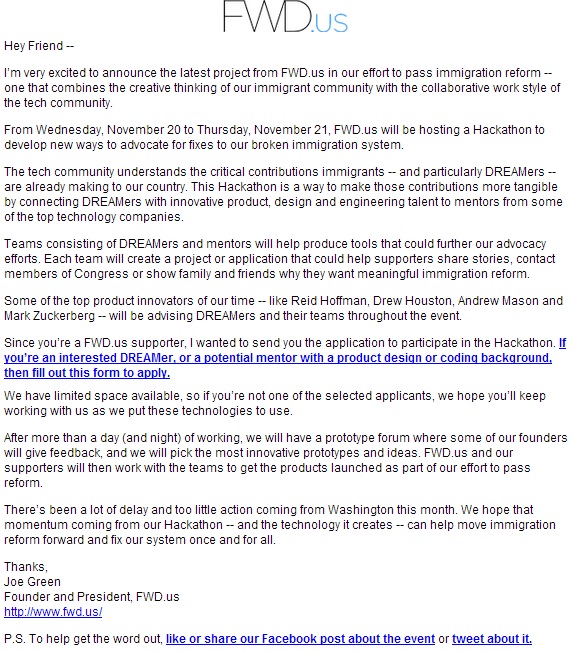
theodp writes "In the early days of Facebook, the company would go into what CEO Mark Zuckerberg called lockdown, where no one is supposed to leave until the task at hand is done. Speaking on Saturday at Startup School 2013, CNET reports, Mark Zuckerberg remarked that the practice persists to this day. Facebook doesn't lock people in the office, but it comes "as close to that as we can legally get," Zuckerberg said to an eruption from the crowd. The lockdown isn't the first at-home-in-a-Bangladesh-garment-factory management technique Zuck's touted at Startup School. Back in 2007, Zuckerberg drew fire for advising company founders "you should only hire young people with technical expertise" if they want to be successful. And while there are no reports of Facebook hiring 9-year-old bosses yet, the LA Times reports that only young undocumented immigrants are welcome at the hackathon hosted by Zuckerberg's FWD.us next month where "tech CEO's like Mark Zuckerberg, Reid Hoffman, Drew Houston and Andrew Mason will be sitting side-by-side with undocumented youth [with technical expertise] creating tech products to help the immigration reform movement" (invitation to 'day (and night) of working')." -
Teachers Get 1 Week To Test Tech Giants' Hour of Code
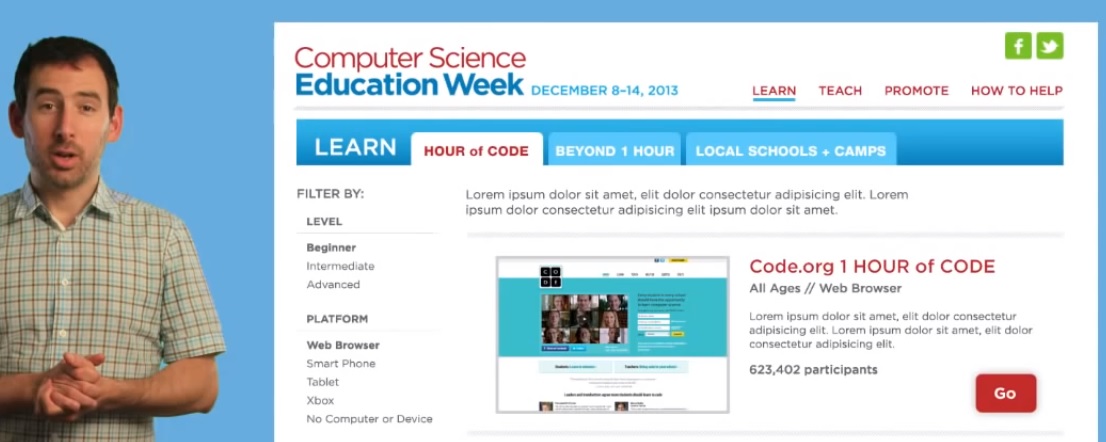
theodp writes "In a move straight out of Healthcare.gov's playbook, teachers won't get to preview the final lessons they're being asked to roll out to 10 million U.S. students until a week before the Dec. 9th launch of the Hour of Code nation-wide learn-to-code initiative, according to a video explaining the project, which is backed by the nation's tech giants, including Facebook, Microsoft, Apple, Google, and Amazon. The Hour of Code tutorial page showcased to the press sports Lorem Ipsum pseudo-Latin text instead of real content, promised tutorial software is still being developed by Microsoft and Google, and celebrity tutorials by Bill Gates and Mark Zuckerberg are still a work-in-progress. With their vast resources and deep pockets, the companies involved can still probably pull something off, but why risk disaster for such a high-stakes effort with a last-minute rush? One possible explanation is that CS Education Week, a heretofore little-recognized event, is coming up soon. Then again, tech immigration reform is back on the front burner, an initiative that's also near-and-dear to many of same players behind Hour of Code, including Microsoft Chief Counsel Brad Smith who, during the Hour of Code kickoff press conference, boasted that Microsoft's more-high-tech-visas-for-U.S.-kids-computer-science-education deal found its way into the Senate Immigration Bill, but minutes later joined his fellow FWD.us panelists to dismiss a questioner's suggestion that Hour of Code might somehow be part of a larger self-serving tech industry interest." -
Teaching Fractions: The Tootsie Roll Is the New Pie
theodp writes "Following up on a WSJ story, data visualization author Stephen Few illustrates why using lines or bars may be sweeter than pie when it comes to teaching kids fractions. 'Although the metaphor is easy to grasp (the slices add up to an entire pie),' explains Few, 'we know that visual perception does a poor job of comparing the sizes of slices, which is essential for learning to compare fractions. Learning that one-fifth is larger than one-sixth, which is counter-intuitive in the beginning, becomes further complicated when the individual slices of two pies — one divided into five slices and other into six — look roughly the same. Might it make more sense to use two lines divided into sections instead, which are quite easy to compare when placed near one another?' So, is the Tootsie Roll the new pie?" -
Can Even Apple Make a Watch Insanely Smart?
theodp writes "Throwing some cold water on the buzz surrounding the Galaxy Gear Smartwatch launch, The New Yorker's Matt Buchanan questions how smart a watch can really be. Calling offerings like the Galaxy Gear useful but not the stuff of dreams and revolutions, Buchanan writes, 'So there remains a strange undercurrent of hope that somebody-Apple-will figure out, soon, some grander vision for wearable technology, transforming it from something that people have vaguely imagined into something people intensely desire. It did it for smartphones, once, and again, for tablets. The question that Apple has been charged with, since nobody has definitively answered it yet, is whether the lack of an invention that truly carries us beyond the last five hundred years of wrist-mounted technology is the result of a failure of imagination or simply a fact of nature-that a watch will always just be a watch, no matter how smart it might think it is.' So, will you be an early adopter and drink Samsung's or Sony's smartwatch Kool-Aid, wait to see what Apple comes up with, or hold out for a Windows Forearm Pad 8?" -
Back To 'The Future of Programming'
theodp writes "Bret Victor's The Future of Programming (YouTube video; Vimeo version) should probably be required viewing this fall for all CS majors — and their professors. For his recent DBX Conference talk, Victor took attendees back to the year 1973, donning the uniform of an IBM systems engineer of the times, delivering his presentation on an overhead projector. The '60s and early '70s were a fertile time for CS ideas, reminds Victor, but even more importantly, it was a time of unfettered thinking, unconstrained by programming dogma, authority, and tradition. 'The most dangerous thought that you can have as a creative person is to think that you know what you're doing,' explains Victor. 'Because once you think you know what you're doing you stop looking around for other ways of doing things and you stop being able to see other ways of doing things. You become blind.' He concludes, 'I think you have to say: "We don't know what programming is. We don't know what computing is. We don't even know what a computer is." And once you truly understand that, and once you truly believe that, then you're free, and you can think anything.'" -
Microsoft's Math-Challenged STEM Education Contest
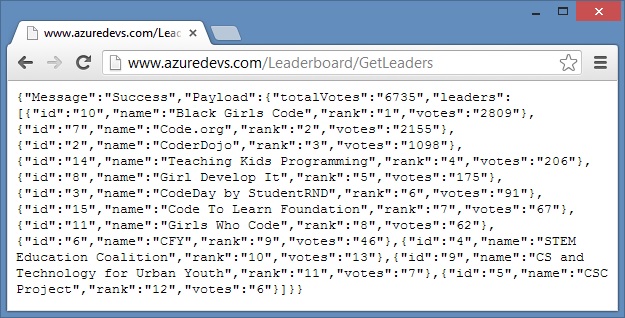
theodp writes "As noted earlier, Microsoft is tackling the CS education crisis with a popularity contest that will award $100K in donations to five technology education nonprofits that help make kids technically literate. Hopefully, the nonprofits will teach kids that the contest's voting Leader Board is a particularly good example of what-not-to-do technically. In addition to cherry-picking the less-pathetic vote totals to make its Leader Board, Microsoft also uses some dubious rounding code that transforms the original voting data into misleading percentages. Indeed, developer tools reveal that the top five leaders in the Microsoft STEM education contest miraculously account for 130% of the vote. Let's hope the quality control is better for those Microsoft Surface voting machines!" -
Microsoft's Math-Challenged STEM Education Contest
theodp writes "As noted earlier, Microsoft is tackling the CS education crisis with a popularity contest that will award $100K in donations to five technology education nonprofits that help make kids technically literate. Hopefully, the nonprofits will teach kids that the contest's voting Leader Board is a particularly good example of what-not-to-do technically. In addition to cherry-picking the less-pathetic vote totals to make its Leader Board, Microsoft also uses some dubious rounding code that transforms the original voting data into misleading percentages. Indeed, developer tools reveal that the top five leaders in the Microsoft STEM education contest miraculously account for 130% of the vote. Let's hope the quality control is better for those Microsoft Surface voting machines!" -
Microsoft's Math-Challenged STEM Education Contest
theodp writes "As noted earlier, Microsoft is tackling the CS education crisis with a popularity contest that will award $100K in donations to five technology education nonprofits that help make kids technically literate. Hopefully, the nonprofits will teach kids that the contest's voting Leader Board is a particularly good example of what-not-to-do technically. In addition to cherry-picking the less-pathetic vote totals to make its Leader Board, Microsoft also uses some dubious rounding code that transforms the original voting data into misleading percentages. Indeed, developer tools reveal that the top five leaders in the Microsoft STEM education contest miraculously account for 130% of the vote. Let's hope the quality control is better for those Microsoft Surface voting machines!" -
Microsoft's Math-Challenged STEM Education Contest
theodp writes "As noted earlier, Microsoft is tackling the CS education crisis with a popularity contest that will award $100K in donations to five technology education nonprofits that help make kids technically literate. Hopefully, the nonprofits will teach kids that the contest's voting Leader Board is a particularly good example of what-not-to-do technically. In addition to cherry-picking the less-pathetic vote totals to make its Leader Board, Microsoft also uses some dubious rounding code that transforms the original voting data into misleading percentages. Indeed, developer tools reveal that the top five leaders in the Microsoft STEM education contest miraculously account for 130% of the vote. Let's hope the quality control is better for those Microsoft Surface voting machines!" -
Google Patents Displaying Athletes On Sports Fields
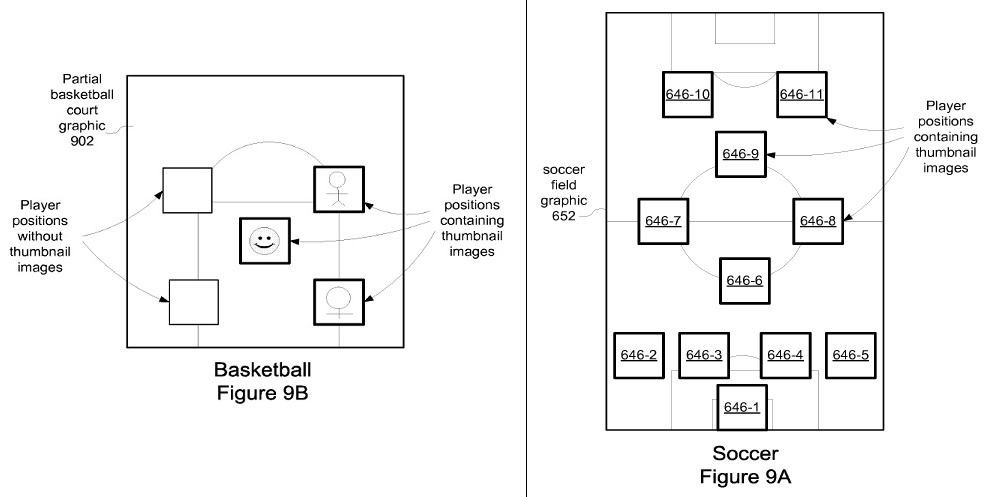
theodp writes "Just about anyone that's familiar with sports has seen position and depth charts, in which athletes are portrayed on the athletic fields their sport is played on. But that didn't stop Google from asking for — and the USPTO granting — a patent on displaying pictures of athletes on the fields on which their sport is played, or in legal-speak, its Method, System, and Graphical User Interface for Personalized Online Sports Team Charts. 'One aspect of the invention,' explains Google, 'involves a graphical user interface on a computer that includes a graphic of an athletic playing field or a portion thereof, and a plurality of player positions on the athletic field. At least some of the player positions contain thumbnail images selected by a first user. The thumbnail images provide links to corresponding profiles in an online social network.' Six Googlers, including Orkut Buyukkokten, were credited as inventors in the 2007 patent application." -
Microsoft Patents "Cartoon Face Generation"
theodp writes "The latest round of patents granted by the USPTO included one for Cartoon Face Generation, an invention which Microsoft explains 'generates an attractive cartoon face or graphic of a user's facial image'. Microsoft adds, 'The style of cartoon face achieved resembles the likeness of the user more than cartoons generated by conventional vector-based cartooning techniques. The cartoon faces thus achieved provide an attractive facial appearance and thus have wide applicability in art, gaming, and messaging applications in which a pleasing degree of realism is desirable without exaggerated comedy or caricature.' A Microsoft Research Face SDK Beta is available. Hey, too bad Microsoft didn't have this technology when they generated Bob from Ralphie!" -
Microsoft Patents "Cartoon Face Generation"
theodp writes "The latest round of patents granted by the USPTO included one for Cartoon Face Generation, an invention which Microsoft explains 'generates an attractive cartoon face or graphic of a user's facial image'. Microsoft adds, 'The style of cartoon face achieved resembles the likeness of the user more than cartoons generated by conventional vector-based cartooning techniques. The cartoon faces thus achieved provide an attractive facial appearance and thus have wide applicability in art, gaming, and messaging applications in which a pleasing degree of realism is desirable without exaggerated comedy or caricature.' A Microsoft Research Face SDK Beta is available. Hey, too bad Microsoft didn't have this technology when they generated Bob from Ralphie!" -
Google Cache Makes Murdoch's K-12 Site Look Obscene
theodp writes "Rupert Murdoch's Amplify Education site is all about the kids, so it's understandable that the site's Terms of Use bans abusive, pornographic, obscene, and vulgar content. But if one uses Google to do a site search of Amplify.com (e.g., site:amplify.com donkey) you may get quite an unexpected eye-opener (redacted, but still NSFW). So, does someone at Amplify really want to "@&^$" your "a**"? Of course not. But this does serve as a cautionary tale of the perils of buying a second-hand domain name when pages of the shuttered site may live on in cache-land. Prior to its conversion to a site for kids' education, Amplify.com was a social sharing product that allowed users to clip favorite sites from the web and add their own commentary. Google does note that removed content may still show up in Google's search results in certain situations (removal requests can be made)." Update: 04/08 17:04 GMT by T : Stephanie Chang writes (in a comment below): "Hi, I’m the editor of Amplify.com. We purchased our domain name in February 2012 and took ownership of the site in July 2012 for use as our company's home page. Prior to that, the domain was used by its previous owners as a social-sharing site. As a result, some old content dating back to the previous domain ownership still shows up as cached on certain search engines. Amplify Education, Inc. did not produce the cached content in question nor do we in any way endorse it. We’re working with Google and other search providers to make sure caches of our site are up to date. In the meantime, we apologize to anyone whose attempts to locate information on amplifying donkeys resulted in a negative browsing experience." -
Microsoft: the 'Scroogled' Show Must Go On
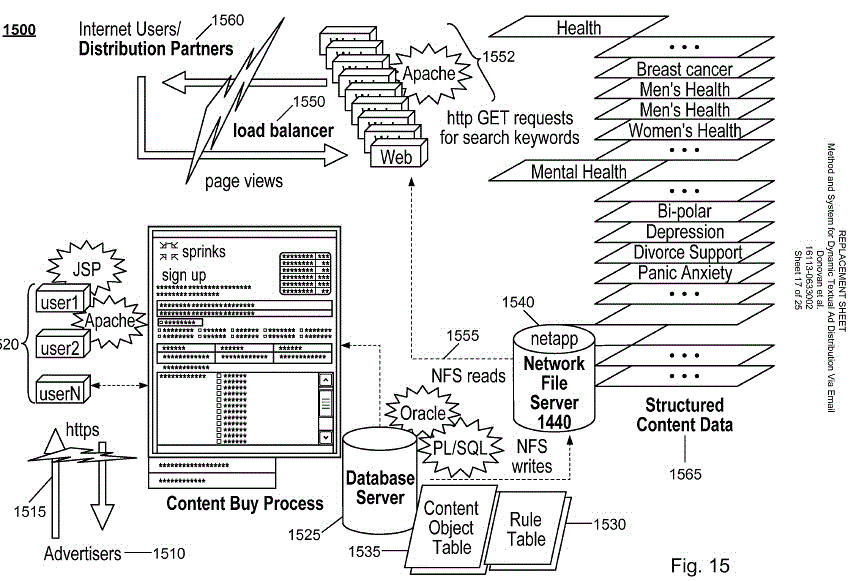
theodp writes "Microsoft says that the death of its 'Scroogled' ad campaign against Google has been greatly exaggerated. 'Scroogled will go on as long as Google keeps Scroogling people,' said a Microsoft spokesperson. 'Nearly 115,000 people signed a petition asking Google to stop going through their Gmail.' So, is Microsoft's scare campaign justified? Well, in a recently-published patent application for a Method and System for Dynamic Textual Ad Distribution Via Email, Google explains how its invention can be used to milk more money from advertisers by identifying lactating Moms, which might make some uneasy. Google also illustrates how advertisers can bid on access to those suffering from breast cancer, bi-polar disorder, depression, and panic anxiety. Hey, what could possibly go wrong?" -
Microsoft: the 'Scroogled' Show Must Go On
theodp writes "Microsoft says that the death of its 'Scroogled' ad campaign against Google has been greatly exaggerated. 'Scroogled will go on as long as Google keeps Scroogling people,' said a Microsoft spokesperson. 'Nearly 115,000 people signed a petition asking Google to stop going through their Gmail.' So, is Microsoft's scare campaign justified? Well, in a recently-published patent application for a Method and System for Dynamic Textual Ad Distribution Via Email, Google explains how its invention can be used to milk more money from advertisers by identifying lactating Moms, which might make some uneasy. Google also illustrates how advertisers can bid on access to those suffering from breast cancer, bi-polar disorder, depression, and panic anxiety. Hey, what could possibly go wrong?" -
Internet-Deprived Kids Turning To 'McLibraries'
theodp writes "After the school computer lab and public library close for the night in many communities, the local McDonald's is often the only place to turn for students without internet access at home. 'Cheap smartphones and tablets have put Web-ready technology into more hands than ever,' reports the WSJ's Anton Troianovski. 'But the price of Internet connectivity hasn't come down nearly as quickly. And in many rural areas, high-speed Internet through traditional phone lines simply isn't available at any price. The result is a divide between families that have broadband constantly available on their home computers and phones, and those that have to plan their days around visits to free sources of Internet access.' The FCC says it can make broadband available to all Americans by spending $45 billion over 10 years, but until then the U.S. will have to rely on Mickey D's, Starbucks, and others to help address its digital divide. Time to update that iconic McDonald's sign?" -
Cockatoo Manufactures, Uses Tools
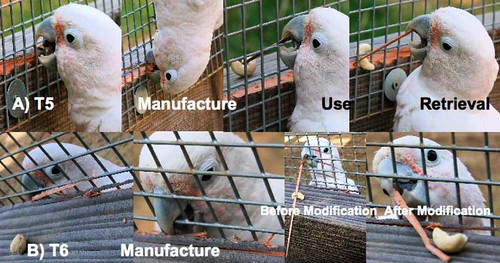
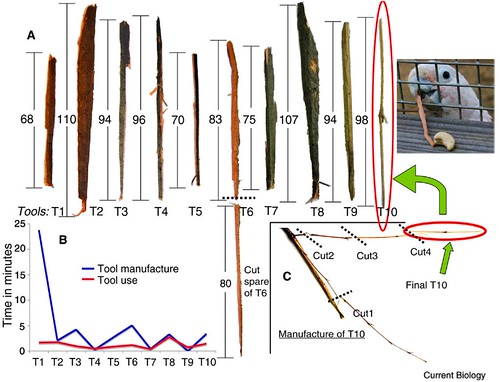
grrlscientist writes with news of a cockatoo named Figaro, who was observed to construct and use his own tools to retrieve objects that were outside of his cage. Quoting: "One day, a student caregiver noticed Figaro pushing a stone pebble through the aviary wire mesh, where it fell on a wood structural beam. Unable to retrieve the stone with his foot, Figaro then fetched a piece of bamboo and again attempted to retrieve the stone using the bamboo stick. ... During the next three days, the researchers ran trials of the original scenario, which was repeated ten times but substituting a cashew nut for the pebble. All trials were captured on video and the process of tool manufacture and use was documented photographically. ... 'Figaro made a new tool for every nut we placed there and each time the bird was successful in obtaining it,' reports cognitive biologist Alice Auersperg of the University of Vienna, who led the study (PDF). During these trials, Figaro used 10 tools, nine of which he manufactured and one of which was ready-made." -
Cockatoo Manufactures, Uses Tools
grrlscientist writes with news of a cockatoo named Figaro, who was observed to construct and use his own tools to retrieve objects that were outside of his cage. Quoting: "One day, a student caregiver noticed Figaro pushing a stone pebble through the aviary wire mesh, where it fell on a wood structural beam. Unable to retrieve the stone with his foot, Figaro then fetched a piece of bamboo and again attempted to retrieve the stone using the bamboo stick. ... During the next three days, the researchers ran trials of the original scenario, which was repeated ten times but substituting a cashew nut for the pebble. All trials were captured on video and the process of tool manufacture and use was documented photographically. ... 'Figaro made a new tool for every nut we placed there and each time the bird was successful in obtaining it,' reports cognitive biologist Alice Auersperg of the University of Vienna, who led the study (PDF). During these trials, Figaro used 10 tools, nine of which he manufactured and one of which was ready-made." -
Google Patents Guilt-By-Association
theodp writes "Guilt by association is defined as the attribution of guilt (without proof) to individuals because the people they associate with are guilty. It's also at the heart of U.S. Patent No. 8,306,922, which was awarded to Google on Tuesday for Detecting Content on a Social Network Using Links, the invention of three Googlers. In its patent application, Google argues that if an individual posts content to social networks such as Facebook, MySpace, Orkut, Twitter, LinkedIn, YouTube, etc. 'that is illegal (e.g., content violating copyright law, content violating penal statutes, etc.), inappropriate for minors (e.g., pornography, "R" or "NC-17" rated videos, adult content, etc.), in contravention of an end user licensing agreement (EULA), etc.', then their friends 'may be likely to post content to their profile pages related to similar topics.' Google further explains: 'For instance, a first user and a second user that are designated as friends on a social network may be friends based upon a set of common interests (e.g., the first user and the second user are both interested in tennis). If the first user adds content to its profile page that is related to sports, then the friendship (link) between the first user and the second user can indicate that the profile page of the second user is likely to contain content related to sports as well.' By extension, the same holds true for porn, pirated videos and music, etc., right? So, would you feel comfortable being judged by the online company you keep?" -
Facebook Patents Pokes-Per-Minute Limits
theodp writes "The USPTO lowered the bar again on Tuesday, granting U.S. Patent No. 8,296,373 to four Facebook inventors for Automatically Managing Objectionable Behavior in a Web-based Social Network, essentially warning users or suspending their accounts when their poking, friend requesting, and wall posting is deemed annoying. From the patent: 'Actions by a user exceeding the threshold may trigger the violation module 240 to take an action. For example, the point 360, which may represent fifty occurrences of an action in a five hour period, does not violate any of the policies as illustrated. However, the point 350, which represents fifty occurrences in a two hour period, violates the poke threshold 330 and the wall post threshold 340. Thus, if point 350 represents a user's actions of either poking or wall posting, then the policy is violated.'" -
Microsoft Patents 1826 Choropleth Map Technique
theodp writes "A newly-granted Microsoft patent for Variable Formatting of Cells covers the use of 'variable formatting for cells in computer spreadsheets, tables, and other documents', such as using the spectrum from a first color to a second color to represent the values in or associated with each cell. Which is really not a heck of a lot different from how Baron Pierre Charles Dupin created what's believed to be the first choropleth map way back in 1826, when he used shadings from black to white to illustrate the distribution and intensity of illiteracy in France. By the way, beginning in March, the U.S. will switch from a first-to-invent to a first-to-file system of granting patents. Hey, what could go wrong?" -
Google Bans Online Anonymity While Patenting It
theodp writes "'It's important to use your common name,' Google explains in its Google+ ground rules, 'so that the people you want to connect with can find you.' Using a 'secondary online identity,' the search giant adds, is a big Google+ no-no. 'There are lots of places where you can be anonymous online,' Betanews' Joe Wilcox notes. 'Google+ isn't one of them.' Got it. But if online anonymity is so evil, then what's the deal with Google's newly-awarded patent for Social Computing Personas for Protecting Identity in Online Social Interactions? 'When users reveal their identities on the internet,' Google explained to the USPTO in its patent application, 'it leaves them more vulnerable to stalking, identity theft and harassment.' So what's Google's solution? Providing anonymity to social networking users via an 'alter ego' and/or 'anonymous identity.' So does Google now believe that there's a genuine 'risk of disclosing a user's real identity'? Or is this just a case of Google's left hand not knowing what its right hand is patenting?" -
Google Patents Profit-Maximizing Dynamic Pricing
theodp writes "A newly-granted Google patent on Dynamic Pricing of Electronic Content describes how information gleaned from your search history and social networking activity can be used against you by providing tell-tale clues for your propensity to pay jacked-up prices to 'reconsume' electronic content, such as 'watching a video recording, reading an electronic book, playing a game, or listening to an audio recording.' The patent is illustrated with drawings showing how some individuals can be convinced to pay 4x what others will be charged for the same item. From the patent: 'According to one innovative aspect of the subject matter described by this specification, a system may use this information to tailor the price that is offered to the particular user to repurchase the particular item of electronic content. By not applying discounts for users that may, in relation to a typical user, be more inclined to repurchase a particular product, profits may increase.' Hey, wasn't this kind of dynamic pricing once considered evil?" -
And Now, the Cartoon News
theodp writes "Would you read a cartoon version of Slashdot? Quality stuff, not half-baked MS-Paint posts like 'Introducing Microsoft Monocle and Self-Driving Bentley'. Erin Polgreen has big plans for illustrated journalism. In October, Polgreen will be launching Symbolia, a tablet-based magazine of illustrated journalism, through Apple's App Store. 'Illustrated journalism draws you in, Polgreen explains. 'It's accessible in a way 5,000 words of text isn't. Regardless of age, gender or anything, you grasp it faster than most journalism.' Polgreen follows in the footsteps of other cartoonist-journalists, including Joe Kubert (RIP), Joe Sacco, and Josh Neufeld." -
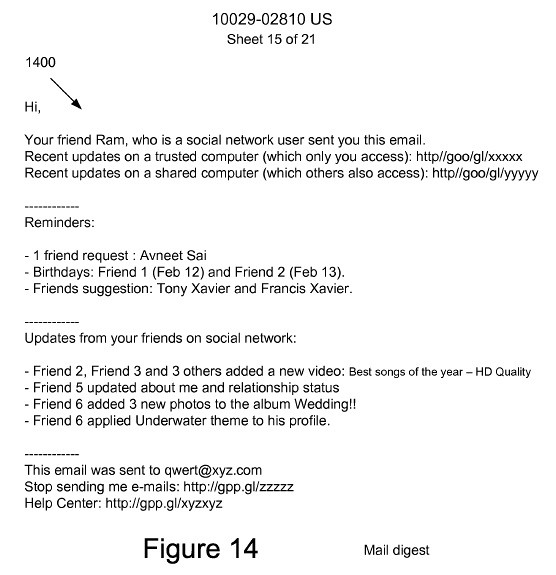
Microsoft Surface, Meet Apple iSurface
theodp writes "Responding to Microsoft's Windows 8 efforts, Apple CEO Tim Cook insisted in late April that combining a tablet and a notebook would be like converging a toaster and a refrigerator. But a patent application submitted by Apple last year — and made public Tuesday morning — proposes marrying a tablet and a keyboard to create 'a true laptop alternative,' which GeekWire notes looks a lot like Microsoft Surface (comparison pic). In its patent filing, Apple describes various ways that a tablet's cover could be used as an I-O device — as a tactile-feedback keyboard ('word processing and email become much more efficient'), to display additional output, as a touchpad replacement, and even to receive stylus input. 'The experience,' claims Apple, 'is even better in some ways than the laptop experience.'" -
Amazon Patents Pitching As-Seen-On-TV Products
theodp writes "Q. What do you get when you surround the image of Men in Black star Will Smith trying on sunglasses with a pitch for 'MIB Bill Smith Dark Shades'? A. U.S. Patent No. 8,180,688. 'Many people consume broadcast media such as television shows and movies for many hours a week,' Amazon explained to the USPTO in its patent application for a Computer-Readable Medium, System, and Method for Item Recommendations Based on Media Consumption. 'The consumed broadcast media may depict a variety of items during the course of the transmission, such as clothing, books, movies, accessories, electronics, and/or any other type of item.' So, does Amazon's spin on As Seen on TV advertising deserve a patent?" -
Google Patents Using iPhones To Kill 'Free Bird'
theodp writes "At Chicago's Billy Goat Tavern, construction workers found physical threats an effective way to discourage smart-ass Whitney Young High School students from playing annoying jukebox songs over and over again. But with Google's newly-patented technology for the Collaborative Rejection of Media for Physical Establishments, you no longer need to resort to violence to prevent Elton John Songs from being played on jukeboxes in bars. Its invention, boasts Google, 'enables customers of an establishment to collaboratively reject a media file that is currently playing and/or pending to be played within that establishment by entering data into a personal wireless portable computing device on their person, for example a cellular telephone.' But don't get your hopes up too high, kids. Much like Google's dual-tier stock plan, the patent calls for 'customer status levels including a premium status and a standard status,' so a premium customer will be able to veto attempts by lowly standard customers to kill his requests to play MC Hammer's 'Can't Touch This'. The patent comes from a quirky Outland Research IP portfolio acquired by Google; its inventor is Louis B. Rosenberg, a Stanford PhD and professional film maker." -
Google Patents Using iPhones To Kill 'Free Bird'
theodp writes "At Chicago's Billy Goat Tavern, construction workers found physical threats an effective way to discourage smart-ass Whitney Young High School students from playing annoying jukebox songs over and over again. But with Google's newly-patented technology for the Collaborative Rejection of Media for Physical Establishments, you no longer need to resort to violence to prevent Elton John Songs from being played on jukeboxes in bars. Its invention, boasts Google, 'enables customers of an establishment to collaboratively reject a media file that is currently playing and/or pending to be played within that establishment by entering data into a personal wireless portable computing device on their person, for example a cellular telephone.' But don't get your hopes up too high, kids. Much like Google's dual-tier stock plan, the patent calls for 'customer status levels including a premium status and a standard status,' so a premium customer will be able to veto attempts by lowly standard customers to kill his requests to play MC Hammer's 'Can't Touch This'. The patent comes from a quirky Outland Research IP portfolio acquired by Google; its inventor is Louis B. Rosenberg, a Stanford PhD and professional film maker." -
The Phantoms of Google+
theodp writes "Engadget reports that Google wants a patent on its System and Method for Generating a Ghost Profile for a Social Network. The brainchild of five Googlers, the invention is designed to convert anti-social-networking types to the joys of Google+ and its ilk. From the patent: 'A problem arises when users of social networks are friends with people that are opposed to social networks. The second group misses out on an important social component. For example, many users only share their photos on a social networking site. As a result, users that do not want to join the social network are forced to either join with reservations or miss out on the social component, such as viewing pictures.' By generating an unsearchable 'ghost profile' when a member of the social network invites a Google+ adverse friend to join, Google explains, non-believers get to participate in social networking activities without providing user information." -
Amazon Patents Annotating Books, Digital Works
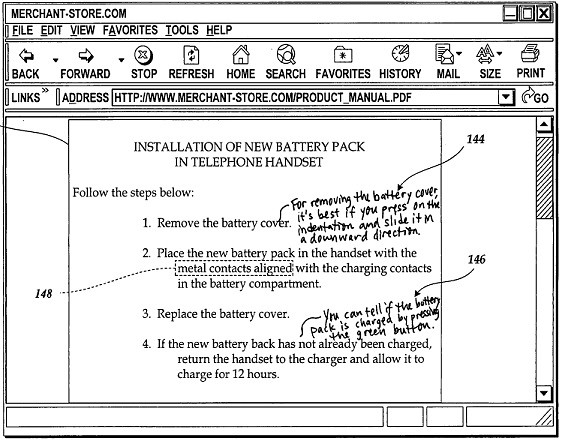
theodp writes "On Tuesday, the USPTO granted Amazon a patent on its Method and System for Providing Annotations of a Digital Work, which covers 'receiving an annotation of the digital work, storing the annotation, and providing the annotation to a user.' This includes annotations received in a graphical or handwriting format, as well as highlighting of text." I think I smell at least one example of prior art.
.jpg)