Slashdot Mirror
Domain: toastytech.com
Stories and comments across the archive that link to toastytech.com.
Comments · 363
-
Get rid of the blue screen of death forever!!!
-
Re:Definitely Next?
Actually, MS have already released Microsoft Bob and they're trying very hard to forget about it...
-
Re:subpixel rendering - OS X too - Acorn
-
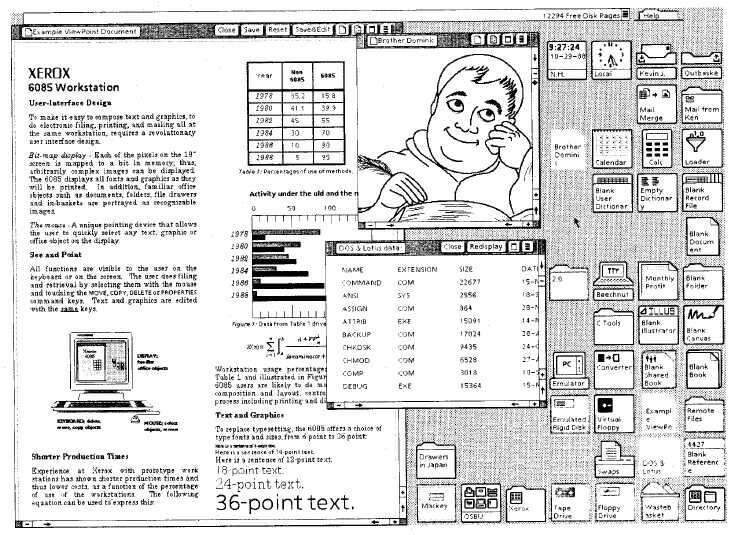
Re:Apple's patent on desktop search before MicrosoNote the wastebasket, bottom right.
Note what ist says on the site where the image is linked from:
"In 1985 Xerox revamped the Xerox Star. The Xerox 6085, codename Daybreak, included a faster processor and an improved version of the Star application software, now called ViewPoint. [...] ViewPoint greatly improves upon the original star software."
-
Re:useless info in status barAs for ripping off, I think the similarity between Aero's back and forward buttons and the KDE Crystal icon set's is rather striking. Microsoft's version does look a tiny bit better, though.
Aero's back and forward buttons also look a lot like Luna's back and forward buttons, but with the color changed to blue, and lighting affect applied to the upper-left corner.
-
Re:Apple's patent on desktop search before Microso
/me looks at the "Recycle Bin" on his Windows desktop and shakes his head at the obviousness of its origin...and the rest of the operating system...
I hope you're not stupid enough to think that Apple was the origin of that concept.
Note the wastebasket, bottom right.
This is on a Xerox Star system. -
Glaser from RealNetworks on Plays for SureJust read this bit from a conversation with Glaser from RealNetworks, as reported by Eric Savitz (from Barron's):
Microsoft is making a mess of "Plays For Sure," its effort to provide an umbrella brand for non-Apple music players and download sites. "It makes the marketing for Microsoft Bob look masterful," he said. Which is not to say that he thinks marketing is the only issue. "They're taking a bunch of online sites that aren't that good, a bunch of products that aren't very good, and putting a logo on them. Every nickel they spend on this is a wasted nickel."
For a split second I thought about Baghdad Bob, but then, here's what his reference to Microsoft Bob means:
You may have heard jokes about some old failed Microsoft product called "Bob" or seen that big yellow smily face wearing nerdy glasses, and wondered "what the heck was that all about?".
Well, in early 1995 Microsoft released a software program called "Bob" designed to replace the desktop of Windows 3.1 and 95 with an interface designed mainly for novice users.
Microsoft held a big advertising campaign and loaded up stores with copies of Bob expecting huge sales. It totally flopped.
Found that at: Toastytech
Which makes me wonder, was Baghdad Bob named after Microsoft Bob after all?
-
Re:IntegrationYes, because we all know that OS components will be forcefully removed (by a government) 13-14 years after they were introduced.
Media Player isn't like IE. Media Player and its infrastructure were introduced when Multimedia components were first added to Windows, way back when Windows 3.0 with Multimedia Extensions was released in 1991.
Which, incidently, makes Media Player as old, or older than, Linux.
-
It's as if icons STARTED 2-4 years ago...
I have to disagree. The NeXT had amazing icons back in the late 80s and early 90s, many of which still hold up today (though they were only 2-bit black and white).
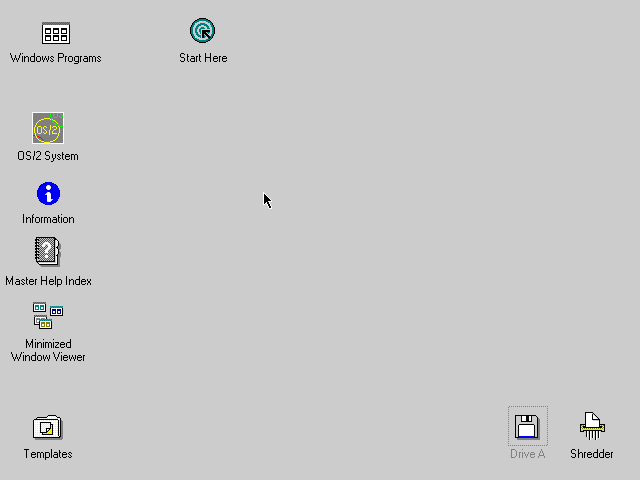
I really like having the side-by-side comparison of icons, but they've chosen mostly modern, mostly mainstream OSes. "Trash" icons in particular are a favorite of mine, but here they're all nearly identical (with the exception of OS/2's wacky shredder). It's also weird that they don't include the folder icon, one of those basics that some OSes did slightly differently (eg, the Amiga's "drawers").
They do show some Lisa icons here, but what about all the other early GUIs? It would be great to include DEC GEM, a sampling of X11 icons from different UNIXes, and geesh - the NeXT, which they claim to be represented by Rhapsody (it's not! Where are the Black Hole and Recycler?!?)
Plus, any history of the GUI that excludes Xerox is missing the prime mover! With a quick search I found this site which includes screenshots from the Xerox Star. The icons are distorted, being photos of a curved screen, but surely someone somewhere has the original bitmaps.
The "interactive chart" of GUI influences on this page shows dozens of sources I've never even heard of...I'd like to see a history that cites these designs, to show the initial struggle to represent all these machine functions graphically, not just the differences between popular, modern UIs, after everyone's adopted a common visual vocabulary for most things. -
It's as if icons STARTED 2-4 years ago...
I have to disagree. The NeXT had amazing icons back in the late 80s and early 90s, many of which still hold up today (though they were only 2-bit black and white).
I really like having the side-by-side comparison of icons, but they've chosen mostly modern, mostly mainstream OSes. "Trash" icons in particular are a favorite of mine, but here they're all nearly identical (with the exception of OS/2's wacky shredder). It's also weird that they don't include the folder icon, one of those basics that some OSes did slightly differently (eg, the Amiga's "drawers").
They do show some Lisa icons here, but what about all the other early GUIs? It would be great to include DEC GEM, a sampling of X11 icons from different UNIXes, and geesh - the NeXT, which they claim to be represented by Rhapsody (it's not! Where are the Black Hole and Recycler?!?)
Plus, any history of the GUI that excludes Xerox is missing the prime mover! With a quick search I found this site which includes screenshots from the Xerox Star. The icons are distorted, being photos of a curved screen, but surely someone somewhere has the original bitmaps.
The "interactive chart" of GUI influences on this page shows dozens of sources I've never even heard of...I'd like to see a history that cites these designs, to show the initial struggle to represent all these machine functions graphically, not just the differences between popular, modern UIs, after everyone's adopted a common visual vocabulary for most things. -
Defining bloat...
Defining exactly what constitutes bloat may be hard, but take a look at the QNX demo disk sometime if you want to see the absence of bloat. Each bootable 1.44MB floppy contained the OS, GUI, networking, Web browser, file browser, Web server, and several demo applications.
-
Things change. Deal.
OK, here it is quick, to back up Anita.
2005-8 = 1997
http://toastytech.com/guis/guitimeline4.html
8.5 years ago, my current 8th grade class was starting 1st Grade, and many were using PCs for the 1st time. Windows '95 was MS's "consumer" option, NT 4 was the best option available from MS. OS/2 Warp 4 and Mac OS8 were competitors. Fortunately, MS Bob had died an early death, and could be found (if at all) in dollar stores.
2005-12 = 1993
http://toastytech.com/guis/guitimeline3.html
Current U.S. high school seniors were entering 1st Grade, and many were using PCs for the first time. The main OS choices are Windows 3.1, Windows NT 3.1 (there were no previous versions), OS/2 V2, PC-Geos, Amiga Workbench 3, and Mac (not sure which version, sorry).
Fortunately, Lotus 1-2-3 was no longer considered as a viable option (see quote "In the single-tasking MS-DOS 1-2-3 was sometimes used as a complete environment" at http://www.answers.com/topic/lotus-1-2-3
In light of all this, it is foolish to assume that any OS that students use in school, or university, will be vaguely similar to the similarly-titled offerings available when they graduate and go into the "real world". No one can say that Win XP would be quickly intuitive to a Win 3.1 user, and yet wouldn't be much harder for an Amiga Workbench user to learn.
Therefore, it is irrelevant to claim that students will have to learn a new OS when they graduate; and I would think that encouraging students to try new things is an important part of teaching "computers"; it is in my classroom, at least
(see: http://slashdot.org/comments.pl?sid=140414&cid=117 69514 or http://slashdot.org/comments.pl?sid=138172&cid=115 61825). -
Things change. Deal.
OK, here it is quick, to back up Anita.
2005-8 = 1997
http://toastytech.com/guis/guitimeline4.html
8.5 years ago, my current 8th grade class was starting 1st Grade, and many were using PCs for the 1st time. Windows '95 was MS's "consumer" option, NT 4 was the best option available from MS. OS/2 Warp 4 and Mac OS8 were competitors. Fortunately, MS Bob had died an early death, and could be found (if at all) in dollar stores.
2005-12 = 1993
http://toastytech.com/guis/guitimeline3.html
Current U.S. high school seniors were entering 1st Grade, and many were using PCs for the first time. The main OS choices are Windows 3.1, Windows NT 3.1 (there were no previous versions), OS/2 V2, PC-Geos, Amiga Workbench 3, and Mac (not sure which version, sorry).
Fortunately, Lotus 1-2-3 was no longer considered as a viable option (see quote "In the single-tasking MS-DOS 1-2-3 was sometimes used as a complete environment" at http://www.answers.com/topic/lotus-1-2-3
In light of all this, it is foolish to assume that any OS that students use in school, or university, will be vaguely similar to the similarly-titled offerings available when they graduate and go into the "real world". No one can say that Win XP would be quickly intuitive to a Win 3.1 user, and yet wouldn't be much harder for an Amiga Workbench user to learn.
Therefore, it is irrelevant to claim that students will have to learn a new OS when they graduate; and I would think that encouraging students to try new things is an important part of teaching "computers"; it is in my classroom, at least
(see: http://slashdot.org/comments.pl?sid=140414&cid=117 69514 or http://slashdot.org/comments.pl?sid=138172&cid=115 61825). -
Re:Get a clue!
The bit about the loop with no exit and self-modifying code sounds like a truly grand version of some self-modifying code I was particularly proud of.
Back in the days of Apple GEOS while working at Geoworks (nee Berkeley Softworks), my first task as a co-op was to port Commodore GeoCalc (a spreadsheet program) to run on Apple GEOS (not too bad since they were both 6502 family processors: "6502 -- the original RISC chip...there's no multiply instruction!") and add some new features. I ended up writing a new floating point math libary, too.
At some point during the work, I noticed that it took a really long time for operations on the whole spreadsheet (easy for users since there was a 'select all' button like in the upper left of Excel), even when there was no data in most of the cells. After some profiling, I determined that it was the busy indicator that was chewing up all the cycles. Users like to know the program is busy doing something, after all. But the code had to push a bunch of pseudo-registers (zero-page locations that had been given symbolic labels, for you 6502 fans), load up some coordinates, call the invert rectangle routine, pause a tiny bit, call the invert rectangle routine again, then pop the pseudo-registers. Doesn't seem like too much, but done a bunch of times on a 1MHz machine, it added up to quite a few cycles.
So I replaced the invert-a-rectangle-twice code with some much simpler code that inverted a smaller rectangle (7 pixels wide, to match the wonderfully bizarre hi-res Apple ][ graphics screen) twice by XOR-ing specific memory locations in the graphics memory. The code was now down to a blazing few dozen cycles.
Feeling quite proud of myself, I told a number ^H^H^H a lot of people in the office about my discovery and great solution. One person (Hi, Matt T., if you're reading this) took it as a challenge, and we sat down and optimized the routine further. 40 cycles. 33 cycles. Could we do better?
Finally, with much fanfare, we had it -- 11 cycles or somesuch (yeah, yeah -- I'm sure someone will point out that the following must total X cycles, but frankly I don't care
The routine had gone from who-knows-how-many cycles (in the low thousands, IIRC) down to a dozen. It was fast enough that I could call the 'busy' subroutine once for every cell processed instead of once for every block of 256 cells, and it was still an order of magnitude faster. Operations that had taken minutes before were done in few seconds.
And I'm amazed (and frankly, a bit disturbed) to see that there are still people doing work with the 6502. And I'm definitely disturbed to realize I still remember the hex values of some 6502 instructions ($EA - NOP, $60 - RTS).
-
Re:Oh, come on
I wouldn't want some cartoon devil character showing up on my company's computers either. It looks unprofessional and odd. I work in a real estate office. Would I want to have Bugs Bunny as the boot logo on all the machines in our computer room?
I can see where this is a problem.
Office 2000 had Clippy and it seemed to be universaly hated.
Worse yet WinXp's default cartoonish character is Rover direct from Microsoft Bob no less. Merlin, Courtney, and Earl are even worse. What's worse is these popup on your desktops and are not confined to the server room.
None of these silly animated cartoon images are approperate for a professional setting like a real estate office. -
Re:If only it didn't 'draw' it's widgets
"And better"? If that were true, drawing would be native on Windows 2000
Anyway, I agree with the rest of your post. I'll also add two more examples, from Microsoft themselves: Office and IE. They both draw their own widgets. It's also lead to some rather interesting effects (note the bottom screenshot on the first page and the second-to-bottom screenshot on the second page). -
Re:If only it didn't 'draw' it's widgets
"And better"? If that were true, drawing would be native on Windows 2000
Anyway, I agree with the rest of your post. I'll also add two more examples, from Microsoft themselves: Office and IE. They both draw their own widgets. It's also lead to some rather interesting effects (note the bottom screenshot on the first page and the second-to-bottom screenshot on the second page). -
Re:Erm
I would have thought that in 1985 Apple would have already had a help icon on their Macs...
Let's see
System 7.5.5 had a help icon
Where System 1.1 didn't have the same nice "?" icon. I have no urls to screenshots for any system between 1 and 7.
OS/2 2.20 offered a desktop help icon.
-
Re:Erm
I would have thought that in 1985 Apple would have already had a help icon on their Macs...
Let's see
System 7.5.5 had a help icon
Where System 1.1 didn't have the same nice "?" icon. I have no urls to screenshots for any system between 1 and 7.
OS/2 2.20 offered a desktop help icon.
-
Re:Erm
I would have thought that in 1985 Apple would have already had a help icon on their Macs...
Let's see
System 7.5.5 had a help icon
Where System 1.1 didn't have the same nice "?" icon. I have no urls to screenshots for any system between 1 and 7.
OS/2 2.20 offered a desktop help icon.
-
Thanks, but-McInterface.
"To me is seems that this project will only work if it is managed as a coherent whole, like BSD or Squeak, and that means being open source with a strong leader. And now that I've gotten completely off-topic of your question I'll end my post
A Coherent Interface has been available for quite some time. Unfortunately Good Enough won instead of it's nearest Competitor.
-
Thanks, but-McInterface.
"To me is seems that this project will only work if it is managed as a coherent whole, like BSD or Squeak, and that means being open source with a strong leader. And now that I've gotten completely off-topic of your question I'll end my post
A Coherent Interface has been available for quite some time. Unfortunately Good Enough won instead of it's nearest Competitor.
-
Re:All this for...
You might want to check out the "Sick Windows Tricks" page, which has the ancient Windows apps monkeyed to work with modern Windows versions.
Right now, I'm still running Win98SE to play games and do ocassional video trashing. (actually I just got a new comp and haven't even yet bothered to move the Windows partitions over... strangely long Linux uptime too...) There hasn't been much reason to upgrade, really. But if Longhorn (or any intermediate XP-based cashcow release) comes with single-player Reversi, yeah, I'll be upgrading *right* away! =)
-
Re:This could be dangerous!
haha, you beat me to it.
Microsoft released something simlar called Bob and it flopped. Will it happen with WindowsXP Starter Edition? I bet so... why buy something that is so limited so it can teach you to run a mouse when one can take a class or by an inexpensive book to learn the other editions like Home or Pro? I just do not see how it can be sucessful... I guess if it is only in the targeted markets, others will not really care when there are other choices out there.
Also, is it silly to market to places where people are more interested in food, finding loved ones and getting things in order than worrying about buying a computer?
In Thailand and India, however, the participating users gave tremendous feedback, because it was all so new to them.
Microsoft has four goals for the initial XP Starter Edition pilot program. First, the company wants to make sure that first time PC users in new markets have the right product at the right price, on the right hardware, and with the right features. Second, the product must help Microsoft's government partners--the tech ministries in these countries--help middle and lower class citizens gain access to technology for the first time.
Oh well, we will see what happens there.
-
Re:WinXP is what NT4.0 should have beennt4 is fast and supports ISA.
I myself only upgraded because I didn't want mr. Clippy any longer.
Ah, so you settled for Rover from Microsoft BOB instead....
-
Re:IE: Zones are a broken concept
Can someone please find the creature responsible for "Internet Zones" and beat him to death with a large wooden mallet?
I heard the last person to implement such a mind-bogglingly dumb Windows "feature" had to marry Bill Gates.
Maybe Bill would take on the developer of the Internet Zones "feature" as a mistress? -
Re:Give them the technology.
I used a an Atari 800XL to code. It was my first computer, followed by a Victor Computer. Then an 8086 Olivetti PC, with a whopping 10 MB drive (or so), that ran DOS and GeoWorks...and finally after much begging, I got my first 486...man, I was so glad to have a VGA display.
-
Re:Which IE only sites?
Unfotunatly there are some odball sites out there that are IE only. This is a list of IE only sites. Most of them are pretty obscure, which makes one wonder why they even bother keeping out Moz in the first place.
-
Anyone remember the QNX Demo Disk?
1.44MB. Web browser, modem/network support, blah blah.
Pretty neat at the time. Heck, it's still neat.
http://toastytech.com/guis/qnxdemo.html
That was the one and only time I ever used it.
I remember reading that Dan Hildebrand, the man behind that disk, passed away a few years back.
http://www.openqnx.com/modules.php?op=modload&name =News&file=article&sid=298 -
I'm afraid you have it backwards. Turn 'e' around!If you were good, upstanding, moral Christians, you would use IE.
Obviously, you haven't see this. Behold:
-
Screenshots
For awhile I was in search of the x86 version of Apple's Rhapsody DR2. Finally after speaking to a guy who created a page of screenshots, I found a beta software trading forum and grabbed an ISO of it. This guy also has screenshots of OpenStep too.. He's been running this site for years and its given me quite a nice look into the past. Its interesting never the less
-
Screenshots
For awhile I was in search of the x86 version of Apple's Rhapsody DR2. Finally after speaking to a guy who created a page of screenshots, I found a beta software trading forum and grabbed an ISO of it. This guy also has screenshots of OpenStep too.. He's been running this site for years and its given me quite a nice look into the past. Its interesting never the less
-
Screenshots
For awhile I was in search of the x86 version of Apple's Rhapsody DR2. Finally after speaking to a guy who created a page of screenshots, I found a beta software trading forum and grabbed an ISO of it. This guy also has screenshots of OpenStep too.. He's been running this site for years and its given me quite a nice look into the past. Its interesting never the less
-
Re:It's bound to happen
HSBC in India still runs OS/2 1.3 on its ATMs (that's the (c) Microsoft version).
-
IE Bin Laden
That's a very strange (but highly amusing) site. Check out their graphic of the IE logo dressed as Bin Laden.
-
Re:Show us your stats!
There actually are still many sites that require IE to work properly there is a list of some here: http://toastytech.com/good/badsitelist.html
The worst offenders are usually locked away behind user accounts (like bank systems) or hidden deep within a web site that otherwise works.
-
Re:Wrong person
BTW, I didn't realize I wasn't clear that the XP dog was directly ripped off from Bob.
-
Re:Good news..
Yep, go look at Rhapsody (aka Mac OS X Server for x86): Screenies / Short History. It barely supported anything.
-
Re:So, you're asking
Once upon a time, Apple mad an x86 OS called Rhapsody:
http://toastytech.com/guis/rhap.html
And it died ca. 1997:
http://www.theregister.co.uk/1998/11/05/who_killed _apples_rhapsody/ -
crippled OS is foolishness
Why would anybody in their right mind (and with good concience) release an OS which runs a really limited number of apps (virtually is crippled) for less cash. The cash still adds up. They are setting computing back a decade for their Starter Edition users. That's just dumb. How many of those people, after a few months of frustration or even less time, are going to either upgrade to a non-crippled Win XP, or even pirate one that allows them to connect to other computers. I won't be surprised if this goes the way of MS Bob (to use an over-used analogy). The main problem with this is some users don't know what they need until it's too late. Microsoft is pulling the wool over people's eye with this stupid Starter Edition software.
Do they offer a Starter Ed. of MS Office, or do they still expect you to shell out full price for the Office suite to run on your crippled OS? Maybe someone else can answer that. I'm too angry right now to look it up -
Re:looking for the specs
Windows can run at a hell of a lot of weird resolutions that are simply hidden from the Display control pannel applet. It'd get ridiculous if they crammed in every video mode your graphics card is capable of, so obviously, you have to draw the line somewhere. Many of the dialogue boxes, toolbars, and so forth in XP are huge compared to their Windows 95 counterparts. 640x480 is damn near unusable in Windows 2000, and I'd assume XP isn't much different.
-
Re:XP only ?
What nasty DRM shit? It has Windows Media Player, which is a good idea to update to 9 (which is DRM-laced) due to security issues anyway, but XP has ZERO DRM out of box.
2000 IS the most stable, but not the lightest. http://www.toastytech.com/guis/ is the lightest -
Re:Good, but...
- X with dropshadows (from the article)
- Old X which shipped with Red Hat 5.0
- Windows 95
- Windows XP
- Mac OS X
Where the Linux desktop really shines, however, is when it comes to customization. I prefer to operate in a very Windows-like manner, with maximized windows and taskbar. KDE allows me to do that (and gives me a nice launcher command bar with autocompletion - I haven't used the "start" menu in ages). Some want a nice file manger - KDE gives you Konqueror, GNOME gives you Nautilus. Others prefer doing everything in the shell, where you can use Midnight Commander and feel like you're back in the old DOS days.
Some want virtual desktops or virtual screens (larger than the physical screen size). Any decent window manager provides that. Some want a very efficient, slim system - they use something like Windowmaker or XFCE. Others want all the bells and whistles and install KDE or GNOME with lots of applets. Some like to experiment with innovative new UIs and try out window managers like ion. Others are happy just using a cloned Windows or Mac interface.
If you're willing to experiment, no system offers you as many possibilities as Linux. If you just want a clean, working desktop, all the major distro makers provide that by now.
There's room to improvement, and the devil is in the details: clipboard interoperability is still buggy and incomplete, performance in some areas can be improved (try resizing your window very fast with content visible), the driver situation is unsatisfactory etc. But none of the problems before us is unsolvable. It's just a matter of time.
-
Re:Good, but...
- X with dropshadows (from the article)
- Old X which shipped with Red Hat 5.0
- Windows 95
- Windows XP
- Mac OS X
Where the Linux desktop really shines, however, is when it comes to customization. I prefer to operate in a very Windows-like manner, with maximized windows and taskbar. KDE allows me to do that (and gives me a nice launcher command bar with autocompletion - I haven't used the "start" menu in ages). Some want a nice file manger - KDE gives you Konqueror, GNOME gives you Nautilus. Others prefer doing everything in the shell, where you can use Midnight Commander and feel like you're back in the old DOS days.
Some want virtual desktops or virtual screens (larger than the physical screen size). Any decent window manager provides that. Some want a very efficient, slim system - they use something like Windowmaker or XFCE. Others want all the bells and whistles and install KDE or GNOME with lots of applets. Some like to experiment with innovative new UIs and try out window managers like ion. Others are happy just using a cloned Windows or Mac interface.
If you're willing to experiment, no system offers you as many possibilities as Linux. If you just want a clean, working desktop, all the major distro makers provide that by now.
There's room to improvement, and the devil is in the details: clipboard interoperability is still buggy and incomplete, performance in some areas can be improved (try resizing your window very fast with content visible), the driver situation is unsatisfactory etc. But none of the problems before us is unsolvable. It's just a matter of time.
-
Re:Good, but...
- X with dropshadows (from the article)
- Old X which shipped with Red Hat 5.0
- Windows 95
- Windows XP
- Mac OS X
Where the Linux desktop really shines, however, is when it comes to customization. I prefer to operate in a very Windows-like manner, with maximized windows and taskbar. KDE allows me to do that (and gives me a nice launcher command bar with autocompletion - I haven't used the "start" menu in ages). Some want a nice file manger - KDE gives you Konqueror, GNOME gives you Nautilus. Others prefer doing everything in the shell, where you can use Midnight Commander and feel like you're back in the old DOS days.
Some want virtual desktops or virtual screens (larger than the physical screen size). Any decent window manager provides that. Some want a very efficient, slim system - they use something like Windowmaker or XFCE. Others want all the bells and whistles and install KDE or GNOME with lots of applets. Some like to experiment with innovative new UIs and try out window managers like ion. Others are happy just using a cloned Windows or Mac interface.
If you're willing to experiment, no system offers you as many possibilities as Linux. If you just want a clean, working desktop, all the major distro makers provide that by now.
There's room to improvement, and the devil is in the details: clipboard interoperability is still buggy and incomplete, performance in some areas can be improved (try resizing your window very fast with content visible), the driver situation is unsatisfactory etc. But none of the problems before us is unsolvable. It's just a matter of time.
-
Re:Limited use?
Of couse it will only be useful to people named Bob. One Bob in particular.
-
Re:The root cause
People like these designers. (interestingly, most render fine when switching the user string to IE6)
-
Re:If I were to design a window system today
For a minute there, I thought you were talking about a different Evil Yellow Face. -
Re:Maybe not so wrong after all
Yeah, like when the released Microsoft Bob...
-
Re:What happened, Apple?
Automator is simply Microsoft Bob.