Slashdot Mirror
Domain: universetoday.com
Stories and comments across the archive that link to universetoday.com.
Comments · 355
-
Re:A lost Lunar Probe ?
I replied to your post on the blog and also referenced that reply here on Slashdot when someone else brought up the same point. I've posted the links for the sake of not repeating if you're interested.
-
Re: someone did
Obviously we did already because there's a camera shot from the asteroid of Earth.
That's not a photograph, it's a crappy 3D render.
http://www.universetoday.com/wp-content/uploads/2009/01/earth_toutatis_big.gif -
Re:Wait another 4 years
One might argue that mars would be easier to land on if it had no athmosphere at all. The low pressure means that you're going to need a huge, monstrous parachute to decelerate enough, and you wont be able to use retro rockets until your speed is low enough (subsonic speeds). If you fire at supersonic speeds, all sorts of nasty things happen.
It is explained further here. This article was even covered on slashdot.
-
Re:Food for thought
I haven't received any memo. Tell us how they have solved the radiation problem.
Various groups are working on this. The radiation is largely charged particles, and so can be defected by magnetic fields. This British group was in the news about this 2 years ago and it seems to work well.
A shielded safe room would also be a good idea, for really extreme events. I thought that the ISS has one, but I cannot find a reference. SOHO and Stereo should be able to give adequate warning.
-
Re:Science v. Defense
I like the story of gamma rays first being detected because we were looking for evidence of the Soviets using Nukes on the Moon. DoD projects that help develop tech for NASA projects could be a good thing.
As long as they don't start developing plans for bringing liberty to the hydrocarbon rich populace of Titan.
-
Re:Riiiiight
It's really not that unlikely, seeing as how the yearly Geminids meteor shower peaked last night, at an approximate rate of the hundreds per hour and increasing every year. http://www.universetoday.com/2008/12/11/geminid-meteor-shower-sparkles-on-december-13/
-
Re: gridlock in the sky
Any excuse for us to put even more satellites in the sky... And since having new satellites in the sky costs next to nothing, why not? Right?
-Matt
-
Re:Time to move...
This will be sooooo much fun.
You are slowly being cooked by solar radiation here on Earth. Cosmic radiation is even getting you right now. The reality is that the radiation problem is more of a minor hurdle. But misinformed or non-informed people fear it because Hollywood tells them to.
"Minor hurdle" sure isn't the terminology that NASA seems to be using when they speak about radiation. In fact they seem to be fond of the term "show stopper". Also according to the same article I just cited: "A 2-1/2-year trip to Mars, including six months of travel time each way, would expose an astronaut to nearly the lifetime limit of radiation allowed under NASA guidelines.".
Fact: The earth's (eroding) ozone layer protects us from a number of different types of harmful UV radiation.
Fact: Mars has no ozone layer to speak of, and has absolutely no magnetic field. In 2001 Mars Odyssey detected radiation levels 2.5 times higher than that found on the International Space Station.
DId you know the space station leaks? yet they manage. Again, "Hollywood Science" FTL.
Yes, they manage, and it helps a lot that if worse comes to worse they can always just hop the next shuttle back to good old planet earth for all the air they could ever need. No such option on a 6 month trip. On the trip you'd also have to worry about having enough supplies for repairs.
If you can;'t hack small confines for months at a time, then stay here. Believe it or not, most people who do those things do not go nuts. Some do, and Hollywood capitalizes on that very small subset. Even those who do, tend to do it alone.
I hate to break it to you chief but this issue has been given serious consideration. Just because it was mentioned by Hollywood at some point doesn't mean that it isn't a valid concern. I'm sure the folks who actually go on the first trip will be acutely aware of the dangers of crewmates losing their nerve along the way.
Mars is far less inhospitable than hard vacuum of space. It *has* and atmosphere. A dome with a diameter of a mere 50 meters would take days to weeks to deflate if you fired a 50 caliber bullet into the dome, for example. The atmosphere it does have provides magnitudes more radiation and temperature buffer than you'll find in open space. Plus it actually has resources. Open space is well, just open space.
Yes, Mars *has* an atmosphere, one which is less than 1% of the surface pressure of earth and composed of 95% carbon dioxide. As to your assertion that a 50m dome would "take days to to weeks" to deflate I'd like to see some citation on this. With such a huge difference in air pressure I am much more inclined to believe that there would be rapid, significant air loss, not to mention that the temperature (which averages between -60 and -50 degrees Celsius) would quickly affect any inhabitants and equipment within such a structure.
Seriously, the first people to go to Mars will not have a deathwish. Those types of people make missions of any kind other than suicide ones (and even some of those) a disaster waiting to happen.
Because, you know, astronauts have never been known to lose it.
Columbus couldn't take 99% of what he was going to need, and as a result had serious and fata
-
Re:Time to move...
This will be sooooo much fun.
You are slowly being cooked by solar radiation here on Earth. Cosmic radiation is even getting you right now. The reality is that the radiation problem is more of a minor hurdle. But misinformed or non-informed people fear it because Hollywood tells them to.
"Minor hurdle" sure isn't the terminology that NASA seems to be using when they speak about radiation. In fact they seem to be fond of the term "show stopper". Also according to the same article I just cited: "A 2-1/2-year trip to Mars, including six months of travel time each way, would expose an astronaut to nearly the lifetime limit of radiation allowed under NASA guidelines.".
Fact: The earth's (eroding) ozone layer protects us from a number of different types of harmful UV radiation.
Fact: Mars has no ozone layer to speak of, and has absolutely no magnetic field. In 2001 Mars Odyssey detected radiation levels 2.5 times higher than that found on the International Space Station.
DId you know the space station leaks? yet they manage. Again, "Hollywood Science" FTL.
Yes, they manage, and it helps a lot that if worse comes to worse they can always just hop the next shuttle back to good old planet earth for all the air they could ever need. No such option on a 6 month trip. On the trip you'd also have to worry about having enough supplies for repairs.
If you can;'t hack small confines for months at a time, then stay here. Believe it or not, most people who do those things do not go nuts. Some do, and Hollywood capitalizes on that very small subset. Even those who do, tend to do it alone.
I hate to break it to you chief but this issue has been given serious consideration. Just because it was mentioned by Hollywood at some point doesn't mean that it isn't a valid concern. I'm sure the folks who actually go on the first trip will be acutely aware of the dangers of crewmates losing their nerve along the way.
Mars is far less inhospitable than hard vacuum of space. It *has* and atmosphere. A dome with a diameter of a mere 50 meters would take days to weeks to deflate if you fired a 50 caliber bullet into the dome, for example. The atmosphere it does have provides magnitudes more radiation and temperature buffer than you'll find in open space. Plus it actually has resources. Open space is well, just open space.
Yes, Mars *has* an atmosphere, one which is less than 1% of the surface pressure of earth and composed of 95% carbon dioxide. As to your assertion that a 50m dome would "take days to to weeks" to deflate I'd like to see some citation on this. With such a huge difference in air pressure I am much more inclined to believe that there would be rapid, significant air loss, not to mention that the temperature (which averages between -60 and -50 degrees Celsius) would quickly affect any inhabitants and equipment within such a structure.
Seriously, the first people to go to Mars will not have a deathwish. Those types of people make missions of any kind other than suicide ones (and even some of those) a disaster waiting to happen.
Because, you know, astronauts have never been known to lose it.
Columbus couldn't take 99% of what he was going to need, and as a result had serious and fata
-
Re:Where oh where?
Probably in the toolbag - http://www.universetoday.com/2008/11/19/lost-in-space-tool-bag-overboard-spider-missing/
-
Re:whenever something goes wrong in the server roo
This is exactly why Intel patented a method to protect chips from cosmic rays.
-
This isn't a new question.
In fact, it was addressed pretty well at Universe Today back in March. They focused on a proposal called "Spirit of the Lone Eagle" by NASA engineer Jim McLane. I could say more but I'll leave it at RTFA.
-
Re:How would one go about it?
It could be a lottery for the large crowd which wants to go to Mars no matter how.
Check this out:
http://www.universetoday.com/2008/03/04/a-one-way-one-person-mission-to-mars/
-
Re:This is needlessly complicated and HERE is why:
Even in their most recent plan for this Mars descent, their first mode of descent is to drop the module like a stone, using elaborate and expensive heat shielding to protect the even-more-expensive gear. But maybe -- just maybe -- they could take a lesson from Spaceship One and just take their time getting this thing down to the ground.
Sorry - but you have no clue. Mars' atmosphere at the surface has about 1% of the Earth's density, making something like aerodynamic flying impossible.
There simply isn't any other way than "dropping like a stone" - even on their parachutes, the rovers did exactly that. Those parachutes were supersonic, and their
main purpose was trajectory stabilization (although they did of course contribute to the braking).
Go read this article already linked above for a well written explanation about why
landing on Mars is actually very hard and cannot in any way be compared to landing on Earth. -
This link explains a lot of your questions.
Here is a link to a Universe Today story outlining the difficulties of landing on Mars. This is mostly about a manned mission but it does specifically reference the MSL. http://www.universetoday.com/2007/07/17/the-mars-landing-approach-getting-large-payloads-to-the-surface-of-the-red-planet/
-
Re:Ancient Atmosphere
Early Earth Atmosphere was similar to Titan's, making it a rich organic soup...
http://www.universetoday.com/2006/11/07/the-early-earths-atmosphere-was-similar-to-titan/
-
Re:Cold is on the way...
You might say that variations in reflectance are a "well known fact" but the fact is that studies of the effect of reflectance on global warming are relatively recent and are not properly accounted for in current models. Certainly, the CO2-causes-global-warming fans ignore it. You claim that the CO2 theory of global warming does not result in more heat present in the oceans every year. Would you concede that the alleged 'greenhouse' effect of CO2 warming occurs every year or do you you claim that the CO2 molecules take an occasional year off? If the effect of atmospheric CO2 on heat retention is continuous (which it must be if the theory is correct), then increased heat must be retained every year. If that heat is NOT being accumulated in the oceans, then where must it be going? The air? Rocks? Moonbeams? Or are you just waving that away as a "minor point?" You claim that the variation in planetary core heat causes a variation in temperatures on the crust of "a hundredth of a degree" but the fact is that no one has any idea what the variation in heat from the core even is, much less what the magnitude of the temperature variation that might be resulting from it is. Just wave that away as another "minor point." Finally, you claim that variations in solar output are inconsistent with the warming which has been observed in those oceans which, according to you, don't have more heat present every year. The problem with your entire belief system on this issue is that it is based on what you want the facts to be rather than what they are.
-
Re:Bad Data
This was followed up on the astro mailing lists as faulty data -- the observers mistook sunspot-dimming for a planet passing in front of the star. The correction hasn't made it to journalists yet and the science article is still in draft, so no link-to-reference, sorry!
The same thing happened 3-4 weeks back with TW Hydrae b.
NASA and the ESA's sites still claim this one is valid.
Maybe you could post an excerpt from one of the emails?
-
Re:Nice!
http://www.universetoday.com/2008/09/27/chinas-first-spacewalk-a-success-video/ (After the implosion of his body, another astronaut from the 344 person manned spacecraft was sent to replace him.)
Implosion of his body? In a vacuum? Hmmmm... If anything it would explode. But that wouldn't happen either. There would probably just be unconsciousness, bloating, and boiling of some liquids in and on his body. He would then die if one of the other 344 astronauts didn't get him back into a pressurized area within 60 to 90 seconds.
But there would be no implosion. Now if it had been an undersea, um, "seawalk" there may be implosion. -
Nice!
http://www.universetoday.com/2008/09/27/chinas-first-spacewalk-a-success-video/
"Zhai lifted himself through the hatch and waved at the camera attached to the service module on the outside of the craft, with Earth looming overhead."
"He then tried to take off the helmet for a 'nicer portrait shot'."
(After the implosion of his body, another astronaut from the 344 person manned spacecraft was sent to replace him.) -
Re:Since looking farther = further in time
So far we have seen stars (gamma rays) in the distance of 12.8 billion light years away. That is really close to the edge of the known universe. So we are going to see the light from 13.7 billion light years in the end, but it is hard to know when it reaches us.
A gamma ray that was detected 12.8 billion light years away from us.
http://www.universetoday.com/2008/09/20/gamma-ray-burst-from-the-edge-of-the-universe/#more-18387
-
Re:Let's hope the motors hold out.
Huh? [[Citation Needed]]
http://www.universetoday.com/2008/03/25/nasa-u-turn-over-mars-rover-funding/
already building a bigger, better rover, one that's just under a year from launch
I know, I worked on it for 4 years
-
I'll take your money
I'll take your money! I'll put up $100 to your $2000 that the world DOES get sucked into a black hole. You may ask for your payment, should I lose, right after the Big Rip unless the Big Crunch comes first. Should the Big Crunch come first, you owe me.
Citations:
- the particular big hole I expect to swallow our planet
- really?
- swallowed by the sun first
- I'm betting against the Big Rip
- in favor of the Big Crunch (Which would be a good idea for an ice cream flavor)
And no cheezy trying to squirm out of it by claiming the definition of the earth was to a more or less big single rock not a bunch of shredded atoms, our bet is on the fate of the majority of the sum of energy and matter that make up said big rock.
-
Re:How much does the balloon help?
Actually, it appears that you can get quite a bit of mass up pretty high - a LOT more than I'd thought, and it seems I wasn't alone in my previous understanding.
There is a company in Texas that's been actually doing it for a number of years with Air Force and Commercial and scientific and advertising payloads. Now, I'll grant you that it seems mighty crazy because we've all just grown up *knowing* that the only way to orbit is with a modified ICBM... but, fact is, that it may not be all that crazy after all.
http://www.universetoday.com/2008/07/22/floating-to-space is see a book review related to that company.
And/or, search google video for "Space Balloons" to see the Discovery network show about the lauching of the huge BLAST telescope launch.
http://www.spaceref.com/news/viewpr.html?pid=21557
It's actually pretty interesting... if we read a little before we post about how it "just can't be done"
Here's the thing that gets me the most (even if this exact way of doing it is not the way)... Getting Commercial volume cargo *back down to earth" is directly addressed with this technology whereas it elsewhere that little missing part of Space Business is directly avoided and all of our excitement tends to be over payload launch discussions instead.
I'd really like someone to read that little book "floating to space" about a company that is doing it instead of just talking about it and, after reading the short & fast book, come back and talk about the potentials of airship style payloading.
Robert Smith
Kirkland, WA
www.smithvoice.com -
Re:looking for actual followup coverage
From http://www.universetoday.com/2008/08/03/elon-musk-i-will-never-give-up-after-falcon-1-loss/:
"The anomaly, according to Musk, was with the stage separation not occurring when it should. The Merlin 1C engine in the first stage (which was completely designed from scratch by SpaceX) performed "picture perfect," but the second stage rocket wasn't able to prove itself as the launch had to be aborted. At this time, I am uncertain whether Falcon 1 was remotely destroyed or whether it was allowed to plunge into the ocean (although the latter option seems unlikely). We'll know at a later date as to the details of this anomaly." -
Re:Why don't you link to the original article?
Yes, that is the original artcle. universetoday.com picked it up first, then I picked *that* up and posted it on Reddit's space section first..
http://www.reddit.com/comments/6ukw2/phoenix_about_to_announce_potential_for_life_on/
Then it appears on slashdot..
Then on digg..
Then on the other news networks.
So aviationweek >> universetoday >> reddit >> slashdot >> digg. It just the way god wants things. Get used to it.
Oh, did you see that picture of me on universetoday? http://www.universetoday.com/2008/07/12/cosmic-monster-n44-by-don-goldman/ pasterfari! -
Re:"During the three-day journey...
It's probably the "overview effect". Some people get a mild version of it looking out of an airplane window, or even just looking up at the stars. From what I gather, it's like meditating. Dozens of astronauts have been similarly affected, though Mitchell seems to be the most vocal.
-
Re:Once had life, but no more
For starters, could you explain your solution to the Mach 5 problem? (No, I know you don't know what that is, I'm using it to illustrate my point, vis., that you are talking bollocks about something you know nothing about. Now go away and google and read for a few years.
Here's the explanation (google cached) of the "Mach 5 problem" I found on Google (which really does appear to be unresolved):
Motu Mach 5 problem with Logic 7
Nov 19 2006, 12:06 AM
hi i recently did a re installation of the mach 5 on my G5 computer running the latest version of logic 7. it loaded up fine and asked me to specify a location for the mach 5 sounds folder which i did. however i am getting an error message . . .Hmm... what does that have to do with mars?
Ah... you're probably referring to the problem described in this result, which consists of quotes from this article.
Certainly wouldn't seem to be a well known topic for the general populace. Without quotes in the google search I didn't even get any relevant results in the first page (although adding the word "Mars" might have helped).
-
Re:Who knew?
Oh, and by the way, please elaborate on the proven viability of SS2.
For years, I was warning people that Scaled was playing fast and loose with safety. I wrote this in 2006 (and updated with the latter link in early 2007, before the accident):
"Rutan, on the other hand, nearly killed his test pilot by launching in high wind shear conditions, and launching before resolving the cause of wild rolls at rocket ignition. With just a small handful of flights. On a task that is incredibly easy compared to reaching orbit. Some view the rocketplane tourism industry as a disaster waiting to happen."
I would rather have been proven wrong.
-
My big themed listComics
- Dilbert - do I need to describe this?
- Explosm.com - Cyanide and Happiness comic
- Fokke & Sukke - Dutch comic. Popular daily cartoon (yes, I'm dutch and the name is intentional)
- Little Gamers - gaming comic
- Penny Arcade - gaming comic
- FAIL blog - epic fail every day
Finance & Economy
- BusinessWeek Online -- Most Popular Stories
- Calculated Risk - general blog
- The Economist - News analysis and views
- NRC | EconomieDutch newspaper, economy section
Space
- Bad Astronomy - Phil Plait's blog about astronomy and skepticism
- Chris Lintott's Universe - Astronomer, Galaxy Zoo co-founder and co-host of BBC's The Sky at Night
- NASA Astronomy Picture of the Day
- New Scientist, Space - Astronomy section of New Scientist
- Space.com - More space news...
- Starts With a Bang! - Astrophysicist Ethan Siegel, tries to answer some common but very complex astronomy questions.
- Universe Today - One of the most well known astronomy blogs
Tech
- Engadget - THE gadget blog
- Evil Mad Scientist Laboratories - making crazy electronic stuff (and drooling over niche market product catalogues)
- Gametrailers' ScrewAttack - funny gaming videos
- Kotaku - THE games blog
- Reuters Science
- Reuters Technology
- Slashdot
- The Brainy Gamer - in-depth articles about (the history of) games in general
- Tweakers.net - the dutch Slashdot
Misc
- Greggman - American gamedev'er who lived in Japan
- Jort Kelder - Dutch dandy. Ex-editor-in-chief of Quote, a magazine about entrepeneurs and the life of the nouveau rich. Co-host of the dutch Dragons Den.
- Scalzi's Whatever - Sciencefiction author.
- The Sartorialist - Fashion photographer. If you'd like to dress like a man with some class, instead of a fake tan metrosexual...look here for inspiration.
-
Re:I wonder what kind of flyer miles I'll get?
Right now we have not tried to land anything extremely heavy on Mars. From the data from landing other craft on the surface it would be extremely difficult and a very big hurdle, though not impossible.
The best hope on the horizon for making the human enterprise on Mars possible is a new type of supersonic decelerator that's only on the drawing board. A few companies are developing a new inflatable supersonic decelerator called a Hypercone.
Imagine a huge donut with a skin across its surface that girdles the vehicle and inflates very quickly with gas rockets (like air bags) to create a conical shape. This would inflate about 10 kilometers above the ground while the vehicle is traveling at Mach 4 or 5, after peak heating. The Hypercone would act as an aerodynamic anchor to slow the vehicle to Mach 1.
Another alternative discussed at the 2004 Mars Road Mapping session was the space elevator.
http://www.universetoday.com/2007/07/17/the-mars-landing-approach-getting-large-payloads-to-the-surface-of-the-red-planet/
Implimenting any of these technologies way to much seeing what the current funding is. But if were to only have a "do or die" kind of attitude then we definitely would be able to land on the surface (just a few crashes later) -
Re:"Russian Built"What has me curious is this snippet from Universe Today:
The replacement parts are being flown in from Russia today, hand-carried in a diplomatic pouch, and will be added to the payload on board space shuttle Discovery.
A diplomatic pouch isn't just a fancy alternative to Fed Ex, you know. It (and its carrier) are completely immune from examination or questioning by the host country. Wikipedia notes one possible use that might be especially interesting to Slashdot crypto geeks:In discussions of cryptography, the diplomatic bag is conventionally used as an example of the ultimate secure channel used to exchange keys, codebooks and other necessarily secret materials. Like Alice and Bob, it is an example of a metasyntactic variable when used this way.
In actual practice, diplomatic bags are indeed used for exactly this purpose.
Seems like overkill for replacing a busted space-flapper. It sounds more like the plot for a space-based spy novel -- a Russian agent on board the station "accidentally" disables the one device that would warrant a no-questions-asked addition to the next shuttle. Is it really a coincidence that the toilet went out just a week before the next shuttle? I think nyet! -
Re:Beer lovers get the shaft either way
Well to start
http://wattsupwiththat.wordpress.com/2008/02/13/where-have-all-the-sunspots-gone/
sun cycle length predicts coming cool period
http://www.universetoday.com/2008/04/03/there-is-no-sun-link-with-global-warming/
sun cycle has no effect on temperature
http://reason.com/news/show/125300.html the David Archibald presentation mentioned here interested me.
AFAIK empirical data will be the final arbiter of the various climate beliefs (climate religion).
I don't discuss religion publicly so this is my final post on this subject. Too many people are too emotional on this subject.
Regards,
_GP_ -
Re:But wait ... now how much would you pay?
cayenne8: Frankly, I'm more concerned with the financial situation in the US than climate change...I'll likely be long dead before any climate related Armageddon occurs....but, I do want my $$ safe for retirement.
The thought that the entire future of life on the planet could come down to whether there are enough people like you, professing to be concerned only with their short-term enrichment and comfort, is stunning and scary.
cayenne8: Besides...it sure doesn't seem to be warming very much the past couple years....which I thought I heard, had been cooler rather than warmer overall?
Your impression is not supported by scientific measurement. In fact, it has gotten warmer.
2007 was Tied for the Second Hottest Year on Record by Fraser Cain
You weren't imagining things, 2007 really was an unseasonably hot year. In fact, it was tied with 1998 for the second hottest year on record. All in all, the 8 warmest years have all occurred since 1998, and the 14 warmest years since 1990. This mini-record was announced by NASA climatologists this week.
Moreover, there is substantial speculation based on various models that the process may be accelerating, indicating that urgent action sooner rather than later is essential.
Relating back to the topic of the article upon which we are commenting, this emphasizes the importance not just of science but of math. One reason people have trouble absorbing the science of things is that they may lack the necessary appreciation of math to understand why the word "acceleration" in this context should make them very concerned. People think very linearly, and probably aren't aware of why linear vs non-linear is even an issue, so it's hard for them to realize they should be tuning in more. Words like "non-linear" or "accelerative" don't have the kind of punch that other words do. And meanwhile, the scientists are working hard to separate fact from conjecture, which means they're really only talking about what they can prove... but what some suspect is actually much worse.
The National Geographic Channel recently ran a very good story explaining why even a tiny number of degrees change can be fatal for the earth, not to mention potentially intruding on the comfort of your retirement. See their page for information; you can click on the various degrees (one degree, two degrees, etc.) to see the effects of that much change. It is not pretty.
We now return you to your regularly scheduled, science free, "reality" show.
-
Re:Hey KDawson....Geez, relax dude. I've never read an astronomy journal in my life. Like i said, i was just as ignorant until very recently when someone brought it up on, *gasp!* slashdot! Also the basic theory isn't incorrect, they're just disagreeing over the exact numbers and times involved. Despite what you claim a quick google search shows that the sun will lose about 33% of its mass and earth's new stable orbit will be at 1.5 AU, but the orbit won't expand quite quickly enough and the sun will catch it before it gets there.
So let's take a look at the response of various groups to the article. Some of us saw the article and said "i'd heard about that theory, it's interesting to see that there's been a conclusion about it," some of us said "i didn't know it was even a matter of question, but it's interesting to read about the reasons why it was being investigated and to see what the results were," and some said "i didn't know about that and/or i'm not interested in it, so i'm not going to pay any attention to it." But one small group of people decided to jump in and say "i wasn't aware of the possibility but since the final result is the same as what my grade school textbook said a couple decades ago i'm going to declare that this research by real astronomers isn't actually news!" I certainly know which of those groups i find to be elitist and arrogant. So if they suddenly found out tomorrow that global warming didn't actually exist would you say that that wasn't news since no one had heard of global warming 30 years ago so nothing had changed? Or 300 years ago would you have declared that Newton's theory of gravity wasn't news because all it proved is that things fall when you drop them, and everyone already knew that anyways?
-
Re:Unless Obama winsyeah, right, 'cos the current regime have been just showering money on NASA, right? Why, it's almost as if Dubya announced a pie in the sky plan at some far-off-date just far enough ahead that it'll have to be Democrat decision that, sorry, actually you've already spent the NASA Mars budget a few thousand times over in Iraq. (Note that that Planetary Society "success!" press release is about their (ok, our - I'm a member) getting existing funding for space science restored, after it was slashed to try to make up the increasing void between the directive "go back to the moon" and the reality that it costs money to make and fly spaceships and train astronauts. Lots and lots and lots of it, actually.)
Many of us don't think the gee-whizz eye-candy coolness factor of watching someone bounce round the moon on TV is actually worth the enormous opportunity cost of what could have been done with that money if it wasn't wasted on manned missions. The Shuttle's landing tomorrow morning after a ten day mission that cost $1.3 billion. Consider that the incredibly successful Mars Exploration Rovers cost less than half that over the entire four years and counting mission, and have made fantastic breakthrough scientific discoveries as well as producing some amazing eye-candy.
(And incidentally those are all "amateur" images produced from the raw data stream, thanks to JPL/Cornell/Steve Squyres' wonderful policy to release it as it arrives.)
-
Re:Journalism
I agree. It's very easy now to find, for example, astronomy news on blogs where the author knows what they are talking about (cough cough). Universe Today is a great example, and there are many others. The mainstream media have shot themselves in the foot over the past few years; very few have any dedicated science reporters, but the public *likes* science stories. So folks turn to teh intertoobs, and I for one welcome our new public overlords.
-
Re:Supermassive black holes
If theory says that black holes beyond 10 solar masses cannot form, how do they explain the conjectured supermassive black holes
Like This.
Or, more pedantically, black holes may never form at all from the point of view of an observer outside the event horizon. -
Re:That's alright
"I don't see the point of a moon base at all. Launching Mars missions from orbit makes far more sense than any moon base does. (Robert Zubrin has explained all of this in excruciating detail.)"
We're doing a moonbase first because it allows us to build up beyond-LEO space infrastructure and gain experience maintaining a base on another world, with a base 2 to 3 days away. Mars is 4 to 6 months away, much harder to reach in case of problems. This is the big push to gain a permanent human presence beyond LEO, not a chest-pounding look-what-we-did excercise that Apollo was.
Besides, with the technology we have now we have a ways to go to figure out how to land humans on Mars -- at the moment, nobody knows how to do it. Whatever approach we end up with there will need to be a lot testing and maybe a dry run or two before we put astronauts' safety at risk. -
Re:CC is desperate ... just pay lots more for enerSon, put your brain back in your head and stop believing everything Al gore says.
http://www.universetoday.com/2005/11/04/greenlands-ice-sheet-is-growing/
I did a single google search and found credible evidence that there is no such desperate situation, and that global warming is not as cut and dry as it's made out to be.
Do i need to remind you of the recent debarcle where climate models once used as a baston of global warming cult memebers as PROOF we are all going to die in a bad hollywood movie, actually had a 2yk bug which once corrected showed preindustrial times as the hottest on record.
-
Not much point if you can't get there --
-
Microscopic black holes
I found this idea about microscopic black holes much more interesting. They are talking about the idea that these things could be rattling around inside the sun, or inside Jupiter and causing it to heat up, or even inside the earth. It was also suggested that the new Large Hadron Collider might be capable of creating microscopic black holes through the collision of particles at relativistic velocities.
I once read a scifi story decades ago about this tiny black hole that revolved around a planet close to the surface, leaving a hole behind whenever it passed through a mountain or whatever. I never forgot that story and was fascinated by the concept. -
L-1 elevatorThe moon is a terrible place to build a space elevator.
Agreed. at least for a lunarsynchronous elevator. However, there is a proposal for an elevator that reaches from a fixed point on the lunar surface to the L-1 point located between the Earth and the Moon. Such an elevator wouldn't be lunarsynchronous, but because it would terminate at L-1, very little station-keeping fuel would be needed to keep it lunarstationary. Best of all, it could be built from off-the-shelf materials like Kevlar. Using M5 fiber, an elevator with a 200 kg payload would mass only 6800 kg, which is well within the capacity of a single Delta IV launch. All in all, a feasible solution. Now we just need a problem for it.
The main reason for building a space elevator in the first place is to avoid the irreversabilitys due to atmospheric drag. The moon has no atmosphere so this is not a problem.
Actually, the main reason for a space elevator is to avoid the need for fuel. To lift a payload with an elevator, just input energy. To lift the same payload with a rocket, you need to burn some fuel, plus the fuel needed to lift the fuel, plus the fuel needed to lift the fuel that lifts the fuel, et cetera. The amount of fuel required scales exponentially with the mass of the payload.
Worse, while oxygen is abundant on the Moon, hydrogen is almost nonexistent. So it will be difficult to make fuel on the moon. Lifting the fuel from Earth would be prohibitively costly.
So the payback period for an elevator, even on the Moon, should be pretty short -- assuming, of course, that the Moon has something we want to export.
-
Re:Dark Matter == Alien Civilizations
Actually, if all of the dark matter were Dyson Spheres around stars, or star systems, they'd still give off black body radiation, which we can easily detect. This is because black body radiation is independent of everything except temperature, which will be above ambient interstellar temperature (thus producing the radiation) in every case, unless this civilization has found a way to reverse entropy.
Further, recent observations of a pair of colliding galaxies conclusively shows that dark matter absolutely cannot be normal matter, since normal matter interacts with the EM force (which is producing drag on the colliding gas clouds), but dark matter does not (in the collision the dark matter clouds are just sliding past each other). Thus Dyson Sphere-covered stars, or star systems, dark matter is not. -
Re:Eskimo UFO
What's the odds we'll see this reported as a UFO story on Unsolved Mysteries in a few years ?
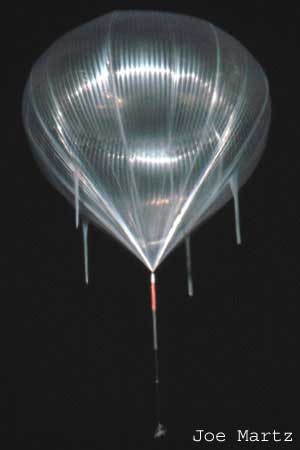
Well, like already pointed out, not too many people live in Antarctica, so not too many. But these types of balloons are launched relativly often from other locations as well, and some of the time, yes, they are reported as UFOs. When BLAST flew its test flight from Ft. Sumner, NM, it was reported as a UFO in the Santa Fe area after it flew overhead just after dark. The balloon is easy to see in the daytime, but is very small, so hard to notice. Just after dark (on the ground), the balloon is still in the sunlight (since it is so high), and therefore lit up and hard to miss. In fact, this photo was taken by an amateur astronomer (Joe Martz) in Santa Fe of BLAST at float (the same time people were calling it in as a UFO). -
Re:Tofu?
This sounds pretty close to "not an animal." Yes, it starts with a sample from an animal, usually a cow. It currently also needs animal products which do not necesarilly come from slaughtering the animal, but it will in theory become more and more possible and then eventually cost effective to find synthetic replacements for these compounds.
This product might fall under the "really creepy" category for most people, but carries minimal animal suffering. I really don't think the majority of people would mind this product, as long as the taste/texture is good (not even necesarilly identical to "traditional" meat) and the price is not much more than traditional cheap meat -
NoticeNotice how the Earth pulls on the moon, and on anything dangling from its surface towards the Earth? Ever notice how you go around criticizing ideas about which you don't know shit?
Third google result, including a diagram.
In 10 seconds with google, all this knowledge could have been yours. But that's okay -- I'm sure ignorance is a good choice too. You're American, huh?
-
By that time...
We'll be a Type III Civilization and we will be able to push the moon back into orbit.
-
Other impossibles...
It was impossible for comets to glow by themselves, let alone in ultraviolet, but they do.
It was impossible for a 25cm remnant to remain from the object forming a 43km wide impact crater on Earth, but it did.
It was impossible for a flat channel 3000km long to form, but Valles Marineris exists on Mars, 10km deep and 90km wide and more. Carved by what? Hardly water, since roughly half of the carving was done uphill.
These are a few of the many impossible things which exist apparently for our collective puzzlement. Many. -
Re:You got some stuff wrong there, chief
It can reasonably be disputed based on our current evidence.
Are there any peer-reviewed published articles that argue we are not causing global warming?the fact he is giving the NOAA extra money for research rather than prevention is quite interesting
Congress cut that funding. NASA's science missions have also been cut, even though the spacecraft is built.
Bush talks about doing more research, while cutting funding for that research. It's pretty obvious.