Slashdot Mirror
Domain: uoregon.edu
Stories and comments across the archive that link to uoregon.edu.
Comments · 320
-
Re:You have you facts confused
Technically O is 1s(2) 2S(2) 2P(4)
H is 1S(1)
Right, so when they bond you end up with the oxygen's valence orbital looking like this:
2s:
3p:
(those should be up arrows and down arrows, representing the electron spin pairs.
Each hydrogen atom's valence orbital will look like this:
1s:
(again this is an up arrow and down arrow, representing the spin-paired electrons)
Because these orbitals are hybridized they end up as sp3 (sp superscript 3) hybrid orbitals, with oxygen as the central atom. Here is a non-wikki website illustrating just how this works out.
The actual electronegativity delta between O and H disregarding all other factors is 1.34 not 1.4...
Without the aformentioned polar covalency ( see your post) which is just a fancy term for a covalent bond with SIGNIFIGANT ionic properties
Using the most accurate values I can find without digging out a CRC Handbook (I'm not near one right now) oxygen has Pauling electronegativity of 3.44, hydrogen has a Pauling electronegativity of 2.20. This means that the difference between the two is actually 1.24. So we are both off a bit but nonetheless we are far below where a molecule is considered to be ionic in quality. That happens at a difference of around 2.0. Despite what you think there is NO WAY a chemist is going to consider this bond to even remotely be ionic. Even at a difference of 2.0 the ionic character is considered to be just slightly better than 50%.
Now are you a chemist or a student who will be when he grows up one day? Not to be terribly harsh but when you put a smiley after you IAAC and use wiki for citations on scientific matters I start to have my doubts.
I am an analytical chemist who has worked in industry for over 10 years. I have a BS in Chemistry, working on an MS in Chemistry with a concentration in Analytical Chemistry. I put the smiley after the IAAC to indicate that I wasn't trying to beat people over the head with my credentials and the wikki reference was used simply because it was a fairly decent explanation of the subject without getting too deep into the science to be over the heads of the layman.
I deal with and build laser systems (so I know a little something practically about atomic valances and their quantium states) as part of my part time job as a security consultant and the rest of my time I spend in seminary or writing medical database applications.
I'm glad that you have small knowledge of chemistry and physics. However, this does not make you an expert in chemistry. While my explanations here have sided with keeping things simple for the layman rest assured that I have worked with this sort of material for the better part of 20 years, counting undergraduate work, graduate work, and real-world work in research laboratories. I would no more pretend to completely understand the ins and outs of security consulting (though I do program extensively and dabble in IS myself) than you should pretend to be an expert in chemistry. -
Soundscape studies did this decades agoSince this is a rerun story, I'm going to repost myself from a few weeks back:
Hildegard Westerkamp wrote about Walkmans and personal audio space as a key part of her 1988 thesis "Listening and Soundmaking-A Study of Music-as- Environment", but the World Soundscape Project generally had a pretty good analysis of this right from the beginning of the phenomenon.
Now I don't know that Bull has ignored soundscape studies in general, but it is the true home of sound nerds who move beyond the engineering and get into the social, psychophysics, and ecological aspects of sound, and the article should have mentioned it at least. If you're interested in the field at all, you need to check out the World Forum for Acoustic Ecology, where this stuff is hashed out on many levels.The composer R. Murray Shafer's concept of "schizophonia" became used to describe an effect of electroacoustic tech: essentially something you hear that happens in another place and time. Barry Truax's definitive book Acoustic Communication develops the whole idea further.
The thing about PLD's is that they supplant the actual soundscape with a soundtrack, often a remedy to noise and stress but usually just fun. There may be a long-term chronic danger from extreme schizophonia, but I don't think it's been studied empirically. Soundscape studies is fringe, most of the work being done in the area is engineering and psych.
-
Dragon with Flame Thrower Picture
Someone had to do it sooner or later, so I thought that I would be the first. Flame throwing dragon.
Sadly the perpetrator got away as he unplugged the power cord from the 18,000 dollar flame throwing "dragon."
Original images from:
http://mpolak.neostrada.pl/gfx/gfx_yourart/steven/ steven/flamethrower.jpg
http://radio.weblogs.com/0105910/2004/03/06.html -
Todays lecture is on electromagnetic radiation....
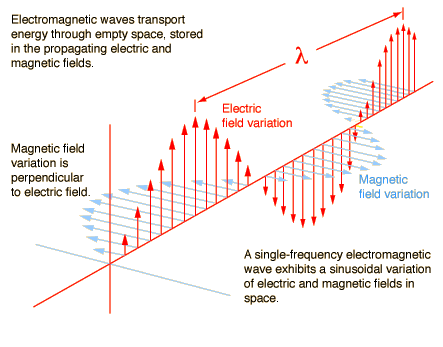
Electromagnetic waves are self-propetuating in that the electric field creates a magnetic field which re-creates the electric field. All EM waves travel at the speed of light and their frequency corrisponds to how fast the radiation changes polarity. The speed of the wave (c = 3*10^8 m/s) is equal to the frequency * wavelength. The wavelength of Terahertz radiation is between 1mm and
Xrays, Ultra-violet, Visible Light, Infared, Microwave, Radar, UHF, VHF and FM/AM radio all corrispond to different frequencies of electromagnetic radiation with wavelengths from 10 picometers to 10 kilometers. If you want to know more take a physics course on electromagnetism, as it is very interesting material. -
Todays lecture is on electromagnetic radiation....
Electromagnetic waves are self-propetuating in that the electric field creates a magnetic field which re-creates the electric field. All EM waves travel at the speed of light and their frequency corrisponds to how fast the radiation changes polarity. The speed of the wave (c = 3*10^8 m/s) is equal to the frequency * wavelength. The wavelength of Terahertz radiation is between 1mm and
Xrays, Ultra-violet, Visible Light, Infared, Microwave, Radar, UHF, VHF and FM/AM radio all corrispond to different frequencies of electromagnetic radiation with wavelengths from 10 picometers to 10 kilometers. If you want to know more take a physics course on electromagnetism, as it is very interesting material. -
Eurekalert... More information
I only took a year's worth of physics (with one semester on electromagnetism), but this sounded very interesting so I went looking for more information. I stumbled upon a couple other articles that give a lot more information about the split ring structure, manufacturing technique, and scientific significance.
"In normal materials the constituent atoms and molecules determine electrical and magnetic properties; they are much smaller than the wavelength of light so only the average response of the atoms matters. In the new materials an intermediate or meta-structure is engineered on a scale somewhere between atomic dimensions and the wavelength of radiation. The properties of metamaterials are not limited by the periodic table and scientists can now engineer a huge range of electromagnetic responses that can be tailored to anything allowed by the laws of electromagnetism..."
The first design for a magnetic metamaterial was the 'Split Ring' structure. "A simple, plain ring of metal gives a magnetic response, but in the wrong direction....By cutting the ring the flow of current is interrupted by capacitance across the gap which, together with the inductance of the ring, makes a tuned circuit whose resonant frequency is determined by the inductance and capacitance. It is well known that a resonant structure responds with opposite signs on either side of the resonant frequency. Hence by tuning through the resonance the desired negative magnetic response is obtained: positive or negative."
The split ring structure "looks like a small letter 'C' inside a larger letter 'C', with the smaller C turned to face the opposite direction...many Split Rings brought together in organized 2D or 3D grids form a magnetic metamaterial." The material can be tuned for specific frequencies by changing the size and layout of the split rings. Here are metamaterials tuned to microwave frequencies, and the Terahertz materials used "a special 'photo-proliferated process' that deposited the 3 micrometer-wide (0.003 mm) copper rings on a quartz base."
Pretty cool stuff..."So far we have only seen negative refraction at microwave or GHz frequencies but some of the most exciting applications in sensing, communication, and data storage would be at higher frequencies... But the really valuable applications have yet to be dreamt of. Think back to when the first lasers were made, the reaction was that they were just incredible, but what the hell would we do with them?" -
Current ideas erupt concurrentlyIf something's in the air, it's only natural that people working on the same problem will be influenced by the ideas that are already out there, then come to the same or similar conclusions. Not all the duplication in blogs is unethical, nor would it be fair to characterize it as mere coincidence.
Just one typical example: After finishing a grad thesis, then going to a conference to give a lecture, I sat through an excruciating keynote that preceeded my presentation. Not that it was boring or bad, it just stated some of my core themes, and came to conclusions that, when I was writing, I thought were rare, if not unique. I distinctly remember my supervisor sitting two rows in front of me turning around to give me the ol' raised eyebrows look, as if to say, "did you plagiarize her?" and me shrugging deflatedly.
[aside: the conference in question was "The Tuning of the World" and the keynote was "Silence and the Notion of the Commons" by Ursula Franklin. While I was honoured to be in illustrious company, I felt badly upstaged.]
-
Re:Silencewhat kind of a world would we be in if silence becomes patented?
Noisy.
It doesn't really matter, anyway, silence (meaning quiet, really) has suffered the "tragedy of the commons" and barely exists. There are almost no acoustic wildernesses left (where you can't hear internal combustion, eg.) and silence has become a golden commodity reflected in real estate values and construction techniques. We're habituated to the constant hum of fans and machinery and all policy decisions on the topic are oriented towards noise reduction, not quiet protection; technological solutions are generally oriented towards masking or reduction, not noise elimination.
In communication studies, silence is like the water we fish swim in: everyone notices it's there, but almost no-one studies it. Without some degree of relative silence, acoustic communication is impossible. We've traded some of that away for progress, and the results are subtle but disturbing.
-
Re:Meteorite?
It could have come from the meteor, but I think that volcanic activity might be more likely. I'm not sure though, I'm straining to remember my college geology courses, but the important thing to put this in context is Bowen's Reaction Series (explanations from U. Florida, U. Oregon, Skidmore, Florida State U., Google). Basically, this model describes (quoting from the U. Oregon page):
Bowen determined that specific minerals form at specific temperatures as a magma cools. At the higher temperatures associated with
mafic and intermediate magmas, the general progression can be separated into two branches. The continuous branch describes the evolution of the plagioclase feldspars as they evolve from being calcium-rich to more sodium rich. The discontinuous branch describes the formation of the mafic minerals olivine, pyroxene, amphibole, and biotite mica. The weird thing that Bowen found concerned the discontinuous branch. At a certain temperature a magma might produce olivine, but if that same magma was allowed to cool further, the olivine would "react" with the residual magma, and change to the next mineral on the series (in this case pyroxene). Continue cooling and the pyroxene would convert to amphibole, and then to biotite. Mighty strange stuff, but if you consider that most silicate minerals are made from slightly different proportions of the same 8 elements, all we're really doing here is adjusting the internal crystalline lattice to achieve stability at different temperatures. Really no big deal.
At lower temperatures, the branches merge and we obtain the minerals common to the felsic rocks -- orthoclase feldspar, muscovite mica, and quartz (the banana slug of the mineral world).
So basically, the assumption begins by pointing out that the Earth's crust mainly has eight elements present. By mass, they are oxygen (46.6%), silicon (27.7%), aluminum (8.1%), iron (5.0%), calcium (3.6%), sodium (2.8%), potassium (2.6%), and magnesium (2.1%). I suspect, but am not positive, that the proportions of elements in this cocktail will be similar for most of the solar system's rocky planets, so Mars should more or less obey the same rules.
Those of you that remember your high school chemistry will notice that, of these top eight elements, all but oxygen are metals or metalloids, so they all will want to bond with a non-metal -- and hey presto, there's plenty of oxygen to go around. As a result, nearly all of the minerals in the Earth's crust are composed of oxygen bonded to one or more metals. But which? This is where Bowen's reaction series comes in.
Given a roughly uniform cocktail of the top eight elements present in a magma flow, you have a range of different minerals that can form as the magma cools & solidifies. If the magma was very hot, it will solidify into olivine, which has a complex crystalline structure. If the magma was cooler, it would solidify into some simpler mineral, down to quartz for the lowest temperature magmas.
Moreover, Bowen's reaction series also sheds light on how materials will break down over the course of millenia of weathering -- basically, they'll tend to keep breaking down into simpler & simpler minerals, until eventually you just have quartz. A
-
Re:Meteorite?
It could have come from the meteor, but I think that volcanic activity might be more likely. I'm not sure though, I'm straining to remember my college geology courses, but the important thing to put this in context is Bowen's Reaction Series (explanations from U. Florida, U. Oregon, Skidmore, Florida State U., Google). Basically, this model describes (quoting from the U. Oregon page):
Bowen determined that specific minerals form at specific temperatures as a magma cools. At the higher temperatures associated with
mafic and intermediate magmas, the general progression can be separated into two branches. The continuous branch describes the evolution of the plagioclase feldspars as they evolve from being calcium-rich to more sodium rich. The discontinuous branch describes the formation of the mafic minerals olivine, pyroxene, amphibole, and biotite mica. The weird thing that Bowen found concerned the discontinuous branch. At a certain temperature a magma might produce olivine, but if that same magma was allowed to cool further, the olivine would "react" with the residual magma, and change to the next mineral on the series (in this case pyroxene). Continue cooling and the pyroxene would convert to amphibole, and then to biotite. Mighty strange stuff, but if you consider that most silicate minerals are made from slightly different proportions of the same 8 elements, all we're really doing here is adjusting the internal crystalline lattice to achieve stability at different temperatures. Really no big deal.
At lower temperatures, the branches merge and we obtain the minerals common to the felsic rocks -- orthoclase feldspar, muscovite mica, and quartz (the banana slug of the mineral world).
So basically, the assumption begins by pointing out that the Earth's crust mainly has eight elements present. By mass, they are oxygen (46.6%), silicon (27.7%), aluminum (8.1%), iron (5.0%), calcium (3.6%), sodium (2.8%), potassium (2.6%), and magnesium (2.1%). I suspect, but am not positive, that the proportions of elements in this cocktail will be similar for most of the solar system's rocky planets, so Mars should more or less obey the same rules.
Those of you that remember your high school chemistry will notice that, of these top eight elements, all but oxygen are metals or metalloids, so they all will want to bond with a non-metal -- and hey presto, there's plenty of oxygen to go around. As a result, nearly all of the minerals in the Earth's crust are composed of oxygen bonded to one or more metals. But which? This is where Bowen's reaction series comes in.
Given a roughly uniform cocktail of the top eight elements present in a magma flow, you have a range of different minerals that can form as the magma cools & solidifies. If the magma was very hot, it will solidify into olivine, which has a complex crystalline structure. If the magma was cooler, it would solidify into some simpler mineral, down to quartz for the lowest temperature magmas.
Moreover, Bowen's reaction series also sheds light on how materials will break down over the course of millenia of weathering -- basically, they'll tend to keep breaking down into simpler & simpler minerals, until eventually you just have quartz. A
-
Re:Meteorite?
It could have come from the meteor, but I think that volcanic activity might be more likely. I'm not sure though, I'm straining to remember my college geology courses, but the important thing to put this in context is Bowen's Reaction Series (explanations from U. Florida, U. Oregon, Skidmore, Florida State U., Google). Basically, this model describes (quoting from the U. Oregon page):
Bowen determined that specific minerals form at specific temperatures as a magma cools. At the higher temperatures associated with
mafic and intermediate magmas, the general progression can be separated into two branches. The continuous branch describes the evolution of the plagioclase feldspars as they evolve from being calcium-rich to more sodium rich. The discontinuous branch describes the formation of the mafic minerals olivine, pyroxene, amphibole, and biotite mica. The weird thing that Bowen found concerned the discontinuous branch. At a certain temperature a magma might produce olivine, but if that same magma was allowed to cool further, the olivine would "react" with the residual magma, and change to the next mineral on the series (in this case pyroxene). Continue cooling and the pyroxene would convert to amphibole, and then to biotite. Mighty strange stuff, but if you consider that most silicate minerals are made from slightly different proportions of the same 8 elements, all we're really doing here is adjusting the internal crystalline lattice to achieve stability at different temperatures. Really no big deal.
At lower temperatures, the branches merge and we obtain the minerals common to the felsic rocks -- orthoclase feldspar, muscovite mica, and quartz (the banana slug of the mineral world).
So basically, the assumption begins by pointing out that the Earth's crust mainly has eight elements present. By mass, they are oxygen (46.6%), silicon (27.7%), aluminum (8.1%), iron (5.0%), calcium (3.6%), sodium (2.8%), potassium (2.6%), and magnesium (2.1%). I suspect, but am not positive, that the proportions of elements in this cocktail will be similar for most of the solar system's rocky planets, so Mars should more or less obey the same rules.
Those of you that remember your high school chemistry will notice that, of these top eight elements, all but oxygen are metals or metalloids, so they all will want to bond with a non-metal -- and hey presto, there's plenty of oxygen to go around. As a result, nearly all of the minerals in the Earth's crust are composed of oxygen bonded to one or more metals. But which? This is where Bowen's reaction series comes in.
Given a roughly uniform cocktail of the top eight elements present in a magma flow, you have a range of different minerals that can form as the magma cools & solidifies. If the magma was very hot, it will solidify into olivine, which has a complex crystalline structure. If the magma was cooler, it would solidify into some simpler mineral, down to quartz for the lowest temperature magmas.
Moreover, Bowen's reaction series also sheds light on how materials will break down over the course of millenia of weathering -- basically, they'll tend to keep breaking down into simpler & simpler minerals, until eventually you just have quartz. A
-
Re:Meteorite?
It could have come from the meteor, but I think that volcanic activity might be more likely. I'm not sure though, I'm straining to remember my college geology courses, but the important thing to put this in context is Bowen's Reaction Series (explanations from U. Florida, U. Oregon, Skidmore, Florida State U., Google). Basically, this model describes (quoting from the U. Oregon page):
Bowen determined that specific minerals form at specific temperatures as a magma cools. At the higher temperatures associated with
mafic and intermediate magmas, the general progression can be separated into two branches. The continuous branch describes the evolution of the plagioclase feldspars as they evolve from being calcium-rich to more sodium rich. The discontinuous branch describes the formation of the mafic minerals olivine, pyroxene, amphibole, and biotite mica. The weird thing that Bowen found concerned the discontinuous branch. At a certain temperature a magma might produce olivine, but if that same magma was allowed to cool further, the olivine would "react" with the residual magma, and change to the next mineral on the series (in this case pyroxene). Continue cooling and the pyroxene would convert to amphibole, and then to biotite. Mighty strange stuff, but if you consider that most silicate minerals are made from slightly different proportions of the same 8 elements, all we're really doing here is adjusting the internal crystalline lattice to achieve stability at different temperatures. Really no big deal.
At lower temperatures, the branches merge and we obtain the minerals common to the felsic rocks -- orthoclase feldspar, muscovite mica, and quartz (the banana slug of the mineral world).
So basically, the assumption begins by pointing out that the Earth's crust mainly has eight elements present. By mass, they are oxygen (46.6%), silicon (27.7%), aluminum (8.1%), iron (5.0%), calcium (3.6%), sodium (2.8%), potassium (2.6%), and magnesium (2.1%). I suspect, but am not positive, that the proportions of elements in this cocktail will be similar for most of the solar system's rocky planets, so Mars should more or less obey the same rules.
Those of you that remember your high school chemistry will notice that, of these top eight elements, all but oxygen are metals or metalloids, so they all will want to bond with a non-metal -- and hey presto, there's plenty of oxygen to go around. As a result, nearly all of the minerals in the Earth's crust are composed of oxygen bonded to one or more metals. But which? This is where Bowen's reaction series comes in.
Given a roughly uniform cocktail of the top eight elements present in a magma flow, you have a range of different minerals that can form as the magma cools & solidifies. If the magma was very hot, it will solidify into olivine, which has a complex crystalline structure. If the magma was cooler, it would solidify into some simpler mineral, down to quartz for the lowest temperature magmas.
Moreover, Bowen's reaction series also sheds light on how materials will break down over the course of millenia of weathering -- basically, they'll tend to keep breaking down into simpler & simpler minerals, until eventually you just have quartz. A
-
Re:Meteorite?
It could have come from the meteor, but I think that volcanic activity might be more likely. I'm not sure though, I'm straining to remember my college geology courses, but the important thing to put this in context is Bowen's Reaction Series (explanations from U. Florida, U. Oregon, Skidmore, Florida State U., Google). Basically, this model describes (quoting from the U. Oregon page):
Bowen determined that specific minerals form at specific temperatures as a magma cools. At the higher temperatures associated with
mafic and intermediate magmas, the general progression can be separated into two branches. The continuous branch describes the evolution of the plagioclase feldspars as they evolve from being calcium-rich to more sodium rich. The discontinuous branch describes the formation of the mafic minerals olivine, pyroxene, amphibole, and biotite mica. The weird thing that Bowen found concerned the discontinuous branch. At a certain temperature a magma might produce olivine, but if that same magma was allowed to cool further, the olivine would "react" with the residual magma, and change to the next mineral on the series (in this case pyroxene). Continue cooling and the pyroxene would convert to amphibole, and then to biotite. Mighty strange stuff, but if you consider that most silicate minerals are made from slightly different proportions of the same 8 elements, all we're really doing here is adjusting the internal crystalline lattice to achieve stability at different temperatures. Really no big deal.
At lower temperatures, the branches merge and we obtain the minerals common to the felsic rocks -- orthoclase feldspar, muscovite mica, and quartz (the banana slug of the mineral world).
So basically, the assumption begins by pointing out that the Earth's crust mainly has eight elements present. By mass, they are oxygen (46.6%), silicon (27.7%), aluminum (8.1%), iron (5.0%), calcium (3.6%), sodium (2.8%), potassium (2.6%), and magnesium (2.1%). I suspect, but am not positive, that the proportions of elements in this cocktail will be similar for most of the solar system's rocky planets, so Mars should more or less obey the same rules.
Those of you that remember your high school chemistry will notice that, of these top eight elements, all but oxygen are metals or metalloids, so they all will want to bond with a non-metal -- and hey presto, there's plenty of oxygen to go around. As a result, nearly all of the minerals in the Earth's crust are composed of oxygen bonded to one or more metals. But which? This is where Bowen's reaction series comes in.
Given a roughly uniform cocktail of the top eight elements present in a magma flow, you have a range of different minerals that can form as the magma cools & solidifies. If the magma was very hot, it will solidify into olivine, which has a complex crystalline structure. If the magma was cooler, it would solidify into some simpler mineral, down to quartz for the lowest temperature magmas.
Moreover, Bowen's reaction series also sheds light on how materials will break down over the course of millenia of weathering -- basically, they'll tend to keep breaking down into simpler & simpler minerals, until eventually you just have quartz. A
-
Re:Meteorite?
It could have come from the meteor, but I think that volcanic activity might be more likely. I'm not sure though, I'm straining to remember my college geology courses, but the important thing to put this in context is Bowen's Reaction Series (explanations from U. Florida, U. Oregon, Skidmore, Florida State U., Google). Basically, this model describes (quoting from the U. Oregon page):
Bowen determined that specific minerals form at specific temperatures as a magma cools. At the higher temperatures associated with
mafic and intermediate magmas, the general progression can be separated into two branches. The continuous branch describes the evolution of the plagioclase feldspars as they evolve from being calcium-rich to more sodium rich. The discontinuous branch describes the formation of the mafic minerals olivine, pyroxene, amphibole, and biotite mica. The weird thing that Bowen found concerned the discontinuous branch. At a certain temperature a magma might produce olivine, but if that same magma was allowed to cool further, the olivine would "react" with the residual magma, and change to the next mineral on the series (in this case pyroxene). Continue cooling and the pyroxene would convert to amphibole, and then to biotite. Mighty strange stuff, but if you consider that most silicate minerals are made from slightly different proportions of the same 8 elements, all we're really doing here is adjusting the internal crystalline lattice to achieve stability at different temperatures. Really no big deal.
At lower temperatures, the branches merge and we obtain the minerals common to the felsic rocks -- orthoclase feldspar, muscovite mica, and quartz (the banana slug of the mineral world).
So basically, the assumption begins by pointing out that the Earth's crust mainly has eight elements present. By mass, they are oxygen (46.6%), silicon (27.7%), aluminum (8.1%), iron (5.0%), calcium (3.6%), sodium (2.8%), potassium (2.6%), and magnesium (2.1%). I suspect, but am not positive, that the proportions of elements in this cocktail will be similar for most of the solar system's rocky planets, so Mars should more or less obey the same rules.
Those of you that remember your high school chemistry will notice that, of these top eight elements, all but oxygen are metals or metalloids, so they all will want to bond with a non-metal -- and hey presto, there's plenty of oxygen to go around. As a result, nearly all of the minerals in the Earth's crust are composed of oxygen bonded to one or more metals. But which? This is where Bowen's reaction series comes in.
Given a roughly uniform cocktail of the top eight elements present in a magma flow, you have a range of different minerals that can form as the magma cools & solidifies. If the magma was very hot, it will solidify into olivine, which has a complex crystalline structure. If the magma was cooler, it would solidify into some simpler mineral, down to quartz for the lowest temperature magmas.
Moreover, Bowen's reaction series also sheds light on how materials will break down over the course of millenia of weathering -- basically, they'll tend to keep breaking down into simpler & simpler minerals, until eventually you just have quartz. A
-
Re:One glaring problem
Good point! I'm sure there are plans for keeping the astronauts warm. There are a few ways I can think of, but alas, I'm not a scientist but I'll give it a try. I have started by looking at the atmosphere on Mars. So, I researched that on this site. So, I see that the atmosphere is mainly Carbon Dioxide 95.3%, 2.7% Nitrogen, 1.6% Argon, and only 0.13% Oxygen. The atmospheric pressure on Mars is much thinner than the Earth- roughly 1/100th than the surface of the Earth. The warmest regions on Mars ranges from 17 degrees (F) to -170 at the caps. However the warmer regions have been reported to be as high as 30 degrees (Mars Global Surveyor). We will land in the mid-latitude warm region. Now that we are there we can set up camp. We need the basic needs: food, water, shelter. A Hydroponic Farm will be built from the modules that were landed there autonomously prior to arrival, also meat will be on the surface waiting to be eaten, here the temperature comes to our advantage. Water can be recycled from urine and from prior deliveries along with the modules. Shelter will also be modular and be assembled by the first pioneers, I figure we need about 12 people to land on Mars together to get this work done. Heat can be generated from fuel that we have transported from Earth. There has to be many supply missions to Mars before we land. Everything needs to be ready for us. Their mission will be to assemble the first Martian colony. The supplies will keep coming. The next group will relieve the first, perhaps one or two will volunteer to stay awhile. The cycle continues, and before you know it- you have colonized Mars, complete with the first native Martian baby. Eventually, we will plant the first seeds for terraforming the planet. Not an easy task, not a fast one either. But with the proper infrastructure it can get started
m l -
Re:Viruses, Worms, and Exploits Are... Where?
Most definitely. I think these numbers will finally silence those misguided idiots who continue to say that Apache doesn't get exploited as much because "it's less popular" or "it's not used by anyone" or "it's written by a bunch of unpaid amateurs". Apache gets used because it's clean, simple, reliable, robust, and most importantly, EASY TO CONFIGURE.
If 2003 was the Year of Apache, then 2004 will be the Year of the LAMP. -
Re:Yeah, but we don't really know...
> Earthlings's sending their gas guzzlers to ruin their clean air.
Yeah, they have enough CO2 already! -
Re:Trademarks and HistoryIt isn't like it is some huge leap of logic, just because the name of something has become so common that people may not even know the name of the real product.
If a name becomes so common that people don't know it's a trademark, the trademark is lost. Aspirin is the earliest example I can think of.
-
Re:A Hoax? To What End?
Tolkien made up his own language for the fun of it
More accurately, Tolkien made up multiple languages for the fun of it. Tolkien's writings on Middle Earth contain at least 7 well-developed fabricated languages:- Quenya (old/formal Elvish)
- Sindaran (modern/conversational Elvish)
- Adunaic (the language of Numenor)
- Westron (The Common Tongue, a descendant of Anduic)
- Rohirric (Language of Rohan, an offshoot of Anduic)
- The Black Speech of Mordor (Orcish)
- Khuzdul (Dwarvish)
The dialect of Westron used in The Shire and Bree (Soval Phare) could be considered a seperate language as well. There are several other languages mentioned or alluded to, but which are minimally developed in grammar and vocabulary (EG, Old Entish, Valarin). A good resource for learning more about Tolkien's linguistics is online at http://babel.uoregon.edu/yamada/guides/tolkien.ht
m l -
Re:Suggestion: Venus
This is your space probe on Earth, then on Venus.
I wish I could find the sequence I saw in an old astronomy textbook of mine. It was four or five photos, and by the fifth one, the visible parts of the lander had been reduced to a pile of slag. -
Re:Bill Gates once said...
Basically, I have no problem with what Gore said. It's just as stupid, both in and out of context, as many things folks such as Dan Quayle have said. The annoying thing is that when a liberal such as Gore says something stupid there are a bunch of apologetics trying to make him look less stupid. But when Dan Quayle or George Bush says something stupid it's either evidence of stupidity or an evil conspiracy. It's a double standard.
I make my living talking in front of people, and I know as well as anyone that anybody speaking off the cuff can fluff a word, or stumble on a syllable, or (as Gore did) use ambiguous wording. In fact, it's often an indication of intelligence - bright people's brains and mouths are operating extremely asynchronously. However, nobody with the rudiments of a brain and a modern education would ever come up with a howler such as Quayle's infamous Mars quote. And yes, he really did say that. It was in a press briefing in his role as nominal head of NASA, one of the duties of the VP. (Needless to say, his handlers cut the interview short.)
I don't see a double standard, I see one raving loony and one bright fellow who strongly supported the development of the internet long before it was popularly recognized as a big idea, and used ambiguous wording to say so.
-
Re:Next StepWhy put trillions into space colonization when a simple reorganization of priorities here on Earth would cost less and provide far more benefits
Yes, I personally know a certain $87 billion that was much better spent here.
Seriously though, this arguement is an endless loop. There will ALWAYS be problems here on earth. People will ALWAYS say things were better in the past/things need to be improved now, because many believe that eventually everything will be 'perfect'.
The effort must not be one of colonization, but of terra-forming. Mars has no atmosphere because it is too light.
In case you weren't aware, Mars does have an atmosphere albeit light. There is 30 times more CO2 in Mars atmosphere than our own.
There are always going to be problems with planets other than mother earth, perhaps that is why there is no life anywhere else in the solar system. That stated, there is some sufficent evidence that there is water frozen underneath the poles which is at least a start, and probably our best chance for outer-earth colonization.
-
Game of life?:/
why? Why not this then:
% cat
Hello, world.
^D
source
-
Re:A thinly veiled political rant, actually
, 1. Novak looks into "yellow-cake" incident. 2. Novak wonders why a Clinton-appointee was sent on a highly sensitive mission. 3. Novak contacts Wilson and asks him why he was chosen. 4. Wilson says he was sent because of the influence of his wife - who is a WMD expert analyst for the CIA.
This is from Talking Points Memo:Bob Novak is is now saying that his source says that Valerie Plame was an "analyst" and not an "operative" at the CIA. Joe Wilson remembers their conversation in July a bit differently. According to what Wilson told TPM early Monday evening, when Novak first contacted him in July, he told him that he had a CIA source that told him that Wilson's wife, Valerie Plame, was a "CIA operative." Would Wilson confirm it? Wilson declined to discuss the matter, as Novak's original article made clear. When Novak's article appeared, it sourced the story to "two senior administration officials."
5. Novak - now knowing that the wife is an employee of the CIA contacts administration officals to verify Wilsons story. 6. Administration officals believing that Novak already knew that the wife was a CIA Agent (he did) and that she was "covered" as part of another government agency (he didn't know that yet) confirmed Wilson's story that he was sent to Niger due to the influence of his wife - a long time CIA employee.
According to a newsday article on July 22:Novak, in an interview, said his sources had come to him with the information. "I didn't dig it out, it was given to me," he said. "They thought it was significant, they gave me the name and I used it."
Novak is a lying sack of shit. He's trying to cover his ass, which is to be expected given the scandal that has erupted.As for jobs, no, the president does not determine the unemployment rate. But he can influence it. I don't want to go into too much detail, but sometimes aggregate demand needs a boost, which government can provide by either directly creating jobs (like the WPA in the 1930's or the military buildup in the 1940s and again in the 1980s, all of which substantially reduced unemployment) or by getting money into the hands of people who will spend it. This would mean normal people, not the ultra-rich who benefit from Bush's tax cut ($400 checks notwithstanding).
The most striking example of government reducing unemployment was in Nazi Germany. When Hitler took over in 1933, unemployment was around %40 percent, under a laissez faire government. 3 years later, it was essentially nothing. (disclaimer - Hitler was a bad, bad man, not someone to be emulated. But it proves the point that government is not helpless).
5 things Clinton did right: Acted sane and responsible (economically), didn't screw things up. He opened up more free trade and balanced the budget. Mainly, he stayed out of the way and American business created the jobs. He was lucky to be president in the 1990s, when unemployment was not a problem. (if Bush had been president in the '90s he may have been adequate, but that really doesn't matter)5 things Bush did wrong: Cut taxes on the rich instead of implementing a real stimulus package. Raised tariffs on steel, which only hurts our industries which *buy* steel. Brought back deficits as far as the eye can see. Failed to go after his buddies who rip off investors (think Enron), which frays the social contract necessary for people to do business.
Ok, that's only 4, but I have to go now. The first one is the really important one, and should be enough anyway. With a proper stimulus package, the recovery would probably be over and the economy would be back on track after what was really a relatively mild recession.
-
Re:Does this ver. solve the WinXP security "featur
We did this. It's the reg entry that's in the docs. Every machine that we attempted to connect has it. Thanks for trying though. Originally I found that information here:
The Samba unofficial HOWTO - 5.3. Joining your Samba Domain -
Re:What's wrong with Word with long documents?
Give TeXShop a spin. It's pretty spiffy, and also fairly easy to install. TeX (say it like "tech") is pretty powerful and was written for the needs of scientists more than anything, but it's great for documents where you value structure and content over presentation. It lets you focus almost purely on your content, and then renders it in a very readable fashion for consumption.
-
I call shenanigans!
You wanna see a plasma lamp?
If your at work, look up.
Those florescent lights are plasma lights with a phosphorus coating that absorbs the UV light emitted by the plasma and emits visible light. The plasma is created by applying high voltage to the electrodes.
Did you know that there is no such thing as a white fluorescent light?
The lights are shifted ever so slightly towards either the red green or blue spectrum. Thats why if you go into a older office building and look up you will likely notice that some of the lamps just don't look the same - look at it closely relative to the other lights and you can tell what color shift it has.
Neon lamps (I believe any noble gas will do), cold cathode lamps (the ones people install in their windowed computer cases), those cheesy globes that when you touch them lightning shaped light appears to be reaching for your finger - all plasma.
Read about plasma here:
http://www.prl.dcu.ie/expl.html
Here are the different ways to create plasma:
http://www.phys.tue.nl/EPG/epghome/polylab/sourc es
Or if you can find them - some of you probably remember these:
http://bulbmuseum.net/bulbs/figuralargon.htm
Noble gases:
http://www.theodoregray.com/PeriodicTable/Elemen ts
Anyway the real story here is the tools that they used to capture the data in the instant that is takes to turn on the lamps. I see nothing of intrest here esp. regarding 'life'.
The crap about life is garbage. Plasma is the fourth state of matter (solid, liquid, gas, plasma). They are not "reproducing" thereby mimicking life. Rather, they are merely converting an element from one physical state to another.
Quick theory:
Gas can not pass an electrical current because if the electrons (- charge) in the atom move then the rest of the atom goes along with including the + charged protons.
The electrical potential (voltage) has to be high enough such that the electrons begin to be ripped away from the atom itself. This exchange of energy causes the gas matter to change from a gas state to a plasma state and is called ionization. The emission of light (photons) is caused by the change in energy states. As you can see here..
http://zebu.uoregon.edu/~js/ast123/images/bohr_a to m.gif
When an electron jumps from one orbit to another energy must be released by the atom this energy is released in a form of a proton at a fixed wavelength relative to the distance of the state change (atom specific). If the wavelength falls into the visible range of the EM spectrum you'll be able to see it.
-
Re:Not "Revolutionary"
Official numbers are suspicious, since Pinochet still has imunnity in his country, but the majoity of sources I heard of speaks in 30,000
http://www.hansard.act.gov.au/hansard/1998/week08/ 2337.htm
http://www.thenewpress.com/newbooks/condor.htm
http://www.uoregon.edu/~caguirre/382_13.html -
speaking of james bond...
hey, check out this Sean Conneryizer. Connery is the one, true Bond, who likes his martinish shaken, not shtirred.
-
Re:Open to abuse
Google for "spam economics". Here are some of the links you'll find.
Even if I'm out by a factor of 40, my figures were based on a tiny 60,000 mails, and the only reason for this was the assumption that the ISP would be proactively monitoring traffic through its MTA or network in order to prevent policy violations, and would pick up attempts to send a number of messages unreasonably large for an opt-in list.
-
Re:sharpest ground-based images of Mars to date
Here's a working link: The surface of Venus.
-
Re:The bad taste of Appletalk
-
Why filtering isn't the solution
An analysis of filtering methods against spam is kind of like a comparison of bullet-proof vests in that there's no incentive to stop someone from pointing a gun at you and firing it. In the past, spammers have been grossly affected by more sweeping changes, and I'm afraid filtering methods are only creating the mindset of, "Give up, use this software, it will do the deleting for you." It takes the attitude of, "just delete the stuff" and makes it automatic; sure it's convenient for a time, but in a year you're still going to get spam and your ISP will likely have fewer resources to deal with the complaints.
I'm saying, why not focus instead on technology which puts a bigger dent in spammers' ability to operate, like how to secure against proxy hijacking. -
Sean Conneryizer!!!
Hey, check out I what found earlier in the day!
The Sean Conneryizer. -
Re:howard dean
Sorry I fucked up my post. Corrected version...
Sorry, you are incorrect. Back to my original example... you could say "I have red-blue trucks" [ref]. Or in your example, you could say "I hate small-minded, self-important people".
less likely to mean
There are no "likely"'s. There is a standard English. Note that I said "without context". Most people's use of incorrect grammar is ok, because there is context pointing to right meaning. -
Re:howard dean
Sorry, you are incorrect. Back to my original example... you could say "I have red-blue trucks" []. Or in your example, you could say "I hate small-minded, self-important people".
less likely to mean
There are no "likely"'s. There is a standard English. Note that I said "without context". Most people's use of incorrect grammar is ok, because there is context pointing to right meaning. -
New technology! Makes dupes interesting!!!
Hey, someone made a Sean Conneryizer that translates slashdot into Sean Connery speak! This makesh dupesh intereshting!!
-
Yeah, I got one of those emails too.
Except this is what it was: a trojan, but with an all new date, and an all new filename. Someone has just rereleased this baby.
Fortunately, a few things clued me in:
(1) It said it was from Microsoft. But the URL said from a Verizon ad.
(2) It called me a Microsoft Client. I've never felt so humiliated. I do *NIX or Mac.
(3) It claimed to fix ALL the known security flaws in Windows. This one should have been obvious.
(4) It was advertised to work on Win9x, ME, and 2000. My guess is that Microsoft doesn't do a whole lot for Win95 people who haven't upgraded. I could be wrong.
(5) It included an executable. [??? how did that slip past my ISP??? They normally strip executables.]
Anyhow, for those of you who use Windows, be aware [once again, and again and again] that those trojans are not to be run.
-
Re:Antropomorphic principle
The Antropomorphic principle is the name given by a tendency by us humans to believe that our situation is unique.
You spelled anthropomorphic wrong. However, had you spelled it correctly you still would have been wrong because anthropomorphism is the tendency to assign human characteristics to non-human items.
Perhaps you mean't the anthropic principle? -
Re:Ah, but does he mention that his amino acids...
From previous arguments I've had with you here on slashdot, I have surmised that you believe in creation, not evolution, and thus a young earth, etc. What I would like to know is what hardcore rock solid evidence do YOU have that YOUR ideas are not just like every other fairy tale? Seriously, I'd like to know. All I ever see you do is harp on any possible slight imperfection in science and use that as your evidence, which is completely circumstantial. In other words, where is the data that shows that life couldn't have begun from such amino acids in a natural primordial environment like the experiment suggests, and that evolution didn't occur. And if it exists, has it been published in a peer-reviewed, respectable scientific journal? Sorry to sound bitchy, but that's just how I feel about such thinking.
Also, you are wrong about no evidence for a reducing atmosphere. The existance of iron deposits known as banded iron formations is the evidence you need. These deposits are sedimentary in nature, meaning that the iron was accumulating underwater near the surface. Had the atmosphere at the time been oxidizing (basically oxygen rich), these deposits could not have formed since iron would have combined with the oxygen in the atmosphere to form rust basically (hematite, Fe2O3). Instead, these formations are magnetite (Fe3O4), which contains the reduced form of iron, Fe(III). This is why the occurence of banded iron formations decreases and eventually dissapears sometime during the proterozoic (1.8 to 2 billion years ago seems to stick in my head) once the atmosphere became oxidizing. A nice short, but good explanation can be found here.
-
Re:what's the point?
do you really think they , mac users , will accustom them to m4 , groff , epn etc or anything built upon them?
Actually, there are many nice OS X applications that are build around unix programs:- Texshop is a wrapper around Latex.
- cocoaspell is a wrapper around the Unix spell checker aspell
- GPG Mail is a wrapper around the Gnu PGP implementation so that Mail.app can handle PGP.
The intersting thing is that the service menu is something very Unixish, many command line utilities would make good services. For those that don't know OS X, services are components that take the current selection and apply some treatement on them. There are services that search google, do text transformation, ec...
-
Re:How is it not a parody of Shortcake?
I would disagree. If a product name that is copyrighted enters American vernacular, the copyright becomes invalidated. I'm not making this up.
Consider the case of Xerox, they have all but lost the term xerox (oh no! I'm going to be sued!) to the general language of men. Check it out here.
As the article points out, the goal of advertising is to get people to purchase your product. And one of the best ways to do so is through brand recognition. But outstanding success in this area (such as the case with Xerox) will cause one to lose their trademark. (Like aspirin.) -
Re:Does it really matter?
Fixed link from parent post: Here.
-
SAMBA: oplocks = no?
Have you tried debugging the problem from the Samba side? There are a number of helpful configuration documents and mailing lists.
In one of the installations of Samba, as a replacement to Novell, I ran into a file locking/corruption problem. The problematic application was an ancient DOS scheduling program with multiple users. The solution turned out to be:
[DOS_SHARE_NAME]
oplocks = no
There are a couple of other options for file locking but that was the one that fixed our problem.
Other locking options:
strict locking = yes
kernel oplocks = no
level2 oplocks = no
the handy groups.google search
smb.conf man page
The Unofficial Samba HOWTO -
SAMBA: oplocks = no?
Have you tried debugging the problem from the Samba side? There are a number of helpful configuration documents and mailing lists.
In one of the installations of Samba, as a replacement to Novell, I ran into a file locking/corruption problem. The problematic application was an ancient DOS scheduling program with multiple users. The solution turned out to be:
[DOS_SHARE_NAME]
oplocks = no
There are a couple of other options for file locking but that was the one that fixed our problem.
Other locking options:
strict locking = yes
kernel oplocks = no
level2 oplocks = no
the handy groups.google search
smb.conf man page
The Unofficial Samba HOWTO -
Re:Good news
I was going to recommend a particular set of documentation on the Samba site but I can't find it. There seem to be a number of choices. Some of the documentation is included in the tar ball but not (easily) accessable on the website.
This new document looks good:
The Unofficial Samba HOWTO
(moderators: no need to mod this up, really, it won't get lost in the few posts here) -
If life is on Mars...
and fungi found on Earth. The most interesting thing, though, is that the
origin of such a Mars life form could probably not be Mars-based. On
Earth, we have mightily strained to hypothesize an origin of life in primordial
ocean soups and atmospheres
in the presence of electric sparks and self-assembling
molecules. These theories have been severely weakened
in recent years with the discovery of fossilized life forms on Earth with
an apparent age of 3.5+ billion years which, given the estimated age of the
Earth, would imply a much more rapid creation of life than the hypothesized
mechanisms would allow. If life is present on Mars, the Earth-origin
theories of life are weakened even further, in the absence of evidence for
the necessary atmospheres and oceans on Mars, and theories for extraterrestrial
origins of life would gain traction.
-
Re:Trademarks and loss of trademarks
I'm not interested in the why. While I would prefer to take the naive view you are taking, the courts have found that trademarks are diluted by generic use, and that unless active steps are taken to protect a trademark it can be diluted and eventually lost. The accepted legal term is genericide.
I must apologise that Xerox(R) is not a case in point - it managed to keep its trademark, as did Kleenex(R). Aspirin and thermos weren't so lucky. This is discussed in an article and reinforced by TSANet(R)'s trademark policy
(since they have been in past danger of trademark dilutionI don't like the way the world works
-
Soundscapes and Acoustic EcologyAcoustic ecology and soundscape studies try to puzzle out the whole relationship of humans to sound; this goes from physics to cultural stuff like music, and includes wierdness like how we respond to harmonics, sub/ultrasonics, and the like. Just a FYI since no-one else has mentioned this and it's core to the topic.
-
Soundscapes and Acoustic EcologyAcoustic ecology and soundscape studies try to puzzle out the whole relationship of humans to sound; this goes from physics to cultural stuff like music, and includes wierdness like how we respond to harmonics, sub/ultrasonics, and the like. Just a FYI since no-one else has mentioned this and it's core to the topic.