Slashdot Mirror
Domain: usda.gov
Stories and comments across the archive that link to usda.gov.
Comments · 710
-
Re:Isolation
We're still wasting a cool billion/year on rural electrification.
Actually, the requested fiscal year budget was six billion for rural electrification. And the value creation is much higher so waste is hard to argue. Do you have any specific sources for your assertions?
It hasn't wired a single new residence in 40 years.
The Rural Utilities Service doesn't wire residences, it provides funding to electrical cooperatives who provide service to residences, who have their home wired.
Did you think they were an electrician? Nope. Not a home builder either. For that, I believe you want Ben Carson and HUD. Maybe the Bureau of Indian Affairs, and the Base Housing authority.
All wasted money absorbed by rent seekers. It's never done.
Actually, that money put up over 19,000 miles of electric line, and lots of telecommunication work and more.
Really, if your intent is legitimate, there may be some grounds on which you can complain about the level of performance, you might have some useful critiques, if you ever bother to develop specifics, but your hyperbolic grandstanding ruins your case.
Lot of that going around.
-
Re:Isolation
We're still wasting a cool billion/year on rural electrification.
Actually, the requested fiscal year budget was six billion for rural electrification. And the value creation is much higher so waste is hard to argue. Do you have any specific sources for your assertions?
It hasn't wired a single new residence in 40 years.
The Rural Utilities Service doesn't wire residences, it provides funding to electrical cooperatives who provide service to residences, who have their home wired.
Did you think they were an electrician? Nope. Not a home builder either. For that, I believe you want Ben Carson and HUD. Maybe the Bureau of Indian Affairs, and the Base Housing authority.
All wasted money absorbed by rent seekers. It's never done.
Actually, that money put up over 19,000 miles of electric line, and lots of telecommunication work and more.
Really, if your intent is legitimate, there may be some grounds on which you can complain about the level of performance, you might have some useful critiques, if you ever bother to develop specifics, but your hyperbolic grandstanding ruins your case.
Lot of that going around.
-
Re:Isolation
We're still wasting a cool billion/year on rural electrification.
Actually, the requested fiscal year budget was six billion for rural electrification. And the value creation is much higher so waste is hard to argue. Do you have any specific sources for your assertions?
It hasn't wired a single new residence in 40 years.
The Rural Utilities Service doesn't wire residences, it provides funding to electrical cooperatives who provide service to residences, who have their home wired.
Did you think they were an electrician? Nope. Not a home builder either. For that, I believe you want Ben Carson and HUD. Maybe the Bureau of Indian Affairs, and the Base Housing authority.
All wasted money absorbed by rent seekers. It's never done.
Actually, that money put up over 19,000 miles of electric line, and lots of telecommunication work and more.
Really, if your intent is legitimate, there may be some grounds on which you can complain about the level of performance, you might have some useful critiques, if you ever bother to develop specifics, but your hyperbolic grandstanding ruins your case.
Lot of that going around.
-
Re: Plant a tree, save the Earth...
Great then I have a question: I've dreamed that sometime in my future I will be able to use this map as a guild line http://planthardiness.ars.usda... it's the hardiness map, to advise the US of where we need lighter colour pavement. so this leads to the question. how do you lighten pavement without changing slipperiness and or night driving issues?
-
Re:sounds like a shakedownBullshit.
Family farms comprise 99 percent of U.S. farms, accounting for 89 percent of production. Small farms make up 90 percent of farms, operating nearly half of farmland. Still, large family farms accounted for 42 percent of production in 2015.
-
Re:Maybe not such bad news
You might consider turning some of that patriotic service to your flag into service for your brain.
1) Food inflation barely outstrips COLA, to the tune of exactly squat for anyone that has COLA-adjusted benefits. At a whopping $4k/month in benefits, assuming you nonetheless spend the same 25% of that income on food that someone with much lower income spends, your $1000 from June last year should have been something like $1002. I don't think that $2 difference starves anyone to death at $4k/month.
2) Food-at-home inflation (yes, this exists) is LOWER than COLA and has been for some time, so 'the govmint' is only really stealing that $2 if we assume you get to eat out all the time.
3) COLA uses the CPI-W (Consumer Price Index for Urban Wage Earners and Clerical Workers) and has for decades. You may realize that many (most) of us live in cities and many (most) of us don't have manufacturing jobs. If you had used the more broad CPI for the last 25 years, instead of your $4k/mo you'd have a whopping $4250. I guess we are stealing another $2 a month out of your $4k. Or are you arguing we should make decisions for the entire economy based not on some attempt to get an accurate measure, but instead your anecdotal "gas costs went down, groceries & medicals went up"? Even when we know that groceries did not in fact go up?
electing one of the piss-poor candidates still trying to ru(i)n the country by pampering the rich while stealing (taxing) the poor into abject poverty.. At least Trump is honest on THAT issue.
Really? He has admitted he's doing that? Even though its his Republican Congress mostly responsible for it?
-
Re:Hmmmmmmm
The Green Revolution actually started in the United States in 1938. That was the time and place that agricultural productivity abruptly shifted from an annual productivity growth of near zero (less than 0.1%) which stretched back hundreds of years, to about 1.5% every year. Here is an illustration of the phenomenon. This USDA chart starts in 1948, setting everything equal to "1", but the trend goes back to 1938. After WWII this trend spread from the U.S. to the entire world, and has (so far) tripled agricultural productivity. The overall trend shows no sign of slowing down yet. This growth rate is actually a bit higher than the economic growth rate introduced by the Industrial Revolution.
The revolution appears to be the synergistic effect of all science-based inputs into agriculture: evidence based practices, scientific breeding, use of fertilizers, pesticides (selectively), etc. The actual level of inputs into agriculture have been essentially flat for half a century, so the growth in the use of fertilizers and pesticides led the way early on, but are no longer a factor, superior practices and breeding now dominate.
-
Could be actually a good thing
This could be actually a good thing, but for their unintended consequences.
After the publication in 1980 of USDA dietary guidelines the percentage of obese people in USA started to rise.
Same thing happened in the UK with the introduction of the Eatwell plate.
I think that all stems from the idea that eating fats and cholesterol make one fat, so the energy intake should be based on starchy foods like rice, potatoes and refined wheat: these are foods with a really high glycemic index so the starches are rapidly converted in glucose, the pancreas stats to produce insulin and the glucose is transformed in fat. Then normally the level of glucose in food decreases and the brain registers it as starving and if food is readily available one eats again the starchy foods, that are healthy. Unfortunately this is a sure way to eat too much.
Eating some fatty food, like cheese, eggs, olive oil, nuts or meat requires more times to be digested and the glycemic response is much lower, so one feels more satisfied to eat.
In this case I think thast giving to kids "boring" foods makes them eat more "tasty" food like snacks and fried potatoes, that are high in calories and surely not "gourmet" foods, making the whole dietary advice moot.
If in schools they start to serve a real pizza margherita made with buffalo mozzarella, olive oil, fresh tomato sauce and freh basil, maybe the kids will get a more decent taste for good food, istead to eat some baked thing called pizza made with leftovers -
Re:I often think dietary "science" is a myth
Who's Balanced diet?
USDA HTML Images All of the USDA postings are from special interests, many by food marketing people.
UK NHS Eating a balanced diet
wikipedia HTML Images
JapanDietary guidelines for Japanese (Japanese: ), Basic Law on Shokuiku
or traditional japan dietJapanese Traditional 5 color diet
Or do you follow the latest fad - seems like a personal choice. I prefer to vary my diet and not over do highly processed foods, -
Er, of course it is?
https://www.fsis.usda.gov/wps/...
Cooked chicken is about 60% water.
So no, it isn't more than about 40% "chicken" by weight.But it still very well could be what we call "chicken" - ie the agglomeration of the muscle fiber, water, fats, etc.
-
Re:Farmers usually vote Republican
A farm is defined as any place from which $1,000 or more of agricultural products were produced and sold, or normally would have been sold, during the year. https://www.ers.usda.gov/topic... So yes, there are a lot of "small farms" but they don't produce an appreciable quantity of food. States have tried to stop the takeover of corporate farms, but have lost in the courts. http://nationalaglawcenter.org... So while most of our farms are not "corporate," most of the food is produced on corporate farms. The others are mostly tax schemes.
-
Re:Similar
I think they've done a good job at that by diverting water from the croplands to some fish somewhere.
This actually worries me more than AGW. And AGW worries me a lot. The situation needs addressed. But we aren't a country that can address much any more. https://www.youtube.com/watch?...
BTW, most of CA already is a desert.
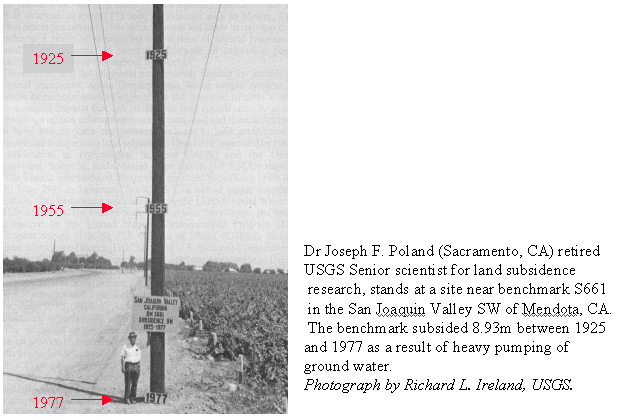
Exactly. Its a situation where the weather is pretty good, lots of sunshine, OK soil, but not much water. They've wrecked their local sources and when you get soil subsidance like this, http://www.ldeo.columbia.edu/~... https://ca.water.usgs.gov/land... you've probably made the water table recharge either impossible or a tens of thousands of years effort.
Then we have the river diversion issues. Already the Colorado no longer reaches the sea. Most impressive to stop that river.
If I had a say in how water use in California is handled, I'd say you start with the Sunshine. That's not likely to go away any time soon. So that's good. But the next issue is that water. It has to be used better, and more efficiently. I'm seeing a lot of farming under glass, so to speak. If you are going to use water, you have to meter it out and limit evaporation. If you are going to ship water from another state, you need to keep the damn stuff covered. Gotta watch how we deliver it to the plants though, because drip irrigation is great for saving water but you eventually salinate the soil. https://www.nrcs.usda.gov/Inte... https://upload.wikimedia.org/w...
We are perhaps a dog that likes to shit in it's dinner bowl.
-
Re: Want good Internet? Move to a city.
Bullshit. 2010 (most recent year for which I could find hard figures) Per capita Federal funding: Metro $10,976, Nonmetro $10,293. And those figures include retirement/disability benefits. Not surprising that category has the highest expenditures in rural areas classified as "Retirement Destinations." I submit that category should be excluded - if someone moved between urban and rural areas, those payments would move with them - they're associated with individuals, not location. Excluding that single category, Per capita Federal funding: Metro $8,171, Nonmetro $6,773.
And don't bother with your crap about artificial taxes and subsidies - those are economic and also occur in the industries which support urban incomes. Crop subsidies are skewed one way, defense spending (which is much greater) is skewed the other. All considered, the facts show your claim is wrong.
I second the bullshit. I live out in the sticks and I have FIOS. They can keep the city.
-
Re: Want good Internet? Move to a city.
Bullshit. 2010 (most recent year for which I could find hard figures) Per capita Federal funding: Metro $10,976, Nonmetro $10,293. And those figures include retirement/disability benefits. Not surprising that category has the highest expenditures in rural areas classified as "Retirement Destinations." I submit that category should be excluded - if someone moved between urban and rural areas, those payments would move with them - they're associated with individuals, not location. Excluding that single category, Per capita Federal funding: Metro $8,171, Nonmetro $6,773.
And don't bother with your crap about artificial taxes and subsidies - those are economic and also occur in the industries which support urban incomes. Crop subsidies are skewed one way, defense spending (which is much greater) is skewed the other. All considered, the facts show your claim is wrong. -
Check the stats, first, please...
In 2012, 75% of the 2 million farms in the US produced a paltry three percent of total revenue. In fact, their average annual income was less than $40k per farm, and most of that was from "non-farm" income, like subsidies, retirement income, etc. The dismal data is here.
John Deere couldn't care less about those farmers -- the money obviously lies elsewhere. And exactly where is that? In the three percent of farms (classed "large" or "very large" by the US Dept of Agriculture) that accounted for a whopping 52 percent of all production and 66.4% of agricultural revenue in the US.
So -- John Deere isn't going to worry about a bunch of hayseeds hacking their tractors -- they are not a significant revenue source now, and based on concentration trends in the US agriculture market, they are going to disappear entirely.
Marx was right about one thing -- owning the means of production (he called it "tools"; we call it hardware, now) is the key to capitalist success, and in a largely mechanized and automated industry like agriculture, that means owning the software, and through it, the hardware. John Deere has apparently grokked it rightly, as well.
-
Re: Taste Score
No, if you were interested in accuracy you wouldn't be quibbling over a common food industry term. Read this: https://www.fsis.usda.gov/OPPD...
Canada defines it thusly:
processed means, in respect of a food product, canned, cooked, frozen, concentrated, pickled or otherwise prepared to assure preservation of the food product in transport, distribution and storage, but does not include the final cooking or preparation of a food product for use as a meal or part of a meal such as may be done by restaurants, hospitals, food centres, catering establishments, central kitchens or similar establishments where food products are prepared for consumption rather than for extended preservation; (http://laws-lois.justice.gc.ca/eng/regulations/C.R.C.,_c._291/FullText.html) -
Re:Desert
You fail to realize how much habitat is now available for growing and raising animals and how much land is not destroyed by periodic massive floods. Water in California is a precious resource. It is what makes California the most productive agricultural state in the nation. The value of the crops grown in California are almost double the next largest state (Texas). Because of this, there are many acres of land that are used to grow crops, which consume CO2 in order to grow which are far more productive than the usual desert one would find for much of the year. Without the dam there would be periodic massive flooding and most likely the land would be used for cattle grazing, which is what much of the grassland in California is used for.
Before spouting off that California is wasteful of water, California agriculture has been getting more efficient with water use and already leads most of the country. They've been moving away from gravity irrigation/flooding to drip irrigation and other methods.
The Oroville dam was built in large part to prevent major flood damage, estimated to have prevented more than $1.3 billion in damage between 1987 and 1999 alone.
I wouldn't be at all surprised if the water from the reservoir used in agriculture was more than enough to offset any greenhouse gases emitted. Many trees are alive because of the water where the central valley grows a lot of nut and fruit trees.
-
Re: Desert
In the event that you didn't know there are 5 vineyards within an hour drive from my home in Kansas. California's growing seasons span the year round at least in some parts where as Iowa is 6-7 months of the year so I'm not surprised it produces almost twice as much.
no clue what last year was but heres 2015...
https://data.ers.usda.gov/repo... -
Except that USDA statement is a LIE.
"The review of APHIS' website has been ongoing, and the agency is striving to balance the need for transparency with rules protecting individual privacy.
In 2016, well before the change of Administration, APHIS decided to make adjustments to the posting of regulatory records.
In addition, APHIS is currently involved in litigation concerning, among other issues, information posted on the agency's website.
While the agency is vigorously defending against this litigation, in an abundance of caution, the agency is taking additional measures to protect individual privacy.
These decisions are not final. Adjustments may be made regarding information appropriate for release and posting."A blatant and stupid lie.
Trump administration forgets that people from the Obama administration are still alive and around.Matt Herrick, director of Communications of USDA under Obama, tweeted this regarding the disappearing of animal abuse reports:
Decision by @usda 2 remove animal abuse reports not required.
Totally subjective. Same option given 2 past admin. We refused. #transparencyAnd it's not the first (and probably not the last) time that Trump administration, once caught doing something they shouldn't be doing, tries to blame it on Obama.
Like the Muslim ban, Yemen raid fiasco (BTW, that was "winning"), Trump's disastrous calls to Mexican and Australian heads of state... and now this.
More here. -
Re:reprioritizing, not cutting
No, and it isn't relevant. This specific brand wasn't on the market in 1980.
Not relevant. Brands of similar products attempt to out-compete each other, often by finding better ways to make things. If Brand X figured out how to make the same quality of tea with half the human labor, it could sell for half what Brand Y sells for.
So I spend a lot of time thinking about global climate change and why it isn't called global warming anymore.
Fair enough, but you get the point; stop being obtuse.
The fact of the matter is the price of products goes down over time. Sometimes, between today and tomorrow, a price fluctuates upwards; sometimes it does that thanks to things like the cost of shipping (oil), or construction. Sometimes speculative markets have an impact. Give it 3 years, 5 years, 10 years, 20 years, and the cost of everything follows an endless, downward trend.
This doesn't stop being true just because you can find one specific maker who can't run a business profitably without raising prices out of control; that maker will either get back in line or will go out of business. It also doesn't stop being true when people try to play the razor-and-blade model, lose, and have to adjust their prices--e.g. with fast food taking a loss on hamburgers and a giant profit on fries and soda, until people start rejecting soda and the price of burgers has to reflect their actual cost.
Consider the increase in agricultural outputs for non-increasing agricultural inputs and the impact on the expense share of food.
That decrease in inputs is technical progress: new technology allows production of the same goods more-cheaply (which enables us to make more-expensive goods, because they're suddenly cheap enough to make and sell).
You keep trying to argue that something changed last week and so it must expand to a general trend. Observe the productivity factor, and its fluctuations; and its trend is decidedly upwards. That's how economy works: we extend our means to achieve the maximum ends. We constantly seek ways to extend our means further--that's things getting cheaper.
By the by, on grocery shopping: the trend in the past 5 years and 10 years and 50 years has been for the proportion of people's income spent on food to go down. Households now average around 10.09% of their income spent on food as of 2015, versus 10.11% in 2014, versus 10.35% in 2013. For food at home ("groceries"), the share is 5.8% 2015, 5.9% 2014, 6.2% 2013, getting bigger going backwards; although that's semi-unfair, because people are spending more eating out at 4.3% 2015, 4.2% 2014, 4.1% 2013. The trend on total food makes more sense because people economize their time as well, and cheap food prepared by someone else becomes more-attractive as food gets cheaper--and becomes a bigger share of the bill. In 2000, the share of consumer income spent on food was around 13.5%.
Smaller and smaller percentages of people's money is going to food, it seems. You can obsess over a jug of tea all you want, but it won't hold back the tides of reality; facts are inconvenient, and the facts display that the price of food has been and continues to fall.
-
Re: Fast food
There are 3 other sides to a pyramid. You do realize those are all vegetables, right?
Um, no. Just flat out, no.
https://www.cnpp.usda.gov/site... -
Free Help! From the government???
https://naldc.nal.usda.gov/dow...
Yup. Quite handy. You can get a hard copy from Amazon:
https://www.amazon.com/Wood-Fr... -
Re:Well, duh...!
Actually corn does have a fair bit of protein (about 1g protein for every 10g of corn according to the USDA) relative to many other vegetables, but it doesn't include all of the essential amino acids so you'll need to get those from somewhere else. Of course that's true for anything a person is going to eat, and corn is probably only something you'd want for supplemental protein anyhow as lentils or other beans offer much more protein per serving. It's good to have on the cob and cornbread is alright once in a while, and you can mix it in with a lot of other things to make salsas and the like. Corn chips and corn flower tortillas are also popular and common.
However, most of what's raised in the U.S. isn't the sweet corn that you can buy at grocery stores, but instead a different variety for livestock feed, which is mainly used because its pretty energy dense compared to grass so you can get your livestock to put on weight faster. Knowing that fact and how much we've incorporated corn into our diets probably gives a bit of a hint as to why the U.S. and Mexico have the worst obesity rates on the planet. -
Re:Who Has EVER Trusted Government Data?
Who trust government data? Anybody who uses a USGS map. Or a weather forecast that uses satellite data. Or who uses a GPS (both the satellite signal and the base map, which is compiled by private companies from government sources).
Now any statistic is capable of misleading, if you choose to misinterpret it. Take unemployment. I think that figure is accurate, it just doesn't mean what people think it does. By 2016 unemployment had recovered to where it was before the Great Recession, but if you think that means the government is fraudulently telling you that the job picture is good, that's you misinterpreting what it means. The low unemployment rate masks (a) relatively low labor participation and (b) disastrously low job growth and labor participation in certain regions of the country -- particularly rural and small to middle-sized cities. How do I know this? Well, government data, obviously.
You are conflating "data", with "information" and "opinion". The Food Pyramid is opinion, not data. If you think for yourself and drill down into the facts a bit, you'll find that government data is pretty useful. Opinions, less so.
-
Re:labor participation never recovered
Actually participation levels have increased under Obama. They just haven't reached pre-Great Recession levels. What is interesting is a massive difference in metro (urban and suburban) and non-metro (small town and rural) participation. Check out this source, which also explain an important fact about the 2016 election: the widening of the rural/urban split.
To complete this picture you have to add rural flight. This explains why the number of jobs in metro areas has grown robustly but the unemployment situation is only so-do. Metro areas do have an immigration problem, it's just not foreign migrants taking jobs.
So what we have is a picture of two Americas experiencing very different things: a metro America that may have problems, but is largely on track employment-wise; and a rural America that is still dealing with nearly decade-long catastrophe. The reasons for this are complicated and confounded, but the picture itself is stark.
-
Re:labor participation never recovered
Actually participation levels have increased under Obama. They just haven't reached pre-Great Recession levels. What is interesting is a massive difference in metro (urban and suburban) and non-metro (small town and rural) participation. Check out this source, which also explain an important fact about the 2016 election: the widening of the rural/urban split.
To complete this picture you have to add rural flight. This explains why the number of jobs in metro areas has grown robustly but the unemployment situation is only so-do. Metro areas do have an immigration problem, it's just not foreign migrants taking jobs.
So what we have is a picture of two Americas experiencing very different things: a metro America that may have problems, but is largely on track employment-wise; and a rural America that is still dealing with nearly decade-long catastrophe. The reasons for this are complicated and confounded, but the picture itself is stark.
-
This is not about urban farming
This is about making farming an attractive proposition to the next generation of potential farmers. (I am somewhat optimistic: my grandparents sold their farm to a returning Iraq vet who wants to get into the business.) The knowledge and skills of the agricultural sector are being lost an alarming rate and without new farmers we're doomed.
Also: the USDA is super excited about the return of farmer's markets. They are an important, one might say even vital, interchange between urban and rural economies.
-
This is not about urban farming
This is about making farming an attractive proposition to the next generation of potential farmers. (I am somewhat optimistic: my grandparents sold their farm to a returning Iraq vet who wants to get into the business.) The knowledge and skills of the agricultural sector are being lost an alarming rate and without new farmers we're doomed.
Also: the USDA is super excited about the return of farmer's markets. They are an important, one might say even vital, interchange between urban and rural economies.
-
Re:30k is a hell of a lot of money to me
97 percent of all U.S. farms are family-owned
88 percent of all U.S. farms are small family farms
http://www.usda.gov/wps/portal...
What nobody told me about small farming: I can’t make a living
-
Not much. I do look at data which may upset you.
The refugee crisis you refer to is actually the second Syrian refugee crisis.
The first refugee was an internal displacement of 1.5 million people (out of a population of 20 million) over the period 2007-2011 during crops failed due to unprecedented drought. Over two hundred villages were completely depopulated, and 40% of Syria's agricultural workforce was lost. Domestic wheat production crashed, and prices skyrocketed as it was replaced by imports.
So you had over a million hungry, unemployed displaced people crowded into cities, when a bad harvest in Russia caused a spike in global wheat prices. Check out the graph in this link labelled "World Monthly Grains Price Index" and note the massive upswing in prices in 2010 - 2011. There was a similar price spike in 2007, but back then Syria produced essentially all the wheat it consumed. In 2010 Syria only produced 80% of what it needed, resulting in underconsumption -- aka "starvation". You can check out the figures here.
Finally note that the so-called "Day of Rage" which critically destabilized the regime took place on March 15, 2011. The timing was not coincidental.
Now you can talk to me about "political struggle" in Syria. The roots of that struggle are of course decades old. But the effects were exacerbated by the worst drought in 900 years.
Without the sarcasm, try to stay on topic lest you continue to be perceived as a shithead Troll.
I have stayed on topic. Shithead troll I guess is a matter of perspective. Syria is exactly the kind of scenario security planners are worried about. And one reason they are worried is that many in the public literally find the idea of climate-driven refugees unimaginable. People who've been paying attention find it all too easy to imagine.
-
Re: It's past time.
-
Re:No
>Nonsense. What do you imagine will happen automation arrives at farms? The supply of food will increase, and the price will decrease. Same thing for trucking and the volume of goods carried down the world's roadways. The volume of cargo will go up, and the cost to move it will drop. Thats more economic productivity, which means more for all. Simply awesome.
Short sighted and fails to see many pitfalls.
First off, automation will only be available to those who can afford it. IE multinational corporations. Whether that's good or bad is your perspective, but it will spell the end of many small businesses. Many will sell, some will take on bank debt to try to compete under the new "rules" of labor being a one-time fixed cost that you amortize over an amount of years, rather than being able to pay as they go. That, or they'll cut wages even lower than they already are. And that work force was a million people in 2012.
https://www.ers.usda.gov/topic...
Second, independantly of that, transportation is another industry that's being threatened with being automated away. That's 6.8 million people (3 million truck drivers, people loading, unloading, etc). Not counting independent contractors, owner/operators, which are very prevalent.
http://www.trucking.org/News_a...
So, food is now cheaper, but you've taken away the means for millions and millions of people to actually purchase food.
And you last supposition, the volume of cargo will go up and the price to move it will drop. That's not correct - the cost to ship things doesn't drop as more stuff needs to get shipped, it rises as producers with more and more product to ship bid against one another in an effort to secure access to a limited resource. Gasoline prices stay constant, tire costs are constant, and the trucks themselves are fixed costs - you don't achieve new economies of scale by shipping more and more, you're locked in battle fighting over the same resources as not only your competition in that industry, but with every industry that has goods they want to ship to market. In the short term, that's higher profit margins for transportation companies, but in the longer term, that means they'll need to expand their fleets to capture more of that lost revenue - whose cost will be passed on to us as well.
So. We produce more food. We have far fewer people able to afford it. You lose tons of small/family farms in order to redistribute that income to Wall Street. And shipping prices most certainly rise, not just for foodstuffs, but for anything else that could be shipped on those same trucks as well.
-
100% Correct
And to add to the money side, there's banking, human resources (many farms use hired hands), filing and redeeming crop insurance...
The parent post best describes what farms currently are. My mom and dad can both talk about what it used to be like growing up on a farm; waking up at 5am, feeding livestock, cleaning pens, milking cows, their dads fixing the tractor and equipment, tilling, plowing, seeding, fertilizing, spraying, harvesting...and lots and lots of praying for good weather and a good harvest. But most of all, it was always a roller-coaster ride of two or three really good years, maybe including a boom year, followed by some break-even years, maybe including a few bust years, with never a guarantee that any year could make them money.
Those "family farm" days are disappearing. Farm sizes are growing, and the number of farmers are shrinking. But that's not to say that families still don't own their farms. Crops aren't rotated nearly as frequently. Livestock aren't kept on the side and graze the fields. Machines and automation have evolved, and farms now focus on one or two crops (or livestock) with greater efficiency. Farms have changed from labor-intensive diversified endeavors to an efficient, business-intensive farm.
My grandpa managed a 120-acre farm. Farmers around where I live talk about how they manage their 1,000+ acre farms. Automated machinery will just make these farms grow even larger and make it easier for farmers to own and farm more land.
-
Re:Interesting they release these reports on rainy
Your hypothesis doesn't appear to be supported by the evidence. The Forest Service webpage http://www.fs.usda.gov/detail/... indicates that the areas of greatest die-off are in the mountains rather than in farmland.
You are surprised to find that there are more pines in a pine forest than there are in the middle of a farm plot? Welcome to Slashdot, you should apply for an editor job.
-
Re:Interesting they release these reports on rainy
Your hypothesis doesn't appear to be supported by the evidence. The Forest Service webpage http://www.fs.usda.gov/detail/... indicates that the areas of greatest die-off are in the mountains rather than in farmland.
-
Re:75% of california's poeple are brain dead
The trees are fine. All this talk about trees is because the Califronia taxpayers will not build new infrastructure for farmers.
So you are telling me that the US Forest Service wants to build new irrigation projects for farmers. Here's the link to the actual forest service report. http://www.fs.fed.us/news/rele...
Here's photos of dead trees perhaps you'll claim photoshopped by the USDA? The Farmers? So they can implement the ultimate non-sequitur solution? http://www.fs.usda.gov/main/ca... So the warmer than normal temperatures and drought conditions have enabled bark beetles to infest and kill more trees, and you think this is a plot by farmers to build new irrigation projects that will have zero impact on the situation.
This is the logic that says - "Honey, the car broke down, so I'm buying a new furnace and computer."
What happens is the warmer and dryer conditions don't kill off the beetles, so they infest the trees and kill them. Under normal circumstances, they wouldn't do that. We have a similar issue near me with the Emerald ash borer, a beautiful green critter that has been devastating forests. As in miles of dead trees. http://ento.psu.edu/extension/... http://buffalonews.com/2016/06...
EAB isn't based on drought or temps, just accidentally introduced and no local predators. But no, the trees are not fine.Neither are teh ones in Cali. They're dead, Jim!
-
SFGate's Article Seems to Simple Be Wrong
The SF Chronicle has degraded from a real newspaper to a poorly edited regurgitation in many cases. This seems to be a case where the author of the piece didn't actually check their facts.
I believe the "third" quote is just an error:
"There are about 21 million acres of trees spread across Californiaâ(TM)s 18 national forests, and the latest figures show 7.7 million of them â" more than one-third â" are dead. "This quote is linked-cited to their other paper site, sfchronicle, and that article does not give those same numbers.
The sfchronicle article links to this http://www.fs.fed.us/sites/default/files/DROUGHT_book-web-1-11-16.pdf
The New York Times version of the article does NOT make the same "third are dead" claim and it links to a USDA release:
http://www.usda.gov/wps/portal/usda/usdahome?contentid=2016/11/0246.xml&contentidonly=true
That also does not make the "third are dead" claim.
As a non-professional forest person in California, the claim that a third of forested acres are "dead" or that a third of all trees are dead is demonstrably absurd.
I think someone slipped a digit somewhere and sfgate's editing is no longer good enough to trust anyone checked it. If anyone happens to see any original source making this claim, please let me know.
-
Re:Bark beetle hello!
Look into ecology - why do you think Bark Beetle populations have risen?
-
Re:Holy flamebait batman!
We could give everyone a UBI of at least $5k today, possibly even $10k, without costing anyone an extra dollar. There may or may not be moral hazards, although recent surveys from Sweden suggest that these are not as bad a people initially think. And this might sound harsh, but the sort of people that would stop working after receiving a $5k or $10k UBI are probably not really contributing that much to society anyway, so it might not be that big of a loss to the rest of us if they drop out of the economy.
But anyway, here's how the math would work:
The population of the US is 319 million.
Of those, 122 million pay federal income tax (source: https://www.reference.com/gove...)
Suppose that for those 122 million people, we gave them a tax hike of exactly $5k
Under a UBI, they could get an extra $5k, which exactly offsets this tax hikeSo there are 192 million people left
Keep in mind that UBI replaces existing welfare payments, like social security and food stamps
Social security taxes bring in $920 billion (source: https://www.ssa.gov/oact/STATS...)
Food stamps cost us $74.1 billion (source: http://www.fns.usda.gov/pd/sup...)
That's enough to pay just over $5k to each of those remaining 192 million peopleI haven't bothered to look into how much we're spending in admin costs to apply means testing to these welfare systems, and I haven't looked into how much money the various state governments are spending on various welfare schemes - all of this would become unnecessary under a UBI.
However the Cato Institute has looked into this, and they think we're spending $1 trillion per year on "welfare" (source: http://www.cato.org/publicatio...). I'm not sure I fully trust their analysis, but I'll take this as an estimate of the upper bound of what we could afford. So this, combined with social security revenue, would add up to $2 trillion per year to share amongst the 192 million non-taxpayers, which would give a UBI of just over $10k.
No need to tap into our Medicare funds, or cut any of our other expenses. We could continue to pay medical expenses, pensions, fund NASA and wage unnecessary and expensive wars around the world.
So that's where we're at today. In the future, there could be technological advances that make us more productive, and mean that we can lower our labor participation rate. The OP asks us whether UBI is the way to go in the future, and I'd say it's a plausible option.
-
Re:Building wealth
Yes. It does affect farmers. Estimates are it 0.8% of them will pay estate tax. Enough bullshit already.
-
Re:Civilized
Poor people live in urban areas. Urban areas have fast broadband because it's easy and cheaper per residence to run more lines in high density population zones.
Your first sentence is factually incorrect, and the implication of the second one—that poor people in urban areas have access to fast broadband—is also frequently factually incorrect.
First, for at least the past several decades, the percentage of people living in poverty in non-urban areas has been higher than in urban areas. There are still way more poor people in urban areas than in rural areas, but only because urban areas have way more people in general. Country folks are typically four or five percent more likely to be poor than city folks (Source: U.S. Census Bureau Current Population Survey via USDA).
Second, poor people living in urban areas tend to live in specific neighborhoods within those urban areas. They tend to be clustered, and telecoms can't be bothered with upgrading the infrastructure to serve them better, because they would get more return by spending the same amount of money to run new lines to a rich suburb. This is an ongoing problem to such a degree that New York City recently said that it is considering suing one of its major utilities (I forget which one) for being years behind schedule at rolling out fiber to the entire city as promised. Other cities have had similar issues.
-
Re: Shocking!
What I DO think people are saying is that the correlation between increasing use of HFCS, and increasing obesity, is suggestive of a link.
The problem with that "study" is that it really is just "suggestive." It cites a lot of research showing the problems of increased sweetener consumption in general, including studies that show obesity problems with sucrose too. (That includes a European study on cane sugar-sweetened soft drinks, which your link says indicates we need a study on HFCS since that's more dominant in the U.S., since none existed at that time.) And the problem is that most of its argument is based on the circumstantial data that HFCS became available in the 1970s, and its rise correlates with the the rise in obesity in America. The problem with that argument is that per capita sugar consumption overall increased something like 40% from the 1950s to the year 2000. So yeah, obesity rose at the same time HFCS rose, but it also rose along with sugar consumption in general.
In addition to that, there is strong clinical evidence, not just of correlation, but of causation.
Yes, that's one of the studies I've seen, along with 2 or 3 others. I've also seen quite a few showing no significant difference between HFCS vs. sucrose. It's fair to say the "jury is still out" in scientific terms, but there MAY be a minor effect for HFCS. I'm NOT trying to downplay that possibility, but the hysteria around HFCS seems mostly based on chemophobia and its name, rather than actual evidence.
Also, when you think about it, a 10% increase in content is not trivial. If you were to raise the caloric content of your diet by 10% and change nothing else, you would expect steady weight gain to ensue.
Yep, kinda like how Americans raised their per capita sugar consumption in general by roughly 40% over the past 50 years. Again, HFCS may have some greater impact here, but arguing about which sugar is the "true demon" is overlooking the much larger issue... people just need to consume less sugar, whatever the source.
-
Re:Let's talk about the meat of the matter.
haha.. Given cows aren't stacked, squared km would be more relevant..but then factor in that each one needs a certain amount of space to graze, etc..and then a LOT more space for their primary feed...as I already posted, livestock consumes about half the land used in the US. Here's another article highlighting many of the concerns.
-
Re:Very Basic Income
Then we have food, which averages around $720 a month.
That's $8 per meal, which generally means you're taking stuff from fast food or restaurants.
From the Official USDA Food Plans, the expected cost should be half of that, and even less if you're going for a lower-cost options.
-
Re: Heck yes,
Grain Prices Impact Entire Livestock Production Cycle
http://www.ers.usda.gov/amber-...Sigh, I bet you are one of those people that thinks raising the minimum wage doesn't cause unemployment.
-
All about Monsanto - conspiracy theory
It was all about bashing Monsanto — the "evil" company, that specialized in GMO seeds and holds thousands of patents.
European competitors in particular were so afraid of it rising, they started a PR campaign to mongering fears of GMOs. The campaign created public's perception so negative, some countries (France, Germany) ban GMOs outright and vandals attack growers. Lately Monsanto (and DuPont) must've started fighting back, because American media began defending the technology — even calling its opponents "anti-Science" (where have I heard that before?).
But now that a German firm is seeking to buy Monsanto, Europeans need to be disabused of their misconceptions too.
GMO-haters have nothing but FUD — they've heard it is (or may be) dangerous, but don't know why — somebody told them... See also "chemtrails" and "Trump is racist".
Unfortunately, even in the US food can not be labeled "Organic", if it contains GMOs...
-
Re: Recession is really a depression
4 years ago I could buy a lbs of beef for $1.99, it's around $5.99-7.30lbs these days. Top that out with 94m people not in the labor force, you've got a recipe for people popping themselves off. Past trends show that as well regardless of what the government says the unemployment rate is, especially unemployment rates where you simply fall off after several years.
-
Re: Recession is really a depression
4 years ago I could buy a lbs of beef for $1.99, it's around $5.99-7.30lbs these days.
Maybe you're not a very good shopper. The actual data - http://www.indexmundi.com/comm... or http://www.ers.usda.gov/datafi... - disagrees with your personal experience.
-
Re:According to...
This from their website:
"The federal government funds about 85 percent of our work. The rest is funded internally or by foundations."So I guess the question is, do you trust the federal government and/or foundations to not be largely controlled by or at least primarily motivated to protect the interests of Monsanto et al?
Given that we grow so much corn that we literally have to find new ways to use it,
http://www.ers.usda.gov/media/...
yet massive federal corn subsidies are still in place,
https://farm.ewg.org/progdetai...
it really does make you wonder. -
Re:Actual Work - they can't do it anyway
You actually believe they would cut a program...ever?
I've got a bridge to sell you. The USA spends 1.5 billion/year (in 2015) on the rural electrification program. A program that outlived it's usefullness 50 years ago.
They hide it in the USDA budget.