Slashdot Mirror
Domain: vice.com
Stories and comments across the archive that link to vice.com.
Stories · 1,377
-
There's a Problem In the Silk Road Trial: the Jury Doesn't Get the Internet
sarahnaomi (3948215) writes "The trial began this week for Ross Ulbricht, the 30-year-old Texas man accused of being the mastermind behind the dark net drug market, Silk Road. But as the jury began hearing testimony in the case, it was clear the technological knowledge gap would impede the proceedings. Judge Katherine Forrest said right off the bat when the case began that "highly technical" issues must be made clear to the jury. "If I believe things are not understandable to the average juror, we will talk about what might be a reasonable way to proceed at that time," she said. After the first day of proceedings, Forrest told the prosecution to be more clear with explanations of concepts central to the case, noting she was unhappy with its "mumbo-jumbo" explanation of the anonymizing service Tor. She also requested all readings of chat transcripts include emoticons." -
There's a Problem In the Silk Road Trial: the Jury Doesn't Get the Internet
sarahnaomi (3948215) writes "The trial began this week for Ross Ulbricht, the 30-year-old Texas man accused of being the mastermind behind the dark net drug market, Silk Road. But as the jury began hearing testimony in the case, it was clear the technological knowledge gap would impede the proceedings. Judge Katherine Forrest said right off the bat when the case began that "highly technical" issues must be made clear to the jury. "If I believe things are not understandable to the average juror, we will talk about what might be a reasonable way to proceed at that time," she said. After the first day of proceedings, Forrest told the prosecution to be more clear with explanations of concepts central to the case, noting she was unhappy with its "mumbo-jumbo" explanation of the anonymizing service Tor. She also requested all readings of chat transcripts include emoticons." -
Washington DC's Public Library Will Teach People How To Avoid the NSA
Jason Koebler writes Later this month, the Washington DC Public Library will teach residents how to use Tor as part of a 10 day series designed to shed light on government surveillance, transparency, and personal privacy. The series is called "Orwellian America," and it's quite subversive, considering that it's being held by a publicly funded entity mere minutes from a Congress and administration that allowed the NSA's surveillance programs to spin wildly out of control. -
Is 'SimCity' Homelessness a Bug Or a Feature?
sarahnaomi writes: SimCity players have discussed a variety of creative strategies for their virtual homelessness problem. They've suggested waiting for natural disasters like tornadoes to blow the vagrants away, bulldozing parks where they congregate, or creating such a woefully insufficient city infrastructure that the homeless would leave on their own.
You can read all of these proposed final solutions in Matteo Bittanti's How to Get Rid of Homelessness, "a 600-page epic split in two volumes documenting the so-called 'homeless scandal' that affected 2013's SimCity." Bittanti collected, selected, and transcribed thousands of these messages exchanged by players on publisher Electronic Arts' official forums, Reddit, and the largest online SimCity community Simtropolis, who experienced and then tried to "eradicate" the phenomenon of homelessness that "plagued" SimCity." -
'Silk Road Reloaded' Launches On a Network More Secret Than Tor
rossgneumann writes A new anonymous online drug market has emerged, but instead of using the now infamous Tor network, it uses the lesser known "I2P" alternative. "Silk Road Reloaded" launched yesterday, and is only accessible by downloading the special I2P software, or by configuring your computer in a certain way to connect to I2P web pages, called 'eepsites', and which end in the suffix .i2p. The I2P project site is informative, as is the Wikipedia entry. -
Researchers "Solve" Texas Hold'Em, Create Perfect Robotic Player
Jason Koebler writes The best limit Texas Hold'Em poker player in the world is a robot. Given enough hands, it will never, ever lose, regardless of what its opponent does or which cards it is dealt. Researchers at the University of Alberta essentially "brute forced" the game of limit poker, in which there are roughly 3 x 10^14 possible decisions. Cepheus runs through a massive table of all of these possible permutations of the game—the table itself is 11 terabytes of data—and decides what the best move is, regardless of opponent. -
How Close Are We To Engineering the Climate?
merbs writes The scientists had whipped themselves into a frenzy. Gathered in a stuffy conference room in the bowels of a hotel in Berlin, scores of respected climate researchers were arguing about a one-page document that had tentatively been christened the "Berlin Declaration." It proposed ground rules for conducting experiments to explore how we might artificially cool the Earth—planet hacking, basically. This is the story of scientists' first major international meeting to tackle geoengineering. It’s most commonly called geoengineering. Think Bond-villain-caliber schemes but with better intentions. It’s a highly controversial field that studies ideas like launching high-flying jets to dust the skies with sulfur in order to block out a small fraction of the solar rays entering the atmosphere, or sending a fleet of drones across the ocean to spray seawater into clouds to make them brighter and thus reflect more sunlight. Those are two of the most discussed proposals for using technology to chill the planet and combat climate change, and each would ostensibly cost a few billion dollars a year—peanuts in the scheme of the global economy. We’re about to see the dawn of the first real-world experiments designed to test ideas like these, but first, the scientists wanted to agree on a code of ethics—how to move forward without alarming the public or breaking any laws. -
Porn Companies Are Going After GitHub
rossgneumann writes Porn production companies are currently engaged in a scorched earth copyright infringement campaign against torrenting sites with URLs containing specific keywords and Github is getting caught in the crossfire. Several Digital Millenium Copyright Act (DMCA) complaints filed to Google by companies representing various porn companies in the last month alone have resulted in dozens of legitimate Github URLs being removed from the search engine's results, TorrentFreak first reported." -
The Search For Starivores, Intelligent Life That Could Eat the Sun
sarahnaomi writes: There could be all manner of alien life forms in the universe, from witless bacteria to superintelligent robots. Still, the notion of a starivore — an organism that literally devours stars — may sound a bit crazy, even to a seasoned sci-fi fan. And yet, if such creatures do exist, they're probably lurking in our astronomical data right now.
That's why philosopher Dr. Clement Vidal, who's a researcher at the Free University of Brussels, along with Library of Congress Chair in Astrobiology Stephen Dick, futurist John Smart, and nanotech entrepreneur Robert Freitas are soliciting scientific proposals to seek out star-eating life. -
Finding Genghis Khan's Tomb From Space
rossgneumann writes Genghis Khan really, really didn't want anyone to know where he was buried. The soldiers escorting his body to its final resting place killed everyone they passed, killed the people who built the tomb, and then were killed themselves. An elegant solution to this problem bubbled up from two unlikely sources: a man described as a "modern day Indiana Jones" and amateur archaeologists. -
New App Detects Government Stingray Cell Phone Trackers
HughPickens.com writes IMSI catchers, otherwise known as stingrays, are those surveillance tools that masquerade as cell towers and trick mobile phones into connecting, spewing private data in the process. Law-enforcement agencies have been using them for almost two decades, but there's never been a good way for individuals to detect them. Now Lily Hay Newman reports that SnoopSnitch scans for radio signals that indicate a transition to a stingray from a legitimate cell tower. "SnoopSnitch collects and analyzes mobile radio data to make you aware of your mobile network security and to warn you about threats like fake base stations (IMSI catchers), user tracking and over-the-air updates." say German security researchers Alex Senier, Karsten Nohl, and Tobias Engel, creators of the app which is available now only for Android. The app can't protect people's phones from connecting to stingrays in the first place, but it can at least let them know that there is surveillance happening in a given area. "There's no one set of information, taken by itself, that allows you to detect an IMSI catcher," says Nohl. "But we do stream analysis of everything that happens on your phone, and can come out with a warning if it crosses a certain threshold."
Stingrays have garnered attention since a 2011 Arizona court case in which one agent admitted in an affidavit that the tool collaterally swept up data on "innocent, non-target devices" (U.S. v. Rigmaiden). The government eventually conceded in this case that the "tracking operation was a Fourth Amendment search and seizure," meaning it required a warrant. But given that the Justice Department has continued to claim that cellphone users have no reasonable expectation of privacy over their location data, it may take a Supreme Court judgement to settle the Stingray issue countrywide. -
The NSA Uses the Same Chat Protocol As Hackers
rossgneumann writes NSA documents obtained by Edward Snowden and reported on by Der Spiegel on Sunday reveal that the agency communicates internally with Jabber, an open source messaging service used by hackers and activists trying to skirt the NSA's internet surveillance dragnet. A document outlining the NSA's Scarletfever program—a "message driven cryptologic exploitation service" designed as part of the larger Longhaul initiative, a program that collects data and finds ways to break its encryption—contains a curious point buried near the end: "Jabber Chat Room: TBD." -
White House Touts Obama's 1-Liner as 2014 Tech Highlight
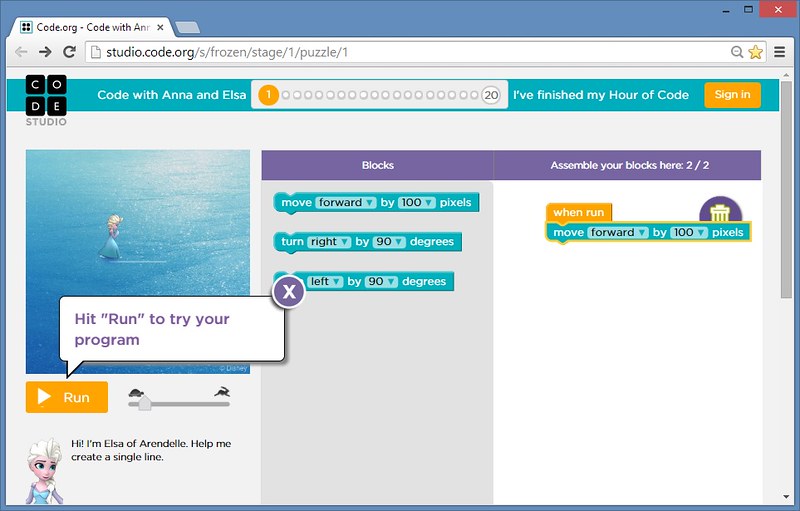
theodp (442580) writes That President Obama became the first President to write a line of code (as a top Microsoft lobbyist looked on) is #1 on the White House's Top 9 science and technology highlights from 2014. To kick off this year's Hour of Code, the President 'learned to code' by moving a Disney Princess Elsa character 100 pixels on a screen, first by dragging-and-dropping Blockly puzzle pieces and then by coding 1 line of JavaScript. Interestingly, Bill Clinton might have been The First President To Write Code had Microsoft seen fit to use its patented, circa-1995 Graphical Programming System and Method for Enabling a Person to Learn Text-Based Programming — which describes how kids as young as 8-12 years of age can be taught to program by progressing from creating a program using graphical objects to doing so using text-based programming — to teach President Clinton to code some 20 years ago! -
The Dominant Life Form In the Cosmos Is Probably Superintelligent Robots
Jason Koebler writes: If and when we finally encounter aliens, they probably won't look like little green men, or spiny insectoids. It's likely they won't be biological creatures at all, but rather, advanced robots that outstrip our intelligence in every conceivable way. Susan Schneider, a professor of philosophy at the University of Connecticut, joins a handful of astronomers, including Seth Shostak, director of NASA's Search for Extraterrestrial Intelligence, NASA Astrobiologist Paul Davies, and Library of Congress Chair in Astrobiology Stephen Dick in espousing the view that the dominant intelligence in the cosmos is probably artificial. In her paper "Alien Minds," written for a forthcoming NASA publication, Schneider describes why alien life forms are likely to be synthetic, and how such creatures might think. -
Reaction To the Sony Hack Is 'Beyond the Realm of Stupid'
rossgneumann writes North Korea may really be behind the Sony hack, but we're still acting like idiots. Peter W. Singer, one of the nations foremost experts on cybersecurity, says Sony's reaction has been abysmal. "Here, we need to distinguish between threat and capability—the ability to steal gossipy emails from a not-so-great protected computer network is not the same thing as being able to carry out physical, 9/11-style attacks in 18,000 locations simultaneously. I can't believe I'm saying this. I can't believe I have to say this." -
A Domain Registrar Is Starting a Fiber ISP To Compete With Comcast
Jason Koebler writes: Tucows Inc., an internet company that's been around since the early 90s — it's generally known for being in the shareware business and for registering and selling premium domain names — announced that it's becoming an internet service provider. Tucows will offer fiber internet to customers in Charlottesville, Virginia — which is served by Comcast and CenturyLink — in early 2015 and eventually wants to expand to other markets all over the country. "Everyone who has built a well-run gigabit network has had demand exceeding their expectations," Elliot Noss, Tucows' CEO said. "We think there's space in the market for businesses like us and smaller." -
Sony Pictures Leak Reveals Quashed Plan To Upload Phony Torrents
retroworks writes Motherboard.vice offers an interesting scoop from the hacked Sony Pictures email trove. A plan championed by Polish marketing employee Magda Mastalerz was to upload false versions of highly-pirated Sony programming, effectively polluting torrent sites with false positives. For example, a "Hannibal"-themed anti-piracy ad to popular torrent sites disguised as the first episode. Sony Pictures legal department quashed the idea, saying that if pirate sites were illegal, it would also be illegal for Sony Pictures to upload onto them. There were plans in WW2 to drop phony counterfeit currency to disrupt markets, and I wonder why flooding underground markets with phony products isn't widespread. Why don't credit card companies manufacture fake lists of stolen credit card numbers, or phony social security numbers, for illegal trading sites? For that matter, would fake ivory, fake illegal porn, and other "false positives" discourage buyers? Or create alibis? -
Tracking the Mole Inside Silk Road 2.0
derekmead writes: The arrest of the Silk Road 2.0 leader and subsequent seizure of the site was partially due to the presence of an undercover U.S. Department of Homeland Security agent, who "successfully infiltrated the support staff involved in running the Silk Road 2.0 website," according to the FBI.
Referencing multiple interviews, publicly available information, and parts of the moderator forum shared with me, it appears likely that the suspicions of many involved in Silk Road 2.0 are true: the undercover agent that infiltrated the site was a relatively quiet staff member known as Cirrus. -
Researchers Design DNA With New Shapes and Structures
Jason Koebler writes: The shape of DNA is a double helix, right? That's what we are taught. Well, now the answer is "not always." Researchers at the Massachusetts Institute of Technology have discovered how to program DNA to be shaped like a bowl, or a spiral, or a ring, or other shapes that aren't found in nature.
It's the latest in a string of discoveries about the underlying structure of life and the building blocks by which it's made. Recently, scientists created new nucleotides that do not exist in nature and inserted them into a living organism. And now, this: DNA can look like just about anything and can be assembled into many shapes. -
Aliens Are Probably Everywhere, Just Not Anywhere Nearby
rossgneumann writes If there's intelligent life in the cosmos, it's probably nowhere we can get to anytime soon. At least that's the finding of the astrobiologist who, for the first time in decades, has rendered a major update to the key formula scientists use to seek out interstellar life. That'd be the Drake equation, which was developed over half a century ago to determine where life might lurk in the universe. Using the new Kepler data, astrobiologist Amri Wandel did some calculations to estimate the density of life-bearing worlds in our corner of the universe. -
The Fastest Camera Ever Made Captures 100 Billion Frames Per Second
Jason Koebler writes A new imaging technique is able to capture images at 100 billion frames per second—fast enough to watch light interact with objects, which could eventually lead to new cloaking technologies. The camera was developed by a team at Washington University in St. Louis—for the team's first tests, it was able to visualize laser pulse reflections, photons racing through air and through resin, and "faster-than-light propagation of non-information." It can also be used in conjunction with telescopes and to image optical and quantum communications, according to lead researcher Liang Gao. -
Scientists Have Finally Sampled the Most Abundant Material On Earth
rossgneumann writes: The most abundant material on Earth didn't have a name, and, in fact, hadn't been seen — until now. For the first time ever, scientists have gotten their hands on a sample of bridgmanite, a mineral that is believed to make up more than a third of the volume of the Earth. In a new paper published in Science late last week, Oliver Tschauner of the University of Nevada, Las Vegas, and his team describe bridgmanite for the first time. -
The Schizophrenic Programmer Who Built an OS To Talk To God
rossgneumann writes: Terry Davis, a schizophrenic programmer, has spent 10 years building an operating system to talk to God. He's done this work because God told him to. According to the TempleOS charter, it is "God's official temple. Just like Solomon's temple, this is a community focal point where offerings are made and God's oracle is consulted." [The TempleOS V2.17 welcome screen] greets the user with a riot of 16-color, scrolling, blinking text; depending on your frame of reference, it might recall DESQview, the Commodore 64, or a host of early DOS-based graphical user interfaces. In style if not in specifics, it evokes a particular era, a time when the then-new concept of "personal computing" necessarily meant programming and tinkering and breaking things. -
How the Pentagon's Robots Would Automate War
rossgneumann writes: Pentagon officials are worried that the U.S. military is losing its edge compared to competitors like China, and are willing to explore almost anything to stay on top—including creating robots capable of becoming fighting machines. A 72-page document throws detailed light on the far-reaching implications of the Pentagon's plan to monopolize imminent "transformational advances" in biotechnology, robotics and artificial intelligence, information technology, nanotechnology, and energy. -
Harvard Scientists Say It's Time To Start Thinking About Engineering the Climate
merbs writes: Harvard has long been home to one of the fiercest advocates for climate engineering. This week, Harvard's School of Engineering and Applied Sciences published a research announcement headlined "Adjusting Earth's Thermostat, With Caution." That might read as oxymoronic — intentionally altering the planet's climate has rarely been considered a cautious enterprise — but it fairly accurately reflects the thrust of several new studies published by the Royal Society, all focused on exploring the controversial field of geoengineering. -
The Man Who Made Tetris
rossgneumann writes Life gets pretty chill after creating 'Tetris' and escaping the KGB. A quick web search for "Alexey Pajitnov" brings up pages of articles and interviews that fixate only on his seminal creation—a work that remains, far and away, the best selling video game of all time. But clearly, there's more to the man than just Tetris. Meeting Pajitnov himself led me to wonder about, well, everything else. What was the Tetris-less life of Alexey Pajitnov? -
The Software Big Oil's PR Firm Uses To "Convert Average Citizens"
merbs writes The CEO of the world's largest PR firm has a policy when it comes to campaigns that focus on the environment. "We do not work with astroturf groups and we have never created a website for a client with the intent to deny climate change," Richard Edelman wrote in a blog post in August. That may actually turn out to be true. Technically. Edelman may not work with astroturf groups. Instead, it appears to prefer to build them itself, from the ground up, using sophisticated proprietary software platform designed to "convert" advocates and then "track" their behavior. -
How To Mathematically Predict Lightning Strikes
rossgneumann writes Soon, it's very possible that when you say something like "you have better odds of being struck by lightning," that won't necessarily mean it's all that rare. And there's a good chance that you'll be able to tell that person (roughly) what the odds of that happening are. Research published this week in Nature provides an equation that is reasonably accurate at mathematically predicting lightning strikes. From the article: "There's not a whole lot of noise in Romps's estimates: CAPE [Convective Available Potential Energy] is something that can be predicted out fairly easily: "All [models] in our ensemble predict that [the United State's] mean CAPE will increase over the 21st century, with a mean increase of 11.2 percent per degree Celsius of global warming," he wrote. "Overall, the [models] predict a ~50 percent increase in the rate of lightning strikes in the United States over the 21st century." -
Hacker Builds a Dark Net Version of the FBI Tip Form
Daniel_Stuckey writes A London-based programmer has set up a new hidden service for anyone using Tor to submit anonymous tips to the FBI. With the new .onion hidden service link, which accesses the FBI's tips page through a reverse proxy, Mustafa Al-Bassam told me in an IRC chat that he's engineered a "proof-of-concept," demonstrating how the bureau might go about setting up a more secure system for receiving crime tips. -
Manslaughter Conviction Overturned For Scientists Who Didn't Predict Earthquake
Jason Koebler writes: Geologists who didn't warn a town about an impending earthquake are not murderers, an Italian appeals court ruled today. A 2012 decision that rocked the scientific world has been overturned, according to Italy's Repubblica newspapers and confirmed by other Italian outlets. In that decision, six prominent geologists and one government worker were convicted of manslaughter for failing to notify the town of L'Aquila of a 2009 earthquake that killed at least 309 people. The scientists were originally sentenced to six years in prison and were to pay more than $10 million in damages. -
The Math Behind the Hipster Effect
rossgneumann writes If everyone always wants to look different than everybody else, everybody starts looking the same. At least, if you use a recently published mathematical model describing the phenomenon. "The hipster effect is this non-concerted emergent collective phenomenon of looking alike trying to look different," in the words of Jonathan Touboul, mathematical neuroscientist at the College de France in Paris. -
Why Scientists Think Completely Unclassifiable and Undiscovered Life Forms Exist
An anonymous reader writes: In a new paper published in Science, researchers at the Department of Energy's Joint Genome Institute note that "there are reasons to believe that current approaches [to discovering life] may indeed miss taxa, particularly if they are very different from those that have so far been characterized." They believe life forms exist that don't fall into the established eukaryota, archaea, or bacteria kingdoms. They argue that there may be life out there that doesn't use the four DNA and RNA bases that we're used to; there may be life out there that has evolved completely separately from everything that we have ever known to exist; there may be life that lives in places we haven't even looked. -
New Particle Collider Is One Foot Long
Jason Koebler writes The CERN particle collider is 17 miles long. China just announced a supercollider that is supposed to be roughly 49 miles long. The United States' new particle collider is just under 12 inches long. What the SLAC National Accelerator Laboratory's new collider lacks in size, it makes up for by using plasma to accelerate particles more than 500 times faster than traditional methods. In a recent test published in Nature, Michael Litos and his team were able to accelerate bunches of electrons to near the speed of light within the tiny chamber." -
Physicists Resurrect an Old, Strange Dark Matter Theory
New submitter rossgneumann writes: Dark matter might not be nearly as exotic as most theories suggest. Instead, it could be macroscopic clumps of material formed from common particles already found within the Standard Model of particle physics. This argument comes courtesy of physicists at Case Western University (PDF). Dark matter is usually thought of in terms of exotic, so-far undiscovered particles. The leading candidates are known as weakly interacting massive particles, or WIMPs. But the Case Western theory suggests that there are no dark matter particles, at least none that exist outside of current knowledge. Instead, there are baseball-sized clumps of "regular" matter formed from unexpected combinations of Standard Model particles. -
Gigabit Internet Connections Make Property Values Rise
Jason Koebler writes: When families go to buy a new home, they're most often looking for a couple things: Good schools, a safe neighborhood, maybe something that's near public transportation. And, increasingly and undeniably, access to gigabit internet service. A study by RVA LLC Market Research and Consulting found that fiber optic internet adds roughly $5,250 to the value of a $300,000 home. "It's getting to the point where, if my neighboring community has a gig and we're still doing satellite, the property value in that town is going to go up," Deb Socia, director of Next Century Cities, a coalition of cities trying to provide gigabit internet speeds to their citizens, said. "You're going to lose people and you're going to lose revenue without it. I'm hearing it from folks in different chambers of commerce, in real estate, in politics." -
Drones Over Greenland Give Insight To Pollution's Effects On Melting
merbs writes Thank glaciologist Jason Box for the Arctic bird's-eye view of one of the most serene, alien landscapes on the planet. Box spends much of his time in Greenland, where he uses drones to measure 'dark snow'—snow that has accumulated soot and dust, thanks to human activity—which absorbs more sunlight and melts faster. Drone photography, then, may hold the key to understanding just how fast Greenland is melting. -
Denmark Plans To Be Coal-Free In 10 Years
merbs writes "Earlier this year, Denmark's leadership announced that the nation would run entirely on renewable power by 2050. Wind, solar, and biomass would be ramped up while coal and gas are phased out. Now Denmark has gone even further, and plans to end coal by 2025. -
Researchers At Brown University Shattered a Quantum Wave Function
Jason Koebler writes: A team of physicists based at Brown University has succeeded in shattering a quantum wave function. That near-mythical representation of indeterminate reality, in which an unmeasured particle is able to occupy many states simultaneously, can be dissected into many parts. This dissection, which is described this week in the Journal of Low Temperature Physics, has the potential to turn how we view the quantum world on its head. Specifically, they found it's possible to take a wave function and isolate it into different parts. So, if our electron has some probability of being in position (x1,y1,z1) and another probability of being in position (x2,y2,z2), those two probabilities can be isolated from each other, cordoned off like quantum crime scenes. -
The Airplane of the Future May Not Have Windows
merbs writes: Hope you're not too attached to looking out the windows when you fly — the designers of tomorrow's airplanes seem intent on getting rid of them. A Paris design firm recently made waves when it released its concept for a sleek, solar paneled, windowless passenger jet. Before that, Airbus proposed eschewing windows and building its cabins out of transparent polymers. Now, the Center for Process Innovation has floated its own windowless plane concept, and it's attracting plenty of headlines, too. -
20 More Cities Want To Join the Fight Against Big Telecom's Broadband Monopolies
Jason Koebler writes At least 20 additional American cities have expressed a formal interest in joining a coalition that's dedicated to bringing gigabit internet speeds to their residents by any means necessary—even if it means building the infrastructure themselves. The Next Centuries Cities coalition launched last week with an impressive list of 32 cities in 19 states who recognize that fast internet speeds unencumbered by fast lanes or other tiered systems are necessary to keep residents and businesses happy. That launch was so successful that 20 other cities have expressed formal interest in joining, according to the group's executive director. -
32 Cities Want To Challenge Big Telecom, Build Their Own Gigabit Networks
Jason Koebler writes: More than two dozen cities in 19 states announced today that they're sick of big telecom skipping them over for internet infrastructure upgrades and would like to build gigabit fiber networks themselves and help other cities follow their lead. The Next Century Cities coalition, which includes a couple cities that already have gigabit fiber internet for their residents, was devised to help communities who want to build their own broadband networks navigate logistical and legal challenges to doing so. -
How an FBI Informant Led the Hack of British Tabloid "The Sun"
Daniel_Stuckey writes Hector Xavier Monsegur, also known online as "Sabu," was caught by the FBI in June of 2011 for a litany of hacking-related offenses and, within hours, began cooperating with authorities in hopes of receiving a lenient sentence. Now, never-before-published FBI records and exclusive interviews detail how the informant rallied other hackers to attack various News Corp. interests, including The Sun, at a time that the FBI has said it was tracking all of Monsegur's online activity. And for a week shortly after his arrest, he was privy to the anti-Murdoch campaign waged by Anonymous, according to the documents obtained by Motherboard. -
Wind Power Is Cheaper Than Coal, Leaked Report Shows
merbs writes: A leaked report shows wind is the cheapest energy source in Europe, beating the presumably dirt-cheap coal and gas by a mile. Conventional wisdom holds that clean energy is more expensive than its fossil-fueled counterparts. Yet cost comparisons show that renewable energy sources are often cheaper than their carbon-heavy competition. The report (PDF) demonstrates that if you were to take into account mining, pollution, and adverse health impacts of coal and gas, wind power would be the cheapest source of energy. -
NASA Finds a Delaware-Sized Methane "Hot Spot" In the Southwest
merbs writes According to new satellite research from scientists at NASA and the University of Michigan this "hot spot" is "responsible for producing the largest concentration of the greenhouse gas methane seen over the United States—more than triple the standard ground-based estimate." It covers 2,500 square miles, about the size of Delaware. It is so big that scientists initially thought it was a mistake in their instruments. "We didn't focus on it because we weren't sure if it was a true signal or an instrument error," NASA's Christian Frankenberg said in a statement. -
Outsourced Tech Jobs Are Increasingly Being Automated
Jason Koebler writes Yahoo announced [Tuesday] it would be laying off at least 400 workers in its Indian office, and back in February, IBM cut roughly 2,000 jobs there. Meanwhile, tech companies are beginning to see that many of the jobs it has outsourced can be automated, instead. Labor in India and China is still cheaper than it is in the United States, but it's not the obvious economic move that it was just a few years ago: "The labor costs are becoming significant enough in China and India that there are very real discussions about automating jobs there now," Mark Muro, an economist at Brookings, said. "Companies are seeing that automated replacements are getting to be 'good enough.'" -
MIT Study Outlines a 'Perfect' Solar Cell
Daniel_Stuckey writes A new MIT study offers a way out of one of solar power's most vexing problems: the matter of efficiency, and the bare fact that much of the available sunlight in solar power schemes is wasted. The researchers appear to have found the key to perfect solar energy conversion efficiency—or at least something approaching it. It's a new material that can accept light from an very large number of angles and can withstand the very high temperatures needed for a maximally efficient scheme. Conventional solar cells, the silicon-based sheets used in most consumer-level applications, are far from perfect. Light from the sun arrives here on Earth's surface in a wide variety of forms. These forms—wavelengths, properly—include the visible light that makes up our everyday reality, but also significant chunks of invisible (to us) ultraviolet and infrared light. The current standard for solar cells targets mostly just a set range of visible light. -
Device Allows Paralyzed Rats To Walk, Human Trials Scheduled Next Summer
An anonymous reader writes "A new technique pioneered by scientists working on project NEUWalk at the Swiss Federal Institute for Technology (EPFL) have figured out a way to reactivate the severed spinal cords of fully paralyzed rats, allowing them to walk again via remote control. Human trials are scheduled for next summer. "We have complete control of the rat's hind legs," EPFL neuroscientist Grégoire Courtine said. "The rat has no voluntary control of its limbs, but the severed spinal cord can be reactivated and stimulated to perform natural walking. We can control in real-time how the rat moves forward and how high it lifts its legs." -
CIA Tested Primitive Chatbots For Interrogation In the 1980s
New submitter ted_pikul writes: Newly declassified documents reveal that, 30 years ago, the CIA pitted one of its own agents against an artificial intelligence interrogator in an attempt to see whether or not the technology would be useful. The documents, written in 1983, describe a series of experimental tests (PDF) in which the CIA repeatedly interrogated its own agent using a primitive AI called Analiza. The intelligence on display in the transcript is clearly undeveloped, and seems to contain a mixed bag of predetermined threats made to goad interrogation subjects into spilling their secrets as well as open-ended lines of questioning. -
Service Promises To Leak Your Documents If the Government Murders You
Jason Koebler writes With all the conspiracy theories surrounding some high-profile deaths in recent years, how can you, theoretical whistleblower with highly sensitive documents, be assured that your information gets leaked if you're murdered in some government conspiracy? A new dark web service says it's got your back. "Dead Man Zero" claims to offer potential whistleblowers a bit more peace of mind by providing a system that will automatically publish and distribute their secrets should they die, get jailed, or get injured. -
Star Wars Producers Want a 'DroneShield' To Prevent Leaks On Set
Jason Koebler writes Over the last couple of weeks, people have been flying drones over Pinewood Studios, where Star Wars Episode VII is being filmed. That made waves last week, but, perhaps most interestingly, the studio ordered a "DroneShield" back in June anticipating the drone problem. According to the company, a DroneShield can provide email and SMS warnings if it detects a helicopters or drone. In any case, the folks over at DroneShield say that Pinewood Studios never actually got the product: The State Department keeps close tabs on products like these that are shipped overseas, and the company's export application still hasn't gone through.