Slashdot Mirror
Domain: wri.org
Stories and comments across the archive that link to wri.org.
Comments · 96
-
It came from America
https://www.wri.org/blog/2014/... America managed to be the world leaders in CO2 emissions with a tiny fraction of the worlds population. If you counted per person it would only be worse.
-
Re:Bad approach
between 2C-4C is fine
Lol, if you say so. Yes we can "deal with it" - at the cost of hundreds of billions annually in adaption costs, not to mention displacing billions from coastal areas, threatened sea ecologies from CO2 acidification, famines from shifting agriculture in undeveloped nations, etc etc. Better to avoid those costs wherever possible, don't you think?
If you want to believe that fine
I believe the research. Linear kinetics models suggest an atmospheric lifetime of 30-95 years. Equilibrium models tell us that even after equilibrium is reached once more, it will be at a higher atmospheric concentration than today, meaning some of that CO2 will be keeping our temperatures high for thousands of years.
We can precisely measure solar irradiance (with the SORCE satellite among many other methods). We know that average solar irradiance has not increased, yet our temperatures have. Your assertions that CO2 is not much of a factor are entirely unconvincing. The planet will of course deal with all that CO2 in the much longer term (past CO2 pulses have taken hundreds of thousands of years to fully stabilise), but the issue is all the costs to us, in dollars and human suffering, that we'll experience along the way.
it's the only thing that can literally destroy our species
Heh, it's not even in the top 12. We've already proved we can keep the planet warm without even trying.
That's just common sense
Your "common sense" is contradicted by reality. The negative effects are already outweighing the positives, and we're now observing significant net decreases in yields for staples like wheat, rice and maize (and corresponding price hikes, reversing the historical trend). Cited there are numerous studies showing "large negative sensitivity of crop yields to extreme daytime temperatures around 30C", for example, and that's not likely to improve anytime soon. And far from being "nonsense", the research is showing substantial aridification for a massive 32% of the planet's land surface, for the mid-range RCP4.5 scenario.
It's past time you re-evaluated those firmly-held beliefs of yours, and took a hard look at the actual science.
-
Chengdu air: EXTREME pollution, low visibility
From the story, China's Clean Air Challenge: $3 Billion Air Pollution from Transport in Chengdu
Quotes:
1) "Economic loss from transport-related air pollution in Chengdu, China, was $3 billion in 2013, and that number is on the rise."
2) "Chengdu, the fourth largest city in China, has over 15 million residents and 4 million vehicles, with 27 percent of PM2.5 emissions coming from transport, increasing risks to public health, the environment and the economy." -
Re: Chicken Warns UN of Sky's Imminent Demise
What was that about the EU lowering their emissions?
-
Re: 5% is nothing
I have said nothing of the kind. You continue to lie.
Your lies have been numerous and documented, you only add to them here.
You are yet to show any lie that I have made, despite your repeated claims.I have said that China continues to produce more than 2x the CO2 that America does, while their GDP output is far less.
But China doesn't produce more than twice, it produces a bit less than twice Americas CO2.
China's GDP output is also larger than the US.And America's transport CO2 rose far far less than what CHina's CO2 did. In fact, our transportation has risen for the last couple of years, BUT, our CO2 continues to drop, which is what matters. OTOH, your nation's CO2 continues to rise.
Facts are you transport has been getting worse for 5 years in a row with no end in site. Despite tougher fuel standards people are still switching away from cars and into SUV's and light trucks making the situation worse. (I'll note here that it's people choosing this despite businesses making more efficient cars and government enacting tougher standards.)
The fact that you continue to claim that Coal burns cleaner than nat gas shows how fucked up you are.
You keep telling this lie, but I never said it and you never show where you think I did. (How many lies so far from you in just this post?)
But China’s National Development and Reform Commission released detailed data this week showing that the country’s electricity consumption jumped 6.6 percent last year. Wind and solar energy grew quickly, but not nearly enough to meet the extra demand. Electricity generation from the burning of fossil fuels, almost entirely coal, rose 5.2 percent in China last year.
As I said before, because your nation continues to install loads more coal than AE, your new electricity continues to come from coal, and not AE.
More lies from you? Can you not read?
Around 15% of the increase in China’s electricity demand was due to higher demand for cooling, driven by a particularly hot summer. (This topic will be the focus of a forthcoming IEA report on how the projected growth in air conditioning usage around the world will affect global electricity demand). Despite continued reductions of coal use in buildings and industry, the growth in the power sector pushed up coal demand in China by 0.3%, after three years of declining demand. Despite this rebound, coal use in China remains below its 2013 peak.
Coal increased less than 1/2 a percent, yet you keep using ten times that number...And coal use peaked in China half a decade ago !!
Now, I know that your gov pays you to lie here, but others need to realize what kind of trash you are for trying to pretend that China is NOT a major polluter. Hell, your cleanest city is worse than any city in America or Europe.
It's quite clear who the liar is here WindBourne.
No one is pretending China is not a big polluter, due to being the global factory and also having the largest population. But it is you who is pretending America is not a major polluter.
-
Re:Okay! Let's stand around wringing hands!
Those worst offending countries aren't on this list since these countries are already cutting CO2. The worst offending countries were exempted from any action as they quickly and happily agreed in the Paris accords...
-
Re:yes, but few care
This is wrong. In fact, China's CO2 production has gone down https://insideclimatenews.org/news/28022017/chinas-co2-reduction-clean-energy-trump-us, and this is in part because they've managed to do exactly what you think would trigger a revolution, namely by reducing their coal burning amount http://www.wri.org/blog/2017/01/china%E2%80%99s-decline-coal-consumption-drives-global-slowdown-emissions.
-
Re:America should pay
Not only is your argument irrelevant, is is also incorrect.
Depending on what propaganda site you visit ether China or Russia emits more green house gases than the United States. While the United States is still in the top percentage its over all emissions is going down. Where as China is already more than the United States, their over all emissions is going up.
According to this graph the United States isn't the top emitter per capita ether. Get ready for it.
http://www.wri.org/sites/defau...
Interesting. Of course during this little research project I also found graphs that show Russia at the top, Japan, China, India and several others. So basically what ever spin you want to believe you can find a graph for it.
But what I did find is that China is emitting more than US and is scheduled to rise. India is not quiet there yet but is also scheduled to rise eventually surpassing the United States. Where as the United States over all emissions are down and continuing to decrease over time.
But never let the facts get in the way of your anti American rant. Continue to believe whatever you want to, the facts will not change your mind.
-
Re:Adapt not Evolve
-
Re:real headline (for better or worse)
The Chinese don't even have binding CO2 targets. The government of China are always getting special treatment because they pretend China is still a developing country. To hell with those "Climate Deals" that always leave China of the hook and always give them special treatment. As if their slave labour practices and their 25% tax on imports to mainland China doesn't give them enough unfair advantage.
Whatever your opinion of China's treatment of workers, they are cutting emissions. https://www.theguardian.com/en... http://www.wri.org/blog/2017/0...
-
Re:"Not possible to be fair"
Because it isn't fair. It will transfer at least $100B from our economy to third world economies for no other reason than it can. Once you look it this treaty is nothing more than an attempt to redistribute wealth from western nations to non western nations. All under the disguise of helping the climate.
The West of your country has been burning up with forest fires. The East has been flooded. Tornadoes are increasing in the centre. All of this is linked to global warming and will get worse because of it. This is a problem for everyone, including you. In other places in the world the problem is worse.
America has released well over 200GT of emissions, more than any other country and, compared to your nearest rival (china) you released almost 1000T per person where they are well below 100T. This is a problem caused by you. Only the United Arab Emirates are worse and then, only in the sense of emissions per person. They have committed to helping in the Paris process.
The rest of the world is becoming energy dependent and moving up in lifestyle. They can either do this the cheapest way - burning wood and coal in local stoves, or they move directly to electricity if someone helps them. Because you did this transformation before, your economy is now worth over 18 Trillion dollars per year. Even if $100B was to come out in one year (which it won't have to) and was simply going to be a cost (which it won't be because the countries will then be able to trade with you and buy your products) and if you had to do this alone (which you won't because the EU has committed to being much more generous than the USA) then this is a problem that you could easily solve and which, having benefited from using everyone's atmosphere for your development, you have a moral duty to solve.
It is entirely fair reasonable and easy for the USA to pull its weight here.
Some further information.
-
Tons of Carbon dioxide = 3 times tons of carbon
When it comes to global warming, Fido and Fluffy are part of the problem, a new study by UCLA indicates. Pet ownership in the United States creates about 64 million tons of carbon dioxide a year, UCLA researchers found.
That's a weird definition of "significant" given that fossil fuel emissions of CO2 alone are around 10 billion tons per year.
That's ten billion tons of carbon, which comes out to about 30 billion tons of carbon dioxide. (Increased to about 40 billion (metric) tons now.)
https://www.livescience.com/47... -
A rounding error
When it comes to global warming, Fido and Fluffy are part of the problem, a new study by UCLA indicates. Pet ownership in the United States creates about 64 million tons of carbon dioxide a year, UCLA researchers found.
That's a weird definition of "significant" given that fossil fuel emissions of CO2 alone are around 10 billion tons per year. Even if we take the numbers given at face value (and we should not) that's substantially less than 1% of all CO2 emissions.
Dogs and cats are responsible for 25 to 30 percent of the impacts of meat production in the United States, said Orkin.
Yeah they eat a lot of the nasty stuff we turn our noses up at. What? You thought Fluffy was getting top sirloin?
Compared to a plant-based diet, meat production "requires more energy, land and water and has greater environmental consequences in terms of erosion, pesticides and waste," the study found. And what goes in, must come out. In terms of waste, Okin noted, feeding pets also leads to about 5.1 million tons of feces every year, roughly equivalent to the total trash production of Massachusetts.
Evidently they are unaware that while cats are obligate carnivores dogs actually are omnivores and can eat and thrive on most of the same foods you do. They prefer meat (like a lot of humans) and its and important part of their diet when available but dogs can and sometimes do live without meat just fine. Furthermore most dog food sold contains substantial amounts of grains, vegatables and even fruit. So a lot of that poop comes from plants. Pets are little different from any other animal and we are hardly stressing the earth's carrying capacity with a few million dogs.
-
Re:Terrible misnomer
According to this comprehensive chart, about 66.5% of greenhouse gas emissions are from the energy sector (nearly all of it CO2), so yes, it's not unexpected that the major energy companies are the penultimate source of so much.
While this is an activist report of course, the point it's making is that these companies hold a huge amount of influence over our energy future - if they chose to scale down their investments in carbon-based energy in favour of creating and supplying low- or zero-carbon alternatives (natural gas, nuclear, solar+wind, energy storage technologies, hydrogen fuels etc), those few companies could ultimately make a dramatic difference to the planet's future climate.
-
Re:Sanctions
second largest polluter in the world, and the largest per capita
source?
Not that hard to find.
Those graphs only show CO2 emissions, the, the grownups were talking about pollution. In China there are cities where people wear gas masks (no not surgical masks either) outside because the photochemical smog and ozone is so bad.
-
Re:Sanctions
-
Re:One word: sadness
Don't look at it as population numbers alone, but as energy used and pollution produced per person. The U.S.A. is a problem.
I agree that the US is an energy pig, but there are two counter points:
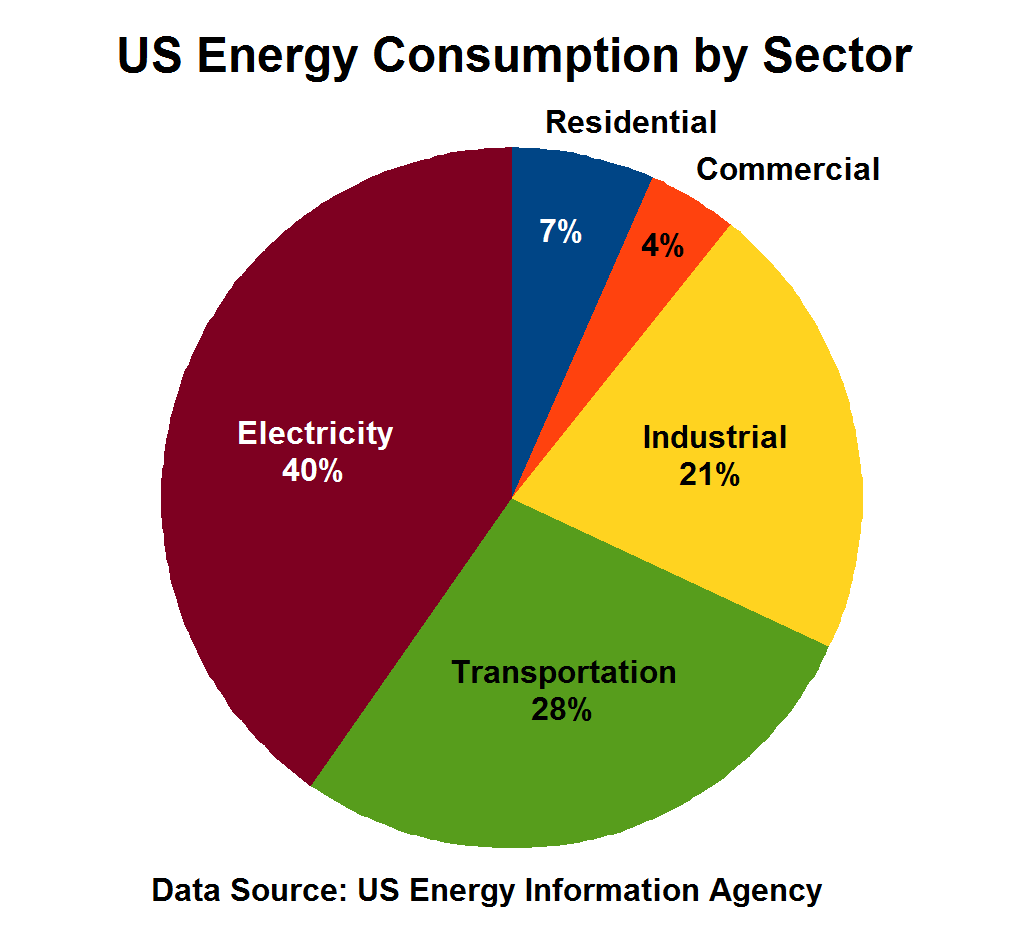
There's a hell of alot more counter points than that. Only 7% of our energy usage is residential: https://upload.wikimedia.org/w...
So per capita isn't even a great measure. We have a huge GDP with alot of industry, which equates to a great deal of energy usage. If you take GDP into account, the US ranks somewhere around Canada in terms of efficiency (https://en.wikipedia.org/wiki/List_of_countries_by_ratio_of_GDP_to_carbon_dioxide_emissions). Both India and China have tremendously poor efficiency ratings at the bottom of the list.
So the US isn't a beacon of efficiency being mid-pack, but not nearly as bad as the usual "5% of the population causing 15% of emissions". It's more like 25% of the world's total industry is causing 15% of emissions: https://www.google.com/search?...
Considering the fact the vast majority of the world's industry is in the US, EU, and China, it is no surprise they're the top 3 carbon emitters: https://wri.org/blog/2014/11/6...
-
Re:Chain of conclusions
The World Resources Institute estimates that all aviation (not just tourism) contributes around 1.7% of greenhouse emissions. Compare that to 10.5% for road transport, 13.8% for agriculture, and 29% for electricity - and you can see that jet-setting tourists are a pretty tiny slice of the problem.
Contrary to popular straw men, a sustainable future does not require drastic slashing of lifestyles or economic growth. We could save nearly 50% of our global CO2 emissions simply by transitioning to carbon-neutral energy, instead of burning coal, oil, and gas everywhere, meaning we could further scale up our cars, air conditioners, and heavy industry as much as we cared to without heating the climate at all.
-
Good for China
Good for China, and good for us: the sea level rises for everybody equally, no matter which country is at fault. Today, the U.S. and China emit vastly more greenhouse gases than the EU, India, and Russia combined. Those two countries have a responsibility to the rest of the world to get their houses in order.
China is doing something about it, albeit first steps. The U.S., by contrast, is being run buy delusional nuts who think global warming is some kind of scam. Makes me ashamed to be an American.
-
Re: Humans are a virus
What kind of damage has the developed world done and continues to do?
Well, looking at greenhouse gas emissions:
http://www.wri.org/sites/defau...
http://www.wri.org/sites/defau...
And looking at issues like deforestation, species extinction, and fresh-water pollution, it is overwhelmingly the transnational corporations originating in the developed countries and supplying the developed countries which have had the largest destructive effects cumulatively, and are continuing to do so.
I don't have time to source all of that for you, but you can look it up for yourself.You need to understand that just because, say, we've cleaned up the litter on our city streets better, and that we TALK about environmental issues more than the rest of the world, does not mean we are doing better than them on the serious global environmental destruction factors. We are still doing way worse, especially if you rate it on a per person basis. Way way worse. Orders of magnitude worse.
-
Re: Humans are a virus
What kind of damage has the developed world done and continues to do?
Well, looking at greenhouse gas emissions:
http://www.wri.org/sites/defau...
http://www.wri.org/sites/defau...
And looking at issues like deforestation, species extinction, and fresh-water pollution, it is overwhelmingly the transnational corporations originating in the developed countries and supplying the developed countries which have had the largest destructive effects cumulatively, and are continuing to do so.
I don't have time to source all of that for you, but you can look it up for yourself.You need to understand that just because, say, we've cleaned up the litter on our city streets better, and that we TALK about environmental issues more than the rest of the world, does not mean we are doing better than them on the serious global environmental destruction factors. We are still doing way worse, especially if you rate it on a per person basis. Way way worse. Orders of magnitude worse.
-
Re:You made the bed. Now sleep in it.
Uh, I would have thought that most of the cumulative CO2 is due to coal, civil engineering and metallurgy, agriculture and land use change.
"the country-level contributions to climate change are extremely sensitive to two factors: (1) the time period chosen and (2) inclusion of LUCF [land use change] (and non-CO2) emissions. Even if countries could agree on which time period to adopt, no official country-level data exists prior to 1990. Unofficial data for CO2 from fossil fuels extends back to the 1800s.However, the certainty of data covering such distant time periods is likely to be disputed. Historical data is also geographically biased, as earlier data is more likely to be available for European countries. Equally significant is the absence of virtually any country-level data for non-CO2 gases and LUCF prior to 1990." http://pdf.wri.org/navigating_...
-
Re:And better for the enviroment
The answer is we don't know, and those who say "no way" and those that say "absolutely" have little evidence to support or contradict them, since it's all speculation.
However, according to the EPA humans have been producing between 5 and 6 GT (billion metric tonnes) or CO2 a year form quite some time. Trying to grow meat in a laboratory and make it scalable like this likely produces less than a few tonnes, so less than 0.0000001% increase. Estimates of the animal agriculturla contribution to this seem to average around 5% (World Resources Institute, UN Food and Agriculture Organization, and Pitesky et al. 2009) [NB: I just eyeballed this, didn't actually pull out a spreadsheet].so about 300,000,000T.
If we "spend" 2-6T of CO2 for a mere 1% chance that if adopted widely it will save emissions from meat production by an ultra-paltry 1 in 10,0000 (300,000T/year), even factoring the risk, it's a really smart investment. So do it. Once you're done, then let's talk about how it will save the world from Global Warming.
-
Re:we're all scientists
Your arrogance is astounding.
I live there you idiot.
And yet I can be very kind and pleasant when not dealing with the willfully ignorant. It's after a while that I don't feel the need for patience, and thanks for adding me to the personality attacks, much appreciation for another example of denialists using the last of their weapons. The personality attack. I suspect you are a nice guy despite our disagreement.
On the other hand, here is something for you to deny: http://www.rsmas.miami.edu/blo...
More for you to deny http://www.wri.org/publication...
4 inches since 1996. In an almost sea level area such as Miami. a four inch difference is a lot. The photo of a spring tide flood seems to concur with that. Man, salt water is tough on a person's ride.
Now back to me and my foibles - you want to know why I asked where you lived? Did you know that there are places on Earth where the sea level is dropping? There are places in Scandinavia there isostatic rebound form glacier melt has raised enough new coastal land that there are issues in dealing with who owns the land.
Did you know that the horrid droughts in Australia a few years ago made for a temporary sea level drop?
The world is not a static place, and surprises us all the time.
So if you had noted that you lived in Scandanavia or even Coastal Alaska, I would have concurred, then explained.
By the way, the isostatic rebound will not help Miami or the rest of Florida. Or Louisiana, where they have the added issue of Crustal thinning along with sea level rise.
-
Re:To higher ground?
No, a ton is a ton. All I was saying is that when you account for over 100 years of emissions that Europe (including Russia) and US did, it dwarfs everybody else, even China. And so you need to look at each country's share in historical emissions since we started burning fossil fuels, as opposed to just the current year's share.
-
Feeding the world without the Haber process
Human waste includes urine, which is part of "night soil".
http://en.wikipedia.org/wiki/N...But yes, "night soil" could only be part of a system. But there are other parts, as mentioned in a section quoted at the end.
I don't know about England specifically, or later years, but this says:
"Population and Economy : From Hunger to Modern Economic Growth"
https://books.google.com/books...
"According to official Chinese statistics, by the middle of the 18 century, population density was already over 500 people per cultivated sq. km (see Liang 1980: 400, 546). While these numbers are undoubtedly exaggerated owning to under-registration of cultivated acreage (ho 1995), the contrast with 18th-cent. Europe, where 1 sq. km of cultivated acreage supported 70 people, is quite extreme (see Braudel 1981a: 56-64)."Much of China is just not that cultivated because of mountains and deserts and such (especially in the West).
Organic agriculture is indeed information and labor intensive -- which is why robotics will revolutionize it -- including robots to pick specific insects off of plants.
On fertilizer loss, see:
http://www.wri.org/our-work/pr...
"Between 1960 and 1990, global use of synthetic nitrogen fertilizer increased more than sevenfold, while phosphorus use more than tripled. Studies have shown that fertilizers are often applied in excess of crop needs (MA 2005). The excess nutrients are lost through volatilization (when nitrogen vaporizes in the atmosphere in the form of ammonia), surface runoff (Figure 2), and leaching to groundwater. On average, about 20 percent of nitrogen fertilizer is lost through surface runoff or leaching into groundwater (MA 2005). Synthetic nitrogen fertilizer and nitrogen in manure that is spread on fields is also subject to volatilization. Under some conditions, up to 60 percent of the nitrogen applied to crops can be lost to the atmosphere by volatilization (University of Delaware Cooperative Extension 2009); more commonly, volatilization losses are 40 percent or less (MA 2005). A portion of the volatilized ammonia is redeposited in waterways through atmospheric deposition. Phosphorus, which binds to the soil, is generally lost through soil erosion from agricultural lands."Comparisons to medicine... Don't get me started.
http://www.drfuhrman.com/libra...
"The sad thing is surgical interventions and medications are the foundation of modern cardiology and both are relatively ineffective compared to nutritional excellence. My patients routinely reverse their heart disease, and no longer have vulnerable plaque or high blood pressure, so they do not need medical care, hospitals or cardiologists anymore. The problem is that in the real world cardiac patients are not even informed that heart disease is predictably reversed with nutritional excellence. They are not given the opportunity to choose and just corralled into these surgical interventions. Trying to figure out how to pay for ineffective and expensive medicine by politicians will never be a real solution. People need to know they do not have to have heart disease to begin with, and if they get it, aggressive -
Re:One more promising lead....
Biofuel is dead! Didn't they hear the news?
http://www.wri.org/tags/biofue...According to the World Resources Institute report just released within the last week (!):
- Claims for biofuel potential have been exaggerated
- Their production is costly and inefficient
- There are better alternatives to fossil fuels already available for achieving lower carbon
- Research funding has led to little progress compared to alternatives, and that is unlikely to change
- And biofuel production has caused unintended disruptions on the food markets -
Re:Science creates understanding of a real world.
Talk about setting up a straw man to knock it down.
If you prefer, we can do it this way:
1. Set limit on total carbon budget into the atmosphere. Humans can net-emit 1 trillion tonnes and have a 50/50 chance of staying under 2 degrees Celsius global temperature rise . We are a little over half way through the trillion tonnes now, but our pace of emitting is still increasing.
http://www.wri.org/blog/2014/0...2. Set a function for carbon pricing (carbon tax, taxed at source) so that the price will increase exponentially so as to keep the emissions under the budget.
If you prefer, the revenue from the tax can be redistributed as corporate and personal income tax reductions. Some would advocate devoting a good portion of it to transition funding, split between job transitioning funding and alternative energy and transportation technology R&D acceleration.3. Under those conditions, let the market take hold and determine the best solutions.
On the first and second points, to which you will object, remember that physics does not negotiate. It's the most extremist of them all. It's not just gravity. It's the law. It's not just differential absorption/reflection/transmission of EM radiation energy by the atmosphere with different chemical composition. It's the law.
-
Not Me
The common perception among Slashdotters is that while Bill Gates may cause us some professional difficulties, he makes up for it with an exemplary philanthropic record.
Not me. I've voiced my concerns that are not so warmly received.
The short of it is that I think what Gates is doing is great but I don't understand why they buy research facilities in America and not Africa or why all the drug companies that get to sell their cures to Africa are all American. I mean without stability, roads and other infrastructure, Africa is going to constantly need someone else to fix their problems. And the money from the B&G Foundation stays in America invested in American companies that pays out to American companies that provide "cures" for Africa. It will perpetually work that way.
Imagine aliens landed on Earth, took an assessment of us and were saddened to see war, pollution, poverty, etc. So they say they're going to help us and they buy 10 long range matter transmitters from another alien race and give them to Earth. But if we ask them on how to make the transmitters ourselves they just laugh and say "Please, you're still searching for subatomic particles. Plus, you're just going to use them for war if you can make them. And on top of that, you would have to pay sums you cannot fathom to the alien race who invented these machines. When these break, we'll get you some new ones." Meanwhile they're receiving accolades from the galactic senate and Earth remains full of war, pollution, poverty, etc.
It's a horrible truth but the one thing Africa has a lot of is humans. Life is cheap there. If you want to reverse that, you need to introduce stability and then farming and then commerce. There are huge areas where crime, corruption and warlords make it impossible to raise crops. Curing malaria is important but it isn't going to stop that from being the hungriest place on Earth. And it's not going to raise the value of human life there. Gates' idea to fix that is to pair up with Monsanto (surprise another American company with tons of IP). Right. I wonder if they'll patent the seeds they breed that grow well in regions of Africa?
Just like thinking up a new microfinancing system can win you a Nobel Prize, ideas on how to make areas secure and stable will go much further for farming in Africa than importing Monsanto seed with terminator genes. -
Re:Protectionism by any other name...
For just CO2 emissions for example look here: http://www.mnp.nl/images/Top20-CO2andGHG-countries-in2006-2005(GB)_tcm61-36276.xls
For total green house gas emissions an example source: http://pdf.wri.org/navigating_numbers_chapter4.pdfYou will note that the US has over 5 times the emissions of China and over 10 times the emissions of India per capita. If you think about it it is quite crazy since most products that the US consumes, are manufactured outside the US! And yet the US is not keen on reducing emissions (or ratifying Kyoto).
And then comes the Slashdoter from the US who has not RAFA in his life complaining how the other countries don't care about emissions! -
Re:location, location, location
That'd be fine for Chernobyl. Russia has vast tracts of land. Japan, not so much.
http://earthtrends.wri.org/text/population-health/map-192.html
-
Re:A couple errors in a 3,000 page document
I take it that you're dropping the ridiculous notion that a couple errors in a 3,000 page document written by hundreds of people somehow means that the whole thing is invalid?
preaching something that doesn't exist and then claiming that science supports what you preach is "climate evangelism".
Yeah. I mean, only ~97% of the world's publishing climate scientists believe in it. Who cares about those who actually do the research and keep up on all of the (very extensive) literature? It's all a socialist conspiracy anyway.
In case anyone's curious how different mountain glaciers are changing, here's a nice graph.
-
Re:To the Global Warming naysayers
It's quite simple. You argue "why is it that in OUR country, which is nothing like your country, doing this worked (well didn't impact our tax rates anyway!), but in yours, you think it wont?!"
I don't know how uneducated you are but grab a map or a globe and check out relative sizes. Not good enough? Numbers: USA - 9,161,923 KM^2... Sweden - 449,964 KM^2. That's 20.4 : 1. Population? USA - ~307,269,000... Sweden - ~9,263,872... That's 33.2 : 1. And let's just completely for sake of simplicity IGNORE the climate differences because that has a huge factor.
Now, actual energy consumption numbers? Let's see....
USA
Sweden
Ok. Sweden's total energy consumption in 1999 was 51094 units. For reference, the USA consumed 2269985 units. 44.4 : 1. The USA produced enough renewable energy to completely power all of Sweden... boy.. a CO2 tax wouldn't be very expensive there now would it? But do you notice something about how much CO2 emitting fuels we use here in the USA because it is TOO FUCKING EXPENSIVE to power this entire country on anything else with the grid being powered primarily by private corporations. A CO2 tax here is imposed and is completely unfair because we're one of the highest renewable energy producing countries ON THE PLANET, yet we're still not completely green -- and the country is SO MUCH BIGGER than sweden that a much larger portion of the population must commute, and a huge percentage of those vehicles burn a petroleum product -- producing CO2.
We'd have no problem with a CO2 tax... IF the government would spend equally in that sector and to make *SOME* effort to help the country move toward the government's goals. Cash for clunkers -- bad move, good for banks (the ones the gov. now owns).. and the motor companies (which it also now owns.. lol..). Hundreds of billions of $ in stimulus -- building roads, money disappearing in pork projects, most of it completely invisible to citizens -- bailing out insurance companies, banks, motor vehicle companies, etc etc etc. A TRILLION DOLLAR healthcare bill -- when the existing system would be *FINE* if everyone didn't have to pay so much for energy (taxing it won't help). Where's the "stimulus" towards renewable energies? Towards R&D in vehicle technology that will make very high mileage vehicles CHEAP? Nowhere... but a very willing government to make us pay for producing CO2 when it's our lifeline at this point in history.
We all want to pursue fission, it's less waste producing that burning coal but you've got fanatic green fucktards who lobby against it... we want fusion (lol, that would power THE PLANET).. but no government investment there.. we'd like to all power our homes with solar panels and turbines.. stipends here and there but no real public push or incentive from the government. Nothing. NOTHING. But tax our consumption practices because "change" is desired.
You see, liberals hit a brick wall here with this one. Complete hypocrisy. On the one hand, when the economy is failing, we're gonna pump money into banks and corporations who have shown an inability to run their company successfully (ie, why they're failing). That's FINE, encourage those bad practices which are economically DISASTROUS... but CO2 emissions? Oh, we need... TR.. TR.. TRUH.. TRILLIONS of dollars.. to implement a "green" energy grid -- which nobody has!!... well.. fuck you guys, we'll make you PAY MORE MONEY TO US, the FUCKING government of the USA, because we're the big daddys baby, we're YOUR FUCKING DADDY, give us your money.. because we'll re-invest it in helping you do what is good for this country!! (Lol). Taking money from companies that you want to turn around and invest money in renewable energy is completely counter-productive and counter-intuitive.
Your argument is inherently flawed. L -
Re:To the Global Warming naysayers
It's quite simple. You argue "why is it that in OUR country, which is nothing like your country, doing this worked (well didn't impact our tax rates anyway!), but in yours, you think it wont?!"
I don't know how uneducated you are but grab a map or a globe and check out relative sizes. Not good enough? Numbers: USA - 9,161,923 KM^2... Sweden - 449,964 KM^2. That's 20.4 : 1. Population? USA - ~307,269,000... Sweden - ~9,263,872... That's 33.2 : 1. And let's just completely for sake of simplicity IGNORE the climate differences because that has a huge factor.
Now, actual energy consumption numbers? Let's see....
USA
Sweden
Ok. Sweden's total energy consumption in 1999 was 51094 units. For reference, the USA consumed 2269985 units. 44.4 : 1. The USA produced enough renewable energy to completely power all of Sweden... boy.. a CO2 tax wouldn't be very expensive there now would it? But do you notice something about how much CO2 emitting fuels we use here in the USA because it is TOO FUCKING EXPENSIVE to power this entire country on anything else with the grid being powered primarily by private corporations. A CO2 tax here is imposed and is completely unfair because we're one of the highest renewable energy producing countries ON THE PLANET, yet we're still not completely green -- and the country is SO MUCH BIGGER than sweden that a much larger portion of the population must commute, and a huge percentage of those vehicles burn a petroleum product -- producing CO2.
We'd have no problem with a CO2 tax... IF the government would spend equally in that sector and to make *SOME* effort to help the country move toward the government's goals. Cash for clunkers -- bad move, good for banks (the ones the gov. now owns).. and the motor companies (which it also now owns.. lol..). Hundreds of billions of $ in stimulus -- building roads, money disappearing in pork projects, most of it completely invisible to citizens -- bailing out insurance companies, banks, motor vehicle companies, etc etc etc. A TRILLION DOLLAR healthcare bill -- when the existing system would be *FINE* if everyone didn't have to pay so much for energy (taxing it won't help). Where's the "stimulus" towards renewable energies? Towards R&D in vehicle technology that will make very high mileage vehicles CHEAP? Nowhere... but a very willing government to make us pay for producing CO2 when it's our lifeline at this point in history.
We all want to pursue fission, it's less waste producing that burning coal but you've got fanatic green fucktards who lobby against it... we want fusion (lol, that would power THE PLANET).. but no government investment there.. we'd like to all power our homes with solar panels and turbines.. stipends here and there but no real public push or incentive from the government. Nothing. NOTHING. But tax our consumption practices because "change" is desired.
You see, liberals hit a brick wall here with this one. Complete hypocrisy. On the one hand, when the economy is failing, we're gonna pump money into banks and corporations who have shown an inability to run their company successfully (ie, why they're failing). That's FINE, encourage those bad practices which are economically DISASTROUS... but CO2 emissions? Oh, we need... TR.. TR.. TRUH.. TRILLIONS of dollars.. to implement a "green" energy grid -- which nobody has!!... well.. fuck you guys, we'll make you PAY MORE MONEY TO US, the FUCKING government of the USA, because we're the big daddys baby, we're YOUR FUCKING DADDY, give us your money.. because we'll re-invest it in helping you do what is good for this country!! (Lol). Taking money from companies that you want to turn around and invest money in renewable energy is completely counter-productive and counter-intuitive.
Your argument is inherently flawed. L -
Re:Good.
Actually Nuclear is not a replacement for Coal.
Why you might ask? Because Nuclear can only provide a "base load" and cannot be used to "generate on demand" such as required for peak loads. A reactor on a sub or ship is quite different than that used on land.
Coal and Natural Gas can be quickly "spun up" to handle peak loads, can't do that with Nuclear.
I am a for Nuclear but it is not possible to cover the entire grid with it (not even France can do that, they tried and they sell off their surplus "base load" power to surrounding countries).
Wind is unreliable and there is no current technology that can be used to store it so it is pretty useless actually, especially for what you have to do in order to provide it (install long distance transmission lines because the best windfields are far away from population centers; damn ugly; if you live near them the noise will literally cause you to get insane; if they get iced up they don't work, etc.)
Solar is pointless...PV at least {good for niche applications only}, but "solar thermal" is somewhat useful as it can be used to generate a baseload + peak but suitable locations for such plants is also far away from most population centers.
Here is a good PDF on concentrated solar thermal:
http://www.wri.org/publication/juice-from-concentrate
(pdf is linked to from page above)
-
Re:Costs of Solar, Wind, and Nuclear Power
Sending all the immigrants back just moves the problem of energy generation to another place in the world - but it will still be there, and the ecosystem is a global one.
You missed the point; which is that immigrants from poor nations tend to have as many children as they would have had if they remained in the poor nation, but they live much closer to the standard of living (and thus energy consumption) of the new nation they reside in. This is often driven by religion, the idea of having a large number of offspring who can send money back to the remaining family in the original country, or a simple lack of education. This is obvious to anyone living near immigrant populations from many less-developed countries, yet bringing it up is super-taboo.
Of course, americans use more energy per head of the population than everybody else.
Ninth. Not that that is something to be proud of, but it's hard to trust what you say when you either willfully exaggerate or fail to look up simple facts. Energy per GDP is another way of looking at things that rewards productivity and wealth creation rather than the number of near-starving people a state can maintain.
I'd also like to point out that your last two points are contradictory. You claim that sending immigrants back to a country moves the same problem somewhere else, yet you then claim that people living in different countries use different amounts of energy. Both cannot be true.
Finally, we're not trying to exterminate people, send them back, or ban them from the country. All we want is education and empowerment of women, reform of religious doctrines that are decidedly "viral" in nature, and an end to government bonuses that *encourage* having too many children. As soon as women no longer feel obligated to have 4+ children, or that they must guarantee male heirs, then we'll be in much better shape.
Once the population is stabilized, *then* consumption will be the most important thing to tackle. The most efficient large developed nations are no better than 50% less energy than the US per capita or GDP; While that may seem like a lot, if the population keeps doubling every generation you've only staved off calamity by about 30 years. If the population is stable however, that 50% is something you get to keep indefinitely. Eventually both problems need to be addressed (along with power generation), but it is pure folly to think that percentage adjustments to consumption alone are enough to solve the problem.
-
Re:More on "altruistic vaccination"
Natural fallacy medicine and conventional medicine were roughly equivalent because, before the scientific method was used, they were both based on superstition.
The amusing thing is that the medication part of allopathic medicine is largely based on naturopathic medicine: I've read estimates that as much as 80% of the medication in the USA is either a plant extract or derivative or a synthetic version of the same. But the 25% that comes directly from plants would be compelling all by itself.
If you think that naturopathic practitioners are incapable of learning, there's not much I can do to change your mind, such as it is.
-
Re:A little sad.
Which might have been relevant if Australia didn't have lower energy consumption than the US (per capita) as does the United Arab Emirates.
Places that have a higher (again per capita) consumption include Iceland, Norway, Finland and Canada
So in essence you are pulling that argument out of your ass. (mod me flamebait all you want, it's true. See: http://earthtrends.wri.org/searchable_db/results.php?years=all&variable_ID=574&theme=6&country_ID=all&country_classification_ID=all)
-
Re:Global warming my blue butt
You mean like these graphs from the IPCC which show an increase in global temperatures from 2000 to 2007?
-
Re:Exactly What We Need
Though I share your concern about the environment I must say that western countries particularly the USA have no moral standing to highlight energy consumption in countries like India, China etc... I dont want to turn this into a mud sling match however , I feel people should be aware of the facts. I do feel a sense of dread when I think about so many people turning to less efficient mode of transport and the effect it will have on the environment. I am sure with tighter controls on other pollutants in the country we might be able to save some semblance of an environment. Lets see the facts. per capita consumption of energy in oil equivalents (kg/year) 2003 - USA - 7,844.1 India - 512.4. Difference ratio - 15.31 (reference: http://earthtrends.wri.org/text/energy-resources/variable-351.html ) population USA - 301139947 , India - 1129866154 (reference: https://www.cia.gov/library/publications/the-world-factbook ) 7844.1 * 301139947 = 2362171858262.7 and 512.4 * 1129866154 = 578943417309.6 and 2362171858262.7/578943417309.6 = 4.08 Simple Math tells us that even with India's huge population the USA consumes 4 times more energy than India. Therefore it sounds a bit lame when people in America express concern about a few people in India get some small cars while they themselves ride around in gas guzzling SUVs. While the concern about cars is still understandable the concern expressed by certain countries regarding the provision of electricity in more villages in India is downright ridiculous. People in these villages dont even have light bulbs. I admit we are a backward country with very bad traffic and other bad things. But HEY! we still consume less energy than YOU.
-
Re:Gosh, that's stange
"2) The US has actually done much better in reducing green house gas emissions compared to most Kyoto signatories. Name me one country that will actually meet its obligations."
Theree are 2 ways of looking a this - the US is already the largest consumer of energy per person... way too high compared to most other nations.
http://earthtrends.wri.org/text/energy-resources/variable-351.html
Some clips: 2003 2000 1990
Asia (excluding Middle East) 991.2 911.3 753.7
North America 7,844.1 8,113.1 7,544.8
China CHN 1,138.3 946.4 791.7
India IND 512.4 501.4 425.7
United States USA 7,794.8 8,109.0 7,543.4
India and China are home to over 35% of the World's population; but it appears they do not have much of a scope to reduce consumption. The US consumes more than 15 times the energy per person consumed in India; and there is a huge scope for reduction. Inaction by the US govt. is dangerous for the entire planet, including India and China.
And on a more personal note:
4) President Bush's home in Texas is actually a surprising green residence while Gore's pool house consumes more power than the average person's home.
It doesn't matter if Mr. Bush lives in a thatched shed and uses biogas to light up his dwelling. He is responsible for the energy consumption of the entire USA, not just his hut. -
Natural Gas != Oil
That link that you gave is not for oil, but rather natural gas.
While it is true that many people do not realize that transportation is only one part of the pie with gas consumption, it is far more than 1%. According to this link, in 1998 it was 24%. While it is true that items such as power generation use more oil than transportation, a Prius or two still does help.
-
Responsibility for ScrewingFrom a certain point of view, you're correct; we have no immediate need to concern ourselves in Darfur. But there is some very good evidence out there that countries with large disparities in wealth suffer all sorts of problems. A prime example is Brazil, wherein the rich are largely housed behind reinforced steel because crime is so prevalent.
We don't need to intervene, but it is a good idea for us to stabilize these regions before they spin out of control. I don't think military intervention is the best idea; I think that people are most peaceful when they have the most to lose. Instead, we let their infrastructures get destroyed, large itinerant populations to arise, and wealth to be suspiciously dealt to only a few. Wealth, like power, is best distributed as evenly as possible. The result of allowing wealth to concentrate in one place is that it creates a class of dispossessed; never as easy to deal with as we'd like to think. Any sane person would pay attention to these issues for their own long-term interest, if not for their humanitarian nature; especially if they're hands-down the richest country in the world.
In short, of course we shouldn't gut our way of life in an ill-aimed crusade to save the world. But we should share the wealth, and we should never believe that we are somehow more worthy of the wealth than the poorest of the poor in the backwater countries that are experiencing such strife. Realize you did not work for your wealth; you were born into it.
-
Re:This is news?
Is the ongoing threat of far right political parties in Europe (the BNP, Le Pen, etc) the reason why Europe's socialist governments sink so much money into subsidizing their rail systems, whereas the United States has no need, and therefore couldn't care a whit about poor Amtrak?
Take maps of greenhouse gas emmissions, signatories of the Kyoto protocol and a comparison of petrol prices and maybe you'll come up with a different reason. -
Re:I think the real value or point of the story is
Especially with large appliances, cars, and the like, you typically save a hell of a lot more energy by continually repairing it and by not buying a newer, more efficient model
As of 2005, the energy cost of manufacturing a car is 3 MWh (0.6 tons of CO2 equivalent), partially thanks to the fact that many parts of a car are recycled. Your mileage my vary, but that is equivalent to burning about 300 liters of gasoline. Replacing a gas-guzzling SUV (12 liters per 100 km) by a compact (6 liters per 100 km) will pay back in just 5000 km, energy-wise.
Another site says that 94% of the CO2 emissions of a car are related to fuel production and consumption.
-
Re:At least China has a gas standard for cars
Well, the US does have standards for emissions that are more stringent than China*
That's not what I've heard in Al Gore's documentary "An Inconvenient Truth".
I just searched for other sources and I found the following:
http://www.wri.org/climate/newsrelease_text.cfm?Ne wsReleaseID=304
http://forests.org/articles/reader.asp?linkid=2709 8
http://www.dieselnet.com/standards/us/fe.php -
Not so new - ATMs for the poor in Bolivia
PRODEM Private Financial Fund has been using specially designed ATMs for poorer communities in Bolivia for several years now. The ATMs uses smart cards, finger prints, and a multilingual voice-driver interface with a color coded system. The cost is about half of the cost of traditional ATMs.
From the World Resources Institute:
Serving the Poor Profitably in BoliviaAt first glance, the largely illiterate and impoverished villages of indigenous peoples nestled in the rural jungles of Bolivia do not appear to offer substantial financial opportunities. However, one innovative company saw this vast segment of the Bolivian population not as an obstacle to economic success, but as an untapped opportunity.
The World Resources Institute has written a case study on them too:
http://www.digitaldividend.org/pdf/prodem.pdf -
Another inconvenient post full of falsehoods
Basically, everything you wrote was wrong except for the bit about the Greenpeace founder.
1. There is no global warming on Mars
2. DDT is dangerous to the environment
3. The Kyoto Treaty exemptions are based on CUMULATIVE emissions, not annual emissions. The US and Western Europe have released the most CO2 into the atmosphere by far. That's not even when you factor equity into account on a per capita basis. -
Re:Maybe it's just a sign of evolution
No, but it does lead to intellectual laziness and a propensity for moral superiority, a feminine trait necessary for the indoctrination of small children.
You can look up the statistics yourself, you lazy bastard.
http://earthtrends.wri.org/searchable_db/index.php ?theme=8&variable_ID=193&action=select_countries -
Re:Including "innovation" is dangerous.
Other sources of ethanol are only now beginning to be developed. It is very reasonable to expect that some of the sources will be crops that can grow on land that isn't well suited to growing foodstuffs. Second, that 19% is the amount of land actually under active cultivation, not the amount that could be brought under cultivation. It took me a while to run that down, but look at page 3 of this pdf http://earthtrends.wri.org/pdf_library/country_pr
o files/agr_cou_840.pdf [wri.org]. Third, you assume that the same land - even the same crop - can't generate both foodstuff and fuel. Think about using cornstalks as a driver for fuel. Fourth, you make the assumption that the yield will remain constant. In only the last few years the yield from corn has gone from 400 g/acre to over 500 g/acre. Some people expect that the yield will rise to 2000 g/acre in the next 20 years. Last, you make the assumption that the inputs will only be crops. Non-agricultural inputs can also be applied. For instance, suburban lawn clippings and leaves.
This is exactly why Julian Simon destroyed those who see the solution as government intervention. There are thousands of engineers, businessmen, and scientists working on the problem at every possible step of it, from cheaper oil (new mining, new searching techniques, artificial production) to new fuels (ethanol, LPG, electricity, fuel cells, Mr. Fusion), to totally new engine types, to who knows what else.
The intellectual power working to solve it greatly outweighs temporary shortages (as measured by price increases in an otherwise free market) and the counter-intuitive result is that the situation repairs itself, while government regulation and even rationing just yields more shortages.
Imagine the idiocy of a "BTU" tax -- it would penalize newer forms of energy production that produced more for less cost -- and thus would yield the opposite effect as to what is intended.
It's similar to the old wive's tale that Congress was gonna tax data transfer based on # of bytes -- you'd end up with a purely text-only internet, as a 30 cent email would turn into a $5 billion charge for downloading a movie.
There are sometimes shortages of RAM chips, of new processors, etc. I don't see any of the computer nerds around here clamoring for a government takeover of the design and manufacture of new computer chips.
A wise man once noted that nobody signs up for "holistic muffler repair" or "alternative medicine Boing 747 mechanical maintenance" -- people know crap when they see it.
So who's with me, fellas? Government rationing and granting and directing research into new ways to produce computer chips?