Slashdot Mirror
Domain: yle.fi
Stories and comments across the archive that link to yle.fi.
Comments · 98
-
Re:Pedigree speaks for itself
And oh, yeah
This particular conspiracy theory can be put to rest now.
-
Re:Pedigree speaks for itself
And oh, yeah
This particular conspiracy theory can be put to rest now.
-
Pedigree speaks for itself
The guy's more comfortable with Microsoft, he's got shares in it, he talks to the people, he knows Microsoft. Now, Google is a totally different beast there - they're doing exactly the same thing, i.e just make an OS, but they're not really Mr Elop's circle.
And oh, yeah
I love my Nokia phones and I've never bought any other. For the brief period I worked for Ericsson, I was shocked to realize the depth of their patent portfolio, especially when it comes to UX stuff. I can guess those guns will be aimed at Apple first, while it's leaderless without Steve, but eventually the aim's going to turn around and point at Android.
-
zzzPhone sidestory: wooden mobile phone
The Outcome: zzzPhone took some orders and shipped a small number of very low-quality phones. I heard crazier and crazier stories about Horowitz, all second-hand. For instance, he apparently hired a carver to make him a cell phone out of wood that he tried to insert working phone components into.
I found that a bit funny because making one is a course at a Finnish university. More pictures here, but with finnish text only.
I originally read about this in a magazine; apparently they solder the sim-card connecting leads so swapping operators requires some work.
-
Church Concern Over Mass Resignations
-
Re:No, we are not
Certainly you will get FiOS or some other fiber to developed areas, but it's not worth running those cables again across US to rural households. Most of the cables already run out there should be replaced with either wired or wireless service, FCC needs to (de)regulate this process.
I haven't yet understood what benefit you get from receiving terabytes worth of channels you don't watch. I can understand that you may want to be able to stream two maximum of three simultaneous channels to your home, but wanting more seems extremely strange. You demand other people to explain the need for fast internet while backing your own arguments with ridiculous features. What need can there possibly be to have 20 simultaneous channels? And more importantly, is it justified use of public radio spectrum to allow such waste of bandwidth to very few households who can replace the service with basic satellite/cable TV?
Real requirement should be that you are able to watch any program you wish at any time with as high quality as possible. TV just cannot get there, and it's time to change.
Trust me a cellular service can be adequate for many things. Right now I'm watching World Cup over 3G HSPA (6-7mbit real life speed) connection in rural Finland where all phone cables have been taken away. Data connection is unlimited and costs 13 EUR/month. In my city apartment I have 100mbps fiber for 20 EUR/month. Most of government channels are provided on demand online with 750kbps bitrate (will increase later) at http://www.yle.fi/areena. Many private providers are providing online "tivo" as part of the cable service where you can record/play programs from any channel.
-
Finnish YLE already applies filtering
The Finnish broadcaster YLE reports that it started filtering the vuvuzela sound on Monday:
http://yle.fi/uutiset/kotimaa/2010/06/yle_on_jo_suodattanut_lahetyksista_vuvuzelan_torinaa_1762215.html (Finnish)
(bad Google translation) -
Police is investigating it too
There's criminal investigations in Finland about Google Street view too, after a man was photographed nude in his back porch and another case when an underaged girl was photographed nude in beach and put in the Street view.
-
Re:like trying to offer proof to a Birther
There more CO2 you have the stronger is the greenhouse effect.
280 to 380ppm. Not so much.
AGW isn't about CO2 itself, but mythical positive feedbacks that are pure speculation. Some of those models have now been tested by observation and turned out to be completely false - the feedback was negative instead.
http://ohjelmat.yle.fi/files/ohjelmat/u3219/kaavio7.jpg (Lindzen, water vapor)
-
Re:They flipped Finnish data upside down
English transcript: http://ohjelmat.yle.fi/mot/viime_viikon_mot/transcript_english
-
Re:Bastards!
Seems slashdot didn't like nordic characters - proper link
And here's a link to an English language article from the Finnish Broadcasting Company (the Finnish equivalent of the BBC): 1Mb Broadband Access Becomes Legal Right
-
Crappy system...
This picture gets 95.1%
This, completely different picture, gets 9.8%.
While this one gets 7.3%.Note that the one that actually represents the photographed object the best got horrible grades, but the blurred, oversaturated and cropped version got nearly perfect score.
-
News in EnglishSome news in English about the court decision:
Finnish e-voting results annulled, municipalities to hold new elections by Electronic Frontier Finland ry (Effi), the best summary in English, IMO;
Helsingin Sanomat;
Helsinki Times;
The Brad Blog;
NewsRoom Finland;
YLE; and
Turre (the lawyers that won the case).The voting system was provided by Tieto and Scytl. In their News Page, Scytl declares: "Scytl's Pnyx.core successfully used in local elections in Finland" Shouldn't they update this...? It is even possible that the 2% of the votes lost was due to the Pnyx.core, instead of usability issues with the voting terminals, as has been commonly assumed - who knows.
-
More Info in English
Actually the machines were supplied by local company called Tieto.
More about the case in English
Yle News
Helsingin Sanomat
Newsroom Finland -
no country restrictions?
Not only their own productions. I regularly watch the spanish drama Los Serrano there: http://areena.yle.fi/hae?pid=810385
Could someone outside Finland try that? I must admit I'll be surprised if it isn't geographically restricted, although I guess it's possible they've gotten permission for that from the Spanish producers.
-
Re:Umm...
Not only their own productions. I regularly watch the spanish drama Los Serrano there: http://areena.yle.fi/hae?pid=810385
-
Re:Failed to Finnish
Finnish municipal elections are always by the D'Hondt method, so the result can be strongly affected by a few additional votes.
Doesn't really matter. If you let them vote, count all the fucking votes. It's that simple.
I have my own problems with any voting system skewing the results in favor of the two candidates most likely to win ("Don't vote on the little guy, your vote will be lost!"), but this is ridiculous.
Did they offer any reimbursement for the people whose vote they didn't count? I'd be pissed off if they did that to me. I'd also start screaming around about someone cheating, and likely sue as well.
-
Re:Failed to Finnish
Finnish municipal elections are always by the D'Hondt method, so the result can be strongly affected by a few additional votes. In fact, if the missing votes were all for one candidate, that candidate would have received the most votes.
-
Re:Spreadsheet
Bullshit! I am Ubuntu user, and A/V sucks. Not as much as it used to, but it still sucks. For example, try to stream these videos http://areena.yle.fi/ Sometimes it works, most of the time not.
-
Re:City By The Sea
I believe you meant to say, there's never an excuse to beat up on anyone.
Yep, just today when driving to work I heard a brief news on radio about a recent study made in Finland (link in Finnish).
Briefly:
--
A two-part study was made in 2006 among 17-20 year old men serving their military service in Finland - a total over 2000 young men who had been in a relationship participated. Of those, nearly 17% said that they have been hit by their partner at least once. Critics of the study have commented that the definitions of "relationship" and "hitting" were not clear enough and that the number is therefore too high.
--
Violence in a relationship is NOT just a problem with men hitting woman, and I have seen opinion pieces in newspapers where those men who uphold the principle that they should "never hit a woman" are quite upset and shaken when their wife/girlfriend hits them (repeatedly) and only thing they feel they can do is try to protect themselves (and maybe their kids) from blows.
It is said that women who end up in abusive relationship tend to stick in that relationship despite of the violence (and there are many speculative reasons why) - and while this is propably true, so can be the opposite. It is really hard for a "man of principle who would never beat up a woman" to admit to himself, his friends and ultimately to the police that he is a target of violence from woman, and can't really do anything about it.
As there are (stereotypical) males who drink too much on a friday night and then hit their wife/girlfriend when they nag about drinking / don't want to have sex etc. there are women who can be loving wives and mothers, but when rage takes them on they can throw a frying pan at you (happened to a friend, multiple times...).
But exposing these types to the whole Internet to see forever (Internet remembers, the sentence is for life) is not right and won't solve the problem. -
Nokia recently signed on with MS
... This wouldn't be a story if Microsoft had done it, trying to force WMP codecs into the standard - I'm actually kind of surprised they hadn't yet... but Nokia? wtfNokia recently signed on with MS for its proprietary codecs and is shoehorning WMP/WMA codecs into many (all?) of its products. Biting into Ogg and other open formats is probably part of the deal, or perhaps the MS boosters working from inside Nokia now feel secure enough to upset the apple cart.
It could also be backlash from MSFTers (both inside Nokia and outside) from Jorma Ollila's public support of open standards.
Or it could just be the water
-
Re:Europe
Speaking of Crazy Frog... http://www.yle.fi/top40/albumit.shtml Thats Finnish Top 40 Album list and look what is at 11th place... and been on the list for 14 veeks!
-
Re:Actually...
Google does. Probably not the best pic, but one:
http://www.yle.fi/linna98/photos/photo46_i.jpg -
Working against freedom from the inside
Sorry, you should read the whole statement, which specifically states that you CAN listen to it on M$, but if you have anything else, you should buy a CD player.
Also consider the fact that since earlier this year a former MS executive, Mikael Jungner, is now in charge of Finnish public radio and television for the whole country (YLE). He was hustled through and appointed with nearly a complete absence of a normal interview process after several highly qualified and experienced candidates were passed over. The SDP has more to say if someone is looking for details.Jungner came to MS after work in the government as special assistant to a politician forced to step down after a scandal involving over stepping his authority and illegal deals with the Bush junta over the War on Iraq
-
Working against freedom from the inside
Sorry, you should read the whole statement, which specifically states that you CAN listen to it on M$, but if you have anything else, you should buy a CD player.
Also consider the fact that since earlier this year a former MS executive, Mikael Jungner, is now in charge of Finnish public radio and television for the whole country (YLE). He was hustled through and appointed with nearly a complete absence of a normal interview process after several highly qualified and experienced candidates were passed over. The SDP has more to say if someone is looking for details.Jungner came to MS after work in the government as special assistant to a politician forced to step down after a scandal involving over stepping his authority and illegal deals with the Bush junta over the War on Iraq
-
Re:That would make you
How about http://fi.wikipedia.org/wiki/Lola_Odusoga
Lola Odusoga was Miss Finland 1996, Miss Scandinavia 1997.
http://www.yle.fi/linna98/photos/photo2_i.jpg -
Re:Time Shift?
The only people I know of who actually pay for TV are the British.
The other people with that problem are the Finnish. In Finland, we have this thing called "televisioilmoitus" ("TV-license") which is practically a yearly tax supported by law and the money goes directly to our lovely national broadcast company YLE. And one has to pay for that license for owning a device capable to sync with publicly available TV-broadcasts. It doesn't matter if one actually views content produced or distributed by YLE or not. In addition to this, commercial TV-companies have to pay yearly royalties to YLE by law for broadcasting TV-signals.
And still, with all this monetary support by law, the YLE cannot compete with commercial channels; all viewers combined from all YLE's channels are roughly equal to the viewers of a single commercial publicly available channel. Talk about wasted money...
-
Codex Mentifex
Latina -- lingua Amoris -- vivit in aeternum post hunc splendidum eventum.
Vita Immortalis est tua si habueris bounum karma.
AI soluta est (Q.E.D.) quod erat demonstrandum -- educatio classica est melior quam diploma in scientia!
-
Re:Who cares about Linus anymore?Not to be mean, but "scorching hot" martial arts babe is a bit of a mischaracterization. She looks like somebody's aunt Tillie
(Other trolls please feel free to conjecture about my own physical shortcomings, of course.)
-
Yay! and WMV on your TV ... unless you wise upand you'll get WMV on your TV, too, unless you wise up. MS has already planted what looks like a Manchurian candidate (sorry, link in finnish) as head of the Finnish television service. The previous head was heading the same direction as the BBC has by pursuing open standards. MS's candidate has no background in radio or television and his only 'IT' experience was 2 years at MS. He was chosen over other highly experienced candidates (sorry link in Finland Swedish.
If ever there was a time to use Ogg Vorbis, this would be it. Ericsson handsets have more or less caught up with Nokia's especially after the stumble Nokia made with the latest models. Beating Nokia to Ogg could push them into the lead.
-
Lack of gravy is a process requiring ongoing work.I hope it does reflect on the Finnish corporate culture. However, lack of gravy, even a relative lack is a process requiring ongoing work. Slack off for a short while and things go sour quickly.
Two things I'd like to see examined more carefully are
a) something that looks suspiciously like the state sponsoring a private company's ad campaign and
b) something that looks like a potential conflict of interest by putting an MS exec in charge of the country's information. He claims to be cutting ties with MS, but like any politician talk is cheap and only actions count. Highly qualified and experienced candidates were pushed aside to put him in that post.
-
great news
This is great news. I live in Finland and our bbc equivalent media company http://www.yle.fi/yleista/faq_stream.shtml#14 doesn't stream ogg vorbis because "ogg vorbis can contain software patents and the media companies don't allow a format which doesn't contain digital restrictions management". Maybe they will change their minds someday and start offering streaming in a Free format.
-
Re:Teletext to HTTP gateways?
Finnish Broadcasting Company has had their teletext service available on their website for years.
I remember when they launched the web based teletext. The pages were basically screen captures. Made me laugh pretty hard.
A few years later I worked on a project with FBC and figured out why. The technology behind the teletext service is some proprietary garbage that makes it nearly impossible to transfer the data in any other format.
They have since launched an interface on the website that displays the teletext service in text only though. -
Re:Teletext to HTTP gateways?
Finnish Broadcasting Company has had their teletext service available on their website for years.
I remember when they launched the web based teletext. The pages were basically screen captures. Made me laugh pretty hard.
A few years later I worked on a project with FBC and figured out why. The technology behind the teletext service is some proprietary garbage that makes it nearly impossible to transfer the data in any other format.
They have since launched an interface on the website that displays the teletext service in text only though. -
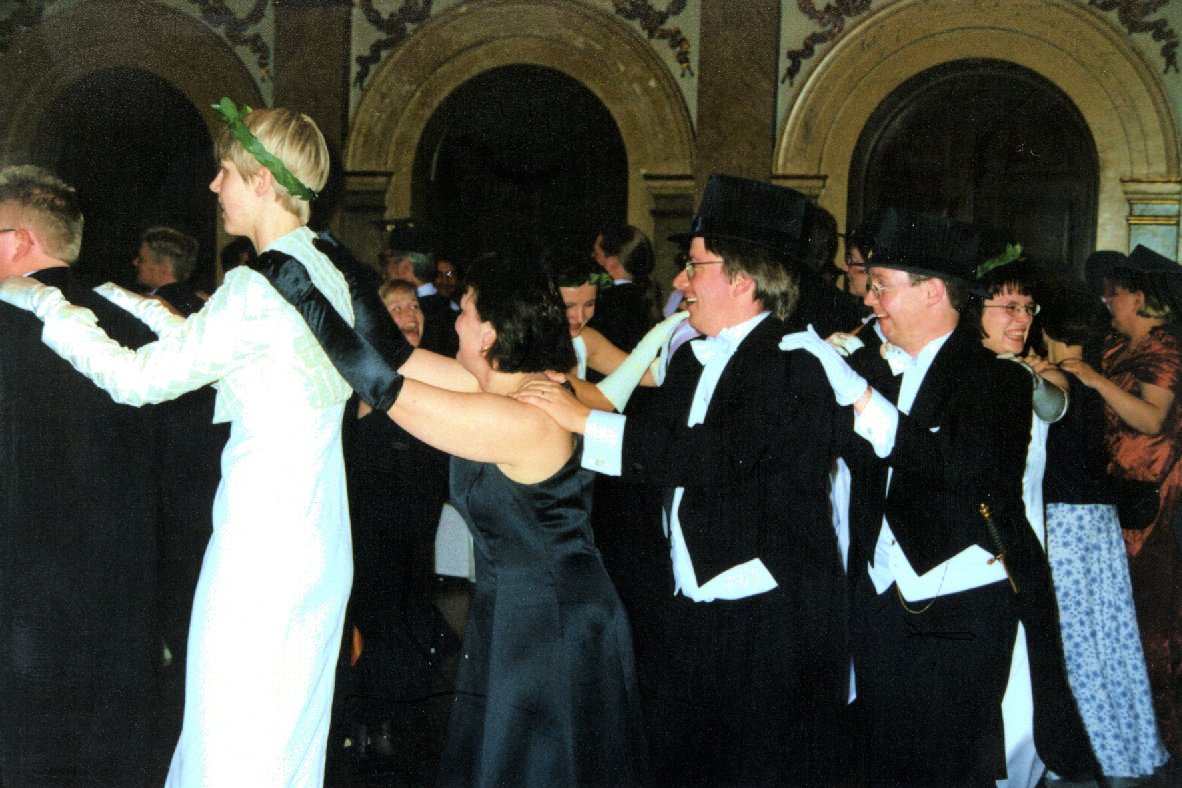
Linus CAN dance!
-
Re:Forget Forking
You do know that Linus is married? Then again looking at this photo, I would advise him to get one.
My eyes. My eyes. -
Finns do a lot of things in funny languages
The Finns have noticed that no-one understands Finnish, so they've become extremely good at putting things in more popular languages. For example you can get the news in Latin courtesy of Finnish Radio (today's headline: Kerry candidatus democratarum.)
-
Re:It's a wonderful life
Doh! Ok, well...Melinda is prettier than Tove, and therefore Bill is better than Linus.
-
Re:If this is what Linux gets, I'll stick to Windo
Well, here's a pic of Mrs. Melinda Gates w/ hubby and Kofi Annan. Not bad, but not particularly attractive, either.
-
Re:Oh no, Karate! I'M SCARED!!!!!!
Maybe so. But she's still a fucking ugly dumbass who married a geek with a stupid name. So fuck you, and fuck "Tove" as well.
You know, I honestly doubt whoever wrote this has even seen Linus' wife. In truth, she does not appear in many photographs, so I had not seen her either. I always imagined her as a svelte ninja goddess.
Curious, I did a little Google research, and my personal conclusion is that there do not appear to be any glamour photos made of Tove (whereas there are many carefully grommed Linus images) and many of the pictures of her are bad. I don't think she is ugly, but some of the pictures are badly taken, on bad hair days, or somesuch.
Then again, you can judge for yourself, eh?.
Personally, I think she looks just fine. And if she makes Linus happy, that is all that matters, right? That makes her beautiful to me.
-
Broadcasting C64 programs over the air
Well, if it was Aphex Twin music, I'd be very impressed that their songs were runnable on a C64
The broadcast was done by the Finnish Broadcasting Company if my memory serves me correctly. We do have similar laws prohibiting mixing data and radio signals at the moment, but I'm not sure about the law situation some 16 years ago when this happened, it might have been legal back then. -
Re:Computer virii - THAT WORD does NOT EXISTWhat's the Plural of `Virus'? What's the Plural of `Virus'? The plural of virus is neither viri nor virii, nor even vira nor virora. It is quite simply viruses, irrespective of context. Here's why.
Sections in this document:
- English Inflections [slashdot.org]
- Classical Inflections [slashdot.org] and References [slashdot.org]
- Journey Into the Fourth Declension [slashdot.org] (new)
- Other Latin Resources [slashdot.org]
- ASM News [slashdot.org]
- ASM News Update [slashdot.org] (new)
- Footnotes [slashdot.org]
Etymology: a. L. virus slimy liquid, poison, offensive odour or taste. Hence also Fr., Sp., Pg. virus.
Other sources that support viruses include Birchfield (n Fowler1 Venom, such as is emitted by a poisonous animal. Also fig.
2 Path. a A morbid principle or poisonous substance produced in the body as the result of some disease, esp. one capable of being introduced into other persons or animals by inoculations or otherwise and of developing the same disease in them. Now superseded by the next sense.
b Pl. viruses. An infectious organism that is usu. submicroscopic, can multiply only inside certain living host cells (in many cases causing disease) and is now understood to be a non-cellular structure lacking any intrinsic metabolism and usually comprising a DNA or RNA core inside a protein coat (see also quot. 1977). [ Formerly referred to as filterable viruses, their first distinguishing characteristic being the ability to pass through filters that retained bacteria. ]
The simple answer is that there wasn't one. The longer answer follows.
Writers who, searching for a fancy plural to virus, incorrectly write *viri are doubtless blindly applying an overreaching -us => -i rule. This mis-inflects many words. For example, status and hiatus only change the length of the final vowel; genus goes to genera; corpus goes to corpora. Others are even worse if this rule is mis-applied, like syllabus, caucus, octopus, mandamus, and rebus.
Anyway, Latin already had a word viri, but it was the nominative plural not of virus (slime, poison, or venom), but of vir (man), which as it turns out is also a 2nd declension noun. I do not believe that writers of English who write viri are intentionally speaking of men. And although there actually is a viri form for virus, it's the genitive singular[1] [slashdot.org], not the nominative plural. And we certainly don't grab for genitive singulars for the plurals when we've started out with a nominative. Such hanky panky would certainly get you talked about, and probably your hand slapped as well.
This apparently invariant use of virus as a genitive singular may also imply that it's 4th declension, as some scholars [slashdot.org] believe.
Those confused souls who write *virii are tacitly positing the existence of the non-word *virius, and declining it as though it were like filius. It's true that l/r are both linguals that sometimes get interchanged, and that f/v are just a change in voicing[2] [slashdot.org], but that's just reaching. *Virii is still completely silly, so don't do that; otherwise, everyone will know you're just a blathering script kiddie.
The crucial problem here is that, classically speaking, there appears to be no recorded use of virus in the plural. It was a 2nd declension noun ending in -us, which is rather common, but it was also a neuter, which is rather rare. I could only come up with three such 2nd declension neuters: virus [tufts.edu] (some poison), pelagus [tufts.edu] (the sea, usually poetically), and vulgus [tufts.edu] (the crowd). None appear to admit plurals. Perhaps this is because they are mass nouns, not count nouns. [3] [slashdot.org]
One citation below wonders whether these -us 2nd declension neuters might have inflected -us => -ora, the way the 3rd declension's neuter plurals for tempus and corpus do. There's really not any support for that notion--that I could find at least. If so, that would end up producing *virora. Most other citations think that these plurals just never happened at all, or that if they did, they didn't jump declensions. Perhaps they were invariant as they oddly are for the vocative and accusative cases. In any event, *virora does not fit comfortably in the mouth of an English speaker, which is a good reason to avoid it.[4] [slashdot.org]
Another theory holds that virus, if it was a 2nd declension neuter, must go to *vira in the plural as do its -um neuter brethren in the 2nd declension. However, that assumes that it works like a -um form, not as a -us form does. And it really seems to do neither. If it were a -us form (again, as a 2nd declension nominative), then its vocative would have to be *vire; but it's really only virus. You also expect an accusative form *viros, but that too is missing; it's still just virus in the accusative. And if it were a -um form, then its vocative would have to be *virum. But it's not--here again, it's only virus. (Vocative examples of virus are not particularly common. Apparently the Romans seldom addressed their slime in a personal fashion.
So what we have here is something of a mixed or invariant declension. Trying to find a plural for something that didn't take a plural (possibly because it was not a count but a mass noun), or at least, one for which no plural is classically attested, is a fruitless endeavour. Best to stick with English and use viruses. Journey Into the Fourth Declension Some scholars, includining Gavin Betts, believe that virus pertained not to the second declension, but to the fourth one. Here is an example or two that support[5] [slashdot.org] Betts and dispute the 2nd declension theory. The first is classical, from Ammianus [geocities.com]:
qui ut coluber copia virus exuberans natorum
That seems to be using virus as a genitive, which contradicts the assertion that it's 2nd declension, which would have lead to viri, and supports the 4th declension position. This was brought to my attention by Andreas Waschbuesch [mailto], who went on to write:Just another note: You must not forget that Ammian's native tongue was Greek, not Latin - so it's (very hypothetical!) possible he understood virus as a so called accusativus respectus and copia as adverbial expression. (A more common phenomenon in Greek.) exuberare was combined that way with lucrum and there was a tendency to use non-transitive verbs in a (active) transitive way - like anhelare or spumare in late antiquity's Latin as well. (The pseudo-Ciceronian Rhetorica ad Herennium's fourth book is an outstanding exception with its usage of anhelans et spumans in the passage about the denarratio and the following example IF one dates it to 80 a.Chr.n.
This recent letter [slashdot.org] also supports the fourth declension point of view. Of course, even if virus really turns out to have been in the fourth declension, we'll still have vulgus, pelagus, and cetus as irregular -us neuters in the second declension. Let's blame it all on the Greeks. ReferencesHere's what other sources have to say about this matter:
alt.usage.english FAQ [ccp14.ac.uk] Not all Latin words ending in -us had plurals in -i. Apparatus, cantus, coitus, hiatus, impetus, Jesus, nexus, plexus, prospectus, and status were 4th declension in Latin, and had plurals in -us with a long `u'. Corpus, genus, and opus were 3rd declension, with plurals corpora, genera, and opera. Virus is not attested in the plural in Latin, and is of a rare form (2nd declension neuter in -us) that makes it debatable what the Latin plural would have been; the only plural in English is viruses. Omnibus and rebus were not nominative nouns in Latin. Ignoramus was not a noun in Latin.
[...] classical plurals [...] [ilhawaii.net] What is the plural of virus? This neuter in Latin lacked a plural; it would presumably [disputable -tchrist ] have been virora like corpora, the plural of neuter corpus. (Like corpora, virora would be stressed on its initial syllable. As indicated earlier, *corpi would be as outlandish--as far beyond the pale--as *rhinoceri and *octopi.)
Latin had several declensions containing neuter, feminine, and masculine words ending in -us; the plurals are different in each one. Incidentally, the singular of mores (pronounced `moh-rehs') is mos, with the same change of `s' to `r' between vowels heard in corpus : corpora and in genus : genera.
Allen and Greenough [tufts.edu] The authors at the cited reference point out the follwoing:
Many Greek nouns retain their original gender: as, arctus (F.), the Polar Bear; methodus (F.), method.
Whether this leading would lead to ?vire, however, is unclear, since virus does not appear to be of Greek extraction.a. The following in -us are Neuter; their accusative (as with all neuters) is the same as the nominative: pelagus, sea; virus, poison; vulgus (rarely M.), the crowd. They are not found in the plural, except pelagus, which has a rare nominative and accusative plural pelage.
NOTE.--The nominative plural neuter cete, sea monsters, occurs; the nominative singular cetus occurs in Vitruvius.
Latin inflections [erols.com] And for those who just can't get enough, try this. It is a bunch of inflection tables, more complete than I've seen elsewhere. For a good time, figure out the nominative plural of venus is. Hint: it's not veni. ASM News Apparently this question is `in the air'. The following is from the June 1999 issue of ASM News by the American Society for Microbiology, sent it by Jim Sandoz.
Numerous Latin words have been taken over into the modern scientific vocabulary, most without difficulty. The Latin word virus, however, presents a minor but interesting problem, if one wishes to express a phrase such as Index of Viruses in its Latin form. By analogy with other nouns, one would expect the normal Latin equivalent to be Index Virorum. The difficulty stems from the fact that the Latin noun virus is defective, i.e. does not have a full set of case--forms, singular and plural. The Roman grammarian Priscian (fl. 500 A.D.) states that some claim the word is indeclinable (i.e., has only one form for all the cases in the singular); others, apparently more accurately, that it is declined in the singular according to the second declension neuter and cite two passages from the poet Lucretius in substantiation. All of the ancient grammarians are in agreement, however, that the word is used in the singular only, which indeed appears to be true, for no plural forms are attested in extant Latin works.
In antiquity the word virus had not yet acquired, of course, its current scientific meaning; rather it denoted something like toxicity, venom, a poisonous, deleterious, or unpleasant agent or principle, or poison in the abstract or general sense. (The first meaning given for this word, a slimy liquid, slime, in the most widely used Latin-English dictionaries is inaccurate; the error has been corrected in the more recent Oxford Latin Dictionary.) Nouns denoting entities that are countable pluralize (book, books); nouns denoting noncountable entities do not (except under special circumstances) pluralize (air, mood, valor). The term virus in antiquity appears to have belonged to the latter category, hence the nonexistence of plural forms.
When the word was taken over into modern languages and acquired its current scientific meaning, it changed categories and denoted a countable entity. The modern languages which have adopted the word each pluralize it in their own fashion (e.g., Eng. viruses, Germ. Viren; French and Italian do not distinguish in form between singular and plural, virus). But what to do in neo-Latin, which normally is subject to the rules and constraints of classical Latin?
W. T. Steam in his manual on botanical Latin (Botanical Latin, Newton Abbey, 2nd ed., 1973) gives what would be the normal plural forms of such a second declension neuter noun: nominative vira, genitive virorum, without, however, indicating his authority for those forms. It may be observed that in Latin as in other languages when the plural of noncountable nouns does occur, it generally denotes various kinds of the entity (e.g., wine, honey, oil). Steam may have applied this principle to virus in order to meet the requirements of modern scientific terminology. If Latin had continued to be the common international language of scholars and scientists at the time that viruses were first identified, it appears likely that it would have generated the forms adduced by Steam.
Robert J. Smutny
ASM News Update The following letter recently appeared in ASM News, from Ton E. van den Bogaard. (Formatting added.)
On the Presence of a Plural of the Latin Noun "Virus"
Other Latin Resources One textbook I'd like to recommend Gavin Betts's Teach Yourself Latin, which you can look up on Amazon [amazon.com] if you'd like. No, I don't believe in kickbacks.With interest I read the contribution `On the Absence of a Plural of the Latin Noun ``Virus''' in the June 1999 ASM News, p. 388, by Robert J. Smutny. However, according to my Latin grammar, one of the very few books of my gymnasium (high school) days that is still up to date, the plural of the noun virus in Latin is, like the plural nowadays used for virus in Romance languages (e.g., Italian and French), also virus. The Latin noun virus does not belong to the second declension group but, like the noun fructus, meaning fruit or piece of fruit, belongs to a group of Latin words that is declined according to the fourth declension. Hence, two pieces of fruit is in Latin duo fructus and two viruses would be duo virus. According to the fourth declension the plural genitive of virus in Latin is viruum and therefore an Index of Viruses is in Latin an Index Viruum. Virorum is the plural genitive of the Latin noun vir (second declension) meaning man or husband. Consequently an Index Virorum would indicate a list of husbands or men.
Moreover, because the noun virus belongs to the fourth declension group the study of viruses should have been called virulogy and people practicing that science virulogists. My former professor in virology at veterinary school consequently called himself a virulogist and he lectured virulogy. I am afraid that these words have become extinct since he died.
It is important to realize that Latin and Greek derived expressions in biomedical English have been coined by scientists for convenience and not by scholars based on classical grammar. The old Romans might have said to these scientists modulating their language: ``Ut desint vires, tamen est laudanda voluntas,'' which means freely translated: ``Despite your lack of knowledge, still appreciated.''
Ton E. van den Bogaard
University Maastricht, the NetherlandsHere are some Web resources: The Perseus Project [tufts.edu] Read Caesar, Catullus, Cicero, Hirtius, Horace, Livy, Ovid, Plautus, Servius, and Vergil, plus quite a bit of other useful material. For example, you can look up virus [tufts.edu] for a definition and forms, or find its citations [tufts.edu] in literature. Here's one by Vergil [tufts.edu].
Latin Textbook: Wheelock's Latin (HTML) [cuhk.edu.hk] Wonderful on-line course notes designed as a study aid for those without formal grammar/linguistics training. Note that `the entire zip archive' he advertises isn't really complete, and so I used these commands to pull in and view the whole thing locally: % cd
t in/ % netscapen The Classics Page [patriot.net] Innumerable links, including some to on-line interactive exercises and to various dictionaries.
Transcriptio Nuntiorum Hebdomadalis [www.yle.fi] Read your daily news--in Latin! Also contains sound files for the radio version whence it was transcribed. I'm sure glad that we now write FAQ instead of interrogata usitatissima.
De Meditatione [rr.com] Various Latin snippets and sound clips. Footnotes [1] One examble of an invariant genitive form of virus is attested in Ammianus [geocities.com], which reads: qui ut coluber copia virus exuberans natorum. See the original for details. [2] Well, in English; in Latin it probably wasn't, as their `v' was likely more akin to the intervocalic `v' in today's Spanish, a sound with no equivalent in English but which is often perceived as a `w'. To be even more technical, an English `v' is a voiced labial-dental fricative. An intervocalic Spanish `v' (or `b') such as in aves, is a voiced bilabial fricative, usually represented in IPA as a lower-case Greek beta. [3] Some budding Romance philologist should go research a possible connection between the neuter conceptual nouns versus the gendered discrete ones in asturianu [asturies.org], the only extant Romance tongue with anything aproximating neuter nouns [asturies.org] (I'm not counting the nominalized adjectives of Spanish such as lo difcil, since these aren't really nouns the way the so-called nomes de xneru neutru (de materia) are in asturianu.) a [4] The word virora actually appears to exist, but as some sort of South American tree. [5] Yes, I hated this sentence, too. It takes the singular verb "is" because the singular "an example" is the closer of the two elements in the disjunction, but likewise, "support" should be in the plural because the closer thing to it is now "two", which is obviously nonsingular. I think only a rewrite would be tolerable. Silly rules.
Sections in this document:
- English Inflections [slashdot.org]
- Classical Inflections [slashdot.org] and References [slashdot.org]
- Other Latin Resources [slashdot.org]
- ASM News [slashdot.org]
- Footnotes [slashdot.org]
O tempora, o mores! Senatus haec intellegit. consul videt; hic tamen vivit. Vivit? immo vero etiam in senatum venit, fit publici consilii particeps, notat et designat oculis ad caedem unum quemque nostrum.
Cicero [utexas.edu], Oratio in Catilinam Prima [utexas.edu], 2
piss@fuck.com [mailto] -
the plural of virus is viruses, GOBBLES is a FOOLWhat's the Plural of `Virus'? What's the Plural of `Virus'? The plural of virus is neither viri nor virii, nor even vira nor virora. It is quite simply viruses, irrespective of context. Here's why.
Sections in this document:
- English Inflections
- Classical Inflections and References
- Journey Into the Fourth Declension (new)
- Other Latin Resources
- ASM News
- ASM News Update (new)
- Footnotes
Etymology: a. L. virus slimy liquid, poison, offensive odour or taste. Hence also Fr., Sp., Pg. virus.
Other sources that support viruses include Birchfield (n Fowler1 Venom, such as is emitted by a poisonous animal. Also fig.
2 Path. a A morbid principle or poisonous substance produced in the body as the result of some disease, esp. one capable of being introduced into other persons or animals by inoculations or otherwise and of developing the same disease in them. Now superseded by the next sense.
b Pl. viruses. An infectious organism that is usu. submicroscopic, can multiply only inside certain living host cells (in many cases causing disease) and is now understood to be a non-cellular structure lacking any intrinsic metabolism and usually comprising a DNA or RNA core inside a protein coat (see also quot. 1977). [ Formerly referred to as filterable viruses, their first distinguishing characteristic being the ability to pass through filters that retained bacteria. ]
The simple answer is that there wasn't one. The longer answer follows.
Writers who, searching for a fancy plural to virus, incorrectly write *viri are doubtless blindly applying an overreaching -us => -i rule. This mis-inflects many words. For example, status and hiatus only change the length of the final vowel; genus goes to genera; corpus goes to corpora. Others are even worse if this rule is mis-applied, like syllabus, caucus, octopus, mandamus, and rebus.
Anyway, Latin already had a word viri, but it was the nominative plural not of virus (slime, poison, or venom), but of vir (man), which as it turns out is also a 2nd declension noun. I do not believe that writers of English who write viri are intentionally speaking of men. And although there actually is a viri form for virus, it's the genitive singular[1], not the nominative plural. And we certainly don't grab for genitive singulars for the plurals when we've started out with a nominative. Such hanky panky would certainly get you talked about, and probably your hand slapped as well.
This apparently invariant use of virus as a genitive singular may also imply that it's 4th declension, as some scholars believe.
Those confused souls who write *virii are tacitly positing the existence of the non-word *virius, and declining it as though it were like filius. It's true that l/r are both linguals that sometimes get interchanged, and that f/v are just a change in voicing[2], but that's just reaching. *Virii is still completely silly, so don't do that; otherwise, everyone will know you're just a blathering script kiddie.
The crucial problem here is that, classically speaking, there appears to be no recorded use of virus in the plural. It was a 2nd declension noun ending in -us, which is rather common, but it was also a neuter, which is rather rare. I could only come up with three such 2nd declension neuters: virus (some poison), pelagus (the sea, usually poetically), and vulgus (the crowd). None appear to admit plurals. Perhaps this is because they are mass nouns, not count nouns. [3]
One citation below wonders whether these -us 2nd declension neuters might have inflected -us => -ora, the way the 3rd declension's neuter plurals for tempus and corpus do. There's really not any support for that notion--that I could find at least. If so, that would end up producing *virora. Most other citations think that these plurals just never happened at all, or that if they did, they didn't jump declensions. Perhaps they were invariant as they oddly are for the vocative and accusative cases. In any event, *virora does not fit comfortably in the mouth of an English speaker, which is a good reason to avoid it.[4]
Another theory holds that virus, if it was a 2nd declension neuter, must go to *vira in the plural as do its -um neuter brethren in the 2nd declension. However, that assumes that it works like a -um form, not as a -us form does. And it really seems to do neither. If it were a -us form (again, as a 2nd declension nominative), then its vocative would have to be *vire; but it's really only virus. You also expect an accusative form *viros, but that too is missing; it's still just virus in the accusative. And if it were a -um form, then its vocative would have to be *virum. But it's not--here again, it's only virus. (Vocative examples of virus are not particularly common. Apparently the Romans seldom addressed their slime in a personal fashion.
So what we have here is something of a mixed or invariant declension. Trying to find a plural for something that didn't take a plural (possibly because it was not a count but a mass noun), or at least, one for which no plural is classically attested, is a fruitless endeavour. Best to stick with English and use viruses. Journey Into the Fourth Declension Some scholars, includining Gavin Betts, believe that virus pertained not to the second declension, but to the fourth one. Here is an example or two that support[5] Betts and dispute the 2nd declension theory. The first is classical, from Ammianus:
qui ut coluber copia virus exuberans natorum
That seems to be using virus as a genitive, which contradicts the assertion that it's 2nd declension, which would have lead to viri, and supports the 4th declension position. This was brought to my attention by Andreas Waschbuesch, who went on to write:Just another note: You must not forget that Ammian's native tongue was Greek, not Latin - so it's (very hypothetical!) possible he understood virus as a so called accusativus respectus and copia as adverbial expression. (A more common phenomenon in Greek.) exuberare was combined that way with lucrum and there was a tendency to use non-transitive verbs in a (active) transitive way - like anhelare or spumare in late antiquity's Latin as well. (The pseudo-Ciceronian Rhetorica ad Herennium's fourth book is an outstanding exception with its usage of anhelans et spumans in the passage about the denarratio and the following example IF one dates it to 80 a.Chr.n.
This recent letter also supports the fourth declension point of view. Of course, even if virus really turns out to have been in the fourth declension, we'll still have vulgus, pelagus, and cetus as irregular -us neuters in the second declension. Let's blame it all on the Greeks. ReferencesHere's what other sources have to say about this matter:
alt.usage.english FAQ Not all Latin words ending in -us had plurals in -i. Apparatus, cantus, coitus, hiatus, impetus, Jesus, nexus, plexus, prospectus, and status were 4th declension in Latin, and had plurals in -us with a long `u'. Corpus, genus, and opus were 3rd declension, with plurals corpora, genera, and opera. Virus is not attested in the plural in Latin, and is of a rare form (2nd declension neuter in -us) that makes it debatable what the Latin plural would have been; the only plural in English is viruses. Omnibus and rebus were not nominative nouns in Latin. Ignoramus was not a noun in Latin.
[...] classical plurals [...] What is the plural of virus? This neuter in Latin lacked a plural; it would presumably [disputable -tchrist ] have been virora like corpora, the plural of neuter corpus. (Like corpora, virora would be stressed on its initial syllable. As indicated earlier, *corpi would be as outlandish--as far beyond the pale--as *rhinoceri and *octopi.)
Latin had several declensions containing neuter, feminine, and masculine words ending in -us; the plurals are different in each one. Incidentally, the singular of mores (pronounced `moh-rehs') is mos, with the same change of `s' to `r' between vowels heard in corpus : corpora and in genus : genera.
Allen and Greenough The authors at the cited reference point out the follwoing:
Many Greek nouns retain their original gender: as, arctus (F.), the Polar Bear; methodus (F.), method.
Whether this leading would lead to ?vire, however, is unclear, since virus does not appear to be of Greek extraction.a. The following in -us are Neuter; their accusative (as with all neuters) is the same as the nominative: pelagus, sea; virus, poison; vulgus (rarely M.), the crowd. They are not found in the plural, except pelagus, which has a rare nominative and accusative plural pelage.
NOTE.--The nominative plural neuter cete, sea monsters, occurs; the nominative singular cetus occurs in Vitruvius.
Latin inflections And for those who just can't get enough, try this. It is a bunch of inflection tables, more complete than I've seen elsewhere. For a good time, figure out the nominative plural of venus is. Hint: it's not veni. ASM News Apparently this question is `in the air'. The following is from the June 1999 issue of ASM News by the American Society for Microbiology, sent it by Jim Sandoz.
Numerous Latin words have been taken over into the modern scientific vocabulary, most without difficulty. The Latin word virus, however, presents a minor but interesting problem, if one wishes to express a phrase such as Index of Viruses in its Latin form. By analogy with other nouns, one would expect the normal Latin equivalent to be Index Virorum. The difficulty stems from the fact that the Latin noun virus is defective, i.e. does not have a full set of case--forms, singular and plural. The Roman grammarian Priscian (fl. 500 A.D.) states that some claim the word is indeclinable (i.e., has only one form for all the cases in the singular); others, apparently more accurately, that it is declined in the singular according to the second declension neuter and cite two passages from the poet Lucretius in substantiation. All of the ancient grammarians are in agreement, however, that the word is used in the singular only, which indeed appears to be true, for no plural forms are attested in extant Latin works.
In antiquity the word virus had not yet acquired, of course, its current scientific meaning; rather it denoted something like toxicity, venom, a poisonous, deleterious, or unpleasant agent or principle, or poison in the abstract or general sense. (The first meaning given for this word, a slimy liquid, slime, in the most widely used Latin-English dictionaries is inaccurate; the error has been corrected in the more recent Oxford Latin Dictionary.) Nouns denoting entities that are countable pluralize (book, books); nouns denoting noncountable entities do not (except under special circumstances) pluralize (air, mood, valor). The term virus in antiquity appears to have belonged to the latter category, hence the nonexistence of plural forms.
When the word was taken over into modern languages and acquired its current scientific meaning, it changed categories and denoted a countable entity. The modern languages which have adopted the word each pluralize it in their own fashion (e.g., Eng. viruses, Germ. Viren; French and Italian do not distinguish in form between singular and plural, virus). But what to do in neo-Latin, which normally is subject to the rules and constraints of classical Latin?
W. T. Steam in his manual on botanical Latin (Botanical Latin, Newton Abbey, 2nd ed., 1973) gives what would be the normal plural forms of such a second declension neuter noun: nominative vira, genitive virorum, without, however, indicating his authority for those forms. It may be observed that in Latin as in other languages when the plural of noncountable nouns does occur, it generally denotes various kinds of the entity (e.g., wine, honey, oil). Steam may have applied this principle to virus in order to meet the requirements of modern scientific terminology. If Latin had continued to be the common international language of scholars and scientists at the time that viruses were first identified, it appears likely that it would have generated the forms adduced by Steam.
Robert J. Smutny
ASM News Update The following letter recently appeared in ASM News, from Ton E. van den Bogaard. (Formatting added.)
On the Presence of a Plural of the Latin Noun "Virus"
Other Latin Resources One textbook I'd like to recommend Gavin Betts's Teach Yourself Latin, which you can look up on Amazon if you'd like. No, I don't believe in kickbacks.With interest I read the contribution `On the Absence of a Plural of the Latin Noun ``Virus''' in the June 1999 ASM News, p. 388, by Robert J. Smutny. However, according to my Latin grammar, one of the very few books of my gymnasium (high school) days that is still up to date, the plural of the noun virus in Latin is, like the plural nowadays used for virus in Romance languages (e.g., Italian and French), also virus. The Latin noun virus does not belong to the second declension group but, like the noun fructus, meaning fruit or piece of fruit, belongs to a group of Latin words that is declined according to the fourth declension. Hence, two pieces of fruit is in Latin duo fructus and two viruses would be duo virus. According to the fourth declension the plural genitive of virus in Latin is viruum and therefore an Index of Viruses is in Latin an Index Viruum. Virorum is the plural genitive of the Latin noun vir (second declension) meaning man or husband. Consequently an Index Virorum would indicate a list of husbands or men.
Moreover, because the noun virus belongs to the fourth declension group the study of viruses should have been called virulogy and people practicing that science virulogists. My former professor in virology at veterinary school consequently called himself a virulogist and he lectured virulogy. I am afraid that these words have become extinct since he died.
It is important to realize that Latin and Greek derived expressions in biomedical English have been coined by scientists for convenience and not by scholars based on classical grammar. The old Romans might have said to these scientists modulating their language: ``Ut desint vires, tamen est laudanda voluntas,'' which means freely translated: ``Despite your lack of knowledge, still appreciated.''
Ton E. van den Bogaard
University Maastricht, the NetherlandsHere are some Web resources: The Perseus Project Read Caesar, Catullus, Cicero, Hirtius, Horace, Livy, Ovid, Plautus, Servius, and Vergil, plus quite a bit of other useful material. For example, you can look up virus for a definition and forms, or find its citations in literature. Here's one by Vergil.
Latin Textbook: Wheelock's Latin (HTML) Wonderful on-line course notes designed as a study aid for those without formal grammar/linguistics training. Note that `the entire zip archive' he advertises isn't really complete, and so I used these commands to pull in and view the whole thing locally: % cd
t in/ % netscapen The Classics Page Innumerable links, including some to on-line interactive exercises and to various dictionaries.
Transcriptio Nuntiorum Hebdomadalis Read your daily news--in Latin! Also contains sound files for the radio version whence it was transcribed. I'm sure glad that we now write FAQ instead of interrogata usitatissima.
De Meditatione Various Latin snippets and sound clips. Footnotes [1] One examble of an invariant genitive form of virus is attested in Ammianus, which reads: qui ut coluber copia virus exuberans natorum. See the original for details. [2] Well, in English; in Latin it probably wasn't, as their `v' was likely more akin to the intervocalic `v' in today's Spanish, a sound with no equivalent in English but which is often perceived as a `w'. To be even more technical, an English `v' is a voiced labial-dental fricative. An intervocalic Spanish `v' (or `b') such as in aves, is a voiced bilabial fricative, usually represented in IPA as a lower-case Greek beta. [3] Some budding Romance philologist should go research a possible connection between the neuter conceptual nouns versus the gendered discrete ones in asturianu , the only extant Romance tongue with anything aproximating neuter nouns (I'm not counting the nominalized adjectives of Spanish such as lo difcil, since these aren't really nouns the way the so-called nomes de xneru neutru (de materia) are in asturianu.) a [4] The word virora actually appears to exist, but as some sort of South American tree. [5] Yes, I hated this sentence, too. It takes the singular verb "is" because the singular "an example" is the closer of the two elements in the disjunction, but likewise, "support" should be in the plural because the closer thing to it is now "two", which is obviously nonsingular. I think only a rewrite would be tolerable. Silly rules.
Sections in this document:
O tempora, o mores! Senatus haec intellegit. consul videt; hic tamen vivit. Vivit? immo vero etiam in senatum venit, fit publici consilii particeps, notat et designat oculis ad caedem unum quemque nostrum.
piss@fuck.com Last update: Wed Nov 17 09:20:10 MST 1969 -
Re:Radio isn't free?
Anyway does this apply to only music stations? What if they listen to the Finnish equivalent of NPR? Or the BBC?
Actually, the funny bit is that the Finnish Broadcasting Company (the Finnish TLA is YLE) is funded with a similar fee to this taxi thing.
See, there's a pretty thing called the "television fee" (EUR 165.15 per year) in Finland that you have to pay up if you own anything that could ever be used to watch TV. They use this money to fund the YLE/FBC.
And before you ask: yes, there actually are inspectors who go around houses that have not payed and demand to be let in to check if they really don't have TV sets (luckily, of course, you don't have to let them in without a search warrant, which they'll never get).
I bet this taxi thing will work the same way: in practise you have to pay, whether you use the car radio or not.
Then again, bus companies in Finland have been forced to pay a fee like this for years, so this was only a matter of time for the taxis. -
Virii the word _does not exis_t. Read why. tsarkonWhat's the Plural of `Virus'? What's the Plural of `Virus'? The plural of virus is neither viri nor virii, nor even vira nor virora. It is quite simply viruses, irrespective of context. Here's why.
Sections in this document:
- English Inflections
- Classical Inflections and References
- Journey Into the Fourth Declension (new)
- Other Latin Resources
- ASM News
- ASM News Update (new)
- Footnotes
Etymology: a. L. virus slimy liquid, poison, offensive odour or taste. Hence also Fr., Sp., Pg. virus.
Other sources that support viruses include Birchfield (n Fowler1 Venom, such as is emitted by a poisonous animal. Also fig.
2 Path. a A morbid principle or poisonous substance produced in the body as the result of some disease, esp. one capable of being introduced into other persons or animals by inoculations or otherwise and of developing the same disease in them. Now superseded by the next sense.
b Pl. viruses. An infectious organism that is usu. submicroscopic, can multiply only inside certain living host cells (in many cases causing disease) and is now understood to be a non-cellular structure lacking any intrinsic metabolism and usually comprising a DNA or RNA core inside a protein coat (see also quot. 1977). [ Formerly referred to as filterable viruses, their first distinguishing characteristic being the ability to pass through filters that retained bacteria. ]
The simple answer is that there wasn't one. The longer answer follows.
Writers who, searching for a fancy plural to virus, incorrectly write *viri are doubtless blindly applying an overreaching -us => -i rule. This mis-inflects many words. For example, status and hiatus only change the length of the final vowel; genus goes to genera; corpus goes to corpora. Others are even worse if this rule is mis-applied, like syllabus, caucus, octopus, mandamus, and rebus.
Anyway, Latin already had a word viri, but it was the nominative plural not of virus (slime, poison, or venom), but of vir (man), which as it turns out is also a 2nd declension noun. I do not believe that writers of English who write viri are intentionally speaking of men. And although there actually is a viri form for virus, it's the genitive singular[1], not the nominative plural. And we certainly don't grab for genitive singulars for the plurals when we've started out with a nominative. Such hanky panky would certainly get you talked about, and probably your hand slapped as well.
This apparently invariant use of virus as a genitive singular may also imply that it's 4th declension, as some scholars believe.
Those confused souls who write *virii are tacitly positing the existence of the non-word *virius, and declining it as though it were like filius. It's true that l/r are both linguals that sometimes get interchanged, and that f/v are just a change in voicing[2], but that's just reaching. *Virii is still completely silly, so don't do that; otherwise, everyone will know you're just a blathering script kiddie.
The crucial problem here is that, classically speaking, there appears to be no recorded use of virus in the plural. It was a 2nd declension noun ending in -us, which is rather common, but it was also a neuter, which is rather rare. I could only come up with three such 2nd declension neuters: virus (some poison), pelagus (the sea, usually poetically), and vulgus (the crowd). None appear to admit plurals. Perhaps this is because they are mass nouns, not count nouns. [3]
One citation below wonders whether these -us 2nd declension neuters might have inflected -us => -ora, the way the 3rd declension's neuter plurals for tempus and corpus do. There's really not any support for that notion--that I could find at least. If so, that would end up producing *virora. Most other citations think that these plurals just never happened at all, or that if they did, they didn't jump declensions. Perhaps they were invariant as they oddly are for the vocative and accusative cases. In any event, *virora does not fit comfortably in the mouth of an English speaker, which is a good reason to avoid it.[4]
Another theory holds that virus, if it was a 2nd declension neuter, must go to *vira in the plural as do its -um neuter brethren in the 2nd declension. However, that assumes that it works like a -um form, not as a -us form does. And it really seems to do neither. If it were a -us form (again, as a 2nd declension nominative), then its vocative would have to be *vire; but it's really only virus. You also expect an accusative form *viros, but that too is missing; it's still just virus in the accusative. And if it were a -um form, then its vocative would have to be *virum. But it's not--here again, it's only virus. (Vocative examples of virus are not particularly common. Apparently the Romans seldom addressed their slime in a personal fashion.
So what we have here is something of a mixed or invariant declension. Trying to find a plural for something that didn't take a plural (possibly because it was not a count but a mass noun), or at least, one for which no plural is classically attested, is a fruitless endeavour. Best to stick with English and use viruses. Journey Into the Fourth Declension Some scholars, includining Gavin Betts, believe that virus pertained not to the second declension, but to the fourth one. Here is an example or two that support[5] Betts and dispute the 2nd declension theory. The first is classical, from Ammianus:
qui ut coluber copia virus exuberans natorum
That seems to be using virus as a genitive, which contradicts the assertion that it's 2nd declension, which would have lead to viri, and supports the 4th declension position. This was brought to my attention by Andreas Waschbuesch, who went on to write:Just another note: You must not forget that Ammian's native tongue was Greek, not Latin - so it's (very hypothetical!) possible he understood virus as a so called accusativus respectus and copia as adverbial expression. (A more common phenomenon in Greek.) exuberare was combined that way with lucrum and there was a tendency to use non-transitive verbs in a (active) transitive way - like anhelare or spumare in late antiquity's Latin as well. (The pseudo-Ciceronian Rhetorica ad Herennium's fourth book is an outstanding exception with its usage of anhelans et spumans in the passage about the denarratio and the following example IF one dates it to 80 a.Chr.n.
This recent letter also supports the fourth declension point of view. Of course, even if virus really turns out to have been in the fourth declension, we'll still have vulgus, pelagus, and cetus as irregular -us neuters in the second declension. Let's blame it all on the Greeks. ReferencesHere's what other sources have to say about this matter:
alt.usage.english FAQ Not all Latin words ending in -us had plurals in -i. Apparatus, cantus, coitus, hiatus, impetus, Jesus, nexus, plexus, prospectus, and status were 4th declension in Latin, and had plurals in -us with a long `u'. Corpus, genus, and opus were 3rd declension, with plurals corpora, genera, and opera. Virus is not attested in the plural in Latin, and is of a rare form (2nd declension neuter in -us) that makes it debatable what the Latin plural would have been; the only plural in English is viruses. Omnibus and rebus were not nominative nouns in Latin. Ignoramus was not a noun in Latin.
[...] classical plurals [...] What is the plural of virus? This neuter in Latin lacked a plural; it would presumably [disputable -tchrist ] have been virora like corpora, the plural of neuter corpus. (Like corpora, virora would be stressed on its initial syllable. As indicated earlier, *corpi would be as outlandish--as far beyond the pale--as *rhinoceri and *octopi.)
Latin had several declensions containing neuter, feminine, and masculine words ending in -us; the plurals are different in each one. Incidentally, the singular of mores (pronounced `moh-rehs') is mos, with the same change of `s' to `r' between vowels heard in corpus : corpora and in genus : genera.
Allen and Greenough The authors at the cited reference point out the follwoing:
Many Greek nouns retain their original gender: as, arctus (F.), the Polar Bear; methodus (F.), method.
Whether this leading would lead to ?vire, however, is unclear, since virus does not appear to be of Greek extraction.a. The following in -us are Neuter; their accusative (as with all neuters) is the same as the nominative: pelagus, sea; virus, poison; vulgus (rarely M.), the crowd. They are not found in the plural, except pelagus, which has a rare nominative and accusative plural pelage.
NOTE.--The nominative plural neuter cete, sea monsters, occurs; the nominative singular cetus occurs in Vitruvius.
Latin inflections And for those who just can't get enough, try this. It is a bunch of inflection tables, more complete than I've seen elsewhere. For a good time, figure out the nominative plural of venus is. Hint: it's not veni. ASM News Apparently this question is `in the air'. The following is from the June 1999 issue of ASM News by the American Society for Microbiology, sent it by Jim Sandoz.
Numerous Latin words have been taken over into the modern scientific vocabulary, most without difficulty. The Latin word virus, however, presents a minor but interesting problem, if one wishes to express a phrase such as Index of Viruses in its Latin form. By analogy with other nouns, one would expect the normal Latin equivalent to be Index Virorum. The difficulty stems from the fact that the Latin noun virus is defective, i.e. does not have a full set of case--forms, singular and plural. The Roman grammarian Priscian (fl. 500 A.D.) states that some claim the word is indeclinable (i.e., has only one form for all the cases in the singular); others, apparently more accurately, that it is declined in the singular according to the second declension neuter and cite two passages from the poet Lucretius in substantiation. All of the ancient grammarians are in agreement, however, that the word is used in the singular only, which indeed appears to be true, for no plural forms are attested in extant Latin works.
In antiquity the word virus had not yet acquired, of course, its current scientific meaning; rather it denoted something like toxicity, venom, a poisonous, deleterious, or unpleasant agent or principle, or poison in the abstract or general sense. (The first meaning given for this word, a slimy liquid, slime, in the most widely used Latin-English dictionaries is inaccurate; the error has been corrected in the more recent Oxford Latin Dictionary.) Nouns denoting entities that are countable pluralize (book, books); nouns denoting noncountable entities do not (except under special circumstances) pluralize (air, mood, valor). The term virus in antiquity appears to have belonged to the latter category, hence the nonexistence of plural forms.
When the word was taken over into modern languages and acquired its current scientific meaning, it changed categories and denoted a countable entity. The modern languages which have adopted the word each pluralize it in their own fashion (e.g., Eng. viruses, Germ. Viren; French and Italian do not distinguish in form between singular and plural, virus). But what to do in neo-Latin, which normally is subject to the rules and constraints of classical Latin?
W. T. Steam in his manual on botanical Latin (Botanical Latin, Newton Abbey, 2nd ed., 1973) gives what would be the normal plural forms of such a second declension neuter noun: nominative vira, genitive virorum, without, however, indicating his authority for those forms. It may be observed that in Latin as in other languages when the plural of noncountable nouns does occur, it generally denotes various kinds of the entity (e.g., wine, honey, oil). Steam may have applied this principle to virus in order to meet the requirements of modern scientific terminology. If Latin had continued to be the common international language of scholars and scientists at the time that viruses were first identified, it appears likely that it would have generated the forms adduced by Steam.
Robert J. Smutny
ASM News Update The following letter recently appeared in ASM News, from Ton E. van den Bogaard. (Formatting added.)
On the Presence of a Plural of the Latin Noun "Virus"
Other Latin Resources One textbook I'd like to recommend Gavin Betts's Teach Yourself Latin, which you can look up on Amazon if you'd like. No, I don't believe in kickbacks.With interest I read the contribution `On the Absence of a Plural of the Latin Noun ``Virus''' in the June 1999 ASM News, p. 388, by Robert J. Smutny. However, according to my Latin grammar, one of the very few books of my gymnasium (high school) days that is still up to date, the plural of the noun virus in Latin is, like the plural nowadays used for virus in Romance languages (e.g., Italian and French), also virus. The Latin noun virus does not belong to the second declension group but, like the noun fructus, meaning fruit or piece of fruit, belongs to a group of Latin words that is declined according to the fourth declension. Hence, two pieces of fruit is in Latin duo fructus and two viruses would be duo virus. According to the fourth declension the plural genitive of virus in Latin is viruum and therefore an Index of Viruses is in Latin an Index Viruum. Virorum is the plural genitive of the Latin noun vir (second declension) meaning man or husband. Consequently an Index Virorum would indicate a list of husbands or men.
Moreover, because the noun virus belongs to the fourth declension group the study of viruses should have been called virulogy and people practicing that science virulogists. My former professor in virology at veterinary school consequently called himself a virulogist and he lectured virulogy. I am afraid that these words have become extinct since he died.
It is important to realize that Latin and Greek derived expressions in biomedical English have been coined by scientists for convenience and not by scholars based on classical grammar. The old Romans might have said to these scientists modulating their language: ``Ut desint vires, tamen est laudanda voluntas,'' which means freely translated: ``Despite your lack of knowledge, still appreciated.''
Ton E. van den Bogaard
University Maastricht, the NetherlandsHere are some Web resources: The Perseus Project Read Caesar, Catullus, Cicero, Hirtius, Horace, Livy, Ovid, Plautus, Servius, and Vergil, plus quite a bit of other useful material. For example, you can look up virus for a definition and forms, or find its citations in literature. Here's one by Vergil.
Latin Textbook: Wheelock's Latin (HTML) Wonderful on-line course notes designed as a study aid for those without formal grammar/linguistics training. Note that `the entire zip archive' he advertises isn't really complete, and so I used these commands to pull in and view the whole thing locally: % cd
t in/ % netscapen The Classics Page Innumerable links, including some to on-line interactive exercises and to various dictionaries.
Transcriptio Nuntiorum Hebdomadalis Read your daily news--in Latin! Also contains sound files for the radio version whence it was transcribed. I'm sure glad that we now write FAQ instead of interrogata usitatissima.
De Meditatione Various Latin snippets and sound clips. Footnotes [1] One examble of an invariant genitive form of virus is attested in Ammianus, which reads: qui ut coluber copia virus exuberans natorum. See the original for details. [2] Well, in English; in Latin it probably wasn't, as their `v' was likely more akin to the intervocalic `v' in today's Spanish, a sound with no equivalent in English but which is often perceived as a `w'. To be even more technical, an English `v' is a voiced labial-dental fricative. An intervocalic Spanish `v' (or `b') such as in aves, is a voiced bilabial fricative, usually represented in IPA as a lower-case Greek beta. [3] Some budding Romance philologist should go research a possible connection between the neuter conceptual nouns versus the gendered discrete ones in asturianu , the only extant Romance tongue with anything aproximating neuter nouns (I'm not counting the nominalized adjectives of Spanish such as lo difcil, since these aren't really nouns the way the so-called nomes de xneru neutru (de materia) are in asturianu.) a [4] The word virora actually appears to exist, but as some sort of South American tree. [5] Yes, I hated this sentence, too. It takes the singular verb "is" because the singular "an example" is the closer of the two elements in the disjunction, but likewise, "support" should be in the plural because the closer thing to it is now "two", which is obviously nonsingular. I think only a rewrite would be tolerable. Silly rules.
Sections in this document:
O tempora, o mores! Senatus haec intellegit. consul videt; hic tamen vivit. Vivit? immo vero etiam in senatum venit, fit publici consilii particeps, notat et designat oculis ad caedem unum quemque nostrum.
piss@fuck.com Last update: Wed Nov 17 09:20:10 MST 1969 -
Re:The plural of "Server" is not "Servers"What's the Plural of `Virus'? What's the Plural of `Virus'? The plural of virus is neither viri nor virii, nor even vira nor virora. It is quite simply viruses, irrespective of context. Here's why.
Sections in this document:
- English Inflections
- Classical Inflections and References
- Journey Into the Fourth Declension (new)
- Other Latin Resources
- ASM News
- ASM News Update (new)
- Footnotes
Etymology: a. L. virus slimy liquid, poison, offensive odour or taste. Hence also Fr., Sp., Pg. virus.
Other sources that support viruses include Birchfield (n Fowler1 Venom, such as is emitted by a poisonous animal. Also fig.
2 Path. a A morbid principle or poisonous substance produced in the body as the result of some disease, esp. one capable of being introduced into other persons or animals by inoculations or otherwise and of developing the same disease in them. Now superseded by the next sense.
b Pl. viruses. An infectious organism that is usu. submicroscopic, can multiply only inside certain living host cells (in many cases causing disease) and is now understood to be a non-cellular structure lacking any intrinsic metabolism and usually comprising a DNA or RNA core inside a protein coat (see also quot. 1977). [ Formerly referred to as filterable viruses, their first distinguishing characteristic being the ability to pass through filters that retained bacteria. ]
The simple answer is that there wasn't one. The longer answer follows.
Writers who, searching for a fancy plural to virus, incorrectly write *viri are doubtless blindly applying an overreaching -us => -i rule. This mis-inflects many words. For example, status and hiatus only change the length of the final vowel; genus goes to genera; corpus goes to corpora. Others are even worse if this rule is mis-applied, like syllabus, caucus, octopus, mandamus, and rebus.
Anyway, Latin already had a word viri, but it was the nominative plural not of virus (slime, poison, or venom), but of vir (man), which as it turns out is also a 2nd declension noun. I do not believe that writers of English who write viri are intentionally speaking of men. And although there actually is a viri form for virus, it's the genitive singular[1], not the nominative plural. And we certainly don't grab for genitive singulars for the plurals when we've started out with a nominative. Such hanky panky would certainly get you talked about, and probably your hand slapped as well.
This apparently invariant use of virus as a genitive singular may also imply that it's 4th declension, as some scholars believe.
Those confused souls who write *virii are tacitly positing the existence of the non-word *virius, and declining it as though it were like filius. It's true that l/r are both linguals that sometimes get interchanged, and that f/v are just a change in voicing[2], but that's just reaching. *Virii is still completely silly, so don't do that; otherwise, everyone will know you're just a blathering script kiddie.
The crucial problem here is that, classically speaking, there appears to be no recorded use of virus in the plural. It was a 2nd declension noun ending in -us, which is rather common, but it was also a neuter, which is rather rare. I could only come up with three such 2nd declension neuters: virus (some poison), pelagus (the sea, usually poetically), and vulgus (the crowd). None appear to admit plurals. Perhaps this is because they are mass nouns, not count nouns. [3]
One citation below wonders whether these -us 2nd declension neuters might have inflected -us => -ora, the way the 3rd declension's neuter plurals for tempus and corpus do. There's really not any support for that notion--that I could find at least. If so, that would end up producing *virora. Most other citations think that these plurals just never happened at all, or that if they did, they didn't jump declensions. Perhaps they were invariant as they oddly are for the vocative and accusative cases. In any event, *virora does not fit comfortably in the mouth of an English speaker, which is a good reason to avoid it.[4]
Another theory holds that virus, if it was a 2nd declension neuter, must go to *vira in the plural as do its -um neuter brethren in the 2nd declension. However, that assumes that it works like a -um form, not as a -us form does. And it really seems to do neither. If it were a -us form (again, as a 2nd declension nominative), then its vocative would have to be *vire; but it's really only virus. You also expect an accusative form *viros, but that too is missing; it's still just virus in the accusative. And if it were a -um form, then its vocative would have to be *virum. But it's not--here again, it's only virus. (Vocative examples of virus are not particularly common. Apparently the Romans seldom addressed their slime in a personal fashion.
So what we have here is something of a mixed or invariant declension. Trying to find a plural for something that didn't take a plural (possibly because it was not a count but a mass noun), or at least, one for which no plural is classically attested, is a fruitless endeavour. Best to stick with English and use viruses. Journey Into the Fourth Declension Some scholars, includining Gavin Betts, believe that virus pertained not to the second declension, but to the fourth one. Here is an example or two that support[5] Betts and dispute the 2nd declension theory. The first is classical, from Ammianus:
qui ut coluber copia virus exuberans natorum
That seems to be using virus as a genitive, which contradicts the assertion that it's 2nd declension, which would have lead to viri, and supports the 4th declension position. This was brought to my attention by Andreas Waschbuesch, who went on to write:Just another note: You must not forget that Ammian's native tongue was Greek, not Latin - so it's (very hypothetical!) possible he understood virus as a so called accusativus respectus and copia as adverbial expression. (A more common phenomenon in Greek.) exuberare was combined that way with lucrum and there was a tendency to use non-transitive verbs in a (active) transitive way - like anhelare or spumare in late antiquity's Latin as well. (The pseudo-Ciceronian Rhetorica ad Herennium's fourth book is an outstanding exception with its usage of anhelans et spumans in the passage about the denarratio and the following example IF one dates it to 80 a.Chr.n.
This recent letter also supports the fourth declension point of view. Of course, even if virus really turns out to have been in the fourth declension, we'll still have vulgus, pelagus, and cetus as irregular -us neuters in the second declension. Let's blame it all on the Greeks. ReferencesHere's what other sources have to say about this matter:
alt.usage.english FAQ Not all Latin words ending in -us had plurals in -i. Apparatus, cantus, coitus, hiatus, impetus, Jesus, nexus, plexus, prospectus, and status were 4th declension in Latin, and had plurals in -us with a long `u'. Corpus, genus, and opus were 3rd declension, with plurals corpora, genera, and opera. Virus is not attested in the plural in Latin, and is of a rare form (2nd declension neuter in -us) that makes it debatable what the Latin plural would have been; the only plural in English is viruses. Omnibus and rebus were not nominative nouns in Latin. Ignoramus was not a noun in Latin.
[...] classical plurals [...] What is the plural of virus? This neuter in Latin lacked a plural; it would presumably [disputable -tchrist ] have been virora like corpora, the plural of neuter corpus. (Like corpora, virora would be stressed on its initial syllable. As indicated earlier, *corpi would be as outlandish--as far beyond the pale--as *rhinoceri and *octopi.)
Latin had several declensions containing neuter, feminine, and masculine words ending in -us; the plurals are different in each one. Incidentally, the singular of mores (pronounced `moh-rehs') is mos, with the same change of `s' to `r' between vowels heard in corpus : corpora and in genus : genera.
Allen and Greenough The authors at the cited reference point out the follwoing:
Many Greek nouns retain their original gender: as, arctus (F.), the Polar Bear; methodus (F.), method.
Whether this leading would lead to ?vire, however, is unclear, since virus does not appear to be of Greek extraction.a. The following in -us are Neuter; their accusative (as with all neuters) is the same as the nominative: pelagus, sea; virus, poison; vulgus (rarely M.), the crowd. They are not found in the plural, except pelagus, which has a rare nominative and accusative plural pelage.
NOTE.--The nominative plural neuter cete, sea monsters, occurs; the nominative singular cetus occurs in Vitruvius.
Latin inflections And for those who just can't get enough, try this. It is a bunch of inflection tables, more complete than I've seen elsewhere. For a good time, figure out the nominative plural of venus is. Hint: it's not veni. ASM News Apparently this question is `in the air'. The following is from the June 1999 issue of ASM News by the American Society for Microbiology, sent it by Jim Sandoz.
Numerous Latin words have been taken over into the modern scientific vocabulary, most without difficulty. The Latin word virus, however, presents a minor but interesting problem, if one wishes to express a phrase such as Index of Viruses in its Latin form. By analogy with other nouns, one would expect the normal Latin equivalent to be Index Virorum. The difficulty stems from the fact that the Latin noun virus is defective, i.e. does not have a full set of case--forms, singular and plural. The Roman grammarian Priscian (fl. 500 A.D.) states that some claim the word is indeclinable (i.e., has only one form for all the cases in the singular); others, apparently more accurately, that it is declined in the singular according to the second declension neuter and cite two passages from the poet Lucretius in substantiation. All of the ancient grammarians are in agreement, however, that the word is used in the singular only, which indeed appears to be true, for no plural forms are attested in extant Latin works.
In antiquity the word virus had not yet acquired, of course, its current scientific meaning; rather it denoted something like toxicity, venom, a poisonous, deleterious, or unpleasant agent or principle, or poison in the abstract or general sense. (The first meaning given for this word, a slimy liquid, slime, in the most widely used Latin-English dictionaries is inaccurate; the error has been corrected in the more recent Oxford Latin Dictionary.) Nouns denoting entities that are countable pluralize (book, books); nouns denoting noncountable entities do not (except under special circumstances) pluralize (air, mood, valor). The term virus in antiquity appears to have belonged to the latter category, hence the nonexistence of plural forms.
When the word was taken over into modern languages and acquired its current scientific meaning, it changed categories and denoted a countable entity. The modern languages which have adopted the word each pluralize it in their own fashion (e.g., Eng. viruses, Germ. Viren; French and Italian do not distinguish in form between singular and plural, virus). But what to do in neo-Latin, which normally is subject to the rules and constraints of classical Latin?
W. T. Steam in his manual on botanical Latin (Botanical Latin, Newton Abbey, 2nd ed., 1973) gives what would be the normal plural forms of such a second declension neuter noun: nominative vira, genitive virorum, without, however, indicating his authority for those forms. It may be observed that in Latin as in other languages when the plural of noncountable nouns does occur, it generally denotes various kinds of the entity (e.g., wine, honey, oil). Steam may have applied this principle to virus in order to meet the requirements of modern scientific terminology. If Latin had continued to be the common international language of scholars and scientists at the time that viruses were first identified, it appears likely that it would have generated the forms adduced by Steam.
Robert J. Smutny
ASM News Update The following letter recently appeared in ASM News, from Ton E. van den Bogaard. (Formatting added.)
On the Presence of a Plural of the Latin Noun "Virus"
Other Latin Resources One textbook I'd like to recommend Gavin Betts's Teach Yourself Latin, which you can look up on Amazon if you'd like. No, I don't believe in kickbacks.With interest I read the contribution `On the Absence of a Plural of the Latin Noun ``Virus''' in the June 1999 ASM News, p. 388, by Robert J. Smutny. However, according to my Latin grammar, one of the very few books of my gymnasium (high school) days that is still up to date, the plural of the noun virus in Latin is, like the plural nowadays used for virus in Romance languages (e.g., Italian and French), also virus. The Latin noun virus does not belong to the second declension group but, like the noun fructus, meaning fruit or piece of fruit, belongs to a group of Latin words that is declined according to the fourth declension. Hence, two pieces of fruit is in Latin duo fructus and two viruses would be duo virus. According to the fourth declension the plural genitive of virus in Latin is viruum and therefore an Index of Viruses is in Latin an Index Viruum. Virorum is the plural genitive of the Latin noun vir (second declension) meaning man or husband. Consequently an Index Virorum would indicate a list of husbands or men.
Moreover, because the noun virus belongs to the fourth declension group the study of viruses should have been called virulogy and people practicing that science virulogists. My former professor in virology at veterinary school consequently called himself a virulogist and he lectured virulogy. I am afraid that these words have become extinct since he died.
It is important to realize that Latin and Greek derived expressions in biomedical English have been coined by scientists for convenience and not by scholars based on classical grammar. The old Romans might have said to these scientists modulating their language: ``Ut desint vires, tamen est laudanda voluntas,'' which means freely translated: ``Despite your lack of knowledge, still appreciated.''
Ton E. van den Bogaard
University Maastricht, the NetherlandsHere are some Web resources: The Perseus Project Read Caesar, Catullus, Cicero, Hirtius, Horace, Livy, Ovid, Plautus, Servius, and Vergil, plus quite a bit of other useful material. For example, you can look up virus for a definition and forms, or find its citations in literature. Here's one by Vergil.
Latin Textbook: Wheelock's Latin (HTML) Wonderful on-line course notes designed as a study aid for those without formal grammar/linguistics training. Note that `the entire zip archive' he advertises isn't really complete, and so I used these commands to pull in and view the whole thing locally: % cd
t in/ % netscapen The Classics Page Innumerable links, including some to on-line interactive exercises and to various dictionaries.
Transcriptio Nuntiorum Hebdomadalis Read your daily news--in Latin! Also contains sound files for the radio version whence it was transcribed. I'm sure glad that we now write FAQ instead of interrogata usitatissima.
De Meditatione Various Latin snippets and sound clips. Footnotes [1] One examble of an invariant genitive form of virus is attested in Ammianus, which reads: qui ut coluber copia virus exuberans natorum. See the original for details. [2] Well, in English; in Latin it probably wasn't, as their `v' was likely more akin to the intervocalic `v' in today's Spanish, a sound with no equivalent in English but which is often perceived as a `w'. To be even more technical, an English `v' is a voiced labial-dental fricative. An intervocalic Spanish `v' (or `b') such as in aves, is a voiced bilabial fricative, usually represented in IPA as a lower-case Greek beta. [3] Some budding Romance philologist should go research a possible connection between the neuter conceptual nouns versus the gendered discrete ones in asturianu , the only extant Romance tongue with anything aproximating neuter nouns (I'm not counting the nominalized adjectives of Spanish such as lo difcil, since these aren't really nouns the way the so-called nomes de xneru neutru (de materia) are in asturianu.) a [4] The word virora actually appears to exist, but as some sort of South American tree. [5] Yes, I hated this sentence, too. It takes the singular verb "is" because the singular "an example" is the closer of the two elements in the disjunction, but likewise, "support" should be in the plural because the closer thing to it is now "two", which is obviously nonsingular. I think only a rewrite would be tolerable. Silly rules.
Sections in this document:
O tempora, o mores! Senatus haec intellegit. consul videt; hic tamen vivit. Vivit? immo vero etiam in senatum venit, fit publici consilii particeps, notat et designat oculis ad caedem unum quemque nostrum.
piss@fuck.com Last update: Wed Nov 17 09:20:10 MST 1969 -
Re:"Virii" You are so fucking wrong.What's the Plural of `Virus'?What's the Plural of `Virus'? The plural of virus is neither viri nor virii, nor even vira nor virora. It is quite simply viruses, irrespective of context. Here's why.
Sections in this document:
- English Inflections
- Classical Inflections and References
- Journey Into the Fourth Declension (new)
- Other Latin Resources
- ASM News
- ASM News Update (new)
- Footnotes
Etymology: a. L. virus slimy liquid, poison, offensive odour or taste. Hence also Fr., Sp., Pg. virus.
Other sources that support viruses include Birchfield (n Fowler1 Venom, such as is emitted by a poisonous animal. Also fig.
2 Path. a A morbid principle or poisonous substance produced in the body as the result of some disease, esp. one capable of being introduced into other persons or animals by inoculations or otherwise and of developing the same disease in them. Now superseded by the next sense.
b Pl. viruses. An infectious organism that is usu. submicroscopic, can multiply only inside certain living host cells (in many cases causing disease) and is now understood to be a non-cellular structure lacking any intrinsic metabolism and usually comprising a DNA or RNA core inside a protein coat (see also quot. 1977). [ Formerly referred to as filterable viruses, their first distinguishing characteristic being the ability to pass through filters that retained bacteria. ]
The simple answer is that there wasn't one. The longer answer follows.
Writers who, searching for a fancy plural to virus, incorrectly write *viri are doubtless blindly applying an overreaching -us => -i rule. This mis-inflects many words. For example, status and hiatus only change the length of the final vowel; genus goes to genera; corpus goes to corpora. Others are even worse if this rule is mis-applied, like syllabus, caucus, octopus, mandamus, and rebus.
Anyway, Latin already had a word viri, but it was the nominative plural not of virus (slime, poison, or venom), but of vir (man), which as it turns out is also a 2nd declension noun. I do not believe that writers of English who write viri are intentionally speaking of men. And although there actually is a viri form for virus, it's the genitive singular[1], not the nominative plural. And we certainly don't grab for genitive singulars for the plurals when we've started out with a nominative. Such hanky panky would certainly get you talked about, and probably your hand slapped as well.
This apparently invariant use of virus as a genitive singular may also imply that it's 4th declension, as some scholars believe.
Those confused souls who write *virii are tacitly positing the existence of the non-word *virius, and declining it as though it were like filius. It's true that l/r are both linguals that sometimes get interchanged, and that f/v are just a change in voicing[2], but that's just reaching. *Virii is still completely silly, so don't do that; otherwise, everyone will know you're just a blathering script kiddie.
The crucial problem here is that, classically speaking, there appears to be no recorded use of virus in the plural. It was a 2nd declension noun ending in -us, which is rather common, but it was also a neuter, which is rather rare. I could only come up with three such 2nd declension neuters: virus (some poison), pelagus (the sea, usually poetically), and vulgus (the crowd). None appear to admit plurals. Perhaps this is because they are mass nouns, not count nouns. [3]
One citation below wonders whether these -us 2nd declension neuters might have inflected -us => -ora, the way the 3rd declension's neuter plurals for tempus and corpus do. There's really not any support for that notion--that I could find at least. If so, that would end up producing *virora. Most other citations think that these plurals just never happened at all, or that if they did, they didn't jump declensions. Perhaps they were invariant as they oddly are for the vocative and accusative cases. In any event, *virora does not fit comfortably in the mouth of an English speaker, which is a good reason to avoid it.[4]
Another theory holds that virus, if it was a 2nd declension neuter, must go to *vira in the plural as do its -um neuter brethren in the 2nd declension. However, that assumes that it works like a -um form, not as a -us form does. And it really seems to do neither. If it were a -us form (again, as a 2nd declension nominative), then its vocative would have to be *vire; but it's really only virus. You also expect an accusative form *viros, but that too is missing; it's still just virus in the accusative. And if it were a -um form, then its vocative would have to be *virum. But it's not--here again, it's only virus. (Vocative examples of virus are not particularly common. Apparently the Romans seldom addressed their slime in a personal fashion.
So what we have here is something of a mixed or invariant declension. Trying to find a plural for something that didn't take a plural (possibly because it was not a count but a mass noun), or at least, one for which no plural is classically attested, is a fruitless endeavour. Best to stick with English and use viruses. Journey Into the Fourth Declension Some scholars, includining Gavin Betts, believe that virus pertained not to the second declension, but to the fourth one. Here is an example or two that support[5] Betts and dispute the 2nd declension theory. The first is classical, from Ammianus:
qui ut coluber copia virus exuberans natorum
That seems to be using virus as a genitive, which contradicts the assertion that it's 2nd declension, which would have lead to viri, and supports the 4th declension position. This was brought to my attention by Andreas Waschbuesch, who went on to write:Just another note: You must not forget that Ammian's native tongue was Greek, not Latin - so it's (very hypothetical!) possible he understood virus as a so called accusativus respectus and copia as adverbial expression. (A more common phenomenon in Greek.) exuberare was combined that way with lucrum and there was a tendency to use non-transitive verbs in a (active) transitive way - like anhelare or spumare in late antiquity's Latin as well. (The pseudo-Ciceronian Rhetorica ad Herennium's fourth book is an outstanding exception with its usage of anhelans et spumans in the passage about the denarratio and the following example IF one dates it to 80 a.Chr.n.
This recent letter also supports the fourth declension point of view. Of course, even if virus really turns out to have been in the fourth declension, we'll still have vulgus, pelagus, and cetus as irregular -us neuters in the second declension. Let's blame it all on the Greeks. ReferencesHere's what other sources have to say about this matter:
alt.usage.english FAQ Not all Latin words ending in -us had plurals in -i. Apparatus, cantus, coitus, hiatus, impetus, Jesus, nexus, plexus, prospectus, and status were 4th declension in Latin, and had plurals in -us with a long `u'. Corpus, genus, and opus were 3rd declension, with plurals corpora, genera, and opera. Virus is not attested in the plural in Latin, and is of a rare form (2nd declension neuter in -us) that makes it debatable what the Latin plural would have been; the only plural in English is viruses. Omnibus and rebus were not nominative nouns in Latin. Ignoramus was not a noun in Latin.
[...] classical plurals [...] What is the plural of virus? This neuter in Latin lacked a plural; it would presumably [disputable -tchrist ] have been virora like corpora, the plural of neuter corpus. (Like corpora, virora would be stressed on its initial syllable. As indicated earlier, *corpi would be as outlandish--as far beyond the pale--as *rhinoceri and *octopi.)
Latin had several declensions containing neuter, feminine, and masculine words ending in -us; the plurals are different in each one. Incidentally, the singular of mores (pronounced `moh-rehs') is mos, with the same change of `s' to `r' between vowels heard in corpus : corpora and in genus : genera.
Allen and Greenough The authors at the cited reference point out the follwoing:
Many Greek nouns retain their original gender: as, arctus (F.), the Polar Bear; methodus (F.), method.
Whether this leading would lead to ?vire, however, is unclear, since virus does not appear to be of Greek extraction.a. The following in -us are Neuter; their accusative (as with all neuters) is the same as the nominative: pelagus, sea; virus, poison; vulgus (rarely M.), the crowd. They are not found in the plural, except pelagus, which has a rare nominative and accusative plural pelage.
NOTE.--The nominative plural neuter cete, sea monsters, occurs; the nominative singular cetus occurs in Vitruvius.
Latin inflections And for those who just can't get enough, try this. It is a bunch of inflection tables, more complete than I've seen elsewhere. For a good time, figure out the nominative plural of venus is. Hint: it's not veni. ASM News Apparently this question is `in the air'. The following is from the June 1999 issue of ASM News by the American Society for Microbiology, sent it by Jim Sandoz.
Numerous Latin words have been taken over into the modern scientific vocabulary, most without difficulty. The Latin word virus, however, presents a minor but interesting problem, if one wishes to express a phrase such as Index of Viruses in its Latin form. By analogy with other nouns, one would expect the normal Latin equivalent to be Index Virorum. The difficulty stems from the fact that the Latin noun virus is defective, i.e. does not have a full set of case--forms, singular and plural. The Roman grammarian Priscian (fl. 500 A.D.) states that some claim the word is indeclinable (i.e., has only one form for all the cases in the singular); others, apparently more accurately, that it is declined in the singular according to the second declension neuter and cite two passages from the poet Lucretius in substantiation. All of the ancient grammarians are in agreement, however, that the word is used in the singular only, which indeed appears to be true, for no plural forms are attested in extant Latin works.
In antiquity the word virus had not yet acquired, of course, its current scientific meaning; rather it denoted something like toxicity, venom, a poisonous, deleterious, or unpleasant agent or principle, or poison in the abstract or general sense. (The first meaning given for this word, a slimy liquid, slime, in the most widely used Latin-English dictionaries is inaccurate; the error has been corrected in the more recent Oxford Latin Dictionary.) Nouns denoting entities that are countable pluralize (book, books); nouns denoting noncountable entities do not (except under special circumstances) pluralize (air, mood, valor). The term virus in antiquity appears to have belonged to the latter category, hence the nonexistence of plural forms.
When the word was taken over into modern languages and acquired its current scientific meaning, it changed categories and denoted a countable entity. The modern languages which have adopted the word each pluralize it in their own fashion (e.g., Eng. viruses, Germ. Viren; French and Italian do not distinguish in form between singular and plural, virus). But what to do in neo-Latin, which normally is subject to the rules and constraints of classical Latin?
W. T. Steam in his manual on botanical Latin (Botanical Latin, Newton Abbey, 2nd ed., 1973) gives what would be the normal plural forms of such a second declension neuter noun: nominative vira, genitive virorum, without, however, indicating his authority for those forms. It may be observed that in Latin as in other languages when the plural of noncountable nouns does occur, it generally denotes various kinds of the entity (e.g., wine, honey, oil). Steam may have applied this principle to virus in order to meet the requirements of modern scientific terminology. If Latin had continued to be the common international language of scholars and scientists at the time that viruses were first identified, it appears likely that it would have generated the forms adduced by Steam.
Robert J. Smutny
ASM News Update The following letter recently appeared in ASM News, from Ton E. van den Bogaard. (Formatting added.)
On the Presence of a Plural of the Latin Noun "Virus"
Other Latin Resources One textbook I'd like to recommend Gavin Betts's Teach Yourself Latin, which you can look up on Amazon if you'd like. No, I don't believe in kickbacks.With interest I read the contribution `On the Absence of a Plural of the Latin Noun ``Virus''' in the June 1999 ASM News, p. 388, by Robert J. Smutny. However, according to my Latin grammar, one of the very few books of my gymnasium (high school) days that is still up to date, the plural of the noun virus in Latin is, like the plural nowadays used for virus in Romance languages (e.g., Italian and French), also virus. The Latin noun virus does not belong to the second declension group but, like the noun fructus, meaning fruit or piece of fruit, belongs to a group of Latin words that is declined according to the fourth declension. Hence, two pieces of fruit is in Latin duo fructus and two viruses would be duo virus. According to the fourth declension the plural genitive of virus in Latin is viruum and therefore an Index of Viruses is in Latin an Index Viruum. Virorum is the plural genitive of the Latin noun vir (second declension) meaning man or husband. Consequently an Index Virorum would indicate a list of husbands or men.
Moreover, because the noun virus belongs to the fourth declension group the study of viruses should have been called virulogy and people practicing that science virulogists. My former professor in virology at veterinary school consequently called himself a virulogist and he lectured virulogy. I am afraid that these words have become extinct since he died.
It is important to realize that Latin and Greek derived expressions in biomedical English have been coined by scientists for convenience and not by scholars based on classical grammar. The old Romans might have said to these scientists modulating their language: ``Ut desint vires, tamen est laudanda voluntas,'' which means freely translated: ``Despite your lack of knowledge, still appreciated.''
Ton E. van den Bogaard
University Maastricht, the NetherlandsHere are some Web resources: The Perseus Project Read Caesar, Catullus, Cicero, Hirtius, Horace, Livy, Ovid, Plautus, Servius, and Vergil, plus quite a bit of other useful material. For example, you can look up virus for a definition and forms, or find its citations in literature. Here's one by Vergil.
Latin Textbook: Wheelock's Latin (HTML) Wonderful on-line course notes designed as a study aid for those without formal grammar/linguistics training. Note that `the entire zip archive' he advertises isn't really complete, and so I used these commands to pull in and view the whole thing locally: % cd
t in/ % netscapen The Classics Page Innumerable links, including some to on-line interactive exercises and to various dictionaries.
Transcriptio Nuntiorum Hebdomadalis Read your daily news--in Latin! Also contains sound files for the radio version whence it was transcribed. I'm sure glad that we now write FAQ instead of interrogata usitatissima.
De Meditatione Various Latin snippets and sound clips. Footnotes [1] One examble of an invariant genitive form of virus is attested in Ammianus, which reads: qui ut coluber copia virus exuberans natorum. See the original for details. [2] Well, in English; in Latin it probably wasn't, as their `v' was likely more akin to the intervocalic `v' in today's Spanish, a sound with no equivalent in English but which is often perceived as a `w'. To be even more technical, an English `v' is a voiced labial-dental fricative. An intervocalic Spanish `v' (or `b') such as in aves, is a voiced bilabial fricative, usually represented in IPA as a lower-case Greek beta. [3] Some budding Romance philologist should go research a possible connection between the neuter conceptual nouns versus the gendered discrete ones in asturianu , the only extant Romance tongue with anything aproximating neuter nouns (I'm not counting the nominalized adjectives of Spanish such as lo difcil, since these aren't really nouns the way the so-called nomes de xneru neutru (de materia) are in asturianu.) a [4] The word virora actually appears to exist, but as some sort of South American tree. [5] Yes, I hated this sentence, too. It takes the singular verb "is" because the singular "an example" is the closer of the two elements in the disjunction, but likewise, "support" should be in the plural because the closer thing to it is now "two", which is obviously nonsingular. I think only a rewrite would be tolerable. Silly rules.
Sections in this document:
O tempora, o mores! Senatus haec intellegit. consul videt; hic tamen vivit. Vivit? immo vero etiam in senatum venit, fit publici consilii particeps, notat et designat oculis ad caedem unum quemque nostrum.
-
Re:Plural - you are right.
The stupid fuckhead asshole pieces of shit editors and the fags that post are fucking wrong - as usual.
What's the Plural of `Virus'? What's the Plural of `Virus'? The plural of virus is neither viri nor virii, nor even vira nor virora. It is quite simply viruses, irrespective of context. Here's why.Sections in this document:
- English Inflections
- Classical Inflections and References
- Journey Into the Fourth Declension (new)
- Other Latin Resources
- ASM News
- ASM News Update (new)
- Footnotes
Etymology: a. L. virus slimy liquid, poison, offensive odour or taste. Hence also Fr., Sp., Pg. virus.
Other sources that support viruses include Birchfield (n Fowler1 Venom, such as is emitted by a poisonous animal. Also fig.
2 Path. a A morbid principle or poisonous substance produced in the body as the result of some disease, esp. one capable of being introduced into other persons or animals by inoculations or otherwise and of developing the same disease in them. Now superseded by the next sense.
b Pl. viruses. An infectious organism that is usu. submicroscopic, can multiply only inside certain living host cells (in many cases causing disease) and is now understood to be a non-cellular structure lacking any intrinsic metabolism and usually comprising a DNA or RNA core inside a protein coat (see also quot. 1977). [ Formerly referred to as filterable viruses, their first distinguishing characteristic being the ability to pass through filters that retained bacteria. ]
The simple answer is that there wasn't one. The longer answer follows.
Writers who, searching for a fancy plural to virus, incorrectly write *viri are doubtless blindly applying an overreaching -us => -i rule. This mis-inflects many words. For example, status and hiatus only change the length of the final vowel; genus goes to genera; corpus goes to corpora. Others are even worse if this rule is mis-applied, like syllabus, caucus, octopus, mandamus, and rebus.
Anyway, Latin already had a word viri, but it was the nominative plural not of virus (slime, poison, or venom), but of vir (man), which as it turns out is also a 2nd declension noun. I do not believe that writers of English who write viri are intentionally speaking of men. And although there actually is a viri form for virus, it's the genitive singular[1], not the nominative plural. And we certainly don't grab for genitive singulars for the plurals when we've started out with a nominative. Such hanky panky would certainly get you talked about, and probably your hand slapped as well.
This apparently invariant use of virus as a genitive singular may also imply that it's 4th declension, as some scholars believe.
Those confused souls who write *virii are tacitly positing the existence of the non-word *virius, and declining it as though it were like filius. It's true that l/r are both linguals that sometimes get interchanged, and that f/v are just a change in voicing[2], but that's just reaching. *Virii is still completely silly, so don't do that; otherwise, everyone will know you're just a blathering script kiddie.
The crucial problem here is that, classically speaking, there appears to be no recorded use of virus in the plural. It was a 2nd declension noun ending in -us, which is rather common, but it was also a neuter, which is rather rare. I could only come up with three such 2nd declension neuters: virus (some poison), pelagus (the sea, usually poetically), and vulgus (the crowd). None appear to admit plurals. Perhaps this is because they are mass nouns, not count nouns. [3]
One citation below wonders whether these -us 2nd declension neuters might have inflected -us => -ora, the way the 3rd declension's neuter plurals for tempus and corpus do. There's really not any support for that notion--that I could find at least. If so, that would end up producing *virora. Most other citations think that these plurals just never happened at all, or that if they did, they didn't jump declensions. Perhaps they were invariant as they oddly are for the vocative and accusative cases. In any event, *virora does not fit comfortably in the mouth of an English speaker, which is a good reason to avoid it.[4]
Another theory holds that virus, if it was a 2nd declension neuter, must go to *vira in the plural as do its -um neuter brethren in the 2nd declension. However, that assumes that it works like a -um form, not as a -us form does. And it really seems to do neither. If it were a -us form (again, as a 2nd declension nominative), then its vocative would have to be *vire; but it's really only virus. You also expect an accusative form *viros, but that too is missing; it's still just virus in the accusative. And if it were a -um form, then its vocative would have to be *virum. But it's not--here again, it's only virus. (Vocative examples of virus are not particularly common. Apparently the Romans seldom addressed their slime in a personal fashion.
So what we have here is something of a mixed or invariant declension. Trying to find a plural for something that didn't take a plural (possibly because it was not a count but a mass noun), or at least, one for which no plural is classically attested, is a fruitless endeavour. Best to stick with English and use viruses. Journey Into the Fourth Declension Some scholars, includining Gavin Betts, believe that virus pertained not to the second declension, but to the fourth one. Here is an example or two that support[5] Betts and dispute the 2nd declension theory. The first is classical, from Ammianus:
qui ut coluber copia virus exuberans natorum
That seems to be using virus as a genitive, which contradicts the assertion that it's 2nd declension, which would have lead to viri, and supports the 4th declension position. This was brought to my attention by Andreas Waschbuesch, who went on to write:Just another note: You must not forget that Ammian's native tongue was Greek, not Latin - so it's (very hypothetical!) possible he understood virus as a so called accusativus respectus and copia as adverbial expression. (A more common phenomenon in Greek.) exuberare was combined that way with lucrum and there was a tendency to use non-transitive verbs in a (active) transitive way - like anhelare or spumare in late antiquity's Latin as well. (The pseudo-Ciceronian Rhetorica ad Herennium's fourth book is an outstanding exception with its usage of anhelans et spumans in the passage about the denarratio and the following example IF one dates it to 80 a.Chr.n.
This recent letter also supports the fourth declension point of view. Of course, even if virus really turns out to have been in the fourth declension, we'll still have vulgus, pelagus, and cetus as irregular -us neuters in the second declension. Let's blame it all on the Greeks. ReferencesHere's what other sources have to say about this matter:
alt.usage.english FAQ Not all Latin words ending in -us had plurals in -i. Apparatus, cantus, coitus, hiatus, impetus, Jesus, nexus, plexus, prospectus, and status were 4th declension in Latin, and had plurals in -us with a long `u'. Corpus, genus, and opus were 3rd declension, with plurals corpora, genera, and opera. Virus is not attested in the plural in Latin, and is of a rare form (2nd declension neuter in -us) that makes it debatable what the Latin plural would have been; the only plural in English is viruses. Omnibus and rebus were not nominative nouns in Latin. Ignoramus was not a noun in Latin.
[...] classical plurals [...] What is the plural of virus? This neuter in Latin lacked a plural; it would presumably [disputable -tchrist ] have been virora like corpora, the plural of neuter corpus. (Like corpora, virora would be stressed on its initial syllable. As indicated earlier, *corpi would be as outlandish--as far beyond the pale--as *rhinoceri and *octopi.)
Latin had several declensions containing neuter, feminine, and masculine words ending in -us; the plurals are different in each one. Incidentally, the singular of mores (pronounced `moh-rehs') is mos, with the same change of `s' to `r' between vowels heard in corpus : corpora and in genus : genera.
Allen and Greenough The authors at the cited reference point out the follwoing:
Many Greek nouns retain their original gender: as, arctus (F.), the Polar Bear; methodus (F.), method.
Whether this leading would lead to ?vire, however, is unclear, since virus does not appear to be of Greek extraction.a. The following in -us are Neuter; their accusative (as with all neuters) is the same as the nominative: pelagus, sea; virus, poison; vulgus (rarely M.), the crowd. They are not found in the plural, except pelagus, which has a rare nominative and accusative plural pelage.
NOTE.--The nominative plural neuter cete, sea monsters, occurs; the nominative singular cetus occurs in Vitruvius.
Latin inflections And for those who just can't get enough, try this. It is a bunch of inflection tables, more complete than I've seen elsewhere. For a good time, figure out the nominative plural of venus is. Hint: it's not veni. ASM News Apparently this question is `in the air'. The following is from the June 1999 issue of ASM News by the American Society for Microbiology, sent it by Jim Sandoz.
Numerous Latin words have been taken over into the modern scientific vocabulary, most without difficulty. The Latin word virus, however, presents a minor but interesting problem, if one wishes to express a phrase such as Index of Viruses in its Latin form. By analogy with other nouns, one would expect the normal Latin equivalent to be Index Virorum. The difficulty stems from the fact that the Latin noun virus is defective, i.e. does not have a full set of case--forms, singular and plural. The Roman grammarian Priscian (fl. 500 A.D.) states that some claim the word is indeclinable (i.e., has only one form for all the cases in the singular); others, apparently more accurately, that it is declined in the singular according to the second declension neuter and cite two passages from the poet Lucretius in substantiation. All of the ancient grammarians are in agreement, however, that the word is used in the singular only, which indeed appears to be true, for no plural forms are attested in extant Latin works.
In antiquity the word virus had not yet acquired, of course, its current scientific meaning; rather it denoted something like toxicity, venom, a poisonous, deleterious, or unpleasant agent or principle, or poison in the abstract or general sense. (The first meaning given for this word, a slimy liquid, slime, in the most widely used Latin-English dictionaries is inaccurate; the error has been corrected in the more recent Oxford Latin Dictionary.) Nouns denoting entities that are countable pluralize (book, books); nouns denoting noncountable entities do not (except under special circumstances) pluralize (air, mood, valor). The term virus in antiquity appears to have belonged to the latter category, hence the nonexistence of plural forms.
When the word was taken over into modern languages and acquired its current scientific meaning, it changed categories and denoted a countable entity. The modern languages which have adopted the word each pluralize it in their own fashion (e.g., Eng. viruses, Germ. Viren; French and Italian do not distinguish in form between singular and plural, virus). But what to do in neo-Latin, which normally is subject to the rules and constraints of classical Latin?
W. T. Steam in his manual on botanical Latin (Botanical Latin, Newton Abbey, 2nd ed., 1973) gives what would be the normal plural forms of such a second declension neuter noun: nominative vira, genitive virorum, without, however, indicating his authority for those forms. It may be observed that in Latin as in other languages when the plural of noncountable nouns does occur, it generally denotes various kinds of the entity (e.g., wine, honey, oil). Steam may have applied this principle to virus in order to meet the requirements of modern scientific terminology. If Latin had continued to be the common international language of scholars and scientists at the time that viruses were first identified, it appears likely that it would have generated the forms adduced by Steam.
Robert J. Smutny
ASM News Update The following letter recently appeared in ASM News, from Ton E. van den Bogaard. (Formatting added.)
On the Presence of a Plural of the Latin Noun "Virus"
Other Latin Resources One textbook I'd like to recommend Gavin Betts's Teach Yourself Latin, which you can look up on Amazon if you'd like. No, I don't believe in kickbacks.With interest I read the contribution `On the Absence of a Plural of the Latin Noun ``Virus''' in the June 1999 ASM News, p. 388, by Robert J. Smutny. However, according to my Latin grammar, one of the very few books of my gymnasium (high school) days that is still up to date, the plural of the noun virus in Latin is, like the plural nowadays used for virus in Romance languages (e.g., Italian and French), also virus. The Latin noun virus does not belong to the second declension group but, like the noun fructus, meaning fruit or piece of fruit, belongs to a group of Latin words that is declined according to the fourth declension. Hence, two pieces of fruit is in Latin duo fructus and two viruses would be duo virus. According to the fourth declension the plural genitive of virus in Latin is viruum and therefore an Index of Viruses is in Latin an Index Viruum. Virorum is the plural genitive of the Latin noun vir (second declension) meaning man or husband. Consequently an Index Virorum would indicate a list of husbands or men.
Moreover, because the noun virus belongs to the fourth declension group the study of viruses should have been called virulogy and people practicing that science virulogists. My former professor in virology at veterinary school consequently called himself a virulogist and he lectured virulogy. I am afraid that these words have become extinct since he died.
It is important to realize that Latin and Greek derived expressions in biomedical English have been coined by scientists for convenience and not by scholars based on classical grammar. The old Romans might have said to these scientists modulating their language: ``Ut desint vires, tamen est laudanda voluntas,'' which means freely translated: ``Despite your lack of knowledge, still appreciated.''
Ton E. van den Bogaard
University Maastricht, the NetherlandsHere are some Web resources: The Perseus Project Read Caesar, Catullus, Cicero, Hirtius, Horace, Livy, Ovid, Plautus, Servius, and Vergil, plus quite a bit of other useful material. For example, you can look up virus for a definition and forms, or find its citations in literature. Here's one by Vergil.
Latin Textbook: Wheelock's Latin (HTML) Wonderful on-line course notes designed as a study aid for those without formal grammar/linguistics training. Note that `the entire zip archive' he advertises isn't really complete, and so I used these commands to pull in and view the whole thing locally: % cd
t in/ % netscapen The Classics Page Innumerable links, including some to on-line interactive exercises and to various dictionaries.
Transcriptio Nuntiorum Hebdomadalis Read your daily news--in Latin! Also contains sound files for the radio version whence it was transcribed. I'm sure glad that we now write FAQ instead of interrogata usitatissima.
De Meditatione Various Latin snippets and sound clips. Footnotes [1] One examble of an invariant genitive form of virus is attested in Ammianus, which reads: qui ut coluber copia virus exuberans natorum. See the original for details. [2] Well, in English; in Latin it probably wasn't, as their `v' was likely more akin to the intervocalic `v' in today's Spanish, a sound with no equivalent in English but which is often perceived as a `w'. To be even more technical, an English `v' is a voiced labial-dental fricative. An intervocalic Spanish `v' (or `b') such as in aves, is a voiced bilabial fricative, usually represented in IPA as a lower-case Greek beta. [3] Some budding Romance philologist should go research a possible connection between the neuter conceptual nouns versus the gendered discrete ones in asturianu , the only extant Romance tongue with anything aproximating neuter nouns (I'm not counting the nominalized adjectives of Spanish such as lo difcil, since these aren't really nouns the way the so-called nomes de xneru neutru (de materia) are in asturianu.) a [4] The word virora actually appears to exist, but as some sort of South American tree. [5] Yes, I hated this sentence, too. It takes the singular verb "is" because the singular "an example" is the closer of the two elements in the disjunction, but likewise, "support" should be in the plural because the closer thing to it is now "two", which is obviously nonsingular. I think only a rewrite would be tolerable. Silly rules.
Sections in this document:
O tempora, o mores! Senatus haec intellegit. consul videt; hic tamen vivit. Vivit? immo vero etiam in senatum venit, fit publici consilii particeps, notat et designat oculis ad caedem unum quemque nostrum.
piss@fuck.com Last update: Wed Nov 17 09:20:10 MST 1969