Slashdot Mirror
Domain: youtube.com
Stories and comments across the archive that link to youtube.com.
Stories · 2,039
-
Solowheel is for People Who Think a Segway is Boring (Video)
Shane Chen is an inventor who likes to make all kinds of things. For instance, he designed the frame and invented a special reflective surface for the screen you see in the background of the video below. But many of his inventions have to do with transportation, especially the kind of transportation that doubles as personal thrill ride, like a sail for paddleboats and an electric surfboard. At this year's CES, I spoke with Chen's daughter Ywanne about his latest rideable invention, which is for obvious reasons called the Solowheel. Her father's the one you can see demonstrating the device in the background; you can see trickier riding in this YouTube video. She says that of all her father's inventions, this is the one that came together most easily: his first stab at a powered unicycle just worked, and since then it's been polishing the experience and getting it to market. And "to market" isn't a dream; for about $1800, you can have an experience that's a bit more intense than a Segway. The Solowheel can climb hills of surprising steepness, as long as the rider is up for it. Coming down looks more challenging, though. -
Machine Gun Fire From Military Helicopters Flying Over Downtown Miami
Okian Warrior writes with word that, as of Monday evening, multiple police agencies and the military were "conducting training exercises over Miami and elsewhere in the county. The exercise includes military helicopters firing machine-gun blanks while flying over highways and buildings. This YouTube video shows helicopters strafing highways with blank rounds near the Adrian Arts center. There are reports of similar actions in Houston From the Houston article: 'if you see the helicopters or hear gunfire, it's only a drill.'" Note: this time, it's not in The Onion. -
Microsoft Blames PC Makers For Windows Failure
rtfa-troll writes "The Register tells us that Microsoft has begun squabbling with PC manufacturers over the reasons behind the failure of Windows 8. Microsoft is 'frustrated with major OEMs who didn't build nearly enough touch systems.' PC manufacturers have hit back, saying that they 'would have been saddled with the costs of a huge pile of unsold units,' claiming that customers actually avoided higher-end touch products which were available and instead bought lower-end, cheaper laptops while 'Microsoft is not blaming itself for' the failure of its own touch device, the Surface RT. The PC manufacturers' claims that touch is the problem seem to be backed by reviews, and some educational rants from users and opinions from user interface design experts. However, Microsoft sees this differently. Microsoft is planning to strike back at the PC vendors in February with Surface Pro; with a shorter battery life and much heavier than a normal tablet, this is being seen as a direct competitor to traditional laptops. By using its desktop operating system franchise as a lever, Microsoft will be able to enter the lower-specification end of the laptop market with a cost advantage which make make life difficult for former partners such as HP and Dell. We've discussed previously how some PC manufactures such as Dell have failed in generational change whilst others have diversified to survive market changes; Samsung with Android and the (still) bestselling Chromebook. ASUS with their successful Nexus tablets. We also discussed the ergonomic problems which are claimed to make touch screens unsuitable for PC use." -
Anonymous Warhead Targets US Sentencing Commission
theodp writes "Late Friday, Violet Blue reports, the U.S. Sentencing Commission website was hacked and government files distributed by Anonymous in 'Operation Last Resort.' The U.S. Sentencing Commission sets guidelines for sentencing in United States Federal courts, and on the defaced ussc.gov website Anonymous cited the recent suicide of Aaron Swartz as 'a line that has been crossed.' Calling the launch of its new campaign a "warhead," Anonymous vowed, 'This time there will be change, or there will be chaos.'" Adds reader emil: "Anonymous has not specified exactly what files they have obtained. The various files were named after Supreme Court judges. At a regular interval commencing today, Anonymous will choose one media outlet and supply them with heavily redacted partial contents." -
Jonathan Coulton Song Used By Glee Without Permission
FunPika writes "Jonathan Coulton, who is known for songs such as "Code Monkey", is claiming that his cover of "Baby Got Back" was used without permission on Glee, a television show aired by Fox Broadcasting Company. When the Glee version appeared on YouTube last week, Coulton suspected that it sounded similar to his cover, and several of his fans confirmed this by analyzing the two tracks. Despite Coulton contacting Fox, they continued with airing the episode and have placed the song on sale in iTunes." -
Jonathan Coulton Song Used By Glee Without Permission
FunPika writes "Jonathan Coulton, who is known for songs such as "Code Monkey", is claiming that his cover of "Baby Got Back" was used without permission on Glee, a television show aired by Fox Broadcasting Company. When the Glee version appeared on YouTube last week, Coulton suspected that it sounded similar to his cover, and several of his fans confirmed this by analyzing the two tracks. Despite Coulton contacting Fox, they continued with airing the episode and have placed the song on sale in iTunes." -
Ask Jörg Sprave About Building Dangerous Projectiles
Jörg Sprave's day job is as a manager in the world of consumer electronics. But he has been for many years making manifest the sort of things that once filled my school notebook margins with doodles: slingshots and other devices for launching bolts, steel balls, and other stuff at high speed at targets or just into the air. (Some of his "slingshots" are hard to recognize as such; he eschews the classic American wrist-rocket braced design as well as the old Tom Sawyer forked branch in favor of things a bit more elaborate.) Thanks to the Internet, hobbies that were once obscure are now easy to follow, and Sprave's homemade slingshots are no exception; you can follow his exploits through an ongoing series of YouTube videos and a forum site that builds on these videos. He's doing it in Germany, too, where firearms may be harder to come by than in the U.S., but giant honkin' firecrackers are available (at least for part of the year), and acts accordingly. Amazingly, he has yet to lose an eye; his goggles are a wise precaution. Sprave has agreed to answer your questions about his own take on physics as a hobby. As usual for Slashdot interviews, you're invited to ask as many questions as you'd like, but please divide them, one question per post. -
Ask Jörg Sprave About Building Dangerous Projectiles
Jörg Sprave's day job is as a manager in the world of consumer electronics. But he has been for many years making manifest the sort of things that once filled my school notebook margins with doodles: slingshots and other devices for launching bolts, steel balls, and other stuff at high speed at targets or just into the air. (Some of his "slingshots" are hard to recognize as such; he eschews the classic American wrist-rocket braced design as well as the old Tom Sawyer forked branch in favor of things a bit more elaborate.) Thanks to the Internet, hobbies that were once obscure are now easy to follow, and Sprave's homemade slingshots are no exception; you can follow his exploits through an ongoing series of YouTube videos and a forum site that builds on these videos. He's doing it in Germany, too, where firearms may be harder to come by than in the U.S., but giant honkin' firecrackers are available (at least for part of the year), and acts accordingly. Amazingly, he has yet to lose an eye; his goggles are a wise precaution. Sprave has agreed to answer your questions about his own take on physics as a hobby. As usual for Slashdot interviews, you're invited to ask as many questions as you'd like, but please divide them, one question per post. -
Linux and Android MMO Launches Kickstarter To Support Gameplay Expansion
Incarnate-VO writes "Long running space-MMO Vendetta Online, which debuted with Linux support back in 2002, has launched a Kickstarter campaign to support a major gameplay expansion, including player-owned stations, capships, and territorial conquest. If the Kickstarter succeeds, an upcoming iPad version could also gain some added polish, joining the existing mobile support for Android. (The Kickstarter video is also available on YouTube in HD)." -
RIM Attracts 15,000 Apps For BlackBerry 10 In 2 Days
CWmike writes "It's starting to look like the BlackBerry store will be well stocked with apps when Research In Motion launches BlackBerry 10 (see YouTube preview) at the end of this month. The company held an event over the weekend where it offered app developers incentives to port their programs to the BlackBerry 10 platform and managed to attract 15,000 app submissions. 'Well there you have it. 37.5 hours in, we hit 15,000 apps for this portathon. Feel like I've run a marathon. Thanks to all the devs!' wrote Alec Saunders, vice president of developer relations at RIM, in a Twitter message. The 'port-a-thon' event was held in two parts: One aimed at Android developers and the other at apps written in other platforms, including Appcelerator, Maramalade, Sencha, jQuery, PhoneGap and Qt. RIM was offering $100 for each app ported and subsequently approved for sale in the BlackBerry 10 app store, up to certain limits. Developers could also win BlackBerry 10 development handsets and a trip to RIM's BlackBerry Jam Europe developer event." It's hard to believe that many current iOS or Android users are leaping toward Blackberry, though. If you're in one of those camps, is that so crazy? -
Making Earbuds That Fit (Video)
Decibullz creator Kyle Kirkpatrick talks as fast as an old-time carnival barker and is as enthusiastic about his product as Dr. Ironbeard was about his potions. A lot of people are probably satisfied with $10 earbuds, but it's kind of a cool (more accurately a warm) idea to have earbuds you can heat in your microwave, then shape and reshape as often as you like to fit perfectly in your ears.They're just one of many interesting items on display this year at CES (annoying sound if you click the "CES" link). -
The Science Behind Building a Space Gun
An anonymous reader writes "Astronomer and gamer Scott Manley (more famous for his Kerbal Space program coverage) has created a fantastic video explaining the science behind building guns that could one day be used to launch payloads into space. It's not as easy as simply making a bigger gun, there's a whole host of unorthodox 'gun' designs which work around the limitations of garden variety propellants." -
Microsoft's Future of the Living Room Starring SuperTuxKart
New submitter Antoine.Stroll writes "Microsoft's concept of the living room's future doesn't include Master Chief apparently. In fact, it's starring several FOSS games including Red Eclipse and SuperTuxKart (video). Does FOSS just allow more possibilities for research and experimentation? SuperTuxKart had their 0.8 release last month. Go check out the website and download the game that Redmond's researchers couldn't resist. STK gets its Microsoft closeup at 48 seconds into the demonstration." This is the full room projection tech detailed in an earlier story about the patents Microsoft filed relating to it. -
Futuristic Highway Will Glow In the Dark For Icy Conditions
Hugh Pickens writes writes "Will Oremus reports that a glow-in-the-dark highway will be installed in the Netherlands that will replace standard road markings with photoluminescent powder that charges in the daylight and glows through the night for up to 10 hours. But the new highway's most interesting feature is when the temperature drops below freezing, the road will automatically light up with snowflake indicators to warn drivers of icy conditions (video). 'One day I was sitting in my car in the Netherlands, and I was amazed by these roads we spend millions on but no one seems to care what they look like and how they behave,' says designer Daan Roosegaarde. 'I started imagining this Route 66 of the future where technology jumps out of the computer screen and becomes part of us.' The first few hundred meters of glow-in-the-dark, weather-indicating road will be installed in the province of Branbant in mid-2013, followed by priority induction lanes for electric vehicles, interactive lights that switch on as cars pass and wind-powered lights within the next five years. 'Research on smart transportation systems and smart roads has existed for over 30 years — call any transportation and infrastructure specialist and you'll find out yourself,' adds Emina Sendijarevick. 'What's lacking is the implementation of those innovations and making those innovations intuitive and valuable to the end-consumers — drivers.'" -
Catch Up Via Video With World of Commodore 2012
Leif_Bloomquist writes "Videos of the presentations from the recent World of Commodore, held December 1st 2012 in Toronto, have been published on YouTube. The presentations range from new product announcements to remakes of classic Commodore games for iPhone, from animation and music performances to coding tutorials and discussions for retro platforms. The revived World of Commodore is held annually on the first weekend of December by the Toronto PET Users Group." -
Previously Unseen Stage of Planet Formation Observed
SchrodingerZ writes "Seen from the Atacama Large Millimeter/submillimeter Array (ALMA) in Chile; scientists have detected a gas giant planet focusing material from a gas cloud toward a main star. The star, HD 142527, is a young 2 million years old, and is 450 light-years from Earth. The system has 'A disk of spinning dust and gas left over from its formation... and from this material, planets are being created.' The planetesimals are drawing material from the dust cloud inward, effectively fueling the expansion of the parent star, currently twice the size of our own Sun. 'Theoretical simulations have predicted such bridges between outer and inner portions of disks surrounding stars, but none have been directly observed until now.' Simon Casassus, lead scientist at the University of Chile, said, 'Currently, the only mechanism known to produce such gap-crossing dense molecular flows, with residual carbon monoxide gas more diffusely spread out inside the gap, is planetary formation.' While the planets currently are not visible, their presence is very noticeable. More examination of the dust cloud is needed to precisely pinpoint the planet(s)." -
Open-Hardware Licensed Handheld Software-Defined Radio In the Works
An anonymous reader writes "Chris Testa recently presented at TAPR Digital Communications Conference and annouced his development work on a hand-held software defined radio. Running uClinux on an ARM Corex-M3 coupled to a Flash-based FPGA, it will be capable of receiving and transmitting from 100MHz to 1GHz. Designed to be low power, Chris has designed the radio primarily with the Amateur 2m and 70cm bands in mind. Currently in early prototyping stage, Chris intends to release the design under the TAPR Open Hardware License." -
Google Engineer Shows How To Forge Swords and Knives
An anonymous reader writes "Niels Provos, an engineer at Google working on malware and phishing protection, is showing on YouTube how to forge knives and Viking swords. The process is absolutely fascinating and follows the steps of Viking blacksmiths from a thousand years ago. It starts by taking small bars of metal that get heated and hammered together until they become a solid piece. He then shows how to form it with the hammer, heat treat and polish it. All the videos are narrated explaining the purpose of each step. Sure beats sitting in front of the computer." -
Google Engineer Shows How To Forge Swords and Knives
An anonymous reader writes "Niels Provos, an engineer at Google working on malware and phishing protection, is showing on YouTube how to forge knives and Viking swords. The process is absolutely fascinating and follows the steps of Viking blacksmiths from a thousand years ago. It starts by taking small bars of metal that get heated and hammered together until they become a solid piece. He then shows how to form it with the hammer, heat treat and polish it. All the videos are narrated explaining the purpose of each step. Sure beats sitting in front of the computer." -
A Firecracker-Launching Slingshot: Start the New Year With a Bang
An anonymous reader writes "Joerg Sprave is at it again. This time, in order to bring in the New Year, he's got something with a bit more bang to it: a firecracker-launching slingshot. Being German, Joerg has built a slingshot that will accommodate the largest legal firecracker in that country. '2 grams of black powder in a tight cardboard "cigar" make a pretty loud bang! In order to make these bangs more spectacular, it is desirable to shoot them as high into the air as possible. A special slingshot crossbow has been designed, chambered for the strongest legal firecrackers. The weapon is a breech loader, and an integrated storm lighter allows the shooter to light the fuse when the weapon is all ready for the shot. The weapon launches the firecracker with tremendous force. The blunt object easily crashes through a moving card board box, and — equipped with a wooden tip — even goes in all the way into a block of ballistic gelatin.' His two videos are available on YouTube: part 1, part 2." This is the same gentleman who made a slingshot that launches machetes. -
A Firecracker-Launching Slingshot: Start the New Year With a Bang
An anonymous reader writes "Joerg Sprave is at it again. This time, in order to bring in the New Year, he's got something with a bit more bang to it: a firecracker-launching slingshot. Being German, Joerg has built a slingshot that will accommodate the largest legal firecracker in that country. '2 grams of black powder in a tight cardboard "cigar" make a pretty loud bang! In order to make these bangs more spectacular, it is desirable to shoot them as high into the air as possible. A special slingshot crossbow has been designed, chambered for the strongest legal firecrackers. The weapon is a breech loader, and an integrated storm lighter allows the shooter to light the fuse when the weapon is all ready for the shot. The weapon launches the firecracker with tremendous force. The blunt object easily crashes through a moving card board box, and — equipped with a wooden tip — even goes in all the way into a block of ballistic gelatin.' His two videos are available on YouTube: part 1, part 2." This is the same gentleman who made a slingshot that launches machetes. -
Christmas Tree Rocketry
An anonymous reader writes "It's after Christmas, so what do you do with your Christmas tree? Turn it into a missile, of course! From the creators of 'Christmas Tree Rocketry: The Art and Science of Holiday Recycling' (video) comes a new epic: the flight of the XMS MissileToe." -
Moscow Plane Crash Caught On Passerby's Dash Cam
acidradio writes "Yesterday a Tupolev 204 (Russian-made aircraft equivalent to an Airbus 321 or a shortened 757) overran the runway at Moscow Vnukovo airport and crashed into a nearby highway. A plane crash is always bad, but what makes this seem different is how well it was recorded. It seems like everyone in Russia has a dashcam, here is footage. A driver who just happened to be driving by on the nearby M3 highway (right about here on the map) is pelted by flying nose wheels and a row of coach-class seats! An accident like this has probably never been filmed so up close. We are getting better and better at recording accidents and disasters (whether by coincidence due to overuse of surveillance or maybe on purpose). What does that say about our level of documentation and recording of people's everyday lives? And what's the deal with dashcams in every Russian car?" -
Stan Lee Celebrates 90th Birthday
An anonymous reader writes "Congratulatory tweets and missives pour in to honor @theRealStanLee (nee Stanley Lieber), the Romanian immigrant who created or co-created most of Marvel Comics' memorable heroes. Lee celebrated his 90th birthday on Friday. Earlier this year, someone posted a collection of Lee's cameo appearances in Marvel Comics movies, often playing an older gentleman in the crowd ('Superheroes in New York? Give me a break!'), but watch for the time he plays himself, trying to get past a club bouncer ('I'm Stan Lee. I should be on that list!')." -
Ouya Dev Consoles Ship, SDK Released
An anonymous reader writes "Earlier this year, the Android-based Ouya game console project raised over nine times as much funding as they initially asked for in their Kickstarter campaign. Now, Ouya developer consoles are starting to ship, and folks on the Ouya team released a video showing what the developers should expect. As explained in the video, the console currently being shipped is by no means the final hardware, but promises to give developers everything they need to start developing apps and games for Ouya. The only surprise is that they decided to add a micro-USB port to the hardware, making it easy to hook up to a PC. The Ouya team has also released an SDK for the device (which they call the ODK — Ouya Development Kit), and have provided most of the source under the Apache 2.0 license. They wrote, 'We think we’ve got a great team of developers here at OUYA, but there’s strength in numbers and a wealth of passionate, talented people out there. We want you, the developers of the world, to work alongside us to continually improve our platform. It’s our hope that releasing a more open ODK will help foster such innovation.'" -
Ask Slashdot: How Do You "Unwrap" e-Gifts?
theodp writes "With all of the content that can be delivered electronically — e-books, music, apps, movies, e-gift cards, tickets — the percentage of Christmas gift giving that's digital is growing each year. However, the e-gift unwrapping user experience on Christmas morning leaves much to be desired. In addition to providing old-school mail delivery of gift cards, Amazon offers a variety of other options, including e-mailing a gift card on a specific day with or without a suggested gift, posting it on someone's Facebook Wall, or allowing you to print one for personal delivery. Another suggestion — using USB drives — harkens back to the days of burning CDs with custom playlists for last-minute gifts, but you'll be thwarted by DRM issues for lots of content. So, until Facebook introduces The Tree to save our e-gifts under until they're 'unwrapped' on Christmas morning with the other physical gifts, how do you plan on handling e-gift giving and getting?" -
Arduino and MK802 Robot, Controlled By Phone
beefsack writes "An engineer by the name of Andrej Skraba has combined an Arduino board and an MK802 mini PC running Ubuntu to create a robot which is controllable via its own node.js server and a mobile phone. Seen by some as products competing in a similar space, Andrej shows how the two devices can make the most of their unique features to complement each other, working together." -
DARPA's Headless Robotic Mule Takes Load Off Warfighters
Hugh Pickens writes writes "If robots are ever really going to carry the equipment of US soldiers and Marines, they're going to have to act more like pack animals. Now Terri Moon Cronk reports that DARPA's semiautonomous Legged Squad Support System — also known as the LS3 — will carry 400 pounds of warfighter equipment and walk 20 miles at a time also acting as an auxiliary power source for troops to recharge batteries for radios and handheld devices while on patrol. 'It's about solving a real military problem: the incredible load of equipment our soldiers and Marines carry in Afghanistan today,' says Army Lt. Col. Joseph K. Hitt, program manager in DARPA's tactical technology office. The robot's sensors allow it to navigate around obstacles at night, maneuver in urban settings, respond to voice commands, and gauge distances and directions. The LS3 can also distinguish different forms of vegetation when walking through fields and around bushes and avoid logs and rocks with intelligent foot placement on rough terrain (video). The robot's squad leader can issue 10 basic commands to tell the robot to do such things as stop, sit, follow him tightly, follow him on the corridor, and go to specific coordinates. Darpa figures that it's illogical to make a soldier hand over her rucksack to a robotic beast of burden if she's then got to be preoccupied with 'joysticks and computer screens' to guide it forward. 'That adds to the cognitive burden of the soldier,' Hitt explains. 'We need to make sure that the robot also is smart, like a trained animal.'" -
30 Days Is Too Long: Animated Rant About Windows 8
First time accepted submitter Funksaw writes "Back in 2007, I wrote three articles on Ubuntu 6, Mac OS X 10.4, and Windows Vista, which were all featured on Slashdot. Now, with the release of Windows 8, I took a different tactic and produced an animated video. Those expecting me to bust out the performance tests and in-depth use of the OS are going to be disappointed. While that was my intention coming into the project, I couldn't even use Windows 8 long enough to get to the in-depth technical tests. In my opinion, Windows 8 is so horribly broken that it should be recalled." -
How Experienced And Novice Programmers See Code
Esther Schindler writes "We always talk about how programmers improve their skill by reading others' code. But the newbies aren't going to be as good at even doing that, when they start. There's some cool research underway, using eye tracking to compare how an experienced programmer looks at code compared to a novice. Seems to be early days, but worth a nod and a smile." Reader Necroman points out that if the above link is unreachable, try this one. The videos are also available on YouTube: Expert, Novice. -
How Experienced And Novice Programmers See Code
Esther Schindler writes "We always talk about how programmers improve their skill by reading others' code. But the newbies aren't going to be as good at even doing that, when they start. There's some cool research underway, using eye tracking to compare how an experienced programmer looks at code compared to a novice. Seems to be early days, but worth a nod and a smile." Reader Necroman points out that if the above link is unreachable, try this one. The videos are also available on YouTube: Expert, Novice. -
Google+ Chief Grounded From Twitter By Larry Page
theodp writes "Vic Gundotra, formerly Sr. VP of Social (and now, of Engineering) at Google, and head of the company's social networking service Google+, hasn't posted anything on his Twitter account since July 2011. Why? Responding to a question about his own social networking behavior at SMX 2012, Gundotra explained that he was asked by Google CEO Larry Page not to tweet anymore. 'I was asked not to tweet again.' Gundotra said (video). 'I was asked not to do that by my boss [Page]. I tweeted a tweet about two companies [Microsoft, Nokia] that went viral, went very very viral and made a lot of headline news.' So, what does it say when the Google CEO who reportedly tied all Googlers' bonuses to social networking apparently finds it too dangerous to permit the head of Google+ to participate in social networking?" -
Interviews: Eugene Kaspersky Answers Your Questions
Last week, you asked questions of Eugene Kaspersky; below, find his answers on a range of topics, from the relationship of malware makers to malware hunters, to Kasperky Labs' relationship to the Putin government, as well as whitelisting vs. signature-based detection, Internet ID schemes, and the SCADA-specific operating system Kaspersky is working on. Spoiler: There are a lot of interesting facts here, as well as some teases. Which OS/OSs do you run?
by magic maverick
While MS Windows is the most common computer OS around, there are obviously many others. For your personal use, what is your main OS, and how do you keep it secure (do you, e.g., run MS Windows with anti-malware software, or do you run Ubuntu Linux with the defaults)? Is this a setup that you would suggest for others, or is it too esoteric?
Eugene Kaspersky: I'm afraid my answer's nothing special — I've got Windows 7 on my laptop + Kaspersky Internet Security 2013. To put it short, I've no need for any other operating systems like Ubuntu or Mac OS, and some software I need is available only under Windows.
Special thing about my devices is that I don't have a smartphone. I use a good old Sony Ericsson, whose most advanced feature is its (handy) flashlight. A simple phone like this is the safest mobile you could ever choose!
On this topic I also have a few tips I can share with you:- Outside the KL corporate network I always use a VPN connection. If you have the possibility to use VPN — do so. It's a very useful way to minimize risks.
- Always use quality security software and keep it updated (automatically). That is an absolute must.
- I prefer using browsers with a relatively high security level (e.g., Chrome) and I disable scripts in it.
- And finally, the most important rule — also the simplest: always — always — use your head. I'm certain that the above + common sense is perfectly sufficient for secure personal use.
What color is your hat?
by eldavojohn
I feel like when someone is as deep in malware protection as you are, you're basically running malware and, I assume, developing malware or finding exploitable aspects of software. I notice you "discover" a lot of malware but I don't recall seeing you publish any exploits. How much malware development do you do? Any at all? Is there anyone in your company that attempts to mimic what other malware does so you can better understand it? Do you feel like that is a necessity in the field of malware protection?
EK: No, no and no. We don't develop malware and we don't publish exploits. Both happen to be illegal — and amoral. I don't recommend you doing either too.
Firemen don't start fires, doctors don't infect people, and antivirus companies don't create viruses. Any at all.
We detect 200,000 new threats every day as it is. Keeping on top of them all is quite a task. And another thing — we don't hire ex-hackers. Our business is built on trust, and we apply the highest standards in sensitive areas of our work: in malware analysis, product development, etc. Like a homicide detective doesn't need to kill to investigate a murder more effectively, a good expert doesn't need to be on the dark side to analyze viruses and predict what may come next.
Why do we still use the black list security model?
by Zaphod-AVA
Malware continues to be successful despite our current efforts. Why do we continue to use the same failed security model? Automated white listing seems like a better answer to modern security problems.
Imagine a whitelist that checks with a central repository that reputable software manufacturers send their updates to. Even with updates, checking the software you regularly run is now a simpler problem then comparing everything you run to a list of all the malware in existence.
EK: Actually we do use a whitelist security approach. Modern antiviruses are not simply based on signature analysis; they are sophisticated pieces of software containing whitelisting as well. Faced with constantly increasing malicious activity, the AV industry needs to seriously toughen up and come up with new approaches. One such new approach is the application of whitelisting technology.
Whitelisting takes a different view of computer files. It doesn't look for the bad things on your PC like with the traditional pattern-based approach, instead it just checks if files are safe based on whether such files are already whitelisted — already in the whitelist database of known-to-be-ok software. Any files that aren't already whitelisted are marked as potentially bogus. Our whitelist of ok'ed files is now populated by more than 530 million green-lighted files.
Now, depending on the settings you make in the antivirus program, files not included in the whitelist directory can be either automatically blocked (particularly useful in a corporate environment), or flagged as suspicious and sent for additional checks by anti-virus components. For the suspicious ones, a further stage of analysis can be performed by running them in Safe Run — an isolated sandbox environment from which maliciousness can't contaminate the computer's environment proper. Alternatively, right-clicking a file gives you its reputation info from our cloud-based KSN (video, details), which incidentally gets 400,000 file-checking requests per second!
The traditional pattern-based approach by its nature needs to catch 100% of all the maliciousness on a computer to be effective. Besides, every instance of malware needs to be analyzed and entered into a database, which takes time, and this is a crucial moment if we talk about epidemics. Whitelisting, on the other hand, isn't bothered about bogusness directly — it's not its concern. It concentrates instead on simply detecting possibly bogus files — files not included in the whitelist, just in case, as it were. And this task is completed in seconds — much quicker the traditional approach's task. Since today we detect around 200,000 malware samples every day, and this figure is only going to keep on increasing, just in case becomes crucially important, and isn't just some new bell/whistle addition to traditional antivirus.
Of course, let the pattern approach keep at it with the baddies, which it is doing, valiantly. But also let whitelisting do its thing with goodies. The result? Superior overall protection — a lot quicker. Kind of what we're all after, after all .
Re: Assembly code and vulnerability of Apple
by dave562
We see Apple growing in market share and one of the memes that has been accepted by a large part of the community is that Apple is not targeted by malware authors in part because the return on investment is not as high as it is for Windows machines. To put it another way, if a malware author targets Windows they get millions of home users, but more importantly, they also have the potential to infect corporate systems, server farms, etc. If they go after OS X, they get a bunch of home computers and some audio visual professionals.
Apple's market share is growing, and they also have converted their OS over to run on Intel chips. It now shares the same hardware base as PCs that run Windows. Given that all of the really advanced malware code (rootkits, polymorphism, etc.) is written in Assembly, do you foresee any tipping point coming where OS X will be targeted on a large scale like Windows has been? Or is there simply not enough of a payoff there for the malware creators, given the ease of exploitation and widespread deployment of Windows?
EK: Cybercrime today is no game; it's a very successful business. Its underlying principle is simple: risks are taken and attacks are invested in only if lots of money can be earned. The more users you can reach — the more money you may get. Simple. These days Mac OS market share is high enough to be attractive to the bad guys. In 2011 it was estimated that Apple had over 5% of worldwide desktop/laptop market share. And figures by web-tracking company Net Applications for the month of August 2012 show that Apple's combined share of the desktop market — counting versions 10.4 and after of OS X — is 7.11%, while Windows Vista for example takes 6.1%! This is a significant figure already, and that's why cyber criminals are turning their heads towards Apple.
The Flashfake epidemic, the first global Trojan for Mac OS, highlighted two things:
First, it showed that the most popular Windows attack scenario can be easily copied for Mac: a Trojan spreads via drive — by downloads — no user interaction needed, no clicks, no admin password. Just surf to a hacked website and the malware gets installed onto your computer automatically.
Second, epidemics are indeed now possible for Mac: if you compare the number of computers infected by Flashfake with the overall number of Macs, you'll find out that the "iBotnet" can be compared to Conficker — the biggest PC-botnet in history!
In sum this all means that we've reached the stage where attacks on Mac OS have become a usual phenomenon — not unusual as claimed in the past. And the scale will only increase. The Apple marketing people may not like it, but it's time to admit it — yes guys, your system is as vulnerable as Windows. Don't ignore the lesson of Flashfake. Think serious about security, not just different [sic].
Re: Healthcare/industry-specific software?
by HideyoshiJ
Many pieces of software and hardware used in healthcare are required to pass FDA certification, especially in areas like radiology. Often times, these vendors report that because they are certified on a certain patch level, these systems cannot be patched without losing that certification. Do you see any solutions to the current state of industry-specific software's seeming lack of quality, updates and security?
EK: What works best in these circumstances is whitelisting. We realized the importance of whitelisting a long time ago when we started our whitelisting program. Like many technologies, whitelisting is not a solution by itself, but in terms of more completely protected machines in healthcare it really does help. What's more, because such machines generally go unchanged the whitelisting rules can be extra strict. In our experience this works very well, especially in combination with technologies such as exploit prevention.
Anonymous Internet IDs
by AaronLS
Do you believe everyone could be issued an ID, and still remain anonymous? What I mean is, I believe that you could ensure each of your users is unique, but not necessarily know who they are. If everyone is issued a certificate signed by some trusted authority, one could verify that the certificate is valid, without the certificate exposing the information about who you are. You could even have a scheme that lets the authority issue you multiple IDs, but only one for each unique ForUseWithDomain attribute, such that if you wanted to keep your identity from being correlated across different sites, you could do so. This could probably even be automated.
This would ensure that if you banned a malicious user from your site, they wouldn't be able to come back without compromising someone else's certificate. Yet, you still get a high level of anonymity.
Sites that require non-anonymous access could deny anonymous certificates, and require that you authorize access to full name perhaps. This would be like OpenID in the way it will prompt you for a site requesting additional information, like your email.
EK: Firstly, in my opinion, Internet IDs aren't necessary for every type of Internet activity. Let me clarify in what cases I think Internet ID is needed. I believe the World Wide Web should be divided into three zones. Red zone is for critical processes: voting in elections, online banking, interactions with official bodies, and other critical transactions. For operations in this zone an Internet ID should be necessary. This is in everyone's interest — no one wants to lose private data which in some cases may lead to losing money, for example. Then comes the grey zone, where minimal authorization is needed. For example, age verification for online shops selling alcohol or adult stores. I don't think an Internet ID is necessary for this zone. You're right — Open ID is enough. And finally — the green zone: blogs, social networks, news sites, chats ... — everything related to your freedom of speech. No authorization required.
I suggest using special proxies for surfing in the red zone. You register using your Internet ID and then you use a nickname. Nobody can see your real name. If you break the law, your identity is subject to disclosure after legal procedures and a court decision. I want to stress that nobody can discover your real identity if you observe the law.
Re: Online anonymity
by gallondr00nk
Recent protest movements and the Arab Spring have shown that the ability to use the Internet anonymously is crucial to organizing resistance and circumventing censorship or oppression. In light of that have you modified your views on the "Internet ID"?
EK: My position on Internet ID is developing. The more governments speak about regulation of the Internet, the more liberal I become. I'm really worried that one day governments will go too far in their attempts to control the WWW and its users.
After the Arab spring I've slightly changed my views on the subject. I still think that Internet IDs are required for certain operations, but as I've explained above, you don't need them when, say, surfing social networks. And as far as I know it was specifically Twitter and Facebook that were used as communication tools for protesters during the Arab Spring.
Re: "Approved" Spyware
by Fnord666
I assume that various state sponsored agencies provide you with their "research" tools and ask that you not detect them with your products nor should you interfere with their operation. To what extent does this happen, to what degree are you "asked" to comply, and to what degree are you forbidden to discuss this topic? Do you, or if you had the opportunity to do so without repercussions would you, offer a version of your products that identified and disabled this spyware?
EK: There is nobody who can forbid me from discussing this topic, so here you go. The short answer is no — we don't have relations with state sponsored agencies in the way you describe. Nor ever will.
Reputation is an extremely important asset in our business. If you let somebody be your bodyguard you need to be 100% sure that you can rely on this guy. And it's the same for users and companies when choosing security software. Trust is everything for us. If we had such a skeleton in the closet, our rep would go into nosedive. And believe me, such a skeleton would be found if it ever existed: I'm pretty sure that our products are analyzed scrupulously by competitors, cyber criminals and governments. No, secret agreements with state agencies like the one you imagine — there's never been such a thing nor ever will be.
Kaspersky's relationship with the government
by swb
Does Kaspersky have a relationship with the Putin administration or the FSB? Do either of these organizations have any influence on the business practices or technology of Kaspersky antivirus? Should a security minded person be concerned with the geographic origin of security software?
EK: Firstly, we have relations with law enforcement agencies in many countries, not only in Russia, as per which we provide expertise. Moreover, all the world's leading security companies — Symantec, McAfee/Intel, and Kaspersky Lab — we all collaborate with law enforcement bodies in our own countries and worldwide — to help fight cybercrime. CERTs, the FBI, FSB, Interpol, etc. — our duty is to help them investigate criminal cases.
Without the expertise of security professionals, successful law enforcement operations would be an unattainable dream. When cybercrime cases are domestic, IT Security companies work with their law enforcement agencies to assist in investigations. When they're international, they work with the appropriate law enforcement authorities of the affected countries to abide by legal policies and federal jurisdictions. This cooperation is crucial in fighting cybercrime worldwide, and we are proud to be a part of the process.
Secondly, Kaspersky Lab is a private international company which registered its holding in Great Britain in 2006. This means that our financial reporting is completely transparent and freely available to anyone. As a private company we act independently. There's no organization that could influence our business or product development.
And finally, regarding origin: Paranoia can be useful sometimes, but you should have good reasons for it. Should the security minded person be concerned that his/her laptop is assembled in China? Or that Intel, which produces most processors, has plants not only in the US, but also in Israel, Ireland and China too? Many other chip companies of course design their chips but have them produced by third parties — mostly in Taiwan and China. Should one be worried that one of the leading Microsoft R&D centers is situated in Israel? Or that the SAP headquarters is in Germany, Sony's in Japan, and Acer's in Taiwan?
We live in the age of globalization. Kaspersky Lab has R&D centers and virus experts around the world, including Russia, Europe, Japan, China, the United States and Latin America. It's simply not a question of origin any more.
In the early 2000s, when we first entered both the UK and US markets, we were perceived with a somewhat prejudiced attitude. Nobody took much notice of our product quality, but only in its origin. However, I think that was because of lack of information about our company and the products we supplied. With years the situation has changed: it's impossible for a superior quality product to stay ignored.
Are you safe Mr. Kaspersky?
by Lieutenant_Dan
You're operating out of the same country that has a ton of botnet operators raking in some decent dough with cheap pharmaceutical sales thanks to people desperate or naive enough to do so.
There are have been some interesting stories hailing from your corner of your world. How do you feel with your ability to run your company the way you want and without any threats to you or your staff?
EK: Botnet operators? Cyber criminals? I'd say they're the most tamed animals in our zoo! In recent years we've been discovering much wilder, more dangerous stuff — more and more viruses that can be classified as cyber weapons, created by nation states or by private companies sponsored by them.
Though you can never be absolutely safe, our staff hasn't been threatened, and I hope never will be. This may be because we fight malware, we don't conduct criminal investigations. This is what the police should do.
Re: Your secure OS
by lister king of smeg
You plan on making a secure OS for industrial/infrastructure systems; do you plan on basing it on preexisting open kernels, such as BSD, Linux, Haiku, or Mach? Will it be Unix/Posix like? Will it be a monolithic or micro kernel? Or are you thinking more of a hypervisor that hosts and monitors the guest OS for SCADA systems?
It will not be based on Linux or any other OS. Existing operating systems weren't created with security in mind. Security is an extra option for many of them, and vulnerabilities are inevitable. Of course existing systems have a lot going for them — and we recognize that. But I think that their level of security isn't high enough to cope with today's threats.
We're developing our OS at the micro kernel level.
We support the POSIX standard to the extent it does not contradict with our security principles. Our main target is to create a development platform for those interested in producing software or hardware with very high levels of security. As for a hypervisor, its creation is not our original intent, although we're not completely disregarding such a development path.
Re: Your exploit-free OS
by eldavojohn
Recently you confirmed you're working on an exploit-free OS following all the SCADA attacks. Among other things, you're claiming it is to be written from scratch but I can't find many details on what it's going to look like architecturally. You say: "Architecturally, the operating system is constructed in such a way that even a break-in into any of the components or applications loaded onto it won't allow an intruder to gain control over it or to run malicious code."
Could you expound on this? Are you writing this code or still in the design phase? Or better yet, could you compare it to something like, say, CentOS or Debian, and tell us how your architecture is going to be more secure? I understand you're scoping down the requirements of your OS to be more easily manageable, but the skeptic in me feels like it just can't be done. The cat and mouse game must be played in some form or fashion.
EK: This highly-complex project is extremely time consuming. We are still writing the code but we already have several working prototypes.
Don't believe the skeptic inside you. It is possible. Our OS will guarantee the possibility to run just preliminarily and explicitly declared functionality. I'm afraid I'm not ready to disclose much information at this stage — our rivals are watching. We are also currently collaborating with hardware manufacturers. Where there is a need for a superior level of security we plan to provide an integral, reliable computer appliance developed by our own team of specialists. Regarding architecture, we're not restricting ourselves to anything specific such as x86 or ARM. The hardware will definitely have to meet some specific requirements because it will have a direct bearing on the ability to ensure the required security guarantees. Follow our news — it's going to be interesting.
Re: The importance of programming language to SCADA security?
by Anonymous Coward
How important will the process of choosing a "language-based system" be to ensure the security of the operating system you envision? Choosing a type-safe language to create a memory-safe OS can help with the threats posed by the Internet or malware while also reducing some complex code used to get around a lack of type-safety in an OS. Will you be creating your own system or general purpose programming language to ensure this security in this way? If not, there are a few languages already available, or partially available, to choose from: Cyclone (an extension of the last version of C), Red/System (still under development), Euphoria (a system language with type-checking, and it uses simple words instead of punctuation to improve readability) and the combination of a type-safe Assembly that handles hardware and memory with managed C# that handles the rest of the kernel and the applications (like Microsoft implements in the Verve OS and might implement in a future Windows; that is, code-name Midori).
EK: Using a type-safe language is an interesting and promising approach, although we're not using it in our micro-kernel. We give a higher priority to tailoring OS architecture along with our security principles, which do not depend on the implementation language. More details on the approaches we use we'll share later.
Re: Malware's history and future?
by Anonymous Coward
You've been in computer security a long time, and have seen many things come and go. DOS/bootsector viruses, Windows viruses, macro viruses, rise of worms to replace them, and now the commercialization of malware with botnets, extortion-ware and the targeted weaponised malware like the one that hit Iran (and who knows what else). What's changed? What's remained the same? What about the malware creators — has their motivation changed? Where do you believe things are headed?
EK: Twenty years ago malware was a curious toy for programmers. Ten years ago it was a criminal instrument for bad guys who wanted to earn some money. Today it's a cyber weapon for governments. And that is the main and the most dangerous tendency of recent years.
Recent malware — Stuxnet, Duqu, Flame, Gauss — proved that cyber weapons (i) are relatively cheap to produce, (ii) are effective, (iii) mostly go undetected, (iv) leave their authors anonymous, and (v) can be easily replicated. And they're hard to protect against. They look like perfect weapons to some governments. In the meantime, Pandora's box is now wide open.
The most dangerous aspect of cyber weapons is their unpredictable side effects. A worst case scenario is when a cyber weapon aimed at a specific industrial object — like, say, Stuxnet — isn't actually able to accurately pick out its victim — either down to a mistake in the algorithm or a banal error in the code. As a result of such an attack the targeted victim — let's say a nuclear power station — would not be the only one affected: all the other nuclear stations in the world built with the same design would be too. Sounds scary, doesn't it? And without control from an international body, it could become more than scary: catastrophic.
As concerns home/consumer users, the defining feature of the next decade will be an enormous shift to mobile OS — and all the cyber criminals will be there already to greet them. The more financial transactions we conduct using smartphones, the more cyber criminals will target them. Future developments are likely to see more mobile botnets and drive-by downloads. There is also a high probability that the first mass worm for Android will appear, capable of spreading itself via text messages and sending out links to itself at some online app store. We're also likely to see more mobile botnets, of the sort created using the RootSmart backdoor.
Digital concepts young people should learn?
by davecrusoe
There's much talk about combating malware through technical solutions (e.g., adding transparency to communication, building increasingly sophisticated scanning systems, etc.). But what interests me is what we should be teaching our young people (children in primary and secondary school) with respect to the expertise we wished all adults possessed. In your estimation, what are 2-3 things that, if young people understood well, would help them excel in the face of cyber adversity (e.g., malware, privacy theft, etc.)?
EK: The most important advice I can give to young people is to always use your head. It might sound too simplistic, but if everyone who surfs online followed this rule the risks would be minimized. Don't download suspicious applications, and use social networks with caution. The largest portion of viruses is being spread with the use of social engineering, so never open links or files from unknown persons. Never ever! And even if you know the person, double check before doing so. Another way is to open suspicious files or links in a Sandbox mode.
Also, always use up-to-date quality security software. Free AV products are not a solution. Don't forget to update your system regularly. Install all the patches from the software developer and don't ignore update notifications.
By following these few simple rules you can minimize the risks online. As I mentioned, I've got standard Windows running with Internet Security, and I don't experience any problems with online surfing. -
New Hampshire Cops Use Taser On Woman Buying Too Many iPhones
turbosaab writes "A woman who said she was asked to leave New Hampshire's Pheasant Lane Mall because she wanted to buy too many iPhones was pinned down by Nashua police and zapped by a Taser (video) as she shrieked in front of crowds of shoppers Tuesday. The Chinese woman from Newton, Mass blamed a language barrier for the confrontation outside the Apple Store in the Pheasant Lane Mall Tuesday afternoon. Police say Li knew exactly what they were telling her and simply refused to comply. Police said Li had $16,000 in cash in her purse at the time of her arrest and may have been purchasing the phones for unauthorized export resale." -
Qt Developer Days 2012 Videos Released
Via Planet KDE comes news that the videos from the 2012 Qt Developer Conference are available on YouTube. This joins the slides released in late November. It looks like there's some pretty interesting stuff in there. -
Bennett's Whimsi-Geek Gift Guide For 2012
Frequent contributor Bennett Haselton writes this week with his favorite novelty science gift items for 2012. Levitation engines, puzzles, optical illusions brought to life, and all of the tips and tricks he's found for getting the products to work correctly. Decorative, whimsical, and not too expensive — except for the items that have earned it by being pretty amazing. Read on for the details, and be sure to mention other good possibilities (Just 14 shopping days left until Christmas) in the comments below.You already know how to find all the latest iPad or iPhone accessories, or how to find all the licensed merchandise if your BFF is a fan of some specific franchise. The items in this list are things that most people wouldn't even think to look for, but that I thought seemed interesting once I found out that they existed.
I'm more of a science geek than a gadget geek, so this list is built around optical illusions, whimsy, conversation pieces that demonstrate some scientific principle, and a reasonable budget. (The "Swinging Sticks Kinetic Energy Sculpture" from ThinkGeek is a work of art, but at $225, the price is apparently set to extract as much as possible from all the people who have to have one after seeing it in Iron Man 2.)
Also, unless otherwise noted, I've actually tried everything listed here and verified that it actually works; there were some items that I really wanted to make work, but couldn't. The Double Sand Sculpture, for example, looks great (especially in colors other than that ugly orange), but in all three models that American Science & Surplus sent me — the original plus the two free replacements — air bubbles formed in the hourglasses after a few days, which blocked the sand grains from flowing through the apertures. I could also never get Educational Innovations' Color Changing Nail Polish to change color, even under a UV light. And I loved the look of the Tornado Fountain from Fascinations.com, but no matter how I calibrated it, the drain at the bottom made a squirting and scraping sound like the last dregs of water draining from a bathtub, which pretty much killed its potential as a "tranquil" conversation piece. (As far as I can tell, any tabletop water fountain that costs less than $100 is either too noisy or doesn't work, but I haven't given up looking.) Of course, if you can get any of those things to work, more power to you.
For most of these items I've included the tips and tricks that I've accumulated for getting the full effect out of the product, tips that in some cases would have saved me a lot of hassle if I'd known them when the product first arrived. So you get the full benefit of my impulsive early-September Christmas shopping.
Neither I nor Slashdot make any profit from these links (except some items are from ThinkGeek, which is a corporate cousin of Slashdot for a few more weeks — but I didn't know that when I was making this list, and besides, it's not like you can put together a geek gift guide without including some stuff from ThinkGeek anyway).
Here are some of the things I've found that look as cool in person as they do in their catalog photos, and actually work:
- - - - - - - - - - - - - - - - - - - -
Levitron Revolution
Made by Fascinations.com, $100 from Innovatoys.com.I bought my first "Levitron"-branded product out of a Sky Mall catalog 15 years ago, assuming the picture of the levitating spinning top had to be a doctored photo, and half-set on proving that the product was a sham. I had spent enough time trying to levitate repelling magnets as a kid to conclude that it "couldn't be done," but I held out the faintest glimmer of hope that this might be the holy grail that I'd given up chasing about 10 years earlier. When the box arrived, I spent all evening and a sleepness night trying to get it working (the original product had to be calibrated and balanced very carefully, and you could waste a lot of time trying to make it work if the weights or alignments were slightly off), until just as the sun was coming up, I got the spinning top to levitate above the magnetic base for about four seconds before falling, and felt as if it had all been worth it. And the Levitron product line has come a long way since then, so you probably won't have to journey to the edge of your sanity to get this latest one working.
The Levitron Revolution is a levitation device which uses a base containing four computer-controlled magnets, and a magnetic disc that levitates about 1/2-inch above the base and can support a weight of up to 1 pound placed on top of it while continuing to levitate. It still takes a bit of practice to learn how to position the disc above the base to start the levitation, but the payoff is worth the effort. You can even rotate the base sideways and upside down, and the levitating disc will stay in the same position relative to the base while you turn it.
I used mine to levitate a crystal specimen that I got from a specialty gem store, which set me back about another $30, but I liked the way it glittered in the lights from the magnetic base. The rock was labeled "quartz / pyrite / sphalerite" at the store, and if you're looking for a similar rock to go with the Levitron Revolution, it looks like you can find one on Google Shopping for less than I paid for mine.
You can also use the Levitron Revolution for homemade illusions like levitating a cupcake in mid-air. (A Hostess dessert cup has a circular cavity on top to hold strawberries and whipped cream; turn it upside down and it fits perfectly over the Levitron disc. The book underneath the cupcake in the video was hollowed out to contain the magnetic base.)
Innovatoys sells several other Levitron products made by Fascinations, which all fall into two categories: those based on the classic Levitron design (which include any product showing the yellow-necked Levitron spinning top), and those based on the newer Levitron Revolution technology (everything else). I also have a Levitron CherryWood which is part of the "classic" lineup. The pros and cons of the two series are:
- The classic Levitron levitates the spinning top a full two inches above the base, which is much more visually impressive than the 1/2-inch that the magnetic disc floats above the base of the Levitron Revolution.
- The classic Levitron has to be hand-spun, however, and takes even more practice to operate than the Levitron Revolution.
- The classic Levitron has to be perfectly level for the top to float (the base comes with three adjustable legs to help you level it perfectly); the Levitron Revolution can be tilted and rotated, and the magnetic disc will continue to float in position relative to the base.
- The classic Levitron levitates in a very delicate equilibrium, with just the slightest touch being enough to push the floating top out out of balance and make it fall, so it can't be used to support other objects (and the top is spinning so fast that you wouldn't be able to see anything attached to it anyway). The Levitron Revolution floating disc can be touched and objects can be placed on top of it without pushing it out of equilibrium.
- The classic Levitron requires no power to operate, but because the top has to keep spinning at a high rate for the gyroscopic force to keep it from flipping over, after about two minutes the air friction will slow down the top enough that it falls. The Levitron Revolution will levitate forever as long as the DC power supply is connected.
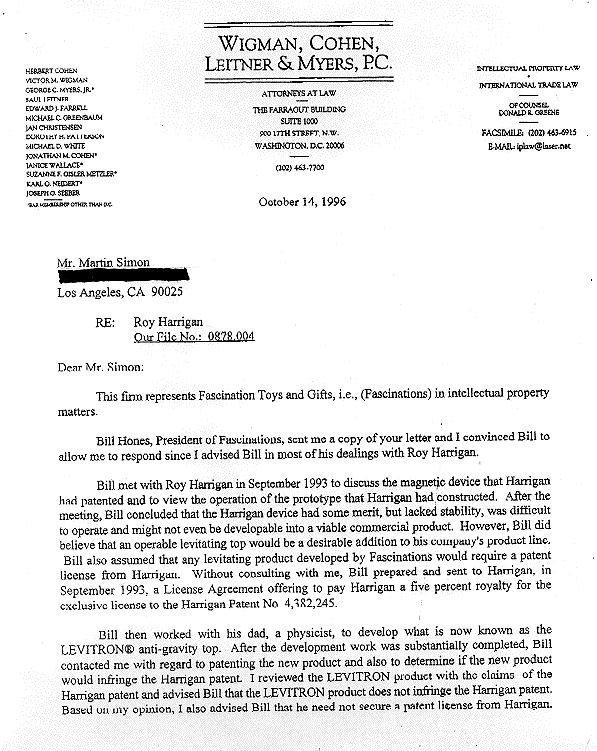
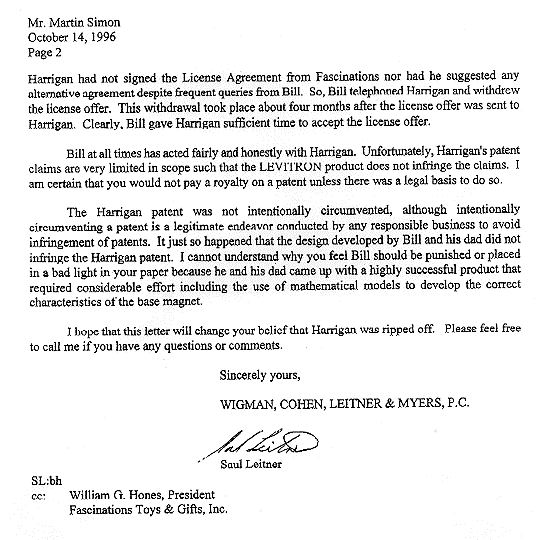
The Levitron invention itself has something of a contentious history (recounted here and here). Evidently, the physicist Ray Harrigan had patented a similar device a few years earlier and showed it to Bill Hones, who later got his own patent for a similar device and called it the "Levitron," but Hones was advised by his own lawyer that his own invention was sufficiently different from Harrigan's that he could market it without infringing Harrigan's patent or giving him credit or royalties. Apparently Harrigan was so disgusted and distrustful of his own lawyer that he never took the issue to court, so we'll never know what a judge would have thought. (The only issue which was ever litigated in court was over a former re-seller's use of the trademark "Levitron" — but that seems more straightforward, since the company that made up the word and trademarked it, owns it, completely separate from the merits of the invention that bears the name.) Some physicists have mixed feelings about the Levitron because of this, but it was apparently Harrigan's choice not to pursue the issue. (Besides, the new Levitron Revolution design uses nothing of Harrigan's idea, so some might feel that it's less "tainted".)
For cheaper levitation that takes no skill to operate, you can get the Diamagnetic Levitation Kit from Educational Innovations or search for pyrolitic graphite levitation on eBay — much less visually impressive though, with the graphite sheet levitating only 1 millimeter above the magnets.
Or for a more expensive conversation piece, the Levitron Lamp ($450 from InnovaToys or $400 from WorldToHome) levitates an entire lampshade above the base. I haven't tried that one out though.
- - - - - - - - - - - - - - - - - - - -
Levitating Picture Frames
Heart-shaped frame $25 from ZOpid; rectangular frame $70 from Hammacher Schlemmer.Computer-controlled levitation operating on a similar principle to the Levitron Revolution products. The $25 ZOpid picture frame is currently hanging out in Amazon limbo with a solitary 1-star review from a customer whose model broke after 4 months. But I think they look fine, and I'm giving two of them as gifts and crossing my fingers that I'm not that unlucky. With both the ZOpid and the Hammacher Schlemmer frames, unfortunately, there's apparently no way to switch off the LED lights (short of turning off the whole model).
Protip: You can prepare these as gifts by using photos downloaded from a friend's Facebook profile, but Facebook reduces the quality of uploaded photos, so that if you print them out, the pixellation will be noticeable up close. If you want the photos to look the best, you need to print them from high-res originals.
- - - - - - - - - - - - - - - - - - - -
Hanayama Japanese Pocket Puzzles
$13 from ThinkGeek and other vendors; some puzzles available for slightly less on eBay.Some disassembly puzzles are complete fails, either because there are so many separately moving pieces that you can't manipulate the puzzles in your hands at all (e.g. Yin and Yang"), or the moving parts are hidden from view so you can only "solve" them by pure guesswork (e.g. the "Bolted Closed" puzzle). The Hanayama pocket puzzles actually get it right — you can see all the pieces and move them comfortably in your hands, so solving them is just a matter of figuring out the right sequence of moves.
These are basically grown-up versions of the twisted nail puzzles you might have grown up with (and which you could also get, of course, as much cheaper stocking stuffers). But the Hanayama ones look good as shelf knick-knacks as well.
Hanayama pocket puzzles come with no solution included, but you can download a solution by going to this page and submitting your email address to request a download link.
- - - - - - - - - - - - - - - - - - - -
LED Jellyfish Mood Lamp
$35 from ThinkGeek and other vendors; no cheaper alternatives on eBayWorks more or less as shown in the video, with one caveat: In both the first model that I tried, and the free replacement ThinkGeek sent me when I reported the problem, the transitions between the different colors were much more abrupt and jarring than the smooth "color fade" shown in the video. (For some reason, some color LEDs would switch from completely on to completely off at the same time that other LEDs would switch on.) Unfortunately this small problem completely breaks the "reverie" effect of staring at the jellyfish floating around in the water, so I just set mine to a single color without using the transition effect.
Protip: You have to use real distilled water like the instructions tell you. I tried to make it work with regular tap water, and bubbles kept forming around the jellyfish and causing them to float to the surface. Fill it with distilled water and the jellyfish should sink beneath the surface without too much trouble.
Note, Fascinations has come out with a similar product, again sold on Innovatoys.com; I haven't tried that one, so it might be better (might actually get the color transition right), or it might not. Discovery Kids also makes a similar product which I haven't seen and which has been pulling pretty bad reviews on Amazon.
- - - - - - - - - - - - - - - - - - - -
Vino Vault and Cryptex Puzzle Pod
$30 and $22 from 4Thought Products LLCThe Puzzle Pod is a gift container that can only be opened by arranging the 5 rings to spell out a 5-letter password. It arrives pre-configured with the keyword "GRAPE"; once opened, you can re-configure the Pod with a new 5-letter secret word, seal a gift inside, and gift it to a recipient who has to find the secret word to open the puzzle and retrieve the gift. (It's re-usable, and you can set a different 5-letter "password" every time.) The Vino Vault is a larger version of the Puzzle Pod that can hold a bottle of wine.
I've only sampled the Puzzle Pod, so I can just vouch for the fact that it works exactly as described and doesn't get stuck or break easily. When you line up the letters of the secret word correctly, it actually slides smoothly open like it's supposed to.
- - - - - - - - - - - - - - - - - - - -
Ambiguous Vase
$33 from Grand Illusions Ltd (ships from the UK)This is a real-life version of the Rubin vase optical illusion. For years, Grand Illusions sold only a ceramic version for about $400 (plus another $200 to ship to the U.S.), but in November 2012 they released the $33 plastic version. It can also be used as a real vase (as long as you don't mind the barrier running down the center that divides the two halves).
- - - - - - - - - - - - - - - - - - - -
Steam Powered Top
$14 from Grand Illusions (ships from the UK)The world's simplest steam engine, made from a tube of copper pushed through a piece of cork, as shown in the demo video. Wikipedia explains the principle here — when the water in the copper tube is heated by the candle flame and boils, it expands and pushes out the ends of the tubes (driving the spinning motion). When the water contracts again, in sucks in water through the ends of the tubes — but the sucking motion pulls in water from all directions (while the expulsion of water pushes in only one direction), so the suction doesn't counteract the propulsion, and the top continues spinning.
Now, the original version is from Germany (and comes with detailed German instructions); the version that I got came with a sheet of English instructions that weren't as detailed. The instructions say to push the copper tube through the cork platform and "bend the tube at a 90-degree angle"; however if you just try bending the tube, it will probably crimp and create a hole, making it useless. To bend the tube so that it curves gradually, place your thumb on the cork next to where the tube protrudes, and use the fingers of your other hand to gently push the tube so that curves around your thumb. (This is spelled out in the original German instructions.)
Also, the instructions say to fill the copper tube by holding it under running tap water. This didn't work at all for me, since the tube is only about 2mm wide and the surface tension of water makes it hard to "push" it into a tube that small. Fortunately, a straw from a grocery-store juicebox fits perfectly over the other end of the copper tube, so if you submerge the other end in water, you can suck on the straw to fill the tube that way. (It's just copper after all, not lead.)
Finally, if you leave the cork floating in water too long, it eventually gets waterlogged and sinks, and as far as I can tell it's very hard to dry it out and bring it back to its original buoyancy. The workarounds for this are: (1) to increase the buoyancy, first put another tea light directly into your bowl of water so that it floats, and then lower the top into the water on top of that tea light, which will then help keep the top afloat; and (2) don't leave the top floating in water when not in use.
- - - - - - - - - - - - - - - - - - - -
"Flying F*CK" Remote-Control Helicopter
$20 from ThinkGeekAgain with the ThinkGeek swag; I swear I didn't know.
This is pretty self-explanatory, except I've tried two of them and the product doesn't seem to work too well as an actual remote-control helicopter; one of them couldn't hover in place (its two modes were "shooting up at the ceiling" or "falling"), and with the other, the R/C didn't seem to work through furniture. But that's probably OK since the whole point of this gift is in the giving and not the having.
In my case, I hid it behind a friend's chair at his birthday party, then at the appropriate time gave a speech ending with, "And so I thought, what do I give my friend to mark this occasion? What do I give? After much thought, I decided, this is what I give:..." There followed a dramatic pause where I pressed the "up" control on the remote, and nothing happened, whereupon I muttered, appropriately enough, "Fuck", then wandered over behind my friend's chair, repeated the setup line, pressed the remote button, at which point the copter shot up, banged into a chair and fell to the ground, whereupon for my third attempt I just picked it up and held it on the palm of my hand, pressed the remote, and the copter took flight and finally delivered the punch line, and all was good. If I'm there when he re-gifts it (since we both agreed that was the point of a gift like this), I hope it works better for him.
- - - - - - - - - - - - - - - - - - - -
Falling Sand Sculptures
$13 for the smaller 'Sandscape'; $80 for the larger 'Deep Sea Round'; both available from Educational InnovationsThese both make good decorations and shelf widgets. The sand in the Sandscape always falls in more or less the same pattern, since it's pre-determined by the gaps in the shelves holding the sand; the Deep Sea Round is more interesting since the pattern is determined by the placement of air bubbles and varies every time.
Pro tip: water evaporates from both of these, so eventually the water level will drop and the volume of air will increase, getting in the way of the sand flow. The 'Deep Sea Round' comes with a syringe that you can use to draw out air and inject more water into the aperture on the side. The cheaper 'Sandscape' doesn't come with a syringe, but it has a hole in the side where you can use a syringe to inject more water, if you buy the syringe separately.
- - - - - - - - - - - - - - - - - - - -
Galileo Thermometer
$17 for a wood-mounted model from Office Playground; cheaper ones available without wood mountingJust your basic elegant conversation piece demonstrating the principle that the density of a liquid changes with temperature. Pro tip: If you get the wood mounted one, before emailing the seller to complain that it's not working because all the spheres are bunched together at the wrong end, make sure it's not upside-down. (I realized, before I hit Send, that the felt-covered end goes on the bottom.)
- - - - - - - - - - - - - - - - - - - -
All of the remaining items on this list do exactly what they say they do, with no need for any special instructions not included by the manufacturer, so I'm just going to list them:
Glass Water Faucet — $50 from Uncommon Goods — a nice double optical illusion (faucet suspended in space, and glass-as-water).
Slicked Grandfather Clock — $30-$60 depending on who's selling it.
Tin Can Robot Kit — about $15 from various vendors — my stepdad and I assembled one using one of his beloved Hansen's soda cans.
Mini metal DIY sculptures — the Metal Works sculptures from Innovatoys ($7-$12) take some time to assemble but they come out looking pretty much like the pictures and make good shelf decorations. These Mikro sculptures ($10 and up, also available from Grand Illusions if you're filling your shopping cart there) are a bit easier to assemble since you just have to bend some shapes out from the metal sheet that they're carved from.
Ulexite "Television Stones" — $10 from Educational Innovations — a naturally occuring rock containing thousands of parallel fiber optic strands. Give it as a gift together with a square of patterned fabric so you can see the eerie effect when you place the rock against the fabric and the pattern "magically" appears on the opposite side of the rock.
And finally, if you need a last-minute gag gift for someone, browse through the gum and hand sanitizers from BlueQ.com — they're not geek-themed, but at $5.49 for the hand sanitizers and $1.39 for the gum, you can afford to stock up so you'll have a reserve of gag gifts suited for a variety of different people's tastes (except, of course, good taste).
And those are my favorites for gift-giving season 2012. You can send me suggestions for any items in this category that I've missed; I'll be back for Valentine's Day.
- - - - - - - - - - - - - - - -
Remember, if you have a feature idea, we'd love to hear it. -
Bennett's Whimsi-Geek Gift Guide For 2012
Frequent contributor Bennett Haselton writes this week with his favorite novelty science gift items for 2012. Levitation engines, puzzles, optical illusions brought to life, and all of the tips and tricks he's found for getting the products to work correctly. Decorative, whimsical, and not too expensive — except for the items that have earned it by being pretty amazing. Read on for the details, and be sure to mention other good possibilities (Just 14 shopping days left until Christmas) in the comments below.You already know how to find all the latest iPad or iPhone accessories, or how to find all the licensed merchandise if your BFF is a fan of some specific franchise. The items in this list are things that most people wouldn't even think to look for, but that I thought seemed interesting once I found out that they existed.
I'm more of a science geek than a gadget geek, so this list is built around optical illusions, whimsy, conversation pieces that demonstrate some scientific principle, and a reasonable budget. (The "Swinging Sticks Kinetic Energy Sculpture" from ThinkGeek is a work of art, but at $225, the price is apparently set to extract as much as possible from all the people who have to have one after seeing it in Iron Man 2.)
Also, unless otherwise noted, I've actually tried everything listed here and verified that it actually works; there were some items that I really wanted to make work, but couldn't. The Double Sand Sculpture, for example, looks great (especially in colors other than that ugly orange), but in all three models that American Science & Surplus sent me — the original plus the two free replacements — air bubbles formed in the hourglasses after a few days, which blocked the sand grains from flowing through the apertures. I could also never get Educational Innovations' Color Changing Nail Polish to change color, even under a UV light. And I loved the look of the Tornado Fountain from Fascinations.com, but no matter how I calibrated it, the drain at the bottom made a squirting and scraping sound like the last dregs of water draining from a bathtub, which pretty much killed its potential as a "tranquil" conversation piece. (As far as I can tell, any tabletop water fountain that costs less than $100 is either too noisy or doesn't work, but I haven't given up looking.) Of course, if you can get any of those things to work, more power to you.
For most of these items I've included the tips and tricks that I've accumulated for getting the full effect out of the product, tips that in some cases would have saved me a lot of hassle if I'd known them when the product first arrived. So you get the full benefit of my impulsive early-September Christmas shopping.
Neither I nor Slashdot make any profit from these links (except some items are from ThinkGeek, which is a corporate cousin of Slashdot for a few more weeks — but I didn't know that when I was making this list, and besides, it's not like you can put together a geek gift guide without including some stuff from ThinkGeek anyway).
Here are some of the things I've found that look as cool in person as they do in their catalog photos, and actually work:
- - - - - - - - - - - - - - - - - - - -
Levitron Revolution
Made by Fascinations.com, $100 from Innovatoys.com.I bought my first "Levitron"-branded product out of a Sky Mall catalog 15 years ago, assuming the picture of the levitating spinning top had to be a doctored photo, and half-set on proving that the product was a sham. I had spent enough time trying to levitate repelling magnets as a kid to conclude that it "couldn't be done," but I held out the faintest glimmer of hope that this might be the holy grail that I'd given up chasing about 10 years earlier. When the box arrived, I spent all evening and a sleepness night trying to get it working (the original product had to be calibrated and balanced very carefully, and you could waste a lot of time trying to make it work if the weights or alignments were slightly off), until just as the sun was coming up, I got the spinning top to levitate above the magnetic base for about four seconds before falling, and felt as if it had all been worth it. And the Levitron product line has come a long way since then, so you probably won't have to journey to the edge of your sanity to get this latest one working.
The Levitron Revolution is a levitation device which uses a base containing four computer-controlled magnets, and a magnetic disc that levitates about 1/2-inch above the base and can support a weight of up to 1 pound placed on top of it while continuing to levitate. It still takes a bit of practice to learn how to position the disc above the base to start the levitation, but the payoff is worth the effort. You can even rotate the base sideways and upside down, and the levitating disc will stay in the same position relative to the base while you turn it.
I used mine to levitate a crystal specimen that I got from a specialty gem store, which set me back about another $30, but I liked the way it glittered in the lights from the magnetic base. The rock was labeled "quartz / pyrite / sphalerite" at the store, and if you're looking for a similar rock to go with the Levitron Revolution, it looks like you can find one on Google Shopping for less than I paid for mine.
You can also use the Levitron Revolution for homemade illusions like levitating a cupcake in mid-air. (A Hostess dessert cup has a circular cavity on top to hold strawberries and whipped cream; turn it upside down and it fits perfectly over the Levitron disc. The book underneath the cupcake in the video was hollowed out to contain the magnetic base.)
Innovatoys sells several other Levitron products made by Fascinations, which all fall into two categories: those based on the classic Levitron design (which include any product showing the yellow-necked Levitron spinning top), and those based on the newer Levitron Revolution technology (everything else). I also have a Levitron CherryWood which is part of the "classic" lineup. The pros and cons of the two series are:
- The classic Levitron levitates the spinning top a full two inches above the base, which is much more visually impressive than the 1/2-inch that the magnetic disc floats above the base of the Levitron Revolution.
- The classic Levitron has to be hand-spun, however, and takes even more practice to operate than the Levitron Revolution.
- The classic Levitron has to be perfectly level for the top to float (the base comes with three adjustable legs to help you level it perfectly); the Levitron Revolution can be tilted and rotated, and the magnetic disc will continue to float in position relative to the base.
- The classic Levitron levitates in a very delicate equilibrium, with just the slightest touch being enough to push the floating top out out of balance and make it fall, so it can't be used to support other objects (and the top is spinning so fast that you wouldn't be able to see anything attached to it anyway). The Levitron Revolution floating disc can be touched and objects can be placed on top of it without pushing it out of equilibrium.
- The classic Levitron requires no power to operate, but because the top has to keep spinning at a high rate for the gyroscopic force to keep it from flipping over, after about two minutes the air friction will slow down the top enough that it falls. The Levitron Revolution will levitate forever as long as the DC power supply is connected.
The Levitron invention itself has something of a contentious history (recounted here and here). Evidently, the physicist Ray Harrigan had patented a similar device a few years earlier and showed it to Bill Hones, who later got his own patent for a similar device and called it the "Levitron," but Hones was advised by his own lawyer that his own invention was sufficiently different from Harrigan's that he could market it without infringing Harrigan's patent or giving him credit or royalties. Apparently Harrigan was so disgusted and distrustful of his own lawyer that he never took the issue to court, so we'll never know what a judge would have thought. (The only issue which was ever litigated in court was over a former re-seller's use of the trademark "Levitron" — but that seems more straightforward, since the company that made up the word and trademarked it, owns it, completely separate from the merits of the invention that bears the name.) Some physicists have mixed feelings about the Levitron because of this, but it was apparently Harrigan's choice not to pursue the issue. (Besides, the new Levitron Revolution design uses nothing of Harrigan's idea, so some might feel that it's less "tainted".)
For cheaper levitation that takes no skill to operate, you can get the Diamagnetic Levitation Kit from Educational Innovations or search for pyrolitic graphite levitation on eBay — much less visually impressive though, with the graphite sheet levitating only 1 millimeter above the magnets.
Or for a more expensive conversation piece, the Levitron Lamp ($450 from InnovaToys or $400 from WorldToHome) levitates an entire lampshade above the base. I haven't tried that one out though.
- - - - - - - - - - - - - - - - - - - -
Levitating Picture Frames
Heart-shaped frame $25 from ZOpid; rectangular frame $70 from Hammacher Schlemmer.Computer-controlled levitation operating on a similar principle to the Levitron Revolution products. The $25 ZOpid picture frame is currently hanging out in Amazon limbo with a solitary 1-star review from a customer whose model broke after 4 months. But I think they look fine, and I'm giving two of them as gifts and crossing my fingers that I'm not that unlucky. With both the ZOpid and the Hammacher Schlemmer frames, unfortunately, there's apparently no way to switch off the LED lights (short of turning off the whole model).
Protip: You can prepare these as gifts by using photos downloaded from a friend's Facebook profile, but Facebook reduces the quality of uploaded photos, so that if you print them out, the pixellation will be noticeable up close. If you want the photos to look the best, you need to print them from high-res originals.
- - - - - - - - - - - - - - - - - - - -
Hanayama Japanese Pocket Puzzles
$13 from ThinkGeek and other vendors; some puzzles available for slightly less on eBay.Some disassembly puzzles are complete fails, either because there are so many separately moving pieces that you can't manipulate the puzzles in your hands at all (e.g. Yin and Yang"), or the moving parts are hidden from view so you can only "solve" them by pure guesswork (e.g. the "Bolted Closed" puzzle). The Hanayama pocket puzzles actually get it right — you can see all the pieces and move them comfortably in your hands, so solving them is just a matter of figuring out the right sequence of moves.
These are basically grown-up versions of the twisted nail puzzles you might have grown up with (and which you could also get, of course, as much cheaper stocking stuffers). But the Hanayama ones look good as shelf knick-knacks as well.
Hanayama pocket puzzles come with no solution included, but you can download a solution by going to this page and submitting your email address to request a download link.
- - - - - - - - - - - - - - - - - - - -
LED Jellyfish Mood Lamp
$35 from ThinkGeek and other vendors; no cheaper alternatives on eBayWorks more or less as shown in the video, with one caveat: In both the first model that I tried, and the free replacement ThinkGeek sent me when I reported the problem, the transitions between the different colors were much more abrupt and jarring than the smooth "color fade" shown in the video. (For some reason, some color LEDs would switch from completely on to completely off at the same time that other LEDs would switch on.) Unfortunately this small problem completely breaks the "reverie" effect of staring at the jellyfish floating around in the water, so I just set mine to a single color without using the transition effect.
Protip: You have to use real distilled water like the instructions tell you. I tried to make it work with regular tap water, and bubbles kept forming around the jellyfish and causing them to float to the surface. Fill it with distilled water and the jellyfish should sink beneath the surface without too much trouble.
Note, Fascinations has come out with a similar product, again sold on Innovatoys.com; I haven't tried that one, so it might be better (might actually get the color transition right), or it might not. Discovery Kids also makes a similar product which I haven't seen and which has been pulling pretty bad reviews on Amazon.
- - - - - - - - - - - - - - - - - - - -
Vino Vault and Cryptex Puzzle Pod
$30 and $22 from 4Thought Products LLCThe Puzzle Pod is a gift container that can only be opened by arranging the 5 rings to spell out a 5-letter password. It arrives pre-configured with the keyword "GRAPE"; once opened, you can re-configure the Pod with a new 5-letter secret word, seal a gift inside, and gift it to a recipient who has to find the secret word to open the puzzle and retrieve the gift. (It's re-usable, and you can set a different 5-letter "password" every time.) The Vino Vault is a larger version of the Puzzle Pod that can hold a bottle of wine.
I've only sampled the Puzzle Pod, so I can just vouch for the fact that it works exactly as described and doesn't get stuck or break easily. When you line up the letters of the secret word correctly, it actually slides smoothly open like it's supposed to.
- - - - - - - - - - - - - - - - - - - -
Ambiguous Vase
$33 from Grand Illusions Ltd (ships from the UK)This is a real-life version of the Rubin vase optical illusion. For years, Grand Illusions sold only a ceramic version for about $400 (plus another $200 to ship to the U.S.), but in November 2012 they released the $33 plastic version. It can also be used as a real vase (as long as you don't mind the barrier running down the center that divides the two halves).
- - - - - - - - - - - - - - - - - - - -
Steam Powered Top
$14 from Grand Illusions (ships from the UK)The world's simplest steam engine, made from a tube of copper pushed through a piece of cork, as shown in the demo video. Wikipedia explains the principle here — when the water in the copper tube is heated by the candle flame and boils, it expands and pushes out the ends of the tubes (driving the spinning motion). When the water contracts again, in sucks in water through the ends of the tubes — but the sucking motion pulls in water from all directions (while the expulsion of water pushes in only one direction), so the suction doesn't counteract the propulsion, and the top continues spinning.
Now, the original version is from Germany (and comes with detailed German instructions); the version that I got came with a sheet of English instructions that weren't as detailed. The instructions say to push the copper tube through the cork platform and "bend the tube at a 90-degree angle"; however if you just try bending the tube, it will probably crimp and create a hole, making it useless. To bend the tube so that it curves gradually, place your thumb on the cork next to where the tube protrudes, and use the fingers of your other hand to gently push the tube so that curves around your thumb. (This is spelled out in the original German instructions.)
Also, the instructions say to fill the copper tube by holding it under running tap water. This didn't work at all for me, since the tube is only about 2mm wide and the surface tension of water makes it hard to "push" it into a tube that small. Fortunately, a straw from a grocery-store juicebox fits perfectly over the other end of the copper tube, so if you submerge the other end in water, you can suck on the straw to fill the tube that way. (It's just copper after all, not lead.)
Finally, if you leave the cork floating in water too long, it eventually gets waterlogged and sinks, and as far as I can tell it's very hard to dry it out and bring it back to its original buoyancy. The workarounds for this are: (1) to increase the buoyancy, first put another tea light directly into your bowl of water so that it floats, and then lower the top into the water on top of that tea light, which will then help keep the top afloat; and (2) don't leave the top floating in water when not in use.
- - - - - - - - - - - - - - - - - - - -
"Flying F*CK" Remote-Control Helicopter
$20 from ThinkGeekAgain with the ThinkGeek swag; I swear I didn't know.
This is pretty self-explanatory, except I've tried two of them and the product doesn't seem to work too well as an actual remote-control helicopter; one of them couldn't hover in place (its two modes were "shooting up at the ceiling" or "falling"), and with the other, the R/C didn't seem to work through furniture. But that's probably OK since the whole point of this gift is in the giving and not the having.
In my case, I hid it behind a friend's chair at his birthday party, then at the appropriate time gave a speech ending with, "And so I thought, what do I give my friend to mark this occasion? What do I give? After much thought, I decided, this is what I give:..." There followed a dramatic pause where I pressed the "up" control on the remote, and nothing happened, whereupon I muttered, appropriately enough, "Fuck", then wandered over behind my friend's chair, repeated the setup line, pressed the remote button, at which point the copter shot up, banged into a chair and fell to the ground, whereupon for my third attempt I just picked it up and held it on the palm of my hand, pressed the remote, and the copter took flight and finally delivered the punch line, and all was good. If I'm there when he re-gifts it (since we both agreed that was the point of a gift like this), I hope it works better for him.
- - - - - - - - - - - - - - - - - - - -
Falling Sand Sculptures
$13 for the smaller 'Sandscape'; $80 for the larger 'Deep Sea Round'; both available from Educational InnovationsThese both make good decorations and shelf widgets. The sand in the Sandscape always falls in more or less the same pattern, since it's pre-determined by the gaps in the shelves holding the sand; the Deep Sea Round is more interesting since the pattern is determined by the placement of air bubbles and varies every time.
Pro tip: water evaporates from both of these, so eventually the water level will drop and the volume of air will increase, getting in the way of the sand flow. The 'Deep Sea Round' comes with a syringe that you can use to draw out air and inject more water into the aperture on the side. The cheaper 'Sandscape' doesn't come with a syringe, but it has a hole in the side where you can use a syringe to inject more water, if you buy the syringe separately.
- - - - - - - - - - - - - - - - - - - -
Galileo Thermometer
$17 for a wood-mounted model from Office Playground; cheaper ones available without wood mountingJust your basic elegant conversation piece demonstrating the principle that the density of a liquid changes with temperature. Pro tip: If you get the wood mounted one, before emailing the seller to complain that it's not working because all the spheres are bunched together at the wrong end, make sure it's not upside-down. (I realized, before I hit Send, that the felt-covered end goes on the bottom.)
- - - - - - - - - - - - - - - - - - - -
All of the remaining items on this list do exactly what they say they do, with no need for any special instructions not included by the manufacturer, so I'm just going to list them:
Glass Water Faucet — $50 from Uncommon Goods — a nice double optical illusion (faucet suspended in space, and glass-as-water).
Slicked Grandfather Clock — $30-$60 depending on who's selling it.
Tin Can Robot Kit — about $15 from various vendors — my stepdad and I assembled one using one of his beloved Hansen's soda cans.
Mini metal DIY sculptures — the Metal Works sculptures from Innovatoys ($7-$12) take some time to assemble but they come out looking pretty much like the pictures and make good shelf decorations. These Mikro sculptures ($10 and up, also available from Grand Illusions if you're filling your shopping cart there) are a bit easier to assemble since you just have to bend some shapes out from the metal sheet that they're carved from.
Ulexite "Television Stones" — $10 from Educational Innovations — a naturally occuring rock containing thousands of parallel fiber optic strands. Give it as a gift together with a square of patterned fabric so you can see the eerie effect when you place the rock against the fabric and the pattern "magically" appears on the opposite side of the rock.
And finally, if you need a last-minute gag gift for someone, browse through the gum and hand sanitizers from BlueQ.com — they're not geek-themed, but at $5.49 for the hand sanitizers and $1.39 for the gum, you can afford to stock up so you'll have a reserve of gag gifts suited for a variety of different people's tastes (except, of course, good taste).
And those are my favorites for gift-giving season 2012. You can send me suggestions for any items in this category that I've missed; I'll be back for Valentine's Day.
- - - - - - - - - - - - - - - -
Remember, if you have a feature idea, we'd love to hear it. -
Bennett's Whimsi-Geek Gift Guide For 2012
Frequent contributor Bennett Haselton writes this week with his favorite novelty science gift items for 2012. Levitation engines, puzzles, optical illusions brought to life, and all of the tips and tricks he's found for getting the products to work correctly. Decorative, whimsical, and not too expensive — except for the items that have earned it by being pretty amazing. Read on for the details, and be sure to mention other good possibilities (Just 14 shopping days left until Christmas) in the comments below.You already know how to find all the latest iPad or iPhone accessories, or how to find all the licensed merchandise if your BFF is a fan of some specific franchise. The items in this list are things that most people wouldn't even think to look for, but that I thought seemed interesting once I found out that they existed.
I'm more of a science geek than a gadget geek, so this list is built around optical illusions, whimsy, conversation pieces that demonstrate some scientific principle, and a reasonable budget. (The "Swinging Sticks Kinetic Energy Sculpture" from ThinkGeek is a work of art, but at $225, the price is apparently set to extract as much as possible from all the people who have to have one after seeing it in Iron Man 2.)
Also, unless otherwise noted, I've actually tried everything listed here and verified that it actually works; there were some items that I really wanted to make work, but couldn't. The Double Sand Sculpture, for example, looks great (especially in colors other than that ugly orange), but in all three models that American Science & Surplus sent me — the original plus the two free replacements — air bubbles formed in the hourglasses after a few days, which blocked the sand grains from flowing through the apertures. I could also never get Educational Innovations' Color Changing Nail Polish to change color, even under a UV light. And I loved the look of the Tornado Fountain from Fascinations.com, but no matter how I calibrated it, the drain at the bottom made a squirting and scraping sound like the last dregs of water draining from a bathtub, which pretty much killed its potential as a "tranquil" conversation piece. (As far as I can tell, any tabletop water fountain that costs less than $100 is either too noisy or doesn't work, but I haven't given up looking.) Of course, if you can get any of those things to work, more power to you.
For most of these items I've included the tips and tricks that I've accumulated for getting the full effect out of the product, tips that in some cases would have saved me a lot of hassle if I'd known them when the product first arrived. So you get the full benefit of my impulsive early-September Christmas shopping.
Neither I nor Slashdot make any profit from these links (except some items are from ThinkGeek, which is a corporate cousin of Slashdot for a few more weeks — but I didn't know that when I was making this list, and besides, it's not like you can put together a geek gift guide without including some stuff from ThinkGeek anyway).
Here are some of the things I've found that look as cool in person as they do in their catalog photos, and actually work:
- - - - - - - - - - - - - - - - - - - -
Levitron Revolution
Made by Fascinations.com, $100 from Innovatoys.com.I bought my first "Levitron"-branded product out of a Sky Mall catalog 15 years ago, assuming the picture of the levitating spinning top had to be a doctored photo, and half-set on proving that the product was a sham. I had spent enough time trying to levitate repelling magnets as a kid to conclude that it "couldn't be done," but I held out the faintest glimmer of hope that this might be the holy grail that I'd given up chasing about 10 years earlier. When the box arrived, I spent all evening and a sleepness night trying to get it working (the original product had to be calibrated and balanced very carefully, and you could waste a lot of time trying to make it work if the weights or alignments were slightly off), until just as the sun was coming up, I got the spinning top to levitate above the magnetic base for about four seconds before falling, and felt as if it had all been worth it. And the Levitron product line has come a long way since then, so you probably won't have to journey to the edge of your sanity to get this latest one working.
The Levitron Revolution is a levitation device which uses a base containing four computer-controlled magnets, and a magnetic disc that levitates about 1/2-inch above the base and can support a weight of up to 1 pound placed on top of it while continuing to levitate. It still takes a bit of practice to learn how to position the disc above the base to start the levitation, but the payoff is worth the effort. You can even rotate the base sideways and upside down, and the levitating disc will stay in the same position relative to the base while you turn it.
I used mine to levitate a crystal specimen that I got from a specialty gem store, which set me back about another $30, but I liked the way it glittered in the lights from the magnetic base. The rock was labeled "quartz / pyrite / sphalerite" at the store, and if you're looking for a similar rock to go with the Levitron Revolution, it looks like you can find one on Google Shopping for less than I paid for mine.
You can also use the Levitron Revolution for homemade illusions like levitating a cupcake in mid-air. (A Hostess dessert cup has a circular cavity on top to hold strawberries and whipped cream; turn it upside down and it fits perfectly over the Levitron disc. The book underneath the cupcake in the video was hollowed out to contain the magnetic base.)
Innovatoys sells several other Levitron products made by Fascinations, which all fall into two categories: those based on the classic Levitron design (which include any product showing the yellow-necked Levitron spinning top), and those based on the newer Levitron Revolution technology (everything else). I also have a Levitron CherryWood which is part of the "classic" lineup. The pros and cons of the two series are:
- The classic Levitron levitates the spinning top a full two inches above the base, which is much more visually impressive than the 1/2-inch that the magnetic disc floats above the base of the Levitron Revolution.
- The classic Levitron has to be hand-spun, however, and takes even more practice to operate than the Levitron Revolution.
- The classic Levitron has to be perfectly level for the top to float (the base comes with three adjustable legs to help you level it perfectly); the Levitron Revolution can be tilted and rotated, and the magnetic disc will continue to float in position relative to the base.
- The classic Levitron levitates in a very delicate equilibrium, with just the slightest touch being enough to push the floating top out out of balance and make it fall, so it can't be used to support other objects (and the top is spinning so fast that you wouldn't be able to see anything attached to it anyway). The Levitron Revolution floating disc can be touched and objects can be placed on top of it without pushing it out of equilibrium.
- The classic Levitron requires no power to operate, but because the top has to keep spinning at a high rate for the gyroscopic force to keep it from flipping over, after about two minutes the air friction will slow down the top enough that it falls. The Levitron Revolution will levitate forever as long as the DC power supply is connected.
The Levitron invention itself has something of a contentious history (recounted here and here). Evidently, the physicist Ray Harrigan had patented a similar device a few years earlier and showed it to Bill Hones, who later got his own patent for a similar device and called it the "Levitron," but Hones was advised by his own lawyer that his own invention was sufficiently different from Harrigan's that he could market it without infringing Harrigan's patent or giving him credit or royalties. Apparently Harrigan was so disgusted and distrustful of his own lawyer that he never took the issue to court, so we'll never know what a judge would have thought. (The only issue which was ever litigated in court was over a former re-seller's use of the trademark "Levitron" — but that seems more straightforward, since the company that made up the word and trademarked it, owns it, completely separate from the merits of the invention that bears the name.) Some physicists have mixed feelings about the Levitron because of this, but it was apparently Harrigan's choice not to pursue the issue. (Besides, the new Levitron Revolution design uses nothing of Harrigan's idea, so some might feel that it's less "tainted".)
For cheaper levitation that takes no skill to operate, you can get the Diamagnetic Levitation Kit from Educational Innovations or search for pyrolitic graphite levitation on eBay — much less visually impressive though, with the graphite sheet levitating only 1 millimeter above the magnets.
Or for a more expensive conversation piece, the Levitron Lamp ($450 from InnovaToys or $400 from WorldToHome) levitates an entire lampshade above the base. I haven't tried that one out though.
- - - - - - - - - - - - - - - - - - - -
Levitating Picture Frames
Heart-shaped frame $25 from ZOpid; rectangular frame $70 from Hammacher Schlemmer.Computer-controlled levitation operating on a similar principle to the Levitron Revolution products. The $25 ZOpid picture frame is currently hanging out in Amazon limbo with a solitary 1-star review from a customer whose model broke after 4 months. But I think they look fine, and I'm giving two of them as gifts and crossing my fingers that I'm not that unlucky. With both the ZOpid and the Hammacher Schlemmer frames, unfortunately, there's apparently no way to switch off the LED lights (short of turning off the whole model).
Protip: You can prepare these as gifts by using photos downloaded from a friend's Facebook profile, but Facebook reduces the quality of uploaded photos, so that if you print them out, the pixellation will be noticeable up close. If you want the photos to look the best, you need to print them from high-res originals.
- - - - - - - - - - - - - - - - - - - -
Hanayama Japanese Pocket Puzzles
$13 from ThinkGeek and other vendors; some puzzles available for slightly less on eBay.Some disassembly puzzles are complete fails, either because there are so many separately moving pieces that you can't manipulate the puzzles in your hands at all (e.g. Yin and Yang"), or the moving parts are hidden from view so you can only "solve" them by pure guesswork (e.g. the "Bolted Closed" puzzle). The Hanayama pocket puzzles actually get it right — you can see all the pieces and move them comfortably in your hands, so solving them is just a matter of figuring out the right sequence of moves.
These are basically grown-up versions of the twisted nail puzzles you might have grown up with (and which you could also get, of course, as much cheaper stocking stuffers). But the Hanayama ones look good as shelf knick-knacks as well.
Hanayama pocket puzzles come with no solution included, but you can download a solution by going to this page and submitting your email address to request a download link.
- - - - - - - - - - - - - - - - - - - -
LED Jellyfish Mood Lamp
$35 from ThinkGeek and other vendors; no cheaper alternatives on eBayWorks more or less as shown in the video, with one caveat: In both the first model that I tried, and the free replacement ThinkGeek sent me when I reported the problem, the transitions between the different colors were much more abrupt and jarring than the smooth "color fade" shown in the video. (For some reason, some color LEDs would switch from completely on to completely off at the same time that other LEDs would switch on.) Unfortunately this small problem completely breaks the "reverie" effect of staring at the jellyfish floating around in the water, so I just set mine to a single color without using the transition effect.
Protip: You have to use real distilled water like the instructions tell you. I tried to make it work with regular tap water, and bubbles kept forming around the jellyfish and causing them to float to the surface. Fill it with distilled water and the jellyfish should sink beneath the surface without too much trouble.
Note, Fascinations has come out with a similar product, again sold on Innovatoys.com; I haven't tried that one, so it might be better (might actually get the color transition right), or it might not. Discovery Kids also makes a similar product which I haven't seen and which has been pulling pretty bad reviews on Amazon.
- - - - - - - - - - - - - - - - - - - -
Vino Vault and Cryptex Puzzle Pod
$30 and $22 from 4Thought Products LLCThe Puzzle Pod is a gift container that can only be opened by arranging the 5 rings to spell out a 5-letter password. It arrives pre-configured with the keyword "GRAPE"; once opened, you can re-configure the Pod with a new 5-letter secret word, seal a gift inside, and gift it to a recipient who has to find the secret word to open the puzzle and retrieve the gift. (It's re-usable, and you can set a different 5-letter "password" every time.) The Vino Vault is a larger version of the Puzzle Pod that can hold a bottle of wine.
I've only sampled the Puzzle Pod, so I can just vouch for the fact that it works exactly as described and doesn't get stuck or break easily. When you line up the letters of the secret word correctly, it actually slides smoothly open like it's supposed to.
- - - - - - - - - - - - - - - - - - - -
Ambiguous Vase
$33 from Grand Illusions Ltd (ships from the UK)This is a real-life version of the Rubin vase optical illusion. For years, Grand Illusions sold only a ceramic version for about $400 (plus another $200 to ship to the U.S.), but in November 2012 they released the $33 plastic version. It can also be used as a real vase (as long as you don't mind the barrier running down the center that divides the two halves).
- - - - - - - - - - - - - - - - - - - -
Steam Powered Top
$14 from Grand Illusions (ships from the UK)The world's simplest steam engine, made from a tube of copper pushed through a piece of cork, as shown in the demo video. Wikipedia explains the principle here — when the water in the copper tube is heated by the candle flame and boils, it expands and pushes out the ends of the tubes (driving the spinning motion). When the water contracts again, in sucks in water through the ends of the tubes — but the sucking motion pulls in water from all directions (while the expulsion of water pushes in only one direction), so the suction doesn't counteract the propulsion, and the top continues spinning.
Now, the original version is from Germany (and comes with detailed German instructions); the version that I got came with a sheet of English instructions that weren't as detailed. The instructions say to push the copper tube through the cork platform and "bend the tube at a 90-degree angle"; however if you just try bending the tube, it will probably crimp and create a hole, making it useless. To bend the tube so that it curves gradually, place your thumb on the cork next to where the tube protrudes, and use the fingers of your other hand to gently push the tube so that curves around your thumb. (This is spelled out in the original German instructions.)
Also, the instructions say to fill the copper tube by holding it under running tap water. This didn't work at all for me, since the tube is only about 2mm wide and the surface tension of water makes it hard to "push" it into a tube that small. Fortunately, a straw from a grocery-store juicebox fits perfectly over the other end of the copper tube, so if you submerge the other end in water, you can suck on the straw to fill the tube that way. (It's just copper after all, not lead.)
Finally, if you leave the cork floating in water too long, it eventually gets waterlogged and sinks, and as far as I can tell it's very hard to dry it out and bring it back to its original buoyancy. The workarounds for this are: (1) to increase the buoyancy, first put another tea light directly into your bowl of water so that it floats, and then lower the top into the water on top of that tea light, which will then help keep the top afloat; and (2) don't leave the top floating in water when not in use.
- - - - - - - - - - - - - - - - - - - -
"Flying F*CK" Remote-Control Helicopter
$20 from ThinkGeekAgain with the ThinkGeek swag; I swear I didn't know.
This is pretty self-explanatory, except I've tried two of them and the product doesn't seem to work too well as an actual remote-control helicopter; one of them couldn't hover in place (its two modes were "shooting up at the ceiling" or "falling"), and with the other, the R/C didn't seem to work through furniture. But that's probably OK since the whole point of this gift is in the giving and not the having.
In my case, I hid it behind a friend's chair at his birthday party, then at the appropriate time gave a speech ending with, "And so I thought, what do I give my friend to mark this occasion? What do I give? After much thought, I decided, this is what I give:..." There followed a dramatic pause where I pressed the "up" control on the remote, and nothing happened, whereupon I muttered, appropriately enough, "Fuck", then wandered over behind my friend's chair, repeated the setup line, pressed the remote button, at which point the copter shot up, banged into a chair and fell to the ground, whereupon for my third attempt I just picked it up and held it on the palm of my hand, pressed the remote, and the copter took flight and finally delivered the punch line, and all was good. If I'm there when he re-gifts it (since we both agreed that was the point of a gift like this), I hope it works better for him.
- - - - - - - - - - - - - - - - - - - -
Falling Sand Sculptures
$13 for the smaller 'Sandscape'; $80 for the larger 'Deep Sea Round'; both available from Educational InnovationsThese both make good decorations and shelf widgets. The sand in the Sandscape always falls in more or less the same pattern, since it's pre-determined by the gaps in the shelves holding the sand; the Deep Sea Round is more interesting since the pattern is determined by the placement of air bubbles and varies every time.
Pro tip: water evaporates from both of these, so eventually the water level will drop and the volume of air will increase, getting in the way of the sand flow. The 'Deep Sea Round' comes with a syringe that you can use to draw out air and inject more water into the aperture on the side. The cheaper 'Sandscape' doesn't come with a syringe, but it has a hole in the side where you can use a syringe to inject more water, if you buy the syringe separately.
- - - - - - - - - - - - - - - - - - - -
Galileo Thermometer
$17 for a wood-mounted model from Office Playground; cheaper ones available without wood mountingJust your basic elegant conversation piece demonstrating the principle that the density of a liquid changes with temperature. Pro tip: If you get the wood mounted one, before emailing the seller to complain that it's not working because all the spheres are bunched together at the wrong end, make sure it's not upside-down. (I realized, before I hit Send, that the felt-covered end goes on the bottom.)
- - - - - - - - - - - - - - - - - - - -
All of the remaining items on this list do exactly what they say they do, with no need for any special instructions not included by the manufacturer, so I'm just going to list them:
Glass Water Faucet — $50 from Uncommon Goods — a nice double optical illusion (faucet suspended in space, and glass-as-water).
Slicked Grandfather Clock — $30-$60 depending on who's selling it.
Tin Can Robot Kit — about $15 from various vendors — my stepdad and I assembled one using one of his beloved Hansen's soda cans.
Mini metal DIY sculptures — the Metal Works sculptures from Innovatoys ($7-$12) take some time to assemble but they come out looking pretty much like the pictures and make good shelf decorations. These Mikro sculptures ($10 and up, also available from Grand Illusions if you're filling your shopping cart there) are a bit easier to assemble since you just have to bend some shapes out from the metal sheet that they're carved from.
Ulexite "Television Stones" — $10 from Educational Innovations — a naturally occuring rock containing thousands of parallel fiber optic strands. Give it as a gift together with a square of patterned fabric so you can see the eerie effect when you place the rock against the fabric and the pattern "magically" appears on the opposite side of the rock.
And finally, if you need a last-minute gag gift for someone, browse through the gum and hand sanitizers from BlueQ.com — they're not geek-themed, but at $5.49 for the hand sanitizers and $1.39 for the gum, you can afford to stock up so you'll have a reserve of gag gifts suited for a variety of different people's tastes (except, of course, good taste).
And those are my favorites for gift-giving season 2012. You can send me suggestions for any items in this category that I've missed; I'll be back for Valentine's Day.
- - - - - - - - - - - - - - - -
Remember, if you have a feature idea, we'd love to hear it. -
A US Apple Factory May Be Robot City
dcblogs writes "Apple's planned investment of $100 million next year in a U.S. manufacturing facility is relatively small, but still important. A 2009 Apple video of its unibody manufacturing process has glimpses of highly automated robotic systems shaping the metal. In it, Jonathan Ive, Apple's senior vice president of design, described it. 'Machining enables a level of precision that is just completely unheard of in this industry,' he said. Apple has had three years to improve its manufacturing technology, and will likely rely heavily on automation to hold down labor costs, say analysts and manufacturers. Larry Sweet, the CTO of Symbotic, which makes autonomous mobile robots for use in warehouse distribution, described a possible scenario for Apple's U.S. factory. First, a robot loads the aluminum block into the robo-machine that has a range of tools for cutting and drilling shapes to produce the complex chassis as a single precision part. A robot then unloads the chassis and sends it down a production line where a series of small, high-precision, high-speed robots insert parts, secured either with snap fit, adhesive bonds, solder, and a few fasteners, such as screws. At the end, layers, such as the display and glass, are added on top and sealed in another automated operation. Finally, the product is packaged and packed into cases for shipping, again with robots. "One of the potentially significant things about the Apple announcement is it could send a message to American companies — you can do this — you can make this work here," said Robert Atkinson, president of The Information Technology & Innovation Foundation." -
Scientists Develop Sixty Day Bread
Hugh Pickens writes writes "BBC reports that scientists have developed a technique that can make bread stay mold-free for 60 days that could also be used with a wide range of foods including fresh turkey and many fruits and vegetables. At its laboratory on the campus of Texas Tech University in Lubbock, Don Stull of Microzap showed off the long, metallic microwave device that resembles an industrial production line. Originally designed to kill bacteria such as MRSA and salmonella, the researchers discovered it could kill the mold spores in bread in around 10 seconds. 'We treated a slice of bread in the device, we then checked the mold that was in that bread over time against a control,' says Stull. 'And at 60 days it had the same mold content as it had when it came out of the oven.' Food waste is a massive problem in most developed countries. In the US, figures released this year suggest that the average American family throws away 40% of the food they purchase — which adds up to $165 Billion annually. There is some concern that consumers might not take to bread that lasts for so long and Stull acknowledges it might be difficult to convince some people of the benefits. 'We'll have to get some consumer acceptance of that. Most people do it by feel and if you still have that quality feel they probably will accept it.'" -
Khan Academy: the Future of Taxpayer Reeducation?
theodp writes "Illinois Governor Pat Quinn has launched a website and gone social on Facebook, Twitter, and YouTube to educate taxpayers on why they must make good on pension promises to state workers. And, in addition to Squeezy the Pension Python, Gov. Quinn is enlisting the help of Khan Academy, the tax-exempt, future-of-education organization funded by tax-free millions from Google, Bill Gates, and others, to help convince taxpayers that a state-pension-promise is a promise. In the Khan Academy video commissioned by the Governor, Illinois Pension Obligations, Sal Khan concedes that the annual annuity payouts for IL state employee retirees do look 'pretty reasonable' — e.g., $43,591 for the average teacher, $117,558 for a judge — but goes on to argue that 'in all fairness, this was promised to these people,' who he speculates 'probably took lower compensation while they were working,' 'probably stayed in the jobs longer,' and 'probably sacrificed other things' to get these 'great benefits.' 'We're delighted to have his [Khan's] help in enlightening Illinois citizens about how the pension problem came to be,' said the Governor. Of course, not everything can be explained in one video — perhaps other contributing factors like 'pension spiking', lobbyists' maneuvers, sweetheart deals, creative job reclassification, golden parachutes, bruising investment losses, and other wacky pension games will be taught in Illinois Pension Obligations II!" -
Khan Academy: the Future of Taxpayer Reeducation?
theodp writes "Illinois Governor Pat Quinn has launched a website and gone social on Facebook, Twitter, and YouTube to educate taxpayers on why they must make good on pension promises to state workers. And, in addition to Squeezy the Pension Python, Gov. Quinn is enlisting the help of Khan Academy, the tax-exempt, future-of-education organization funded by tax-free millions from Google, Bill Gates, and others, to help convince taxpayers that a state-pension-promise is a promise. In the Khan Academy video commissioned by the Governor, Illinois Pension Obligations, Sal Khan concedes that the annual annuity payouts for IL state employee retirees do look 'pretty reasonable' — e.g., $43,591 for the average teacher, $117,558 for a judge — but goes on to argue that 'in all fairness, this was promised to these people,' who he speculates 'probably took lower compensation while they were working,' 'probably stayed in the jobs longer,' and 'probably sacrificed other things' to get these 'great benefits.' 'We're delighted to have his [Khan's] help in enlightening Illinois citizens about how the pension problem came to be,' said the Governor. Of course, not everything can be explained in one video — perhaps other contributing factors like 'pension spiking', lobbyists' maneuvers, sweetheart deals, creative job reclassification, golden parachutes, bruising investment losses, and other wacky pension games will be taught in Illinois Pension Obligations II!" -
Spaun: a Large-Scale Functional Brain Model
New submitter dj_tla writes "A team of Canadian researchers has created a state-of-the-art brain model that can see, remember, think about, and write numbers. The model has just been discussed in a Science article entitled 'A Large-Scale Model of the Functioning Brain.' There have been several popular press articles, and there are videos of the model in action. Nature quotes Eugene Izhikevich, chairman of Brain Corporation, as saying, 'Until now, the race was who could get a human-sized brain simulation running, regardless of what behaviors and functions such simulation exhibits. From now on, the race is more [about] who can get the most biological functions and animal-like behaviors. So far, Spaun is the winner.' (Full disclosure: I am a member of the team that created Spaun.)" -
Notch Expands On 0x10c, Microsoft and Quantum Computing
eldavojohn writes "Mojang's Marcus Persson (better known as 'Notch') has answered quite a few questions in an interview with PC Gamer about his new game 0x10c. Since its announcement, there's been very few details about game play aside from the DCPU-16 and art tests. But in this interview, Notch has revealed quite a bit about how the game will function and non-final ideas he has for either a monthly fee to play in a 'multiverse' or micropayments. He talks about a custom OS people are working on to load into the game's CPU as well as a an in-game 3D printer that will allow you to make virtual objects. When asked about Kickstarter and his Oculus dev kit, Notch said 'Definitely going to make it work in 0x10c no matter what' and his account of using the Oculus Rift sounds more than promising for the VR Device. When asked about Linux he said, '[Linux] is wonderful. I think we need to have it, and it's a shame that more people, including myself, don't use it. It's gotten easier and friendlier.' When asked about Microsoft he said, 'I use their OS – Windows 7 is an amazing operating system in my opinion and of course there's the Xbox, which I love. I'm sure Bing is going to take off and save them. [Editor's note: Notch is smiling mischievously as he says this.]'" -
Ask Slashdot: Which OSS Database Project To Help?
DoofusOfDeath writes "I've done a good bit of SQL development / tuning in the past. After being away from the database world for a while to finish grad school, I'm about ready to get back in the game. I want to start contributing to some OSS database project, both for fun and perhaps to help my employment prospects in western Europe. My problem is choosing which OSS DB to help with. MySQL is the most popular, so getting involved with it would be most helpful to my employment prospects. But its list of fundamental design flaws (video) seems so severe that I can't respect it as a database. I'm attracted to the robust correctness requirements of PostgreSQL, but there don't seem to be many prospective employers using it. So while I'd enjoy working on it, I don't think it would be very helpful to my employment prospects. Any suggestions?" -
DOOM 3 BFG Edition On Github, Timed For Oculus Rift
New submitter alexanderb writes "While DOOM 3 BFG Edition might not have blown most gamers' minds, it sure blew some hackers' minds by supporting the Oculus Rift head-mounted display. Now, id Software have put up the source code of the BFG Edition under the GPL in good time for the tentative Oculus Rift release date, 12/12/12." -
Finding a Crowdsourced Cure For Brain Cancer
Hugh Pickens writes "Salvatore Iaconesi, a software engineer at La Sapienza University of Rome, writes that when he was recently diagnosed with brain cancer, his first idea was to seek other opinions. He immediately asked for his clinical records in digital format, converted the data into spreadsheets, databases, and metadata files, and published them on the web site called The Cure. 'The responses have been incredible. More than 200,000 people have visited the site and many have provided videos, poems, medical opinions, suggestions of alternative cures or lifestyles, personal stories of success or, sadly, failures — and simply the statement, "I am here." Among them were more than 90 doctors and researchers who offered information and support.' The geneticist and TED fellow Jimmy Lin has offered to sequence the genome of Iaconesi's tumor after surgery, and within one day Iaconesi heard from two different doctors who recommended similar kinds of 'awake surgery,' where the brain is monitored in real time as different parts are touched. A brain map is produced and used during a second surgery. 'We are creating a cure by uniting the contributions of surgeons, homeopaths, oncologists, Chinese doctors, nutritionists and spiritual healers. The active participation of everyone involved — both experts and ex-patients — is naturally filtering out any damaging suggestion which might be proposed,' writes Iaconesi. 'Send us videos, poems, images, audio or text that you see as relevant to a scenario in which art and creativity can help form a complete and ongoing cure. Or tell us, "I am here!" — alive and connected, ready to support a fellow human being.'" -
Another Player In the World of Free, Open Online CS Courseware
dncsky1530 writes "UNSW professor Richard Buckland, lecturer of the famous Computing 1 course on YouTube, is now running a large scale open online Computer Science course for the world. UNSW Computing 1 — PuzzleQuest and the Art of Programming starts off with microprocessors and works it way through C with interactive activities while taking students on an adventure of hacking, cracking and problem solving. It's based around a three month long PuzzleQuest with grand and suspiciously unspecified prizes as well as fame and glory for the intrepid. The next class starts December 3rd 2012." -
On Demo, a $25 1080p Camera Module For Raspberry Pi
hypnosec writes "The Raspberry Pi Foundation has announced a new add-on – a camera module that will enable the credit card sized computer to snap pictures as well as record 1080p videos. Showcased by RS Components at the Elecontrica 2012 in Germany [watch video here] the £16 (apprx) module will be equipped with a 5MP sensor and will plug into the otherwise unused CSI pins of the Pi. The camera module's board is still in prototype stage and is expected to reach production sometime soon. Liz Upton, Executive Director of the Foundation said in a blog post, 'We've a (very) little way to go before we're able to send it out to manufacture.' According to Upton, testing slots have been booked in December to check on electromagnetic radiations from the ribbon cable." -
This Is What Happens When You Deep Fry a Frozen Turkey
Too late for many east-coast Americans, but perhaps in time to stop a blaze or two in California, an anonymous reader writes with this video of "a controlled demonstration of why it is a bad idea to fry a frozen turkey." My brother this morning assembled (despite poor directions and questionable parts fit) a deep fryer for a Thanksgiving turkey; we're optimistic, and the turkey seems to be fully thawed at least.