Slashdot Mirror
Domain: youtube.com
Stories and comments across the archive that link to youtube.com.
Stories · 2,039
-
Photosynth Demo
A couple of days ago Microsoft labs released a demo of their new Photosynth software on the web. Photosynth allows the aggregation of social picture networks (a la Flickr) into a completed image in addition to allowing a level of depth to image browsing previously unavailable. There is also a very impressive video of the demo available. -
Venezuela's Contrarian TV Station Survives on YouTube
carlos_J writes "Ars Technica is running a story about RCTV, a Venezuelan television station whose broadcast license was refused renewal by the government. In response, the station turned to YouTube to get its message out. Says Ars, 'El Observador clips have been seen 175,000 times since May 28, and the channel is currently the most-subscribed channel of the week. While putting the station's shows on YouTube is an excellent idea, YouTube still lacks anything near the reach of over-the-air broadcasts. But the use of the site to avoid censorship is growing, and it's not hard to imagine a day in the near future when the site (or sites like it) becomes as essential as local TV stations. As that happens, YouTube will come into even more conflicts with governments that have an interest in controlling what their citizens see, It's already happening--Thailand's king, for instance, has a thing for iPods but isn't too keen on YouTube. Will Hugo Chavez show more tolerance? '" -
Disney Video Used to Explain Copyright
Recently a pretty amazing video surfaced that used clips from Disney films to explain copyright law. It was created by Eric Faden of Bucknell University and must have taken an insane amount of time to assemble. Now you have to wonder how long before someone gets sued over it. Also here is a corel cache version as well as a link to the original page. -
XM Satellite Radio Backlash
mrchubbs writes "Sponsors and subscribers to XM Radio are protesting the decision by XM management to suspend the Opie and Anthony show for comments made on an uncensored channel. Subscribers are canceling subscriptions — some estimate that between 20,000 and 40,000 have cancelled. Some are even smashing their radios in protest. Sponsors are pulling ads. Also, there is some evidence of XM not honoring cancellation requests, forcing multiple calls to finally get accounts canceled." Of course this dispute isn't a free-speech issue. "Free speech" refers to a prohibition on censorship by the government; XM is free to do as it wishes with the content it broadcasts, within the law. -
Google Reader - Now for Wii!
Thwomp writes "I love using my Wii to catch up on my Google Reader feeds and now that activity is officially supported by Google. It's really great to see that the Google Reader team has created an improved user interface optimized for the Wii's Opera browser and Wiimote. You can also try out the Google Reader for Wii in your browser. Google account is mandatory, of course." -
OLPC Project Rollout Begins In Uruguay
Acer500 writes "The One Laptop Per Child project became a reality Thursday in Uruguay, as the 160 children of school number 24 in the humble town of Cardal received their XO computers. The learning tools came directly from the hands of president Tabaré Vazquez. It has become a matter of national pride that Uruguay is the first country to realize the project's goal. The target is that by 2009, every school-age child in Uruguay will have one, and an initial 15 million dollars have already been allocated to the project. From the newspaper articles: 'The happiness of having a PC in their hands, some of them for the first time, had the kids in ecstasy, which didn't wait to turn on their computers, introduce their personal information (required the first time they're turned on), choose the screen colors, and start experimenting with them. What initially made them more enthusiastic was the possibility of taking photographs and filming each others with the included webcams.'" More information below. According to the unofficial blog of the Uruguayan project, named proyecto Ceibal, the infrastructure for wireless is not yet in place but will be provided in the next few days by the national telco ANTEL. No photos of the event have been posted online, but you can see an institutional video on Youtube. One interesting point is that it has not yet been decided that the XO will be the laptop of choice for the entire project. Two other companies want to be considered: Intel, with their Classmate PC, and Israeli-manufactured ITP-C. In a press conference, Intel manager for the southern cone Esteban Galluzzi went as far as to compare the XO to a Pentium II, and stressed that the Classmate is able to run Windows XP. As advisor and local guru Juan Grompone stated, 'who will ultimately benefit from this is education?' This will be an interesting test to see if the OLPC project meets its intended goals of 'learning learning'. Let's hope this project is the means that will foster among some of the children the desire to learn and to tinker." -
Electronic Frontier Foundation Sues Uri Geller
reversible physicist writes "The Electronic Frontier Foundation has sued spoon-bender Uri Geller for using 'baseless copyright claims' to silence critics who question his paranormal powers. Brian Sapient posted on YouTube a 14-minute excerpt from the 1993 PBS NOVA program 'Secrets of the Psychics,' in which skeptic James Randi says Geller's spoon-bending feats were simple tricks. YouTube took down the video after Geller complained — his lawyers claim that 10 seconds of the video are owned by Geller. A shorter excerpt of the video is still up on YouTube." -
Digg.com Attempts To Suppress HD-DVD Revolt
fieryprophet writes "An astonishing number of stories related to HD-DVD encryption keys have gone missing in action from digg.com, in many cases along with the account of the diggers who submitted them. Diggers are in open revolt against the moderators and are retaliating in clever and inventive ways. At one point, the entire front page comprised only stories that in one way or another were related to the hex number. Digg users quickly pointed to the HD DVD sponsorship of Diggnation, the Digg podcast show. Search digg for HD-DVD song lyrics, coffee mugs, shirts, and more for a small taste of the rebellion." Search Google for a broader picture; at this writing, about 283,000 pages contain the number with hyphens, and just under 10,000 without hyphens. There's a song. Several domain names including variations of the number have been reserved. Update: 05/02 05:44 GMT by J : New blog post from Kevin Rose of Digg to its users: "We hear you." -
Music Decoded From 600-Year-Old Carvings
RulerOf writes "Musicians recently unlocked a 600 year old mystery that had been encoded into the walls of the Rosslyn Chapel in Scotland, the one featured in The Da Vinci Code. The song was carved into the walls of the chapel in the form of geometric shapes that a father-son team — both are musicians and the father is an ex-Royal Air Force code breaker — finally matched to so-called Chladni patterns (see the Wikipedia article on cymatics). The recovered melody was paired with traditional lyrics (translated into Latin) and recorded; the result can be heard in this video (also linked from the musicians' website). The video also gives a visual representation of how the engravings match up to the cymatic patterns." From the Reuters article: "'The music has been frozen in time by symbolism... [The carvings] are of such exquisite detail and so beautiful that we thought there must be a message here.' The two men matched each of the patterns on the carved cubes to a Chladni pitch, and were able finally to unlock the melody." -
Donkey Kong Recreated Using 6,400 Post-it Notes
NickFitz writes "Students at UCSC have recreated the first level of Donkey Kong using 6,400 Post-it notes stuck to the windows of the E2 building. It took a team of about 10 people five hours to complete the work, which will remain in place until May 1. There's a time-lapse video of the construction process." -
A Bit About Making Maniac Mansion
Over at the Grumpy Gamer site, Rob Gilbert is reminiscing a bit about the making of Maniac Mansion, prompted by a YouTube video depicting a 9 minute speed run for the game. "I found it fascinating to watch this video. It's was like thumbing through an old family album of childhood photos. Memories long forgotten are jarred to the surface by the smallest of details. An old and forgotten toy. The front grill of your fathers car. Things you could never have remembered if you tried become so clear they could have happened yesterday. I'd see little things like Dave hitting the edge of the porch, turning around, then walking forward and then continuing on his way. I remember this from development. It was a weird bug having to do with the walk-boxes that told the character where they could walk. I knew how to fix it, but it would have broken oh-so-many of other things. It always drove me crazy that he did that." Many thanks to Mr. Gilbert for his work on the game; Bernard's Theme still pops into my head every once in a while for no particular reason. -
Computer Interaction in Science Fiction Movies
MidVicious writes "From futuristic 'Punch Cards' to Voice Recognition HoloDeck Interfaces, human/computer interactions have always mirrored the base concepts of our emerging technologies. An article from a Saarland University CS Seminar highlights Hollywood history with UI, ranging from the moderately feasible (Total Recall's television/scenery display wall) to the often ridiculous (Swordfish's 6-flat screen monitor setup complete with 3-D virus-hacking environment). An interesting read, especially considering some of the technology is on its way to becoming a reality." -
PS3 Linux Performs Real Time Ray Tracing
fistfullast33l writes "A video posted on You Tube shows three PS3s networked together to perform Real Time Ray Tracing. Keep in mind that PS3 Linux runs in a hypervisor, so the RSX graphics chip is not being used at all. Even more impressive, PS3 Fanboy is reporting that Linux also limits the number of SPEs to 6 at once, so not all the horsepower on each of the PS3s is being utilized. According to the You Tube Summary, IBM Cell SDK 2.0 is being used for the IBM Interactive Ray-tracer (iRT). This apparently was done by the same team that presented a tech demo at GDC 2007 of a Linux PS3 rendering a 3 million polygon scene in real time at 1080p resolution." -
GTA IV Trailer Released, Slows Sites
Mr_Congeniality writes "The much-anticipated trailer for the next chapter in the Grand Theft Auto series has been released. Rockstar's servers, including the one that hosts Rockstar's homepage, was completely overloaded with traffic last night as a result. Users desperately flocking to other websites like GTANet and GTA4.net, but even these websites were overloaded by the interest level. If these sites are still slow, try GameTrailers or GameVideos as an alternative. For analysis of the video, CVG has ten things you may have missed, while 1up's editors offer their opinions on what they saw." -
Maker of Anti-Clinton Video Outed, Loses Job
Raul654 writes "Philip de Vellis, the author of the anti-Hilary Clinton viral video was outed yesterday on the Huffington Post. The company he worked for, Blue State Digital — a Democratic Internet strategy company that does work for Barack Obama — has now fired him as a result. Said Vellis: 'I made the "Vote Different" ad because I wanted to express my feelings about the Democratic primary, and because I wanted to show that an individual citizen can affect the process.'" -
GDC: LucasArts and The Force Unleashed
With the title of 'Next Generation GamePlay in Service of Story and Characters', LucasArts had a lot of ground to cover Thursday morning. Their new technologies have been well received, and the developers and journalists in the room were anticipating details on the over-the-top effects we've seen from The Force Unleashed. From a technical standpoint, Haden Blackman's talk fully delivered. Read on for my notes from this fascinating look at the point where storytelling and physics meet. The next-gen focus for LucasArts is on simulation-based gameplay, how that feeds into character. Environments and characters, events and systems built around physics and objects rather than scripts and hand-crafted events. They're doing this to make it a foundation for more cost- effective development. There's a greater emphasis on surprise and novelty with this route, because every time you play it's going to be different. Authenticity is the aim: the world behaves the way you'd expect given what you know about the setting.
The other goal is to revolutionize story and character. LucasFilm is an obvious example within the company. Their goal, then is to bring new life to stories, telling them in different ways. They're always looking to tell stories in new ways, both in and out of the game. The 'out of game story' is the player's story: what the player did to overcome obstacles. Their goal is to make every player story unique: I beat the game slightly differently than you did. They're aiming for relatable, authentic characters. Characters that behave how you'd expect in animations, AI, and physically.
Once they'd gotten rallied around those concepts, they began working on Force Unleashed's game's core concepts. "The Force = The galaxy's best simulation catalyst." It's an interactive power that allows you to manipulate your environment. They really wanted to push the boundaries with the Force. Their goal is to amp up, over the top showcase Jedi powers. They began doing imagery, and then a pre-visualization video, with the goal of grasping just how powerful they wanted the Force to be.
They show the pre-viz video, which is something we've all seen previously on YouTube. Blackman says "After that I had the most terrifying moment of my career." He had to go show the video to Lucas, and convince him it was the right direction. He said "That's great, go do it." Blackman was even more afraid then, because they didn't have the tech to do it.
He then outlines some of the elements of the game, which is available in more depth in IGN's preview of the game. The best part of this slide: "What is the core gameplay: Kicking someone's ass with the Force."
At that point they had a game in search of technology. Design drives everything, so they didn't start with the tech, they started with the story/concept. They began building their team that began building the 'Ronin' engine, integrating Havok and Digital Molecular Matter. They partnered up with ILM for elements like cloth and fur, too.
The ILM partnership has been very fruitful. They are utilizing Zeno, their digital editor, originally made for film. LucasArts adopted it for games, and now they have a common pipeline for assets, VFX, and other elements. They're working on likeness captures and facial motion capture technologies, to get really accurate performances. ILM is one of the forefront workers in fluid dynamics, and so they're hoping to utilize that as well with true water simulation. They're sharing engineers across the company, leveraging the expertise of both companies to produce more powerful results. ILM is getting something out of it too. They'll be using some of LucasArts' tech to do pre-visualiation on films; using the Ronin engine to make animatics for big-budget Hollywood flicks.
He then shows an 'ILM Sizzle' piece, showing some of their incredibly impressive work on the Poseidon movie. Lots of fluid dynamics elements, tons of special effects elements. "There was no boat, there was no ocean." They also show a number of scenes from Pirates of the Carribean: Dead Man's Chest, using much of the same sizzle footage in the online piece we have previously discussed here on the site.
Blackman then moves on to the two techs they're incorporating into the game. Digital Molecular Matter allows them to translate real materials into their titles; wood breaks like wood, glass breaks like glass. DMM saves on art time, increases the authenticity of the environment, and encourages experimentation. "What happens when I throw the Stormtrooper through that hut?" It provides surprising payoffs, and it's different every time. "Soft bodies are cool." Soft bodies are game elements that bend or sway instead of breaking. (Denting metal, bending girders.) This all results in more exciting and immersive stories. It begs players to share stories. "I made a bridge to cross the lava." Character interactions are also more varied; creatures moving through a forest force plants and trees out of the way.
They then show off the DMM tech, using much of the same elements as the much-watched YouTube video we've probably all seen before. He goes further, though, editing the properties of elements in the room he's in. Glass in the ceiling can be edited to be flexible and fragile; when he resets the room the glass breaks under its own weight. He demonstrates again with a brick wall, which can be made to collapse and sag depending on the properties he sets. The goal is to get authentic experiences, but also ones that are fun, and this is what a lot of their designers spend their time doing.
Euphoria is the next subject up, and is "true bio-mechanical AI". Characters have a central nervous system, muscles, and a brain. NPCs then, have reflexes. They grab onto things in the environment to save themselves, do their best to stay alive. It's not about replacing animators; it's about making sure animators are working on important things (character performances) rather than gross physical movements. "Barrel of Stormtroopers - How many Stormtroopers can we get to latch on to each other when held over a pit?" This results in a different story every time, improves the immersive experience, and gives characters somewhat of a sense of self. It also leads to comedy. Comedy is a big part of Star Wars, and torturing Stormtroopers is something that they do on a daily basis at the company.
They boot up a demo, and show off some of the 'best ways to exploit Euphoria'. They start with the Stormtrooper drop. It's different every time, with the poor guy getting slammed into the ground again and again. They use a pile of boxes to show how the objects and character, based on orientation and speed, scatter and flip. The next demo is the Balancing Act, which has a surface with a trooper on it. As they shift and jump the surface, the little man tries to keep his balance and stay upright. GrabNGo shows the hanging physics: a trooper slides down the slope, and tries to grab onto the ledge before he falls. The next uses animated legs (the trooper is running forward) and a euphoria upper body. By tossing boxes at the trooper, they show how he tires to deflect incoming objects. The final demo shows actual force effects in use, knocking troopers off a ledge with a box, force chocking and light sabering a trooper.
They're in full production on all levels, now working on motion capture and art, higher level elements.
So, the keys here are that these simulations are really hard to get right. It took a lot of work, and several brand new techs. Designers had to learn to deal with fear; get over the possibility of doing something 'wrong'. Iterating and experimentation has been key to getting the 'feel' of these systems right. Consistency is king; if you do it in one level you have to make sure that you can do it every time. Don't be constrained by realism; if the force of their 'Force Push' was applied to a real human they'd probably be ripped in half. Go for fun, not for reality. They are trying to encourage and reward experimentation, breaking the player's conditioning, and pull them fully into the game. -
GDC: LucasArts and The Force Unleashed
With the title of 'Next Generation GamePlay in Service of Story and Characters', LucasArts had a lot of ground to cover Thursday morning. Their new technologies have been well received, and the developers and journalists in the room were anticipating details on the over-the-top effects we've seen from The Force Unleashed. From a technical standpoint, Haden Blackman's talk fully delivered. Read on for my notes from this fascinating look at the point where storytelling and physics meet. The next-gen focus for LucasArts is on simulation-based gameplay, how that feeds into character. Environments and characters, events and systems built around physics and objects rather than scripts and hand-crafted events. They're doing this to make it a foundation for more cost- effective development. There's a greater emphasis on surprise and novelty with this route, because every time you play it's going to be different. Authenticity is the aim: the world behaves the way you'd expect given what you know about the setting.
The other goal is to revolutionize story and character. LucasFilm is an obvious example within the company. Their goal, then is to bring new life to stories, telling them in different ways. They're always looking to tell stories in new ways, both in and out of the game. The 'out of game story' is the player's story: what the player did to overcome obstacles. Their goal is to make every player story unique: I beat the game slightly differently than you did. They're aiming for relatable, authentic characters. Characters that behave how you'd expect in animations, AI, and physically.
Once they'd gotten rallied around those concepts, they began working on Force Unleashed's game's core concepts. "The Force = The galaxy's best simulation catalyst." It's an interactive power that allows you to manipulate your environment. They really wanted to push the boundaries with the Force. Their goal is to amp up, over the top showcase Jedi powers. They began doing imagery, and then a pre-visualization video, with the goal of grasping just how powerful they wanted the Force to be.
They show the pre-viz video, which is something we've all seen previously on YouTube. Blackman says "After that I had the most terrifying moment of my career." He had to go show the video to Lucas, and convince him it was the right direction. He said "That's great, go do it." Blackman was even more afraid then, because they didn't have the tech to do it.
He then outlines some of the elements of the game, which is available in more depth in IGN's preview of the game. The best part of this slide: "What is the core gameplay: Kicking someone's ass with the Force."
At that point they had a game in search of technology. Design drives everything, so they didn't start with the tech, they started with the story/concept. They began building their team that began building the 'Ronin' engine, integrating Havok and Digital Molecular Matter. They partnered up with ILM for elements like cloth and fur, too.
The ILM partnership has been very fruitful. They are utilizing Zeno, their digital editor, originally made for film. LucasArts adopted it for games, and now they have a common pipeline for assets, VFX, and other elements. They're working on likeness captures and facial motion capture technologies, to get really accurate performances. ILM is one of the forefront workers in fluid dynamics, and so they're hoping to utilize that as well with true water simulation. They're sharing engineers across the company, leveraging the expertise of both companies to produce more powerful results. ILM is getting something out of it too. They'll be using some of LucasArts' tech to do pre-visualiation on films; using the Ronin engine to make animatics for big-budget Hollywood flicks.
He then shows an 'ILM Sizzle' piece, showing some of their incredibly impressive work on the Poseidon movie. Lots of fluid dynamics elements, tons of special effects elements. "There was no boat, there was no ocean." They also show a number of scenes from Pirates of the Carribean: Dead Man's Chest, using much of the same sizzle footage in the online piece we have previously discussed here on the site.
Blackman then moves on to the two techs they're incorporating into the game. Digital Molecular Matter allows them to translate real materials into their titles; wood breaks like wood, glass breaks like glass. DMM saves on art time, increases the authenticity of the environment, and encourages experimentation. "What happens when I throw the Stormtrooper through that hut?" It provides surprising payoffs, and it's different every time. "Soft bodies are cool." Soft bodies are game elements that bend or sway instead of breaking. (Denting metal, bending girders.) This all results in more exciting and immersive stories. It begs players to share stories. "I made a bridge to cross the lava." Character interactions are also more varied; creatures moving through a forest force plants and trees out of the way.
They then show off the DMM tech, using much of the same elements as the much-watched YouTube video we've probably all seen before. He goes further, though, editing the properties of elements in the room he's in. Glass in the ceiling can be edited to be flexible and fragile; when he resets the room the glass breaks under its own weight. He demonstrates again with a brick wall, which can be made to collapse and sag depending on the properties he sets. The goal is to get authentic experiences, but also ones that are fun, and this is what a lot of their designers spend their time doing.
Euphoria is the next subject up, and is "true bio-mechanical AI". Characters have a central nervous system, muscles, and a brain. NPCs then, have reflexes. They grab onto things in the environment to save themselves, do their best to stay alive. It's not about replacing animators; it's about making sure animators are working on important things (character performances) rather than gross physical movements. "Barrel of Stormtroopers - How many Stormtroopers can we get to latch on to each other when held over a pit?" This results in a different story every time, improves the immersive experience, and gives characters somewhat of a sense of self. It also leads to comedy. Comedy is a big part of Star Wars, and torturing Stormtroopers is something that they do on a daily basis at the company.
They boot up a demo, and show off some of the 'best ways to exploit Euphoria'. They start with the Stormtrooper drop. It's different every time, with the poor guy getting slammed into the ground again and again. They use a pile of boxes to show how the objects and character, based on orientation and speed, scatter and flip. The next demo is the Balancing Act, which has a surface with a trooper on it. As they shift and jump the surface, the little man tries to keep his balance and stay upright. GrabNGo shows the hanging physics: a trooper slides down the slope, and tries to grab onto the ledge before he falls. The next uses animated legs (the trooper is running forward) and a euphoria upper body. By tossing boxes at the trooper, they show how he tires to deflect incoming objects. The final demo shows actual force effects in use, knocking troopers off a ledge with a box, force chocking and light sabering a trooper.
They're in full production on all levels, now working on motion capture and art, higher level elements.
So, the keys here are that these simulations are really hard to get right. It took a lot of work, and several brand new techs. Designers had to learn to deal with fear; get over the possibility of doing something 'wrong'. Iterating and experimentation has been key to getting the 'feel' of these systems right. Consistency is king; if you do it in one level you have to make sure that you can do it every time. Don't be constrained by realism; if the force of their 'Force Push' was applied to a real human they'd probably be ripped in half. Go for fun, not for reality. They are trying to encourage and reward experimentation, breaking the player's conditioning, and pull them fully into the game. -
Rockstar to Use NaturalMotion Technology in Upcoming Games
CVG reports that future Rockstar titles will feature NaturalMotion technologies in an effort to make the games more realistic. Specifically, Rockstar will be licensing the 'Euphoria' engine, an advanced physics and substance simulation model already in use in several upcoming LucasArts titles. There's no word in the article on which games will feature the technology, but this certainly seems like something that would fit well with the sandbox style games of the GTA series. " Employed in the recently revealed The Force Unleashed, euphoria simulates the human body and motor nervous system. It means that in-game characters are fully interactive and always react differently to external influences, ultimately leading to a more life-like experience for the player. Specific reference to how euphoria 'uses the processing power of PLAYSTATION 3 and Xbox 360' to simluate the human body and motor nervous system was made in the announcement. While Rockstar is yet to name games using euphoria, its integration of the tech is well advanced." -
Two Ways Not To Handle Free Speech
Two stories in the news offer contrasting approaches by Web companies to questions of free speech. First YouTube: reader skraps notes that the Google property has recently banned the popular atheist commentator Nick Gisburne. Gisburne had been posting videos with logical arguments against Christian beliefs; but when he turned his attention to Islam (mirror of Gisburne's video by another user), YouTube pulled the plug, saying: 'After being flagged by members of the YouTube community, and reviewed by YouTube staff, the video below has been removed due to its inappropriate nature. Due to your repeated attempts to upload inappropriate videos, your account now been permanently disabled, and your videos have been taken down.' Amazon.com provides a second example of how to react to questions of free speech. Reader theodp sends along a story in TheStreet.com about how Amazon hung up on customers wanting to comment on its continuing practice of selling animal-fighting magazines. The article notes that issues of free speech are rarely cut-and-dried, and that Amazon is doing itself no favors by going up against the Humane Society.
Update: 02/11 04:25 GMT by KD : updated Nick Gisburne link to new account. -
Two Ways Not To Handle Free Speech
Two stories in the news offer contrasting approaches by Web companies to questions of free speech. First YouTube: reader skraps notes that the Google property has recently banned the popular atheist commentator Nick Gisburne. Gisburne had been posting videos with logical arguments against Christian beliefs; but when he turned his attention to Islam (mirror of Gisburne's video by another user), YouTube pulled the plug, saying: 'After being flagged by members of the YouTube community, and reviewed by YouTube staff, the video below has been removed due to its inappropriate nature. Due to your repeated attempts to upload inappropriate videos, your account now been permanently disabled, and your videos have been taken down.' Amazon.com provides a second example of how to react to questions of free speech. Reader theodp sends along a story in TheStreet.com about how Amazon hung up on customers wanting to comment on its continuing practice of selling animal-fighting magazines. The article notes that issues of free speech are rarely cut-and-dried, and that Amazon is doing itself no favors by going up against the Humane Society.
Update: 02/11 04:25 GMT by KD : updated Nick Gisburne link to new account. -
Diebold Security Foiled Again
XenoPhage writes "Yet again, Diebold has shown their security prowess. This time they posted, on their website, a picture of the actual key used to open all of their Diebold voting machines. Ross Kinard of Sploitcast crafted three keys based on this photo. Amazingly enough, two of the three keys successfully opened one of the voting machines. But fear not, Diebold has removed the offending picture, replacing it with a picture of their digital card key. Take that, hackers!" -
Father of Internet Warns Against Net Neutrality
An anonymous reader writes "At a recent talk at the Computer History Museum Robert Kahn, co-inventor of TCP/IP, warned against net neutrality legislation that could hinder experimentation and innovation. Calling 'net neutrality' a slogan, Khan also cautioned against 'dogmatic views of network architecture.' A video of the talk is also available." -
iPhone Roundup
Some of you are tired of the blizzard of coverage the iPhone is getting, so this roundup of iPhone stories is running off the main page. First off, EMIce points out what seems to be plenty of prior art (as well as a booming research scene) on the multi-touch interface that Steve Jobs demo'ed, boasting of having "filed for over 200 patents." FastCompany has a profile of NYU researcher Jefferson Han and his killer demo of a multi-touch interface at TED. Next, Toreo asesino writes in with Microsoft's Steve Ballmer's take on the iPhone; the Microsoft CEO doesn't sound very impressed. And finally, an anonymous reader notes CNet's article on why the iPhone, once it's in the hands of consumers, may be the most muggable item of consumer electronics ever. -
Did Producer Timbaland Steal From the Demoscene?
gloom writes "In 2000 the Finnish demoscene musician Janne Suni (also known as 'Tempest') won the Oldskool Music Competition at the Assembly demoparty with his four-channel Amiga .MOD entitled 'Acid Jazzed Evening.' A Commodore 64 musician called 'grg' remade the song on the C64 (using the infamous SID soundchip); it is this that was stolen. The producer's name is Timbaland and he is one of the hottest names in American music these days. The track in question is called 'Do it' and it is featured on the Nelly Furtado album 'Loose' on the Geffen label. Getting nowhere with Geffen, the demoscene has now risen to the aid of Tempest, first by creating a stir at SomethingAwful (files downloadable from the forum), then at Digg.com, then on YouTube, with a video demonstrating the blatant ripoff. Being an online-posting musician myself — what rights do I have if this should ever happen to me, and what can be done to raise awareness about such things?" -
Did Producer Timbaland Steal From the Demoscene?
gloom writes "In 2000 the Finnish demoscene musician Janne Suni (also known as 'Tempest') won the Oldskool Music Competition at the Assembly demoparty with his four-channel Amiga .MOD entitled 'Acid Jazzed Evening.' A Commodore 64 musician called 'grg' remade the song on the C64 (using the infamous SID soundchip); it is this that was stolen. The producer's name is Timbaland and he is one of the hottest names in American music these days. The track in question is called 'Do it' and it is featured on the Nelly Furtado album 'Loose' on the Geffen label. Getting nowhere with Geffen, the demoscene has now risen to the aid of Tempest, first by creating a stir at SomethingAwful (files downloadable from the forum), then at Digg.com, then on YouTube, with a video demonstrating the blatant ripoff. Being an online-posting musician myself — what rights do I have if this should ever happen to me, and what can be done to raise awareness about such things?" -
ABC/Disney Shuts Down Blog Exercising Fair Use
An anonymous reader writes "A blogger named Spocko had his blog shut down by ABC/Disney lawyers because he had posted clips from an ABC Radio-affiliated program and commented on their content, as well as informed show advertisers of what exactly they were paying for. Spocko merely pointed out the content that station KSFO was broadcasting, and as a result Visa pulled their advertising from the station. More companies were reportedly considering pulling their ads. A YouTube video summary is available. From the Daily Kos article: 'How'd he do it? He did it the way it's always done - by working within the law, identifying points of weakness, exploiting them and being absolutely tenacious ... It appears to me as if Disney is attempting to bully a little guy in an unethical manner. Any media lawyer worth the air she breathes knows that Spocko's use was well protected.'" -
UK Teachers Say Censor The Internet
Marlow the Irelander writes "The BBC is reporting that in response to a YouTube video of a schoolboy breaking his teacher's window (yes, this is a video), NASUWT, one of the teaching unions in the UK, is calling for legislation to control the internet. Could Britain, rather than the US, be the main front of the battle against censorship in 2007?" From the article: "Unfortunately, any yob or vandal can now have their 15 minutes of fame, aided and abetted by readily accessible technology and irresponsible internet sites which enable such behaviour to be glorified. [The general secretary of the union] said the union supported a zero tolerance approach in schools to pupils who used technology to abuse and undermine teachers, and called for more rigorous legislative control of internet sites which gave them license." -
Starbucks Responds In Kind To Oxfam YouTube Video
Kligmond writes "Last week, Starbucks placed a video on YouTube responding to a video posted by the Oxfam Charity. The Oxfam video was launched in conjunction with 'Starbucks Day of Action,' held December 16th, when activists visited Starbucks locations across the world in protest of the coffee retailer's alleged mistreatment of Ethiopian farmers. The Starbucks video calmly addresses the Oxfam allegations, citing an impasse over Ethiopian trademark legalities. Starbucks claims the refusal to sign a trademark agreement with Ethiopia is a stumbling block they hope to resolve on behalf of the farmers. The coffee chain's representative goes on to refute the contention that Starbucks refuses to pay a fair price for its coffee reserves and, in fact, routinely pays well above commodity price, and above fair trade price. Unlike many recent ineffectual corporate reactions to social journalism and networking eruptions, Starbucks' response is unique in that the corporation managed Oxfam's unconventional assault in a very unconventional way, via YouTube. Regardless of the outcome of this particular incident, the move on Starbucks' part comes off as unmistakably in touch with today's communication modes and methods." -
Starbucks Responds In Kind To Oxfam YouTube Video
Kligmond writes "Last week, Starbucks placed a video on YouTube responding to a video posted by the Oxfam Charity. The Oxfam video was launched in conjunction with 'Starbucks Day of Action,' held December 16th, when activists visited Starbucks locations across the world in protest of the coffee retailer's alleged mistreatment of Ethiopian farmers. The Starbucks video calmly addresses the Oxfam allegations, citing an impasse over Ethiopian trademark legalities. Starbucks claims the refusal to sign a trademark agreement with Ethiopia is a stumbling block they hope to resolve on behalf of the farmers. The coffee chain's representative goes on to refute the contention that Starbucks refuses to pay a fair price for its coffee reserves and, in fact, routinely pays well above commodity price, and above fair trade price. Unlike many recent ineffectual corporate reactions to social journalism and networking eruptions, Starbucks' response is unique in that the corporation managed Oxfam's unconventional assault in a very unconventional way, via YouTube. Regardless of the outcome of this particular incident, the move on Starbucks' part comes off as unmistakably in touch with today's communication modes and methods." -
OLPC's UI To Be Kid-Tested In February
dfoulger writes "The AP is reporting that kid testing of Negroponte's '$100 Laptop' starts in February. This article is some of the first mainstream coverage of just how different the user interface of the XO Computer is — it ditches the traditional office metaphors in favor of a 'neighborhood' and an activity-based journaling approach. Video of Sugar, as the UI is called, has been out on the net for a while, and Popular Science recently gave the color / monochrome display a 'Grand Award' in its 2006 technology roundup. What do you think of this new UI?" -
HD DVD's AACS Protection Bypassed
Mr. BS writes "Playfuls.com is running a story how HD DVD's AACS protection has been compromised. Although the video of the hack leaves much to be desired, the source code has already been made available. Feel free to start backing up your HD DVD's whenever you feel the need." -
Wii + Warp Pipe = Del.icio.us Tabbed Browsing
An anonymous reader writes "The folks at Warp Pipe have developed a simple yet useful tabbed browsing interface for the Wii with del.icio.us bookmark integration which makes browsing on the Wii more efficient until the fully realized Opera build hits later next year. The web application does not require registration, this video overviews the interface and feature set in this early release." -
A Working, Winged Jetpack from Switzerland
serutan writes "A Swiss airline pilot and self-described adrenaline junkie named Yves Rossy has developed a working jet-pack and flown it more than 30 times. Actually, it's a pair of rigid carbon fiber wings strapped to his back, with two small kerosene-powered jet engines on each wing — essentially a small jet airplane using the pilot's body as the fuselage. His flights have lasted up to 6-1/2 minutes at speeds over 100mph. Rossy's website and YouTube have some pretty cool videos of him flying around over the mountains like Buzz Lightyear. He is working toward ground takeoffs and landings, but currently he jumps out of an airplane, unfolds the wings and flies until he runs out of fuel, then parachutes to the ground." -
The Dueling Nerdcore Documentaries
Colin Reuter writes "There are not one but two feature-length documentary films in the works about the burgeoning nerdcore hip-hop scene. Nerdcore Rising from indie company Vaguely Qualified Productions in NY focuses on the founder of the "movement," MC Frontalot, and features MC Hawking, mc chris, Weird Al Yankovic, Brian Posehn, Daily Show personnel, and dozens of aspiring nerdcore rappers from around the country. The competing movie, Nerdcore For Life from Chicago's Crapbot Productions covers many of the same personalities, getting the backstory on more than twenty young nerd rappers including ytcracker, MC++, and Lords of the Rhymes. With two movies duking it out, the print edition of Wired profiling the rappers, and the Associated Press getting onboard, is nerdcore going to turn into a legitimate subgenre? Or will this always be our dirty little secret?" -
The Dueling Nerdcore Documentaries
Colin Reuter writes "There are not one but two feature-length documentary films in the works about the burgeoning nerdcore hip-hop scene. Nerdcore Rising from indie company Vaguely Qualified Productions in NY focuses on the founder of the "movement," MC Frontalot, and features MC Hawking, mc chris, Weird Al Yankovic, Brian Posehn, Daily Show personnel, and dozens of aspiring nerdcore rappers from around the country. The competing movie, Nerdcore For Life from Chicago's Crapbot Productions covers many of the same personalities, getting the backstory on more than twenty young nerd rappers including ytcracker, MC++, and Lords of the Rhymes. With two movies duking it out, the print edition of Wired profiling the rappers, and the Associated Press getting onboard, is nerdcore going to turn into a legitimate subgenre? Or will this always be our dirty little secret?" -
Unrefined "Musician" Gains a Global Audience
Carl Bialik from WSJ writes "An unskilled musician performed a catchy pop instrumental for more than one million YouTube users even though he can't play a lick of drums or piano. The 22-year-old Norwegian's tool was stop-motion video, WSJ.com reports. From the article: 'To make "Amateur," Mr. Gjertsen recorded each analog beat and note one by one on video. He transferred the sounds from each video clip into audio files, which he could rearrange with the Fruity Loops sound-editing program — the same software he's used to create his all-digital music in the past. After organizing the sound files into the right order, Mr. Gjertsen reconstructed the pattern with the original video files. In the final product, he insists, nothing about his performance was digitally enhanced. "You have the original sounds from the video," he says.'" -
Moglen on Social Justice and OSS
NewsCloud writes "What does Firefox have to do with social justice? How will the one laptop per child project discourage genocide? How soon will Microsoft collapse? Watch Eben Moglen's inspiring keynote from the 2006 Plone Conference (Archive.org: mp3 or qt; or YouTube). The video presentation is ordinary, so the mp3 is an equally good format. 'If we know that what we are trying to accomplish is the spread of justice and social equality through the universalization of access to knowledge; If we know that what we are trying to do is build an economy of sharing which will rival the economies of ownership at every point where they directly compete; If we know that we are doing this as an alternative to coercive redistribution, that we have a third way in our hands for dealing with long and deep problems of human injustice; If we are conscious of what we have and know what we are trying to accomplish, when this is the moment for the first time in lifetimes, we can get it done.'" -
Verizon Can't Do Math
Blogger George Vaccaro recently had a problem with his Verizon based on an unfortunate miscommunication of currency. The crux of the matter was that he was quoted .002 cents per kilobyte for data during a trip to Canada but was charged .002 dollars. Normally this would have been an easy fix, however several humorous calls later the Verizon reps still were unable to discern between the difference between the two rates. You really have to hear it to believe it. Kudos George, you have the patience of a saint. -
Legend of Zelda - Twilight Princess Review
In talking about perfection in games, there are very few names that deserve that kind of accolade. If the business situation demands it, once great titles may need to be compromised in the name of the bottom line. Even great gaming franchises experience bumps in the road or unexpected problems. Many players considered Wind Waker a letdown; too much ocean, not enough story. Now that Link is back on dry land, he has found his feet again. The Legend of Zelda is gaming at its pure best. Created by a man who enjoyed walking in the woods and exploring the caves near his childhood home, Zelda captures the fun, the excitement, the danger that every game dreams of delivering. For most gamers, the adventures of Link and the story of Zelda have never failed to deliver. The latest chapter in the cyclic Legend, Twilight Princess, had the fate of not only Hyrule but a brand-new gaming platform resting on its shoulders. It has - almost unreasonably well - borne up under the pressure. Link saves himself and the princess from the darkness of evil, and the Wii from the darkness of financial misfortune. Read on for my impressions of the latest chapter in gaming's greatest dynasty - The Legend of Zelda: Twilight Princess.- Title: The Legend of Zelda: Twilight Princess
- Publisher/Developer: Nintendo
- System: Wii (GameCube)
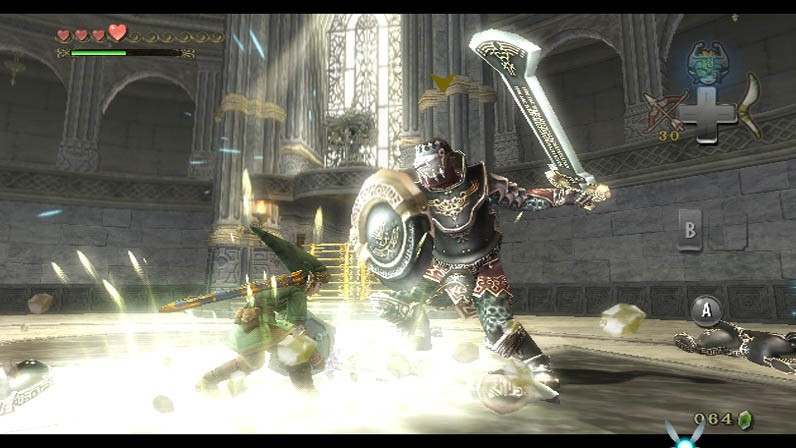
They go by fairly quickly during this extended introduction period, but there are hints of the differences to come early in the game. The twilight creature Midna, who sort of 'adopts' Link in his wolfen form, is unusually cynical for a Zelda title. She has an honestly funny sense of humor, and seems to delight in manipulating events towards some goal we're not privvy to. Zelda herself is distant and remorseful, the art style of the twilight world is very distinctive - the game has a serious tone from the get-go.
What begins to happen, as you pass beyond the introductory period and move into the game proper, is that you stop crawling. You start running. After the long tutorial, your legs stretch out and before you know it you're looking around at a game that demands your continued movement. The element that shifts Twilight Princess beyond Ocarina is the sheer momentum that the game builds as it hurtles forward through the story. There's so much to see, so much to do, that the game stops being 'another Zelda' and becomes Zelda in its purest form. There are references throughout the game to other chapters in the series, and you begin to realize that you aren't just playing some schmo here: you are playing with the Hero of Legend.
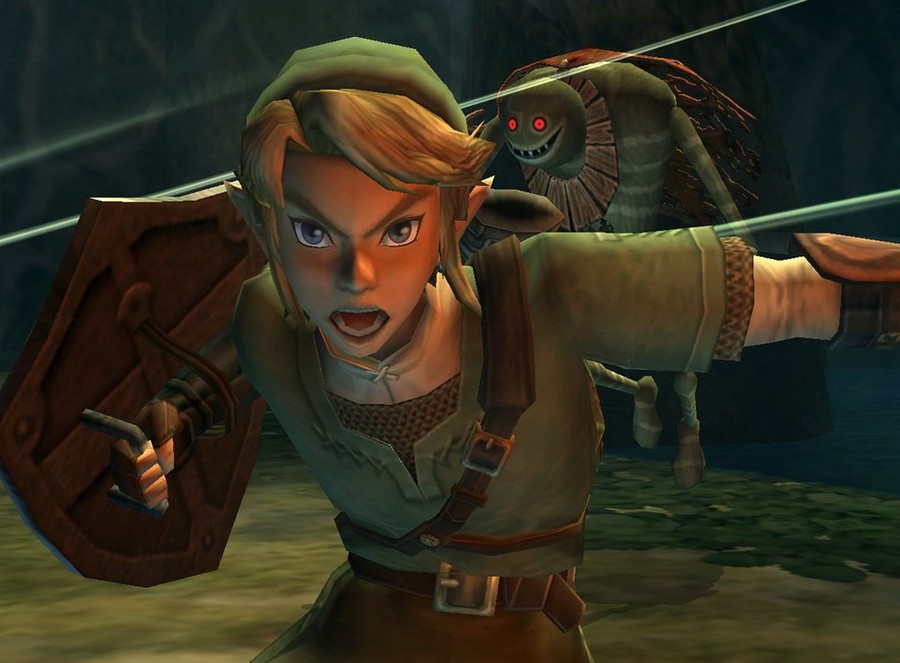
The gravitas which sinks that idea in is echoed in every element of the game. Link isn't the hero foretold by the marketing department when they dreamed up this game's ad campaign. Link is a hero, and you know it. You've been there, in other times and other places, helping other Links to complete the quests that made those Links into legends. When you pick up the boomerang, or the bow and arrow, it's not just another item upgrade. These are the tools of a hero, going all the way back to snagging that boomerang off of a dead moblin in the first dungeon of the very first game.
That may sound overly dramatic, but it's something that has to be experienced to be believed. The Wiimote control scheme is the first stepping stone. The fear Zelda fans expressed when it was announced you were going to have to waggle to swing your sword was palpable. They needn't have worried; holding your hands apart in your lap, destroying your enemies with a quick flick of the wrist, is the most natural thing in the world. Most impressively, you'll even find there are a few 'Wii Sports' moments in the game. There is no in-game need for you to do a completely elaborate overhand slash into the boss's weak point ... but it's a hell of a lot of fun. The control scheme turns the spin attack into a regular part of your routine, too. With no need for charging up, a simple gesture with your nunchuck hand sends mobs of enemies to their doom.
The controls fit seamlessly with other traditional Zelda elements, as well. Complex themed dungeons and brain-breaking puzzles litter the game. Each holds not only the simple pleasures of tackling room after room of enemies and traps, but pits you against a mini-boss and a end-boss for each labyrinth. The bosses further the game's seriousness, pitting you against devious creatures which require unique strategies to put down. Likewise, puzzles are likely to force you to utilize every tool you've been taught and every item you've been given to overcome them. Even if you have to spend twenty or thirty minutes staring at one puzzle element, you'll always get it eventually. Twilight Princess has no cheap tricks or unfair moments; solving a puzzle is always a cause for celebration, not for throwing your Wiimote.
It's the Wiimote, of course, that makes these bosses and puzzles work so well. Aiming for targets with the boomerang or bow and arrows is just a matter of pointing. Because all of the buttons (A, B, C, Z) are so close together, and so distinctly placed on the two parts of the controller, performing quick presses with any of them is just a matter of reacting. There's never a need to think 'Which one is B, now?' You just know.
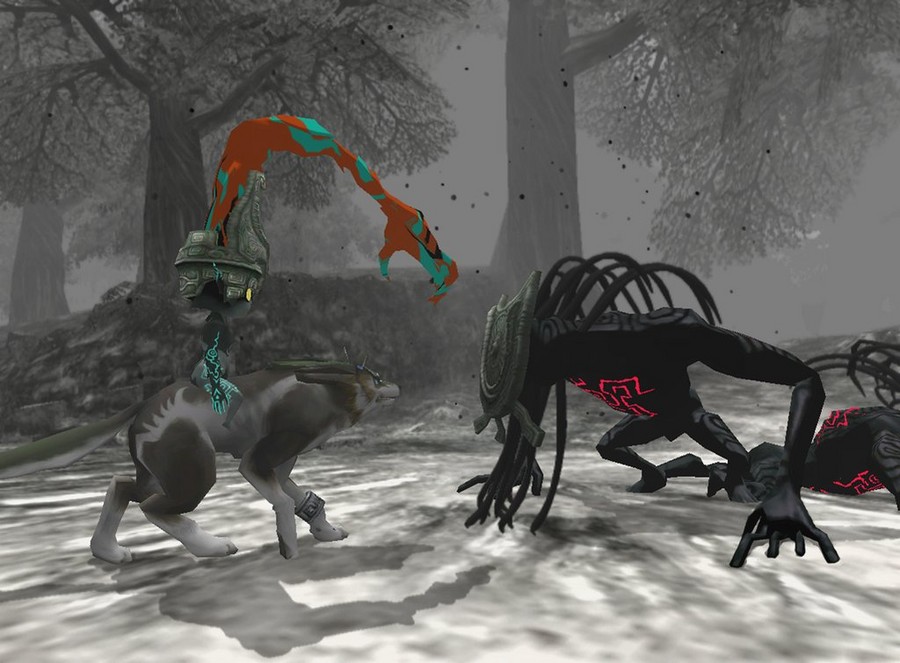
The slow buildup at the start of the game is what makes that possible. Your thorough grounding in the 'basics of Twilight Princess' leaves you well-prepared for the unpredictability of the later portions of the game. You'll bounce back and forth between light and darkness, freeing portions of Hyrule as a wolf, and then returning to the light to exterminate the twilight beasts with your sword and shield. In the twilight realm, Midna rides atop your furry back, while in the light she hides within your own shadow. In both realms, she offers advice whenever she feels it's appropriate, as well as hints as to what to do next. Once you've begun defeating shadow creatures, she'll offer you teleportation services across Hyrule as well. It's a truly great experience, to have the option to bop across Hyrule or make your way via more conventional means.
The game's teleportation service, and the availability of Link's horse Epona throughout the majority of the storyline are just more pieces of the well-made path the designers have laid down: Even though this title is in the neighborhood of 70 hours of content, there are no wasted moments. As good as Final Fantasy XII is, the need to grind levels means that some portions of your quest are, ultimately, forgettable. Twilight Princess is just the opposite. You'll never find yourself unable to do something you shouldn't be able to. Traveling between dungeons, you'll find hidden niches of goodies, new heart containers, even mini-dungeons that make you suspect every boulder and bush of containing an unseen realm. If you see something you can't reach you can move on without frustration; you'll get back to it eventually.
Whatever that unattainable object is, chances are you can see it from quite a ways away. Despite the (relatively) underpowered nature of the Wii, Twilight Princess is a very, very beautiful game. To an eye used to the slickness of the 360 or PS3, some portions of the games textures can certainly appear muddy and dull. The difference in image quality between AV cables and component cables is also quite striking; unartistically abstract portions of the game pop to life with the increase in visual quality. What the game lacks in graphical power, though, is more than made up for by the sheer amount and precision of the graphics. Zelda's huge environment is lovingly laid out, with every portion of the world having received careful attention. Places like Hyrule Castle, Death Mountain, and Kakariko Village are instantly recognizable, but look quite different from previous incarnations. The game's audio needs no qualifiers. I've been a fan of the music in Zelda games since the original 8-bit theme kept me up at night. This title's score is equal parts tradition and originality. The twilight realm, especially, moves the horizon of the game's musical landscape. Twisted, vaguely mechanical sounds are now a part of the instrumental selections, and the game's use of music to build mood is carefully laid down. Both visually and auditorally, Twilight Princess is a feast.
The game is not flawless, of course. If you don't like adventure games, or the Zelda series, there is nothing here that will change your perspective. Likewise, while I don't think the extreme visual style of Wind Waker would have been appropriate here, I wouldn't have objected to some slightly more stylized graphical elements. Titles like Okami and Final Fantasy XII have proven what you can get out of an aging console if you focus on style over realism; it might have been interesting to see what such a marriage could reap with a Zelda title.
These are minor, minor quibbles. Zelda is nothing less that the most precisely crafted adventure game of the last several years. Twilight Princess may be the finest adventure game ever made, for the simple reason than it encompasses the entire possibility range that the genre offers. Every single gameplay element you could think to see in an adventure game is here, and many novel and interesting new pieces besides. As you move forward through the game you're constantly challenged with new ideas, new items, new puzzles, new gameplay elements; what you are actually doing within the game never stands still. If boredom can be defined as repetition, you will be hard pressed to point at any section of the title and call it boring.
The path the designers have laid down leads from the last generation to the next. They've built this game on series traditions, and fitted the stones into place with the tools of their 'new gen' console. The highest praise I can think to give to a game is to say that it is fun. Legend of Zelda: Twilight Princess is an awful, awful lot of fun. Not only is it a reason to buy a Wii, it's proof that despite all of our doubts, despite the fears that they'd gone crazy-nutso with this 'waggling' thing, they really know what they're doing. Truly, perhaps, the best part of this whole scenario is the date on the calendar. This was a launch title. If they can so finely craft the entertainment experience of a Wii title this early in the console's life, one can only hope that future titles will be able to build on the lessons of Twilight Princess. Zelda won't be the best game on the system. Down the line, I look foward to more memorable, physically involving, and deeply moving experiences on Nintendo's little white box. -
Legend of Zelda - Twilight Princess Review
In talking about perfection in games, there are very few names that deserve that kind of accolade. If the business situation demands it, once great titles may need to be compromised in the name of the bottom line. Even great gaming franchises experience bumps in the road or unexpected problems. Many players considered Wind Waker a letdown; too much ocean, not enough story. Now that Link is back on dry land, he has found his feet again. The Legend of Zelda is gaming at its pure best. Created by a man who enjoyed walking in the woods and exploring the caves near his childhood home, Zelda captures the fun, the excitement, the danger that every game dreams of delivering. For most gamers, the adventures of Link and the story of Zelda have never failed to deliver. The latest chapter in the cyclic Legend, Twilight Princess, had the fate of not only Hyrule but a brand-new gaming platform resting on its shoulders. It has - almost unreasonably well - borne up under the pressure. Link saves himself and the princess from the darkness of evil, and the Wii from the darkness of financial misfortune. Read on for my impressions of the latest chapter in gaming's greatest dynasty - The Legend of Zelda: Twilight Princess.- Title: The Legend of Zelda: Twilight Princess
- Publisher/Developer: Nintendo
- System: Wii (GameCube)
They go by fairly quickly during this extended introduction period, but there are hints of the differences to come early in the game. The twilight creature Midna, who sort of 'adopts' Link in his wolfen form, is unusually cynical for a Zelda title. She has an honestly funny sense of humor, and seems to delight in manipulating events towards some goal we're not privvy to. Zelda herself is distant and remorseful, the art style of the twilight world is very distinctive - the game has a serious tone from the get-go.
What begins to happen, as you pass beyond the introductory period and move into the game proper, is that you stop crawling. You start running. After the long tutorial, your legs stretch out and before you know it you're looking around at a game that demands your continued movement. The element that shifts Twilight Princess beyond Ocarina is the sheer momentum that the game builds as it hurtles forward through the story. There's so much to see, so much to do, that the game stops being 'another Zelda' and becomes Zelda in its purest form. There are references throughout the game to other chapters in the series, and you begin to realize that you aren't just playing some schmo here: you are playing with the Hero of Legend.
The gravitas which sinks that idea in is echoed in every element of the game. Link isn't the hero foretold by the marketing department when they dreamed up this game's ad campaign. Link is a hero, and you know it. You've been there, in other times and other places, helping other Links to complete the quests that made those Links into legends. When you pick up the boomerang, or the bow and arrow, it's not just another item upgrade. These are the tools of a hero, going all the way back to snagging that boomerang off of a dead moblin in the first dungeon of the very first game.
That may sound overly dramatic, but it's something that has to be experienced to be believed. The Wiimote control scheme is the first stepping stone. The fear Zelda fans expressed when it was announced you were going to have to waggle to swing your sword was palpable. They needn't have worried; holding your hands apart in your lap, destroying your enemies with a quick flick of the wrist, is the most natural thing in the world. Most impressively, you'll even find there are a few 'Wii Sports' moments in the game. There is no in-game need for you to do a completely elaborate overhand slash into the boss's weak point ... but it's a hell of a lot of fun. The control scheme turns the spin attack into a regular part of your routine, too. With no need for charging up, a simple gesture with your nunchuck hand sends mobs of enemies to their doom.
The controls fit seamlessly with other traditional Zelda elements, as well. Complex themed dungeons and brain-breaking puzzles litter the game. Each holds not only the simple pleasures of tackling room after room of enemies and traps, but pits you against a mini-boss and a end-boss for each labyrinth. The bosses further the game's seriousness, pitting you against devious creatures which require unique strategies to put down. Likewise, puzzles are likely to force you to utilize every tool you've been taught and every item you've been given to overcome them. Even if you have to spend twenty or thirty minutes staring at one puzzle element, you'll always get it eventually. Twilight Princess has no cheap tricks or unfair moments; solving a puzzle is always a cause for celebration, not for throwing your Wiimote.
It's the Wiimote, of course, that makes these bosses and puzzles work so well. Aiming for targets with the boomerang or bow and arrows is just a matter of pointing. Because all of the buttons (A, B, C, Z) are so close together, and so distinctly placed on the two parts of the controller, performing quick presses with any of them is just a matter of reacting. There's never a need to think 'Which one is B, now?' You just know.
The slow buildup at the start of the game is what makes that possible. Your thorough grounding in the 'basics of Twilight Princess' leaves you well-prepared for the unpredictability of the later portions of the game. You'll bounce back and forth between light and darkness, freeing portions of Hyrule as a wolf, and then returning to the light to exterminate the twilight beasts with your sword and shield. In the twilight realm, Midna rides atop your furry back, while in the light she hides within your own shadow. In both realms, she offers advice whenever she feels it's appropriate, as well as hints as to what to do next. Once you've begun defeating shadow creatures, she'll offer you teleportation services across Hyrule as well. It's a truly great experience, to have the option to bop across Hyrule or make your way via more conventional means.
The game's teleportation service, and the availability of Link's horse Epona throughout the majority of the storyline are just more pieces of the well-made path the designers have laid down: Even though this title is in the neighborhood of 70 hours of content, there are no wasted moments. As good as Final Fantasy XII is, the need to grind levels means that some portions of your quest are, ultimately, forgettable. Twilight Princess is just the opposite. You'll never find yourself unable to do something you shouldn't be able to. Traveling between dungeons, you'll find hidden niches of goodies, new heart containers, even mini-dungeons that make you suspect every boulder and bush of containing an unseen realm. If you see something you can't reach you can move on without frustration; you'll get back to it eventually.
Whatever that unattainable object is, chances are you can see it from quite a ways away. Despite the (relatively) underpowered nature of the Wii, Twilight Princess is a very, very beautiful game. To an eye used to the slickness of the 360 or PS3, some portions of the games textures can certainly appear muddy and dull. The difference in image quality between AV cables and component cables is also quite striking; unartistically abstract portions of the game pop to life with the increase in visual quality. What the game lacks in graphical power, though, is more than made up for by the sheer amount and precision of the graphics. Zelda's huge environment is lovingly laid out, with every portion of the world having received careful attention. Places like Hyrule Castle, Death Mountain, and Kakariko Village are instantly recognizable, but look quite different from previous incarnations. The game's audio needs no qualifiers. I've been a fan of the music in Zelda games since the original 8-bit theme kept me up at night. This title's score is equal parts tradition and originality. The twilight realm, especially, moves the horizon of the game's musical landscape. Twisted, vaguely mechanical sounds are now a part of the instrumental selections, and the game's use of music to build mood is carefully laid down. Both visually and auditorally, Twilight Princess is a feast.
The game is not flawless, of course. If you don't like adventure games, or the Zelda series, there is nothing here that will change your perspective. Likewise, while I don't think the extreme visual style of Wind Waker would have been appropriate here, I wouldn't have objected to some slightly more stylized graphical elements. Titles like Okami and Final Fantasy XII have proven what you can get out of an aging console if you focus on style over realism; it might have been interesting to see what such a marriage could reap with a Zelda title.
These are minor, minor quibbles. Zelda is nothing less that the most precisely crafted adventure game of the last several years. Twilight Princess may be the finest adventure game ever made, for the simple reason than it encompasses the entire possibility range that the genre offers. Every single gameplay element you could think to see in an adventure game is here, and many novel and interesting new pieces besides. As you move forward through the game you're constantly challenged with new ideas, new items, new puzzles, new gameplay elements; what you are actually doing within the game never stands still. If boredom can be defined as repetition, you will be hard pressed to point at any section of the title and call it boring.
The path the designers have laid down leads from the last generation to the next. They've built this game on series traditions, and fitted the stones into place with the tools of their 'new gen' console. The highest praise I can think to give to a game is to say that it is fun. Legend of Zelda: Twilight Princess is an awful, awful lot of fun. Not only is it a reason to buy a Wii, it's proof that despite all of our doubts, despite the fears that they'd gone crazy-nutso with this 'waggling' thing, they really know what they're doing. Truly, perhaps, the best part of this whole scenario is the date on the calendar. This was a launch title. If they can so finely craft the entertainment experience of a Wii title this early in the console's life, one can only hope that future titles will be able to build on the lessons of Twilight Princess. Zelda won't be the best game on the system. Down the line, I look foward to more memorable, physically involving, and deeply moving experiences on Nintendo's little white box. -
Two Weeks with the Wii
In the 80s, kids of my generation cut their teeth on Super Mario Bros.. They went through high school with Mario Kart, and bonded with college friends playing Super Smash Bros. By 1999, though, the N64 had long since proven that Nintendo's dominance in American videogaming was over. The GameCube that followed was largely a disappointment. Nintendo failed to interest third party developers, and frustrated fans with long-delayed chapters of the Mario, Zelda, and Metroid franchises. Coming into this no-longer-next generation of consoles, Nintendo announced they were aiming for a Revolution, and then confused everyone by renaming it Wii. Their actions left a lot of people wondering if the company still had what it took to compete with committed powerhouses like Microsoft and Sony. The launch lineup is kind of tepid, and the controls really do take some getting used to. We've already established that they're not aiming to compete in the graphics race. So what is the console really like? Why is it selling so quickly? What does it have to offer? I've had two weeks to find out. Read on, so that you can get a feel for the system you'll definitely be playing (if not owning) at some point in the future. My somewhat bold claim is not based in any sort of fanboi favoritism. It's a simple reality of Nintendo's console; the Wii begs to be played by lots of people. Unlike the solitary games that are popular on the PlayStation 3 and Xbox 360, Nintendo's scrappy fighter is at its fullest potential when you've got four people armed with Wiimotes. Four players on a Wii title is like nothing you have ever experienced in gaming before. For some people the Wii's demand that you be physically proximate to your fellow gamer will be a mark against it. For many people, though, I think the need to get together in one space will cut through the confusion and misunderstanding this hobby has always suffered from.
The reason for this is that it is easy: It just works. The first time you hand a Wiimote to someone and they point it at the screen, they know what to do. There's a little hand, representing where you're pointing, and each Wiimote has a different colored hand. Navigating menus is actually ... fun, in an odd sort of way. Moving over UI elements with the little hand representing your controller causes a very slight rumble. The controller shakes just enough to give the entire experience a tactile element that, again, I've never seen in gaming before. It's the little things like this that really makes the Wii experience. Turning the Wiimote upside down inverts the hand. They didn't have to do it that way, but they did. Navigating menus is, mildly, fun. One of the first games my cousins played after they'd picked up the controllers was the "duel with their icon-hands" challenge. Odd, yes, but entirely understandable. The Wiimote, and the completely natural movements you make when using the device, require no explanation. When Nintendo went to the AARP event earlier this year, they knew what they were doing; this is the console your grandmother can use as easily as you can.
UI
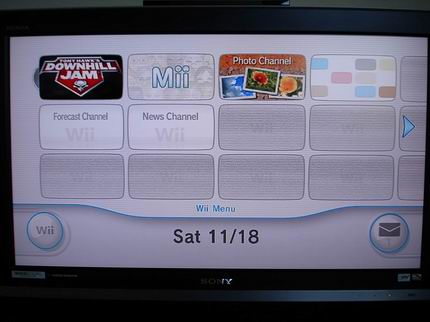
Graphically, the system's UI is a clean mixture of greys and whites. The Channel selection screen is the first thing you see on booting the system, and stands out well against the system's default imagery. From left to right on the top row, you're going to find the games channel, the Mii channel, the photo channel, and Wii Store channel. Though I'm not sure why the somewhat anemic photo functionality gets to rank so highly, they've organized your primary Wii elements together on one screen. On the bottom of the screen there's an unobtrusive options button, and a button to take you to your Wii's address book functionality. As you purchase things from the Virtual console (the primary online capability of the console right now) they'll fill in additional windows on the console's launch page. This is also where the news and weather features are accessible, with promises of more services further on in the Wii's lifetime.
To start addressing the channels in order, the games channel is where you'll access your currently-loaded disc. The system has a little splash screen there on your Wii frontpage illustrating what you have loaded. Just to reiterate something you've probably already heard, GameCube titles are 100% backwards compatible with the system. The Wavebird controllers are too, and nicely slot into the ports for them on the top of the console. If you're planning on playing a lot of Virtual Console titles, I recommend that you make sure to hang onto your Wavebird; they'll play almost every game the download service can offer up, and your Cube games to boot.
Mii
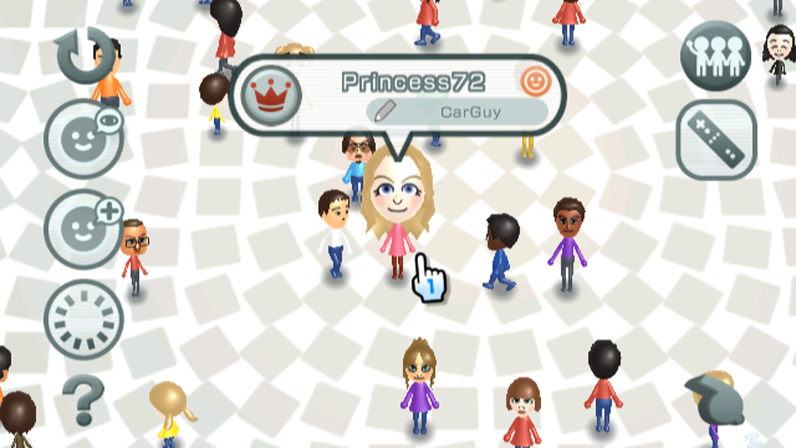
The Mii channel may just be the hidden gem for this system. If Nintendo plays things right, the Mii may become as much a part of your online identity as Microsoft's gamertag. Miis, to explain, are little virtual people. Using a canned set of features (hair, eyes, mouths), you can combine facial elements to great a little 'you'. Or a mini-Lincoln. Or Jesus. If you've always wanted to school the King of Kings in tennis, the Wii is the system for you. As innocuous a feature as this sounds, it's impossible not to find yourself wrapped up in possibilities once you sit down to play with it. At the very least, you're going to have to make you. And your S.O. And your family, and all of your friends, and your favorite movie star ... it's just too bad they don't have ears and you can't make pets.
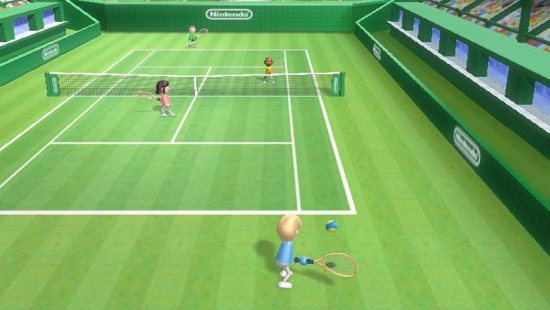
Once you've made your Mii-version of former child star Gary Coleman, you can actually compete with him or against him in Wii Sports. At the moment, the games on the pack-in disc (and those on the upcoming Wii Play disc) are the only places you can make use of your strange little people. Even with that limited scope, Nintendo is already showing their intent to make the most of this feature. Your capabilities in Wii Tennis, for example, are tracked via intuitive charts. Someday down the line, when more titles take your Mii into account, you'll hopefully be able to import more interesting stats (frags and such) into your Mii's pockets. You can already take your Mii with you; up to 8 Miis can be loaded onto a single Wiimote for easy toting to another person's house. You can send them away, too; after you exchange friend codes with someone, you can trade Miis. They'll go wandering, too, if you let them. Heading off into the great Wii beyond, they'll wander across the Mii Parades of consoles across the nation, just begging to be included in that owner's personal Mii Plaza. Reggie Fils Aime has already hinted at the eventual addition of more facial features, and it is little wonder why. With the ease of making a little 'you' so tantalizing, it's easy to see why Nintendo is taking this 'uber-cutesy' feature very seriously.
Photos
The system's photo feature/mp3 player is something of a forgettable tack-on. Photos and music can be uploaded to the system, or played directly from, SD memory cards. They slot right into the front, and featured photos are very lovingly displayed by the UI. Music can be played behind the photos; it's essentially the only way to just listen to music on the system. Uploaded tunes can be played during select Wii titles (like ExciteTruck), which is very nice, but otherwise the media capabilities of the Wii are fairly forgettable. Given Nintendo's drum-beating about the Wii being 'focused on games', I'm kind of surprised they even bothered. Just the same, the utility of these features can't be denied, and they certainly don't get in the way.
Virtual Console
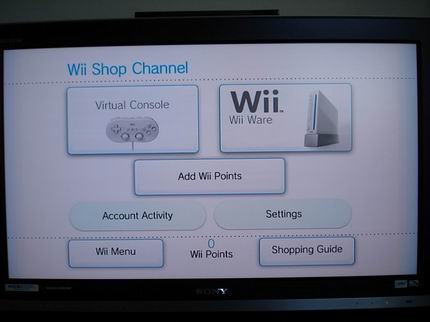
The Virtual Console, then, is the final default offering you'll find on loading the system. Nintendo's answer to Microsoft's Xbox Live and Sony's E-Distribution model, it currently only offers downloadable retro titles. The Wii Shop will eventually be where you pick up additional services as well, but for now games are all this service has to offer. While the launch list for the U.S. market has some much appreciated classics included, overall the titles are downright disappointing compared to other regions. I'm not complaining about what we have gotten, to be sure. Bonk, the original Sonic, the SNES version of Sim City, and the original Legend of Zelda are all titles still well worth your time in 2006. It's hard not to look at the Virtual Console list from Japan and other sectors, though, and not be a little jealous. Castlevania IV and A Link to the Past? Why don't we deserve Link to the Past? Recent events has also hinted that Nintendo has no plans to offer games via the Virtual Console if they were not originally released in that market. If that turns out to be true, terrific JP-only NES and SNES games will never reach our virtual shores. A serious oversight on the company's part.
The Virtual Console itself has proven to be less enjoyable for me to use than other parts of the Wii interface. Out of the box, the only way you'll be connecting with the Internet is via a WiFi connection. Even with a solid WiFi setup, it's inevitable that your connection will flake out. The console seems intent on blaming 'firewalls' for its woes, but some days I know everything is working fine; the problem lies with a cranky Wii. Once you're online you may run into difficulties there as well. The interest level in the Virtual Console must be higher than Nintendo expected, because I've found the service absolutely hammered and essentially unusable several times since the system launched. All that said, this is exactly what you'd expect from Nintendo: a solid retro-delivery system, straight from your childhood. I spent many, many, many hours playing the SNES version of Sim City. I gave myself an allowance of three games from the launch lineup. Along with that early Will Wright title, I snagged the original Zelda (my wife had never played it) and Sonic, as we were Sega-less in my formative years. All three play as smoothly as silk. No hiccups, no quirky controls, just unadulterated blasts from the past. Of course, my three titles will soon have friends. Even with Nintendo's odd reluctance to give us the good stuff, they'll be releasing a least one new title every Monday for the foreseeable future. Emulator fans may scoff, but it's hard to look down your nose at a legal way to enjoy retro classics in relatively high definition. The Wii even does game suspension, so you don't have to play games straight through. Despite some petty annoyances, they've got a great channel here for future content (including the much vaunted indie gaming scene), and it only looks to be getting better in the future. At the end of the day, even if it can be annoying to use, at least the Wii Shop music is soothing.
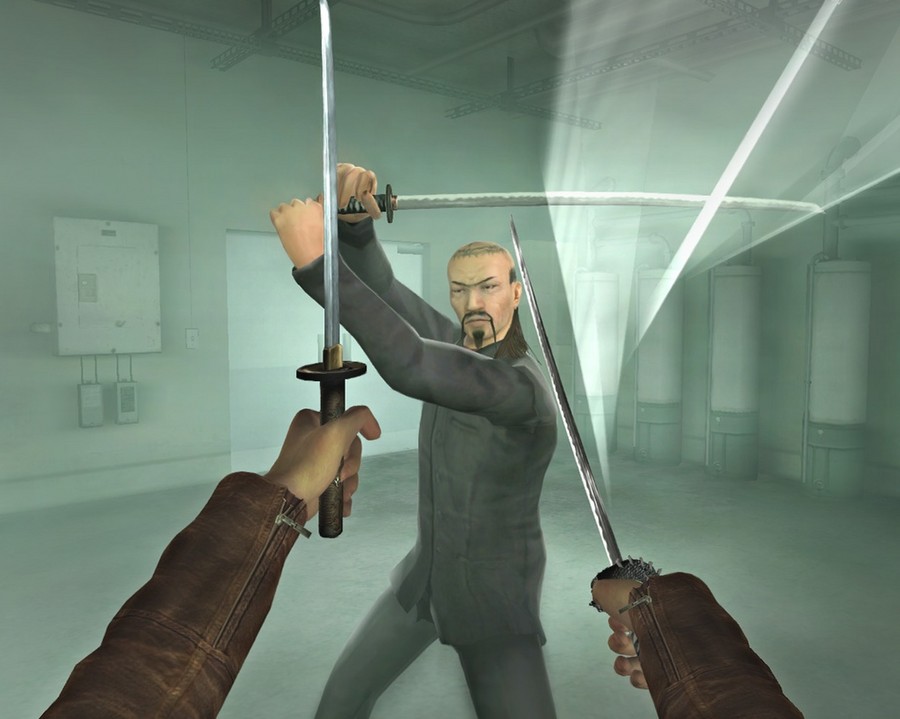
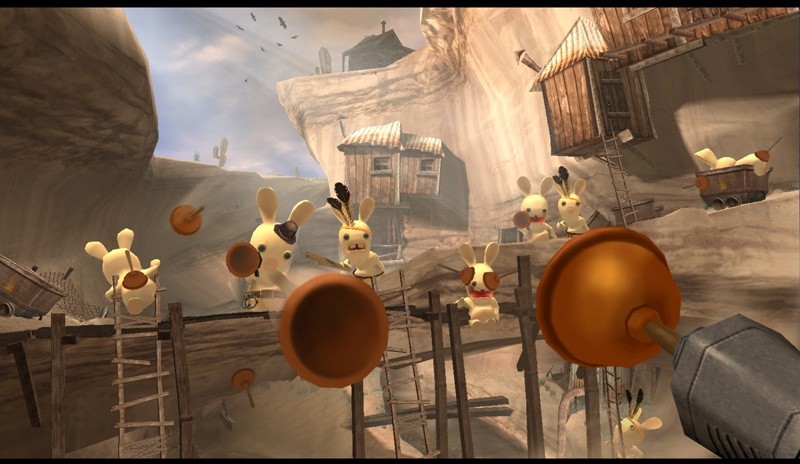
So, that's what the machine itself is like. The Wii's control scheme is what has people sitting up and taking notice though, and it's hard to judge that on menus alone. As a study in comparisons, I offer you the Good, the Bad, and the Awesome: Wii Sports, Red Steel, and Rayman Raving Rabbids.
Wii Sports
In the U.S., our consoles were $40 more expensive than in Japan. This was the reason - the Wii Sports pack-in. I've been lamenting the loss of the pack-in for years now, though, so I begrudge them nothing. It would be one thing if Wii Sports was a waste, a Luigi's Mansion for the next-gen era, but thankfully this mini-game game holds its own and encourages your aging relatives to make fools of themselves. Wii Sports consists of five simple games which ... kind of ... resemble actual sports. There's tennis, golf, bowling, boxing, and baseball. Controls for each of the five pastimes are the definition of simplicity. Each only requires a very simple motion with the Wiimote, mimicking actual movements you'd make while participating in the sport. Tennis is probably the one that's been seen the most at press events, and all it requires is a quick flick of the wrist to get the ball moving to the other end of the court. It's also one of the most enjoyable of the offerings, and supports up to four players for some hi-larious doubles action. Bowling is likewise enjoyable in multiplayer mode, and requires only that you know how to make the bowling motion with your arm in order to strike. Golf and baseball are less enjoyable, as built-in sensitivities to the mini-games lend themselves to confusion and mistrust of your capabilities. In reality, it's not you, it's the game. Golf is particularly bad, as even the slightest swing will have the game registering 'too much force' on the ball. The final game, boxing, is much the same. Using the Wiimote and the nunchuck, you can deliver one-two punches to your opponent's Mii ... if you can get your flailing arms to work right. I've personally found boxing to be highly enjoyable, despite its lack of precision. Two people really into the game results in an air-slapping girly-fight scene like something out of "Revenge of the Nerds". Nintendo made an excellent choice including this as a pack-in, and Wii Sports will continue to be the social game console owners reach for until the likes of Wario Ware or Mario Party make it to store shelves. (Just make sure to use the wrist strap.)
Red Steel
On the opposite end of the hardcore scale, we have Red Steel. Along with Call of Duty 3, this is one of the more 'adult' offerings accompanying the Wii at launch. It concerns the battles of a gentleman who has come to a fancy restaurant to have dinner with his girlfriend's father. As sometimes happens, the Yakuza assault the building and an epic fight ensues. While the title does an admirable job of convincing the player that FPS controls are completely enjoyable on the Wii, the title fails to deliver in almost any other way. The reason has nothing to do with the Wii; Red Steel is just not a very good game. Unlike Yakuza , which manages to weave a tale of Japanese crime with a straight face and get away with it, here the attempts at gritty criminality come off as hokey and poorly thought-out. The hero is utterly forgettable, and the noble quest to protect friends and family from the vicious crime syndicate is one John Woo flick short of a film festival. The only thing it gets (mostly) right is the control scheme, which is just as you'd imagine it. The Wiimote directs your point of view, while the stick on the nunchuck moves you forward. This is the schema that were' going to (hopefully) see a lot of over the Wii's lifespan. It's the way we'll be playing Metroid down the line, and can also be seen one door over in Call of Duty 3. Red Steel chooses to make the protagonist's arm flex and bend in inhuman ways as you turn, fouling up the game's one solid feature. His long, seemingly jointless arm is very disconcerting, and only serves to remove you from the action. Embarrassingly, the control scheme breaks down during sword fights. Those gooshy, confusing fight sequences are not quite as disconnected from reality as Wii Boxing, but it's fairly close. Even when poor reactions began leaking out of the enthusiast press, I maintained a guarded enthusiasm for this title. Guns and swords for the win, right? In the end, though, there's just not enough 'there' there. As much as it makes me want to play Metroid Prime, it makes me want to shut off the console more. You need not suffer from the launch-day enthusiasm that carried this into my cart; you can definitely give this one a pass.
Rayman Raving Rabbids
From the inane to the insane, we move on to Rayman Raving Rabbids. I've never really liked Rayman in his previous platform title outings; he's always been something of a forgettable character. Here, though, Ubisoft has offered up a crack-addled assortment of mini-games, and hung them very loosely around Rayman's neck. He's the central character of the game only insomuch as the little guy on screen has his name. Otherwise, you'll be concerning yourself more with the Rabbids: evil, stupid, ugly, bunnies from hell. The outline of the game is fairly simple. Ray competes in various events, spread out over a period of about thirteen days. Every day, there are four events to participate in. Completing three events unlocks a 'boss' event, which when cleared allows Ray to move on to the next day. Completing all four events during each day unlocks (on alternating days) new outfits for Ray to wear, and new music for you to listen to. Multiplayer play focuses on several people competing in individual events, with an option to string some of them together to make fairly anemic storylines for your adventures.
The beauty of this game, though, is that it's a.) absolutely crack-addled b.) hilarious and c.) completely addicting. Just a few of my favorite examples from the game include:- "Bunnies Don't Like Bats" - Direct Rayman as he mounts a giant bat, collecting piggies and dropping them into a pigpen before the time runs out. "Bunnies Don't Like Bats 2" adds the complexity of fending off a Bunny raiding party while you collect the piggies.
- "Bunnies Don't Know What to do with Cows" - Whirl the Wiimote over your head, as Ray does the same with a chain attached to a cow's collar. Hit a button on the Wiimote to send the cow flying while it's facing away from you. You get more points the further the cow flies; the cow flies further by whipping that Wiimote as fast as you can above your head.
- "Bunnies Don't Use Toothpaste" - Grab horrible grimacing worms with the Wiimote as they emerge from the rotten teeth of a Bunny, and flick them away. They come slowly at first, but emerge faster and faster as you play. Allowing a worm to emerge and then disappear ruins a tooth. Allowing two worms to reenter a single tooth sends the worm borrowing up into the Bunny's soft palate and ends the game. Hilariously, the mini-game is backed by an homage to the the theme from "Brazil".
- "Bunnies Can Only Fly Downward" - This wonderful bunny-filled version of the parachuting level from PilotWings has you directing Ray down through smoke rings with your Wiimote. You speed up by pushing on the nunchuck's stick, but you lose control that way too. Your aim is to get to the ground before a set time has passed. (Hint to Nintendo: PilotWings for the Virtual Console. Get on it.)
- "Bunnies Are Addicted to Carrot Juice" - While pumping the nunchuck with your left hand up and down, aim the Wiimote at the oncoming diver-Bunnies to fill their dive masks with carrot juice. Filling them up causes them to fall over. You lose if the ever-increasing wave of bunnies reaches your bar.
Final Thoughts
The reality of the situation is that multiplayer Wii games make you look like an idiot. As strange as it sounds, this is just one mark of a system that has succeeded. For so many people, gaming is either a solitary pastime or one done socially via the cold detachment of a Ventrilo link. I, like many other folks, had the opportunity to introduce the Wii to my family during Thanksgiving, and it was anything but detached. It resulted in several hours of good-natured competition among my cousins, and allowed me the pleasure of watching four individuals north of 40 volley and serve via Wiimote. With the exception of my mother, I believe it may well have been the first time these people had ever played a videogame. It's not Half-Life, sure, but it isn't exactly Tetris either.
Even with a fairly humble collection of launch titles, Nintendo has managed to get gamers and non-gamers alike to drink the kool-aid. The system delivers exactly what the company promised when the 'Revolution' was announced in 2004. It's a system that offers the best of both worlds. Non-gamers have a completely intuitive control scheme that will now allow them to play with their game-loving friends. Hardcore gamers already have more innovative titles to play than they know what to do with. So what if some of them, like Red Steel come up a little short. For every Red Steel, there's a Trauma Center, a Rayman, or a Twilight Princess (whose review grew too large to fit here, and will be addressed tomorrow). Offering the best of new technology and plenty of unearthable retro memories, the Wii is a console that demands attention. I've yet to encounter anyone with a mild opinion of the little white box; you are either going to love this thing, or hate it.
Either way, Nintendo has finally broken free of its 'me too' position, held since the days of the N64. Even if the Wii stays the third-place console, it's no longer possible to think of the company as an also-ran. Sony and Microsoft are in for a hard fight this time around. The only side guaranteed not to lose is our side; whatever happens in this war, it's the gamers who win. -
Two Weeks with the Wii
In the 80s, kids of my generation cut their teeth on Super Mario Bros.. They went through high school with Mario Kart, and bonded with college friends playing Super Smash Bros. By 1999, though, the N64 had long since proven that Nintendo's dominance in American videogaming was over. The GameCube that followed was largely a disappointment. Nintendo failed to interest third party developers, and frustrated fans with long-delayed chapters of the Mario, Zelda, and Metroid franchises. Coming into this no-longer-next generation of consoles, Nintendo announced they were aiming for a Revolution, and then confused everyone by renaming it Wii. Their actions left a lot of people wondering if the company still had what it took to compete with committed powerhouses like Microsoft and Sony. The launch lineup is kind of tepid, and the controls really do take some getting used to. We've already established that they're not aiming to compete in the graphics race. So what is the console really like? Why is it selling so quickly? What does it have to offer? I've had two weeks to find out. Read on, so that you can get a feel for the system you'll definitely be playing (if not owning) at some point in the future. My somewhat bold claim is not based in any sort of fanboi favoritism. It's a simple reality of Nintendo's console; the Wii begs to be played by lots of people. Unlike the solitary games that are popular on the PlayStation 3 and Xbox 360, Nintendo's scrappy fighter is at its fullest potential when you've got four people armed with Wiimotes. Four players on a Wii title is like nothing you have ever experienced in gaming before. For some people the Wii's demand that you be physically proximate to your fellow gamer will be a mark against it. For many people, though, I think the need to get together in one space will cut through the confusion and misunderstanding this hobby has always suffered from.
The reason for this is that it is easy: It just works. The first time you hand a Wiimote to someone and they point it at the screen, they know what to do. There's a little hand, representing where you're pointing, and each Wiimote has a different colored hand. Navigating menus is actually ... fun, in an odd sort of way. Moving over UI elements with the little hand representing your controller causes a very slight rumble. The controller shakes just enough to give the entire experience a tactile element that, again, I've never seen in gaming before. It's the little things like this that really makes the Wii experience. Turning the Wiimote upside down inverts the hand. They didn't have to do it that way, but they did. Navigating menus is, mildly, fun. One of the first games my cousins played after they'd picked up the controllers was the "duel with their icon-hands" challenge. Odd, yes, but entirely understandable. The Wiimote, and the completely natural movements you make when using the device, require no explanation. When Nintendo went to the AARP event earlier this year, they knew what they were doing; this is the console your grandmother can use as easily as you can.
UI
Graphically, the system's UI is a clean mixture of greys and whites. The Channel selection screen is the first thing you see on booting the system, and stands out well against the system's default imagery. From left to right on the top row, you're going to find the games channel, the Mii channel, the photo channel, and Wii Store channel. Though I'm not sure why the somewhat anemic photo functionality gets to rank so highly, they've organized your primary Wii elements together on one screen. On the bottom of the screen there's an unobtrusive options button, and a button to take you to your Wii's address book functionality. As you purchase things from the Virtual console (the primary online capability of the console right now) they'll fill in additional windows on the console's launch page. This is also where the news and weather features are accessible, with promises of more services further on in the Wii's lifetime.
To start addressing the channels in order, the games channel is where you'll access your currently-loaded disc. The system has a little splash screen there on your Wii frontpage illustrating what you have loaded. Just to reiterate something you've probably already heard, GameCube titles are 100% backwards compatible with the system. The Wavebird controllers are too, and nicely slot into the ports for them on the top of the console. If you're planning on playing a lot of Virtual Console titles, I recommend that you make sure to hang onto your Wavebird; they'll play almost every game the download service can offer up, and your Cube games to boot.
Mii
The Mii channel may just be the hidden gem for this system. If Nintendo plays things right, the Mii may become as much a part of your online identity as Microsoft's gamertag. Miis, to explain, are little virtual people. Using a canned set of features (hair, eyes, mouths), you can combine facial elements to great a little 'you'. Or a mini-Lincoln. Or Jesus. If you've always wanted to school the King of Kings in tennis, the Wii is the system for you. As innocuous a feature as this sounds, it's impossible not to find yourself wrapped up in possibilities once you sit down to play with it. At the very least, you're going to have to make you. And your S.O. And your family, and all of your friends, and your favorite movie star ... it's just too bad they don't have ears and you can't make pets.
Once you've made your Mii-version of former child star Gary Coleman, you can actually compete with him or against him in Wii Sports. At the moment, the games on the pack-in disc (and those on the upcoming Wii Play disc) are the only places you can make use of your strange little people. Even with that limited scope, Nintendo is already showing their intent to make the most of this feature. Your capabilities in Wii Tennis, for example, are tracked via intuitive charts. Someday down the line, when more titles take your Mii into account, you'll hopefully be able to import more interesting stats (frags and such) into your Mii's pockets. You can already take your Mii with you; up to 8 Miis can be loaded onto a single Wiimote for easy toting to another person's house. You can send them away, too; after you exchange friend codes with someone, you can trade Miis. They'll go wandering, too, if you let them. Heading off into the great Wii beyond, they'll wander across the Mii Parades of consoles across the nation, just begging to be included in that owner's personal Mii Plaza. Reggie Fils Aime has already hinted at the eventual addition of more facial features, and it is little wonder why. With the ease of making a little 'you' so tantalizing, it's easy to see why Nintendo is taking this 'uber-cutesy' feature very seriously.
Photos
The system's photo feature/mp3 player is something of a forgettable tack-on. Photos and music can be uploaded to the system, or played directly from, SD memory cards. They slot right into the front, and featured photos are very lovingly displayed by the UI. Music can be played behind the photos; it's essentially the only way to just listen to music on the system. Uploaded tunes can be played during select Wii titles (like ExciteTruck), which is very nice, but otherwise the media capabilities of the Wii are fairly forgettable. Given Nintendo's drum-beating about the Wii being 'focused on games', I'm kind of surprised they even bothered. Just the same, the utility of these features can't be denied, and they certainly don't get in the way.
Virtual Console
The Virtual Console, then, is the final default offering you'll find on loading the system. Nintendo's answer to Microsoft's Xbox Live and Sony's E-Distribution model, it currently only offers downloadable retro titles. The Wii Shop will eventually be where you pick up additional services as well, but for now games are all this service has to offer. While the launch list for the U.S. market has some much appreciated classics included, overall the titles are downright disappointing compared to other regions. I'm not complaining about what we have gotten, to be sure. Bonk, the original Sonic, the SNES version of Sim City, and the original Legend of Zelda are all titles still well worth your time in 2006. It's hard not to look at the Virtual Console list from Japan and other sectors, though, and not be a little jealous. Castlevania IV and A Link to the Past? Why don't we deserve Link to the Past? Recent events has also hinted that Nintendo has no plans to offer games via the Virtual Console if they were not originally released in that market. If that turns out to be true, terrific JP-only NES and SNES games will never reach our virtual shores. A serious oversight on the company's part.
The Virtual Console itself has proven to be less enjoyable for me to use than other parts of the Wii interface. Out of the box, the only way you'll be connecting with the Internet is via a WiFi connection. Even with a solid WiFi setup, it's inevitable that your connection will flake out. The console seems intent on blaming 'firewalls' for its woes, but some days I know everything is working fine; the problem lies with a cranky Wii. Once you're online you may run into difficulties there as well. The interest level in the Virtual Console must be higher than Nintendo expected, because I've found the service absolutely hammered and essentially unusable several times since the system launched. All that said, this is exactly what you'd expect from Nintendo: a solid retro-delivery system, straight from your childhood. I spent many, many, many hours playing the SNES version of Sim City. I gave myself an allowance of three games from the launch lineup. Along with that early Will Wright title, I snagged the original Zelda (my wife had never played it) and Sonic, as we were Sega-less in my formative years. All three play as smoothly as silk. No hiccups, no quirky controls, just unadulterated blasts from the past. Of course, my three titles will soon have friends. Even with Nintendo's odd reluctance to give us the good stuff, they'll be releasing a least one new title every Monday for the foreseeable future. Emulator fans may scoff, but it's hard to look down your nose at a legal way to enjoy retro classics in relatively high definition. The Wii even does game suspension, so you don't have to play games straight through. Despite some petty annoyances, they've got a great channel here for future content (including the much vaunted indie gaming scene), and it only looks to be getting better in the future. At the end of the day, even if it can be annoying to use, at least the Wii Shop music is soothing.
So, that's what the machine itself is like. The Wii's control scheme is what has people sitting up and taking notice though, and it's hard to judge that on menus alone. As a study in comparisons, I offer you the Good, the Bad, and the Awesome: Wii Sports, Red Steel, and Rayman Raving Rabbids.
Wii Sports
In the U.S., our consoles were $40 more expensive than in Japan. This was the reason - the Wii Sports pack-in. I've been lamenting the loss of the pack-in for years now, though, so I begrudge them nothing. It would be one thing if Wii Sports was a waste, a Luigi's Mansion for the next-gen era, but thankfully this mini-game game holds its own and encourages your aging relatives to make fools of themselves. Wii Sports consists of five simple games which ... kind of ... resemble actual sports. There's tennis, golf, bowling, boxing, and baseball. Controls for each of the five pastimes are the definition of simplicity. Each only requires a very simple motion with the Wiimote, mimicking actual movements you'd make while participating in the sport. Tennis is probably the one that's been seen the most at press events, and all it requires is a quick flick of the wrist to get the ball moving to the other end of the court. It's also one of the most enjoyable of the offerings, and supports up to four players for some hi-larious doubles action. Bowling is likewise enjoyable in multiplayer mode, and requires only that you know how to make the bowling motion with your arm in order to strike. Golf and baseball are less enjoyable, as built-in sensitivities to the mini-games lend themselves to confusion and mistrust of your capabilities. In reality, it's not you, it's the game. Golf is particularly bad, as even the slightest swing will have the game registering 'too much force' on the ball. The final game, boxing, is much the same. Using the Wiimote and the nunchuck, you can deliver one-two punches to your opponent's Mii ... if you can get your flailing arms to work right. I've personally found boxing to be highly enjoyable, despite its lack of precision. Two people really into the game results in an air-slapping girly-fight scene like something out of "Revenge of the Nerds". Nintendo made an excellent choice including this as a pack-in, and Wii Sports will continue to be the social game console owners reach for until the likes of Wario Ware or Mario Party make it to store shelves. (Just make sure to use the wrist strap.)
Red Steel
On the opposite end of the hardcore scale, we have Red Steel. Along with Call of Duty 3, this is one of the more 'adult' offerings accompanying the Wii at launch. It concerns the battles of a gentleman who has come to a fancy restaurant to have dinner with his girlfriend's father. As sometimes happens, the Yakuza assault the building and an epic fight ensues. While the title does an admirable job of convincing the player that FPS controls are completely enjoyable on the Wii, the title fails to deliver in almost any other way. The reason has nothing to do with the Wii; Red Steel is just not a very good game. Unlike Yakuza , which manages to weave a tale of Japanese crime with a straight face and get away with it, here the attempts at gritty criminality come off as hokey and poorly thought-out. The hero is utterly forgettable, and the noble quest to protect friends and family from the vicious crime syndicate is one John Woo flick short of a film festival. The only thing it gets (mostly) right is the control scheme, which is just as you'd imagine it. The Wiimote directs your point of view, while the stick on the nunchuck moves you forward. This is the schema that were' going to (hopefully) see a lot of over the Wii's lifespan. It's the way we'll be playing Metroid down the line, and can also be seen one door over in Call of Duty 3. Red Steel chooses to make the protagonist's arm flex and bend in inhuman ways as you turn, fouling up the game's one solid feature. His long, seemingly jointless arm is very disconcerting, and only serves to remove you from the action. Embarrassingly, the control scheme breaks down during sword fights. Those gooshy, confusing fight sequences are not quite as disconnected from reality as Wii Boxing, but it's fairly close. Even when poor reactions began leaking out of the enthusiast press, I maintained a guarded enthusiasm for this title. Guns and swords for the win, right? In the end, though, there's just not enough 'there' there. As much as it makes me want to play Metroid Prime, it makes me want to shut off the console more. You need not suffer from the launch-day enthusiasm that carried this into my cart; you can definitely give this one a pass.
Rayman Raving Rabbids
From the inane to the insane, we move on to Rayman Raving Rabbids. I've never really liked Rayman in his previous platform title outings; he's always been something of a forgettable character. Here, though, Ubisoft has offered up a crack-addled assortment of mini-games, and hung them very loosely around Rayman's neck. He's the central character of the game only insomuch as the little guy on screen has his name. Otherwise, you'll be concerning yourself more with the Rabbids: evil, stupid, ugly, bunnies from hell. The outline of the game is fairly simple. Ray competes in various events, spread out over a period of about thirteen days. Every day, there are four events to participate in. Completing three events unlocks a 'boss' event, which when cleared allows Ray to move on to the next day. Completing all four events during each day unlocks (on alternating days) new outfits for Ray to wear, and new music for you to listen to. Multiplayer play focuses on several people competing in individual events, with an option to string some of them together to make fairly anemic storylines for your adventures.
The beauty of this game, though, is that it's a.) absolutely crack-addled b.) hilarious and c.) completely addicting. Just a few of my favorite examples from the game include:- "Bunnies Don't Like Bats" - Direct Rayman as he mounts a giant bat, collecting piggies and dropping them into a pigpen before the time runs out. "Bunnies Don't Like Bats 2" adds the complexity of fending off a Bunny raiding party while you collect the piggies.
- "Bunnies Don't Know What to do with Cows" - Whirl the Wiimote over your head, as Ray does the same with a chain attached to a cow's collar. Hit a button on the Wiimote to send the cow flying while it's facing away from you. You get more points the further the cow flies; the cow flies further by whipping that Wiimote as fast as you can above your head.
- "Bunnies Don't Use Toothpaste" - Grab horrible grimacing worms with the Wiimote as they emerge from the rotten teeth of a Bunny, and flick them away. They come slowly at first, but emerge faster and faster as you play. Allowing a worm to emerge and then disappear ruins a tooth. Allowing two worms to reenter a single tooth sends the worm borrowing up into the Bunny's soft palate and ends the game. Hilariously, the mini-game is backed by an homage to the the theme from "Brazil".
- "Bunnies Can Only Fly Downward" - This wonderful bunny-filled version of the parachuting level from PilotWings has you directing Ray down through smoke rings with your Wiimote. You speed up by pushing on the nunchuck's stick, but you lose control that way too. Your aim is to get to the ground before a set time has passed. (Hint to Nintendo: PilotWings for the Virtual Console. Get on it.)
- "Bunnies Are Addicted to Carrot Juice" - While pumping the nunchuck with your left hand up and down, aim the Wiimote at the oncoming diver-Bunnies to fill their dive masks with carrot juice. Filling them up causes them to fall over. You lose if the ever-increasing wave of bunnies reaches your bar.
Final Thoughts
The reality of the situation is that multiplayer Wii games make you look like an idiot. As strange as it sounds, this is just one mark of a system that has succeeded. For so many people, gaming is either a solitary pastime or one done socially via the cold detachment of a Ventrilo link. I, like many other folks, had the opportunity to introduce the Wii to my family during Thanksgiving, and it was anything but detached. It resulted in several hours of good-natured competition among my cousins, and allowed me the pleasure of watching four individuals north of 40 volley and serve via Wiimote. With the exception of my mother, I believe it may well have been the first time these people had ever played a videogame. It's not Half-Life, sure, but it isn't exactly Tetris either.
Even with a fairly humble collection of launch titles, Nintendo has managed to get gamers and non-gamers alike to drink the kool-aid. The system delivers exactly what the company promised when the 'Revolution' was announced in 2004. It's a system that offers the best of both worlds. Non-gamers have a completely intuitive control scheme that will now allow them to play with their game-loving friends. Hardcore gamers already have more innovative titles to play than they know what to do with. So what if some of them, like Red Steel come up a little short. For every Red Steel, there's a Trauma Center, a Rayman, or a Twilight Princess (whose review grew too large to fit here, and will be addressed tomorrow). Offering the best of new technology and plenty of unearthable retro memories, the Wii is a console that demands attention. I've yet to encounter anyone with a mild opinion of the little white box; you are either going to love this thing, or hate it.
Either way, Nintendo has finally broken free of its 'me too' position, held since the days of the N64. Even if the Wii stays the third-place console, it's no longer possible to think of the company as an also-ran. Sony and Microsoft are in for a hard fight this time around. The only side guaranteed not to lose is our side; whatever happens in this war, it's the gamers who win. -
Two Weeks with the Wii
In the 80s, kids of my generation cut their teeth on Super Mario Bros.. They went through high school with Mario Kart, and bonded with college friends playing Super Smash Bros. By 1999, though, the N64 had long since proven that Nintendo's dominance in American videogaming was over. The GameCube that followed was largely a disappointment. Nintendo failed to interest third party developers, and frustrated fans with long-delayed chapters of the Mario, Zelda, and Metroid franchises. Coming into this no-longer-next generation of consoles, Nintendo announced they were aiming for a Revolution, and then confused everyone by renaming it Wii. Their actions left a lot of people wondering if the company still had what it took to compete with committed powerhouses like Microsoft and Sony. The launch lineup is kind of tepid, and the controls really do take some getting used to. We've already established that they're not aiming to compete in the graphics race. So what is the console really like? Why is it selling so quickly? What does it have to offer? I've had two weeks to find out. Read on, so that you can get a feel for the system you'll definitely be playing (if not owning) at some point in the future. My somewhat bold claim is not based in any sort of fanboi favoritism. It's a simple reality of Nintendo's console; the Wii begs to be played by lots of people. Unlike the solitary games that are popular on the PlayStation 3 and Xbox 360, Nintendo's scrappy fighter is at its fullest potential when you've got four people armed with Wiimotes. Four players on a Wii title is like nothing you have ever experienced in gaming before. For some people the Wii's demand that you be physically proximate to your fellow gamer will be a mark against it. For many people, though, I think the need to get together in one space will cut through the confusion and misunderstanding this hobby has always suffered from.
The reason for this is that it is easy: It just works. The first time you hand a Wiimote to someone and they point it at the screen, they know what to do. There's a little hand, representing where you're pointing, and each Wiimote has a different colored hand. Navigating menus is actually ... fun, in an odd sort of way. Moving over UI elements with the little hand representing your controller causes a very slight rumble. The controller shakes just enough to give the entire experience a tactile element that, again, I've never seen in gaming before. It's the little things like this that really makes the Wii experience. Turning the Wiimote upside down inverts the hand. They didn't have to do it that way, but they did. Navigating menus is, mildly, fun. One of the first games my cousins played after they'd picked up the controllers was the "duel with their icon-hands" challenge. Odd, yes, but entirely understandable. The Wiimote, and the completely natural movements you make when using the device, require no explanation. When Nintendo went to the AARP event earlier this year, they knew what they were doing; this is the console your grandmother can use as easily as you can.
UI
Graphically, the system's UI is a clean mixture of greys and whites. The Channel selection screen is the first thing you see on booting the system, and stands out well against the system's default imagery. From left to right on the top row, you're going to find the games channel, the Mii channel, the photo channel, and Wii Store channel. Though I'm not sure why the somewhat anemic photo functionality gets to rank so highly, they've organized your primary Wii elements together on one screen. On the bottom of the screen there's an unobtrusive options button, and a button to take you to your Wii's address book functionality. As you purchase things from the Virtual console (the primary online capability of the console right now) they'll fill in additional windows on the console's launch page. This is also where the news and weather features are accessible, with promises of more services further on in the Wii's lifetime.
To start addressing the channels in order, the games channel is where you'll access your currently-loaded disc. The system has a little splash screen there on your Wii frontpage illustrating what you have loaded. Just to reiterate something you've probably already heard, GameCube titles are 100% backwards compatible with the system. The Wavebird controllers are too, and nicely slot into the ports for them on the top of the console. If you're planning on playing a lot of Virtual Console titles, I recommend that you make sure to hang onto your Wavebird; they'll play almost every game the download service can offer up, and your Cube games to boot.
Mii
The Mii channel may just be the hidden gem for this system. If Nintendo plays things right, the Mii may become as much a part of your online identity as Microsoft's gamertag. Miis, to explain, are little virtual people. Using a canned set of features (hair, eyes, mouths), you can combine facial elements to great a little 'you'. Or a mini-Lincoln. Or Jesus. If you've always wanted to school the King of Kings in tennis, the Wii is the system for you. As innocuous a feature as this sounds, it's impossible not to find yourself wrapped up in possibilities once you sit down to play with it. At the very least, you're going to have to make you. And your S.O. And your family, and all of your friends, and your favorite movie star ... it's just too bad they don't have ears and you can't make pets.
Once you've made your Mii-version of former child star Gary Coleman, you can actually compete with him or against him in Wii Sports. At the moment, the games on the pack-in disc (and those on the upcoming Wii Play disc) are the only places you can make use of your strange little people. Even with that limited scope, Nintendo is already showing their intent to make the most of this feature. Your capabilities in Wii Tennis, for example, are tracked via intuitive charts. Someday down the line, when more titles take your Mii into account, you'll hopefully be able to import more interesting stats (frags and such) into your Mii's pockets. You can already take your Mii with you; up to 8 Miis can be loaded onto a single Wiimote for easy toting to another person's house. You can send them away, too; after you exchange friend codes with someone, you can trade Miis. They'll go wandering, too, if you let them. Heading off into the great Wii beyond, they'll wander across the Mii Parades of consoles across the nation, just begging to be included in that owner's personal Mii Plaza. Reggie Fils Aime has already hinted at the eventual addition of more facial features, and it is little wonder why. With the ease of making a little 'you' so tantalizing, it's easy to see why Nintendo is taking this 'uber-cutesy' feature very seriously.
Photos
The system's photo feature/mp3 player is something of a forgettable tack-on. Photos and music can be uploaded to the system, or played directly from, SD memory cards. They slot right into the front, and featured photos are very lovingly displayed by the UI. Music can be played behind the photos; it's essentially the only way to just listen to music on the system. Uploaded tunes can be played during select Wii titles (like ExciteTruck), which is very nice, but otherwise the media capabilities of the Wii are fairly forgettable. Given Nintendo's drum-beating about the Wii being 'focused on games', I'm kind of surprised they even bothered. Just the same, the utility of these features can't be denied, and they certainly don't get in the way.
Virtual Console
The Virtual Console, then, is the final default offering you'll find on loading the system. Nintendo's answer to Microsoft's Xbox Live and Sony's E-Distribution model, it currently only offers downloadable retro titles. The Wii Shop will eventually be where you pick up additional services as well, but for now games are all this service has to offer. While the launch list for the U.S. market has some much appreciated classics included, overall the titles are downright disappointing compared to other regions. I'm not complaining about what we have gotten, to be sure. Bonk, the original Sonic, the SNES version of Sim City, and the original Legend of Zelda are all titles still well worth your time in 2006. It's hard not to look at the Virtual Console list from Japan and other sectors, though, and not be a little jealous. Castlevania IV and A Link to the Past? Why don't we deserve Link to the Past? Recent events has also hinted that Nintendo has no plans to offer games via the Virtual Console if they were not originally released in that market. If that turns out to be true, terrific JP-only NES and SNES games will never reach our virtual shores. A serious oversight on the company's part.
The Virtual Console itself has proven to be less enjoyable for me to use than other parts of the Wii interface. Out of the box, the only way you'll be connecting with the Internet is via a WiFi connection. Even with a solid WiFi setup, it's inevitable that your connection will flake out. The console seems intent on blaming 'firewalls' for its woes, but some days I know everything is working fine; the problem lies with a cranky Wii. Once you're online you may run into difficulties there as well. The interest level in the Virtual Console must be higher than Nintendo expected, because I've found the service absolutely hammered and essentially unusable several times since the system launched. All that said, this is exactly what you'd expect from Nintendo: a solid retro-delivery system, straight from your childhood. I spent many, many, many hours playing the SNES version of Sim City. I gave myself an allowance of three games from the launch lineup. Along with that early Will Wright title, I snagged the original Zelda (my wife had never played it) and Sonic, as we were Sega-less in my formative years. All three play as smoothly as silk. No hiccups, no quirky controls, just unadulterated blasts from the past. Of course, my three titles will soon have friends. Even with Nintendo's odd reluctance to give us the good stuff, they'll be releasing a least one new title every Monday for the foreseeable future. Emulator fans may scoff, but it's hard to look down your nose at a legal way to enjoy retro classics in relatively high definition. The Wii even does game suspension, so you don't have to play games straight through. Despite some petty annoyances, they've got a great channel here for future content (including the much vaunted indie gaming scene), and it only looks to be getting better in the future. At the end of the day, even if it can be annoying to use, at least the Wii Shop music is soothing.
So, that's what the machine itself is like. The Wii's control scheme is what has people sitting up and taking notice though, and it's hard to judge that on menus alone. As a study in comparisons, I offer you the Good, the Bad, and the Awesome: Wii Sports, Red Steel, and Rayman Raving Rabbids.
Wii Sports
In the U.S., our consoles were $40 more expensive than in Japan. This was the reason - the Wii Sports pack-in. I've been lamenting the loss of the pack-in for years now, though, so I begrudge them nothing. It would be one thing if Wii Sports was a waste, a Luigi's Mansion for the next-gen era, but thankfully this mini-game game holds its own and encourages your aging relatives to make fools of themselves. Wii Sports consists of five simple games which ... kind of ... resemble actual sports. There's tennis, golf, bowling, boxing, and baseball. Controls for each of the five pastimes are the definition of simplicity. Each only requires a very simple motion with the Wiimote, mimicking actual movements you'd make while participating in the sport. Tennis is probably the one that's been seen the most at press events, and all it requires is a quick flick of the wrist to get the ball moving to the other end of the court. It's also one of the most enjoyable of the offerings, and supports up to four players for some hi-larious doubles action. Bowling is likewise enjoyable in multiplayer mode, and requires only that you know how to make the bowling motion with your arm in order to strike. Golf and baseball are less enjoyable, as built-in sensitivities to the mini-games lend themselves to confusion and mistrust of your capabilities. In reality, it's not you, it's the game. Golf is particularly bad, as even the slightest swing will have the game registering 'too much force' on the ball. The final game, boxing, is much the same. Using the Wiimote and the nunchuck, you can deliver one-two punches to your opponent's Mii ... if you can get your flailing arms to work right. I've personally found boxing to be highly enjoyable, despite its lack of precision. Two people really into the game results in an air-slapping girly-fight scene like something out of "Revenge of the Nerds". Nintendo made an excellent choice including this as a pack-in, and Wii Sports will continue to be the social game console owners reach for until the likes of Wario Ware or Mario Party make it to store shelves. (Just make sure to use the wrist strap.)
Red Steel
On the opposite end of the hardcore scale, we have Red Steel. Along with Call of Duty 3, this is one of the more 'adult' offerings accompanying the Wii at launch. It concerns the battles of a gentleman who has come to a fancy restaurant to have dinner with his girlfriend's father. As sometimes happens, the Yakuza assault the building and an epic fight ensues. While the title does an admirable job of convincing the player that FPS controls are completely enjoyable on the Wii, the title fails to deliver in almost any other way. The reason has nothing to do with the Wii; Red Steel is just not a very good game. Unlike Yakuza , which manages to weave a tale of Japanese crime with a straight face and get away with it, here the attempts at gritty criminality come off as hokey and poorly thought-out. The hero is utterly forgettable, and the noble quest to protect friends and family from the vicious crime syndicate is one John Woo flick short of a film festival. The only thing it gets (mostly) right is the control scheme, which is just as you'd imagine it. The Wiimote directs your point of view, while the stick on the nunchuck moves you forward. This is the schema that were' going to (hopefully) see a lot of over the Wii's lifespan. It's the way we'll be playing Metroid down the line, and can also be seen one door over in Call of Duty 3. Red Steel chooses to make the protagonist's arm flex and bend in inhuman ways as you turn, fouling up the game's one solid feature. His long, seemingly jointless arm is very disconcerting, and only serves to remove you from the action. Embarrassingly, the control scheme breaks down during sword fights. Those gooshy, confusing fight sequences are not quite as disconnected from reality as Wii Boxing, but it's fairly close. Even when poor reactions began leaking out of the enthusiast press, I maintained a guarded enthusiasm for this title. Guns and swords for the win, right? In the end, though, there's just not enough 'there' there. As much as it makes me want to play Metroid Prime, it makes me want to shut off the console more. You need not suffer from the launch-day enthusiasm that carried this into my cart; you can definitely give this one a pass.
Rayman Raving Rabbids
From the inane to the insane, we move on to Rayman Raving Rabbids. I've never really liked Rayman in his previous platform title outings; he's always been something of a forgettable character. Here, though, Ubisoft has offered up a crack-addled assortment of mini-games, and hung them very loosely around Rayman's neck. He's the central character of the game only insomuch as the little guy on screen has his name. Otherwise, you'll be concerning yourself more with the Rabbids: evil, stupid, ugly, bunnies from hell. The outline of the game is fairly simple. Ray competes in various events, spread out over a period of about thirteen days. Every day, there are four events to participate in. Completing three events unlocks a 'boss' event, which when cleared allows Ray to move on to the next day. Completing all four events during each day unlocks (on alternating days) new outfits for Ray to wear, and new music for you to listen to. Multiplayer play focuses on several people competing in individual events, with an option to string some of them together to make fairly anemic storylines for your adventures.
The beauty of this game, though, is that it's a.) absolutely crack-addled b.) hilarious and c.) completely addicting. Just a few of my favorite examples from the game include:- "Bunnies Don't Like Bats" - Direct Rayman as he mounts a giant bat, collecting piggies and dropping them into a pigpen before the time runs out. "Bunnies Don't Like Bats 2" adds the complexity of fending off a Bunny raiding party while you collect the piggies.
- "Bunnies Don't Know What to do with Cows" - Whirl the Wiimote over your head, as Ray does the same with a chain attached to a cow's collar. Hit a button on the Wiimote to send the cow flying while it's facing away from you. You get more points the further the cow flies; the cow flies further by whipping that Wiimote as fast as you can above your head.
- "Bunnies Don't Use Toothpaste" - Grab horrible grimacing worms with the Wiimote as they emerge from the rotten teeth of a Bunny, and flick them away. They come slowly at first, but emerge faster and faster as you play. Allowing a worm to emerge and then disappear ruins a tooth. Allowing two worms to reenter a single tooth sends the worm borrowing up into the Bunny's soft palate and ends the game. Hilariously, the mini-game is backed by an homage to the the theme from "Brazil".
- "Bunnies Can Only Fly Downward" - This wonderful bunny-filled version of the parachuting level from PilotWings has you directing Ray down through smoke rings with your Wiimote. You speed up by pushing on the nunchuck's stick, but you lose control that way too. Your aim is to get to the ground before a set time has passed. (Hint to Nintendo: PilotWings for the Virtual Console. Get on it.)
- "Bunnies Are Addicted to Carrot Juice" - While pumping the nunchuck with your left hand up and down, aim the Wiimote at the oncoming diver-Bunnies to fill their dive masks with carrot juice. Filling them up causes them to fall over. You lose if the ever-increasing wave of bunnies reaches your bar.
Final Thoughts
The reality of the situation is that multiplayer Wii games make you look like an idiot. As strange as it sounds, this is just one mark of a system that has succeeded. For so many people, gaming is either a solitary pastime or one done socially via the cold detachment of a Ventrilo link. I, like many other folks, had the opportunity to introduce the Wii to my family during Thanksgiving, and it was anything but detached. It resulted in several hours of good-natured competition among my cousins, and allowed me the pleasure of watching four individuals north of 40 volley and serve via Wiimote. With the exception of my mother, I believe it may well have been the first time these people had ever played a videogame. It's not Half-Life, sure, but it isn't exactly Tetris either.
Even with a fairly humble collection of launch titles, Nintendo has managed to get gamers and non-gamers alike to drink the kool-aid. The system delivers exactly what the company promised when the 'Revolution' was announced in 2004. It's a system that offers the best of both worlds. Non-gamers have a completely intuitive control scheme that will now allow them to play with their game-loving friends. Hardcore gamers already have more innovative titles to play than they know what to do with. So what if some of them, like Red Steel come up a little short. For every Red Steel, there's a Trauma Center, a Rayman, or a Twilight Princess (whose review grew too large to fit here, and will be addressed tomorrow). Offering the best of new technology and plenty of unearthable retro memories, the Wii is a console that demands attention. I've yet to encounter anyone with a mild opinion of the little white box; you are either going to love this thing, or hate it.
Either way, Nintendo has finally broken free of its 'me too' position, held since the days of the N64. Even if the Wii stays the third-place console, it's no longer possible to think of the company as an also-ran. Sony and Microsoft are in for a hard fight this time around. The only side guaranteed not to lose is our side; whatever happens in this war, it's the gamers who win. -
Two Weeks with the Wii
In the 80s, kids of my generation cut their teeth on Super Mario Bros.. They went through high school with Mario Kart, and bonded with college friends playing Super Smash Bros. By 1999, though, the N64 had long since proven that Nintendo's dominance in American videogaming was over. The GameCube that followed was largely a disappointment. Nintendo failed to interest third party developers, and frustrated fans with long-delayed chapters of the Mario, Zelda, and Metroid franchises. Coming into this no-longer-next generation of consoles, Nintendo announced they were aiming for a Revolution, and then confused everyone by renaming it Wii. Their actions left a lot of people wondering if the company still had what it took to compete with committed powerhouses like Microsoft and Sony. The launch lineup is kind of tepid, and the controls really do take some getting used to. We've already established that they're not aiming to compete in the graphics race. So what is the console really like? Why is it selling so quickly? What does it have to offer? I've had two weeks to find out. Read on, so that you can get a feel for the system you'll definitely be playing (if not owning) at some point in the future. My somewhat bold claim is not based in any sort of fanboi favoritism. It's a simple reality of Nintendo's console; the Wii begs to be played by lots of people. Unlike the solitary games that are popular on the PlayStation 3 and Xbox 360, Nintendo's scrappy fighter is at its fullest potential when you've got four people armed with Wiimotes. Four players on a Wii title is like nothing you have ever experienced in gaming before. For some people the Wii's demand that you be physically proximate to your fellow gamer will be a mark against it. For many people, though, I think the need to get together in one space will cut through the confusion and misunderstanding this hobby has always suffered from.
The reason for this is that it is easy: It just works. The first time you hand a Wiimote to someone and they point it at the screen, they know what to do. There's a little hand, representing where you're pointing, and each Wiimote has a different colored hand. Navigating menus is actually ... fun, in an odd sort of way. Moving over UI elements with the little hand representing your controller causes a very slight rumble. The controller shakes just enough to give the entire experience a tactile element that, again, I've never seen in gaming before. It's the little things like this that really makes the Wii experience. Turning the Wiimote upside down inverts the hand. They didn't have to do it that way, but they did. Navigating menus is, mildly, fun. One of the first games my cousins played after they'd picked up the controllers was the "duel with their icon-hands" challenge. Odd, yes, but entirely understandable. The Wiimote, and the completely natural movements you make when using the device, require no explanation. When Nintendo went to the AARP event earlier this year, they knew what they were doing; this is the console your grandmother can use as easily as you can.
UI
Graphically, the system's UI is a clean mixture of greys and whites. The Channel selection screen is the first thing you see on booting the system, and stands out well against the system's default imagery. From left to right on the top row, you're going to find the games channel, the Mii channel, the photo channel, and Wii Store channel. Though I'm not sure why the somewhat anemic photo functionality gets to rank so highly, they've organized your primary Wii elements together on one screen. On the bottom of the screen there's an unobtrusive options button, and a button to take you to your Wii's address book functionality. As you purchase things from the Virtual console (the primary online capability of the console right now) they'll fill in additional windows on the console's launch page. This is also where the news and weather features are accessible, with promises of more services further on in the Wii's lifetime.
To start addressing the channels in order, the games channel is where you'll access your currently-loaded disc. The system has a little splash screen there on your Wii frontpage illustrating what you have loaded. Just to reiterate something you've probably already heard, GameCube titles are 100% backwards compatible with the system. The Wavebird controllers are too, and nicely slot into the ports for them on the top of the console. If you're planning on playing a lot of Virtual Console titles, I recommend that you make sure to hang onto your Wavebird; they'll play almost every game the download service can offer up, and your Cube games to boot.
Mii
The Mii channel may just be the hidden gem for this system. If Nintendo plays things right, the Mii may become as much a part of your online identity as Microsoft's gamertag. Miis, to explain, are little virtual people. Using a canned set of features (hair, eyes, mouths), you can combine facial elements to great a little 'you'. Or a mini-Lincoln. Or Jesus. If you've always wanted to school the King of Kings in tennis, the Wii is the system for you. As innocuous a feature as this sounds, it's impossible not to find yourself wrapped up in possibilities once you sit down to play with it. At the very least, you're going to have to make you. And your S.O. And your family, and all of your friends, and your favorite movie star ... it's just too bad they don't have ears and you can't make pets.
Once you've made your Mii-version of former child star Gary Coleman, you can actually compete with him or against him in Wii Sports. At the moment, the games on the pack-in disc (and those on the upcoming Wii Play disc) are the only places you can make use of your strange little people. Even with that limited scope, Nintendo is already showing their intent to make the most of this feature. Your capabilities in Wii Tennis, for example, are tracked via intuitive charts. Someday down the line, when more titles take your Mii into account, you'll hopefully be able to import more interesting stats (frags and such) into your Mii's pockets. You can already take your Mii with you; up to 8 Miis can be loaded onto a single Wiimote for easy toting to another person's house. You can send them away, too; after you exchange friend codes with someone, you can trade Miis. They'll go wandering, too, if you let them. Heading off into the great Wii beyond, they'll wander across the Mii Parades of consoles across the nation, just begging to be included in that owner's personal Mii Plaza. Reggie Fils Aime has already hinted at the eventual addition of more facial features, and it is little wonder why. With the ease of making a little 'you' so tantalizing, it's easy to see why Nintendo is taking this 'uber-cutesy' feature very seriously.
Photos
The system's photo feature/mp3 player is something of a forgettable tack-on. Photos and music can be uploaded to the system, or played directly from, SD memory cards. They slot right into the front, and featured photos are very lovingly displayed by the UI. Music can be played behind the photos; it's essentially the only way to just listen to music on the system. Uploaded tunes can be played during select Wii titles (like ExciteTruck), which is very nice, but otherwise the media capabilities of the Wii are fairly forgettable. Given Nintendo's drum-beating about the Wii being 'focused on games', I'm kind of surprised they even bothered. Just the same, the utility of these features can't be denied, and they certainly don't get in the way.
Virtual Console
The Virtual Console, then, is the final default offering you'll find on loading the system. Nintendo's answer to Microsoft's Xbox Live and Sony's E-Distribution model, it currently only offers downloadable retro titles. The Wii Shop will eventually be where you pick up additional services as well, but for now games are all this service has to offer. While the launch list for the U.S. market has some much appreciated classics included, overall the titles are downright disappointing compared to other regions. I'm not complaining about what we have gotten, to be sure. Bonk, the original Sonic, the SNES version of Sim City, and the original Legend of Zelda are all titles still well worth your time in 2006. It's hard not to look at the Virtual Console list from Japan and other sectors, though, and not be a little jealous. Castlevania IV and A Link to the Past? Why don't we deserve Link to the Past? Recent events has also hinted that Nintendo has no plans to offer games via the Virtual Console if they were not originally released in that market. If that turns out to be true, terrific JP-only NES and SNES games will never reach our virtual shores. A serious oversight on the company's part.
The Virtual Console itself has proven to be less enjoyable for me to use than other parts of the Wii interface. Out of the box, the only way you'll be connecting with the Internet is via a WiFi connection. Even with a solid WiFi setup, it's inevitable that your connection will flake out. The console seems intent on blaming 'firewalls' for its woes, but some days I know everything is working fine; the problem lies with a cranky Wii. Once you're online you may run into difficulties there as well. The interest level in the Virtual Console must be higher than Nintendo expected, because I've found the service absolutely hammered and essentially unusable several times since the system launched. All that said, this is exactly what you'd expect from Nintendo: a solid retro-delivery system, straight from your childhood. I spent many, many, many hours playing the SNES version of Sim City. I gave myself an allowance of three games from the launch lineup. Along with that early Will Wright title, I snagged the original Zelda (my wife had never played it) and Sonic, as we were Sega-less in my formative years. All three play as smoothly as silk. No hiccups, no quirky controls, just unadulterated blasts from the past. Of course, my three titles will soon have friends. Even with Nintendo's odd reluctance to give us the good stuff, they'll be releasing a least one new title every Monday for the foreseeable future. Emulator fans may scoff, but it's hard to look down your nose at a legal way to enjoy retro classics in relatively high definition. The Wii even does game suspension, so you don't have to play games straight through. Despite some petty annoyances, they've got a great channel here for future content (including the much vaunted indie gaming scene), and it only looks to be getting better in the future. At the end of the day, even if it can be annoying to use, at least the Wii Shop music is soothing.
So, that's what the machine itself is like. The Wii's control scheme is what has people sitting up and taking notice though, and it's hard to judge that on menus alone. As a study in comparisons, I offer you the Good, the Bad, and the Awesome: Wii Sports, Red Steel, and Rayman Raving Rabbids.
Wii Sports
In the U.S., our consoles were $40 more expensive than in Japan. This was the reason - the Wii Sports pack-in. I've been lamenting the loss of the pack-in for years now, though, so I begrudge them nothing. It would be one thing if Wii Sports was a waste, a Luigi's Mansion for the next-gen era, but thankfully this mini-game game holds its own and encourages your aging relatives to make fools of themselves. Wii Sports consists of five simple games which ... kind of ... resemble actual sports. There's tennis, golf, bowling, boxing, and baseball. Controls for each of the five pastimes are the definition of simplicity. Each only requires a very simple motion with the Wiimote, mimicking actual movements you'd make while participating in the sport. Tennis is probably the one that's been seen the most at press events, and all it requires is a quick flick of the wrist to get the ball moving to the other end of the court. It's also one of the most enjoyable of the offerings, and supports up to four players for some hi-larious doubles action. Bowling is likewise enjoyable in multiplayer mode, and requires only that you know how to make the bowling motion with your arm in order to strike. Golf and baseball are less enjoyable, as built-in sensitivities to the mini-games lend themselves to confusion and mistrust of your capabilities. In reality, it's not you, it's the game. Golf is particularly bad, as even the slightest swing will have the game registering 'too much force' on the ball. The final game, boxing, is much the same. Using the Wiimote and the nunchuck, you can deliver one-two punches to your opponent's Mii ... if you can get your flailing arms to work right. I've personally found boxing to be highly enjoyable, despite its lack of precision. Two people really into the game results in an air-slapping girly-fight scene like something out of "Revenge of the Nerds". Nintendo made an excellent choice including this as a pack-in, and Wii Sports will continue to be the social game console owners reach for until the likes of Wario Ware or Mario Party make it to store shelves. (Just make sure to use the wrist strap.)
Red Steel
On the opposite end of the hardcore scale, we have Red Steel. Along with Call of Duty 3, this is one of the more 'adult' offerings accompanying the Wii at launch. It concerns the battles of a gentleman who has come to a fancy restaurant to have dinner with his girlfriend's father. As sometimes happens, the Yakuza assault the building and an epic fight ensues. While the title does an admirable job of convincing the player that FPS controls are completely enjoyable on the Wii, the title fails to deliver in almost any other way. The reason has nothing to do with the Wii; Red Steel is just not a very good game. Unlike Yakuza , which manages to weave a tale of Japanese crime with a straight face and get away with it, here the attempts at gritty criminality come off as hokey and poorly thought-out. The hero is utterly forgettable, and the noble quest to protect friends and family from the vicious crime syndicate is one John Woo flick short of a film festival. The only thing it gets (mostly) right is the control scheme, which is just as you'd imagine it. The Wiimote directs your point of view, while the stick on the nunchuck moves you forward. This is the schema that were' going to (hopefully) see a lot of over the Wii's lifespan. It's the way we'll be playing Metroid down the line, and can also be seen one door over in Call of Duty 3. Red Steel chooses to make the protagonist's arm flex and bend in inhuman ways as you turn, fouling up the game's one solid feature. His long, seemingly jointless arm is very disconcerting, and only serves to remove you from the action. Embarrassingly, the control scheme breaks down during sword fights. Those gooshy, confusing fight sequences are not quite as disconnected from reality as Wii Boxing, but it's fairly close. Even when poor reactions began leaking out of the enthusiast press, I maintained a guarded enthusiasm for this title. Guns and swords for the win, right? In the end, though, there's just not enough 'there' there. As much as it makes me want to play Metroid Prime, it makes me want to shut off the console more. You need not suffer from the launch-day enthusiasm that carried this into my cart; you can definitely give this one a pass.
Rayman Raving Rabbids
From the inane to the insane, we move on to Rayman Raving Rabbids. I've never really liked Rayman in his previous platform title outings; he's always been something of a forgettable character. Here, though, Ubisoft has offered up a crack-addled assortment of mini-games, and hung them very loosely around Rayman's neck. He's the central character of the game only insomuch as the little guy on screen has his name. Otherwise, you'll be concerning yourself more with the Rabbids: evil, stupid, ugly, bunnies from hell. The outline of the game is fairly simple. Ray competes in various events, spread out over a period of about thirteen days. Every day, there are four events to participate in. Completing three events unlocks a 'boss' event, which when cleared allows Ray to move on to the next day. Completing all four events during each day unlocks (on alternating days) new outfits for Ray to wear, and new music for you to listen to. Multiplayer play focuses on several people competing in individual events, with an option to string some of them together to make fairly anemic storylines for your adventures.
The beauty of this game, though, is that it's a.) absolutely crack-addled b.) hilarious and c.) completely addicting. Just a few of my favorite examples from the game include:- "Bunnies Don't Like Bats" - Direct Rayman as he mounts a giant bat, collecting piggies and dropping them into a pigpen before the time runs out. "Bunnies Don't Like Bats 2" adds the complexity of fending off a Bunny raiding party while you collect the piggies.
- "Bunnies Don't Know What to do with Cows" - Whirl the Wiimote over your head, as Ray does the same with a chain attached to a cow's collar. Hit a button on the Wiimote to send the cow flying while it's facing away from you. You get more points the further the cow flies; the cow flies further by whipping that Wiimote as fast as you can above your head.
- "Bunnies Don't Use Toothpaste" - Grab horrible grimacing worms with the Wiimote as they emerge from the rotten teeth of a Bunny, and flick them away. They come slowly at first, but emerge faster and faster as you play. Allowing a worm to emerge and then disappear ruins a tooth. Allowing two worms to reenter a single tooth sends the worm borrowing up into the Bunny's soft palate and ends the game. Hilariously, the mini-game is backed by an homage to the the theme from "Brazil".
- "Bunnies Can Only Fly Downward" - This wonderful bunny-filled version of the parachuting level from PilotWings has you directing Ray down through smoke rings with your Wiimote. You speed up by pushing on the nunchuck's stick, but you lose control that way too. Your aim is to get to the ground before a set time has passed. (Hint to Nintendo: PilotWings for the Virtual Console. Get on it.)
- "Bunnies Are Addicted to Carrot Juice" - While pumping the nunchuck with your left hand up and down, aim the Wiimote at the oncoming diver-Bunnies to fill their dive masks with carrot juice. Filling them up causes them to fall over. You lose if the ever-increasing wave of bunnies reaches your bar.
Final Thoughts
The reality of the situation is that multiplayer Wii games make you look like an idiot. As strange as it sounds, this is just one mark of a system that has succeeded. For so many people, gaming is either a solitary pastime or one done socially via the cold detachment of a Ventrilo link. I, like many other folks, had the opportunity to introduce the Wii to my family during Thanksgiving, and it was anything but detached. It resulted in several hours of good-natured competition among my cousins, and allowed me the pleasure of watching four individuals north of 40 volley and serve via Wiimote. With the exception of my mother, I believe it may well have been the first time these people had ever played a videogame. It's not Half-Life, sure, but it isn't exactly Tetris either.
Even with a fairly humble collection of launch titles, Nintendo has managed to get gamers and non-gamers alike to drink the kool-aid. The system delivers exactly what the company promised when the 'Revolution' was announced in 2004. It's a system that offers the best of both worlds. Non-gamers have a completely intuitive control scheme that will now allow them to play with their game-loving friends. Hardcore gamers already have more innovative titles to play than they know what to do with. So what if some of them, like Red Steel come up a little short. For every Red Steel, there's a Trauma Center, a Rayman, or a Twilight Princess (whose review grew too large to fit here, and will be addressed tomorrow). Offering the best of new technology and plenty of unearthable retro memories, the Wii is a console that demands attention. I've yet to encounter anyone with a mild opinion of the little white box; you are either going to love this thing, or hate it.
Either way, Nintendo has finally broken free of its 'me too' position, held since the days of the N64. Even if the Wii stays the third-place console, it's no longer possible to think of the company as an also-ran. Sony and Microsoft are in for a hard fight this time around. The only side guaranteed not to lose is our side; whatever happens in this war, it's the gamers who win. -
Two Weeks with the Wii
In the 80s, kids of my generation cut their teeth on Super Mario Bros.. They went through high school with Mario Kart, and bonded with college friends playing Super Smash Bros. By 1999, though, the N64 had long since proven that Nintendo's dominance in American videogaming was over. The GameCube that followed was largely a disappointment. Nintendo failed to interest third party developers, and frustrated fans with long-delayed chapters of the Mario, Zelda, and Metroid franchises. Coming into this no-longer-next generation of consoles, Nintendo announced they were aiming for a Revolution, and then confused everyone by renaming it Wii. Their actions left a lot of people wondering if the company still had what it took to compete with committed powerhouses like Microsoft and Sony. The launch lineup is kind of tepid, and the controls really do take some getting used to. We've already established that they're not aiming to compete in the graphics race. So what is the console really like? Why is it selling so quickly? What does it have to offer? I've had two weeks to find out. Read on, so that you can get a feel for the system you'll definitely be playing (if not owning) at some point in the future. My somewhat bold claim is not based in any sort of fanboi favoritism. It's a simple reality of Nintendo's console; the Wii begs to be played by lots of people. Unlike the solitary games that are popular on the PlayStation 3 and Xbox 360, Nintendo's scrappy fighter is at its fullest potential when you've got four people armed with Wiimotes. Four players on a Wii title is like nothing you have ever experienced in gaming before. For some people the Wii's demand that you be physically proximate to your fellow gamer will be a mark against it. For many people, though, I think the need to get together in one space will cut through the confusion and misunderstanding this hobby has always suffered from.
The reason for this is that it is easy: It just works. The first time you hand a Wiimote to someone and they point it at the screen, they know what to do. There's a little hand, representing where you're pointing, and each Wiimote has a different colored hand. Navigating menus is actually ... fun, in an odd sort of way. Moving over UI elements with the little hand representing your controller causes a very slight rumble. The controller shakes just enough to give the entire experience a tactile element that, again, I've never seen in gaming before. It's the little things like this that really makes the Wii experience. Turning the Wiimote upside down inverts the hand. They didn't have to do it that way, but they did. Navigating menus is, mildly, fun. One of the first games my cousins played after they'd picked up the controllers was the "duel with their icon-hands" challenge. Odd, yes, but entirely understandable. The Wiimote, and the completely natural movements you make when using the device, require no explanation. When Nintendo went to the AARP event earlier this year, they knew what they were doing; this is the console your grandmother can use as easily as you can.
UI
Graphically, the system's UI is a clean mixture of greys and whites. The Channel selection screen is the first thing you see on booting the system, and stands out well against the system's default imagery. From left to right on the top row, you're going to find the games channel, the Mii channel, the photo channel, and Wii Store channel. Though I'm not sure why the somewhat anemic photo functionality gets to rank so highly, they've organized your primary Wii elements together on one screen. On the bottom of the screen there's an unobtrusive options button, and a button to take you to your Wii's address book functionality. As you purchase things from the Virtual console (the primary online capability of the console right now) they'll fill in additional windows on the console's launch page. This is also where the news and weather features are accessible, with promises of more services further on in the Wii's lifetime.
To start addressing the channels in order, the games channel is where you'll access your currently-loaded disc. The system has a little splash screen there on your Wii frontpage illustrating what you have loaded. Just to reiterate something you've probably already heard, GameCube titles are 100% backwards compatible with the system. The Wavebird controllers are too, and nicely slot into the ports for them on the top of the console. If you're planning on playing a lot of Virtual Console titles, I recommend that you make sure to hang onto your Wavebird; they'll play almost every game the download service can offer up, and your Cube games to boot.
Mii
The Mii channel may just be the hidden gem for this system. If Nintendo plays things right, the Mii may become as much a part of your online identity as Microsoft's gamertag. Miis, to explain, are little virtual people. Using a canned set of features (hair, eyes, mouths), you can combine facial elements to great a little 'you'. Or a mini-Lincoln. Or Jesus. If you've always wanted to school the King of Kings in tennis, the Wii is the system for you. As innocuous a feature as this sounds, it's impossible not to find yourself wrapped up in possibilities once you sit down to play with it. At the very least, you're going to have to make you. And your S.O. And your family, and all of your friends, and your favorite movie star ... it's just too bad they don't have ears and you can't make pets.
Once you've made your Mii-version of former child star Gary Coleman, you can actually compete with him or against him in Wii Sports. At the moment, the games on the pack-in disc (and those on the upcoming Wii Play disc) are the only places you can make use of your strange little people. Even with that limited scope, Nintendo is already showing their intent to make the most of this feature. Your capabilities in Wii Tennis, for example, are tracked via intuitive charts. Someday down the line, when more titles take your Mii into account, you'll hopefully be able to import more interesting stats (frags and such) into your Mii's pockets. You can already take your Mii with you; up to 8 Miis can be loaded onto a single Wiimote for easy toting to another person's house. You can send them away, too; after you exchange friend codes with someone, you can trade Miis. They'll go wandering, too, if you let them. Heading off into the great Wii beyond, they'll wander across the Mii Parades of consoles across the nation, just begging to be included in that owner's personal Mii Plaza. Reggie Fils Aime has already hinted at the eventual addition of more facial features, and it is little wonder why. With the ease of making a little 'you' so tantalizing, it's easy to see why Nintendo is taking this 'uber-cutesy' feature very seriously.
Photos
The system's photo feature/mp3 player is something of a forgettable tack-on. Photos and music can be uploaded to the system, or played directly from, SD memory cards. They slot right into the front, and featured photos are very lovingly displayed by the UI. Music can be played behind the photos; it's essentially the only way to just listen to music on the system. Uploaded tunes can be played during select Wii titles (like ExciteTruck), which is very nice, but otherwise the media capabilities of the Wii are fairly forgettable. Given Nintendo's drum-beating about the Wii being 'focused on games', I'm kind of surprised they even bothered. Just the same, the utility of these features can't be denied, and they certainly don't get in the way.
Virtual Console
The Virtual Console, then, is the final default offering you'll find on loading the system. Nintendo's answer to Microsoft's Xbox Live and Sony's E-Distribution model, it currently only offers downloadable retro titles. The Wii Shop will eventually be where you pick up additional services as well, but for now games are all this service has to offer. While the launch list for the U.S. market has some much appreciated classics included, overall the titles are downright disappointing compared to other regions. I'm not complaining about what we have gotten, to be sure. Bonk, the original Sonic, the SNES version of Sim City, and the original Legend of Zelda are all titles still well worth your time in 2006. It's hard not to look at the Virtual Console list from Japan and other sectors, though, and not be a little jealous. Castlevania IV and A Link to the Past? Why don't we deserve Link to the Past? Recent events has also hinted that Nintendo has no plans to offer games via the Virtual Console if they were not originally released in that market. If that turns out to be true, terrific JP-only NES and SNES games will never reach our virtual shores. A serious oversight on the company's part.
The Virtual Console itself has proven to be less enjoyable for me to use than other parts of the Wii interface. Out of the box, the only way you'll be connecting with the Internet is via a WiFi connection. Even with a solid WiFi setup, it's inevitable that your connection will flake out. The console seems intent on blaming 'firewalls' for its woes, but some days I know everything is working fine; the problem lies with a cranky Wii. Once you're online you may run into difficulties there as well. The interest level in the Virtual Console must be higher than Nintendo expected, because I've found the service absolutely hammered and essentially unusable several times since the system launched. All that said, this is exactly what you'd expect from Nintendo: a solid retro-delivery system, straight from your childhood. I spent many, many, many hours playing the SNES version of Sim City. I gave myself an allowance of three games from the launch lineup. Along with that early Will Wright title, I snagged the original Zelda (my wife had never played it) and Sonic, as we were Sega-less in my formative years. All three play as smoothly as silk. No hiccups, no quirky controls, just unadulterated blasts from the past. Of course, my three titles will soon have friends. Even with Nintendo's odd reluctance to give us the good stuff, they'll be releasing a least one new title every Monday for the foreseeable future. Emulator fans may scoff, but it's hard to look down your nose at a legal way to enjoy retro classics in relatively high definition. The Wii even does game suspension, so you don't have to play games straight through. Despite some petty annoyances, they've got a great channel here for future content (including the much vaunted indie gaming scene), and it only looks to be getting better in the future. At the end of the day, even if it can be annoying to use, at least the Wii Shop music is soothing.
So, that's what the machine itself is like. The Wii's control scheme is what has people sitting up and taking notice though, and it's hard to judge that on menus alone. As a study in comparisons, I offer you the Good, the Bad, and the Awesome: Wii Sports, Red Steel, and Rayman Raving Rabbids.
Wii Sports
In the U.S., our consoles were $40 more expensive than in Japan. This was the reason - the Wii Sports pack-in. I've been lamenting the loss of the pack-in for years now, though, so I begrudge them nothing. It would be one thing if Wii Sports was a waste, a Luigi's Mansion for the next-gen era, but thankfully this mini-game game holds its own and encourages your aging relatives to make fools of themselves. Wii Sports consists of five simple games which ... kind of ... resemble actual sports. There's tennis, golf, bowling, boxing, and baseball. Controls for each of the five pastimes are the definition of simplicity. Each only requires a very simple motion with the Wiimote, mimicking actual movements you'd make while participating in the sport. Tennis is probably the one that's been seen the most at press events, and all it requires is a quick flick of the wrist to get the ball moving to the other end of the court. It's also one of the most enjoyable of the offerings, and supports up to four players for some hi-larious doubles action. Bowling is likewise enjoyable in multiplayer mode, and requires only that you know how to make the bowling motion with your arm in order to strike. Golf and baseball are less enjoyable, as built-in sensitivities to the mini-games lend themselves to confusion and mistrust of your capabilities. In reality, it's not you, it's the game. Golf is particularly bad, as even the slightest swing will have the game registering 'too much force' on the ball. The final game, boxing, is much the same. Using the Wiimote and the nunchuck, you can deliver one-two punches to your opponent's Mii ... if you can get your flailing arms to work right. I've personally found boxing to be highly enjoyable, despite its lack of precision. Two people really into the game results in an air-slapping girly-fight scene like something out of "Revenge of the Nerds". Nintendo made an excellent choice including this as a pack-in, and Wii Sports will continue to be the social game console owners reach for until the likes of Wario Ware or Mario Party make it to store shelves. (Just make sure to use the wrist strap.)
Red Steel
On the opposite end of the hardcore scale, we have Red Steel. Along with Call of Duty 3, this is one of the more 'adult' offerings accompanying the Wii at launch. It concerns the battles of a gentleman who has come to a fancy restaurant to have dinner with his girlfriend's father. As sometimes happens, the Yakuza assault the building and an epic fight ensues. While the title does an admirable job of convincing the player that FPS controls are completely enjoyable on the Wii, the title fails to deliver in almost any other way. The reason has nothing to do with the Wii; Red Steel is just not a very good game. Unlike Yakuza , which manages to weave a tale of Japanese crime with a straight face and get away with it, here the attempts at gritty criminality come off as hokey and poorly thought-out. The hero is utterly forgettable, and the noble quest to protect friends and family from the vicious crime syndicate is one John Woo flick short of a film festival. The only thing it gets (mostly) right is the control scheme, which is just as you'd imagine it. The Wiimote directs your point of view, while the stick on the nunchuck moves you forward. This is the schema that were' going to (hopefully) see a lot of over the Wii's lifespan. It's the way we'll be playing Metroid down the line, and can also be seen one door over in Call of Duty 3. Red Steel chooses to make the protagonist's arm flex and bend in inhuman ways as you turn, fouling up the game's one solid feature. His long, seemingly jointless arm is very disconcerting, and only serves to remove you from the action. Embarrassingly, the control scheme breaks down during sword fights. Those gooshy, confusing fight sequences are not quite as disconnected from reality as Wii Boxing, but it's fairly close. Even when poor reactions began leaking out of the enthusiast press, I maintained a guarded enthusiasm for this title. Guns and swords for the win, right? In the end, though, there's just not enough 'there' there. As much as it makes me want to play Metroid Prime, it makes me want to shut off the console more. You need not suffer from the launch-day enthusiasm that carried this into my cart; you can definitely give this one a pass.
Rayman Raving Rabbids
From the inane to the insane, we move on to Rayman Raving Rabbids. I've never really liked Rayman in his previous platform title outings; he's always been something of a forgettable character. Here, though, Ubisoft has offered up a crack-addled assortment of mini-games, and hung them very loosely around Rayman's neck. He's the central character of the game only insomuch as the little guy on screen has his name. Otherwise, you'll be concerning yourself more with the Rabbids: evil, stupid, ugly, bunnies from hell. The outline of the game is fairly simple. Ray competes in various events, spread out over a period of about thirteen days. Every day, there are four events to participate in. Completing three events unlocks a 'boss' event, which when cleared allows Ray to move on to the next day. Completing all four events during each day unlocks (on alternating days) new outfits for Ray to wear, and new music for you to listen to. Multiplayer play focuses on several people competing in individual events, with an option to string some of them together to make fairly anemic storylines for your adventures.
The beauty of this game, though, is that it's a.) absolutely crack-addled b.) hilarious and c.) completely addicting. Just a few of my favorite examples from the game include:- "Bunnies Don't Like Bats" - Direct Rayman as he mounts a giant bat, collecting piggies and dropping them into a pigpen before the time runs out. "Bunnies Don't Like Bats 2" adds the complexity of fending off a Bunny raiding party while you collect the piggies.
- "Bunnies Don't Know What to do with Cows" - Whirl the Wiimote over your head, as Ray does the same with a chain attached to a cow's collar. Hit a button on the Wiimote to send the cow flying while it's facing away from you. You get more points the further the cow flies; the cow flies further by whipping that Wiimote as fast as you can above your head.
- "Bunnies Don't Use Toothpaste" - Grab horrible grimacing worms with the Wiimote as they emerge from the rotten teeth of a Bunny, and flick them away. They come slowly at first, but emerge faster and faster as you play. Allowing a worm to emerge and then disappear ruins a tooth. Allowing two worms to reenter a single tooth sends the worm borrowing up into the Bunny's soft palate and ends the game. Hilariously, the mini-game is backed by an homage to the the theme from "Brazil".
- "Bunnies Can Only Fly Downward" - This wonderful bunny-filled version of the parachuting level from PilotWings has you directing Ray down through smoke rings with your Wiimote. You speed up by pushing on the nunchuck's stick, but you lose control that way too. Your aim is to get to the ground before a set time has passed. (Hint to Nintendo: PilotWings for the Virtual Console. Get on it.)
- "Bunnies Are Addicted to Carrot Juice" - While pumping the nunchuck with your left hand up and down, aim the Wiimote at the oncoming diver-Bunnies to fill their dive masks with carrot juice. Filling them up causes them to fall over. You lose if the ever-increasing wave of bunnies reaches your bar.
Final Thoughts
The reality of the situation is that multiplayer Wii games make you look like an idiot. As strange as it sounds, this is just one mark of a system that has succeeded. For so many people, gaming is either a solitary pastime or one done socially via the cold detachment of a Ventrilo link. I, like many other folks, had the opportunity to introduce the Wii to my family during Thanksgiving, and it was anything but detached. It resulted in several hours of good-natured competition among my cousins, and allowed me the pleasure of watching four individuals north of 40 volley and serve via Wiimote. With the exception of my mother, I believe it may well have been the first time these people had ever played a videogame. It's not Half-Life, sure, but it isn't exactly Tetris either.
Even with a fairly humble collection of launch titles, Nintendo has managed to get gamers and non-gamers alike to drink the kool-aid. The system delivers exactly what the company promised when the 'Revolution' was announced in 2004. It's a system that offers the best of both worlds. Non-gamers have a completely intuitive control scheme that will now allow them to play with their game-loving friends. Hardcore gamers already have more innovative titles to play than they know what to do with. So what if some of them, like Red Steel come up a little short. For every Red Steel, there's a Trauma Center, a Rayman, or a Twilight Princess (whose review grew too large to fit here, and will be addressed tomorrow). Offering the best of new technology and plenty of unearthable retro memories, the Wii is a console that demands attention. I've yet to encounter anyone with a mild opinion of the little white box; you are either going to love this thing, or hate it.
Either way, Nintendo has finally broken free of its 'me too' position, held since the days of the N64. Even if the Wii stays the third-place console, it's no longer possible to think of the company as an also-ran. Sony and Microsoft are in for a hard fight this time around. The only side guaranteed not to lose is our side; whatever happens in this war, it's the gamers who win. -
Two Weeks with the Wii
In the 80s, kids of my generation cut their teeth on Super Mario Bros.. They went through high school with Mario Kart, and bonded with college friends playing Super Smash Bros. By 1999, though, the N64 had long since proven that Nintendo's dominance in American videogaming was over. The GameCube that followed was largely a disappointment. Nintendo failed to interest third party developers, and frustrated fans with long-delayed chapters of the Mario, Zelda, and Metroid franchises. Coming into this no-longer-next generation of consoles, Nintendo announced they were aiming for a Revolution, and then confused everyone by renaming it Wii. Their actions left a lot of people wondering if the company still had what it took to compete with committed powerhouses like Microsoft and Sony. The launch lineup is kind of tepid, and the controls really do take some getting used to. We've already established that they're not aiming to compete in the graphics race. So what is the console really like? Why is it selling so quickly? What does it have to offer? I've had two weeks to find out. Read on, so that you can get a feel for the system you'll definitely be playing (if not owning) at some point in the future. My somewhat bold claim is not based in any sort of fanboi favoritism. It's a simple reality of Nintendo's console; the Wii begs to be played by lots of people. Unlike the solitary games that are popular on the PlayStation 3 and Xbox 360, Nintendo's scrappy fighter is at its fullest potential when you've got four people armed with Wiimotes. Four players on a Wii title is like nothing you have ever experienced in gaming before. For some people the Wii's demand that you be physically proximate to your fellow gamer will be a mark against it. For many people, though, I think the need to get together in one space will cut through the confusion and misunderstanding this hobby has always suffered from.
The reason for this is that it is easy: It just works. The first time you hand a Wiimote to someone and they point it at the screen, they know what to do. There's a little hand, representing where you're pointing, and each Wiimote has a different colored hand. Navigating menus is actually ... fun, in an odd sort of way. Moving over UI elements with the little hand representing your controller causes a very slight rumble. The controller shakes just enough to give the entire experience a tactile element that, again, I've never seen in gaming before. It's the little things like this that really makes the Wii experience. Turning the Wiimote upside down inverts the hand. They didn't have to do it that way, but they did. Navigating menus is, mildly, fun. One of the first games my cousins played after they'd picked up the controllers was the "duel with their icon-hands" challenge. Odd, yes, but entirely understandable. The Wiimote, and the completely natural movements you make when using the device, require no explanation. When Nintendo went to the AARP event earlier this year, they knew what they were doing; this is the console your grandmother can use as easily as you can.
UI
Graphically, the system's UI is a clean mixture of greys and whites. The Channel selection screen is the first thing you see on booting the system, and stands out well against the system's default imagery. From left to right on the top row, you're going to find the games channel, the Mii channel, the photo channel, and Wii Store channel. Though I'm not sure why the somewhat anemic photo functionality gets to rank so highly, they've organized your primary Wii elements together on one screen. On the bottom of the screen there's an unobtrusive options button, and a button to take you to your Wii's address book functionality. As you purchase things from the Virtual console (the primary online capability of the console right now) they'll fill in additional windows on the console's launch page. This is also where the news and weather features are accessible, with promises of more services further on in the Wii's lifetime.
To start addressing the channels in order, the games channel is where you'll access your currently-loaded disc. The system has a little splash screen there on your Wii frontpage illustrating what you have loaded. Just to reiterate something you've probably already heard, GameCube titles are 100% backwards compatible with the system. The Wavebird controllers are too, and nicely slot into the ports for them on the top of the console. If you're planning on playing a lot of Virtual Console titles, I recommend that you make sure to hang onto your Wavebird; they'll play almost every game the download service can offer up, and your Cube games to boot.
Mii
The Mii channel may just be the hidden gem for this system. If Nintendo plays things right, the Mii may become as much a part of your online identity as Microsoft's gamertag. Miis, to explain, are little virtual people. Using a canned set of features (hair, eyes, mouths), you can combine facial elements to great a little 'you'. Or a mini-Lincoln. Or Jesus. If you've always wanted to school the King of Kings in tennis, the Wii is the system for you. As innocuous a feature as this sounds, it's impossible not to find yourself wrapped up in possibilities once you sit down to play with it. At the very least, you're going to have to make you. And your S.O. And your family, and all of your friends, and your favorite movie star ... it's just too bad they don't have ears and you can't make pets.
Once you've made your Mii-version of former child star Gary Coleman, you can actually compete with him or against him in Wii Sports. At the moment, the games on the pack-in disc (and those on the upcoming Wii Play disc) are the only places you can make use of your strange little people. Even with that limited scope, Nintendo is already showing their intent to make the most of this feature. Your capabilities in Wii Tennis, for example, are tracked via intuitive charts. Someday down the line, when more titles take your Mii into account, you'll hopefully be able to import more interesting stats (frags and such) into your Mii's pockets. You can already take your Mii with you; up to 8 Miis can be loaded onto a single Wiimote for easy toting to another person's house. You can send them away, too; after you exchange friend codes with someone, you can trade Miis. They'll go wandering, too, if you let them. Heading off into the great Wii beyond, they'll wander across the Mii Parades of consoles across the nation, just begging to be included in that owner's personal Mii Plaza. Reggie Fils Aime has already hinted at the eventual addition of more facial features, and it is little wonder why. With the ease of making a little 'you' so tantalizing, it's easy to see why Nintendo is taking this 'uber-cutesy' feature very seriously.
Photos
The system's photo feature/mp3 player is something of a forgettable tack-on. Photos and music can be uploaded to the system, or played directly from, SD memory cards. They slot right into the front, and featured photos are very lovingly displayed by the UI. Music can be played behind the photos; it's essentially the only way to just listen to music on the system. Uploaded tunes can be played during select Wii titles (like ExciteTruck), which is very nice, but otherwise the media capabilities of the Wii are fairly forgettable. Given Nintendo's drum-beating about the Wii being 'focused on games', I'm kind of surprised they even bothered. Just the same, the utility of these features can't be denied, and they certainly don't get in the way.
Virtual Console
The Virtual Console, then, is the final default offering you'll find on loading the system. Nintendo's answer to Microsoft's Xbox Live and Sony's E-Distribution model, it currently only offers downloadable retro titles. The Wii Shop will eventually be where you pick up additional services as well, but for now games are all this service has to offer. While the launch list for the U.S. market has some much appreciated classics included, overall the titles are downright disappointing compared to other regions. I'm not complaining about what we have gotten, to be sure. Bonk, the original Sonic, the SNES version of Sim City, and the original Legend of Zelda are all titles still well worth your time in 2006. It's hard not to look at the Virtual Console list from Japan and other sectors, though, and not be a little jealous. Castlevania IV and A Link to the Past? Why don't we deserve Link to the Past? Recent events has also hinted that Nintendo has no plans to offer games via the Virtual Console if they were not originally released in that market. If that turns out to be true, terrific JP-only NES and SNES games will never reach our virtual shores. A serious oversight on the company's part.
The Virtual Console itself has proven to be less enjoyable for me to use than other parts of the Wii interface. Out of the box, the only way you'll be connecting with the Internet is via a WiFi connection. Even with a solid WiFi setup, it's inevitable that your connection will flake out. The console seems intent on blaming 'firewalls' for its woes, but some days I know everything is working fine; the problem lies with a cranky Wii. Once you're online you may run into difficulties there as well. The interest level in the Virtual Console must be higher than Nintendo expected, because I've found the service absolutely hammered and essentially unusable several times since the system launched. All that said, this is exactly what you'd expect from Nintendo: a solid retro-delivery system, straight from your childhood. I spent many, many, many hours playing the SNES version of Sim City. I gave myself an allowance of three games from the launch lineup. Along with that early Will Wright title, I snagged the original Zelda (my wife had never played it) and Sonic, as we were Sega-less in my formative years. All three play as smoothly as silk. No hiccups, no quirky controls, just unadulterated blasts from the past. Of course, my three titles will soon have friends. Even with Nintendo's odd reluctance to give us the good stuff, they'll be releasing a least one new title every Monday for the foreseeable future. Emulator fans may scoff, but it's hard to look down your nose at a legal way to enjoy retro classics in relatively high definition. The Wii even does game suspension, so you don't have to play games straight through. Despite some petty annoyances, they've got a great channel here for future content (including the much vaunted indie gaming scene), and it only looks to be getting better in the future. At the end of the day, even if it can be annoying to use, at least the Wii Shop music is soothing.
So, that's what the machine itself is like. The Wii's control scheme is what has people sitting up and taking notice though, and it's hard to judge that on menus alone. As a study in comparisons, I offer you the Good, the Bad, and the Awesome: Wii Sports, Red Steel, and Rayman Raving Rabbids.
Wii Sports
In the U.S., our consoles were $40 more expensive than in Japan. This was the reason - the Wii Sports pack-in. I've been lamenting the loss of the pack-in for years now, though, so I begrudge them nothing. It would be one thing if Wii Sports was a waste, a Luigi's Mansion for the next-gen era, but thankfully this mini-game game holds its own and encourages your aging relatives to make fools of themselves. Wii Sports consists of five simple games which ... kind of ... resemble actual sports. There's tennis, golf, bowling, boxing, and baseball. Controls for each of the five pastimes are the definition of simplicity. Each only requires a very simple motion with the Wiimote, mimicking actual movements you'd make while participating in the sport. Tennis is probably the one that's been seen the most at press events, and all it requires is a quick flick of the wrist to get the ball moving to the other end of the court. It's also one of the most enjoyable of the offerings, and supports up to four players for some hi-larious doubles action. Bowling is likewise enjoyable in multiplayer mode, and requires only that you know how to make the bowling motion with your arm in order to strike. Golf and baseball are less enjoyable, as built-in sensitivities to the mini-games lend themselves to confusion and mistrust of your capabilities. In reality, it's not you, it's the game. Golf is particularly bad, as even the slightest swing will have the game registering 'too much force' on the ball. The final game, boxing, is much the same. Using the Wiimote and the nunchuck, you can deliver one-two punches to your opponent's Mii ... if you can get your flailing arms to work right. I've personally found boxing to be highly enjoyable, despite its lack of precision. Two people really into the game results in an air-slapping girly-fight scene like something out of "Revenge of the Nerds". Nintendo made an excellent choice including this as a pack-in, and Wii Sports will continue to be the social game console owners reach for until the likes of Wario Ware or Mario Party make it to store shelves. (Just make sure to use the wrist strap.)
Red Steel
On the opposite end of the hardcore scale, we have Red Steel. Along with Call of Duty 3, this is one of the more 'adult' offerings accompanying the Wii at launch. It concerns the battles of a gentleman who has come to a fancy restaurant to have dinner with his girlfriend's father. As sometimes happens, the Yakuza assault the building and an epic fight ensues. While the title does an admirable job of convincing the player that FPS controls are completely enjoyable on the Wii, the title fails to deliver in almost any other way. The reason has nothing to do with the Wii; Red Steel is just not a very good game. Unlike Yakuza , which manages to weave a tale of Japanese crime with a straight face and get away with it, here the attempts at gritty criminality come off as hokey and poorly thought-out. The hero is utterly forgettable, and the noble quest to protect friends and family from the vicious crime syndicate is one John Woo flick short of a film festival. The only thing it gets (mostly) right is the control scheme, which is just as you'd imagine it. The Wiimote directs your point of view, while the stick on the nunchuck moves you forward. This is the schema that were' going to (hopefully) see a lot of over the Wii's lifespan. It's the way we'll be playing Metroid down the line, and can also be seen one door over in Call of Duty 3. Red Steel chooses to make the protagonist's arm flex and bend in inhuman ways as you turn, fouling up the game's one solid feature. His long, seemingly jointless arm is very disconcerting, and only serves to remove you from the action. Embarrassingly, the control scheme breaks down during sword fights. Those gooshy, confusing fight sequences are not quite as disconnected from reality as Wii Boxing, but it's fairly close. Even when poor reactions began leaking out of the enthusiast press, I maintained a guarded enthusiasm for this title. Guns and swords for the win, right? In the end, though, there's just not enough 'there' there. As much as it makes me want to play Metroid Prime, it makes me want to shut off the console more. You need not suffer from the launch-day enthusiasm that carried this into my cart; you can definitely give this one a pass.
Rayman Raving Rabbids
From the inane to the insane, we move on to Rayman Raving Rabbids. I've never really liked Rayman in his previous platform title outings; he's always been something of a forgettable character. Here, though, Ubisoft has offered up a crack-addled assortment of mini-games, and hung them very loosely around Rayman's neck. He's the central character of the game only insomuch as the little guy on screen has his name. Otherwise, you'll be concerning yourself more with the Rabbids: evil, stupid, ugly, bunnies from hell. The outline of the game is fairly simple. Ray competes in various events, spread out over a period of about thirteen days. Every day, there are four events to participate in. Completing three events unlocks a 'boss' event, which when cleared allows Ray to move on to the next day. Completing all four events during each day unlocks (on alternating days) new outfits for Ray to wear, and new music for you to listen to. Multiplayer play focuses on several people competing in individual events, with an option to string some of them together to make fairly anemic storylines for your adventures.
The beauty of this game, though, is that it's a.) absolutely crack-addled b.) hilarious and c.) completely addicting. Just a few of my favorite examples from the game include:- "Bunnies Don't Like Bats" - Direct Rayman as he mounts a giant bat, collecting piggies and dropping them into a pigpen before the time runs out. "Bunnies Don't Like Bats 2" adds the complexity of fending off a Bunny raiding party while you collect the piggies.
- "Bunnies Don't Know What to do with Cows" - Whirl the Wiimote over your head, as Ray does the same with a chain attached to a cow's collar. Hit a button on the Wiimote to send the cow flying while it's facing away from you. You get more points the further the cow flies; the cow flies further by whipping that Wiimote as fast as you can above your head.
- "Bunnies Don't Use Toothpaste" - Grab horrible grimacing worms with the Wiimote as they emerge from the rotten teeth of a Bunny, and flick them away. They come slowly at first, but emerge faster and faster as you play. Allowing a worm to emerge and then disappear ruins a tooth. Allowing two worms to reenter a single tooth sends the worm borrowing up into the Bunny's soft palate and ends the game. Hilariously, the mini-game is backed by an homage to the the theme from "Brazil".
- "Bunnies Can Only Fly Downward" - This wonderful bunny-filled version of the parachuting level from PilotWings has you directing Ray down through smoke rings with your Wiimote. You speed up by pushing on the nunchuck's stick, but you lose control that way too. Your aim is to get to the ground before a set time has passed. (Hint to Nintendo: PilotWings for the Virtual Console. Get on it.)
- "Bunnies Are Addicted to Carrot Juice" - While pumping the nunchuck with your left hand up and down, aim the Wiimote at the oncoming diver-Bunnies to fill their dive masks with carrot juice. Filling them up causes them to fall over. You lose if the ever-increasing wave of bunnies reaches your bar.
Final Thoughts
The reality of the situation is that multiplayer Wii games make you look like an idiot. As strange as it sounds, this is just one mark of a system that has succeeded. For so many people, gaming is either a solitary pastime or one done socially via the cold detachment of a Ventrilo link. I, like many other folks, had the opportunity to introduce the Wii to my family during Thanksgiving, and it was anything but detached. It resulted in several hours of good-natured competition among my cousins, and allowed me the pleasure of watching four individuals north of 40 volley and serve via Wiimote. With the exception of my mother, I believe it may well have been the first time these people had ever played a videogame. It's not Half-Life, sure, but it isn't exactly Tetris either.
Even with a fairly humble collection of launch titles, Nintendo has managed to get gamers and non-gamers alike to drink the kool-aid. The system delivers exactly what the company promised when the 'Revolution' was announced in 2004. It's a system that offers the best of both worlds. Non-gamers have a completely intuitive control scheme that will now allow them to play with their game-loving friends. Hardcore gamers already have more innovative titles to play than they know what to do with. So what if some of them, like Red Steel come up a little short. For every Red Steel, there's a Trauma Center, a Rayman, or a Twilight Princess (whose review grew too large to fit here, and will be addressed tomorrow). Offering the best of new technology and plenty of unearthable retro memories, the Wii is a console that demands attention. I've yet to encounter anyone with a mild opinion of the little white box; you are either going to love this thing, or hate it.
Either way, Nintendo has finally broken free of its 'me too' position, held since the days of the N64. Even if the Wii stays the third-place console, it's no longer possible to think of the company as an also-ran. Sony and Microsoft are in for a hard fight this time around. The only side guaranteed not to lose is our side; whatever happens in this war, it's the gamers who win. -
Two Weeks with the Wii
In the 80s, kids of my generation cut their teeth on Super Mario Bros.. They went through high school with Mario Kart, and bonded with college friends playing Super Smash Bros. By 1999, though, the N64 had long since proven that Nintendo's dominance in American videogaming was over. The GameCube that followed was largely a disappointment. Nintendo failed to interest third party developers, and frustrated fans with long-delayed chapters of the Mario, Zelda, and Metroid franchises. Coming into this no-longer-next generation of consoles, Nintendo announced they were aiming for a Revolution, and then confused everyone by renaming it Wii. Their actions left a lot of people wondering if the company still had what it took to compete with committed powerhouses like Microsoft and Sony. The launch lineup is kind of tepid, and the controls really do take some getting used to. We've already established that they're not aiming to compete in the graphics race. So what is the console really like? Why is it selling so quickly? What does it have to offer? I've had two weeks to find out. Read on, so that you can get a feel for the system you'll definitely be playing (if not owning) at some point in the future. My somewhat bold claim is not based in any sort of fanboi favoritism. It's a simple reality of Nintendo's console; the Wii begs to be played by lots of people. Unlike the solitary games that are popular on the PlayStation 3 and Xbox 360, Nintendo's scrappy fighter is at its fullest potential when you've got four people armed with Wiimotes. Four players on a Wii title is like nothing you have ever experienced in gaming before. For some people the Wii's demand that you be physically proximate to your fellow gamer will be a mark against it. For many people, though, I think the need to get together in one space will cut through the confusion and misunderstanding this hobby has always suffered from.
The reason for this is that it is easy: It just works. The first time you hand a Wiimote to someone and they point it at the screen, they know what to do. There's a little hand, representing where you're pointing, and each Wiimote has a different colored hand. Navigating menus is actually ... fun, in an odd sort of way. Moving over UI elements with the little hand representing your controller causes a very slight rumble. The controller shakes just enough to give the entire experience a tactile element that, again, I've never seen in gaming before. It's the little things like this that really makes the Wii experience. Turning the Wiimote upside down inverts the hand. They didn't have to do it that way, but they did. Navigating menus is, mildly, fun. One of the first games my cousins played after they'd picked up the controllers was the "duel with their icon-hands" challenge. Odd, yes, but entirely understandable. The Wiimote, and the completely natural movements you make when using the device, require no explanation. When Nintendo went to the AARP event earlier this year, they knew what they were doing; this is the console your grandmother can use as easily as you can.
UI
Graphically, the system's UI is a clean mixture of greys and whites. The Channel selection screen is the first thing you see on booting the system, and stands out well against the system's default imagery. From left to right on the top row, you're going to find the games channel, the Mii channel, the photo channel, and Wii Store channel. Though I'm not sure why the somewhat anemic photo functionality gets to rank so highly, they've organized your primary Wii elements together on one screen. On the bottom of the screen there's an unobtrusive options button, and a button to take you to your Wii's address book functionality. As you purchase things from the Virtual console (the primary online capability of the console right now) they'll fill in additional windows on the console's launch page. This is also where the news and weather features are accessible, with promises of more services further on in the Wii's lifetime.
To start addressing the channels in order, the games channel is where you'll access your currently-loaded disc. The system has a little splash screen there on your Wii frontpage illustrating what you have loaded. Just to reiterate something you've probably already heard, GameCube titles are 100% backwards compatible with the system. The Wavebird controllers are too, and nicely slot into the ports for them on the top of the console. If you're planning on playing a lot of Virtual Console titles, I recommend that you make sure to hang onto your Wavebird; they'll play almost every game the download service can offer up, and your Cube games to boot.
Mii
The Mii channel may just be the hidden gem for this system. If Nintendo plays things right, the Mii may become as much a part of your online identity as Microsoft's gamertag. Miis, to explain, are little virtual people. Using a canned set of features (hair, eyes, mouths), you can combine facial elements to great a little 'you'. Or a mini-Lincoln. Or Jesus. If you've always wanted to school the King of Kings in tennis, the Wii is the system for you. As innocuous a feature as this sounds, it's impossible not to find yourself wrapped up in possibilities once you sit down to play with it. At the very least, you're going to have to make you. And your S.O. And your family, and all of your friends, and your favorite movie star ... it's just too bad they don't have ears and you can't make pets.
Once you've made your Mii-version of former child star Gary Coleman, you can actually compete with him or against him in Wii Sports. At the moment, the games on the pack-in disc (and those on the upcoming Wii Play disc) are the only places you can make use of your strange little people. Even with that limited scope, Nintendo is already showing their intent to make the most of this feature. Your capabilities in Wii Tennis, for example, are tracked via intuitive charts. Someday down the line, when more titles take your Mii into account, you'll hopefully be able to import more interesting stats (frags and such) into your Mii's pockets. You can already take your Mii with you; up to 8 Miis can be loaded onto a single Wiimote for easy toting to another person's house. You can send them away, too; after you exchange friend codes with someone, you can trade Miis. They'll go wandering, too, if you let them. Heading off into the great Wii beyond, they'll wander across the Mii Parades of consoles across the nation, just begging to be included in that owner's personal Mii Plaza. Reggie Fils Aime has already hinted at the eventual addition of more facial features, and it is little wonder why. With the ease of making a little 'you' so tantalizing, it's easy to see why Nintendo is taking this 'uber-cutesy' feature very seriously.
Photos
The system's photo feature/mp3 player is something of a forgettable tack-on. Photos and music can be uploaded to the system, or played directly from, SD memory cards. They slot right into the front, and featured photos are very lovingly displayed by the UI. Music can be played behind the photos; it's essentially the only way to just listen to music on the system. Uploaded tunes can be played during select Wii titles (like ExciteTruck), which is very nice, but otherwise the media capabilities of the Wii are fairly forgettable. Given Nintendo's drum-beating about the Wii being 'focused on games', I'm kind of surprised they even bothered. Just the same, the utility of these features can't be denied, and they certainly don't get in the way.
Virtual Console
The Virtual Console, then, is the final default offering you'll find on loading the system. Nintendo's answer to Microsoft's Xbox Live and Sony's E-Distribution model, it currently only offers downloadable retro titles. The Wii Shop will eventually be where you pick up additional services as well, but for now games are all this service has to offer. While the launch list for the U.S. market has some much appreciated classics included, overall the titles are downright disappointing compared to other regions. I'm not complaining about what we have gotten, to be sure. Bonk, the original Sonic, the SNES version of Sim City, and the original Legend of Zelda are all titles still well worth your time in 2006. It's hard not to look at the Virtual Console list from Japan and other sectors, though, and not be a little jealous. Castlevania IV and A Link to the Past? Why don't we deserve Link to the Past? Recent events has also hinted that Nintendo has no plans to offer games via the Virtual Console if they were not originally released in that market. If that turns out to be true, terrific JP-only NES and SNES games will never reach our virtual shores. A serious oversight on the company's part.
The Virtual Console itself has proven to be less enjoyable for me to use than other parts of the Wii interface. Out of the box, the only way you'll be connecting with the Internet is via a WiFi connection. Even with a solid WiFi setup, it's inevitable that your connection will flake out. The console seems intent on blaming 'firewalls' for its woes, but some days I know everything is working fine; the problem lies with a cranky Wii. Once you're online you may run into difficulties there as well. The interest level in the Virtual Console must be higher than Nintendo expected, because I've found the service absolutely hammered and essentially unusable several times since the system launched. All that said, this is exactly what you'd expect from Nintendo: a solid retro-delivery system, straight from your childhood. I spent many, many, many hours playing the SNES version of Sim City. I gave myself an allowance of three games from the launch lineup. Along with that early Will Wright title, I snagged the original Zelda (my wife had never played it) and Sonic, as we were Sega-less in my formative years. All three play as smoothly as silk. No hiccups, no quirky controls, just unadulterated blasts from the past. Of course, my three titles will soon have friends. Even with Nintendo's odd reluctance to give us the good stuff, they'll be releasing a least one new title every Monday for the foreseeable future. Emulator fans may scoff, but it's hard to look down your nose at a legal way to enjoy retro classics in relatively high definition. The Wii even does game suspension, so you don't have to play games straight through. Despite some petty annoyances, they've got a great channel here for future content (including the much vaunted indie gaming scene), and it only looks to be getting better in the future. At the end of the day, even if it can be annoying to use, at least the Wii Shop music is soothing.
So, that's what the machine itself is like. The Wii's control scheme is what has people sitting up and taking notice though, and it's hard to judge that on menus alone. As a study in comparisons, I offer you the Good, the Bad, and the Awesome: Wii Sports, Red Steel, and Rayman Raving Rabbids.
Wii Sports
In the U.S., our consoles were $40 more expensive than in Japan. This was the reason - the Wii Sports pack-in. I've been lamenting the loss of the pack-in for years now, though, so I begrudge them nothing. It would be one thing if Wii Sports was a waste, a Luigi's Mansion for the next-gen era, but thankfully this mini-game game holds its own and encourages your aging relatives to make fools of themselves. Wii Sports consists of five simple games which ... kind of ... resemble actual sports. There's tennis, golf, bowling, boxing, and baseball. Controls for each of the five pastimes are the definition of simplicity. Each only requires a very simple motion with the Wiimote, mimicking actual movements you'd make while participating in the sport. Tennis is probably the one that's been seen the most at press events, and all it requires is a quick flick of the wrist to get the ball moving to the other end of the court. It's also one of the most enjoyable of the offerings, and supports up to four players for some hi-larious doubles action. Bowling is likewise enjoyable in multiplayer mode, and requires only that you know how to make the bowling motion with your arm in order to strike. Golf and baseball are less enjoyable, as built-in sensitivities to the mini-games lend themselves to confusion and mistrust of your capabilities. In reality, it's not you, it's the game. Golf is particularly bad, as even the slightest swing will have the game registering 'too much force' on the ball. The final game, boxing, is much the same. Using the Wiimote and the nunchuck, you can deliver one-two punches to your opponent's Mii ... if you can get your flailing arms to work right. I've personally found boxing to be highly enjoyable, despite its lack of precision. Two people really into the game results in an air-slapping girly-fight scene like something out of "Revenge of the Nerds". Nintendo made an excellent choice including this as a pack-in, and Wii Sports will continue to be the social game console owners reach for until the likes of Wario Ware or Mario Party make it to store shelves. (Just make sure to use the wrist strap.)
Red Steel
On the opposite end of the hardcore scale, we have Red Steel. Along with Call of Duty 3, this is one of the more 'adult' offerings accompanying the Wii at launch. It concerns the battles of a gentleman who has come to a fancy restaurant to have dinner with his girlfriend's father. As sometimes happens, the Yakuza assault the building and an epic fight ensues. While the title does an admirable job of convincing the player that FPS controls are completely enjoyable on the Wii, the title fails to deliver in almost any other way. The reason has nothing to do with the Wii; Red Steel is just not a very good game. Unlike Yakuza , which manages to weave a tale of Japanese crime with a straight face and get away with it, here the attempts at gritty criminality come off as hokey and poorly thought-out. The hero is utterly forgettable, and the noble quest to protect friends and family from the vicious crime syndicate is one John Woo flick short of a film festival. The only thing it gets (mostly) right is the control scheme, which is just as you'd imagine it. The Wiimote directs your point of view, while the stick on the nunchuck moves you forward. This is the schema that were' going to (hopefully) see a lot of over the Wii's lifespan. It's the way we'll be playing Metroid down the line, and can also be seen one door over in Call of Duty 3. Red Steel chooses to make the protagonist's arm flex and bend in inhuman ways as you turn, fouling up the game's one solid feature. His long, seemingly jointless arm is very disconcerting, and only serves to remove you from the action. Embarrassingly, the control scheme breaks down during sword fights. Those gooshy, confusing fight sequences are not quite as disconnected from reality as Wii Boxing, but it's fairly close. Even when poor reactions began leaking out of the enthusiast press, I maintained a guarded enthusiasm for this title. Guns and swords for the win, right? In the end, though, there's just not enough 'there' there. As much as it makes me want to play Metroid Prime, it makes me want to shut off the console more. You need not suffer from the launch-day enthusiasm that carried this into my cart; you can definitely give this one a pass.
Rayman Raving Rabbids
From the inane to the insane, we move on to Rayman Raving Rabbids. I've never really liked Rayman in his previous platform title outings; he's always been something of a forgettable character. Here, though, Ubisoft has offered up a crack-addled assortment of mini-games, and hung them very loosely around Rayman's neck. He's the central character of the game only insomuch as the little guy on screen has his name. Otherwise, you'll be concerning yourself more with the Rabbids: evil, stupid, ugly, bunnies from hell. The outline of the game is fairly simple. Ray competes in various events, spread out over a period of about thirteen days. Every day, there are four events to participate in. Completing three events unlocks a 'boss' event, which when cleared allows Ray to move on to the next day. Completing all four events during each day unlocks (on alternating days) new outfits for Ray to wear, and new music for you to listen to. Multiplayer play focuses on several people competing in individual events, with an option to string some of them together to make fairly anemic storylines for your adventures.
The beauty of this game, though, is that it's a.) absolutely crack-addled b.) hilarious and c.) completely addicting. Just a few of my favorite examples from the game include:- "Bunnies Don't Like Bats" - Direct Rayman as he mounts a giant bat, collecting piggies and dropping them into a pigpen before the time runs out. "Bunnies Don't Like Bats 2" adds the complexity of fending off a Bunny raiding party while you collect the piggies.
- "Bunnies Don't Know What to do with Cows" - Whirl the Wiimote over your head, as Ray does the same with a chain attached to a cow's collar. Hit a button on the Wiimote to send the cow flying while it's facing away from you. You get more points the further the cow flies; the cow flies further by whipping that Wiimote as fast as you can above your head.
- "Bunnies Don't Use Toothpaste" - Grab horrible grimacing worms with the Wiimote as they emerge from the rotten teeth of a Bunny, and flick them away. They come slowly at first, but emerge faster and faster as you play. Allowing a worm to emerge and then disappear ruins a tooth. Allowing two worms to reenter a single tooth sends the worm borrowing up into the Bunny's soft palate and ends the game. Hilariously, the mini-game is backed by an homage to the the theme from "Brazil".
- "Bunnies Can Only Fly Downward" - This wonderful bunny-filled version of the parachuting level from PilotWings has you directing Ray down through smoke rings with your Wiimote. You speed up by pushing on the nunchuck's stick, but you lose control that way too. Your aim is to get to the ground before a set time has passed. (Hint to Nintendo: PilotWings for the Virtual Console. Get on it.)
- "Bunnies Are Addicted to Carrot Juice" - While pumping the nunchuck with your left hand up and down, aim the Wiimote at the oncoming diver-Bunnies to fill their dive masks with carrot juice. Filling them up causes them to fall over. You lose if the ever-increasing wave of bunnies reaches your bar.
Final Thoughts
The reality of the situation is that multiplayer Wii games make you look like an idiot. As strange as it sounds, this is just one mark of a system that has succeeded. For so many people, gaming is either a solitary pastime or one done socially via the cold detachment of a Ventrilo link. I, like many other folks, had the opportunity to introduce the Wii to my family during Thanksgiving, and it was anything but detached. It resulted in several hours of good-natured competition among my cousins, and allowed me the pleasure of watching four individuals north of 40 volley and serve via Wiimote. With the exception of my mother, I believe it may well have been the first time these people had ever played a videogame. It's not Half-Life, sure, but it isn't exactly Tetris either.
Even with a fairly humble collection of launch titles, Nintendo has managed to get gamers and non-gamers alike to drink the kool-aid. The system delivers exactly what the company promised when the 'Revolution' was announced in 2004. It's a system that offers the best of both worlds. Non-gamers have a completely intuitive control scheme that will now allow them to play with their game-loving friends. Hardcore gamers already have more innovative titles to play than they know what to do with. So what if some of them, like Red Steel come up a little short. For every Red Steel, there's a Trauma Center, a Rayman, or a Twilight Princess (whose review grew too large to fit here, and will be addressed tomorrow). Offering the best of new technology and plenty of unearthable retro memories, the Wii is a console that demands attention. I've yet to encounter anyone with a mild opinion of the little white box; you are either going to love this thing, or hate it.
Either way, Nintendo has finally broken free of its 'me too' position, held since the days of the N64. Even if the Wii stays the third-place console, it's no longer possible to think of the company as an also-ran. Sony and Microsoft are in for a hard fight this time around. The only side guaranteed not to lose is our side; whatever happens in this war, it's the gamers who win. -
Will Wright on the Colbert Report
N'Gai Croal, the talented gent covering the games scene at Newsweek, has a short piece up looking behind the scenes at the Colbert Report the night that Will Wright was in attendance. Mr. Wright passed on some encouraging words about the progress of Spore, and some funny comments about the culture inside EA. From the article: "Wright told us that Spore is slated to come out sometime during the second half of 2007. It's currently at a stage that he calls Pre-Alpha Five. In non-geek, this means that the game is finally at a point where EA employees outside of his team can play it from beginning to end, though they must endure rough transitions and levels of difficulty that have yet to be tuned. The project's subsequent milestones--Pre-Alpha Four, Pre-Alpha Three, etc.--are expected to be achieved monthly until it finally hits Alpha next spring. " Update: 12/06 00:23 GMT by Z : Don't blame me, Comedy Central. I got the YouTube link from KingJoshi. -
David Jaffe Stops Being Nice, Gets Real
This past weekend, an inebriated David Jaffe (designer for the hit God of War title) said some very blunt things to GT.tv. Among his statements in the heavily edited piece are comments about his work on God of War 3, his failed PSP game, and his place in the pantheon of game designers. From the horse's mouth: "I think I'm a b-level game designer, I KNOW THAT ... When these guys come up and shove a microphone in my face and say 'whaddya think?' maybe I have a healthy enough ego to give you an opinion cos you asked for it, but I don't think I'm the sh**! I don't think our fighting system's as good as Devil May Cry! I think I'm just doing the best I can and I'm grateful people like the sh** our team's pr--" -
How Sega Ruined Sonic the Hedgehog
The always entertaining RetroGaming with Racketboy has a long post up railing against Sega for ruining Sonic the Hedgehog. The blue, spikey hero has had a rough time of it of late. Outings from the series like Shadow the Hedgehog, and even the next-gen title simply named Sonic the Hedgehog, have gotten simply terrible reviews. He longs for a return to simple, fun, not-creepy play. From the article: "As the new generation of platforms emerged, Sega used Sonic as a way to show off their newest graphical technologies. There is no doubt that the new Sonic the Hedgehog for the XBox 360 looks nice, but as the abysmal reviews indicate, graphics are not everything. In order to push its cutting-edge graphics to the limit, Sega, in their infinite wisdom, felt the need to bring Sonic and his friends into a more realistic world, filled with life-like humans. As you can see from this video, there is something creepy about some giant hedgehogs interacting with humans. My point is that Sega doesn't seem to know what it wants to do with Sonic. It seems like Sega assigns various quick-and-dirty development projects in order to see what ideas sticks with consumers. Unfortunately, Sega fans have had to suffer through this process."