Slashdot Mirror
Domain: berkeley.edu
Stories and comments across the archive that link to berkeley.edu.
Comments · 3,539
-
There's more than graphics...Am I the only person who thought that:
"Over the next year or two, I think you're going to see a whole range of applications that use your graphics board as a supercomputer," Trevett says enthusiastically.
was the most interesting part of the article?
SETI@home, Finite Element Analysis, video recoding are all areas which could benefit from vector processing , matrix calculation and/or huge register sizes provided by GPUs. -
Re:Flight Control Systems - Stick ShakerActually, this is a common misconception. Because it was one of the first fly by wire crafts, everyone assumes that's what cause the crash. In fact, it has grown into an urban legend. My understanding is that it was pilot error.
For more details on what the investigation found, see here.
-
Re:"Seismic Effects" measurement
The Mercali scale measures localised effects, whereas the Richter scale measures the actual amount of energy released. For example, every year there is at least one 8.0 Richter scale earthquake in the world, which is a set amount of energy released from the shiftng plates. If the 8.0 happens in the Mid-Atlantic Ridge, the Mercali Scale intensity in Dallas would be "I" (roman numeral 1).
A good reference can be found here. -
Re:MP3 server
Okay, I've set up my MP3 server, now what do I do with the other 4 233Mhz boxes I have?
What I've done is donate their cpu cycles to projects like Seti@Home That 233 pig can chug through Fast Fourier calculations all day for all I care. Don't even need a montior hooked up to it either. -
Re:architectural differences?A funny anecdote for you here....
I was working on the Sprite project at Berkeley at the time the worm hit. Sprite was largely UNIX-compatible, but at the source level, not binaries. So we saw evidence that one aspect of the system had been compatible enough to be attacked, with a certain file in
While others were cheering that it hadn't been compatible enough to be effectively attacked, I was the one who'd done most of the UNIX compatibility, and my thought was "wow, we were compatible enough for it to get in and write tmp files! Cool!"
-
Re:Biggest?Yeah. Ellison also has a sunlight-visible projection TV in that place. And that's his old house. His new one is the size of a shopping mall, and it's years behind schedule.
-
When will Linux do direct IO?If IO speed is so important, why doesn't Linux do direct IO, where the app's buffer is DMA'd directly to/from the device instead of getting buffered in the kernel?
Doing direct IO can shave up to 30-50% of IO times on Solaris 9.
-
Forward error correction and bulk data transfers
What I'd like to see incorporated in their protocols is the proper use of forward error correction techniques to speed up file tranfers. Most Internet file transfer protocols these days make use of automatic rerequest to correct mistransmitted packets, which can be costly when large amounts of data are to be transferred over unreliable links. I've heard that it is possible to make use of erasure codes such as Reed-Solomon or Tornado codes to speed up multicast bulk data transfers. Michael Luby the inventor of the Tornado codes, has actually considered this application for his error correcting codes in the paper "Accessing Multiple Mirror Sites in Parallel: Using Tornado Codes to Speed Up Downloads". I wonder if this approach would help improve this application's performance?
-
Forward error correction and bulk data transfers
What I'd like to see incorporated in their protocols is the proper use of forward error correction techniques to speed up file tranfers. Most Internet file transfer protocols these days make use of automatic rerequest to correct mistransmitted packets, which can be costly when large amounts of data are to be transferred over unreliable links. I've heard that it is possible to make use of erasure codes such as Reed-Solomon or Tornado codes to speed up multicast bulk data transfers. Michael Luby the inventor of the Tornado codes, has actually considered this application for his error correcting codes in the paper "Accessing Multiple Mirror Sites in Parallel: Using Tornado Codes to Speed Up Downloads". I wonder if this approach would help improve this application's performance?
-
Forward error correction and bulk data transfers
What I'd like to see incorporated in their protocols is the proper use of forward error correction techniques to speed up file tranfers. Most Internet file transfer protocols these days make use of automatic rerequest to correct mistransmitted packets, which can be costly when large amounts of data are to be transferred over unreliable links. I've heard that it is possible to make use of erasure codes such as Reed-Solomon or Tornado codes to speed up multicast bulk data transfers. Michael Luby the inventor of the Tornado codes, has actually considered this application for his error correcting codes in the paper "Accessing Multiple Mirror Sites in Parallel: Using Tornado Codes to Speed Up Downloads". I wonder if this approach would help improve this application's performance?
-
For those who don't know about RMS...
RMS was born in Modesto, California and attended Berkeley University. This shouldn't surprise anyone, since Berkeley is the Liberal Hive of America and RMS is an admitted communist. RMS began his bizarre lifestyle while attending Berkeley, where he occupied the attic of a clock tower. This eccentricity continues today and RMS will not travel without a grandfather clock and a spitoon.
RMS' penchant for thievery was evident from the very beginning. His attic "apartment" was filled with equipment stolen from the Berkeley computer labs. This was quite an achievement in the early '70s, when any computer equipment was the size of a refrigerator.
RMS and his hacker friends cut class regularly, opting to spend their time and parent's money constructing illegal electronics devices designed to covertly access phone lines. The group of pirates would hack into the phone company, and charge enormous phone bills to unsuspecting Republican professors.
It was during this period that Stallman met Steve Jobs. RMS' technical savvy was far exceeded by that of Jobs and, never one to like being second-best, this caused him to pursue software hacking. RMS' hacking ability was innate and he and Jobs formed an alliance which would later result in the birth of Apple Computer.
Jobs' technical accumen was matched only by his ability to sell. He designed the internal electronics and outer package design of the first Apple, which was financed by Nolan Bushnell. He set RMS on to the task of developing the computer's "operating system" - a sequence of low-level MS-DOS commands which tell the computer how to decode program codes.
Though a gifted "coder", Stallman was quite lazy and didn't fare so well with the new operating system. His sloppy design and bloated codes were barely useable on the first microcomputer. Jobs dumped Stallman and hired John Wozniack to rewrite the internal operating system codes for the Apple I.
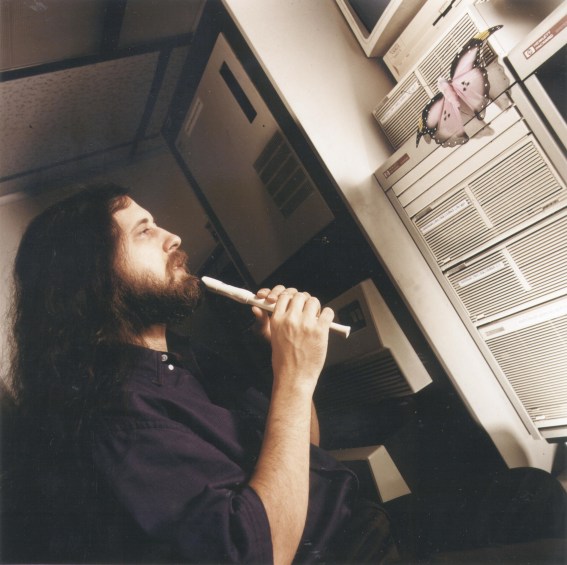
This situation didn't sit too well with RMS. Though he effectively dropped out of college, through non-attendance, he remained in the clock tower, unbeknownst to the faculty and administration of Berekely. His bizarre reclusiveness and tendency to "hack" only in the night kept him invisible to everyone, though rumors did circulate around campus about the "haunted clock-tower" and the deformed ghost that would occasionally appear, transluscent white, on top of the tower playing a magical flute.
Stallman grew sullen and withdrew into his own world in the clock tower. He watched as the joint Apple/Microsoft empire grew to become the computer industry and he vowed to topple it by undermining the livelyhood of his arch-rival Steve Jobs (and, by extension, Bill Gates) with his illegal offerings.
Stallman conspired with Linux Torvaledse, another Berkeley student, to create a hacker operating system which could be used to leverage the internet and wreak havoc on corporations everywhere. RMS even went so far as to use Microsoft's innovative GUI (Graphical User Implementation) which he had stolen from Microsoft's mainframe computer and given the hacker alias "X-Windows". Unfortunately, RMS was not able to acquire the latest Microsoft GUI codes and was thus forced to settle for an inferior version.
RMS' continued interest in communism provided him some insight as to how to spread his hacker tool across the internet. By stressing the free nature of the software, he would appeal to the welfare nature of the public.
This marketing scheme worked spectacularly. RMS' hacker tool is now installed on countless computers, hidden away in the dark bedrooms of LSD-using hacker teens.
B
-
Re:P2P Research
Actually, it does have major scalability problems...please refer to some of the numerous papers published on exactly this topic.
The supernode/ultrapeer addition to the protocol was meant to address some of the scalability issues of the previous version of the protocol. However, the fragile nature of the original overlay network is only made worse since ultrapeers are explicitly meant to be highly connected nodes.
The problem with Gnutella is that it can't do search efficiently due to the the broadcast nature of forwarding query messages. Research such as Random Walkers(SIGCOMM 02), and Attenuated Bloom Filters (IEEE INFOCOM 02) have tried to tackle the problem of scalable and fast search in unstructured P2P networks like Gnutella. -
P2P Research
There are several P2P research projects that are looking at building reliabale and scalable P2P systems.
Take a look at Tapestry, and Chord (and read some of the papers) to understand the issues involved in providing scalable and high performance P2P services. Not only is scalable search and overlay graph connectivity an issue, but also node failure and short session times of P2P nodes.
Additionally, when you actually handle the issue of downloading data, building application-lvel multicast trees to distribute the data efficiently on a large scale is not easy. Two papers from SOSP '03 SplitStream, and Bullet address that issue. -
Re:Network latency...
-
Re:Visual design
-
Re:Dig that propeller!
Or you could go a slightly different route - use a kite
The pictures on the website are pretty cool. -
Too bad this won't be ready for November
If the presidential election is within 10% either way (and from the current polls, that would seem to be likely), we are going to see a firestorm of lawsuits. With all the experts claiming electronic voting systems are insecure, both sides are already gearing up for legal battle.
Don Campbell at USA Today has an interesting op/ed piece on the subject.
Berzerkely has collected a large amount of information on this site. Lots of interesting data. -
Re:torrennts...
The link forgot the f of pdf. Try here
-
torrennts...
hmm the bittorrent paper says that it does not scale beyond roughly 2000 users. Now, given the number of people who come to
-
Obligatory Slashdot Intellectual Snobbery/joke
-
Gates' credit card?
This borders on the apocryphal.
Why would Bill Gates even have a credit card in his own name?
And why in hell would he use it online, instead of a one-time electronic transaction instrument?
And just what was he buying?
-
I think
These game developers should buddy up with those guy who make the exoskeleton legs (Previous Slashdot article). Could you imagine the possiblities?
-
Re:One thing to say...>seti@home!
These are their WU totals for the last few days...
65818
69106
73928
and right now they're closing in on 5th place in New Zealand
-
nothing changesMicrosoft co-founder Paul Allen
This is living proof that no matter how popular, powerful or rich a computer geek becomes, he never leaves his roots. The difference is instead of running SETI@home like the rest of the masses, instead he's funding such projects because he can -- plus it would be nice to have your name attached to an array of radio telescopes. Maybe he has to pay for each letter of his last name -- the latest being 13.5 mil to get the 'N' -- good thing he doesn't have a Russian last name.
-
Let's roll our own distributed search engine
In a few years, most search engines would probably not be free anymore. Even Google (our all-times favorite) is going commercial, and as this story shows, only companies with deep pockets will be able to pay for the bandwidth and computing resources of a serious search engine. Would you trust such engines from being bias-free?
All is not lost however. Let's roll our own search engine! A search engine from the users, for the users, and by the users. No, not for consumers, but for people interested in good results.
Obviously, a simple robot hooked up on a modem or adsl line will not be sufficient. There's simply not enough bandwidth to crawl the Net. But there is enough bandwidth if we take a few hundreds (thousands) of nodes. Just like seti@home, a distributed search engine would consist of two parts: a more-or-less-centralized-database which would maintain the index and work-units, and thousand of client machines, which would fetch a list of URLs to crawl from the DB, crawl a few levels, and return partial indexing results back to the DB. The DB would then generate an index just like google and others.
The beautiful part of this, is that it would scale very well: the more client machines participate, the faster will a new index be generated. The fewer participants, the longer the update intervals. That's all there is to it.
Another advantage is that we could tune the results (and work-units) dynamically, by analyzing the query strings, and other criteria. It may very well happen that this search engine adapts itself to the need of its users _and_ participating crawlers. We could even get results that are currently very hard (of not impossible) to get with closed-source and closed-index engines: How's about searching in DNS (a la whois.sc)? How's about analyzing the popularity of query strings? All this could be possible with an open index!
Ideas? Comments? Perhaps there's already something similar in sourceforge? Something that we could improve?
-
on being a planet or something less...
My former advisor here at UC Berkeley, Gibor Basri, has a neat way of discriminating between planets and the lesser (comets, asteroids, etc.). His idea is that if the object has enough self-gravity to force it into a spherical shape, it's a planet... if it doesn't (like Mars' "moons"), it's something less.
Here's a snipet:
read on for his full article.How can this be resolved? A consensus is slowly developing (I believe) for the following solution. We can first define what we mean by "planetary mass", and base this only on physical characteristics. Then we can include circumstance into the definition of "planet". I propose the following three definitions:
FUSOR - an object that achieves core fusion during its lifetime.
PLANEMO - a round non-fusor.
PLANET - a planemo orbiting a fusor.
[...]
The following is a draft of an article now published in the Nov/Dec 2003 issue of Mercury. Draft of Mar. 20, 2003.
Defining "Planet" by Gibor Basri Univ. of California, Berkeley
Even before they were civilized, people looked into the sky and recognized different celestial objects. The Sun defined daytime, and the stars provided a fixed background of faint, twinkling lights at night. Among them moved the Moon, and a few special steadier lights. The Greeks called those which moved "planets" (it is worth noting that the Sun and Moon were originally included, since motion against the stars was the defining characteristic). Most cultures have an analogous word for these "wanderers". Both the stars and the planets were thought to revolve around the Earth.After the Copernican Revolution, we recognize the Moon as the only body that orbits the Earth. The Sun is a very nearby example of a star, and the visible planets are other large bodies that orbit the Sun. We see them by reflected sunlight, while stars produce their own visible light. This understanding yields the dictionary (lay public) definition of the word "planet": a large heavenly body that shines by reflected light and orbits the Sun. In the past century we gained much understanding of our Solar System, and even visited most of the planets robotically. Yet today, professional astronomers find themselves unable to agree upon a succinct definition of "planet". Replacing "the Sun" with "a star" is obviously necessary now that many extrasolar planets have been discovered, but the problem goes well beyond that.
Two recent controversies that found their way to the popular press illustrate further difficulties. One is the "Pluto controversy". This arose because of the discovery of a large belt of icy objects beyond Neptune. They are the outer remains of the original protoplanetary disk. This "Kuiper Belt" is a natural outcome of incomplete planet formation in the outer Solar System, and is the source of some of the comets we see. As Kuiper Belt objects (KBOs) were discovered in increasing numbers in the 1990s, including a population of "Plutinos" which share Pluto's orbital characteristics (somewhat different from the other planets), some astronomers began to suggest that Pluto itself (which shares many properties with, but is the largest KBO known so far) does not qualify as a planet. The recent discoveries of Varuna and Quaoar (which are KBOs half the size of Pluto, like its moon Charon) may presage the time when we find another Pluto-sized KBO.
The current situation is much like that in the early 1800s, when the first asteroids were discovered. Ceres was originally hailed as the fifth planet, particularly since one in its position was expected from "Bode's Law" of planetary spacings. It lost its status within a few years, when other members of the asteroid belt began turning up. Herschel, who had been the only person to have discovered a new planet before then, aided the effort to demote Ceres. The arguments against its planetary status were 1) that it is much smaller
-
Sounds like a Warhol virus
This sounds like another step towards a perfect virus described in this paper titled "Warhol Worms: The Potential for Very Fast Internet Plagues"
-
on being a planet or something less...
My former advisor here at UC Berkeley, Gibor Basri, has a neat way of discriminating between planets and the lesser (comets, asteroids, etc.). His idea is that if the object has enough self-gravity to force it into a spherical shape, it's a planet... if it doesn't (like Mars' "moons"), it's something less.
Here's a snipet:
How can this be resolved? A consensus is slowly developing (I believe) for the following solution. We can first define what we mean by "planetary mass", and base this only on physical characteristics. Then we can include circumstance into the definition of "planet". I propose the following three definitions:
FUSOR - an object that achieves core fusion during its lifetime.
PLANEMO - a round non-fusor.
PLANET - a planemo orbiting a fusor.
[...]
read on for his full article.
The following is a draft of an article now published in the Nov/Dec 2003 issue of Mercury. Draft of Mar. 20, 2003.
Defining "Planet" by Gibor Basri Univ. of California, Berkeley
Even before they were civilized, people looked into the sky and recognized different celestial objects. The Sun defined daytime, and the stars provided a fixed background of faint, twinkling lights at night. Among them moved the Moon, and a few special steadier lights. The Greeks called those which moved "planets" (it is worth noting that the Sun and Moon were originally included, since motion against the stars was the defining characteristic). Most cultures have an analogous word for these "wanderers". Both the stars and the planets were thought to revolve around the Earth.
After the Copernican Revolution, we recognize the Moon as the only body that orbits the Earth. The Sun is a very nearby example of a star, and the visible planets are other large bodies that orbit the Sun. We see them by reflected sunlight, while stars produce their own visible light. This understanding yields the dictionary (lay public) definition of the word "planet": a large heavenly body that shines by reflected light and orbits the Sun. In the past century we gained much understanding of our Solar System, and even visited most of the planets robotically. Yet today, professional astronomers find themselves unable to agree upon a succinct definition of "planet". Replacing "the Sun" with "a star" is obviously necessary now that many extrasolar planets have been discovered, but the problem goes well beyond that.
Two recent controversies that found their way to the popular press illustrate further difficulties. One is the "Pluto controversy". This arose because of the discovery of a large belt of icy objects beyond Neptune. They are the outer remains of the original protoplanetary disk. This "Kuiper Belt" is a natural outcome of incomplete planet formation in the outer Solar System, and is the source of some of the comets we see. As Kuiper Belt objects (KBOs) were discovered in increasing numbers in the 1990s, including a population of "Plutinos" which share Pluto's orbital characteristics (somewhat different from the other planets), some astronomers began to suggest that Pluto itself (which shares many properties with, but is the largest KBO known so far) does not qualify as a planet. The recent discoveries of Varuna and Quaoar (which are KBOs half the size of Pluto, like its moon Charon) may presage the time when we find another Pluto-sized KBO.
The current situation is much like that in the early 1800s, when the first asteroids were discovered. Ceres was originally hailed as the fifth planet, particularly since one in its position was expected from "Bode's Law" of planetary spacings. It lost its status within a few years, when other members of the asteroid belt began turning up. Herschel, who had been the only person to have discovered a new planet before then, aided the effort to demote Ceres. The arguments against its planeta
-
Re:A Single Disk Hit Kills Responsiveness
From the UC Berkeley School of Information Management and Systems:
"The World Wide Web contains about 170 terabytes of information on its surface; in volume this is seventeen times the size of the Library of Congress print collections."
This 2.5 TB RAMdisk is a big thing? You'd need 68 of them (more if you actually expect the internet to grow, but I don't know...).
That's also without the "deep web" -- database-driven sites (they estimate the size to be 400 to 450 times larger if they were included). -
Re:The boson kludge
Since space is flat, that is, light travels in a straight line, there must be this mysterious force ("Dark Matter") driving the expansion.
No, this is the so-called "dark energy" that's driving the expansion. "Dark matter" acts through the gravitational force, to help keep galaxies and clusters bound. You were on the right track, until you suddenly wrote "dark matter" instead of "dark energy."Again, these are two completely separate concepts. One makes things fly apart, the other helps keep things together.
What are the observations of "more gravitational attraction" that you refer to?
Since the 1930's, it has been known that stars in galaxies orbit the center of the galaxy more quickly than they should, based on the visible matter. This requires extra "dark matter" to provide enough gravitational force to result in the observed rotational speed. -
Encryption
Oh goody, it uses that ubreakable WEP stuff
-
Re:Proof?
I challenge someone to find an automated response to C/R.
Students at Berkeley have already beaten the C/R system setup by Yahoo! and with a selection of 191 different version of text obfuscation they were able to return a 92% success rate. In much more detailed images, with random background textures and overlaying text they were only able to achieve a 33% success rate but I am sure with time they would be able to do better.
In a paper published by Greg Mori and Jitendra Malik they explain the methods used to defeat the system. For the full write up you can visit their site on Breaking a Visual CAPTCHA -
Re:Proof?
I challenge someone to find an automated response to C/R.
Students at Berkeley have already beaten the C/R system setup by Yahoo! and with a selection of 191 different version of text obfuscation they were able to return a 92% success rate. In much more detailed images, with random background textures and overlaying text they were only able to achieve a 33% success rate but I am sure with time they would be able to do better.
In a paper published by Greg Mori and Jitendra Malik they explain the methods used to defeat the system. For the full write up you can visit their site on Breaking a Visual CAPTCHA -
Re:Most advanced and powerful?In a recent interview, Jef Raskin remarked that he thinks the one-button designe of the original Mac was a mistake.
As for the one-button mouse, I'd observed at Xerox Parc which had a 3-button mouse, that people were very confused as to its use and when I was designing the software for the Macintosh, in designing the interface, I figured that if there was only one button, there would never be any question on what you have to press the number of ways of using a one-button mouse. I think this was probably a mistake, in fact there is an appendix in my book which discusses why I think this was a mistake and what I think I should have done. One of the reasons I made the mistake is that there is a certain school of industrial design dating back to the Bauhaus which says that designs have to be simple, uncluttered, and clean. In particular, don't put writing on it except for brand names or logos. If we had had a multiple-button mouse with two keys, labeled something like "select" and "activate," it would have been much easier to use, but the idea of putting writing on keys did not occur to anybody, including me. So if I was designing one today, it would have two buttons and they would be labeled.
-
Re:What andy doesn't know about the Hubble...(1) asmospheric distubances mess up earthbound images -- it's hard to beat a point spread function of 1 arcsec with a passive earthbound scope; the Hubble is more like 0.1 arcsec. You can mess around with adaptive optics (all modern 6m + up scopes do) if you can get a good guidestar near your target, and you can mess around with artificial guidestars, but you're still dependent on still dry air to do as well as the Hubble does.
(2) The atmosphere blocks alot of the UV band, in particular the hydrogen 1 Lyman-alpha line. That's the brighest emission line of the most common element in the universe. With a wavelength of about 121.6nm (unredshifted), not much of it punches through the atmosphere. Check out this for a primer on what's so important about the lyman alpha line.
-
Re:Eolas should now sue the Patent Office
If the grant for the patent was a vaild one, the USPTO has no right to reject the patent
Ahh. The Crux of the matter.
Having followed this for quite some time, it was clear that the patent infringed upon prior art.
The putz at Eolas was quite aware of the prior art too.
Look here for information about the prior art -
Re:Possibilities
I think "robotic pants" refers to a lower extremity exoskeleton that helps people walk. While this one could definitely use some serious miniaturization, it gives a pretty good idea of what the ultimate goal is.
-
Re:sensationalism... bleh...
Nothing to see here, move along.
ps. that third one looks kinda like Tinkerbells legs sprouting out of a frog's ass. Kinda gruesome. Time to order dinner from that Frenchy place on third ave.
The researchers have been collecting samples. Nothing statistically significant. Jump back into your SUV and move along. -
Re:sensationalism... bleh...
Nothing to see here, move along.
ps. that third one looks kinda like Tinkerbells legs sprouting out of a frog's ass. Kinda gruesome. Time to order dinner from that Frenchy place on third ave.
The researchers have been collecting samples. Nothing statistically significant. Jump back into your SUV and move along. -
Re:Excellent.
Actually, the professor cited in the article (my old research advisor) consulted on the Aliens movie for their "lifter" technology.
Trust me, this guy's lab has the best toys.
Check this baby out. Yup that's Alan Alda in the pics.
Pedro -
Re:University of California at Berkeley
When quoted for comment, the Berkeley representative cryptically responded "She bang! She bang!" and proceeded to gyrate hysterically, adding "I gave my best and I have no regrets at all."
-fren -
Cool - I got my Masters from this Prof
Excuse me while I shamelessly try to attach myself to work that I can take no credit for.
Professor Kazerooni was my Masters Advisor while at Berkeley in 96-97. His lab is filled with completed and partially completed robotic mechanisms. He and his students have been working on things like this for years. Just to give you an idea of the advancements, check out the arms and legs of his Electric Power Extender. These things are a lot closer to any Mech than the BLEEX. Then again, these things were attached to several Pentium era PCs and several LARGE wall mounted power racks. The reduction in size is remarkable. Imagine walking into the lab and seeing these big, shiny, robotic legs hanging in the middle of the room for the first time. It is a very cool "oooh" and "ahh" experience.
I'm a little disappointed that the project I and others worked on is not on his main page. Oh well.
-
Cool - I got my Masters from this Prof
Excuse me while I shamelessly try to attach myself to work that I can take no credit for.
Professor Kazerooni was my Masters Advisor while at Berkeley in 96-97. His lab is filled with completed and partially completed robotic mechanisms. He and his students have been working on things like this for years. Just to give you an idea of the advancements, check out the arms and legs of his Electric Power Extender. These things are a lot closer to any Mech than the BLEEX. Then again, these things were attached to several Pentium era PCs and several LARGE wall mounted power racks. The reduction in size is remarkable. Imagine walking into the lab and seeing these big, shiny, robotic legs hanging in the middle of the room for the first time. It is a very cool "oooh" and "ahh" experience.
I'm a little disappointed that the project I and others worked on is not on his main page. Oh well.
-
Cool - I got my Masters from this Prof
Excuse me while I shamelessly try to attach myself to work that I can take no credit for.
Professor Kazerooni was my Masters Advisor while at Berkeley in 96-97. His lab is filled with completed and partially completed robotic mechanisms. He and his students have been working on things like this for years. Just to give you an idea of the advancements, check out the arms and legs of his Electric Power Extender. These things are a lot closer to any Mech than the BLEEX. Then again, these things were attached to several Pentium era PCs and several LARGE wall mounted power racks. The reduction in size is remarkable. Imagine walking into the lab and seeing these big, shiny, robotic legs hanging in the middle of the room for the first time. It is a very cool "oooh" and "ahh" experience.
I'm a little disappointed that the project I and others worked on is not on his main page. Oh well.
-
Bacteria *do* leave fossils!I'm not sure how much of a fossil bacteria-like creatures would leave behind. There might have been life, but still be no discernible fossils (even assuming that fossils would have been preserved). Chemical signature would be more likely method of identification. Then again, we might find fossils and not even recognize them! Life need not be organic. For example, A.G. Cairns-Smith's book "Genetic Takeover and the mineral origins of life" argues that the first forms of life on earth were colloidal clay organisms without organic chemistry. If Cairns-Smith is correct, then perhaps we should be looking for something like that on Mars insteI'm not sure how much of a fossil bacteria-like creatures would leave behind. There might have been life, but still be no discernible fossils (even assuming that fossils would have been preserved). Chemical signature would be more likely method of identification. Then again, we might find fossils and not even recognize them! Life need not be organic. For example, A.G. Cairns-Smith's book "Genetic Takeover and the mineral origins of life" argues that the first forms of life on earth were colloidal clay organisms without organic chemistry. If Cairns-Smith is correct, then perhaps we should be looking for something like that on Mars instead
Actually, bacteria do in fact leave fossil records
I don't know much (actually, anything) regarding purported non-carbon "life," but regular ol' bacteria can leave fossils, believe it or not.
-
Re:Less Violent End?
"I'm looking for a theory that says the earth was a warmer place with most of that fossil fuel carbon still on the surface"
Wouldn't that be contrary to existing theories about the carboniferous period, which occured more than 250 million years prior to the K-T bounday? Maybe not.
Limestones and other sedimentary rocks high in calcium lock away a lot of carbon and oxygen in the form of CaCO3. I wonder how much impact the periods of high limestone production had on the environment including surface level CO2. Of course, right before the Tertiary period we had the Cretaceous - a period of high sea levels and warm temperatures, and distinctively marked in many places by chalk beds. -
Programming is essentially a creative endeavor
Programming is essentially a creative endeavor where beauty emerges from the harmonious implementation of function - i.e. a function (creation) in harmony with the object (material or imagined) which is the program's intention to model and with a given set of factors or rules (the API, language, instruction set.) This kind of creativity is in this sense more akin to that expressed in building architecture and industrial design than that expressed in the fine arts and philosophy.
Terming programming as a fine art is quite a stretch apart from the latter's primary concern - which is the creation of beautiful objects. Programming's primary concern is the creation of interactive models of objects in harmony with their material or imaginary counterparts and the boundaries that define the model space.
In this other sense, the aesthetic pleasure derived from programming or observing beautiful code is similar in nature to that derived from the construction or contemplation of philosophical concepts - both can recur to visual metaphors but are in essence invisible.
-
Re:The spherulesWell, not quite, but it's nice to see that someone knows about what we were doing.
There have been at least two expeditions to the Arizona desert by NASA people to study dust devils, both run out of the University of Arizona. I had the opportunity to spend a month in the Arizona desert gathering data on the second trip.
I wouldn't say that NASA is particularly concerned about dust devils -- due to the lower gravity, dust devils on mars would be much weaker than those on earth, even if they are larger. Even on earth, dust devils post little threat. Some of the ones we studied were over 2 miles tall, and you could walk right through them with absolutely no danger. While the original trip was sponsored by the HEDS (Human Exploration and Developement of Space) funded Matador experiment to see if the dust devils posed any danger to human exploration, the primary concerns were over static electricity and dust getting into space suits.
What NASA is really interested in is how dust affect the geology of the planet. In the absense of water or strong winds, dust devils may in fact be the primary erosive force on Mars. During the first half of the 20th century, astronomers noticed that Mars changed color depending on the season, and this led them to beleive that there was rich vegetation on Mars. When the first orbiters and lander arrived, we learned that this wasn't quite true, but we still had no other solution. Now, scientists believe that is was dust devils, which are a seasonal occurance, that were actually reconfiguring the landscape of the planet. We have actually seen pictures of light colored planes that are crisscrossed by dark dust devil trails.
The problem is that very little is known about dust devils on Earth. I only know of one scientific paper published on the subject. While some of the work we did was trying to find out the proerties of dust devils, especially the electrostatic properties, to help create an accurate model for their formation on Mars, this was not really why we were there. The primary goal of the NASA researchers was to study the dust devils on earth in order to learn how to study them on Mars. We were mainly out there to test a set of instruments planned for Matador (including some far out stuff, like using a special UV camera to detect sparks caused by static electricity).
If anyone is interested, there is an article on the first trip at:
http://www.spacedaily.com/news/mars-atmosphere-01a
and the second trip at:
http://www.berkeley.edu/news/media/releases/2002/0 5/29_dust.html -
Mac System 1.x already had a better design
The Mac's Classic OS used a little program called the Chooser. Combined with the AppleTalk network protocol (often laughted away because of the 'chatty' nature) it was a complete non issue to select a network printer.
Even under OS X it's a little more difficult.
See for yourself -
Re:Laughable?
The last benchmarks I saw that compared Java to the fastest Python implementation the author could find (though he didn't try Jython which might have been faster;) left Python behind by a factor of 10. I don't have the link handy, sorry
The guy wasn't doing it the way any real Python programmer would do it: using the library for high-performance numeric computation. If he did (or if he had used Pyrex), Python would have stomped Java. But more to the point, what is the benefit of using Java and getting to the wrong answer faster.
Python is a nice language, and I'd love to see a very high performance implementation - suitable for 3D game development, for instance. Do you have any pointers?
Python would be fine for parts of 3D game development (and has been used that way several times already) but I wouldn't use it (or Java or C#) to write a 3D game engine. Let's keep in mind our points of comparison. Python programmers do not claim to compete for performance against C!