Slashdot Mirror
Domain: confex.com
Stories and comments across the archive that link to confex.com.
Comments · 70
-
Re: Deniable, by lying faggots...
In the seventies it was common knowledge, and agreed on consensus, that the Earth was experiencing a climatic cooling period.
Here we have an example of complete bullshit.
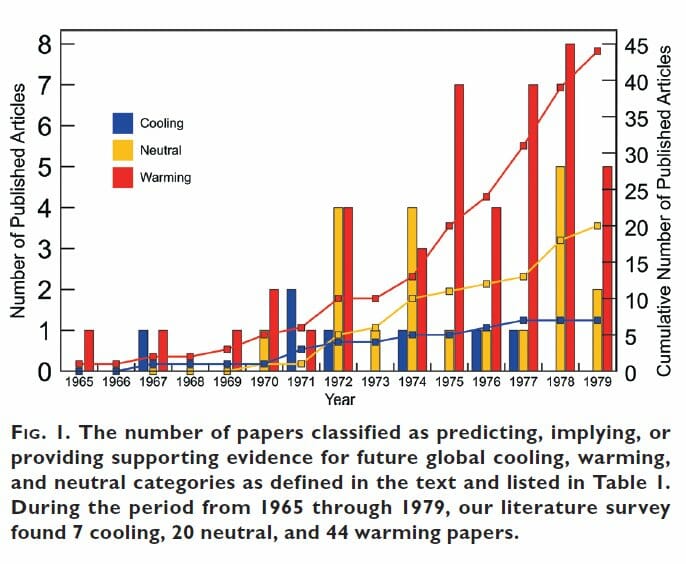
In 2008, Petersen et al. published a comprehensive literature review of scholarly papers on that had an opinion on the subject: THE MYTH OF THE 1970s GLOBAL COOLING SCIENTIFIC CONSENSUS
From the abstract:
An enduring popular myth suggests that in the 1970s the climate science community was predicting “global cooling” and an “imminent” ice age, an observation frequently used by those who would undermine what climate scientists say today about the prospect of global warming. A review of the literature suggests that, on the contrary, greenhouse warming even then dominated scientists' thinking as being one of the most important forces shaping Earth's climate on human time scales. More importantly than showing the falsehood of the myth, this review describes how scientists of the time built the foundation on which the cohesive enterprise of modern climate science now rests.
This figure from the paper shows that even then, the papers predicting warming dominated.
But in the denialosphere, this is still a much repeated lie.
Stop it.The problem is, between then and now, climate itself became a political baseball bat.
Nope. The problem is that if fossil fuels are reduced a lot of people who are very rich now will earn less. And they can pay PR groups to stop that happening.
Something that changes meaning with the whim of those who weild it. Used to beat those who disagree into submission.
...okay, I'm going in
How has the meaning of climate been used to beat people who disagree, and who are some people who've been beated by the meaning of climate becasue they disagree?Feck global alarmist and their facist ways.
It's just science, mate.
-
Re:survived for millions of years after
Except there's this one. I had forgotten about it due to the thought that a single bone is more likely to be a re-buried bone, and also because I forget a lot of stuff lately. Decide for yourself.
http://palaeo-electronica.org/...
https://gsa.confex.com/gsa/201... -
Re:S*** - two weeks of "Olympics" article are comi
I strongly disagree. This article is about technology that's used in training for one of the sports at the Winter Olympics. I fail to see your objection, and it's actually very cool to see the spread of technology that's used to monitor athlete performance.
There's a lot of science and technology going on behind the scenes at the Olympics, and sometimes it's an opportunity to demonstrate new ideas. I'm a meteorologist and I worked for someone who participated in the Sydney forecast demonstration project. That project involved testing several systems for making short-range forecasts on the scale of a few hours to predict thunderstorms. Papers about this were published in meteorology journals, such as: https://doi.org/10.1175/1520-0434(2004)019%3C0131:SFDPCS%3E2.0.CO;2, https://doi.org/10.1175/1520-0434(2004)019%3C0115:TSOGFD%3E2.0.CO;2, https://doi.org/10.1175/BAMS-84-8-1041, https://doi.org/10.1175/1520-0434(2004)019%3C0168:TSSAEI%3E2.0.CO;2, and https://doi.org/10.1175/1520-0434(2004)019%3C0097:TIOANS%3E2.0.CO;2. All of those were published in peer-reviewed journals operated by the American Meteorological Society.
This sort of thing has been done at more recent Olympics. For Beijing 2008, papers include https://doi.org/10.1175/2010WAF2222336.1 and https://doi.org/10.1175/2010WAF2222417.1. For Vancouver 2010, here's a scientific paper about forecasting during the Olympics: https://doi.org/10.1175/WAF-D-11-00114.1. Also for Vancouver 2010, here's an article in a peer-reviewed AMS journal that's intended for a more general audience: https://doi.org/10.1175/2009BAMS2998.1. The UK Met Office developed forecasting systems that they tested at the London Olympics: https://doi.org/10.1175/BAMS-D-13-00102.1. There was a similar project called FROST-2014 at the Sochi Olympics: https://doi.org/10.1175/BAMS-D-15-00307.1 and https://doi.org/10.1175/WAF-D-16-0048.1.
There's a similar project at the PyeongChang Olympics: https://ams.confex.com/ams/98Annual/webprogram/Paper329045.html and https://www.wmo.int/pages/prog/arep/wwrp/new/SCMREX.html. The latter of those links, the WMO page, has a lot of links about past projects at various Olympics. These aren't journal papers because the project is taking place right now at the Olympics, but I fully expect there will be peer-reviewed papers about this as well.
In my field, the Olympics are frequently opportunities to test out new systems and advance our forecasting capabilities. These are often organized by the World Meteorological Organization and are opportunities for international collaboration that advances the science of meteorology.
Just because something is done in relation to the Olympics doesn't make it PR at all. I've linked to plenty of scientific articles about meteorological research and testing of forecasting systems at the Olympics. You should reconsider your statement.
-
Re:"20mm x 16mm x 1.5mm and weighing just 1 g"
Am I have a bad morning? This thread is making me want to scream. "Moore's law", "5 years?" Anyone else want to pile in with a tired fatuity? Surf's up, apparently, for a tiny value of "surf".
The following video (from January 2016) contains just about everything worth knowing at this point about Intel's forthcoming phantom memory. Don't even try reading anything else unless you got a bone for chalcogenide chemistry.
Rick Coulson of Intel on 3D XPoint and NVMe
Executive summary: Charge-storage memory is at the end of its rope. There's no longer enough electrons per cell to make the cells reliable. According to Coulson (he passed my bullshit detector with nary a glitch), the typical 3D SSD is correcting about 50 bit-errors per read using advanced error correction, or the devices would not work at all. DRAM scaling is possibly worse.
Resistive memory does not depend upon charge storage, and has completely different physical scaling. Even resistive memories must stack almost out of the starting gate to achieve the scaling velocity that conventional fatuity demands. But the physics and economics of lithography are such that each additional layer suffers from diminishing returns. In fact, the cost of lithography scales as the total amount of surface area patterned, with stacked patterns being ever more expensive the higher you go. There's a sweet spot where the reduction in wafer cost through the use of less wafer pays back the more expensive lithographic process in stacking layers.
It wouldn't surprise me that we're already past that point at 32 layers in SSD, and that what pays off for going even this far are the advantages in density and integration of the surrounding products. (Hence the chips cost more than they could have, but the end product costs less, or justifies a higher per-GB selling price due to some rack-density jizz premium.)
Hard drives have traditionally had the huge advantage of not being a patterned media, hence you get a lot more surface area at a far lower cost. This, too, will change in the transition to bit-patterned media. But this media involves an extremely regular pattern with no fancy layers.
Magnetic Bit Patterned Media Fabrication Using Block Copolymer Directed Assembly
When we finally invent copolymer directed assembly of chalcogenide matrices, then perhaps we can finally dance on the grave of spinning rust.
It pretty much has to be Facebook and Twitter making people so stupid these days. People get so dialed into the present moment where the only acceptable latency is none at all as to completely forget that the past is a large object. Just look at the archival data generated by gene sequencing, EOS, deep sky surveys, CERN, and gravity-wave telescopes and then ask yourself whether an 8 ms cold latency over raw data is too big for you.
With ZFS, 1500 TB is around the present practical limit for one pool (200 drives at 8 TB each, per the Oracle Cloud guy, early 2016) and it's still just 8 ms sector latency (depending on what else you're standing behind). How about you sit there and watch while some lithographic robot patterns out 1500 TB of charge storage cells? Ring me when it's done. I've got more pressing things to do.
-
Re: Climatology
Who's going to study or publish papers rubbishing this stuff? Someone who wants tenure? Someone keen to attract government money to his institution? It's interesting, isn't it, that most sceptics (Judith Curry and Richard Lindzen are rare exceptions) are retired academics.
With respect to models not matching the actual temperature rise, here's a paper. Does that sate your lust, or are you going to find a reason to dismiss it because it goes against your already strongly held opinions? -
Re:Something doesn't smell right...
In 2008, the Bulletin of the American Meteorological Society published a review of the scientific literature from 1965 to 1979. They found seven papers that pointed to global cooling and forty-four that indicated global warming.
You'll find a quick, 7-min summary in this video by Peter Hadfield (aka: Potholer54):
-
Re:These people scare me
Ah, I see, your objection is informed by your ideology more than science.
Here are some papers that examine the changes in outgoing longwave radiation spectra over time that support the increase in greenhouse forcing:
* Increases in greenhouse forcing inferred from the outgoing longwave radiation spectra of the Earth in 1970 and 1997 – John E. Harries, Helen E. Brindley, Pretty J. Sagoo & Richard J. Bantges; Nature 410, 355-357 (15 March 2001) | doi:10.1038/35066553.
* Comparison of spectrally resolved outgoing longwave data between 1970 and present, J.A. Griggs et al, Proc SPIE 164, 5543 (2004).
* Spectral signatures of climate change in the Earth’s infrared spectrum between 1970 and 2006, Chen et al, (2007)
* Radiative forcing – measured at Earth’s surface – corroborate the increasing greenhouse effect, R. Phillipona et al, Geo Res Letters, v31 L03202 (2004)
* Measurements of the Radiative Surface Forcing of Climate, W.F.J. Evans, Jan 2006
* A method for continuous estimation of clear-sky downwelling longwave radiative flux developed using ARM surface measurements, C. N. Long and D. D. Turner, Journal of Geophysical Research, vol 113, D18206, doi:10.1029/2008JD009936, 2008
* Satellite-Based Reconstruction of the Tropical Oceanic Clear-Sky Outgoing Longwave Radiation and Comparison with Climate Models, Gastineau et al, J Climate, vol 27, 941–957 (2014).
-
Re:In a century...
The 70's are calling... Back then the global environmental disaster of the day was "Global Cooling"
Oh look the tired old 70s Global Cooling Myth rears its idiot head once again. To summarise of the relevant papers located in the peer-reviewed literature between 1965-1979, 42 predicted warming, 7 predicted cooling, and 19 predicted neither.
-
Re:Fuck this shit!
An analysis of the peer reviewed literature from 1965 to 1979 [PDF] found 42 papers on global warming and only 7 on global cooling. There were some headlines in the popular press but it was never a leading theory in the scientific field.
-
Re:Global warming..
It was actually a toss-up at the time (in science, not public opinion)
Perhaps but the fact that from 1965 to 1979 the number of papers on warming outnumbered the number of papers on cooling by 6 to 1 shows they were already leaning toward warming. Link.
-
Re:This is just fear-mongering itself.
I need to emphasise how extraordinarily unlikely it is for a measles outbreak to occur in a vaccinated population. Unless a new strain of measles has arisen that the vaccine is not effective against - and as far as I know measles is incredibly stable - then the only way that an outbreak can occur is in the unvaccinated population.
What an absolute load of bullshit
Measles (Rubeola) in Previously Immunized Children, Pediatrics Vol. 46 No. 3 September 1970, pp. 397-402
Measles Outbreak among Vaccinated High School Students — Illinois, Centers for Disease Control (CDC) 1984 Report
A measles outbreak at a college with a prematriculation immunization requirement. American Journal of Public Health (1991)
Explosive School-based Measles Outbreak, American Journal of Epidemiology, 1998
Largest Measles Outbreak in the Americas since 2000: Quebec Ongoing Epidemic, IDSA Boston Oral Abstract, 2011 -
Re:The Miocene of Southern California, was Cetacea
The article was informative, but it is just shy of giving the useful information from the refereed source,
The article is a summary, as far as I can tell, of a symposium discussion involving a number of specialists in whale palaeontology. http://aaas.confex.com/aaas/2013/webprogram/Session5818.html has the list of speakers, including
I guess you'll need to contact the authors directly to get (advance) copy of the paper(s). Though they're quite likely to do that, when they've got a paper ready for publication.
(Geologist here too.)
-
Re:The Miocene of Southern California, was Cetacea
The article was informative, but it is just shy of giving the useful information from the refereed source,
The article is a summary, as far as I can tell, of a symposium discussion involving a number of specialists in whale palaeontology. http://aaas.confex.com/aaas/2013/webprogram/Session5818.html has the list of speakers, including
I guess you'll need to contact the authors directly to get (advance) copy of the paper(s). Though they're quite likely to do that, when they've got a paper ready for publication.
(Geologist here too.)
-
Or...
Or Obama used information gathered since 2008 by the US military for the "Hurricane Aerosol and Microphysics Program (HAMP)" to create an event influence the elections... https://ams.confex.com/ams/29Hurricanes/techprogram/paper_168336.htm "The Department of Homeland Security asked NOAA/ESRL in Boulder to organize a workshop on possible new scientific theory and approaches to hurricane modification in February, 2008. Nearly two dozen scientists from around the world attended and there were a number of hypotheses and new ideas presented. We shall summarize the workshop results here and the development of the new DHS-funded HAMP Program that arose from the Workshop. HAMP is only the first Phase in a planned three-phase program. There will be no actual seeding trials unless one or more of the modification hypotheses is confirmed in Phase 1, through an interactive program of high-resolution coupled models and new aircraft observations. HAMP will focus on the effects of aerosols on cloud microphysics within the hurricane and on the effects of aerosols on hurricane structure and behavior, especially changes in hurricane intensity. " I'll put on my tin-foil hat, tin-foil rain coat and tin-foil rain boots
-
Berry College
Ask Berry College(located in Rome, GA http://en.wikipedia.org/wiki/Berry_College ) how their college campus ended up when Florida Rock dug a huge hole on campus property. Though the site was out of site to people on campus, one of the lakes on campus(Victory Lake) almost completely dried up(sink hole) and buildings, some very old(Ford Buildings, paid for by Henry Ford and given continued assistance by the Ford Corporation), started having problems from sink holes, the watertable started to be displaced, and it hurt the college far more than the help Berry College got from Florida Rock.
The rock quarry is now a large lake, which is also extremely deep. Would you fall in(which you should survive the fall), and cannot get out, you will drown and never have your body retrieved. Sadly, this place is well known to be an excellent place(one of a few in the area) to dump a body, or other items you do not want found, or ever retrieved by anyone(including the person that dump the body or item). Yes, Martha Berry would be proud.
https://gsa.confex.com/gsa/2011SE/finalprogram/abstract_183994.htm
There are other buildings that have had problems from the bad decision of Berry Colege's administration. These colleges may end up in a similar situation.
-
Re:Who Benefits?
Here's your citation.
https://imfar.confex.com/imfar/2010/webprogram/Paper7336.html
YOU LOSE.
Not even a try, let alone a nice one. -
Re:Most of you are too young to remember -
It seems to me that a survey of the peer reviewed literature in a scientific field would usually be a pretty good indicator of scientists current thinking. The survey found 42 papers predicted global warming, 7 papers that predicted global cooling and 19 neutral papers. Judge for yourself (Peterson 2008).
The first papers to mention global warming as a potential issue were in the late 1950s. The first briefing of a US President on the issue of global warming due to increases in CO2 was Lyndon Johnson in 1967. Such a new concept wouldn't make textbooks for a while so I'm not surprised they didn't mention anything about warming.
-
Re:scare tactics
Lovely thought, but all these magical screens that come up when you type in URLs cost real money.
As someone who was creating those magical screens before there were ad networks on the internet, I say unto thee: *snore*
Servers cost money. Hardware, software, maintenance, and electricity just off the top of my head to say nothing of the MUCH higher costs to them of commercial bandwidth. And the big sites? Multiply that by about 100x for re-hosting providers. And that's just the physical capability to put a "hello world" on your screen when you type in catlolzmemes.com.
I'm paying something like $24 a year for hosting now, and that includes me using up a whole bunch of memory because I run Drupal, and "unlimited" disk space and bandwidth use until you actually use a lot on a regular basis. That includes my domain registration and fees. So that "hello world" costs jack diddly shit when served through a "re-hosting provider" (no "re-" is necessary) because of volume.
Then there's the people who design professional sites, who think up and write content like the article you may have read that led you to "collaborate" with us.
Most of those sites suck hairy donkey balls through a glass pipette while singing "O Come all ye Faithful". And the content is mostly written by people trolling the blogosphere for information these days, although there are actual humans on the street now and then too. The photography, anyway, is real.
Just because you don't pay the bills personally doesn't mean they don't get paid by someone. And that someone makes their money back off ads.
And if they can't find meaningful ways to monetize their content then they deserve to cease to exist. I produce very little content, but I produce it free and I don't even have ads. Hell, I don't even have referral bonuses right now unless you count my hosting provider, and I don't exactly stress that, I just made another cute little banner to go at the bottom of the page along with the ones that say I use linux and php and so on. (whoops, fixed the firefox affiliate link there, heh heh.) If lots of people produce a little content there will be a lot of content out there. Meanwhile, I don't know about you, but I pay actual money to have content delivered via the internet, indeed, via the WWW. Not only do I pay my service provider, but I also pay Netflix a recurring subscription. Many such services exist and they do not depend on advertising, aside from attracting visitors. This proves that if you have compelling content, the world really will pay for it.
The days of the internet being only "a collaborative medium" are long past.
It was never only a collaborative medium and nobody said it was. On the other hand, it was designed to be peer to peer. If it were designed to be centralized, it would look very different down to the underlying protocol.
Now it is how we all communicate globally. And one of the most basic reasons to foster communication in any civilizations is trade. Hence, advertising.
Uh no. Advertising is not necessary for trade. There are other means of dissemination of that information. Besides sneakiness, there are also trade catalogs, that people acquire intentionally as a directory of those who might serve their requests.
Time to grow up a bit and realize that just because YOU didn't pay for it directly, doesn't mean that it's all just free.
I *am* paying for it directly, both with dollars and by producing content that people want to consume. What are you doing besides spouting a group of falsehoods?
-
Re:Global warming has become hopelessly politicize
Problem is from 1965 to 1979 there were over 40 peer reviewed papers published on global warming and only 7 on global cooling. The global cooling meme got a big writeup in Time and Newsweek but it was never prevalent in the scientific community. Here is a study on that.
-
Re:Obvious follow up question
Yes.
-
Re:Paying the Cost to Be the Boss
Actually, it is thought that nearly ALL of their coal is loaded with more mercury than is America's. The problem is that it is not known fully. China has tried to keep it quiet
In fact, back in the 90's, China became the number 1 polluter back around mid 90's, and And continue to grow. Several studies have claimed that china has accounted for over 1/2 of all mercury emissions of all times by 2006 (or was it 2005). This is caused by their coal being such low grade, but also because they refuse to use their pollution control (it costs money to run it).
Now, I did in fact hear about all the other issues, HOWEVER, the mercury issue is a bigger issue. The reason is that the clean-up on that will be difficult. The rest will sort itself out globally, once emissions comes to a stop, or are brought under control. BUT, the mercury that China has, and continues to emit, will continue in our environment for decades, if not CENTURIES, to cause issues. The clean up on that will be so costly, that it will never occur. And china will never take responsibility for their actions.
Finally, their emissions CONTINUE TO INCREASE at an increasing rate. Neither the amount, nor the rate, are decreasing. If their gov. would require that they run all pollution control, then overnight, they would drop their mercury emission to 1/3 of what they have today. Of course, their electrical costs will jump 50-100%, but that is another issue. -
640 kbytes
http://www.fas.harvard.edu/~epsas/dynamics/vortex/structure.pdf
http://arxiv.org/pdf/physics/0404004
http://www.peter-thomson.co.uk/tornado/A_self_organised_structure_for_the_tornado.html
http://ams.confex.com/ams/pdfpapers/21580.pdf
http://www.britannica.com/EBchecked/topic-art/594363/19397/Tornadic-thunderstorm-The-rotating-updraft-that-produces-the-tornado-extends
http://www.spc.noaa.gov/publications/edwards/hcr3may.htmThanks! I never thought of googling it!
Now why didn't Galileo just read the documentation Aristotle had written on gravitation? He could have avoided some nasty arguments with the pope! Or why didn't Einstein read what Lorenz had written on relativity? Or why did Schockley, Bardeen, and Brattain invent the transistor? Vacuum tubes were extremely well documented in 1947. I could go on all night.
Sigh. I guess 640 kbytes will always be enough for somebody...
-
Re:Big fucking deal.
Is google down in your area:
http://www.fas.harvard.edu/~epsas/dynamics/vortex/structure.pdf
http://arxiv.org/pdf/physics/0404004
http://www.peter-thomson.co.uk/tornado/A_self_organised_structure_for_the_tornado.html
http://ams.confex.com/ams/pdfpapers/21580.pdf
http://www.britannica.com/EBchecked/topic-art/594363/19397/Tornadic-thunderstorm-The-rotating-updraft-that-produces-the-tornado-extends
http://www.spc.noaa.gov/publications/edwards/hcr3may.htm -
Re:always the loudest wins.
"Can you cite any remotely mainstream opinions "advocating mass genocide" ?
Al Gore's "Earth in the Balance" advocates reduction of the earth's population by more than 2/3, before the end of the century. Methodology for accomplishing this is not elaborated on; yet the only way to reduce population that drastically in that short a time frame is either mass sterilization, or mass genocide.
"I'm kind of curious why you're concerned about "sequestering" carbon, but apparently not so concerned about dumping it out into the atmosphere. "
I am concerned about current carbon sequestration as well, but possibly for different reasons. Recently (within the past 10 years) there was a major incident in a nearby town called Hutchinson, involving an underground natural gas storage tank. Abstract on a news report of the incident
Now, let's consider the storage of a large industrial sector's CO2 in a similar manner. Slow release into the atmosphere allows at least some portion of that CO2 emission to be absorbed by nature and converted into cellulose and sugar via photosynthesis; a process that does not occur when stored underground in pressurized rock strata. Let us consider further, that this "Solution" has gained widespread "support" (because it is "cheap", and "effective"), and that after 20 or so years, several billion metric tonnes of CO2 are stored in such a storage system.
Now, What happens when that storage vents catastrophically?
You guessed it-- 20 years worth of industrial effluent gas is INSTANTLY added to the atmosphere.
How do you suppose THAT would effect global climate, eh?
-
Re:There's a problem with this coverage
Measurement of pH of standard distilled water shows variances of + or - 0.1 all of the time.
Perfectly distilled H20 does have a pH of 7.0. Actual measured values will vary due both to the resolution of measuring instruments, and contamination of the sample - principally absorption of CO2. With expensive equipment and a pure sample (e.g. from nuclear grade resin purification) the sample variance should be lower than ±0.1
http://gsa.confex.com/gsa/inqu/finalprogram/abstract_54486.htm
You realise that this isn't a peer-reviewed paper, right? It's just a poster presentation at a conference. Calls for posters go out to everyone, even PhD students who have barely started their research, it's just a presentation of what you're doing, and is not supposed to be taken as finished, published, reviewed research.
Here's something to consider:
Morner used "coring, levelling, sampling and carbon dating". Conspicuously absent from this list is any direct measure of sea level from tide gauges or satellites." Sea level rise at tropical Pacific and Indian Ocean islands by Church, White and Hunter published in 2006 in the journal Global and Planetary Change looked at data from tide gauges and satellites and found:
"In the Indian Ocean, the tide-gauge records at the Maldives indicate large rates of relative sea-level rise in agreement with Singh et al. (2001) and Woodworth (2005), and in disagreement with Morner et al. (2004). -
Re:There's a problem with this coverage
Yes, there are plenty of places where sea level is falling. Want something more dramatic? The area around Hudson's Bay is experiencing quite rapid sea level fall, and that has been the case for thousands of years (you can see the stranded beaches along the coast for many kilometres inland). Why? Because the land is rising faster than the global sea level is, and the mechanism in this case is the removal of the weight of the glaciers that used to exist around Hudson's Bay. This sort of effect is true of all sorts of places in the world: the land moves up and down due to local and regional tectonics. All you've discovered is that if you cherry pick appropriate places, you can find contrary examples to the global trend. It's the same thing for glacier advance and retreat. But if you look at the average trend, it's flagrantly obvious which way sea level is going: up.
It's flagrently obvious that you didn't do the pre-reading. The sea levels at the Maldives were higher (~20cm) between 1790 and the 1970s than they are today. The actual measurements show no meaningful sea-level rise since. Citation: http://gsa.confex.com/gsa/inqu/finalprogram/abstract_54486.htm
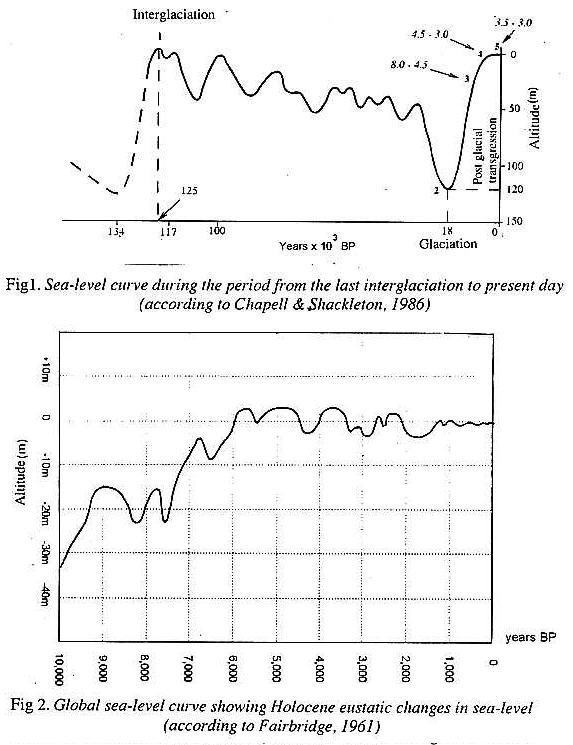
Every earth scientist knows about isostatic rebound, but do they know about the Fairbridge Curve? Citation: http://www.idm.gov.vn/nguon_luc/Xuat_ban/2001/17_18/A1_B9.JPG Figure 2.
Sea levels have been rising since the trough of the Little Ice Age (early 17th Century), but they are still lower than they were during the Medieval Warm Period, the Roman Warm Period, the Minoan Warm Period and the Holocene Optimum.
It's not the end of the world. But I'm sure that's not much consolation to people living in, say, Holland.
I've lived in Holland. Not only do they measure sea-level rise, but Holland is sinking because of the isostatic rebound of countries to the north as well as local effects of compaction of the soil due to the building above them. The Dutch continue to do what they always do - remodel the land, make sure the dykes are strong - a constant civil engineering project going back hundreds of years during which time sea level has remorselessly risen. -
Re:There's a problem with this coverage
Fail. New Scientist Climate Myths: Ice cores show CO2 increases lag behind temperature rises, disproving the link to global warming [newscientist.com]
Epic fail. New Scientist does not dispute that carbon dioxide rise follows temperature rise EVERY SINGLE TIME. It offers a pathetic analogy instead of an explanation. Calling it a myth when its entirely correct shows how out of touch Nature is with actual science.
Fail. Between 1751 and 1994 surface ocean pH is estimated to have decreased from approximately 8.179 to 8.104 (a change of 0.075). [wikipedia.org]
Epic fail. The pH of the oceans is in constant flux and cannot be absolutely constant.
Fail. The very best (very expensive!) meters have an accuracy of ±0.002 pH units. [cornell.edu] (and besides, multiple replicates and statistical analysis is used to increase accuracy and reduce individual variance - or did you seriously think that scientists only sample a single point in the sea with a single meter to determine temperature change?!)
Epic fail. Measurement of pH of standard distilled water shows variances of + or - 0.1 all of the time. The problem is not that the meters can masure to this accuracy its the fact that sea water's pH varies by at least 0.1 pH on very short timescales. YOU'VE CONFUSED NOISE WITH SIGNAL DUMBASS.
The CIA disagree with you: "Maldives: Environment - current issues: depletion of freshwater aquifers threatens water supplies; global warming and sea level rise; coral reef bleaching" [cia.gov] How sea level rise has affected the Maldives [bbc.co.uk] Tuvalu is concerned about global increases in greenhouse gas emissions and their effect on rising sea levels, which threaten the country's underground water table [cia.gov]
Unfortunately for the CIA, actual measurements ON THE GROUND at the Maldives show a fall in sea level of 20 cm in the 1970s and stasis since: see http://gsa.confex.com/gsa/inqu/finalprogram/abstract_54486.htm and http://www.climatechangefacts.info/ClimateChangeDocuments/NilsAxelMornerinterview.pdf
So you can't crack a book on science and you have no clue how climate parameters are measured and collated. Go to the back of the class. -
Re:Modern-Day Galileo
You guys gotta give up on the "Global Cooling in the 1970s" bs. A study (PDF) found that from 1965 to 1979 there were 7 papers predicting global cooling and 42 papers predicting global warming. It got a lot of publicity from writeups in Newsweek and other publications but it was never the predominant theory in the field.
-
Re:Well, good for them.
That's right. But a lot of the Netherlands is below sea level whereas the Maldives are above sea-level. So who has most to fear?
Around 1970 the sea level dropped by 20-30 cms and since then there has been no sea-level rise: http://gsa.confex.com/gsa/inqu/finalprogram/abstract_54486.htm
But don't let scientific and historical facts get in the way of a good piece of hysteria. -
Re:Old science
It helps to focus on the observable facts (e.g. the distribution of dinosaur fossils in geological strata) in preference to speculations of individual scientists. The fact is: no fossils of non-avian dinosaurs have yet been conclusively dated above the KT impact boundary, but fossils of a number of non-avian dinosaur genera have been found very close to the KT event (making it extremely likely that they existed at the KT impact time). A few claims of post-KT non-avian dinosaurs have been made, but have not stood up to closer investigation.
See for example: http://gsa.confex.com/gsa/2003RM/finalprogram/abstract_47695.htm
Since the distribution of dinosaur fossils close to the KT event has received by far the most scientific attention the failure to find any surviving lineages after the event is striking.
I would be fascinated to know what actual evidence (as opposed to speculation) that your unnamed, unsourced microbiologist could possibly have of a disease striking all non-avian dinosaurids, given the limitations of the fossil record. Proposed alternate scenarios (generally lacking any evidence) are all over the map and are a dime a dozen. Looking at all conceivable possibilities is good science, but one needs to keep such speculation in perspective.
Working out all of the details about events unfolded around the time of the KT impact, and the recovery period after, is a project that will likely never be finished -- there are so many possible mechanisms, scenarios, and sub-scenarios and the evidence is (and always will be) restricted.
But to assert that "the dinosaurs being destroyed by the asteroid strike is almost mythology" is a fantastic distortion of the situation -- it is not noticing the Amazon rain forest because of all the trees.
-
Re:Real problem with auto fuel cells, the hydrogen
You might want to actually follow the link to the resources provided. The data is from the algae industry experts themselves, and most was very recent, including data as early as late 2008 and early 2009.
petrosuninc may be operating a plant, sure. Honda is building fuel cell vehicles too... the cars cost OVER $1M without the government subsidies! petrosuninc is using government funds to offset their costs. They're also a research firm. Sure, they're selling fuel, but they're selling it under cost (they do have to do SOMETHING with the gas after its made, and noone's going to pay $14 a gallon. look at the real numbers, not the marketing fluff... In NJ I can get solar panels on my house for a few thousand dollars and pay them off in 6 years. Same solar panels in SC cost 6X the price, and have a 31 year payoff, in a BETTER sun zone. That's due to the subsidies. Those government subsidies are fine when 3,000 people get fuel from it. When 300 million are, who's going to pay for it?
I don;t care WHERE you grow tha algae... you still have billions of metric tons of waste to deal with... only 34% of the mass is oil, and it;s DIRTY oil that requires expensive processing to be used in cars and creas tons of highly dangerous byproducts.
The DOA also said we could get H2 for $3 per gallon equivalent by 2010 too... They also said we'd not go over $2 a gallon for gas before 2018. They also said fuel cells would be economical by 2009. The technology HAS improved since the DOE made it's statement, but it's imporved marginally, not by the 2 orders of magnitude required to meet the $3/gallon line. Also, other costs have spiraled upwards.
Before you debunk my data, I suggest you read the sources I referenced you to. Since you;re too laze to click 1 link and ready the article I suggested, here's it's own sources for you:
Biodeisel from Algae at $33/gallon, Feb 2009:http://www.greentechmedia.com/articles/read/algae-biodiesel-its-33-a-gallon-5652/
Article by Bob Grant, chief scientist working on het fuels under AirForce grants, and one of the leading scientists in the entire Algae Oils field:
http://www.the-scientist.com/2009/02/1/36/1/Keynote Address Photosynthetic Biohydrogen, Paul D. Frymier, Department of Chemical Engineering, University of Tennessee:
http://aiche.confex.com/aiche/2008/techprogram/P134919.HTMGreenFuel Technologies: A Case Study for Industrial Photosynthetic Energy Capture
Krassen: March 2007 http://www.nanostring.net/Algae/CaseStudy.pdfCarbon Recycling Forum, Department of Energy: Sept 2008: http://www.netl.doe.gov/publications/proceedings/08/H2/index.html
A history of the US DOE's Algae Research, publiched by NREL: http://www.nrel.gov/docs/legosti/fy98/24190.pdf
There are more citations available on dotyenergy.com. They all back up the extreme costs and failed research and failed promises. Considder the source man, the DOE has continually lied and lied and overpromised. THEY'RE A BUNCH OF BIG OIL NUTJOBS ON BIG OIL PAYROLLS!!!
-
Re:Terraforming Earth
If you gear the models to accurately track past weather then they don't predict any significant warming now. Likewise, if you gear the models to show warming now, they no longer make sense of past weather.
Climate models don't track weather. If you calibrate them against past climate, they do predict current warming. And models which are not calibrated against climatic time series, but are initialized to a pre-industrial climate state, do agree with the subsequent climate.
You may be getting confused about the Keenlyside Nature paper, which predicts little warming for a few years based on initializing a model with recent ocean state data instead of a spun-up pre-industrial state. (i.e., the model knows that the PDO is in the cool phase, whereas models spun up to pre-industrial climates know about the PDO but not its phase.) This does not actually alter any model parameter (i.e., any of the model physics), or the model's climate sensitivity to CO2, or the model's hindcasts for past climates, or the model's forecasts for long-term climate.
Hell, it was just thirty years ago we are being told a global ice age was on the way...and they were giving the same type of dire predictions, the same hand wringing, and the same "we're absolutely sure we're right" speeches from all the noted scientists
I don't know how many times this needs to be debunked, but here goes again.
-
Re:What Could go Wrong?
I think it was in the last century or so, that scientists had the world in an uproar by declaring 'Global Cooling'...that they world was getting colder and heading towards a new ice age.
-
Re:Substitute? Sounds good
I'll add one more thing to my post - people old enough will remember back in the 70 and early 80's when we thought we were causing a massive cooling and heading towards and ice age.
"We" (meaning the climate science community) didn't actually think that (see, e.g., here). There were a few papers that got a lot of media hype, but the general view among scientists at the time was "we don't know enough yet, but it's more likely to warm than cool". 30+ years later and the view is "it's very likely to warm, but we're not totally sure how much".
We better be *damn* sure we know what will happen when we intentionally release more change into the world than what we are trying to fix.
Well, one virtue of some of the present geoengineering schemes is that they're fast-acting, and conversely, quick to turn off if they start having side effects. Take stratospheric aerosol injection. Aerosols precipitate out of the atmosphere in a year or two; CO2 stays up for a century or more. If erroneously think the planet is warming and cool it with aerosols, you can turn them off within a few years if you need to. If you erroneously think the planet is cooling and warm it with CO2, your mistake stays around a lot longer. The decision problem is asymmetric.
That being said, your basic point is valid: geoengineering is a lot riskier than just reducing CO2 concentrations back to earlier levels.
-
Re:More of the same sad humanity.
I know what you're talking about. Yet I still do not believe it is reason enough to grow large government to protect people from themselves. I personally protect those in my house from the more egregious ignorance. Mostly they believe me to be anal retentive, due to something that must have happened to me in the military. Truth is that I just dislike seeing things go boom/spark/flash/etc. in my house/garage/lawn/neighborhood.
It really doesn't take that much to learn about dangers. Most of what you need to know is on the label. Much of the rest is on the Internet. Have you ever seen any regulations about fine aluminum dust? How about mixing household cleaners? There are many things that are dangerous but go without regulation. There is more politics than safety behind this. Never mind if people dispose of oil, not that many change their own oil. How about do they dispose of batteries properly? There are no regulations for many things that can and will kill you and others, which just points out that this is political in nature, not safety oriented.
Want some danger? http://www.swissrocketman.com/perochem/concentrator.html
Drop a car battery in a bucket of that stuff, see what happens. I could go on.or http://aiche.confex.com/aiche/s07/preliminaryprogram/abstract_80050.htm Don't use the wrong grinder on your aluminum lawn sculpture!
There are probably a dozen ways to use common chemicals found in your home to make your day a bad one. Some take more work than others, yet none of them have any government regulations. No license for buying a car battery etc.
-
Re:Correlation does not imply causation...
The article starts out blaming man and herbicides, but then has to conclude that even areas free from herbicides, such as national parks "provide no refuge."
What areas free from pesticides? Maybe you didn't read the article:
"Atrazine is one of the more mobile and persistent pesticides being widely applied. In fact, residues have been found in remote, nonagricultural areas, such as the poles."
Places that are "protected from pollution" are not free of it. You'd be surprised just how much pollution there is in national parks.
So that is blamed on global warming (no doubt man-made), causing the ponds to dry out. Neither of these are supplemented with facts, but is all speculative. Frogs and salamanders are dying, so we must be causing it.
Two problems with these statements:
1) A problem may have multiple causes.
It's a widespread mental disease of today that people demand that experts must find THE source of the problem and fix IT. The three problems identified in the article are all major, separate contributors to amphibian decline. Each one may affect different species in different proportions. Fixing one will not solve the problem for all species, but it is not pointless for the species that it will save. (They do leave out habitat destruction, though.)
2) What do you mean "all speculative" and "not supplemented with facts?"
For crying out loud, the article references specific scientific studies. I decided to go searching for them:
- Understanding the net effects of pesticides on amphibian trematode infections by Jason Rohr et al of the University of South Florida, Tampa
- Climate change, wetland degradation, and amphibian decline in the world's oldest national park by researchers at Stanford University.
- Neotropical tadpoles inuence stream benthos: evidence for the ecological consequences of decline in amphibian populations from UGA (full article, PDF)
Personally, I would like to have seen links to those studies in the article, but what more would you like to see? What is your standard for "speculation" v. "facts?"
We could have the perfect ecosystem for frogs and salamanders, and that would threaten some other species that found the weather too damp or warm to thrive. We blame ourselves for everything, when in fact there's no evidence that, if we all vanished tomorrow, animals wouldn't continue to die out as they always have.
Of course, they will continue dying out. That's nature. The issue is that they'll die out *much slower* than we're *currently* killing them off, and new species will evolve to fill the gaps. If you want to know what environment would be perfect for the frogs and salamanders, the answer would be the one they evolved to be adapted to. We're changing the world far faster than evolution can keep up.
-
Re:Cue the rationalists....
I forgot, I meant to cite this historical review of what climate scientists, as opposed to the media, were really saying at the time.
-
Re:Cue the rationalists....
What I worry about, is that in this rush to "counteract global warming" (conveniently forgetting that a few decades ago, the paranoia was about "global cooling"!)
That wasn't really a fear among the scientific community; unlike global warming, global cooling was something that you saw in the media but didn't really see in the literature. This is a nice historical review.
we'll both disrupt and accelerate the normal cycles
Merely reducing CO2 levels back to pre-industrial levels is not likely to worsen the natural cycles compared to letting them increase without constraint. Unmitigated CO2 potentially could disrupt the ice age cycle.
Geoengineering efforts like the pollution being discussed here could make things worse, but given its short residence time in the atmosphere, probably doesn't matter on long time scales. But it could cause problems on a sub-annual time scale just as you fear. If you stop doing it, the air clears up all you get hit by a whole bunch of global warming all at once.
Considering how little we understand long-term weather and climate, I'd say it's smarter to keep our hands off the controls, lest we crash the planet BY our efforts at course corrections.
Emitting CO2 at increasing rates is keeping hands ON the controls. Reducing them back to more natural levels isn't going to hurt. CO2 levels don't respond quickly in the atmosphere given the speed of the carbon cycles.
Our unintentional contributions to the atmosphere haven't caused any huge changes on a millennial scale.
Even if we stopped emitting CO2 today, a lot of that CO2 will indeed be around on millennial scale, and that's only going to get worse.
-
Re:of course you realize ...
And that of the people predicting climate disaster now many are the same ones that predicted climate disaster back in the '70's, but the other way (ice-age).
Oh really? Who are these people who are predicting ice ages in the 1970s, and which of them are today predicting climate disaster?
"Scientists in the 1970s were predicting an imminent ice age" is a myth, based on basically one paper by Rasool and Schneider, plus some confusion with scientists talking about ice ages in thousands or tens of thousands of years.
You might read this to start.
And they're all dead wrong.
On the contrary, they reproduce temperatures quite well and precipitation decently.
The data is really spotty until 50 years or so ago so there's no idea how accurate they are.
We have reasonable data for over 100 years, and even 50 years of data tells us a lot about how accurate they are, as the measurement error is quite smaller than the visible trend.
None of them are predictive.
That's nonsense. Even a simple two-equation energy balance model is decently predictive for global temperature, and the GCMs do much better, not just time trends but also spatial patterns, for atmospheric and ocean temperatures, top-of-atmosphere radiative fluxes, precipitation at least at the zonal level, etc.
And none of them match the spotty historical data without what they call "forcing"
You have no idea what you're talking about, do you?
Of course they don't match the historical data without forcing. Forcing is what makes the climate change: changes in greenhouse gases, solar irradiance, sulphate aerosols, etc. With no forcing, the climate just hovers around an equilibrium state.
You're simply saying "models can't reproduce warming temperatures unless you include a source of heating". Well duh.
and what everyone else calls "fiddling with parameters until it looks kinda right".
Again, duh. Pretty much every model in the world requires its parameters to be calibrated from data; you can pretty much never calculate anything from first principles, unless you're talking particle physics. That doesn't mean that models aren't predictive. The question is whether you can adjust the parameters to reproduce the observed climate without substantial input from anthropogenic forcings, and the answer is no.
Here's an interesting paper (from a real journal).
That's not a real journal, it's an un-peer reviewed newsletter, and the paper was written by a journalist, not a scientist. Monckton's "critique" is just a horrible train wreck of absurd errors, some of which are being detailed here, here, and here.
Since you quote that part specifically, I should note that his claim that the IPCC takes its feedbacks from one paper is absurd. The feedback factor is just another word for "climate sensitivity"; model based computations of the feedbacks are found in chapter 8 of the latest IPCC WG1 report, and observational estimates of the sensitivity are found in chapter 9. The relevant sections cite dozens of papers.
Dismissing valid objections with supporting evidence just because it doesn't say "Climate Modeller" on a business card is foolish.
Let me know when you have any valid objections with supporting evidence.
-
Re:Revisionist history
Do my homework better? Okay, in a minute I came up with a paper entitled The Myth of the 1970s Global Cooling Scientific Consensus. It sounds like the real scientific consensus has been that anthropogenic global warming is a real concern.
-
Re:Wheat price vs sun spotsA few hundred years ago William Herschel was able to notice the inverse relationship between sunspots and the price of wheat. Total, unmitigated disinformation.
For a discussion of what can genuinely be deduced about the interaction of solar activity with global climate, see this paper: http://ams.confex.com/ams/84Annual/techprogram/paper_74103.htm
(The Sun-Climate Connection, John A. Eddy, National Solar Observatory, Tucson, AZ)
As this commentator on the paper says: Itâ(TM)s really only been since 1978 that, using newly launched satellites, weâ(TM)ve been able to measure the solar irradiance - how much energy the sun is actually dumping into our atmsophere. The idea that William Herschel's 250-year-old spurious correlations have any relevance here is flat-out ridiculous. -
Re:So now we have theRather than letting the UN decide to ban DDT, how about we let the people affected decide if they want it banned. Why not ask them? Yeah, why not ask the people affected? But you didn't ask them. You cited an organization of African Americans talking about DDT in Africa. Why not ask the actual Africans? If you did, you might learn that DDT is not banned in Africa, and that both WHO and USAID recommend limited, targeted DDT use in anti-malarial campaigns. You might also learn that excessive DDT use in Africa has lead to malaria-resistant mosquitoes (particularly in west Africa), and that anti-malarial organizations in those countries recommend moderating DDT use and mixing it with other measures (netting, artemisinin-based combination therapy, etc.). The very web site you link admits that DDT is not banned in Africa for anti-malarial use.
So, tell me, how many millions have died due to "a ban on DDT"? Please be sure to cite the scholarly literature to support your answer. Methinks you need to find qualified sources. I've read the Newsweek article. It's a scare piece. Despite its dire insinuations, it says virtually nothing about actual scientific studies predicting an imminent ice age. Read it here.
The Newsweek quote above is a fine quote about how the climate cooled in the past — which it did! But that's got nothing to do with whether we were supposed to be "in an ice age right now".
In another comment, you cite Rasool and Schneider. Do you know why you cited Rasool and Schneider? Because that's pretty much the only paper published in the 1970s which predicted large cooling in the near future. The rest were generally either predicting warming, or were agnostic. See here for a literature review.
For that matter, have you even read Rasool and Schneider? Their prediction of strong cooling was based on their assumption that atmospheric pollutant emissions would outpace greenhouse gas emissions. In other words, their main error was not in the climate science, but in their economic/industrial forecasting. (True, they lowballed climate sensitivity as well, but that doesn't imply any cooling, just less greenhouse warming.) Their fundamental climate point was RIGHT: if aerosol emissions really had accelerated they way they speculated, they WOULD have a large cooling effect. In fact, that idea has been floated again recently as a means to combat global warming, under the name "aerosol geoengineering". (There turn out to be undesirable side effects.)
So, tell me, where are all the scientific studies predicting that "we should be in an ice age by now"? Be sure to cite the scholarly literature. And shall we ignore the studies which predicted the opposite? -
Re:Can you cite these?
One place to start would be the review titled "THE MYTH OF THE 1970S GLOBAL COOLING SCIENTIFIC CONSENSUS" that looks at the papers published on subject from 1965-1979. You can see it here: http://ams.confex.com/ams/pdfpapers/131047.pdf According to this there was a mention of possible climate change due to the release of CO2 from burning of fossil fuels in a 1965 report from the Presidents Science Advisory Committee (to Lyndon Johnson).
-
The right temperature to serve coffeeCoffee is supposed to be brewed HOT. It is supposed to be served HOT. You spill HOT SHIT on you, and you GET BURNT
That woman was sold a cup of coffee that was somewhere between 180-190 F. That's hot, sure225 consumers tasted black coffees at six different temperatures, ranking them for preference. The lowest temperature was below the pain threshold, the next below the epithelial damage threshold, the next two above. The two highest temperatures approximated to coffees served commercially.
The rank order of preference for temperatures was 160F (71.1C)... Coffee shop serving temperatures ranged 168-187F (75.6-86.1C). Observed time from serving to drinking ranged: 2-1005 sec, (median 114 sec). The average estimated drinking temperature was 168.1F. At what temperature should you serve coffee?
As to Liebeck v. McDonald's Restaurants;
1 The coffee was sold as a drive-thru take out. That maximizes the chance of spills.
2 The woman was 79 years old and for all practical purposesd mmobilized in her car seat. This was nothing like the geek tippimg over his cup at Starbucks.
She was taken to the hospital, where it was determined that she had suffered third-degree burns on six percent of her skin and lesser burns over sixteen percent. She remained in the hospital for eight days while she underwent skin grafting. Two years of treatment followed.
3 Documents obtained from McDonald's showed that from 1982 to 1992 the company had received more than 700 reports of people burnt by McDonald's coffee to varying degrees of severity, and had settled claims arising from scalding injuries for more than $500,000
4 Liebeck sought to settle with McDonald's for US $20,000 to cover her medical costs, which were $11,000, but the company offered only $800. A mediator suggested $225,000 just before trial, but McDonald's refused these final pre-trial attempts to settle.
In short, McDonald's attorneys gambled on the chance they could persuade a jury to decide against an 81 year old woman who had been in and out of hospital for two years.
-
This vs biofuels, sustainability & how to do i
I am working on a similar process that synthesizes hydrocarbon fuels from carbon dioxide, water, and non-fossil energy (could be solar) and should eventually have some publications out about this. There are several ways to go about this. But first, let me comment on some of the comments:
Regarding the "They're leaving the production of actual liquid fuel to other people
Regarding the "Renewable not!" comment and using power-plant flue gas CO2 as the input to this process, this would indeed not be sustainable. However, if industrial capture of CO2 from the air is available, one can fully close the loop and have a sustainable hydrocarbon fuel cycle. Flue gas CO2 could be a good option in the short term, however. For instance, if solar and other nearly-carbon-free energy sources begin to rapidly take over, coal plants will not immediately be shut down. Other CO2-emitting industrial plants such as aluminum smelters, etc, will also have CO2 emissions to deal with, and this form of using it to store non-fossil energy by recycling it once as a liquid fuel would be worthwhile. One comment discussed this transition well.
Related, other comments say "why not just use the solar energy to produce electricity". These intermittent resources need storage, and liquid fuel storage is not a bad method (and very versatile). Others responded about storage.
So, processes like this are a way to store non-fossil energy as a convenient energy-dense fuel which can be used in our existing petroleum fuel infrastructure and vehicles (as opposed to hydrogen and batteries). Biofuels can do the same, and there are many comments above ("I saw something like this... it's called a tree") mentioning biofuels and how this process replicates it with much more complexity; indeed you could call this whole process including the Fischer-Tropsch fuel synthesis "artificial photosynthesis". However, this process cuts out the middle-man of the plant in biofuels processes, which has much lower sunlight-to-fuel efficiency than industrial solar collectors (PV or thermal) and requires a lot of fertilizers and pesticides to boost growth rate. Such land- and resource-intensive agriculture is not sustainable in its current form and may not ever be on the scale we will need it.
TFA discusses a solar-heat-driven thermochemical process that has potential. A somewhat similar solar-heat thermolytic process splits CO2 directly at higher temperatures. There are many other methods of accomplishing this that are at different levels of development and being researched, including electrochemical (pdf link1, pdf link2), photoelectrochemical, photo(bio)chemical... -
Re:Ummm how about volcanos and aircraft carriers
1) stuff from below is bad.
Well better tell that to the volcanos and under sea islands that spew crap into the air and ocean.
Stuff from below is perfectly safe? Better tell that to those impacted by acid mine drainage.
) Salt water is corrosive and bad for power plants.
Better tell that to the navy--they have ships floating in it! and they pump it through their nuclear reactors.
I'll ask about the navy's budget.. the US Navy fleet alone spent $4.4B in corrosion and corrosion related maintenance and repair. Corrosion also adversely affects system readiness and personal safety. That's around 25% of the navy's maintenance budget. -
Re:Lack of progress
Ahem,
1. Fluoridation of Water
2. One of many other innovations in development.
3. Do you really think dentists are making anywhere near the kind of money our friends at Bayer, Merck, Pfizer, and Novartis reap on lifelong medications for heart disease, cancer, and ED? -
A meteorologist repliesOK - this is what I do for a living - forecasting the weather. I've been doing it for better than 25 years.
Most operational meteorologists I know feel human induced global warming is a bad theory, based on really bad modeling. The equations are incomplete as is the data set. Maybe we're worried because we use numeric weather prediction models on a daily basis and understand we can't always get the temperature right to within 2-3 degree over 24 hours, much less 24 years!
Academicians and theorists seem to support the idea in great numbers. These are people who haven't had to answer for a bad forecast in the supermarket.
Surely, human induced global warming is a political argument. Ask yourself, why have I never heard even one positive influence from global warming? In science, you should hear the good and the bad. In this argument, it's only the bad that gets publicized. If everyone in the Northern Plains, Northern Europe, New England, Canada and other cold weather climates get a longer growing season with lower winter heating costs, shouldn't that be weighed against tidal rises on Vanuatu?
Recently, after Katrina and the others, there has been a chorus trying to connect more hurricanes with global warming. Here's what Dr. William Gray says (he's the guy you hear quoted every year with seasonal hurricane predictions):
There is absolutely no solid evidence that the recent US hurricane disasters of 2004-05 and of Japan in 2004 are 'directly' attributed to the impact of global warming. Landfalling major hurricanes have occurred in earlier periods when the globe was cooler. The two scientific papers in Nature and Science have been largely discredited by myself and others.
Most of the warming of the last 30 years (1975-2005) cannot possibly be due solely to greenhouse gas increases. Although CO2 amounts have gone up by about 378 ppm/330 ppm = ~15% during this period, the net energy forcing (of about 0.65 w/m2) from this CO2 increase is considerably less than the other energy forcing changes of long wave radiation (LW), evaporation-precipitation, and ocean thermohaline circulation change that have been measured by the reanalysis data over the last 30 and 55 years. For instance, various rainfall measurements indicate there has been a small global average rainfall decrease of 0.5-1.0 mm/d. This is equivalent to global evaporation decreases of 1.5-3.0 w/m2 - 2 to 4 times than that can be attributed to CO2 increase. There are similar energy variations in the last 30 years in OLR and in the global thermohaline circulation. I believe that the global surface warming of the last 30 years is largely due to a small decrease in ocean surface evaporation cooling brought about by ocean deep water circulation changes.
Blaming all the warming of the last 30 years on CO2 requires that one believe that all the other larger energy source-sinks sum to zero. It is naive to think this is the case. Most warming of the last 30 years has to be of natural origin.
You can read more of Dr. Gray's thoughts in this excellent paper "Global Warming and Hurricanes."
I have posted this late. Positive modding to make it more visible would be appreciated.
-
Rumored Replenishment of Oil FleldsThere have been suggestions that oil reserves are abiotic/non-organic in origin, as well as self replenishing. Some replenishment seems to be going on, but the source of this is fiercely debated.
Of course, murphy's law says that if so, they will replenish at a rate at a rate matching our correct consumption divided by 2. Meaning we will still be up the creek without a paddle.
-
Google "temperature of coffee"
If you google the phrase "temperature of coffee", you'll find dozens upon dozens of sites (unrelated to the McDonald's case) recommending what temperature coffee should be brewed at. Here's one example: http://hypertextbook.com/facts/2003/DianaGendler.
s html. Here's a study on what temperature people prefer their coffee: http://ift.confex.com/ift/99annual/techprogram/abs tracts/3583.htm.
The range that McDonald's brewed its coffee at is right about at the range most people recommend, and only slightly hotter than the average temperature people prefer to drink it.