Slashdot Mirror
Domain: jalopnik.com
Stories and comments across the archive that link to jalopnik.com.
Stories · 52
-
Online Videos Shame Two Sleeping Tesla Drivers (jalopnik.com)
Electrek reports: A Tesla Model S driver in Southern California was caught on camera seemingly asleep at the wheel while driving on Autopilot... Kevin Paschal from Southern California shared the video on Facebook and said about the incident: "Highlight of my day. Dude is passed out on the freeway in his Tesla and still driving better than 90% of SoCal, lol... Dude was perfectly centered in his lane the whole time and maintained a safe distance from all vehicles...."
In this case, it looks like the driver has at least one hand over the bottom half of the steering wheel, which could be enough to avoid any Autopilot alert -- thought that's not always the case. Paschal said that the driver was like that for "several miles" and when asked why he didn't honk to attempt to wake him or get him to pay attention, he wrote, "I'm not sure the car would have cared...."
You should definitely attempt to wake the driver up if it can be done safely. As for the driver falling asleep, there are basically two schools of thoughts here. One could say that the driver would have fallen asleep anyway, as drivers do, and Autopilot actually made the situation a lot safer. Others would argue that the convenience aspect of Tesla's Autopilot might have actually contributed to putting the driver to sleep.
BGR also reports on a second incident where "If anything, the Tesla driver in the video is so relaxed that he's not even at the wheel; he's full-on reclining."
"This is why I personally think Level 2 autonomy is a bad idea," warns Jalopnik. "If it's possible for a moron like this to sleep while the car is driving at highway speeds, that's a huge problem." -
Tesla Model 3 Earns Five-Star Crash Safety Rating From NHTSA (jalopnik.com)
The National Highway Traffic Safety Administration has awarded the Tesla Model 3 with a five-star safety rating -- the highest possible score. This means that every car Tesla has built has earned a five-star rating. Jalopnik reports: The NHTSA tests cover three primary categories: Frontal Crash, Side Crash, and Rollover, and the Model 3 received the highest ratings in all categories. For some categories, it's easy to understand why Teslas do so well. Rollover resistance, for example, makes sense for cars that carry most of their weight at the very bottom, in the batteries sandwiched in the Tesla's chassis design. Other reasons for the remarkable crash safety may be that, without the need for a heavy chunk of metal as a drivetrain, effective and large crumple zones can be designed in, front and rear. The NHTSA has released videos of their frontal collision test, side pole collision test, and side collision test, for those who like watching these sort of things. -
Why London's Heathrow Airport Sometimes Hosts 'Ghost Flights' With No One on Them (jalopnik.com)
An anonymous reader writes: Six times per week, an empty plane used to fly from London's Heathrow Airport to Cardiff, Wales. The next day, the plane would make the return trip without a single passenger. Half As Interesting, the second channel from Planelopnik-approved Wendover Productions, details why ghost flights like this sometimes operate from Britain's biggest airport in his new video. Despite being one of the most crowded airports in the world, Heathrow operates with only two runways. As a result, it's extremely difficult to get a "slot pair" -- rights for airlines to land and take off at a certain time. Only 650 slot pairs exist per day, so airlines are prepared to drop massive cash in order to get prime slot pairs. And they can trade and sell them, too. [...] Should an airline fail to use their slot at least 80 percent of the time, Heathrow will reassign it to the next company on the waiting list. -
Why London's Heathrow Airport Sometimes Hosts 'Ghost Flights' With No One on Them (jalopnik.com)
An anonymous reader writes: Six times per week, an empty plane used to fly from London's Heathrow Airport to Cardiff, Wales. The next day, the plane would make the return trip without a single passenger. Half As Interesting, the second channel from Planelopnik-approved Wendover Productions, details why ghost flights like this sometimes operate from Britain's biggest airport in his new video. Despite being one of the most crowded airports in the world, Heathrow operates with only two runways. As a result, it's extremely difficult to get a "slot pair" -- rights for airlines to land and take off at a certain time. Only 650 slot pairs exist per day, so airlines are prepared to drop massive cash in order to get prime slot pairs. And they can trade and sell them, too. [...] Should an airline fail to use their slot at least 80 percent of the time, Heathrow will reassign it to the next company on the waiting list. -
Tesla Will Be First Automaker To Lose the Federal Tax Credit For Electric Cars (theverge.com)
Tesla has confirmed to Jalopnik that its 200,000th vehicle has been delivered this month, meaning the full $7,500 federal tax credit for electric cars will slowly be phased out. Tesla is the first automaker to reach this mark. "GM is close, too, while Nissan, Ford, and others still have a ways to go," notes The Verge. From the report: Tesla customers who take delivery of their cars -- regardless of whether it's a Model S, X, or 3 -- between now and December 31st, 2018, will still be eligible for the full $7,500 credit from the IRS. Customers who take delivery of their cars between January 1st and June 30th, 2019, will only be eligible for a $3,750 credit. And customers who take delivery of their cars between July 1st and December 31st, 2019, will be offered just $1,875. After that, the incentive is dead.
Put in place early on in the Obama administration, the tax credit was seen as a tool that could be used to encourage customers to buy plug-in electric or hybrid vehicles. This would simultaneously help advance the president's climate and clean energy goals while offering consumers a bit of a break while the cost of battery technology slowly came down. It was also meant to encourage manufacturers to push for greater advancements in that technology. The dollar amount was technically flexible; it was essentially a $2,500 credit with room to increase up to $7,500 depending on the battery capacity of the car being sold. The better the battery in a company's car, the better the rebate their buyers would get. -
Tesla Earnings Show Record Revenues With Record Losses (techcrunch.com)
TechCrunch reports of Tesla's recent Q1 2018 earnings: Tesla reported its Q1 2018 earnings today, posting adjusted losses of $3.35 per share with revenues on $3.4 billion. This is technically a beat, as analysts expected Tesla to report a loss of $3.48 a share with revenues of $3.22 billion, up from $2.7 billion a year ago. Tesla also ended Q1 with $2.7 billion in cash, down from $3.4 billion in cash at the beginning of the year. This quarter, Tesla's net losses were a record $784.6 million ($4.19 per share). So, while it's revenue was higher than ever before, it also reported record losses. At market close today, Tesla was trading at $301.15. In after-hours, Tesla is trading around $287. In its letter to investors, Tesla provided some updates to its Model 3 production, noting it hit 2,270 cars produced per week for three straight weeks in April. Tesla said demand for the Model S and Model X is still quite strong as it hit its highest order number in Q1. "Tesla said it produced 24,728 Model S cars and X vehicles, while delivering a total of 21,815 of them," reports TechCrunch. Tesla also went on to say that they expect to be profitable in Q3 once they reach their 5,000 Model 3 cars produced per week goal.
CEO Elon Musk said the automaker will launch production of the Tesla Model Y crossover in 24 months, which Musk claims to be a "manufacturing revolution." Additionally, Musk said Tesla will publish quarterly reports about the safety of its Autopilot driver assistant feature following a high-profile Autopilot crash in March. -
Elon Musk's Alleged Email To Employees on Tesla's Big Picture (jalopnik.com)
An email allegedly sent by Elon Musk to Tesla staff has announced that the Model 3, which has faced a number of production issues, will go into "24/7" production by June, resulting in 6,000 Model 3 units made per week. But apart from this update, in the email, Elon Musk sheds light on how much he values precision in his cars. An excerpt: Most of the design tolerances of the Model 3 are already better than any other car in the world. Soon, they will all be better. This is not enough. We will keep going until the Model 3 build precision is a factor of ten better than any other car in the world. I am not kidding.
Our car needs to be designed and built with such accuracy and precision that, if an owner measures dimensions, panel gaps and flushness, and their measurements don't match the Model 3 specs, it just means that their measuring tape is wrong.
Some parts suppliers will be unwilling or unable to achieve this level of precision. I understand that this will be considered an unreasonable request by some. That's ok, there are lots of other car companies with much lower standards. They just can't work with Tesla. -
Robots Replace Soldiers In First of Its Kind Obstacle-Breaching Exercise (military.com)
Long-time Slashdot reader cold fjord writes: U.S. and British troops have completed a first-of-its-kind exercise using robots for breaching a complex anti-tank/anti-personnel obstacle as part of what was titled the "Robotic Complex Breach Concept demonstration" at the Grafenwoehr training area in Germany. The exercise included a number of robotic systems, including remotely controlled British Army Terrier engineering vehicles (five cameras, including thermal imaging), UAVs for reconnaissance and chemical agent detection, and the M58 Wolf under remote control and used to provide smoke screens...
British Warrant Officer Robert Kemp stated that breaching enemy obstacles is one of the most dangerous tasks on a battlefield, and that, "Any breach like this will have enemy weapons trained in on the area... Roboticizing breach operations takes away the risk of life and makes clearing enemy obstacles much safer." U.S. Army officer 1st Lt. Felix Derosin said, "As an engineer, this means a lot to me... The casualty rate for a breach is expected to be 50 percent. Being able to take our guys away from that, and have some robots go in there, is a very positive thing for us. In the future, this can save engineers' lives."
The engineer added later that "Being able to see it, eyes on, shows me what the future is going to be like, and it's pretty good." -
Tesla Is Making Over 2,000 Model 3s a Week, Falling Just Short of Its Goal (theverge.com)
According to an email from Elon Musk, Tesla has increased its production of its mass-market electric Model 3 to over 2,000 units per week. "It's an impressive ramp up of production, but it still falls short of Musk's goal of 2,500 Model 3s per week by the end of the first quarter of 2018," reports The Verge. From the report: In the companywide email (which was obtained by Jalopnik, Electrek, and Autonocast host Ed Niedermeyer), Musk sounds a celebratory note on the 2,000-vehicle per week benchmark, while ignoring the larger issue of missed deadlines: "It has been extremely difficult to pass the 2,000 cars per week rate for Model 3, but we are finally there. If things go as planned today, we will comfortably exceed that number over a seven-day period! Moreover, the whole Tesla production system is now on a firm foundation for that output, which means we should be able to exceed a combined Model S, X, and 3 production rate of 4,000 vehicles per week and climbing rapidly. This is already double the pace of 2017! By the end of this year, I believe we will be producing vehicles at least four times faster than last year." With Q1 now behind us, we can expect to see Tesla report its official production numbers to investors sometime this week. -
Porsche Is 3D Printing Hard-To-Find Parts For The 959 And Other Classics (jalopnik.com)
Porsche Classic, Porsche's classic cars division, has turned to 3D printing obscure parts that people might need on occasion. From a report: They already have about 52,000 parts available, but for the truly arcane ones, it's cheaper to 3D print them than make the specialized tools to create them over again. In addition to that 959 lever, Porsche is also 3D printing eight other parts. They are made from steel and alloy and the plastics are made using an selective laser sintering printer, which Porsche describes as: "A process where the material is heated to just below melting point and the remaining energy is applied through a laser to fuse the plastic powder at a selected point." So there you have it! The next time something is busted on your 959 or 356, don't cry and abandon the car, stalled on the side of the road. Call up Porsche. They'll science something for you. -
Ford Has An Idea For An Autonomous Police Car That Could Find A Hiding Spot (jalopnik.com)
Ford has submitted a patent application to the U.S. Patent and Trademark Office for an autonomous police car that could function "in lieu of or in addition to human police officers." From a report: Now, companies always file patents for technology that may never get made, but an autonomous police cruiser seems like the logical conclusion to the development self-driving cars. But damn is it weird to read about. The patent, describes how the hypothetical car would rely on artificial intelligence and use "on-board speed detection equipment, cameras, and [it would] communicate with other devices in the area such as stationary speed cameras." -
Challenging Tesla, Ferrari Will Build An Electric Sportscar -- and an SUV (theverge.com)
Long-time Slashdot reader Kant shared an article from The Verge: Ferrari will build a battery-electric supercar in a bid to challenge Tesla for a piece of the high-end, eco-conscious luxury market. CEO Sergio Marchionne, who also heads Fiat Chrysler, said that the Italian racecar company would also make a Ferrari SUV -- after previously dismissing the idea as ridiculous. Speaking at the North American International Auto Show in Detroit, Marchionne didn't offer any specifics on the electric Ferrari, but indicated the company would release it before the Tesla Roadster hits the road in 2020.
"If there is an electric supercar to be built, then Ferrari will be the first," Marchionne said, according to Bloomberg. "People are amazed at what Tesla did with a supercar: I'm not trying to minimize what Elon did but I think it's doable by all of us."
BMW and Porsche also have plans to introduce all-electric supercars, and Marchionne says "I don't know of a [business] that is making money selling electric vehicles unless you are selling them at the very, very high end of the spectrum."
His remarks were also "a significant departure" from comments made in 2016 about the Ferrari SUV: 'You have to shoot me first.'" -
Uber Fined $8.9 Million In Colorado For Allowing Drivers With Felonies, Motor Violations To Work (jalopnik.com)
Uber has been fined by a Colorado regulator on Monday for nearly $9 million, after an investigation revealed that 57 people with criminal and motor vehicle offenses were allowed to drive with the ride-hailing company. Jalopnik reports: States across the U.S. have been considering laws to require additional background checks for individuals who drive for Uber and competitors like Lyft. In Colorado, the state's Public Utilities Commission investigated the company's drivers after an incident this past March, reported The Denver Post, when a driver dragged a passenger out of a car and kicked them in the face. The commission said it found 57 drivers had issues that should've disqualified them from driving for Uber, including felony convictions for driving under the influence and reckless driving, while others had revoked, suspended or canceled licenses. A similar investigation was conducted on Lyft, the Post reported, but no violations were revealed. An Uber spokesperson said the situation stems from a "process error" that was "inconsistent with Colorado's ridesharing regulations." The spokesperson said Uber "proactively notified" the commission. "This error affected a small number of drivers and we immediately took corrective action," the company said in a statement to the Post. "Per Uber safety policies and Colorado state regulations, drivers with access to the Uber app must undergo a nationally accredited third-party background screening. We will continue to work closely with the CPUC to enable access to safe, reliable transportation options for all Coloradans." -
We May Not Have Enough Minerals To Even Meet Electric Car Demand (jalopnik.com)
Citing two reports from Reuters and Bloomberg, Jalopnik reports on the scarcity of metals necessary for electric cars. From the report: [W]hile demand for nickel keeps increasing, half the world's nickel supply is too low in quality to use for car batteries. All of which is going to have seismic effect on the world's suppliers. In short: There will be winners and losers, and the winners will be the ones with the highest-grade stuff -- not unlike, I suppose, the illicit drugs market. "Some of the biggest producers of the higher-grade ores, including BHP Norilsk Nickel, Vale and Sumitomo Corp, are moving quickly to take advantage and seal long-term supply deals with battery producers," reports Reuters. "Among those losing out would be lower-grade nickel mines like Cerro Matoso in Columbia, owned by South32 Ltd and Glencore's Koniambo in New Caledonia, as well as Anglo American's mines in Brazil producing ferronickel."
What of cobalt? Bloomberg sent a writer and photographer to Cobalt, Ontario, about 300 miles north of Toronto, to find out. The town, which began life as a silver town, also is believed to have some cobalt, though no one's really found much yet. The search for a new source of cobalt isn't taking place in just Cobalt, Ontario, of course, as mining companies worldwide try to capitalize on the our electric car future. But the search is ramping up as the world's biggest source of cobalt -- the Democratic Republic of Congo, where about half of all cobalt comes from -- is increasingly unstable, making car manufacturers nervous and cobalt all the more valuable. -
Japanese Metal Manufacturer Faked Specifications To Hundreds of Companies (jalopnik.com)
schwit1 writes: Kobe Steel, a major Japanese supplier of steel and other metals worldwide, has admitted that it faked the specifications to metals shipped to hundreds of companies over the past decade.Last week, Kobe Steel admitted that staff fudged reports on the strength and durability of products requested by its clients -- including those from the airline industry, cars, space rockets, and Japan's bullet trains. The company estimated that four percent of aluminum and copper products shipped from September 2016 to August 2017 were falsely labelled, Automotive News reported.
But on Friday, the company's CEO, Hiroya Kawasaki, revealed the scandal has impacted about 500 companies -- doubling the initial count -- and now includes steel products, too. The practice of falsely labeling data to meet customer's specifications could date back more than 10 years, according to the Financial Times.For rockets the concern is less serious as they generally are not built for a long lifespan, but for airplanes and cars this news could be devastating, requiring major rebuilds on many operating vehicles.
-
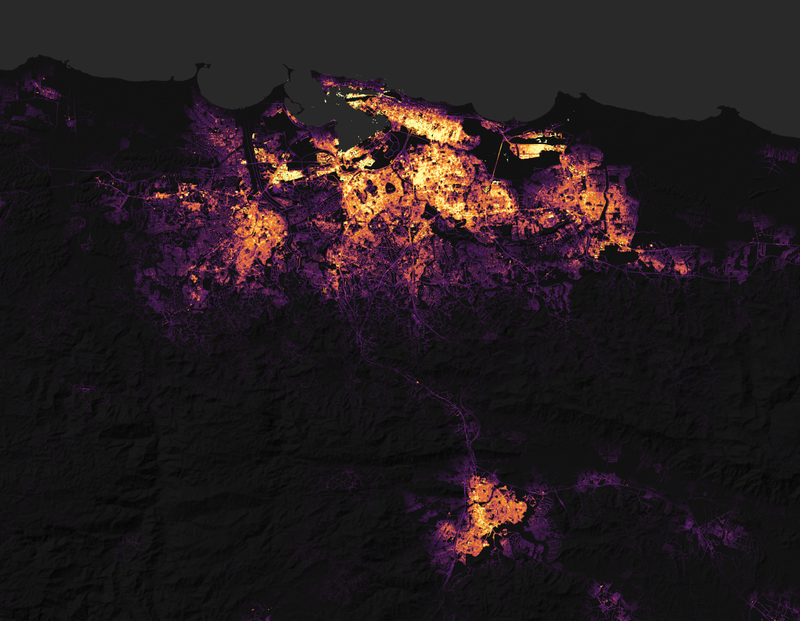
NASA Images of Puerto Rico Reveal How Maria Wiped Out Power On the Island (jalopnik.com)
An anonymous reader quotes a report from Jalopnik: Hurricane Maria was the most devastating hurricane to make land in Puerto Rico in nearly 100 years and the country is still reeling in its wake. Much of the island still doesn't have running water, reliable communication or electricity. Recently, NASA published a set of date-processed photos that show the island's nighttime lights both before and after the storm. Here, you can see images of the country's capital, San Juan, on a typical night before Maria. It's based on cloud-free and low moonlight conditions. Conversely, the following composite image is of data taken on the nights of Sept. 27 and 28 -- nearly a week after the storm hit -- by the Visible Infrared Imaging Radiometer Suite, a scanning radiometer that collects visible and infrared imagery of land, atmosphere, cryosphere and oceans, according to NASA's website. -
Hyperloop One Conducts First Full Systems Test But Only Traveled 70MPH (jalopnik.com)
Thelasko shares a report from Jalopnik about Hyperloop One's first full systems Hyperloop test: In the test, Hyperloop says its vehicle traveled the first portion of a track using magnetic levitation in a vacuum environment, and reached 70 mph. It's a significant leap past the company's test a year ago, which sent a sled down a track for a grand total of two seconds. And while that's not the lighting-fast speed that Hyperloop Ones says its futurist transport system could go, the company says this test -- conducted privately on May 12 -- is only Phase 1. Hyperloop One's in the process of the next phase, now aiming for 250 mph. "By achieving full vacuum, we essentially invented our own sky in a tube, as if you're flying at 200,000 feet in the air," said Shervin Pishevar, co-founder and Executive Chairman of Hyperloop One. "For the first time in over 100 years, a new mode of transportation has been introduced. Hyperloop is real, and it's here now." -
'Uber Is Doomed', Argues Transportation Reporter (jalopnik.com)
When an Uber self-driving car ran a red light last year, they blamed and suspended the car's driver, even though it was the car's software that malfunctioned, according to two former employees, ultimately causing Uber cars to run six different red lights. But technical issues may be only the beginning. An anonymous reader writes: Jalopnik points out that in 2016 Uber "burned through more than $2 billion, amid findings that rider fares only cover roughly 40% of a ride, with the remainder subsidized by venture capitalists" (covering even less than the fares of government-subsidized mass transit systems). So despite Google's lawsuit and other recent bad publicity, "even when those factors are removed, it's becoming more evident that Uber will collapse on its own."
Their long analysis argues that the problems are already becoming apparent. "Uber, which didn't respond to questions from Jalopnik about its viability, recently paid $20 million to settle claims that it grossly misled how much drivers could earn on Craigslist ads. The company's explosive growth also fundamentally required it to begin offering subprime auto loans to prospective drivers without a vehicle."
Last month transportation industry analyst Hubert Horan calculated that Uber Global's losses have been "substantially greater than any venture capital-funded startup in history." -
Air Force Says F-35 Glitches Mean the A-10 Will Keep Flying 'Indefinitely' (jalopnik.com)
The A-10 aircraft "is just too effective to get rid of," wrote one defense blogger -- especially in light of ongoing issues with the F-35. schwit1 quotes Jalopnik: Strategists have feared that the jet will be axed in favor of funding the F-35, but the U.S. Air Force recently confirmed that it plans to keep the A-10 flying "indefinitely." While the Air Force is theoretically supposed to be diverting the A-10's operating expenses to feed the F-35 Joint Strike Fighter, the people in charge are now planning to keep the plane running...
Air Force Materiel Command chief Gen. Ellen Pawlikowski told AviationWeek in a interview, "Our command, anyway, is approaching this as another airplane that we are sustaining indefinitely." While the beancounters and product planners are trying to push the A-10 off the board, Materiel Command is going to keep on keeping the planes in peak condition, which will give the A-10 it's best chance of proving its worth over and over again. And it seems to be working -- the A-10 posted a 5% increase in its availability rate from 2014 to 2015, and the Air Force seems to keep postponing its demise.
In Congress one representative has even suggested an operational testing "fly-off" between the two aircraft -- a jet-vs-jet competition to determine whether any more A-10s get retired. -
All Tesla Vehicles Being Produced Now Have Full Self-Driving Hardware (jalopnik.com)
An anonymous reader quotes a report from Jalopnik: All current Tesla models that will be produced in its Fremont, California factory will come with self-driving hardware built-in capable of Level 5 autonomy, including the upcoming Tesla Model 3, the company announced tonight. According to the announcement, Tesla will manufacture all of its cars with the hardware necessary for Level 5 self-driving systems going forward, including the Model S, Model X and new Model 3. At the introduction of the Model 3, it wasn't clear whether or not every Model 3 package would come standard with the hardware and software to handle Autopilot and any other self-driving features. That's been cleared up now, but there's a kicker. Just like on current Model S and Model X models, you can purchase the cars with the self-driving hardware included. But, in order to activate the software and actually use the Autopilot or upcoming advanced self-driving safety features, you will have to option it when you order the car, or pay more for it later. Elon Musk stated that the new hardware in all of Tesla's cars going forward are Tesla's own vision software, with a Tesla-developed neural net. The new hardware and software capabilities still need to undergo all of the testing required by Tesla's own standards, as well as government approval before unleashing Level 5 autonomous cars onto the streets. -
20-Yr-Old Compaq Laptop Is Still Crucial to Maintaining McLaren's Multi-Million Dollar Cars (jalopnik.com)
An anonymous reader writes: It may come as a surprise to many, but the 20-year-old Compaq LTE 5280 still plays a vital role in maintaining multi-million dollar McLaren F1s. Jalopnik recently visited McLaren's Special Operations workshop where it found several of Compaq's old laptops serving their masters. Why do they rely on these dated computers, you ask? A McLaren Special Operations staff explains, "The reason we need those specific Compaq laptops is that they run a bespoke CA card which is installed into them. The CA card is an interface between the laptop software (which is DOS based) and the car. We are currently working on a new interface which will be compatible with modern laptops as the old Compaqs are getting less and less reliable and harder to find." For those wondering, the Compaq LTE 5280 comes with a 120MHz Intel Pentium processor, up to "80MB" of RAM, and up to 1.2GB of HDD. -
Volvo Engineer Calls Out Tesla For Dangerous 'Wannabe' Autopilot System (jalopnik.com)
An anonymous reader shares an article on Jalopnik: Tesla's semi-autonomous Autopilot system has been impressing everyone from consumers to journalists, and even other industry experts and executives. But now a Volvo engineer has called Tesla's system out, claiming it's a dangerous "wannabe" autonomous technology. Trent Victor, senior technical leader of crash avoidance for Volvo, had quite a few choice words to say about Tesla's Autopilot system in a recent interview with The Verge, claiming the electric automaker was touting what is essentially a rudimentary semi-autonomous technology as being far more capable than it actually is. Victor fears that Autopilot "gives you the impression that it's doing more than it is." He went on to call Tesla's system an "unsupervised wannabe." -
Hacker May Have Discovered Plans For A Tesla P100D (jalopnik.com)
One computer wiz claims to have hacked into Tesla's firmware and discovered a reference to a juicier battery. Self-proclaimed white hat hacker, Jason Hughes, says he discovered a secret in Tesla's firmware 7.1, but he didn't want to tell the world outright what he discovered, so he made Tesla Motors Club forum-members work for it by obfuscating the secret with a hash. TheSHA256 hash, a one-way function, would either require forum members to guess and check to decrypt this code, or to look it up in a hash directory. Forum member LuckyLuke decrypted Hughes' hash and discovered its meaning: P100D. P100D is the nickname given to Tesla's upcoming 100-kWh battery pack that would give the Model S a range of 300 miles or more. In response to a fellow forum-member decrypting his secret code, Hughes responded on Twitter. On the forum, Hughes had some additional information to mention, saying: There have been references to the P100D in firmwares as early as 2 months ago. They finally added the badges to 2.13.77. I mucked it up a bit by adding a crappy background (it's a PNG with transparency in the firmware)... There are quite a few things that are in the firmware that I'm not prepared to share publicly. Just like the P100D has been in there for months with my lips mostly sealed. I don't want to spoil all of Tesla's surprises. -
Coast-To-Coast Autonomous Tesla Trips 2-3 Years Out, Says Elon Musk (google.com)
Jalopnik reports that Elon Musk's predicted window for being able (for Tesla owners, that is) to call up your autonomous car and have it find its own way from New York to California, or vice versa, is astonishingly close: 24-36 months from now. From the article: As far as the summoning feature is concerned, Tesla plans for the 33-foot range to greatly expand—soon. Within two years, Musk predicted that owners will be able to summon their car from across the country. “If you’re in New York and your car is in Los Angeles, you can summon your car to you from your phone and tell the car to find you,” Musk said. “It’ll automatically charge itself along the journey. I might be slightly optimistic about that, but not significantly optimistic.” In getting from one place to another, Musk said autopilot “is better than human in highway driving, or at least it will be soon with machine learning.” If it’s not already better than human, Musk said it will be within the coming months. But right now, Musk said the car still needs a human around, just in case. “The car currently has sensors to achieve that cross-country goal,” Musk said. “But you’d need more hardware and software, you’d need more cameras, more radars, redundant electronics, redundant power buses and that sort of thing. -
Tesla To Voluntarily Recall Every Model S Because One Seat Belt Came Apart (jalopnik.com)
An anonymous reader writes: Earlier this month, a passenger in a Tesla Model S turned to talk to people in the back seat, and her seat belt somehow disconnected itself from the front seat. According to a Tesla spokesperson, "The seat belt is anchored to the outboard lap pretensioner through two anchor plates that are bolted together. The bolt that was supposed to tie the two anchors together wasn't properly assembled." Though the company hasn't been able to replicate the issue on any other cars, Tesla is issuing a recall for roughly 90,000 Model S vehicles so they can test that bolt. -
Robots' Next Big Job: Trash Pickup
Nerval's Lobster writes: You've heard of self-driving cars, fast-moving robots, and automated homes. Now a research group led by Volvo, a waste-recycling company, and a trio of universities in the United States and Sweden want to bring much of the same technology to bear on a new problem: trash disposal. Specifically, the consortium wants to build a robot that will collect trash-bins from in front of peoples' homes, carry those bins to the nearest waste-disposal truck, and empty them. While that's a pretty simple (although smelly) task for a human being, it's an incredibly complex task for a robot, which will need to evaluate and respond to a wide range of environmental variables while carrying a heavy load. An uneven curb, or an overloaded bin, could spell disaster. Hopefully Volvo's experiment can succeed in a way that some of its other self-driving projects have failed. It's struck me, too, how the trash collection vehicles that come by my house are mostly piloted robots already; the humans are there to deal with problems and control the joysticks, but hydraulic arms lift and empty the garbage containers themselves. -
Club Concorde Wants To Put a Concorde Back In the Air
The Verge (relying on The Telegraph) reports that the Concorde, grounded since just a few years after the disastrous loss of flight 4590 in 2000, may yet fly again, with the help of a private coalition of Concorde enthusiasts that's already managed to raise $160 million. ("A massive war chest," says Jalopnik.) The Verge explains that Club Concorde ("a club for all things Concorde, run by ex-Captains, ex-charterers and people passionate about Concorde") would like to buy two of the existing but idle Concordes, turning one of them into a ground-based tourist attraction for gawking and for dining on Concorde-style meals. But as for the second? The more ambitious initiative is to purchase the second plane, have it restored, and get it in the air once more. Concorde Club president Paul James is aiming to resume flights by 2019, while the tourist attraction would be opened around 2017 if all goes according to plan. British Airways and Air France have no plans to resume commercial Concorde flights, meaning it would likely cost quite a lot of money to grab a private ticket if and when the plane gets off the ground again. -
The Coming Terrorist Threat From Autonomous Vehicles
HughPickens.com writes: Alex Rubalcava writes that autonomous vehicles are the greatest force multiplier to emerge in decades for criminals and terrorists and open the door for new types of crime not possible today. According to Rubalcava, the biggest barrier to carrying out terrorist plans until now has been the risk of getting caught or killed by law enforcement so that only depraved hatred, or religious fervor has been able to motivate someone to take on those risks as part of a plan to harm other people. "A future Timothy McVeigh will not need to drive a truck full of fertilizer to the place he intends to detonate it," writes Rubalcava. "A burner email account, a prepaid debit card purchased with cash, and an account, tied to that burner email, with an AV car service will get him a long way to being able to place explosives near crowds, without ever being there himself." A recent example is instructive. Dzhokhar and Tamerlan Tsarnaev were identified by an examination of footage from numerous private security cameras that were recording the crowd in downtown Boston during the Marathon. Imagine if they could have dispatched their bombs in the trunk of a car that they were never in themselves? Catching them might have been an order of magnitude more difficult than it was.
According to Rubalcava the reaction to the first car bombing using an AV is going to be massive, and it's going to be stupid. There will be calls for the government to issue a stop to all AV operations, much in the same way that the FAA made the unprecedented order to ground 4,000-plus planes across the nation after 9/11. "But unlike 9/11, which involved a decades-old transportation infrastructure, the first AV bombing will use an infrastructure in its infancy, one that will be much easier to shut down" says Rubalcava. "That shutdown could stretch from temporary to quasi-permanent with ease, as security professionals grapple with the technical challenge of distinguishing between safe, legitimate payloads and payloads that are intended to harm." (And don't forget The Dead Pool.) -
Self-Driving Big Rigs Become a Reality
drinkypoo writes: We've been discussing the importance of automating over-the-road trucking here on Slashdot whenever self-driving vehicles come up in conversation. Jalopnik reports that the Freightliner "Inspiration Truck" will be the first autonomous commercial truck to drive on American roads. It's been given the green light to start testing its self-driving technology on the roads of Nevada. A human will be present at the wheel at all times, and will take control whenever the truck is in more populated areas. "Given a big trucks' long stopping distances and limited maneuverability, driving one requires the ability to correctly predict what's going to happen far out ahead. That requires foresight and intuition that are difficult to program into computers." -
Tesla Adds Used Models To Its Inventory, For Online Purchase
Jalopnik reports that Tesla Motors Inc. has very quietly started to sell used cars online, following in the footsteps of larger car companies. Its new certified vehicle program brings down the staggering costs of one of their electric cars while still ensuring manufacturer maintenance and repairs. Most of the cars that are on Tesla’s website were previously owned by people who have since traded up to the AWD Model S. Soon, this stockpile will also include leased Teslas. Engadget adds You're limited to shopping in a handful of cities in the U.S. and Canada, but the cars come with a 4-year, 50,000-mile warranty to assuage fears that you've bought a lemon. No, the move doesn't make the company's luxury EVs much more attainable -- the best offer we've seen so far is for a $59,000 'entry' model. -
Elon Musk Pledges To End "Range Anxiety" For Tesla Model S
An anonymous reader writes: Elon Musk has used his Twitter account to announce a press conference on Thursday which he claims will end "range anxiety" for Tesla's Model S sedan. Whatever change they're making will be implemented through an over-the-air software update to the cars, affecting the entire fleet. Range anxiety is the term for a fear that your vehicle won't have enough fuel/charge to reach its destination. It's a common reason for people to avoid buying electric cars, given the much smaller infrastructure build-out compared to gas stations. If Tesla is improving the Model S's range through a software update, then it likely involves optimizations to the battery and to the ways in which power is used. Tesla has also talked about developing a feature called "torque sleep," which puts one of the drive units to sleep while not needed. They say it can wake up and begin delivering torque again "so fast that the driver can't perceive it." -
Dealer-Installed GPS Tracker Leads To Kidnapper's Arrest in Maryland
New submitter FarnsworthG writes A news story about the capture of a kidnapper mentioned that he was caught because a car dealer had secretly installed a GPS device on his car. Apparently this is becoming common for "buy-here-pay-here" dealers. The devices are sold by Spireon, among many others. Raises interesting privacy questions. FarnsworthG also points to this Jalopnik article condemning the practice, when it's done without disclosure. The kidnapping itself, of Philadelphia nursing assistant Carlesha Freeland-Gaither, was captured by a surveillance camera. -
New Ford Mustang May Have Electronic "Burnout" Button
cartechboy writes "Ford has decided to take the burnout into the 21st century for the new 2015 Mustang. The Mustang's new 'electronic' burnout system is intended to enable perfect burnouts every time, much like launch control has made it easier to accelerate quickly from a stop. So think of every new Mustang with a bright red 'burnout' button. While the details on how the burnout control system will work remain secret, it's possible that a combination of the features used in a typical launch control system, including traction and rev-limiting controls, together with a front brake locking system, could enable Ford to pull together existing technology in a completely new way. So far Ford has no comment." -
Elon Musk Making a Working Version of James Bond's Submersible Car
Nerval's Lobster writes "In The Spy Who Loved Me (1977), James Bond is given a Lotus Espirit S1 that doubles as a submarine. More than thirty years after that movie's release, a contractor opened up a random Long Island storage container to find one of the automobile-submarines used in filming. He promptly put it up for auction, and Tesla and SpaceX CEO Elon Musk purchased it for a cool $866,000. But Musk isn't planning to restore the Bond car and put it in a garage somewhere: he wants to make it run. 'It was amazing as a little kid in South Africa to watch James Bond in The Spy Who Loved Me drive his Lotus Esprit off a pier, press a button and have it transform into a submarine underwater,' Tesla PR wrote in a statement to Jalopnik. 'I was disappointed to learn that it can't actually transform. What I'm going to do is upgrade it with a Tesla electric powertrain and try to make it transform for real.' Whether that means Musk will install new equipment in the actual prop, or have his engineers build a seaworthy replica, is an open question. What's more certain is that Musk has the capability (and cash) to make something like that happen, considering how he already manages the construction of next-generation electric cars and reusable rockets for a living." -
Fisker Hybrids Get Bad Karma From Superstorm Sandy
New submitter slas6654 writes with this excerpt from Jalopnik: "Approximately 16 of the $100,000+ Fisker Karma extended-range luxury hybrids were parked in Port Newark, New Jersey last night when water from Hurricane Sandy's storm surge apparently breached the port and submerged the vehicles. As Jalopnik has exclusively learned, the cars then caught fire and burned to the ground.' Apparently Fiskar super-duty lithium ion batteries are neither water-proof or water soluble." -
How To Steal a Space Shuttle
An anonymous reader tips a piece by Jason Torchinsky at Jalopnik, who attended the California Science Center's press conference about moving Space Shuttle Endeavour through Los Angeles to its final resting place. While he was there, he noticed that security for the event was focused less on the shuttle than on keeping the city itself safe. So, after a helpful LAPD officer suggested it would be impossible for a supervillain to make off with OV-105, Torchinsky went ahead and made a plan to do just that. All he needs is a submarine, a score of Sikorsky CH-53E heavy-lift helicopters, a salvaged and disguised Buran spaceplane, and the assistance of Switzerland. -
The Chevy Segway Keeps On Rolling (Video)
Back in 2009 G.M. and Segway talked about the P.U.M.A., or Personal Urban Mobility and Accessibility vehicle. Now it's the EN-V, which stands for Electric Network Vehicle. G.M. (along with partner Shanghai Automotive Industry Corporation) debuted the thing in Shanghai in 2010, then displayed it at the Las Vegas Consumer Electronics Show in 2011, and now they're showing it off at auto shows, no doubt hoping to get a lot of buzz going for this two-wheeled wonder, which is supposed to be so loaded with navigation and collision avoidance electronics that you can sleep in it on your way to work. (Please wake us up when we get there, okay?) -
Google's Self Driving Car Crashes
datapharmer writes "We've all read previous stories on slashdot about Google's driverless car, and some have even pondered if a crash would bring the end to robotic cars. For better or for worse, we will all find out soon, as the inevitable has occurred. The question remains, who is to blame. A Google spokesperson told Business Insider that 'Safety is our top priority. One of our goals is to prevent fender-benders like this one, which occurred while a person was manually driving the car.'" -
Libyan Rebels Weaponize Power Wheels Toys
Danny Rathjens pointed out a story about the DIY weapons created by Libyan rebels. One of the more interesting is a machine gun drone created from a Power Wheels-style ATV. Rebels outfit the toys with a small cannon and attach controls via long wire. A solider can hide while he uses a small television and simple controls to move the vehicle and fire the gun. A similar system is also outfitted to a toy truck with a machine gun on top. -
Virginia DMV Revokes World's Greatest License Plate
An anonymous reader writes "A man in possession of the world's greatest license plate has lost his battle with the Virginia DMV, who ridiculously claim it encourages oral sex with kids instead of just cannibalism. According to poster WHOWANTSBEEF at Reddit, he's the owner of the infamous 'EATTHE Kids First' license plate floating around the internet for years. Unfortunately for him, someone complained his plate was advocating something beyond hilarious cannibalism." -
The Rise and Fall of America's Jet-Powered Car
Pickens writes "The WSJ reports that the automobile designs of the 1950s and 1960s were inspired by the space race and the dawn of jet travel. But one car manufacturer, Chrysler, was bold enough to put a jet engine in an automobile that ran at an astounding 60,000 rpm on any flammable fluid including gasoline, diesel, kerosene, jet fuel, peanut oil, alcohol, tequila, or perfume. Visionary Chrysler designer George Huebner believed that there was plenty to recommend the turbine. People loved the car. In a publicity scheme to promote its 'jet' car, Chrysler commissioned Ghia to handcraft 50 identical car bodies and each car would be lent to a family for a few months and then passed on to another. Chrysler received more than 30,000 requests in 1962 to become test drivers and eventually 203 were chosen who logged more than one million miles (mostly trouble free) in the 50 Ghia prototypes. In the end Chrysler killed the turbine car after OPEC's 1973 oil embargo. 'How different would America be now if we all drove turbine-powered cars? It could have happened. But government interference, shortsighted regulators, and indifferent corporate leaders each played a role in the demise of a program that could have lessened US dependence on Middle East oil.'" -
Denver Airport Overrun by Car-Eating Rabbits
It turns out the soy-based wire covering on cars built after 2002 is irresistible to rodents. Nobody knows this better than those unlucky enough to park at DIA's Pikes Peak lot. The rabbits surrounding the area have been using the lot as an all-you-can-eat wiring buffet. Looks like it's time to break out The Holy Hand Grenade of Antioch. -
GM Criticized Over Chevy Volt's Hybrid Similarities
Attila Dimedici writes "This article says the Chevy Volt is not what GM claimed it was: an Extended Range Electric Vehicle. The Volt is simply a plug-in hybrid. Instead of a vehicle that is only driven with the electric drive train that uses a gasoline engine to charge the batteries, the Volt actually uses the gasoline engine to drive the front wheels at speeds above 70 miles per hour or when the batteries run down. Additionally, the Volt gets nowhere near the 230 mpg that GM was claiming for it. If this is all true, why did GM misrepresent the car? The facts as stated in the article make the Volt a pretty decent competitor to the Prius and other hybrids already on the market." A post at the Car Connection blog takes the opposing view, saying that accusations of GM "lying" are overhyped, since the capability to power the wheels with gasoline is reserved for situations where electricity isn't a viable option. The author says GM didn't mention this ability before now due to concerns over patents and competition from other companies. -
When the US Government Built Ultra-Safe Cars
Jalopnik has a piece on a mostly forgotten piece of automotive history: the US government built a fleet of ultra-safe cars in the 1970s. The "RSV" cars were designed to keep four passengers safe in a front or side collision at 50 mph (80 kph) — without seat belts — and they got 32 miles to the gallon. They had front and side airbags, anti-lock brakes, and gull-wing doors. Lorne Greene was hired to flack for the program. All this was quickly dismantled in the Reagan years, and in 1990 the mothballed cars were all destroyed, though two prototypes survived in private hands. "Then-NHTSA chief Jerry Curry [in 1990] contended the vehicles were obsolete, and that anyone who could have learned something from them had done so by then. Claybrook, the NHTSA chief who'd overseen the RSV cars through 1980, told Congress the destruction compared to the Nazis burning books. ... 'I thought they were intentionally destroying the evidence that you could do much better,' said [the manager of one of the vehicles' manufacturers]." -
Tesla Motors To Suspend Roadster Production
Wyatt Earp writes with news that a recent SEC filing from Tesla Motors revealed the company plans to stop production on its electric Roadster (and the Roadster Sport as well) in 2011. This will leave the automaker without any cars to sell until the launch of its Model S sedan (financed in part by $465 million in DoE loans) in 2012. Tesla plans to resume production of Roadster models "at least a year" after the Model S arrives. From Wired's Autopia blog: "'As a result, we anticipate that we may generate limited, if any, revenue from selling electric vehicles after 2011 until the launch of the planned model S,' the company says in the SEC filing. That may not be a problem if S production starts on plan and goes off without a hitch, but if Tesla hits any snags, things could get ugly fast — a point it concedes in the filing. 'The launch of the Model S could be delayed for a number of reasons and any such delays may be significant and would extend the period in which we would generate limited, if any, revenues from sales of our electric vehicles.'" -
$25,000 of Communications Gear In a $500 Car
In perhaps one of the finest displays of technological excess in automotive communications gear, one "enthusiast" has managed to cram over $25,000 worth of gear into a $500 car. The car is rigged for just about every conceivable communications band including FM, UHF, VHF, HF, and WTF. What other amazing displays of technological excess have others seen? "The equipment seems to cover an amazing array of technologies, many of which seem to be redundant. For instance, just how many handheld 144 MHz radios do you need? It seems like the owner of the Ham Car is capable of listening to every police/fire/ems/military channel in the world. Simultaneously. There's a laptop and we assume there's some form of cellular or satellite communication setup for that, too." -
Tesla Releases First Official Photos of Model S Sedan
Thelasko writes "After several pictures of the Model S were leaked onto the internet, Jalopnik has the first official pictures of the Model S. One of its most striking features is its massive touchscreen in place of the center console." -
Flying Car Passes First Flight Test
waderoush writes "Terrafugia — the Massachusetts company building a 'roadable aircraft' (that's flying car to you and me) — revealed at a press conference Wednesday that the Transition vehicle has been taken aloft for its maiden flight. The craft, which can fly up to 460 miles at 115 mph and then fold up its wings for 65-mph highway driving, was the subject of two hotly debated Slashdot posts on May 8 and May 13 of last year. The company said the first flight took place in Plattsburgh, NY; retired Air Force Colonel Phil Meteer was at the controls." -
Where Automakers Stash Unsold Cars
The steep decline in worldwide car sales has caused automakers to stash over-produced cars in some interesting places. From right outside the factory, to holding lots at ports and even test tracks, the over-production problem is starting to catch up with manufacturers. -
Plug-in Hybrids May Not Go Mainstream, Toyota Says
mattnyc99 writes "Honda's challenger to the Prius — the Insight hybrid that we discussed so lividly a month ago — got its official unveiling today at the Paris auto show, with insiders confirming it would be cheaper than the world's most popular 'green' car while still hitting the same fuel-efficiency range. But the hybrid-electric showdown comes in the midst of a sudden rethink by Toyota about plug-in hybrids. Apparently all the recent hype — over the production version of the Chevy Volt, plus Chrysler's new electric trio and even the cool new Pininfarina EV also unveiled today — has execs from the world's number one automaker, and alt-fuel experts, questioning how many people will really buy electric cars, whether people will really charge them at night to keep the grid clear, whether batteries will make them too expensive and more. "