Slashdot Mirror
Domain: latimes.com
Stories and comments across the archive that link to latimes.com.
Stories · 803
-
Scientists Are Developing the World's Biggest Wind Turbine With 656-Ft. Long Blades (latimes.com)
An anonymous reader writes from an LATimes article: Efforts to increase wind power mean that turbine blades are getting bigger and bigger. But a new design in the works takes the idea to levels most people can barely imagine: Blades up to 656.2 feet long -- more than two football fields. Today's longest blades are 262.5 feet. The blades at Imperial County's Ocotillo wind farm, which sends electricity to San Diego, are 173.9 feet long. "We call it the extreme scale," Eric Loth, a University of Virginia professor of mechanical and aerospace engineering, said of the planned mega-blades. "There's nothing like it." The blades would look much different look from today's wind turbines. They wouldn't face the wind but would go downwind, aligning the blades to flow with the wind instead of fighting it. And instead of a single stiff blade, each blade would be broken into segments, allowing it to be more easily fabricated. In addition, the concept would allow the blades to "morph" -- spread out when the wind is blowing lightly to capture as much power as possible. -
SeaWorld To End Orca Breeding Program (latimes.com)
An anonymous reader writes: Amusement park operator SeaWorld Entertainment announced on Thursday that it is ending its orca breeding program. The announcement comes amid growing pressure from activists who found that whales and their trainers weren't treated properly. A 2013 documentary Blackfish cited a number of violent incidents at the amusement park. In an op-ed Joel Manby, President and CEO of SeaWorld Parks and Entertainment laid bare the details on why his company is shutting down the orca breeding program. "Customers visit our marine parks, in part, to watch orcas. But a growing number of people don't think orcas belong in human care. [...] Now we need to respond to the attitudinal change that we helped to create -- which is why SeaWorld is announcing several historic changes. This year we will end all orca breeding programs -- and because SeaWorld hasn't collected an orca from the wild in almost four decades, this will be the last generation of orcas in SeaWorld's care. [...] More than 3,000 species are endangered, and hundreds are lost every year. Americans and thoughtful people everywhere need to acknowledge these fundamental problems. SeaWorld takes seriously its responsibility to preserve marine wildlife. That's why we are partnering with the Humane Society of the United States. Together, we will work against commercial whaling and seal hunts, shark finning and ocean pollution. -
Surge Pricing Arrives In Disney's Magic Kingdom Just in Time for Star Wars Opening
HughPickens.com writes: Taking a page from the Uber playbook, Christopher Palmeri writes that Disney's six parks in Orlando, Florida, and Anaheim, California, are raising the cost to visit its theme parks as much as 20 percent during the busiest times of year and lowering them on typically slow days. Previously, the parks charged the same price for a one-day pass any time of year. "The demand for our theme parks continues to grow, particularly during peak periods," the company said. "In addition to expanding our parks, we are adopting seasonal pricing on our one-day ticket to help better spread visitation throughout the year." The move is designed to help manage traffic at the parks, which had record visits in the final three months of 2015. Busy days at Disney's amusement parks cause long lines for customers, and even gate closures. Dynamic pricing is meant to financially incentivize customers to choose less-busy days, spread out attendance, and to make as much money as possible on days when the park is historically expected to be full. It is also likely to boost Disney's total revenue since most visitors will pay more for their tickets.
One reason Disney may expect bigger crowds this year is the upcoming Star Wars theme park expansion which includes a virtual reality ride that allows guests to control the Millennium Falcon in an aerial battle with the First Order. "Star Wars is, for lack of a better word awesome," said Harrison Ford. "I'm so blessed that I had the opportunity to be a part of it. To walk in these iconic locations. And soon, you'll be able to do that as well. Not in a galaxy far, far away, but in a place close to home." -
Apple Is Not Such a Freedom Fighter In China (latimes.com)
mi writes: Though loudly resisting the American government's attempts to make it help break into the phone of a dead scumbag, Apple is very accommodating of the Chinese government's attempts to keep tabs on the citizenry's communications. Apple has censored apps that wouldn't pass muster with the Chinese government, moved local user data onto servers operated by the state-owned China Telecom, and submitted to Chinese audits. According to James Lewis, senior fellow at the Center for Strategic and International Studies in Washington, "I can't imagine the Chinese would tolerate end-to-end encryption or a refusal to cooperate with their police, particularly in a terrorism case." Why the accommodation there? -
L.A. Hospital Pays Off Ransomware Thieves To Reclaim Its Network (google.com)
Los Angeles' Presbyterian Medical Center, the target of a successful ransomware attack (successful from the thieves' point of view, that is) has buckled under: to regain control of its network, the hospital has paid a 40-bitcoin ransom (about $17,000) to the gang responsible. That, at least, is a far cry from the much higher ransom widely reported to have been initially demanded: 9,000 bitcoin. (That would have meant a payment of $3.6-3.9 million.) -
New Maps Show Spread and Impact of Drought On California Forests (latimes.com)
An anonymous reader writes: According to a new study 58 million trees are dead or dying due to the California drought and hundreds of millions could die if the conditions persist. The LA Times reports: "The researchers used an airplane, high-tech remote sensing technology and satellite imagery to produce the first maps that show how much water the state's trees have lost. Virtually every forest has been affected in some way, said study leader Greg Asner, an ecologist at the Carnegie Institution for Science at Stanford University. Asner said he was struck by the 'sheer degree of loss and mortality' in Southern California forests as he flew over the depleted trees." -
New Maps Show Spread and Impact of Drought On California Forests (latimes.com)
An anonymous reader writes: According to a new study 58 million trees are dead or dying due to the California drought and hundreds of millions could die if the conditions persist. The LA Times reports: "The researchers used an airplane, high-tech remote sensing technology and satellite imagery to produce the first maps that show how much water the state's trees have lost. Virtually every forest has been affected in some way, said study leader Greg Asner, an ecologist at the Carnegie Institution for Science at Stanford University. Asner said he was struck by the 'sheer degree of loss and mortality' in Southern California forests as he flew over the depleted trees." -
Star Wars Pulls In $1 Billion At Record Speed (reuters.com)
New submitter henrydan798 writes to note that Star Wars: The Force Awakens has set a new record for ticket sales, becoming the fastest movie ever to earn a billion dollars at the till. As the L.A. Times reports, The latest installment in the "Star Wars" franchise grossed an estimated $153.5 million in the U.S. and Canada in its second weekend, beating the lower end of analyst expectations of $140 million. This drives the J.J. Abrams-directed picture to a to-date domestic gross of $544.5 million. "The Force Awakens," which cost an estimated $200 million to produce, debuted last weekend to record domestic ticket sales of $248 million. It also grossed $281 million overseas for a global total of $529 million, topping the previous worldwide debut benchmark set in June by "Jurassic World" ($525 million). This week, with an international estimated gross of $546 million to date, the film became the fastest to surpass $1 billion globally. Were any of those dollars yours? If so, do you think they were well spent? -
Dissecting a $231 Million High-Tech Boondoggle
The L.A. Times takes to task the U.S. Congress, the Obama administration, and various military agencies for their combined role in supporting the expenditure of vast amount of money on a system called the Precision Tracking Space System. All told, according to the paper, the PTSS program -- which was to have provided early warning of missile launches, and precision tracking of the missiles themselves -- ended up blowing through more than $230 million before being cancelled. After talking to defense experts and reviewing hundreds of documents, the Times comes to what probably sounds like an easy conclusion for any big-budget military program that never reaches operation: it shouldn't have even left the drawing board. -
Persistent Storm Detected On Low-Mass Star (latimes.com)
The L.A. Times reports that researchers using the Kepler and Spitzer space telescopes have discovered an astronomical first: a low-mass star with a huge, persistent, swirling surface feature akin to the long-lived storm on Jupiter. The star, W1906+40 , is cool enough ("a mere 3,500 degrees Fahrenheit or so") to allow cloud formation. A slice: This star was first spotted by NASA's Wide-field Infrared Survey Explorer (or WISE) in 2011; study leader John Gizis of the University of Delaware, Newark and colleagues then looked through NASA's Kepler data to further examine the star. (It just so happened that Kepler was pointing in the right direction to spot the L-dwarf.) ... "The long life of the cloud is in contrast with weather changes seen in cooler brown dwarfs on the timescale of hours and days," they wrote. In fact, the researchers believe the storm has been going strong for at least two years — a stability they seemed to find slightly baffling. "Evidently the W1906+40 spot is very long-lived compared to the 'weather' features in cooler L and T dwarfs," they wrote. "Why would the clouds in W1906+40 be stable?" -
Study: Happiness Won't Extend Your Life After All (latimes.com)
schwit1 writes with good news for fans of living a long and ultimately unfulfilling life. Happy people live longer, a relationship that's been documented in a variety of research studies. But a new paper published in the medical journal Lancet comes to the sad conclusion that happiness isn't responsible for this observed longevity. Instead, the things that make people happy, particularly their good health, are the same things that shield them from premature death. "Happiness and related measures of well-being do not appear to have any direct effect on mortality," the study authors wrote. -
Prolonged Sitting and Poor Sleep Can Work Together To Shorten Your Life (latimes.com)
schwit1 sends word that a new study published in PLOS Medicine has examined how lifestyle risk factors can affect mortality rates, both alone and in combination with each other. Having a single major risk factor increased mortality rates slightly, but the study found that those who report multiple risk factors are significantly more likely to die early. While this includes obvious behavior like smoking and alcohol consumption, the findings also suggest prolonged sitting and unhealthy sleep patterns can strongly increase mortality rates when combined with each other, or with the obvious behaviors. "Some combinations were more deadly than others, the researchers found. Those who blended insufficient exercise with prolonged sitting were 2.42 times more likely to die during the study, and those who were also guilty of sleeping for too many hours were 4.23 times more likely die by the time the study ended. 'These findings suggest there is a "synergistic effect" among risk factors,' the study authors wrote." -
Air Force Hires Civilian Drone Pilots For Combat Patrols (latimes.com)
schwit1 writes: For the first time, civilian pilots and crews now operate what the Air Force calls "combat air patrols," daily round-the-clock flights above areas of military operations to provide video and collect other sensitive intelligence. Civilians are not allowed to pinpoint targets with lasers or fire missiles. They operate only Reapers that provide intelligence, surveillance and reconnaissance, known as ISR, said Air Force Gen. Herbert "Hawk" Carlisle, head of Air Combat Command. -
Greenwald: Why the CIA Is Smearing Edward Snowden After Paris Attacks (latimes.com)
JoeyRox points out that Glenn Greenwald has some harsh words for the CIA in an op-ed piece for the LA Times. From the article: "Decent people see tragedy and barbarism when viewing a terrorism attack. American politicians and intelligence officials see something else: opportunity. Bodies were still lying in the streets of Paris when CIA operatives began exploiting the resulting fear and anger to advance long-standing political agendas. They and their congressional allies instantly attempted to heap blame for the atrocity not on Islamic State but on several preexisting adversaries: Internet encryption, Silicon Valley's privacy policies and Edward Snowden." -
Islamic State Claims Responsibility for Paris Attacks; Death Toll At 127
The L.A. Times reports that Islamic State, the group variously known as ISIL, ISIS, and Daesh, has claimed responsibility for the multi-pronged terror attack yesterday in Paris which left at least 128 people dead, most of them from among the audience of a rock concert at the Bataclan theater, in the heart of the city. Details of how Friday’s assaults were carried out remained hazy. It was still unclear, for example, whether the restaurants and concert theater were attacked by two separate teams of militants or one group that went from one place to another. ... Attackers opened fire on the crowd with automatic weapons, shouting “God is great!” or blaming France for airstrikes on Islamic State in Syria, according to some reports. Dozens of concert-goers were killed before French forces stormed the theater. Many Parisians posted appeals and photos on social media asking for news of friends or loved ones whom they had not heard from since the attacks. One man said on Twitter that a government hotline set up to inquire about missing persons was so overloaded that calls could not get through. In the wake of the attacks and with an overloaded public infrastructure, Facebook activated its post-disaster check-in tool for Parisians to notify loved ones that they are safe. According to Reuters, French President Francois Hollande has vowed to undertake a "mercliess" response to the attacks. -
Coming Set-top Box Mandate May Help Break Pay TV Firms' Hold Over Viewers (latimes.com)
Joe_Dragon sends a report from the LA Times about proposed regulations that could disrupt the cable industry's hold on consumers by targeting set-top boxes. These boxes are required to view most pay-TV programming these days, and consumers often require multiples if they have more than one TV. The rental fees add up to almost $20 billion in revenue for the industry each year. Yet the technology within these boxes is nothing special, and alternatives could easily arise if there was incentive to create them. "The changes aren't coming fast enough for some lawmakers and consumer advocates as well as tech companies such as Google Inc., which are eager to jump into the set-top box market. They want the Federal Communications Commission to require that pay TV providers make their services more easily compatible with third-party set-top boxes or similar devices. ... Such a mandate could allow consumers to access their pay TV and streaming services through one device instead of having to switch between two or more. And it could lead to innovations such as an ability to search for programming across services to determine, for example, whether a movie is available on Netflix or on-demand via a pay TV provider." -
Google-Supported CodeGirl Documentary Makes "Exclusive YouTube Premiere"
theodp writes: As part of our Made with Code and media perception initiatives," wrote YouTube CEO Susan Wojcicki over at the Official Google Blog, "I'm excited that we're supporting award-winning documentary filmmaker Lesley Chilcott — of An Inconvenient Truth and Waiting for Superman [and Code.org] fame — on her next film, CodeGirl. Until November 5 Lesley's film will be available for free on YouTube, before its theatrical debut in the next few weeks." Microsoft is pretty jazzed about the movie too, as is Al Gore. Decidedly less excited about CodeGirl is film critic Inkoo Kang, who writes, "CodeGirl, a chronicle of this year's Technovation contest, is just as well-intentioned as its subject. It coasts for as long as it can on the feel-good fuel of watching smart, earnest girls talk about creating an app, but with virtually no tension, context, narrative or characterization driving the story, the documentary grows to feel like a parent describing their daughter's involvement in an international competition. The girls' achievements are impressive, but you definitely don't want to hear about them for nearly two hours. -
California's $68 Billion Bullet Train Project Faces Major Hurdles (latimes.com)
New submitter willworkforbeer writes: The proposed US$68B high speed rail project in California faces extraordinary hurdles, both in terms of budget and timeframe. Even Einstein (no, not that one; Herbert Einstein, an MIT civil engineer and top tunneling expert) says the schedule is probably not possible. "Having looked at a number of these long tunnels, [the California] plan is aggressive," said Einstein, who has consulted on a 35-mile-long tunnel under the Swiss Alps. "From a civil engineering perspective it is very, very ambitious — to put it mildly."
New York's 11-mile East Side Access tunnel project is 14 years late and about 2.5x its original budget. If California's 72 miles of tunnels (twin tunnels of 36 miles) go like New York's, that would be over US$160B spent, with an opening date sometime in the 2030s. The article goes through a number of complicating factors for the tunnels, from the major faults they must cross to the melange of rock types they must drill through. -
Tomorrow Is 'Back To the Future' Day (cnn.com)
An anonymous reader writes: In Back to the Future Part II, Marty McFly travels from 1985 to tomorrow — October 21, 2015. The occasion is being noted in a couple of ways. A documentary called Back In Time debuts tomorrow that will chronicle the making of the Back to the Future trilogy. There are also screenings of the films around the world, and even a tour of locations from the film. Much to director Robert Zemeckis's dismay, everybody's judging the predictive accuracy of the films. "I always hated — and I still don't like — movies about the future. I just think they're impossible, and somebody's always keeping score." For example: "big-screen TVs, yes, Mr. Fusion, no; virtual-reality goggles, yes, Jaws 19, no." On the other hand, people are keeping an eye on the baseball playoffs — the movie predicts a World Series victory for the Chicago Cubs, something they haven't managed since 1908. The Cubs actually did make the playoffs this year, and are fighting for a league championship title at the moment of this writing. -
"Happy Birthday To You" Now Public Domain
New submitter Duckman5 writes: As mentioned on multiple occasions, the popular song "Happy Birthday To You" has recently been the subject of a lawsuit between a couple of documentary filmmakers and Warner/Chappell Music. The judge in the case, George H. King, has finally issued his ruling and according to NPR and the LA Times, that song is finally in the public domain. Warner is still apparently "considering our options," so this may not be the end of it, but it seems to be a turn in the right direction. Also at the Washington Post, among many others. -
Porsche Unveils Its First Electric Car
An anonymous reader writes: German automaker Porsche has made its first foray into electric vehicles. On Monday at the Frankfurt Auto Show, it unveiled a concept car called the Porsche Mission E. Its 800-volt drive system can take the car from 0 to 100km/h in 3.5 seconds. The high-voltage charging system lets it gain 80% of its battery capacity back within 15 minutes. They claim a driving range of 500km on a single battery charge. Porsche said the car was not a response to the Tesla Model S, but the two will likely be direct competitors when the Mission E goes into full production. That will happen "within the next five years." -
Blue Origin To Launch Big Rockets From Canaveral's Rechristened Complex 36
As reported by The Verge, Jeff Bezos's space venture Blue Origin today unveiled its new facility at Cape Canaveral's Launch Complex 36. Complex 36 was once the launching point for NASA and USAF Atlas rockets, as well as for NASA's Mariner missions. "Now," says the article, "after a decade of inactivity, the complex will be revamped and renamed Exploration Park. ... Bezos said the company hopes to launch people from Exploration Park later this decade. He also announced plans to build a new orbital rocket at the facility, which he noted will use the company's upcoming BE-4 engine." (More coverage of the Blue Origin opening at the L.A. Times and Wired.) -
Only Self-Awareness Can Keep Drones Out of Do Not Fly Zones
szczys writes: Chris Anderson is on the bleeding edge of the drone world, having founded 3D Robotics (drone manufacturer) and DIY Drones (enthusiast site). He takes on the issue of people flying drones where they shouldn't, and concludes that making drones self aware is the best solution. This isn't the "robots are trying to kill you" type of self awareness. Instead, it considers drone type, operator, and location, to establish if all those factors equate to a safe flight area. This is an important issue — in the last few months, there have been several stories about drones in places they should not have been. This included incidents like disrupting the efforts of airborne firefighting and interfering with a police manhunt. -
Alaska: The Only US State Where Everyone Gets Free Money
merbs writes: Alaska’s Permanent Fund was established in 1976, in the midst of a black gold rush; the massive Trans-Alaska pipeline was in the process of being built, and the state had reaped $900 million in revenue from the sale of drilling leases in Prudhoe Bay, the largest oil field in North America, in a matter of years. In a matter of a few more, it’d spent it. Alaskans soon recognized that their enormous oil reserves were nonetheless limited, so, with a kind of longterm forward-thinking rarely seen in politics today, they voted to add an amendment to the state constitution to establish a fund that would protect a portion of all incoming oil wealth for future generations. In 2014, the net income of the fund was $6.8 billion dollars and the dividend doled out $1,884 to 640,000 citizens, despite a decline in oil revenues that year. -
Apple Partners With Cisco To Boost Enterprise Business
An anonymous reader writes: Apple and Cisco announced a partnership aimed at helping Apple's devices work better for businesses. Cisco will provide services specially optimized for iOS devices across mobile, cloud, and on premises-based collaboration tools such as Cisco Spark, Cisco Telepresence and Cisco WebEx, the companies said in a statement. "What makes this new partnership unique is that our engineering teams are innovating together to build joint solutions that our sales teams and partners will take jointly to our customers," Cisco Chief Executive Chuck Robbins said in a blog post. -
Judge Rules That Inglewood, California Cannot Copyright Public Videos
UnknowingFool writes: Recently a judge ruled in California that the city of Inglewood cannot hold copyrights of videos of public city council meetings which they published on their YouTube account and thus cannot sue individuals for copyright infringement for using them. In several YouTube videos, Joseph Teixeira, a resident of Inglewood, California, criticized the mayor, James Butts. Under the account name Dehol Truth, Teixeira took city council meetings posted on their YouTube account and edited them to make pointed criticisms about the mayor.
The city responded by registering the videos with copyrights and then suing Teixeira for copyright infringement. Many would say it was a thinly veiled attempt to silence a critic. Teixeira filed a motion to dismiss, arguing that (1) the city cannot claim copyright over public records (videos of public city council meetings) and (2) even if they could, his videos fell under Fair Use.
Unsurprisingly, a judge dismissed the city's case, citing California law which bars the city from holding copyrights on most public records. (This case may not be over as Teixeira's pro bono lawyer has not filed for attorney's fees. The ruling can be found here.) What is notable is that the judge dismissed the case with prejudice, so the city cannot refile. Normally judges do not do this unless they feel that the plaintiff's case was so weak that he feels no judge should hear the case ever again. Since the judge agreed with the defendant on the first point, he would not normally need to address Teixeira's Fair Use defense, but he did anyway. Anticipating that the city may appeal his decision, judge ruled that Teixeira's videos substantially met all four factors for Fair Use:- There is no evidence Teixeira used the videos for commercial gain and was transformative
- His work was creative by adding music and commentary to the normally boring council videos
- Despite the city's claim he used their "entire work", it clear that he only used portions of meetings that lasted as long as four hours editing them down to a max of 15 minutes.
- Teixeira did not harm the city's market for the videos because the city is barred by state law from recouping more than direct costs of duplication. Even if the city could sell the videos (which they published themselves for free on YouTube), his short videos are not a substitute.
-
California Fights Drought With 96 Million "Shade Balls"
HughPickens.com writes: Katie Rogers writes in the NY Times that the city of Los Angeles is releasing 96 million plastic "shade balls" into the 175-acre Los Angeles Reservoir to help block sunlight and UV rays that promote algae growth, which would help keep the city's drinking water safe. Officials also say the balls will help slow the rate of evaporation, which drains the water supply of about 300 million gallons a year. The balls cost $0.36 each and are part of a $34.5 million initiative to protect the water supply. Shade balls are the brainchild of Brian White, a biologist with the utility who based the idea on "bird balls" that he observed in waterways near airport runways to prevent airfield bird strikes. The Los Angeles Reservoir, which holds 3.3 billion gallons, or enough water to supply the city for up to three weeks, joins three other reservoirs already covered in the shade balls. "In the midst of California's historic drought, it takes bold ingenuity to maximize my goals for water conservation," says Mayor Eric Garcetti who was at the Los Angeles Reservoir to mark the addition of 20,000 of the small balls to the lake. "This effort by LADWP is emblematic of the kind of the creative thinking we need to meet those challenges." -
Tim O'Reilly and the 'WTF?!' Economy (Video)
This is a conversation Tim Lord had with Tim O'Reilly at OSCON. Tim O'Reilly wrote an article titled "The WTF Economy,", which started with these words: "WTF?! In San Francisco, Uber has 3x the revenue of the entire prior taxi and limousine industry." He talks about Uber and AirbnB and how, with real-time measurement of customer demand, "The algorithm is the new shift boss." And then there is this question: "What is the future when more and more work can be done by intelligent machines instead of people, or only done by people in partnership with those machines?"
My (late) father was an engineer. Politically, you could have called him a TechnoUtopian. He believed -- along with most of his engineer, ham radio, and science fiction writer and reader friends -- that as machines took over the humdrum tasks, humans would work less and create more. O'Reilly seems to have similar beliefs, even though (unlike my father) he's seen the beginnings of an economy with self-driving cars and trucks, factory machines that don't need humans to run them, and many other changes the 1950s and 1960s futurists didn't expect to see until we had flying cars and could buy tickets on Pan Am flights to the moon. Listening to these conversations, I remember my father's dreams, but O'Reilly isn't as optimistic as a full-blown TechnoUtopian. He takes a "Something's happening here; what it is ain't exactly clear" view of how work (and pay for work) will change in the near future. Please note that Tim O'Reilly has been called "The Oracle of Silicon Valley," so he's totally worth watching -- or reading, if that's your preferred method of taking in new information.
NOTE: Today we have a "main video," plus a "bonus video" that is viewable only with Flash. But we have a transcript that covers both of them. Enjoy! -
Marvel Tweaks Their Superhero Film Formula With Ant-Man
An anonymous reader writes: Over the past decade, Marvel has been rolling out superhero film after superhero film. They've found a successful formula, and each of the last half-dozen films has brought in over a half-billion dollars in ticket revenue. Today they added to the franchise with Ant-Man, based on a superhero who can shrink himself to the size of an ant (while maintaining normal strength), and control insects. But where the spate of Avengers-related movies only occasionally interjected humor into their world-preserving plots, Ant-Man focuses more on being funny and simply entertaining. Reviews are generally positive, but not overwhelmingly so — Rotten Tomatoes has it at 79%, with a 91% audience score while Metacritic has it at 64/100, with an 8.4/10 user score. The LA Times calls it "playful." Vox has good and bad to say about Ant-Man, but notes that its failings are very common to Marvel's other films. Salon says, "...in its medium-stupid and mismanaged fashion it's not so awful." Wired posted the obligatory physics of Ant-Man article, as did FiveThirtyEight. -
Astronauts Forced To Take Shelter From Space Junk
An anonymous reader writes: Three astronauts living at the International Space Station were forced to scramble to safety Thursday after a "close pass" by flying Russian space debris. The men decamped into the Soyuz spacecraft, which is attached to the orbiting station, while a chunk of an old Russian weather satellite passed 1.5 miles away. Flight engineer Scott Kelly tweeted: "Happy there was no impact. Great coordination with international ground teams. Excellent training." -
Twitter Yanks Ads UK Activists Say Could Trigger Seizures
After complaints from UK charity Epilepsy Action, Twitter pulled after less than a day two ads that the group said might cause epileptic seizures. The in-house ads, in the 6-second format of Twitter-owned Vine, consisted of flashing video which the Epilepsy Action said "was dangerous, as it could potentially produce seizures in people who have photo-sensitive epilepsy." -
New Horizons Gets Closer to Pluto, But Mystery Spots Now Out of Sight
The L.A. Times reports that the strange spots spotted on the surface of Pluto by the New Horizons mission will be on the wrong side of the planet for the approaching fly-by that the craft will make of the smallest planet (or dwarf planet, depending) of our solar system. (The BBC makes a similar observation.) That doesn't mean that New Horizons' approach is anything short of "a spectacular event." -
Simple Geometry = More Seats In an Airline
New submitter innerpeace writes: New airline seat arrangement looks to increase passenger capacity. A patent application by Zodiac Seats France calls for a design that puts every other passenger in a row facing backward. That means that in a row of three fliers, the seat by the window and the seat by the aisle face toward the front of the plane while the middle seat faces toward the back. The design idea could fit up to 80 more passengers in a plane, depending on the current seat layout. Whatever downsides it has, if such a design is adopted, I hope it leads to a stronger adoption of a convention that those with window seats board first. -
SpaceX Rocket Failure Cost NASA $110 Million
An anonymous reader writes: On June 28th, a SpaceX Falcon 9 rocket exploded just over two minutes into its attempt to reach the International Space Station. It was a contracted mission from NASA to resupply the astronauts living there. Today, NASA associate administrator William Gerstenmaier said the price tag to taxpayers for that failed launch is $110 million. SpaceX is leading the investigation into the cause of the failure, and NASA officials faced tough questions about whether private companies should be allowed to direct investigations into their own failed launches. A similar inquiry is underway at Orbital ATK. NASA inspector general Paul Martin said his office is looking into the matter. Gerstenmaier added that NASA is thinking about making these companies take out insurance policies that would cover the cost to taxpayers in the event of another failure. -
Virtually Climb El Capitan With Google's First Vertical Street View
mpicpp writes: Google Maps is incorporating its first vertical Street View by allowing users to virtually climb El Capitan in Yosemite National Park. To capture the 3,000-foot ascent up El Capitan Google relied on the skills of mountain climbers Lynn Hill, Alex Honnold and Tommy Caldwell. "People around the world will now be able to virtually experience the unique act of ascending a 3,000-foot cliff by going on a self-directed, vertical climb," the Mountain View, Calif., company said. -
So Long Voicemail, Give My Regards To the Fax Machine
itwbennett writes: Yes, it was just a matter of time before voicemail, the old office relic, the technology The Guardian's Chitra Ramaswamy called "as pointless as a pigeon with a pager," finally followed the fax machine into obscurity. Last week JPMorgan Chase announced it was turning off voicemail service for tens of thousands of workers (a move that CocaCola made last December). And if Bloomberg's Ramy Inocencio has the numbers right, the cost savings are significant: JPMorgan, for example, will save $3.2 million by cutting voicemail for about 136,000. As great as this sounds, David Lazarus, writing in the LA Times, warns that customer service will suffer. -
Spotify Raises $526 Million As Apple Charges Into Streaming
An anonymous reader writes: Spotify has raised an enormous $526 million in funding to fight off Apple's new Apple Music subscription service. As part of the funding round, European carrier TeliaSonera is responsible for $115 million. The music service now has 20 million paying subscribers and 75 million monthly active users, doubling the subscriber base since May of 2014. The LA Times reports: "U.S. companies participating in the Spotify funding include Halcyon Asset Management, GSV Capital, D.E. Shaw & Co., Technology Crossover Ventures, Northzone and P. Schoenfeld Asset Management, said the person familiar with the matter, who was not authorized to comment publicly. British investment firms Baillie Gifford, Lansdowne Partners and Rinkelberg Capital, along with Canadian hedge funds Senvest Capital and Discovery Capital Management also took part. In a statement disclosing its investment, TeliaSonera said it would work with Spotify to come up with innovations in media distribution, customer insights, data analytics and advertising." -
How Does Musk's Government Funding Compare To Competitors?
Rei writes: We recently discussed an article in the LA Times complaining about how Elon Musk has built his corporate empires — Solar City, Tesla Motors and SpaceX — on the back of government subsidies. However, how does the funding compare in context to various competitors? USC professor Greg Autry breaks it down, noting among other things that SpaceX's competitors have benefited from decades of tremendous government money and a launch monopoly, while the Volt receives — on a percentage basis — 2 1/2 times greater subsidy than a Model S, and was developed on the government's dime. -
How Elon Musk's Growing Empire is Fueled By Government Subsidies
theodp writes: By the Los Angeles Times' reckoning, Elon Musk's Tesla Motors, SolarCity, and SpaceX together have benefited from an estimated $4.9 billion in government support. The figure compiled by The Times, explains reporter Jerry Hirsch, comprises a variety of government incentives, including grants, tax breaks, factory construction, discounted loans and environmental credits that Tesla can sell. It also includes tax credits and rebates to buyers of solar panels and electric cars. "He definitely goes where there is government money," said an equity research analyst. "Musk and his companies' investors enjoy most of the financial upside of the government support, while taxpayers shoulder the cost," Hirsch adds. "The payoff for the public would come in the form of major pollution reductions, but only if solar panels and electric cars break through as viable mass-market products. For now, both remain niche products for mostly well-heeled customers." And as Musk moves into a new industry — battery-based home energy storage — Hirsch notes Tesla has already secured a commitment of $126 million in California subsidies to companies developing energy storage technology. -
GoPro's Next Adventure: Virtual Reality and Drones
stowie writes: Rumors have been swirling for some time that GoPro was developing a drone. Well, now it's official. Speaking at the Code Conference, GoPro CEO Nick Woodman announced the company's plans to come out with a quadcopter in the first half of 2016. Woodman said "the quad is in some ways the ultimate GoPro accessory," adding that the company is testing software that will wirelessly sync up GoPro footage to the cloud. In a deal announced with Google, GoPro is also offering a virtual reality system using 16 cameras and Google software. -
Los Angeles Raises Minimum Wage To $15 an Hour
HughPickens.com writes: Jennifer Medina reports at the NY Times that the council of the nation's second-largest city voted by a 14-1 margin to increase its minimum wage to $15 an hour by 2020. Los Angeles and its almost 4 million residents represent one of the biggest victories yet for those pushing wage increases across the country. Proponents hope it will start to reverse the earning gap in the city, where the top 7% of households earn more than the bottom 67%.
Detractors point out the direct cost increase to businesses, which could total as much as a billion dollars per year. If a business can't handle the increased cost, the employees this measure was designed to help will lose their jobs when it folds. An editorial from the LA Times says it's vital for other cities nearby to increase their minimum wage, too, else businesses will gradually migrate to cheaper locations. They add, "While the minimum wage hike will certainly help the lowest-wage workers in the city, it should not be seen as the centerpiece of a meaningful jobs creation strategy. The fact is that far too many jobs in the city are low-wage jobs — some 37% of workers currently earn less than $13.25 an hour, according to the mayor's estimates — and even after the proposed increase, they would still be living on the edge of poverty." -
California Senate Approves School Vaccine Bill
mpicpp writes: California state senators have passed a controversial bill designed to increase school immunization rates. SB277 would prohibit parents from seeking vaccine exemptions for their children because of religious or personal beliefs. California would join West Virginia and Mississippi as the only states with such requirements if the bill becomes law. "SB 277 is about increasing immunization rates so no one will have to suffer from vaccine-preventable diseases," said Sen. Ben Allen (D- Santa Monica) who coauthored the bill with Sen. Richard Pan (D-Sacramento). -
California Gets Past the Yuck Factor With "Toilet To Tap" Water Recycling
HughPickens.com writes: From a marketing point of view, using treated sewage to create drinking water is a proposition that has proved difficult to sell to customers. Now John Schwartz writes in the NYT that as California scrambles for ways to cope with its crippling drought and the mandatory water restrictions imposed last month by Gov. Jerry Brown, enticing people to drink recycled water is requiring California residents to get past what experts call the "yuck" factor. Efforts in the 1990s to develop water reuse in San Diego and Los Angeles were beaten back by activists who denounced what they called, devastatingly, "toilet to tap." Orange County swung people to the idea of drinking recycled water with a special purification plant which has been operating since 2008 avoiding a backlash with a massive public relations campaign that involved more than 2,000 community presentations. The county does not run its purified water directly into drinking water treatment plants; instead, it sends the water underground to replenish the area's aquifers and to be diluted by the natural water supply. This environmental buffer seems to provide an emotional buffer for consumers as well.
In 2000, Los Angeles actually completed a sewage reclamation plant capable of providing water to 120,000 homes — the Donald C. Tillman Water Reclamation Plant in Van Nuys.The plan was abandoned after public outrage. Angelenos, it seemed, were too good to drink perfectly safe recycled water — dismissed as "toilet to tap." But Los Angeles is ready to try again, with plans to provide a quarter of the city's needs by 2024 with recycled water and captured storm water routed through aquifers. "The difference between this and 2000 is everyone wants this to happen," says Marty Adams. The inevitable squeamishness over drinking water that was once waste ignores a fundamental fact, says George Tchobanoglous: "When it comes down to it, water is water. Everyone who lives downstream on a river is drinking recycled water." -
Examining Costs and Prices For California's High-Speed Rail Project
The L.A. Times features a look at the contentious issue of a publicly funded high-speed rail system for travel within the state of California, which focuses especially on an obvious question: how much would it cost for passengers to ride? This isn't a straightforward answer, though, partly because the system isn't expected to be operational for another 13 years, and the estimates vary wildly for what would be a trip of more than 400 miles that touches on some of the U.S.'s most expensive real estate. From the Times' article: "The current $86 fare [for an L.A. to San Francisco ticket] is calculated in 2013 dollars based on a formula that prices tickets at 83% of average airline fares to help attract riders. The rail fare is an average that includes economy and premium seats, nonstop and multi-stop trains, as well as last-minute and advance purchase tickets. A premium, same-day nonstop bullet train trip would cost more than $86. But compared with current average prices on several high-speed rail systems in Asia and Europe, $86 would be a bargain, equating to about 20 cents a mile or less, the Times review found. The analysis was based on a 438-mile route in the mid-range of what state officials expect the final alignment to measure." How much would you be willing to pay to take a fast train between L.A. and San Francisco? -
AT&T Bills Elderly Customer $24,298.93 For Landline Dial-Up Service
McGruber writes: 83-year-old Woodland Hills, California resident Ron Dorff usually pays $51 a month to AT&T for a landline, which he uses to access the Internet via an old-school, low-speed AOL dial-up subscription.... but then, in March, AT&T sent him a bill for $8,596.57. He called AT&T and their service rep couldn't make heads or tails of the bill, so she said she'd send a technician to his house. None came, so Dorff figured that everything was ok.
Dorff's next monthly bill was for $15,687.64, bringing his total outstanding debt to AT&T, including late fees, to $24,298.93. If he didn't pay by May 8, AT&T warned, his bill would rise to at least $24,786.16. Droff then called David Lazarus, business columnist for the LA Times, who got in touch with AT&T, who wasted little time in deciding it would waive the more than $24,000 in charges.
AT&T spokeshole Georgia Taylor claims Dorff's modem somehow had started dialing a long-distance number when it accessed AOL, and the per-minute charges went into orbit as he stayed connected for hours.
AT&T declined to answer the LA Times questions about why AT&T didn't spot the problem itself and proactively take steps to fix things? AT&T also declined to elaborate on whether AT&T's billing system is capable of spotting unusual charges and, if so, why it doesn't routinely do so. -
Tesla To Announce Battery-Based Energy Storage For Homes
Okian Warrior writes: Billionaire Elon Musk will announce next week that Tesla will begin offering battery-based energy storage for residential and commercial customers. The batteries power up overnight when energy companies typically charge less for electricity, then are used during the day to power a home. In a pilot project, Tesla has already begun offering home batteries to SolarCity (SCTY) customers, a solar power company for which Musk serves as chairman. Currently 330 U.S. households are running on Tesla's batteries in California. The batteries start at about $13,000, though California's Pacific Gas and Electric Co. (PCG) offers customers a 50% rebate. The batteries are three-feet high by 2.5-feet wide, and need to be installed at least a foot and a half off the ground. They can be controlled with a Web app and a smartphone app. -
Except For Millennials, Most Americans Dislike Snowden
HughPickens.com writes: Newsmax reports that according to KRC Research, about 64 percent of Americans familiar with Snowden hold a negative opinion of him. However 56 percent of Americans between the ages of 18 and 34 have a positive opinion of Snowden which contrasts sharply with older age cohorts. Among those aged 35-44, some 34 percent have positive attitudes toward him. For the 45-54 age cohort, the figure is 28 percent, and it drops to 26 percent among Americans over age 55, U.S. News reported. Americans overall say by plurality that Snowden has done "more to hurt" U.S. national security (43 percent) than help it (20 percent). A similar breakdown was seen with views on whether Snowden helped or hurt efforts to combat terrorism, though the numbers flip on whether his actions will lead to greater privacy protections. "The broad support for Edward Snowden among Millennials around the world should be a message to democratic countries that change is coming," says Anthony D. Romero, executive director of the American Civil Liberties Union. "They are a generation of digital natives who don't want government agencies tracking them online or collecting data about their phone calls." Opinions of millennials are particularly significant in light of January 2015 findings by the U.S. Census Bureau that they are projected to surpass the baby-boom generation as the United States' largest living generation this year. -
Gyrocopter Pilot Appears In Court; Judge Bans Him From D.C.
mpicpp writes The Florida mail carrier accused of landing a gyrocopter outside the U.S. Capitol on Wednesday was charged in federal court Thursday and has been barred from returning to the District of Columbia or flying any aircraft, officials said. Douglas Hughes, 61, was charged with violating aircraft registration requirements, a felony, and violating national defense airspace, a misdemeanor. If convicted, he could be sentenced to up to three years in prison for the felony and one year in prison for the airspace violation. U.S. Magistrate Judge Deborah A. Robinson also barred Hughes from the District of Columbia, except for court appearances, and said he must stay away from the Capitol, White House and nearby areas while he is there. He will also have to hand over his passport. -
LAUSD OKs Girls-Only STEM School, Plans Boys-Only English Language Arts School
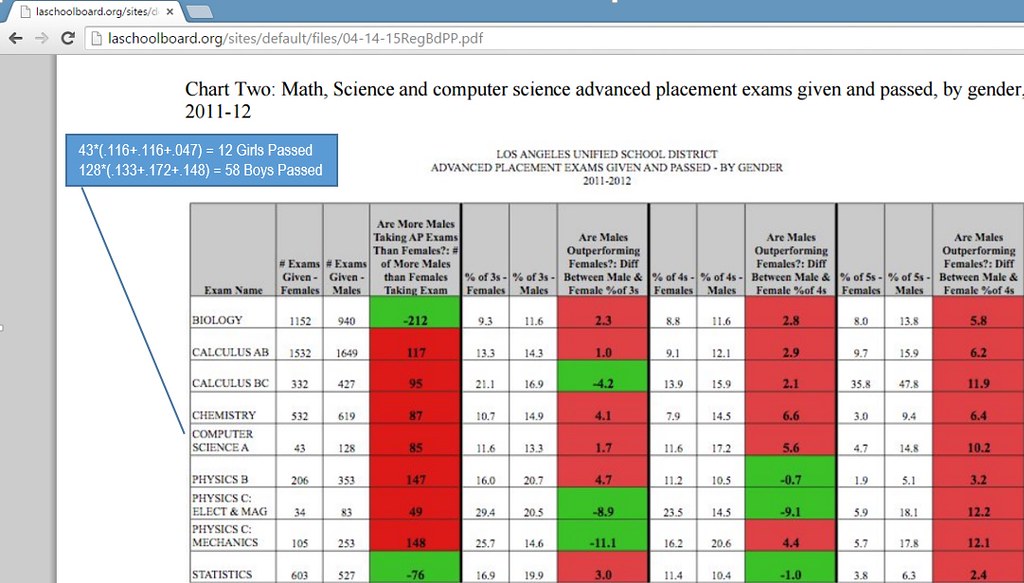
theodp writes: Citing statistics that showed a whopping 46 more boys than girls passed the AP Computer Science Exam in 2011-12, the 640,000+ student Los Angeles Unified School District (LAUSD) on Tuesday approved a waiver to enable the District to operate a single-gender, all-girls STEM School called the Girls Academic Leadership Academy (GALA). Students in GALA will follow a six year sequence of computer courses starting in middle school that will culminate in AP Computer Science Principles. "Fewer females take AP courses in math, science, or computer science, and they are not as successful as males in receiving passing scores of 3, 4 or 5," argued the General Waiver Request (PDF, 700+ pages). "An all girls environment is reasonably necessary for the school to improve the self-confidence of girls in their academic abilities, especially in STEM areas where an achievement gap currently exists. GALA's admissions shall also comply with AB 1266 to ensure male students who identify as female are admitted to the school." The school's CS-related Partners include the UCLA Exploring Computer Science Program, as well as Google-bankrolled Girls Who Code, Black Girls Code, and NCWIT. One of the reasons the all-girls STEM school reportedly got the green light is that its backers satisfied federal regulations requiring a "substantially equal school" for excluded male students by submitting a plan for a companion all-boys school that would emphasize English Language Arts, where they often fall short of girls' test scores, rather than GALA's focus on STEM. One suspects the no-fan-of-gender-restricted-public-schools ACLU may call BS on this maneuver. -
LA Schools Seeking Refund Over Botched iPad Plan
SternisheFan sends news that Los Angeles Unified School District is asking Apple for a refund of the district's effort to equip students with iPads. The project was budgeted at around $1.3 billion to equip its 650,000 students, though only about 120,000 iPads have been purchased so far. After the program went bad, the FBI launched an investigation into their procurement practices. The iPads weren't standalone education devices — they were supposed to work in conjunction with another device carrying curriculum from a company named Pearson. But the district now says the combined tech didn't meet their needs, and they want their money back. Lawyers for the local Board of Education are looking into litigation options. They've also notified Apple and Pearson they won't pay for any new products or services.