Slashdot Mirror
Domain: nature.com
Stories and comments across the archive that link to nature.com.
Stories · 1,757
-
Supercomputers Assist In Search For New, Better Cancer Drugs (utexas.edu)
aarondubrow writes: Finding new drugs that can more effectively kill cancer cells or disrupt the growth of tumors is one way to improve survival rates for ailing patients. Researchers are using supercomputers at the Texas Advanced Computing Center to find new chemotherapy drugs and to test known compounds to determine if they can fight different types of cancer. Recent efforts have yielded promising drug candidates, potential plant-derived compounds and new target sites that can lead to more effective drugs. From the Texas Advanced Computing Center: "Identifying a new drug by intuition or trial and error is expensive and time consuming. Virtual screening, on the other hand, uses computer simulations to explore how a large number of small molecule compounds 'dock,' or bind, to a target to determine if they may be candidates for future drugs. [...] In September 2016, writing in the journal Oncogene, Rommie Amaro, professor of Chemistry and Biochemistry at the University of California, reported results from the largest atomic-level simulation of the tumor suppression protein [p53] to date -- comprising more than 1.5 million atoms. The simulations helped to identify new 'pockets' -- binding sites on the surface of the protein -- where it may be possible to insert a small molecule that could reactivate p53. They revealed a level of complexity that is very difficult, if not impossible, to experimentally test. According to Amaro, computing provides a better understanding of cancer mechanisms and ways to develop possible novel therapeutic avenues." -
Supercomputers Assist In Search For New, Better Cancer Drugs (utexas.edu)
aarondubrow writes: Finding new drugs that can more effectively kill cancer cells or disrupt the growth of tumors is one way to improve survival rates for ailing patients. Researchers are using supercomputers at the Texas Advanced Computing Center to find new chemotherapy drugs and to test known compounds to determine if they can fight different types of cancer. Recent efforts have yielded promising drug candidates, potential plant-derived compounds and new target sites that can lead to more effective drugs. From the Texas Advanced Computing Center: "Identifying a new drug by intuition or trial and error is expensive and time consuming. Virtual screening, on the other hand, uses computer simulations to explore how a large number of small molecule compounds 'dock,' or bind, to a target to determine if they may be candidates for future drugs. [...] In September 2016, writing in the journal Oncogene, Rommie Amaro, professor of Chemistry and Biochemistry at the University of California, reported results from the largest atomic-level simulation of the tumor suppression protein [p53] to date -- comprising more than 1.5 million atoms. The simulations helped to identify new 'pockets' -- binding sites on the surface of the protein -- where it may be possible to insert a small molecule that could reactivate p53. They revealed a level of complexity that is very difficult, if not impossible, to experimentally test. According to Amaro, computing provides a better understanding of cancer mechanisms and ways to develop possible novel therapeutic avenues." -
Supercomputers Assist In Search For New, Better Cancer Drugs (utexas.edu)
aarondubrow writes: Finding new drugs that can more effectively kill cancer cells or disrupt the growth of tumors is one way to improve survival rates for ailing patients. Researchers are using supercomputers at the Texas Advanced Computing Center to find new chemotherapy drugs and to test known compounds to determine if they can fight different types of cancer. Recent efforts have yielded promising drug candidates, potential plant-derived compounds and new target sites that can lead to more effective drugs. From the Texas Advanced Computing Center: "Identifying a new drug by intuition or trial and error is expensive and time consuming. Virtual screening, on the other hand, uses computer simulations to explore how a large number of small molecule compounds 'dock,' or bind, to a target to determine if they may be candidates for future drugs. [...] In September 2016, writing in the journal Oncogene, Rommie Amaro, professor of Chemistry and Biochemistry at the University of California, reported results from the largest atomic-level simulation of the tumor suppression protein [p53] to date -- comprising more than 1.5 million atoms. The simulations helped to identify new 'pockets' -- binding sites on the surface of the protein -- where it may be possible to insert a small molecule that could reactivate p53. They revealed a level of complexity that is very difficult, if not impossible, to experimentally test. According to Amaro, computing provides a better understanding of cancer mechanisms and ways to develop possible novel therapeutic avenues." -
DNA-Based Test Can Spot Cancer Recurrence a Year Before Conventional Scans (theguardian.com)
An anonymous reader quotes a report from The Guardian: A revolutionary blood test has been shown to diagnose the recurrence of cancer up to a year in advance of conventional scans in a major lung cancer trial. The test, known as a liquid biopsy, could buy crucial time for doctors by indicating that cancer is growing in the body when tumors are not yet detectable on CT scans and long before the patient becomes aware of physical symptoms. It works by detecting free-floating mutated DNA, released into the bloodstream by dying cancer cells. In the trial of 100 lung cancer patients, scientists saw precipitous rises in tumor DNA in the blood of patients who would go on to relapse months, or even a year, later. In the latest trial, reported in the journal Nature, 100 patients with non-small cell lung cancer were followed from diagnosis through surgery and chemotherapy, having blood tests every six to eight weeks. By analyzing the patchwork of genetic faults in cells across each tumor, scientists created personalized genomic templates for each patient. This was then compared to the DNA floating in their blood, to assess whether a fraction of it matched that seen in their tumor. -
New Study Suggests Humans Lived In North America 130,000 Years Ago (npr.org)
An anonymous reader writes: In 1992, archaeologists working a highway construction site in San Diego County found the partial skeleton of a mastodon, an elephant-like animal now extinct. Mastodon skeletons aren't so unusual, but there was other strange stuff with it. "The remains were in association with a number of sharply broken rocks and broken bones," says Tom Demere, a paleontologist at the San Diego Natural History Museum. He says the rocks showed clear marks of having been used as hammers and an anvil. And some of the mastodon bones as well as a tooth showed fractures characteristic of being whacked, apparently with those stones. It looked like the work of humans. Yet there were no cut marks on the bones showing that the animal was butchered for meat. Demere thinks these people were after something else. "The suggestion is that this site is strictly for breaking bone," Demere says, "to produce blank material, raw material to make bone tools or to extract marrow." Marrow is a rich source of fatty calories. The scientists knew they'd uncovered something rare. But they didn't realize just how rare for years, until they got a reliable date on how old the bones were by using a uranium-thorium dating technology that didn't exist in the 1990s. The bones were 130,000 years old. That's a jaw-dropping date, as other evidence shows that the earliest humans got to the Americas about 15,000 to 20,000 years ago. The study has been published in the journal Nature. -
An Artificial Womb Successfully Grew Baby Sheep -- and Humans Could Be Next (theverge.com)
An anonymous reader quotes a report from The Verge: Inside what look like oversized ziplock bags strewn with tubes of blood and fluid, eight fetal lambs continued to develop -- much like they would have inside their mothers. Over four weeks, their lungs and brains grew, they sprouted wool, opened their eyes, wriggled around, and learned to swallow, according to a new study that takes the first step toward an artificial womb. One day, this device could help to bring premature human babies to term outside the uterus -- but right now, it has only been tested on sheep. The Biobag may not look much like a womb, but it contains the same key parts: a clear plastic bag that encloses the fetal lamb and protects it from the outside world, like the uterus would; an electrolyte solution that bathes the lamb similarly to the amniotic fluid in the uterus; and a way for the fetus to circulate its blood and exchange carbon dioxide for oxygen. Flake and his colleagues published their results today in the journal Nature Communications. -
107 Cancer Papers Retracted Due To Peer Review Fraud (arstechnica.com)
An anonymous reader quotes a report from Ars Technica: The journal Tumor Biology is retracting 107 research papers after discovering that the authors faked the peer review process. This isn't the journal's first rodeo. Late last year, 58 papers were retracted from seven different journals -- 25 came from Tumor Biology for the same reason. It's possible to fake peer review because authors are often asked to suggest potential reviewers for their own papers. This is done because research subjects are often blindingly niche; a researcher working in a sub-sub-field may be more aware than the journal editor of who is best-placed to assess the work. But some journals go further and request, or allow, authors to submit the contact details of these potential reviewers. If the editor isn't aware of the potential for a scam, they then merrily send the requests for review out to fake e-mail addresses, often using the names of actual researchers. And at the other end of the fake e-mail address is someone who's in on the game and happy to send in a friendly review. This most recent avalanche of fake-reviewed papers was discovered because of extra screening at the journal. According to an official statement from Springer, the company that published Tumor Biology until this year, "the decision was made to screen new papers before they are released to production." The extra screening turned up the names of fake reviewers that hadn't previously been detected, and "in order to clean up our scientific records, we will now start retracting these affected articles...Springer will continue to proactively investigate these issues." -
First Evidence For Higher State of Consciousness Found (neurosciencenews.com)
New submitter baalcat quotes a report from Neuroscience News: Neuroscientists observed a sustained increase in neural signal diversity -- a measure of the complexity of brain activity -- of people under the influence of psychedelic drugs, compared with when they were in a normal waking state. The diversity of brain signals provides a mathematical index of the level of consciousness. For example, people who are awake have been shown to have more diverse neural activity using this scale than those who are asleep. This, however, is the first study to show brain-signal diversity that is higher than baseline, that is higher than in someone who is simply "awake and aware." Previous studies have tended to focus on lowered states of consciousness, such as sleep, anesthesia, or the so-called "vegetative" state. For the study, Michael Schartner, Dr Adam Barrett and Professor Seth of the Sackler Center reanalyzed data that had previously been collected by Imperial College London and the University of Cardiff in which healthy volunteers were given one of three drugs known to induce a psychedelic state: psilocybin, ketamine and LSD. Using brain imaging technology, they measured the tiny magnetic fields produced in the brain and found that, across all three drugs, this measure of conscious level -- the neural signal diversity -- was reliably higher. The findings have been published in Scientific Reports. -
Glowing Bacteria Detect Buried Landmines (sciencemag.org)
sciencehabit quotes a report from Science Magazine: More than 100 million landmines lay hidden in the ground around the world, but glowing bacteria may help us find them, according to a new study. The approach relies on small quantities of vapor released from the common explosive TNT. Previously, researchers engineered E. coli to glow green upon detection of DNT, a byproduct of TNT. In a study published in Nature Biotechnology today, the same team reports on a small field test with mines buried in sand and soil, whose triggering mechanisms were removed. The scientists loaded about 100,000 DNT-detecting bacterial cells into a single bead made of polymers derived from seaweed and sprinkled these beads over the landmine site at night. Twenty-four hours later, they used a laser to remotely detect and quantify fluorescing bacteria from 20 meters away, mapping the location of the landmines. -
Scientists Identify Parts of Brain Involved In Dreaming (theguardian.com)
An anonymous reader quotes a report from The Guardian: Scientists have unpicked the regions of the brain involved in dreaming, in a study with significant implications for our understanding of the purpose of dreams and of consciousness itself. What's more, changes in brain activity have been found to offer clues as to what the dream is about. Writing in the journal Nature Neuroscience, Siclari and colleagues from the U.S., Switzerland and Italy, reveal how they carried out a series of experiments involving 46 participants, each of whom had their brain activity recorded while they slept by electroencephalogram (EEG) -- a noninvasive technique that involved placing up to 256 electrodes on the scalp and face to monitor the number and size of brainwaves of different speeds. While the experiments probed different aspects of the puzzle, all involved participants being woken at various points throughout the night and asked to report whether they had been dreaming. If the participants had been dreaming, they were asked how long they thought it had lasted and whether they could remember anything about their dream, such as whether it involved faces, movement or thinking, or whether it was instead a vivid, sensory experience. Analysis of the EEG recording reveal that dreaming was linked to a drop in low-frequency activity in a region at the back of the brain dubbed by the researchers the "posterior cortical hot zone" -- a region that includes visual areas as well as areas involved in integrating the senses. The result held regardless of whether the dream was remembered or not and whether it occurred during REM or non-REM sleep. The researchers also looked at changes in high-frequency activity in the brain, finding that dreaming was linked to an increase in such activity in the so-called "hot zone" during non-REM sleep. Further, the team identified the region of the brain which appears to be important in remembering what a dream was about, finding that this recall was linked to an increase in high-frequency activity towards the front of the brain. A similar pattern of activity was seen in the hot zone and beyond for dreams during REM sleep. The upshot is that dreaming is rooted in the same changes in brain activity regardless of the type of sleep. -
Belgian Scientists Inhibit Protein Responsible For Allergic Reactions (ugent.be)
lhunath writes: Scientists at the University of Gent exposed the TSLP protein's function in triggering allergic reactions such as asthma and eczema. The team then developed a protein-based inhibitor used to capture TSLP and prevent its bioactivity as it associates with its natural receptors. Using this method, allergic reactions can be inhibited before they are triggered.
The team's results were recently published in Nature, where they share a vision that their work "will guide therapeutic approaches that manipulate human TSLP-mediated signalling to treat allergic diseases." -
Graphene-Based Sieve Turns Seawater Into Drinking Water (bbc.com)
An anonymous reader quotes a report from BBC: A UK-based team of researchers has created a graphene-based sieve capable of removing salt from seawater. The sought-after development could aid the millions of people without ready access to clean drinking water. The promising graphene oxide sieve could be highly efficient at filtering salts, and will now be tested against existing desalination membranes. It has previously been difficult to manufacture graphene-based barriers on an industrial scale. Reporting their results in the journal Nature Nanotechnology, scientists from the University of Manchester, led by Dr Rahul Nair, shows how they solved some of the challenges by using a chemical derivative called graphene oxide. Isolated and characterized by a University of Manchester-led team in 2004, graphene comprises a single layer of carbon atoms arranged in a hexagonal lattice. Its unusual properties, such as extraordinary tensile strength and electrical conductivity, have earmarked it as one of the most promising materials for future applications. But it has been difficult to produce large quantities of single-layer graphene using existing methods, such as chemical vapor deposition (CVD). Current production routes are also quite costly. On the other hand, said Dr Nair, "graphene oxide can be produced by simple oxidation in the lab." Graphene oxide membranes have already proven their worth in sieving out small nanoparticles, organic molecules and even large salts. But until now, they couldn't be used to filter out common salts, which require even smaller sieves. Previous work had shown that graphene oxide membranes became slightly swollen when immersed in water, allowing smaller salts to flow through the pores along with water molecules. Now, Dr Nair and colleagues demonstrated that placing walls made of epoxy resin (a substance used in coatings and glues) on either side of the graphene oxide membrane was sufficient to stop the expansion. -
An Unexpected Relationship Between Nuclear Power and Low Birth Weight (arstechnica.com)
Applehu Akbar writes: Ars Technica reports on a Carnegie-Mellon study of an unexpected side effect of the slowdown in nuclear plant construction after Chernobyl and Three Mile Island. The pollution associated with replacing the power in places where nuclear plants were delayed or canceled has resulted in significantly lower birth weights for children born in the region. The impact on birth weight starts at 97g less in the second quarter after a nuclear shutdown and goes to 146g for in the third quarter, and of similar magnitude thereafter. Though the steady shift in recent years from coal to natural gas has probably slowed this trend down (no update to the study has been announced) because gas pollutes less, Trump's policy of bringing back coal may mean that micro-babies are back in fashion. Here's an excerpt from Ars Technica's report: "[Carnegie Mellon assistant professor of economics and public policy Edson Severnini] looked at the closure of the Browns Ferry nuclear plant in Alabama in 1985 as well as the Sequoyah plant in Tennessee, which was closed from 1985 to 1988. The closure of the two plants corresponded to increased coal burning at nearby coal plants -- in 1985, TVA noted in its annual report that coal plants had 'extraordinary performance' due to the shut down of the nuclear plants. He also gathered birth-weight data from the National Centre for Health Statistics (NCHS) and found that babies born in regions with the biggest increase in coal burning had lower birth weights than babies born in other nearby areas. Looking at data from 1983 to 1985, before the nuclear plant shut down, also showed that the largest change in birth weight occurred after the shutdown." -
Scientists Turn Mammalian Cells Into Complex Biocomputers (sciencemag.org)
sciencehabit quotes a report from Science Magazine: Computer hardware is getting a softer side. A research team has come up with a way of genetically engineering the DNA of mammalian cells to carry out complex computations, in effect turning the cells into biocomputers. The group hasn't put those modified cells to work in useful ways yet, but down the road researchers hope the new programming techniques will help improve everything from cancer therapy to on-demand tissues that can replace worn-out body parts. To upgrade their DNA "switches," Wong and his colleagues steered clear of transcription factors and instead switched human kidney cell genes on and off using scissor-like enzymes that selectively cut out snippets of DNA. These enzymes, known as DNA recombinases, recognize two target stretches of DNA, each between 30 to 50 or more base pairs long. When a recombinase finds its target DNA stretches, it cuts out any DNA in between, and stitches the severed ends of the double helix back together. To design genetic circuits, Wong and his colleagues use the conventional cellular machinery that reads out a cell's DNA, transcribes its genes into RNA, and then translates the RNA into proteins. This normal gene-to-protein operation is initiated by another DNA snippet, a promoter, that sits just upstream of a gene. When a promoter is activated, a molecule called RNA polymerase gets to work, marching down the DNA strand and producing an RNA until it reaches another DNA snippet -- a termination sequence -- that tells it to stop. To make one of their simplest circuits, Wong's team inserted four extra snippets of DNA after a promoter. The main one produced green fluorescent protein (GFP), which lights up cells when it is produced. But in front of it was a termination sequence, flanked by two snippets that signaled the DNA recombinase. Wong and his team then inserted another gene in the same cell that made a modified recombinase, activated only when bound to a specific drug; without it, the recombinase wouldn't cut the DNA. When the promoter upstream of the GFP gene was activated, the RNA polymerase ran headfirst into the termination sequence, stopped reading the DNA, and didn't produce the fluorescent protein. But when the drug was added, the recombinase switched on and spliced out the termination sequence that was preventing the RNA polymerase from initiating production of GFP. Voila, the cell lit up. The approach Wong and his colleagues used worked so well that they were able to build 113 different circuits, with a 96.5% success rate. The study has been published in the journal Nature. -
Climate Change Is Altering Global Air Currents (independent.co.uk)
An anonymous reader quotes a report from The Independent: One of the scientists who demonstrated conclusively that global warming was an unnatural event with the famous "hockey stick" graph is now warning that giant jetstreams which circle the planet are being altered by climate change. Jetstreams are influenced by the difference in temperatures between the Arctic and the equator. But the Arctic has been warming much faster than tropical climates -- the island of Svalbard, for example was 6.5 degrees celsius warmer last year compared to the average between 1961 and 1990. The land has also been warming faster than the sea. Both of those factors were changing the flow of these major air currents to create "extreme meanders" which were helping to cause "extreme weather events", Professor Michael Mann said. In a paper in the journal Scientific Reports, Professor Mann and other researchers wrote that evidence of the effect of climate change on the jetstreams had "only recently emerged from the background noise of natural variability." They said that projections of the effect on the jetstreams in "state-of-the-art" climate models were "mirrored" in "multiple" actual temperature measurements. The jetstream normally flows reasonably consistently around the planet, but can develop loops extending north and south. The researchers, who studied temperature records going back to 1870 as well as satellite data, said these loops could grow "very large" or even "grind to a halt" rather than moving from west to east. The effect has been most pronounced during the past 40 years, they found. -
Researchers Discover A Surprising New Role for Lungs: Making Blood (ucsf.edu)
schwit1 quotes ScienceAlert: In experiments involving mice, the team found that lungs produce more than 10 million platelets (tiny blood cells) per hour, equating to the majority of platelets in the animals' circulation. This goes against the decades-long assumption that bone marrow produces all of our blood components. Researchers from the University of California, San Francisco also discovered a previously unknown pool of blood stem cells that makes this happen inside the lung tissue -- cells that were incorrectly assumed to mainly reside in bone marrow. "This finding definitely suggests a more sophisticated view of the lungs -- that they're not just for respiration, but also a key partner in formation of crucial aspects of the blood," says one of the researchers, Mark R. Looney.
The platelet-producing cells actually migrate from the bone marrow to the lungs. -
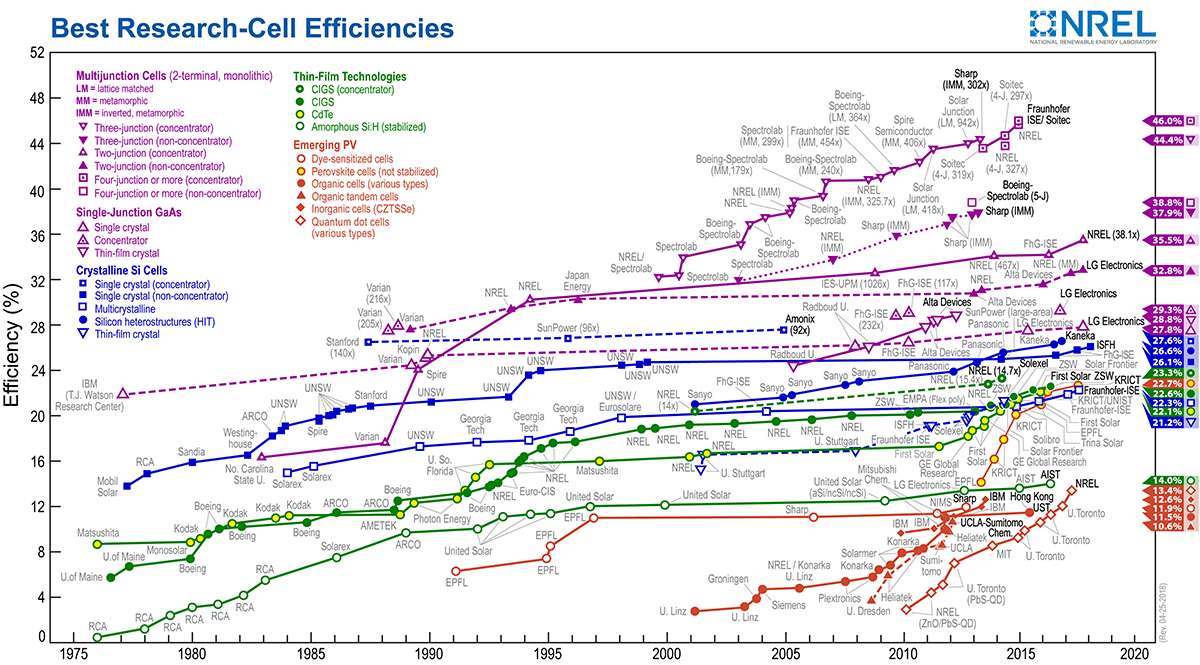
Japanese Company Develops a Solar Cell With Record-Breaking 26%+ Efficiency (arstechnica.com)
An anonymous reader quotes a report from Ars Technica: The silicon-based cells that make up a solar panel have a theoretical efficiency limit of 29 percent, but so far that number has proven elusive. Practical efficiency rates in the low-20-percent range have been considered very good for commercial solar panels. But researchers with Japanese chemical manufacturer Kaneka Corporation have built a solar cell with a photo conversion rate of 26.3 percent, breaking the previous record of 25.6 percent. Although it's just a 2.7 percent increase in efficiency, improvements in commercially viable solar cell technology are increasingly hard-won. Not only that, but the researchers noted in their paper that after they submitted their article to Nature Energy, they were able to further optimize their solar cell to achieve 26.6 percent efficiency. That result has been recognized by the National Renewable Energy Lab (NREL). In the Nature Energy paper, the researchers described building a 180.4 cm2 cell using high-quality thin-film heterojunction (HJ) -- that is, layering silicon within the cell to minimize band gaps where electron states can't exist. Controlling heterojunctions is a known technique among solar cell builders -- Panasonic uses it and will likely incorporate it into cells built for Tesla at the Solar City plant in Buffalo, and Kaneka has its own proprietary heterojunction techniques. For this record-breaking solar cell, the Kaneka researchers also placed low-resistance electrodes toward the rear of the cell, which maximized the number of photons that collected inside the cell from the front. And, as is common on many solar cells, they coated the front of the cell with a layer of amorphous silicon and an anti-reflective layer to protect the cell's components and collect photons more efficiently. -
Satellite Navigation 'Switches Off' Parts of Brain Used For Navigation, Study Finds (scientificamerican.com)
A new study published today in the journal Nature Communications reveals some of the drawbacks of using satellite navigation (SatNav) technology. After scanning the brains of 24 volunteers as they explored a simulation through the streets of London's Soho district, researchers from the University of London found that listening to a satellite navigation's instructions "switches off" activity in parts of the brain used for navigation. Scientific American reports: The researchers found that a brain structure called the hippocampus, which is involved in both memory and spatial navigation, appears to encode two different maps of the environment: One tracks the distance to the final destination as the crow flies and is encoded by the frontal region of the hippocampus, the other tracks the "true path" to the goal and is encoded by its rear region. During the navigation tasks, the hippocampus acts like a flexible guidance system, flipping between these two maps according to changing demands. Activity in the hippocampal rear region acts like a homing signal, increasing as the goal gets closer. Analysis of the brain-scanning data revealed activity in the rear right of the hippocampus increased whenever the participants entered a new street while navigating. It also varied with the number of new path options available. The more alternatives there were, the greater the brain activity. The researchers also found that activity in the front of the hippocampus was associated with a property called centrality, defined by the proximity of each new street to the center of the network. Further, they observed activity in the participants' prefrontal cortices when they were forced to make a detour and had to replan their route -- and this, too, increased in relation to the number of options available. Intriguingly, when participants followed SatNav instructions, however, brain activity in these regions "switched off." Together, the new findings suggest the rear portion of the hippocampus reactivates spatial memories of possible navigation paths, with more available paths evoking more activity, and that the prefrontal cortex may contribute to path-planning by searching though different route options and selecting the best one. -
Climate Shaped the Human Nose, Researchers Say (theguardian.com)
An anonymous reader quotes a report from The Guardian: Human noses have been shaped by climate, according to research probing variation in the human snout. Researchers say their findings back up the theory that wider nostrils developed in populations living in warm, humid conditions, while populations living in high latitudes, such as northern Europe, developed narrower nostrils as an adaptation to the chilly, dry conditions. Writing in the journal Plos Genetics, researchers from the U.S., Ireland and Belgium describe how they began to unpick variations in nose shape by using 3D facial imaging to take a host of measurements from 476 volunteers of south Asian, east Asian, west African and northern European ancestry. The results revealed that only two out of seven nose-related traits were found to differ more between the populations than would be expected from the impact of random, chance changes in genetic makeup over time. The authors say that suggests variations in those traits have been influenced by natural selection. With further analysis, based on data from participants of west African and European ancestry, confirming that nose shape is highly heritable, the team looked to see if there was a link between nose shape and climate. The results showed that nostril width is linked to temperature and absolute humidity, with participants whose ancestors lived in warm-humid climates on average having wider nostrils than those whose ancestors lived in cool-dry climates. That, says Arslan Zaidi, co-author of the study from Pennsylvania State University, could be because narrower nasal passages help to increase the moisture content of air and warm it -- a bonus for those in higher latitudes. -
US Federal Budget Proposal Cuts Science Funding (washingtonpost.com)
hey! writes: The U.S. Office of Management and Budget has released a budget "blueprint" which outlines substantial cuts in both basic research and applied technology funding. The proposal includes a whopping 18% reduction in National Institutes of Health medical research. NIH does get a new $500 million fund to track emerging infectious agents like Zika in the U.S., but loses its funding to monitor those agents overseas. The Department of Energy's research programs also get an 18% cut in research, potentially affecting basic physics research, high energy physics, fusion research, and supercomputing. Advanced Research Projects Agency (ARPA-E) gets the ax, as does the Advanced Technology Vehicle Manufacturing Program, which enabled Tesla to manufacture its Model S sedan. EPA loses all climate research funding, and about half the research funding targeted at human health impacts of pollution. The Energy Star program is eliminated; Superfund funding is drastically reduced. The Chesapeake Bay and Great Lakes cleanup programs are also eliminated, as is all screening of pesticides for endocrine disruption. In the Department of Commerce, Sea Grant is eliminated, along with all coastal zone research funding. Existing weather satellites GOES and JPSS continue funding, but JPSS-3 and -4 appear to be getting the ax. Support for transfer of federally funded research and technology to small and mid-sized manufacturers is eliminated. NASA gets a slight trim, and a new focus on deep space exploration paid for by an elimination of Earth Science programs. You can read more about this "blueprint" in Nature, Science, and the Washington Post, which broke the story. The Environmental Protection Agency, the State Department and Agriculture Department took the hardest hits, while the Defense Department, Department of Homeland Security, and Department of Veterans Affairs have seen their budgets grow. -
US Federal Budget Proposal Cuts Science Funding (washingtonpost.com)
hey! writes: The U.S. Office of Management and Budget has released a budget "blueprint" which outlines substantial cuts in both basic research and applied technology funding. The proposal includes a whopping 18% reduction in National Institutes of Health medical research. NIH does get a new $500 million fund to track emerging infectious agents like Zika in the U.S., but loses its funding to monitor those agents overseas. The Department of Energy's research programs also get an 18% cut in research, potentially affecting basic physics research, high energy physics, fusion research, and supercomputing. Advanced Research Projects Agency (ARPA-E) gets the ax, as does the Advanced Technology Vehicle Manufacturing Program, which enabled Tesla to manufacture its Model S sedan. EPA loses all climate research funding, and about half the research funding targeted at human health impacts of pollution. The Energy Star program is eliminated; Superfund funding is drastically reduced. The Chesapeake Bay and Great Lakes cleanup programs are also eliminated, as is all screening of pesticides for endocrine disruption. In the Department of Commerce, Sea Grant is eliminated, along with all coastal zone research funding. Existing weather satellites GOES and JPSS continue funding, but JPSS-3 and -4 appear to be getting the ax. Support for transfer of federally funded research and technology to small and mid-sized manufacturers is eliminated. NASA gets a slight trim, and a new focus on deep space exploration paid for by an elimination of Earth Science programs. You can read more about this "blueprint" in Nature, Science, and the Washington Post, which broke the story. The Environmental Protection Agency, the State Department and Agriculture Department took the hardest hits, while the Defense Department, Department of Homeland Security, and Department of Veterans Affairs have seen their budgets grow. -
Researchers Convert Biomass To Hydrogen Using Sunlight (rdmag.com)
New submitter omaha393 writes: Cambridge chemists have developed a new catalytic approach capable of converting biomass into hydrogen gas using only sunlight as an energy source. The method converts lignocellulose, one of Earth's most abundant biomaterials, into hydrogen gas and organic byproducts when in a basic water and in the presence of the cadmium sulfide/oxide nanoparticle catalysts. The new method, published in Nature Energy, offers a relatively cheap fuel alternative that researchers are looking to scale up to meet consumer demands at the industrial level. Per R&D Magazine: "'With this in place we can simply add organic matter to the system and then, provided it's a sunny day, produce hydrogen fuel,' says joint lead author David Wakerley. 'Future development can be envisioned at any scale.'" In addition to lignocellulose, the team was also able to produce hydrogen gas using unprocessed material including wood, paper and leaves. Further reading: New Atlas; ScienceDaily -
West African Village Weighs Using Genetically Modified Mosquitoes In Malaria Fight (scientificamerican.com)
New submitter omaha393 writes: A public engagement campaign is underway in the hopes of convincing Burkina Faso residents to allow the release of genetically modified mosquitoes to combat deadly mosquito-borne pathogens. GM mosquitoes rely on a technology called "gene drives." Different gene drives offer different solutions, typically leading to subsequent broods being sterile, predominantly male, resistant to infection or nonviable due to toxic traits. Researchers in this case are only in the preliminary stages of releasing sterile males but hope to begin wider releases of GM mosquitoes in about 6 years.
Burkina Faso is not the only country to pursue GM mosquitoes in efforts to prevent disease. Brazil has become a testing ground for wide release, and last fall voters in Florida Keys approved measures to begin releasing GM mosquitoes to fight the spread of Zika. Both the WHO and the U.S. FDA have approved the technique, but skeptics are critical of the method. -
IBM Researchers Prove It Is Possible To Store Data In a Single Atom (techcrunch.com)
In an experiment published today in Nature, IBM researchers have managed to read and write data to a single atom. A previous atomic storage technique, as mentioned by TechCrunch, doesn't actually store data in the atom, but moves them around to form readable patterns. "This means that imbuing individual atoms with a 0 or 1 is the next major step forward and the next major barrier in storing data digitally, both increasing capacity by orders of magnitude and presenting a brand new challenge to engineers and physicists," reports TechCrunch. From the report: It works like this: A single Holmium atom (a large one with many unpaired electrons) is set on a bed of magnesium oxide. In this configuration, the atom has what's called magnetic bistability: It has two stable magnetic states with different spins (just go with it). The researchers use a scanning tunneling microscope (also invented at IBM, in the 1980s) to apply about 150 millivolts at 10 microamps to the atom -- it doesn't sound like a lot, but at that scale, it's like a lightning strike. This huge influx of electrons causes the Holmium atom to switch its magnetic spin state. Because the two states have different conductivity profiles, the STM tip can detect which state the atom is in by applying a lower voltage (about 75 millivolts) and sensing its resistance. In order to be absolutely sure the atom was changing its magnetic state and this wasn't just some interference or effect from the STM's electric storm, the researchers set an iron atom down nearby. This atom is affected by its magnetic neighborhood, and acted differently when probed while the Holmium atom was in its different states. This proves that the experiment truly creates a lasting, stored magnetic state in a single atom that can be detected indirectly. And there you have it: a single atom used to store what amounts to a 0 or a 1. The experimenters made two of them and zapped them independently to form the four binary combinations (00,01,10,11) that two such nodes can form. -
The Quest To Crystallize Time - Previously Considered Impossible, Researchers Create Time Crystals (nature.com)
New submitter omaha393 writes: Researchers have addressed a perplexing issue in physics: the existence of time crystals. Time crystals, previously only hypothetical in nature, are structures that oscillate without any external energy supplied. The idea of time crystals set off a massive feud among physicists, arguing that such a state of matter could not exist. As leading time crystal proponent Frank Wilczek describes it: "conceptually, it is a clock that ticks forever without being wound." With the paper published in Nature Wednesday, researchers showed their method of production and the unusual nature of time crystals, which owe their oscillation properties to never achieving a state of equilibrium. From a report on Phys.org: Ordinary crystals such as diamonds, quartz or ice are made up of molecules that spontaneously arrange into orderly three-dimensional patterns. The sodium and chlorine atoms in a crystal of salt, for example, are spaced at regular intervals, forming a hexagonal lattice. In time crystals, however, atoms are arranged in patterns not only in space, but also in time. In addition to containing a pattern that repeats in space, time crystals contain a pattern that repeats over time. One way this could happen is that the atoms in the crystal move at a certain rate. Were a time crystal of ice to exist, all of the water molecules would vibrate at an identical frequency. What is more, the molecules would do this without any input from the outside world. [...] Shivaji Sondhi, a Princeton professor of physics said that the work addresses some of the most fundamental questions about the nature of matter. "It was thought that if a system doesn't settle down and come to equilibrium, you couldn't really say that it is in a phase. It is a big deal when you can give a definition of a phase of matter when the matter is not in equilibrium," he said. -
Researchers Create New Form of Matter (phys.org)
An anonymous reader quotes a report from Phys.Org: MIT physicists have created a new form of matter, a supersolid, which combines the properties of solids with those of superfluids. By using lasers to manipulate a superfluid gas known as a Bose-Einstein condensate, the team was able to coax the condensate into a quantum phase of matter that has a rigid structure -- like a solid -- and can flow without viscosity -- a key characteristic of a superfluid. Studies into this apparently contradictory phase of matter could yield deeper insights into superfluids and superconductors, which are important for improvements in technologies such as superconducting magnets and sensors, as well as efficient energy transport. The researchers report their results this week in the journal Nature. The team used a combination of laser cooling and evaporative cooling methods, originally co-developed by Ketterle, to cool atoms of sodium to nanokelvin temperatures. Atoms of sodium are known as bosons, for their even number of nucleons and electrons. When cooled to near absolute zero, bosons form a superfluid state of dilute gas, called a Bose-Einstein condensate, or BEC. To create the supersolid state, the team manipulated the motion of the atoms of the BEC using laser beams, introducing "spin-orbit coupling." In their ultrahigh-vacuum chamber, the team used an initial set of lasers to convert half of the condensate's atoms to a different quantum state, or spin, essentially creating a mixture of two Bose-Einstein condensates. Additional laser beams then transferred atoms between the two condensates, called a "spin flip." -
Life Expectancy Set To Hit 90 In South Korea, Study Predicts (nature.com)
According to a study published in the journal The Lancet, researchers have predicted that South Korea will likely become the first country where the average life expectancy will exceed 90 years. The researchers led by public-health researcher Majid Ezzati at Imperial College London used data from the World Health Organization and a suite of 21 statistical models they developed to figure out how life expectancy will change in 35 developed countries by 2030. Nature reports: Life expectancy is expected to increase in all 35 countries, in keeping with steady progress in recent decades, the team found. But it is South Korean women who will be living longest by 2030: there is a nearly 60% chance that their life expectancy at birth will exceed 90 years by that time, the team calculates. Girls born in the country that year can expect to live, on average, to nearly 91, and boys to 84, the highest in the world for both sexes. The nation's rapid improvement in life expectancy -- the country was ranked twenty-ninth for women in 1985 -- is probably down to overall improvements in economic status and child nutrition, the study notes, among other factors. South Koreans also have relatively equal access to health care, lower blood pressure than people in Western countries and low rates of smoking among women. As for the United States, the life expectancy is "predicted to be among the lowest of these countries by 2030; 80 for men (similar to the Czech Republic) and 83 for women (similar to Mexico)." -
SpaceX's Next Launch Carries Colonies Of A Drug-Resistant Superbug (businessinsider.com.au)
An anonymous reader quotes Business Insider: SpaceX is preparing to launch a lethal, antibiotic-resistant superbug into orbit...to live its days in the microgravity environment of the International Space Station. The idea is not to weaponize space with MRSA -- a bacterium that kills more Americans every year than HIV/AIDS, Parkinson's disease, emphysema, and homicide combined -- but to send its mutation rates into hyperdrive, allowing scientists to see the pathogen's next moves well before they appear on Earth. The NASA-funded study will see SpaceX's Falcon 9 rocket launch colonies of MRSA into space, to be cultivated in the US National Laboratory on the International Space Station.
"We will leverage the microgravity environment on the ISS to accelerate the Precision Medicine revolution here on Earth," lead researcher Anita Goel, CEO of biotech company Nanobiosym, told Yahoo News... "Our ability to anticipate drug-resistant mutations with Gene-RADAR will lead to next generation antibiotics that are more precisely tailored to stop the spread of the world's most dangerous pathogens," says Goel.
That launch was scheduled for today, but SpaceX postponed it to "take a closer look at positioning of the second stage engine nozzle." [UPDATE: The launch was completed successfully on Sunday.] Two more externally-mounted payloads will conduct other experiments, with one monitoring lightning strikes on earth and the other measuring chemicals in the earth's atmosphere. In addition, there's also 21 science experiments that were submitted by high school students
Meanwhile, Slashdot reader tomhath brings news that researchers have discovered the red berries of a U.S. weed can help fight superbugs. The researchers found "extracts from the Brazilian peppertree, which traditional healers in the Amazon have used for hundreds of years to treat skin and soft-tissue infections, have the power to stop methicillin-resistant MRSA infections in mice." One of the researchers said the extract "weakens the bacteria so the mouse's own defenses work better." -
Scientists Use Stem Cells To Grow Animal-Free Pork In a Lab (digitaltrends.com)
A new study published in the journal Scientific Reports describes research "designed to generate muscle from a newly established pig stem-cell line, rather than from primary cells taken directly from a pig," says co-author Dr. Nicholas Genovese, a stem-cell biologist. "This entailed understanding the biology of relatively uncharacterized and recently-derived porcine induced pluripotent stem cell lines. What conditions support cell growth, survival and differentiation? These are all questions I had to figure out in the lab before the cells could be turned into muscle." Digital Trends reports: It may not sound like the most appetizing of foodstuffs, but pig skeletal muscle is in fact the main component of pork. The fact that it could be grown from a stem-cell line, rather than from a whole pig, is a major advance. This is also true of the paper's second big development: the fact that this cultivation of pig skeletal muscle didn't use animal serum, a component which has been used in other livestock muscle cultivation processes. [Genovese] acknowledges that there are other non-food-related possibilities the work hints at. "There is a contingent interest in using the pig as a model to study disease and test regenerative therapies for human conditions," he said. -
Lost Winston Churchill Essay Reveals His Thoughts On Alien Life (theverge.com)
"A newly discovered essay by Winston Churchill shows that the British statesman gave a lot of thought to the existential question that has inspired years of scientific research and blockbuster movies: are we alone in the University?" reports The Verge. "The essay was drafted in the 1930s, but unearthed in a museum in Missouri last year." Astrophysicist Mario Livio was the first scientist to analyze the article and has published his comments in the journal Nature. The Verge reports: Livio was "stunned" when he first saw the unpublished, 11-page essay on the existence of alien life, he tells The Verge. The astrophysicist was visiting Westminster College in Fulton, Missouri, for a talk last year, when he was approached by Timothy Riley, the director of Fulton's US National Churchill Museum. Riley showed him the essay, titled "Are We Alone in the Universe?" In the essay, Churchill reasons that we can't possibly be alone in the Universe -- and that many other Suns will likely have many other planets that could harbor life. Because of how enormously distant these extrasolar planets are, we may never know if they "house living creatures, or even plants," Churchill concludes. He wrote this decades before exoplanets were discovered in the 1990s; hundreds have since been detected. What's impressive about the essay is the way Churchill approaches the existential and scientific question of whether life exists on other planets, Livio says. Churchill's reasoning mirrors extremely well the way scientists think about this problem today. The British leader also talks about several theories that still guide the search for alien life, Livio says. For example, he notes that water is the key ingredient for life on Earth, and so finding water on other planets could mean finding life there. Churchill also notes that life can only survive in regions "between a few degrees of frost and the boiling point of water" -- what today we call the habitable zone, the region around a star that is neither too hot or too cold, so that liquid water may exist on the planet's surface. -
Autism Starts Months Before Symptoms Appear, Study Shows (scientificamerican.com)
A new study published this week in the journal Nature suggests there is evidence of autism in the brain well before symptoms start to appear. Typically, the earliest that children are diagnosed with the disorder is at the age of two, although often times it is even later. Scientists may now be able to detect the disorder well before a child's first birthday via a magnetic resonance imaging (MRI) scan. Scientific American reports: Researchers conducted MRI scans on 150 children three times: at six months old, one year and two years. Just over 100 of the children were at high risk because they had an older sibling diagnosed with autism. The faster growth rate of the surface areas of their brains correctly predicted eight times out of 10 which of the high-risk children would go on to be diagnosed with the condition. Enlargement of the brain seemed to correlate with the arrival of symptoms, says Heather Hazlett, a psychologist at the University of North Carolina's Carolina Institute for Developmental Disabilities (CIDD), and the paper's lead author. Still, with only 100 at-risk children, the study is too small to be considered definitive -- nor should doctors rush to use MRIs to diagnose autism, Hazlett says. But if the study results are confirmed in future research, it could offer a new option for screening high-risk children before their symptoms become obvious -- and possibly at a time when treatment will be most effective. -
Banned Chemicals From 1970's Persist In Deepest Reaches of the Pacific Ocean, Study Shows (bbc.com)
walterbyrd quotes a report from BBC: Scientists were surprised by the relatively high concentrations of pollutants like PCBs and PBDEs in deep sea ecosystems. Used widely during much of the 20th Century, these chemicals were later found to be toxic and to build up in the environment. The results are published in the journal Nature Ecology and Evolution. The team led by Dr Alan Jamieson at the University of Newcastle sampled levels of pollutants in the fatty tissue of amphipods (a type of crustacean) from deep below the Pacific Ocean surface. The pollutants found in the amphipods included polychlorinated biphenyls (PCBs) and polybrominated diphenyl ethers (PBDEs), which were commonly used as electrical insulators and flame retardants. PCB production was banned by the U.S. in 1979 and by the Stockholm Convention on Persistent Organic Pollutants, a UN treaty signed in 2001. From the 1930s to when PCBs were banned in the 1970s, the total global production of these chemicals is estimated to be in the region of 1.3 million tons. Released into the environment through industrial accidents and discharges from landfills, these pollutants are resistant to being broken down naturally, and so persist in the environment. The authors of the study say that the deep ocean can become a "sink" or repository for pollutants. They argue that the chemicals accumulate through the food chain so that when they reach the deep ocean, concentrations are many times higher than in surface waters. -
Amputees Control Virtual Prosthetic Arm Using Nerve Signals (newscientist.com)
CanadianRealist writes: Current prosthetic arms are usually controlled by detecting signals from the user twitching muscles in the shoulder or arm. This allows only a limited number of possible movements, such as grasp and release. Researchers have developed a new technique that interprets signals from motor neurons in the spinal cord, allowing for a greater range of control of an arm. Signals from nerves associated with hand and arm movements were mapped to the corresponding movements. Test subjects were able to move a virtual prosthetic arm with greater freedom than has been achieved with muscle-controlled prosthetics. (Note: A virtual prosthetic arm was used rather than a real one as this work is still in the early stages.) The study has been published in the journal Nature Biomedical Engineering. -
Scientists Successfully Decode the Genome of Quinoa (bbc.com)
Gr8Apes writes: Scientists have successfully decoded the genome of quinoa, a hugely popular "super-food" because it is well balanced and gluten-free. They have pinpointed one of the genes that they believe control the production of saponins (bitter toxic compounds that protect the plant from predators) which can facilitate the breeding of plants without saponins, resulting in sweeter seeds without having to process them. The scientists also believe that the genetic understanding now gained will allow them to breed shorter, stockier plants that don't fall over as easily, and that these benefits could be gained without the use of genetic modification. Furthermore, the researchers believe the genetic code will rapidly lead to more productive varieties that will push down costs. "We need the price of quinoa to go down by a factor of five," said project leader Professor Mark Tester, from King Abdullah University of Science and Technology. "If we get to a similar price to wheat it can be used in processing and in bread making and in many other foods and products. It has the chance to truly add to current world food production." The study has been published in the journal Nature. -
Scientists Discover Evidence of a 'Lost Continent' Under the Indian Ocean (earthsky.org)
Scientists at Wits University in Johannesburg, South Africa say they've discovered evidence of a "lost continent" beneath the island of Mauritius in the Indian Ocean. According to EarthSky, the evidence of the "lost continent" may be leftover from the breakup of the ancient supercontinent Gondwana, which started to break up around 200 million years ago. The evidence itself "takes the form of ancient zircon minerals found in much-younger rocks." From the report: Geologist Lewis Ashwal of Wit University led a group studying the mineral zircon, found in rocks spewed up by lava during volcanic eruptions. Zircon minerals contain trace amounts of radioactive uranium, which decays to lead and can thus be accurately dated. Ashwal and his colleagues say they've found remnants of this mineral far too old to have originated on the relatively young island of Mauritius. They believe their work shows the existence of an ancient continent, which may have broken off from the island of Madagascar, when Africa, India, Australia and Antarctica split up and formed the Indian Ocean. Ashwal explained in a statement: "Earth is made up of two parts -- continents, which are old, and oceans, which are "young." On the continents you find rocks that are over four billion years old, but you find nothing like that in the oceans, as this is where new rocks are formed. Mauritius is an island, and there is no rock older than 9 million years old on the island. However, by studying the rocks on the island, we have found zircons that are as old as 3 billion years. The fact that we have found zircons of this age proves that there are much older crustal materials under Mauritius that could only have originated from a continent." The study has been published in the journal Nature Communications. -
Milky Way Is Being Pushed Across the Universe (cnn.com)
dryriver quotes a report from CNN: Our home galaxy, the Milky Way, is being pushed across the universe by a large unseen force, according to new research. Although it may not seem like a friendly gesture, the newly discovered Dipole Repeller is actually helping our galaxy on its journey across the expanding universe. Researchers have known that the galaxy was moving at a relative speed for the past 30 years, but they didn't know why. "Now we find an emptiness in exactly the opposite direction, which provides a 'push' in the sense of a lack of pull," said Brent Tully, one of the study authors and an astronomer at the Institute for Astronomy in Honolulu. "In a tug-of-war, if there are more people at one end, then the flow will be toward them and away from the weaker side." But this is no aimless journey of motion. Researchers have long believed that our galaxy was attracted to an area rich with dozens of clusters of galaxies 750 million light-years away, called the Shapley Concentration or Shapley Attractor. "We found a flow pattern reminiscent of streams of water that are organized by gravity to run downhill," Tully said. "In detail, we played a mathematical trick by inverting the sense of gravity to see where flows would terminate in this altered case. Flows ended at our Dipole Repeller." -
Oxygen From Earth's Atmosphere May Be Traveling To the Moon's Surface (theverge.com)
An anonymous reader quotes a report from The Verge: New research shows that oxygen from Earth could be journeying all the way out to the Moon, where it then gets lodged inside the lunar soil. It's a process that's likely been happening for 2.4 billion years, ever since oxygen formed around our planet, meaning the Moon's soil may contain trapped particles from Earth's ancient atmosphere. This oxygen exchange, detailed in a study published today in Nature Astronomy, supposedly occurs for just a few days during the Moon's 27-day orbit. Most of the time, the Moon is constantly being blasted with solar wind -- fast streams of charged particles emanating from the Sun. But for five days of every lunar orbit, the Moon passes into Earth's magnetotail, the portion of the planet's magnetic field that stretches outward away from the Sun. This tail shields the Moon from the solar wind, and allows charged oxygen ions from Earth to travel to the lunar surface, according to the study. That means the Moon -- a dead rock incapable of supporting life -- is being showered with the byproducts of life here on Earth. In fact, the source of most of the oxygen in our atmosphere is biological, created by plants during photosynthesis. It's a process that experts have suspected for a while but haven't been able to confirm until today. Researchers have also suggested that other atmospheric components, such as nitrogen and noble gases, are getting to the Moon this way based on lunar soil samples. -
Oxygen From Earth's Atmosphere May Be Traveling To the Moon's Surface (theverge.com)
An anonymous reader quotes a report from The Verge: New research shows that oxygen from Earth could be journeying all the way out to the Moon, where it then gets lodged inside the lunar soil. It's a process that's likely been happening for 2.4 billion years, ever since oxygen formed around our planet, meaning the Moon's soil may contain trapped particles from Earth's ancient atmosphere. This oxygen exchange, detailed in a study published today in Nature Astronomy, supposedly occurs for just a few days during the Moon's 27-day orbit. Most of the time, the Moon is constantly being blasted with solar wind -- fast streams of charged particles emanating from the Sun. But for five days of every lunar orbit, the Moon passes into Earth's magnetotail, the portion of the planet's magnetic field that stretches outward away from the Sun. This tail shields the Moon from the solar wind, and allows charged oxygen ions from Earth to travel to the lunar surface, according to the study. That means the Moon -- a dead rock incapable of supporting life -- is being showered with the byproducts of life here on Earth. In fact, the source of most of the oxygen in our atmosphere is biological, created by plants during photosynthesis. It's a process that experts have suspected for a while but haven't been able to confirm until today. Researchers have also suggested that other atmospheric components, such as nitrogen and noble gases, are getting to the Moon this way based on lunar soil samples. -
Scientists Find 'Oldest Human Ancestor' -- A Big-Mouthed Sea Creature With No Anus (bbc.com)
An anonymous reader quotes a report from BBC: Researchers have discovered the earliest known ancestor of humans -- along with a vast range of other species. They say that fossilized traces of the 540-million-year-old creature are "exquisitely well preserved." The microscopic sea animal is the earliest known step on the evolutionary path that led to fish and -- eventually -- to humans. Details of the discovery from central China appear in Nature journal. The research team says that Saccorhytus is the most primitive example of a category of animals called "deuterostomes" which are common ancestors of a broad range of species, including vertebrates (backboned animals). Saccorhytus was about a millimeter in size, and is thought to have lived between grains of sand on the sea bed. The researchers were unable to find any evidence that the animal had an anus, which suggests that it consumed food and excreted from the same orifice. The study was carried out by an international team of researchers, from the UK, China and Germany. Among them was Prof Simon Conway Morris, from the University of Cambridge. The study suggests that its body was symmetrical, which is a characteristic inherited by many of its evolutionary descendants, including humans. Saccorhytus was also covered with a thin, relatively flexible skin and muscles, leading the researchers to conclude that it moved by contracting its muscles and got around by wriggling. The researchers say that its most striking feature is its large mouth, relative to the rest of its body. They say that it probably ate by engulfing food particles, or even other creatures. Also interesting are the conical structures on its body. These, the scientists suggest, might have allowed the water that it swallowed to escape and so might have been a very early version of gills. -
Nicotine Shown To Reduce Symptoms of Schizophrenia (newatlas.com)
New submitter future guy quotes a report from New Atlas: A meta-analysis of worldwide studies conducted in 2005 definitively showed what many doctors had been anecdotally noting for decades. Schizophrenia patients were much more likely to become heavy smokers than than those in the general population. In fact some studies found over 80 percent of those diagnosed with schizophrenia were smokers. There were many social and psychological hypotheses proposed to explain this strange anomaly, but none were ever sufficient. A new study published in Nature Medicine has not only revealed how smoking can normalize the impairments in brain activity associated with schizophrenia, but unlocks an entirely new field of drug research to combat the disease. The study expanded on the recent discovery of a genetic mutation, labelled CHRNA5, that was identified as being associated with the cognitive impairments seen in schizophrenic patients. The scientists took mice with the CHRNA5 gene variant and discovered they displayed similar characteristics to those suffering from schizophrenia, such as an inability to suppress a startle response and an aversion to social interaction. Using brain imaging technologies the research team discovered the mice with the CHRNA5 gene variant displayed symptoms of hypofrontality, a state of decreased blood flow in the prefrontal cortex of the brain. Hypofrontality is commonly thought to be a prominent cause of many symptoms of schizophrenia, as well as being associated with other psychiatric conditions including Bipolar Disorder and ADHD. As well as identifying the role this gene variant plays in causing hypofrontality, the study examined how nicotine acted to restore normal activity to the prefrontal cortex. The researchers found that within one week of daily nicotine dosing the impaired brain activity in mice with schizophrenic characteristics had normalized. -
Caffeine May Counter Age-Related Inflammation, Says Study (stanford.edu)
According to a new Stanford study published in the journal Nature Medicine, caffeine may help to counter the inflammatory process that occurs in some older people. The researchers have found a connection between advancing age, systemic inflammation, cardiovascular disease and coffee consumption by analyzing blood samples, survey data and medical and family histories obtained from more than 100 human participants in a multiyear study. Stanford Medical Center Report adds: The study implicates this inflammatory process as a driver of cardiovascular disease and increased rates of mortality overall. Metabolites, or breakdown products, of nucleic acids -- the molecules that serve as building blocks for our genes -- circulating in the blood can trigger this inflammatory process, the study found. The study also provides evidence that caffeine and its own metabolites may counter the action of these circulating nucleic-acid metabolites, possibly explaining why coffee drinkers tend to live longer than abstainers. Notably, this inflammatory mechanism was found to be activated only in some, but not all, of the older study participants. Those in whom it was relatively quiescent tended to drink more caffeinated beverages. Laboratory experiments revealed that the mechanism was directly countered by caffeine and associated compounds. For the new study, the researchers compared blood drawn from older versus younger study participants to see which genes tended to be more highly activated in older people. They zeroed in on two clusters of genes whose activity was associated with the production of a potent circulating inflammatory protein called IL-1-beta. The genes within each cluster appeared to work in coordination with one another. The researchers found that incubating a type of immune cell with two of those nucleic-acid metabolites boosted activity in one of the gene clusters, resulting in increased IL-1-beta production. When injected into mice, the substances triggered massive systemic inflammation, along with high blood pressure. In addition, immune cells infiltrated and clogged the animals' kidneys, increasing renal pressure substantially. Intrigued by the correlation between older participants' health, gene-cluster activation and self-reported rates of caffeine consumption, the researchers followed up and verified that blood from the group with low cluster activity was enriched for caffeine and a number of its metabolites, compared with blood from the group with high cluster activity. (Examples of these metabolites are theophylline, also found in tea, and theobromine, which abounds in chocolate.) Incubating immune cells with caffeine and its breakdown products along with the inflammation-triggering nucleic acid metabolites substantially prevented the latter from exerting their powerful inflammatory effect on the cells. -
Japanese Spacecraft Spots Massive Gravity Wave In Venus' Atmosphere (theverge.com)
An anonymous reader quotes a report from The Verge: The Japanese probe Akatsuki has observed a massive gravity wave in the atmosphere of Venus. This is not the first time such a wave was observed on the Solar System's second planet, but it is the largest ever recorded, stretching just over 6,000 miles from end to end. Its features also suggest that the dynamics of Venus' atmosphere are more complex than previously thought. An atmospheric gravity wave is a ripple in the density of a planet's atmosphere, according to the European Space Agency. Akatsuki spotted this particular gravity wave, described in a paper published today in Nature Geoscience, when the probe arrived at the planet on December 7th, 2015. The spacecraft then lost sight of it on December 12th, 2015, because of a change in Akatsuki's orbit. When the probe returned to a position to observe the bow-shaped structure on January 15th, 2016, the bright wave had vanished. What sets the huge December wave apart from previously discovered ones is that it appeared to be stationary above a mountainous region on the planet's surface, despite the background atmospheric winds. The study's authors believe that the bright structure is the result of a gravity wave that was formed in the lower atmosphere as it flowed over the planet's mountainous terrain. It's not clear how the wave exactly propagates to the planet's upper atmosphere, where clouds rotate faster than the planets itself -- four days instead of the 243 days it takes Venus to rotate once. -
Alcohol Switches the Brain Into Starvation Mode In Mice, Increasing Hunger and Appetite, Study Finds (bbc.com)
An anonymous reader quotes a report from BBC: In tests on mice, alcohol activated the brain signals that tell the body to eat more food. The UK researchers, who report their findings in the journal Nature Communications, believe the same is probably true in humans. The mice were given generous doses of alcohol for three days -- a dose being equivalent to around 18 units or a bottle-and-a-half of wine for a person. The alcohol caused increased activity in neurons called AGRP. These are the neurons that are fired when the body experiences starvation. The mice ate more than normal too. When the researchers repeated the experiment but blocked the neurons with a drug, the mice did not eat as much which, the researchers say, suggests that AGRP neurons are responsible for the alcohol-induced eating. The study authors, Denis Burdakov and colleagues, say understanding how alcohol changes the body and our behavior could help with managing obesity. Around two-thirds of adults in the UK are overweight or obese. -
Our Moon May Have Formed From Multiple Small Ones, Says Report (go.com)
An anonymous reader quotes a report from ABC News: A series of cosmic collisions may have spawned multiple moonlets that morphed into the one big moon we know today. Rather than one giant impact that knocked off part of early Earth and created the moon, a number of smaller collisions may have produced lots of mini-moons, Israeli scientists reported Monday. And those mini-moons, over millions of years, may have clumped together to make one large one. The researchers conducted nearly 1,000 computer simulations and estimate about 20 impacts could do the job. They say that would explain why the moon seems to be composed of material from Earth, rather than some other planet, too. It's actually an old theory revitalized now by the Weizmann Institute of Science's Raluca Rufu in Rehovot, Israel, and his team. Their findings were published in Nature Geoscience. -
Flickering Lights May Illuminate A Path To Alzheimer's Treatment (latimes.com)
Slashdot reader rpavlicek writes, "Research done by MIT late this year has shown that light signals can improve the brain's neuron gamma frequency which can reverse the effects of Alzheimer's disease (by removing brain plaque). Beneficial effects were found in both intercranial and optical stimuli." The Los Angeles Times reports: New research demonstrates that, in mice whose brains are under attack by Alzheimer's dementia, exposure to lights that flicker at a precise frequency can right the brain's faulty signaling and energize its immune cells to fight off the disease... In mice, these effects were limited to the visual cortex. In humans with Alzheimer's, that's not one of the brain regions that gets gummed up early or significantly by amyloid plaques. But the authors of the new research held out hope that the light therapy might induce gamma oscillations, or their immune-boosting effect, more broadly in human brains, or that some change in delivery of the light might extend its effects to brain regions, such as the hippocampus, that are profoundly affected by Alzheimer's.
A startup has already approached the FDA seeking clinical trials, and the L.A. Times adds that "Even if the new research does not yield a treatment for Alzheimer's, it is expected to deepen understanding of a key player in the disease -- the brain's dedicated immune system -- and point to ways it can be used to fight the disease." -
Pregnancy Alters Woman's Brains 'For At Least Two Years' (bbc.com)
EzInKy writes: The BBC and others are reporting the results of a study that women's brains do in fact change during pregnancy. BBC reports: "Pregnancy reduces grey matter in specific parts of a woman's brain, helping her bond with her baby and prepare for the demands of motherhood. Scans of 25 first-time mums showed these structural brain changes lasted for at least two years after giving birth. European researchers said the scale of brain changes during pregnancy were akin to those seen during adolescence. But they found no evidence of women's memory deteriorating. This study, from researchers at the Universitat Autonoma de Barcelona and Leiden University and published in Nature Neuroscience, looked at the brain scans of women before they became pregnant, soon after they gave birth, and two years later, to see how the brain changed. And they compared these women's brains with those of 19 first-time fathers, 17 men without children and 20 women who had never given birth. The researchers found 'substantial' reductions in the volume of grey matter in the brains of first-time mothers. The grey matter changes occurred in areas of the brain involved in social interactions used for attributing thoughts and feelings to other people -- known as 'theory-of-mind' tasks. The researchers thought this would give new mothers an advantage in various ways - help them recognize the needs of their child, be more aware of potential social threats and become more attached to their baby." Thanks Mom! As for first-time fathers, the researchers found no changes in their grey matter. -
Scientists Blast Antimatter Atoms With a Laser For The First Time (npr.org)
For the first time, researchers from Indiana University were able to blast antimatter atoms with a laser to measure the light emitted from the anti-atoms. The researchers hope to answer one of the big mysteries of our universe: Why, in the early universe, did antimatter lose out to regular old matter? NPR reports: "The first time I heard about antimatter was on Star Trek, when I was a kid," says Jeffrey Hangst, a physicist at Aarhus University in Denmark. "I was intrigued by what it was and then kind of shocked to learn that it was a real thing in physics." He founded a research group called ALPHA at CERN, Europe's premier particle physics laboratory near Geneva, that is devoted to studying antimatter. That's a tricky thing to do because antimatter isn't like the regular matter you see around you every day. At the subatomic level, antimatter is pretty much the complete opposite -- instead of having a negative charge, for example, its electrons have a positive charge. And whenever antimatter comes into contact with regular matter, they both disappear in a flash of light. In the journal Nature, his team reports that they've now used the special laser to probe this antimatter. So far, what they see is that their anti-hydrogen atoms respond to the laser in the same way that regular hydrogen does. That's what the various theories out there would predict -- still, Hangst says, it's important to check. "We're kind of really overjoyed to finally be able to say we have done this," he says. "For us, it's a really big deal." From the journal Nature: "Researchers at CERN, the European particle physics laboratory outside Geneva, trained an ultraviolet laser on antihydrogen, the antimatter counterpart of hydrogen. They measured the frequency of light needed to jolt a positron -- an antielectron -- from its lowest energy level to the next level up, and found no discrepancy with the corresponding energy transition in ordinary hydrogen." -
Scientists Blast Antimatter Atoms With a Laser For The First Time (npr.org)
For the first time, researchers from Indiana University were able to blast antimatter atoms with a laser to measure the light emitted from the anti-atoms. The researchers hope to answer one of the big mysteries of our universe: Why, in the early universe, did antimatter lose out to regular old matter? NPR reports: "The first time I heard about antimatter was on Star Trek, when I was a kid," says Jeffrey Hangst, a physicist at Aarhus University in Denmark. "I was intrigued by what it was and then kind of shocked to learn that it was a real thing in physics." He founded a research group called ALPHA at CERN, Europe's premier particle physics laboratory near Geneva, that is devoted to studying antimatter. That's a tricky thing to do because antimatter isn't like the regular matter you see around you every day. At the subatomic level, antimatter is pretty much the complete opposite -- instead of having a negative charge, for example, its electrons have a positive charge. And whenever antimatter comes into contact with regular matter, they both disappear in a flash of light. In the journal Nature, his team reports that they've now used the special laser to probe this antimatter. So far, what they see is that their anti-hydrogen atoms respond to the laser in the same way that regular hydrogen does. That's what the various theories out there would predict -- still, Hangst says, it's important to check. "We're kind of really overjoyed to finally be able to say we have done this," he says. "For us, it's a really big deal." From the journal Nature: "Researchers at CERN, the European particle physics laboratory outside Geneva, trained an ultraviolet laser on antihydrogen, the antimatter counterpart of hydrogen. They measured the frequency of light needed to jolt a positron -- an antielectron -- from its lowest energy level to the next level up, and found no discrepancy with the corresponding energy transition in ordinary hydrogen." -
Vitamin D Deficiency During Pregnancy Linked To Autism (newatlas.com)
New submitter future guy quotes a report from New Atlas: The researchers examined around 4,200 blood samples from pregnant women and their children and discovered a link between autism and low levels of vitamin D. More specifically, they found that pregnant women who were vitamin D deficient at 20 weeks gestation were more likely to have a child with autistic traits by the age of six. Rather than taking in more sunlight and the heightened risk of skin cancer that it carries, the researchers suggest that making inexpensive and safe vitamin D supplements available to at-risk groups may be a better path forward. "This study provides further evidence that low vitamin D is associated with neurodevelopmental disorders," says Professor John McGrath from the University of Queensland. "Just as taking folate in pregnancy has reduced the incidence of spina bifida, the result of this study suggests that prenatal vitamin D supplements may reduce the incidence of autism." The research was published in the journal Molecular Psychiatry. -
'Star In a Jar' Fusion Reactor Works, Promises Infinite Energy (space.com)
An anonymous reader quotes a report from Space.com: For several decades now, scientists from around the world have been pursuing a ridiculously ambitious goal: They hope to develop a nuclear fusion reactor that would generate energy in the same manner as the sun and other stars, but down here on Earth. Incorporated into terrestrial power plants, this "star in a jar" technology would essentially provide Earth with limitless clean energy, forever. And according to new reports out of Europe this week, we just took another big step toward making it happen. In a study published in the latest edition of the journal Nature Communications, researchers confirmed that Germany's Wendelstein 7-X (W7-X) fusion energy device is on track and working as planned. The space-age system, known as a stellerator, generated its first batch of hydrogen plasma when it was first fired up earlier this year. The new tests basically give scientists the green light to proceed to the next stage of the process. It works like this: Unlike a traditional fission reactor, which splits atoms of heavy elements to generate energy, a fusion reactor works by fusing the nuclei of lighter atoms into heavier atoms. The process releases massive amounts of energy and produces no radioactive waste. The "fuel" used in a fusion reactor is simple hydrogen, which can be extracted from water. The W7-X device confines the plasma within magnetic fields generated by superconducting coils cooled down to near absolute zero. The plasma -- at temperatures upwards of 80 million degrees Celsius -- never comes into contact with the walls of the containment chamber. Neat trick, that. David Gates, principal research physicist for the advanced projects division of PPPL, leads the agency's collaborative efforts in regard to the W7-X project. In an email exchange from his offices at Princeton, Gates said the latest tests verify that the W7-X magnetic "cage" is working as planned. "This lays the groundwork for the exciting high-performance plasma operations expected in the near future," Gates said.