Slashdot Mirror
Domain: sciencedaily.com
Stories and comments across the archive that link to sciencedaily.com.
Comments · 1,588
-
Actually cockroaches can learn
Actually cockroaches can learn
According to http://www.sciencedaily.com/releases/2007/09/070927132543.htm
cockroaches can learn.I still agree that a human analogy is irrelevant, though.
-
Re:Why not hardware manufacturers?
As stated below, we meant to type spectacularly.
But let's bite the bait and play little with my foolish:
http://www.huffingtonpost.com/2012/05/29/asteroid-near-misses-earth-space-rocks_n_1553252.html
http://neo.jpl.nasa.gov/news/news174.html
http://www.sciencedaily.com/releases/2012/03/120315225625.htm
http://news.discovery.com/space/asteroid-impact-hazard-2040-120228.html
-
Re:That's not funny
Besides that Humans can feel horror and misery that a brain as simple as a cockroaches almost certainly cannot.
What makes you so certain? If you were in a cockroach body you would have limited senses and physical abilities, so even if you feel horror and misery how would you prove it to some human? Cockroaches may not pass IQ tests, but how can you be so sure they don't feel pain, horror and misery? And how much can you learn with a limited cockroach body? They certainly do have memory: http://www.sciencedaily.com/releases/2007/09/070927132543.htm
Maybe amoebas too: http://www.microscopy-uk.org.uk/mag/artsep01/feed.html
Some amoebas even build elaborate shells:
http://www.microscopy-uk.org.uk/mag/artsep01/shelled.html
Instinct maybe, but what's instinct then? And how sure are you that horror and misery don't come with instinct either? After all pain, horror and misery would be more useful concepts than passing IQ tests to most creatures on this planet and elsewhere even.I think we're are still far from understanding thought and consciousness.
By the way there are single neurons that specialize in going "BINGO!" whenever someone thinks "Halle Berry".
http://newsroom.ucla.edu/portal/ucla/Single-Cell-Recognition-Research-6260.aspxWho knows, an individual amoeba might be potentially more intelligent than a single neuron. But there is currently no way for an amoeba to be hooked up to a suitable body to prove otherwise, no super exoskeleton or mecha robot equivalent that it can pilot and be provide supersenses. In contrast, multi-cellular animals allow a bunch of neurons to pilot a body and have their senses extended. But the neurons still have to specialize and cooperate with other neurons to fire the impulses to move limbs, receive impulses etc. A single cell wouldn't be able to do it plus there is no redundancy - if the entire body is controlled by a single cell and that cell dies without a replacement, the body is in trouble.
-
Solar panel costs
Does this experience account for the solar panel manufacturing costs and their environmental footprint as well? Even the most optimistic studies admit it is not zero.
-
Re:Thoughts as a former Creationist.Good stuff, only a couple complaints about the first one:
- The insistence on claiming the core is made of iron, when there is no direct evidence to prove it as a certainty, and
- The idea that a single event which appears to confirm the theory, confirms the theory. For true confirmation, the test must be repeated and the results must be the same. Or have we already forgotten about the LHC / FTL Neutrinos debacle?
Interestingly, the Science Daily article does mention what I consider the basis for the hollow earth theory:In the 1930s, seismologists did find a "discontinuity" in the velocity of waves propagated through the center of the Earth, suggesting some sort of stratification of the core.
The problem, for 60 years now, is that those waves never carried the signature of a solid.Quite easy to imagine how rational people would contend the planet is hollow, considering that for 60 years, by all scientific measurement, at least part of it was.
The second link you provided was a great read, I especially liked how the writer deliberately avoided assigning definite values to topics (such as the chemical composition of the core) that we currently have no way of knowing for sure. -
Re:Thoughts as a former Creationist.
So, these seismometers - they can send a signal to the alleged core, and it will bounce back in such a way that we can be certain the core is X miles deep, Y miles in diameter, and made up of Z?
Yes, pretty much. Except that the signals are either earthquakes or nukes.
Really? Sounds cool! Got a link?
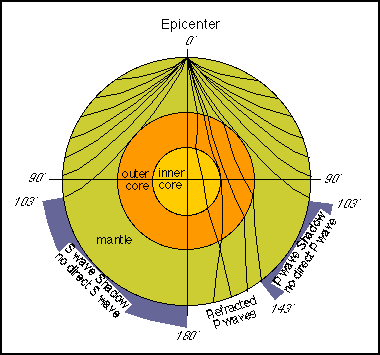
Vacuum, gasses, liquids, and solids reveal different properties in how sound waves pass through them (with vacuum revealed by not transmitting sound at all of course). Sound waves can also be focused to create images, like the way dolphins can see with sonar. Where building a suitable lens is impractical you can use multiple sound sources and/or multiple listening points as a virtual lens to compute an image. Here's a good link explaining a 1998 confirmation of a solid inner core below the molten mantle and molten outer core: Earthquake Provides Proof That Earth's Innermost Core Is Solid.
Another link is: Evidence for Internal Earth Structure and Composition. That one gives more explanation on how seismic waves are used to see the inner earth, but mainly I'm linking it for this image which illustrates how seismic stations at different points on earth see seismic waves passing through different parts of the earth. Seismic stations at the bottom of the image see seismic waves which reveal the inner and outer core. Note that it takes something like a half hour or more for waves from an earthquake to arrive at the opposite side of the planet. Different kinds of waves travel at different speeds and arrive several minutes apart, with the difference in timing between different kinds of waves providing rich additional information of the composition of the earth along various paths. Different kinds of waves can be analyzed separately to compute images of different aspects of the inner earth.
-
-
Re:A question for the bio geeks..
I'd agree about the imperfect stemming/heart cell conversion thing, but not with this:
Propagating genetic errors is certainly a concern here, but the same concerns exist for genetic transfer in breeding generally.
They're not exactly the same concerns. 'Normal' somatic cells, cells of the body which aren't stem cells, have a much higher capacity for surviving with DNA damage in their genomes than stem cells. This is because they have stopped growing & proliferating and hence stopped replicating their DNA, and a major method by which DNA damage is detected in the cell is by "testing whether DNA replication can occur". When DNA replication fails or is particularly difficult there's a good chance a proliferating cell (i.e. stem cells) will activate DNA damage checkpoints and die or senesce (stop growing permanently).
The methods used to make "stemmed" cells (induced pluripotent stem cells) usually involve introducing some oncogenes which ultimately mess up activation of the DNA damage checkpoints. Also, the genes that are introduced during the process of "stemming" are randomly scattered into the genome, potentially inserting into and knocking out the cell's tumour suppressor genes, so cells which may already be in a DNA-damaged state can be further damaged while being deliberately converted to a highly proliferating state. The process selects for cells which can proliferate even when damaged, which is not ideal as far as preventing cancer is concerned. New methods, using drugs and not the introduction of oncogenes, have been produced, but I don't think they're commonly used yet (correct me if I'm wrong, someone).
I don't pretend to understand what's unique about how DNA damage is dealt with during sex to prevent mutations being propagated to the next generation. I'm not sure that much work has been done on it, but germline sperm and egg-producing cells are stem cells, so damage isn't likely to be that well tolerated in them, and if sperm is very damaged it's likely to be inviable and won't lead to conception. I had to go off and research this to have something to say about it, during which I found the following tidbit: having sex/ spanking off once a day gets rid of damaged sperm and seems to be a way of maintaining a bloke's fertility in tip-top condition. So blokes are probably biologically programmed to masturbate, in case you needed an excuse!
-
Severe N. Reactor Accidents Likely Every 10-20 yrs
Severe Nuclear Reactor Accidents Likely Every 10 to 20 Years, European Study Suggests http://www.sciencedaily.com/releases/2012/05/120522134942.htm I'm nuclear agnostic, but articles like these leave me a bit uneasy. Only a bit.
-
False claims
The claim of 0.8 THz being 10X faster than existing technology is wrong. Here's a 2006 report of an Indium phosphide device. http://www.sciencedaily.com/releases/2006/12/061212091344.htm. Also, tubes can't make the equivalent of P-channel or PNP devices, greatly reducing their utility in logic circuits. Finally, the 10V switching threshold severely limits the amount of future shrinking possible.
-
Able to survive the harsh radiation of space
-
One way it might work.
They have a little wireless device sitting below the screen that supposedly can sense the position of individual fingers of a hand above it. That tells us something.
One interesting option is using the monitor's speakers for ultrasound and putting some microphones in the pickup. Now you have two emitters some distance apart, and some number of detectors close together. That configuration is powerful enough to image. See "One-handed gesture recognition using ultrasonic Doppler sonar" People have been fooling around with this sort of thing for years, but nobody has really nailed the problem yet. It's similar to the problem of emulating bat sonar. Part of the trick, I expect, is that the system measures both effects on the direct path from speaker to microphone and on the path which involves a reflection from the screen. That gives you the distance-from-screen information.
You probably could get 0.2mm of resolution if you sampled the microphones at 2MHz or so. Bats have roughly that resolution.
The Apple Thunderbolt monitor they're using has two high-frequency speakers, a subwoofer, a microphone, and a camera. It's not clear how much of that complement they're using for positional data.
-
Physics, not humans : slime
Humans build systems to suit humans. The commonality is humans.
The commanity is physics and math; research on slime has shown that, when faced with the same constraints as the rail network, it will grow into almost exactly the same network structure.
Slime Design Mimics Tokyo's Rail System: Efficient Methods of a Slime Mold Could Inform Human Engineers "The model captures the basic dynamics of network adaptability through interaction of local rules, and produces networks with properties comparable to or better than those of real-world infrastructure networks... The work of Tero and colleagues provides a fascinating and convincing example that biologically inspired pure mathematical models can lead to completely new, highly efficient algorithms able to provide technical systems with essential features of living systems, for applications in such areas as computer science."
-
Re:Don't do that.And of course from related articles on the same site.
The latest common wisdom on carbohydrates claims that eating so-called “bad” carbohydrates will make you fat, but University of Virginia professor Glenn Gaesser says, “that’s just nonsense.”
Gaesser, author of “It’s the Calories, Not the Carbs” and other books, found that diets high in carbohydrates are almost universally associated with slimmer bodies.
-
Re:Don't do that.
Except it is excess carbs instead of fat that actually causes CHD, we should send them wonder bread and corn flakes! http://www.sciencedaily.com/releases/2009/06/090625133215.htm
-
Re:What Year is it, Again?
Exposure to TV/Computers is dangerous for kids because synapses develop incorrectly: Because of the incorrect audio/video synchronisation and the lack of feedback -- as opposed to real objects where feedback is immediate -- poor connections form. And those can not be corrected later anymore.
This is well known to neuroscientists, and by large horizontal studies (average TV usage 5.5 hours per day), it has been shown that there is a very strong correlation between TV usage (hours per day) during childhood and intelligence, success, social life, obesity, health, etc.. The point is that the content does not matter, and even a little causes this form of brain damage.Source: https://www.youtube.com/watch?v=JPQ4C5RdUr4 (Neuroscientist Prof. Dr.Dr. Spitzer, talk in German) (I'd like to have a english talk by a scientist on the topic)
http://www.huffingtonpost.com/dr-david-perlmutter-md/television-and-the-develo_b_786934.html
http://www.brainy-child.com/article/tvonbrain.shtml
http://www.sciencedaily.com/releases/2009/06/090601182830.htm
http://www.livestrong.com/article/226572-the-impact-of-television-on-early-childhood-brain-development/I would not let my kids near TVs or computers until grown (they may watch at their friends place, that's social), and I recommend you have your parents come over to play with your kid, and give it toys/animals/people to play and interact with. Unfortunately, people are lazy and prefer to have the TV/screen babysitter.
-
Re:Americano is a twit
Not in his chart but... Radiation May Have Positive Effects On Health: Study
-
Stasi, radioactive spray, etc
Stasi used radioactive spray to track dissidents
http://www.telegraph.co.uk/news/worldnews/europe/germany/1313191/Stasi-used-radioactive-spray-to-track-dissidents.htmlStasi's radioactive hold over dissidents
http://news.bbc.co.uk/2/hi/europe/1100317.stmReport: Dissidents Tracked Using Radiation
http://abcnews.go.com/International/story?id=81775&page=1"The feared East German secret police routinely sprayed suspected dissidents with a radioactive solution as a means of secretly tracking them, according to a new report.
Stasi agents would then wear portable Geiger counters that would activate when a marked suspected dissident was nearby, according to New Scientist magazine.
So that targets would not hear the distinctive clicking of the counter at close range, Stasi secret police agents wore the detector strapped under one arm, while a vibrating alarm was slung under the other arm. The magazine reports that the 30-year-old invention mirrors the technology behind todayâ(TM)s pagers and cellphones. The magazineâ(TM)s article was based on a paper by leading radiation protection expert Klaus Becker."Sir Bernard Lovell claims Russians tried to kill him with radiation
The veteran British scientist behind Joddrell Bank telescope has disclosed how the Russians once tried to kill him with radiation for tracking the Sputnik satellite.
http://www.telegraph.co.uk/science/space/5362829/Sir-Bernard-Lovell-claims-Russians-tried-to-kill-him-with-radiation.htmlCell Phone Sensors Detect Radiation To Thwart Nuclear Terrorism
http://www.sciencedaily.com/releases/2008/01/080122154415.htm -
Re:We already have driverless cars
Do some research http://www.sciencedaily.com/releases/2008/12/081201081917.htm
-
Beware of too many LEDs
-
Re:really?
Does it really matter? The amount of effort required to look into ONE person in footage is huge. Stop being so paranoid everyone. If they looked at footage of me they would see a guy walking down the street..WOW. sometimes I think people are concerned over things like this far to much. Just live your life and chill out!
Yea, it's not like there's advanced recognition software they could be using; nor does the military ever, I dunno, mistake cameras for guns and blow away innocent journalists.
Ignorance is Strength -
Re:This is how oxygen producers changed the world
Yes, they made some methane. But I didn't say they would ruin life on Earth. Just that other organisms have done so, because of their gas production.
The reason why I didn't dismiss their idea entirely is that we already know that mammals produce methane in large quantities. See, for example http://www.sciencedaily.com/releases/2011/06/110606112822.htm
Researchers from the University of Bristol and the Teagasc Animal and Grassland Research Centre in Ireland, have found a link between methane production and levels of a compound called archaeol in the feces of several fore-gut fermenting animals including cows, sheep and deer. The compound could potentially be developed as a biomarker to estimate the methane production from domestic and wild animals, allowing scientists to more accurately assess the contribution that ruminants make to global greenhouse gas emissions. Co-author Dr Fiona Gill, who conducted the work as a postdoctoral researcher at Bristol and is now at the University of Leeds, said: "When it comes to calculating carbon budgets there is currently a lot of uncertainty surrounding animal methane contributions, particularly from wild ruminants. "We're quite good at measuring man-made CO2 emissions, but techniques to measure the animal production of methane -- a much more potent greenhouse gas -- have serious limitations. "If we can identify a simple biomarker for methane production in animal stools, then we can use this along with information on diet and animal population numbers to estimate their total contribution to global methane levels." Cows, sheep and other ruminants are thought to be responsible for around one-fifth of global methane production but the precise amount has proved difficult to quantify.
You don't need to be full of shit to appreciate that dung produces methane.
-
Re:Death
And a naturally-occurring disease like Ebola could get into a major international airport and have much the same effect?
We now have a pretty effective Ebola vaccine and even before the vaccine the virus just wasn't all that contagious. People sick with the disease have traveled in crowded cities and crowded aircraft without a single recorded case of transmission.
Ebola is a very nasty disease if you haven't had the vaccine and certain varieties have very high mortality rates, but all of the outbreaks have been self-limiting and there haven't been any confirmed cases of airborne transmission of any of the strains that affect humans.
Smallpox would be make a very nasty weapon, but remember that humanity has dealt with the disease before. It did not wipe out our species. And because it only affects human beings it is vulnerable to mass vaccination programs. We killed it off once. We may be able to do so again.
-
Re:Don't get all that excited....
Its a unique glimpse into a long vanished way of life and people, an ancient culture of which very little if anything survives today. Some of us find every little detail to be quite fascinating, and who knows, maybe we'll be able to put a few more pieces together and build a more complete picture of our ancestors.
Considering when Otzi lived, if he had any children that has present day descendants, odds are he is everyone's direct ancestor. The period of is life is before the identical ancestors point, before which, everyone who alive is either the ancestor of all human beings alive today, or the ancestor of nobody alive today.
-
Re:I don't get it.
"5 million years ago the Earth was roughly 2 C warmer than it is today, CO_2 levels were in excess of what they are expected to go to by the end of the century in the worst case "anthropogenic" scenario"
Hold on, stop.
http://www.sciencedaily.com/releases/2009/10/091008152242.htm
"The last time carbon dioxide levels were apparently as high as they are today — and were sustained at those levels — global temperatures were 5 to 10 degrees Fahrenheit higher than they are today, the sea level was approximately 75 to 120 feet higher than today, there was no permanent sea ice cap in the Arctic and very little ice on Antarctica and Greenland," said the paper's lead author, Aradhna Tripati, a UCLA assistant professor in the department of Earth and space sciences and the department of atmospheric and oceanic sciences.
Carbon dioxide is a potent greenhouse gas, and geological observations that we now have for the last 20 million years lend strong support to the idea that carbon dioxide is an important agent for driving climate change throughout Earth's history," she said."
Notice, carbon dioxide levels "as high as they are today", not as high as they will soon get.
"So spending $4.00 per KW-hour to "prevent a disaster" that there isn't a shred of evidence that the Earth's climate system is capable of supporting"
That's just a lie. Past climate has been in a much hotter condition with significant changed compared to today. (If there's no Arctic ice cap and no ice in Greenland, how hot will it be in India in the summer? 130F? 140F?)
During that time humans did not exist, much less technological civilization. Next, humans are inducing change on a time-scale which is geologically unprecedented with a known potent physical change.
-
Re:Quality vs. quanity?
Hi Lee - you state "Previous studies showed that organic farming doesn't give bigger nutritional value" Can you provide some links? My own tests showed our potatoes were more nutritious than store-bought potatoes (we had those tested, too). I've also provided literature that stated corn had higher protein before GMO. I'd be interested to see a counter-claim.
Some quick Googling seemed to indicate mainstream media wasn't ready to state one way or the other:
http://www.organicconsumers.org/organic/organic_nutrition.cfm
http://www.mayoclinic.com/health/organic-food/NU00255/NSECTIONGROUP=2
http://www.ota.com/organic/benefits/nutrition.html
interesting report here, would be interesting to see more details:
http://www.sciencedaily.com/releases/2008/08/080807082954.htm -
Re:2 more ways to make better solar cells
Or you could skip the photo-voltaic effect completely:
http://www.sciencedaily.com/releases/2011/11/111110125955.htmand/or add a coating that converts uv to visible light so you can harvest that too:
http://www.sciencedirect.com/science/article/pii/S0927024898001056 -
There is a logical error in that reasoning
In his book "Why We Get Fat", author Gary Taubes makes the point (which the Paleo diet advocates also make) that humans didn't develop anything like organized agriculture until about 8,000 years ago, too recent in our physical evolution to have developed a predominantly grain-consuming physiology.
Actually, at least two.
First being the implication that humans are somehow not adapted/meant to eat grain. As if were talking rocks and not plants.
Plants, which humans found SO tasty, they decided to plant them.We planted what we could eat already. We did NOT plant random things and then tried to eat them.
Second error lies in the fact that not only did we not need to evolve the ability to digest each kind of food one at a time, we actually simply picked up the ability to digest locally available food.
How? By ingesting such food (as in trying to eat it). Along with the bacteria already feeding on it.
http://www.sciencedaily.com/releases/2010/04/100413072046.htmSo, instead of evolving our own abilities to digest certain food for thousands and thousands of human generations - we picked it up from the millions and millions of generations of the local bacteria.
Who adapted to living in our intestines where it's warm and safe and the food is plentiful all year round. -
Re:All feminist psychos will nuts
As a male vegetarian, I have encountered the "real men eat meat" mentality repetitively. Carol Adams may not be mainstream, but she's not a complete crackpot. My kids are vegetarian as well. My son, at 4 years, saw a bus drive by and noted to me: the number of that bus, 462, is a multiple of 3. I just about crashed the car when he said that. I don't see any evidence of intellectual issues with him as he reads ahead of his class level, and a 6 is doing long division. Likewise, he is average size for his age and does quite well on his medical evals for school. Granted, this is anectodal, but I'm not seeing any evidence of what the Swedish meatballers found.
If we want to get into the study itself, it seems to have a number of issues. First and foremost, they are trotting out that old chestnut that brain size and intelligence are equivalent. They are not. Research has shown that intelligence is genetically determined in humans. While we do know that lack of adequate nutrition seems to impact later intelligence, the American Dietetic Association has not found any lack of nutrition in vegetarian or vegan diets as noted in their position papers on the topic. Furthermore, correlations between IQ and brainsize as determined by MRI show very weak correlation (R-squared ~ 0.4) despite the title of the meta-analysis.
Secondly, using a linear model across a number of species they are saying that weaning time is best predicted by meat consumption. Granted this shows a correlation. However, they also show a strong correlation with body weight, and there is no normalization of body weight or brain weight within a species. Based on their conclusions (correlations only), body size ~ brain weight ~ intelligence. This seems to mean that shorter people should be less intelligent. We just don't see this in real life. Furthermore, we see that late weaning in humans has benefits such as fewer cavities later in life and a better immune system.
This study has so many problems on so many levels....
-
Re:Magical thinkingIn a somewhat related note, according to studies, meditation may change brain structure and even gene expression in a positive way. Meditation might also reduce age-related brain degeneration. I think that meditation could be somehow related to the placebo effect as both have a mental process leading to a physiological effect.
From the first link:"Our results suggest that long-term meditators have white-matter fibers that are either more numerous, more dense or more insulated throughout the brain," Luders said. "We also found that the normal age-related decline of white-matter tissue is considerably reduced in active meditation practitioners."
From the second link:
Eileen Luders, an assistant professor at the UCLA Laboratory of Neuro Imaging, and colleagues, have found that long-term meditators have larger amounts of gyrification ("folding" of the cortex, which may allow the brain to process information faster) than people who do not meditate. Further, a direct correlation was found between the amount of gyrification and the number of meditation years, possibly providing further proof of the brain's neuroplasticity, or ability to adapt to environmental changes.
It seems to me that meditation could help with many modern health issues which are often stress-related. It's no wonder that many religions use meditation in a form or another. However, meditation doesn't really have to include any magical thinking, and the non-religious version is often called mindfulness.
Regarding magical thinking, I'd say that it's more important to recognize your biases than to totally eliminate them, as the latter is pretty much impossible. -
Re:Magical thinkingIn a somewhat related note, according to studies, meditation may change brain structure and even gene expression in a positive way. Meditation might also reduce age-related brain degeneration. I think that meditation could be somehow related to the placebo effect as both have a mental process leading to a physiological effect.
From the first link:"Our results suggest that long-term meditators have white-matter fibers that are either more numerous, more dense or more insulated throughout the brain," Luders said. "We also found that the normal age-related decline of white-matter tissue is considerably reduced in active meditation practitioners."
From the second link:
Eileen Luders, an assistant professor at the UCLA Laboratory of Neuro Imaging, and colleagues, have found that long-term meditators have larger amounts of gyrification ("folding" of the cortex, which may allow the brain to process information faster) than people who do not meditate. Further, a direct correlation was found between the amount of gyrification and the number of meditation years, possibly providing further proof of the brain's neuroplasticity, or ability to adapt to environmental changes.
It seems to me that meditation could help with many modern health issues which are often stress-related. It's no wonder that many religions use meditation in a form or another. However, meditation doesn't really have to include any magical thinking, and the non-religious version is often called mindfulness.
Regarding magical thinking, I'd say that it's more important to recognize your biases than to totally eliminate them, as the latter is pretty much impossible. -
Re:Posting from my iPad
The ministers were afraid people would become curious with all those pretty printed symbols and tried to learn how to read them. Then they'd lose their minister jobs. Ignorance and superstition are close friends.
Once again, the old "educate them and they'll lose faith" saw.
Except... it's not true, and never has been. The spread of literacy and Christianity went hand-in-hand in the West. You're more likely to be deeply faithful if you can read your own scriptures, not less. And especially in the case of Americans that are religious, they tend to be especially more so the higher their level of education:
"
Many in the pundit class identify religion as something of a regressive tendency, embraced by the less enlightened, the less skilled, intelligent and educated...Some might be surprised to learn that religious affiliation grows with education levels. A new University of Nebraska study finds that with each additional year of education, the odds of attending religious services increased by 15%. The educated, the study found, may not be eschewing religion, as social science has long maintained, even if their spiritual views tend to be less narrow, and less overtly tied to politics, than among the less schooled.
I've noted here in past posts that the 9/11 hijackers were all educated, and that the London bombers were British-born, with a lifetime of Western liberal educations and economic and political opportunity. Their immigrant parents were poor and uneducated when they came to the UK, and were much more moderate. And yet their Westernized, educated children chose Jihad.
-
Re:But...
I thought it was fungus.
I think this is the third cause discovered in the past month.
-
But...
I thought it was fungus.
-
Re:More, less, anything is caused by AGW
I don't think you actually read those articles, nor anyone that modded you insightful. Did you only read the headlines?
http://news.nationalgeographic.com/news/2007/07/070730-hurricane-warming.html
On the first page, one group claims their study shows that the number of hurricanes has doubled in the last century. On the second page, another group claims that study is "sloppy" and uses incomplete data. When the second group added their own data, the results conveniently reflected their own preconceived conclusions, but then they admit that their data is still incomplete.
Summary: Reliable records do not exist from a century ago, which leads to multiple interpretations, which are exploited by political biases.http://www.science20.com/news/global_warming_may_mean_fewer_hurricanes
This article talks about how most people reference warming oceans when talking about hurricane trends, but increasing wind shear is also a major factor, which can, in some cases, negate warming waters.
Summary: The climate is monstrously complicated and predictive modelling can lead to conclusions which seem counterintuitive if you don't take the time to understand them.http://www.sciencedaily.com/videos/2009/0109-global_warming_causes_severe_storms.htm
This is a blatant TV fluff piece. It isn't even about hurricanes, just severe storms. You know, regular old thunderstorms.
Summary: There is no real content here. -
Re:More, less, anything is caused by AGW
You can find studies that show more hurricanes, less hurricanes, more sever hurricanes all due to global warming. It's getting old attributing every possible outcome to Advance Global Warming. http://news.nationalgeographic.com/news/2007/07/070730-hurricane-warming.html http://www.science20.com/news/global_warming_may_mean_fewer_hurricanes http://www.sciencedaily.com/videos/2009/0109-global_warming_causes_severe_storms.htm
Can someone explain why this was modded down? He made a point and backed it up links. If you don't agree, that's fine. Reply and tell him why he's wrong.
Modding a comment down simply because you disagree with it against the moderation guidelines.
-
That Last Link Does Not Mean Hurricane
You can find studies that show more hurricanes, less hurricanes, more sever hurricanes all due to global warming. It's getting old attributing every possible outcome to Advance Global Warming. http://news.nationalgeographic.com/news/2007/07/070730-hurricane-warming.html http://www.science20.com/news/global_warming_may_mean_fewer_hurricanes http://www.sciencedaily.com/videos/2009/0109-global_warming_causes_severe_storms.htm
You do realize that a hurricane and a "severe storm" are rather different things, right? Your last Science Daily citation is about severe storms, not hurricanes. It never even uses the word "hurricane" nor does it indicate that it's talking about storms that only affect coastlines. A thunderstorm and a hurricane are two very different events. Are you going to complain that global warming reports are in direct conflict over precipitation figures and then link to stories about increased monsoon seasons and decreased snow fall?
-
More, less, anything is caused by AGW
You can find studies that show more hurricanes, less hurricanes, more sever hurricanes all due to global warming. It's getting old attributing every possible outcome to Advance Global Warming. http://news.nationalgeographic.com/news/2007/07/070730-hurricane-warming.html http://www.science20.com/news/global_warming_may_mean_fewer_hurricanes http://www.sciencedaily.com/videos/2009/0109-global_warming_causes_severe_storms.htm
-
Re:Screen
The study referenced in this article claims just the opposite.
-
Re:CPUs/GPUs/SOCs/etc
First of all, mod+1 for the reference to the minimum amount of heat -- I knew that such a limit existed but it was good to see the estimate and have links to the formal argument and beyond. Second, while we may or may not be able to reduce the heat released from the bits themselves as they change state, room temperature superconductors will still make two very significant improvements in processor design. First, reducing the resistance of everything BUT the bits will reduce the heat released by a chip by a nontrivial amount, rather a nontrivial fraction -- presuming that one can lay down the superconductor in VLSI circuits and mass produce them, as opposed to build them a molecule at a time. Second, electrical superconductors are usually thermal superconductors as well.
It is this latter property that is probably by far the most important. Note e.g. this article: http://www.sciencedaily.com/releases/2003/11/031112072719.htm -- if one were able to make the base of a chip out of a superconductor in good thermal contact with the actual semiconductor matrix a thin film on top of it, and couple that base directly to a superconducting heat sink, one could e.g. produce 10x to 50x the heat in the actual CPU and still remove it fast enough to keep the chip itself sufficiently cool. If the traces within the chip itself were superconducting, if clever use of superconducting material let one reduce the heat associated with switching closer to the limit, so much the better. Ultimately, it would probably mean that one could run chips at higher voltage and higher clock to produce faster reliable switching and still deal with the heat.
I don't have time to do a formal estimate of the speedup possible, but I'm guestimating that a real thermal superconductor -- one with "zero" resistance to the flow of heat -- suitable for use as the base material for a chip would permit a very rapid scale-up of chip speed by up to an order of magnitude in clock or effective clock. It also might make it possible to build a three dimensional CPU -- one reason chips are 2D is so that one can get the heat out; if one had a thermal/electrical superconductor one could in principle stack up layers and scale performance by one or more orders of magnitude, at first multiple cores on steroids but all at much higher clocks, later true 3d design and layout.
In any event, the impact would very probably be profound, at least if the hypothetical RTS was cheap and suitable for nanoscale integration as a substrate and/or trace material (and functioned as a thermal superconductor as well as noted).
Still, I think that simply eliminating resistivity in power transmission would have the greatest societal impact. PV solar power, for example, "instantly" becomes feasible because one can generate in the Mojave and use the electricity in Maine without transmission loss. That isn't huge, that is game-changing enormous. The Sahara become the electrical source for Europe and Africa, India for Asia, etc. Depending on the hypothetical materials magnetic properties (big if, actually!) it may well revolutionize electrical motor design, maglev trains and roadways, and more, but just letting us move power for free to where we use it makes Edison have the last laugh over Tesla -- human civilization can convert to low voltage DC electrical service. A civilization run on 5 VDC would make electrocution a historical oddity from pre-RTS times -- one can manage to kill yourself with as little as 9 volts (see my favorite Darwin Award, "Resistance is Futile" -- http://www.darwinawards.com/darwin/darwin1999-50.html) but 50 mA should be below the fatal threshold even for somebody that tries very hard.
rgb -
Re:Prohibition
And imagine what we could accomplish if the researchers were free to soak the wires in LSD and tires in cannabis solutions?
Researchers probably could do that if they had a valid scientific reason and went through the proper procedures. The problem is that most people aren't interested in soaking wires or tires, but soaking minds. The result of that is well known.
Marijuana Smokers Face Rapid Lung Destruction -- As Much As 20 Years Ahead Of Tobacco Smokers
Marijuana Use Precedes PsychosisWe could have free energy and flying cars, because the laws of physics are like, whatever man.
We already have flying cars, but they aren't really economical. There is more "free lunch" than there is "free energy".
People should never confuse mind-altering substances with reality-altering substances.
-
Re:Of course it is
That's more of a result than a cause. Most other mammals don't have a menopause.
Only a few: http://www.sciencedaily.com/releases/2010/07/100701103405.htm
-
Re:And yet.
Fast-growing trees drain nutrients but absorb little CO2, for example.
It's a bit more complicated than that:
"The study showed that when phosphorus or nitrogen -- which occur naturally in rain forest soils -- were added to forest plots in Costa Rica, they caused an increase in carbon dioxide emissions to the atmosphere by about 20 percent annually, said Cleveland. "
http://www.sciencedaily.com/releases/2006/06/060621084137.htm
"On a global scale, long-term fluxes are approximately in balance, so that an undisturbed rainforest would have a small net impact on atmospheric carbon dioxide levels,[14]"
-
Re:I think PETA just had a heart attack
You are mistaken. The pathogenic contributions to atherosclerosis are not well understood, but there are clear indications they are at least related and quite possibly a contributing factor.
For example this article, but you can find others as well:
-
Re:Dead link
Also here.
-
Re:Just keep in mind the tradeoff
http://www.sciencedaily.com/releases/2008/01/080105140107.htm
of course 56% of those marketing dollars are "samples" according to http://www.medicine.mcgill.ca/MJM/issues/v08n01/orig_articles/barfett.pdf. Which end up being drugs for uninsured poor people at the doctor's discretion, when I was uninsured and jobless in the US the doctor gave me samples of some antibiotics, for example.
-
Re:... and heart attacks
I'm glad I have flexible work hours, because otherwise I'd be looking forward to a 10%-increased chance of having a heart attack tomorrow or the day after. So... if there are 2 million heart attacks per year in the US, I guess that means several hundred extra heart attacks just due to this effect?
The first snowfall shoveling fest also creates a spike in heart attacks. What I've never been able to find out (admittedly I haven't looked) is if these types of stats reflect an actual increase in the problem, or just a shifting of the timing of the incidents. Is that 10% increase a result of triggering a bunch of people who likely would have had troubles in the following weeks anyway, or is are these "new" cases? Do places with a DST shift have a higher rate when comparing the entire year, compared with those who do not have such a shift? If it is just shifting the events to a specific date, then that might actually be a good thing - you can have the hospitals and emergency responders ready and waiting, and schedule your vacation time for the lull after the event.
-
... and heart attacks
I'm glad I have flexible work hours, because otherwise I'd be looking forward to a 10%-increased chance of having a heart attack tomorrow or the day after. So... if there are 2 million heart attacks per year in the US, I guess that means several hundred extra heart attacks just due to this effect?
-
Re:Lack of will, or lack of need to prove oneself?
Many compelling reasons, above and beyond the "we must explore" philosophical position (which is, admittedly, not an axiom). Let's get practical.
How about recovering lost nuclear weapons, maintenance of deep-sea seismic sensors to detect and generate warnings for tsunami-generating underwater landslides? What about transoceanic optical fiber maintenance? Rescue of sailors from submarine accidents? Maritime accident investigation?
This is important stuff. In the U.S. this has (unsurprisingly) typically been a function of the Navy. Their Alvin submarines have been used for undersea exploration, rescue and military investigation work, but they do not have the ability to go to every point on the ocean bottom.
Those of you who are tinfoil hat-wearing conspiracy theorists would do well to take note of the Glomar Explorer, which was a ship and diving apparatus that was something of a joint venture between the US Navy and Howard Hughes. One of the covert operations it performed was the recovery of nuclear weapons, cryptographic equipment and dead sailors from a Soviet K-129 submarine, which was lost (with all crew) in 16,000 feet of water in the late 60's. See Project Azorian. I ain't saying Cameron is exactly the type to be embracing the US military, but you can bet there's keen interest.
-
Re:Nice
-
Re:Translation?
Correct, methylation stops gene expression. Mod Parent up, grandparent down
http://www.sciencedaily.com/releases/2007/04/070421211622.htm