Slashdot Mirror
Domain: spacedaily.com
Stories and comments across the archive that link to spacedaily.com.
Comments · 469
-
We've seen this before.
Cape seasonal weather variations certainly have a degree of predictability. STS-71 had similar conditions to contend with: http://science.ksc.nasa.gov/shuttle/missions/sts-
7 1/mission-sts-71.html
Because the entire program is so beleagured and under the microscope at this point, it's easy to overlook that hold-ups due to weather have occurred quite frequently. Another important factor is wind monitoring, typically done by balloons. Simulations are done at regular intervals with the up to the minute winds available data to determine potential adverse loads on the vehicle. This could possibly hold up a launch as well, completely aside from cloud cover or thunderstorm activity.
The post 2010 Space program would optimally take Cape weather and the possibility of higher hurricane frequency into account as a cost factor. Alternate launch locations may be advisable, despite the existing infrastructure built up at the Cape. Would there be any possibility of government and commercial concerns sharing responsibility and building up a different launch facility? The Richard Branson/Virgin spaceport comes to mind, http://www.spacedaily.com/news/tourism-05zt.html. Other sites in New Mexico and west Texas could be considered. -
Re:Some bold statements from this articleYea, there is a "pro-Global Warming" crowd. It isn't that they are sitting back going "lets warm the globe" it is a crowd of people who advocate that theory or have something to gain by that theory be valid. These people are usualy politicians running on this platform, scientist looking for grant money based on thier previous findings, people who have been inducted into some group based on the science or evidence presented from those groups and people (maybe as the previous) looking for fame and fortune based on global warming being true.
These are all people who have something to gain if it was true. It can be like the ghia people who advocate birth control because they think humans are a cancer to the earth.The facts point the the extreme liklihood that human beings are responsible for the current warming trend, and the facts suggest that CO2 is the likliest cause. The levels of CO2 and the global temperature are strongly corrrelated.
I can see why you were upset with the pro global warming statment. Acording to this, there isn't realy that big of a data trail supporting CO2 being the sole cause of the warming. It apreas that other things like sun cycles and volcanic eruptions as well as inconsistancies in data colection contribute more then anything else combines.
This is a problem I have with global warming as it stands. There is no room in the current theory being presented for factors other then human imposed ones. When anyone points to some natural phenominom preseting some changes in the climatate they are branded as a non believer or in denial and pushed aside pointing to his esimates or science as being junk. Now the stuff at the above link could be wrong but I havn't been able to find any reference to it being wrong that have ground going deeper then I said so or a blanket "they are using junk science" with no hint of were thier science is wrong. But there are a numberof reasons to be skepticle of those claiming global warming exist in it's current state. It is more likley temperature changes have something to with the sun then with just CO2 alone.That doesn't mean that people who accept this are pro Global Warming. What would someone have to gain by being pro Global Warming?
Your right, those people who accept it are more likly just misinformed. Or partialy misinformed anyways. But there are lots of things advocates of global warming can gain. First and probably the most common root of coruption (on either side of any issue) is money. Those claiming global warming are using thier findings to get funding from different groups inclusing the governments of the world as well as oversite bodies set up by those governments. Certain memeber can advance thier own religious teachings about being one with the earth and some may be looking for just fame (prizes and awards from scientific comunities. Who wouldn't want to be remebered as the man who saved earth) and fortune (fortune derived from speaking engagments). But in either way, there is no possiblility for them to lose. If global warming doesn't happen they can say we saved the planet give us more money and we will make sure it doesn't happen again. If it does happen they can say you should have listened to us give us more money and we will fix it. So either way, they benefit.
As far as I see it, higher levels of CO2 favor plants, not humans, so maybe all the scientists (and it really is ALL the scientists) that simply agree with the data are secretly working for the super-secret plant-world agenda. The only arguments against the facts are that they might make certain pollutors adopt certain precautionary behaviors, and that might be momentarily expensive for certain industries, and we simply can't inconv
-
Re:Nothing newI can't agree with your comment about medical funding. Considering that the NIH has had their budget quadruple in 15 years, I would say they're doing pretty good. There is a lot of hand wringing because in recent years the budget has been increased either just a little, or even flat, but historically their budget was about $7.5B in 1990, $11.3B in 1995, $17.8B in 2000, and $28.5B in 2005. Their budget can be held flat for the next few years, and they'll still have a budget increase that is the envy of pretty much every part of government outside the DoD.
I would also like to see you defend your comment about most of the space research budget has been diverted to militarizing space. That just sounds like a whole lot of bunk.
If you are concerned about space science budgets, then you should be rooting for the death of the moon-mars initiative and over-emphasis on manned space. That, the ISS, and the shuttle are pretty much killing space research. The ESA is fortunate to not have that millstone around their necks. Besides, in 2001 at least, the ESA space science budget was only about 12.5-percent of the science budget of NASA, so I'm not sure how you can defend your statement that the ESA is doing most of the space research.
-
Re:But ...
The collision between the "Mars sized planet" and the early Earth that formed the moon certainly wiped out all life, on both the Earth and the "Mars sized planet" at least.
http://www.spacedaily.com/news/lunar-01d.html -
Re:Say what?
The impression I got is that he was arguing that Griffin is trying to kill everything else so he can turn CEV into elaborate super-machine
Here's a sample article.
"In a previous column I criticised the return-to-the-moon plan presented by the ESAS study group as too grandiose and too expensive, and promised to show how it could be "simplified and de-porked enough to fit inside the budget wedge that is likely to be available".
Since I wrote that, NASA Administrator Mike Griffin has already started that process without any advice from me. Just look at the list of changes that have been made already:"
He's also proposed theories that Griffin is trying to kill the shuttle. His comments on the big research cuts were that they're designed to kill off the shuttle's remaining support base, since the cuts were specifically made in order to spend money on the shuttle.
Bell wants a lean, small, single-purpose CEV. I agree with him on this. In a way, I hate seeing people propose Big Dumb Boosters to accomplish Big Dumb Projects.
I disagree about some other things, of course; I'd like to see more money put into new craft research, while Bell doesn't see much payoff in that. -
Re:Moon Base Bush is pie in the sky
Unfortunately, or fortunately depending on your viewpoint, the FAA is quite reluctant to accept any significant changes in GA because, you know the saying, "if it ain't broke, don't fix it." However, there has been multiple leaps in the technology implemented in small airplanes over the past few years.
For example, instead of carburetors, most new planes now come with a FADEC system that handles the fuel injection into each individual cylinder, increasing performance and ridding the pilot of that pesky mixture control lever. Also, this system gives you real time status information on each cylinder so you can monitor their performance and detect a problem before it becomes too serious. About the mags, I can't really see why you'd want to get rid of them, they really are a pilot's best friend because even a total electrical failure (well almost anyways) cannot stop the magneto from sparking the engine. You have to always remember that aviation is practically married to redundancy, and for good reason.
While you did mention GPS being added into planes now, that's really only half the story. Glass cockpits are literally revolutionizing how we fly. Take a look at the good 'ol 152 cockpit then and now, there's a pretty big difference, no? The GPS is also going to make traveling to smaller airports in IMC a much greater experience when WASS/LAAS and TLS approaches become implemented around airports in the upcoming years.
Besides the GPS, ideas such as 'live' radar via XM radio, as well as a much more affordable radar dish are making storm traversal a much easier, safer thing for light airplanes, while Mode S transponders are finally bringing collision avoidance systems down from the major airlines to general aviation which I'm sure you'll agree is a major advantage.
Going outside the cockpit, we find that airplanes are beginning to be made with composite materials which are both lighter and stronger. However the high cost associated with manufacturing them, as well its unknown safety factor, are keeping it from being too widely accepted. The cirrus even designed a parachute for the entire plane. Overall, while the major design of airplanes have basically remained the same, I would say that there has been many great innovative improvements in general aviation that are changing the way pilot's fly. -
Re:Say what?
Well... the thing is, yes, technology has advanced. It hasn't advanced by the leaps and bounds that we would like it to have advanced by, however, and that is the crux of the problem. The Apollo program cost $135B in modern dollars. Even if we consider the overall effect of technology advancements to have doubled our access to space for the same dollar, the concept of a lunar base will require at least double the landing and liftoff payload (in addition to regular trips). Probably much more. It'll take serious money.
The public tolerates out of control spending on wars because the rhetoric is so heated on it - it's either an abomination or essential to the survival of our way of life, depending on which side you listen to. The level of discourse for space missions just isn't that extreme, and so people look a lot closer at the financial aspect. Apollo-level funding just isn't politically realistic. That's why they're stretching this out over the long run. The longer it takes, the less blatant it is that we're spending as much money as we are on this single program.
Lastly, something that I should mention: CEV design is not going well 2. I agree with Jeff Bell, who's been very critical of the whole proposal. -
Re:Say what?
Well... the thing is, yes, technology has advanced. It hasn't advanced by the leaps and bounds that we would like it to have advanced by, however, and that is the crux of the problem. The Apollo program cost $135B in modern dollars. Even if we consider the overall effect of technology advancements to have doubled our access to space for the same dollar, the concept of a lunar base will require at least double the landing and liftoff payload (in addition to regular trips). Probably much more. It'll take serious money.
The public tolerates out of control spending on wars because the rhetoric is so heated on it - it's either an abomination or essential to the survival of our way of life, depending on which side you listen to. The level of discourse for space missions just isn't that extreme, and so people look a lot closer at the financial aspect. Apollo-level funding just isn't politically realistic. That's why they're stretching this out over the long run. The longer it takes, the less blatant it is that we're spending as much money as we are on this single program.
Lastly, something that I should mention: CEV design is not going well 2. I agree with Jeff Bell, who's been very critical of the whole proposal. -
Re:Say what?
Well... the thing is, yes, technology has advanced. It hasn't advanced by the leaps and bounds that we would like it to have advanced by, however, and that is the crux of the problem. The Apollo program cost $135B in modern dollars. Even if we consider the overall effect of technology advancements to have doubled our access to space for the same dollar, the concept of a lunar base will require at least double the landing and liftoff payload (in addition to regular trips). Probably much more. It'll take serious money.
The public tolerates out of control spending on wars because the rhetoric is so heated on it - it's either an abomination or essential to the survival of our way of life, depending on which side you listen to. The level of discourse for space missions just isn't that extreme, and so people look a lot closer at the financial aspect. Apollo-level funding just isn't politically realistic. That's why they're stretching this out over the long run. The longer it takes, the less blatant it is that we're spending as much money as we are on this single program.
Lastly, something that I should mention: CEV design is not going well 2. I agree with Jeff Bell, who's been very critical of the whole proposal. -
Re:Say what?
Well... the thing is, yes, technology has advanced. It hasn't advanced by the leaps and bounds that we would like it to have advanced by, however, and that is the crux of the problem. The Apollo program cost $135B in modern dollars. Even if we consider the overall effect of technology advancements to have doubled our access to space for the same dollar, the concept of a lunar base will require at least double the landing and liftoff payload (in addition to regular trips). Probably much more. It'll take serious money.
The public tolerates out of control spending on wars because the rhetoric is so heated on it - it's either an abomination or essential to the survival of our way of life, depending on which side you listen to. The level of discourse for space missions just isn't that extreme, and so people look a lot closer at the financial aspect. Apollo-level funding just isn't politically realistic. That's why they're stretching this out over the long run. The longer it takes, the less blatant it is that we're spending as much money as we are on this single program.
Lastly, something that I should mention: CEV design is not going well 2. I agree with Jeff Bell, who's been very critical of the whole proposal. -
The race has begunThe anti-sat laser race began years ago. Whilst the US was cutting back defense research into all but the most pork laden projects, China was pushing a serious military space strategy. This included new ICMBs, satellite and anti-sat and guidance technology. All very dual use for their manned program, but by comparison we've been looking the other way whistling whilst a non-democratic expansionistic country that tends to threaten our major trading partners and threaten first strike nuclear assaults against the US is building weapons to cripple the US military.
My response to reading the article: duh!
Here are some recent articles on the developments in China. The US is not starting this race, but it'd be nice to keep up regardless.
http://www.usatoday.com/tech/science/space/2005-0
7 -27-china-satellites_x.htm
http://www.atimes.com/atimes/China/HD20Ad03.html
http://www.house.gov/coxreport/chapfs/ch4.html
http://www.spacedaily.com/news/china-01c.html
http://www.taiwandc.org/twcom/84-no3.htm
http://www.afio.com/sections/wins/1998/notes48.htm l
The world is, a dangerous place. As with Sudan and Iran, the UN is no deterrent to aggression. Enlightened self-interest directs us to investigate these types of systems for the same reasons we investigate lethal pathogens. Surviving them requires understanding them even if we never intend to use them.
-
Re:Purpose for defense or offense?
"We need that ability to protect our assets" in orbit.
Ok, call me an X files conspiracy theory type, but we've already got space defense systems and this is merely meant as an upgrade or additional weapons systems.
Lets examine the facts.
-we currently have more than 20 GPS sattelites in orbit. Besides helping you find the closest Starbucks, these are also used to help our soldiers find their way throug remote mountain passes and help missiles find their targets.
-Military doctrine is to control the media as soon as you can in any conflict. A large part of the media is broadcast via sattelite
-Our military insists on protecting its assets. Quick, name any military asset of regional significance that we don't guard?
-We've already have antisattelite missles. in the mid 80s, an ASAT took out a satellite in a successful test.
-China is interested in anti-satellite technology.
-Squadrons of fully operational stealth fighters were deployed and used for more than half a decade before being made public. Our military clearly is able to keep very large opperations secret for quite some time.
When I add this all up, I come to the conclusion that we already have space-based weapons designed, at a minimum, to disrupt an incoming missile. Others may have similar, which would explain why we'd be interested in lasers. The only question I really have is why they'd bother to make it public.
TW -
Re:The Real Purpose...
its about the telescopes: http://www.spacedaily.com/news/ngst-99e.html
-
Mr. Roboto
It seems to me that even the smartest robots are still only about as intellectually capable as me and my roommates after a heavy night of drinking.
So naturally, the next step for them is to be made citizens. That way, they can't dodge the draft.
While they've already began using them for educational and military purposes, I somehow doubt that they will become useful anytime soon. They will be something used only by the government or by the rich until enough money is thrown in and research is done to turn them into anything worth considering. -
Re:Not the BritsTo elaborate further, the Hyshot program is actually based out of the University of Queensland, (ie. Australia) and is very much NOT a British program. If anything, it's international. Yes, QinetiQ is a partner and did help, but the BBC isn't doing anything new by touting the local (to it) firm's part in things. The UQ website also notes USAF and CAF involvement.
To quote from a SpaceDaily article at the time of the last test:
The Hyshot Consortium partners include Astrotech Space Operations, DTI and GASL, QinetiQ, NASA Langley Research Center, Seoul National University, the DLR (German Aerospace Center), NAL (National Aerospace lab. Japan), AFRL (Air Force Research Laboratory, USA), Australian Space Research Institute (ASRI), Institute of Engineers Australia (IEAust), UniQuest and the Australian Department of Defence. Australian firms, Alesi Technologies, NQEA, AECA, Luxfer Australia and Jet Air Cargo, and BAE Systems Australia are also involved.
So, next time the BBC reports on something that's happening outside America, I hope somebody will do some research before they base the headline on the leading paragraphs.
Note: I'm a UQ past student (had Allan Paull as a first year subject coordinator) and employee, so I'm not short on local perspective/bias here.
-
The other space related success
The launch of ST5 happened at last on Wednesday after being postponed several times.
-
Re:Does anyone disagree with me here?
That's because it depends on how well the next flight goes before it officially goes on the manifest. The NASA Director has shown that he seems to want to fly it, however, so I'm hopeful.
More:
Griffin Vows To Send Shuttle Mission To Hubble -
Carnival side show
Tentatively scheduled for a spacewalk this summer, a Russian cosmonaut will take his trusty six iron and a special weightless-friendly tee and put a golf ball into orbit from outside the International Space Station.
Is there any better example of the pettiness and utter pointlessness of the ISS? The program has been reduced to a carnival side show of paid stunts and celebrity guests. It won't be long until its hull is rented for advertising. I can imagine it eventually looking like a NASCAR racer. The political goal of moderation of Russia, set by Clinton, has failed. The program cost and responsibility for launching and assembly is disproportately born by the US. In the US we have wasted 30 years of the future on this. Support project Constellation.
-
If it ever flies.
Everyone believing it will fly on schedule, please stand on your head.
The first mission:
Mission name: ST9 (Space Tech 9)
Tentative launch date: 2010-2011
Then we have more:
Mission name: Heliostorm
Tentative launch date: 2016-2020
Mission name: SPI (Solar Polar Imager)
Tentative launch daMission name: Interstellar Probe
Tentative launch date: 2031-2035
These are science. As we all know, the US gubmint don't hold with that science stuff. And does anyone out there believe that NASA have any clue what they'll be doing five years from now, let alone 25-30?
Remember the two year delay on the James Web Space Telescope (successor to Hubble) announced back in November? That's nothing. In addition to the congressional criticism of the no-science budget, we have things like:
http://www.newscientistspace.com/channel/human-spa ceflight/dn8689-nasa-to-divert-cash-from-science-i nto-shuttle.html
(Feb. 7) Wherein we learn that the Terrestrial Planet Finder has been delayed indefinitely, and more, such as "The budget announcement was "extraordinarily depressing", says Louis Friedman, executive director of the Planetary Society, a non-profit organisation in Pasadena, California, US, which promotes solar system exploration. "I would almost describe it as 'anti-science NASA' now, with these kinds of deep cuts." Seven missions, or areas of research, or listed as cancelled or postponed. Of the postponed, all but one is indefinitely.
The Planetary Society has a statement here:
(Feb. 16)
http://www.planetary.org/programs/projects/space_a dvocacy/budget_statement.html
with gems like, "The Bush Administration's proposed 5-year budget for NASA, just submitted to Congress, is an attack on science. The proposed budget directs three billion dollars (over five years) away from robotic exploration of the solar system to continue to operate the shuttle. Last year the Administrator said, "not one thin dime" would be so directed. Now we learn it is 30 billion dimes."
and
"In addition, a devastating 15% cut to science research funding -- including likely cuts to some approved 2006 research programs -- is being applied across all Earth and space science disciplines, and 50% is being cut from astrobiology research! This attack on basic science ironically comes at a time when the President announced in his State of the Union speech his intention "to double the federal commitment to the most critical basic research programs in the physical sciences over the next 10 years." Apparently the physical sciences do not include either Earth or space sciences."
If you think the much advertised "Vision for Space" is really going to get us back on the moon, then to Mars, you may be in for a surprise as well. Yes there's been all the talk about the new heavy lift and crew exploration vehicles. Even methane engines, so we can 'live off the land'. Guess again, and see:
http://www.spacedaily.com/reports/The_Moon_Program _The_NASA_Administrator_Is_Really_Planing_For.html
(Feb. 14). No methane engines, the Crew Exploration Vehicle diameter has been resized to five meters (can now be lifted by existing hardware), which the authors suggest was done to put the Crew Launch Vehicle on the chopping block. The Cargo Delivery Vehicle is gone, so we can't send control gyros to ISS after the shuttles retire in 2010. "This implies that the ISS won't be there at that time - or at least that NASA will not be supporting it."
So far, most popular reporting implies that science is being scrapped for Shuttle/ISS. That would be bad news, after the "not one thin di -
TPF has been delayed, not cancelled
As Michael Griffin explains in Griffin Builds Hopes For Terrestrial Planet Finder And Hubble Rescue Missions.
The short reason is that the Crew Exploration Vehicle takes priority.
-
How is this news?
From what I had been reading, the American shuttle has been grounded for the next few years. Perhaps even until 2012...
And despite other comments I've read and the lack of coverage of this in the news, we WILL be depending on Russia during this period to get us to the ISS. We are buying Suyoz vehicles.
The sale of them WAS out of the question since NASA could not purchase any space equipment from Russia because of the Iran Nonproliferation Act. Only a U.S. President could "bypass" the legislation.
Read for yourself... http://www.spacedaily.com/news/NASA_Had_No_Choice
_ But_To_Buy_Soyuz_Flights.html -
Re:Mine the asteroids or junk piles?Oh, I wasn't thinking about subsidies necessarily. Mostly I was thinking that there should be laws around how a country might make a claim to an asteriod. What is required for a country or corporation to stake a valid claim? How long is the claim good for? What resources are required to maintain the claim? At some point, there will likely be an economic threshold where mining asteroids is feasable and doing some preplanning before the rush might be a good idea.
There's an old but interesting article on the challenges of mining asteroids. From the article:
Substantial legal issues have to be addressed before any of this can happen, of course; & for Lunar mining in particular (the issues involving asteroid mining are rather different), these issues are likely to be the most intractable in the short term. Commercial operations on the Moon are currently banned under the Moon Treaty; & - given that only the US-Americans currently claim to have any motivation to industrialise space - there's little or no motivation on the part of the rest of the world to change this situation (Australia has made some noises about trying to change this treat as some bureaucrats can smell a cheap buck here; but noises are all that Australian politicians are generally any good at). Asteroid mining may be legal in the absence of any contradictory precedents; but few financiers are likely to invest in a project where the final product can be legally hijacked by independent parties because there is no legally enforceable ownership.
-
Re:The Jamming Issues
For what the article is worth.
US Could Shoot Down Euro GPS Satellites If Used By China In Wartime: Report
http://www.spacedaily.com/news/milspace-04zc.html -
Re:Better than US GPS?
The idea that the US would just unilaterally, without warning, turn off GPS to Europe is insane.
Are you sure???
http://www.spacedaily.com/news/milspace-04zc.html
London (AFP) Oct 24, 2004 The United States could attack Europe's planned network of global positioning satellites if it was used by a hostile power such as China, The Business weekly reported Sunday. -
Hubble won't decommissioned soon
In his zeal to take a political potshot Zonk has ignored the most recent developments. Don't be deceived. NASA administrator Michael Griffin has reconsidered earlier the earlier decision to scrap Hubble servicing. A shuttle crew will indeed have to risk their lives to extend Hubble's life for a few more years. Relax. There should still be lots of money left over to invest in Iraqi freedom, and to kill Al Qaida.
-
Spacedaily picture links
for some reason the pic links on spacedaily are wrong. the links are to erosdaily.com - (someone's joke?).
this link works-
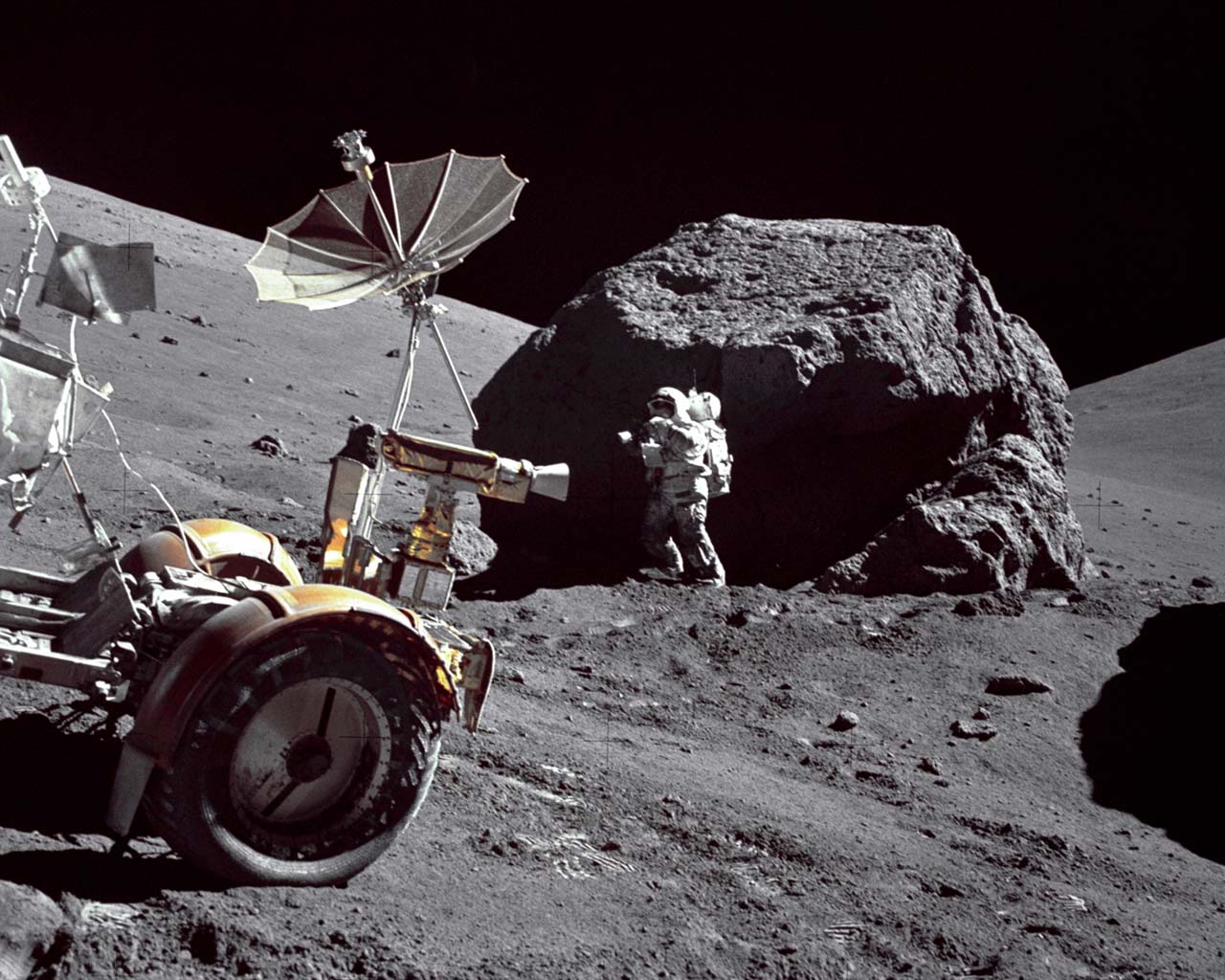
http://spacedaily.com/images/apollo-schmitt-rock-1 280.jpg -
Re:PredictionThis change was made specifically in response to US concerns. Tell me thats not a concession to a party unrelated to the project?
I'd argue that the US is a party related to the project in the sense that (a)they are a member of NATO (as are most EU contries) and (b) Galileo signals could (and will) be used against the US military at some point. Almost certainly not by an EU member state, but by some even more unrelated party (China and Iran seem obvious potential candidates). Note that EU delagates have specificly stated that they would not selectivly degrade Galileo's accuracy, even if it was being used militarily against the US. That is a pretty bold and reckless statement. If a US ally was attacked by an adversary that was exploiting GPS in its efforts, I'd wager that the US would be happy to degrade the signal if asked.
-
Re:very old news
-
What about on Mars?
How are the polar bears handling the polar ice cap melting on Mars? Must be the Mars rovers...
-
Re:Where's Russia, China, India, et al in all this
Dunno, why are europe being slackers - sending a robot to do a Man's job???
http://www.spacedaily.com/news/rlv-02g.html -
They are already flogging the old one on Ebay?Apparently you can buy the Hubble space telescope on eBay. At least, thats what eBay claims.
On this page, check out the smart tag on "hubble telescope" on the caption for the picture of Ceres"Find Hubble space telescopes at low prices. Shop for all kinds of unique products on eBay."
Wonder what the reserve is like. And what about the shipping? -
Understand the motivation, not the implementation
I personally produced a RSS->HTML feed. Instead of implementing the solution as an application I wrote a PHP script using the XML parser to convert RSS feeds to HTML. Customisation of the output is often as simple as a CSS file, more "complex" arrangements can be made by modifying the PHP code.
There really isn't very much more to it than that, the page auto-updates every 30minutes. The only feature missing are the user configurable persistent storage of your favourite rss lists, but for the environment it was needed this was no major problem.
Maybe I'm wrong. It's just that I didn't see the point in creating a seperate app + GUI when all the portability I needed was already present on the host machines. I doubt there are many places where there is access to RSS but not to an HTML browser.
For an example go to... http://www.burnttoys.co.uk/rss.html and cut n' paste this into the box.
http://rss.slashdot.org/Slashdot/slashdot
http://newsrss.bbc.co.uk/rss/newsonline_uk_edition /front_page/rss.xml
http://www.juno.co.uk/all/feeds/rss
http://www.spacedaily.com/spacedaily.xml
http://www.theinquirer.net/inquirer.rss
then hit "feed". Yes, it's not very pretty and the one major disadvantage is being able to get a user click on an RSS feed to auto open in the webpage. This I have never discovered how to do and this sort of feature could be considered a security flaw IMNSHO. I wanted to implement user storage with the ability to maintain a global list of all RSS feeds, typed and rated. -
Japanese space tourist wants to cosplay in orbit
In Space Daily a few days back, there was an article titled "Japanese Whiz Aims For Space - In Cartoon Uniform". Here's a snippet:
A Japanese Internet whiz is tipped to become the world's fourth space tourist - and he wants to orbit the earth dressed as an ace pilot from a hit Japanese animation series.
Other people might consider that a sacrilege or making space less "dignified," but I think it's actually pretty cool. In any case, it's also humbling to know there are people out there far geekier than me... -
Re:A Few CommentsThe Delta IV Heavy failed to put the inaugural payload in the right orbit and is being debugged. The Atlas V Heavy has never even flown yet.
If Boeing and Lockheed Martin do merge like they want, one of these rockets is most likely going to bite the dust without even getting to prove itself.
The first successful Ariane 5 ECA launch was in February 12.
Saturn V and Energia would have more payload, but neither are in production right now. So sorry to burst your bubble, but what I said was the truth. Ariane 5 ECA is heaviest lift vehicle you can buy on the market right now if you actually wanted your payload to be delivered ASAP. If we are going to count paper rockets, might as well add Falcon 9 to the list.
-
Too bad they're going to stop listening
As mentioned on Slashdot in April of this year, NASA is planning to terminate funding to the Voyager programs. SpaceDaily has an article from earlier this year that says that funding is not available for the seven older missions (Voyager, Ulysses, Polar, Wind, Geotail, FAST and TRACE) beyond the end of NASA's fiscal year, which ends in October. Given the fact that Voyager only costs $4.1M a year, hopefully someone will realize that it's not really an effective cost saving measure before they pull the plug!
-
Re:Huge Upfront Costs
and the CO2 percentage in the atmosphere has by far exceeded its natural levels.
I also found your post interesting until I stumbled upon the above sentence. Really. There's been a lot more CO2 in the atmosphere before in Earth's history.
http://www.spacedaily.com/news/climate-05zzi.html -
Re:In what way is this new?
I fail to see why formations of smaller satellites should be a new development. If smaller types could accomplish the mission of bigger ones, the big ones wouldn't be up there (carrying large antennae, big lenses or whatever).
At the bottom of the article this article is linked, about ESA's SSETI Express, launching 1kg CubeSat picosatellites developed by European universities.
The idea of using smaller and lighter satellites is hardly revolutionary, and resources are quite tight as it is: 71*60*60 cm max. form factor for Ariane 5 launches, peak power of maybe 50W - a modest car pc - if you don't want to add heavy batteries. Fitting multiple micro, nano, or picosatellites in a single cargo hold is the obvious way to decrease costs. -
Re: Full article text - Real versions
First story from : http://www.utias-sfl.net/nanosatellites/CanX2/
The CanX-2 Mission
The CanX-2 Mission is the second "NanoSatellite" Mission at the University of Toronto Institute for Aerospace Studies, Space Flight Laboratory (UTIAS/SFL). The Canadian Advanced Nanospace eXperiments (CanX) push the envelope of what can be achieved in space with small, low-power devices. With a focus on aggressive experimentation, CanX missions use the latest commercial technologies and manage moderate risks in exchange for low cost and quick turnaround. UTIAS/SFL is part of an international community of nanosatellite developers that share common launches to reduce costs.
At 3.5 kilograms and the size of a carton of milk, CanX-2 will be a pathfinder mission in 2006 to evaluate novel technologies that will be used on the CanX-4 / CanX-5 dual satellite mission in 2008 to demonstrate controlled formation flying in space. Formation flying technology will open the door to larger missions for highresolution Earth observation and interferometric imaging that can also be used for space astronomy. The technologies to be tested include a novel propulsion system, custom radios, innovative attitude sensors and actuators, and a commercial GPS receiver.
In addition to evaluating these miniature technologies, the satellite will also perform experiments for other university researchers across Canada. These include a GPS radio occultation experiment to characterize the upper atmosphere (Calgary), an atmospheric spectrometer to measure greenhouse gases (York), a network communications experiment (Carleton), and a space materials experiments (Toronto).
Second story from : http://www.spacedaily.com/news/microsat-05j.html
Canadian Researchers To Showcase CanX-2 Nanosat August 31
Toronto ON (SPX) Aug 30, 2005 University of Toronto researchers will demonstrate how a satellite the size of a milk carton that may revolutionize the space industry on Wednesday, Aug. 31, at 10 a.m. at University of Toronto Institute for Aerospace Studies (UTIAS) Lecture Hall, 4925 Dufferin Street.
At only 3.5 kilograms, the Canadian Advanced Nanospace eXperiment 2 (CanX-2) will test small, low-power devices that could lay the groundwork for flying formations of small satellites that could eventually replace larger, more expensive satellites.
At the demonstration, researchers will control the CanX-2 nanosatellite through a wireless radio link and download real-time images and telemetry from on-board equipment including a GPS-based positioning system, a miniature propulsion system and tiny devices used for sensing and controlling the satellite's orientation in space.
"The point of this mission is two-fold," says Professor Robert Zee, managing director of the UTIAS Space Flight Laboratory (SFL).
"The first is to provide complete development cycle training for students through a real space mission that has to be completed in two years. The second is to launch a tiny research platform into space to test innovative, revolutionary technologies in a rapid, risk-taking manner and also to perform important science missions that are now benefiting from the availability of smaller and smaller instrumentation."
CanX-2 is the second nanosatellite mission at UTIAS/SFL. CanX-1, Canada's first nanosatellite and one of the smallest satellites ever built, was launched with the MOST microsatellite in 2003 by Eurockot Launch Services from Plesetsk, Russia.
Sidebar to Second story
In collaboration with researchers from across Canada, the primary mission of CanX-2 will be a GPS radio occultation experiment to determine vertical profiles of atmospheric properties. It will also perform a number of additional experiments including mobile ad-hoc networking, autonomous control, advanced surface mate -
Re:"Virus kills hundreds on I-95"
I can't imagine any sane engineer linking the OS to the intercar communication system in a way that would allow direct control of the car from an outside source.
They've been doing that for a while now. I'm guessing that you aren't aware of the Invisible Fleet that moves toxic waste and very Top Secret Government Stuff.
Those vehicles can be manipulated remotely in case they are hijacked (or whatever else Bad happens). Look for the little white dome on top of discreet plain tractor-trailers. It has satellite communications. Among other things, the doors can be locked and the speed of the vehicle can be changed all of the way down to zero from a remote location.
Tanker Truck Shutdown Via Satellite
"Satellite Security Systems (S3), a global provider of asset security and logistics control, in cooperation with the California Highway Patrol (CHP) and InterState Oil Company, dramatically demonstrated the first wireless remote shutdown of a fully loaded moving petrochemical tanker truck."
Imagine what will happen when someone figures out how to shut a bunch of those vehicles down at one time when they are all driving at highway speeds. -
Re:HeyI also doubt a single beam actually cost 600 million.
http://www.spacedaily.com/news/shuttle-02d.html
I doubt you are a engineer, let alone an aerospace engineer.
I'm not an aerospace engineer, but I am an engineer. I'm an engineer who believes in redundant systems and simple solutions over "space hardened" systems. There are lots of examples of guys building working systems on shoestring budgets that last well beyond their engineered lifetimes. Check out http://www.hypocrites.com/article2897.html for just one example. I also cite a story from the Apollo days when Joe Shea vetoed a crazy design for measuring the remaining fuel in the fuel tanks of Apollo spacecraft. Instead of using a nuclear detector to measure fuel in a weightless environment (page 8), he chose a design based on one found in his Karman Ghia. They installed reserve fuel tanks capable of getting the crew home, and always made sure that they were within their limits.
I find it interesting that NASA always talks about how they fly the most complex systems in the world, yet somehow its the Russians with their 40 year old designs that have the most reliable systems.
-
Re:Hey
To get people in to space affordably I vote for either Kliper or CRX.
The Russians just announced the Kliper launch targets, 2011 first unmanned flight and 2012 first manned flight. It will carry six so if it works its the best bet to actually fully man the ISS. It can't be over 3 people now due to the emergency lifeboat limit which is currently a Soyuz. At a 3 man crew very little research or manufacturing can be done.
CRX is essentially Burt Rutan's LEO successor to SpaceShipOne in partnership with Transformational space and under a small contract from NASA. CRX is not as well known as CEV. Its intended to just get people to and from LEO and the Space Station reliably, safely and affordably. Its a leader, follower NASA contractor. If the leader, which is I think Transformational and Scale succeeds they stay the leader, if they fail the followers move up on the funding ladder. A real improvement in competition over NASA's usual approach which is just pick between Boeing, Lockheed or a consortium of the big names.
As for the grandparent's assertion that NASA's problem is not enough money THAT is absurd. NASA has squandered $100 billion and heading for $160 billion on the ISS by 2010. The Shuttle averages over its life $1.3 billion a launch. Its the most expensive launcher in history.
NASA's problem is waste not insufficient funding. If its budget is getting cut by the politicians its because they to waste much doing to little in their manned space program. Of course politicians in Florida, Texas, Utah and Mississippi, in particular, fan the flames by encouraging NASA to maintain bloated payrolls so they have lots of nice jobs in their states and districts. The Shuttle and ISS are great for a bloated payroll, jobs program. In that regard they will be missed. The danger is new programs like CEV will have to maintain the same bloated payroll to win political and budget support. If you keep the bloated payroll the bloated launch costs will live on. -
Propellant Costs
For those like-minded people who were curious about how much propellant/fuel the launch used after being struck (as always) by the awesome power produced, I did some searching and came up with a figure of around $500,000 for the propellant costs (liquid oxygen/liquid nitrogen).
-
sperm or 'eggs'?
in this article, it says 'eggs'. Or is sperm another forbidden word in the land of the free?
-
Re:Good for Science
Yay. It appears the Russian government has green lighted Kliper and hopefully other countries, especially ESA might chip in. My horse is off and running. Meanwhile NASA let some multimillion dollar contracts to Boeing and Lockheed to provide paper for a committee meeting.
I notice your current horse, the Shuttle, the one you said was so reliable, such a success and achievement, is for all practical purposes grounded indefinitely. Apparently there was yet another one of long running intermittent failures, this time in the ET fuel sensor they never fixed, one that could have either caused premature engine cut off or failure to cut off the engine when the tank empties and threatened another catastrophic failure.
We should have confidence that it will be fixed because now they have TWELVE, thats right TWELVE, different teams trying to fix it. I guess you can do TWELVE teams when you have 6,000 people working at your jobs program.
GO TEAM GO. -
Re:The effects of 3 suns
The Moon and Plate Techtonics: Why We Are Alone: a very interesting article about why we owe everything to our glorious moon!
-
Re:My memories
I read the CEV RFP. It was a bureaucratic nightmare. The space daily editorial is loopy in spots but it does convey a flavor of how goofy the CEV is going to be. Its more focused on producing mountains of paper and killing trees than on getting people in to space in a reasonable time at a reasonable cost. The paper generation requirements alone are beyond the grasp of any company smaller and less bureaucratic than Lockheed and Boeing. If Burt pissed his pants it was due to the devestation of seeing hopeless bureaucracy in action and especially one in the process of squandering manned space exploration for another decade. Burt isn't exactly young, I doubt he can wait another decade for another manned space vehicle competition to come along when CEV fails.
Maybe I agree with you in one respect, Burt is a realist and it will cost some serious money to build his vehicles to get to LEO and beyond. Since CEV is a writeoff, they have to raise the money on their own and that will be HARD to IMPOSSIBLE. Contrast with NASA who is handed billions of our tax dollars on a platter, year afer year, their track record is one of complete failure since the early seventies, yet the money keeps getting showered on them, decade after decade. That is enough to make any space enthusiast cry.
Lockheed's CEV proposal regurgitation of the their Orbital Space Plane.
As I recall Boeings proposal is an unoriginal attempt to replicate Apollo without the Saturn V. I think it was mostly empty headed artists conceptions as was Lockheeds. Not sure that replicating Apollo wouldn't be a bad idea if we actually want to get back to the moon. Dust off the blue prints, bend the same metal and maybe put in some new computers. More likely to succeed than Lockheed and Boeing's empty headed proposals.
"Actually, I view Burt with great respect"
Geez, now I know you work for NASA, "I view Burt with great respect" though you've been belittling and bashing him every other sentance, because he isn't part of MIGHTY NASA. Whats the matter? Looking in your NASA rear view mirror and seeing a little domestic competition for a change. He has a long way to go but he has one big plus, he is almost universally admired and respected after Voyager and SpaceShipOne. Ordinary people actually know his name. You would be hard pressed to find anyone that knows the name of or will say a kind word about anyone in NASA's manned space ministry.
You just have to hope some Congressman or a President doesn't wake up one day and say to themselves, we've been throwing all this money at NASA and getting nothing for it, maybe we should throw some of it Burt's way just to see what he can do with it. That is the day the Soviet Ministries in Florida and Texas are doomed. We desperately need some like Kelly Johnson to restart the space program and Burt is a LOT like Kelly Johnson. Kelly hate overgrown bureaucracy with a passion too, NASA people seem to love it and that is the sad. -
Space debris...
The ring could be comprised of particles which would scatter the sunlight, or be built by an interconnected ring of spaceships aligned to block the light.
I thought we already had this, or at least the beginnings. No need to spend so much money on purposely putting up a protective ring of stuff, as soon as China and India really ramp up their space programs, presto, global warming solved. -
Northrop Grumman is hiring
-
Re:Asteroids/Comets - Terraforming
Besides, it's a lot easier to picture living on Mars. The landscape has such an Earthlike feel to it. It's easy to picture a city off in the distance haze, sagebrush growing scattered across the landscape, etc.
Even if you can't get an O2 atmosphere, just increasing the atmospheric density to a sizable portion of our own would be a huge benefit. You wouldn't need pressure suits (only rebreathers and, depending on temperature and atmospheric composition, possibly unpressurized skin-protecting layers). The atmosphere would do a good job shielding you from radiation, the climate would be more moderate, and if you had to protect crops from the atmosphere still, the greenhouses would be much lighter if you didn't have to have them pressurized. -
Qualitatively
It seems like this is just a small-scale example of effects like this, where the whole planet does a whoopsie.
Seems like a step in the direction of understanding gravity.
Let's fund this kind of research, shall we?