Slashdot Mirror
Domain: t-online.de
Stories and comments across the archive that link to t-online.de.
Comments · 174
-
Re:Hmm
And other countries and cultures in general. Here's the "World according to America": Map
-
Re:Thank god shuttle has an EOL date
There is a well-written article (in German) on the end-of-life of the shuttle program in 2010. Among other things, it mentions that the shuttle program alone had higher costs (4 billion $) than the whole European space program. And it talks about the difficulties of the replacement program.
-
Re:Great job!
But is there a pager available for Sawfish which is as useful as FVWM's? Mine has the active window highlighted in a different color, and all of the windows have abbreviated (icon?) titles in a tiny but legible font. Far more useful than pictures.
I use sawfish.wm.ext.pager, which, while not updated in over a year (much like Sawfish, regrettably), it could probably match FVWM's (as it's written in the same LISP dialect as Sawfish, so it's thus fairly easy to hack).
-
Re:Uh oh
That is such a great movie (not because the movie is "good" in the normal sense, it's good because it's so catastrophically bad and/or plain crazy)
It's great for one, very important reason:
Ms. Naked Space Vampire - Mathilda May, naked, but only petrified at the start of the film. Really
(If she doesn't look that hot to you in the stills I linked to, that's because you haven't seen her moving, or the close-up of her eyes - now it probably just looks like cheap special effect contacts, but then (1985?), it looked like her eyes were huge dark whirlpools. She looked at the camera and you just stopped thinking.)
-
Re:3D ControlBut them from here. I have a set myself. Amazingly good.
In fact, when coupled with this joystick you can actually program the pedals to mimic both keyboard and mouse movements.
Who needs a keyboard?
And yes... I do have that setup myself. Yes I am a sorry person.
-
Solution for finding the an optimum solutionCube Explorer 3.0 will find a solution to the 3x3x3 cube that will take less than 20 moves.
And to see a video of a speed cuber, look at Dan Knight's page.
-
Re:What was the largest before this one?What was the talled building before this one?
The Petronas Towers in Kuala Lumpur. The reason why they held that title for so long is that Malaysia is a Muslim country...
Also, any odds on how long it'll be before they're flying helicopters around this
Around?
-
Join the fun
The VICe Emulator multiple plarform, open-source Commodore Vic20, 64, 128, PET emulator
-
Re:Not explained well...
Seems like one of those "wink wink nudge nudge" statement I make about *trying* games out on my GBA emulator.
That may be true for you, but it isn't true for everyone. I've actually written several programs for the Game Boy Color using emulators and the Bung XChanger and flash carts. I also wrote my own assembler and linker for the GBC.
Just because tools can be used for piracy doesn't mean everyone uses them that way. Writing programs and development tools for limited consoles can be a lot of fun and a great learning experience. -
Re:If you like MUDs
I think you meant Mercthievia. Hope that helps.
-
Re:Uh, no.
He also can give you a named note in just temperament if you prefer that to Well Tempered Clavier equal temperament.
The "Well-Tempered" in "Well-Tempered Clavier" does not refer to equal temperament. -
Re:Darmstadtium? Ewwww
Darm, if I'm not mistaken, means 'intestine'. Stadt means city. So this element is Intestine-city-um.
Exactly. AFAIK the city is named after the wriggly litte rivulet Darmbach which is not quite visible any more in the city.
Darmstadt, by the way, is about the geekiest place in old Europe. Seemingly ordinary people may actually understand the print on your T-shirt there. Besides GSI, Darmstadt has a Technical University and a University of Applied Sciences. The European Space Operations Center is located there and the Fraunhofer institutes for Secure Telecooperation, Integrated Publication and Information Systems, Computer Graphics, and Structural Durability. Deutsche Telekom is running a research center there and the headquarters of T-Online are about to move to Darmstadt from the nearby town of Weiterstadt. There is a Linux User Group too. Darmstadt officially carries the title Wissenschaftsstadt (city of science). It is located about 30km south of Frankfurt/Main. The bus ride from Frankfurt airport takes 25 minutes.
-
Computer speechI agree, for the most part. Just this past week, a guy was showing me a program that would say whatever he typed. I think it was an Open Source program on Linux, so I suppose it wasn't exactly state-of-the-art. It wasn't very good at English-to-phonemes.
So I grabbed and compiled a copy of VICE, the Commodore 64 emulator. Then I grabbed an abandon-ware copy of SAM, the Software Automatic Mouth. Its text-to-speech was about equivalent to the modern program. Plus, it had the option to type things in phonetically, including syllable emphasis. And it added the SAY command to the C64 built-in BASIC. All this in less than 32K is just incredible.
To be fair, I have heard some of the more modern TTS programs, and they do a pretty good job. So do some of the newer voice recognition programs, especially the ones now used on automated phone systems.
-
Even if you had to...
...load it from paper tape before you could start using it.
-
Link text: my pet peevePlease don't get too creative with what text you put in your hyperlinks. It makes it hard to tell where the links go. Hint: look at the Related Links box, and if it's totally nonsensical, your links need work.
Let's look at the links in this article:
- "skymap" points to the astrobio article
- "most promising" points to the skymap
- "project" points to a past slashdot article about SETI@home
- "these" points to a description of the signals SETI@home looks for
"An Astrobiology Magazine article today presents the skymap of where in the night sky to find the most promising SETI@Home signals, along with the research plan for the March Stellar Countdown project that produced it. The dedicated use of the Arecibo Telescope to revisit the most promising spikes, pulses, and steady signals, focused on 166 star candidates. Those 166 were pruned from the five billion signals that have been found since 1999, depending on the signal's persistence, closeness to a known star, and frequency. The next step is particularly fascinating, if a signal appears to have increased since the first observation put that star on the checklist."
-
Nobody mentions these search engines?
How come nobody mentions Vivisimo and Teoma in this context? They happen to present the results for different meanings of the word "apple", although they cannot read your minder neither, very much like Googe. They only make it easier for laymen and novices to see that there are other "meanings" for the same search term.
However, this discussion is also blatantly Anglo-centric. In the rest of the world, "Apple" is even more strongly connected to the computer manufacturer (or the Beatles!). Try appel, Apfel, manzana, or pomme in Google and see what you'll find then (or take a look here. -
VICE emulator
If you want VICE, an excellent, essentially perfect, C64 (and C128, and some other CBM-machines) emulator, then it's here.
I still use it about once a week when I feel nostalgic - while the graphics of C64 games totally suck, some of them still have better gameplay in my opinion than many of today's.
Plus there's some games I had in primary school that I've never completed (or looped, for those games that don't really end).
It's about 2 to 4 times faster than a real C64 on my now-ancient 400MHz PC.
I remember laboriously translating 6502 assembly into DATA statements, by hand, when I was learning to program in the 80s - the C64 BASIC was so unutterably pants (yes, it was made by MS), that people jumped to assembly to get anything non-trivial done. Then I got a C128 with a built-in assembler.
-
OllydbgHadn't seen this mentioned in the book or in any comments so far: If you are wanting to get started reverse-engineering on Windows, you don't need to shell out big bucks (or pirate) softice unless you plan to do hard-core driver/kernel debugging. Seriously, check out Ollydbg It's freeware AND it kicks ass. I'm using it to do almost all my reverse engineering now.
Here are a couple of beginner-level articles I've written on reverse-engineering malicious code:
-
Re:How about .NET being bundled with Java?
How about LISP written in C++ Templates? The file metalisp.cpp is quite interesting.
-
Theres ALOT more than just those two.
Theres dozens, theres a few that are pretty good, no they arent as good as Doom3(until ID releases the source) or Turbines engine, but they dont have to be, they just have to be good enough to make PS2 quality games.
Most of these games would look better than anything on the PS2. There is an open source game repository but are you willing to donate money to make these games good? Or will you complain about quality when you dont pay?
Well here are some engines.
Genesis3d
Nooface
WorldForge
Reality FactoryM
Ogre
Obsidian
More at LinuxGames -
Re:Mac OS X Panther still a mystery
I close the lid (Putting the laptop to sleep)
You need SleepWatcher and a dismount script.
You could even have a wakeup script that automounts the appropriate newtork drives when you open the lid.
-
BZZZZZZZ NEOWOP DING DING
Just to clarify.
-
Re:Its already moribund
-
Re:damn it....
thank you, that side eventually led me to my answer
-
Re:Already been done
you put a space in "humor"
click here to view. -
Some more info, in case you don't speak Japanese;)
... because Sharp actually did issue the news in a language more comprehensible to this audience either:
Linux "clamshell" PDAs with an Intel Xscale PXA255@400MHz, 64 megs of RAM and up to 128 megs of built-in flash are only some of the mouth-watering specs for the new SL-C760 and C750, just released in English to make geeks world-wide wish they were in Japan - the only place, again, for which Sharp has announced to market the new models. The predecessor, widely acclaimed for its excellent "Continuous Grain Silicon" VGA LCD, has been made available by third parties in the USA, Germany, and directly from Japan, but if you're looking to replace e.g. your aging Psion with the latest and greatest Linux PDA from a local vendor, you may want to get Sharp to change their mind and make it available world-wide this time.
In other news, in India the Simputer is expected to be shipping below US$200 (10000 rupies) soon.
Wouldn't both of these be rather compelling items for ThinkGeek to carry as well (just in case the current vendors get overwhelmed by Slashdotters buying up the equivalent of a monthly production - BTW, what's the discount at 30000 units) ? -
|Windows XP SP1 has big memory mgmnt problems.
Windows XP Service Pack 1 causes memory management problems that my experience shows are far, far worse than Microsoft says. The new 815411 patch seems to fix the problems on the one system on which I have tested it. The title is "Programs Run Slower After You Install Windows XP SP-1", but that doesn't make sense. Why do they run slower? Because the operating system is trying to recover from memory management errors?
To see the problem, start 20 instances of Mozilla, each with 10 tabs. As you are doing this, you will find that the responsiveness of the Windows XP system becomes much slower. Then, when the limit of installed memory is reached, and the system begins using virtual memory, all instances of Mozilla will crash. After the crashes, the Windows XP system remains unstable. The instability can only be fixed by re-booting.
See the Slashdot article: XP Service Pack Slows Programs
The Slashdot article referenced this article: Service Pack glitch causes system slowdowns (Notice the nonsense subtitle in this article: "Windows XP SP1 update flaw affects memory-allocating programs".)
Microsoft is apparently afraid that the patch causes more problems, so the patch has limited availability. Also, by making people who want the patch call Microsoft, the company may be collecting information about the problems people are having. It seems from the way the notice of the patch is worded that if you call Microsoft, you may have to pay.
I downloaded the patch from other sources, and found that they all were the same, so that relieved worries of a bad patch.
Sources:
Neowin
Q815411_WXP_SP2_x86_ENU.exe
Q815411_WXP_SP2_x86_ENU.exe
Q815411_WXP_SP2_x86_ENU.exe
http://www.paricom.com/matt/xphotfix/ -
More mirrors for Patch
-
My favorite dying gamesare being kept alive by Soleau Software. I loved these puzzle games while growing up. I always enjoyed the challenge.
Aside from that, all the great games died with the Commodore 64.
-
T-Linux?
Noooo! Deutsche Telekom, take your hands off Linux!
For those who don't know them, about every product as a T prefixed: T-Mobile, T-Net, T-Systems, T-Online... and now T-LInux)
-
Re:[OT] Re:Already got this luvin :)
Linux on NForce2 getting there.
-
jelly donut?
-
Nameservers for Linux and *BSDevilpenguin wrote:
BTW, what alteratives to BIND exist for Linuxand *BSD? I actually don't know and would like to know.
There are now a number of alternative packages that may have advantages for many deployments. E.g.:
MaraDNS is a general-purpose, fast DNS server package (doing recursive, authoritative, and caching roles, plus fully supporting zone transfers):
http://www.maradns.org/pdnsd is a small caching-only DNS server with a disk-based cache, suitable for small networks and workstations:
http://home.t-online.de/home/Moestl/Dnsmasq is a small authoritative and caching DNS server for a group of NATted / IPmasqued machines (optionally pulling names from DHCP leases):
http://www.thekelleys.org.uk/dnsmasq/DNRD is a small caching-only DNS server for NAT / IPmasq networks:
http://dnrd.nevalabs.org/MyDNS is a MySQL-based authoritative and caching server (no recursive service) suitable for very large sites. In such roles, it's faster and more responsive than BIND9, even though the latter uses a RAM-based cache:
http://mydns.bboy.net/ldapdns implements the same idea, except out of an LDAP database. Again, much faster than BIND9:
http://nimh.org/code/ldapdns/GnuDIP is an authoritative server for Dynamic DNS:
http://gnudip2.sourceforge.net/gnudip-www/NSD is a high-performance authoritative-only daemon:
http://www.nlnetlabs.nl/nsd/PowerDNS (open source as of 2002-11-25) is an authoritative-only daemon with a modular structure supporting various back-end information stores such as SQL databases (MySQL, PostgreSQL, Oracle 8i, Oracle 9i, IBM DB2, and others via ODBC), BIND zonefiles and other file formats, and LDAP directories. Supports AXFR zone transfers.
http://www.powerdns.com/products/powerdns/CustomDNS is a authoritative-only daemon for both static addresses and its variant form of dynamic DNS:
http://customdns.sourceforge.net/lbnamed is a similar authoritative-only daemon for static and dynamic information, with a load-balancing multi-machine architecture:
http://www.stanford.edu/~riepel/lbnamed/Posadis is another fast authoritative-only daemon:
http://posadis.sourceforge.net/dents is another general-purpose DNS server, but is perenially unfinished, and is probably dead, at this point:
http://sourceforge.net/projects/dents/Pliant DNS Server is another general-purpose DNS server, although it may not support zone transfers:
http://pliant.cx/pliant/protocol/dns/Yaku-NS is another small, fast general-purpose DNS server:
http://www.kyuzz.org/antirez/ens.htmlTwisted Names is an authoritative and caching DNS server, written in Python:
http://twistedmatrix.com/documents/howto/namesOak DNS Server is an authoritative and caching DNS server, supporting dynamic DNS updates and AAAA records. It's written in Python, and doesn't need to run privileged:
http://www.digitallumber.com/oakdnsjava is a minimal, authoritative-only server, a resolver library, and a set of DNS utilities, all written in Java:
http://www.xbill.org/dnsjava/Related:
FireDNS is a client library for DNS requests, with emphasis on speed and asynchronous processing. Written in C, and has low-timeout blocking functions. Can be used to relace standard libc resolver library functions like getbyhostname with much faster equivalent code:
http://ares.penguinhosting.net/~ian/GNU adns is a resolver library for C (and C++) programs, and a collection of useful DNS resolver utilities:
http://www.chiark.greenend.org.uk/~ian/adns/Proprietary packages include:
UltraDNS (UltraDNS Corporation)
djbdns/tinydns
ATLAS (Verisign)
BINDPlus (Information Network Eng. Group, Inc.)
Global Name Service (Nominum, Inc.)
NeDNS (Neteka, Inc.)I maintain this list at http://linuxmafia.com/~rick/linux-info/dns-server
s Rick Moen
rick@linuxmafia.com -
Contiki LinksContiki Links
URL: http://dunkels.com/adam/contiki/links.html
System information and emulators
Commodore 64/128
The Commodore 64 is based on the 6510 CPU, which is a 6502-derived 8-bit CPU. It has 64k of RAM and 16k ROM which includes a BASIC interpreter and some basic I/O services. Graphics is provided by the VIC chip which has 16 colors and a maximum resolution of 320x200 in hi-res mode. It provides a 40x25 raster of characters in character mode. The three voices of digital sound is produced by the SID chip.
The Commodore 128 is an extended version of the Commodore 64 that contains a 8510 CPU which is capable of 2 MHz operation and can address 128k RAM (hence the name Commodore 128). It also has a Commodore 64 compatibility mode which is extremely similar to a regular C64 but with a few minor differences.
SuperCPUThe SuperCPU is a 20 MHz 16-bit 65816-based computer that is plugged into the back of the Commodore 64 or 128. It uses the C64 keyboard and joysticks for input and the VIC and SID chips for audiovisual output. The SuperCPU is capable of addressing several megabytes of memory and is usually used together with a 16 megabytes RAM expansion board.
There are no SuperCPU emulators avaliable.
Links- The VICE emulator
is capable of emulating a large number of Commodore machines. It
emulates the C64, the C128, the VIC20, most of the PET models, and the
CBM-II. VICE runs under Windows, Linux, FreeBSD, and a number of other
host systems.
- Joakim Eriksson's Web
C64 emulator, written in Java, runs as an applet within a web
browser.
- Per Håkan Sundell's CCS64 emulator works
under Windows and DOS.
- The ec64
emulator is developed for Linux and was originally written entirely in
x86 assembler.
- An article by Simon
N Goodwin about C64 emulators.
- The Commodore
emulators category in the Dmoz has more links.
Commodore 64/128
There are plenty of alternative operating systems for the C64, mostly written in 6502 assembler. Some of them are far from complete, however, and only appear as dark shadows on a few web pages - MagerValp's SMOS and my own osT are among those.
- GEOS from 1986 probably
is the most well-known graphical operating system for the C64. It is
still sold commercially by CMDKEY.com.
- LUnix NG is an open-source multi-tasking operating system with TCP/IP/PPP-support, a *nix-like command shell, and a number of *nix-like utilities such as ls and cp.
- Craig Bruce's ACE is a
text-based single-tasking operating system for the 64 and the 128. It
provides a *nix-like command shell, a text-editor, a terminal program
for the SwiftLink RS232 interface, as well as device drivers for a
lot of devices
- GeckOS/A65 is a
multi-tasking operating system with TCP/IP support and a *nix-like
command shell.
- Wheels is a version of GEOS that requires RAM expansion to run.
With its 20 MHz and megabytes of memory, the SuperCPU is powerful enough to run fully-fledged graphical operating systems that rival early Machintosh or Microsoft Windows systems.
- Wings is a TCP/IP-enabled graphical operating system for the SuperCPU. It includes a MOD music player, JPEG viewer, web page download utility, etc.
- JOS is an older version
of Wings.
TCP/IP and PPP connectivity
To surf the web, send or read email, etc., the first step is to actually get in touch with the Internet. This requires both physical access to an ISP, either via a modem and a phone-line or an Ethernet broadband connection, and the TCP/IP software running on the C64.
There are a number of programs that make it possible to reach the Internet with a C64/C128.
- LUnix NG contains a
TCP/IP stack and a PPP implementation which makes it possible to reach
the Internet using a modem and a dial-up ISP.
- GeckOS/A65 also
contains a TCP/IP stack, but no PPP dialer.
- My own uIP TCP/IP stack
has been used for some time to run a web server on a Commodore 64. uIP
currently does not include a PPP dialer.
- Novaterm 10
contains a PPP dialer and enough TCP/IP code to be able to run telnet
over the Internet.
SuperCPU
All of the above mentioned SuperCPU operating systems have TCP/IP support.
- The
Wave is a web browser for the SuperCPU (and not for the Commodore
64/128 as the web page claims) that runs under the Wheels operating
systems. Here
is another page with information about The Wave (that also falsely
claims that The Wave is for the Commodore 64/128). The latter page
also includes screenshots of The Wave in action.
Small graphical user-interfaces (GUIs)
User interfaces for embedded systems range from the simple buttons on the front of a washing machine to those of fully fledged web browser type interfaces on information stations. The underlying technology varies from simple electronic circuits to full-scale PC compatibles.
- PicoGUI is a GUI architecture
designed for embedded systems to desktop machines. It does not require
any supporting GUI system and can be used on anything from graphical
screens to text based systems. Their smallest target system are
handheld terminals and the compiled object code size is on the order
of hundreds of kilobytes.
- Microwindows/NanoGUI is
a graphical user interface system designed to run without support from
an underlying system. On 16-bit systems Microwindows is about 64k
large.
The smallest web browsers are usually specially designed for the limitations of embedded systems and other specialized computers such as car navigation systems, set-top boxes and medical equipment. There are also a few small web browsers for old DOS PCs available.
- Interniche's NicheView Portable
Embedded Web Browser is probably the smallest full-featured web
browser around with its 35 kilobytes code footprint. There is also an
additional JavaScript module available.
- AU-systems' AU Mobile
Internet Browser supports both HTML/TCP/IP and WML/WAP as well as
SSL. It occupies 340 kilobytes of code (plus an additional 190
kilobytes for the protocol stacks) and uses 5 kilobytes of RAM when
idle (plus 8 kilobytes used by the protocol stacks). Extra RAM is used
when downloading web pages.
- The Fusion
WebPilot Embedded Micro-Browser supports much of the features
found in modern web browsers including frames, authentication, and
JavaScript. The web page does not specify memory footprint.
- MicroDigial's Graphical
MicroBrowser supports tables, frames, images as well as FTP as
uses 260 kilobytes of code memory and requires a minimum of 210
kilobytes of RAM apart from that. A demo version is available.
- The 2net Alice Web
Browser is intended for handheld computers and PC based
architectures and requires 400 kilobyte of free RAM and 200 kilobytes
of code memory. It includes a TCP/IP stack.
- WebBoy is a
fully-fledged browser with SSL support intended for 386 DOS boxes with
more than 4 megabytes of memory. Includes a TCP/IP stack.
- The Arachne web browser
runs under MS-DOS or Linux and requires at least 1 megabyte of
memory. Does not include a TCP/IP/PPP stack.
- Lynx is probably the most
well-known text-based web browser around. It is ported to many
different operating systems and architectures including MS-DOS.
- The Off by One Web Browser
has been labeled as the smallest web browser ever, but is quite large
in comparison with other small web browsers. It is 1.1 megabytes large
and requires support from an underlying Windows operating system.
- Mirko Sobe's BOSS-X
HTML browser for 8-bit Ataris is not a full web browser, but an
off-line HTML viewer with hyperlinking abilities written in three
days.
- The pre-alpha v0.3 GEMWeb browser
supports 640x480x16 VGA.
- The Atari
Phoenix Web Browser is a non-existant vapor-ware web browser
project intended for the 8-bit Ataris.
- The VICE emulator
is capable of emulating a large number of Commodore machines. It
emulates the C64, the C128, the VIC20, most of the PET models, and the
CBM-II. VICE runs under Windows, Linux, FreeBSD, and a number of other
host systems.
-
Re:German DSL
I think you are right about the ISDN part, I'll have to look at that when I get back... unfortunately, starting tomorrow, I'll be looking for access in another, less hospitable place...
but anyway, try this link for the email name question - link. I got it out of an english-translation for the setup instructions. It will as for your t-online password (a 8 or 10 digit number IIRC), then you should prompted for a user name (all in german of course). Hit "Andern" to accept. (Hadn't tried it myself, I just use yahoo.) -
German DSL
The Deutsche Telekom sells flat-rate "T-DSL" for about 55 euros a month. The service is extremely reliable as compared to what I was used to in the states. However, it is a bit of pain to get the parts (three separate boxes) and get it turned on. Get some help from a German-speaking friend or soldier. (as a side bonus, with the flat DSL, you can call the US for 4 cents a minute)
They also sell time-based access cards on post, and on the economy, if you don't want always-on access.
Good luck! -
Re:Linus too Harsh
We had a working Telex machine in our basement. My dad helped me build a kit ZX81. It had 1k of memory. It didn't have a cassette to store things so we played "Hunt the Wombat" for a week before turning the computer off. Then we would spend evenings entering in code for "Eliza". On a speak-and-math keyboard. Good times
-
Re:limited functionality
Incidentally, This is very, very old news- I remember reading about this years ago, a bunch of US researchers beat these guys to the punch by quite a bit.
Yeah, sure. Just as much as the first flight was performed by Americans and just as much as the first Computer was made in the US... -
Why not...
Why not get one of these and run this? You can get a complete system with power supply and nice case for less than just the C-ONE board alone costs.
-
Re:Uhhh, date?Since neither 'Time' nor 'Wired' are German magazines,...
Maybe it was the infamous Bild Zeitung?
-
From the Berlin wall
I didn't know Krushchev was gay.
Don't know, but I saw Brezhnev kissing Honecker. -
OSNews to interview Jeri and Jens :)
I am planning an interview with Jeri and Jens for OSNews.com with regard to the c-one and Catweasel board (targeted mainly at AmigaOne/Pegasos/AmigaOS emulation users) today. If there are any questions anyone would like to see answered, then you can suggest them here or send me an email.
I am planning to publish this interview somewhere next week. My interview/article will likely emphasize that the c-one is a reconfigurable solution, not solely for c64 fans. So stay tuned.
For the people who understand German, here's an interesting piece regarding the c-one by a German Mag.
Here's a video of an Amiga show where a prototype c-one was being demonstrated by Jeri. Also the Pegasos and AmigaOne were being sold at this event.
Some more pictures of Jeri and some interesting Pegasos demonstration video can be found here. -
It's not an emulator, it's not a breadbox
Yes, emulators (especially VICE) emulate the C64 almost perfectly. Yes, an old breadbox is only one tenth of the price on eBay. But the C1 is neither.
If you've ever worked with the real hardware you'll know that emulators can't replace the real deal. They're great development tools, and they're great for playing games when the boss isn't watching, but just as MAME is not a dedicated Galaga cabinet, VICE is not a real C= machine.
So why not just get a breadbox on eBay then? Well, I suggest that you do, it's an excellent machine. But then you'll also need to buy a 1541 disk drive to run games and demos. If you want to transfer software to or from the system you'll also need an X1541 cable or a 3.5" disk drive. And don't forget an S-video monitor, as you can't use a normal VGA monitor.
The C1 makes it possible to use common PC hardware like VGA monitors and IDE drives. It has 20 times the CPU power and 512 times the RAM, which is great for us that actually use the machine for things like coding (assemble and test in less than 1 second, sweet). Another important point is that when the original C= hardware starts to disintegrate, the C1 will still be there, as it's all just VHDL code.
This is not a machine for everyone, but there's certainly a market for it. There are still a lot of active C= users in the world, more than you'd think.
-
In other news...
...the Vice emulator, which emulates the C= 64, C= 128 (both 40 and 80 column modes), VIC-20, Pet, and CBM-II, is still free.
-
Re:If you consider an EMachine on par with a PC
I loved the engineering on those 851-916s, but the look never really grabbed me. I can see why others liked them. Among the Cagiva era Ducatis I have a soft spot for the 1990 750S (a.k.a. the Nuevo Sport). I got a leftover one brand new for $6700 in 1993, but it was stolen several years ago. sniff.
When I was in college my local welder offered to sell me his near perfect Laverda 750 SFC for $1100. I happened to have exactly that much in the bank but stupidly chose to spend it on food and rent. Consequently, I ended up an old fart with a BMW R100S. But at least it has R90S paint, rear sets, a lightened flywheel, 40mm Del'Ortos and an R100S solo seat. There is hope for me yet.
Now that I think about it, I think the SFC is my favorite bike ever. From an asthetic standpoint anyway.
-
Re:Why we need to abandon DNSIf you've never written to the protocol, how do you know it's bad?
I have single-handendly written a working recursive DNS server without getting paid for my work. There is a reason why there are only three of us in the entire world; DNS is that bad. Actually, it is a good deal worse than you can imagine.
Let me put it this way. Writing a DNS client (or a non-recursive DNS server) is sort of like Highlander I. Entertaining, really. You think to youself "Hey! That was easy! A recursive server can't be too bad!"
Well, writing a working recursive DNS server is like watching Highlander II. Suddenly, just as Highlander II changes your outlook on the entire Highlander franchise, writing a recursive DNS server changes your outlook on the entire DNS protocol.
But, hey, don't take my word for it. Dan, one of the other three of us, feels the same way. Thomas, the last of us, has made no statements either for or against DNS. If we were to review recursive DNS the same way Rotten Tomatoes reviews movies, DNS would get a 0%; possibly a 33% if Thomas secretly loves DNS and hasn't told anyone. By any standard, that makes for a bomb that should have tanked at the box office.
Alas, it didn't. And so we are stuck with a horrible mess of a protocol today.
- Sam
-
Why they were exonerated
The facts behind the charges were pretty solid, as were the determinations. So why were they exonerated? As you can read here, less than a week before a 2-day congressional hearing was scheduled to review the allegations of scientific fraud, the National Institutes of Health reopened the inquiry and this time found "significant errors" in the paper, but "no evidence of fraud, conscious misrepresentations, or manipulation of data" by the authors. As you'll read in that article, the scientists basically thought that any government intrusion would be too much, and so the convictions were suddenly overturned. Ever since, this has been an example of how the scientific community was unable to police itself.
-
Why they were exonerated
The facts behind the charges were pretty solid, as were the determinations. So why were they exonerated? As you can read here, less than a week before a 2-day congressional hearing was scheduled to review the allegations of scientific fraud, the National Institutes of Health reopened the inquiry and this time found "significant errors" in the paper, but "no evidence of fraud, conscious misrepresentations, or manipulation of data" by the authors. As you'll read in that article, the scientists basically thought that any government intrusion would be too much, and so the convictions were suddenly overturned. Ever since, this has been an example of how the scientific community was unable to police itself.
-
Upcoming Amiga + Retro show in Germany
For Retro fans interested in c64 technology and nostalgia, the upcoming Amiga Messe in Aachen may be of interest.
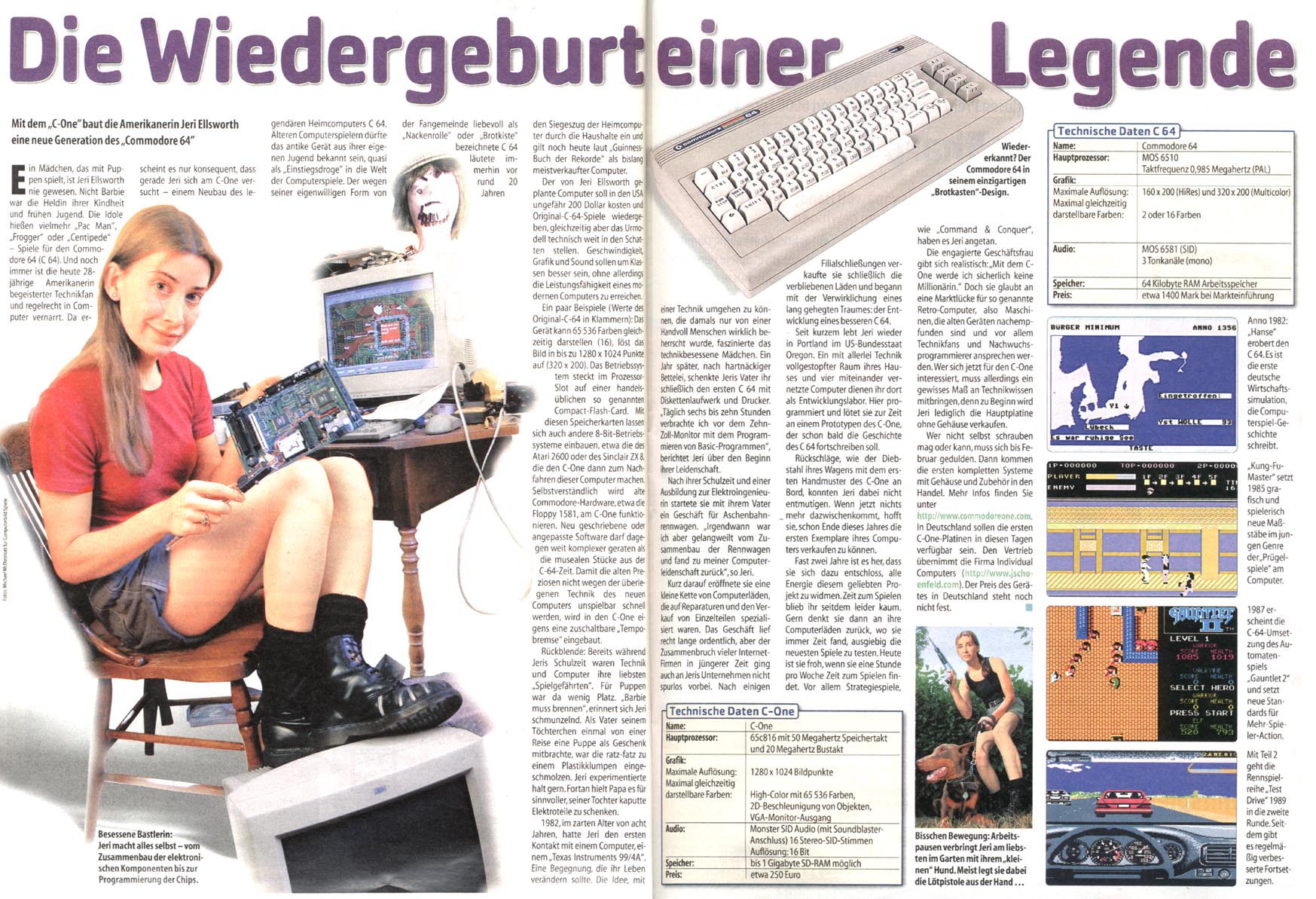
Next to Amiga products, Jeri Ellsworth will travel from the US to the show to launch a new c64 compatible clone, called the c-one.
The c-one is a MicroATX form factor board, with at its core a (65c816 processor running approximately at 20 MHz) the 65c816 is a 6502 compatible processor with a 24 bit address range extra instructions that access the full memory range are added to the 6502 core.
Another interesting product which will be sold at the Aachen fair is the new Catweasel MK3 PCI/Flipper board. This PCI board can be used with the c-one, AmigaOne boards, Pegasos boards, Classic Amigas and even ordinary PCs to read just about any disk format using ordinary mainstream diskdrives (including 880kb/1,76 MB Amiga disks and c64 disks!), connect digital c64/Amiga/Atari joysticks, connect Amiga keyboards or even add a real c64 SID soundchip'.
Here's a picture:
http://home.t-online.de/home/indcomp/bin/cwmk3.jpg
For more information about this Catweasel product look here. -
Catweasel MK3 PCI/Flipper board
Another interesting product which will be sold at the Aachen fair is the new Catweasel MK3 PCI/Flipper board. This PCI board can be used with AmigaOne boards, Pegasos boards, Classic Amigas and even ordinary PCs to read just about any disk format using ordinary mainstream diskdrives (including 880kb/1,76 MB Amiga disks), connect digital c64/Amiga/Atari joysticks, connect Amiga keyboards or even add a real c64 SID soundchip'.
Here's a picture:
http://home.t-online.de/home/indcomp/bin/cwmk3.jpg
For more infor turn here.
Previous slashdot coverage.
Also interesting for Retro fans is that an ATX form factor c64 clone will be launched at the upcoming fair as well. (No kidding!)