Slashdot Mirror
Domain: technologyreview.com
Stories and comments across the archive that link to technologyreview.com.
Stories · 1,042
-
You Could Be Flirting On Dating Apps With Paid Impersonators (qz.com)
Chloe Rose Stuart-Ulin sheds some light on the world of paid impersonators on dating apps like Tinder. Here's an excerpt from the report: Every morning I wake up to the same routine. I log into the Tinder account of a 45-year-old man from Texas -- a client. I flirt with every woman in his queue for 10 minutes, sending their photos and locations to a central database of potential "Opportunities." For every phone number I get, I make $1.75. I'm what's called a "Closer" for the online-dating service ViDA (Virtual Dating Assistants). Men and women (though mostly men) from all over the world pay this company to outsource the labor and tedium of online dating. The matches I speak to on behalf of the Texan man and other clients have no idea they're chatting with a professional.
It shouldn't come as a surprise that these ghostwriting services exist. Tinder alone produces more than 12 million matches a day, and if you're a heterosexual American, you now have a one in three chance of meeting your future husband or wife online. But as e-romance hits an all-time high, our daily dose of rejection, harassment, and heartbreak creeps upward, too. Once you mix in the vague rules of netiquette and a healthy fear of catfishing scams, it's easy to see why someone might want to outsource their online-dating profile to a pro, if only to keep themselves sane. But where does the digital social assistant end and the con artist begin? -
Researchers Are Keeping Pig Brains Alive Outside the Body (technologyreview.com)
In a step that could change the definition of death, researchers have restored circulation to the brains of decapitated pigs and kept the reanimated organs alive for as long as 36 hours. From a report: The feat offers scientists a new way to study intact brains in the lab in stunning detail. But it also inaugurates a bizarre new possibility in life extension, should human brains ever be kept on life support outside the body. The work was described on March 28 at a meeting held at the National Institutes of Health to investigate ethical issues arising as US neuroscience centers explore the limits of brain science. During the event, Yale University neuroscientist Nenad Sestan disclosed that a team he leads had experimented on between 100 and 200 pig brains obtained from a slaughterhouse, restoring their circulation using a system of pumps, heaters, and bags of artificial blood warmed to body temperature. -
Algorithm Automatically Spots 'Face Swaps' In Videos (technologyreview.com)
yagoda shares a report from MIT Technology Review: Andreas Rossler at the Technical University of Munich in Germany and colleagues have developed a deep-learning system that can automatically spot face-swap videos. The new technique could help identify forged videos as they are posted to the web. But the work also has sting in the tail. The same deep-learning technique that can spot face-swap videos can also be used to improve the quality of face swaps in the first place -- and that could make them harder to detect. The new technique relies on a deep-learning algorithm that Rossler and co have trained to spot face swaps. These algorithms can only learn from huge annotated data sets of good examples, which simply have not existed until now. In semi-related news, the Screen Actors Guild-American Federation of Television and Radio Artists (SAG-AFTRA) says it's "fighting back" against the dangers posed by new face-swapping technologies that have been used to digitally superimpose the faces of its members onto the bodies of porn stars.
"SAG-AFTRA has undertaken an exhaustive review of our collective bargaining options and legislative options to combat any and all uses of digital re-creations, not limited to deepfakes, that defame our members and inhibit their ability to protect their images, voices and performances from misappropriation. We are talking with our members' representatives, union allies, and with state and federal legislators about this issue right now and have legislation pending in New York and Louisiana that would address this directly in certain circumstances. We also are analyzing state laws in other jurisdictions, including California, to make sure protections are in place. To the degree that there are not sufficient protections in place, we will work to fix that..." -
The US Military Desperately Wants To Weaponize AI (technologyreview.com)
Artificial intelligence is a transformative technology, and US generals already see it as the next big weapon in their arsenal. From a report: War-machine learning: Michael Griffin, Undersecretary of Defense for Research and Engineering, signaled how keen the military is to make use of AI at the Future of War 2018 conference held in Washington, DC, yesterday. Saber rattling: "There might be an artificial intelligence arms race, but we're not yet in it," Griffin said. In reference to China and Russia, he added, "I think our adversaries -- and they are our adversaries -- understand very well the possible future utility of machine learning, and I think it's time we did as well." -
MIT Severs Ties To Company Promoting Fatal Brain Uploading (technologyreview.com)
An anonymous reader quotes a report from MIT Technology Review: The MIT Media Lab will sever ties with a brain-embalming company that promoted euthanasia to people hoping for digital immortality through "brain uploads." The startup, called Nectome, had raised more than $200,000 in deposits from people hoping to have their brains stored in an end-of-life procedure similar to physician-assisted suicide. MIT's connection to the company came into question after MIT Technology Review detailed Nectome's promotion of its "100 percent fatal" technology. Under a subcontract, MIT was receiving approximately $300,000 from a federal grant won by Nectome to develop methods of brain preservation and analysis. According to an April 2 statement, MIT will terminate the research contract with Media Lab professor and neuroscientist Edward Boyden. Boyden said he didn't have a financial stake or other personal involvement with Nectome. MIT's connection to the company drew sharp criticism from some neuroscientists, who say brain uploading isn't possible. -
The World's Fastest Delivery Drone Takes Off (technologyreview.com)
A couple of years ago, Zipline, a California-based startup, created a national drone delivery system to ship blood and drugs to remote medical centers in Rwanda. Now it has developed what it claims is the world's swiftest commercial delivery drone, with a top speed of 128 kilometers an hour (a hair shy of 80 miles per hour). From a report: Zipline is hoping its new fixed-wing aerial robot, which is both speedier and easier to maintain than its predecessor, will help it win business in an industry that's attracted plenty of big players. They include Amazon, which has been testing its Prime Air drone delivery service for years in the UK and elsewhere, and Project Wing, part of Alphabet's secretive X lab, which is using its drones to deliver pharmaceuticals and burritos in a pilot project in Australia. -
CRISPR-Altered Plants Are Not Going To Be Regulated (For Now) (fastcompany.com)
Good news for people who like genetically altered tomatoes and other plants. The U.S. Department of Agriculture announced it will no longer regulate them. From a report: The USDA not only rolled back Obama-era rules regulating genetically edited plants, but now it claims that plants whose genomes have been altered using gene-editing technology (read: CRISPR) pose "no risk," MIT's Technology Review reports. While CRISPR engineering is still a relatively new science whose full impact is not yet known, the USDA has decided that it is merely an innovative shortcut to the age-old practice of plant breeding. -
To Protect AI From Attacks, Show It Fake Data (technologyreview.com)
AI systems can sometimes be tricked into seeing something that's not actually there -- remember when Google's software "saw" a 3-D-printed turtle as a rifle. At an event earlier this week, Google Brain researcher Ian Goodfellow explained how AI systems defend themselves. From a report: Goodfellow is best known as the creator of generative adversarial networks (GANs), a type of artificial intelligence that makes use of two networks trained on the same data. One of the networks, called the generator, creates synthetic data, usually images, while the other network, called the discriminator, uses the same data set to determine whether the input is real. Goodfellow went through nearly a dozen examples of how different researchers have used GANs in their work, but he focused on his current main research interest, defending machine-learning systems from being fooled in the first place.
[...] GANs are very good at creating realistic adversarial examples, which end up being a very good way to train AI systems to develop a robust defense. If systems are trained on adversarial examples that they have to spot, they get better at recognizing adversarial attacks. The better those adversarial examples, the stronger the defense. -
Open Source RISC V Processor Gets Support From Google, Samsung, Qualcomm, and Tesla (seekingalpha.com)
An anonymous reader writes: Google, Qualcomm, and Samsung "are among 80 tech companies joining forces to develop a new open-source chip design for new technologies like self-driving vehicles," writes Seeking Alpha, citing a (pay-walled) report on The Information. "Western Digital and Nvidia also plan to use the new chip design for some of their products," while Tesla "has joined the RISC-V Foundation and is considering using the tech in its new chip efforts."
MIT Technology Review adds that while Arm had hoped to bring their low-power/high performance processors to AI and self-driving cars, "The company that masterminded the processor inside your smartphone may find that a set of free-to-use alternative designs erode some of its future success." -
The Gig Economy Keeps Growing, But Worker Benefits Aren't (technologyreview.com)
An anonymous reader quotes a report from MIT Technology Review: According to a new report out from Brookings, the number of non-employer firms -- primarily incorporated freelancers and gig-economy workers -- has grown 2.6 percent every year since 1997. By contrast, payroll employment has grown by only 0.8 percent annually in that time. That means a growing number of people lack employer-sponsored benefits like paid leave, health care, and retirement assistance. The Aspen Institute has proposed a system of portable benefits that are not tied to one job. Companies would make contributions to a worker's benefits on the basis of how much the employee works for them. To date, the U.S. government has not been helpful. House and Senate bills supporting gig-worker benefits have died in committee. But state and local governments are taking action. Washington, California, New York, and New Jersey are exploring avenues to provide benefits to their gig workers. -
AI is Rapidly Changing the Types and Location of the Best-Paying Jobs (technologyreview.com)
Artificial intelligence and automation are not likely to cause vast unemployment, but that doesn't mean we shouldn't be concerned about the impact on jobs. From a report: "I'm not worried about technological unemployment," said Laura Tyson, a prominent economist at the Haas School of Business at the University of California, Berkeley. "But I am worried about the quality of jobs created and the location where they are created." Speaking this week at EmTech Digital, an annual AI conference organized by MIT Technology Review, Tyson suggested we look the effects of increasing automation over the last 30 years. What we know, says Tyson, is that automation has taken away many routine jobs.
Particularly hard hit have been middle-skill and middle-income jobs, such as those in manufacturing. "We know from the past that the jobs that require low skills are more likely to be automated," said Tyson. "I worry about income inequality." Automation and AI will create new jobs. But, said Tyson, those new jobs might not be in the same parts of the country in which employment has been decreased by automation. And that has created frustrations and concerns in many parts of the US, including the Midwest. Technology advances have greatly changed jobs in the past, of course, most notably during the Industrial Revolution. But, Tyson said, the rate of change is much faster today, and there are some vital questions unanswered. Can we come up with a way to retrain workers? And, asked Tyson, who will pay for that retraining? -
Baidu Shows Off Its Instant Pocket Translator (technologyreview.com)
MIT Technology Review: Baidu showed off the speed of its pocket translator for the first time in the United States during an afternoon presentation at MIT Technology Review's EmTech Digital conference in San Francisco. The Chinese Internet giant has made significant strides improving machine language translation since 2015, using an advanced form of artificial intelligence known as deep learning, said Hua Wu, the company's chief scientist focused on natural-language processing. On stage, the Internet-connected device was able to almost instantly translate a short conversation between Wu and senior editor Will Knight. It easily rendered Knight's questions -- including "Where can I buy this device?" and "When will machines replace humans?" -- into Mandarin, and relayed Wu's responses in clear, if machine-inflected, English. -
A Startup is Pitching a Mind-Uploading Service That is '100 Percent Fatal' (technologyreview.com)
The startup accelerator Y Combinator is known for supporting audacious companies in its popular three-month boot camp. There's never been anything quite like Nectome, though. From a report: Next week, at YC's "demo days," Nectome's cofounder, Robert McIntyre, is going to describe his technology for exquisitely preserving brains in microscopic detail using a high-tech embalming process. Then the MIT graduate will make his business pitch. As it says on his website: "What if we told you we could back up your mind?" So yeah. Nectome is a preserve-your-brain-and-upload-it company. Its chemical solution can keep a body intact for hundreds of years, maybe thousands, as a statue of frozen glass. The idea is that someday in the future scientists will scan your bricked brain and turn it into a computer simulation. That way, someone a lot like you, though not exactly you, will smell the flowers again in a data server somewhere.
This story has a grisly twist, though. For Nectome's procedure to work, it's essential that the brain be fresh. The company says its plan is to connect people with terminal illnesses to a heart-lung machine in order to pump its mix of scientific embalming chemicals into the big carotid arteries in their necks while they are still alive (though anesthetized). The company has consulted with lawyers familiar with California's two-year-old End of Life Option Act, which permits doctor-assisted suicide for terminal patients, and believes its service will be legal. The product is "100 percent fatal," says McIntyre. "That is why we are uniquely situated among the Y Combinator companies." -
China's Alibaba is Investing Huge Sums in AI Research and Resources -- and It Is Building Tools To Challenge Google and Amazon (technologyreview.com)
Alibaba is already using AI and machine learning to optimize its supply chain, personalize recommendations, and build products like Tmall Genie, a home device similar to the Amazon Echo. China's two other tech supergiants, Tencent and Baidu, are likewise pouring money into AI research. The government plans to build an AI industry worth around $150 billion by 2030 and has called on the country's researchers to dominate the field by then. But Alibaba's ambition is to be the leader in providing cloud-based AI. From a report: Like cloud storage (think Dropbox) or cloud computing (Amazon Web Services), cloud AI will make powerful resources cheaply and readily available to anyone with a computer and an internet connection, enabling new kinds of businesses to grow. The real race in AI between China and the US, then, will be one between the two countries' big cloud companies, which will vie to be the provider of choice for companies and cities that want to make use of AI. And if Alibaba is anything to go by, China's tech giants are ready to compete with Google, Amazon, IBM, and Microsoft to serve up AI on tap. Which company dominates this industry will have a huge say in how AI evolves and how it is used.
[...] There have been other glimpses of Alibaba's progress in AI lately. Last month a research team at the company released an AI program capable of reading a piece of text, and answering simple questions about that text, more accurately than anything ever built before. The text was in English, not Chinese, because the program was trained on the Stanford Question Answering Dataset (SQuAD), a benchmark used to test computerized question-and-answer systems. [...] One advantage China's tech companies have over their Western counterparts is the government's commitment to AI. Smart cities that use the kind of technology found in Shanghai's metro kiosks are likely to be in the country's future. One of Alibaba's cloud AI tools is a suite called City Brain, designed for tasks like managing traffic data and analyzing footage from city video cameras. -
Why Humans Learn Faster Than AI (technologyreview.com)
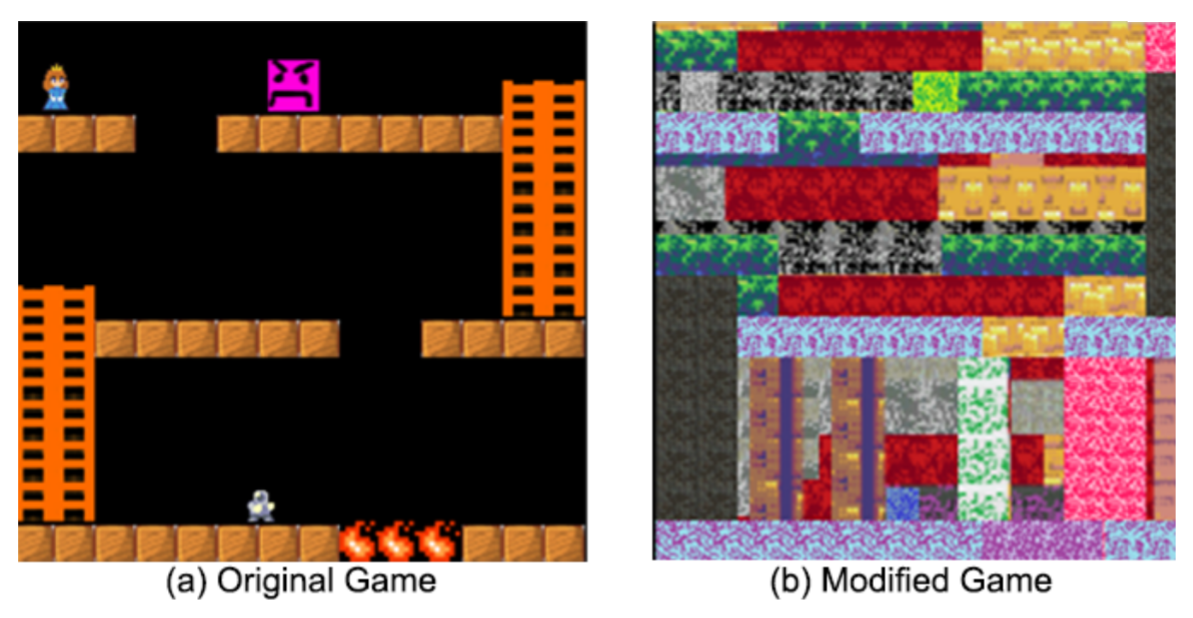
What is it about human learning that allows us to perform so well with relatively little experience? MIT Technology Review: Today we get an answer of sorts thanks to the work of Rachit Dubey and colleagues at the University of California, Berkeley. They have studied the way humans interact with video games to find out what kind of prior knowledge we rely on to make sense of them. It turns out that humans use a wealth of background knowledge whenever we take on a new game. And this makes the games significantly easier to play. But faced with games that make no use of this knowledge, humans flounder, whereas machines plod along in exactly the same way. Take a look at the computer game shown here. This game is based on a classic called Montezuma's Revenge, originally released for the Atari 8-bit computer in 1984. There is no manual and no instructions; you aren't even told which "sprite" you control. And you get feedback only if you successfully finish the game.
Would you be able to do so? How long would it take? You can try it at this website. In all likelihood, the game will take you about a minute, and in the process you'll probably make about 3,000 keyboard actions. That's what Dubey and co found when they gave the game to 40 workers from Amazon's crowdsourcing site Mechanical Turk, who were offered $1 to finish it. "This is not overly surprising as one could easily guess that the game's goal is to move the robot sprite towards the princess by stepping on the brick-like objects and using ladders to reach the higher platforms while avoiding the angry pink and the fire objects," the researchers say. By contrast, the game is hard for machines: many standard deep-learning algorithms couldn't solve it at all, because there is no way for an algorithm to evaluate progress inside the game when feedback comes only from finishing. -
Why Humans Learn Faster Than AI (technologyreview.com)
What is it about human learning that allows us to perform so well with relatively little experience? MIT Technology Review: Today we get an answer of sorts thanks to the work of Rachit Dubey and colleagues at the University of California, Berkeley. They have studied the way humans interact with video games to find out what kind of prior knowledge we rely on to make sense of them. It turns out that humans use a wealth of background knowledge whenever we take on a new game. And this makes the games significantly easier to play. But faced with games that make no use of this knowledge, humans flounder, whereas machines plod along in exactly the same way. Take a look at the computer game shown here. This game is based on a classic called Montezuma's Revenge, originally released for the Atari 8-bit computer in 1984. There is no manual and no instructions; you aren't even told which "sprite" you control. And you get feedback only if you successfully finish the game.
Would you be able to do so? How long would it take? You can try it at this website. In all likelihood, the game will take you about a minute, and in the process you'll probably make about 3,000 keyboard actions. That's what Dubey and co found when they gave the game to 40 workers from Amazon's crowdsourcing site Mechanical Turk, who were offered $1 to finish it. "This is not overly surprising as one could easily guess that the game's goal is to move the robot sprite towards the princess by stepping on the brick-like objects and using ladders to reach the higher platforms while avoiding the angry pink and the fire objects," the researchers say. By contrast, the game is hard for machines: many standard deep-learning algorithms couldn't solve it at all, because there is no way for an algorithm to evaluate progress inside the game when feedback comes only from finishing. -
Relying on Renewables Alone Significantly Inflates the Cost of Overhauling Energy (technologyreview.com)
A growing number of US cities and states have proposed or even passed legislation that would require producing all electricity from renewable energy sources like solar and wind within a few decades. That might sound like a great idea. But a growing body of evidence shows it's not. From a report: It increasingly appears that insisting on 100 percent renewable sources -- and disdaining others that don't produce greenhouse gases, such as nuclear power and fossil-fuel plants with carbon-capture technology -- is wastefully expensive and needlessly difficult. In the latest piece of evidence, a study published in Energy & Environmental Science determined that solar and wind energy alone could reliably meet about 80 percent of recent US annual electricity demand, but massive investments in energy storage and transmission would be needed to avoid major blackouts. Pushing to meet 100 percent of demand with these resources would require building a huge number of additional wind and solar farms -- or expanding electricity storage to an extent that would be prohibitively expensive at current prices. Or some of both. -
'Tech Companies Should Stop Pretending AI Won't Destroy Jobs' (technologyreview.com)
Kai-Fu Lee, the founder and CEO of Sinovation Ventures and president of the Sinovation Ventures Artificial Intelligence Institute, believes that we're not ready for the massive societal upheavals on the way. He writes for MIT Technology Review: The rise of China as an AI superpower isn't a big deal just for China. The competition between the US and China has sparked intense advances in AI that will be impossible to stop anywhere. The change will be massive, and not all of it good. Inequality will widen. As my Uber driver in Cambridge has already intuited, AI will displace a large number of jobs, which will cause social discontent. Consider the progress of Google DeepMind's AlphaGo software, which beat the best human players of the board game Go in early 2016. It was subsequently bested by AlphaGo Zero, introduced in 2017, which learned by playing games against itself and within 40 days was superior to all the earlier versions. Now imagine those improvements transferring to areas like customer service, telemarketing, assembly lines, reception desks, truck driving, and other routine blue-collar and white-collar work.
It will soon be obvious that half of our job tasks can be done better at almost no cost by AI and robots. This will be the fastest transition humankind has experienced, and we're not ready for it. Not everyone agrees with my view. Some people argue that it will take longer than we think before jobs disappear, since many jobs will be only partially replaced, and companies will try to redeploy those displaced internally. But even if true, that won't stop the inevitable. Others remind us that every technology revolution has created new jobs as it displaced old ones. But it's dangerous to assume this will be the case again. -
AI Experts Say Some Advances Should Be Kept Secret (technologyreview.com)
AI could reboot industries and make the economy more productive; it's already infusing many of the products we use daily. But a new report [PDF] by more than 20 researchers from the Universities of Oxford and Cambridge, OpenAI, and the Electronic Frontier Foundation warns that the same technology creates new opportunities for criminals, political operatives, and oppressive governments -- so much so that some AI research may need to be kept secret. From a report: [...] The study is less sure of how to counter such threats. It recommends more research and debate on the risks of AI and suggests that AI researchers need a strong code of ethics. But it also says they should explore ways of restricting potentially dangerous information, in the way that research into other "dual use" technologies with weapons potential is sometimes controlled. -
How UPS Delivers Faster Using $8 Headphones and Code That Decides When Dirty Trucks Get Cleaned (technologyreview.com)
With Amazon's imminent plans to launch a low-cost package delivery service, UPS is about to face intense competition from a company with top customer-tracking capabilities and even artificial-intelligence expertise. To tackle it, the company is turning to advances analytics. From a report: In 2016, it began collecting data across its facilities. Today there are about 25 projects based on that data, grouped under the acronym EDGE (which stands for "enhanced dynamic global execution"). The program has sparked changes in everything from how workers place packages inside delivery trucks in the morning to how the vast army of temporary hires that UPS recruits during the busy holiday season are trained. Eventually, data will even dictate when UPS vehicles get washed. The company expects to save $200 million to $300 million a year once the program is fully deployed.
[...] Another project tells seasonal workers where to direct the outbound packages that UPS vehicles pick up throughout the day and bring to the company's sorting facilities. UPS hires nearly 100,000 of these workers from November through January. Typically, these people would need to memorize hundreds of zip codes to know where to place parcels, but last winter UPS outfitted about 2,500 of them with scanning devices and $8 Bluetooth headphones that issue one-word directions, such as "Green," "Red," or "Blue." The colors correspond to specific conveyor belts, which then transport the packages to other parts of the building for further processing. -
Researchers Are Developing An Algorithm That Makes Smartphones Child-Proof (technologyreview.com)
An anonymous reader quotes a report from MIT Technology Review: Researchers at the University of South Carolina and China's Zhejiang University have created an algorithm that can spot whether your kid is accidentally trying to, say, order from Amazon without your knowing. There are already plenty of activity-monitoring apps that aim to control what kids do on phones, but parents need to add them and turn them on, and they could be disabled by tech-savvy children. The researchers figured that automated age-range detection would make it easier for parents to hand their phones over to curious children without worrying that the kids will stumble upon an inappropriate website or get into a work e-mail account.
The researchers built a simple app and asked a group of kids between the ages of three and 11 -- and a group of adults between 22 and 60 -- to use it. The app had participants unlock an Android phone and then play a numbers-based game on it, so that the researchers could record a variety of taps and swipes. They also tracked things like the amount of pressure applied by a user's finger and the area it encompassed. The researchers used the resulting data to train an age-detecting algorithm that they say is 84 percent accurate with just one swipe on the screen -- a figure that goes up to 97 percent after eight swipes. -
A Search For Insomnia Genes Involving 1.3 Million People is the Largest Genetic Study Ever (technologyreview.com)
In a genetic study of unprecedented size, scientists have searched for inherited causes of insomnia in the DNA 1,310,010 people. From a report: They found 956 different genes linked to the sleep disorder, drawing closer to an explanation of what causes it and, perhaps, to new ways to treat it. The study appears to be the first gene search to involve DNA collected from more than one million people. "It's amazingly massive," says Stuart Ritchie, a psychologist involved with genetics research at the University of Edinburgh. On Twitter, scientists let loose with superlatives: "Holy cr*p," "mammoth," and "Wow!" The project involved crunching genetic and medical information collected from the UK Biobank and the consumer DNA testing company 23andMe. It was led by Danielle Posthuma, a neuroscientist specializing in statistical genetics at Vrije University, in Amsterdam. -
A Cheap and Easy Blood Test Could Catch Cancer Early (technologyreview.com)
A simple-to-take test that tells if you have a tumor lurking, and even where it is in your body, is a lot closer to reality -- and may cost only $500. From a report: The new test, developed at Johns Hopkins University, looks for signs of eight common types of cancer. It requires only a blood sample and may prove inexpensive enough for doctors to give during a routine physical. "The idea is this test would make its way into the public and we could set up screening centers," says Nickolas Papadopoulos, one of the Johns Hopkins researchers behind the test. "That's why it has to be cheap and noninvasive." Although the test isn't commercially available yet, it will be used to screen 50,000 retirement-age women with no history of cancer as part of a $50 million, five-year study with the Geisinger Health System in Pennsylvania, a spokesperson with the insurer said. The test, detailed today in the journal Science, could be a major advance for "liquid biopsy" technology, which aims to detect cancer in the blood before a person feels sick or notices a lump. That's useful because early-stage cancer that hasn't spread can often be cured. -
US Doctors Plan To Treat Cancer Patients Using CRISPR (technologyreview.com)
An anonymous reader shares a report: The first human test in the U.S. involving the gene-editing tool CRISPR could begin at any time and will employ the DNA cutting technique in a bid to battle deadly cancers. Doctors at the University of Pennsylvania say they will use CRISPR to modify human immune cells so that they become expert cancer killers, according to plans posted this week to a directory of ongoing clinical trials. The study will enroll up to 18 patients fighting three different types of cancer -- multiple myeloma, sarcoma, and melanoma -- in what could become the first medical use of CRISPR outside China, where similar studies have been under way. An advisory group to the National Institutes of Health initially gave a green light to the Penn researchers in June 2016, but until now it was not known whether the trial would proceed. -
Apparently, People Say 'Thank You' To Self-Driving Pizza Delivery Vehicles (technologyreview.com)
An anonymous reader shares a report: Last summer, Ford worked with Domino's Pizza on a test in Ann Arbor, Michigan, where it delivered pizza to randomly chosen customers in a self-driving Ford Fusion hybrid. An operator was inside the car, and a regular human-driven car trailed behind, videotaping the drive. Customers had to approach the car and enter a number on a touch screen on the side of the vehicle to get their pizza. Speaking at CES, the annual consumer electronics show, in Las Vegas this week, Jim Farley, Ford's executive vice president, acknowledged that the idea sounds silly, "but we learned so freaking much," he said. Apparently, most people say "thank you" to the car after getting their pizza. -
Hackers Could Blow Up Factories Using Smartphone Apps (technologyreview.com)
An anonymous reader quotes a report from MIT Technology Review: Two security researchers, Alexander Bolshev of IOActive and Ivan Yushkevich of Embedi, spent last year examining 34 apps from companies including Siemens and Schneider Electric. They found a total of 147 security holes in the apps, which were chosen at random from the Google Play Store. Bolshev declined to say which companies were the worst offenders or reveal the flaws in specific apps, but he said only two of the 34 had none at all. Some of the vulnerabilities the researchers discovered would allow hackers to interfere with data flowing between an app and the machine or process it's linked to. So an engineer could be tricked into thinking that, say, a machine is running at a safe temperature when in fact it's overheating. Another flaw would let attackers insert malicious code on a mobile device so that it issues rogue commands to servers controlling many machines. It's not hard to imagine this causing mayhem on an assembly line or explosions in an oil refinery. The researchers say they haven't looked at whether any of the flaws has actually been exploited. Before publishing their findings, they contacted the companies whose apps had flaws in them. Some have already fixed the holes; many have yet to respond. -
A Cryptocurrency Without a Blockchain Has Been Built To Outperform Bitcoin (technologyreview.com)
An anonymous reader quotes a report from MIT Technology Review: Bitcoin isn't the only cryptocurrency on a hot streak -- plenty of alternative currencies have enjoyed rallies alongside the Epic Bitcoin Bull Run of 2017. One of the most intriguing examples is also among the most obscure in the cryptocurrency world. Called IOTA, it has jumped in total value from just over $4 billion to more than $10 billion in a little over two weeks. But that isn't what makes it interesting. What makes it interesting is that it isn't based on a blockchain at all; it's something else entirely. The rally began in late November, after the IOTA Foundation, the German nonprofit behind the novel cryptocurrency, announced that it was teaming up with several major technology firms to develop a "decentralized data marketplace."
Though IOTA tokens can be used like any other cryptocurrency, the protocol was designed specifically for use on connected devices, says cofounder David Sonstebo. Organizations collect huge amounts of data from these gadgets, from weather tracking systems to sensors that monitor the performance of industrial machinery (a.k.a. the Internet of things). But nearly all of that information is wasted, sitting in siloed databases and not making money for its owners, says Sonstebo. IOTA's system can address this in two ways, he says. First, it can assure the integrity of this data by securing it in a tamper-proof decentralized ledger. Second, it enables fee-less transactions between the owners of the data and anyone who wants to buy it -- and there are plenty of companies that want to get their hands on data. The report goes on to note that instead of using a blockchain, "IOTA uses a 'tangle,' which is based on a mathematical concept called a directed acyclic graph." The team decided to research this new alternative after deciding that blockchains are too costly. "Part of Sonstebo's issue with Bitcoin and other blockchain systems is that they rely on a distributed network of 'miners' to verify transactions," reports MIT Technology Review. "When a user issues a transaction [with IOTA], that individual also validates two randomly selected previous transactions, each of which refer to two other previous transactions, and so on. As new transactions mount, a 'tangled web of confirmation' grows, says Sonstebo." -
Blockchains Are Poised To End the Password Era (technologyreview.com)
schwit1 shares a report from MIT Technology Review: Blockchain technology can eliminate the need for companies and other organizations to maintain centralized repositories of identifying information, and users can gain permanent control over who can access their data (hence "self-sovereign"), says Drummond Reed, chief trust officer at Evernym, a startup that's developing a blockchain network specifically for managing digital identities. Self-sovereign identity systems rely on public-key cryptography, the same kind that blockchain networks use to validate transactions. Although it's been around for decades, the technology has thus far proved difficult to implement for consumer applications. But the popularity of cryptocurrencies has inspired fresh commercial interest in making it more user-friendly.
Public-key cryptography relies on pairs of keys, one public and one private, which are used to authenticate users and verify their encrypted transactions. Bitcoin users are represented on the blockchain by strings of characters called addresses, which are derived from their public keys. The "wallet" applications they use to hold and exchange digital coins are essentially management systems for their private keys. Just like a real wallet, they can also hold credentials that serve as proof of identification, says Reed. Using a smartphone or some other device, a person could use a wallet-like application to manage access to these credentials. But will regular consumers buy in? Technologists will need to create a form factor and user experience compelling enough to convince them to abandon their familiar usernames and passwords, says Meltem Demirors, development director at Digital Currency Group, an investment firm that funds blockchain companies. The task calls for reinforcements, she says: "The geeks are working on it right now, but we need the designers, we need the sociologists, and we need people who study ethics of technology to participate." -
IBM Raises the Bar with a 50-Qubit Quantum Computer (technologyreview.com)
IBM said on Friday it has created a prototype 50 qubit quantum computer as it further increases the pressure on Google in the battle to commercialize quantum computing technology. The company is also making a 20-qubit system available through its cloud computing platform, it said. From a report: The announcement does not mean quantum computing is ready for common use. The system IBM has developed is still extremely finicky and challenging to use, as are those being built by others. In both the 50- and the 20-qubit systems, the quantum state is preserved for 90 microseconds -- a record for the industry, but still an extremely short period of time. Nonetheless, 50 qubits is a significant landmark in progress toward practical quantum computers. Other systems built so far have had limited capabilities and could perform only calculations that could also be done on a conventional supercomputer. A 50-qubit machine can do things that are extremely difficult to simulate without quantum technology. Whereas normal computers store information as either a 1 or a 0, quantum computers exploit two phenomena -- entanglement and superposition -- to process information differently. -
Andrew Ng Wants a New 'New Deal' To Combat Job Automation (technologyreview.com)
Andrew Ng, formerly the head of AI for Chinese search giant Baidu and, before that, creator of Google's deep-learning Brain project, knows as well as anyone that artificial intelligence is coming for plenty of jobs. Speaking at a conference on Tuesday, Ng said he would like to see a "new New Deal" that pays people displaced by technology to study, offering an incentive to learn new skills and reenter the workforce. From a report: Speaking at MIT Technology Review's annual EmTech MIT conference in Cambridge, MA, on Tuesday, Ng said he's visited call centers and spoken to workers, knowing that his teams of software engineers will then write software that will automate aspects of their work. "There are many professions in the crosshairs of AI teams across the world," he said. Ng, who's currently working on a startup called Deeplearning.ai that helps train people on deep-learning technology, has some ideas for helping those in jobs he thinks will be automated, from call-center workers to radiologists, truck drivers, and the like. His suggestion is for an updated version of the New Deal -- the Depression-era economic programs that invested in, among other things, getting unemployed Americans back to work -- that pays displaced workers to learn new job skills. -
Humans Are Still Better Than AI at StarCraft (technologyreview.com)
29-year-old professional StarCraft player Song Byung-gu won 4-0 in the world's first contest between AI systems and professional human players, writes MIT Technology Review. An anonymous reader quotes their report: One of the bots, dubbed "CherryPi," was developed by Facebook's AI research lab. The other bots came from Australia, Norway, and Korea. The contest took place at Sejong University in Seoul, Korea, which has hosted annual StarCraft AI competitions since 2010. Those previous events matched AI systems against each other (rather than against humans) and were organized, in part, by the Institute of Electrical and Electronics Engineers (IEEE), a U.S.-based engineering association.
Though it has not attracted as much global scrutiny as the March 2016 tournament between Alphabet's AlphaGo bot and a human Go champion, the recent Sejong competition is significant because the AI research community considers StarCraft a particularly difficult game for bots to master. Following AlphaGo's lopsided victory over Lee Sedol last year, and other AI achievements in chess and Atari video games, attention shifted to whether bots could also defeat humans in real-time games such as StarCraft... Executives at Alphabet's AI-focused division, DeepMind, have hinted that they are interested in organizing such a competition in the future.
The event wouldn't be much of a contest if it were held now. During the Sejong competition, Song, who ranks among the best StarCraft players globally, trounced all four bots involved in less than 27 minutes total. (The longest match lasted about 10 and a half minutes; the shortest, just four and a half.) That was true even though the bots were able to move much faster and control multiple tasks at the same time. At one point, the StarCraft bot developed in Norway was completing 19,000 actions per minute. Most professional StarCraft players can't make more than a few hundred moves a minute. -
Data Science Meets Sports Gambling: How Researchers Beat the Bookies (newscientist.com)
"A trio of data scientists developed a betting strategy to beat bookmakers at football games," writes austro. [The game Americans call soccer.] New Scientist reports: The team studied 10 years' worth of data on nearly half a million football matches and the associated odds offered by 32 bookmakers between January 2005 and June 2015. When they applied their strategy in a simulation, they made a return of 3.5 per cent. Making bets randomly resulted in a loss of 3.32 per cent. Then the team decided to try betting for real. They developed an online tool that would apply their odds-averaging formula to upcoming football matches. When a favorable opportunity arose, a member of the team would email Kaunitz and his wife, one of whom then placed a bet.
They kept this up for five months, placing $50 bets around 30 times a week. And they were winning. After five months the team had made a profit of $957.50 -- a return of 8.5 per cent. But their streak was cut short. Following a series of several small wins, the trio were surprised to find that their accounts had been limited, restricting how much they could bet to as little as $1.25. The gambling industry has long restricted players who appear to show an edge over the house, says Mark Griffiths at Nottingham Trent University, UK.
The paper "illustrates how the sports gambling industry compensates market inefficiencies with discriminatory practices against successful clients," adds austro, noting that the researchers posted a paper explaining their methodology on arxiv last week. "They also made the dataset and source code available on github. And best of all, they made an online publicly available dashboard that shows a live list of bet recommendations on football matches based on their strategy here or here for anyone to try." -
Dozens Of Drones Surveil Houston For Damage After Hurricane Harvey (usatoday.com)
An anonymous reader quotes MIT Technology Review: AT&T is using drones to inspect its cellular towers for damage, while insurance companies like Allstate and Farmers are rolling out their own fleets to follow up on claims... Rescue operations are benefitting, too. According to Axios, the company DroneDeploy is sending out vehicles to produce detailed 3-D maps that can help navigate the watery chaos. The company claims it can speed up rescue operations by providing imagery that allows rescuers to see around buildings and beneath tree cover.
The drones can fly high-definition cameras, and there's now dozens of them flying over Houston, reports USA Today: By Thursday, the Federal Aviation Administration has authorized 43 drone operators in Harvey's wake, for recovery efforts and for news organizations covering it... Eight approvals went to a railroad company to survey damage along tracks running through Houston. Five went to oil or energy companies to look for damage to fuel tanks, power lines and other facilities. Emergency-management officials are checking damage to roads, bridges and water-treatment plants... The FAA has also prohibited private drone pilots from flying in a broad area around Houston to avoid areas where emergency aircraft such as rescue helicopters are plucking people from rooftops or searching for survivors. -
Autonomous Forklift May Eat Up Warehouse Jobs (technologyreview.com)
Jamie Condliffe reports via MIT Technology Review: Seegrid, a provider of material-handling equipment, takes the kinds of forklifts that move 8,000-pound loads around warehouses and makes them autonomous. It does that by popping five stereo cameras on top of the vehicles, having a human drive them around to map a space, and then using image recognition systems similar to those in autonomous cars to navigate the facilities. (Unlike autonomous cars that use sensors like radar and lidar, Seegrid can use just cameras, because lighting conditions in warehouses are more consistent than those on the open road.) But while it's easy enough to have a forklift move objects from one side of a factory to another, reliably loading and unloading them poses a bigger challenge. Other robots designed to haul loads like this tend to pick things up from below, rather than spearing pallets with forks. So autonomous forklifts usually require humans to be present during pickup and dropoff to make sure nothing goes wrong. Seegrid's new GP8 Series 6 forklift has been engineered to reverse its forks into pallets, pick them up, and set them down without a human in the loop. -
Scientists Create DNA-Based Exploit of a Computer System (technologyreview.com)
Archeron writes: It seems that scientists at University of Washington in Seattle have managed to encode malware into genomic data, allowing them to gain full access to a computer being used to analyze the data. While this may be a highly contrived attack scenario, it does ask the question whether we pay sufficient attention to data-driven exploits, especially where the data is instrument-derived. What other systems could be vulnerable to a tampered raw data source? Perhaps audio and RF analysis systems? MIT Technology Review reports: "To carry out the hack, researchers led by Tadayoshi Kohno and Luis Ceze encoded malicious software in a short stretch of DNA they purchased online. They then used it to gain 'full control' over a computer that tried to process the genetic data after it was read by a DNA sequencing machine. The researchers warn that hackers could one day use faked blood or spit samples to gain access to university computers, steal information from police forensics labs, or infect genome files shared by scientists. To make the malware, the team translated a simple computer command into a short stretch of 176 DNA letters, denoted as A, G, C, and T. After ordering copies of the DNA from a vendor for $89, they fed the strands to a sequencing machine, which read off the gene letters, storing them as binary digits, 0s and 1s. Yaniv Erlich, a geneticist and programmer who is chief scientific officer of MyHertige.com, a genealogy website, says the attack took advantage of a spill-over effect, when data that exceeds a storage buffer can be interpreted as a computer command. In this case, the command contacted a server controlled by Kohno's team, from which they took control of a computer in their lab they were using to analyze the DNA file." You can read their paper here. -
First Evidence That Social Bots Play a Major Role In Spreading Fake News (technologyreview.com)
An anonymous reader writes: Researchers from Indiana University in Bloomington provide an answer for how social bots play a major role in spreading fake news. MIT Technology Review reports: "At issue is the publication of news that is false or misleading. So widespread has this become that a number of independent fact-checking organizations have emerged to establish the veracity of online information. These include snopes.com, politifact.com, and factcheck.org. These sites list 122 websites that routinely publish fake news. These fake news sites include infowars.com, breitbart.com, politicususa.com, and theonion.com. 'We did not exclude satire because many fake-news sources label their content as satirical, making the distinction problematic,' say researcher Chengcheng Shao and co. Shao and co then monitored some 400,000 claims made by these websites and studied the way they spread through Twitter. They did this by collecting some 14 million Twitter posts that mentioned these claims. At the same time, the team monitored some 15,000 stories written by fact-checking organizations and over a million Twitter posts that mention them. Next, Shao and co looked at the Twitter accounts that spread this news, collecting up to 200 of each account's most recent tweets. In this way, the team could study the tweeting behavior and work out whether the accounts were most likely run by humans or by bots. Having made a judgment on the ownership of each account, the team finally looked at the way humans and bots spread fake news and fact-checked news.
'Accounts that actively spread misinformation are significantly more likely to be bots,' say Shao and co. 'Social bots play a key role in the spread of fake news.' Shad and co say bots play a particularly significant role in the spread of fake news soon after it is published. What's more, these bots are programmed to direct their tweets at influential users. 'Automated accounts are particularly active in the early spreading phases of viral claims, and tend to target influential users,' say Shao and co." -
First Human Embryos Edited In US (technologyreview.com)
randomErr shares a report from MIT Technology Review: The first known attempt at creating genetically modified human embryos in the United States has been carried out by a team of researchers in Portland, Oregon, MIT Technology Review has learned. The effort, led by Shoukhrat Mitalipov of Oregon Health and Science University, involved changing the DNA of a large number of one-cell embryos with the gene-editing technique CRISPR. Until now, American scientists have watched as scientists elsewhere were first to explore the controversial practice. To date, three previous reports of editing human embryos were all published by scientists in China. Now Mitalipov is believed to have broken new ground both in the number of embryos experimented upon and by demonstrating that it is possible to safely and efficiently correct defective genes that cause inherited diseases. In altering the DNA code of human embryos, the objective of scientists is to show that they can eradicate or correct genes that cause inherited disease, like the blood condition beta-thalassemia. The process is termed "germline engineering" because any genetically modified child would then pass the changes on to subsequent generations via their own germ cells -- the egg and sperm. Reached by Skype, Mitalipov declined to comment on the results, which he said are pending publication. But other scientists confirmed the editing of embryos using CRISPR. -
Is Homeland Security's Face-Scanning At Airports An Unreasonable Search? (technologyreview.com)
schwit1 shares an article from MIT's Technology Review: Facial-recognition systems may indeed speed up the boarding process, as the airlines rolling them out promise. But the real reason they are cropping up in U.S. airports is that the government wants to keep better track of who is leaving the country, by scanning travelers' faces and verifying those scans against photos it already has on file... The U.S. Department of Homeland Security has partnered with airlines including JetBlue and Delta to introduce such recognition systems at New York's JFK International Airport, Washington's Dulles International, and airports in Atlanta, Boston, and Houston, among others. It plans to add more this summer...
As facial-recognition technology has improved significantly in recent years, it has attracted the interest of governments and law enforcement agencies. That's led to debates over whether certain uses of the technology violate constitutional protections against unreasonable searches... Harrison Rudolph, a law fellow at Georgetown Law's Center on Privacy and Technology, and others are raising alarms because as part of the process, U.S. Customs and Border Protection is also scanning the faces of U.S. citizens... They say Congress has never expressly authorized the collection of facial scans from U.S. citizens at the border routinely and without suspicion.
"We aren't entirely sure what the government is doing with the images," the article adds, though it notes that the Department of Homeland Security is saying that it deletes all data pertaining to the images after two weeks. But Slashdot reader schwit1 is still worried about the possibility of an irretrievable loss of privacy, writing that "If the DHS database gets hacked, it's hard to get a new face." -
First Object Teleported From Earth To Orbit (technologyreview.com)
Researchers in China have teleported a photon from the ground to a satellite orbiting more than 500 kilometers above. From a report: Last year, a Long March 2D rocket took off from the Jiuquan Satellite Launch Centre in the Gobi Desert carrying a satellite called Micius, named after an ancient Chinese philosopher who died in 391 B.C. The rocket placed Micius in a Sun-synchronous orbit so that it passes over the same point on Earth at the same time each day. Micius is a highly sensitive photon receiver that can detect the quantum states of single photons fired from the ground. That's important because it should allow scientists to test the technological building blocks for various quantum feats such as entanglement, cryptography, and teleportation. Today, the Micius team announced the results of its first experiments. The team created the first satellite-to-ground quantum network, in the process smashing the record for the longest distance over which entanglement has been measured. And they've used this quantum network to teleport the first object from the ground to orbit. Teleportation has become a standard operation in quantum optics labs around the world. The technique relies on the strange phenomenon of entanglement. This occurs when two quantum objects, such as photons, form at the same instant and point in space and so share the same existence. In technical terms, they are described by the same wave function. -
The Oculus Rift Still Isn't Selling, In a Worrying Sign For VR (technologyreview.com)
An anonymous reader quotes a report from MIT Technology Review: Despite Mark Zuckerberg's early enthusiasm for virtual reality, the technology has stubbornly remained a hard sell for Facebook. Now, in yet another sign that VR is failing to capture the imagination of the public, the company has just cut the price of its Oculus Rift hardware for the second time this year. For the next six weeks, the Oculus Rift headset and its matching controllers will cost just $399. That's $400 less than when it first hit the market, and $200 less than when its price was first slashed in March. It means that the Rift now costs less than the package offered by its cheapest rival, Sony, whose PlayStation VR currently totals $460 including headset and controllers. Even so, it's not clear that it will be enough to lure people into buying a Rift. Jason Rubin, vice president for content at Oculus, tells Reuters that the reduction isn't a sign of weak product sales, but rather a decision to give the headset more mass market appeal now that more games are available. -
Personalized Cancer Vaccines Safely Fight, Kill Tumors In Early Human Trials (arstechnica.com)
Emily Mullin reports via MIT Technology Review: Now two personalized cancer vaccine approaches appear to have safely prevented cancer relapse in a dozen patients with late-stage skin cancer. In recent years, scientists have realized that each patient's tumor harbors a unique set of genetic characteristics, or mutations. So for cancer vaccines to be effective, they'll probably also have to be unique. Two clinical trials, detailed today in separate papers in Nature, are among the first to show that this might be possible. In one trial, eight of 13 melanoma patients who got a personalized cancer vaccine were tumor-free nearly two years after being treated. In a smaller study, four of the six patients who received a vaccine had no detectable cancer for more than two years after treatment. All patients had their tumors surgically removed before getting the vaccine. The customized vaccines are an emerging class of therapies that take advantage of neoantigens, proteins that appear on tumors and seem to be specific to each cancer patient. To make the vaccines, researchers first sequenced DNA and RNA extracted from each patient's tumor. They then used computer algorithms to analyze the mutations on each tumor and predict the best targets that code for neoantigens. Based on that data, they created a personalized vaccine containing up to 20 of these neoantigens. Each patient received several injections of the vaccine over a few months. -
New Maglev Elevator Can Travel Horizontally, Vertically, and Diagonally (wired.co.uk)
An elevator that can move in any direction has been successfully tested by a German company named ThyssenKrupp. An anonymous reader quotes Wired UK: The Multi is the first ropeless lift, built using the same magnetic levitation technology used in Japan's bullet train and proposed for the Hyperloop. In the same way the train slides along a track horizontally, the lift travels both vertically, horizontally and diagonally around a building riding an electromagnetic field, a system known as a linear drive. "If you can run a 500-tonne train on magnets at 500km/h you should be able to elevate a cabin of 500 kilograms or 1,000 kilograms at a speed of five metres per second," [ThyssenKrupp CEO Andreas] Schierenbeck said.
The elevator can cost 3 to 5 times more than a regular elevator -- but can handle higher buildings than a conventional elevator. -
What Happens When Geoengineers 'Hack The Planet'? (thebulletin.org)
Dan Drollette shares an article by an Oxford physics professor who's concerned about the popularity of radical new proposals to fight global warming. The Christian Science Monitor wonders if it's time to re-engineer our climate. MIT's Technology Review basically thinks the answer is "yes," having described it earlier as "cheap and easy." The Atlantic seems quite smitten with Economist writer Oliver Morton's vision of remaking the planet, which geoengineering booster Jane Long breathlessly called "geopoetry." The idea received recent coverage (much of it favorable) by New Scientist, NBC, and in TED talks; I myself have recently participated in an NPR panel discussion on the subject... But what has really catapulted the idea into the public eye is Harvard's reckless plan for a privately-funded field trial testing some of the key elements needed... Proceeding to field experimentation crosses a thin red line beyond which lies the slippery slope down to ever-larger field trials and ultimately deployment.
Harvard's experiment -- which is partially funded by Bill Gates -- is "subject to no governance save what Harvard chooses to impose upon itself," according to the article. The experiment involves "putting something in the atmosphere to reflect more sunlight back out into space," which the article warns will create "enduring" effects -- and require humanity to commit to maintaining the same atmospheric conditions forever. -
Trump Promises a Federal Technology Overhaul To Save $1 Trillion (technologyreview.com)
New submitter threc shares a report from MIT Technology Review: The tech world descended on Washington, D.C. yesterday to attend a tech summit at the White House. According to MIT Technology Review associate editor Jamie Condliffe: "Trump suggested he might relax his stance on immigration as a way to get tech leaders to help his cause. 'You can get the people you want,' he told the assembled CEOs. That sweetener may be a response to a very vocal backlash in the tech world against the administration's recent travel bans. Trump may hope that his business-friendly stance will offer enough allure: if tech giants scratch his back, he may later deign to scratch theirs." The report continues: "'Our goal is to lead a sweeping transformation of the federal government's technology that will deliver dramatically better services for citizens,' said Trump at the start of his meeting with the CEOs, according to the Washington Post. 'We're embracing big change, bold thinking, and outsider perspectives.' The headline announcement from the event was Trump's promise to overhaul creaking government computing infrastructure. According to Jared Kushner, the president's son-in-law and advisor, there's much to be done: federal agencies have over 6,000 data centers that could be consolidated, for instance, while the 10 oldest networks in use by the government are all at least 39 years old. The upgrade, said Trump, could save the country $1 trillion over the next 10 years." -
Roomba Inventor Launches 'Tertill', a Weed-Killing Robot For Your Garden
mcpublic writes: iRobot veteran and Roomba co-inventor, Joe Jones is a modest man with a big mission: to create robots that make agriculture more efficient, less tedious, and yes, maybe even one day feed the world. After a decade at Harvest Automation building greenhouse robots, his new team at Franklin Robotics has developed Tertill, an affordable, waterproof, solar-powered robot that continuously whacks weeds around your yard. MIT Technology Review calls Tertill "a Roomba for your garden." Today the Kickstarter campaign went live and already they are well on the way to their goal. According to the Kickstarter campaign, Tertill is solar powered, chemical free, waterproof and Bluetooth compatible. It doesn't actually pull the weeds from your garden, instead it uses a "spinning string trimmer" to trim the weeds down to ground level. Since Tertill will be trimming weeds daily, the company says the weeds will eventually run out of nutrients to continue growing, and therefore will die and decompose. How does it know what's a weed and what's a plant? "A plant tall enough to touch the front of Tertill's shell activates a sensor that makes the robot turn away. A plant short enough to pass under Tertill's shell, though, activates a different sensor that turns on the weed cutter. Because Tertill's approach is height-based, put one of the provided plant collars around short plants until they are tall enough for Tertill to recognize. When Tertill approaches the collar, it will recognize it and turn away." -
When Sentencing Criminals, Should Judges Use Closed-Source Algorithms? (technologyreview.com)
Some judges in America have recently started using a closed-source algorithm that predicts how likely convicts are to commit another crime. Mosquito Bites shared an article by law professor Frank Pasquale raising concerns about the algorithms: They may seem scientific, an injection of computational rationality into a criminal justice system riddled with discrimination and inefficiency. However, they are troubling for several reasons: many are secretly computed; they deny due process and intelligible explanations to defendants; and they promote a crabbed and inhumane vision of the role of punishment in society...
When an algorithmic scoring process is kept secret, it is impossible to challenge key aspects of it. How is the algorithm weighting different data points, and why? Each of these inquiries is crucial to two core legal principles: due process, and the ability to meaningfully appeal an adverse decision... A secret risk assessment algorithm that offers a damning score is analogous to evidence offered by an anonymous expert, whom one cannot cross-examine... Humans are in charge of governments, and can demand explanations for decisions in natural language, not computer code. Failing to do so in the criminal context risks ceding inherently governmental and legal functions to an unaccountable computational elite.
This issue will grow more and more important, the law professor argues, since there's now proprietary analytics software that also predicts "the chances that any given person will be mentally ill, a bad employee, a failing student, a criminal, or a terrorist." -
China's Unprecedented Cyber Law Signals Its Intent To Protect a Precious Commodity: Data (technologyreview.com)
An anonymous reader quotes a report from MIT Technology Review: An aggressive new cybersecurity and data protection law in China that goes into effect today will have global ripple effects, and could serve as a model for other governments. But the Chinese government has also left many parts of the law vague -- likely an intentional move meant to allow the country to stake out its own sense of "cyber sovereignty" while waiting to see how the U.S., Europe, and others decide to regulate the flow of data across international borders. The new law is a resounding announcement from China that it intends to be a global player in controlling perhaps the most precious commodity of the digital economy: data. It's hard to know how the law will actually change things because the most controversial aspects of it are so vague. Among them is a requirement that certain companies submit their products to the government for cybersecurity checks, which may even involve reviewing source code. How often it would be required, and how the government will determine which products must be reviewed is unknown. This could come into play as part of China's broader regulatory push to expand law enforcement's power to access data during criminal investigations. Another vague directive calls for companies to store certain data within the country's borders, in the interest of safeguarding sensitive information from espionage or other foreign meddling. The government has delayed the implementation of this change until the end of 2018, however. -
Microsoft Wants To Use DNA For Cloud Data Storage (technologyreview.com)
Last July, researchers from Microsoft and the University of Washington said that they had successfully encoded about 200 megabytes of data onto synthetic DNA molecules. The company is now planning to take the technology commercial. "Computer architects at Microsoft Research say the company has formalized a goal of having an operational storage system based on DNA working inside a data center toward the end of this decade," reports MIT Technology Review. "The aim is a 'proto-commercial system in three years storing some amount of data on DNA in one of our four centers for at least a boutique application,' says Doug Carmean, a partner architect at Microsoft Research." From the report: Internally, Microsoft harbors the even more ambitious goal of replacing tape drives, a common format used for archiving information. Major obstacles to a practical storage system remain. Converting digital bits into DNA code (made up of chains of nucleotides labeled A, G, C, and T) remains laborious and expensive because of the chemical process used to manufacture DNA strands. In its demonstration project, Microsoft used 13,448,372 unique pieces of DNA. Experts say buying that much material on the open market would cost $800,000. According to Microsoft, the cost of DNA storage needs to fall by a factor of 10,000 before it becomes widely adopted. While many experts say that's unlikely, Microsoft believes such advances could occur if the computer industry demands them. -
Software Is Eating the World, But AI Is Going To Eat Software, Nvidia CEO Says (technologyreview.com)
An anonymous reader writes: Nvidia's revenues have started to climb in the recent quarters as it looks at making hardware customized for machine-learning algorithms and use cases such as autonomous cars. At the company's annual developer conference in San Jose, California last week, the company's CEO Jensen Huang spoke about how the machine-learning revolution is just starting. "Very few lines of code in the enterprises and industries all over the world use AI today. It's quite pervasive in Internet service companies, particularly two or three of them," Huang said. "But there's a whole bunch of others in tech and other industries that are trying to catch up. Software is eating the world, but AI is going to eat software." -
Scientists Consider 'Cloud Brightening' To Preserve Australia's Great Barrier Reef (technologyreview.com)
An anonymous reader quotes MIT Technology Review: A group of Australian marine scientists believe that altering clouds might offer one of the best hopes for saving the Great Barrier Reef. For the last six months, researchers at the Sydney Institute of Marine Science and the University of Sydney School of Geosciences have been meeting regularly to explore the possibility of making low-lying clouds off the northeastern coast of Australia more reflective in order to cool the waters surrounding the world's biggest coral reef system...
Last year, as El Nino events cranked up ocean temperatures, at least 20% of the reef died and more than 90% of it was damaged. The Australian researchers took a hard look at a number of potential ways to preserve the reefs. But at this point, making clouds more reflective looks like the most feasible way to protect an ecosystem that stretches across more than 130,000 square miles, says Daniel Harrison, a postdoctoral research associate with the Ocean Technology Group at the University of Sydney. Cloud brightening is the only thing we've identified that's scalable, sensible, and relatively environmentally benign," he says... Next month, he plans to start computer climate modeling to explore whether cloud brightening could make a big enough temperature difference to help.
They're collaborating with Silicon Valley's Marine Cloud Brightening Project, which has spent the last seven years "developing a nozzle that they believe can spray salt particles of just the right size and quantity to alter the clouds. They're attempting to raise several million dollars to build full-scale sprayers." The article describes them as "one of several research groups that have started to explore whether cloud brightening, generally discussed as a potential tool to alter the climate as a whole, could be applied in more targeted ways."