Slashdot Mirror
Domain: theverge.com
Stories and comments across the archive that link to theverge.com.
Stories · 1,776
-
S. Korea Diverts Network From Huawei Networks
An anonymous reader writes with this excerpt from The Verge: "The South Korean government has decided to route sensitive data away from networks operated by Huawei, amid longstanding fears from the U.S. that the Chinese company's infrastructure could be used to spy on communications. As the Wall Street Journal reports, the U.S. had been urging its South Korean allies to route government communications away from Huawei networks, claiming that the infrastructure could be used to spy on communications with American military bases there. As a result, Huawei equipment will not be used at any American military base in South Korea. The Obama administration denies playing a role in the decision, and South Korean officials have not commented. The Journal reports that the White House made a point of keeping the talks private because it didn't want to be seen as meddling in its ally's business affairs." -
Target's Internal Security Team Warned Management
david.emery writes "According to this story, Target's own internal computer security team raised concerns months before the retailer lost millions of credit card numbers in an attack. (Quoting a paywalled story in the Wall Street Journal.) Target's management allegedly 'brushed them off.' 'At least one analyst at the Minneapolis-based retailer wanted to do a more thorough security review of its payment system.' This raises a more general question for the Slashdot community: how many of you have identified vulnerabilities in your company's/client's systems, only to be 'brushed off?' If the company took no action, did they ultimately suffer a breach?" -
The Search for Life On Habitable Exoplanets
New submitter Benzainload895 writes "The Verge has an article about why life on other worlds would be far stranger than we might expect. They also interview some astronomers who are trying to narrow down the most likely locations for life. Quoting: 'As it turns out, the small planets with long orbits that Kepler was finding were the ones it was least disposed to find. [After estimating how often red dwarf stars have planets and taking into account their expanded habitable zones, they] came up with an estimate Cowan says is "starting to get really close to a hundred percent, where for every [red dwarf] out there you should expect there to be a habitable rocky planet." Furthermore, research exploring these planets suggests weirdness — and lots of it — in what life they might harbor. For instance, the dim light coming from a red dwarf may not be enough for plant photosynthesis like on Earth. This may lead plants to be black instead of green in order to absorb more available light. Even weirder, these planets likely don't spin as they orbit. Since red dwarfs are smaller and cooler than the sun, planets circle them at close range, creating greater tidal forces than on our planet. While the tidal force on Earth moves the ocean up and down a few meters, that force on a red dwarf planet would be so strong it'd gradually slow down the rotation of planet completely. The result? One side of the planet would face its star in a permanently sunny day, while the other side would face the stars in an endless night." -
Comcast To Buy Time Warner Cable In $44.2 Billion All-Stock Deal
symbolset writes "CNBC and many others report Time Warner Cable has agreed to be acquired by Comcast for $44.2 billion. From the article: 'The agreement comes more than eight months after Charter Communictions and Liberty Media made their first foray to try and negotiate a deal to acquire Time Warner Cable (a story broken by CNBC) and follows months of conversations between Time Warner Cable and Comcast about the prospect of a Comcast acquisition of the company. '" -
Microsoft Rumored To Integrate Android Apps
phmadore writes "Windows Phone has been struggling for market share, largely due to a serious lack of developers willing to invest their time in what one might consider a niche market. Statistically speaking, Android has more than 1.1M apps to Windows Phone's 200,000+. Well, according to unnamed sources informing the Verge, Microsoft may soon integrate/allow Android applications into both Windows and Windows Phone." This follows the recent debate over whether Microsoft should try to fork Android. Peter Bright made the point that doing so would be extremely difficult, and probably not worth Microsoft's time. Ben Thompson has an insightful post about how Microsoft's real decision is whether to focus on devices or services. -
Death Hovers Politely For Americans' Swipe-and-Sign Credit Cards
schwit1 writes "U.S. banks and merchants are shifting to a more secure way of authorizing credit card transactions in which customers will enter a personal identification number (PIN) at checkout instead of signing a receipt. The US is the last major market in the world using the signature system, which is part of the reason why a disproportionate amount of credit card fraud happens here. The change is especially relevant given the massive fraud perpetrated against customers of Target in the fall. During a Congressional hearing last week, Target CFO John Mulligan said the company is accelerating the $100 million effort to switch to the so-called "chip and pin" system. The change won't happen all at once. Banks must issue cards with microprocessors and merchants need the right equipment to process the chip and PIN transactions, which is likely to happen gradually. But Visa, American Express, and MasterCard have announced that banks and merchants that have not adopted the technology for face-to-face transactions by October 2015 will be liable for fraudulent purchases. That's a strong incentive to get up to date. The new system will also prepare merchants and banks to transition to contactless payments in the near future." -
NASA Now Accepting Applications From Companies That Want To Mine the Moon
cold fjord writes "The Verge reports, "NASA is now working with private companies to take the first steps in exploring the moon for valuable resources like helium 3 and rare earth metals. Initial proposals are due tomorrow for the Lunar Cargo Transportation and Landing by Soft Touchdown program (CATALYST). One or more private companies will win a contract to build prospecting robots, the first step toward mining the moon. Final proposals are due on March 17th, 2014. NASA has not said when it will announce the winner." -
Microsoft Building an 'Xbox Reading' App For Windows 8
Nate the greatest writes "Microsoft has already sunk $600 million into Nook Media, the ebook division spun off from Barnes & Noble in 2012, but I guess that's not enough for the Redmond tech giant: news broke today that they have a third ebook effort in the works. A new job listing discovered by the Chinese tech blog LiveSino has revealed that Microsoft is hiring an ebook developer to work on 'a groundbreaking interactive reading app on Windows, which incorporates books, magazines, and comics.' The position was posted by the Xbox Music, Video, and Reading unit, which had already released two apps for Windows 8 (video, music) and is clearly going for a trifecta. This new app shows all the signs of being completely unrelated to the Office Reader app, which leaked last year. That app reportedly focused more on PDFs, textbooks, and office docs, while the 'Xbox Reading' app mentions magazines and digital comics." -
How Russia Transformed a Subtropical Beach Resort To Host the Winter Olympics
Hugh Pickens DOT Com writes "Duncan Geere reports at The Verge that Russian resort as Sochi, on the eastern shore of the Black Sea, is humid and subtropical with temperatures averaging about 52 degrees Fahrenheit (12 C) in the winter, and 75 degrees (24 C) in the summer. "There is almost no snow here — at the moment it's raining," says Olga Mironova, a local resident. It's estimated that the cost of staging the Olympics in Sochi has been greater than the previous three Winter Games combined — ballooning to a whopping $51 billion including the cost of implementing an extensive system of safeguards to ensure there'll be sufficient snow in Sochi for the games including the cost of implementing one of the largest snowmaking systems in Europe. The system includes two huge water reservoirs that feed 400 snow cannons installed along the slopes that can generate snow in temperatures of up to 60 degrees fahrenheit (16 C). If that snow isn't enough, then the authorities will fall back on 710,000 cubic meters of snow collected during the winters of previous years leading up to the games. To keep it from melting in the region's hot summers, 10 separate stockpiles have been kept packed tight under insulating covers high up in the mountains, safe from the sun's rays. Down in Sochi itself the other half of the games will be held in five indoor arenas that will host figure skating, speed skating, hockey, and curling, and an additional outdoor area will host the opening and closing ceremonies. In each of these indoor arenas, underfloor cooling systems are installed so that the ice stays frozen above it using propylene glycol, which doesn't freeze until temperatures reach 8.6 F (-13 C). Climatologists predict that even under a best-case scenario, almost half the venues that have hosted the Winter Olympics over the last century would be unable to do so by 2080 without resorting to extensive and expensive artificial snowmaking techniques."" -
Sony Selling Off VAIO Computer Business
Kensai7 writes "Confirming reports from earlier in the week, Sony has announced plans to sell off its VAIO computer division to a Japanese investment fund. Japan Industrial Partners (JIP) will take control of the operation for an undisclosed fee, and Sony will 'cease planning, design and development of PC products.' For a variety of reasons 'including the drastic changes in the global PC industry,' Sony says 'the optimal solution is to concentrate its mobile product lineup on smartphones and tablets and to transfer its PC business to a new company.'" I have some nostalgia for the tiny old VAIO laptops; I wish more companies incorporated the swiveling camera that they came with. -
DARPA Publishes Tons of Open Source Code, Data
An anonymous reader sends this news from The Verge: "The Defense Advanced Research Projects Agency, or DARPA, sponsors a lot of technology through grants to universities and private labs, with projects running the gamut from robots to electroencephalography caps, to software and new programming languages. A lot of that knowledge is open source, but it hasn't always been easy to access. Today, DARPA has responded to requests from the research and development community by publishing the DARPA Open Catalog, a website that aggregates source code and other data for all public DARPA-funded projects." Chris White, DARPA program manager, said, "Making our open source catalog available increases the number of experts who can help quickly develop relevant software for the government. Our hope is that the computer science community will test and evaluate elements of our software and afterward adopt them as either standalone offerings or as components of their products." -
An OS You'll Love? AI Experts Weigh In On Her
theodp writes "Weighing in for the WSJ on Spike Jonze's Oscar-nominated, futuristic love story Her (parodies), Stephen Wolfram — whose Wolfram Alpha drives the AI-like component of Siri — thinks that an operating system like Samantha as depicted in the film isn't that far off. In Her, OS Samantha and BeautifulHandwrittenLetters.com employee Theodore Twombly have a relationship that appears to exhibit all the elements of a typical romance, despite the OS's lack of a physical body. They talk late into the night, relax on the beach, and even double date with friends. Both Wolfram and Google director of research Peter Norvig (who hadn't yet seen the film) believe this type of emotional attachment isn't a big hurdle to clear. 'People are only too keen, I think, to anthropomorphize things around them,' explained Wolfram. 'Whether they're stuffed animals, Tamagotchi, things in videogames, whatever else.' By the way, why no supporting actor nomination for Jonze's portrayal of foul-mouthed animated video game character Alien Child?" -
NSA and GCHQ Target "Leaky" Phone Apps To Scoop User Data
schwit1 writes "New leaked NSA documents shed a new light on the agency's assault on the data controls of smartphone apps. Using app data permissions as a jumping off point, the documents show agency staffers building huge quantities of data, including 'intercepting Google Maps queries made on smartphones, and using them to collect large volumes of location information.' One slide lists capabilities for 'hot mic' recording, high precision geotracking, and file retrieval which would reach any content stored locally on the phone, including text messages, emails and calendar entries. As the slide notes in a parenthetical aside, 'if it's on the phone, we can get it.'" -
CmdrTaco Launches Trove, a Curated News Startup
jigamo writes "The Verge reports on a new app from Slashdot co-founder Rob Malda, a.k.a. CmdrTaco, which aims to provide a user-powered and -curated stream of news. It's called Trove, and it's currently available on the web as well as iPhones and iPads. From the article: 'Trove basically lets users opt in to feeds of stories that align with their interests. Users are encouraged to curate "troves," collections of stories that relate to a particular theme.' You can also read CmdrTaco's announcement post." Rob says, "At its simplest, Slashdot combines editor quality control and insight with crowd-sourced harvesting to cover the 'News for Nerds' space. Trove uses automated harvesting and machine learning to simplify a workflow for curators interested in ANY topic. The idea is that this opens up non-nerdy subjects. This will let us maintain a strong signal/noise ratio for casual users less interested in expending effort to get their news across diverse subject matter." -
Sony Announces Game Streaming Service
You may remember Gaikai, a company built on the idea of cloud-based gaming. The idea was that a remote server would run the game and stream all graphics and sound to a player's device, which would allow underpowered or obsolete machines to run modern, graphically demanding games on high settings. In 2012, Sony purchased Gaikai. Now, they've announced at CES that their cloud gaming tech (dubbed 'PlayStation Now') is just about ready for the public. CES attendees will be able to try it out, and Sony will begin a closed beta test in the U.S. later this month. Full release is planned for summer. It will first support streaming to PS3s, PS4s, and certain Sony TV models. Later, it will expand more broadly to various non-Sony "internet-connected devices." Players will have the option to rent games or to subscribe for continued access. Forbes reports, "According to Sony, gamers who own disc- or digital-based games will not have access to those games via PS Now free of charge." -
AT&T Introduces "Sponsored Data" Allowing Services to Bypass 4G Data Caps
sirhan writes with news that AT&T has announced a program that allows companies to pay for their services to bypass mobile data caps. "With the new Sponsored Data service, data charges resulting from eligible uses will be billed directly to the sponsoring company ... Customers will see the service offered as AT&T Sponsored Data, and the usage will appear on their monthly invoice as Sponsored Data. Sponsored Data will be delivered at the same speed and performance as any non-Sponsored Data content." The Verge comments: "If YouTube doesn't hit your data cap but Vimeo does, most people are going to watch YouTube. If Facebook feels threatened by Snapchat and launches Poke with free data, maybe it doesn't get completely ignored and fail. If Apple Maps launched with free data for navigation, maybe we'd all be driving off bridges instead of downloading Google Maps for iOS." Or, think of distributed services: Mediagoblin vs Flickr, pump.io vs twitter, ownCloud vs Google Apps. This is probably a sign that data caps are here to stay, at least for AT&T subscribers (and if it's successful...). -
Ask Slashdot: Will You Start Your Kids On Classic Games Or Newer Games?
An anonymous reader writes "An article at The Verge got me thinking. Parents and those of you who plan to become parents: will you introduce your kids to the games you played when you were younger? Those of us who grew up playing Pong, Space Invaders, and Pac-Man have had a chance to see gaming software evolve into the enormously complex and graphically realistic beast it is today. I've begun to understand why my grandparents tried to get me to watch old movies. I'm also curious how you folks plan to teach your kids about computers and software in general. When teaching them Linux, do you just download the latest stable Mint or Ubuntu release and let them take it from there? Do you track down a 20-year-old version of Slackware and show them how things used to be? I can see how there would be value in that... the UIs we use every day have been abstracted so far away from their roots that we can't always expect new users to intuitively grasp the chain of logic. How do you think this should be handled?" -
Millions of Dogecoin Stolen Over Christmas
Kenseilon writes "The Verge reports that millions of Dogecoins — an alternative cryptocurrency — was stolen after the service DogeWallet was hacked. DogeWallet worked like a bank account for the currency, and the attackers modified it to make sure all transactions ended up in a wallet of their choice. This latest incident is just one in the long (and growing) list of problems that cryptocurrencies are currently facing. It brings to mind the incident where bitcoin exchange service GBL vanished and took a modest amount of Bitcoins with them. While not a similar case, it highlights the difficulties with trusting service provides in this market." -
A Flood of Fawning Reviews For Apple's Latest
Like many other review sites, it seems that MacWorld can hardly find enough good things to say about the new Mac Pro, even while conceding it's probably not right for many users. 9to5 Mac has assembled a lot of the early reviews, including The Verge's, which has one of the coolest shots of its nifty design, which stacks up well against the old Pro's nifty design. The reviews mostly boil down to this: If you're in a field where you already make use of a high-end Mac for tasks like video editing, the newest one lives up to its hype. -
Putting a Panic Button In Smartphone Users' Hands
theodp writes "If you own an Android phone, you may have inadvertently butt-dialed 911 from time-to-time. So, wonders Kix Panganiban, why don't our phones come with a universal 'Panic Button', that would make it just as easy to intentionally dial the police when it's truly needed? Panganiban envisions "a smartphone app that when triggered, would discreetly send out a distress message to contacts of your choice, and perhaps do some other functions that can get you out of bad (and maybe even life-threatening) situations." While a quick search reveals that some have taken a crack at apps that put a Panic Button in smartphone users' hands, are there good reasons why such a feature isn't just standard on mobile devices? And, with GPS and always-watching and always-listening tech only becoming cheaper and more ubiquitous, how far out in the future is it before your person can be continuously remotely monitored like your residence, even while mobile, and what might that look like?" -
BitTorrent Unveils Secure Chat To Counter 'NSA Dragnet Surveillance'
Hugh Pickens DOT Com writes "Jacob Kastrenakes reports on The Verge that as part a response to the NSA's wide-reaching surveillance programs, BitTorrent is unveiling a secure messaging service that will use public key encryption, forward secrecy, and a distributed hash table so that chats will be individually encrypted and won't be stored on some company's server. 'It's become increasingly clear that we need to devote hackathons, hours and resources to developing a messaging app that protects user privacy,' says Christian Averill, BitTorrent's director of communications. Because most current chat services rely on central servers to facilitate the exchange of messages, 'they're vulnerable: to hackers, to NSA dragnet surveillance sweeps.' BitTorrent chat aims to avoid those vulnerabilities through its encryption methods and decentralized infrastructure. Rather than checking in with one specific server, users of BitTorrent chat will collectively help each other figure out where to route messages to. In order to get started chatting, you'll just need to give someone else your public key — effectively your identifier. Exchanging public keys doesn't sound like the simplest way to begin a chat, but Averill says that BitTorrent hopes to make it easy enough for anyone interested. 'What we're going to do is to make sure there are options for how this is set up,' says Averill. 'This way it will appeal to the more privacy conscious consumer as well as the less technically inclined.' For now, it remains in a private testing phase that interested users can apply for access to. There's no word on when it'll be open to everyone, but with all of the recent surveillance revelations, it's easy to imagine that some people will be eager to get started." -
Oculus Raises $75 Million To Make VR Headset
An anonymous reader writes "The company making the VR headset that has John Carmack and many others in the gaming industry excited has just received another $75 million in funding to make it happen. Netscape founder Marc Andreessen is joining the company's board, along with fellow investor Chris Dixon. Dixon had seen a prototype earlier this year, but it wasn't good enough to spark his interest. After recently seeing how the device has progressed since then, he was blown away, comparing it to early demos of the iPhone. 'The dimensions where you need to improve this kind of VR are latency, resolution and head tracking, and they have really nailed those things.' Now that the device is in good shape, Oculus is going to work on turning it into a product they can produce and ship for gamers." -
Nokia Still Experimenting With Android Smartphone
Nerval's Lobster writes "According to unnamed sources, Nokia is working on an Android-based smartphone. The test versions of the device, which is codenamed 'Normandy,' run a heavily modified version of Android. In late November, @evleaks posted an alleged image of the phone, which (if accurate) includes many of the Nokia design hallmarks, such as a brightly colored shell and prominent rear camera. Exactly how the software differs from the 'standard' version of Android is an open question, although other companies that have forked the operating system (most notably Amazon, with its Kindle tablets) haven't been shy about modifying the user interface in radical ways. According to AllThingsD, Nokia's 'low-end mobile phone unit' is overseeing the project. 'Normandy aims to repurpose the open-source version of Android into a better entry-level smartphone than Nokia has had with its current Asha line,' the publication explained, 'which is based on the aging Series 40 operating system.' But here's the rub: Nokia's phone unit is well on its way to becoming a Microsoft subsidiary. Microsoft competes against Google in many arenas, including mobile and search. The idea of a Microsoft ancillary producing an Android-based phone to compete in lower-end markets — where cheap Android phones dominate — is liable to provoke a burst of surprised laughter from anyone in tech: surely such a project would never hit store-shelves, given Microsoft's very public backing of Windows Phone as its sole mobile OS. And yet, there's also reason to think Microsoft might actually take a chance on an alternative OS. Over the past few years, the company's legal team has cornered the majority of Android manufacturers worldwide into a stark deal: agree to pay a set fee for every Android device produced, or face a costly patent-infringement lawsuit. As a result of that arm-twisting, Microsoft already makes quite a bit of money off Android (more, perhaps, than it earns selling Windows Phone), which could acclimate it to the idea of taking the leap and actually selling Android devices." -
FCC Chair: It's Ok For ISPs To Discriminate Traffic
sl4shd0rk writes "Remember when the ex-cable lobbyist Tom Wheeler was appointed to the FCC chair back in May of 2013? Turns out he's currently gunning for Internet Service Providers to be able to 'favor some traffic over other traffic.' It would set a dangerous precedent, considering the Open Internet Order in 2010 forbade such action if it fell under unreasonable discrimination. The bendy interpretation of the 2010 order is apparently aimed somewhat at Netflix, as Wheeler stated: 'Netflix might say, "I'll pay in order to make sure that my subscriber might receive the best possible transmission of this movie."'" -
Crowdsourcing the Discovery of New Antibiotics
First time accepted submitter Josiah Zayner writes "Katie Drummond at The Verge reports that 'the Infectious Diseases Society of America warned that the pipeline of new antibiotics was "on life support," with only seven drugs in advanced stages of development to treat multidrug-resistant gram-negative superbugs. That's in part because, unlike drugs prescribed to treat chronic conditions, antibiotics are only taken for a few days or weeks at a time — meaning they're less profitable for pharmaceutical companies.' Dr. Josiah Zayner, a synthetic biology fellow at NASA, and Dr. Mark Opal, a neurobiologist and drug development specialist have started an Indiegogo campaign: The ILIAD Project. ILIAD stands for the International Laboratory for Identification of Antibacterial Drugs. Contributors to the project will receive Science kits with all the materials needed for testing environmental samples, such as plants, insects, and bacteria, for antibiotic properties. The information will then be documented in Open manner on Wiki-style website to create the first Massively Multi-Scientist Open Experiment." -
No Shirt, No Shoes, No Service — and No Google Glass, Either
Seattle diners who want to take their food-tweeting pictures with Google glass were already facing a preemptively hostile environment; now (in a different restaurant), a diner's been asked to remove his Google Glass headset, or leave. He chose to leave. Maybe Faraday cages and anti-surveillance features will become the norm at the restaurants where things like Glass are most likely to appear. -
Vint Cerf Thinks Privacy May Be an Anomaly
Nerval's Lobster writes "Vint Cerf, widely considered one of the 'founders of the Internet,' told an audience at the Federal Trade Commission's Internet of Things workshop that privacy could be considered 'an anomaly.' That workshop, held Nov. 19 in Washington, DC, explored (via speeches and panel discussions) how the proliferation of sensors on everything from cars to household devices is fundamentally changing how people live and work—while raising questions of how to best maintain privacy and security in an environment where more and more things are 'watchers.' 'The technology that we use today has far outraced our social intuition, our headlights,' he added. '[There's a] need to develop social conventions that are more respectful of people's privacy.' Current social behaviors, such as instantly posting images from smartphones to social networks, can result in a whole lot of embarrassment—and maybe even penalties, if data and media happens to catch someone in the act of doing something illegal. Cerf currently works at Google as chief Internet evangelist, which would make him uniquely positioned to comment on these sorts of issues even if he hadn't co-created the TCP/IP backbone that supports the modern Web. (Back in April, he told an audience that, if he had to do it all over again, he'd construct the Internet in the mold of Software-Defined Networking — but that's a whole different, tangled discussion.)" -
TSA Screening Barely Working Better Than Chance
rwise2112 writes "The General Accounting Office (GAO) has completed a study of the TSAs SPOT (Screening of Passengers by Observation Techniques) program and found the program is only slightly better than chance at finding criminals. Given that the TSA has spent almost a billion dollars on the program, that's a pretty poor record. As a result, the GAO is requesting that both Congress and the president withhold funding from the program until the TSA can demonstrate its effectiveness." -
How Blockbuster Could Have Owned Netflix
schnell writes "Your age probably determines whether you think of Blockbuster Video as a fond memory or a dinosaur predestined for extinction. While the last Blockbuster rental at the last remaining Blockbuster video store took place last week, Variety retells a now-classic story of how Blockbuster could have bought Netflix for a song, but didn't because it failed to take the new DVD-by-mail and video streaming markets seriously. Who is next to join Blockbuster, Polaroid, Borders and Best Buy on the ash heap of superseded retail business models?" -
Facebook Patented Making NSA Data Handoffs Easier
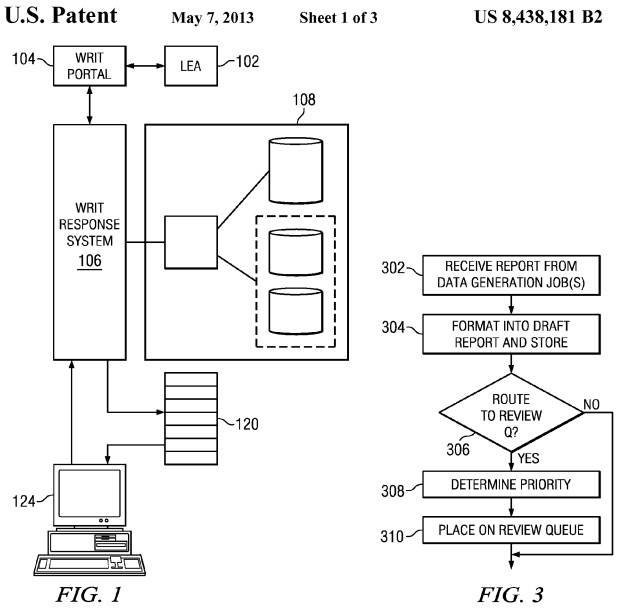
theodp writes "In June, Facebook CEO Mark Zuckerberg blasted 'outrageous press reports' about the PRISM surveillance program, denying that Facebook was ever 'part of any program to give the U.S. or any other government direct access to our servers.' What Zuckerberg didn't mention, and what the press overlooked, is that the USPTO granted Facebook a patent in May for its Automated Writ Response System. Like the NSA-enabling systems described by the NY Times on the same day Zuckerberg cried foul, the patent covers technical methods to more efficiently share the personal data of users with law enforcement agencies (LEAs) in response to lawful government requests via APIs and secured portals installed at company-controlled locations. 'While handing over data in response to a legitimate FISA request is a legal requirement,' the Times noted, 'making it easier for the government to get the information is not, which is why Twitter could decline to do so.'" -
Brazil Admits To Spying On US Diplomats After Blasting NSA Surveillance
cold fjord writes with this excerpt from The Verge: "Brazil this week admitted to spying on diplomats from countries including the US, Russia, and Iran as part of a domestic program launched 10 years ago ... The program was first revealed in a Monday report from the newspaper Folha de São Paulo, which obtained documents from the Brazilian Intelligence Agency, commonly known as ABIN. The revelations come at a sensitive time for current Brazilian president Dilma Rousseff, who has been among the most outspoken critics of the widespread surveillance conducted by the US National Security Agency (NSA). According to Folha, Brazilian intelligence spied on rooms rented out by the US embassy in Brasilia from 2003 to 2004. ... The report also claims that ABIN targeted Russian and Iranian officials, tracking their movements within the country ... Rousseff's office acknowledged Monday that the spying took place, but stressed that the operations were carried out within the law. The administration added that publishing classified documents is a crime in Brazil, and that those responsible 'will be prosecuted according to the law.' ....the revelations may put Rousseff in an awkward position. The Brazilian president cancelled a state dinner with Barack Obama earlier this year ... and lashed out against US spying in an impassioned speech to the UN in September." -
Lost Star Wars Footage Found On LaserDisc
drxenos writes "A LaserDisc purchased on eBay was found to contain raw footage from Star Wars VI: Return of the Jedi. From the article: 'The origin of the LaserDisc isn't entirely clear, but it was purchased for $699 off eBay, apparently once used to demonstrate Lucasfilm's EditDroid station — one of the first digital film editing systems sold nearly 30 years ago. Ironically, George Lucas himself never used EditDroid to make a movie; the Star Wars clips were loaded simply to show off its capabilities to prospective buyers.'" -
Apple Converting Trial and Pirated iWork, iLife and Aperture To Full Versions
tlhIngan writes "One aspect about the new OS X Mavericks release was that all Apple produced software was to be downloadable and updatable through the Mac App Store. However, this raises the obvious question: what happens to users who bought the software beforehand? Initial reports showed that the Mac App Store scanned your hard drive for software and offered to associate it with your Apple ID. The scans even found trial and pirated versions and upgraded those to fully-licensed versions. Even more interestingly, this is not a bug, and it appears Apple is turning a blind eye to the practice, giving away copies of iLife, iWork and Aperture to users who own trial or even pirated versions of the apps. Apple has also recently stopped providing downloadable trial versions of iLife, iWork and Aperture from their web site." -
Nokia Introduces Windows Tablet
jones_supa sends this news from The Verge: "Rumored for a long time, Nokia's Windows tablet has finally been released. Microsoft might be buying Nokia's device business, but for the next few months they're going to be battling it out as competitors for Windows-based tablet market share. The new Lumia 2520 tablet is everything you'd expect from Nokia; it comes with a very bright and colorful full HD 10.1" display and it looks just like a supersized version of a Lumia series Windows Phone. Other Nokia signatures are a high-quality camera and maps which work reliably offline too. Inside there's a 2.2GHz quad-core Snapdragon 800 processor, and the word is that Windows RT 8.1 runs great. It's responsive and multitasking apps seems just as good as the Surface 2. Because this is Windows RT you also get access to the desktop Office apps as part of this device. At that point the real Surface-like keyboard and trackpad become useful, alongside two USB ports. Estimated battery life is of 11 hours, which is increased when the cover is attached." -
Teachers Get 1 Week To Test Tech Giants' Hour of Code
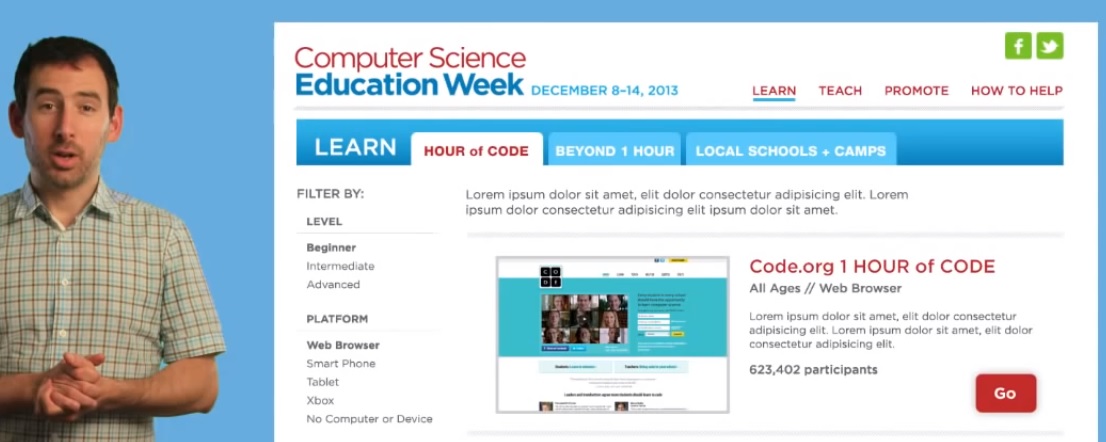
theodp writes "In a move straight out of Healthcare.gov's playbook, teachers won't get to preview the final lessons they're being asked to roll out to 10 million U.S. students until a week before the Dec. 9th launch of the Hour of Code nation-wide learn-to-code initiative, according to a video explaining the project, which is backed by the nation's tech giants, including Facebook, Microsoft, Apple, Google, and Amazon. The Hour of Code tutorial page showcased to the press sports Lorem Ipsum pseudo-Latin text instead of real content, promised tutorial software is still being developed by Microsoft and Google, and celebrity tutorials by Bill Gates and Mark Zuckerberg are still a work-in-progress. With their vast resources and deep pockets, the companies involved can still probably pull something off, but why risk disaster for such a high-stakes effort with a last-minute rush? One possible explanation is that CS Education Week, a heretofore little-recognized event, is coming up soon. Then again, tech immigration reform is back on the front burner, an initiative that's also near-and-dear to many of same players behind Hour of Code, including Microsoft Chief Counsel Brad Smith who, during the Hour of Code kickoff press conference, boasted that Microsoft's more-high-tech-visas-for-U.S.-kids-computer-science-education deal found its way into the Senate Immigration Bill, but minutes later joined his fellow FWD.us panelists to dismiss a questioner's suggestion that Hour of Code might somehow be part of a larger self-serving tech industry interest." -
Should Google Get Aggressive About Monetizing Android?
Nerval's Lobster writes "Google's core search-advertising business is slowing down (despite an uptick in revenue and earnings for the most recent quarter) and a new report suggests that advertising ROI is much higher on iOS than Android. In light of that, it's worth asking whether Google, having dominated much of the mobile-device market with Android, will ever get around to more aggressively monetizing its mobile operating system, and what that could mean to the manufacturers that have been loading the software for free onto their hardware. If Google started charging licensing fees to manufacturers, and attempted to clamp down so that Google Play served as the only hub for Android apps (something that would definitely put it on a collision course with Amazon, which boasts its own Android app store), would it be shooting itself in the foot? Or would the rest of the ecosystem respond in a muted way, considering the sheer size of Google's power and presence?" -
Two Years In Prison For Using Infrared Contact Lenses To Cheat At Poker
dmfinn writes "It was back in 2011 when Stefano Ampollini and two accomplices cheated a French casino out of over €90,000 thanks to the help of Chinese-made infrared contact lenses. According to French authorities, Ampollini and two casino workers marked cards using an invisible liquid that would be picked up by the infrared lenses, which Ampollini then used to read his competitors' cards. Though the contacts themselves cost over €2,000, the crew managed to take €71,000 in their first night. However, the trio was finally caught when a lawyer working for the casino became suspicious after Ampollini folded with an unbelievably good hand, which suggested he knew the croupier's cards. This week, a French court sentenced Ampollini to two years in prison and a €100,000 fine. His main accomplice was handed an even harsher sentence; he was forced to pay the same fine and given a 36-month sentence. It appears, despite their best efforts and advanced tactics, that the men were still unable to beat the house without raising significant alarms. So, at least for now, it seems modern technology still can't simulate good old 'luck.'" -
Ballmer Admits Microsoft Whiffed Big-Time On Smartphones
Nerval's Lobster writes "During an executive Q&A at Microsoft's Financial Analyst Meeting on Sept. 19 (video), outgoing CEO Steve Ballmer admitted that Windows Phone had a minuscule share of the smartphone market, and expressed regret over his company's inability to capitalize on burgeoning interest in mobile devices. 'I regret that there was a period in the early 2000s when we were so focused on what we had to do around Windows that we weren't able to redeploy talent to the new device called the phone,' Ballmer told the audience of Wall Street analysts and investors. 'That is the thing I regret the most.' Back in 2007, Ballmer famously denigrated the first-generation iPhone as an expensive toy that would fail to gain significant market share. He was forced to eat his words after the iPhone became a bestseller and ignited a huge market for touch-screen smartphones. Google subsequently plunged into that smartphone arena with Android, which was soon adopted by a variety of hardware manufacturers. While the iPhone (running iOS) and Android carved up the new market between them, Microsoft tried to come up with its own mobile strategy. The result was Windows Phone, which (despite considerable investment on Microsoft's part) continues to lag well behind Android and iOS in the smartphone wars. Even as he focused on discussing Microsoft's financials, Ballmer also couldn't resist taking some swipes at Google, suggesting that the search-engine giant's practices are 'worthy of discussion with competition authority.' Given Microsoft's own rocky history with federal regulators, that's sort of like the pot calling the kettle black; but Ballmer's statement also hints at how, in this new tech environment, Microsoft is very much the underdog when it comes to some of the most popular and lucrative product segments." -
Tesla Working On Autonomous Cars: Musk Wants Teslas With Auto-Pilot
cartechboy writes "Do you like driving? Well then, you're going to hate the future, because automakers are racing to beat each other to the starting line of the self-driving car race. By 2020, autonomous vehicles may arrive from Cadillac, Nissan, Volvo, Mercedes, Audi, and even Google. But now Tesla wants to jump into the ring. CEO Elon Musk told the Financial Times that the electric-car maker will build a self-driving car...within three years. You'll note that's much sooner than 2020, which means Tesla would beat other, larger automakers to the punch. For those who fear self-driving cars, Musk said the autonomous Tesla could drive 90 percent of the time, but that in his opinion, a vehicle without a human in the cockpit isn't feasible. Like it or not, our roads will probably be safer because you won't actually be driving — well, OK, that other guy who's texting or talking or drinking a huge coffee or ... you get the idea." -
Apple Unveils iPhone 5C, iPhone 5S
Nerval's Lobster writes "Apple unveiled the iPhone 5C and iPhone 5S today, which will replace the company's current iPhone 5. Apple CEO Tim Cook and other executives took to a stage in California to introduce both devices. The cheaper iPhone 5C features a plastic casing available in a variety of colors (green, blue, reddish-pink, yellow, white); Apple seems to have done its best to make the device look high quality, with the backing and sides molded of a single piece of plastic; on the hardware side of things, the iPhone 5C comes with a 4-inch Retina display, A6 processor, and 8-megapixel camera. The other new Apple design, the iPhone 5S, is the company's next-generation 'hero' device. While the iPhone 5 was a radical new design, the 5S is an iterative upgrade; on the outside, it looks pretty much the same as its predecessor (the new iPhone features a new color, gold, in addition to the 'traditional' black or white aluminum body). The iPhone 5S has an A7 chip built on 64-bit architecture (capable of running 32-bit and 64-bit apps), which is pretty speedy, to put it mildly. There's also the M7 'motion co-processor' which boosts the actions of the accelerometer, compass, and gyroscope—in theory, opening the door to more refined motion-related apps, such as ones devoted to exercise." The iPhone 5S also has a sensor built into the home button that will allow you to unlock the device with your fingerprint. Both new phone will be available for purchase on Friday, Sept. 20th. Apple announced that iOS 7 will be rolling out on Wednesday, Sept. 18th. -
Samsung Unveils Galaxy Gear Smartwatch
MojoKid writes "The smartwatch race heated up today, as Samsung showed its Galaxy Gear smartwatch at the Samsung Unpacked event in Berlin. Samsung's take on such a device has been eagerly anticipated. Samsung announced the Galaxy Gear as a companion to the new Galaxy Note 3 (or any Galaxy device). The Gear lets users make and receive calls hands-free with the built-in speaker, and it notifies you of any incoming texts, emails, and alerts and gives you a preview of whatever is coming through. A Smart Relay feature will display the full content on your Galaxy device. The Galaxy Gear sports an 800MHz processor and 1.63-inch display (320x320) AMOLED display with 512MB of RAM, 4GB of internal storage, a speaker, and two microphones with noise cancellation. There's a 1.9MP camera with a BSI sensor and autofocus, and it connects via Bluetooth 4.0 + BLE. Sensors include an accelerometer and a gyroscope. Samsung plans to launch the smartwatch in October for $300." -
SimCity Mac Launch Facing More Problems
The launch of the new SimCity back in March made headlines for the problems caused by the game's always-online DRM. EA Maxis even decided that people who bought the game early deserved a free game for their trouble. They also decided to postpone the launch of the Mac version of the game. Well, the delay is over; SimCity has arrived for Macs, and players are now facing a whole new set of installation and launch problems. "Those issues include a 'mutexAlert' error, which can be resolved by switching the OS to English. Another simply doesn't allow a player to install the game once downloaded. The suggested solution for that is to re-install Origin and opt in to the new Beta version. The game also apparently doesn't currently support Mac OS X 10.7.4 nor the upcoming 10.9 beta release." There are also reports that the game won't function on high-resolution display settings. -
Omni Magazine To Reboot
Hugh Pickens DOT Com writes "Adi Robertson reports in The Verge that classic science fiction magazine Omni, created in 1978 by Penthouse mogul Bob Guccione and partner Kathy Keeton, is coming back — and with it, questions about how our vision of science and science fiction has changed since Omni closed up shop in 1996. 'There's a heavy dose of nostalgia in the proceedings, and it's not just about bringing back an old name,' writes Robertson. 'Longtime editor Ben Bova has described Omni as "a magazine about the future," but since his time as editor, our vision of the future has been tarnished — or, at the very least, we've started looking at the predictions of the past with rose-tinted glasses.' Omni's resurrection comes courtesy of Jeremy Frommer, a collector and businessman who acquired Guccione's archives earlier this year. Like the original magazine, now available at the internet archive, the new Omni will publish a mixture of new fiction and nonfiction publishing the old illustrations that helped define Omni alongside the stories. Longtime science writer Claire Evans will edit the new online project described as an 'Omni reboot' but plans to jettison one of the magazine's most dated elements — a fondness for extraterrestrials and conspiracy theories. 'Omni always had a distressing new agey tinge to it,' says Bruce Sterling. 'There was a lot of "aircraft of the pharaohs'"rubbish going on, which I didn't have very much tolerance for.'" -
Version 2.0 of 3D-Printed Rifle Successfully Fires 14 Rounds
coolnumbr12 writes "The world's first 3D-printed rifle, named 'The Grizzly' after Canadian-built tanks used in World War II, was fired in June, but the first shot fractured the barrel receiver. The creator, a Canadian man who simply goes by 'Matthew,' refined his design and posted a video Friday on YouTube of Grizzly 2.0 successfully firing 3 rounds of Winchester bullets. The video description says the Grizzly 2.0 fired 14 rounds before it cracked. The new rifle was also safe enough for Matthew to fire it by hand rather than the string system used in the first test." -
Microsoft Will Have To Rename SkyDrive
SmartAboutThings writes "A month ago, Microsoft was involved in a legal battle in the United Kingdom, when the court found that there was a conflict between Microsoft's SkyDrive and a trademark owned by the British Sky Broadcasting Group (BSkyB). Back then, the UK court ruled that Microsoft was infringing the BSkyB's trademark. And now we have confirmation that Microsoft will be forced to change the SkyDrive brand name. This is quite a big branding issue for Microsoft. What are they going to call it? DriveSky? And chances are that the name change will be worldwide and not only in the United Kingdom." -
Obama Praises Amazon At One of Its Controversial Warehouses
theodp writes "In his first term, President Obama was a big booster of indie bookstores. But on Tuesday, the President chose to deliver his speech on Jobs for the Middle Class at one of Amazon's controversial fulfillment centers in Chattanooga, TN. 'Amazon is a great example of what's possible,' said Obama, who also toured the 'amazing facility' where workers can make $10.50-$11.50 an hour as an employee of Integrity Staffing Group, 'may also be eligible for medical and dental benefits', and 'must be able to stand/walk for up to 10-12 hours' in temperatures that 'will occasionally exceed 90 degrees.' So, are '21st century migrant workers' the new middle class?" -
Every Public School Student In LA Will Get an iPad In 2014
Jeremiah Cornelius writes "After signing a $30 million iPad deal with Apple in June, the Los Angeles School Board of Education has revealed the full extent of the program that will provide tablets to all students in the district. CiteWorld reports that the first phase of the program will see pupils receive 31,000 iPads this school year, rising to 640,000 Apple tablets by the end of 2014. Apple previously announced that the initiative would include 47 campuses and commence in the fall." Certain companies (not just Apple) stand to benefit from this kind of outlay. -
Forget Apple: Samsung Could Be Google's Next Big Rival
Nerval's Lobster writes "The idea of Samsung as a Google rival isn't unprecedented. For the past several quarters, Samsung has progressively molded Android to its own vision: layered with TouchWiz and sprinkled with all sorts of Samsung-centric apps, the software interface on Samsung devices is deviating rapidly away from the 'stock' Android that runs on other manufacturers' devices. During this year's unveiling of the Samsung Galaxy S4 at New York City's Radio City Music Hall, Samsung executives onstage barely mentioned the word 'Android,' and played up features designed specifically for the device. Establishing its own brand identity by moving away from 'stock' Android has done Samsung a lot of good: its smartphones and tablets not only stand out from the flood of Android devices on the market, but it's given the company an opportunity to position itself as the one true rival to iOS. While other Android manufacturers struggle, Samsung has profited. If Samsung continues to gain strength, it could become a huge issue for Google, which has its own eye on the hardware segment. Although Google purchased Motorola in 2011 for $12.5 billion, it hasn't yet remolded the brand in its own image, claiming that the subsidiary's existing pipeline of products first needs to be flushed into the ecosystem. But that reluctance could be coming to an end: reports suggest that Google will pump $500 million into marketing the Moto X, an upcoming 'hero' smartphone meant to reestablish Motorola's dominance of the Android space. If the Moto X succeeds, and Google decides to push aggressively into the branded hardware space, it could drive Samsung even further away from core Android. Never mind issuing TouchWiz updates until the original Android interface is virtually unrecognizable—with its industry heft, Samsung could potentially boot Google Play from the home-screen and substitute it with an apps-and-content hub of its own design. That would take a lot of work, of course: first, Samsung would need to build a substantial developer ecosystem, and then it would need to score great deals with movie studios and other content providers. But as Amazon and Apple have shown, such things aren't impossible. The only questions are whether (a) Samsung has the will to devote the necessary time and resources to such a project, and (b) if it's willing to transform its symbiotic relationship with Google into an antagonistic one." -
Comcast May Put Wi-Fi Transceivers On Cars, Buses, Humans
An anonymous reader writes "Comcast engineers want to put WiFi transceivers in rental cars, taxis, buses and even on humans to extend reach of its Xfinity WiFi network. They also detail an idea for offering incentives to drivers to move WiFi-enabled cars to areas where it needs WiFi coverage. The plan was detailed in a patent application published today by the USPTO (I wrote a story about it for FierceCable)." Speaking of extension, this sounds like a logical outgrowth of using wireless routers to grow the network. (I hope they choose their humans carefully, if this plan bears fruit.) -
The CIA Wants To Know How To Control the Climate
Taco Cowboy writes " The CIA is currently funding, in part, a $630,000 study on geoengineering, the science of using experimental techniques to modify Earth's climate. Scientists will study how humans might influence weather patterns, assess the potential dangers of messing with the climate, and investigate possible national security implications of geoengineering attempts. The study calls for information on two geoengineering techniques in particular, 'solar radiation management (SRM),' which refers to launching material into Earth's atmosphere to try and block the Sun's infrared radiation, limiting global temperature rise; and 'carbon dioxide removal (CDR),' taking carbon dioxide emissions out of the climate, which scientists have proposed doing through a variety of means, from structures that eat air pollution to capturing carbon emissions as they come out of smokestacks."