Slashdot Mirror
Domain: wired.com
Stories and comments across the archive that link to wired.com.
Stories · 4,012
-
Assassin's Creed And the Future of Sandbox Games
Wired's Game|Life blog, and the site of gaming academic Henry Jenkins, discuss sandbox games and the impact of Assassin's Creed . The relevant discussion on Jenkins' site is actually written by GAMBIT lab supervisor Matthew Weise. He argues that open-ended worlds, by their very nature, require some restraints on the player's avatar. Otherwise, the game's meaning is diluted. Likewise, if you're going for a 'sandbox' world, allow that limited character unlimited opportunities. "When I think of open-ended world design I tend to think of worlds that don't involve such limitations. Call it the result of a childhood playing Ultima. I think of worlds in which, if you need to kill the dragon in the cave and you happen to have a drill, there's no reason you can't just drill straight down, bypassing all his little traps, and kill the bastard. That's open-ended to me. That's sandbox. The pleasure of such incredible agency is much more satisfying than any forced narrative structure." -
Scientists Recycle CO2 with Sunlight to Make Fuel
An anonymous reader brings us this article from Wired about a new method to produce fuel with the help of concentrated sunlight and carbon dioxide. The process "reverses" combustion, breaking down the CO2 into carbon monoxide, which is then used as a building block for hydrocarbons. Quoting: "The Sandia team envisions a day when CR5s are installed in large numbers at coal-fired power plants. Each of them could reclaim 45 pounds of carbon dioxide from the air daily and produce enough carbon monoxide to make 2.5 gallons of fuel. Coupling the CR5 with CO2 reclamation and sequestration technology, which several scientists already are pursuing, could make liquid hydrocarbons a renewable fuel." -
RIAA's 'Misspeaking' May Have Affected Verdict
NewYorkCountryLawyer writes "David Kravetz of Wired.com covered last year's Capitol v. Thomas trial gavel-to-gavel. It's worth noting, then, his article saying that the RIAA's recent statement — that Sony's top litigation lawyer 'misspoke' during the trial. She said that making a copy from one's own cd is 'stealing', which (in his words) may have caused a major miscarriage of justice. Wired further points out that later on in the trial, during the RIAA's examination of Ms. Thomas, 'On the hard drive she [turned] over were thousands of songs Thomas said she ripped from her CDs. The RIAA's Gabriel suggested to jurors that copying one's purchased music was a violation of the Copyright Act. Gabriel, for example, asked Thomas whether she had ever burned CDs, either for herself, or to give away to friends.' Gabriel, the RIAA's lead attorney, apparently misspoke too — prejudicing jurors along the way." -
Boeing 787 May Be Vulnerable to Hacker Attack
palegray.net writes "An article posted yesterday on Wired.com notes that 'Boeing's new 787 Dreamliner passenger jet may have a serious security vulnerability in its onboard computer networks that could allow passengers to access the plane's control systems, according to the U.S. Federal Aviation Administration.' They're already working on solutions to the problem - including placing more physical separation between aircraft networks and implementing more robust software-based firewalls." -
LG & Netflix Team Up to Offer Downloadable Movies on TV
eldavojohn writes "It might seem like they've come full circle, but the movie injection method has gone from TV to mail to online download to TV on demand. And Netflix & LG are betting it's going to be a hit. They're also betting you will want to buy yet another device for your home theater. A Wall Street Journal article notes: 'The partnership between Netflix, Los Gatos, Calif., and South Korea's LG represents another gamble by technology companies that video from the Internet, which is commonly downloaded to personal computers, will go mainstream when users can easily access it from TV sets. So far, Internet television products such as Apple Inc.'s Apple TV have largely been unsuccessful, stymied by a poor selection of videos, complexity of use and other shortcomings.'" -
Data Theft Soars to Unprecedented Levels
A Wired article reports on data loss in 2007, and the numbers aren't good. Credit card and social security theft was at an all-time high, with even more losses expected in 2008. Information thieves, it seems, are just one step ahead of IT security. "While companies, government agencies, schools and other institutions are spending more to protect ever-increasing volumes of data with more sophisticated firewalls and encryption, the investment often is too little too late. 'More of them are experiencing data breaches, and they're responding to them in a reactive way, rather than proactively looking at the company's security and seeing where the holes might be,' said Linda Foley, who founded the San Diego-based Identity Theft Resource Center after becoming an identity theft victim herself." -
Musicians Have Many Money Options Online, Says Talking Head
Time Slows Down writes "Scottish born musician and former record label owner David Byrne says the future of music as a career is wide open and identifies six different distribution models now available to musicians in an article in this month's Wired magazine. At one end of the scale is the 360, or equity deal, where every aspect of the artist's career is handled by producers, promoters, marketing people, and managers. At the other end of the scale is the self-distribution model, where the music is self-produced, self-written, self-played, and self-marketed." -
Jack Thompson Claiming Games Industry in Collusion with DoD
mytrip brings us a Wired blog about Jack Thompson's recent press release, which claims an "unholy alliance" exists between the gaming industry and the U.S. Department of Defense. Game Politics also has a discussion of Thompson's main points. From Wired: "Jim Blank, the head of the modeling and simulation division of the U.S. Joint Forces Command, says that commercial games don't meet the demand of the military, adding, 'first-person shooter games really don't apply in this environment.' Blank's point is that game-like simulations are a valuable tool for training soldiers in situations that would be too expensive to simulate in reality." -
Snortable Drug 'Replaces' Sleep For Monkeys In Trials
sporkme writes "A DARPA-funded research project at UCLA has wrapped up a set of animal trials testing the effects of inhalation of the brain chemical orexin A, a deficiency of which is a characteristic of narcolepsy. Monkeys were deprived of sleep, and then given a shot of the compound. 'The study ... found orexin A not only restored monkeys' cognitive abilities but made their brains look "awake" in PET scans. Siegel said that orexin A is unique in that it only had an impact on sleepy monkeys, not alert ones, and that it is 'specific in reversing the effects of sleepiness' without other impacts on the brain.' Researchers seem cautious to bill the treatment as a replacement for sleep, as it is not clear that adjusting brain chemistry could have the same physical benefits of real sleep in the long run. The drug is aimed at replacing amphetamines used by drowsy long-haul military pilots, but there would no doubt be large demand for such a remedy thanks to its apparent lack of side-effects." -
Information Overload Predicted Problem of the Year for 2008
Wired is reporting that information overload is being predicted by some analysts as the problem of the year for 2008. "'It's too much information. It's too many interruptions. It's too much lost time,' Basex chief analyst Jonathan Spira declared. 'It's always too much of a good thing.' Information overload isn't exactly new, but Spira said the problem has grown as technology increases societal expectations for instantaneous response. And more information available, he said, also means more time wasted looking for the right information, whether in an old e-mail or through a search engine." -
2007's Ten Biggest Gaming Letdowns
Game|Life offers up an anti-top-ten list, noting the three blog authors' biggest disappointments from 2007. Chris Kohler's biggest letdown echoes my own feelings on this topic: "No LittleBigPlanet. PlayStation 3's software library got significantly better this holiday, but there's no killer app. I honestly don't know if LittleBigPlanet would have been one. But I think it's going to be mine. It's going to be the thing that glues me to PlayStation 3... when it ships. I was all ready to start building worlds and sharing them with my friends and generally start being a jackass by now, but it won't happen until next year -- late next year, if you believe the rumors. I hope they're not true. And I do hope LittleBigPlanet sets the planet on fire when it releases." Any gaming 'event' this year an epic fail for you? -
British Drivers Destroying Surveillance Cameras
miletus writes "A Wired article tells us that not everyone in Britain loves the surveillance state." The linked entry (part of Bruce Sterling's blog) quotes a story about British anti-camera groups, one of which claims its up-and-coming methods "will enable them to destroy a roadside camera in just a few seconds," and illustrates with a burned-out camera. I wonder how many Americans are similarly motivated. -
Clinton Would Crack Down On Game Content
thefickler sends us word that Hilary Clinton has taken a public stand in favor of shielding children from game and other animation content that she deems inappropriate. Quote: "When I am president, I will work to protect children from inappropriate video game content." Politically, this puts her in company with Republican Mitt Romney on the subject of game censorship. Her fellow Democrats are content to let the industry self-regulate. -
High Efficiency Hybrid Car Planned For 2009
An anonymous reader writes "You may have heard some of the hype last month when California-based Aptera let out first word of its allegedly super fuel-efficient (and cheap) Typ-1 electric vehicle. A video test drive and gee-whiz specs breakdown at the Popular Mechanics site proves that this thing is for real. The plan is to have a vehicle that goes 120 miles on a single lithium-phosphate pack charge for 2008, with a 300-mpg model to follow by 2009. Aptera is also mentioned in Wired's new cover story as one of several early front-runners for the Automotive X Prize." -
Wired's 2007 Vaporware Awards
Braedley sends word that Wired's annual vaporware list is up, and a number of products this community has discussed made the cut. The top spot, the position of most dishonor, was almost a foregone conclusion. "Another December, another list, another crowning achievement by the Emperor of the Ethereal, the Head Honcho of Hype, Duke Nukem Forever. We were going to disqualify him out of pity, but Sir Duke is back for 2007 thanks to a few leaked screenshots and an overwhelming number of votes. DNF creators 3D Realms even chose this week to debut a well-publicized video trailer for Duke's long-awaited return. Alas, a trailer is not a game, so — long live the king!" -
Official 700MHz Bidder List
j.sanchez1 writes "Wired has the scoop on the official bidder list for the 700MHz auction slated for January 24, 2008. Here are PDFs of the lists of accepted applications (96 names) and incomplete applications (170). Along with AT&T and Verizon, Google and Paul Allen's Vulcan Spectrum are in on the bidding." -
The Intersection of Gaming and Futurama
Nerds made Futurama. You probably already knew that. As you can imagine, these nerds played a lot of games during the making of the show. Games ended up in the show a lot, too. Game|Life's Chris Kohler delves deeply into this connection over a series of articles; for example, did you know that Zoidberg was named for a variant of Qix ? Or that the creators of the show were big pinball players? Probably the most obvious combination of games and the show was the amazing episode Raiders of the Lost Arcade. "The evil alien is joined by his evil arcade comrades: Donkey Kong, a fried egg from Burger Time, a robot from Berserk, a brain from Robotron. Q*bert is also there, and he spouts some characteristically garbled dialogue which, when played backwards, is revealed to be "Where can a guy get some pants around here?"" -
The Intersection of Gaming and Futurama
Nerds made Futurama. You probably already knew that. As you can imagine, these nerds played a lot of games during the making of the show. Games ended up in the show a lot, too. Game|Life's Chris Kohler delves deeply into this connection over a series of articles; for example, did you know that Zoidberg was named for a variant of Qix ? Or that the creators of the show were big pinball players? Probably the most obvious combination of games and the show was the amazing episode Raiders of the Lost Arcade. "The evil alien is joined by his evil arcade comrades: Donkey Kong, a fried egg from Burger Time, a robot from Berserk, a brain from Robotron. Q*bert is also there, and he spouts some characteristically garbled dialogue which, when played backwards, is revealed to be "Where can a guy get some pants around here?"" -
The Intersection of Gaming and Futurama
Nerds made Futurama. You probably already knew that. As you can imagine, these nerds played a lot of games during the making of the show. Games ended up in the show a lot, too. Game|Life's Chris Kohler delves deeply into this connection over a series of articles; for example, did you know that Zoidberg was named for a variant of Qix ? Or that the creators of the show were big pinball players? Probably the most obvious combination of games and the show was the amazing episode Raiders of the Lost Arcade. "The evil alien is joined by his evil arcade comrades: Donkey Kong, a fried egg from Burger Time, a robot from Berserk, a brain from Robotron. Q*bert is also there, and he spouts some characteristically garbled dialogue which, when played backwards, is revealed to be "Where can a guy get some pants around here?"" -
A Law to Spy Back on Government Surveillance Cameras?
mattnyc99 writes "As the Senate begins debate today on wider new surveillance legislation, Instapundit blogger and University of Tennessee law professor Glenn Reynolds has an interesting op-ed as part of Popular Mechanics' cover story on the looming power of spy cameras in America. He cites numerous court cases to argue that our privacy concerns may be backwards, and that there should be a new law for citizen rights — that if Big Brother can keep an eye on us in public spaces, we ought to be able to look back. From the accompanying podcast: 'Realistically I don't think we're going to get much in the way of limits on government and business surveillance. So I think we should be focusing more on making it safe, on making it a double-edged sword.'" -
Army Opens New Office of Videogames
An anonymous reader writes "For the first time, the Army has set up a project office, just for building videogames. The military has been training troops with games for decades, of course. But this is the first wing of the armed forces dedicated exclusively for gaming. One of the first projects: a tool kit that would let soldiers "build and customize their own training scenarios — just like the Marines' did, adapting Armed Assault for military purposes." -
Army Opens New Office of Videogames
An anonymous reader writes "For the first time, the Army has set up a project office, just for building videogames. The military has been training troops with games for decades, of course. But this is the first wing of the armed forces dedicated exclusively for gaming. One of the first projects: a tool kit that would let soldiers "build and customize their own training scenarios — just like the Marines' did, adapting Armed Assault for military purposes." -
Playing With Atomic Clocks At Home
Wired is running a profile of the Time Nuts, a small group of people who buy surplus precision time equipment — cesium clocks for example — on eBay and keep really accurate time, because they can. The article quotes Tom Van Baak, who has outfitted a time lab superior to those of many small countries: "If you have one clock... you are peaceful and have no worries. If you have two clocks... you start asking, 'What time is it, really?'" -
Former Anti-Nuclear Activist Does A 180
palegray.net writes "Wired is running a story on how Gwyneth Cravens, a former nuclear power protester has changed her views on nuclear power as a viable solution to the world's energy needs. Said Cravens: 'I used to think we surely could do better. We could have more wind farms and solar. But I then learned about base-load energy, and that there are three forms of it: fossil fuels, hydro and nuclear. In the United States, we're maxed out on hydro. That leaves fossil fuels and nuclear power, and most of the fossil fuel burned is coal.'" -
Sneaking Stories Past Miyamoto
Chris Kohler, editor over at Game|Life, has up a great interview with Super Mario Galaxy director Yoshiaki Koizumi. They discuss the development of the Mario and Zelda games, clarifying Shigeru Miyamoto's tense relationship with stories (and sentences), and discussing the lineage of the Mario titles: "In terms of spiritual successors, I've never found that to be the case. Whereas with the Zelda series, each game seems to follow pretty closely from the last with a few stylistic deviations. But Galaxy really feels like it went back to earlier roots with Super Mario Bros., in terms of trying to find that same tempo, that same feel. But for me, it's a matter of thinking what to do with each next step. There's nothing you really throw away. You think about these ideas and refine them constantly with every iteration of a game series. So for all the camera problems that you may have found in Mario 64 and Sunshine, even though we didn't realize how to fix those problems then, those solutions presented themselves over time and found their way into this game. I feel like you really can't have Galaxy without all of the things we learned from Sunshine." -
Microfluidic Chips Made With Shrinky Dinks
SoyChemist writes "When she started her job as a new professor at UC Merced, Michelle Khine was stuck without a clean room or semiconductor fabrication equipment, so she went MacGyver and started making Lab-on-a-Chip devices in her kitchen with Shrinky Dinks, a laser printer, and a toaster oven. She would print a negative image of the channels onto the polystyrene sheets and then shrink them with heat. The miniaturized pattern served as a perfect mold for forming rounded, narrow channels in PDMS — a clear, synthetic rubber." -
Microfluidic Chips Made With Shrinky Dinks
SoyChemist writes "When she started her job as a new professor at UC Merced, Michelle Khine was stuck without a clean room or semiconductor fabrication equipment, so she went MacGyver and started making Lab-on-a-Chip devices in her kitchen with Shrinky Dinks, a laser printer, and a toaster oven. She would print a negative image of the channels onto the polystyrene sheets and then shrink them with heat. The miniaturized pattern served as a perfect mold for forming rounded, narrow channels in PDMS — a clear, synthetic rubber." -
Xbox Live Fall Update Drops Tomorrow
Game|Life has a rundown on the Fall Update for Xbox Live. In addition to the Friend of a Friend feature we discussed last week, you'll also be seeing the first of the Xbox Originals download titles, a few Arcade games will be a bit lower cost, and a new 'family timer' option will let parents put caps on service use time. "You'll also be able to expand your bio, providing more detailed information about yourself to the Xbox Live community ... apparently I wasn't the only one going blind trying to watch those itty-bitty move previews, because now you'll be able to see them full-screen. The update also comes with "enhanced video codec support," which means that your DivX and Xvid files will play on your 360." Remember, if you don't want everyone seeing the folks on your Friends List you need to change your settings now. Plus, everybody should snag Psychonauts; make Tim Schafer a happy man for Christmas. -
Duke Scientists Map 'Silenced Genes'
palegray.net writes "Wired reports on new research into the phenomenon of 'silenced genes', genetic constructs that have no 'partner' in case one goes wrong over the course of your lifetime. Scientists at Duke University have mapped some 200 genes that may 'play a profound role' in the health of the average human. 'Many of the newly found imprinted genes are in regions of chromosomes already linked to the development of obesity, diabetes, cancer and some other major diseases, the researchers reported ... Scientists had thought imprinted genes would account for about 1 percent of the human genome. While scientists must double-check that the newly identified ones are truly silenced, the new map matches that tally.'" -
Comcast Continues to Block Peer to Peer Traffic
narramissic writes "A report released Thursday by the Electronic Frontier Foundation (EFF) finds that Comcast continues to use hacker-like techniques to slow down customers' connections to some P-to-P (peer-to-peer) applications. The EFF said that Comcast appears to be injecting RST, or reset, packets into customers' connections, causing connections to close. 'The investigators say that their tests confirmed an earlier one conducted by the Associated Press that showed that Comcast is interfering with BitTorrent traffic. BitTorrent is a protocol used to efficiently distribute the online transmission of large files, and some entertainment companies have partnered with its creators to distribute its content online. Comcast has said that it doesn't block BitTorrent, or any kind of content.'" If you're the type that always looks for a silver lining, Comcast's skulduggery may be pushing Congress to reconsider Net Neutrality. -
Futurama Returns!
Random BedHead Ed writes "Good news everyone! After a five year vanishing act the sci-fi spoof Futurama returned this week with a direct-to-DVD feature. Wired has an article about its return, including the story of the show's origins, a behind the scenes gallery, interviews with creators Matt Groening and David X. Cohen, and some interesting trivia. For example, did you know the ship has an overbite like a Simpson's character? Or that the show's title is taken from an exhibition at the 1939 Worlds Fair?." We just talked about this a bit the other day, too, in reference to a great interview on TVSquad. -
Futurama Returns!
Random BedHead Ed writes "Good news everyone! After a five year vanishing act the sci-fi spoof Futurama returned this week with a direct-to-DVD feature. Wired has an article about its return, including the story of the show's origins, a behind the scenes gallery, interviews with creators Matt Groening and David X. Cohen, and some interesting trivia. For example, did you know the ship has an overbite like a Simpson's character? Or that the show's title is taken from an exhibition at the 1939 Worlds Fair?." We just talked about this a bit the other day, too, in reference to a great interview on TVSquad. -
Robot Hand Learns How To Learn From Babies
jcasman writes "Wired's got a piece on building a better robotic hand at Stanford. The new robot is called Stair 1.0, and scientists are hoping to take a cue from human children for how to teach a robot to learn. 'When a computer fails at a task, it spouts an error message. Babies, on the other hand, just try again a different way, exploring the world by grabbing new objects -- shoving them into their mouths if possible -- to acquire additional data. This built-in drive to explore teaches us how to use our brains and bodies. Now a number of hand-focused roboticists are building machines with the same childlike motivation to explore, fail, and learn through their hands.'" -
New Nerve Gas Antidotes
SoyChemist writes "Scientists from Korea and the Czech Republic have discovered new drugs that can counteract the chemical overload caused by nerve gas. All of the experimental medications belong to a family of chemicals called oximes. Those molecules reactivate the enzyme that is damaged by the chemical weapons. Last year, the FDA approved the first combined atropine and oxime auto-injector for use by emergency personnel. Israel has been providing them to their citizens since the first Gulf War." -
NASA Requires JPL Scientists To Give Up Right To Privacy
Markmarkmark writes "Wired is reporting that all NASA JPL scientists must 'voluntarily' (or be fired) sign a document giving the government the right to investigate their personal lives and history 'without limit'. According to the Union of Concerned Scientists this includes snooping into sexual orientation, mental & physical health as well as credit history and 'personality conflict'. 28 senior NASA scientists and engineers, including Mars Rover team members, refused to sign by the deadline and are now subject to being fired despite a decade or more of exemplary service. None of them even work on anything classified or defense related. They are suing the government and documenting their fight for their jobs and right to personal privacy." -
Are Spammers Giving Up?
sfjoe writes "Are spammers giving up the game? Google seems to think so. In an article at Wired, Google, '... says that spam attempts, as a percentage of e-mail that's transmitted through its Gmail system, have waned over the last year'. They think their own filters are so good that spammers aren't even trying anymore. 'Other experts disagree with Google, pointing out that overall spam attempts continue to rise. By most estimates, tens of billions of spam messages are sent daily. Yet for most users, the amount of spam arriving in their inboxes has remained relatively flat, thanks to improved filtering.'" -
Area 51's Lead Designer Admits Project Was 'F'd Up'
Wired has up an interview with Blacksite: Area 51's lead designer Harvey Smith. Smith is well known for his work on great games like Deus Ex and System Shock, but his latest title is getting a lot of negative press. In the interview, Smith as much as admits the team failed in their quest to make a great game. "'We got hammered so hard [by reviewers], and we deserved it ... Everyone was forced to share tech. It took eight months to get one thing working.' He wouldn't specify what that one thing was, but did note that technical problems set the team back, time and time again. Another of Smith's complaints was 'the fact that we had four days to Orange Box something,' meaning to fix and polish a level. Smith called this 'completely reprehensible.'" Kind of shocking to see this kind of honesty from the games industry. -
Why You Can't Find a Wii for Christmas
Nintendo is making Wii consoles at a record pace, some 1.8 million a month. Last week they sold 350,000 units. Yes, just last week. And yet, still, it's going to be almost impossible to find a Wii in a store this Christmas. Wired reports that the problem actually began back in August. Summer being the traditional 'dry' season in gaming usually leads to hardware surpluses, but not with Nintendo's console. The result is a holiday season that Nintendo essentially couldn't prepare for. "Demand for Wii is so high, says analyst Michael Pachter, because of all the different types of consumers competing for the units ... it's not just kids who crave Wii. [It's] an especially big hit at retirement homes ... Hard-core gamers, who initially spurned the Wii's lower graphic power compared to the Xbox and PlayStation 3, have changed their tune on the console, thanks to brilliant software like the first-person shooter Metroid Prime 3. And eBay scalpers? They really want Wii." In fact, the only reliable way to get your hands on a Wii is to go that most dubious of routes. Ebay Wii sales are very brisk indeed this week. -
How Tech Almost Lost the War
An anonymous reader writes "Blame the geeks for the mess in Iraq? Wired says so. Networked troops were supposed to be so efficient, it'd take just a few of 'em to wipe out their enemies. But the Pentagon got their network theory all wrong, with too few nodes and a closed architecture. Besides, a more efficient killing machine is the last thing you want in an insurgency like Iraq." -
PlayStation 3 'Hacker's Paradise', Sales Up
Via Game|Life, a story on The Age site suggests that password crackers are really enjoying their PlayStation 3s ... and not because Ratchet is a great game. An NZ-based security researcher stated at a local security conference that the supercomputing power of the PS3 is being put to more nefarious uses than Folding@home. "Speed is important to "brute force" password cracking, which relies on guessing all possible combinations of the characters that make up the password. The accelerated technique means passwords protecting Office, PDF, ZIP and Lotus Notes ID files can be cracked with breathtaking speed. However, many other password types are handled more securely in software and remain unaffected by Breese's claimed speed increase." Sony does have some good news this week, though. Either the holiday season or a price drop here in the states has led to a massive sales increase. -
Amazon Sneaks One-Click Past the Patent System
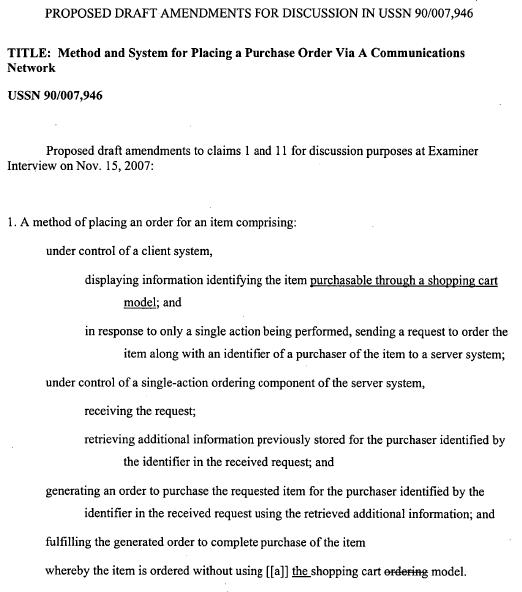
theodp writes "By changing the word 'a' to 'the' and adding the phrase 'purchasable through a shopping cart model,' lawyers for Amazon.com have apparently managed to reinstate two of CEO Jeff Bezos' 1-Click Patent claims that were rejected a month earlier. 'Patent Owner's Rep was informed that the proposed addition to the claims appear to place the claims in condition of patentability,' writes the USPTO in its Ex Parte Reexamination Interview Summary of the 11-15 conference call that was held with five representatives of the USPTO and patent reformer Amazon." -
Amazon's Kindle Sells Out In 5.5 Hours
necro81 writes "As reported on Engadget, Amazon's Kindle e-book reader has sold out. Charlie Rose's interview with Jeff Bezos reveals that the Kindle sold out within just 5-1/2 hours of going on sale. Amazon hasn't revealed how many it had in stock at launch, so it may just be that they didn't anticipate early demand. A check of the Kindle's product page shows that more will be rolling out starting December 3rd." Wired also has a brief head-to-head of the more prominent ebook readers and PCWorld has a review of the new gadget from Amazon. -
Stem-Cell-Like Cells Produced From Skin
MikShapi writes "Skin cells can now be turned into something resembling stem cells. A genetic modification to four genes using a viral vector reverses differentiating, making the cells revert to a stem-cell state, capable for becoming any other cell in the body. The researchers are calling them 'iPS cells' or 'induced pluripotent stem cells.' In their experiments, iPS cells in the lab turned into nerve cells, heart muscle, and other tissues. The research was published in Cell and Nature by teams from the universities of Kyoto and Wisconsin. The article notes that if the new method proves successful, 'we can disconnect the whole stem cell debate from the culture war, from battles over embryo politics and abortion rights.' And, should this technique be adopted, stem cells will henceforth be abundant, easier and cheaper to come by for research and therapeutic purposes." -
10 Great Snake-Oil Gadgets
The Byelorussian Strikes Again writes "Wired offers up 10 of the most awesome snake oil gadgets, from industrial cables sold as $200 ionized pain-relieving bracelets to a plastic chip that cures anything, improves gas mileage and cleans swimming pools. One truly sad development: the infamous $500 wooden volume knob is no longer on sale." -
Hackers Use Banner Ads on Major Sites to Hijack Your PC
The worst-case scenario used to be that online ads are pesky, memory-draining distractions. But a new batch of banner ads is much more sinister: They hijack personal computers and bully users until they agree to buy antivirus software. And the ads do their dirty work even if you don't click on them.The malware-spiked ads have been spotted on various legitimate websites, ranging from the British magazine The Economist to baseball's MLB.com to the Canada.com news portal. Hackers are using deceptive practices and tricky Flash programming to get their ads onto legitimate sites by way of DoubleClick's DART program. Web publishers use the DoubleClick-hosted platform to manage advertising inventory." CT: Link updated to original source instead of plagerizer. -
Open Source, Genetically Engineered Machines From a Kit?
An anonymous reader writes "Students in an MIT competition are helping to build a dev-kit for cells. Together with synthetic biologists, they're building a Registry of Standard Biological Parts called BioBricks. They aim to do for cells what open source software has done for computers. 'The competition is a showcase for the burgeoning field of synthetic biology. Knight and his colleagues Randy Rettberg and Drew Endy, who created the contest in 2004, want to make biological systems easy to build by applying the tools of computer science and engineering: using standard parts and modular design to simplify complex systems. The goal is to create "genetic Legos" that could produce any chemical, from ethanol to pharmaceuticals.'" -
New NSA-Approved Encryption Standard May Contain Backdoor
Hugh Pickens writes "Bruce Schneier has a story on Wired about the new official standard for random-number generators the NIST released this year that will likely be followed by software and hardware developers around the world. There are four different approved techniques (pdf), called DRBGs, or 'Deterministic Random Bit Generators' based on existing cryptographic primitives. One is based on hash functions, one on HMAC, one on block ciphers and one on elliptic curves. The generator based on elliptic curves called Dual_EC_DRBG has been championed by the NSA and contains a weakness that can only be described as a backdoor. In a presentation at the CRYPTO 2007 conference (pdf) in August, Dan Shumow and Niels Ferguson showed that there are constants in the standard used to define the algorithm's elliptic curve that have a relationship with a second, secret set of numbers that can act as a kind of skeleton key. If you know the secret numbers, you can completely break any instantiation of Dual_EC_DRBG." -
The Nuclear Power Renaissance
Actual Reality writes "It is ironic to me that much of the same sentiment that thwarted the nuclear power industry back in the 80's is partially responsible for reviving it. Nuclear power is very clean compared to any power source that burns fuel. The US has missed several advancements in nuclear technology. We can only hope that environmental concerns will not again stifle our progress." -
Wikileaks Releases Sensitive Guantanamo Manual
James Hardine writes "Wired is reporting that a never-before-seen military manual detailing the day-to-day operations of the U.S. military's Guantánamo Bay detention facility has been leaked to the web, via the whistle-blowing site Wikileaks.org, affording a rare inside glimpse into the institution where the United States has imprisoned hundreds of suspected terrorists since 2002. The 238-page document, "Camp Delta Standard Operating Procedures," is dated March 28, 2003. The disclosure highlights the internet's usefulness to whistle-blowers in anonymously propagating documents the government and others would rather conceal. The Pentagon has been resisting — since October 2003 — a Freedom of Information Act request from the American Civil Liberties Union seeking the very same document. Anonymous open-government activists created Wikileaks in January, hoping to turn it into a clearinghouse for such disclosures. The site uses a Wikipedia-like system to enlist the public in authenticating and analyzing the documents it publishes. The Camp Delta document includes schematics of the camp, detailed checklists of what "comfort items" such as extra toilet paper can be given to detainees as rewards, six pages of instructions on how to process new detainees, instructions on how to psychologically manipulate prisoners, and rules for dealing with hunger strikes." -
Yahoo Settles With Imprisoned Chinese Journalists
Terms of the deal are secret, but Yahoo has reached settlements with two Chinese journalists who were arrested based on information the company provided to the ruling Communist government. "[...] a source at Yahoo said the company has been 'working with the families, and we're working with them to provide them with financial, humanitarian and legal assistance.' Yahoo has also agreed to establish a global human rights fund to provide 'humanitarian relief' to support dissidents and their families. The source said that details still have to be worked out."