Slashdot Mirror
Domain: youtube.com
Stories and comments across the archive that link to youtube.com.
Stories · 2,039
-
Simulation Suggests 68 Percent of the Universe May Not Actually Exist (newatlas.com)
boley1 quotes a report from New Atlas: According to the Lambda Cold Dark Matter (Lambda-CDM) model, which is the current accepted standard for how the universe began and evolved, the ordinary matter we encounter every day only makes up around five percent of the universe's density, with dark matter comprising 27 percent, and the remaining 68 percent made up of dark energy, a so-far theoretical force driving the expansion of the universe. A new study has questioned whether dark energy exists at all, citing computer simulations that found that by accounting for the changing structure of the cosmos, the gap in the theory, which dark energy was proposed to fill, vanishes. According to the new study from Eotvos Lorand University in Hungary and the University of Hawaii, the discrepancy that dark energy was "invented" to fill might have arisen from the parts of the theory that were glossed over for the sake of simplicity. The researchers set up a computer simulation of how the universe formed, based on its large-scale structure. That structure apparently takes the form of "foam," where galaxies are found on the thin walls of each bubble, but large pockets in the middle are mostly devoid of both normal and dark matter. The team simulated how gravity would affect matter in this structure and found that, rather than the universe expanding in a smooth, uniform manner, different parts of it would expand at different rates. Importantly, though, the overall average rate of expansion is still consistent with observations, and points to accelerated expansion. The end result is what the team calls the Avera model. If the research stands up to scrutiny, it could change the direction of the study of physics away from chasing the ghost of dark energy. "The theory of general relativity is fundamental in understanding the way the universe evolves," says Dr Laszlo Dobos, co-author of the new paper. "We do not question its validity; we question the validity of the approximate solutions. Our findings rely on a mathematical conjecture which permits the differential expansion of space, consistent with general relativity, and they show how the formation of complex structures of matter affects the expansion. These issues were previously swept under the rug but taking them into account can explain the acceleration without the need for dark energy." The study has been published in the Monthly Notices of the Royal Astronomical Society. You can view an animation that compares the different models here. -
About 90% of Smart TVs Vulnerable To Remote Hacking Via Rogue TV Signals (bleepingcomputer.com)
An anonymous reader quotes a report from Bleeping Computer: A new attack on smart TVs allows a malicious actor to take over devices using rogue DVB-T (Digital Video Broadcasting -- Terrestrial) signals, get root access on the smart TV, and use the device for all sorts of nasty actions, ranging from DDoS attacks to spying on end users. The attack, developed by Rafael Scheel, a security researcher working for Swiss cyber security consulting company Oneconsult, is unique and much more dangerous than previous smart TV hacks. Scheel's method, which he recently presented at a security conference, is different because the attacker can execute it from a remote location, without user interaction, and runs in the TV's background processes, meaning users won't notice when an attacker compromises their TVs. The researcher told Bleeping Computer via email that he developed this technique without knowing about the CIA's Weeping Angel toolkit, which makes his work even more impressing. Furthermore, Scheel says that "about 90% of the TVs sold in the last years are potential victims of similar attacks," highlighting a major flaw in the infrastructure surrounding smart TVs all over the globe. At the center of Scheel's attack is Hybrid Broadcast Broadband TV (HbbTV), an industry standard supported by most cable providers and smart TV makers that "harmonizes" classic broadcast, IPTV, and broadband delivery systems. TV transmission signal technologies like DVB-T, DVB-C, or IPTV all support HbbTV. Scheel says that anyone can set up a custom DVB-T transmitter with equipment priced between $50-$150, and start broadcasting a DVB-T signal. -
Scientists Name 11 New Cloud Types (nationalgeographic.com)
The increased use of technology capable of photographing and sharing images has prompted the World Meteorological Organization to add 11 new cloud classifications to their International Cloud Atlas. "A far cry from simple white puffs, these 11 new cloud types roll, dip, and menace their way across the skies," reports National Geographic. From the report: These 11 additions are the first updates that the atlas has received in 30 years, and much of the change can be attributed to citizen scientists who can share and discuss clouds by uploading photos to the Atlas's site. 2017 is the first year that the renowned atlas will be published entirely online, but a hardbound version will follow later this year. Asperitas, Latin for roughness, is the cloud type that has citizen scientists most excited and has been a special victory for the UK-based Cloud Appreciation Society. This photo, first spotted in 2006, captured their attention for its inability to be described by existing cloud types. Marked by small divot-like features that create chaotic ripples across the sky, asperitas were championed by enthusiasts who noticed they did not accurately fall under existing categories. Other clouds that formerly went by more colloquial names, such as the wave-like Kelvin-Helmoltz cloud, and fallstreak holes, will now be recognized with the Latin names fluctus and cavum, respectively. You can watch a time-lapse of the newly classified asperitas here. -
Physicist Declassifies Rescued Nuclear Test Films (llnl.gov)
Eloking quotes a report from Lawrence Livermore National Laboratory: The U.S. conducted 210 atmospheric nuclear tests between 1945 and 1962, with multiple cameras capturing each event at around 2,400 frames per second. But in the decades since, around 10,000 of these films sat idle, scattered across the country in high-security vaults. Not only were they gathering dust, the film material itself was slowly decomposing, bringing the data they contained to the brink of being lost forever. For the past five years, Lawrence Livermore National Laboratory (LLNL) weapon physicist Greg Spriggs and a crack team of film experts, archivists and software developers have been on a mission to hunt down, scan, reanalyze and declassify these decomposing films. The goals are to preserve the films' content before it's lost forever, and provide better data to the post-testing-era scientists who use computer codes to help certify that the aging U.S. nuclear deterrent remains safe, secure and effective. To date, the team has located around 6,500 of the estimated 10,000 films created during atmospheric testing. Around 4,200 films have been scanned, 400 to 500 have been reanalyzed and around 750 have been declassified. An initial set of these declassified films -- tests conducted by LLNL -- were published today in an LLNL YouTube playlist. -
Class-Action Lawsuit Targets LG Over Legendary G4, V10 Bootloop Issues (arstechnica.com)
For those affected by LG's infamous bootloop issue with the G4 and V10, you might find some joy in this: several (upset) owners of these devices have lodged a proposed class-action lawsuit in a California federal court. They claim that a repeating bootloop issue "renders the phones inoperable and unfit for any use." In other words: bricked. Ars Technica reports: Thousands of complaints about the G4 have been highlighted on Twitter, Reddit, and YouTube. There was even an online petition to "launch a replacement program for defective LG G4s." Not to be outdone, the V10 has been the subject of many online complaints as well. One of the plaintiffs in the lawsuit (PDF) filed Wednesday said that LG replaced his G4 two times and that his third G4 constantly freezes. The new phone, says the suit, is "manifesting signs of the bootloop defect and is unmerchantable." A year ago, LG acknowledged the problem with the G4 and said it was the result of "loose contact between components." The company began offering replacement devices and fixes. The suit said that even after the January 2016 announcement, "LG continued to manufacture LG Phones with the bootloop defect." The suit claims that both models' processors were inadequately soldered to the motherboard, rendering them "unable to withstand the heat." Initially, the phones begin to freeze, suffer slowdowns, overheat, and reboot at random. Eventually, the suit says, they fail "entirely." -
Slashdot Asks: Is the Internet Killing Old and New Art Forms or Helping Them Grow? (nytimes.com)
The thing about the internet is that as it gained traction and started to become part of our lives, it caused a lot of pain -- bloodbath, many say -- to several major industries. The music industry was nearly decimated, for instance, and pennies on the dollar doesn't begin to describe what has happened to the newspapers. But things are starting to change, many observers note. As Netflix CEO Reed Hastings noted at the New Yorker Tech Festival last year, the internet is increasingly changing the way people consume content and that has forced the industries to innovate and find new ways to cater to their audiences. But some of these industries are still struggling to figure out new models for their survival. Farhad Manjoo, a technology columnist at The New York Times, argues that for people of the future, our time may be remembered as a period not of death, but of rejuvenation and rebirth. He writes: Part of the story is in the art itself. In just about every cultural medium, whether movies or music or books or the visual arts, digital technology is letting in new voices, creating new formats for exploration, and allowing fans and other creators to participate in a glorious remixing of the work. [...] In the last few years, and with greater intensity in the last 12 months, people started paying for online content. They are doing so at an accelerating pace, and on a dependable, recurring schedule, often through subscriptions. And they're paying for everything. [...] It's difficult to overstate how big a deal this is. More than 20 years after it first caught mainstream attention and began to destroy everything about how we finance culture, the digital economy is finally beginning to coalesce around a sustainable way of supporting content. If subscriptions keep taking off, it won't just mean that some of your favorite creators will survive the internet. It could also make for a profound shift in the way we find and support new cultural talent. It could lead to a wider variety of artists and art, and forge closer connections between the people who make art and those who enjoy it. -
Dungeons and Dragons Goes Digital (theregister.co.uk)
An anonymous reader writes: Seems like a new digital Dungeons and Dragons will soon be offered. It's not a game in the Baldur's Gate style but rather seems to be about using apps to complement the experience. I wonder if it includes some kind of VOIP facility so the D&D session can be established without everyone being in the same room. From The Register: "The game's publisher, Wizards of the Coast, calls its new effort 'D&D Beyond,' describes it as 'a digital toolset for use with the Dungeons & Dragons fifth edition rules' and has given the service the tagline 'Play with advantage.' Wizards' canned statement says the service will 'take D&D players beyond pen and paper, providing a rules compendium, character builder, digital character sheets, and more -- all populated with official D&D content.' We're also told the service 'aims to make game management easier for both players and Dungeon Masters by providing high-quality tools available on any device.' That repetition of the 'any device' point point suggests this will be a web-based effort, rather than an app. The service will debut in 'summer,' presumably northern hemisphere summer so that folks who play D&D will spend up big on their breaks from school or university." You can watch the promo video here. -
Nintendo Switch Ships With Unpatched 6-Month-Old WebKit Vulnerabilities (arstechnica.com)
An anonymous reader quotes a report from Ars Technica: Nintendo's Switch has been out for almost two weeks, which of course means that efforts to hack it are well underway. One developer, who goes by qwertyoruiop on Twitter, has demonstrated that the console ships with months-old bugs in its WebKit browser engine. These bugs allow for arbitrary code execution within the browser. A proof-of-concept explainer video was posted here. The potential impact of these vulnerabilities for Switch users is low. A Switch isn't going to have the same amount of sensitive data on it that an iPhone or iPad can, and there are way fewer Switches out there than iDevices. Right now, the Switch also doesn't include a standalone Internet browser, though WebKit is present on the system for logging into public Wi-Fi hotspots, and, with some cajoling, you can use it to browse your Facebook feed. The exploit could potentially open the door for jailbreaking and running homebrew software on the Switch, but, as of this writing, the exploit doesn't look like it provides kernel access. The developer who discovered the exploit himself says that the vulnerability is just a "starting point." -
Tesla's New Solar Energy Station On Kauai Will Power Hawaii At Night (engadget.com)
An anonymous reader quotes a report from Engadget: The Kapaia project is a combination 13MW SolarCity solar farm and 53MWh Tesla Powerpack station on the island of Kauai. In partnership with the KIUC (Kauai Island Utility Cooperative) the project will store the sun's energy during the day and release it at night. The station (along with Kauai's other renewable resource solutions including wind and biomass) won't completely keep the island from using fossil fuels but it will temper the need. In addition to using Tesla's station to battle the island's incredibly high electric bills, it's also part of a long-term Hawaii-state plan to be completely powered by renewable energy sources by 2045. Kauai has its own goal of using 70 percent renewable energy by 2030. With this project the island is getting closer to that goal and can now produce 100 percent of the energy it needs during high usage mid days and low loads via renewables during a brief period of time. The island state doesn't have the benefit of a massive grid like the mainland to pull electricity from sources hundreds of miles away. Instead each island has to take care of its own energy solutions. According to Tesla and the KIUC, the 45 acre Kapaia project will reduce the use of fossil fuels by 1.6 million gallons a year. You can view Tesla's Powerpack and solar farm on Kauai here. -
New Sponge Can Soak Up and Release Spilled Oil Hundreds of Times (newscientist.com)
Seth Darling and his colleagues at Argonne National Laboratory in Illinois have created a new material that can absorb up to 90 times its own weight in spilled oil and then be squeezed out like a sponge and reused. This is compared to most commercial products used for soaking up oil, called "sorbents," which act like a paper towel and are only good for a single use. Once the sorbents are used, they get incinerated along with the oil. New Scientist reports: The oil sponge consists of a simple foam made of polyurethane or polyimide plastics and coated with "oil-loving" silane molecules with a sweet spot for capturing oil. Too little chemical attraction would render the sponge useless as an absorber, whereas too much would mean the oil could not be released. In laboratory tests, the researchers found that when engineered with just the right amount of silane, their foam could repeatedly soak up and release oil with no significant changes in capacity. But to determine whether this material could help sort out a big spill in marine waters, they needed to perform a special large-scale test. To do this, the team made an array of square pads of the sponge material measuring around 6 square meters. "We made a lot of the foam, and then these pieces of foam were placed inside mesh bags -- basically laundry bags, with sewn channels to house the foam," Darling says. The researchers suspended their sponge-filled bags from a bridge over a large pool specially designed for practicing emergency responses to oil spills. They then dragged the sponges behind a pipe spewing crude oil to test the material's capability to remove oil from the water. They next sent the sponges through a wringer to remove the oil and then repeated the process, carrying out many tests over multiple days. This so-far unpublished test was conducted in early December at the National Oil Spill Response Research and Renewable Energy Test Facility in Leonardo, New Jersey. Here's a video showing the sponge in action. -
Elon Musk Agrees To Hold Contest For Fan-Made Tesla Ads, At the Urging of a 5th Grader (adweek.com)
An anonymous reader quotes a report from Adweek: Elon Musk is well aware that Tesla's superfans love to make unauthorized commercials for the brand, given that Tesla doesn't make its own (and, given the power of word of mouth, doesn't really need to). But it has taken a fifth-grade girl to convince him to actually run a fan-made ad. "Dear Elon Musk, I'm Bria from Ms. Esparza's 5th grade class," she wrote to the Tesla founder in a letter that her father (a writer for InsideEVs.com) also posted to Twitter. "I have noticed that you do not advertise, but many people make homemade commercials for Tesla and some of them are very good, they look professional and they are entertaining. So, I think that you should run a competition on who can make the best homemade Tesla commercial and the winners will get their commercial aired." Within an hour of the Twitter post, Musk -- who apparently is as smart as a fifth grader -- brightened to the idea. "Thank you for the lovely letter. That sounds like a great idea. We'll do it!" he wrote. Two of the fan-made, cinematography-rich commercials mentioned in the report include the 2014 spot called "Modern Spaceship," and "Fireflies," which was directed by Parachute's Sam O'Hare. What's particularly neat about the "Fireflies" ad is that it was completely CGI. -
Scientists Have Found a Way To Rapidly Thaw Cryopreserved Tissue Without Damage (sciencealert.com)
schwit1 quotes a report from ScienceAlert: Researchers have developed a technique that allows them to rapidly thaw cryopreserved human and pig samples without damaging the tissue -- a development that could help get rid of organ transplant waiting lists. Cryopreservation is the ability to preserve tissues at liquid nitrogen temperatures for long periods of time and bring them back without damage, and it's something scientists have been dreaming about achieving with large tissue samples and organs for decades. Instead of using convection, the team used nanoparticles to heat tissues at the same rate all at once, which means ice crystals can't form, so they don't get damaged. To do this, the researchers mixed silica-coated iron oxide nanoparticles into a solution and generated uniform heat by applying an external magnetic field. They then warmed up several human and pig tissue samples ranging between 1 and 50 mL, using either their new nanowarming technique and traditional slow warming over ice. Each time, the tissues warmed up with nanoparticles displayed no signs of harm, unlike the control samples. Afterwards, they were able to successfully wash the nanoparticles away from the sample after thawing. The team also tested out the heating in an 80 mL system -- without tissue this time -- and showed that it achieved the same critical warming rates as in the smaller sample sizes, suggesting that the technique is scalable. You can view a video of tissue being thawed out in less than a minute here. The research has been published in Science Translational Medicine. -
A New Video Shows Uber CEO Travis Kalanick Arguing With a Driver Over Fares (bloomberg.com)
A new video published by Bloomberg shows Uber CEO Travis Kalanick arguing with an Uber driver over fares. It all started when one of Kalanick's "companions" appears to say that she's heard that Uber is having a hard year. Bloomberg reports: That pleasant conversation between Kalanick and his friends in the back of an Uber Black? It devolved into a heated argument over Uber's fares between the CEO and his driver, Fawzi Kamel, who then turned over a dashboard recording of the conversation to Bloomberg. Kamel, 37, has been driving for Uber since 2011 and wants to draw attention to the plight of Uber drivers. The video shows off Kalanick's pugnacious personality and short temper, which may cause some investors to question whether he has the disposition to lead a $69 billion company with a footprint that spans the globe. Uber declined to comment on the video. Here's part of the conversation:
Travis Kalanick: "So we are reducing the number of black cars in the next few months."
Fawzi Kamel: "It's good."
Kalanick: "You probably saw some email."
Kamel: "I saw the email [says] it starts in May. But you're raising the standards and dropping the prices."
Kalanick: "We're not dropping the prices on black."
Kamel: "But in general."
Kalanick: "In general but we have competitors. Otherwise we'd be out of business."
Kamel: "Competitors? You had the business model in your hands you could have the prices you want but you choose to buy everybody a ride."
You can read the transcript of the conversation here via Recode.
UPDATE 2/28/17: Uber CEO Travis Kalanick has issued "a profound apology." -
YouTube Unveils YouTube TV, Its Live TV Streaming Service (techcrunch.com)
An anonymous reader quotes a report from TechCrunch: After a year of rumors, YouTube is finally drawing back the curtain on its latest play for entertainment industry domination -- a live TV service. Distinct from YouTube Red, the new service YouTube TV, which has been in the works for years at Google's internet video behemoth, has quietly been inking contracts with media companies to distribute their content on its TV service. The service is fairly low-cost, with a family of six accounts available for $35 per month, and no long-term contract required. Earlier reports from the Wall Street Journal set pricing for the service somewhere between $25 and $40 per month. However, it will only launch in markets where it can offer full, live local broadcast feeds. That's planned for the months ahead, but YouTube didn't offer an exact date. "We decided to create an offering that would give them all of these can't miss live moments," said YouTube exec Robert Kinsel of YouTube TV's offering. He explained that YouTube has partnered with all of the broadcast networks, in order to offer "comprehensive national coverage with ABC, NBC, CBS, Fox all included." In addition, the service is getting USA, FX, FreeForm, MSNBC, CNBC, Fox News, and Fox Business. ShowTime is available for an additional fee. Missing, however, is HBO. For sports fans, the service includes national coverage from ESPN, FoxSports, and NBC SportsNet. Also offered are regional sports networks from Fox and Comcast, SEC Network, Big Ten and ESPNU. Fox Soccer Plus is available as an add-on. In addition, YouTube TV includes YouTube Red's 28 original series. Some other features of the service include a DVR that will never run out of space and that's cable of simultaneous recordings, a visual TV guide, search feature, and voice support integration via Google Home. -
Boston Dynamics Reveals Handle, A Robot That Is 6 Feet Tall, Lifts 100 Pounds, and Jumps Up To 4 Feet (popularmechanics.com)
An anonymous reader quotes a report from Popular Mechanics: Back at the beginning of February, a leaked video showed the newest creation from Boston Dynamics -- a wheeled humanoid robot called "Handle." Now the secretive maker of amazing robots has released the full introduction video, revealing some of Handle's brand new tricks. The wheeled bot can travel up to 9 mph, and as you can see in the video, it has no trouble rolling over some light off-road terrain such as patches of grass and flights of stairs. The bot stands 6.5 feet tall when fully extended, though it often crouches to turn or balance. Batteries power the robot's electric and hydraulic actuators, allowing it to crouch down, make sharp turns, and lift objects that weigh at least 100 pounds. Handle has enough battery juice to travel about 15 miles on one charge. Oh and one more thing, this rolling bot can leap four feet into the air. -
Science Fiction Actor Bill Paxton Dies At Age 61 (ew.com)
Bill Paxton died Saturday at the age of 61 after complications from surgery. An anonymous reader remembers Paxton's work with some YouTube clips: Bill Paxton starred in a surprising number of cult science fiction favorites. After playing both the blue-haired punk rocker who confronts The Terminator and the mean older brother in John Hughes' nerd comedy Weird Science, Paxton was cast as private Hudson in Aliens, the soldier who at one point wails "Game over, man!" Sigourney Weaver called his performance "brilliant," while James Cameron said Paxton's character released some of the audience's tension. [For Hudson's climactic final showdown with the aliens] "Bill made up different dialogue on every take, and he was yelling it over a machine gun, so none of it actually recorded."
Paxton also appeared in Predator 2, Apollo 13, Twister, and James Cameron's Titanic. Most recently he provided the voice of the executive Kahn in Call of Duty: Advanced Warfare and had a recurring role as Hydra agent John Garrett in Agents of S.H.I.E.L.D. -
Science Fiction Actor Bill Paxton Dies At Age 61 (ew.com)
Bill Paxton died Saturday at the age of 61 after complications from surgery. An anonymous reader remembers Paxton's work with some YouTube clips: Bill Paxton starred in a surprising number of cult science fiction favorites. After playing both the blue-haired punk rocker who confronts The Terminator and the mean older brother in John Hughes' nerd comedy Weird Science, Paxton was cast as private Hudson in Aliens, the soldier who at one point wails "Game over, man!" Sigourney Weaver called his performance "brilliant," while James Cameron said Paxton's character released some of the audience's tension. [For Hudson's climactic final showdown with the aliens] "Bill made up different dialogue on every take, and he was yelling it over a machine gun, so none of it actually recorded."
Paxton also appeared in Predator 2, Apollo 13, Twister, and James Cameron's Titanic. Most recently he provided the voice of the executive Kahn in Call of Duty: Advanced Warfare and had a recurring role as Hydra agent John Garrett in Agents of S.H.I.E.L.D. -
Science Fiction Actor Bill Paxton Dies At Age 61 (ew.com)
Bill Paxton died Saturday at the age of 61 after complications from surgery. An anonymous reader remembers Paxton's work with some YouTube clips: Bill Paxton starred in a surprising number of cult science fiction favorites. After playing both the blue-haired punk rocker who confronts The Terminator and the mean older brother in John Hughes' nerd comedy Weird Science, Paxton was cast as private Hudson in Aliens, the soldier who at one point wails "Game over, man!" Sigourney Weaver called his performance "brilliant," while James Cameron said Paxton's character released some of the audience's tension. [For Hudson's climactic final showdown with the aliens] "Bill made up different dialogue on every take, and he was yelling it over a machine gun, so none of it actually recorded."
Paxton also appeared in Predator 2, Apollo 13, Twister, and James Cameron's Titanic. Most recently he provided the voice of the executive Kahn in Call of Duty: Advanced Warfare and had a recurring role as Hydra agent John Garrett in Agents of S.H.I.E.L.D. -
Paralyzed Man Uses Brain Implant To Type Eight Words Per Minute (ieee.org)
A study published in the journal eLife describes three participants that broke new ground in the use of brain-computer interfaces (BCIs) by people with paralysis. One of the participants, a 64-year-old man paralyzed by a spinal cord injury, "set a new record for speed in a 'copy typing' task," reports IEEE Spectrum. "Copying sentences like 'The quick brown fox jumped over the lazy dog,' he typed at a relatively blistering rate of eight words per minute." From the report: This experimental gear is far from being ready for clinical use: To send data from their implanted brain chips, the participants wear head-mounted components with wires that connect to the computer. But Henderson's team, part of the multiuniversity BrainGate consortium, is contributing to the development of devices that can be used by people in their everyday lives, not just in the lab. "All our research is based on helping people with disabilities," Henderson tells IEEE Spectrum. Here's how the system works: The tiny implant, about the size of a baby aspirin, is inserted into the motor cortex, the part of the brain responsible for voluntary movement. The implant's array of electrodes record electrical signals from neurons that "fire" as the person thinks of making a motion like moving their right hand -- even if they're paralyzed and can't actually move it. The BrainGate decoding software interprets the signal and converts it into a command for the computer cursor. Interestingly, the system worked best when the researchers customized it for each participant. To train the decoder, each person would imagine a series of different movements (like moving their whole right arm or wiggling their left thumb) while the researchers looked at the data coming from the electrodes and tried to find the most obvious and reliable signal. Each participant ended up imagining a different movement to control the cursor. The woman with ALS imagined moving her index finger and thumb to control the cursor's left-right and up-down motions. Henderson says that after a while, she didn't have to think about moving the two digits independently. "When she became facile with this, she said it wasn't anything conscious; she felt like she was controlling a joystick," he says. The man with the spinal cord injury imagined moving his whole arm as if he were sliding a puck across a table. "Each participant settled on control modality that worked best," Henderson says. You can watch a video about the study here. -
Apple's New Spaceship Campus Gets a Name, Lifts Off In April (arstechnica.com)
An anonymous reader quotes a report from Ars Technica: Apple has been building its giant new "spaceship" campus in the company's hometown of Cupertino, California, since December of 2013, and since then fans have paid obsessive attention to the structure. It gets buzzed by drones constantly, and the most popular YouTube videos of the building in progress have amassed well over half-a-million views apiece. The company announced today that the campus will be open to employees starting in April and that the building and environs now have a name: Apple Park. Apple says that moving the 12,000 employees who will work at the campus will take more than six months, and landscaping and construction on some buildings won't be done until the summer. The new campus mostly replaces the university-style Infinite Loop campus Apple has used since 1993, though Apple has said that it will also be keeping the older buildings. The new campus' cost has been estimated at around $5 billion. Apple will also be naming one space on the new campus after its founder and former CEO -- the Steve Jobs Theater will replace the current Town Hall event space that Apple sometimes uses for company meetings and product announcements, and it will open "later this year." The new space will be much larger (it will seat 1,000, compared to roughly 300 for the Town Hall), and the larger space will presumably allow Apple to launch more of its products on its campus rather than having to rent expensive event space in downtown San Francisco. The company is also moving its Worldwide Developers Conference closer to home this year -- it will return to San Jose after many years at the Moscone Center in San Francisco. -
Fans Choose A New Football Team's Plays With Their Smartphones (slate.com)
A new arena-league football team plays on a 50-yard field and uses a mobile app that allows fans to vote on the team's next play. An anonymous reader writes: Slate describes a receiver tackled for a short gain after the audience instructed the quarterback to throw a quick pass -- as "shouts and cheers exploded from the stands, with phones raised triumphantly in the air." The quarterback is informed of the chosen plays through an earphone in his helmet, and after one touchdown, one of the players even thanked a fan in the seats for picking a good play. "Then noses immediately returned to screens...the coach and QB were antsy, peering upward, waiting for the fans' next call as the play clock ticked down again..." The team eventually lost 78-47, but to at least make things more interactive, the players all have their Twitter handles sewn on the backs of their jerseys.
Fans can also be "virtual general managers" for a small fee, dialing in to a weekly phone call to give feedback to the team's president, and fans also selected the team's head coach from online resumes and some YouTube videos of interviews. In fact, the article says the fans even picked the team's name, with the name "Screaming Eagles" finally winning out over "Teamy McTeamface" and "Spaghetti Monsters." -
Bill Gates: The Robot That Takes Your Job Should Pay Taxes (qz.com)
In a recent interview with Quartz, Bill Gates said he believes that governments should tax companies that use robots who are taking human jobs, as a way to at least temporarily slow the spread of automation and to fund other types of employment. The money gained from taxing robots could then be used to finance jobs taking care of elderly people or working with kids in schools -- jobs which humans are particularly well suited for. Quartz reports: [Gates] argues that governments must oversee such programs rather than relying on businesses, in order to redirect the jobs to help people with lower incomes. The idea is not totally theoretical: EU lawmakers considered a proposal to tax robot owners to pay for training for workers who lose their jobs, though on Feb. 16 the legislators ultimately rejected it. "You ought to be willing to raise the tax level and even slow down the speed" of automation, Gates argues. That's because the technology and business cases for replacing humans in a wide range of jobs are arriving simultaneously, and it's important to be able to manage that displacement. "You cross the threshold of job replacement of certain activities all sort of at once," Gates says, citing warehouse work and driving as some of the job categories that in the next 20 years will have robots doing them. You can watch Gates' remarks in a video here, or read the transcript embedded in Quartz' report. -
PewDiePie Calls Out the 'Old-School Media' For Spiteful Dishonesty
New submitter Shane_Optima writes: After losing his Youtube Red show and his contract with Disney, the owner of the most subscribed channel on Youtube, Felix Arvid Ulf Kjellberg (aka "PewDiePie"), has released a video response to the Wall Street Journal and other mainstream news outlets, who have labeled his comedy videos variously as racist, fascist or anti-semitic. In it, he accuses the mainstream media of deliberately fabricating and misrepresenting the evidence used against him because they are afraid of independent content producers such as himself. In the video, PewDiePie discusses the recent actions of the Wall Street Journal, whose reporters sent nine cherry-picked and edited videos to Disney, which led directly to Disney's decision to terminate their relationship with him. These video clips and others used to "prove" PewDiePie's guilt have been edited (he claims) to remove all context, to the extent of using a pose of him pointing at something as a Nazi salute and using a clip where other players are creating swastikas in a game and editing out the part where he is asking them to stop. The most-cited video in the controversy involves seeing if he can use the site Fiverr to hire someone to create a video containing an over-the-top message for a mere $5. After a couple of laughing males unfurl a sign saying "Death to All Jews," he recoils with widened eyes and sits, apparently dumbfounded, for another thirty seconds before the video ends, without him uttering another word.
PewDiePie's video comes several days after a Tumblr post where he attempted to clarify that the videos were intended to be comedy showing "how crazy the modern world is." He has not yet used the phrase "fake news" in his response to the controversy, but given the current trends surrounding that phrase, it isn't surprising that his supporters are resorting to it frequently. Is this all just another unfortunate instance of collateral damage in the war against far-right political movements, is it a campaign of malicious retaliation by old media that is terrified of new media (as Felix claims), or was J.K. Rowling correct when she called out PewDiePie as a Death Eater? Err, I mean, ...as a fascist?
Update: Apparently, canceling his Youtube Red series was deemed an insufficient response. Youtube has now removed the mirror of PewDiePie's "Death to All Jews" video because it "violates Youtube's policy on hate speech." The original posting of the video had already been marked private by PewDiePie shortly after the controversy erupted. A quick check of Vimeo and Daily Motion came up empty, so you're on your own if you wish to find out for yourself what the controversy was all about. -
PewDiePie Calls Out the 'Old-School Media' For Spiteful Dishonesty
New submitter Shane_Optima writes: After losing his Youtube Red show and his contract with Disney, the owner of the most subscribed channel on Youtube, Felix Arvid Ulf Kjellberg (aka "PewDiePie"), has released a video response to the Wall Street Journal and other mainstream news outlets, who have labeled his comedy videos variously as racist, fascist or anti-semitic. In it, he accuses the mainstream media of deliberately fabricating and misrepresenting the evidence used against him because they are afraid of independent content producers such as himself. In the video, PewDiePie discusses the recent actions of the Wall Street Journal, whose reporters sent nine cherry-picked and edited videos to Disney, which led directly to Disney's decision to terminate their relationship with him. These video clips and others used to "prove" PewDiePie's guilt have been edited (he claims) to remove all context, to the extent of using a pose of him pointing at something as a Nazi salute and using a clip where other players are creating swastikas in a game and editing out the part where he is asking them to stop. The most-cited video in the controversy involves seeing if he can use the site Fiverr to hire someone to create a video containing an over-the-top message for a mere $5. After a couple of laughing males unfurl a sign saying "Death to All Jews," he recoils with widened eyes and sits, apparently dumbfounded, for another thirty seconds before the video ends, without him uttering another word.
PewDiePie's video comes several days after a Tumblr post where he attempted to clarify that the videos were intended to be comedy showing "how crazy the modern world is." He has not yet used the phrase "fake news" in his response to the controversy, but given the current trends surrounding that phrase, it isn't surprising that his supporters are resorting to it frequently. Is this all just another unfortunate instance of collateral damage in the war against far-right political movements, is it a campaign of malicious retaliation by old media that is terrified of new media (as Felix claims), or was J.K. Rowling correct when she called out PewDiePie as a Death Eater? Err, I mean, ...as a fascist?
Update: Apparently, canceling his Youtube Red series was deemed an insufficient response. Youtube has now removed the mirror of PewDiePie's "Death to All Jews" video because it "violates Youtube's policy on hate speech." The original posting of the video had already been marked private by PewDiePie shortly after the controversy erupted. A quick check of Vimeo and Daily Motion came up empty, so you're on your own if you wish to find out for yourself what the controversy was all about. -
McDonald's Hires Project Ara Design Team To Reinvent the Drinking Straw (fastcodesign.com)
An anonymous reader writes: McDonald's has hired the creators of Google's Project Ara to reinvent the drinking straw. Their new invention, the "Suction Tube for Reverse Axial Withdrawal" (STRAW for short), is a J-shaped device that allows the user to drink both layers of the company's dual-layer Chocolate Shamrock shake simultaneously, receiving an optimal mixture of chocolate and, um, shamrock. McDonald's announced the new product at a Facebook live event yesterday, which included a keynote by McDonald's Senior Director of Menu Innovation Darci Forrest, a Silicon-Valley-style panel moderated by Austin Evans, and interviews with engineers from NK Labs and JACE. Computational fluid dynamics simulations, 3D printing, and extensive real-world testing (drinking shakes) were required to get the design ready for its eventual unveiling. McDonald's is producing a limited first run of 2000 of the straws for distribution at restaurants across the U.S. "My first reaction was, that doesn't seem too hard. We could have a double straw -- one longer, one shorter. No problem," says Seth Newburg, principal engineer and managing partner at NK Labs, which teamed up with JACE Design on the STRAW. "Then we immediately thought, once you get halfway down, one straw is going to start sucking air... It's one of those things that seems so simple, but as we got into it there were a lot more issues exposed. It turned out to present quite a few engineering and scientific challenges." NK Labs and JACE Design were the two companies who also worked on Project Ara together, the Google initiative to build a phone with interchangeable modules for various components like cameras and batteries. Unfortunately, the plans for Project Ara were scrapped late last year. -
FCC Chairman Wants It To Be Easier To Listen To Free FM Radio On Your Smartphone (recode.net)
An anonymous reader quotes a report from Recode: Your smartphone has an FM radio in it, only it's unlikely that you're able to use it. That's because in the U.S., less than half of phones actually have the FM tuner turned on. But FCC Chairman Ajit Pai, who just recently assumed the top position at the regulatory agency under President Trump, thinks that should change. In remarks made to the North American Broadcasters Association yesterday, Pai said that it's a public safety issue. Both the former head of the Federal Emergency Management Association and an FCC advisory panel on public safety have advocated for turning on the FM radio capabilities in smartphones, since radio is a reliable source of information when internet or cellphone networks go down in severe weather. Although Pai thinks smartphones should have the FM chip turned on, he doesn't think the government should mandate it: "As a believer in free markets and the rule of law, I cannot support a government mandate requiring activation of these chips. I don't believe the FCC has the power to issue a mandate like that, and more generally I believe it's best to sort this issue out in the marketplace." -
JavaScript Attack Breaks ASLR On 22 CPU Architectures (bleepingcomputer.com)
An anonymous reader quotes a report from BleepingComputer: Five researchers from the Vrije University in the Netherlands have put together an attack that can be carried out via JavaScript code and break ASLR protection on at least 22 microprocessor architectures from vendors such as Intel, AMD, ARM, Allwinner, Nvidia, and others. The attack, christened ASLRCache, or AnC, focuses on the memory management unit (MMU), a lesser known component of many CPU architectures, which is tasked with improving performance for cache management operations. What researchers discovered was that this component shares some of its cache with untrusted applications, including browsers. This meant that researchers could send malicious JavaScript that specifically targeted this shared memory space and attempted to read its content. In layman's terms, this means an AnC attack can break ASLR and allow the attacker to read portions of the computer's memory, which he could then use to launch more complex exploits and escalate access to the entire OS. Researchers have published two papers [1, 2] detailing the AnC attack, along with two videos[1, 2] showing the attack in action. -
JavaScript Attack Breaks ASLR On 22 CPU Architectures (bleepingcomputer.com)
An anonymous reader quotes a report from BleepingComputer: Five researchers from the Vrije University in the Netherlands have put together an attack that can be carried out via JavaScript code and break ASLR protection on at least 22 microprocessor architectures from vendors such as Intel, AMD, ARM, Allwinner, Nvidia, and others. The attack, christened ASLRCache, or AnC, focuses on the memory management unit (MMU), a lesser known component of many CPU architectures, which is tasked with improving performance for cache management operations. What researchers discovered was that this component shares some of its cache with untrusted applications, including browsers. This meant that researchers could send malicious JavaScript that specifically targeted this shared memory space and attempted to read its content. In layman's terms, this means an AnC attack can break ASLR and allow the attacker to read portions of the computer's memory, which he could then use to launch more complex exploits and escalate access to the entire OS. Researchers have published two papers [1, 2] detailing the AnC attack, along with two videos[1, 2] showing the attack in action. -
Shamed In Super Bowl Ads, Verizon Introduces Unlimited Data Plans (theverge.com)
A surprise announcement Sunday revealed that tomorrow Verizon will begin offering introductory plans with unlimited data.*
* Customers "will get full LTE speeds until they reach 22GB of usage," reports The Verge, "after which they'll be subject to reduced data speeds and de-prioritization."
An anonymous reader writes: Other carriers have similar limits. "For Sprint it's 23GB. T-Mobile has a slightly higher threshold of 26GB... AT&T matches Verizon at 22GB," reports The Verge. Verizon says their cap is "to ensure a quality experience for all customers... While we don't expect to do that very often, network management is a crucial tool that benefits all Verizon customers." The $80-a-month plan also includes hotspot tethering -- up to 10 gigabytes -- and "includes 'HD' video as opposed to the 480p/DVD-quality video that T-Mobile One customers get by default."
In a Sunday YouTube video, the head of Verizon's wireless effort says customer interviews found "Some of the heavier users of data -- the power users -- had data anxiety." But it's still a surprising move. Engadget reports that in the past Verizon "frequently tried its hardest to discourage unlimited data users," but today is "facing stiff competition from T-Mobile, which engineered a dramatic comeback in recent years and upped the ante by making unlimited data standard through the One plan."
Verizon's pricing was also targeted heavily last week in a barrage of Super Bowl ads by both Sprint and T-Mobile just last Sunday. T-Mobile showed a masochistic woman calling Verizon just to enjoying hearing about the overages, taxes and fees she incurred by exceeding her data limit, while Sprint showed a man who was trying to escape his Verizon contract by faking his own death. -
Shamed In Super Bowl Ads, Verizon Introduces Unlimited Data Plans (theverge.com)
A surprise announcement Sunday revealed that tomorrow Verizon will begin offering introductory plans with unlimited data.*
* Customers "will get full LTE speeds until they reach 22GB of usage," reports The Verge, "after which they'll be subject to reduced data speeds and de-prioritization."
An anonymous reader writes: Other carriers have similar limits. "For Sprint it's 23GB. T-Mobile has a slightly higher threshold of 26GB... AT&T matches Verizon at 22GB," reports The Verge. Verizon says their cap is "to ensure a quality experience for all customers... While we don't expect to do that very often, network management is a crucial tool that benefits all Verizon customers." The $80-a-month plan also includes hotspot tethering -- up to 10 gigabytes -- and "includes 'HD' video as opposed to the 480p/DVD-quality video that T-Mobile One customers get by default."
In a Sunday YouTube video, the head of Verizon's wireless effort says customer interviews found "Some of the heavier users of data -- the power users -- had data anxiety." But it's still a surprising move. Engadget reports that in the past Verizon "frequently tried its hardest to discourage unlimited data users," but today is "facing stiff competition from T-Mobile, which engineered a dramatic comeback in recent years and upped the ante by making unlimited data standard through the One plan."
Verizon's pricing was also targeted heavily last week in a barrage of Super Bowl ads by both Sprint and T-Mobile just last Sunday. T-Mobile showed a masochistic woman calling Verizon just to enjoying hearing about the overages, taxes and fees she incurred by exceeding her data limit, while Sprint showed a man who was trying to escape his Verizon contract by faking his own death. -
Shamed In Super Bowl Ads, Verizon Introduces Unlimited Data Plans (theverge.com)
A surprise announcement Sunday revealed that tomorrow Verizon will begin offering introductory plans with unlimited data.*
* Customers "will get full LTE speeds until they reach 22GB of usage," reports The Verge, "after which they'll be subject to reduced data speeds and de-prioritization."
An anonymous reader writes: Other carriers have similar limits. "For Sprint it's 23GB. T-Mobile has a slightly higher threshold of 26GB... AT&T matches Verizon at 22GB," reports The Verge. Verizon says their cap is "to ensure a quality experience for all customers... While we don't expect to do that very often, network management is a crucial tool that benefits all Verizon customers." The $80-a-month plan also includes hotspot tethering -- up to 10 gigabytes -- and "includes 'HD' video as opposed to the 480p/DVD-quality video that T-Mobile One customers get by default."
In a Sunday YouTube video, the head of Verizon's wireless effort says customer interviews found "Some of the heavier users of data -- the power users -- had data anxiety." But it's still a surprising move. Engadget reports that in the past Verizon "frequently tried its hardest to discourage unlimited data users," but today is "facing stiff competition from T-Mobile, which engineered a dramatic comeback in recent years and upped the ante by making unlimited data standard through the One plan."
Verizon's pricing was also targeted heavily last week in a barrage of Super Bowl ads by both Sprint and T-Mobile just last Sunday. T-Mobile showed a masochistic woman calling Verizon just to enjoying hearing about the overages, taxes and fees she incurred by exceeding her data limit, while Sprint showed a man who was trying to escape his Verizon contract by faking his own death. -
How UPS Trucks Saved Millions of Dollars By Eliminating Left Turns (ndtv.com)
Some people probably already know this, but for those who don't: UPS truck drivers don't take left turns, and despite this usually resulting in longer route, they are saving millions of dollars in fuel costs. From a report: The company decided on eliminating left turns (or right turns in left-hand driving countries such as India) wherever possible after it found that drivers have to sit idly in the trucks while waiting to take the left turn to pass through traffic. So, it created an algorithm that eliminated left turns from drivers' routes even if meant a longer journey. This meant that drivers do not have to wait in traffic to take a left turn and can take the right turn at junctions. Of course, the algorithm does not entirely eliminate left turns, but the number of left turns taken by UPS trucks is less than 10 percent of all turns made. Turns out that UPS was right -- the idea really paid off. In 2005, a year after it announced that it will minimize left turns, the company said that the total distance covered by its 96,000 trucks was reduced by 747,000km, and 190,000 litres of fuel had been saved. In 2011, Bob Stoffel, a UPS Senior Vice President, told Fortune that the company had reduced distance traveled by trucks by 20.4 million miles, and reduced CO2 emissions by 20,000 metric tons, by not taking left turns. A recent report by The Independent says that the total reduction in distance traveled by UPS trucks now stands at 45.8 million miles, and there are 1,100 fewer trucks in its fleet because of the algorithm. Even by conservative estimates, that's tens of millions of dollar of savings in fuel costs. Senior VP Bob Stoffel explained how it works on CNN a few years ago. -
Goldman Sachs Automated Trading Replaces 600 Traders With 200 Engineers (technologyreview.com)
Goldman Sach's New York headquarters has replaced 600 of its traders with 200 computer engineers over the last two decades or so, thanks to automated trading programs. (Though, the effort to do so has accelerated over the past five years.) "Marty Chavez, the company's deputy chief financial officer and former chief information officer, explained all this to attendees at a symposium on computer's impact on economic activity held by Harvard's Institute for Applied Computational Science last month," reports MIT Technology Review. From their report: The experience of its New York traders is just one early example of a transformation of Goldman Sachs, and increasingly other Wall Street firms, that began with the rise in computerized trading, but has accelerated over the past five years, moving into more fields of finance that humans once dominated. Chavez, who will become chief financial officer in April, says areas of trading like currencies and even parts of business lines like investment banking are moving in the same automated direction that equities have already traveled. Today, nearly 45 percent of trading is done electronically, according to Coalition, a U.K. firm that tracks the industry. In addition to back-office clerical workers, on Wall Street machines are replacing a lot of highly paid people, too. Complex trading algorithms, some with machine-learning capabilities, first replaced trades where the price of what's being sold was easy to determine on the market, including the stocks traded by Goldman's old 600. Now areas of trading like currencies and futures, which are not traded on a stock exchange like the New York Stock Exchange but rather have prices that fluctuate, are coming in for more automation as well. To execute these trades, algorithms are being designed to emulate as closely as possible what a human trader would do, explains Coalition's Shahani. Goldman Sachs has already begun to automate currency trading, and has found consistently that four traders can be replaced by one computer engineer, Chavez said at the Harvard conference. Some 9,000 people, about one-third of Goldman's staff, are computer engineers. -
You Can Make Any Number Out of Four 4s Because Math Is Amazing (youtube.com)
Andrew Moseman, writing for Popular Mechanics: Here's a fun math puzzle to brighten your day. Say you've got four 4s -- 4, 4, 4, 4 -- and you're allowed to place any normal math symbols around them. How many different numbers can you make? According to the fantastic YouTube channel Numberphile, you can make all of them. Really. You just have to have some fun and get creative. When you first start out, the problem seems pretty simple. So, for example, 4 - 4 + 4 - 4 = 0. To make 1, you can do 4 / 4 + 4 - 4. In fact, you can make all the numbers up to about 20 using only the basic arithmetic operations of addition, subtraction, multiplication, and division. But soon that's not enough. To start reaching bigger numbers, the video explains, you must pull in more sophisticated operations like square roots, exponents, factorials (4!, or 4 x 3 x 2 x 1), and concatenation (basically, turning 4 and 4 into 44). -
French Politician Uses Hologram To Hold Meetings In Two Cities At the Same Time (reuters.com)
neutrino38 writes: The French presidential election is approaching fast. One of the candidates, Jean-Luc Melenchon, used a hologram to hold two public meetings at once. With a political program that is mostly socialist and very left leaning, some people pointed out that he used private innovation to stand out from the crowd. Reuters notes that this is "not the first politician to employ such technology," adding that "in 2014, then-Turkish prime minister Tayyip Erdogan used a huge hologram of himself to attract wider support, while India's Narendra Modi trounced the opposition with a campaign that included holograms of his speeches in villages across the country." You can watch part of one of Melenchon's virtual meetings here. -
Hackers Take Over Unsecured Radio Transmitters, Play Anti-Trump Song (arstechnica.com)
Ars Technica is reporting that "a certain model of Low Power FM radio transmitter with known vulnerabilities has been targeted in a new wave of radio-station hacks this week." Hackers have taken advantage of an exploit that was known all the way back in April 2016 to take over terrestrial radio stations and broadcast the YG and Nipsey Hussle song "Fuck Donald Trump." From the report: News of the song's unexpected playback on radio stations began emerging shortly after Trump's inauguration on January 20, and the hack has continued to affect LPFM stations -- a type of smaller-radius radio station that began to roll out after the FCC approved the designation in 2000. Over a dozen stations experienced confirmed hacks in recent weeks, with more unconfirmed reports trickling in across the nation. Thus far, the stations' commonality isn't the states of operation or music formats; it's the transmitter. Specifically, hackers have targeted products in the Barix Exstreamer line, which can decode many audio file formats and send them along for LPFM transmission. As Barix told its products' owners in 2016, Exstreamer devices openly connected to the Internet are incredibly vulnerable to having their remote login passwords discovered and systems compromised. The company recommends using full, 24-character passwords and placing any live Internet connections behind firewalls or VPNs. Reports have yet to connect any dots on why the exploit has apparently focused on the YG and Nipsey Hussle song -- though it is fairly popular, having recently finished in the Top 15 of the Village Voice's 2016 Pazz and Jop music critics' poll. Plus, the uncensored lyrics and topical nature are certainly more likely to catch people's attention, especially when played on stations with formats like oldies, classic rock, and Tejano. -
SpaceX Is Livestreaming A Hyperloop Pod Competition (spacex.com)
SpaceX is livestreaming a competition between hyperloop pods from outside their headquarters in Hawthorne, California, and at least one Los Angeles newspaper is also covering the event live on Facebook. "This competition is the first of its kind anywhere in the world," SpaceX writes, noting that 27 teams put their pods through a "litany" of pre-qualifying tests hoping to qualify for a run on the track on "Rocket Road". An anonymous reader writes: The mile-long track is "roughly half the width of a full-scale Hyperloop system," according to Fortune -- but it's still a near-total vacuum inside, making it possible for the magnetically-levitated pods to attain extremely high speeds. "The winning team will be the one that hits the highest top speed -- then stops before hitting the end of the tube. 'There'll be a bit of tension," Elon Musk mused. 'Will it brake in time?'" Sunday's event "will mark the first time anyone gets to see the Hyperloop pods in action," according to Business Insider, which has photos and descriptions of the 27 pods -- including the MIT Hyperloop and the crowdfunded non-profit rLoop, which crowdsourced their open source development effort on Reddit.
SpaceX engineers ultimately awarded the highest overall score to the team from Delft University and determined that the fastest pod came from the Technical University of Munich, Germany. But SpaceX will also be hosting a second competition this summer focused on one criterion: speed. -
Actor John Hurt Dies At Age 77 (hollywoodreporter.com)
Slashdot reader necro81 writes: A fantastic chameleon of the stage and screen has died. Sir John Hurt passed away at age 77. Slashdot readers should recognize him as the first person to have a xenomorph burst from his chest in the original Alien (a scene he later parodied in Spaceballs ). Others may recall he played the downtrodden protagonist Winston Smith in the film adaption of 1984 , then later played the tyrannical High Chancellor in V for Vendetta . Also: the titular character in The Elephant Man, Caligula in I, Claudius, Ollivander in the Harry Potter films and, more recently, Gilliam in Snowpiercer. But his career spanned decades and genres, and our world is a bit meeker and colorless without him.
Hurt also appeared as the War Doctor in five episodes of the new Doctor Who series, and provided the voice of Aragorn in Ralph Bakshi's 1978 adaptation of The Lord of the Rings. -
Actor John Hurt Dies At Age 77 (hollywoodreporter.com)
Slashdot reader necro81 writes: A fantastic chameleon of the stage and screen has died. Sir John Hurt passed away at age 77. Slashdot readers should recognize him as the first person to have a xenomorph burst from his chest in the original Alien (a scene he later parodied in Spaceballs ). Others may recall he played the downtrodden protagonist Winston Smith in the film adaption of 1984 , then later played the tyrannical High Chancellor in V for Vendetta . Also: the titular character in The Elephant Man, Caligula in I, Claudius, Ollivander in the Harry Potter films and, more recently, Gilliam in Snowpiercer. But his career spanned decades and genres, and our world is a bit meeker and colorless without him.
Hurt also appeared as the War Doctor in five episodes of the new Doctor Who series, and provided the voice of Aragorn in Ralph Bakshi's 1978 adaptation of The Lord of the Rings. -
NASA Is Making New Robots That Can Control Themselves (vice.com)
An anonymous reader quotes a report from Motherboard: NASA wants humans and robots to work together as teams. To ensure that, the space agency's autonomous robotics group is currently developing new technology to improve how humans explore the solar system, and how robots can help. When NASA began working with remotely operated robots several years ago, Fong said the scientists needed a piece of software that would allow them to look at terrain and sensor data coming from autonomous robots. That led to the creation of VERVE, a "3D robot user interface," which allows scientists to see and grasp the three-dimensional world of remotely operated robots. VERVE has been used with NASA's K10 planetary rovers (a prototype mobile robot that can travel bumpy terrain), with its K-Rex planetary rovers (robot to determine soil moisture), with SPHERES (Synchronized Position Hold, Engage, Reorient, Experimental Satellites) on the International Space Station (ISS), and with the new robot Astrobee (a robot that can fly around the ISS). In 2013, NASA carried out a series of tests with astronauts on the ISS, during which astronauts who were flying 200 miles above Earth remotely operated the K10 planetary rover in California. Because of time delay, astronauts can't just "joystick a robot," said Maria Bualat, deputy lead of intelligent robotics group at the NASA Ames Research Center. "You need a robot that can operate on its own, complete tasks on its own," she said. "On the other hand, you still want the human in the loop, because the human brings a lot of experience and very powerful cognitive ability that can deal with issues that the autonomy's not quite ready to handle." That's why, according to NASA, human capabilities and robotic capabilities comprise a powerful combination. -
President Obama Commutes Chelsea Manning's Sentence (theverge.com)
The New York Times is reporting that President Obama has commuted Chelsea Manning's sentence. What this translates to is a reduced sentence for Manning, from 35 years to just over seven years. Since Manning has already served a majority of those years, she is due to be released from federal custody on May 17th. The Verge reports: While serving as an intelligence analyst in Iraq, Manning leaked more than 700,000 documents to Wikileaks, including video of a 2007 airstrike in Baghdad that killed two Reuters employees. In 2013, Manning was sentenced to 35 years in prison for her role in the leak and has been held at the U.S. Disciplinary Barracks at Fort Leavenworth for the past three years. Julian Assange, who has long been sought by U.S. and EU authorities for extradition on Swedish rape charges, had previously pledged to surrender himself to U.S. authorities if Manning was pardoned. Born Bradley Manning, Chelsea announced her gender transition the day after the verdict was handed down. "I am Chelsea Manning. I am a female," she said in a statement. "Given the way that I feel, and have felt since childhood, I want to begin hormone therapy as soon as possible." Obtaining the resulting medical treatments was extremely difficult for Manning, and was the subject of significant and sustained activism. After a lawsuit, Manning was approved for hormone therapy in 2015. In September 2016, she launched a hunger strike, demanding access to gender reassignment surgery; the military complied five days later. -
NASA Astronaut Gene Cernan, Last Man To Walk On the Moon, Dies At 82 (engadget.com)
NASA astronaut and retired U.S. Navy captain Gene Cernan was the second American to walk in space and the last to set foot on the moon during that mission. Unfortunately, today Cernan passed away at age 82. Engadget reports: During his time as an astronaut, Cernan logged over 500 hours in space and he spent more than 73 of those on the surface of the moon. Captain Cernan's NASA career began in 1963 and he made his first trip to space as part of the three-day Gemini IX mission in 1966. He went on to serve as the lunar module pilot for the Apollo 10 mission in 1969 before taking the role of spacecraft commander for Apollo 17 in December 1972. Apollo 17 was the last manned mission to the moon for the United States. Cernan retired from the U.S. Navy after a 20-year career in 1976 and left NASA at the same time. Watch Apollo 17 astronauts Gene Cernan and Jack Schmitt sing "I Was Strolling on the Moon One Day" on YouTube. -
Hackers Corrupt Data For Cloud-Based Medical Marijuana System (bostonglobe.com)
Long-time Slashdot reader t0qer writes: I'm the IT director at a medical marijuana dispensary. Last week the point of sales system we were using was hacked... What scares me about this breach is, I have about 30,000 patients in my database alone. If this company has 1,000 more customers like me, even half of that is still 15 million people on a list of people that "Smoke pot"...
" No patient, consumer, or client data was ever extracted or viewed," the company's data directory has said. "The forensic analysis proves that. The data was encrypted -- so it couldn't have been viewed -- and it was never extracted, so nobody has it and could attempt decryption." They're saying it was a "targeted" attack meant to corrupt the data rather than retrieve it, and they're "reconstructing historical data" from backups, though their web site adds that their backup sites were also targeted.
"In response to this attack, all client sites have been migrated to a new, more secure environment," the company's CEO announced on YouTube Saturday, adding that "Keeping our client's data secure has always been our top priority." Last week one industry publication had reported that the outage "has sent 1,000 marijuana retailers in 23 states scrambling to handle everything from sales and inventory management to regulatory compliance issues." -
New Analysis Shows Lamar Smith's Accusations On Climate Data Are Wrong (arstechnica.com)
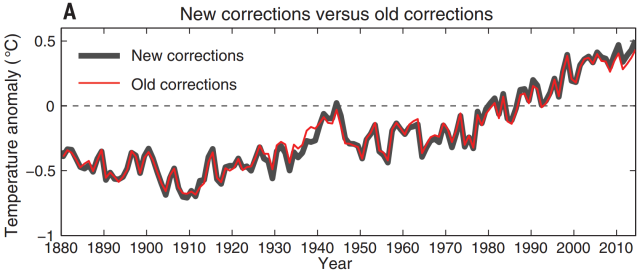
Layzej writes from a report via Ars Technica: In 2015, NOAA released version 4 of their marine temperature dataset called ERSST. The new dataset accounted for a known cooling bias introduced when ocean temperature measurements transitioned from being taken in ship engine intake valves to buoy-based measurements. The warming of the last couple decades increased ever so slightly in NOAA's new analysis. This was a red flag for U.S. House Science Committee Chair Lamar Smith (R-TX), who rejects the conclusions of climate science -- like the fact that the Earth's climate is warming. Suddenly he wanted to see the researchers' e-mails and echoed the accusations of contrarian blogs about scientists' supposedly nefarious adjustments to sea surface temperature measurements. Rather than invoking scientific conspiracies, issues like this should be settled by analyzing the data. A new study, led by University of California Berkeley's Zeke Hausfather, does just that -- and Rep. Smith won't like these results, either. To test the NOAA dataset, Zeke's team created instrumentally homogeneous temperature records from sensors available only over the last couple decades. As it happens, the Argo float data, the buoy data, and the satellite data each hew closer to the updated dataset that NOAA used. The older version (3b) gives a global average that is too cool in recent years, growing to an offset of about 0.06 degrees Celsius. The researchers repeat this same analysis for two more major sea surface datasets that are used by the UK Met Office and the Japanese Meteorological Agency for their global temperature records. Both of those datasets also drift cooler than the comparison data, but less so than NOAA's old dataset. -
YouTube Views Are Down Across the Board, Analysis Says (kotaku.com)
An anonymous reader quotes a report from Kotaku: For months, YouTubers have complained that their view counts are down. New data from the third-party stat tracker SocialBlade confirms what YouTubers fear: viewership is lower across the board. SocialBlade crunched some numbers for Kotaku and determined that, since the first half of the year, YouTube views are now 5-7% lower. Between July and September, that decrease was 10%. It's pretty significant. Why YouTube views have gone down is unclear, but some good theories are floating around. SocialBlade Community Manager Danny Fratella pointed to two potential causes: view audits and altered video-promoting algorithms. During view audits, YouTubers don't actually lose views. YouTube is removing botted or invalid playbacks from the view count. This happens all at once in a sort of purge -- something YouTube has explained publicly. But now that YouTubers have tools like SocialBlade to more rigorously moderate their data, they may be noticing these purges more, Fratella suggested. He added that SocialBlade doesn't see view counts purged as often as subscriber counts -- the main complaint going around YouTube communities. Although YouTubers have widely complained that fans are now randomly unsubscribed from their channels, YouTube and SocialBlade both told me that they've noticed nothing out of the ordinary in subscription data. YouTube's video-promoting algorithm may also play a role in an apparent decreased viewership. What videos the platform draws more eyes to reflects their philosophy on what videos should go viral. -
Filmmaker Installed Security Software On a Decoy Phone To Spy On Smartphone Thieves (theverge.com)
An anonymous reader writes from a report via The Verge: Dutch film student Anthony van der Meer had the unfortunate pleasure of having his phone stolen while having lunch in Amsterdam. Unsatisfied with the response from the Amsterdam police, who register an average of 300 stolen phones per week, Meer decided to find out what kind of person steals a phone. He downloaded DIY security software on a decoy Android phone, intentionally got the phone stolen, and was able to spy on his thief for weeks. He recorded the ups and downs of his covert investigation and turned it into a 22-minute documentary called Find My Phone. Meer preloaded the decoy device with an anti-theft application called Cerberus, which allows the owner of the device to access any file on the phone remotely, as well as discretely activate the phone's camera and microphone. Meer and his friends were able to navigate the technicalities of surveilling the thief with relative ease. They even snapped a close-up of the guy's face. The hard part, it turns out, was getting the preloaded phone stolen in the first place. It took Meer four days to get his device pilfered in a city with high rates of theft because concerned citizens kept coming to his rescue. -
YouTube Bans North Korea's State-Owned TV Channel (asiancorrespondent.com)
An anonymous reader quotes a report from Asian Correspondent: YouTube has blocked North Korea's state television channel, purportedly to avoid breaching U.S. sanctions against the totalitarian state. The Korean Central Television's page, which broadcasts breaking news videos including Pyongyang's nuclear tests and leader Kim Jong Un's outings, now has a message saying "the account has been terminated for violating YouTube's Community Guidelines." YouTube's community guidelines bans harmful, dangerous, violent and graphic content, as well as videos that violate copyright laws or that contain threats and that may incite others to commit violence. According to The Washington Post, the action to terminate the account was taken in November because the North Korean government could earn money from YouTube through advertisements, which would in turn violate a U.S. directive that bans any person or company from doing business with the hermit state. -
YouTube Bans North Korea's State-Owned TV Channel (asiancorrespondent.com)
An anonymous reader quotes a report from Asian Correspondent: YouTube has blocked North Korea's state television channel, purportedly to avoid breaching U.S. sanctions against the totalitarian state. The Korean Central Television's page, which broadcasts breaking news videos including Pyongyang's nuclear tests and leader Kim Jong Un's outings, now has a message saying "the account has been terminated for violating YouTube's Community Guidelines." YouTube's community guidelines bans harmful, dangerous, violent and graphic content, as well as videos that violate copyright laws or that contain threats and that may incite others to commit violence. According to The Washington Post, the action to terminate the account was taken in November because the North Korean government could earn money from YouTube through advertisements, which would in turn violate a U.S. directive that bans any person or company from doing business with the hermit state. -
A $300 Device Can Steal Mac FileVault2 Passwords (bleepingcomputer.com)
An anonymous reader writes: Swedish hardware hacker Ulf Frisk has created a device that can extract Mac FileVault2 (Apple's disk encryption utility) passwords from a device's memory before macOS boots and anti-DMA protections kick in. The extracted passwords are in cleartext, and they also double as the macOS logon passwords. The attack requires physical access, but it takes less than 30 seconds to carry out. A special device is needed, which runs custom software (available on GitHub), and uses hardware parts that cost around $300. Apple fixed the attack in macOS 10.12.2. The device is similar to what Samy Kamker created with Poison Tap. -
Watchdog Group Claims Smart Toys Are Spying On Kids (mashable.com)
The Center for Digital Democracy has filed a complaint with the Federal Trade Commission warning of security and privacy holes associated with a pair of smart toys designed for children. Mashable reports: "This complaint concerns toys that spy," reads the complaint, which claims the Genesis Toys' My Friend Cayla and i-QUE Intelligent Robot can record and collect private conversations and offer no limitations on the collection and use of personal information. Both toys use voice recognition, internet connectivity and Bluetooth to engage with children in conversational manner and answer questions. The CDD claims they do all of this in wildly insecure and invasive ways. Both My Friend Cayla and i-QUE use Nuance Communications' voice-recognition platform to listen and respond to queries. On the Genesis Toy site, the manufacturer notes that while "most of Cayla's conversational features can be accessed offline," searching for information may require an internet connection. The promotional video for Cayla encourages children to "ask Cayla almost anything." The dolls work in concert with mobile apps. Some questions can be asked directly, but the toys maintain a constant Bluetooth connection to the dolls so they can also react to actions in the app and even appear to identify objects the child taps on on screen. While some of the questions children ask the dolls are apparently recorded and sent to Nuance's servers for parsing, it's unclear how much of the information is personal in nature. The Genesis Privacy Policy promises to anonymize information. The CDD also claims, however, that My Friend Cayla and i-Que employ Bluetooth in the least secure way possible. Instead of requiring a PIN code to complete pairing between the toy and a smartphone or iPad, "Cayla and i-Que do not employ... authentication mechanisms to establish a Bluetooth connection between the doll and a smartphone or tablet. The dolls do not implement any other security measure to prevent unauthorized Bluetooth pairing." Without a pairing notification on the toy or any authentication strategy, anyone with a Bluetooth device could connect to the toys' open Bluetooth networks, according to the complaint.