Slashdot Mirror
Domain: computerworld.com
Stories and comments across the archive that link to computerworld.com.
Stories · 2,621
-
Microsoft To Start Selling Windows 7 Add-On Support April 1st (computerworld.com)
AmiMoJo quotes Computerworld: Microsoft plans to start selling its Windows 7 add-on support beginning April 1. Labeled "Extended Security Updates" (ESU), the post-retirement support will give enterprise customers more time to purge their environments of Windows 7. From Windows 7's Jan. 14, 2020 end of support, ESU will provide security fixes for uncovered or reported vulnerabilities in the OS.
Patches will be issued only for bugs rated "Critical" or "Important" by Microsoft, the top two rankings in a four-step scoring system. ESU will be dealt out in one-year increments for up to three years and support will be sold on a per-device basis, rather than the per-user approach Microsoft has pushed for Windows 10 licensing. Costs for ESU will start out low — $25 or $50 per year per device — but will double each year, ending at $100 or $200 per device for the third and final year -
Is The World Shifting To 'Ambient Computing'? (computerworld.com)
In the future, "A massive convergence of technologies will enable us to use computers and the internet without really using them," argues Computerworld. At the dawn of the personal computing revolution, people "operated" a computer. They sat down and did computing -- often programming. Later, with the application explosion, operators became "users." People used computers for purposes other than programming or operating a computer -- like balancing their checkbooks or playing video games. All computing uses so far have required a cognitive shift from doing something in the real world to operating or using a computer. Ambient computing changes all that, because it involves using a computer without consciously or deliberately or explicitly "using" a computer....
It's just there, guiding and nudging you along as you accomplish things in life. Ambient computing devices will operate invisibly in the background. They'll identify, monitor and listen to us and respond to our perceived needs and habits. So a good working definition of ambient computing is "computing that happens in the background without the active participation of the user...."
In 20 years, the idea of picking up a device or sitting down at a computer to actively use it will seem quaintly antiquated. All computing will be ambient -- all around us all the time, whispering in our ear, augmenting the real world through our prescription eyeglasses and car windshields, perceiving our emotions and desires and taking action in the background to help us reach our business goals and live a better life. Between now and then we'll all ride together on a very interesting journey from computers we actively use to computing resources increasingly acting in the background for us.
Though the article identifies smart speakers are the first ambient computing devices most people will encounter, it's argues that that's just the beginning of a much larger change.
"We're also going to be flooded and overwhelmed by the 'ambient computing' hype as, I predict, it will become one of the most overused and abused marketing buzzwords ever." -
Slack Prepares Analytics Tool To Compete With G Suite and Office 365 (computerworld.com)
An anonymous reader quotes Computerworld: Slack is building a new analytics tool to offer businesses greater insights into how their teams collaborate, part of the company's plans to make better use of the data created within its popular chatapp. "We are hoping to build a set of insights that help you understand not only how Slack is being used, but how your company is collaborating and functioning," said Jamie DeLanghe, head of Slack's Search, Learning and Intelligence (SLI) team... Slack's SLI division was created in 2016 to help make better use of the reams of information being created and stored as Slack adoption grows. The New York-based team is responsible for enhancing search functionality and developing the Slack "work graph," which ties together data on a users' behavior and interactions to enable more accurate recommendations.
The team is also tasked with building out Slack's analytics capabilities to highlight areas for improvement based on information about how teams work together. Analytics is something Slack's rivals are focused on, too: Google launched Work Insights to track adoption of its G Suite software and identify which teams are collaborating frequently using tools such as Hangouts Chat. And Microsoft has launched Workplace Analytics, which performs a similar function for its Office 365 tools. -
Is Windows Coming To Chromebooks? (computerworld.com)
Computerworld suggests a strange strategy for Windows: If you can't beat Chromebook, join Chromebook: The eagle-eyed developers at XDA Developers have spotted a new Google Pixelbook firmware branch. This new code, "eve-campfire," includes a new "Alt OS mode." That "Alt OS"? WIndows 10. From the clues XDA has picked up, this looks as if it will be a real offering and not just an internal project that will never see the light of day. XDA thinks it will be a built-in dual-boot option such as Apple's Boot Camp....
So, why offer Windows on the Chromebook...? I think it's two things. One, Google wants to snag all those users who are still stuck on Windows because of a favorite game or required application. Two (and if I'm right, this is so sneaky of Google), Windows 10 will run like a dog on Chromebooks... would Google rub Microsoft's face in just how much better Chromebooks are than Windows laptops by letting users see for themselves? Sure it would. -
Windows 10 Buggy Updates? Our Patching is Simple, Regular, and Consistent, Says Microsoft (zdnet.com)
Microsoft has declined to comment on an expert's many complaints about the quality of its recent patches and cadence of Windows 10 feature updates. Earlier, Susan Bradley, a Microsoft MVP who for the past 18 years has volunteered her time helping Windows users, took a survey of over 1,800 respondents regarding the Windows 10 Update experience. She then sent an open letter to Microsoft executives summarizing the results of this survey and providing thoroughly researched material regarding the poor update experience Windows 10 users have been experiencing. In return, Microsoft argued in a blog that it gives admins all the tools they need to test and provide feedback before it releases Patch Tuesday updates. From a report: Microsoft's John Wilcox, who helps promote why organizations should move to Windows 10's Windows-as-a-service model has, at the behest of Windows pros, offered an explanation of its monthly Windows 10 quality update servicing cadence and terminology.
As noted by ZDNet's Ed Bott recently, IT admins who'd spent years learning about Windows Update needed to "prepare to do some unlearning" due to the many changes introduced by Microsoft's shift to a Windows 10-as-a-service model. "With Windows 10, Microsoft has completely rewritten the Windows Update rulebook. For expert users and IT pros accustomed to having fine-grained control over the update process, these changes might seem wrenching and even draconian," he noted. [...]
Wilcox outlines that Microsoft's guiding principles to its monthly Windows service updates are built around being "simple and predictable", "agile", and "transparent." Wilcox doesn't directly address patching expert Bradley's major complaints about Microsoft's patches of late, but said Microsoft's predictability meant IT managers should be able to handle its "simple, regular and consistent patching cadence." -
With DaaS Windows Coming, Say Goodbye To Your PC As You Know It (computerworld.com)
Ostracus shares a report from Computerworld, written by Steven J. Vaughan-Nichols: Microsoft is getting ready to replace Windows 10 with the Microsoft Managed Desktop. This will be a "desktop-as-a-service" (DaaS) offering. Instead of owning Windows, you'll "rent" it by the month. Microsoft Managed Desktop is a new take. It avoids the latency problem of the older Windows DaaS offerings by keeping the bulk of the operating system on your PC. But you'll no longer be in charge of your Windows PC. Instead, it will be automatically provisioned and patched for you by Microsoft. Maybe you'll be OK with that.
Microsoft has been getting away from the old-style desktop model for years now. Just look at Office. Microsoft would much rather have you rent Office via Office 365 than buy Microsoft Office and use it for years. Microsoft Managed Desktop is the first move to replacing "your" desktop with a rented desktop. By 2021, I expect the Managed Desktop to be to traditional Windows what Office 365 is to Office today: the wave of the future. Or maybe tsunami, depending on your perspective. I'm not happy with this development. I'm old enough to remember the PC revolution. We went from depending on mainframes and Unix boxes for computing power to having the real power on our desktops. It was liberating. Now Microsoft, which helped lead that revolution, is trying to return us to that old, centralized control model. -
ComputerWorld Says Newest Windows 10 'Isn't Ready for Prime Time' (computerworld.com)
"Despite Microsoft's assurances, Windows 10 1803 isn't ready for prime time," writes ComputerWorld's Woody Leonhard, adding "Microsoft's patches in June took on some unexpected twists..." Win10 1803 was declared fully fit for business, a pronouncement that was followed weeks later by fixes for a few glaring, acknowledged bugs -- and stony silence for other known problems. We're continuing the two-big-cumulative-updates-a-month pace for all supported versions of Windows 10. The second cumulative update frequently fixes bugs introduced by the first cumulative update. Microsoft may think that Win10 (1803) is ready for widespread deployment, but there are a few folks who would take issue with that stance...
Tuesday, Microsoft finally released a fix for two big bugs that have dogged Win10 1803 since its inception... In practice, life isn't so simple. WSUS (the Windows Update Server software) isn't "seeing" KB 4284848, as of late Wednesday afternoon -- which may be a good thing. Along with the second cumulative update this month, there are additional releases to fix the Servicing Stack, and a new "Compatibility update" that, per the documentation, is designed to make it easier to upgrade Win10 1803 Enterprise to Win10 1803 Enterprise (not a typo)...
One problem that has been acknowledged -- but only by a Microsoft Agent on an Answers Forum post -- says that installing 1803 can clobber your peer-to-peer network. That certainly matches my experience.
Woody concludes, "If you think Win10 1803 is ready for prime time, you're welcome to give it a try." -
Microsoft Quietly Cuts Off Windows 7 Support For Older Intel Computers (computerworld.com)
An anonymous reader shares a report: If your PC doesn't run Streaming Single Instructions Multiple Data (SIMD) Extensions 2, you apparently won't be getting any more Win7 patches. At least, that's what I infer from some clandestine Knowledge Base documentation changes made in the past few days. Even though Microsoft says it's supporting Win7 until January 14, 2020, if you have an older machine -- including any Pentium III -- you've been blocked, and there's nothing you can do about it. -
Windows 10 Pro Is a Dead End For the Enterprise, Gartner Says (computerworld.com)
A prominent Gartner analyst argues that Windows 10 Pro is a dead end for enterprises, citing recent changes by Microsoft to the Windows 10 support schedule. "[We] predict that Microsoft will continue positioning Windows [10] Pro as a release that is not appropriate for enterprises by reducing [...] support and limiting access to enterprise management features," Stephen Kleynhans, a research vice president at Gartner and one of the research firm's resident Windows experts, said in a report he co-authored. Computerworld reports: Last year, the Redmond, Wash. developer announced a six-month support extension for Windows 10 1511, the November 2015 feature upgrade, "to help some early enterprise adopters that are still finishing their transition to Windows as a service." In February, Microsoft added versions 1609, 1703 and 1709 -- released in mid-2016, and in April and October of 2017, respectively -- to the extended support list, giving each 24 months of support, not the usual 18. There was a catch: Only Windows 10 Enterprise (and Windows 10 Education, a similar version for public and private school districts and universities) qualified for the extra six months of support. Users running Windows 10 Pro were still required to upgrade to a successor SKU (stock-keeping unit) within 18 months to continue receiving security patches and other bug fixes.
Another component of Microsoft's current Windows 10 support strategy, something the company has labeled "paid supplemental servicing," was also out of bounds for those running Windows 10 Pro. The extra support, which Microsoft will sell at an undisclosed price, is available only to Enterprise and Education customers. Paid supplemental servicing adds 12 months to the 18 months provided free of charge. -
GPU Prices Soar as Bitcoin Miners Buy Up Hardware To Build Rigs (computerworld.com)
"Bitcoin and other cryptocurrency miners have created a dearth of mid-range and high-end GPU cards that are selling for twice as much as suggested retail," reports Computerworld. "The reason: miners are setting up server farms with the cards." Lucas123 writes: GPU prices have more than doubled in some cases... Some of the most popular GPUs can't even be found anymore as they've sold out due to demand. Meanwhile, some retailers are pushing back against bitcoin miners by showing favoritism to their traditional gamer customers, allowing them to purchase GPUs at manufacturer's suggested retail price. Earlier this year, NVIDIA asked retailers of its hardware to prioritize sales to gamers over cryptocurrency miners. -
Do More People Use Firefox Than Edge and IE Combined? (computerworld.com)
A funny thing happened when Net Applications' statistics began excluding fake traffic from ad-defrauding bots. Computerworld reports: Microsoft's Edge browser is less popular with Windows 10 users than earlier thought, if revised data from a U.S. analytics vendor can be believed. According to Net Applications of Aliso Viejo, Calif., Edge has been designated the primary browser by fewer than one in six Windows 10 users for more than a year and a half. That's a significant downgrading of Edge's user share statistics from the browser's portrayal before this month...
By comparing Edge's old and new shares, it was evident that as much as half of the earlier Edge traffic had been faked by bots. The portion of Edge's share credited to bots fluctuated month to month, but fell below 30% in only 4 of the 19 months for which Net Applications provided data... Microsoft's legacy browser, Internet Explorer (IE) also was revealed as a Potemkin village. Under the old data regime, which included bots, IE's user share was overblown, at times more than double the no-bots reality. Take May 2016 as an example. With bots, Net Applications pegged IE at 33.7%; without bots, IE's user share dwindled to just 14.9%. Together, IE and Edge - in other words, Microsoft's browsers - accounted for only 16.3% of the global user share last month using Net Applications' new calculations... In fact, the combined IE and Edge now face a once unthinkable fate: falling beneath Mozilla's Firefox.
StatCounter's stats on browser usage already show more people have already been using Firefox than both of Microsoft's browsers combined -- in 12 of the last 13 months. -
HP Quietly Installs System-Slowing Spyware On Its PCs, Users Say (computerworld.com)
It hasn't been long since Lenovo settled a massive $3.5 million fine for preinstalling adware on laptops without users' consent, and it appears HP is on to the same route already. According to numerous reports gathered by news outlet Computer World, the brand is deploying a telemetry client on customer computers without asking permission. The software, called "HP Touchpoint Analytics Service", appears to replace the self-managed HP Touchpoint Manager solution. To make matter worse, the suite seems to be slowing down PCs, users say. From the report: Dubbed "HP Touchpoint Analytics Service," HP says it "harvests telemetry information that is used by HP Touchpoint's analytical services." Apparently, it's HP Touchpoint Analytics Client version 4.0.2.1435. There are dozens of reports of this new, ahem, service scattered all over the internet. According to Gunter Born, reports of the infection go all the way back to Nov. 15, when poster MML on BleepingComputer said: "After the latest batch of Windows updates, about a half hour after installing the last, I noticed that this had been installed on my computer because it showed up in the notes of my Kaspersky, and that it opened the Windows Dump File verifier and ran a disk check and battery test." According to Gartner, HP was the largest PC vendor in the quarter that ended in September this year. -
Microsoft Edge Beats Chrome and Firefox in Malware-Blocking Tests (computerworld.com)
An anonymous reader quotes Computerworld:Microsoft's Edge easily beat rival browsers from Google and Mozilla in third-party tests of the behind-the-scenes services which power anti-malware warnings and malicious website-blocking... NSS Labs says Windows 10's default browser is better at blocking phishing and socially-engineered malware attacks than Google Chrome or Mozilla Firefox... According to NSS Labs of Austin, Texas, Edge automatically blocked 92% of all in-browser credential phishing attempts and stymied 100% of all socially-engineered malware (SEM) attacks. The latter encompassed a wide range of attacks, but their common characteristic was that they tried to trick users into downloading malicious code. The tactics that SEM attackers deploy include links from social media, such as Facebook and Twitter, and bogus in-browser notifications of computer infections or other problems.
Edge bested Chrome and Firefox by decisive margins. For instance, Chrome blocked 74% of all phishing attacks, and 88% of SEM attacks. Meanwhile, Firefox came in third in both tests, stopping just 61% of the phishing attacks and 70% of all SEM attempts... Both Chrome and Mozilla's Firefox rely on the Safe Browsing API (application programing interface), but historically, Mozilla's implementation has performed poorly compared to Google's. No shock: Google created the API. Edge also took top prize in blocking attacks from the get-go. In NSS's SEM attack testing, for example, the Microsoft browser stopped nearly every attempt from the first moments a new attack was detected. Chrome and Firefox, on the other hand, halted 75% and 54% of the brand-new attacks, respectively. Over a week's time, Chrome and Firefox improved their blocking scores, although neither reached Edge's impressive 99.8%.
The researchers spent three weeks continuously monitoring the browsers on Windows 10 computers. But in the real world, Edge runs on just 5% of all personal computers, while Firefox runs on 13% and Chrome on 60%. -
Is the Chromebook the New Android Tablet? (computerworld.com)
An anonymous reader shares a report from Computerworld, where JR Raphael makes the case for why it's time to call the Chromebook the new Android tablet: What does a traditional Android tablet do that a convertible Chromebook doesn't? No matter how long you mull, it's tough to come up with much. Nowadays, a Chromebook runs the same apps from the same Google Play Store. It has an increasingly similar user interface, with a new touch-friendly and Android-reminiscent app launcher rolling out as we speak. It's likely to have an Android-like way of getting around the system before long, too, not to mention native integration of the Google Assistant (which is launching with the newly announced Pixelbook and then presumably spreading to other devices from there). But on top of all of that, a Chromebook offers meaningful advantages a traditional Android tablet simply can't match. It operates within the fast-booting, inherently secure, and free from manufacturer- or carrier-meddling Chrome OS environment. The operating system is updated every two to three weeks, directly by Google, for a minimum of five years. That's a sharp contrast to the software realities we see on Android -- and if you think the updates on Android phones are bad, let me tell you: The situation with Android tablets is worse.
In addition to the regular selection of Android apps, a Chromebook also gives you a desktop-caliber browser experience along with a laptop-level keyboard and capable trackpad. (And, as a side perk, that means you've got a built-in multi-mode stand for your tablet, too.) It's the best of both worlds, as I've put it before -- a whole new kind of platform-defying, all-purpose productivity and entertainment machine. And while it won't immediately lead to the outright extinction of traditional Android tablets, it certainly makes them seem like a watered-down and obsolete version of the same basic experience. -
Will 'Smart Cities' Violate Our Privacy? (computerworld.com)
An anonymous reader quotes Computerworld's article on the implications of New York City's plan to blanket the city with "smart" kiosks offering ultrafast Wi-Fi. The existence of smart-city implementations like Intersection's LinkNYC means that New Yorkers won't actually need mobile contracts anymore. Most who would otherwise pay for them will no doubt continue to do so for the convenience. But those who could not afford a phone contract in the past will have ubiquitous fast connectivity in the future. This strongly erodes the digital divide within smart cities. A 2015 study conducted by New York City found that more than a quarter of city households had no internet connectivity at home, and more than half a million people didn't own their own computer...
Over the next 15 years, the city will go through the other two phases, where sensor data will be processed by artificial intelligence to gain unprecedented insights about traffic, environment and human behavior and eventually use it to intelligently re-direct traffic and shape other city functions... And as autonomous cars gradually roll out, New York will be well positioned to be one of the first cities to legalize them, because they'll be safer thanks to 5G, sensors and data from all those kiosks.
Intersection, a Google-backed startup, has already installed 1,000 of the kiosks in New York, and is planning to install 7,000 more. The sides of the kiosk have screens which show alerts and other public information -- as well as advertisements, which cover all the costs of the installations and even bring extra money into the city coffers.
New York's move "puts pressure on other U.S. cities to follow suit," the article also points out, adding that privacy policies "are negotiated agreements between the company and the city. So if a city wants to use those cameras and sensors for surveillance, it can." -
Microsoft Yanks Three Bad Patches Of Their Last Outlook Patch (computerworld.com)
An anonymous reader quotes ComputerWorld's Woody Leonhard: I just received word from Gunter Born that Microsoft has pulled three of its Outlook patches... There's no specific recommendation that you uninstall the yanked patches -- indeed, there's no description of the problems caused by the latest round -- but earlier versions of the bad patches-of-patches had a nasty habit of crashing Outlook... Microsoft still hasn't fixed any of the Office 2007 bugs it introduced in the June security patches.
If you're keeping score at home, the yanked patches are:- KB 4011042 - July 5, 2017, update for Outlook 2010
- KB 3191849 - June 27, 2017, update for Outlook 2013
- KB 3213654 - June 30, 2017, update for Outlook 2016
-
Microsoft Yanks Three Bad Patches Of Their Last Outlook Patch (computerworld.com)
An anonymous reader quotes ComputerWorld's Woody Leonhard: I just received word from Gunter Born that Microsoft has pulled three of its Outlook patches... There's no specific recommendation that you uninstall the yanked patches -- indeed, there's no description of the problems caused by the latest round -- but earlier versions of the bad patches-of-patches had a nasty habit of crashing Outlook... Microsoft still hasn't fixed any of the Office 2007 bugs it introduced in the June security patches.
If you're keeping score at home, the yanked patches are:- KB 4011042 - July 5, 2017, update for Outlook 2010
- KB 3191849 - June 27, 2017, update for Outlook 2013
- KB 3213654 - June 30, 2017, update for Outlook 2016
-
Even For Businesses, Chrome Is The Top Browser (computerworld.com)
An anonymous reader shares Computerworld's interview with David Michael Smith of Gartner. "Most enterprises still have a 'standard' browser, and most of the time, that's something from Microsoft. These days it's IE11. But we've found that people actually use Chrome more than IE... It's the most-used browser in enterprise," he said... IE retains a sizable share -- Smith called it "a significant presence" -- largely because it's still required in most companies. "There are a lot of [enterprise] applications that only work in IE, because [those apps] use plug-ins," Smith said, ticking off examples like Adobe Flash, Java and Microsoft's own Silverlight. "Anything that requires an ActiveX control needs IE."
Many businesses have adopted the two-prong strategy that Gartner and others began recommending years ago: Keep a "legacy" browser to handle older sites, services and web apps, but offer another for everything else... Chrome, said Smith, is now the "overwhelming choice" as the modern enterprise browser... Smith wasn't optimistic that Edge would supplant Chrome, even when Windows 10 is widely deployed on corporate computers in the next few years. "Edge certainly will have opportunities" once Windows 10 is the enterprise-standard OS, "but I would say that Chrome has a lot of momentum, largely for the fact that it is so popular on the internet."
While a year ago Chrome and Microsoft's browsers both held 41% of the browser market share, now Chrome holds 59% to just 24% for both IE and Edge combined. -
Vint Cerf Reflects On The Last 60 Years (computerworld.com)
Computerworld celebrated its 50th anniversary by interviewing Vinton Cerf. The 73-year-old "father of the internet" remembers reading the early issues of the magazine, and reflects on how much things have changed since he gained access to computers at UCLA in 1960, "the beginning of my love affair with computing." I worry 100 years from now our descendants may not know much about us or be able to read our emails or tweets or documents because nobody saved them or the software you need to read them won't exist anymore. It's a huge issue. I have files of text that were written 20 years ago in WordPerfect, except I don't have WordPerfect running anywhere...
Q: Do you think [creating the internet] was your greatest accomplishment?
No. Getting it turned on was a big deal. Keeping it running for the last some odd years was an even bigger deal. Protecting it from hostile governments that want to shut it down and supporting new applications at a higher capacity are all evolutions. The evolution continues... I don't know if I can point to anything and say that's the biggest accomplishment. It's one big climb up the mountain.
Looking ahead to a future filled with AI, Cerf says "I worry about turning over too much autonomous authority to a piece of software," though he's not overly concerned, "not like Stephen Hawking or Elon Musk, who are alarmists about artificial intelligence. Every time you use Google search or self-driving cars, you're using A.I. These are all assistive technologies and I suspect this is how it will be used."
He also acknowledges that "I probably don't have another 50 years left, unless Ray Kurzweil's predictions come true, and I can upload my consciousness into a computer." -
IT Worker Who Trained H-1B-Visa-Holding Replacement Aims For Congress (computerworld.com)
An anonymous reader quotes a report from Computerworld: Craig Diangelo was an IT worker at Northeast Utilities in Connecticut until he completed training his H-1B-visa-holding replacement. He was one of about 200 who lost their jobs in 2014 after two India-based IT offshore outsourcing firms took over their work at what is now called Eversource. Diangelo, at first, was quiet, bound by severance agreements signed with the company. Then he started speaking out. Now, Diangelo is running for Congress. offering up a first-hand perspective on IT outsourcing that resonates with many other workers in his state. "I've seen the injustices that have been done to us," said Diangelo, who is not optimistic lawmakers will deliver on H-1B reform. "You can't let this matter die down, because when you stop talking about it nothing seems to get done." Diangelo isn't a one-issue candidate or political novice. He previously served two terms as an alderman in his hometown of New Britain and remains involved in city planning work. The 64-year-old has filed the necessary papers to run for office, has a campaign manager, a website and knows he has to raise an awful lot money to challenge Democratic Rep. Elizabeth Esty, now in her third term. But Diangelo has no illusions about his odds. Even so, he may be the only person to run for Congress, at least in recent times, who has trained his replacement. He went to college hoping to be come a teacher, but when that proved difficult, he wound up at Travelers Insurance in Hartford -- in the company's data processing center. -
IT Worker Who Trained H-1B-Visa-Holding Replacement Aims For Congress (computerworld.com)
An anonymous reader quotes a report from Computerworld: Craig Diangelo was an IT worker at Northeast Utilities in Connecticut until he completed training his H-1B-visa-holding replacement. He was one of about 200 who lost their jobs in 2014 after two India-based IT offshore outsourcing firms took over their work at what is now called Eversource. Diangelo, at first, was quiet, bound by severance agreements signed with the company. Then he started speaking out. Now, Diangelo is running for Congress. offering up a first-hand perspective on IT outsourcing that resonates with many other workers in his state. "I've seen the injustices that have been done to us," said Diangelo, who is not optimistic lawmakers will deliver on H-1B reform. "You can't let this matter die down, because when you stop talking about it nothing seems to get done." Diangelo isn't a one-issue candidate or political novice. He previously served two terms as an alderman in his hometown of New Britain and remains involved in city planning work. The 64-year-old has filed the necessary papers to run for office, has a campaign manager, a website and knows he has to raise an awful lot money to challenge Democratic Rep. Elizabeth Esty, now in her third term. But Diangelo has no illusions about his odds. Even so, he may be the only person to run for Congress, at least in recent times, who has trained his replacement. He went to college hoping to be come a teacher, but when that proved difficult, he wound up at Travelers Insurance in Hartford -- in the company's data processing center. -
Microsoft's Surface Revenue Drops By $285M (26%) (computerworld.com)
An anonymous reader quotes Computerworld: Revenue generated by Microsoft's Surface hardware during the March quarter was down 26% from the same period the year before, the company said yesterday as it briefed Wall Street. For the quarter, Surface produced $831 million, some $285 million less than the March quarter of 2016, for the largest year-over-year dollar decline ever... The revenue decline "indicates that the aging product needs a refresh badly," Jack Gold, principal analyst at J. Gold Associates, wrote in a note to clients today. "Price cutting and competing vendors' products will continue to create declines until new product is released, rumored for later this year." Microsoft threw cold water on any significant changes to the Surface line before June, forecasting that the current quarter will also post a revenue decline. -
University of California IT Workers Replaced By Offshore Outsourcing Firm To File Discrimination Lawsuit (computerworld.com)
The IT workers from the University of California's San Francisco campus who were replaced by an offshore outsourcing firm late last year intend to file a lawsuit challenging their dismissal. "It will allege that the tech workers at the university's San Francisco campus were victims of age and national origin discrimination," reports Computerworld. From the report: The IT employees lost their jobs in February after the university hired India-based IT services firm HCL. Approximately 50 full-time university employees lost their jobs, but another 30 contractor positions were cut as well. "To take a workforce that is overwhelmingly over the age of 40 and replace them with folks who are mainly in their 20s -- early 20s, in fact -- we think is age discrimination," said the IT employees' attorney, Randall Strauss, of Gwilliam Ivary Chiosso Cavalli & Brewer. The national origin discrimination claim is the result of taking a workforce "that reflects the diversity of California" and is summarily let go and is "replaced with people who come from one particular part of the world," said Strauss. The lawsuit will be filed in Alameda County Superior Court. -
Microsoft Kills Off Security Bulletins (computerworld.com)
Microsoft has officially retired the security bulletins this week, which were issued to detail "each month's slate of vulnerabilities and accompanying patches for customers -- especially administrators responsible for companies' IT operations," writes Gregg Keizer via Computerworld. "The move to a bulletin-less Patch Tuesday brought an end to months of Microsoft talk about killing the bulletins that included an aborted attempt to toss them." From the report: Microsoft announced the demise of bulletins in November, saying then that the last would be posted with January's Patch Tuesday, and that the new process would debut Feb. 14. A searchable database of support documents would replace the bulletins. Accessed through the "Security Updates Guide" (SUG) portal, the database's content can be sorted and filtered by the affected software, the patch's release date, its CVE (Common Vulnerabilities and Exposures) identifier, and the numerical label of the KB, or "knowledge base" support document. SUG's forerunners were the web-based bulletins that have been part of Microsoft's patch disclosure policies since at least 1998. Microsoft did such a good job turning out those bulletins that they were considered the aspirational benchmark for all software vendors.In February Microsoft canceled that month's Patch Tuesday just hours before the security updates were to reach customers, making the bulletins' planned demise moot. Microsoft kept the bulletins the following month as well, saying it wanted to give users more time to prepare for the change to SUG. Finally, when Microsoft yesterday shipped cumulative security updates for Windows, Internet Explorer, Office and other products, it omitted the usual bulletins. -
Microsoft Claims Windows 10 Saves Enterprises 28% More Than They Claimed Last Year (computerworld.com)
"Microsoft this week boosted by 28% its claim of how much enterprises can save by deploying Windows 10," writes Computerworld. An anonymous reader quotes their report: The revised estimate came from a Microsoft-commissioned analysis first done in mid-2016 by Forrester Research. Then, Forrester said the per-worker savings over a three-year stretch would be $404. To reach that number, the research firm interviewed four Microsoft customers that had begun moving to Windows 10, then modeled a hypothetical organization with 24,000 Windows devices, and a large number of mobile workers among the 20,000 employees. Using that pretend company, Forrester forecast the difference between running Windows 10 and retaining Windows 7.
Late last year, Forrester interviewed another quartet of Windows early 10 adopters, then added that data to what it had originally. The new per-employee savings: $515 over three years, a jump of almost a third... Forrester's increase in the number of mobile workers -- the total climbed by 460 employees -- was the biggest factor in the changed estimate... The bottom line, said Forrester and Microsoft, was that the migration to Windows 10 would pay for itself -- the breakeven point when savings equal costs -- in 14 months.
The report says IT administrators "estimate a 20% improvement in management time, as Windows 10 requires less IT time to install, manage, and support with in-place deployment and more self-service functions," while because of the OS's security software, "security events requiring IT remediation are reduced or avoided by 33%." -
NSA, DOE Say China's Supercomputing Advances Put US At Risk (computerworld.com)
dcblogs quotes a report from Computerworld: Advanced computing experts at the National Security Agency and the Department of Energy are warning that China is "extremely likely" to take leadership in supercomputing as early as 2020, unless the U.S. acts quickly to increase spending. China's supercomputing advances are not only putting national security at risk, but also U.S. leadership in high-tech manufacturing. If China succeeds, it may "undermine profitable parts of the U.S. economy," according to a report titled U.S. Leadership in High Performance Computing by HPC technical experts at the NSA, the DOE, the National Science Foundation and other agencies. The report stems from a workshop held in September that was attended by 60 people, many scientists, 40 of whom work in government, with the balance representing industry and academia. "Meeting participants, especially those from industry, noted that it can be easy for Americans to draw the wrong conclusions about what HPC investments by China mean -- without considering China's motivations," the report states. "These participants stressed that their personal interactions with Chinese researchers and at supercomputing centers showed a mindset where computing is first and foremost a strategic capability for improving the country; for pulling a billion people out of poverty; for supporting companies that are looking to build better products, or bridges, or rail networks; for transitioning away from a role as a low-cost manufacturer for the world; for enabling the economy to move from 'Made in China' to 'Made by China.'" -
Laptop SSD Capacity To Remain Flat As NAND Flash Dearth Causes Prices To Rise (computerworld.com)
Lucas123 writes from a report via Computerworld: Laptop manufacturers aren't likely to offer higher capacity standard SSDs in their machines this year as a shortage of NAND flash is pushing prices higher this year. At the same time, nearly half of all laptops shipped this year will have SSDs versus HDDs, according to a new report from DRAMeXchange. The contract prices for multi-level cell (MLC) SSDs supplied to the PC manufacturing industry for those laptops are projected to go up by 12% to 16% compared with the final quarter of 2016; prices of triple-level cell (TLC) SSDs are expected to rise by 10% to 16% sequentially. "The tight NAND flash supply and sharp price hikes for SSDs will likely discourage PC-[manufacturers] from raising storage capacity," said Alan Chen, a senior research manager of DRAMeXchange. "Therefore, the storage specifications for mainstream PC [...] SSDs are expected to remain in the 128GB and 256GB [range]." -
94% of Microsoft Vulnerabilities Can Be Mitigated By Turning Off Admin Rights (computerworld.com)
An anonymous reader quotes Computerworld: If you want to shut out the overwhelming majority of vulnerabilities in Microsoft products, turn off admin rights on the PC. That's the conclusion from global endpoint security firm Avecto, which has issued its annual Microsoft Vulnerabilities report. It found that there were 530 Microsoft vulnerabilities reported in 2016, and of these critical vulnerabilities, 94% were found to be mitigated by removing admin rights, up from 85% reported last year. This is especially true with the browser, for those who still use Microsoft's browsers. 100% of vulnerabilities impacting both Internet Explorer and Edge could be mitigated by removing admin rights, Avecto reported... Windows 10 was found to have the highest proportion of vulnerabilities of any OS (395), 46% more than Windows 8 and Windows 8.1 (265 each). Avecto found that 93% of Windows 10 vulnerabilities could be mitigated by removing admin rights.
Of course, the stats are based on vulnerabilities announced in Microsoft Security Bulletins, but there's an overwhelming pattern. Turning off admin rights mitigated the vast majority of vulnerabilities, whether it was Windows Server (90%) or older versions of Microsoft Office (99%). And turning off admin rights in Office 2016 mitigated 100% of its vulnerabilities. -
Toshiba Plans To Ship a 1TB Flash Chip To Manufacturers This Spring (computerworld.com)
Lucas123 writes: Toshiba has begun shipping samples of its third-generation 3D NAND memory product, a chip with 64 stacked flash cells that it said will enable a 1TB chip shipping later this spring. The new flash memory product has 65% greater capacity than the previous generation technology, which used 48 layers of NAND flash cells. The chip will be used in data centers and consumer SSD products. The technology announcement comes even as suitors are eyeing buying a majority share of the company's memory business. Along with a previous report about Western Digital, Foxxcon, SK Hynix and Micron Technology have now also thrown their hats in the ring to purchase a majority share in Toshiba's memory spin-off, according to a new report in the Nikkei's Asian Review. -
Serious Computer Glitches Can Be Caused By Cosmic Rays (computerworld.com)
The Los Alamos National Lab wrote in 2012 that "For over 20 years the military, the commercial aerospace industry, and the computer industry have known that high-energy neutrons streaming through our atmosphere can cause computer errors." Now an anonymous reader quotes Computerworld: When your computer crashes or phone freezes, don't be so quick to blame the manufacturer. Cosmic rays -- or rather the electrically charged particles they generate -- may be your real foe. While harmless to living organisms, a small number of these particles have enough energy to interfere with the operation of the microelectronic circuitry in our personal devices... particles alter an individual bit of data stored in a chip's memory. Consequences can be as trivial as altering a single pixel in a photograph or as serious as bringing down a passenger jet.
A "single-event upset" was also blamed for an electronic voting error in Schaerbeekm, Belgium, back in 2003. A bit flip in the electronic voting machine added 4,096 extra votes to one candidate. The issue was noticed only because the machine gave the candidate more votes than were possible. "This is a really big problem, but it is mostly invisible to the public," said Bharat Bhuva. Bhuva is a member of Vanderbilt University's Radiation Effects Research Group, established in 1987 to study the effects of radiation on electronic systems.
Cisco has been researching cosmic radiation since 2001, and in September briefly cited cosmic rays as a possible explanation for partial data losses that customer's were experiencing with their ASR 9000 routers. -
Russian Cyberspies Blamed For US Election Hacks Are Now Targeting Macs (computerworld.com)
You may recall "APT28", the Russian hacking group which was tied to last year's interference in the presidential election. It has long been known for its advanced range of tools for penetrating Windows, iOS, Android, and Linux devices. Now, researchers have uncovered an equally sophisticated malware package the group used to compromise Macs. From a report on ComputerWorld: The group -- known in the security industry under different names including Fancy Bear, Pawn Storm, and APT28 -- has been operating for almost a decade. It is believed to be the sole user and likely developer of a Trojan program called Sofacy or X-Agent. X-Agent variants for Windows, Linux, Android, and iOS have been found in the wild in the past, but researchers from Bitdefender have now come across what appears to be the first macOS version of the Trojan. It's not entirely clear how the malware is being distributed because the Bitdefender researchers obtained only the malware sample, not the full attack chain. However, it's possible a macOS malware downloader dubbed Komplex, found in September, might be involved. Komplex infected Macs by exploiting a known vulnerability in the MacKeeper antivirus software, according to researchers from Palo Alto Networks who investigated the malware at the time. The vulnerability allowed attackers to execute remote commands on a Mac when users visited specially crafted web pages.Further reading on ArsTechnica. -
Three Privacy Groups Challenge The FBI's Malware-Obtained Evidence (eff.org)
In 2015 the FBI took over a Tor-accessible child pornography site to infect its users with malware so they could be identified and prosecuted. But now one suspect is challenging that evidence in court, with three different privacy groups filing briefs in his support. An anonymous reader writes. One EFF attorney argues it's a classic case of an unreasonable search, which is prohibited by the U.S. Constitution. "If the FBI tried to get a single warrant to search 8,000 houses, such a request would unquestionably be denied." But there's another problem, since the FBI infected users in 120 different countries. "According to Privacy International, the case also raises important questions: What if a foreign country had carried out a similar hacking operation that affected U.S. citizens?" writes Computerworld. "Would the U.S. welcome this...? The U.S. was overstepping its bounds by conducting an investigation outside its borders without the consent of affected countries, the group said."
The FBI's evidence is also being challenged by the ACLU of Massachusetts, and the EFF plans to file two more challenges in March, warning that otherwise "the precedent is likely to impact the digital privacy rights of all Internet users for years to come... Courts need to send a very clear message that vague search warrants that lack the required specifics about who and what is to be searched won't be upheld." -
CS Professor Argues Silicon Valley Is Exploiting Both H-1B Visas And Workers (huffingtonpost.com)
schwit1 quotes Norm Matloff, a CS professor at the University of California at Davis, on H-1B visa programs: The Trump administration has drafted a new executive order that could actually mean higher wages for both foreign workers and Americans working in Silicon Valley. The Silicon Valley companies, of course, will not be happy if it goes into effect... Their lobbyists claim there is a "talent shortage" among Americans and thus that the industry needs more of such work visas. This is patently false. The truth is that they want an expansion of the H-1B work visa program because they want to hire cheap, immobile labor -- i.e., foreign workers.
To see how this works, note that most Silicon Valley firms sponsor their H-1B workers, who hold a temporary visa, for U.S. permanent residency (green card) under the employment-based program in immigration law. EB sponsorship renders the workers de facto indentured servants; though they have the right to move to another employer, they do not dare do so, as it would mean starting the lengthy green card process all over again.
Computerworld also argues this year's annual H-1B visa lottery "may be different, because of President Donald Trump," reporting that the lottery has historically favored the largest firms heavily. "In the 2015 fiscal year, for instance, the top 10 firms received 38% of all the H-1B visas in computer occupations alone. All these firms, except for Amazon and to a partial extent IBM, are outsourcers." -
Ford Just Invested $1 Billion In Self-Driving Cars (usatoday.com)
An anonymous reader quote USA Today: Ford Motor is betting $1 billion on the world's self-driving car future. The Detroit automaker announced Friday that it would allocate that sum over five years to a new autonomous car startup called Argo AI, which is headquartered in Pittsburgh, Pa., and will have offices in Michigan and California. Ford's financial outlay is part of a continuing investment strategy anchored to transforming the car and truck seller into a mobility company with a hand in ride-hailing, ride-sharing and even bicycle rentals.
Lucas123 writes: Argo AI founders CEO Bryan Salesky, and COO Peter Rander are alumni of Carnegie Mellon National Robotics Engineering Center and former leaders on the self-driving car teams of Google and Uber, respectively. Argo AI's team will include roboticists and engineers from inside and outside of Ford working to develop a new software platform for Ford's fully autonomous vehicle, expected in 2021. Ford said it could also license the software to other carmakers. -
Google To Force Basic HTML Gmail On Older Chrome Versions (computerworld.com)
Earlier this week, Google quietly announced that Gmail will only be partially supported on older versions of Chrome browser soon. From a report: Users of Chrome version 53 and older editions of the browser could start being redirected to the basic HTML version of Gmail as early as December, the company said in a blog post. Starting next week, users who will be affected by the change will start seeing a banner at the top of Gmail telling them to upgrade to an up-to-date version of Google's browser. The affected browser versions include Chrome v49, the last version of the software that supports XP and Vista. While Microsoft officially ended support for XP more than two and a half years ago, Gmail has continued to work with it. Vista Service Pack 2 will reach the end of its extended support period on April 11. -
Toshiba Will Spin Off Some Of Its Memory Business (computerworld.com)
Lucas123 writes: Toshiba, which invented NAND flash, plans to sell off an as-of-yet undisclosed portion of its memory business, including its solid-state drive unit, to Western Digital. Toshiba is spinning the business off to WD, a business ally, because it hopes in the long run the Toshiba-WD alliance will enable an expansion in NAND flash production capacity and increased efficiency in storage product development... Currently, Toshiba and WD together represent 35% of global NAND flash production; Samsung leads that market with 36% of production. "Toshiba wants to put its memory business in a more stable financial position," said Sean Yang, research director of DRAMeXchange. "Facing mounting operational and competitive pressure, the spun-off entity will be more effective in raising cash to stay afloat or expand"...
Toshiba's solvency and fundraising ability are also in trouble because of a $1.9 billion accounting scandal and a multi-billion dollar loss related to a nuclear plant purchase. Last week, Toshiba announced its share price had tumbled 13% after reports that its nuclear power business had lost $4.4 billion. -
Server Runs Continuously For 24 Years (computerworld.com)
In 1993 a Stratus server was booted up by an IT application architect -- and it's still running. An anonymous reader writes: "It never shut down on its own because of a fault it couldn't handle," says Phil Hogan, who's maintained the server for 24 years. That's what happens when you include redundant components. "Over the years, disk drives, power supplies and some other components have been replaced but Hogan estimates that close to 80% of the system is original," according to Computerworld.
There's no service contract -- he maintains the server with third-party vendors rather than going back to the manufacturer, who says they "probably" still have the parts in stock. And while he believes the server's proprietary operating system hasn't been updated in 15 years, Hogan says "It's been extremely stable."
The server will finally be retired in April, and while the manufacturer says there's some more Stratus servers that have been running for at least 20 years -- this one seems to be the oldest. -
Solar Energy Now Employs More Americans Than Oil, Coal and Gas Combined (computerworld.com)
Solar energy now accounts for 43% of the workers in the U.S. power-generating industry, surpassing the 22% from all workers in the coal, oil, and gas industries combined, according to new figures from the Department of Energy. Slashdot reader Lucas123 writes: In 2016, the solar workforce in the U.S. increased by 25% to 374,000 employees, compared to 187,117 electrical generation jobs in the coal, gas and oil industries... [N]et power generation from coal sources declined by 53% between 2006 and September 2016; electricity generation from natural gas increased by 33%; and solar grew by over 5,000% -- from 508,000 megawatt hours (MWh) to just over 28 million MWh.
Solar industry created jobs at a rate 20 times faster than the national average, according to the Energy Department, while 102,000 more workers also joined the wind turbine industry last year, a 32% increase. In fact, 93% of the new power in America is now coming from solar, natural gas, and wind -- but it's building out new solar-generating capacity that's causing much of the workforce increases, according to the Energy Department. "The majority of U.S. electrical generation continues to come from fossil fuels," their report points out, adding that the latest projections show that will still be true in the year 2040. -
Microsoft CEO Satya Nadella Says PC Market Is Finally Stabilizing (fortune.com)
In a call with analysts on Thursday, Microsoft CEO Satya Nadella said the consumer PC market is finally stabilizing after being in a long decline. His statement echoes a recent report by International Data Corporation in which the market research firm said it was optimistic that the PC market would rebound this year after five years of contraction as people switched to mobile devices. Fortune reports: Nadella, however, did not cite specific numbers showing that the consumer PC market was rallying. He merely said that video gamers seem to be buying high-end computers loaded with Microsoft's Windows 10 operating system, raising hope of an overall recovery in the PC market. Additionally, Nadella said that businesses are increasingly upgrading to Windows 10, which is noteworthy because several other third-party research firms said in November that Windows 10 adoption numbers seemed low. "I think the overall adoption cycle of Windows 10 in the enterprise is perhaps the best we have seen for any new release of Windows," Nadella said. Still, Microsoft's personal computing business unit that includes Windows 10 dropped 5% year-over-year in the latest quarter to $11.8 billion. Still, the unit's revenue was better than what the company had originally projected because of an unexpected uptick in Windows 10 sales, said chief financial officer Amy Hood. Microsoft said that the money it collects from sales of Windows by other PC makers rose 5% in the latest quarter, which Nadella said highlights an "improving commercial PC market and enterprise demand." Nadella said that computer manufacturers that use Windows are seeing an uptick in sales of high-end PCs. He took credit for the rise by saying that the Surface blazed the trail for other manufacturers to create similar devices, which are selling well. "The enterprise adoption of these new devices is driving the all around excitement of Windows 10," Nadella said. -
New York Approves Largest US Offshore Wind Farm Off Long Island (computerworld.com)
New York Governor Andrew Cuomo has approved what will be the longest U.S. offshore wind farm when it's built off the east end of Long Island. When it's all said and done, it will generate enough electricity to power more than 50,000 homes on Long Island's South Fork. Computerworld reports: The South Fork Wind Farm will consist of 15 wind turbines with 90 megawatts (MW) of capacity. While the project still needs to complete its permitting process, construction could start as early as 2019 and it may be operational as early as 2022. The approval of the South Fork Wind Farm, to be located 30 miles southeast of Montauk, is the first step toward developing 1,000 megawatts (1 gigawatt) of offshore wind power, Cuomo said in a statement. The wind farm approval comes two weeks after Cuomo's State of the State Address, during which he called for the development of 2.4 gigawatts of offshore wind by 2030. The 2.4 gigawatt target, which is enough power generation for 1.25 million homes, is the largest commitment to offshore wind energy in U.S. history, Cuomo said. Cuomo wants New York state to get 50% of its energy from renewable sources by 2030. The nation's first offshore wind farm, the Block Island Wind Farm, went live last month. Both the Block Island and South Fork wind farms are owned by Deepwater Wind, a company based in Providence, R.I. -
Raspberry Pi Gets Competitors (hackaday.com)
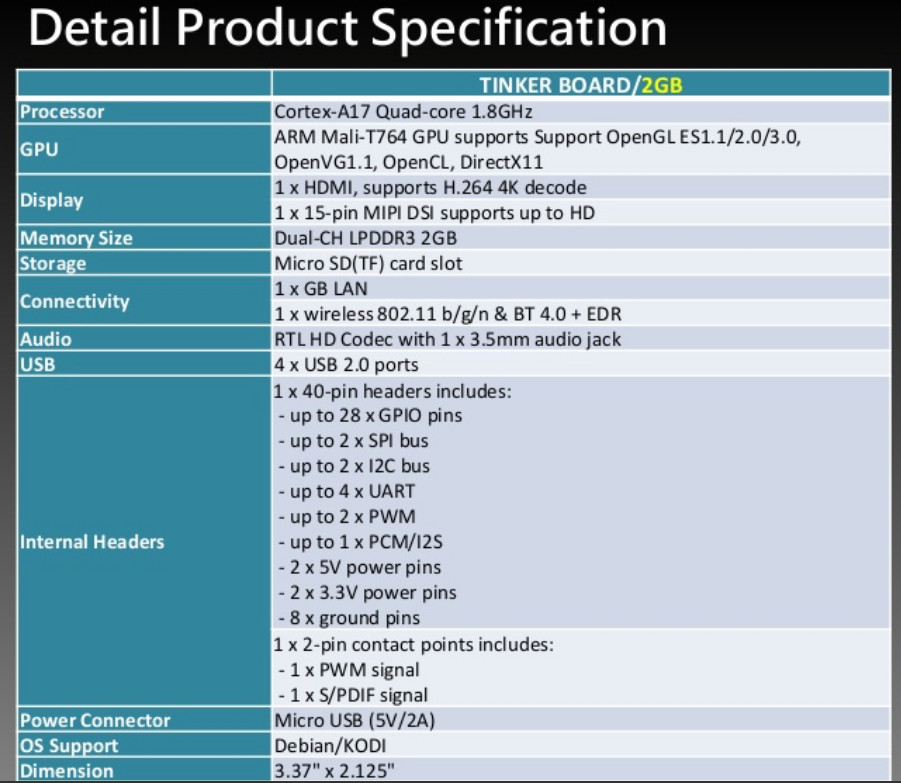
Hackaday reports that Asus has "quietly released their Tinker board that follows the Pi form factor very closely, and packs a 1.8 GHz quad-core ARM Cortes A17 alongside an impressive spec At £55 (about $68) where this is being written it's more expensive than the Pi, but Asus go to great lengths to demonstrate that it is significantly faster."
And though the Raspberry Pi foundation upgraded their Compute Module, Pine64 has just unveiled their new SOPINE A64 64-bit computing module, a smaller version of the $15 Pine64 computer. An anonymous reader quotes ComputerWorld: At $29, the SOPINE A64 roughly matches the price of the Raspberry Pi Compute Module 3, which ranges from $25 to $30. The new SOPINE will ship in February, according to the website. The SOPINE A64 can't operate as a standalone computer like the Pine64. It needs to be plugged in as a memory slot inside a computer. But if you want a full-blown computer, Pine64 also sells the $15 SOPINE Baseboard Model-A, which "complements the SOPINE A64 Compute Module and turns it into a full single board computer," according to the company...
The original Pine64 was crowdsourced and also became popular for its high-end components like a 64-bit chip and DDR3 memory... It has 2GB RAM, which is twice that of Raspberry Pi's compute module. SOPINE also has faster DDR3 memory, superior to DDR2 memory in Raspberry Pi Compute Module 3 board. -
New Senate Bill Would Give US Grads Preference In Receiving H-1B Visas (computerworld.com)
dcblogs quotes a report from Computerworld: A new bill in Congress would give foreign students who graduate from U.S. schools priority in getting an H-1B visa. The legislation also "explicitly prohibits" the replacement of American workers by visa holders. This bill, the H-1B and L-1 Visa Reform Act, was announced Thursday by its co-sponsors, U.S. Senators Chuck Grassley (R-Iowa) and Sen. Dick Durbin (D-Ill.), longtime allies on H-1B reform. Grassley is chairman of the Senate Judiciary Committee, which gives this bill an immediate big leg up in the legislative process. This legislation would end the annual random distribution, via a lottery, of H-1B visas, and replace it with a system to give priority to certain types of students. Foreign nationals in the best position to get one of the 85,000 H-1B visas issued annually will have earned an advanced degree from a U.S. school, have a well-paying job offer, and have preferred skills. The specific skills weren't identified, but will likely be STEM-related. "Congress created these programs to complement America's high-skilled workforce, not replace it," said Grassley, in a statement. "Unfortunately, some companies are trying to exploit the programs by cutting American workers for cheaper labor." -
New Senate Bill Would Give US Grads Preference In Receiving H-1B Visas (computerworld.com)
dcblogs quotes a report from Computerworld: A new bill in Congress would give foreign students who graduate from U.S. schools priority in getting an H-1B visa. The legislation also "explicitly prohibits" the replacement of American workers by visa holders. This bill, the H-1B and L-1 Visa Reform Act, was announced Thursday by its co-sponsors, U.S. Senators Chuck Grassley (R-Iowa) and Sen. Dick Durbin (D-Ill.), longtime allies on H-1B reform. Grassley is chairman of the Senate Judiciary Committee, which gives this bill an immediate big leg up in the legislative process. This legislation would end the annual random distribution, via a lottery, of H-1B visas, and replace it with a system to give priority to certain types of students. Foreign nationals in the best position to get one of the 85,000 H-1B visas issued annually will have earned an advanced degree from a U.S. school, have a well-paying job offer, and have preferred skills. The specific skills weren't identified, but will likely be STEM-related. "Congress created these programs to complement America's high-skilled workforce, not replace it," said Grassley, in a statement. "Unfortunately, some companies are trying to exploit the programs by cutting American workers for cheaper labor." -
Microsoft's Security Bulletins Will End In February (computerworld.com)
Remember how Microsoft switched to cumulative updates? Now Computerworld points out that that's bringing another change. An anonymous reader quotes their report: Microsoft next month will stop issuing detailed security bulletins, which for nearly 20 years have provided individual users and IT professionals information about vulnerabilities and their patches... A searchable database of support documents will replace the bulletins; that database has been available, albeit in preview, since November on the portal Microsoft dubbed the "Security Updates Guide," or SUG. The documents stored in the database are specific to a vulnerability on an edition of Windows, or a version of another Microsoft product. They can be sorted and filtered by the affected software, the patch's release date, its CVE identifier, and the numerical label of the KB, or "knowledge base" support document.
Redmond Magazine reports that Microsoft still plans to continue to issue its security advisories, and to issue "out-of-band" security update releases as necessary. -
A Federal Judge's Decision Could End Patent Trolling (computerworld.com)
"Forcing law firms to pay defendants' legal bills could undermine the business model of patent trolls," reports Computerworld. whoever57 writes: Patent trolls rely on the fact that they have no assets and, if they lose a case, they can fold the company that owned the patent and sued, thus avoiding paying any of the defendant's legal bills. However in a recent case, the judge told the winning defendant that it can claim its legal bills from the law firm. The decision is based on the plaintiff's law firm using a contract under which it would take a portion of any judgment, making it more than just counsel, but instead a partner with the plaintiff. This will likely result in law firms wanting to be paid up front, instead of offering a contingency-based fee.
The federal judge's decision "attacks the heart of the patent-troll system," according to the article, which adds that patent trolls are "the best evidence that pure evil exists." -
US Government Offers $25,000 Prize For Inventing A Way To Secure IoT Devices (ftc.gov)
An anonymous reader writes: America's Federal Trade Commission has announced a $25,000 prize for whoever creates the best tool for securing consumers' IoT devices. The so-called "IoT Home Inspector Challenge" asks participants to create something that will work on current, already-on-the-market IoT devices, with extra points also awarded for scalability ad easy of use.
"Contestants have the option of adding features, such as those that would address hard-coded, factory default, or easy-to-guess passwords," according to the official site, but "The tool would, at a minimum, help protect consumers from security vulnerabilities caused by out-of-date software." The winning submission can't be just a policy (or legal) solution, and will be judged by a panel which includes two computer science professors and a vulnerability researcher from Carnegie Mellon University's CERT Coordination Center.
Computerworld points out that "This isn't the first time the FTC has offered cash for software tools. In 2015, it awarded $10,500 to developers of an app that could block robocalls." -
Apple Could Finally Sell More Devices Than Microsoft In 2017 (computerworld.com)
Gartner predicts Apple will ship more iOS and macOS devices in 2017 than Windows-powered devices "for the first time this century," and then increase their lead over the next two years. An anonymous reader quotes Computerworld: Gartner predicted that iOS + macOS, unlike Windows, will recover in 2017. Apple's OSes will climb 8% to 268 million this year, add 3% in 2018 to reach 276 million, then increase another 3% in 2019, with that year's device shipment forecast at 285 million. Windows will dip this year, then stagnate for the following two years... The gap between Microsoft and Apple -- 12 million last year, with Microsoft atop -- will widen to 27 million by 2019, advantage Apple.
"The global devices market is stagnating," said Gartner analyst Ranjit Atwal in a statement Wednesday. Mobile phone shipments are growing only in emerging markets in the Asia and Pacific markets, Atwal added, and noted that "The PC market is just reaching the bottom of its decline." The PC industry's troubles have affected Microsoft most of all; Windows is almost entirely dependent on PC shipments, which have been stuck in a protracted slump. Future shipments were further hit when Microsoft walked away from the smartphone business last year.
The article also points out that even in 2016, Windows devices came in second, and "accounted for approximately 11.2% of the total devices, which overwhelmingly ran Google's Android." -
Changing Other People's Flight Bookings Is Too Easy (computerworld.com)
"The security of online travel booking systems are stuck in the 1990s, according to security researchers," reports Computerworld. An anonymous reader quotes their article, which argues that the ancient systems are also "woefully insecure": This allows attackers to easily modify other people's reservations, cancel their flights and even use the refunds to book tickets for themselves, according a team of researchers who analyzed this online ecosystem... They presented their findings Tuesday at the 33rd Chaos Communications Congress in Hamburg. The three major Global Distribution Systems operators...store Passenger Name Records for hundreds of millions of travelers at any given time.
Any data added or modification made to a booking is stored in their systems and all that's required to access that information is typically a last name and a six-character booking code. There are multiple access points into these systems and this includes the websites operated by airlines and travel agencies, but also third-party websites like CheckMyTrip... The booking code itself is far from secret. It's printed on luggage tags that most people throw away after each flight -- even if their entire trip has not concluded yet -- and is also embedded in the QR codes printed on tickets that an alarmingly large number of travellers photograph and post on social media websites, the researchers said. -
Facing Layoff, An IT Employee Makes A Bold Counteroffer (computerworld.com)
ComputerWorld reports: In early December, Carnival Corp. told about 200 IT employees that the company was transferring their work to Capgemini, a large IT outsourcing firm. The employees had a choice: Either agree to take a job with the contractor or leave without severance. The employees had until the week before Christmas to make a decision about their future with the cruise line. By agreeing to a job with Paris-based Capgemini, employees are guaranteed employment for six months, said Roger Frizzell, a Carnival spokesman. "Our expectation is that many will continue to work on our account or placed into other open positions within Capgemini" that go well beyond the six-month period, he said in an email.
Senior IT engineer Matthew Culver told CBS that the requested "knowledge transfer activities" just meant training their own replacements, and "he isn't buying any of it," writes Slashdot reader dcblogs. "After receiving his offer letter from Capgemini, he sent a counteroffer. It asked for $500,000...and apology letters to all the affected families," signed by the company's CEO. In addition, the letter also demanded a $100,000 donation to any charity that provides services to unemployed American workers. "I appreciate your time and attention to this matter, and I sincerely hope that you can fulfill these terms."
And he's also working directly with a lawyer for an advocacy group that aims to "stop the abuse of H-1B and other foreign worker programs." -
Disney IT Workers, In Lawsuit, Claim Discrimination Against Americans (computerworld.com)
dcblogs quotes a report from Computerworld: After Disney IT workers were told in October 2014 of the plan to use offshore outsourcing firms, employees said the workplace changed. The number of South Asian workers in Disney technology buildings increased, and some workers had to train H-1B-visa-holding replacements. Approximately 250 IT workers were laid off in January 2015. Now 30 of these employees filed a lawsuit on Monday in U.S. District Court in Orlando, alleging discrimination on the basis of national origin and race. The Disney IT employees, said Sara Blackwell, a Florida labor attorney who is representing this group, "lost their jobs when their jobs were outsourced to contracting companies. And those companies brought in mostly, or virtually all, non-American national origin workers," she said. The lawsuit alleges that Disney terminated the employment of the plaintiffs "based solely on their national origin and race, replacing them with Indian nationals." The people who were laid off were multiple races, but the people who came in were mostly one race, said Blackwell. The lawsuit alleges that Disney terminated the employment of the plaintiffs "based solely on their national origin and race, replacing them with Indian nationals."