Slashdot Mirror
Domain: harvard.edu
Stories and comments across the archive that link to harvard.edu.
Comments · 3,112
-
Re:ZOMG
Astronomical observations don't always need to be reported as "mysterious," tbh.
No they don't, These x-ray sources were called Quasars and mysterious, now seen as the birth of a super massive black hole,
http://chandra.harvard.edu/xra... -
Re:Why you shouldn't care...
Except that this country can be barred from imports for failure to cooperate with repressive intellectual property laws. Related events occurred in Africa, where AIDS is more common that it ever became in the USA. The drug cocktails used to treat AIDS were prohibitively expensive to purchase for many of the patients, and some of these companies started manufacturing the drugs locally, in violation of international patent law.
There are a number of good articles about the problem, such as https://cyber.harvard.edu/peop... .
-
Re:and the Aliens Go Whaaaaaaaa?
Tell it to the BBC http://www.bbc.com/news/magazi... or http://www.abc.net.au/news/201... or https://www.forbes.com/sites/a... or https://cosmosmagazine.com/bio... or http://scholar.harvard.edu/fil... or https://en.wikipedia.org/wiki/.... Let me guess, you love firing lead bullets at firing ranges with your buddies, as much as possible.
-
Re:Doctors hate us...
and only care about profits. This is more proof of that.
Doctors = legalized crack dealers
You wouldn't say most patients then are "legalized crackheads", would you? So why then, since most doctors don't give pain medicine to make money (see below) like a crack dealer, nor do doctors give pain medications because they know a large portion (most don't) will become addicts like crack dealers, would you say that about doctors?
There is also a bit of cultural shift - some of it driven by the pharmaceutical industry pushing "pain free" and away from the thought process of our grandparents that some aches and pains were just associated with "growing old". I see many elderly patients with "plain" old osteoarthritis because they tell their docs their knees hurt or hips hurt. Some of it driven by the 5th vital since, Joint Commission, and your doctors "patient satisfaction survey" (HCAHPS):
(1) Did you need medicine for pain?
(2) How often was your pain well-controlled?
(3) How often did the hospital staff do everything they could to help with your pain?
It's a perverse goal. I probably can get your pain to zero. You might end up a drooling heap of drowsiness, but it will be an incoherent zero when I ask what your pain score is....This perverse goal has incentivized over treatment and allowed for much abuse by a small number of patients, some of whom are abusing the system for profit or to get high, and by those with, essentially unrealistic expectations - for some people pain is not zero even when they are in a drooling heap of slumber. Any docs will tell you stories of patients admitted for "pain crisis" who are seriously sawing some logs, dead asleep, literally need to be shaken to be awoken and when asked will still claim their pain score is 10/10 or, even better 20/10 or 50/10...... *sigh*
Most of us come to work everyday to alleviate some suffering and misery. Cure, treat or ameliorate disease. There is no nefarious conspiracy to turn people into addicts. Here are the real factors....and this is by no means an exhaustive list
The association between chronic pain and obesity
Pain and Depression: A Neurobiological Perspective of Their Relationship
-
Re:Google as gatekeeper of truth
I was expecting many of these records to be accessible only in paper form, but five minutes of searching found these examples already:
- Holocaust Survivors and Victims Database
- 650,000 pages of the Nuremberg Trials records are available online
- More digitized records, again including death lists from camps. -
Re: FRost
You mean the scientific fact ?
http://scholar.harvard.edu/fil...Or is Harvard not a sufficiently scientific source for you ?
-
Re:The debt is optional too
I may get my masters degree from Harvard Extension. That would cost me $20K, but I'd end up with a Harvard Master's degree. A master's from Harvard may increase my income by $10K-$20K per year, meaning it would pay for itself in just 1-2 years.
https://www.extension.harvard....You'll get a Harvard Master's degree in Extension Studies (not software engineering)...which is what it will say right on it.
http://blogs.harvard.edu/lamont/2016/04/18/a-petition-to-change-harvard-extension-school-diplomas/
You may wish to reconsider that cost/benefit analysis.
-
The debt is optional too
It doesn't guarantee a job, and it doesn't guarantee debt either. The summary says "education only guarantees debt, not a stable job." That's compete bullocks. Debt is 100% optional. Common, but entirely optional. I'll graduate with more money in the bank than when I started school.
I chose a state school in Texas. Actually it's state school in many states - Western Governor's University was started by 19 state governors. I originally chose WGU because a) I could do the work on my own schedule - there are no scheduled class times and b) it's cheap, $6000 / year, minus $1500 tax credit = $4500 / year. After I started I found out that it's even better than that. For many courses, the final exam is an industry certification such as Cisco CCNA. Two years into school, my certifications led to a job making almost twice as much as I was making when I started school.
My employer reimbursed $1500 / year of tuition, so after the tax credit my out-of-pocket cost for school is $1,500 / year meanwhile my income has already increased by $50,000 / year, so the day I graduate I'll have a lot more money than I did the day I started school.
I could have actually gotten the first year or so free, or for about $500. What you can do is study the material, such as CCNA material, before enrolling. You can watch YouTube courses, get books from eBay, etc. Then enroll after you've studied and get a year of credits in your first few weeks by taking the exams. In fact, for industry exams like CCNA you can take the exams before enrolling and WGU will give you credit for the course - you've already passed the final exam.
The other good surprise with WGU is that I can do most of my school work 10 minutes at a time, when I have nothing better to do for a few minutes. I study while I'm on the toilet or whatever. 10 minutes per day, three times a day, seven days per week will cover a good portion of the material. In other words - I get my degree by spending half as much time on Slashdot as I used to.
I may get my masters degree from Harvard Extension. That would cost me $20K, but I'd end up with a Harvard Master's degree. A master's from Harvard may increase my income by $10K-$20K per year, meaning it would pay for itself in just 1-2 years.
https://www.extension.harvard.... -
Re:Sigh...
Your point is moot because the sun does not produce electromagnetic radiation in the microwave spectrum
-
Re:Eat Fat, Get Thin -- Refined carbs makes you fa
Since you don't seem to be able (or willing) to google this, here are a few results from the first page:
http://www.heart.org/HEARTORG/...
http://cardiobrief.org/2016/11...
https://www.hsph.harvard.edu/n...
Note that these are from science based publications... not fake news sites.
Also, animal saturated fat causes cancer:
http://www.pcrm.org/nbBlog/ind...
-
Re:Eat Fat, Get Thin -- Refined carbs makes you fa
Since you don't seem to be able (or willing) to google this, here are a few results from the first page:
http://www.heart.org/HEARTORG/...
http://cardiobrief.org/2016/11...
https://www.hsph.harvard.edu/n...
Note that these are from science based publications... not fake news sites.
Also, animal saturated fat causes cancer:
http://www.pcrm.org/nbBlog/ind...
-
NB: most medical scientists
The human body is the most complex organism in the known universe so there's nothing to be sneezed at or be surprised by. For instance recent studies have shown that for a lot of people placebo works even when people have a perfect knowledge that they are given placebo.
As another confirmation, the brain has the ability to directly change/affect the chemical processes in the body as demonstrated by Wim Hof who can manage his body's temperature at will.
-
Re:Android in the car?
I cannot for a moment imagine the hell that would ensue if Windows were the dominant OS on cars.
1. For no reason whatsoever, your car would crash twice a day.
2. Every time they repainted the lines in the road, you would have to buy a new car.
3. Occasionally your car would die on the freeway for no reason. You would have to pull to the side of the road, close all of the windows, shut off the car, restart it, and reopen the windows before you could continue.
For some reason you would simply accept this.
4. Occasionally, executing a maneuver such as a left turn would cause your car to shut down and refuse to restart, in which case you would have to reinstall the engine.
5. Macintosh would make a car that was powered by the sun, was reliable, five times as fast and twice as easy to drive - but would run on only five percent of the roads.
6. The oil, water temperature, and alternator warning lights would all be replaced by a single "This Car Has Performed An Illegal Operation" warning light.
7. The airbag system would ask "Are you sure?" before deploying.
8. Occasionally, for no reason whatsoever, your car would lock you out and refuse to let you in until you simultaneously lifted the door handle, turned the key and grabbed hold of the radio antenna.
9. Every time a new car was introduced car buyers would have to learn how to drive all over again because none of the controls would operate in the same manner as the old car.
10. You'd have to press the "Start" button to turn the engine off."
-
Re:like rain on your wedding day
wait, The Memory Hole *2* ??!!!1
It's at least the third one. Russ Kick's original Memory Hole blog was active in the mid-200Xs while James Tracy's Memory Hole blog was active 2012-2016.
If you want to know more about how governments memory-hole information, follow Gamergate on 8chan.
-
Exposing babies to peanuts
Done! http://www.health.harvard.edu/...
"In 2015, a study showed that giving peanut products to babies could help prevent peanut allergy. This was exciting news, given that 1-2% of children suffer from peanut allergy, an allergy that can not only be life-threatening but last a lifetime, unlike other food allergies that often improve as children get older. " -
Re:Prematurely Optimistic?
My largest issue with the paper is they did not describe the depressurizing process.
They uploaded the paper in October to ArXiv and said "As of the writing of this article we are maintaining the first sample of the first element in the form of solid metallic hydrogen at liquid nitrogen temperature in a cryostat. This valuable sample may survive warming to room temperature and the DAC could be extracted from the cryostat for greatly enhanced observation and further study. Another possibility is to cool to liquid helium temperatures and slowly release the load to see if SMH is metastable."
That was months ago, what the heck happened since then?
(Boston did not blow up...)
Also note that this paper was about SOLID metallic hydrogen. Another group previously claimed creation of LIQUID metallic hydrogen at low pressures but high temperatures.
-
Shockingly close, actually
The thing that blows my mind is not that one measurement is higher and another lower, it's just how closely they agree: to less than 10%. This despite the fact that they were arrived at from different instruments and lines of inquiry. The earlier measurement from Planck satellite measurements is derived from measurements of cosmic background radiation. The newer measurement comes from images of gravitational lensing of distant quasars, from the Hubble and Spitzer telescopes. For such a tricky measurements, and such an abstruse topic, I wouldn't have been surprised if they differed by an order of magnitude.* And yet, the agree pretty closely.
Science is really freaking awesome. Sure, assuming that the expansion is universal and constant (i.e., there is only one value for the Hubble Constant, which is hardly a sure thing), you ought to be able to measure the same answer by any experiment designed to measure it, within the experimental error. I ought to arrive at the same value for the gravitational constant, too, whether I experiment using a precision pendulum, or dropping a cannonball from the tower of Pisa (accounting for air friction, of course), or analyze the tides, or by successfully putting a man on the Moon. It doesn't matter who I am, or where I live, or under which government, or what language(s) I speak - it all still works.
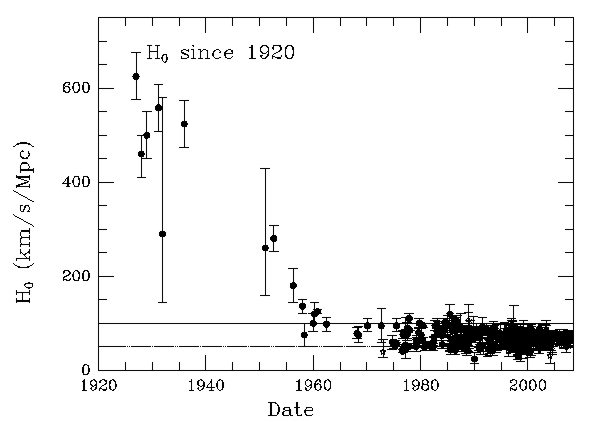
* Hubble's own initial estimate was about 10x the current values. For those that are interested, here's a graph of the value of H0, with error bars, through history. [source] -
Shockingly close, actually
The thing that blows my mind is not that one measurement is higher and another lower, it's just how closely they agree: to less than 10%. This despite the fact that they were arrived at from different instruments and lines of inquiry. The earlier measurement from Planck satellite measurements is derived from measurements of cosmic background radiation. The newer measurement comes from images of gravitational lensing of distant quasars, from the Hubble and Spitzer telescopes. For such a tricky measurements, and such an abstruse topic, I wouldn't have been surprised if they differed by an order of magnitude.* And yet, the agree pretty closely.
Science is really freaking awesome. Sure, assuming that the expansion is universal and constant (i.e., there is only one value for the Hubble Constant, which is hardly a sure thing), you ought to be able to measure the same answer by any experiment designed to measure it, within the experimental error. I ought to arrive at the same value for the gravitational constant, too, whether I experiment using a precision pendulum, or dropping a cannonball from the tower of Pisa (accounting for air friction, of course), or analyze the tides, or by successfully putting a man on the Moon. It doesn't matter who I am, or where I live, or under which government, or what language(s) I speak - it all still works.
* Hubble's own initial estimate was about 10x the current values. For those that are interested, here's a graph of the value of H0, with error bars, through history. [source] -
Re:Self-fulfilling ProphecyI just plugged random numbers into a the Harvard financial aid calculator, https://college.harvard.edu/fi...
A one parent household making $130k/year would get $48k worth of scholarships bringing the annual bill to under $20k. This does not sound unreasonable for someone making $130k.
-
Re:documentary on Chernobyl
I'm a lifelong proponent of nuclear energy, and I've often vented my rage at the mindless knee-jerk reactionary opposition to nuclear energy voiced by "greenies" who over-inflate accidents caused by infamously careless and dysfunctional regimes. I tell you this so you'll understand the significance when I say that your point is not lost on pro-nuke activists.
"We almost Lost Detroit is one of my favorite nonfiction books - especially because I was born and raised in Fermi I's potential fallout shadow. The book does a lovely job of documenting other costly accidents and near misses as well. Nuclear energy scares the hell out of me - and I think any pro-nuke activist should feel the same. I'm also an avid firearms enthusiast, and as any gun owner can tell you the rules of gun safety are based on multi-layered, defense-in-depth paranoia. It is not a question of if you will make a mistake, but when. Failing to apply this same standard to nuclear energy is insane, and we can't expect anyone to take our advocacy seriously if we brush off their concerns as fear-mongering, Luddite hysteria or flat-out ignorance. All three are present in anti-nuke activism, but that doesn't excuse us from the valid fears that need answering.
Those fears are why Americans proof-test our containment buildings to an extremely high standard. It's why our containment domes (Fermi I, shown here) are a damn sight more spacious than those used by other nations, which might explain why ours don't fail and others have. It's not enough to sit around and point out how the Soviet Union was a pack of incompetent bastards, or how Fukushima was the result of breathtakingly corrupt practices in government and industry, with half the employees being Yakuza, terrifyingly slapdash construction (when two major pipes didn't meet up in the middle like they were supposed to, hooking an earthmover to it, bending the pipe a bit and welding it together wasn't unheard of,) and laughable government "oversight" (i.e. "descent from heaven.") To dismiss these incidents is to say "it can't happen here" and most certainly can. And fear of that keeps the sharp edge on the vigilance needed to ensure it never does.
-
Re:And the next food craze starts
"How, exactly, is milk harmful?"
It's sugary, fatty water, with about the same calories as soda, destined to give a calf a nice pelt.
BTW, I like your hair.
The difference between milk and soda is that the fat in milk will slow down the glycemic reaction, whereas soda is just sugar and water (and a bit of flavor) and so the glycemic reaction is higher. The glycemic index for 250ml of both milk and skim milk is 31. The glycemic index for 250ml of Coca Cola is 63. (Source)
On top of that, milk contains protein, which also slows down the glycemic reaction.
So yes, we can objectively point to well-tested and (importantly) repeatable scientific experiments (glycemic indexes are calculated and published by a number of different organizations around the world) that point to the fact that milk is healthier than sugary soda drinks.
Shocking.
-
Also: Jay Forrester and Bob Fano
Also you should add Jay Forrester (inventor of core memory, among other things) and Bob Fano (founder of the MIT computer science lab).
-
Re:Down with Angela Merkel!
First, a warning about your source:
Then, from that iffy source there's this:
German feminist Alice Schwarzer wrote a book about the Cologne incidents, Der Schock - die Silvesternacht von Köln (The shock - New Year's Eve of Cologne). In it, she characterized the perpetrators as "not any Muslims.
-
Re:Replacing CMD
However, powershell *puroports* to have security features like execution policies and signing, so it draws more scrutiny.
Both terrible "security" policies. What would a signature possibly mean to me as a user if I don't know you? With or without a signature, my choice is still: either I run this script I need to my job, or I don't and I can't do my job (or it gets much, much harder). So basically PowerShell's security is no better than any other shell that's come before it; it projects a false sense of security, and like UAC before it, it just gets in your way.
So given the fact that getting a job done is king, and running scripts or programs written by potentially malicious people is the only reasonable way to do your job, then running arbitrary scripts must be made safe. The means to achieve this is the Principle of Least Authority (POLA), and POLA environments can and have been done before, even within commodity POSIX and Windows systems.
The earliest secure POSIX shell that I recall was Plash. Now we also have Shill (requires a kernel module) and the Capsicum shell (also requires kernel modules). Windows can be made POLA secure out of the box as was demonstrated with Polaris.
It's just amazing that we fail to learn the mistakes of the past even when solutions are available.
-
Re:No, just no
Please read:
Interesting. I''l hav eto dig up the original report. Thanks much.
-
Re:No, just no
I used to take Benadryl as a sleep aid. All I need is one half of a pill (lil' pink sleepies, I call them). But then, I saw a study a while back that showed a link to increased risk of dementia from Benadryl use. I'm not trying to make any kind of point here -- I just saw your comment and, out of concern for the well being of a complete stranger, I thought I'd share this link with you. Please read:
-
Re:In other news...
... People have a problem with separating fantasy from reality. What else is new?
FTFY
If these people were not willing to kill, maim
Among the worst are the people trying to build a "heaven on earth," also known as a "worker's paradise." Oddly enough they tend to be atheists.
-
Re:Two Million Man-Years?
The simple answer is that there are a huge number of people who have been affected. Lots of land has been labelled "contaminated". A huge amount of industrial productivity has been lost. Housing and infrastructure has been abandoned and fallen into disrepair. People have lost jobs, all that will end up being compensated. Consider that close to 1 million people may have lost close to their entire net worth, and their health.
The most tragic part of that, is that the overwhelming majority of the evacuation and exclusion zone was inappropriate. Evacuation is known to be traumatic in terms of mental and physical health. In the case of the Fukushima accident, the evacuation was the direct cause of 60 deaths, and up to 5000 serious physical or mental injuries, even though contamination levels even in the most heavily contaminated regions would not have been expected to cause any acute radiation injuries or illness, and around 200 total excess cancer deaths over the next 60 years (had the region not been evacuated). http://users.physics.harvard.e... -
Re:Not a proper study, get this astroturf out of h
Wrong. Even when patients are informed that they are receiving a placebo, it has an effect. Want proof?
Dr. Ted J. Kaptchuk, a professor of medicine at Harvard Medical School and director of the Harvard-wide Program in Placebo Studies and the Therapeutic Encounter (PiPS) at Beth Israel Deaconess Medical Center in Boston, has been studying placebos for more than 20 years. His most recent work on these “open-label placebos,” as they’re called, is fascinating. I had a chance to interview him in person earlier this year.
In one study, Kaptchuk looked at people with irritable bowel syndrome (IBS), a common condition that causes abdominal cramping and diarrhea or constipation that can be debilitating for many. Half of the study volunteers were told they were getting an “open-label” placebo and the others got nothing at all. He found that there was a dramatic and significant improvement in the placebo group’s IBS symptoms, even though they were explicitly told they were getting a “sugar pill” without any active medication.
Also, nice way to be intentionally silly - you don't tell them that they are receiving a placebo - you inform them that they will receive either the placebo or the treatment being tested. You don't have to tell them which. Just that the distribution will be at random.
Placebos are often considered “fake” treatments. You may have heard them described as “sugar pills.” They usually take the form of pills, injections, or even entire procedures that are used in clinical trials to test “real” treatments. For example, one group of study participants is given an active drug and another group is given a placebo, which looks exactly like the active medication but is completely inactive. The participants can’t tell whether they’re getting the fake drug or the real drug. The researchers wait to see if the people taking the real one do better (or worse) than those taking the fake one.
-
Re:Largest CO2 emitter on Earth
Honestly guys, put down the Guardian pipe. It's a matter of time before these figures, both the exaggerated "reductions" and the exaggerated amount of investment get exposed as the lies they are. Only doe-eyed libtards believe this Chinese propaganda.
Even "progressives" acknowledge that Chinese CO2 numbers are fictional, when they aren't themselves trying to use those lies as leverage over Western nations. Communists lie. They lie about their achievements and they lie about their failures, and the fact that they've got fellow travelers in the Western Media parroting their lies is not novel.
-
Blue light is bad
It's not actually surprising to see why this might be true if you look at this link, which explains that blue light suppresses secretion of melatonin and interferes with sleep. And I doubt everyone installs Twilight or CF.lumen on their phone if it's Android, and previous versions of iOS didn't have Night Mode if I remember correctly.
-
Re:as a layperson, im a little confused.
I fully agree that institutional biases exist and are a problem. And in some cases, they are born out of unconscious bias. But you can't really blame people for having an unconscious bias - after all, it's not a decision they've consciously made. So, what a decent person would do is find ways to counteract bias, as scientists do with double-blind studies. Or, if that's not practical, find a way to test your own bias and then actively work against it.
Harvard has a pretty quick way to do that online: https://implicit.harvard.edu/i...
For myself, I taught high-school science for a while, and so I took a few tests on that site to see if I had any strong bias to be worried about. Turns out that I had no particular racial bias, but had a pretty strong gender bias against females in STEM. I've tried to be actively more self-aware thanks to that, although effectively addressing the bias, even if you know it's there and you know it's wrong, is hard to do. You're essentially trying to ignore and/or retrain your subconscious associations, and I'm not sure that anybody is super effective at doing that.
-
Re:You can't protect against everything.
Probably nothing would happen, according to recent research.
-
Re:Mail-only voting
Dumbass.
Dumbass to you too sir. (I didn't know this was a greeting. Must be an american idiom)
People do this in their homes, you know, where they receive their mail. If people are coming into your home and strongarming you, you have some other serious issues to contend with.
A lot of people have spouses or parents coming into their homes ready to play the peer-pressure or wholesale strong-arming game. After all if 1 in 4 women experience domestic violence how many would merely be forced to vote for the right party? How many cases of unprovable vote coercion would even be reported? How many would be investigated?
As to getting a meeting where everyone brings their blank ballots, there is no way to keep that shit secret! It will be found out, and the law will be on their ass! It's not going to happen, so you can put your tinfoil hat down, this isn't a hollywood movie.
Indeed this is different and not a hollywood movie. It's history. While what happened in Chile did not involve mail-in it qualifies as strong-arming on a scale large enough to clear the "no way to keep that shit secret!" threshold. And yet it worked for decades...
-
Re: Shocking!
Fructose is far worse than glucose, so any sugar with a higher percentage of fructose, (such as HFCS), has measurably worse health effects. Evidence is here, and many other places as well. All it took was a quick Google search for "fructose glucose liver", and a click on the third link. But then, I've been following this for a while, so I knew what to look for. The bottom line is that glucose is used by every cell in the body, whereas fructose can only be processed by the liver. Excessive consumption leads to liver disease almost exactly like that caused by excessive alcohol consumption, whereas excessive glucose consumption does not. There is also evidence that consumption of fructose in concentrations common in the current North American diet actually increases appetite. So yes, all sugars can lead to increased body fat through excessive calorie consumption; but fructose, in more than limited amounts, messes with the body's metabolism in ways that both cause more damage and more inflammation, and make weight gain more likely. The effects of fructose in causing obesity and poor health go far beyond its mere caloric content.
Be careful searching as there is a LOT of bullshit surrounding hfcs vs sugar. Yeah only glucose feeds direct into Krebs cycle. Been a while since I finished my degree (Biochem BSc in late 90's) but things haven't changed biochemically since then. What has changed is a bit more studies on certain sugars having a harder impact on body function and you're right fructose is one. Taken out of context of nature (eg. fruits) it is worse as no fibre etc to slow down its uptake. Now the stuff about obesity and it is turned into fat is BS. Only 1 or 2% of human fat at most tends to come from that route and although we have that pathway we don't use it unlike the likes of ruminants. What does happen is because muscles prefer fats for energy production at rest if you have high blood sugar level all the time the body never switches to rest mode and saves the fats for after the blood sugar is normal. Many people have bad diet so never eating into glycogen nor fat reserves. This is over simplicifation somewhat but can answer in more detail if it helps. Obviously we need some glucose in blood even at rest as fats wont cross blood brain barrier thus brain uses glucose as energy source.
Also there is a lot of sucrose vs hfcs and people forget sucrose splits quick and yields fructose too so isn't comparable to glucose either (prob know it is disaccharide made of glucose-fructose) although you could argue it is only half as bad. Even high glucose diet is bad from point of view you never burn up fats at rest and eat into glycogen in exercise. Basically stressing pancreas which is constantly mopping up excess blood sugar and living off this glucose in blood and never touching stores. Part the reason refined sugar is bad is the spikes in blood sugar. Something with fibre to slow the uptake and complex carbs that take much longer to split and convert to glucose (eg. not stuff like potato) . -
Re: Shocking!
Evidence is here
Actually, no, that is not "evidence". It is opinion, unsupported by data. Even the title of the article, "Is fructose bad for you?", gives the game away. Why is it phrased as a question? If there was supporting data, the title would have been: "Fructose is bad for you".
Even the article itself admits there is no data: Experts still have a long way to go to connect the dots between fructose and nonalcoholic fatty liver disease, obesity, diabetes, heart disease, and cancer. Higher intakes of fructose are associated with these conditions, but clinical trials have yet to show that it causes them.
In summary:
1. Fructose, including HFCS is bad for you.
2. Sucrose is also bad for you.
3. There are some good reasons why fructose should be worse than sucrose.
4. There is no actual evidence that #3 is true. -
Re: Shocking!
Can you point to any actual evidence to support this assertion? Excessive sugar is bad for you, but I am aware of no controlled studies that have found that fructose or HFCS is any better or worse than any other sugar. The common belief that HFCS is worse than sucrose is based on conjecture and superstition, not data.
Guzzling soda sweetened with HFCS is bad for you. But guzzling the same amount of soda sweetened with cane sugar is no better.
Fructose is far worse than glucose, so any sugar with a higher percentage of fructose, (such as HFCS), has measurably worse health effects. Evidence is here, and many other places as well. All it took was a quick Google search for "fructose glucose liver", and a click on the third link. But then, I've been following this for a while, so I knew what to look for. The bottom line is that glucose is used by every cell in the body, whereas fructose can only be processed by the liver. Excessive consumption leads to liver disease almost exactly like that caused by excessive alcohol consumption, whereas excessive glucose consumption does not. There is also evidence that consumption of fructose in concentrations common in the current North American diet actually increases appetite. So yes, all sugars can lead to increased body fat through excessive calorie consumption; but fructose, in more than limited amounts, messes with the body's metabolism in ways that both cause more damage and more inflammation, and make weight gain more likely. The effects of fructose in causing obesity and poor health go far beyond its mere caloric content.
-
Re: Shocking!
Back on topic. You'll probably find a bunch sponsored by the industry finding both are equally bad.
Here's one from nih:
http://www.ncbi.nlm.nih.gov/pm...Here's one from harvard:
http://www.health.harvard.edu/... -
Re:the more guns you have, the more likely you are
There are still quite a few relatively easy ways to kill yourself, even without a gun.
But those ways aren't used nearly as often. and they're not nearly as lethal. Some of the most common means of attempting suicides have a success rate of around 5-10%. Very nearly 70% of all successful suicides are with a firearm. Not the number of attempts mind you, but the number of successes. All those other "relatively easy" ways to commit suicide are very often unsuccessful, and that means those people have a chance to get help. Firearm suicides are successful just about 90% of the time, which means a gun owner having a very bad day might be dead when if they didn't have ready access to a gun, they'd still be alive. And if they're still alive, they are very unlikely to die of suicide later.
High-gun ownership states have suicide rates just about double that of low-gun ownership states.
Oh yeah, people who attempt suicide and are unsuccessful are unlikely (less than 10%) to die by suicide later. But since only about 10% of gun-related suicide attempts survive, it's too late for them. Now put all that together for yourself.
https://www.hsph.harvard.edu/m...
-
Re:the more guns you have, the more likely you are
There are still quite a few relatively easy ways to kill yourself, even without a gun.
But those ways aren't used nearly as often. and they're not nearly as lethal. Some of the most common means of attempting suicides have a success rate of around 5-10%. Very nearly 70% of all successful suicides are with a firearm. Not the number of attempts mind you, but the number of successes. All those other "relatively easy" ways to commit suicide are very often unsuccessful, and that means those people have a chance to get help. Firearm suicides are successful just about 90% of the time, which means a gun owner having a very bad day might be dead when if they didn't have ready access to a gun, they'd still be alive. And if they're still alive, they are very unlikely to die of suicide later.
High-gun ownership states have suicide rates just about double that of low-gun ownership states.
Oh yeah, people who attempt suicide and are unsuccessful are unlikely (less than 10%) to die by suicide later. But since only about 10% of gun-related suicide attempts survive, it's too late for them. Now put all that together for yourself.
https://www.hsph.harvard.edu/m...
-
Re:the more guns you have, the more likely you are
There are still quite a few relatively easy ways to kill yourself, even without a gun.
But those ways aren't used nearly as often. and they're not nearly as lethal. Some of the most common means of attempting suicides have a success rate of around 5-10%. Very nearly 70% of all successful suicides are with a firearm. Not the number of attempts mind you, but the number of successes. All those other "relatively easy" ways to commit suicide are very often unsuccessful, and that means those people have a chance to get help. Firearm suicides are successful just about 90% of the time, which means a gun owner having a very bad day might be dead when if they didn't have ready access to a gun, they'd still be alive. And if they're still alive, they are very unlikely to die of suicide later.
High-gun ownership states have suicide rates just about double that of low-gun ownership states.
Oh yeah, people who attempt suicide and are unsuccessful are unlikely (less than 10%) to die by suicide later. But since only about 10% of gun-related suicide attempts survive, it's too late for them. Now put all that together for yourself.
https://www.hsph.harvard.edu/m...
-
Re:What's the scientific evidence on blue light?
This is a good place to start:
http://www.health.harvard.edu/...Many brain studies have been made proving that it is the mechanism for humans to wake up when the sun comes out. We are simply wired that way.
-
Re:Stop with the hysteria
would you propose the same solutions to preventing suicides as homicides/violent crimes?
Yes. Better mental health care and sensible restrictions on guns.
Not having ready access to a gun might have given some of those suicides a chance to reconsider. A Harvard study says 9 out 10 people who survive a suicide attempt do not go on to die by suicide. But it's pretty hard to survive a pistol shot through the roof of the mouth, you know?. The vast majority of people who attempt suicide by means other than handgun are not successful. The success rate for the gun users is well over 90%.
https://www.hsph.harvard.edu/m...
Regarding homicides and violent crime, you are much more likely to be shot to death in a violent crime than beaten, stabbed, strangled, impaled, poisoned, hatcheted, smothered or thrown out of a window combined. The National Institute of Justice says that nearly 70% of homicides are committed with firearms.
-
Re: see what the Union free work place get's you!
As said above: There is no such duty to make a profit! Certainly not at the "expenses" entailed in this article.
-
Re:If you're refusing a refund ...
https://corpgov.law.harvard.ed...
captcha: sloping
-
Re:You are missing the point
So just use bank ATMs that are located in already secured bank lobbies.
Thus directly giving control of the elections to private companies and reducing citizen oversight to exactly zero.
Yes, this de-anonymizes your vote.
De-anonymizing votes is the opposite of allowing everyone a say (because it enables community / employer / peer pressure). Not in theory, in practice, as shown by Chile's transition from open to secret ballots. Plus Internet (or ATM in your version) voting has nothing with ensuring anyone has a say. Finally, there's no point ensuring everyone has a say if you first made it trivial for anyone in the world to hack elections on a large scale.
-
Re: Will Internet Voting Endanger The Secret Ballo
For the first 100 or so years, voting in the US was open ballot. The only reason it changed was because there was a civil war. Corruption and vote fraud was much less with an open ballot, and so long as you aren't in a situation with armed insurrection, is clearly superior to the secret ballot.
Chile also had open ballots and was not in a state of civil war or armed insurrection. Yet, as soon as they switched to secret ballots the election results changed significantly.
You're forgetting whole cultures and communities where women don't have equal rights (no matter what the law says), and employers who have the will and the means to try and nudge the balance.
-
Re:Darkening the skies as well!
All that solar is making the sun dimmer! Oh and all that wind power is slowing the rotation of the earth! Senator Joe Bartan (R) said it was true!
On the other hand, the three-gorges dam in china apparently slowed the earth's rotation by about 0.06 microseconds, and shifted the pole position by about two centimeters.
Of course if we extrapolate this data and we continue building dams at the current rate, we will probably cause catastrophic damage to the earth in the next million years (unless we go extinct by then). Maybe we should stop building dams now before it is too late.
FWIW, what Mr. Barton said was actually this...
I am going to read a paragraph which is, if true, very ironic. And this is from Dr. Apt’s paper, and I quote: ‘Wind energy is a finite resource. At large scale, slowing down the wind by using its energy to turn turbines has environmental consequences. A group of researchers at Princeton University found that wind farms may change the mixing of air near the surface, drying the soil near the site. At planetary scales, David Keith, who was then at Carnegie Mellon, and coworkers found that if wind supplied 10 percent of expected global electricity demand in 2100 the resulting change in the earth’s atmospheric energy might cause some regions of the world to experience temperature change of approximately 1 degree Centigrade.’
This Dr. Apt's paper was poorly paraphrasing this 2013 Harvard report which quotes research that was partially funded by the Natural Sciences and Engineering Research Council of Canada (a country with major petroleum reserves and skin in the game)...
It's easy to blame politicians for ignoring science (as if many of them were scientists qualified to analyse data), but it is often the Universities that tend to confuse issues. Hey we've got researchers from Princeton, Haarvaard, and CMU saying something ironic *if-it-were-true*. Then confirmation bias sets in (happens on both sides of the aisle). The spin cycle kicks in to make your political enemies look like idiots to please your audience. Rinse, repeat (god forbid don't lather, think of the environment).
-
f.lux & sleep hygiene
I'm guessing most of the Slashdot crowd already knows about f.lux, which I use on my PC's to (attempt to) reduce nighttime exposure to blue light. I don't know how well it does or doesn't work for me, but it helps just as a reminder to unplug an hour or two before my intended bedtime, if possible.
Practicing good sleep hygiene has tangibly improved my sleep and well-being over the past several years, though I noticed results within a week, once I learned and adopted good practices from my sleep doctor. Keeping the right ambient temperature (a surprisingly low 65-70 degrees for me), avoiding light exposure (completely blocked bedroom windows, taped over LED lights, removing all light sources but two red night-lights), getting a truly comfortable mattress, avoiding late meals/snacks/fluid intake, and (more challenging for couples) sleeping alone make the biggest differences for me.
-
Corporate Governance
Public companies, like republics, end up with the leaders they deserve.
I think the more interesting question is, "Why do boards of directors hire and overpay mediocre CEOs who actively destroy shareholder value?" And why do the shareholders elect board members who do this?
A strong antidote is to a) pay board members minimal cash compensation for their duties and b) ensure board members have a significant portion of their net worth invested in the company they oversee. This rather simply aligns board members’ interests with that of other shareholders. Sitting on a board should not be a cushy job -- it should be a privilege to oversee the management team responsible for making you richer and richer. If enough board members own chunks of the company, then bring in "outsiders" for their perspectives, but always make sure the board collectively has enough skin in the game.
With respect to compensation, I frequently see executive pay associated with bullshitty metrics that are not tied to owners’ total returns or increasing the enterprise’s per-share intrinsic value. When executives are compensated with stock, the cost to owners (share dilution) is frequently obfuscated in the financial reports, or considered income through the use of legal but creative accounting. (Adobe and others were notorious for this chicanery before the dot-com bubble imploded.)
When I consider purchasing shares, I always look at "corporate governance," CEO attitude, and board composition as important qualitative indicators of quality. Frankly I’m shocked by the number of publicly traded enterprises that retain significant earnings, and then piss the money away on failed acquisitions, ostentatious headquarters or skyscrapers, or, in the case of Bethlehem Steel before the bottom fell out of the industry, three separate corporate golf courses -- one for management, middle management, and employees.
This is one of the reasons I’m fond of dividends: I don’t trust many CEOs to smartly allocate capital to generate satisfactory rates of return. It takes a special sort of person to either sit on cash for extended periods until a truly outstanding opportunity presents itself, or just admit that the enterprise has exhausted sensible options for capital redeployment, so time to bust out the dividends and share repurchases.
The topic of corporate governance seems to be in vogue at the moment. Just last week, several CEOs and asset management firms released an open letter advocating for public companies to adopt "commonsense" governance principles [1]. And the large asset management firms like Vanguard are starting to become more vocal about how the companies they own are managed, if this letter is any indication [2]. Vanguard and other "passive" asset management firms have enough weight (literally trillions of dollars under management) to force change, and boards know it.
[1] https://corpgov.law.harvard.ed...
[2] https://corpgov.law.harvard.ed...