Slashdot Mirror
Domain: hpmuseum.org
Stories and comments across the archive that link to hpmuseum.org.
Comments · 124
-
HP Calculator Museum
So what? We have the HP Calculator Museum online now! Screw those physical artifacts!
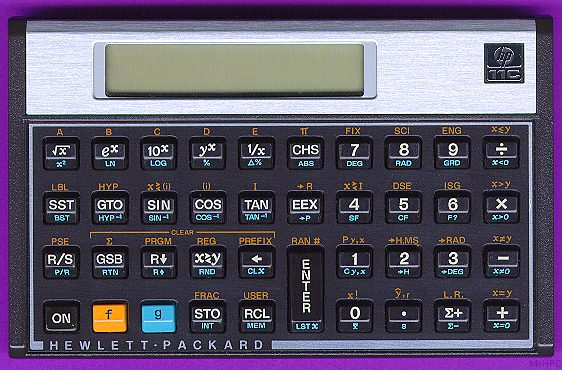
*obsessively fondles HP-11c* My Precious -
Re: Not a first post
When I was a lad: http://www.hpmuseum.org/hp9830...
-
Re:It wasn't just PLATO
I was actually in Junior High at Williamsburg JHS at the time - 8th grade. The "Dialcom" name is familiar - I could be wrong about it being a CDC machine.
Our math teachers were pretty baffled, but trying to put a brave face on kicking off our computer education. There was a lot of "hope I don't break this thing" hesitation. There were a few hardy souls there who really helped us get started.
It appalled me when I got to college in '77 that I had to go backwards to punch cards and JCL for Fortran. Ugh.
I spent a lot of time on the "Career Center" time shared HP (IIRC) in high school at Yorktown, via an ADM-3A glass tube terminal, and on their HP 9830A "Calculator" (really, a low-end mini/microcomputer). Loved that 32-character dot-matrix display!
-
Re:So what's the problem?
OK, perhaps the HP35 didn't have the beveled keys but, the classic HP keys have been beveled almost from the beginning. True, the alphabet isn't a QWERTY keyboard (you switched into Alpha by hitting the "Alpha" key on top). Even so, it would be pretty obvious to arrange them into a QWERTY format for a different application. For example: http://www.hpmuseum.org/3qs/41...
-
Re:According to the history page...
The HP 9830A introduced in 1972 was their first programmable desktop computer with a full keyboard. The programmable 9100 calculator from 1968 was technically a computer too but lacked a full alphanumeric keyboard. Thus predating the Apple I by some years.
-
HP 9830A in 1973
In about 1973 the local education authority for my school bought a HP 9830A. It's less of a computer, more of a jumped up calculator, but was programmable in Basic. We had it for half a term, then it went on to the next school. A year or so later, we got it permanently. None of the teachers knew what to do with it, but I latched on to it, and it being a boarding school I was able to play with it in the evenings. I taught myself from the manual, and wrote a noughts and crosses program. Other pupils joined me, and we ended up writing a program to analyse the alignment of stone circles in Cumbria and compare the number of ley lines that could be drawn through them with randomly generated positions. We went on to enter and do well in both a Computer Weekly "Win a Computer" competition and the BBC "Young Scientists of the Year".
-
Re:Give them away
For those few
-
Re:"PC"
It has an actual etymology: "PC" is a relic of the original "IBM PC" in 1981.
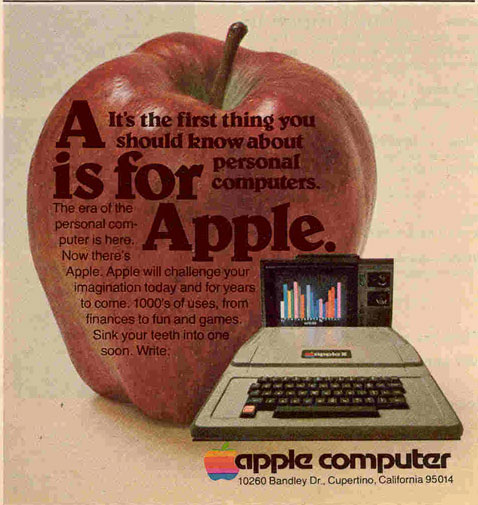
Nope. Apple at least since 1977 referred to their Apple II as a ”personal computer“:
http://www.macmothership.com/gallery/MiscAds2/AisFor1.jpg
Check out the rest of their ads from the late 70s, for many more occurrences of the term, here:
http://www.macmothership.com/gallery/gallery1.html
In 1974 HP published this:
http://www.hpmuseum.org/journals/65a.htm
Dig a little bit more in history and you may find who used the term first:
-
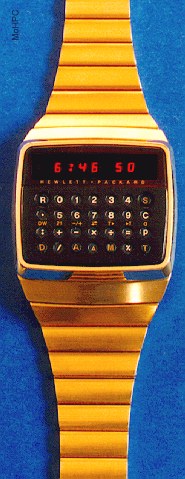
HP-01 Missing? I am disappointed.http://www.hpmuseum.org/hp01.htm
LED Calculator watch. From 1977. Waterproof to 10 meters, and Magnetic-Field-Proof to 60 Gauss.
Sometimes I feel we're working backwards here.
-
you would think
You would think given that calculators still sell pretty well and this one is doing good for 30 full years that HP would maybe consider that they made a mistake in essentially killing off this line. Wouldn't it be wonderful it HP put out hand device for engineers as far advanced a the HPs were then?
Anyway the scientific version of the 12c is the 15c: http://www.hpmuseum.org/hp15.htm
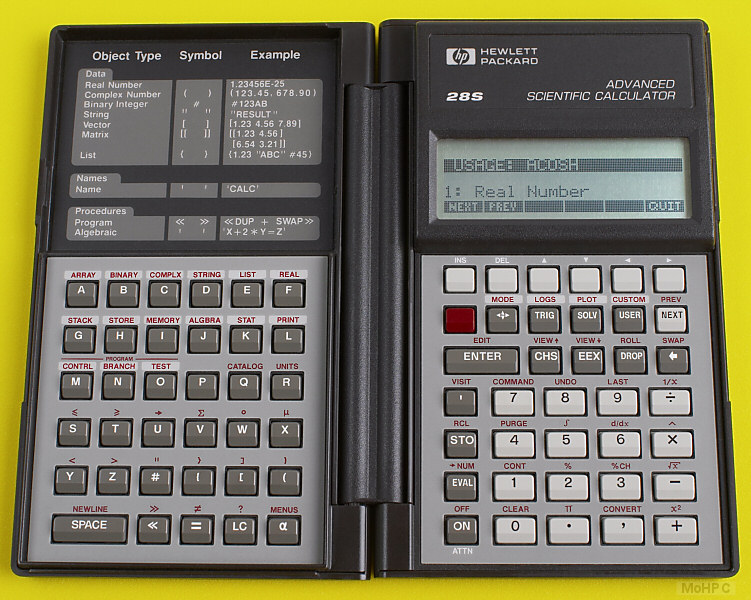
And my love was the 28S. http://www.hpmuseum.org/hp28c.htm -
you would think
You would think given that calculators still sell pretty well and this one is doing good for 30 full years that HP would maybe consider that they made a mistake in essentially killing off this line. Wouldn't it be wonderful it HP put out hand device for engineers as far advanced a the HPs were then?
Anyway the scientific version of the 12c is the 15c: http://www.hpmuseum.org/hp15.htm
And my love was the 28S. http://www.hpmuseum.org/hp28c.htm -
Re:Power consumption
Funnily, I was just wondering if newer graphing calculators chewed through batteries like the ones we were forced to use in the mid nineties.
Picked up an HP-15C on eBay a few years later; I think I've changed the batteries twice. It does integrals, works with complex numbers, and inverts matrices. Anything more, I'd just as soon use a computer (or iPad, or...).
To me, the bizarre thing about graphing calculator use in high school is I only ever remember graphing things(quadratic curves, trig functions, maybe an exponential here and there) that are really easy to graph by hand.
In high school calculus, I seem to remember they were used in a way that's almost the opposite of how they should be used, trying to "visualize" epsilon/delta neighborhoods instead of, say, linear and Taylor approximations to functions, even though the former are essentially topological (or, if you prefer, infinitesimal), and thus pointless to visualize ("what do you want me to look like?"), while the latter let you _see what's going on and why it turns out to be so useful_.
On the other hand, graphing 3-D _anything_ is hard. If I were teaching and I had a choice, I'd want my students to have access to some sort of technology — most likely not on exams — but I'd most likely suggest they shell out the extra $50 or so and get something like an iPod touch, use one of the cheap/free graphing apps and/or WolframAlpha.
And if I did let them use the things on exams, I wouldn't care much about notes — if they put together good, concise notes, and knew the material well enough to reference them efficiently enough to finish the exam on time, they deserve to pass.
Of course, I'd also tell them to learn the Pythagorean theorem, what a circle is, and Euler's identity
e^it = cos t + i sin t,
then forget whatever trig identities they don't need all the time. But remember the quadratic formula and binomial theorem, by all means.This last bit, of course, is for students who actually care/plan to use math for anything but calculating tips.
As for pointlessness, I'd say it depends on how one uses them. Overpriced? Only if people are forced to buy them. Oh, wait...
Cheers,
Jason -
HP isn't new to watches
But I'd rather have an HP 01. In a class by itself.
-
Re:No RPN
-
Back to the future
This wouldn't be the first wristwatch from HP. The company sold the HP-01 from 1977 to 1980. It was a calculator watch that was very advanced for its time (At $750, it should have been!).
-
Could this be...
A new version of the the HP-01? http://www.hpmuseum.org/hp01.htm
-
Re:I'd rather have an HP-50G
Actually HP calculator quality has been falling off significantly the past few years as they have seemed to be outsourcing and cutting corners. I can't help but think that Carly Fiorina was largely responsible.
-
Re:no, Python is not the language to start with
I know you meant this to be kidding but the fact is RPL which is essentially a Forth was for many people their first programming language. And it wasn't a bad choice.
-
Re:Already done
-
You are right!
It was an HP-28S I had:
-
Hacking the 20b
People have been doing hardhacks to HP calcs for decades.
Here is a good place to go for info on HP stuff.
http://www.hpmuseum.org/cgi-sys/cgiwrap/hpmuseum/forum.cgi?read=139798#139798
-
Re:Bubble memoryOriginal HP pocket calculators used bubble memory. Which model? MoHPC says there was a non-production prototype series called Roadrunner that was to use bubble memory but makes no mention of it in any production device.
-
Re:You miss the point
That 10,000 hours of computer time will be available from a wristwatch in two or three years.
I, for one, welcome our new HP-01 overlords. -
Re:HP 1x Calculators
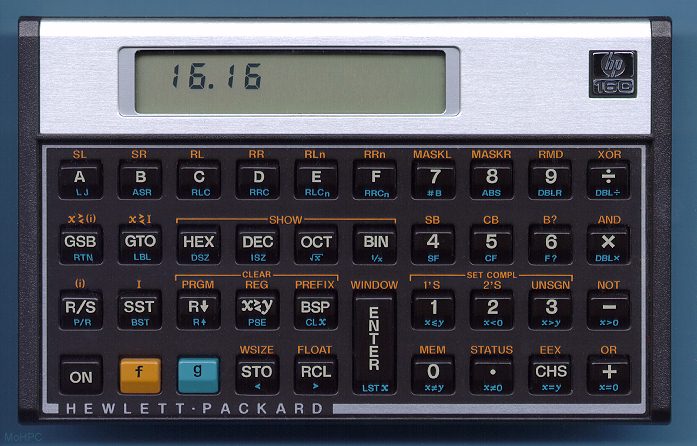
I agree, I still have both my HP-11C and HP-16C (the programmer's model with hex and binary) and they both work fine.
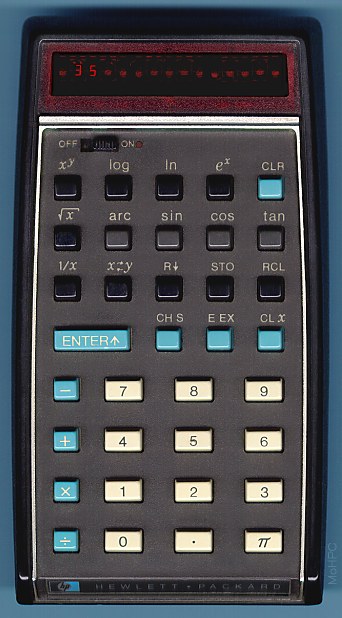
However, I think the toughest HP calculator has to be the original HP-35. I remember seeing my college roommate throw his against a wall (I can't recall exactly why - I think he was demonstrating how tough it was) but it wasn't scratched and worked like a charm. They were built like bricks (the LEDs were hard to read though).
Never let reality temper imagination -
Re:HP 1x Calculators
I agree, I still have both my HP-11C and HP-16C (the programmer's model with hex and binary) and they both work fine.
However, I think the toughest HP calculator has to be the original HP-35. I remember seeing my college roommate throw his against a wall (I can't recall exactly why - I think he was demonstrating how tough it was) but it wasn't scratched and worked like a charm. They were built like bricks (the LEDs were hard to read though).
Never let reality temper imagination -
Re:HP 1x Calculators
I agree, I still have both my HP-11C and HP-16C (the programmer's model with hex and binary) and they both work fine.
However, I think the toughest HP calculator has to be the original HP-35. I remember seeing my college roommate throw his against a wall (I can't recall exactly why - I think he was demonstrating how tough it was) but it wasn't scratched and worked like a charm. They were built like bricks (the LEDs were hard to read though).
Never let reality temper imagination -
I still have my Teledyne Post in my officeAdmittedly, it's on the museum shelf next to the original red spiral bound 4.2 BSD manual. Unfortunately, the Pickett I had in high school disappeared years ago.
My freshman college math teacher used a Curta for routine calculations.
My entire 1974 tax return went into purchase of an HP 45. The slide rule didn't get much use after that, but I kept it around because it would work without batteries.
-
Re:No, and what the hell is the index line?
It's very simple, but ONLY IF YOU HAVEN'T READ THE INSTRUCTIONS IN TFA!
Try the below, it might possibly undo the damage done by the original instructions.
http://www.hpmuseum.org/srinst.htm
I'm new to slide rules as well, but having seen how it works, I'm definitely getting one. It seems superior to a calculator to me, as long as you only need a couple significant figures. Now if only there was a wallet-size one, so I could calculate tips. -
Re:No, and what the hell is the index line?
Better instructions...
http://www.hpmuseum.org/srinst.htm -
I found this page easier to understand
http://www.hpmuseum.org/srinst.htm
Og like pretty pictures. -
Don't forget the HP 9100
Although the HP 9100 of 1968 was a desktop calculator and not a hand-held, it was programmable with IF statements (somewhat like BASIC), and model B about a year later implemented subroutines. One could call it the "first microcomputer".
http://www.hpmuseum.org/hp9100.htm -
Re:Funny...yes...however.....
Besides being a very efficient way to enter formulas into a calculator, one of the nice things about RPN was that people didn't want to borrow your calculator.
If only this was true for all HPs
my HP 27s was stolen
I miss that calc , couldn't replace it so I got the new 49G , just before the G+ was announced
for those in windows land who have never knowen a HP calc , get Emu48
(even that can't emulate the HP 27s -
Only 35 years?? Pah!
My day to day calculator is an HP-14b
50th Anniversary Limited Edition!, with the waaayyy coooool SWAP key. Talk
about turning it up to 11!
[joke]
And it doesn't rely on that arse-backwards RPN crap either.
HP did include an INPUT button to make engineers feel at home, although why
engineers would want a calculator with:
- time value of money
- return on investment
- inventory turnover rate
is beyond me.
[/joke]
(dons flame suit anyway because poking at beloved RPN
is dangerous around here) -
What about the HP-16C
I hold in my hands my cherished HP-16C that soldiered through many an assembly language and C implementation, not to mention device drivers. I would think that to a computer type, this might have more meaning.
And it is also 25 years old, according to the calculator museum site.
http://www.hpmuseum.org/hp16.htm -
Re:TI
Wow, I must be really ignorant, but because every school across the country seemingly pushes TI use in school, I didn't think people used anything else.
Back in the day when HP still made calculators, everyone else -- TI included -- played second fiddle. HPs were the premier pocket (or belt-loop pouch) calculator from the early Seventies to the mid nineties, more capable, more durable and more desirable than TI, Casio, or any other pretender.
Too bad they abandoned the market and now only sell rebranded units from Asia. Check http://www.hpmuseum.org/ for the complete history of the HP calculator.
-
Bring back the HP-16C!
http://www.hpmuseum.org/hp16.htm
I need a calculator that can do hex, and shifts, and bitwise operations. I mean I love my TI LCD Programmer, but I really miss the shift operations... -
Re:Take a good look..
Not a good comparison. 20 years ago, this was the calculator, which is pretty similar to what we use today. Even 25 years ago, the calculator was a significantly powerful computing machine capable of mass storage, and still fit in a pocket. To get to really massive machines, one has to go back to the pre transistor days, when the mechanical machines were 40 pounds.
-
Re:Take a good look..
Not a good comparison. 20 years ago, this was the calculator, which is pretty similar to what we use today. Even 25 years ago, the calculator was a significantly powerful computing machine capable of mass storage, and still fit in a pocket. To get to really massive machines, one has to go back to the pre transistor days, when the mechanical machines were 40 pounds.
-
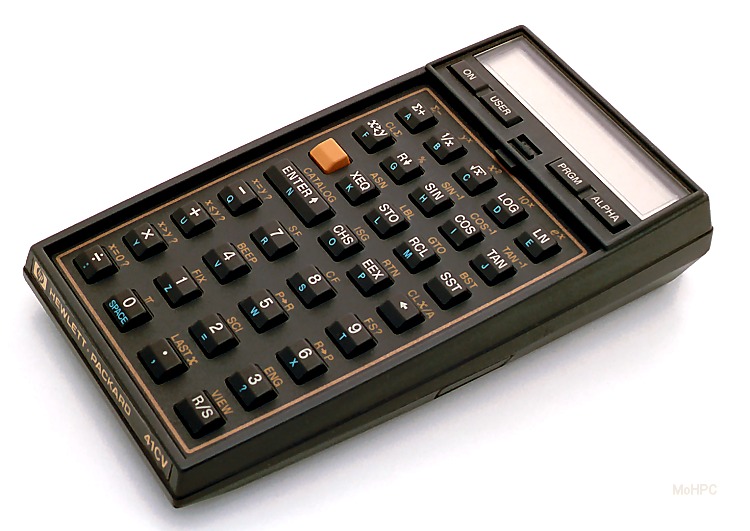
Re:PDA?It was basically an offline memory expander. You could store programs on magnetic memory cards to be read back later. You could buy some pre-programmed ones, but most of us would just write our own programs and store them. It actually was a huge upgrade over the punch cards that everyone who couldn't afford one had to use at the campus computing center. A bunch of us chipped in together to buy an infrared thermal printer (another accessory for the 41) and then we would share it around to print out programs steps and results.
From the HP museum:
"The HP-41C represents a totally new concept in the design of Hewlett-Packard calculators. In fact, because of the advanced capabilities of the HP-41C, it can even be called a personal computing system. The HP-41C is the first Hewlett-Packard handheld calculator offering an exciting array of alphanumeric capabilities.
With so many different kinds of calculator uses and applications in the world, we at Hewlett-Packard decided we could provide a significant contribution by designing and building you a quality calculator with expandable and flexible capability. The alphanumeric HP-41C is just the calculator."
The HP-41CV was the same as the HP-41C except that it had four memory modules built in for a total of 319 registers. (With the four ports still available to add other modules.) The HP-41CX was the same as the HP-41CV but added the Time module (stopwatch plus clock with alarms), an Extended Functions / Extended Memory module, a text editor, and some additional functions.
The 41CX was, and still is, a great calculator. The only one I've seen that I might upgrade to would be a 48SX, but now I've moved to a PDA with SpaceTime on it. Though 2/3 of the time the old 41CX is faster to turn on and use.
-
Re:HP 48GX is an Amazing Calculator
-
Forget the crap
Real calculators are not computers; they do not have graphics, they do not produce diagrams or plots, they will not dull your brain by helping you with symbolic math, they do not even have alphanumeric displays. Programmable calculators are not programmed in any programming language like BASIC, they are programmed by punching the keys, a straightforward action that will result in interesting, numeric, codes on the single line, 7-segment display.
Real calculators were produced by HP and used RPN, only RPN.
The last *real* calculator HP produced, and, obviously, the greatest calculator that will ever be produced, was the HP 15C. http://www.hpmuseum.org/hp15.htm
If you need more, get yourself a computer, not some pitiful electronic experiment.
Finally, real calculators are never used for counting money, they are only used for scientific and engineering calculations. -
Re:TI nspire
I ran into an very insightful discussion on this very subject earlier tonight (while googling around based on stuff I ran into here in this discussion). The second post down I especially thought made a lot of sense.
-
Re:Casio FX-7500g
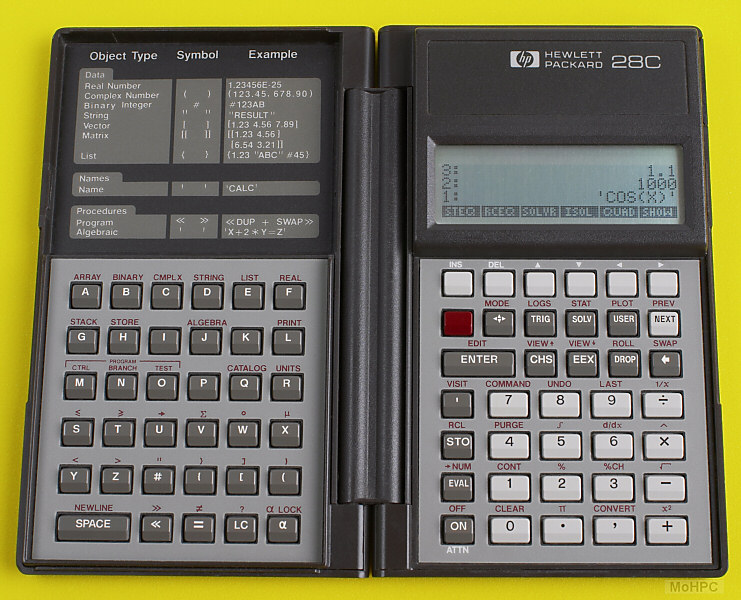
See the HP-28C/S. You can still find them on eBay at reasonable prices.
-
Wasn't this suposed to decrease over time?Looks like there is no top value for the comsuption of home gadgets.
I can understand that the processing power is now much higher than some years ago, but still, looks like nobody really cares much about the power demands of these because what really sells are the meaner and faster machines.
20 years ago you could get a Hewlett Packard HP-11C calculator that lasted (yes, it's true) 10-15 YEARS with a set of 3 cell sized batteries.
Still some 10 years ago you could get an HP-200LX, a complete MS-DOS portable system, that lasted easily 1 month on 2AA batteries (I'm talking about a small laptop computer here).For more information try http://www.hpmuseum.org/
It's difficult to find these ones for sale, but try here for Europe http://www.rpncalcs.com/
-
Old Hewlett Packard RPN and RPL CalculatorAlthough not exactly a computer, they can be considered one, having sometimes replaced bigger computer on space missions (in the space shuttle for instance they used a modified HP-41CV that had the characteristics of the later HP-41CX).
Those were extensively programable and used reverse polish notation, many engineers still use them today.
They are normally not up for sale anymore but you can check this site for instance that still has some of them: http://www.rpncalcs.com/For more information you can also check this site:http://www.hpmuseum.org/
-
Re:Not surprised
Bah. HP changed when they shifted their focus from engineering to sales. They used to make some of the world's best scientific equipment, but they sucked the soul from that and spun it off. Likewise some of the best scientific calculators. Now their fortunes ride the tide of ink sales and everybody thinks of them as a PC supplier.
Oh well, at least we've still got Tektronix... -
Re:Do the math...
Speed of lunar creep away from Earth: 1.6 inches / year
Are we certain that that is (and will remain) a constant? If gravitational attraction drops to the square of the distance, then won't that rate accelerate as the Moon moves further away? Hmmm, I actually have a calculator handy, too bad I've got a data integration meeting in fifteen minutes... -
Actually the early NASA engineers had Slide Rules
The ealry NASA engineers probably learned to use sliderules - http://www.hpmuseum.org/sliderul.htm and therefore learned how to approximate real well.
If you punch numbers into a calculator and hit the wrong buttons and don't know how to approximate... well you don't always realize your answer is off. -
How times have changed
It was hard enough reading text on the 5" screen of the Osborne 1, especially when run in 80 column mode back in the 80s. Heck, not too many years before, geeks were having fun getting the HP-41C goose to fly backwards.
Now these young whippersnappers at Samsung are rocking the boat! Get your microscopes out! -
Re:wtf?
the original HP hand held calculators was an engineering idea and the marketing department saw it as a useless one before they started selling as hotcakes.
And that page, friends, is what geek pr0n looks like.
Ooh, so pretty...