Slashdot Mirror
Domain: msn.com
Stories and comments across the archive that link to msn.com.
Stories · 914
-
Spider-Like Catamaran Travels 5,000 Miles On One Tank
Lucas123 writes "Proteus, a Wave Adaptive Modular Vessel that looks like a spider, is so fuel efficient that it can travel 5,000 miles on one load of diesel fuel. The 100-foot-long, 50-foot-wide boat rides on metal and fabric pontoons that have hinges and shock absorbers to flex with the motion of the waves, which helps it to skim over the water at a max speed of 30 knots. It made its debut yesterday in New York harbor." -
Green Cars You Can't Buy
Geoffrey.landis writes "Auto industry blogger Lawrence Ulrich notes that Honda is now making a "Partial Zero Emissions Vehicle" (or PZEV for short) version of the 2008 Accord, an all-new vehicle that is redesigned to meet California emission standards. He notes "So, just how green is a PZEV machine? Well, if you just cut your lawn with a gas mower, congratulations, you just put out more pollution in one hour than these cars do in 2,000 miles of driving." But the irony is that it's actually illegal for automakers to sell these green cars outside of the special states they were designed for! Apparently, anybody selling one of these ultra-green vehicles out of the correctly-designated venue — which means either California, or seven northeast-states with similar pollution laws — "could be subject to civil fines of up to $27,500. Volvo sent its dealers a memo alerting them to this fact, noting that its greenest S40 and V50 models were only for the special states."" -
PAX 2007 In A Nutshell
Last weekend the dark horde of nerddom descended on Seattle, entering the heart of the 'Emerald City' to gorge itself on the music, culture, and humor of gaming. The Penny Arcade Expo (PAX) once again brought together fans of the influential webcomic for a festival that, without even trying, seems to be taking the place of old E3. Though they were expecting around 30,000 people, the word was that by early Sunday they'd already gone through some 40,000 badges. There were DSes everywhere, concerts at night, a packed exhibit hall, and benchmark comic strips created by Mike Krahulik and Jerry Holkins adorned almost every wall. Despite all the people and the noise, somehow the event had a community feel to it that was hard to understand ... and even harder to describe. I'll try, though, along with impressions from games on the show floor and the incredible music of folks like Jonathan Coulton and the Minibosses. Read on, and All Hail Ball. The Early Weekend
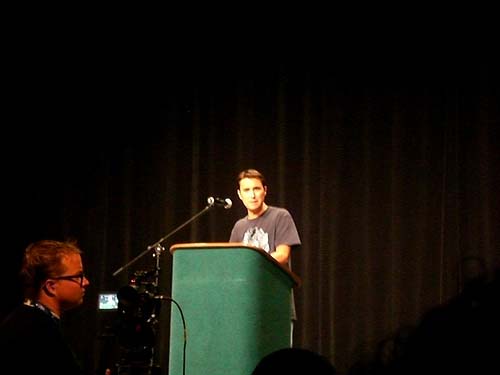
If you missed my discussion of Friday's events, it's understandable; it went up this past Saturday. Suffice it to say that Wil Wheaton's keynote speech was the highlight of the evening. His praise of social gaming, and the relationship-building power of the PAX-goer's favorite pastime resonated incredibly well with the packed theatre. The after-action report on his blog says it all: "My keynote went perfectly, and the audience (and the gaming press online) responded to it in ways I never dreamed possible. I didn't think there would be slightly more than 5000 people in the room when I spoke ..."
The first Penny Arcade Panel featured a lot of middlin' questions, highlighted by the incredible singing power of Jerry Holkins. A description of his performance is in my weekend update, but the real surprise didn't come until after the questions were done. The end of the panel turned ugly when the PA gents left the stage for Uwe Boll to have a chance at the mike. Gabe said later that weekend that he was surprised by the crowd reaction. "You can tell when a crowd is angry, and this was the first time I've felt that at at PAX." The unapologetic Boll was screamed at fairly mercilessly by the attendees.
Other events from the early weekend included a discussion of modern storytelling in videogames. Luminaries Ron Gilbert (Monkey Island), Dave Grossman (Sam and Max) and Nate Fox (Sly Cooper) came together to jaw on a topic near to their hearts. The group discussed linear stories vs. sandbox-style gameplay, user-created content, kids games, and the importance of theme even if your core story isn't all that great: "Grossman [said], 'Well, story isn't just about dialogue and narrative, right - I mean really you want to learn something about the human experience. I think that if I weren't doing adventure games I wouldn't think of myself as a narrator, but rather as the hand of fate. I'm going to kind of let you run around and do what you want and everything. Just to let the player go around and do what they want - they can feel like it's the good hand of fate or the bad hand of fate, but not that they're completely being controlled.'"
The Rain-Slick Precipice of Darkness, the Penny Arcade videogame currently in development, was a visible presence at the show all weekend. The Friday unveiling of a new game demo to the media at a special Q&A event was followed by a weekend's worth of running through the game for attendees on the show floor. Most everyone got to see the title, and hear the news that it will be coming to Xbox Live alongside its PC distribution avenues. The opening, grim, text still makes me smile: "Four gods wait on the windowsill / Where once eight gods did war and will / And if the gods themselves may die / What does that say for you and I?"
PA Panel II
While the first PA Q&A panel was entertaining just to hear Holkins and Krahulik talk, the second panel actually had a number of insightful questions, touching statements, and funny moments. And, thankfully, there were no stoned guys rambling about their paranoid fantasies at the microphone; always a plus. Long queues formed at the two microphones to question the gents, and here are some highlights:- Paul Barnett, Design Manager for the Warhammer Online Massively Multiplayer game, drew applause for his short advertisement during a trailers reel before the event started. He used his clipped British wit to compare Warhammer to World of Warcraft like so: If you're going up against the Beatles, don't try to be the Beatles. You'll end up looking like the Monkees. Instead, we're going to be Led Zeppelin.
- A question about the changes to the primary characters over the year led Mike Krahulik to discuss his influences, such as Stan Sakai. He's essentially 'never finished' with the characters, and we can expect to see further changes to his art style in the coming years.
- Drawings of Gabe and Tycho in ping pong outfits prompted readers to ask if we would ever see that as a project down the road. They're enthusiastic about it and would love to do it, as up until now readers have just seen a few simple images. To further tease us, they described the backstory to the piece: Set in the 80s, a cold war US is still facing down Russia. A little-known clause in the UN charter states that table tennis can be used to decide grudges; the loser forfeits their country. The US table tennis team is slain, and so a group of four people at ping pong camp (including our protagonists) are drawn into international excitement.
- A question about the appeal of the Halo franchise has the gents noting that the series has grown on them considerably.
- In negotiating the price for the XBLA version of the Rain-Slick Precipice of Darkness, they feel they'll have a good deal of leverage as regards pricing (and content as well).
- Several great ideas for projects and future PAX ideas are mentioned, including support of a nerdcore show currently touring the area and an Indie Games FreePlay area.
- When asked about origins of the hobos in Precipice of Darkness, Tycho notes that the game is a 'hobage' of different sources. The Achievement for 100 hobo kills? Hobicide.
- A reader challenges the two to a thumb war, which Jerry wins quite promptly by kicking Gabe in the nuts. He declines to continue, saying he 'values his beanbag.'
- When asked to endorse some games on the exhibit show floor, both gentlemen put their weight behind Eye of Judgement and Sega Rally.
- Someone notes that the current in-the-works game is very much a 'Tycho' game ... lots of words. He wonders what kind of 'Gabe' game they'd like to make. Mike ponders the concept of a brawler, or perhaps something not unlike Turtles in Time.
- The idea of making sure the ball comes back to PAX every year, 'to recharge' is brought up. It could then be sold on eBay to help fund the annual Child's Play charity. They both really like this idea.
- A reader asks what the 'worst thing' either of them have ever done is. Mike tells the story of a time when he set a trap for his family's cat in the backyard, and ended up stringing up the pet by the neck into a tree. It survived, but he has always felt terribly. Jerry, on the other hand, equivocates. When Mike gets tired of it, he tells a story of Jerry drinking a glass of Chai and finding a bug near the bottom of his glass ... which he then upended and finished after fishing out the bug.
Having had a good look at the game at Gen Con, I used my PAX chance to talk to the folks at EA Mythic to dig a little bit deeper on one of the game's claims to fame: Realm vs. Realm combat. Just hours before I spoke to the folks at EA, a team from their company had announced professions from the High Elf and Dark Elf factions for the very first time. I tried to glean just a little bit more PvP-specific information about these races for you, but it was not to be.
Just the same Ryan Barnard (game designer) and Eric Correll (producer on the game) were very forthcoming. The pair was happy to discuss different elements of their signature game feature. For example, new players will have the PvP-focused game introduced to them gradually at low levels. There's a soft introduction, beginning that portion of the title's seamless integration into the overall gameplay. Open-world PvP in specific parts of the starting zones will most likely be their first exposure. Quests will lead them to RvR areas, and eventually will direct them to the instanced 'Scenario'-style missions. Throughout the game, the portion of land that is focused on these activities starts small, but eventually dominates gameplay; the RvR 'city capture' system is Warhammer's 'end game'.
Warhammer Online's unique systems, like the Tome of Knowledge and the Public Quest, also touch on RvR. The Tome will explain elements of Player vs. Player combat, and will record your successes in battle. RvR Public Quests, meanwhile, are currently undergoing retooling. They want them 'right', and currently have taken them all out of the game to make sure they're just so; they hope to have them back into the game by launch.
This feel of 'rightness' is something they're aiming for in their scenarios as well, with the goal of integrating these instances not only into PvP progression, but the ongoing story of the game as well. Each is themed to the area they're in, and tells the tale of a specific conflict between the Order and Chaos armies.
Introducing players who might not otherwise participate in RvR into the fundamentals of that gameplay style is also something the team is focusing on. While they acknowledge that some people just don't want to play against other players, they see folks who are hard and fast about that rule as the minority. They're looking to make PvP a core part of the game, and as such they'll be approaching it differently than a primarily PvE focused game might. This affects multiple game design elements, all the way down to the 'hook' of Public Quests, which gets folks who might not even ever group thinking more favorably about gaming with others. Racial pride is also a factor; by priming characters from low levels to be 'pro-Dwarf', or whatever, players will be more likely to come to their society's aid. They're all steps in a chain, the team hopes, to changing outlooks soured by less focused titles.
On the other side of the equation, the end-game city capture system sees factions sacking the racial homes of their opponents. Though reluctant to use the term 'end game' specifically, the team members were happy to admit that it will be the focus at max-levels. RvR combat will funnel players towards the opposing side, hoping to push the 'antagonists' back to their city walls. They also pointed out, however, that there are other elements in play at that high level. PvE content and public quests are still around, though diminished, and they have plans to further expand both sides of the max-level content once the game is released.
Organized Play, as featured in Guild Wars and now World of Warcraft, is not something they're currently planning for. They'd love to eventually do tournaments for RvR teams at some point, but they're so focused on getting it out the door in a timely fashion that it's not particularly on their radar. As they put it, "we hope we have that problem".
The cutting edge of their work is, obviously, on the Elves at the moment. They're still working to tune the scenarios and open-world play for the Elven areas, and are always working to ensure that classes are balanced and the 'fun' is present.
This cutting edge blends well with some of the surprises that the team had in store for them when masses of people finally entered the Beta. Probably the most surprising for the RvR team: their carefully crafted points of control battlefield objective system, which requires holding targets in open-world PvP, are almost completely being ignored. While they worked hard on this mechanic, the players are more interested in the actual act of combat when in an open-world environment. Scenario tactics are welcomed, but outside of those instances the two sides really just want to enter the fray. The team hopes to have them in the game in some capacity, but they're going to undergo heavy retooling before that happens.
As we wrapped things up, we discussed the reflection this decision has on their overall attitude towards the game: if it's not working, it needs to go/be fixed/tuned/rehashed/whatever. Killing what you thought was going to be the end-all be-all is not outside the realm of possibility, even this late in the game. RvR, and the game in general, has to be fun. No exceptions.
Fury
I'll be honest: Fury came at me from nowhere. I'd read about it before coming to the show, knew that it was approaching an Open Beta, and that it was a free-to-play PvP title. That was just about all I knew when I sat down to play and chat with Fury's lead designer Adam Carpenter.
When you're trying to quantify Fury's gameplay type, it's better to think less about online RPGs and more about first-person shooters. Fury has essentially taken the swords and sorcery milieu and dropped that whole cloth into an FPS schema. In each match, players spawn in, rush out, and slam into each other in extremely fast altercations. Everything is fast; from character creation to combat can be just a few minutes.
This is the underpinning of developer Auran's outlook: fun, fast, and free. Instead of grinding through a PvE component, Fury characters are built entirely around a series of abilities and equipment available at character creation. Each character can play whatever role you want them to in a given match, and their role can be changed freely between altercations. Want to act as a support class in one match? You put on your gear that aids healing type abilities, load those healing abilities into your hotbar , and go. Want to act as a ranged DPS class? Swap those healing bits out for the appropriate gear and powers. Players will never have to whine about not having the right class for a fight, as everyone has flexibility.
Gameplay itself, character abilities, focuses on colors. Your ability bar is full of various attacks, and they are themed around different colors. Each player has a small gauge on their screen to help ascertain how many color points they have built up. These points are gained by using 'low level' colored abilities. A basic blue attack, for example, might give you one blue point. As you move through combat, your gauge will fill with colored points. Higher points unlock the use of more powerful abilities on your hotbar, which in turn use up your points. Fascinatingly, each ability color has a diametric opposite; red points counter blue points and players with red points in their bar will actually be less effective with blue abilities. This led the designers to create special point-manipulating abilities; in the middle of the fight you can switch a player's point colors. You can also steal points, leading to the 'change-their-color-steal-their-points' combo move, leaving your opponent defenseless and cold in the world.
Each color has a sort of 'theme', with green abilities having a sort of nature-y feel to it, while blue abilities being sort of icey. There are ranged and melee abilities in all colors, so there won't be any particular demanded role for a color ability. For most players the only real constraint will be up to what abilities you have on hand as a result of previous accomplishments. While most common abilities will be available by default when you purchase the game, new powers will be unlocked via achievements as you succeed in combat. Achievements include everything from taking the most objectives during a match, to killing the most people, to healing the most ... and your rewards are appropriate for what you accomplish.
Rewards on the equipment side are a bit more random. After completing a match, random loot is generated for the party, and people /roll for it. That's pretty much 'the way it is', going right around the usual sort of arguments at pick up group might have when dealing with looted gear. Gold is equally distributed, of course, and both items and gold are commensurate with your success in the just-completed mission.
It's worth noting here that Fury will have a for-pay option, allowing you to slap down a subscription fee if you want ... but it will have nothing to do with the quality of your in-game items. Money is only given to the Auran folks for the addition of convenience and depth. I should say there is some overlap with items: one of the for-pay conveniences is the ability to roll on three items instead of two. A for-pay player has a bit more in the way of item space, some options for purchasing things from vendors, and other simple things that makes the game just a little bit easier for having forked over your cash. Depth, in this case, is all about in-game ladders. While free players will compete on ladders of various types, paying players will have a long list of different ladder types to participate in. Server, guild, and individual progress will all be tracked for various rewards and bragging rights.
Those bragging rights will come in the form of an online representation of your character's escapades. Kill counts, 'flag' steals, and other metrics will be tracked on an official page for your character, and viewable by anyone. Guilds with an interest in going deeper into min-maxing can make use of the human-readable stats that will be generated locally by the client in a text file. Officers can collect these document to see which builds are working, which aren't, and where the group as a whole needs to focus.
The game build playable on the PAX show floor was already five months old, and showed it. There were server problems a few times, and the game looked more than a little bit jaggy. Even through the cruft, though, there was a lot of promise showing through. The settings were gorgeous despite the outdated rendering model, and the fun factor of actual play was very high. Fury is a simple, brutal combat game, and it makes no pretensions about it. With the promise of free online play for the price of a PC game title, this seems like a pretty nice package. It's definitely not going to be for everyone; there's none of the painstaking polish of Guild Wars, or the deep PvE experience of World of Warcraft. For folks looking for a quick, focused good time Fury may just be what you're looking for.
Jonathan Coulton, Frontalot, Minibosses Concert
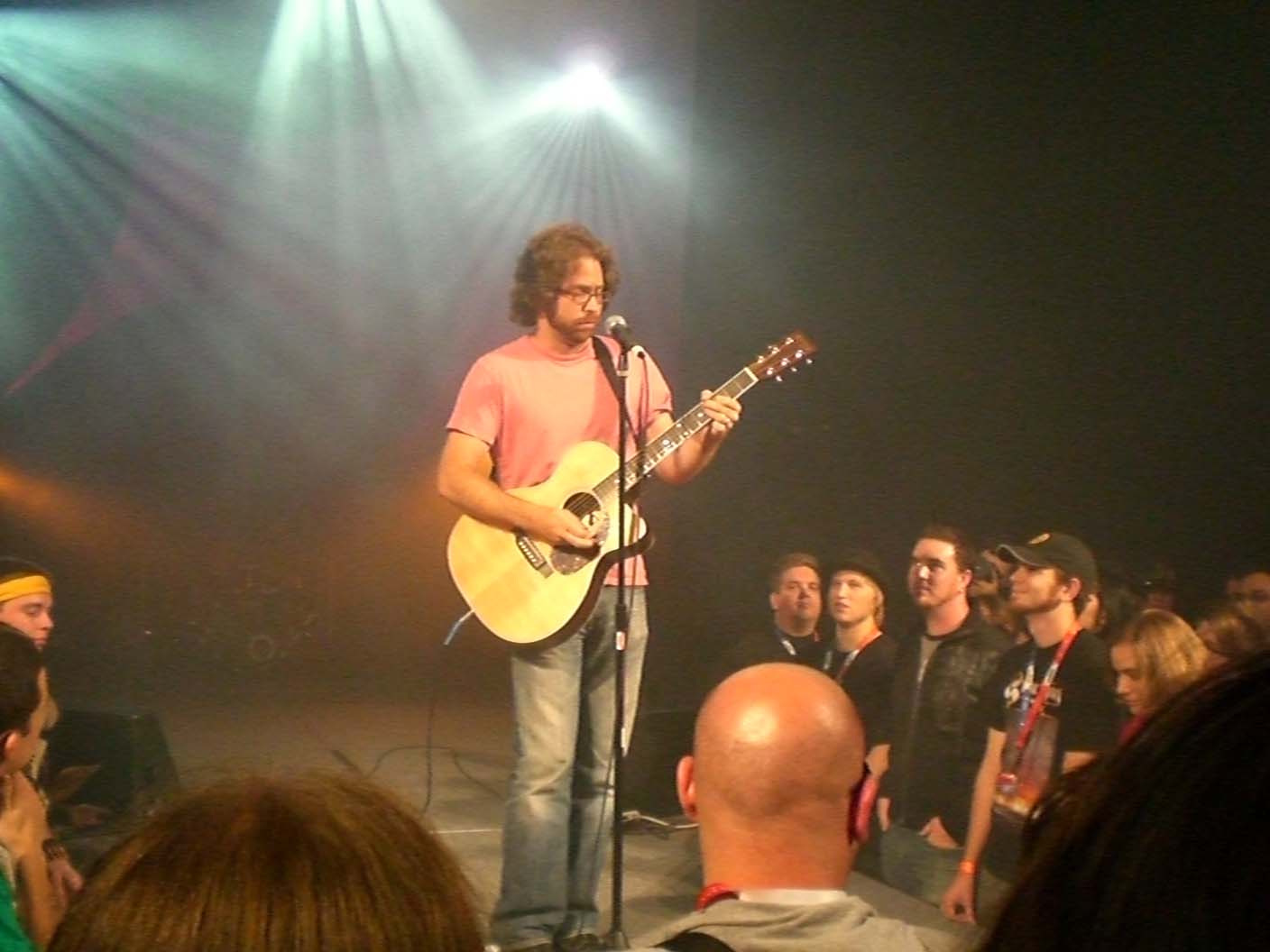
I'm sure many of you could have told me how transcendent Jonathan Coulton's music is, but when I entered the theatre on Saturday night for the triple-headed mega-show I was something of a Coulton newb. I'd heard Code Monkey, of course, but I'd never made much of an effort to seek out his music. Whether it was his intent to really reach the audience that night or not, he made a convert out of me. His haunting lyrics about superficiality, squid, cybernetics, robotics, technology, programming, and zombies were funny, touching, and thought provoking. I asked a friend who followed his music to confirm for me that he usually doesn't play terribly large venues. I had to ask because it was only really apparent during the few moments when he paused to take in the size of the audience. He was really, very good. Coulton had easily the largest crowd of the night, with his mass dwarfing even the groups on hand later for MC Frontalot and the Minibosses. His final song for the night, re: Your Brains was tremendous to experience in the midst of thousands of hand-waving flesh-craving growl/singing faux undead. Both Frontalot and the Minibosses put on amazing shows as well, of course, showing off their polished shows and firm grasp of their material. Frontalot was in rare form, with several new songs of his most recent album. Just the same ... Coulton was the show of the night for me, and it was a privilege to be able to see such a great act in person.
The Games And Panels of PAX
There were so many events and games, demos and panels, at the event that I couldn't make it to every interesting experience. Thankfully, other sites can pick up the slack.
The panel on licensed games explored the pros and cons of using someone else's IP to make a title. "Too many cooks in the kitchen" was seen as the primary problem, with the high cost associated with such a deal a close second.
"Pitch Your Game Idea" is always a very well-attended panel, and this year was no exception. Dozens and dozens of people lined up to present their game ideas to a panel of industry veterans. They were then 'cut', American Idol style, working through less solid game ideas towards the pearly center. There were apparently a surprising number of women there, and the contestant that won was one of them. Her simple, Pong-like concept had a graphical background that became more complicated as the game went on.
That showing would have been a relief to the folks at the very well attended "Women in Games" panel. The event focused around the challenges of entering the industry, and the issues associated with working the day to day grind once you're in.
A number of folks had hands-on time with titles I didn't get to, including Haze, Tabula Rasa -
China Says Tibetans Need Permission To Reincarnate
michaelcole writes "China has banned Buddhist monks in Tibet from reincarnating without government permission. This article is both hilarious and sad, looking at the lengths to which a government will go to regulate thought through censorship. It also goes into some of the more subtle politics of the current 72-year-old Dalai Lama as he thinks about his political and spiritual successor. The Dalai Lama 'refuses to be reborn in Tibet so long as it's under Chinese control.'" -
NID Admits ATT/Verizon Help With Wiretaps
Unlikely_Hero writes "National Intelligence Director Mike McConnell has confirmed in an interview with the El Paso Times that AT&T and Verizon have both been helping the Bush Administration conduct wiretaps. He also claims that only 100 Americans are under surveilance, that it takes 200 hours to assemble a FISA warrant on a telephone number and suggests that companies like AT&T and Verizon that "cooperate" with the Administration should be granted immunity from the lawsuits they currently face regarding the issue." -
TSA's "Behavior Detection Officers"
Stanistani sends us to MSNBC for a dyspeptic Newsweek commentary on the TSA's latest attempt to make air travel safer: the rather ominously named "Behavior Detection Officers" now working in a dozen US airports, and slated to go nationwide in 2008. They are trained in the discipline of reading "micro-expressions." The editorialist calls that a pseudo-science, but in fact it's a well-understood skill that can be taught and learned. A cursory look at this TSA program might put one in mind of Orwell's "facecrime," and that's the road the Newsweek writer goes down. Yet some who bemoan the security theater historically run by the TSA point to the gold standard of airport security, Tel Aviv airport, and wonder why TSA officers can't act more like the Israelis. Bruce Schneier wrote recently about one reason why the Israeli security model isn't completely transplantable to these shores: scale. And here's Schneier's take on behavioral profiling from a year ago. That's what the BDOs will be trying for: scrutinizing intent instead of pocket knives. Let's just hope they don't get swamped with false positives. -
Industry Fallout from GTA IV Delay
SET writes "MSNBC has an interesting writeup on the shakeups in the gaming industry following Take-Two's announcement that Grand Theft Auto IV has been delayed. The article examines the problems this creates for Microsoft and Sony, both of whom were expecting GTA IV to help boost Xbox 360 and Playstation 3 sales this coming holiday season. 'Analyst Michael Pachter told Web site GamesIndustry.biz that he believes Rockstar has delayed the game because it is struggling with development on the PlayStation 3. Sony denies this charge and said that the company has a dedicated team working with Rockstar on "GTA IV." They say they're not that worried about the delay and would prefer that Rockstar take the time it needs to perfect the game. "We'd love to have [it] out as soon as possible," said Sony spokesperson Dave Karakker. "But we've never had a single game make or break any of our platforms. That's not how we built 100 million sales of [the] PlayStation 2, and that's not how we'll build 100 million in sales of [the] PlayStation 3."'" -
Largest-Known Planet Befuddles Scientists
langelgjm writes to mention that scientists are quite puzzled over the discovery of the largest planet yet. According to study-leader Georgi Mandushev it should theoretically not even be able to exist. 'Dubbed TrES-4, the planet is about 1.7 times the size of Jupiter and belongs to a small subclass of "puffy" planets that have extremely low densities. The finding will be detailed in an upcoming issue of Astrophysical Journal. [...] "TrES-4 is way bigger than it's supposed to be," Mandushev told Space.com. "For its mass, it should be much smaller. It basically should be about the size of Jupiter and instead it's almost twice as big." "TrES-4 appears to be something of a theoretical problem," said study team member Edward Dunham, also of the Lowell Observatory. "Problems are good, though, since we learn new things by solving them."'" -
FBI Raids Home of Suspected NSA Leaker
During the hours that Congress was debating codifying the Bush administration's wiretapping by revising the FISA law, the Department of Justice was raiding the home of former Justice official Thomas M. Tamm to identify the person who first brought the illicit program to light: "The agents seized Tamm's desktop computer, two of his children's laptops and a cache of personal files... the raid was related to a Justice criminal probe into who leaked details of the warrantless eavesdropping program to the news media... James X. Dempsey of the Center for Democracy and Technology said the raid was 'amazing' and shows the administration's misplaced priorities: using FBI agents to track down leakers instead of processing intel warrants to close the [purported surveillance] gaps." -
IBM to Regulate Employee Second Life Behavior
mytrip writes "In hopes of avoiding potentially embarrassing incidents, IBM is taking the unusual step of establishing official guidelines for its more than 5,000 employees who inhabit Second Life and other virtual worlds. 'IBM appears to be the first corporation to create rules governing virtual worlds. The move has critics, who say that mandating behavior for the so-called "metaverse" is unlikely to reform impish avatars. They also question why IBM would add a layer of buttoned-down bureaucracy to this relatively rollicking corner of the Internet. IBM executives counter that having a code of conduct is akin to a corporate stamp of approval, encouraging workers to explore more than 100 worlds IBM collectively calls the 3D Internet.'" This regulation may be coming from more than self-interest: IBM sees these environments as management training courses in some ways; working inter-personal skills via chat and human resources via guild activities. -
Testing Einstein's 'Spooky Action at a Distance'
smooth wombat writes "Travelling to a time in the past is, as far as we know, not possible. However, Einstein postulated a faster-than-light effect known as 'spooky action at a distance'. The problem is, how do you test for such an effect? That test may now be here. If all goes well, hopefully by September 15th, John Cramer will have experimented with a beam of laser light which has been split in two to test Einstein's idea. While he is only testing the quantum entanglement portion, changing one light beam and having the same change made in the other beam, his experiment might show that a change made in one beam shows up in the other beam before he actually makes the change." -
A Million PS3s Sold in Japan
Reuters is reporting that the PlayStation 3 has reached 1 million units sold in Japan. The article notes that the eight months the console took to reach this mark is roughly four times slower than it took the Wii. Of course, the 360 has only managed to eek out 420,705 units sold in a much longer timespan. To put things in perspective, an aging news report suggests that the PlayStation 2 sold 1 million units the first weekend it was released in Japan. Even the Wii didn't hit that, though that may have been an issue of supply rather than demand. Do you think there is a specific reason the PS3 isn't selling as well as the PlayStation 2 did, or is the market just a different place than it was 7 years ago? -
Mitochondria and the Prevention of Death
H_Fisher writes "Research into mitochondria — small structures within a cell that have their own DNA — suggests that they may be a cause of cellular death, according to Newsweek. The article The Science of Death: Reviving the Dead reports on people who have recovered from sudden death due to cardiac arrest through the use of medically induced hypothermia. The cooling process may help stop the death of brain and heart cells initiated by the mitochondria once they are deprived of oxygen. The article goes on to probe delicately at the question of where a person's personality 'is' between death and later revival, and describes several ongoing scientific studies of near-death experiences." -
Fresh Security Breaches At Los Alamos
WrongSizeGlass writes "MSNBC is carrying Newsweek reporting on two new security breaches at Los Alamos. Both of these latest incidents were 'human error' on the part of employees. In one, an e-mail containing classified material was sent over the open Internet rather than through the secure defense network. In the other incident, an employee took his lab laptop on vacation to Ireland, where it was stolen out of his hotel room. The machine reportedly contained government documents of a sensitive nature." -
France Bans BlackBerries In Govt. On Fears of Spying
DesertBlade writes "French government officials are no longer allowed to use BlackBerries for official correspondence. The reason? Fear that the US government will snoop out French national secrets via RIM's network. From the article: '"The risks of interception are real. It is economic war," daily Le Monde quoted Alain Juillet, in charge of economic intelligence for the government, as saying. With BlackBerries, there is "a problem with the protection of information," he said. Juillet's office confirmed that he spoke to Le Monde but said he would not talk to other reporters. Officials at the presidential Elysee Palace and the prime minister's office were not immediately available for comment. Le Monde said information sent from BlackBerries goes through servers in the United States and Britain, and that France fears that the U.S. National Security Agency can snoop.'" -
Can Blizzard Top StarCraft?
MSNBC is running an interview with Blizzard designer Rob Pardo discussing a number of facets of the upcoming StarCraft II. Informational tidbits include the fact that, unsurprisingly, the game won't be released this year, and some background on the game's long development cycle. "Penny Arcade figured it out! We keep games under code names and we teach developers to refer to games by their code name. And we're just really careful about talking about the game internally. We don't bring external folks through unannounced product areas. But I think even I'm surprised that we were able to keep it under wraps all the way to the end." -
Dell Plans to Sell PCs at Wal-Mart
DJAdapt writes "In a departure from Dell's approach of selling machines only directly to customers, a Dell spokesman said Thursday that the computer maker will begin selling two of its Dimension desktop computers in about 3,000 Wal-Marts beginning June 10. Dell spokesman Dwayne Cox said the Wal-Mart deal 'represents our first step' into global retail. 'Customers want more and new ways to buy our products, and we plan on meeting their needs on a global level,' Cox said. 'Offering Dell Dimensions in Wal-Mart is a great example of this approach.'" -
Experts Now Say JFK Bullet Analysis Was Wrong
Spy Handler writes "Researchers analyzing bullet fragments from the 1963 Kennedy assassination using new techniques say that the government's 1976 conclusion that the bullets came from only one gun (Oswald's) is wrong. 'Using new guidelines set forth by the National Academy of Sciences for proper bullet analysis, Tobin and his colleagues at Texas A&M re-analyzed the bullet evidence used by the 1976 House Select Committee on Assassinations, which concluded that only one shooter, Oswald, fired the shots that killed Kennedy in Dallas. The committee's finding was based in part on the research of now-deceased University of California at Irvine chemist Vincent P. Guinn. He used bullet lead analysis to conclude that the five bullet fragments recovered from the Kennedy assassination scene came from just two bullets, which were traced to the same batch of bullets Oswald owned.'" -
Fruit Flies Show Spark of Free Will
Lucas123 writes "A study performed at the Free University Berlin on human free will has produced some unexpected results showing that fruit flies may have a spark of free will in their tiny brains." From the article: "Their behavior seemed to match up with a mathematical algorithm called Levy's distribution ... Future research delving further into free will could lead to more advanced robots, scientists added. The result, joked neurobiologist Björn Brembs from the Free University Berlin, could be "world robot domination." -
Tech Billionaire Boot Camp
theodp writes "Forget the Summer of Code. If you've got a hot idea for a start-up, Newsweek says Y-Combinator, the boot camp where Silicon Valley meets 'American Idol', is the place you should be. 'Some critics scoff that Y Combinator's investment is peanuts for that amount of equity. But the opportunity is unparalleled -- total immersion into Silicon Valley start-up culture, advice from Graham and a fast track to the top angel investors and venture-capital funds. When Graham calls the winners, the founders have only five minutes to accept. "If people turn us down," he says, "as far as we're concerned they've failed an IQ test."'" We've previously discussed the program on the site, just over a year ago. -
A Chip on DVDs Could Prevent Theft
Dieppe writes "A simple chip added to a DVD disk could prevent retail theft. According to the AP article at MSNBC, the chip would be activated at the register to make a previously dark area of the DVD clear, and therefore readable. Could this help to stem the tide of the approximate $400 million dollars in losses from brick and mortar stores? Game console DVDs could also be protected this way too. Could this help to bring the prices down on DVD games and movies?" -
CNN To Release Debates Under Creative Commons
remove office writes "After calls from several prominent bloggers and a couple of presidential candidates, CNN has agreed to release the footage from its upcoming June presidential debates uncopyrighted. Senator Barack Obama was the first candidate to call for all presidential debates to be released under Creative Commons, with fellow Democratic hopeful John Edwards following shortly afterwards. CNN will be the first to do so with their June 3rd and 5th Democratic and Republican debates. MSNBC hosted the first presidential debates recently but refused to release them under Creative Commons, opting instead to post online only commercial-ridden clips in Windows Media format." -
Wally Schirra Dead at 84
UglyTool writes "Wally Schirra, the only astronaut to have flown on the Mercury, Gemini, and Apollo missions, died of a heart attack at a hospital in San Diego. Wallyschirra.com has much more on the man, his life, and his contributions to the American Space Program." -
Treating the Dead
FlyByPC writes "According to a NewsWeek article, oxygen deprivation doesn't kill patients as much as the resumption of oxygen does. This discovery could bring about new ways of resuscitating people whose hearts have stopped." -
T. Rex Protein Analysis Supports Dinosaur-Bird Link
LanMan04 writes "For the first time, researchers have read the biological signature of a Tyrannosaur — a signature that confirms the increasingly accepted view that modern birds are the descendants of dinosaurs. Analyzing the organic material (collagen protein) found inside the unique fossil linked the collagen to several extant species. The bottom line is that the T. rex's biological signature was most like a bird's, at least based on the first fragmentary data. "It looks like chicken may be the closest among all species that are present in today's databases for proteins and genomes," one of the scientists interviewed said." -
EU Rejects Microsoft Royalty Proposal
pallmall1 writes "According to MSNBC, The Financial Times has reported that the EU is going to drastically reduce or even eliminate Microsoft's proposed royalties on interoperability information required to be released by the EU's antitrust ruling issued three years ago. According to a confidential EU document, "Microsoft will be forced to hand over to rivals what the group claims is sensitive and valuable technical information about its Windows operating system for next to no compensation...". Even Neil Barrett, the expert picked by both Microsoft and the EU to oversee Microsoft's compliance with the 2004 ruling, says a zero percent royalty would be 'better.'" -
48% of Americans Reject Evolution
MSNBC has up an article discussing the results of a Newsweek poll on faith and religion among members of the US populace. Given the straightforward question, 'Is evolution well-supported by evidence and widely accepted within the scientific community?', some 48% of Americans said 'No'. Furthermore, 34% of college graduates said they accept the Biblical story of creation as fact. An alarmingly high number of individuals responded that they believe the earth is only 10,000 years old, and that a deity created our species in its present form at the start of that period. -
USPS Announces Star Wars Stamp Set
morpheus83 writes "After R2D2 letter boxes, the USPS continues the saga, as it unveiled 15 new stamps featuring Star Wars characters at Grauman's Chinese theater in Hollywood where the original Star Wars movie opened 30 years ago. The 41 cent stamps will be released on May 25, and all the 15 stamps will be issued on a single sheet resembling a movie poster." -
Wikipedia and the Politics of Verification
Slashdot regular contributor Bennett Haselton writes "The reports of Sinbad's death become greatly exaggerated. A Wikipedia contributor is unmasked as a fraud, raising questions about why he wasn't called out earlier. NBC airs a piece about how anybody can edit any article on Wikipedia, and errors creep in as a result. (Duh.) But what's most frustrating about all these controversies surrounding Wikipedia is that news reports describe these incidents as if they are a permanent, unsolvable problem with any type of community-built encyclopedia, when in fact there seems to be a straightforward solution." More words follow. Just click the link.In its simplest form, couldn't a person's academic credentials be verified by sending a confirmation link to their .edu e-mail? (Which could be identified as a faculty address either by a domain name like "faculty.schoolname.edu", or by a Web page in the faculty section of the school's Web site identifying the person's e-mail address?) And then once the user's bona fides have been verified in this or some other way, couldn't they put their seal of approval on any article whose contents need to be considered reliable, or that readers want to cite as an authoritative source? In this way, with only a few minutes of effort and without changing a single word of the article, its value is increased many times -- surely one of the best possible trade-offs in terms of effort versus reward. (As for the question of "What experts would do this?", the answer is, presumably the same people who contribute to sites like Wikipedia currently. If their motives are altruistic in the first place, hopefully they would be willing to take this extra step if they knew it would increase the article's usefulness.)
Something like this model is planned by the operators of Citizendium.org, a Wikipedia alternative (I balk at using the word "rival" although it is inevitable that people will see them that way). The last time I wrote about Citizendium, some thought it sounded like such a valentine to the project that they wondered if I was a shill; actually, sometimes a project just comes along that aligns almost exactly with what I would have done if I could have re-done a popular project like Wikipedia with a few design changes, and when that happens, I just say so. Some others may have wondered if I was sucking up for a board position or something. No, that would be, like, work. But I think they have some good ideas that will make them a more useful alternative in some cases, unless Wikipedia copies back some of their ideas in order to serve both needs at once, which would also be a good thing.
Consider the two major issues on which Citizendium is planning to take a different approach from Wikipedia: (1) user verification, and (2) putting published articles into an "approved" state under the stewardship of a credentialed editor, who has to sign off on any future changes to the article. The issue of user verification can be further divided into two sub-issues: (a) verifying users for the purpose of ascertaining their credentials, and (b) verifying users for the purpose of limiting the amount of vandalism committed by new users under pseudonyms. (While editorial control on Citizendium means that it is not possible to vandalize the public-facing version of an article after it has gone into an "approved" state, users can still vandalize an article while it is a "work in progress" being built up towards the first milestone where it can be approved. Citizendium founder Larry Sanger says that such vandals are surprisingly, pathetically motivated even though their work is only seen by a small audience.)
On the first issue, the one of verifying user credentials, I think the verification of .edu addresses especially would be a cheap and easy way to increase the value of every article that that user writes, or signs off on. I don't think, however, it's necessary to go as far as Citizendium is currently planning on going, by requiring real names and biographies of all users. My thinking is that if an article is synthesized by 100 monkeys with typewriters but the finished product is giving the blessing of a credentialed professor of physics, it's pretty much just as reliable as if the professor had written it themselves. And if the same article gets the blessing of multiple credentialed experts, it could justifiably be considered more reliable than many printed sources written by a single author. The point is that the credentials that matter, are those of the people who stake their reputation on the accuracy of the article, not necessarily those of the people who contribute to it. So on this front, I think that while Wikipedia asks too little of users' backgrounds, Citizendium's current plan would ask too much, because as long as you have the credentials of one person who has signed off on an article, collecting non-verifiable bios of the article's other contributors doesn't actually gain anything.
The other side of verifying credentials is the use of credentials to prevent vandalism. In this situation it's not necessary to verify that the user actually is who they say they are; the system only needs to ensure that the same user is not signing up over and over again after previous accounts get banned for abuse. (You could ban users by IP address, but tools like Tor make it easy for users to connect from what appears to be a different IP address every time.) A blog post from Citizendium founder Larry Sanger lists three possible approaches instead: (a) requiring existing user X to vouch for new user Z before Z can join; (b) requiring new user Z to provide a link to a "credible" Web page establishing their identity; or (c) requiring new user Z to provide a link to a "credible" Web page of some person X who can vouch for Z's identity. I don't know how quickly a system could grow by referrals only -- after all, I was surprised that GMail took off so quickly during the period when you could only join with an "invite" from an existing user. Then again, GMail was giving away something for free that almost everyone could use, so most people who wanted it, would find themselves closely linked to someone else who had it. Citizendium, on the other hand, asks not what they can do for you but what you can do for them, and so might not achieve enough penetration to spread by referrals only.
I suggested that one alternative would be to send a postcard to each new user's physical address with a unique six-digit number, which they would have to enter in order to complete their registration, in order to verify that new users really were unique. The problem here, apart from the privacy concerns, is the delay that users would incur before their registration was complete, which would take away the "instant gratification" that they could get from starting to contribute right away. (You could let users edit before their address is verified, but that would just enable the same person to keep re-creating new accounts with unique but fake addresses, and use them to commit vandalism before the account was found out.)
Another idea would be that for new users, their first, say, three edits would go into a queue to be reviewed by verified users, and once the first three edits have been approved, the user is able to make edits in real time. (Since anybody would be able to review a new user's edits to make sure they were not spam, the new user's edits could be reviewed very quickly, since any Citizendium volunteer who was online, could review the latest entries in the edit queue and approve them.) It's true that a user could game this system by, for example, submitting three minor improvements, and then using their unblocked account to vandalize articles while they're being worked on. However, even in this case, the "vandal" would probably end up having a positive contribution to the site, because of the three small improvements that they'd already made. If a legitimate Citizendium volunteer would have to spend more effort making those three small improvements, than it would take to let a new user make those constructive changes and then ban them and revert their destructive changes once the user is caught committing vandalism (and the latter wouldn't take much effort at all), then Citizendium has actually gotten a good deal out of the "vandal"! (To make this work, a user's first contributions could not be "neutral" changes like replacing one word with a synonym; they would have to be actual improvements, even small ones, thus ensuring that the net effect of a potential "vandal" is positive.) There may be other possible solutions. These are just alternatives in case the model of referral by trusted users turns out not to work.
Now switching to the other side of the reliability issue: Whether the default article that is displayed to the public for a given topic, should be the latest "stable" version approved by credentialed users, or the very latest version incorporating all edits submitted by any user whatsoever. Having talked with members of the Citizendium and Wikipedia communities in their respective forums, there appear to be three schools of thought on the article stability issue. The first is that the whole idea of putting articles into an "approved" state and moderating all changes going forward, goes against the "spirit" of wikis in general and Wikipedia in particular. The second, suggested on the Wikipedia discussion list by Sheldon Rampton, is that it would be a useful feature if credentialed users could select certain page versions in the page history and "sign off" on the accuracy of one of those past versions; the page displayed by default would be the bleeding-edge latest one (with all of the possible vandalism and inaccuracies that entails), but users who wanted a reliable, citable source could look in the history. The third school of thought is that reliability is so valuable, that the default page displayed to the public and carrying the stamp of the project, should be the latest version approved by credentialed editors -- the model that Citizendium currently has in mind.
I'm not really partial to the first view, since I think the success of the project should be defined by how it achieves its goals (whatever you define those goals to be) and not in whether it kept with its original "spirit". Since Wikipedia has far more readers than contributors, if your motivations for contributing to or maintaining Wikipedia are at all oriented towards doing good for other people, presumably meeting the needs of readers is more important than keeping the party going for contributors (provided, of course, that the environment for contributors is at least pleasant enough to keep them contributing). The choice between the second and third points of view is more interesting. There's no obvious best-of-both-worlds choice here, because what motivates many contributors (the fact that their changes go live to the entire world, right away) is also what motivates vandals.
On the other hand, the problem doesn't sound unsolvable. You could go with the Citizendium model of editor-approved changes but create a prioritized system for "urgent" updates, in the case of changes to an article made to incorporate current events. Suppose users (who have been verified using one or more of the methods above) are each issued a certain number of "credits" that they can use to mark a proposed update as an urgent, breaking change. (Misusing these credits to mark changes as "urgent", that really aren't, would be considered abuse tantamount to spamming or vandalism.) Then let's say, for example, Anna Nicole Smith dies. A user could submit this change to the Anna Nicole Smith article, along with a link to a reliable news source (e.g. a wire service story) and a credit marking the change as "urgent". Since an editor would not need any particular expertise to view the article and verify that the change was accurate, any editor could review the "urgent request queue" and approve that particular change for publication, ensuring that the queue was checked frequently throughout the day and urgent updates would get pushed through quickly. Thus the site could keep pace with breaking current events without the kind of inaccuracies that plagued Kenneth Lay's Wikipedia entry when he died.
So there's a trade-off there, between displaying all the latest changes by default and motivating people to contribute but also running the risk of vandalism, versus displaying only the latest editor-approved page. Where there is not a trade-off, that I can see, is in the option of simply having an editor-approved version of a given page -- whether it's displayed by default, or only stored in the version history where people can look for it. To me, both of these steps seem to consist of pure gain for relatively little effort:
- Verify credentials of academic professionals by poking their .edu address.
- Allow them to give their "blessing" to certain versions of a page in the page history, so that users can rely on those specific page versions and even cite them as sources where appropriate.
So I hope that Citizendium will help bring more prominence to the idea, and that something similar might get incorporated back into Wikipedia. The approval of an identity-verified expert can improve an article's value so much, for such comparitively little extra effort, that it makes no sense not to have that option.
-
Another Anti-Terror List Impacting Businesses, Customers
HangingChad writes "MSNBC is running a story about yet another government database designed to thwart terrorists and drug dealers that is having impact on people with similar names. Like a no-fly list for businesses, the Office of Foreign Asset Control's list of 'specially designated nationals' has been used in the past by banks and other financial institutions to block financial transactions of drug dealers and other criminals. Use of the list was expanded after 9-11 and now includes almost any financial transaction. Moreover, there is no minimum amount of money attached to penalties for selling to someone on the list: selling a sandwich to a 'specially designated national' can have a fine for up to '$10 million and 10 to 30 years in prison.' The article goes on: 'Businesses have used it to screen applicants for home and car loans, apartments and even exercise equipment, according to interviews and a report by the Lawyers' Committee for Civil Rights of the San Francisco Bay area to be issued today.'" -
RIAA Says Accused Students Are Settling
As we've been reporting, the RIAA has been offering settlements to college students suspected of sharing music online. Reader Weather Storm notes that more than a quarter of the alleged music pirates have accepted the RIAA's offer. Quoting: "...an attorney Ohio University arranged to meet with its students... said $3,000 is the standard settlement offer, though cases have settled for as much as $5,000." -
Microsoft Temporarily Closes Video Site Soapbox
Weather Storm writes "CNET News.com reports that Microsoft will be closing its video-sharing site, Soapbox, to new users for up to two months so it can create better safeguards against pirated content. Since the test version of Soapbox was launched last month to distribute movies and TV shows for big media companies, the site has filled up with unauthorized clips. 'No new subscribers will be accepted, but anyone who has already signed up for Soapbox can continue to access the site, said Adam Sohn, a director in Microsoft's online-services group.'" -
The Sci-Fi Movie Stigma
An anonymous reader writes "MSN has up an article that explores why Sci-Fi is associated with cheesy Space-Operas and children's movies, and cerebral Sci-Fi films don't make it unless they are adulterated into 'Action' flicks. The piece covers upcoming projects like 'The Last Mizmey' and 'Next', and points the finger at the ultimate culprit: George Lucas. 'When Lucas made Star Wars in 1977, he was paying tribute to a subgenre of science fiction that he loved dearly as a boy: the space opera. But although the breathless serial adventures of Flash Gordon and his ilk had their pleasures, they were often treated with tolerance, at best, by more serious science-fiction writers and readers. Nevertheless, the success of Star Wars changed the movie industry's perception of science fiction forever. As much as we love Star Wars for what it is, it nearly killed Hollywood's willingness to fund science-fiction movies that actually said something about the human condition.'" -
Yellowstone Supervolcano Making Strange Rumblings
Frosty Piss writes "Supervolcanoes can sleep for centuries or millennia before producing incredibly massive eruptions that can drop ash across an entire continent. One of the largest supervolcanoes in the world lies beneath Yellowstone National Park. Significant activity continues beneath the surface. And the activity has been increasing lately, scientists have discovered. In addition, the nearby Teton Range of mountains is somehow getting shorter. The findings, reported this month in the Journal of Journal of Geophysical Research, suggest that a slow and gradual movement of a volcano over time can shape a landscape more than a violent eruption." -
Viacom Sues Google Over YouTube for $1 Billion
Snowgen writes "Viacom has filed a $1,000,000,000.00 lawsuit for 'massive intentional copyright infringement' against Google over YouTube video clips. '"YouTube's strategy has been to avoid taking proactive steps to curtail the infringement on its site," Viacom said in a statement. "Their business model, which is based on building traffic and selling advertising off of unlicensed content, is clearly illegal and is in obvious conflict with copyright laws.'" -
NASA Can't Pay for Killer Asteroid Hunt
CGISecurity.com writes "NASA officials say the space agency is capable of finding nearly all the asteroids that might pose a devastating hit to Earth, but there isn't enough money to pay for the task so it won't get done. 'We know what to do, we just don't have the money,' said Simon 'Pete' Worden, director of NASA's Ames Research Center." But hey, it's just the potential end of the world, so nothing much to worry about there. -
Ocean Floor Crust Wound to Be Explored
eldavojohn writes "A group of scientists are disembarking right now to study an open gash in the ocean floor where earth's mantle lays exposed without any crust covering it. The scientists describe this as the result of the mantle moving too quickly for the crust to keep up. Either that, or the mantle was never covered by the crust and just has always been like this. From the article, 'Regardless of how they formed, the exposed mantle provides scientists with a rare opportunity to study the Earth's rocky innards. Many attempts to drill deep into the planet barely get past the crust.'" -
Where Are All of the HDTV Tuners?
An anonymous reader asks: "Today I read about rabbit ears making a comeback with OTA HTDV. I want to purchase a standalone ATSC HDTV tuner to go with my projector, but I am having a very hard time finding one. The big-box stores seem to only stock one or two models and are frequently sold out. Searching online yields similar results. It would seem that there would be ever increasing demand for these tuners given that many HDTVs were sold without internal tuners in years past, and these tuners will be necessary for all old NTSC TVs after the February, 2009 shutdown of analog broadcasts. Where should I look to buy one of these devices? Of the currently available models, which are the best? Will the standalone HDTV tuner become a ubiquitous item as the 2009 deadline approaches?" -
Meetings Make You Dumber
Maximum Prophet writes "Robert Heinlein once said that the committee was the only life form in the universe with three or more bellies and no brain. MSNBC reports that his statement may have some statistical truth to it. Researchers are finding that meetings are actually bad places to be creative. You're not actually 'dumber' when you're in the meeting, just more likely to lose your creative edge. Studies have now shown that, as collaborative primates, the more often a possibility is mentioned the more likely the group is to go along with it. Individuals placed by themselves were more likely to come up with imaginative alternatives to products, for example." -
Possible 25 Million Year Old Frog Found
dispatch writes "A small frog, found preserved in amber, has been found by researchers in Mexico City. The frog, according to the scientists, may be some 25 million years old! According to the article: 'The chunk of amber containing the 0.4-inch frog was uncovered by a miner in southern Chiapas states in 2005 and was bought by a private collector, who lent it to scientists for study.' Unfortunately, it doesn't seem as though the scientists will be allowed to drill into the rock, at the owner's request." -
Cancer Drug Found; Scientist Annoyed
sporkme writes "A scientist was frustrated when the compound she was working with (called PPAR-gamma) destroyed her sample of cancer cells. Further research revealed that the substance was surprisingly well suited as a cancer treatment. Lab test results on mice resulted in the destruction of colon tumors without making the mice sick." Quoting: "'I made a calculation error and used a lot more than I should have. And my cells died,' Schaefer said. A colleague overheard her complaining. 'The co-author on my paper said, "Did I hear you say you killed some cancer?" I said "Oh," and took a closer look.' ... [They found that the compound killed] 'pretty much every epithelial tumor cell lines we have seen.'" Update: 02/15 17:27 GMT by KD : As reader CorporalKlinger pointed out, PPAR-gamma is a cellular receptor, not a compound; and this news is not particularly new. -
Charter Implements SiteFinder-Like DNS
paulbiz writes "Charter Cable's DNS servers have just started resolving all invalid hostnames and pointing them to their own error page. The About page states: 'This service automatically eliminates many of the error pages you may encounter as you surf the web. No software was installed on your computer for this service to work.' It has an 'opt-out' page, but when you use it Charter simply sets a cookie that makes their page redirect errors to Microsoft Live Search instead!" One more reason to use OpenDNS, where you can actually opt out of the custom error page. -
Blood Vessel Shunt May Save Limbs In War
The FDA has just approved for military use a shunt that allows partially-severed limbs to continue to get circulation. The FDA approved the device in a fast-track process lasting only a week. The article notes: "For most, it won't be a matter of saving a limb outright but rather salvaging the quality of a wounded leg or arm... The shunt may save injured limbs from amputation, since it can be implanted on the battlefield to maintain blood flow until a wounded soldier undergoes surgery, FDA officials said. Since the start of the Iraq war, more than 500 soldiers have lost limbs, many to injuries suffered in roadside bombings." -
Porn Industry May Not Decide Format War
nixkuroi writes "MSNBC Reports that the porn industry may be overstating their numbers and, as a result, may not be the decider of the next winning movie format. Even more interesting: Vivid Entertainment says that despite Sony's refusal to license Blu-ray to the adult industry, they've found a way to replicate the technology and will release Debbie Does Dallas on both formats. Film writer Jimmy Digiorgio states, in an email with MSNBC: 'In the past, porn embraced new technologies that were just gaining a foothold. DVDs are not new, and I don't think consumers perceive Blu-Ray and HD-DVD as new technologies. Instead, they see them as an evolution of an existing technology.... With Blu-ray [versus] HD-DVD, porn will go where the masses go.'" -
NASA Considers Plans for Permanent Moon Base
el crowbar sent us a link to an MSNBC article detailing NASA's plans for a moon base. The permanently staffed structure could begin construction sometime in 2010, with six-month duty rotations the norm by 2025. Interestingly, the space agency is looking far afield for technical expertise. Consultants on the project include individuals from Caterpillar, Norcat, Boeing, and other manufacturing concerns. Right now the only detail for placement and purpose is 'on the rim of a crater near one of the poles', but the article outlines a few other ideas that enterprising individuals have in mind for a moon base. Besides helium-3 mining and lunar hotels, do you have any good ideas for a moon base startup? -
Bill Gates Brags About Vista, Reacts to Apple's Latest Ads
fr8_liner writes "In an unusually candid interview with Newsweek Bill Gates lays it all on the line, bragging about the benefits of Vista, ragging on Apple for their 'I'm a Mac' ads, and claiming primacy in a number of features shared by Vista and OSX. Specifically, it is Mr. Gates' opinion that the Apple adverts are misleading if not untruthful. He makes the claim that 'security guys break the Mac every single day. Every single day, they come out with a total exploit, your machine can be taken over totally. I dare anybody to do that once a month on the Windows machine.' The interview also touches on the future of Microsoft and Operating systems, and some of the company's plans for internet-based computing." -
PS2, DS Real Console War Winners
Paradox writes in with a link to an MSNBC article that shouldn't be too surprising for anyone: the real winners of the console war are the DS and the PS2. Boasting numbers unmatchable by the johnny-come-lately next-gen consoles, the PS2 and Nintendo DS each sold about 1.5 Million units last December. Article author Kristin Kalning points out the reality: given the high quality of gaming in general nowadays, the low prices and rich libraries of these 'venerable' systems will see them in circulation for some time to come. Given the success of last-gen consoles, what are your plans regarding gaming systems? Are you holding out for price drops, or considering buying one of the older systems now that they're considerably less expensive? -
Vista to be Downloadable (Legally)
ubermiester writes "InfoWorld reports that Windows Vista will be available for legal download as of January 30th — the same day it will be available in retail stores. MS-NBC Online notes that, 'a relatively low number of computer users are likely to get Vista by downloading it from the Internet, but the mere availability indicates that Microsoft is fiddling with distribution methods for the extremely profitable franchise at the core of its business.' It will be available via the MS Marketplace site in conjunction with a Circuit City offering. Additionally, users who decide to 'upgrade' to a more expensive version of the OS can simply activate the features they want by unlocking them via online activation." -
Blizzard Hints At New StarCraft, Launches Burning Crusade
Game Developer Blizzard Entertainment's long-anticipated expansion to World of Warcraft has gone live. Initial impressions are ... not available, since all 8 million players are currently in the Outlands. I'll take that to mean the servers for the most part have not melted yet. At a Burning Crusade launch party, a Blizzard exec revealed we may see a new StarCraft game very soon. But today is all about WoW. If you're not playing, and want to live vicariously, check out WarCry's extensive preview of the expansion. You could read designer Jeff Kaplan's comments on new features at FiringSquad, or Shane Dibiri's talk of inspiration at Next Generation. One new expansion a year, eh? Some folks are already looking to the future, where we probably won't see WoW on consoles, but may see it with security dongles. 0.1% of the Earth's population can't all be wrong. -
Japan Scrapping Moon Mission
jonerik writes to mention the AP is reporting that Japan may be scrapping their upcoming moon mission. The original plan was for the "Lunar-A" probe to implant two seismic sensors on the moon, however, the project took so long that the delivery probe has fallen victim to neglect and would take too much money to repair. From the article: "The mission would have been Japan's first to the surface of the moon, and was originally scheduled for lift off in 1995. [...] JAXA's space development committee recommended canceling the Lunar-A project on Monday, and a final decision will be made later in the month, [Satoko] Kanazawa said."