Slashdot Mirror
Domain: stanford.edu
Stories and comments across the archive that link to stanford.edu.
Comments · 4,853
-
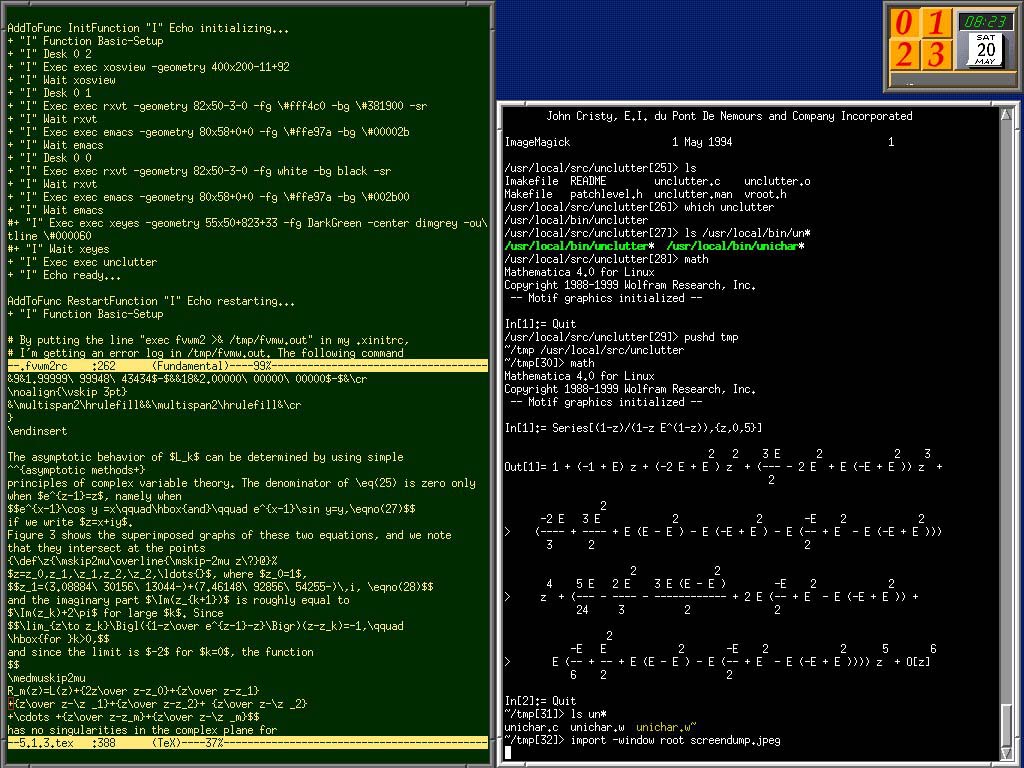
Donald Knuth's desktop
You can see Donald knuth's fvwm desktop and also his fvwm2rc on the bottom of this page
-
Want an invitation?
I think this guy can help.
-
Re:Good riddance
Orkut Buyukkokten's pic
How orkut.com users want Orkut Buyukkokten to be
He seems to like PDAs: His projects
His publications -
Re:Good riddance
Orkut Buyukkokten's pic
How orkut.com users want Orkut Buyukkokten to be
He seems to like PDAs: His projects
His publications -
Re:Good riddance
Orkut Buyukkokten's pic
How orkut.com users want Orkut Buyukkokten to be
He seems to like PDAs: His projects
His publications -
Re:Good riddance
Orkut Buyukkokten's pic
How orkut.com users want Orkut Buyukkokten to be
He seems to like PDAs: His projects
His publications -
Donald Erwin Knuth's desktop
...posting a little late for this discussion:
DEK's desktop -
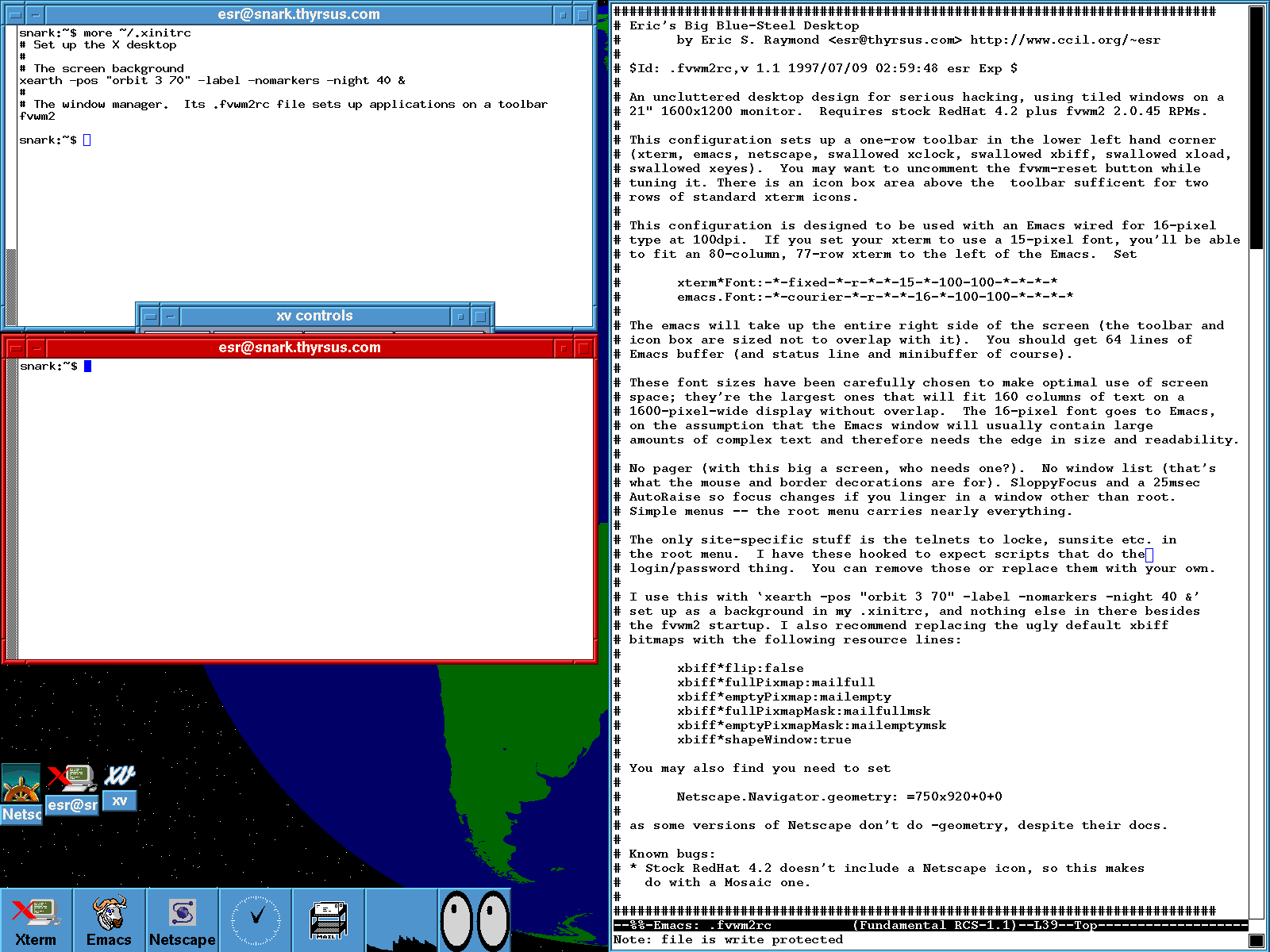
esr/donald knuth screenies and dotfiles
What is it with these guys and their fvwm love, eh?
esr
I used to use fvwm2, and tuned my desktop design very carefully to get maximum use out of the screen space. (Now I use GNOME + Sawfish, which is just as effective but harder to bundle up a configuration for).
screenie
dotfile
D. Knuth
This Fvwm2 setup file provides the basic emacs-centered environment
that I have found most comfortable on my standalone machine at home.
Basically it gives me a big Emacs window at the left and a slightly
smaller XTerm at the right, together with a clock and CPU monitor
and a few buttons for accessing independent desktops.
screenie
dotfile -
esr/donald knuth screenies and dotfiles
What is it with these guys and their fvwm love, eh?
esr
I used to use fvwm2, and tuned my desktop design very carefully to get maximum use out of the screen space. (Now I use GNOME + Sawfish, which is just as effective but harder to bundle up a configuration for).
screenie
dotfile
D. Knuth
This Fvwm2 setup file provides the basic emacs-centered environment
that I have found most comfortable on my standalone machine at home.
Basically it gives me a big Emacs window at the left and a slightly
smaller XTerm at the right, together with a clock and CPU monitor
and a few buttons for accessing independent desktops.
screenie
dotfile -
Re:Orkut?From his website, there are more:
I have been told that I have a colorful personality and perhaps that is why my friends have given me more nicknames than I can remember. O-Man, Big-O, Orc, Yogi, Ivy's Bitch (if you were not there, never mind), Party Animal, OrCute, Orkuttino, Kooter, O, Dostum, and Smooth are some of the ones that I recall at the first hand. As you can probably guess, each nickname has its own saga to go with it. However, for those who are not familiar with the stories, "Orkut" works fine.
Pick one. -
The man himself
Here's a picture of Orkut. I understand why everyone's clammering to be his friend:
http://www.stanford.edu/~orkut/bwphotos/p105.jpg -
Re:Orkut?
He is Turkish. I knew it for sure when I saw this photo in his web page. I went to high school in Turkey too. So I know how it is...
-
Club Nexis
Orkut Buyukkokten has done this before.
-
Re:Prior ArtIts not the inability of the patent examiners to look for prior art. Just using Google and NEC CitetSeer would help them. It's that they aren't even enouraged to look. It's in the Patent Office interest to grant patents - the more patents they grant the more revenue they get.
There are many more problems too. A good article on the problems with patents, the unworkable solutions and possible solutions can be found in Jeffrey D. Ullman's article Ordinary Skill in the Art
-
Re:heh
But why? In all seriousness what reason do we have to go to Mars? The moon is a much better astronomy platform since it has no atmosphere and lower gravity, plus it is much easier to get to.
So what purpose does going to Mars serve? I am a physicist btw, working on GLAST for what is is worth. -
Re:Do eukaryotic cells practice grid computing?
other interesting philosophically-related items:
- panpsychism
- supervenience of mind on the brain
- the qualia problem (the crux of the mind-brain problem)
what i find interesting is the idea that what we call is a feature of all systems, and that qualia constitute the condition of being a system - and furthermore, that the reason other systems seem to have varying degrees of sentience has more to do with scale, perspective and apparent similarity than with some ill-defined threshold of consciousness. -
Re:Here's some more info
Liquid hydrogen is actually lighter than air...
No it's not, "Liquid hydrogen has a density of 0.07 grams per cubic centimeter" (quoted from) while "The density of air under standard conditions is only 1.239 milligrams per cubic centimeter under standard conditions." (quoted from) -
Re:"Images in science"
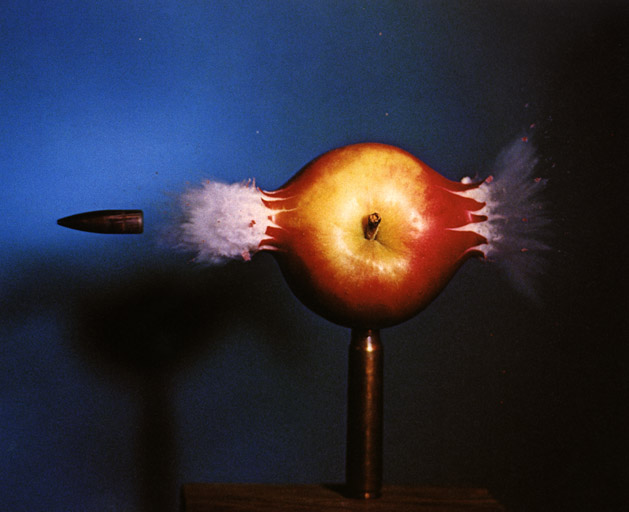
The photograph of the apple and the bullet is the work of Harold E. "Doc" Edgerton. "By synchronizing strobe flashes with the motion being examined (for example, the spinning of engine rotors), then taking a series of photos through an open shutter at the rate of many flashes per second, Edgerton invented ultra-high-speed and stop-action photography (1931)." See Exploring the Art and Science of Stopping Time for more information on Harold Edgerton's life and work.
-
Re:Spirit not that impressive...?The rovers themselves run VxWorks, a well-known real-time Unix variant
Pedantic: VxWorks is not a Unix variant; it has some Unix-like properties, since Wind River started tacking on POSIX API support. But every task lives in the same address space (although I think they added support for different address spaces recently?). Coding for it felt like linux kernel module coding, but with a better interface, but without accessible source code.
The only hard real-time Unix variant I know of is QNX.
You can get a taste of the VxWorks API here.
-
Re:Yahoo? Invent?
Sure they do, Yahoo was one of the first places you go go to find a broadly categorized collection of links. Before yahoo, you're best bet was either usenet, or navigating through narrowly organized hotlists. Yahoo helped design the look and feel of the web as most people know it.
-
This is a job for Darknet!.
This fascinating paper (also available in easy-to-read MS Word format) postulates that any real attempt at suppression will lead to a samizdat-like interlinking of P2P nets, each comprising a small group of people who trust each other. That ``web of trust'' will still get the info through.
They'll have to try harder than that.
-
Re:My ResponseCite your statement about Korea.
Here's a nice reference: National Center for Education Statistics
I'll even point you to Page 39 of the report: Outcomes of Learning: Results From the 2000 Program for International Student Assessment of 15-Year-Olds in Reading, Mathematics, and Science Literacy. You'll find that Korea has the smallest difference in reading literacy but in every single country including Korea girls did better than boys. Next I point you to the mathematics literacy scores where in Korea the difference between boys and girls is the second largest (OECD) with boys of course scoring better than girls. Finally we come to Science literacy where Korea had the largest difference (OECD) between boys and girls again with boys scoring better than girls.
Let me not forget to mention the wealth of experiments in recent years exploring the differences in brain functioning with and without estrogen (or in high v.s. low levels during the woman's hormone cycle).
Care for some citations or can you do the research yourself? Aw hell, for being such a good sport and reading all the way to here, I'll give you a link to a Stanford survey and project called Bridging the Gender Gap
Men and women are very different biologically. Why is it so hard to accept that they are different mentally?
-
lucid dreaming
Or, alternatively, just learn lucid dreaming and become master of your dream world.
-
Re:Well how can they safeguard against this?How does the system handle quoting and paraphrasing, where credit is given? I'm can only guess it doesn't.
That, and the fact that the fact that the English language only ~12 bits of entropy per word(1), it's very likely a birthday attack will be pulled against this database.
(1) http://www.stanford.edu/~vjsriniv/project/entropy
_ of_english_9.htm -
Re:let me be the first to say...
Fair use rights means the right to use your legally purchased goods however you see fit
Wrong.
In this (US) context, "fair use" refers to a set of allowed exceptions to copyright law. Fair use allows you to make copies of at least parts of works to which you do not hold any copyright provision, generally for non-commercial purposes of commentary, criticism, education, and so on. Fair use has nothing to do with your use of your original copy, but rather the circumstances under which you are allowed to make a copy without license from the copyright owner.
See here, among many other resources for copyright law on the Net. -
Re:The Office
"Come friendly bombs and rain on Slough,
It isn't fit for humans now"
John Betjeman, 1937 (full text) - the town has been a byword for dull mundanity for over 60 years now, and to some extent the series could be seen as an extrapolation of the poem. -
Re:MindStorms
"What Lego is using is most likely a pre-programmed chip w/o Flash, which are about 1/3 of the price."
RCX Internals has details - the microcontroller is a Hitachi H8 job, HD6433292B02F, with a preprogrammed ROM and space for software.
It's not exactly rocket science either, AFAIK they got help from MIT with the design (MIT have a "Programmable Brick") but it's something that a fairly competant hobby hardware hacker with a copy of Eagle and etching kit (or even use somewhere like Olimex) could knock together. -
And more lawsuits will follow...
Next thing you know, people are going to file lawsuits against the creators of GTA because their car got damaged in an earthquake...
-
Re:Theories from Stephen Hawking
The basic idea is this: a quantum fluctuation creates a matter/antimatter pair of particles near the event horizon of a black hole. The antiparticle falls in, destroying some of the mass of the black hole, while its partner escapes.
I've heard this explanation many times but it was never clear that this was the right way to think of this kind of process. It might be better to dispense with virtual particles and negative energy states, and view this via its relation with the Unruh effect.
Unruh says: an accelerating observer will see a thermal spectrum in empty space. If you are accelerating uniformly in a flat vacuum, you will fell like you are immersed in blackbody radiation. Note that the intensity of the radiation is rather small for everyday acceleration levels (this page gives a figure of about 1K for an acceleration of 10^20 m/sec^2, or about 10^19 times what we feel on Earth). Quasi-stationary observers near the event horizon are necessarily accelerating outward (since they are not falling in), and thus are bathed in thermal radiation. Faraway observers see this radiation, but it is gravitationally redshifted.
This sort of radiation will occur outside any massive body (e.g. a cat), but for everyday objects it will be immeasurably weak. More detailed explanations can be found here and here. Or you could just spend some time with Google.
-
Re:where is the peer review?I can't find any papers from the said authors on the physics archive, so these two obviously aren't well known or respectable among the scientific community.
You've probably not searched hard enough... Emil Mottola is fairly well known in the high energy physics community. Try this for instance. -
Distributed Computing
With HT enabled I can run 2 copies of Folding@Home.
This is a significant boost in production over a non-HT processor because these programs.
I would assume this would also help other DC projects like Seti@Home. -
Re:We Aren't Going To Mars To Take Pretty Pictures
As much as people try to pick on Bush, it seems to be a government standard. My only guess is that the military types liked the idea of a different name for bombs than energy. Thus "Nukes, nucular" always refers to the things that go BOOM, and "nuclear" refers to energy producing and scientific uses.
-
Delayed Sleep Phase Syndrome (DSPS)Sounds like you have Delayed Sleep Phase Syndrome (DSPS). Light therapy is supposed to work well.
Check out a Stanford Professor's links on the subject
-
E-Panhandling for it?
I'm in a very similar situation myself. I've been accepted to a top-tier school and I really have no way of paying for it, my family has zero savings to pay for it. They make a fair share of money a year so my university given aid is low, but I happen to live in a household of half a dozen and money is always tight. I'll be the first in my entire extended family to go to college, so I figure why not make it to the top tech school that's not in Boston?
That's a damn good sob story, eh? Think I could make a website out of it and beg for money, a dollar or two on paypal, to send me to school? Would you pay for it? -
Re:Rabid AtheismQuoth RickHunter:
Blind faith [is bad], definitely. [but]
I'm tempted to take the Socratic method and ask: "what's so bad about blind faith?"
From there, I'd ask what the difference is between "faith in some kind of higher power" and "blind faith".
The latter question is a strawman argument, of course: there (presumably) being no evidence for a higher power, one believes in such only by virtue of "blind faith".The stronger answer, though, is that the great miracles of the modern world -- technology, sciences (including economics, the study of which can allow people to interact peacefully even if they have widely conflicting beliefs) -- all depend on the Scientific Method, as put together by William of Ockham, Fracis Bacon, and elucidated more precisely by Karl Popper.
Basically, if you train yourself to truly believe only that for which you have experimental evidence (and you're always willing to drop those beliefs in the face of new, contradictory evidence), then you have a shot at really understanding How the World Works, and I assert that humanity's best chance for survival is by really understanding How the World Works. Richard Feynman is quite eloquent in describing this in his various books and lectures.
Faith in any kind of supra-natural "stuff" -- pixies, god(s), you name it -- foils that wonderful, scientific-method, mental training. And it's not that a good scientist can't have any kind of blind faith; just that, like driving a car with the parking brake on, the latter impedes the former, which succeeds only to the degree that it overpowers the dampening effect.
-
ATM...the networking industry [has] devoted inordinate efforts to technologies such as ATM and QoS
The paper seems quite light on the subject ("ATM" only occurs twice)...
but indeed Marconi sank billions of cash into it.
Not everyone was happy
-
Oh, you need "proof", too?From the site where you got your definition:
As an historical matter, positivism arose in opposition to classical natural law theory, according to which there are necessary moral constraints on the content of law. The word 'positivism' was probably first used to draw attention to the idea that law is "positive" or "posited," as opposed to being "natural" in the sense of being derived from natural law or morality.
I think this is exactly what I have said. Those "moral constraints" referred to are called "natural rights". That law is "posited" basically means that powerful people tell less powerful people what to do. We'll leave it to posterity to decide whose "political education" is lacking in this case.
BTW, did you happen to *read* any of that page you quoted about legal positivism? It mostly just discredits the idea.
The judge upholds that ticket. No judge has yet spoken on this matter. Regardless, he would be derelict to ignore either the rights of the defendant or the lack of a victim, as you have. Besides, you still haven't given any indication that you have a *clue* what judges do, other than "uphold ticket(s)". Here's an explanation, also from the source *you* quoted:Austin's view [positivism] is difficult to reconcile with constitutional law in the United States. Courts regard the procedural and substantive provisions of the constitution as constraints on legal validity. The Supreme Court has held, for example, that "an unconstitutional act is not a law; it confers no rights; it imposes no duties; it is, in legal contemplation, as inoperative as though it had never been passed." (Norton v. Shelby County, 118 U.S. 425 (1886)). Moreover, these constraints purport to be legal constraints: the Supremacy Clause of Article VI of the Constitution states that "[t]his Constitution
So, since the Supreme Court says that an unconstitutional law isn't really a law, and the Constitution says that rights are retained by the people, do you think *maybe* that judges should, oh I don't fucking know, take that under consideration? Or are you still holding onto the idea that rights are defined by the legislature and laws are merely "upheld" by judges? (If so, might I suggest that you move *back* to the motherland.)
I see now that the construction used in my last post was unclear. I never meant to say that legal positivism was the scientific method. I said that *logical* positivism was basically the scientific method. What I meant to get across was that both the scientific method and legal positivism were derived from *logical* positivism, as both took their preference of observation over contemplation from it. Here is a relation of positivism to the scientific method:[Positivism] is a position that holds that the goal of knowledge is simply to describe the phenomena that we experience. The purpose of science is simply to stick to what we can observe and measure.
Compare that with this description of legal positivism from here:
'The existence of law is one thing; its merit and demerit another. Whether it be or be not is one enquiry; whether it be or be not conformable to an assumed standard, is a different enquiry.' (1832, p. 157) The positivist thesis does not say that law's merits are unintelligible, unimportant, or peripheral to
-
Re:Two things that need to happen in 2004As for as the audio and CDR stuff go, there are many tools.
- mxv MiXViews sound editor
- snd sound editor
- ecasound multitrack audio processing tool
- cdrecord
- cdparanoia
- ecasound
- sox
- ecasignalview
- mkisofs
- aumix
Once you get the right tools, audio is a snap on Linux. I'd never go back to Windows.
-
Re:Absolutly PointlessRAID is a good solution for not so reliable harddisks, but it is not a replacement for backup. After all RAID only protects against harddisk failure, not against the user doing 'rm *' in the wrong folder, thats what you want backup for.
With two harddisks I would probally not set them up in a RAID, but having them run side by side, mirrored via an rsync based software, such as rdiff-backup, that would give the advantage of having incremental diffs and allowing to recover from an 'rm *'. Sure one has to make sure that it isn't mounted the whole time or else it could get wiped out too just too easily.
-
Re:CVS?
Or he could use wget to download the latest copy of the page and then use CVS (or another version control system) to record the latest changes.
There's no real need for console access, unless its a dynamic site in which case you need to store the source for your scripts as well as maintain versions of the database!
At this point it's nothing more than keeping multi-versioned backups of your website and database files. Check out rdiff-backup
Best of Luck. -
Happy New Year from New Zealand
Yeah it's already 5:45pm on the 1st of January, but what the hell, I'll wish
And look, I didn't even bitch about how
And for anyone that's interested
Have a great year everyone.
-S -
Re:That's really interesting...
Hopefully benefical projects like Folding@Home will get in on this idea.
Maybe each sites opening page will contain something like "Help out such and such project while browsing this site, click here or standard site click here" -
Re:Read the article!
Actually, for about $100 you can get a GeForce4 Ti4200, which was a one of the high end cards from the last generation. In a lot of older games (those without complex shaders like Quake3) it'll beat out some more modern cards (all but the high-end Radeon 9x00s and GeForce FXes).
For current generation cards, $100-150 is the sweet spot (the 'mainstream' cards : Radeon 9600 Pro/XT or maybe 9800SE, GeForce FX 5600 & 5700). While you might not be able to get the raw frame rates of the GF4 Ti4200 in older games, these cards will do some powerful image quality improvements (AA, AF) without a significant hit in performance. They also have the modern programmable shaders used by DirectX 9 and are capable of being used as a vector coprocessor.
So, while there are a number of good cards at the $150 point, there's still some very good deals at the $100 level (lowest pricewatch price for a 9600 (not the crippled SE version) is $92 shipped; the 9600 Pro starts at $107. nVidia has equivalent cards at similar price points. -
Re: academic papers vs. wikipedia peer reviewingMost peer reviewed articles have only between 3-7 reviewers, those reviewers are often not paid for their efforts and the effort they make is highly variable.
Agreed. Though now I see that there's a complication sneaking in: we're in risk of mixing up peer review of journal and encyclopedia articles. But let's go on.
With Wikipedia, the number of peer reviewers is unlimited.
In principle, yes. In practice? And how exactly does it follow that a large number of reviewers makes for better articles?
In specialist or highly technical fields, the number of participants is still limited, so peer review cannot compete with specialist journals in the academic world. On the other hand, most encyclopedias don't really contain such specialist information in the first place.
Yes. Journals aren't really all that good a comparison. I propose we consider the peer review process that would apply to encyclopedia articles: the editor sends off articles for comments to experts in the topics in question, making it clear that this article is intended for a general audience, and they should judge it accordingly.
The efforts individual contributors make to Wikipedia is, of course, also highly variable as in the case of peer-reviewed journal papers.
Yes. But you leave out the facts that (a) pretty much everybody in the process is anonymous (yes, journals use anonymous reviewers, but there's an editor who isn't anonymous), (b) a contributor could be anybody. I.e. you have no information on the reviewers/contributors. To put it in terms of security, there's a trust issue. Also, there are issues having to do with the fact that the persons who contribute to Wikipedia articles are a very self-selected group.
Unlike peer-reviewed journals, however, there is no deadline for the final manuscript after which no error can corrected.
This is not strictly true. The Stanford Encyclopedia of Philosophy doesn't have such deadlines. You're confusing review by competent experts with electronic publishing.
Hell, I remember when I was a child, we had the World Book encyclopedia, which was edited on a yearly basis. They also put out Yearbooks where they included the updated articles from that year's edition-- they came with stickers for you to put on the start of the old article, saying that you had a newer version. Even in the world of paper, your argument doesn't follow.
Finally, whereas many journals will have a two-stage review process (a preliminary review, notice of acceptance/rejection, subsequent requests for elaboration/changes) over a matter of a few months -- limiting the interaction between the peers to a few discrete instances -- peer review on Wikipedia allows constant revision of the article and, using the talk pages, unlimited discussion as well.
I don't see how this improves the quality of the content, and I certainly don't think it addresses the trust issue.
Sure, there also are trust issues involved with journals and traditional encyclopedias. And abuses, even. But they're not as extensive as with Wikipedia.
To be honest, I have no fondness for a lot of Wikipedia articles. I think anime is ridiculously overweighted in the 'Japanese culture' articlese and it depresses me to think of the amount of time spent on articles such as the homestar runner article...
A function of self-selection in the editorial process.
-
Re:Pop Ups
I've seen almost immediate and widespread installation of the new Google Toolbar with Pop-up Blocking on student computers in the dorm. When I came home, my dad had already installed it on the computers at home.
The Google Toolbar is a great 'product' in that it gives all levels of IE users a tools that they -want- (fast searching, pop-up blocking) at a price that's hard to refuse (40~ pixels x resolution-width). The added benefits that techies can appreciate is that millions of people are going to be fighting a war on obstructive advertising -and- doing medical research (Folding@Home) at the same time.
The Folding@Home stats pages show the effects the Google Toolbar is having on their project, but I'd love to see how it's affecting online pop-up ad sales and per view/click prices. -
Stanford Checker
Anyone know how this one is faring? Will it ever be released? It's based on GCC, right? How many students can it pass between until it's "distribution"?
The reason I'm asking is because I saw that one member of the team has jumped over to a company called Coverity where one can read:
Originally developed by a team of researchers in the Computer Systems Lab at Stanford University, Coverity's patent-pending source code analysis technology successfully detected over 2000 bugs in Linux including hundreds of security holes.
I just think it'd be horrible if they used the GPL'ed GCC to develop their methods (having access to a full portable compiler onto which to do research and development is hardly a "small thing"), and then lock these same methods away from the community.
I'm grateful for their work on checking linux, but really... this smells bad, IMHO.
(If you don't know what I'm taking about, don't assume it's off-topic, okay? The Standford Checker is a related topic to the Reasoning analysis of MySQL, and I'm not sure we'll ever have a _better_ fitting topic to discuss this)
-
Re:Quicksilver?
Googled for the quote, and it seems that a whole lot of people said that.
Pascal, Goethe, Cicero... -
An Open Agent-based Distributed System
I've been thinking about something like this all semester in my Distributed Computing class.
What I'd really like to see is a system setup where you have a network of clients, any of whom can dispatch an agent across the system that consumes resources to accomplish some goal.
Obviously there would have to be some sort of non-malicious code signing or sandboxing going on within the system, as well as forcing the agents to consume proportional resources (ie the more time/space/bandwidth you give to the sytem, the more you can consume)... either way it's still a neat idea that I'd be eager to participate in...
It'd be a little more exciting that Folding at anyrate..
My Folding@Home Team -
Multiple Projects on the same machine
This really isn't as good as you might think.
Most distributed computing projects are distributed because they need massive amounts of CPU cycles. Running multiple projects on one machine isn't going to make the projects faster since the same amount of CPU cycles are now being divided up amongst the number of projects that you're running. Infact it'll actually be less because now the machine has to deal with the overhead of switching between project processes.
On the other hand it might make sense if you were running a CPU-intensive project and a data-intensive project at the same time (ie projects that will maximize separate non-conflicting resources on the same machine..)
My Folding@Home Team -
Re:T3?
I wasn't even aware that T3 brought anything new to special effects stage.
That's a naive statement on the state of VFX. Not particularly directed at you but a large number of people just go by the looks without knowing what goes on behind the scenes.
T3 was the subject of several SIGGRAPH (the most important conference and organization related to computer graphics) sketches and even one SIGGRAPH paper (one of the highest honors in CG research):
Smoke Simulation for Large Scale Phenomena
Big Bangs
Melting a Terminatrix
The Machines of T3
'T3' -- BETWEEN THE LAYERS
Fight the Future
Terminator 3 Evolves Historic Effect
TechTV Segements on T3 and Pirates of the Caribbean Online
T3: Man vs. Machine
Building a Believable BlockbusterNot saying that the others weren't outstanding and innovative as well. Thye same point can be made about all the other bakeoff finalists.