Slashdot Mirror
Domain: whoi.edu
Stories and comments across the archive that link to whoi.edu.
Comments · 113
-
Re:Hmm...I just can't think of an example...
Check what happens with glacial rebound - the center of the continent rises a lot more, which forces the edges of the continent down. It's why there is glacial impact on sinking on the East coast. And when you push down on one side of the Continent (the upper side), the lower side lifts; remove the force, the upper side rises and the lower side sinks. Educate yourself - the trampoline analogy and see-saw effect they use should help you understand.
-
Re:Maybe not...
paleoclimate record is much lower resolution, and actually shows us that CO2 levels *lag* temperature changes, rather than lead them. This is contra to the hypothesis of AGW.
Climate scientists were not surprised when it was confirmed that CO2 lagged temperature - AFAIK it was predicted in advance based on the expectation that orbital forcing / milankovich cycles drove the 100,000-year past warming/cooling cycles. I believe the lag was first observed in this paper by Neftel et al. (1988). This video explains how orbital forcing alone is insufficient to explain the magnitude of the observed warming/cooling and thus a CO2 cycle, thought to be driven largely by CO2 solubility in oceans, was posited to explain the rest of the warming/cooling.
But no doubt someone has explained all this to you before. (aside: CO2 leading temperature change has been observed in the northern hemisphere - Shakun et al. 2012.)The difficulty is when you assume that CO2's further interactions with say, water vapor, create a tripling effect of heat retention
Again, it's not an "assumption", it was predicted based on the laws of physics.
when you assume that all other sources and sinks of CO2 do not react to perturbations (say, like plant growth)
Wrong. We know for a fact that other sources and sinks of CO2 will react to perturbations, and scientists have been hard at work producing studies to quantify those effects. Plant growth is one effect, soil erosion is another, there's lower solubility of CO2 in the ocean as it warms up... the list goes on.
small differences in the input criteria may yield wildly varying results, making the predictive utility of even a perfectly written physical model essentially zero.
A perfect example of how climate science denial is built around grains of truth which themselves have always been openly acknowledged. Initial conditions can indeed change the outcome and there are significant differences between climate models, but it doesn't follow that their predictive power is zero. Best estimates of ECS from experts and models range from 1.5 to 4.5 Celcius - a wide range, yet we can predict with high confidence that observed ECS will be somewhere in that range.
The funny thing is that deniers imply that high levels of uncertainty mean there is nothing to fear, as if the climate system's instability somehow guarantees we won't experience a high ECS like 4.5. That just doesn't make sense. -
Re:Info...
Caesium 137 for example.
https://www.whoi.edu/news-rele... -
Re:No such thing as waterproof
Sure there is: http://www.whoi.edu/main/hov-a...
-
Maybe high O2 led to evolution of hard tissue
Rather than sparking rapid evolution, maybe the high O2 concentrations led to (or allowed) the development of hard tissue in existing complex organisms. Ocean acidification dissolves the shells of clams, corals, etc. and increased O2 levels could coincide with decreased CO2 levels (probably because the organisms creating all the O2 had to get it from somewhere).
This being Slashdot (and the link being paywalled) I have not bothered to read the linked article. Hell, I've barely bothered to read the summary.
-
Re:Sounds like a great plan.
we instead have a massive catastrophic climate change when one of those chambers springs a leak.
A lot of people forget that material properties change with pressure and depth. The first time the Alvin submersible found black smokers (active volcanic vents) on the mid-oceanic ridge, they moved in for a closer look. They found out afterwards that they'd recorded temperatures close to 400 C. The melting point of Alvin's portholes was far less than 400 C, and they would've died if they'd stayed there too long. People see liquid water, and just assume the temperature is below 100 C and therefore the glass portholes are safe. But at the depth they were at, the pressure is much higher and thus the boiling point of water was around 400 C.
I did some quick research. Fracking is typically done 2-3 km underground. The ground temperature at that depth is about 75 C. The pressure at that depth is about 200-300 bar (atmospheres).
Looking at the phase diagram for CO2, that's in the supercritical fluid phase. So the CO2 wouldn't need to be pressurized at that depth like it has to be at sea level. The ground pressure alone would be enough to prevent it from reverting to a gas, and thus it would be impossible for the chamber to catastrophically spring a leak. The only way that could happen is if another drilling operation tapped the chamber and suffered a blowout. Normally that doesn't happen - they keep the bore filled with heavy mud to maintain the pressure at depth. But occasionally (e.g. Deepwater Horizon) there is a blowout, the pressurized mud is lost, and the liquid/gas underneath is then squeezed out by the surrounding rock through the "straw" (bore). I don't see this as being any more risky than regular oil drilling. If anything it's safer since CO2 is pretty inert and won't catch fire. The biggest risk would be the CO2 gas pooling in a depression and suffocating anyone/anything inside. -
Re:Greed
All good questions. Some investigations are yielding some some answers.
"Bottom-dwelling fish in the Fukushima area show radioactivity levels above the limit of 100 becquerels per kilogram set by the Japanese government. Greenlings, for example, have been found to have levels as high as 25,000 becquerels per kilogram." That's more than just a little excess.
In concrete terms, losses to the fishing industry exceeding a billion dollars are mentioned, with "many fisheries" still closed as of November 2012.
Was the evacuation necessary? Well, it's the government's decision to make, and they made it. Some 4,500 square miles – an area almost the size of Connecticut – was found to have radiation levels that exceeded Japan’s allowable exposure rate of 1 mSV (millisievert) per year. 310 square miles were declared "permanent" exclusion zones. Estimates of the lost economic value of these losses range from $250 to 500 billion.
-
Re:From 3 to 4 parts per 10,000
I think the effectiveness of ocean fertilization has been studied and debunked. If you are too lazy to click on the PDF, the short version is that while iron stimulates plankton growth, keeping carbon in the ocean is a different matter. http://www.whoi.edu/cms/files/OceanusIron_Will_It_Work_30747.pdf
-
Some Answers on WHOI's Site
Have you noticed any affects of acidification of the world's oceans?
Well, it would be interested to hear his first hand accounts (if any) but his institute has a page devoted to it with a FAQ that may provide some more information on observables such as:
Will ocean acidification kill all ocean life?
No. However, many scientists think that ocean acidification will lead to important changes in marine ecosystems.As well as:
Isn't it better that we sacrifice the oceans and let them keep on taking up CO2 and buffering climate?
Ocean acidification and climate change are two sides of the same coin. Both are direct consequences of anthropogenic CO2 emissions and cannot be separated from each other.Those are just the beginning of longer answers but there's a lot of data on that FAQ if you're genuinely interested in this.
-
Some Answers on WHOI's Site
Have you noticed any affects of acidification of the world's oceans?
Well, it would be interested to hear his first hand accounts (if any) but his institute has a page devoted to it with a FAQ that may provide some more information on observables such as:
Will ocean acidification kill all ocean life?
No. However, many scientists think that ocean acidification will lead to important changes in marine ecosystems.As well as:
Isn't it better that we sacrifice the oceans and let them keep on taking up CO2 and buffering climate?
Ocean acidification and climate change are two sides of the same coin. Both are direct consequences of anthropogenic CO2 emissions and cannot be separated from each other.Those are just the beginning of longer answers but there's a lot of data on that FAQ if you're genuinely interested in this.
-
Re:Carbon dioxide?
CO2 suffocates humans in sufficient dosage. Plants, however, love it and crabs use the extra carbon to make their shells better.
So yay for global warming!
-
slocum thermal glider
Underwater vehicles that are powered by the ocean have been around for a bit, and have even crossed the atlantic.
http://www.whoi.edu/oceanus/viewArticle.do?id=47166 -
Re:And many of the "climate" scientists...
I'm not going make a statement one way or the other on fudged data. If his actions were clearly inappropriate there are plenty of scientific bodies whose only reason for existence is managing scientific professional integrity. If he has done something truly inappropriate, he will be dealt with.
What I will respond to is THE VAST body of work pointing to dramatic changes in global climate. I ask those with an ideological position to defend, to stop for just a moment look at the remarkable amount of indisputable evidence that is now available. Its positively mind numbing.
Your comment about temperature is both uninformed and ludicrous. Scientists have taken wood samples from redwoods and bristlecone pines and with that information they can give you precise climatic information for specific areas including annual rainfall, temperature, and occurrence of catastrophic events. By analyzing human dwelling all over the world we can accurately determine climate through fauna and flora for those regions, spores, seeds and pollen. They tell us precisely what grew, and tell what the climatic conditions were there and when. We have antarctic ice cores with trapped atmospheric samples, we have ocean cores with samples of everything from diatoms to volcanic ash, we have fossils and minerals with trapped air and water going back millions of years, we have rock cores which elegantly give us clear records of temperature over centuries. The body of evidence is overwhelming and rich. Thousands of different sources from hundred of different fields of study, all forming a clear and cohesive picture. Whatever you've been reading, its inaccurate, incomplete, and puts ideology before simple fact and truth. You can absolutely criticize one or two individuals for their poor performance, but that doesn't even begin to indict the work of tens of thousands of scientist all over the world who work in vastly different fields but have all come to the same inescapable conclusion.
The models and theories make specific predictions. Many of those predictions have come to pass. Here are just a few recent facts which are completely incontestable:
- The ice caps are melting: If you haven't read about the disappearing artic ice cap in summer try this source. While some would applaud the economic benefit of opening a new shipping lane, the loss of extinction of many vital species including the loss of arctic krill would produce a devastating crash in global fish stocks and the probable extinction of a variety of whales, seals, penguins, and polar bears.
- Glaciers everywhere are vanishing: Look here for a synopsis. The impact of this is that nearly half the worlds population uses glacial melt for drinking water and for agriculture. When they melt the economic cost (not to mention the cost in human suffering or destabilized governments) will be profound.
- The oceans are changing: Rising sea levels, dropping salinity, increased acidity due to CO2, increasing temperature, and changing currents are all occurring as we speak, and all predictable results of global climate change. The impacts will grow and be devastating. Some include loss of coastal land and cities, weather changes, crash in vital fish populations, crash in all marine life, The ocean are the engine behind climate. Disturbing its integrity has far reaching impact. Already, low lying islands in Polynesia are disappearing and their inhabitants are being displaced.
- Animal are migrating away from the heat: Research is now showing us how climate change is impacting animal migration and we are only now beginning to under
-
Re:100.000 years
Besides, moon shots with unmanned vehicles are pretty cheap, and probably comparable to the costs of developing the deep water surveying and placement technologies needed to set casks in subduction trenches.
Where do you get that moon shots are cheap? A Delta IV Heavy launch costs upwards of $300M, independent of the cost of the payload. Word on the street is that the real cost is something like $700M (big launch vehicles are heavily subsidized by the military. Shuttle launches cost something like $1B). SpaceX claims that they'll get that cost down to $60M for the equivalent of a DIV medium, but that won't go to the moon. I wish them the best, but I'll believe it when I can use my Visa Plutonium to make the deposit on one.
In addition, a not small percentage of these will fail. And rockets, like nuclear power plants, tend to work when they work, and fail spectacularly when they don't, and for the same reasons. Lots of energy in a small volume. Something between 7-10%. So every 15 launches, you get to write off a complete launch facility due to radioactive contamination (blowing up on the launch pad - best case), and a whole lot of downwind real estate (airburst - worst case).
Even in the best case, it ain't cheap to abandon a launch site - "the $4 billion SLC-6 was refurbished at a cost of about $300 million to accommodate Delta IV missions.".
Subduction zones don't seem like a great idea; too many unknowns, though I'd bet that undersea researchers would be thrilled to get a fraction of the cost of moon shot to explore the idea. The next generation deep sea submersible had an estimated cost of $21M in 2008.
-
Re:Amazing
I think it's worth mentioning that the French found it.
With more than a little of help from the Americans at WHOI .
-
Another sub with balls...
The hybrid autonomous underwater vehicle "Nereus" http://en.wikipedia.org/wiki/Nereus_(underwater_vehicle) and http://www.whoi.edu/page.do?pid=10076 uses ceramic ball technology for buoyancy, and it's been down in the Challenger Deep, so the idea of a ceramic ball withstanding the pressure is credible. However, Nereus uses a large number of little ceramic balls, not one large (people-holding) ceramic ball, so there is some testing to be done, I think!
-
Re:The meaning of random
There are people, right here, in this discussion, who are arguing that the data does not support the conclusion that the climate is getting warmer overall. Then, in the same post, they will argue that the climate change, which they just said wasn't happening, isn't caused by humans.
You may have just met different people than me. I doubt we're going to agree on this since it's all pretty much anecdotal.
As for reversing the burden of proof... Well, on the one side you have people saying "we're releasing massive amounts of crap into the environment, we theorize it will have this negative consequence" and on the other side we have people saying "Crap... Climate always changes... public scares and media panics happen all the time..." and basically claiming that there is no problem with releasing all this crap into the atmosphere and that human action can do nothing at all to planet. So, on the one hand, we have people saying that we need to exercise caution in the things we do, and on the other we have people saying that we don't even need to think about it and that anyone who disagrees with them lives in their mothers basement.
As for the oceans warming and releasing all the CO2
Won’t the CO2 outgas as the oceans begin to warm up, therefore cancelling out the problem?
The CO2 content of the surface waters of the oceans responds to both changes in CO2 content of the atmosphere and changes in temperature. For example, if ocean temperatures were not changing, a doubling of preindustrial CO2 levels (from 280 to 560 ppm) would cause an increase in the total amount of dissolved carbon in the surface ocean from about 2002 to 2131 micromoles/kg of seawater (assuming salinity = 35, temperature =15C, and alkalinity = 2300 micromoles/kg). If ocean temperatures warmed by 2C over that period, then less carbon would be taken up (the increase would be from 2002 to 2117 micromoles/kg). Thus, a 2C increase in temperature results in about a 10% decrease in carbon uptake in surface waters. The expected warming of the oceans also may alter ocean circulation, further reducing their capacity to absorb CO2 from the atmosphere, but the excess CO2 will still remain in the atmosphere and drive further acidification. For pH, the net effects of climate warming on atmospheric CO2, CO2 solubility, and chemical speciation approximately cancel out. — Scott Doney, Senior Scientist, Woods Hole Oceanographic Institution, USA; Joan Kleypas, Scientist III, National Center for Atmospheric Research, USA
I got that from an ocean acidification FAQ here.
-
Re:as a scientist
Alvin built in 1964
Owned by USN. Can carry a pilot and 2 passengers to 4,500 meters. -
Re:It's called Iron Seeding, people.
Each ton of Iron dumped into the ocean pulls about 1000 tons of carbon out of the air.
http://www.whoi.edu/oceanus/viewArticle.do?id=34167
Of that a tiny percentage reaches the floor, 20-50% stays in the middle ocean for a few decades, and the rest stays on the top and dies re-releasing the CO2 back into the air.
Each ton of iron smelted from ore creates 2.5 tons of CO2 (not counting transportation), about equal to that tiny percentage that actually gets sequestered, so if you have to move the iron at all (which you do if you want it out of the ground) then your net result in a few decades is adding CO2 to the air.
Not that I am actually all that worried about C02.. I think Methane is a bigger problem and easier target.
-
Re:How about some metric figures?
The original article is in Metric, Fox just buggered with the numbers. http://www.whoi.edu/page.do?pid=7545&tid=282&cid=74755&ct=162
-
Re:Cue the teabaggers.
Ocean acidification is not a threat. Its been exaggerated by global warming alarmists.
The facts are our oceans have been far more acidic in the past, and we still have corals and shellfish. In fact, these are some of the oldest multi-cellular organisms on the planet, and they have survived.
The recent cold-snap in FL has shown that just a few weeks ago a few days of extreme cold (~59deg F) was enough to kill off millions of corals.
Meanwhile, shellfish are doing fine in higher CO2
lets not forget that the oceans have a pH of 8.1 (alkaline). It needs to be at 7.0 to be neutral, and less than that to be acidic. -
Re:Climate change is a security threat
"Over half of the world's reefs have already completely disappeared or are rapidly declining. Most of this so far had been due to pollution and overexploitation, but an increasing percent is due to the warming and increasingly acidic waters"
{{citation needed}} - and something recent at that.
http://www.uq.edu.au/news/?article=17983
(although you bring in pollution, overexploatation and warm water - which is a cyclic phenomena - and yet try to blame it on global warming)
Regarding ocean "acidification", and don't forget to mention how we could measure it with three significant digits hundreds of years ago, it's neither historically nor recently a problem: http://www.whoi.edu/page.do?pid=7545&tid=282&cid=63809&ct=162
The only reason one could have for believing there is a problem is by being blissfully ignorant on geological levels of CO2 in the oceans as well as temperature changes.
-
Re:Plenty of funds going around on both sides
Still wrong.
Clearly there's too much for plants to absorb anyway, since we know CO2 levels are increasing; we're not just getting more plants.
Yes we are, the Earth's biosphere is booming and has been for the last decades. Up more than 6% in total. Plants are currently CO2 starved, most become increasingly happy up to 1000ppm.
http://wattsupwiththat.com/2008/06/08/surprise-earths-biosphere-is-booming-co2-the-cause/
And, of course, the acidification of the oceans is also a huge problem.
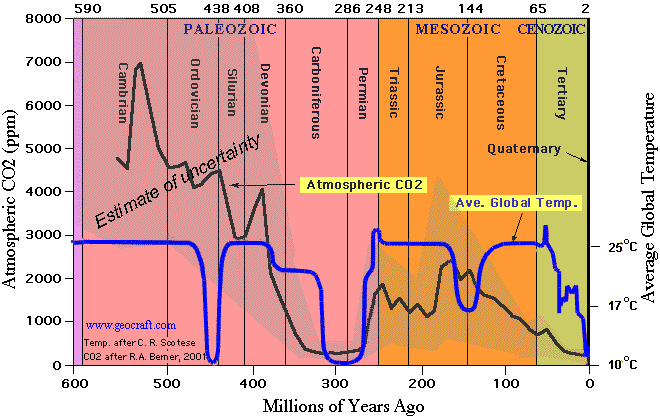
No, it's not. CO2 in the atmosphere has been more than a magnitude higher before in history without the oceans having gone acidic. They're at PH>7 and will stay so. Any slight changes are easily coped with by creatures who've lived through much largers changes before - they've evolved to handle them. Some even grow better with increased levels of CO2.
http://www.geocraft.com/WVFossils/PageMill_Images/image277.gif
http://www.whoi.edu/page.do?pid=7545&tid=282&cid=63809&ct=162
Why don't you like science?
-
Re:psuedo-skeptics
however you can saturate the oceans with CO2 to form carbolic acid and severly disrupt the very roots of the global food chain
The oceans are nowhere near becoming acidic, and have never been so before even though the CO2 levels in the atmosphere have been more than an order of magnitude higher.
Feel free to base your posts on actual science when debating - especially when trying to allude to your opponents being "deniers", "paid by the industry" etc.
As an example, the models that claimed shell building creatures would fare bad if more CO2 was dissolved in the oceans have been falsified by proper scientific testing:
http://www.whoi.edu/page.do?pid=7545&tid=282&cid=63809&ct=162
-
Re:Because I Said So, That's Why!
I was thinking this body as a large droplet of water that has been formed naturally and then hitting earth..then i found this image: http://www.whoi.edu/page.do?pid=10897&i=7301&x=111
-
Re:Chemistry 101Separately tweenk, we are getting too much carbonic acid in the seawater:
Carbon dioxide builds up in the atmosphere, a large fraction has dissolved into the ocean, increasing the total amount of dissolved inorganic carbon and shifting seawater chemistry toward more acidic conditions. Since the end of the last century, the amount dissolved CO2 gas ([CO2 (aq)], shown as the red line) has increased because of both the rise in inorganic carbon levels and acidification. Simultaneously there is a decrease in the waterâ(TM)s pH (shown as the blue line), indicating rising acidity, and a decrease in the carbonate ion ([CO3 2- ], shown as the green line), the substance that many marine animals use to build their shells. (Figure courtesy of Scott Doney, Woods Hole Oceanographic Institution)
The article at Woods Hole is in greater detail: http://www.whoi.edu/oceanus/viewArticle.do?id=17726
-
Re:Get it while it's hot!
No, record low amounts of Arctic ice are due to volcanic activity and a lot of human activity in the north.
Volcanic activity is north of Iceland and is not near Russia. Even your link says "The scientists say the heat released by the explosions is not contributing to the melting of the Arctic ice". Here's a map of Gakkel Ridge where the volcanoes are located.
Falcon
-
Re:Old News
You and your newfangled shiny TV stuff... Back in my day we had books...
"Explorations: my quest for adventure and discovery under the sea." (Hyperion, 1995)
Seriously, not only is this not news, or even new news... TFA gets the sequence of events all wrong. Ballard had already been hunting Titanic with side scan sonar and photo sleds (which is even harder than finding a needle in a haystack) when the Navy approached him to map the wreckage of Thresher and Scorpion. Not find, but map (the locations were already known to the Navy). This was done as part of a Navy project to examine reactors known to be on the bottom of the ocean to determine if reactors could be disposed of by ocean dumping. They also dove on both wrecks using the Alvin (Oxford University Press, 1990) to take samples of the seabed and wreckage and to take radiation readings (photographs from this expedition can be seen at the Naval Historical Center page on Scorpion ).
When the Navy hired him to perform those surveys, he examined the earlier ones (there have been several), and realized that debris trails were the key to locating deep water wrecks. The Scorpion wreck site is compact as she broke up on impact with the bottom. Thresher's wreck on the other hand is scattered across a considerable area as she broke up (relatively) shallow. The Navy however refused to pay for a search for Titanic to prove the theory and to further test Dr. Ballard's new mapping sled. Instead the Woods Hole Oceanographic Institution funded a search for Titanic as an extension of the expedition to map the Scorpion's wreckage. (Though all WHOI knew was that it was a classified USN expedition.) -
Re:If they keep drifting around
Yes, they do wash up on shore (sometimes they're even found), and yes, they are continually replaced.
-
Are you a climate scientist?
there's always been change in climate and we have dealt with it, changes which have been far more then small.
it's just alarmist nonsense your pushing there.
You got your degree in climate science where? You've been studying this topic for how long?
I actually have friends doing research on the topic, both in the lab here in the US on the global climate model an in the field in the Antarctic. They are more alarmed about current trends than is filtering through to the media. The rate at which permafrost and glaciers have begun melting recently is sending shock waves through the scientific community. We are now only beginning to discover environmental feedback mechanisms that likely mean the scientists have UNDERESTIMATED the rate and impact of global warming, not overestimated it.
We used to talk about the climate problems our children and grandchildren will be dealing with. Guess what, the bill came early. Now YOU will likely be suffering the consequences. We are seeing the leading edge of it now with shifting weather patterns and encroachment of invasive species... just as the models predicted, only sooner. Because of climate deniers like you, it is probably now too late to stop it, but we still must do everything we can to slow the change and give our society and economy time to adapt.
Alarmist? Hardly. If anything the message from the scientist has been overly softened and toned down.
BTW, the friends I mentioned work at Woods Hole Oceanographic Institution and on the global climate model at Argonne National Laboratories, in case anyone is curious. -
Re:I know it violates /. protocol, but...
Well, I am sort of with you but if you read this thread it is perfectly clear that all he did was allow everybody justification to retreat further into their existing points of view and yell louder.
I think this is because he places himself in the center of each 'controversy' to prove a point. Except that we've learned enough that there ISN'T necessarily a valid center to each climate change controversy, so he fudged it a bit. I can be all for "not allowing your beliefs to run too far ahead of your facts" but he has unfortunately just dismissed some pretty well done research with a wave of his hand. That's probably not helpful here, or in his larger point of the value of heretical thinking (that is dead on).
There are half of the people on this board actually saying, "What idiots, you have to have competent ethical research -- and you have none! There is nothing there!" Except, mysteriously, there is a lot of research out there but no one points to WHICH research is bad and WHY. This is exactly the lapse of careful rationality that Dyson was trying to get across.
Similarly, most of the other half is saying, "You can't just deny climate change!" Well sure they can, and should until there are decent studies that they can't knock down with a stick. But where are the links to these studies?
Heck, it took me 0.001 seconds on Google. I'm not a scientist, so you tell me, are these people lying, incompetent, or bought?
http://www.whoi.edu/page.do?pid=12455&tid=282&cid= 17906
Whether we understand the entire global climate model for the last 100 million years or not, if there is truth in the above line of research on the smaller scale, we had better pay attention and pick apart the details. We all obviously agree that the world does not need more hot air. -
Re:Welcome the warmth
You might get the short end of the stick:
http://www.whoi.edu/page.do?pid=12455&tid=282&cid= 10148 -
Re:Shatter conesThe references that I found useful to learn about shatter cones are
- "Traces of Catastrophe: A Handbook of Shock-Metamorphic Effects in Terrestrial Meteorite Impact Structures", Bevan M. French (Smithsonian Institution), http://www.lpi.usra.edu/publications/books/CB-954
/ CB-954.intro.html - "Stalking the Wily Shatter Cone: A Critical Guide for Impact Crater Hunters", Bevan M. French (Smithsonian Institution), Impact Field Studies Group newsletter, Winter 2005, online at http://web.eps.utk.edu/ifsg_files/newsletter/Wint
e r_2005.pdf - "Shatter cones: Branched, rapid fractures formed by shock impact", Amir Sagy, Jay Fineberg, Zeev Reches, JOURNAL OF GEOPHYSICAL RESEARCH, VOL.
109 2004, online at http://www.agu.org/pubs/crossref/2004/2004JB00301
6 .shtml (for a fee), http://www.whoi.edu/science/GG/geodynamics/2005/im ages2005/sagy04_JGR.pdf, http://earthquakes.ou.edu/reches/Publications/Sagy _JGR.pdf, and others
- "Traces of Catastrophe: A Handbook of Shock-Metamorphic Effects in Terrestrial Meteorite Impact Structures", Bevan M. French (Smithsonian Institution), http://www.lpi.usra.edu/publications/books/CB-954
-
Re:Shuttle's name is so creepy
Atlantis is actually named after the Research Vehicle Atlantis, the first ship of the Woods Hole Oceanographic Institution. It was in use from 1931-1964 by WHOI, and apparently is still in use in Argentina.
All of the shuttle orbiters are named after sailing ships which were involved in research or exploration. -
Re:It is real, look out the window
All it takes is some sampling of weather patterns over the past few hundred years (since we have been recording them)
This is one problem that I have about "global warming". We have only been recording, officially, historical temperature records since around 1860. This is about 60 years after the end of a "Little Ice Age". For 500 years prior to the 1800's we were in a "Little Ice Age" with very inaccurate records. We only know that the tempuratures were much cooler then today. This is one reason the Norse stoped comming to Eastern North America. So for 500 years we were in a "Little Ice Age" and now the last 200 years shows that the temperatures of the Earth warming.
The real fact about global warming is that we know the mean tempuratures have increased over the last few decades. However, we don't know what the mean tempurature should be do to lack of historical data (150 years of data after a "Little Ice Age" of 500 years is bunk data). We also have no idea of the impact of natural disasters such as volcanos (like it snowing in Isreal in the mid 1990's) versus human impact. It could very well be that in a little over 100 years we will see the tempurature start droping again.
http://www.whoi.edu/institutes/occi/currenttopics/ abruptclimate_15misconceptions.html -
Paleoclimate & the Debate
It's important to remember that global temperatures have been much colder and much warmer than they are now in the past 100 million years--I figure that a the most recent ~2.2% of Earth's history is a good enough starting point for us. Furthermore, if we look at the Sloss [cratonic] sequences, there's been a vast variation in sea level during that time, also. A common rebuttal to pointing this out is that our current climate change is happening at an "above average" rate. However, these models assume a gradualist model of climate change. Furthermore, there is no reason--given human records--to assume climactic gradualism based on the principle of uniformitarianism. Also there is good paleoclimatic evidence for drastic, relatively sudden shifts before [http://www.whoi.edu/institutes/occi/currenttopic
s /climatechange_wef.html%5D.From the "next Ice Age" scare of the 70's, to the billions-dead famines predicted for the 80's, environmental groups have relied on pseudo-science and scare tactics to effect policy change. Current climate change is not monolithic--global temperatures fell slightly in the 1990s, and for another example last year's unusually warm Atlantic Ocean was accompanied by an unusually cool Pacific. Furthermore, CO2 levels are only weakly correlated to climate change in the paleoclimate record.
In any case, I've had my geologist rant out.
-
Re:Won't all the methane from the cows be worse?
"Why didn't we have global warming in 1885?"
Probably because we were just leaving a "Little Ice Age" (1300-1800AD). http://www.whoi.edu/institutes/occi/currenttopics/ abruptclimate_15misconceptions.html
One problem that I have about "global warming" is the fact that we only have historical temperature records since around 1860. This is about 60 years after the end of the "Little Ice Age". So for 500 years we were in a "Little Ice Age" and now the last 200 years has temperatures of the Earth warming. So maybe the bison and horses are what snapped the cold spell and we are perpetuating it. -
Re:Stop Whining
I would trust anything more the The Day After Tomorrow.
http://www.msnbc.msn.com/id/5058474
http://www.wunderground.com/education/thedayafter. asp
http://www.whoi.edu/institutes/occi/currenttopics/ abruptclimate_dayafter.html -
Re:Which way is west?I don't think it is relevant to the actual definition of West Antarctic ice sheet, but Antarctica isn't centered on the magnetic pole, so a compass would give you a sensible west direction if you used it there.
Here is a map marking the magnetic south pole as of 1990, located in the see outside Antarctica.
-
I wrote the codefor the DSP based data acquisition system housed in that orange box shown at http://www.whoi.edu/oceanus/viewImage.do?id=5748&
a id=2509It's a Kinemetrics/Quanterra model Q330. There is a PC-104 based single board computer that records data to hard disk located in another sphere.
-
Re:Open and Shut
Please list all scientific facts (or accepted theories) that have been censored by the government. If you can't list a single one, then I can only assume that they are 'censoring' this scientist from making policy statements as head scientist of NASA.
- Climate change is happening
- Something can be done about it
- It needs urgent action now
Over to you.
-
A Recent BitAnother interesting thing is that this past season's hurricanes had an unusual amount of electrical activity. Typically, there is very little if any lightning in a hurricane. This was from a NOAA site, if I remember correctly. The explanation was that the predominant horizontal flow of the air in a hurrican impedes top-to-bottom electrical discharge.
But this season in particular, visible eletrical activity (lightning bolts) were seen with unusually high frequency. No doubt a "reasonable" non-alarmist explanation will be determined, but it is just another "something is different" tidbit.
There's another line of reasoning which I read from "The Coming Superstorm"--yes, it is considered fringe--that discusses the following sequence of events:
- Planet heats up
- Glacial shelves begin to melt and alter the salnity of the ocean.
- Major heat transfer currents in the northern hemisphere are interrupted.
- Hurricane intensity escalates dramatically.
The ocean currents are a major source of global heat transfer and so are hurricanes. If the gulf stream is interrupted, then there is that much more heat to be dealt with by the other heat transfer systems. Hurricanes will increase in intensity to compensate.
Think of a straw swirling a soda. The faster you swirl it the higher up toward the rim goes the swirling. If you go fast enough it swirls right out of the cup. Well, if you get a hurricane going fast enough, the outer layers of air become the cup and the swirling rises higher and higher into the atmosphere. High enough, it will reach into the very cool areas of the troposphere, which causes a pipeline between the very hot warm air near the oceans and the cool air high in the atmosphere. That gives you really strong vertical flow. You've already got a ton of ionization happening, so zap, zap, zap! Lightning.
I am not claiming that all of this is factual. I would have to go dig up all the sources I've read and substantiate them, etc. But there are definite patterns here. One definite fact is that the glacial shelves have melted significantly and the major currents that bring warm water to the colder regions of the North Atlantic have been measured to have reduced in strength by as much as 30% in the past 50 years.
Many scientists are in agreement that if that flow stops, northern hemisphere temperatures will drop significantly in a single year (because the flow of warm water from the equatorial regions will not be present to balance the cold of the Winter months and the ocean is a huge temperature reservoir for the northern continents). So the second season, we potentially sink to an even lower temperature, until some other environmental balancing factor can take over the role that the ocean is no longer playing in the heat transfer process.
Rapid climate change is a historically documented fact (from core samples in regions all over the world). And it is not just because of us. It happens on Earth quite frequently. If you search the web for rapid climate change, you will find a wealth of information (not all of which is sensationalist crap like TFA,
The bottom line here from my perspective is that we as a global population really need to get our heads out of our asses. Not because of what we are doing to the Earth, though that is a significant issue we should consider, but simply because the Earth changes quite a bit all by itself, and we are not very well prepared for it.
Witness what happened in New Orleans. That was a many billion dollar tragedy and what caused it? A single storm. That should be one Hell of a wakeup call, but honestly, it is not seen as economically expedient to plan for change. Most of the countries on this planet ha
-
Re:...and here come the sceptics
It may be frightening to you, but that doesn't mean it isn't natural. Am I a right-wing neo-con nut? Maybe. So lets check out what Woods Hole Oceanographic Institution has to say.
"Most of the studies and debates on potential climate change have focused on the ongoing buildup of industrial greenhouse gases in the atmosphere and a gradual increase in global temperatures. But recent and rapidly advancing evidence demonstrates that Earth's climate repeatedly has shifted dramatically and in time spans as short as a decade."
The following quote is also from the Woods Hole Oceanographic Institution website.
Q. Have humans contributed to the warming?
A. Yes, but there is debate over how much. Natural variability - such as that arising from changes in the sun's energy input to Earth, volcanic activity, and regional climate phenomena like El Niño-Southern Oscillation (ENSO) - does play a role in adjusting the global thermometer. But the observed temperature record cannot be wholly accounted for by natural causes. -- http://www.whoi.edu/institutes/occi/currenttopics/ abruptclimate_15misconceptions.htmlAnd further down on that same page.
Q. Is there anything we can do about it?
A. The major stress on the climate system now is rapidly rising greenhouse gas concentrations in the atmosphere, and a significant portion of that is from human activity. -- http://www.whoi.edu/institutes/occi/currenttopics/ abruptclimate_15misconceptions.htmlHrm, but wait, your quote makes it seem like abrupt global changes in a few decades are natural. You even explicitly quote the WHOI in apparent support for your statement that the rapid climate change over the past 100 years "doesn't mean it isn't natural". Yet the two quotes I just gave say quite clearly that the recent changes cannot be wholly accounted for by natural causes. How can this be? How can there be two clearly contradictory claims from the same organisation? Could it be... no, certainly it's not possible that you cherry picked a quote to support your self-claimed right-wing neo-con agenda, without realising that the WHOI actually agrees that the current spate of global warming is primarily caused by human activity and that abrupt climate change is significantly affected by global warming?
It is important to clarify that we are not contemplating a situation of either abrupt cooling or global warming. Rather, abrupt regional cooling and gradual global warming can unfold simultaneously. Indeed, greenhouse warming is a destabilizing factor that makes abrupt climate change more probable.
But records of past climates--from a variety of sources such as deep-sea sediments and ice-sheet cores--show that the Conveyor has slowed and shut down several times in the past. This shutdown curtailed heat delivery to the North Atlantic and caused substantial cooling throughout the region.
New ocean-based instruments also offer the potential to reveal the ocean's essential, but poorly understood, role in the hydrological cycle--which establishes global rainfall and snowfall patterns. Global warming affects the hydrological cycle because a warmer atmosphere carries more water. This, in turn, has implications for greenhouse warming, since water vapor itself is the most abundant, and often overlooked, greenhouse gas. -- http://www.whoi.edu/institutes/occi/currenttopics/ climatechange_wef.html
Oh dear, it seems that's exactly what happened. The WHOI is saying that global warming in combinatio
-
Re:...and here come the sceptics
It may be frightening to you, but that doesn't mean it isn't natural. Am I a right-wing neo-con nut? Maybe. So lets check out what Woods Hole Oceanographic Institution has to say.
"Most of the studies and debates on potential climate change have focused on the ongoing buildup of industrial greenhouse gases in the atmosphere and a gradual increase in global temperatures. But recent and rapidly advancing evidence demonstrates that Earth's climate repeatedly has shifted dramatically and in time spans as short as a decade."
The following quote is also from the Woods Hole Oceanographic Institution website.
Q. Have humans contributed to the warming?
A. Yes, but there is debate over how much. Natural variability - such as that arising from changes in the sun's energy input to Earth, volcanic activity, and regional climate phenomena like El Niño-Southern Oscillation (ENSO) - does play a role in adjusting the global thermometer. But the observed temperature record cannot be wholly accounted for by natural causes. -- http://www.whoi.edu/institutes/occi/currenttopics/ abruptclimate_15misconceptions.htmlAnd further down on that same page.
Q. Is there anything we can do about it?
A. The major stress on the climate system now is rapidly rising greenhouse gas concentrations in the atmosphere, and a significant portion of that is from human activity. -- http://www.whoi.edu/institutes/occi/currenttopics/ abruptclimate_15misconceptions.htmlHrm, but wait, your quote makes it seem like abrupt global changes in a few decades are natural. You even explicitly quote the WHOI in apparent support for your statement that the rapid climate change over the past 100 years "doesn't mean it isn't natural". Yet the two quotes I just gave say quite clearly that the recent changes cannot be wholly accounted for by natural causes. How can this be? How can there be two clearly contradictory claims from the same organisation? Could it be... no, certainly it's not possible that you cherry picked a quote to support your self-claimed right-wing neo-con agenda, without realising that the WHOI actually agrees that the current spate of global warming is primarily caused by human activity and that abrupt climate change is significantly affected by global warming?
It is important to clarify that we are not contemplating a situation of either abrupt cooling or global warming. Rather, abrupt regional cooling and gradual global warming can unfold simultaneously. Indeed, greenhouse warming is a destabilizing factor that makes abrupt climate change more probable.
But records of past climates--from a variety of sources such as deep-sea sediments and ice-sheet cores--show that the Conveyor has slowed and shut down several times in the past. This shutdown curtailed heat delivery to the North Atlantic and caused substantial cooling throughout the region.
New ocean-based instruments also offer the potential to reveal the ocean's essential, but poorly understood, role in the hydrological cycle--which establishes global rainfall and snowfall patterns. Global warming affects the hydrological cycle because a warmer atmosphere carries more water. This, in turn, has implications for greenhouse warming, since water vapor itself is the most abundant, and often overlooked, greenhouse gas. -- http://www.whoi.edu/institutes/occi/currenttopics/ climatechange_wef.html
Oh dear, it seems that's exactly what happened. The WHOI is saying that global warming in combinatio
-
Re:...and here come the sceptics
It may be frightening to you, but that doesn't mean it isn't natural. Am I a right-wing neo-con nut? Maybe. So lets check out what Woods Hole Oceanographic Institution has to say.
"Most of the studies and debates on potential climate change have focused on the ongoing buildup of industrial greenhouse gases in the atmosphere and a gradual increase in global temperatures. But recent and rapidly advancing evidence demonstrates that Earth's climate repeatedly has shifted dramatically and in time spans as short as a decade."
The following quote is also from the Woods Hole Oceanographic Institution website.
Q. Have humans contributed to the warming?
A. Yes, but there is debate over how much. Natural variability - such as that arising from changes in the sun's energy input to Earth, volcanic activity, and regional climate phenomena like El Niño-Southern Oscillation (ENSO) - does play a role in adjusting the global thermometer. But the observed temperature record cannot be wholly accounted for by natural causes. -- http://www.whoi.edu/institutes/occi/currenttopics/ abruptclimate_15misconceptions.htmlAnd further down on that same page.
Q. Is there anything we can do about it?
A. The major stress on the climate system now is rapidly rising greenhouse gas concentrations in the atmosphere, and a significant portion of that is from human activity. -- http://www.whoi.edu/institutes/occi/currenttopics/ abruptclimate_15misconceptions.htmlHrm, but wait, your quote makes it seem like abrupt global changes in a few decades are natural. You even explicitly quote the WHOI in apparent support for your statement that the rapid climate change over the past 100 years "doesn't mean it isn't natural". Yet the two quotes I just gave say quite clearly that the recent changes cannot be wholly accounted for by natural causes. How can this be? How can there be two clearly contradictory claims from the same organisation? Could it be... no, certainly it's not possible that you cherry picked a quote to support your self-claimed right-wing neo-con agenda, without realising that the WHOI actually agrees that the current spate of global warming is primarily caused by human activity and that abrupt climate change is significantly affected by global warming?
It is important to clarify that we are not contemplating a situation of either abrupt cooling or global warming. Rather, abrupt regional cooling and gradual global warming can unfold simultaneously. Indeed, greenhouse warming is a destabilizing factor that makes abrupt climate change more probable.
But records of past climates--from a variety of sources such as deep-sea sediments and ice-sheet cores--show that the Conveyor has slowed and shut down several times in the past. This shutdown curtailed heat delivery to the North Atlantic and caused substantial cooling throughout the region.
New ocean-based instruments also offer the potential to reveal the ocean's essential, but poorly understood, role in the hydrological cycle--which establishes global rainfall and snowfall patterns. Global warming affects the hydrological cycle because a warmer atmosphere carries more water. This, in turn, has implications for greenhouse warming, since water vapor itself is the most abundant, and often overlooked, greenhouse gas. -- http://www.whoi.edu/institutes/occi/currenttopics/ climatechange_wef.html
Oh dear, it seems that's exactly what happened. The WHOI is saying that global warming in combinatio
-
Re:...and here come the sceptics
> So don't you dare say that this is all fine because it's natural. About 100,000 years is natural. A few 100 years is frightening.
It may be frightening to you, but that doesn't mean it isn't natural. Am I a right-wing neo-con nut? Maybe. So lets check out what Woods Hole Oceanographic Institution has to say.
"Most of the studies and debates on potential climate change have focused on the ongoing buildup of industrial greenhouse gases in the atmosphere and a gradual increase in global temperatures. But recent and rapidly advancing evidence demonstrates that Earth's climate repeatedly has shifted dramatically and in time spans as short as a decade." -
Re:Global Warming!
I firmly believe that the rise we are currently seeing is indeed the start of an accelerating trend. One that human activity has very little impact on, or if any, has been slowing the rise thus far by emitting clouds of smoke thus keeping temperatures artificially low. Now that we are cleaning up our soot emissions the CO2, and natural process that drive the climate, are regaining their direction. As you noted, we are woefully unprepared for such an event. I would say that we desperately need to start preparing, clearing the low lying areas, etc., but I'm realist enough to know that there is no feasable way to get the huge fraction of the human race that lives on coast lines to change their residence prior to a devastating catastrophy.
As to your comments about peak oil, read the literature more closely and in depth. Yes, oil execs and employees have started falling all over themselves to validate peak oil theories, but apparently, only because they suddenly realized that the peak oil nuts were their best friends. If the oil monopoly (removing Hussein took out the major producer who was not part of the Saudi, Kuwait, Exxon, Shell, Chevron cartel. Russia was broken up to let the cartel take over production there, next in line is Chavez in Venzuela) can convince the world that we have reached peak oil production then they have an indisputable excuse for maintaining higher prices and vastly higher profits. The peak oil advocates love to point out that oil production is down worldwide in recent years. but isn't it interesting that in fact it is down by almost the same percentage at every cartel field world wide. These fields are not connected and shouldn't be suddenly linked in their very close decreases in output capacity. Especially since peak oil states that we can not increase production, not that it will decrease and everyone, including the peak oil fanatics, is very quick to reassure their investors that they have plenty of in ground reserves for X number of years. I propose that this is evidence of global collaboration to set and maintain a specific level of output, regardless of the capacity that could be acheived if it were maximized. In fact, if you research the geophysical scientific papers on new sources and increasing recovery from old sources or souces that were previously inaccessible, you find that not only is there more oil available and accesible today than there ever has been before, but there is far more oil than than we have ever used combined. I would post links to these, but strangely all of the pages I had bookmarked over the last 10 years have disappeared or been replaced by peak oil pages. However, you can find some clue in the investment brochures and independent scientific reports. Now undoubtably these new sources and recovery techniques will cost more, so we have seen the last of cheap oil, monopoly or not.
I became interested in the science and economics of this because of my family's oil wells in west Oklahoma. In the late 60's and early 70's, during U.S. peak production, our 16 wells were producing approx. $200,000 in royalties per month. By the late 80's they were producing about $13,000 per quarter. Basically the oil company explained that, at that time, it cost $32 per barrel to produce from Oklahoma wells, and $6 per barrel to import from the middle east. So all of the wells were placed in maintenance mode, which is basically just enough pumped to lubricate the mechanicals, and at that rate the holding tanks were only emptied once per quarter, instead of weekly or twice weekly. When my mom sold th -
Re:"The Day After" premise
Actually the movie was based on info and theories from the Woods Hole Oceanographic Institution. They just added a bunch of bad science for plot devices. Take a look at these two links: Little Ice Age and Abrupt Climate Change
-
I forgot the Woods Hole link....
"However the Woods Hole institute seems to think that is a problem."
There was supposed to be a link to the press realese from Woods Hole describing a paper they published in Nature. -
Isn't the icecap frozen fresh water?
Maybe someone who really knows can tell us if it makes a difference that it is frozen fresh water floating on salt water.
There is a difference. Because freshwater is lighter then saltwater it floats on the ocean surface. The conveyorbelt Gulf Stream carries warm ocean water north which warms up Northern Europe. But as melting freshwater submerges the warm saltwater the British Isles along with the Scandinavian countries, France and Germany will become cooler. The Woods Hole Oceanographic Institute has a good webpage on what's right and wrong about the movie "The Day After Tomorrow" which is based on this.
What's After the Day After Tomorrow?
Falcon
A science perspective on the science fiction movie