Slashdot Mirror
Domain: wsj.com
Stories and comments across the archive that link to wsj.com.
Comments · 3,663
-
Re:so?
Honest question, not trolling... I'm wondering what they should really be doing, besides forcing Microsoft to stop doing business in member states as long as they remain noncompliant, perhaps.
Easy. Make the fine ten to twenty times bigger so that compliance becomes non-optional. Which is exactly what the EU has in mind. -
Summary
That summary is more than a page and a half long on my screen (800x600), because the author doesn't know a thing about Slashdot and submitted a summary that looks more like a WSJ article.
Why can't the Story Accepters do a little editing on the side? It would have looked perfectly okay if you'd cut it off at "likely to yield results":
Carl Bialik from WSJ writes
"Distributed computing could help researchers studying climate change or Alzheimer's, but SETI@home's search for extra-terrestrial intelligence continues to dominate. Wall Street Journal columnist Lee Gomes says that's a big waste, especially because SETI doesn't seem likely to yield results.
It seems perfectly interesting and complete just like that. Why did we need the other two thirds?
Hint: That's what the link is for. You provide a good summary of the issue being talked about, and if we find it interesting, we click the link (or we head straight for the comments section and argue about it). You don't provide an entire page of stuff on the issue, because that's just not the format that we come to Slashdot for in terms of regular news stories. That only works for book reviews, editorials, and odd news stories that need the extra detail.
This, on the other hand, is an opinion piece on distributed computing. It's a very typical Slashdot article, and should have had a very typical Slashdot summary.
-
Summary
That summary is more than a page and a half long on my screen (800x600), because the author doesn't know a thing about Slashdot and submitted a summary that looks more like a WSJ article.
Why can't the Story Accepters do a little editing on the side? It would have looked perfectly okay if you'd cut it off at "likely to yield results":
Carl Bialik from WSJ writes
"Distributed computing could help researchers studying climate change or Alzheimer's, but SETI@home's search for extra-terrestrial intelligence continues to dominate. Wall Street Journal columnist Lee Gomes says that's a big waste, especially because SETI doesn't seem likely to yield results.
It seems perfectly interesting and complete just like that. Why did we need the other two thirds?
Hint: That's what the link is for. You provide a good summary of the issue being talked about, and if we find it interesting, we click the link (or we head straight for the comments section and argue about it). You don't provide an entire page of stuff on the issue, because that's just not the format that we come to Slashdot for in terms of regular news stories. That only works for book reviews, editorials, and odd news stories that need the extra detail.
This, on the other hand, is an opinion piece on distributed computing. It's a very typical Slashdot article, and should have had a very typical Slashdot summary.
-
Re:Other Planet
you're assuming that if I have 300 million people (the US) that a single store chain having some higher proportion of sales (less than a million) means there aren't a few hundred million non-HDTV sets out there that people aren't upgrading from.
Based on articles in Fortune and the Wall Street Journal. -
Keep your damn paws off my Internet, politicos!
At first I was all for some kind of "Net Nuetrality" law, but I do agree that really any new "internet regulation" law that is passed regardless of who it favours is going to have long reaching effects. The solution?
At first thought I was leaning towards a net neutrality law, but second thought changed that. In general and specifically here I believe no law or regulation should be enacted unless and until a real problem is indentified. Real not potential problem. It wouldn't even be a problem if the FCC would get out of the way and allowed services to offer wireless broadband. Like in Portland or San Francisco, only with competition.
Falcon -
no competition?
Google: Uh, I don't think so. I think we'll just make google.com inaccessible altogether to your pipes, and buy a few ads supporting your competitors who provide full service at normal prices. Take a minute to think about how your customers might react to that before you try to throw your weight around against us.
Telco: We don't have any competitors.
Google: Oh.
Telco: Pay up, bitches.
Google: Okay then, we'll become your competition.
Partering with Earthlink, Google is setting up wireless access in San Francisco. The service is called MetroFi and is advertizer paid for, there isn't a subcriber fee. The Wall Street Journal has an article that mentions it:
Cities Shop
For Lower Prices
In Wi-Fi: FreeAlso mentioned is Portland, OR's plans. MetroFi is waiting for city council approval and they will offer ad supported as well as paid for services.
Falcon -
Re:What's the Correct One?I'm not posting an entire copyrighted article from a subscription site. Here's a link to it. And here's a larger quote that should dispel any issues about context:
- The dispute with Adobe is whether users of Microsoft's Office software, which include the Word, Excel and PowerPoint applications, will be allowed to save files in Adobe's PDF format. If Microsoft included PDF in its widely used Office programs, it could potentially crimp distribution of Adobe's Acrobat software, which is one of several programs that can be used to create PDF documents.
Adobe declined to clarify its exact objections to Microsoft's use of the specifications.
Adobe offers technical specifications for PDF free, allowing other software makers to build applications that can read or write PDF files. Software from Apple Computer Inc. and open-source software called OpenOffice use the PDF technology.
Microsoft has offered the feature in test versions of the next version of Office, called Office 2007 and expected to be available by early next year. It will now have to remove the feature, Microsoft officials said.
- The dispute with Adobe is whether users of Microsoft's Office software, which include the Word, Excel and PowerPoint applications, will be allowed to save files in Adobe's PDF format. If Microsoft included PDF in its widely used Office programs, it could potentially crimp distribution of Adobe's Acrobat software, which is one of several programs that can be used to create PDF documents.
-
Re:Hoisted By Their Own Petard!
You may be trying to be funny, but it almost did happen. Recently too.
clicky (last paragraph).
If just one major member leaves, the whole thing falls apart. -
Re:Aw, these Americans...
But the thing is, like you say, US citizens are free to protest Gitmo. They're even free to toss out those politicians responsible for trampling americas reputation in the mud. Yet they do not. To me that's a mystery.
No protests huh? There've been many individuals and groups protesting Gitmo and the activities there over the years. Just because you didn't know of or remember any off the top of your head doesn't mean they didn't exist.As for throwing out the politicians responsible, that's not something so easily done. The President, and by extension, everyone in his administration, has a four-year term. Senators have six year terms. Representatives have two year terms. Incumbents are generally very well protected, via gerrymandering and other means. The only way to remove the President during his term is impeachment, and for that you need a Congress that doesn't suck up to him.
I think it's definitely worth mentioning that in both the 2000 and 2004 elections, the President won only by extremely narrow margins. In 2000, the President lost the popular vote (i.e., more people voted for his opponent) and in 2004, he won the popular vote by one of the smallest margins of an incumbent President in history. It's not like the administration has some awesome mandate from the American people, or anything.
I'd wait until 2006 to say that Americans refuse to toss out who they can.
-
More of the same, people are blind.My music is already in Itunes Microsoft... If the media player 11 interfaces with my Ipod i'll maybe consider it, until then... i dont really care about the itunes like features.
I'm seeing more of that... like the recent WSJ rejection of all Linux because the distro tried would not work iTunes (and a few "complex" M$Office docs). It's too bad people don't see the magic combination of:
- Amarok, the awesome free music player.
- The Internet Archive's 34,000 concert Music Archive
- A music publisher that does not suck
- Cheap USB music players from walmart, orcheap good ones or software that makes expensive ones rock like they are worth the money.
The whole DRM fiasco is so avoidable and life without it is so much better. If work forces you to use Windoze, it sucks to be you but you don't have to let that take over your entertainment and home life.
By the way, the GUI that Xine makes does all the cool stuff from keyboard shortcuts you want from a video player. If you want a real video editor, go for kino or cinerella. M$ will never give you any of that any more than M$ Word can be used for publishing.
-
Re:Attacking Net Neutrality
they probably log every call made even if not for billing.
That's pretty far fetched! -
Video and the Wii
this is also available for free in video (WMV) where he also talks about E3 and the Wii's similarity to apple's approch and also compares media center PC and Front Row.
-
Re:I would switch.
Having my Tivo learn what types of shows, actors, and even directors I like and having it record "Suggestions" on spare device space, things that other people who like the same types of things that I do also liked.
Fine, as long as it doesn't think you're a gay Korean Nazi -
Re:The FCC exceeds its boundaries regularly
Whether FCC has jurisdiction over this or not was argued today in front of the Court of Appeals for the District of Columbia. Sounds like a ruling is expected before September. Here's an AP article about this morning's argument.
-
Wow, the WSJ is annoying.
First it takes you to a Flash ad, then you get sent directly to the main page instead of to the article... Screw this for a lark. Here's the full article, without all of the annoyances:
The Best of the Worst
By KATHERINE MEYER
May 3, 2006
What were they thinking?
The Internet spawned so many weird gizmos and bad business ideas that mocking dot-com duds became something of a sport in the post-bubble era. But some ideas still stand out for pure silliness. These are products and services that attracted lots of publicity -- and, in some cases, millions of dollars in funding -- before folding.
In the earlier days of the Web, "nobody seemed to care if there was a real business there," said Alan Meckler, chief executive of Jupitermedia Corp. and Internet industry pundit.
If It Seems Too Good to Be True
Take CyberRebate.com, which thought it could make money by giving stuff away for free. The online retailer, founded in 1998, sold an assortment of goods at heavily marked up prices (some items going for up to 10 times their retail values), but promised customers a hefty rebate that often amounted to 100% of the purchase price.
For example, CyberRebate charged about $1,100 for a 13-inch RCA television that normally retailed for a few hundred dollars. Buyers could get a full refund of the purchase price as long as they jumped through some hoops -- rebate forms had to be submitted by a deadline, and checks came 10 to 14 weeks later. CyberRebate banked on the idea that some percentage of buyers would forget to fill out the rebate form, or fail to do so in time, leaving the company to pocket the money.
But selling items at such wildly inflated prices just about guaranteed customers would go out of their way to get their rebates, quickly sinking CyberRebate into heavy debt. The company, founded by law school student Joel Granik, filed for Chapter 11 bankruptcy protection in May 2001, listing liabilities of $83.4 million. Much of that debt was owed to consumers who were promised rebates but hadn't received them.
Both Mr. Granik and his business partner, Joseph Lichter, settled with the Federal Trade Commission for $40,000 in August 2004 and were barred from running a rebate-based business. Some rebate claimants eventually received partial reimbursement of about nine cents for every dollar, according to a statement on CyberRebate's Web site.
Money Matters
Then there was Flooz.com, which tried to create a form of digital currency. Similar to the also-ill-fated Beenz.com, users could purchase "flooz" and give it to others as a sort of virtual gift certificate. Flooz could only be spent at participating online retailers, which included BarnesandNoble.com and J. Crew.
The company managed to raise over $50 million in funding from 1999-2001 and even signed on comedian Whoopi Goldberg as a celebrity spokeswoman before bad times hit.
According to Flooz founder and Chief Executive Robert Levitan, who previously co-founded women's Web site iVillage, the beginning of the end came in spring 2001. That's when Flooz's corporate clients began to cut back on orders for gift certificates to be used in promotional giveaways -- a revenue stream Flooz was counting on -- amid the softening economy. Then a ring of thieves in Russia and the Philippines charged about $300,000 in Flooz to stolen credit cards. The online piggy bank officially declared itself broke in August 2001.
Several other online-payment companies also failed, though PayPal survived, largely because it positioned itself as a money-transfer service. PayPal's offerings became particularly popular with online auction users, and that company was acquired by eBay Inc. in 2002.
"I would have wanted a different outcome," said Mr. Levitan, who has since moved on to start-up Pando Networks Inc., which aims to simplify the sen -
Direct link to article
Here's a direct link to the Wall Street Journal article. It may be fixed now, but when I originally clicked on the link, it just sent me to the WSJ homepage. Come on, guys!
-
Re:again, again!
Actually, judges in the US insert all sorts of stuff into their rulings depending on how bored/pissed off they are at a particular case, lawyer, etc.
Exhibit 1.
Other examples include rulings written entirely in rhyming couplets, and more. Apparently Law Schools test their n00b students' ability to research cases by asking they dig up such arcane trivia.
IANAL but I know a number of law students. -
Don't laugh: Da Vinci Code has been sued for patent infringment:
The Case of The Da Vinci Code Is Solved. Fortunately, sanity prevailed, and the judge ruled in favor of Dan Brown and his publisher.
But yes, some authors do try to patent generic story lines and architectures. It didn't stick this time, but who knows how similar cases will end up a few years from now?
-
Circular
God, I love the circular nature of the net. Notice that the WSJ article links to a wikipedia article that uses the WSF article as its source : )
-Grey -
Re:Simputer vs tivo
Read carefully my friend, I mentioned Portalplayer, not the iPod itself. The Portalplayer chip was largely created in Hyderabad.
-
Re:It's an Education Project
It's doubtful Microsoft would have been taken up on the offer. Apple offered OS X, but the project organizers wanted something that was totally open source. I'm a big OS X fan, but I think that choice made sense, for this application.
-
It's time....
'In that case, it was so severe that trying to recover was meaningless. They did not have an automated process to wipe and rebuild the systems, so it became a burden. They had to design a process real fast,'."
Ummmmm, how about switching?
Seriously though, NeXTstep certainly has a long history in certain TLA government agencies and OS X is beginning to make significant inroads there as well. In addition the timing is right for many businesses as the infrastructure costs to maintaining Windows are simply becoming too high.
And calling these recent instances is a joke. I was having to perform complete system wipes and reconstructions due to malware years ago which is why we have essentially completed a migration to OS X. We do have some windows systems still around, but they are hidden behind OS X machines and are run headless and without connection to the Internet. In fact, it's been interesting that those companies that deliver microscopes (electron, confocal and light) and such that are currently driven by Windows are asking their customers to simply not plug them into networks or the Internet, severely limiting their use. They of course have been suggesting sneakernet to move files and data around, but my solution is to network them all with a dedicated backbone behind a Mac mini that is now shipping with Gigabit Ethernet on board. -
Re:unidentified, anonymity, denials.
Get back under your rock troll. Had you RTFA, you would know that the complaints which are not yet resolved relate to MS publishing specs for MS protocols. From TFA: "In addition to fining the company 497 million euros, the commission ordered Microsoft to disclose technical documentation that rival makers of server software need to develop programs that work properly with the Windows operating system."
This was the 'meat' of the ruling and MS has yet to produce said documentation in any usable form. In fact the arbitrator for the EU (who, incidentally, was chosen by MS) even commented to the EU officials that the documentation they(MS) had produced was useless. -
Re:There is a very good word for this phenomena:
Well, I would pick a couple of other words:
Economic Protectionism.
Lenovo is not the first case. See P&O and Unocal. I am sure Dell and other competing suppliers to the government have nothing to do with it, though. They wouldn't...
This all the more senseless considering what another WSJ article says about the Bush Administration's latest national-security strategy report:
" Much of the 2006 document is devoted to the administration's desire to spread free trade, assist overseas development, promote effective governments and combat protectionism. The fear of protectionism is a new theme in this year's strategy, reflecting increased concerns within the administration that growing jitters over international trade and investment could imperil the
growth of the world economy. " (italics mine) -
Odd coincidence
The Wall Street Journal reported that before the stock market opened today
Microsoft broke the bullish news that it planned to significantly boost the distribution of its Xbox 360 videogame consoles. Xbox and Vista are handled by two different divisions of Microsoft, but did the Redmond brain trust really not know about the Vista news until this afternoon? Microsoft representatives weren't immediately available for comment.
Microsoft shares were down as much as 3% in after-hours trading.
You'd think that Microsoft's investor relations department would try to co-ordinate two announcements that might affect the stock price. If they deliberately staggered the announcements to reduce the effect of the second one, Microsoft might be in violation of securities regulations.
In any case, investors should view Microsoft's future positive announcements with suspicion since they could simply be a precursor to a negative one.
-
Non sequitur?In the corporate world, Mr. Barrett once met a challenge to hack into a large multinational company's system in four days to win a security assignment. He stole the company's undisclosed new logo as a trophy, he wrote.
Does anyone else see this as a non-sequitur to the whole article? In general, original article is very interesting, and more than a little amusing - but the OP on
-
How will they pay for it?
From the parent:
Absent, of course, are any details as to how they will accomplish it when they are the party out of power in Congress.
Interesting question, I'm glad SOMEBODY asked it. I suspect that "they'll" pay for it using some of the 6.9 BILLION dollars per month that we are currently spending between Iraq and Afganistan. Do the math. We are currently flushing ALOT of money down the crapper each month for a war that we should not have started to begin with.
Reference -
Re:Newspapers have adapted - in the wrong directioThe newspaper I want today is the one we had 40 years ago.
I was bored in an airport and picked up a copy of the Wall Street Journal out of curiosity. I was surprised to find out that it was as good as I'd heard. Expect a decidedly pro-Capitalism bent to the financial stories, of course, but the international coverage was really comprehensive.
The Christian Science Monitor is also very well regarded, but it's weekly instead of daily, and I can't personally vouch for it.
If you want daily local news, though, then I suggest you buy a police scanner and attend town hall meetings - I haven't lived anywhere with decent local reporting in years. An alternative would be to hire a bum as your own personal roving reporter. The writing might not be so hot, but it'd probably be cheaper than buying a local paper and definitely much more interesting.
I think I'll name my hobo Bernstein.
-
$100 subsidized
The thing with the $100 laptop is that it's only $100 because they are planning on offering it in wealthier nations for around $200. That higher cost will subsidize the $100 cost for the poor countries.
The Wall Street Journal has a more extensive article
-
Re:why US?
Actually there was a WSJ article a few weeks ago about how Switzerland is actually giving in to international pressure and losing some of its anonymity benefits. (maybe I can find it) Here we go:
http://online.wsj.com/article/SB11391948804236574
1 .html (might need to be a Journal subscriber to access)From the article:
For decades, the ultrarich looking for discreet banking services gravitated to Switzerland, where account secrecy was sacrosanct. But when Swiss authorities acceded to pressure from the European Union to discourage tax evasion, the door opened for a new challenger to woo the world's wealthy: Singapore.
The tiny Asian nation has beefed up account secrecy protections, has changed trust laws and has begun allowing foreigners who meet minimum wealth requirements to purchase land and become residents.
Now private-banking money is flooding in from at least three sources: Asians who have grown rich from the booming Asia-Pacific economy, foreigners seeking to invest and do business in Asia, and Europeans moving money from Switzerland for tax purposes. Swiss banks are expanding in Singapore to get in on the action.
Maybe Google should move their records to Singapore?
-
From the graphic on that article ...
... it doesn't look so good.
http://online.wsj.com/public/resources/images/MK-A F855_VALLEY_20060227193322.gif
Okay, so most people don't read the articles, I know.
But the numbers don't match the story. -
Re:Still fair use
i was under the impression that for in print books they were buying them and scanning them destructively (its almost certainly cheaper to pay for the book, cut the spine off and run it through a sheet feeder than to scan it in book form)
Hmm, I'm pretty sure they're not destroying the books. But then again, when I read an article about it last year I thought it was referring to the Google project. It's actually referring to the Internet Archive project.
As for which way is cheaper, I suppose it depends on how rare/expensive the book is.
Anyone have a reference one way or the other as to what Google is doing?
-
Re:First hand experience
Parent comment is a hack job from a previous Fry article here:
The Accidental Blogger
How an Experiment in February
Became a Nightly Sports Ritual --
October 31, 2005 -
But worm in the Apple is so clever!
At least most reports have stopped claiming there was a virus! Here is a better URL since Commander Taco (or someone else) is about to have their WSJ account suspended. Why do these news companies try to force people to provide a password? I hate that, putting up with advertising is annoying enough. http://online.wsj.com/public/article/SB1140999647
7 6283796.html -
I hope they won't comply with any govt rules
Including (child) porn, libel, advertising, copyright, trademark, decency, campaign financing bullshit or any other laws regarding speech. Because, after all, Bush ~ Hitler.
This makes me want to come over and punch him... nah, I'll just wait till he goes hunting with Dick. What makes him think that his ideas of what to censor are any better that those of the Chinese government? -
Re:Headline
reread the headline now
http://online.wsj.com/public/article/SB11400522216 2375368.html?mod=todays_free_feature/ -
Who would such an action favor?Having the US do an effective job of censorship rather than letting the Chinese enforce an ineffective form of censorship seems counter-productive to me.
Having many channels of communication between the Chinese population and the outside world -- even "censored" ones -- increases the odds that ways will be found to circumvent the censors.
Even schemes like the one spotlighted ("Freegate") in today's WSJ (subscription reqd) would fail if there were no channels of communication through the so-called "Great Firewall of China".
Of course, reasoned thought has long ago been abandoned by the US Congress (if indeed it was EVER present in the House of Representatives) in favor of more lucrative means of constructing legislation. Is the Chinese government acting as the lobbyist for this rumored legislation?
-
Re:Misquoting Benjamin Franklin
The right of the people to be secure in their persons, houses, papers, and effects, against unreasonable searches and seizures, shall not be violated, and no warrants shall issue, but upon probable cause, supported by oath or affirmation, and particularly describing the place to be searched, and the persons or things to be seized.
Here is the quote from TFA:The number of telephone wiretaps from 2000 to 2004 authorized by state and federal judges [emphasys mine -mi] increased by 44% to 1,710, according to the latest annual report from the Administrative Office of the U.S. Courts.
Looks like reasonable and formally warranted searches to me. Ooopsie...
We are selling our country out while there is absolutely nothing you can do to prevent a motivated suicide bomber.
Continuing from TFA:The vast bulk of the wiretaps related to drug and racketeering investigations, according to the report. But terrorism and other national-security investigations also helped drive the increase, according to security experts and service providers.
Another oopsie. The bulk of it is against drug-trafficing and racketeering, not "motivated suicide bombers". Not that those "motivated suicide bombers" are quite so unstoppable either — Israel, for example, has reduced her enemies from suicide bombers to much less effective Qassam rockets. But I'm not going for a debate with someone, who uses cliches like "selling out country"Remember to logout. And next time — read the entire thread before inserting your own two kopeeks worth of already used and defeated arguments.
-
Don't mind me, just feeding the trolls...The only person making inferences here is you.
I had no idea I was also "U.S. Representative Jan Schakowsky, a Chief Deputy Democratic Whip" (as referenced in the GGP post), I guess it was me on my U.S. Representative web site that compiled that list of quotes from the administration. Otherwise, if I wasn't also Jan, then I wouldn't have been "The only person making inferences...". Nevermind the fact that I am also obviously slashdot user "NMerriam (15122)", as it was s/he who made the original comment. Damn, I must be schizophrenic. Thanks for the info!
You have inferred that Bush is just about the worst person on earth
Actually, no. I have simply inferred (to you and you alone I guess, as it was not my original intent) the W "is just about the worst [president] on earth". It that case, I'd have to agree with myself (but which myself? the Jan myself, or the NMerriam myself? Fuck, this is confusing).
which you know isn't true
Actually, none of the me's are positive about that point.
and you can't offer any support for that argument
(Neverminding the fact that that was not *my* argument) You are so right, I offered absolutely no support for that argument what-so-ever. Silly me, I thought we were talking about W's (and HIS administrations) references to the Iraqi's footing part of the bill. I apologize. Excellent use of the NeoCon-ish-ness "demean your critics, divert the debate and ignore the issues", well played!
I have showed you concrete numbers, yet the OBVIOUSNESS of everything still isn't getting into your skull.
To paraphrase W (and yes, I lived in Texas) - "There's an old saying in Tennessee... well, it's an old saying in Texas, I believe also in Tennessee. Actions [pauses] speak louder then [pauses] government documentation on a National Development Strategy authored more then 2 years after the invasion was 'complete'". Shouldn't that have been done BEFORE the invasion? Or at least very soon there after? Or am I a "dick" to assume some leadership in a war that "we" "choose".
Have there been elections? Yes. Have they represented the population? Depends on if your a Sunni, Kurd or Shiite. We've killed 30,000 of them (W's numbers, not mine), is that considered progress? Guess that depends on if your PWT, KKK, or NeoCon.You're not even a very smart liberal man, why bother?
I enjoy a bit of intellectual masturbation every once in a while. Besides, since I don't go to church, I don't have a clergy thinking for me, so I guess that makes me more dumber two.
Some guys can hold their ground, but I've reduced you to this? Sad.
Let's take score, shall we?
You referenced 1 document authored by the Republic of Iraq, Iraqi Strategic Review Board, Ministry of Planning and Development Cooperation to support your position.
I referenced the New York Times, Wall Street Journal, The Guardian, The Associated Press/Ex-President Jimmy Carter, The Washington Post, CNN, San Francisco Gate, and U.S. Representative Jan Schakowsky's website (which itself references NYT, Reuters, The Washington Post, House Budget Committee, Congressional Testimony, CNBC, White House Press Briefings, House Committee on Appropriations Hearing on a Supplem
-
Re:Alright now look at that for what it is!The inference (wow, that's a big word for describing anything Bush has done) was always that the bulk of the costs (not necessarily the *war* costs, which were pegged at $50-60bil, BTW) would come from their resources. Did *I* expect that the bombs dropped on Saddam's Ministry of Love would be paid for by Iraqi oil? No. But as others have said above, *I* did expect (or more rightly, was lead to expect) that the economic benefits we as Americans would receive as being their "liberators" would (eventually) outweigh the costs of those bombs.
Of course, the rebuilding effort was never a high priority for W.
Bush (and by this I mean Rove) is very, VERY good at inference. Sentences for "...9/11...", "...Al-Qaeda..." and "...Saddam..." being back to back in countless speeches. Did he ever *SAY* they were connected? No. Did he repeatedly infer that they were, absol-fucking-lutly! But that's not the same as catching him in a lie, now is it? No, no it is not.
Funny, but Clinton's Iraq approach seems to have been much more effective (in hindsight). There were no WMDs, now were there? Saddam was completely isolated and more or less starved of funds (save the Aussies and their oil-for-wheat scandal going on right now).
More then anything, Bush has been a divider. Half the country hates him, half loves to re-elect him. He has started the first global holy war in more then a century. He has swelled the ranks of terrorists. He has burned thru all of the global pro-American sediment we enjoyed in the days following 9/11. He has stressed that we do not have to follow the Geneva conventions!? Freedom of speech has been limited during his tenure. Check and balances have been avoided (some, like former president Carter say illegally) at his explicate direction. He has lied (or changed his criteria, if you want to spin it that way). He has spent nearly a trillion (that's with a 'T') more then his predecessor ($400+ billion surpluses turned into $400+ billion deficits). By the time he leaves office, he will have added more then 3 trillion to the national debt (and that's being generous, it'll probably be nearly 4, or just about double when he started).
Now, this is a bit unfair as he was at the helm while America suffered one of it's most high profile disasters, and more money would have been spent by anyone in the office at the time. But for a man who comes from a party that believes in small government and smaller government spending, he has done most certainly the opposite (but Halliburton is up 10 fold).
This part of American history will be looked back upon in the same way the McCarthy trials are, with a moral disgust and the question of how in the hell could that have been let to happen. We used to make fun of the Russians for "papers please" for travel within their own country, and were appalled that this African dictator or that Eastern European police state were violating the Geneva conventions, and said "that would NEVER happen here" when news reports told of countries who lock up their own citizens without trial and without charge. That was 1980-1990's America, yet in America 2k...
America has lost her way.
-
Re:HOW is this news?
And yet even at Microsoft's ridiculously discounted price only a small fraction of gamers are signed up for Live. In fact, Microsoft has yet to break the 10% barrier. It's a small wonder that Sony wasn't rushing to enable "online" gaming to the same extent that Microsoft has. As of this point there is little evidence that XBox Live will ever be a good investment. It is estimated that Microsoft has spent ove $1 billion dollars in the development and marketing of XBox Live and currently they have only 2 million users (Source).
There is no question that XBox Live is a good deal. The real question is how much longer Microsoft is going to pay people to use its service. When you do the math it is pretty clear that even were Microsoft to get the volume of users that it is aiming for that at current prices Microsoft would still be losing serious amounts of money. At current usage levels XBox Live is like a money vacuum. Unlike Microsoft Sony has to make a profit with the PS3. Sony would be foolish to try and compete with Microsoft's Live service. Creating a comparable service would cost far more money than it is likely to bring in.
Yes, there exists a relatively small group of gamers that is convinced that XBox Live will change the world. So far it isn't happening and until it does Sony is much better off *pretending* that it has an even cooler system waiting in the wings while secretly spending all of its development resources on things that gamers are willing to pay real money for.
The reason that I bring this up is that in the end it is generally economics (and not technology) that decides which systems survive and which systems die. Microsoft is gambling that it can destroy Sony and Nintendo and turn its XBox product into a cash cow before investors start to wonder why MSFT is throwing away billions of their dollars with the XBox. MSFT has a ridiculously high Price/Earnings ratio considering Microsoft's current growth opportunities. The only reason that Microsoft hasn't pulled the plug on the XBox already is that Microsoft doesn't really have any other investments that have the payout potential that a dominant XBox does. Personally, I think that it is a long shot. Worse, it would appear that the online gaming portion of XBox is likely to be one of the bigger losers.
-
OT: Malpractice is caused by Dr.'s, not LawyersWith all due respect to the parent poster, who only said this in passing and does not deserve to be cast in the role of representing the entire American medical industry, I can't let this pass
The legal world has the medical world frozen in fear of the next litigation.
Boy am I sick of hearing this canard. Here's an easy way of preventing lawsuits: Don't screw up. That's what I have to do in my profession. Blaming the law for holding you accountable is common, but really makes no sense.
You can't spend time in a hospital and miss the disorganization, negligence and sheer ineptitude. In my family, nobody gets hospitalized without a bodyguard to make sure that they get the right medicine, at the right time, that the right hand knows not to do X because the left hand just performed procedure Y, and that the weakened patient isn't overwhelmed by lazy doctors and nurses who care mostly about dispatching their case efficiently.
Everyone I know has the same experience -- Yet the medical community, very aware of the level of errors, acts suprised when they are held responsible!
But enough anecdotal evidence:- This JAMA study found over 27,000 errors due to hospital (not other medical care) negligence in one year, in New York state alone.
- This Institute of Medicine study found 44,000 to 98,000 deaths per year due to hospital errors alone. That makes it the 8th leading cause of death, ahead of car accidents, AIDS, and breast cancer.
- The more comprehensive HealthGrades study puts the number of deaths due to hospital error at 195,000. And the study's authors think that underestimates it. (Also reported here.)
- Just try a few Google searches and you'll easily find more information, like this study.
That's right, doctors' errors are at least the eighth leading cause of death in this country. And the problem is the lawyers?
The response of the medical industry is to continue their practices, blame lawyers, and lobby congress for protection from accountability. I remember when the IOM study came out, it was proposed that hospitals be legally required to report these errors -- think about that: There is no reporting mechanism for, and no regulation of, hospital errors!. The American Medical Assoc. (the doctors' lobby) resisted, saying the potential penalties would discourage doctors from complying. By that reasoning, I shouldn't have to report running that guy over the other day -- I might be held responsible!
It can be done better:
When anesthesiologists were facing high error rates and corresponding malpractice costs, they took a different approach: They systematically studied the problem and tried to reduce errors. As a result, deaths due to anesthesia dropped from 1 in 5,000 to 1 in 200,000-300,000. And insurance premiums dropped 37%. You can read about it here or pay for the full story here.
And most of the industrialized world countries manage to deliver better care for far less. According to a study reported here, Americans spend $5,267 per capita on health care every year, almost two and half times the industrialized world's median of $2,193; -
Re:How about for the geeks?
There is a plan to make these available for purchase in industrialized nations and the price point is, in fact, $200 according to an article in the Wall Street Journal (http://online.wsj.com/public/article/SB113193305
1 49696140-442o71jo_IlBrLpyUeeOdsqDs7E_20061113.html ?mod=tff_main_tff_top). At that price, I for one--quite literally--will take four of them; one for each of my kids and one for me. In the tablet, B&W high-contrast screen mode, they are supposed to be killer E-Book readers (I love E-Books). They have built-in mesh wireless; supposedly if one unit is connected to the Internet physically or by wireless, all units within range of the mesh are as well. They will run RedHat Linux and I'm sure that there will be a pile of easy-to-install programs of all type in a purpose-built YUM repository somewhere to allow them to meet each user's needs. Even thought they will have no hard drive, they will have half a Gig of flash drive and 4 USB ports, making them easy to connect to external drives. This geek certainly wants one (OK, four), and even with marketing costs, I know that at $200 each, my four units would pay to put at least two units in the hands of poor kids as well. It's certainly one of those win-win-win situations all around. -
Windows without a safety net.
At the last D: All Things Digital conference, Mr B Gates KBE made the observation that "during the last year, if you had up-to-date Windows, you would have been safe if you didn't have" antivirus software also running.
If a Blue Badger (full MS employee) were to run his/her Windows machine on the MS campus without AV, would this behaviour be considered loyal, courageous, reckless, career limiting or grounds for dismissal? -
I have an uneasy feel about this
TFA doesn't say anything about DRM on the videos you can buy. I quote:
ne of the more interesting aspects of the Video Store, however, is the fact that they're also making their non-copy-protected content available for download DRM-free encoded for the iPod and PSP (though there's also no word on what it is we're going to have to deal with in terms of DRM on purchased Google Video content).
According to Wall Street Journal ( http://online.wsj.com/public/article/SB11364381456 4838423-wGEG4V5bN3Q0Pm7bvt0ceWXfYjQ_20060112.html? mod=blogs ):
Some details of Google's online video service remain unclear, such as how much content owners might charge consumers to download their videos. Google last year had said it planned to allow content owners to charge for videos, but it hadn't activated that feature. Interest in delivering video over the Internet has surged since October, when Apple began offering downloads of popular TV shows through a partnership with Walt Disney Co. Google has developed its own digital-rights-management software to protect downloaded videos from piracy.
So Google is now creating their own DRM. And they have a partnership with Walt Disney. Anyone else feel a conflicting interest here? Yeah, business is business, but I really liked the "do no evil"-mantra. At least I liked Googles _taste_. Buying AOL of all companies AND creating DRM is not what I'd expect from Google.
On the other hand, Apple did it, and most people still like Apple. It's a sad world when the best we can do is hope for the lesser of all evils to win... -
New Tagline...
Not sure if anyone is still reading this thread - but the Wall Street Journal is reporting the company's new tagline to be "'Leap ahead,' emulating such campaigns as 'Think different' from Apple Computer Inc."
The full artical can be found at the wallstreet journal website, subscription required. http://wsj.com/ -
Re:Addicted to Taxes, tooHmm... Maybe you should become a CEO like Robert Nardelli et al.
Like most Americans, rank-and-file employees of Home Depot Inc. must reach into their own pockets to pay taxes.
But not Robert Nardelli, the home-improvement retailer's chief executive. Under his employment contract, Home Depot picks up a big chunk of his federal and state income taxes. Specifically, the company is obliged to reimburse its CEO for taxes due on a slew of perks, including a high-end luxury car, his family's travel on Home Depot jets and forgiveness of a $10 million loan. Last year, these payments amounted to at least $3.3 million, topping Mr. Nardelli's $2 million base salary.
Amid soaring CEO compensation, a number of companies are paying extra sums to cover executives' personal tax bills. Many companies are paying taxes due on core elements of executive pay, such as stock grants, signing bonuses and severance packages. Others are reimbursing taxes on corporate perquisites, which are treated as income by the Internal Revenue Service. They run the gamut from personal travel aboard corporate jets to country-club memberships and shopping excursions....
Some examples of tax gross-ups:
Federated Department Stores Inc., which owns Macy's and Bloomingdale's, compensates executives for taxes due on big merchandise discounts they receive in company stores. The company said in a filing that the discounts and related tax gross-ups totaled about $300,000 for its top executives in 2004, including more than $100,000 for one vice chairman, Ronald Tysoe...
In an effort to shield executives from any tax bite on their pay, gross-ups can quickly spiral into huge sums. When a company reimburses executives for their tax payments, that creates new taxable compensation. The company then has to cover taxes on that new amount, which creates yet more taxable pay, and so on. The spiral ends when the ever-decreasing amount of new income reaches zero, or close to it.
The bottom line: Grossing up an executive for taxes on $1 million can easily cost an additional $700,000 to $900,000. In some circumstances, gross-up reimbursements can be more than double the covered pay.
Tax gross-ups have proliferated for one major reason, many compensation experts say: They allow companies to quietly pay more to top managers at a time when executive compensation is increasingly controversial. -
No Movie Needed. Orwell Nightmare is the 'Net.What would Orwell do?
Published Wednesday, December 14, 2005 by Jacob | Post to Del.icio.us
If you are an active Internet user and under the age of 25 (or 30), you probably fit in one of two categories; either [1] You have tried social networking, but didn't really get what the buzz was about, or [2] you get it, you dig it, and you sit for hours scouring, posting comments and photos, and clicking refresh obsessively.
Everyone has heard of Facebook. At almost 2 years old, it's growth is staggering.
Take a look at the Repeat Usage statistics, in particular and tell me that this isn't a craze bordering on obsession. 70 percent of users return on a daily basis to a site that really isn't all that dynamic. There are no blogs; just personal info, a place to post blurbs on users' "wall", and now pictures. With websites like Facebook and MySpace gaining an almost-disturbing amount of popularity, it seems that our desire for networking has trumped our sound-thinking, skepticism and desire for privacy.
I started thinking about this issue recently, and the question just keeps popping up: Why do we place so much trust in the creators of these websites? Since the emergence of "Web 2.0", it seems that with a simple "We're not evil, try our Beta" everyone is falling over themselves to shell out as much information as it takes.
Stop and think about Facebook for one minute. A 21-year-old Harvard student starts a networking site for college students, and now there are over 5 million users, many of which have probably never looked at the Privacy Policy. After all, Facebook is fun, so they freely post their name, address, school, concentration, political affiliation, friends, plans and even photos in which faces are linked to profiles. Comforted by the idea that this info isn't crawled by search engines, the fact remains that membership is only limited by the ownership of an ".edu" e-mail address (the Wall Street Journal expressed concerns about this, in fact).
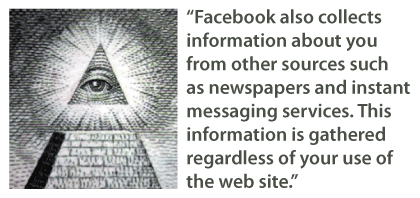
What about the Privacy Policy? In the Help Section of Facebook it says, "Facebook respects your privacy. We don't distribute your user information to third parties" followed by "Read more about our Privacy Policy." Click the link and it says oh yeah, one more thing: we just might share your info, and it "may include sharing information with other companies, lawyers, agents or government agencies." This is a pretty typical policy, actually. It's in the section entitled "The Information We Collect" that it gets a little disconcerting.When you visit the Web Site you may provide us with two types of information: personal information you knowingly choose to disclose that is collected by us and Web Site use information collected by us on an aggregate basis as you and others browse our Web Site.
It goes on to explain cookies, etc., but then ends with this vague third mode of data collection:
I'm not sure what that means, but I do remember something about AOL's updated terms of service.
I'm not usually big on conspiracy theories, but I point out Facebook's privacy policy to highlight some other interesting aspects of this company. It has been just a few months since Accel Partners anno -
might it have anything to do with ....this ?????
The major players are: MIT, Google, AMD, Red Hat, Design Continuum and News Corp. So yeah, a $100 AMD based Linux laptop whose quality will be up to standards with the rest of the above (Newscorp? I don't get it but whatever) is bad for Intel and thier technology partners (Dell, MS, etc.)
IMHO this project will revolutionize computing as we know it, no two ways about it.
-
Previous Slashdot article