Slashdot Mirror


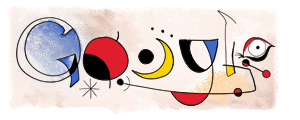
Google Violates Miro's Copyright?

Anonymous Coward writes "In a homage to Joan Miro on his birthday, Google changed its logo as to spell out the word "Google" in Miro's style. Google has a history of changing its logo in order to commemorate events and holidays of particular significance. In this case, the homage was not well received by the Miro family or the Artists Rights Society which represents them, as reported by the Mercury News. According to Theodore Feder, president of the ARS, "There are underlying copyrights to the works of Miro, and they are putting it up without having the rights". The ARS demanded that Google removed the logo, and Google complied, though not without adding that it did not believe it was in violation of copyright. The ARS has raised similar complaints regarding Google's tribute to Salvador Dali in 2002. "It's a distortion of the original works and in that respect it violates the moral rights of the artist," Feder said." It seems to me that the art world has a glorious history of incorporating prior art into modern creations. It's amusing to me that ARS doesn't understand that.
651 comments

  1. This is what I think about ARS by layer3switch · · Score: 4, Funny

    ARS-holes

    There you have it.

    --
    "Don't let fools fool you. They are the clever ones."
    1. Re:This is what I think about ARS by Mick+Ohrberg · · Score: 5, Insightful

      Indeed. In addition - could the Google logo be considered a parody? IIRC, you can make parodies without infringing on copyrights. Weird Al does this a lot, though I get the impression that he does ask first out of courtesy. I think the paridy factor is the whole reason Coolio is unable to take action against Weird Al for Amish Paradase (a parody of Gangsta's Paradise that Weird Al claims he got permission from the record company to do, but Coolio claims he never gave permission).

      --

      Quidquid latine dictum sit, altum sonatur.

    2. Re:This is what I think about ARS by Mr+Z · · Score: 5, Insightful

      I wouldn't say it's a parody, but rather a homage. That said, unless they incorporated his art directly, I don't see how copyright applies. You can't copyright a style. If Google's logo was incorporating art that wasn't Google's, they either need to license it or make a case for "fair use."

      --Joe
    3. Re:This is what I think about ARS by Alystair · · Score: 5, Informative

      You know it's personal when they submit an email address in the content of a slashdot article ;)

    4. Re:This is what I think about ARS by Mecdemort · · Score: 1

      One word: Appropriation
      Look it up, and explain what this problem is.

    5. Re:This is what I think about ARS by gaijin99 · · Score: 4, Funny

      Agree. Copyright covers a specific arrangement of words, or a specific image. An image that is similar to a copyrighted image is not a copyright violation.

      Now, maybe if his family had patented his artistic style they could claim Google violated their patent. Hmmm... I wonder if I could patent an artistic style and exploit the US patent system for my own profit. To heck with business model patents, can you imagine owning the patent for slasher flicks?

      --
      "Mission Accomplished" -- George W. Bush May 1, 2003
    6. Re:This is what I think about ARS by pap1llon · · Score: 1

      I dont think google violates Miro's copyright ;-)

    7. Re:This is what I think about ARS by theshowmecanuck · · Score: 1
      Try looking it up in a dictionary instead to see the real definition:

      adjective
      Suitable for a particular person, condition, occasion, or place; fitting.
      tr verb
      1. To set apart for a specific use: appropriating funds for education.
      2. To take possession of or make use of exclusively for oneself, often without permission: Lee appropriated my unread newspaper and never returned it.
      verb
      1 : to set apart for or assign to a particular recipient, purpose, or use
      2 : to take or make use of without authority or right --appropriation /&-"prO-prE-'A-sh&n/ noun

      I don't think they were taking possession of or making use of exclusively for themselves. But maybe we should use: "to take or make use of without authority or right." Or... since it was on Miro's birthday, maybe it was appropriate ("Suitable for a particular person, condition, occasion, or place; fitting.") to show homage to something the good people at Google appreciated. So let's look at homage:

      1. Ceremonial acknowledgment by a vassal of allegiance to his lord under feudal law.
      2. Special honor or respect shown or expressed publicly. See Synonyms at honor.

      Hmmmmm... Don't see any vassals or lords around here, so considering this was done on a specific occasion (Miro's birthday), by people who seemed to want to show their appreciation of the work, it seems to me like maybe homage is the keyword here. Sooooo... I would personally have to say that unless the ARS want to show how much they dislike people showing appreciation for their members work they should shut the fuck up. This sounds like a case of people who think themselves too good for the common folk. Or more likely, the families of dead artists who only understand the royalties from art, and not art, are a tad too greedy (e.g. ..."The Artists Rights Society, a group that represents the Miro family and more than 40,000 visual artists and their estates...")

      Hey, but then maybe the 'estate' doesn't understand that not everyone knows who Miro was. And now, just maybe, more people will know about him. And giving the estate the benefit of the doubt, they will be happy that more people will appreciate him. Or in my eyes, they will probably be more happy since the estate may make more money... now that more people know who he was thanks to Google.

      --
      -- I ignore anonymous replies to my comments and postings.
    8. Re:This is what I think about ARS by dascandy · · Score: 0, Redundant

      I almost asked what provider Salvador Dali or Joan Miro had, but apparently it weren't their email addresses posted...

    9. Re:This is what I think about ARS by Schraegstrichpunkt · · Score: 3, Informative

      Parody isn't a legal exception to copyright in all jurisdictions (e.g. Canada), sadly.

    10. Re:This is what I think about ARS by nihaopaul · · Score: 4, Funny

      Dear Theodore Feder,

      I am disappointed in your act towards google in the tribute they done for miro, in-fact i wasn't aware who miro was until i saw the tribute and done some research, its people like you and companies like yours that shame artists like those. i hope you can sleep at night knowing that you had the chance to help educate millions of people, but took it away with one FOUL swoop.

      sux2bu(TM)

      Paul

      _Legal Notes_
      sux2bu(TM) is a trademark of nihaopaul, reproduction, use or storage of sux2bu(TM) without prior written consent will result in a banana being shoved up your arse by a family member. by reading this digital transmission you agree to comply with these terms set forth

    11. Re:This is what I think about ARS by nbuet · · Score: 1

      One day, or an other, we will have to burn some witches.

    12. Re:This is what I think about ARS by KDR_11k · · Score: 3, Insightful

      The difference is that Weird Al clearly made a parody while this logo doesn't have anything funny about it.

      --
      Justice is the sheep getting arrested while an impartial judge declares the vote void.
    13. Re:This is what I think about ARS by linvir · · Score: 4, Funny

      No, Google were obviously trying to masquerade their logo as official work of Joan Miró in order to trick his devoted fans into using their search service. It's the only possible explanation, and it's only right that they be stopped!

    14. Re:This is what I think about ARS by KDR_11k · · Score: 1

      I only see the adjective, tr verb and verb definitions. Appropriation is a noun.

      --
      Justice is the sheep getting arrested while an impartial judge declares the vote void.
    15. Re:This is what I think about ARS by networkBoy · · Score: 1

      sux2bu sux2bu sux2bu sux2bu sux2bu sux2bu sux2bu sux2bu sux2bu sux2bu sux2bu sux2bu sux2bu sux2bu sux2bu

      Now where's my babana?
      -nB

      Lameness filter encountered.
      Your comment violated the "postercomment" compression filter. Try less whitespace and/or less repetition. Comment aborted.

      --
      whois gawk date unzip strip find touch finger mount join nice man top fsck grep eject more yes exit umount sleep dump
    16. Re:This is what I think about ARS by ArikTheRed · · Score: 1

      I claim that Weird Al clearly isn't funny either. Does that mean he's less parody now? The point being, paradoy doesn't have to be funny at all.

    17. Re:This is what I think about ARS by AgNO3 · · Score: 1
      Agree. Copyright covers a specific arrangement of words, or a specific image. An image that is similar to a copyrighted image is not a copyright violation.,
      Well it could be considered a derivative work then it would be covered by copyright. Or it could be in this one incident someone copied a Photograph and turned it into an corel draw illustration that looks almost exactly like the photograph. That was a copy right violation. Hmm then you have Picasso who said, "Good artist borrow, Great artist steal." No matter what it pretty lame for ARS to pursue this when they have a derivative work on the main page.
      --
      OMG Ponies!!! with Glitter!!!! I miss Pink :-(
    18. Re:This is what I think about ARS by CastrTroy · · Score: 1

      Also good examples would be Saturday Night Live and Mad Magazine (do they still exist?) who parody just about everything.

      --

      Anthropic principle: We see the universe the way it is because if it were different we would not be here to see it.
    19. Re:This is what I think about ARS by CastrTroy · · Score: 1

      I am a semi-big fan of Escher's work. At lot of stuff that I have says M.C. Escher TM. So I'm guessing that they trademarked his name, so that even when his art goes out of copyright, you won't be able to sell it under the Escher name, because it will still be trademarked (they don't expire). You may even be able to copy the artworks because they contain his name, which is trademarked, maybe they can just crop out the part with his name.

      --

      Anthropic principle: We see the universe the way it is because if it were different we would not be here to see it.
    20. Re:This is what I think about ARS by hoppo · · Score: 2, Interesting

      It doesn't matter (and the parody argument wouldn't hold water anyway). A copyright gives you protection for a specific piece of work -- a script, a character, a painting, a piece of code, etc. If Google copied elements of specific paintings, the Miro family's attorneys *might* have a case. However, if they use ownership of a "style" of work as the basis of their argument, Google will likely win if they were to take this to trial.

      Holders of copyrights have used that to stake ownership claims to which they are not entitled. This is not because of the law. Most people, upon receiving a cease and desist letter, will comply with the terms either immediately or after some correspondence. They either can't be bothered with going to court or are afraid of the consequences. A copyright holder can take advantage of this, by having a lawyer send out a threatening letter accusing the "offender" of some copyright violation. When the "offender" backs down, the holder gains ownership not through endorsement of the law, but through simple bullying.

    21. Re:This is what I think about ARS by Reaperducer · · Score: 1

      This is the same group that sent me a cease and desist letter from their lawyers in New York. They claimed to own the copyright to my vacation photos -- with me in them!

      Let me repeat that: They claim to own the copyright to my vacation photos!

      These were pictures that someone took of me, standing in a park, they claimed were owned by them, and demanded I take them off my web site or go to court. I filed the C&D with EFF.org, but I later found out that 99% of the complaints EFF gets are ignored. Probably because they're swamped.

      --
      -- I'm old enough to have lived through six different meanings of the word "hacker."
    22. Re:This is what I think about ARS by Anonymous Coward · · Score: 0

      careful, they'll sue you for using their work in your homage

    23. Re:This is what I think about ARS by Fulcrum+of+Evil · · Score: 2, Insightful

      So I'm guessing that they trademarked his name, so that even when his art goes out of copyright, you won't be able to sell it under the Escher name, because it will still be trademarked (they don't expire).

      Sure you can. 'This is a copy of a work by M C Escher' is a statement of fact.

      --
      "We returned the General to El Salvador, or maybe Guatemala, it's difficult to tell from 10,000 feet"
    24. Re:This is what I think about ARS by Anonymous Coward · · Score: 0

      Weird Al actually gets permission from the artists that he pariodies. Other pariody artists like Nick Alexander do not. From Nick Alexander's FAQ:
      No. In 1994, the rap group "2 Live Crew" was sued by Roy Orbison for a raunchy parody of Orbison's "Pretty Woman." The case was taken to the Supreme Court, where it sided with the defendants. Since then, all parodies are declared "Fair Use", provided that the parodies are humor-based.
      Many people who come up to me with this question know full well that "Weird Al" Yankovic asks for the artist's permission. I cannot speak for Al, but I suspect that it's because earlier in his career, no such ruling was made, and now he does so out of courtesy.

    25. Re:This is what I think about ARS by lababidi · · Score: 1

      And Coolio used Stevie Wonder's song Pastime Paradise to create Gangsta's Paradise.

    26. Re:This is what I think about ARS by retiarius · · Score: 1

      sorry about your run-in with copyright maximalists insisting
      upon advance permission for preparing derivative works.

      meanwhile, according to The Onion, Apple owns your vacation videos:

      http://www.theonion.com/content/node/47468

    27. Re:This is what I think about ARS by niktemadur · · Score: 2, Informative

      I think the parody factor is the whole reason Coolio is unable to take action against Weird Al for Amish Paradise

      Man oh man, that's a knee-slapper if I ever heard one. Does anybody remember that Gangsta's Paradise is a straight out rip-off of Stevie Wonder's Pastime Paradise, from the 1975 album Songs In The Key Of Life? I mean, to what absurd lengths can these people go in believing their own hype and revisionist history?

      The lack of originality in pseudo-musicians gunning for the Top Forty is a sight to behold. I don't mind hip-hop sampling a drum here and/or a bass there, but to use the full recycled arrangement as some sort of personal karaoke... once may be cute, twice is tiresome, three or more instances is bulls**t. But hey, if the formula works and you're gettin' paid, go for it, right?

      However, the prize of hypocrisy goes to the Rolling Stones who, from one of their two hundred room estates in the english countryside, slapped a lawsuit against The Verve for Bittersweet Symphony, even as the Stones bought their estates by ripping off dozens of old-time blues artists without paying a single cent in royalties to them.

      --
      Lil' Thindime, lilting a lacrimose lament, krashes the kwaint konfines of Kokonino Kounty
    28. Re:This is what I think about ARS by theshowmecanuck · · Score: 1
      appropriation
      1. The act of appropriating.
      2.
      a. Something appropriated, especially public funds set aside for a specific purpose.
      b. A legislative act authorizing the expenditure of a designated amount of public funds for a specific purpose.

      Didn't seem worthwhile adding... the noun just points back to the verb.

      --
      -- I ignore anonymous replies to my comments and postings.
    29. Re:This is what I think about ARS by djperception · · Score: 1

      You may be interested to know, since the post references artist Marcel Duchamp, that ARS is also the rights holder for Duchamp's entire body of work as well. Ahhhhh, sweet irony.

    30. Re:This is what I think about ARS by Anonymous Coward · · Score: 0

      The patent I want is the patent on "applying for, owning, and exercising patents". Or a trademark on the word "Copyright". I tried to register the "registered trademark" symbol, but danged if RadioShack hadn't beat me to it.

      You really can get anything from RadioShack.

    31. Re:This is what I think about ARS by rgravina · · Score: 1

      Yes, and Coolio ripped off Pastime Paradise by Stevie Wonder. Nothing irritates me more than these pop hip-hop artists that make their millions by ripping off lesser known classics (at least to their audience) and rapping about how rich and badass they are over the top. I cringe every time I'm in the unfortunate situation where I'm forced to sit through one of these songs.

      I wonder whether or not Coolio got permission from Stevie Wonder to make such a lousy cover of his song, and turn it from something meaningful about the problems of race relations in America into some BS gansta rap? And do you ever hear these artists actually acknowledge their song is a cover? I certainly haven't.

      And then he has the audacity to take action against Weird Al!

    32. Re:This is what I think about ARS by Fordiman · · Score: 1

      *sniff* *sniff*

      Smeel that, ARS? That's sarcasm. No, you won't get ANY support outside your tight-knit little community of pompous elitists.

      Yeah. Not even the real artists give a shit what google does - unless google starts painting the search page with their actual art.

      --
      110100 1101000 1101000 1100110 0 1101111 1101000 1100011 1
    33. Re:This is what I think about ARS by poot_rootbeer · · Score: 2, Informative

      The difference is that Weird Al clearly made a parody while this logo doesn't have anything funny about it.

      Being funny is not a requisite condition of parody. The term is broad enough that it covers many different forms of appropriating style or content, for a variety of purposes.

    34. Re:This is what I think about ARS by LifesABeach · · Score: 1

      Jessssssssse, looks like the ARS collectively sat on a line of baby power.

      Now I guess Cambells soup can go after Andy Worhall

    35. Re:This is what I think about ARS by Creepy · · Score: 1

      Technically in music, only the lyrics can be copyrighted. Fighting copy infringement on the music itself is MUCH harder, though there are a few notable wins (e.g. I Want a New Drug/Ghostbusters). The hard part is you need to prove a particular hook or sound is uniquely identifiable to a particular song and even that doesn't always work - samplers have taken hooks without permission and won several court cases by saying sampling itself is an art form (they've also lost a few).

      Basically, it's already nearly impossible to go after a parodier in the US, even if parody wasn't protected by law, because recorded and performed works of music are not copyrightable and thus very difficult to prosecute. Published music, OTOH, is copyrightable and the publisher is free to add any royalties into the sheet music for the published work. This is one reason why the original jazz "real book" is illegal but performing and recording songs out of it is not... well, make that as long as original lyrics aren't involved.

    36. Re:This is what I think about ARS by LunaticTippy · · Score: 1
      Wow, that's pretty offensive.

      Out of curiosity, what was the specific problem they had? Imagine if the Eiffel Tower or the Great Pyramids demanded license fees!

      --
      Man, you really need that seminar!
    37. Re:This is what I think about ARS by Mr+Z · · Score: 1

      Both musical scores and performances can be copyrighted. So, for instance, although the works of Bach and Mozart are outside copyright, I can't sample the Boston Philharmonic's performances of said works. For a given song, you have the musical score, the lyrics, and the performance. Each of the three pieces can have separate copyrights associated with them. The musical score seems to be the most fragile though.

      Although, the Beastie Boys recently pushed the boundaries apparently regarding three notes they sampled—perhaps the shortest sampling of a sequence of notes successfully defended under copyright law that still required deep litigation to settle. The narrow victory should give all artists pause.

      --Joe

  2. Its all about the money by IntelliAdmin · · Score: 5, Insightful

    I doubt any of the original artists would have a problem with it. It seems that it is family's that are interested in the financial gain from complaining to Google about it. This tiny excerpt from the article explains it all: "In September, the Authors Guild sued Google for reproducing works..." Come on! The Google symbol in the likeness of an artist is honoring them. It would only help increase the value's of their works, and peoples awareness of them. They just see Google as a big money pit they can take from.

    1. Re:Its all about the money by baptiste · · Score: 5, Insightful

      It is so sad when people try to do something nice (i.e. a tribute) only to be smacked down by money hungry trusts and estates who have no concept of the greater good. I think Google's logo art is an awesome thing. They gain nothing from it, yet it raises awareness of people, places, and causes. I'm all for copyrights and trademark protection when it comes to trying to protect an authors original work, but come on. A tribute that would stay up 1-2 days honoring the artist and they make this big a deal over it? Sigh - this world gets more screwed up by the day

    2. Re:Its all about the money by Anonymous Coward · · Score: 0

      An ironic statement from someone whose "blog" seems to exist to sell what appears to be a recompiled version of VNC.

    3. Re:Its all about the money by squiggleslash · · Score: 1, Insightful
      I've read about the case in several places, and I can't see anywhere anything implying that this is about money.

      This is the family objecting to the misuse of the artist's moral rights. They simply do not want arbitrary businesses associating themselves with the artist's work. This is not about the family wanting money, it's about the family not wanting Google to associate itself with Miro.

      I do get rather annoyed with typically myopic rants from people who are absolutely sure that because they do everything for money, everyone else does too. I don't particularly dislike Google, so I can't comment on Miro's family's particular issue here, but if I produced art (software is not art), I'd be annoyed if:

      - Philip Morris used my theme music to promote their new "Blacklung Cigarettes for kids"

      - Hiatt etched one of my drawings on their special edition "Nerve Twister" handcuffs for the Saudi Arabian secret religious police.

      - Monsanto released a novel based on my characters, fictional world, and one of my plots, where the hero is able to save the developer of a unique brand of corn that turns poisonous and explodes without warning if grown by unlicensed farmers from a group of patent pirates who plan to remove the license-control genes in order to allow third world countries to grow the corn without a license.

      At the very least, I'd want any connection between my name (even if just implied) and the three company's "tributes" to my art removed. Copyright law currently allows that, so I'd be well within my legal rights to do so. This wouldn't be about Philip Morris, Hiatt, or Monsanto giving me money, it would be about my not wanting to be associated with those products.

      And as a matter of principle, I'd want other companies that I don't necessarily have anything like as extreme objections to, to ask my permission first.

      THAT is what this case is about. Not money.

      There is, hard though it may be for many myopic-techies to understand, more to life than money. If you're having trouble understanding that, imagine this is about GNU, not art. Ask yourself how many free software advocates are demanding GPL compliance "for the money"?

      --
      You are not alone. This is not normal. None of this is normal.
    4. Re:Its all about the money by westlake · · Score: 1
      It would only help increase the value's of their works, and peoples awareness of them

      Miro's "Portrait of Madame K' sold for $ 12.6 million in 2002. Art in America When the post office releases a commemorative stamp, it does so in cooperation with surviving family members. There is no reason why Google shouldn't be held to the same standard.

    5. Re:Its all about the money by squiggleslash · · Score: 0, Redundant
      Mysteriously (hah), this comment has been modded +5, despite making an allegation which has no evidence to support it whatsoever (that the family's motivation is "money"), whereas my comment explaining what the issue is about has been modded out of view (using the cowardly "overrated" option), so to repeat:

      This isn't about money. It's about the family of the artist wanting to assert the artist's "moral rights". They don't want the artist's work associated with Google.

      You may agree or disagree with the family's desire to do this. You may agree or disagree with the fact copyright gives them the right to enforce those moral rights. But the fact is that saying this is about money is lying, and does nothing to deal with the issues that are central to this case.

      Saying "I don't want my art to be associated with Google" is no more about money than saying "I don't want the code I contribute to GNU/Linux being put in a proprietary product".

      --
      You are not alone. This is not normal. None of this is normal.
    6. Re:Its all about the money by Lumpy · · Score: 4, Interesting

      All of the out and out WHORING of this fantasy called "intellectual property" is done by the family members and rarely if ever done by the real artists (tools like Metallica as the exception here)

      Look at Yoko Ono, she is wringing the Jhon Lennon Rock dry getting every last drop of blood out of it, and this is the Modus Operandi of almost every single artists family that recieves the goldmine that was their parent's or Spouses. One of the biggest to do this was the wife of Martin Luther King Jr. She demanded money from every photo of him or fil clip of him shwon anywhere, now that she is gone the feeding frenzy will probably go into overtime with the family.

      This is why copyrights need a solid HARD limit that aftera short X years of the death of the creator all of it goes into public domain and free tomatoes get passed out to the public to pelt the family that was whoring the creativity of the artist or person...

      Ok that last part is probably not going to fly but it would be a detterent.

      ARS = spoiled brats that really need to have it all taken away from them and made to sit in a corner until they can come out and play with everyone else in society nicely.

      --
      Do not look at laser with remaining good eye.
    7. Re:Its all about the money by Anonymous Coward · · Score: 0

      My car is red. I like cheese on my hamburgers.

    8. Re:Its all about the money by Anonymous Coward · · Score: 0

      It just goes to show ya; artists are the scourge of the earth; if they could be trusted, they'd have real jobs.
      (this is humor. please don't kill me. thank you.)

    9. Re:Its all about the money by tverbeek · · Score: 4, Insightful
      This is an example of why (IMHO) copyrights should immediately expire along with the creator (unless they have a dependent child or spouse, in which case they'd last a fixed term, as the law was originally written). This whole doctrine that works of art should provide financial support to the grown children of the creator is wrong-headed, and the notion that these property heirs and their children and grandchildren should have creative control over these works is absurd.

      Copyright-enforced royalties should be a kind of pension for creators, offering some financial security to people who've spent their lives creating works of art (visual, literary, musical, etc). Retirement pensions don't keep paying out after someone dies (except to a surviving spouse), because the person who earned them no longer needs them. Likewise, when I die, why should my sisters or my nieces and nephew start getting money from the things I've created? And more importantly, why should they have the right to authorize what's done with copies of them?

      I'm a staunch supporter of copyright in principle - people who indiscriminately "share" tunez, warez, and videoz with strangers on the net can go suck on a shotgun as far as I'm concerned - but I think copyright has been hammered and stretched and twisted over the course of the past century into some kind of hereditary entitlement and corporate welfare scheme. Maybe if modern copyright law weren't so obviously aimed at giving money to people who didn't earn it, it'd be easier to persuade people to respect it.

      --
      http://alternatives.rzero.com/
    10. Re:Its all about the money by flogic42 · · Score: 2, Informative

      Google's use is obviously within the bounds of Fair Use. In particular, transformative works that cannot be substituted for the original and do not detract from profits on the original (except as criticism might deter buyers) are protected under fair use. Obviously, for example, you don't need Disney's permission to write a book analyzing Disney. If you did, copyright law would be in blatant conflict with the first amendment. Quite frankly the first amendment is infinitely more important than anyone's ability to make a buck. And, in this particular case, Google's tribute was only serving to publicize the artist. It would be impossible to argue that their fair use detracted from the profits of the copyright holders.

      --
      Check out my women's designer clothing store.
    11. Re:Its all about the money by arminw · · Score: 2, Interesting

      .....to assert the artist's "moral rights"....

      How does anybody in our relativism wracked society decide what what "morals" are and that artists or anybody else for that matter has such a thing as "moral" rights? Exactly WHO decides what is moral? We have lgislatures and courts decide what's LEGAL, that's all.

      --
      All theory is gray
    12. Re:Its all about the money by radish · · Score: 1

      I don't have any problem with the estate having that view. However, I don't believe the law affords protection for an artists "style" (remember, there's no actual copyright infringment here - Miro never painted a Google logo) and I don't believe it should.

      Look at music - you can't sue someone for sounding like you, otherwise the Beatles estate could have made a fortune out of Oasis and every Britney-alike pop princess would be busy sueing all the others. You CAN sue for specific infringment of specific works (e.g. stealing a hook, or sampling a vocal). If Google had done this - if they'd taken actual parts of Miro works and used them, then I would agree with the estate. But they didn't, they made a new - ORIGINAL - work which just happened to remind people of Miro.

      --

      ---- Den ene knappen er powerknapp, den andre er Bender voice knapp "Bite My Shiny Metal Ass"

    13. Re:Its all about the money by IHC+Navistar · · Score: 1
      Question: Did they 'Reproduce' works, or did they 'create' new works in the style of other artists?

      Why do such large companies bother caving in to the baseless whining and complaining of idiotic groups?

      -----

      Never underestimate the power of stupid people in large numbers.

      --
      Knowing Google's lust for data collection, the Soviet Union is still alive and well inside the psyche of Sergey Brin....
    14. Re:Its all about the money by Forge · · Score: 1

      They do have a "hard limit".

      Onfortunatly it's more than 100 years after the death of the artist.

      Frankly I think that is onreasonable and the people who originaly put that into american law thoght 20 years would be enogh.

      Since then however Walt desney has managed to keap extending it so that Miky Mouse never goes into the public domain.

      This from a company that lives off filming public domain stories. (Cinerela, Prince of Egipt. etc...)

      --
      --= Isn't it surprising how badly I spell ?
    15. Re:Its all about the money by cetialphav · · Score: 1

      But the Post Office makes money off of the stamps. Google is not profiting by making a change to their logo.

    16. Re:Its all about the money by plumby · · Score: 1

      Two questions about the stamp comparison.

      - Did the stamps use some of Miro's work directly, or did the PO just produce stamps "in a Miro style", like Google's logo
      - Did the PO profit, unlike Google, from the sale of the stamps?

    17. Re:Its all about the money by Eunuchswear · · Score: 1
      Saying "I don't want my art to be associated with Google" is no more about money than saying "I don't want the code I contribute to GNU/Linux being put in a proprietary product".

      But... (wait for it...) Miro is dead , he doesn't want anthing.

      --
      Watch this Heartland Institute video
    18. Re:Its all about the money by drsmithy · · Score: 3, Insightful
      This is why copyrights need a solid HARD limit that aftera short X years of the death of the creator all of it goes into public domain and free tomatoes get passed out to the public to pelt the family that was whoring the creativity of the artist or person...

      There is no justifiable reason whatsoever for copyright to last a second past the creator's death.

      Copyright - if it must exist at all - is fundamentally an economic tool (it exists for no other reason than to artificially restrict information to increase its scarcity, and hence value) and as such should have its terms tied to the economic success (or lack thereof) of the protected work. Copyright terms need to be linked to "return on investment" for the system to work in the modern world.

      Successful work -> copyright expires quickly -> creator has to generate more works to keep the money flowing -> higher net benefit to society.

    19. Re:Its all about the money by Eunuchswear · · Score: 1

      What about the Picasso family, having sold the name of the great artist to a cruddy car maker, trying to stop another cruddy car maker selling a car called the "Pissaro" on the grounds that it devalued their "property".

      Scum.

      --
      Watch this Heartland Institute video
    20. Re:Its all about the money by Anonymous Coward · · Score: 0

      >
      > I'd be annoyed if Philip Morris used my theme music
      > to promote their new "Blacklung Cigarettes for kids"
      >

      Probably most people would, but it does not mean much.

      The problem here is the "my". Nothing is yours and nothing is sure.

      "You", is the result of too many things to even try to enumerate them. And some of these things directly amount for a large part of "your" piece of art. Music? Who made the instruments? (at the very least). Well, of course, industrially made instruments might not have much personnality, but there's still something... and you might have used handmade instruments, which is not this rare (well, depending on your music style).

      And even then (you could be proud of what you added and tried to protect it from others -well, if you understood only half of the story), you cannot be sure what you did was really coming from yourself.

      How about the possibility of it coming from someone else (at least in part), through some kind of inconscious telepathic link? How about the possibility of it coming from an implanted engineered tought? (You might possibly be playing some kind of "reality game", the computed choose you'll live the life of an artist and created highly inspirational thoughts for you to use -and made you to be able to use them to create art).

      You probably won't accept much of what I said, and most people would not, but this is reality. Nothing is yours and nothing is sure. Copyright (and patents) egals money and egocentrism, nothing more.

    21. Re:Its all about the money by Anonymous Coward · · Score: 0

      I think Google's logo art is an awesome thing. They gain nothing from it

      The first part of your statement shows they do gain something from it.

    22. Re:Its all about the money by Anonymous Coward · · Score: 1, Interesting

      Sigh.

      "Moral rights" is a technical term in law, referring to certain post-sale rights an IP creator may have no matter who actually owns the work. Typically moral rights include the right of attribution, the right of anonymity, and the right to prevent modification. Fair use allows me to create my own parody of Miró, but it would not allow me to physically alter a Miró work, and moral rights specifically forbid the latter.

      In Europe, moral rights are part of copyright. In the US, moral rights are something of a hodgepodge. They are not part of copyright, however, and are not transferable, and do not extend past death.

    23. Re:Its all about the money by Paradise+Pete · · Score: 4, Insightful
      There is no justifiable reason whatsoever for copyright to last a second past the creator's death.

      If that were the case I'd start looking over my shoulder if I came up with something really popular.

    24. Re:Its all about the money by caseih · · Score: 1

      Google never took a Miro painting and copied it; they made a logo that was in a style of Miro. This is not a copyright violation. This is fair use. And if these companies did what you have mentioned in a similar way (not reproductions but just simply likenesses) then that is not wrong. In fact, other than trademark infringement their is nothing you can do.

      Now your example doesn't apply to this google situation anyway because you are talking about blatant use of your copyrighted works in a way is just plain copying. So yes your post should be rated off-topic because it is. And how you manage to drag the GPL into this is a red herring too. Someone is perfectly welcome to make program that looks much like and acts much like a GPL'd program and use it for any purpose without violating the GPL or copyright on the code.

    25. Re:Its all about the money by Anonymous Coward · · Score: 0

      Commemorative stamps usually contain actual reproductions of the work of the artist. Writing some letters in the style of the artist does not contain the artist's actual work, so no permission is needed.

    26. Re:Its all about the money by dodobh · · Score: 1

      software is not art

      Why not? Some parts of writing software are engineering (version control, scheduling, IDEs....). Other parts like gathering requirements and actually writing good code are art (and in some cases, black magic). It isn't visual art, but art all the same.

      --
      I can throw myself at the ground, and miss.
    27. Re:Its all about the money by blibbler · · Score: 3, Insightful

      > There is no justifiable reason whatsoever for copyright to last a second past the creator's death

      How about the situation:
      company x wants to make a book based on novel by author Y. Y refuses, company X kills Y. Should company X be able to make a movie without any access rights issues? (This is not an unheard of situation)
      What about Author z wishes to provide for Zs family, so writes a book on deathbed. should this book become public domain when Z dies? It would defeat the purpose of Zs actions (this is also not an unheard of situation)

      Companies and organizations can hold copyright. Generally this copyright is held for a fixed period of years (as companies do not have to "die"). Should companies' copyrights be protected more than humans (whose copyrights would expire when they die?

      > Successful work -> copyright expires quickly -> creator has to generate more works to keep the money flowing -> higher net benefit to society.

      How do you propose to measure success? Very few movies ever show a profit. This is not because they don't make money for the studio, but because it makes tax sense to calculate it that way. Many of the wealthiest people in the world pay less income tax than a regular person earning $50,000. It isn't because they are not earning an income, but because they can pay very creative accountants. Income is a lot simpler to measure than "economic success".

    28. Re:Its all about the money by hunterx11 · · Score: 1

      Sir, I have analyzed your post, and every word contained therein was previously published in the work "Merriam-Webster's Collegiate Dictionary," yet I see no mention in your post that you have obtained permission to reproduce Webster's works in whole or part.

      --
      English is easier said than done.
    29. Re:Its all about the money by Buran · · Score: 1

      And how precisely do you mean to stop someone who chooses to write about you or who chooses to draw something inspired by you? You didn't create the work of art (writing is a type of art, in this context). So you have no say over how it is used. You may not LIKE it, but you have no power to stop it.

    30. Re:Its all about the money by Kadin2048 · · Score: 2, Insightful

      I think there are valid legal reasons for making the maximum copyright term equal to the life of the author plus (either) eighteen or twenty-one years. In Common Law, it used to be a fairly strict rule that you couldn't create a legal instrument relating to real property (so a deed, covenant, trust, etc.) with a term of more than the life of someone alive at the time of creation plus 21 years. The idea being that this way you couldn't have basically 'landed gentry,' who had perpetual and un-dissolvable property holdings. The "life plus 21 years" was picked I believe because 21 is the age of majority (well it was, until they changed it to 18), thus it's basically guarantees that the trustee's heirs will be legal adults. So it's possible to create a trust that will last through your lifetime, and see your children through to adulthood, but you can't lock stuff up for eternity.

      It seems that some states have actually softened these laws, which is frankly unfortunate (and suspicious; I wonder who paid for that), but I think it's a good model for Intellectual Property in the same way that its reasoning was valid for real property.

      In fact, I think it's more valid for IP than RP: I could think of some valid reasons for wanting to protect real property in a trust for multiple generations, but few valid ones for IP that don't hugely impact the public's interest. It would allow a creator of some valuable piece of IP to use it for personal gain throughout their lifetime, and also to know that their children would be supported by it at least until they became adults -- which is a valid motivation, and taking this away would I think lessen the incentive to create -- but it wouldn't lock it up for the centuries-plus terms that we have now.

      Also, I think we should give a substantial consideration to harmonizing the laws between corporate-owned and privately created works; anything created "by a corporation" has to be created by an individual -- legal 'entities' do not sit down in front of Microsoft Word and type things. Anything created by IBM, for instance, had its origins in the brain of a human being or group of human beings, and the maximum copyright term ought to be the same as it would be had it been created privately by that person. (The copyright would still be owned by the corporation, the term would just be affected.) Alternately, perhaps a fixed term of 50 years could be chosen if the company preferred, to make accounting easier.

      At any rate, I think we've clearly gone overboard in the present system, there is no justifiable reasons for creating IP portfolios that support generations of leech-like descendants, in the same way that aristocratic families used to live off of perpetuity bonds underwritten by the Crown. There's a reason why we don't allow the latter anymore, we shouldn't allow the former either.

      --
      "Ladies and gentlemen, my killbot features Lotus Notes and a machine gun. It is the finest available."
    31. Re:Its all about the money by BillyBlaze · · Score: 1
      Actually, why should copyrights outlive the death of the creator anyway? Their purpose is to promote the creation of more writings, obviously this doesn't work if the creator is gone. Why should creators be the only people allowed to make money (at the expense of the public) after they're dead?

      The counter-argument is, "It's property, so who is the government to take it away?" Don't waste your time convincing me of that, I don't buy it. Those who call copyrights property rights are doing so to shift the discussion away from "How long should they last?" and towards "Why are you taking away my property?". It's a word game intended to derail honest discussion about how strong copyrights should be. (Hint: the Constitution has something to say on this matter. It says "limited times," and it doesn't mention securing the Right to the great-grandchildren of Authors.)

    32. Re:Its all about the money by Buran · · Score: 1, Funny

      I have never heard of a country called Egipt. Now, if you meant Egypt, that wasn't a Disney movie, that was Dreamworks.

      Now who the hell are Desney and Miky and Cinerela? And your U key seems to be malfunctioning and producing Os instead.

    33. Re:Its all about the money by fmackay · · Score: 1
      Copyright-enforced royalties should be a kind of pension for creators, offering some financial security to people who've spent their lives creating works of art (visual, literary, musical, etc).
      Why?

      Why shouldn't those who earn their living creating intellectual property plan for their retirement the same way everyone else does, by saving a proportion of the money they earn during their working life, in their case by selling/licensing/exhibiting/performing their creations? If the point of copyright is to encourage creators to produce more work, then lengthy copyright terms which allow successful artists to sit on their arses watching the cash roll in for the rest of their lives without producing more work seem counterproductive.
    34. Re:Its all about the money by nyri · · Score: 1

      I think Google's logo art is an awesome thing. They gain nothing from it, yet it raises awareness of people, places, and causes.

      Don't be naive. Of course there's something to Google to gain in with changing logos. For example I like to visit Google's main page from time to time just to see the logo art. At that visit I'm also going to note other changes like link to image.google.com. More over, judging from your message, the changing logo art seems to make Google more likable. Which is good for them.

    35. Re:Its all about the money by spyowl · · Score: 2, Insightful
      Maybe if modern copyright law weren't so obviously aimed at giving money to people who didn't earn it, it'd be easier to persuade people to respect it

      Oh you'll respect it alright when the anti-terrorism unit shows up at your door, destroys your equipment and nails your ass in prison for 20 years.
    36. Re:Its all about the money by TheCarp · · Score: 1

      however, murder is already illegal. conspiracy to commit murder, even more so.

      A better solution, why should copyright even last until the authors death. What if the state of the authors life is unknown?

      I say 20 years is plenty. Period. no until death, nothin. Publish it, and you ahve 20 years to continue to publish it without competition.

      Shit, thats quite a bit longer than the VAST MAJORITY of most works are ever in print anyway. Ditto for prints of art works.

      Are there artists and authors whose works don't end up being profitable till long after they have been out 20 years? Sure... but they are most certainly the exceptions, we need to optimise for the general case.... not make a system that is profitable for every minor outlier and strange situation that we can imagine.

      -Steve

      --
      "I opened my eyes, and everything went dark again"
    37. Re:Its all about the money by tepples · · Score: 1

      They do have a "hard limit".

      No they don't. In the soil where the Slashdot server sits, the United States Congress is free to add 20 more years every 20 years.

    38. Re:Its all about the money by Anonymous Coward · · Score: 0

      Yes, there is. Hypothetically, an author who makes a living from writing books has a young family he needs to support, then he dies shortly after finishing what is to become a best-seller. Assume also this author was too poor to afford life insurance. His family need money to live on and should be entitled to the proceeds of his hard work.

      There should be a reasonable limit on the how long copyright should last, but not related to when the author dies, perhaps something like 20 years after the author makes the work public regardless of whether the author lives another 50 years or dies the next day.

    39. Re:Its all about the money by An+Onerous+Coward · · Score: 1

      An actual answer to your rhetorical question: here.

      But I agree that relativism is wracking about in our society, and it's destroying our moral fabric. Rather than having disagreements over what constitutes ethical behavior, or weaken ourselves by allowing for disagreements, we need to have one standard of conduct and one standard of ethics.

      And that standard is The Holy Bible. King James Version. None of that weak-kneed, liberal, namby-pamby NIV crap.

      --

      You want the truthiness? You can't handle the truthiness!

    40. Re:Its all about the money by forty7 · · Score: 1

      How about the situation: company x wants to make a book based on novel by author Y. Y refuses, company X kills Y. Should company X be able to make a movie without any access rights issues?
      Can it be proven that company X killed Y? If so, no, they shouldn't be able to make the movie, because they'd be profiting as the result of a crime. If it can't be proven that they killed Y, then, yes, they should be allowed to make the movie, just like anyone else.

      What about Author z wishes to provide for Zs family, so writes a book on deathbed. should this book become public domain when Z dies?
      Absolutely.

      Companies and organizations can hold copyright. Generally this copyright is held for a fixed period of years (as companies do not have to "die"). Should companies' copyrights be protected more than humans (whose copyrights would expire when they die?
      Companies should not be allowed to hold copyrights. The point of copyright is to promote the public good by encouraging creation and innovation through the temporary exclusivity provided by copyright law. The public good is not served by allowing corporations to hold copyrights.

    41. Re:Its all about the money by smoker2 · · Score: 1
      It's only a fucking (temporary)logo on a web page !

      No-one dies, google aren't gaining anything financially from doing it, and they are hardly bringing the artist into disrepute.

      Do the family want the artist to disappear into the mists of time ? I'm pretty sure any real artist would welcome free publicity.

      What's next, banning google from indexing images in searches ? And as someone pointed out, it wasn't even his work, it was "in the style of". Would you get as pissed off if google wished you happy birthday on their homepage ? After all they haven't asked permission to use your name.

      As Robin williams would say, you are seriously in need of a blowjob !

    42. Re:Its all about the money by fossa · · Score: 1

      That's absurd. First, anyone with large amounts of money could be equally targeted by an individual looking for money. Second, killing an author to move his popular work into the public domain does not guarantee the murderer any profits because the monopoly would be gone.

    43. Re:Its all about the money by jabelson · · Score: 1

      Do something nice? Google is a corporate entity - a bloated monster worth billions, if they seem art friendly and all, it's just more "content" for their site - they don't care about education or community. I don't think it was a big deal, and Google has a right to evoke a style in their font, but to suggest altruism is a stretch for a behemoth like Google - if MS did this, how many would be schvitzing?

    44. Re:Its all about the money by 1ucius · · Score: 1

      This is not about economic-rights. It's about so-called moral-rights. Many civil law countries (e.g., France, Germany) give artists a separate right to control attribution and right to the integrity of their work. For good or bad, U.S. law generally doesn't recognize moral rights.

    45. Re:Its all about the money by john82 · · Score: 5, Funny

      "In other news, a New York law firm has filed a class-action lawsuit against the estate of Spanish surrealist artist Joan Miro and a group calling itself the Artists Rights Society. The suit was filed on behalf of millions of seven to nine year old children world wide. The firm, Dewey, Cheatham & Howe, claim that numerous pieces by the late artist infringe on the implied copyrighted works of elementary school children who, owing to their age, have been by and large drawing in a flat linear style mimiced by Miro. In filing the suite, DCH released a statement saying that Miro had knowingly been copying the works of children for years without proper attribution or remuneration."

    46. Re:Its all about the money by mcc · · Score: 1

      How does anybody in our relativism wracked society decide what what "morals" are and that artists or anybody else for that matter has such a thing as "moral" rights? Exactly WHO decides what is moral?

      The person who has more money, silly.

    47. Re:Its all about the money by (negative+video) · · Score: 1
      This is the family objecting to the misuse of the artist's moral rights. ... This is not about the family wanting money, ...
      Bullshit. If Google had ripped off the work of an unknown painter with languishing commercial value, nobody would have squawked. In fact they probably would have thanked Google. This is all about cynical profiteers chasing filthy lucre.
    48. Re:Its all about the money by (negative+video) · · Score: 1
      Second, killing an author to move his popular work into the public domain does not guarantee the murderer any profits because the monopoly would be gone.
      The monopoly would remain. The publisher who preprinted a warehouse full of the work would own the market.
    49. Re:Its all about the money by (negative+video) · · Score: 1
      The point of copyright is to promote the public good by encouraging creation and innovation through the temporary exclusivity provided by copyright law. The public good is not served by allowing corporations to hold copyrights.
      In other words, you wish to punish people for doing work as employees.

      Do you channel Joseph Stalin twenty-four hours a day, or just when you're posting to Slashdot?

    50. Re:Its all about the money by NeutronCowboy · · Score: 2, Insightful
      Copyright-enforced royalties should be a kind of pension for creators, offering some financial security to people who've spent their lives creating works of art (visual, literary, musical, etc).

      I'm sorry, but what? No one, in any business except the one of copyrighted works, gets to derive a pension from work they have done earlier. As a matter of fact, copyrighted works are the only legal construct that allows someone to derive income from something that has not only been sold, resold and sold again, but has been done in the past (sometimes decades). By your logic, should the fact that I'm working right, creating software, writing fixes, entitle me to receive a pension 50 years down the line from the people who use my work right now?

      This entire idea that people can somehow retire and still get paid for work that they used to is ludicrous. If you want to retire on the income you've generated by working, fine. Be my guest. I really don't care how you arrive at that result. But don't expect me to subsidize your retirement in the Bahamas, just because you did some work earlier.

      I'm all for copyright. It does have a place indeed. But to twist this into some form of retirement plan is an insult to everyone who actually has to save money to retire. Furthermore, behind these types of uses for copyright is another ludicrous idea: that somehow, your work was so awesomely awesome and groundbreaking that you get to control how it gets used - regardless of how many previous ideas and methods you copied, used or abused to create your work. In short, it's the idea that writing a book or a song somehow results in something doesn't draw on anything else in the world - which is complete and utter crap. The only reason people can create stuff is because they use things and ideas that are already around them. It's the only way to create something that actually matters.

      Let me repeat this: there is a place for copyright. There has to be a way that people can derive an income from creating works of art or software. But copyright is not a natural right, nor does more copyright result in more creativity. On the contrary - there is a very quick limit when copyright starts to inhibit creativity. So to people who think that copyright should be a way to subsidize retirement - go suck on a shotgun indeed.

      --
      Those who can, do. Those who can't, sue.
    51. Re:Its all about the money by ksheff · · Score: 1

      I agree with the short copyright limit, but you know there will be the people who will complain that after 20 years, the work may become popular again in the retro market and the artist is getting screwed out of the profits. Oh well. But one of the reasons patents and copyrights were originally given a limited number of years by the US Constitution was to encourage production of new work. The system we have now is geared towards the one hit wonder. :(

      --
      the good ground has been paved over by suicidal maniacs
    52. Re:Its all about the money by professionalfurryele · · Score: 2, Insightful

      "Do you channel Joseph Stalin twenty-four hours a day, or just when you're posting to Slashdot?"

      Hate to point it out but you are the one proposing an increase of state powers above the ideal level (zero). By giving government the power to grant temporary monopolies you are in fact expanding the state. What sounds more Stalinist to you?

      Can you think of a good reason for companies to hold copyrights?

      I can, for example to allow a group of individuals to produce a work that a single individual could not, or to add value to copyrighted work to increase the incentive to produce it, by giving companies the ability to buy and sell government mandated monopolies. I question the latter reason, the former is one in the primary reason we allow companies to exist in the first place.

      Perhaps you could contribute your reasons, instead of invoking the booogie man.

    53. Re:Its all about the money by porcupine8 · · Score: 1
      First, anyone with large amounts of money could be equally targeted by an individual looking for money.

      And I'm sure they are now and then. But the difference is, your money doesn't go into the public domain when you die.

      Second, killing an author to move his popular work into the public domain does not guarantee the murderer any profits because the monopoly would be gone.

      It doesn't guarantee it, it merely makes it possible. If Steamboat Willie were to finally pass into the public domain, no one would be guaranteed profit from it. But you *could* start making prints of the cels, etc and selling them perfectly legally and profiting from them, which you can't do now. Plenty of publishing companies make money off of books that are in the public domain and easily gotten for free at bartleby.org - but people will pay to buy the hard copy anyhow. So, no, it doesn't guarantee a profit - but if something is super-popular, it could make it very likely.

      --
      Warning: Apple/Nintendo fangirl. Likes her electronics cute & cuddly. May be rabid.
    54. Re:Its all about the money by fossa · · Score: 1

      Well, you can also kill your spouse and reap the life insurance payback. Simple solution: make copyright last less than the author's life.

    55. Re:Its all about the money by Anonymous Coward · · Score: 0

      I think that with this and all future times when they're threatened over the style of their logo, Google should replace the offending logo with a giant hand giving the finger, with links to the ARS..

    56. Re:Its all about the money by Rixel · · Score: 0

      I know it's wrong, and misguided, but I can't help thinking that Google should tweak their page a bit in light of this.....ie:

      "Your search - Miro - did not match any documents."

      I would expect the whining would rise quite a bit.

      --
      Never play chicken with a passive aggressive.
    57. Re:Its all about the money by porcupine8 · · Score: 1
      Yes, and some people do that. But in the case of your spouse, you have a bit of added incentive to not kill them aside from the illegality. Like, y'know, loving them, or raising kids with them, or little things like that.

      If the copyright is less than the author's life, you can still kill them before it runs out to make it run out faster. However, the cost of waiting for it to run out would probably be favorable vs the cost of killing the copyright holder.

      --
      Warning: Apple/Nintendo fangirl. Likes her electronics cute & cuddly. May be rabid.
    58. Re:Its all about the money by thogard · · Score: 1

      There is no justifiable reason whatsoever for copyright to last a second past the creator's death.
      The copyright for years after the death of the author was intended to be a pension for the authors widow.

    59. Re:Its all about the money by Buran · · Score: 1

      Flamebait huh? Then please explain who all these people are ... or learn to fucking spell.

    60. Re:Its all about the money by (negative+video) · · Score: 1
      Hate to point it out but you are the one proposing an increase of state powers above the ideal level (zero).
      The ideal level of state powers is not "zero", unless you enjoy chaos.
      Hate to point it out but you are the one proposing an increase of state powers above the ideal level (zero). By giving government the power to grant temporary monopolies you are in fact expanding the state.
      No. I assumed existing state powers. The proposal I argued against was to expand government power by allowing it to selectively punish those deemed to be employees.
    61. Re:Its all about the money by Anonymous Coward · · Score: 0
      This is an example of why (IMHO) copyrights should immediately expire along with the creator


      This has the unfortunate consequence of making it more attractive for competitors, samplers, licencees, et al. to cause the creator to expire early...
    62. Re:Its all about the money by fossa · · Score: 1

      I was thinking more along the lines of a fixed copyright term (say, 14 years as was once customary?), guess that wasn't clear. If the term is based on life in any way such as "14 years or death, whichever's sooner", "life", or "life + n years", then killing the author will always speed entrance to the public domain. Though I'm still not convinced this would lead to copyright assasinations.

    63. Re:Its all about the money by drsmithy · · Score: 1
      If that were the case I'd start looking over my shoulder if I came up with something really popular.

      Fortunately, premediated murder is already (very) illegal.

      Not to mention, what would be the point ? Killing the creator of a work would put their work into the public domain, severely restricting - indeed, nearly completely eliminating - any ability to generate profit from that work.

    64. Re:Its all about the money by MikeFM · · Score: 1

      You should anyway. Anything worthwhile that you create is a threat to somebody somewhere. Be paranoid.

      --
      At what price learning? At what cost wisdom? The price is a man's peace of mind, and the cost is his life.
    65. Re:Its all about the money by drsmithy · · Score: 1
      company x wants to make a book based on novel by author Y. Y refuses, company X kills Y. Should company X be able to make a movie without any access rights issues? (This is not an unheard of situation)

      Do you really think company x are still going to be in business after being found guilty of premeditated murder ?

      Are there not already laws that deal with generating money from the proceeds of crime ?

      What about Author z wishes to provide for Zs family, so writes a book on deathbed. should this book become public domain when Z dies? It would defeat the purpose of Zs actions (this is also not an unheard of situation)

      Why should the situation for copyright holders be any different to the situation for anyone else ? Does an employer keep paying their employees wages to the family after their death ?

      Companies and organizations can hold copyright. Generally this copyright is held for a fixed period of years (as companies do not have to "die"). Should companies' copyrights be protected more than humans (whose copyrights would expire when they die?

      No, outside of extraordinary circumstances, copyright shouldn't last even close to the lifetime of a person in the first place.

      How do you propose to measure success?

      Given copyright is simply an economic tool, by return on investment.

      Very few movies ever show a profit. This is not because they don't make money for the studio, but because it makes tax sense to calculate it that way.

      This is a flaw in laws dealing with corporate accounting, and should be dealt with there.

      Many of the wealthiest people in the world pay less income tax than a regular person earning $50,000. It isn't because they are not earning an income, but because they can pay very creative accountants. Income is a lot simpler to measure than "economic success".

      Firstly, copyright must be changed to an opt-in system.

      Secondly, when a work is lodged with the copyright office, one copy must be kept by them (for guaranteed availability on expiration of copyright) and a "cost of development" must be registered. This cost - along with any revenue generated from the work, either directly or indirectly - would become an integral part of legally required accounting and/or taxation reporting for the entity that registered it.

      Punishments for defrauding the process would, by necessity, have to be harsh. If found to be fraudulently copyrighted, the work would immediately enter the public domain and a fine levied against the registered entity equal to the stated "cost of development", plus any reported revenue generated by the work. Additionally, any customers able to provide proof of purchase would be entitled to a full refund.

      The enforcement for private individuals registering copyrights would be looser. Firstly, simply for practical reasons, secondly, to encourage such private works and finally, because private individuals have much less scope for abuse. They would generally be able to simply provide a "fair assessment of the value of their time", which could be challenged, if necessary by either the copyright office or the public. (I would expect in a relatively short period of time that legal precedent would establish an "accepted value" of $SOME_INDEXED_AMOUNT*$DEVELOPMENT_TIME.)

      Finally, copyright would expire one taxation year[0] after the first accounting/taxation report shows that revenue generated from the work has exceeded the "cost of development".

      The only thing I cannot decide on is whether or not copyrights should be transferrable from one entity to another, and if so how to deal with it. I can see some value in it, by allowing it would make the system more complex and hence, allow more scope for "creative accountants" and the like to abuse it.

      [0] I see the main vulnerability of this system being here, where an actual, arbitrary time limit is specified - which can then obviously be increased to a higher arbitrary limite by appropriately

    66. Re:Its all about the money by phiwum · · Score: 1

      I think there are valid legal reasons for making the maximum copyright term equal to the life of the author plus (either) eighteen or twenty-one years.

      I personally don't see any reason why the creation of a 78-year-old should be worth less to him and his heirs than the creation of a 21-year-old. Lifespan seems utterly irrelevant to the concept of promoting the creative arts via copyright.

      Why not return to a fixed duration for copyright? This works for corporate-owned copyrights.

      In fact, every copyright had a fixed duration until 1976. For most of that time, it was fourteen year duration, renewable once (for a maximum of twenty-eight years protection).

      We can quibble about how long is long enough, but I just don't see why lifespan should be relevant for the value of one's intellectual creations.

      Caveat: Actually, there's a pretty good reason we can't easily return to fixed durations for copyright. In 1988, the US became a Berne convention signatory. As a result, copyright has to be at least life + 50 years. Nonetheless, I don't think this is a reasonable way to calculate copyright duration.

      Note also that life + 21 years, as the parent advocates, would fall afoul of the Berne convention too.

      --
      Phiwum's law: anyone that names an obvious law after himself and then puts it in his own sig is just pathetic.
    67. Re:Its all about the money by NitsujTPU · · Score: 1

      Martin who? I've never heard of him. Do you have a picture or something that I could check out? Oh... I guess that that's why.

    68. Re:Its all about the money by DDLKermit007 · · Score: 1

      Try this scenario. You get sued by the creator for infringeing and it's going to cost you a few million to settle. Solution? Assasination. No more lawsuit.

      Hey maybe I'm onto something here. Wake up tomarow and mysteriously all of SCO's directors and stockholders are mysteriously dead with masses of cheeto's dust fingerprints at each crime scene? Rock on!

    69. Re:Its all about the money by dvdeug · · Score: 1

      There is no justifiable reason whatsoever for copyright to last a second past the creator's death.

      Ulyssus S. Grant wrote his memoirs on his deathbed, so that his family would have some money to survive on after he was dead. He wouldn't have done that if copyright had ended on his death.

    70. Re:Its all about the money by dvdeug · · Score: 1

      Anything created by IBM, for instance, had its origins in the brain of a human being or group of human beings, and the maximum copyright term ought to be the same as it would be had it been created privately by that person.

      The problem with that is that it is hard to figure out who should be credited for many works. A movie may have three writers, one director, fifteen people who created the backgrounds, seven people who created the wardrobe, a couple dozen musicians who worked on the soundtrack, and at least a half dozen other people with misc. creative input. This also makes the length of the copyright the lifespan of the oldest person in the group. Imagine trying to figure when that fell out of copyright even if the credits give you the name of Joe Smith (1 of 100,000 people with that name in the US) and the other people who worked on it.

    71. Re:Its all about the money by fixinah · · Score: 1

      What is old, yellow and living on a dead beatle? -Yoko Ono.

    72. Re:Its all about the money by Saint+Fnordius · · Score: 1

      The point about the 21 years is that the copyright would (after the artist's death) cover one generation, or be long enough for an heir to reach an age where (s)he could become independant of the copyright income. It is supposed to allow an artist to provide for his family in case of death, but not be long enough to create "professional heirs". The Berne convention raised the after-death time to fifty, due to lobbying from such heirs. Some wags suggest that keeping Hitler's Mein Kampf under copyright (and off the market) was the main concern.

      Copyright was supposed to free artists from powerful patrons at one time, and allow them an alternate way to generate income instead of merely working for a comission. It was also supposed to ensure that a publisher could recoup costs before a rival could publish the book. Unfortunately, there seems to be little pressure to force publication, to prevent people from using copyrights to restrict information. In other words, if a work is not made available to the public within a set time, the copyright is lost. It could prevent families and corporations from sitting on copyrights out of spite, if only to a degree.

      Copyrights were supposed to encuourage more arts, not cement art imperiums where professional heirs dictate who can see or hear their famous forbear's creations.

    73. Re:Its all about the money by phiwum · · Score: 1

      I don't think that we're in disagreement on one point: current copyright law is a damn shame. In particular, copyright lasts too damn long at present.

      The question is whether lifespans of the creator should be part of the consideration for copyright term. I don't see why it should be. I'd much prefer a return to fixed durations, just like corporations have.

      --
      Phiwum's law: anyone that names an obvious law after himself and then puts it in his own sig is just pathetic.
    74. Re:Its all about the money by professionalfurryele · · Score: 1

      "The ideal level of state powers is not "zero", unless you enjoy chaos."

      I said ideal, not practical.

      Who said employees could not hold copyrights? No one, they have the same rights as anyone else un the proposed system. Just that a company cannot own a copyright. A company is not a person, they have different rights and responsibilities. I disagree with the proposed system because of the previous reasons I have listed. You still haven't given a reason for your disagreement. At least not a coherent one.

    75. Re:Its all about the money by petermgreen · · Score: 1

      Second, killing an author to move his popular work into the public domain does not guarantee the murderer any profits because the monopoly would be gone.

      indeed but can you imagine an anti-copyright orginisation that operated by killing authors.

      this could happen with the current life plus system too but its far less likely as you would have to wait 90 years for your killings results.

      --
      note: i'm known as plugwash most places but i screwd up registering that here somehow in the past and now can't register
    76. Re:Its all about the money by jabuzz · · Score: 1

      Why should it matter if there are dependant children etc? Everyone else has to take out life assurance. What so special about artists that they deserve free life assurance from society? Straight 50 years from date of creation is fair and equiatable.

    77. Re:Its all about the money by Fordiman · · Score: 1

      I say detach it from death. A copyright should exist for something like ten years from the publication of the work. Past that, and you're not rewarding the creator for creating; you're rewarding her for sitting on her ass and NOT creating.

      Seriously, have you ever wondered why so many 'one-hit wonders' exist? Make a hit, get a million, invest wisely and disappear into obscurity. Get the fortune with just enough fame to enjoy without leaving a bitter taste in your mouth.

      --
      110100 1101000 1101000 1100110 0 1101111 1101000 1100011 1
    78. Re:Its all about the money by bogado · · Score: 1
      Don't be naive. Of course there's something to Google to gain in with changing logos.


      Does it matter? As far as I know Miro didn't made a google logo during his life. Redering a google logo in the likeness of a style used by an artist is not a copyright infligiment. if it is I sundenly can't make a history about a federation of alien races joint together to explore the universe, it is the same style of star treck. But then I may want to make a space opera fairy tale like kind of story, no it follows the style of star wars. Goverment conspiracy? Nope, "X Files" style.

      Copying a style is not only not a copyright infrigment but is also expected that artists get some influence from it's predecessors. Nothing is 100% new, we are all afected by what we read, listen and watch, including the artists and this influence does show in the work we produce, be it in a consious or in a unconsious manner.
      --
      []'s Victor Bogado da Silva Lins

      ^[:wq

    79. Re:Its all about the money by squiggleslash · · Score: 1
      Both of my comments pointing out the above is false have been modded out of view, and the parent REMAINS, despite being an outright lie AND a bizarre attempt to ensure the actual reasons for this issue are not discussed continues to be modded up to +5. I appreciate some people want everything to be "Idealist copyright infringers vs Evil Money grabbers" because it makes the issues so simple to side on, but I don't understand for the life of me why you feel the need to lie about it.

      And make no mistake, the information showing the parent is lying is out in the public domain. The vast majority of articles discussing this are talking about the objection being about moral rights, not about money.

      Moderators: Don't shoot the messenger. You may not agree with "moral rights", but that doesn't mean that this isn't the central issue here. You may feel - wrongly as it happens - that Google just "copied the style" and therefore no copyright infringement is alleged to have occurred in the first place. In fact, both the ARS and the family are saying that specific elements of Miro's work were copied. Not just the style, but actual elements. You may feel that Google was trying to promote Miro, and that may be true and very nice of them, but the fact is that has little bearing on why Miro's family have objected.

      It remains unfathomable to me why the parent remains at +5, despite being absolutely 100% false, and the efforts to correct it have been modded out of visibility. This is abuse. I think most mods know it otherwise they wouldn't be using "Overrated" to mod down posts pointing out it's not about money. For the rest of you, see you in metamoderation.

      Mysteriously (hah), this comment has been modded +5, despite making an allegation which has no evidence to support it whatsoever (that the family's motivation is "money"), whereas my comment explaining what the issue is about has been modded out of view (using the cowardly "overrated" option), so to repeat:

      This isn't about money. It's about the family of the artist wanting to assert the artist's "moral rights". They don't want the artist's work associated with Google.

      You may agree or disagree with the family's desire to do this. You may agree or disagree with the fact copyright gives them the right to enforce those moral rights. But the fact is that saying this is about money is lying, and does nothing to deal with the issues that are central to this case.

      Saying "I don't want my art to be associated with Google" is no more about money than saying "I don't want the code I contribute to GNU/Linux being put in a proprietary product".

      --
      You are not alone. This is not normal. None of this is normal.
    80. Re:Its all about the money by Sj0 · · Score: 1

      Why does everyone bring up Microsoft? Has Google been proven time and time again in a court of law to be engaged in criminal activities to the detriment of their compatitors? Has Google released software whose quality was such that thousands, or millions of man-hours have been lost to crashes and data loss? Has google, in fact, really done anything other than release cool products for free?

      There's a double standard in what people will tollerate Google doing, exactly because Google does things the way they do. People don't automatically hate corporations by default unless they're idiots; A company which releases good products at a reasonable price and doesn't cause anyone any distress is well on the road to establishing a positive image -- regardless of whether they're really just driven by profits or not.

      --
      It's been a long time.
    81. Re:Its all about the money by arminw · · Score: 1

      .....And that standard is The Holy Bible......

      That used to be true for Western Culture, but seems to be on the way out. Among our founding fathers, there was the consensus that humans rights and by extension, moral standards come from God. The foundational documents of the US were formulated within the Judeo-Christian framework.

      Both moral standards and physical standards are needed in any society. Just as chaos is inevitable in commerce and science if everyone makes up their own weights and measures, so also chaos results when everyone institutes their own moral guidelines. Physical standards are based on, and traceable to, quantities over which humans have no control. They are imposed on us all by the laws of nature, the author of which is God. Many today deny that God is the creator and designer of the world around us. Therefore it is no surprise that these same people would also deny that there are certain laws of behavior, moral laws, that are inherent in our human nature. The difference is that we have no choice about compliance with the physical laws, but we may choose whether or not to obey God's rules of morality. God says, for example, that adultery is morally wrong, but adulterers don't immediately die, such as they do if they leap off a 500 foot cliff. Telling falsehoods is morally wrong, yet liars don't immediately grow long noses and donkey ears.

      It seems though that in the context of the article and copyrights, the word "moral" has a different meaning that what is associated with it in normal daily use.

      --
      All theory is gray
    82. Re:Its all about the money by jedidiah · · Score: 1

      Microsoft started out by extorting it's first big customer (MITS) and then stabbing it in the back. This was before anyone even knew who Gates was, back when it was just a few guys in a garage.

      Anything that Microsoft does is viewed with suspicion because they have a 30 year history of this kind of crap.

      In 30 years, Google might have earned such a reputation.

      --
      A Pirate and a Puritan look the same on a balance sheet.
    83. Re:Its all about the money by An+Onerous+Coward · · Score: 1

      Here's where I'm coming from:

      1) There is no God.
      2) It is easy to demonstrate that moral sentiments about right and wrong exist in human beings. (See Stephen Pinker's "The Blank Slate")
      3) It is possible to come up with guidelines of behavior that, if followed, will make people happier.
      4) None of this proves that there is some single, ideal set of behaviors, whether handed down by God or written in the physical constants of the universe.

      To extend your analogy, while our units of measurement have a basis in fact, the specifics are quite arbitrary. If the meter had been set longer or shorter, it wouldn't have made a big difference. It's not as though The Meter was brought down from on high by a white-haired prophet.

      In the same way, our minds are built to feel certain emotions in certain situations. We are prone to violence and anger when our interests are threatened. We're likely to feel sexual jealousy when we think our mates are being unfaithful. We tend to desire sexual experiences that may not be in our long term interests. We react with shame when we're caught violating social customs, and righteous indignation when we catch someone else violating them. We are revolted by nasty, dead things.

      If we accept these as the physics of the human psyche (just continuing your analogy), there can still be wide disagreement over what courses of action the fundamentals imply. Do you accept sexual jealousy at face value, and react with outrage at your spouse's indiscretions? Do you try to temper it with forgiveness, and try to heal the relationship? Or do you try to dispel the feeling altogether, and allow her to find happiness in a relationship with another man?

      The third option may sound unthinkable to you, but given the unprecedented options we have for negating the potential consequences of sex, it's a far more plausible route than it might have been in, say, eleventh century England. Cultures change, and the rules often have to be changed to accompany them.

      A less drastic example: What to do when you're hungry? Our plains-dwelling ancestors would have answered, "Go look for food." But they would have to spend the day hunting and farming to obtain sufficient food. We, on the other hand, are likely to have an overabundance available without leaving the house. If we follow the same guidelines in this new situation, we become fat and unhealthy. Some people are all right with that, others go to extraordinary lengths--even unhealthy ones--to avoid the available abundance. Two different times, two different sets of rules, and it's easy to see how the rules become inapplicable when divorced from their cultural context.

      Those who want to elevate their personal moral preferences above those of other people by declaring them to be "Authored by God" tend to get angry and upset when others take completely different principles and try to give them the same status. Religious Democrats believe that it is God's will that the government help the poor and dispossessed, while Republicans think God wants the poor not to be robbed of their self-reliance while the rich are robbed of their earnings. Meanwhile, white supremacists think God is offended by the mixing of the races. Environmentalists think God wants us to be stewards of the land (and so do anti-environment business leaders, though they disagree on what exactly that entails). Last week, I ran into a Constitution Party nutcase who tried to tell me that non-Christians shouldn't be allowed to hold office, because that privilege should be reserved for people who truly understand the founding principles of this country (read: not me and my ilk).

      Everyone thinks they know what God wants for us all, and too many of them are willing to use whatever means are at their disposal to enshrine their "godly laws" into the laws of Man. Far better that we take a step back, humble ourselves, and keep the world safe for honest disagreement.

      --

      You want the truthiness? You can't handle the truthiness!

    84. Re:Its all about the money by LunaticTippy · · Score: 1

      Sir, Your "Webster's Dictionary" comment only applies online if you have licensed the "Web-Speek" addition, which includes common mispellings, abbreviations, 1337isms, etc, barf. Only $19.95!

      --
      Man, you really need that seminar!
    85. Re:Its all about the money by blibbler · · Score: 1

      There are many countries in the world which have effectively zero state powers... afghanistan, iraq, much of africa... Few would call these places "ideal".

      Are you suggesting that a company who contracts someone to write a pamphlet for them, or to design a webpage for them should not get copyright over that work? Consider the situation of a movie producer who pays a scriptwriter $1,000,000 to write a script for a movie, why should the scriptwriter maintain copyright? It would be the same as me paying a woodworker $5,000 to construct a table, and the woodworker insisting on maintaining ownership of it. As property, copyright can be bought and sold.

      Also, a company is a person. This has been true for over 400 years. You really should get with the times.

    86. Re:Its all about the money by blibbler · · Score: 1

      Do you really think company x are still going to be in business after being found guilty of premeditated murder ?

      Many companies that have been responsible for human deaths are still running... pharmaceutical companies that knowingly release unsafe products to the public, chemical companies that dump toxic chemical into the environment. Oil companies that support corrupt/totalitarian regimes, or eliminate critics of those regimes.
      In any case, a criminal charge requires proof beyond a reasonable doubt. For a company that could save millions of dollars, it wouldn't be too hard to find someone behind the scenes to do the deed.

      Are there not already laws that deal with generating money from the proceeds of crime ?

      Yes there are, but they are not for rich people, only poor people and drug addicts.

      Why should the situation for copyright holders be any different to the situation for anyone else ? Does an employer keep paying their employees wages to the family after their death ?

      It appears that you don't understand what copyright means. Would you like it if after a person dies, all of their property returns to the government/public domain?

      No, outside of extraordinary circumstances, copyright shouldn't last even close to the lifetime of a person in the first place.

      I am not a fan of the insane copyright lengths that some countries (most notably the US) have been introducing. On the other hand, I don't understand why people think they are "entitled" to copyrighted work. These aren't patents, where a novel and inventive idea is shared with the world in exchange for a limited protection. There are virtually infinite potential novels, songs, computer programs, paintings, poems, television programs (despite what it might appear in modern TV) etc. There is no restriction from you writing your own novels or songs or computer programs or poems etc. While it is true that with computers and other digital technology, there is a very low cost of duplication and distribution, but this is far from granting someone a "right" to the work. If a movie theatre is half empty, it does not cost the proprietor of the cinema complex anything for me to sit in and watch the movie, this does not mean I have a right to sit in the half-empty movie theatre and watch the movie.

      > Very few movies ever show a profit. This is not because they don't make money for the studio, but because it makes tax sense to calculate it that way.

      This is a flaw in laws dealing with corporate accounting, and should be dealt with there.


      If you have an idea, please publish it to the world. Governments would love to know your secret. Governments have been struggling to find an equitable, effective, infallible way to tax citizens. Unfortunately this does not exist. It is true that it would be nice for it to be fixed with corporate accounting, it hasn't, and it won't... not because accountants are stupid, but because it is a lot more complex than you think, and there isn't any neat solution. ... a lot more stuff ...

      Your suggestion puts a lot of emphasis on work needed to be done by the copyright holder. The great thing about copyrights is they are available to protect everyone's work. As I said above, you do not have a "right" to someone else's labour. You never did. You appear to fundamentally misunderstand what copyright is. You should find a text book on IP and read the copyright chapter.

    87. Re:Its all about the money by Forge · · Score: 1

      Mods be reasonable.

      My spelling sucks. I post an apology in my sig but that dose not prevent people from making corrections.

      Why mod Buran "Flamebait" when he is just trying to be funny?

      Note that on my own machine (where I am typing this message) I have a working spell-check utility. :)

      --
      --= Isn't it surprising how badly I spell ?
    88. Re:Its all about the money by arminw · · Score: 1

      (....There is no God.....)

      That of course is an assertion of belief, just as its opposite is. My point was that a much larger percentage of people now hold your position than when this country was founded. The consequence of that is that there is less agreement on what is moral than what it was in the early days of our country.

      If one postulates that there is no giver of absolute moral laws, then who decides what these moral laws should be? Is it the majority? If 99.99% of the population believes that murder or adultery are OK then does that make them right? If 99.99% of the population believes that the earth is flat (like it was once believed), does that make it so? The nazis believed that Jews (and others) were subhuman and eliminated millions of them. Was that right, moral and good, just because they had the power to enforce their beliefs? Of course not!

      I happen to believe that the laws of physics are absolute, and as far as we can tell, they operate uniformly through the observable universe because the Lawgiver made them to be so. I also believe that this is true of the laws of morality, also given by the same One who formulated and enforces the laws of physics. The difference is that, in order for love to be, he gave us the freedom to CHOOSE whether we wish to believe and obey these moral codes. You MUST obey the laws of physics or face the immediate, sure consequences of breaking them. The results of breaking God's moral codes are just as sure, but they are delayed in time. In the end, everyone gets to choose whether they want to live in harmony with and in the presence of God in accordance to His will, or far away on their own, forever isolated from their maker. If you do not believe at this time in your life, you will nevertheless be confronted by God at the end of time and be dealt with in perfect justice according to the way you now live. Perhaps you are good and righteous enough to be able to stand before God and be accepted on that basis. I know I am not able to and therefore have chosen to depend on the mercy and forgiveness He offers everyone through Jesus Christ.

      (..... It's not as though The Meter was brought down from on high by a white-haired prophet.....)

      I never said that. However the meter is based on an arbitrary fraction of a natural dimension. Our time measurements are based on external factors fixed by the laws of motion of atoms and heavenly bodies. Temperature measurements are based on the properties of water, set by the laws of physics. Velocity measurements are referenced to the speed of light or sound. All our measurement standards are ultimately tied in some manner to factors over which we have no control, but are based in some way on the laws of physics legislated by God.

      --
      All theory is gray
    89. Re:Its all about the money by drsmithy · · Score: 1
      Many companies that have been responsible for human deaths are still running... pharmaceutical companies that knowingly release unsafe products to the public, chemical companies that dump toxic chemical into the environment. Oil companies that support corrupt/totalitarian regimes, or eliminate critics of those regimes.

      In any case, a criminal charge requires proof beyond a reasonable doubt. For a company that could save millions of dollars, it wouldn't be too hard to find someone behind the scenes to do the deed.

      Yes there are, but they are not for rich people, only poor people and drug addicts.

      So how is this broken legal system relevant to copyright again ? The best justification you can offer for extending copyright past the authors death is that it *might* add one more thing to an already infinite list of motivations for psychopaths to commit murder ?

      Your argument is like saying extramarital sex should be illegal, because indulging in it might provide motivation for one person to kill another. It's ridiculous on its face and utterly without merit.

      It appears that you don't understand what copyright means.

      Yes, I do.

      Would you like it if after a person dies, all of their property returns to the government/public domain?

      Physical property and information are fundamentally different things. Any attempts to conflate them are inherently flawed (as copyright has made more and more obvious as information and the physical representations of it have become more divorced over time).

      Taking physical property from one person against their wishes is theft. Copying information is *not* theft, nor anything like theft, no matter how much some people would like it to be.

      In short, your analogy is simply wrong. Indeed, given that you then state that you don't support long copyright terms (thus implicitly stating you *do* support the principle of Public Domain), how could you have even conceived such an analogy - one requiring the conceptualising of material entering the Public Domain as "theft" - in the first place ?

      I am not a fan of the insane copyright lengths that some countries (most notably the US) have been introducing.

      Not to put too fine a point on it, but Europe was the leader in this regard.

      On the other hand, I don't understand why people think they are "entitled" to copyrighted work.

      Funny, I've always wondered why some people think they're entitled to be exempted from market forces (not to mention nature and physics) and be given special treatment so they can sell the same thing over and over and over again, but only have to do the work to create it once.

      These aren't patents, where a novel and inventive idea is shared with the world in exchange for a limited protection.

      No, they're copyrights, where information is shared with the world in exchange for a limited (but ever increasing) exemption from natural and market forces.

      (Making the copyright system a mirror of the patent system would, in itself, be an incredible improvement over the existing system.)

      There are virtually infinite potential novels, songs, computer programs, paintings, poems, television programs (despite what it might appear in modern TV) etc.

      I'm glad you realise this. So many are like Chicken Little and think reform (or abolition) of copyright would result in no new creative works being generated.

      You also highlight how low the bar is with regards to copyrighted material, which makes one wonder even more how copyright length exceeding patent length could ever be rationally defended.

      There is no restriction from you writing your own novels or songs or computer programs or poems etc.

      Yes, there is. If someone's work looks or sounds too much like someone else's work - or reuses any part of it (even an insigificant part), then they will be found to have violated copyright.

      For example, there are only a finite number

    90. Re:Its all about the money by professionalfurryele · · Score: 1

      You really don't listen do you.

      Like I said before, I said ideal, not practical. You need some state powers to maintain law and order. But state powers for and of themselves or which exist onlybecause they have been around for a some period of time are not needed. Does this apply to laws applying to corporations? Sometimes, much of the law is antiquated in this respect.

      You list examples but you don't offer any benefits. You said:

      "Consider the situation of a movie producer who pays a scriptwriter $1,000,000 to write a script for a movie, why should the scriptwriter maintain copyright?"

      You completely miss the point. The question isn't does the company have a right to own the copyright. The question is, is it beneficial for the company to own the copyright. Companies are an extension of state powers and should only be vested with rights for the purposes of benefiting society. Not because of some inherent 'right' they may posses. Companies have no inalieable rights because they are not people. If this makes me out of touch, then I would much prefer to be out of touch and live in a liberal democracy than in a corporate republic.

      You also use a totally flawed property vs copyright analogy which I wont even bother to address because copyright is a government mandated monopoly, an extension of state powers for the intent of promoting the useful science and the arts. The right to own property is a inalieable right endowed to all humans at birth.

    91. Re:Its all about the money by blibbler · · Score: 1

      Unfortunately you don't live in the real world. While your ideas might be nice, they have no basis in reality. You might as well be arguing that Vulcans, as a purely logical species, should be in control of the unified earth government.
      Your knowlege of property law is also a fantasy. The right to own real property is also a government created monopoly. As for being an "inalienable right", it wasn't too long ago that Women were not allowed to own property after they were married. I would not be surprised if this was not still true somewhere. Some countries give limited rights for children to own real property, and some countries deny land ownership to some immigrants... not to mention that (at least in commonlaw countries) property is never owned by an individual. It is owned by the government, and certain rights to the land are granted to individuals. Under specified circumstances, these rights revert to the government.

    92. Re:Its all about the money by professionalfurryele · · Score: 1

      Your Ad Hominem attacks are getting tiresome. This is a debate about how things should be, not what they are. The "real world" as you put it is flawed, thats the whole point of the discussion. If we listened to people such as yourself then women still wouldn't have the right to own property because heck, women having rights independent of the man who takes care of her, that isn't living in the real world.
      Lets take a look at the constitution of the United States, which I consider to be high point of civilisation (note I'm not American), the 4th Amendment:
      "The right of the people to be secure in their persons, houses, papers, and effects, against unreasonable searches and seizures."
      That looks to me like establishing property rights to me. Your arguement amounts to an Appeal to Tradition fallacy. Because we didn't in the past correctly treat property rights correctly throught our treatment of women and minors, they cannot be inalieable rights.
      You sound more and more Stalinist to me by the minute, going back to my original post. You now are suggesting that property rights, rather than being drawn from the people are drawn from the state. Any other powers that you wish to draw from the state instead of being inherent to the people?
      It remains the case that while property rights are rights, things such as copyrights, patents and trademarks are restrictions. Restrictions are only tolerated when they do good. You seem to think restrictions should only be tolerated when they are the status quo. I can only hope I've misinterpreted that.

    93. Re:Its all about the money by An+Onerous+Coward · · Score: 1

      To me, you appear to be missing the crucial distinction between what you believe is moral and the standards of morality you (or society as a whole) should be able to inflict on the rest of society. The Golden Rule is a good maxim, as is the old Wiccan saying, "An it harm none, do as ye wilt."

      If you wouldn't want to be murdered, imprisoned without cause, or have your property burgled, and the bulk of society agrees with your sentiments, then perhaps there is sufficient justification for laws against those things. The harm that occurs when I murder someone is pretty clear-cut. The harm that occurs when I look at boobies on the Internet is far less so.

      Look, I didn't need your exposition on the primacy of natural dimensions and quantities. We agree that the nature of the things being measured are reality-based, while the specific units are entirely arbitrary. I was simply trying to explore the same misleading analogy you began with. In my view, there are parts of morality that have objective components, and parts that rely on personal taste.

      For example, mankind has a generally cooperative nature, and these tendencies toward cooperation and compromise can be studied in great detail. But when moral laws come into conflict--something that never happens in physics, which is why I say the analogy is ultimately misleading--the values which resolve the decision are often personal ones. For example, Christians have been given two orders: "Thou shalt not kill," and "be subject to the law of the land." So when the government orders Christians to go to war, are the ones who accept being more or less moral than those who refuse?

      I'm sure you have an answer. I'm sure I could look and find other Christians who vehemently oppose your answer. I'm sure you could both bring evidence to support your views. All of which makes me sure that your shortcut to moral guidance (simply letting God decide) is a non-answer, and that the objective morality you offer is in no way objective. Those who find all their answers in Jesus may find comfort, but they also find a dangerous false certainty.

      --

      You want the truthiness? You can't handle the truthiness!

    94. Re:Its all about the money by arminw · · Score: 1

      (..... For example, Christians have been given two orders: "Thou shalt not kill," and "be subject to the law of the land."....)

      First of all, the word is not "kill", but rather "murder". There is a difference both morally and legally. The second part is that laws and edicts of God are above the laws of man. For example, Jesus commanded Christians to teach His ways and rules for living. He did NOT tell them to enforce them by the sword upon other, such as has unfortunately often been done by organized Christian religion. When man's laws conflict with God's commands, Christians must obey God, but be willing to face the consequences of breaking those manmade rules. Jesus Himself, as well as His followers, all throughout the ages have done so, to the point of death.

      (....To me, you appear to be missing the crucial distinction between what you believe is moral and the standards of morality you (or society as a whole) should be able to inflict on the rest of society....)

      God doesn't impose his moral laws upon us by force and neither should Christians impose them on others, as again has wrongly been done in the past and is still advocated by some Christians. We are not free to disobey God's laws of physics. However God's moral laws are laws of love. Jesus was asked which of all of God's laws was the foremost. Here is His answer to a loaded question:

      "Thou shalt love the Lord thy God with all thy heart, and with all thy soul, and with all thy mind. 38 This is the first and great commandment. 39 And the second is like unto it, Thou shalt love thy neighbour as thyself. 40 On these two commandments hang all the law and the prophets. (Matt22:37-40)

      God gave His laws because he loves us and wants our love in return, as demonstrated by our compliance to His law of love. Love is light and hate is darkness. You along with every person on earth must choose one or the other. This long series of daily life choices becomes permanent after your heart stops beating. Every human will either be with God in the light of His love or in a place of darkness, far removed from Him and that great love, forever. Almost all of the problems every human faces in this life ultimately can be traced back to our individual and collective failure to obey this law of God's love.

      --
      All theory is gray
  3. I wonder whose "rights" they're more interested in by Anonymous Coward · · Score: 2, Interesting

    The artists, or their shareholders.

    Either way, they can kiss my ARS.

  4. Could it be? by koweja · · Score: 5, Funny

    Is it possible that the visual art world is more interested in money than art and expression? I can't believe it.

    1. Re:Could it be? by maggot+the+shrew · · Score: 3, Interesting

      Well, the art world like everyone else is trying to make a living off their trade. In this case, like most others of its ilk, it's a family who never contributed one ounce of effort who are trying to make a buck off of a dead relative.

      That is the nature of capitalism.

    2. Re:Could it be? by dunadan67 · · Score: 1

      Miró? Isn't that the same artist whose work is reproduced in millions of dormitory "art" posters being sold for $15 a pop in every university student center?

      Yeah, I think its fair to say the Miró estate is interested only in prostituting their art for $$$

    3. Re:Could it be? by tverbeek · · Score: 4, Interesting
      ...it's a family who never contributed one ounce of effort who are trying to make a buck off of a dead relative. That is the nature of capitalism.

      Don't blame capitalism for this. (Capitalism has enough on its head.) This absurdity is based on ye olde principle of hereditary property and privilege, which easily pre-dates the whole mercantile economic system that capitalism is based on. And capitalism would work just fine (arguably much better) without it.

      --
      http://alternatives.rzero.com/
    4. Re:Could it be? by Anonymous Coward · · Score: 0

      Christ, who the hell molded that one up. I guess slashdot has a bit too many blind socialists or something.

      And how in god's name is this due to capitalism? Well except that you wanted to stick something into your worthless comment to make people mod it up. Pure libertarian style capitalism would be AGAINST this since it is against a large influential government, and copyright law is created by such a government.

      It is socialism that you should be complaining against, as in that system the government sets the value for products. In this case it sets value to an intangible substance, intellectual property.

    5. Re:Could it be? by Anonymous Coward · · Score: 0

      I can't believe it.

      Habeeb it!

    6. Re:Could it be? by Buran · · Score: 1

      That doesn't make you any less ethically wrong for trying to make money off something you had no part in in the first place. At least in my book.

    7. Re:Could it be? by maggot+the+shrew · · Score: 1

      In its purest sense capitalism turns every transaction into a capital one, and every imaginable possession into a capital asset. Capitalism as a force drives obscene government regulations of the sort you insist that it would decry by allowing everything to be bought and sold. You cannot have it both ways.

      Socialism would not concieve of a copyright lasting an artist's life +70 years, it would likely not need to bother with copyright laws as the incentive to profit by theft of the work of another would be eliminated.

      So yes, capitalism is the culprit here.

    8. Re:Could it be? by Anonymous Coward · · Score: 0

      Ah, much like Communism would so much better if the one party actually represented the views of its people.

      I know what you are trying to say and yes, you do have a point. However, trying to unwind hereditary rights from capitalism is a bit like trying to create a communist system where the one party doesn't just do whatever it pleases.

      It is never going to happen.

    9. Re:Could it be? by Anonymous Coward · · Score: 0

      Hereditary property is a natural extension of private property and is probably as old as man. The penultimate act of being able to control your own property, is to designate who is to have it when you are no longer alive. In the absence of specifying the recipients, it's simply given to your kin because of the clan-like nature of human relationships. This is not appreciably different than selling the rights to intellectual property to others while alive. Or giving a boat to your grandson before you kick it.

      The blame for this lies on the shoulders of copyright law. While inherited wealth creates its own problems, like a de facto aristocracy, screwing with that steps over the line of private property in a pretty large way.

    10. Re:Could it be? by Teun · · Score: 1
      This absurdity is based on ye olde principle of hereditary property and privilege, which easily pre-dates the whole mercantile economic system that capitalism is based on.

      I'm afraid you are a little off.
      Original copyright was at most for the life time of the artist, more recently plus a few (~20) years to enable his wife and siblings to not fall into poverty when the artist deceased.
      http://en.wikipedia.org/wiki/History_of_copyright

      It is recent policy, especially from the USofA, that has increased the period first to death + 50 and now +70 years.
      It is not by coincidence this new period was passed into law just before some early Disney work was to become public domain.

      What pisses me off is that the US has succesfully been strong arming other countries into adopting the same expansions in period.

      --
      "The likes of Facebook and WhatsApp are free to those whose privacy is of zero value."
    11. Re:Could it be? by DocLandolt · · Score: 1

      I agree that concepts such as hereditary priviledge, status, class, et al are inherently rediculous, but since you're suggesting the abolition of that ye olde principle of hereditary property, I'm curious to know what you think capitalism v1.1 might look like? Where does all the property go? Should we just burn it? I suppose we could 'equitably' redistribute...err...damn!

    12. Re:Could it be? by Anonymous Coward · · Score: 0

      Every year the government takes all of the assets that it's collected from seizing property at the death of the owner and holds an essay contest. The person whose essay most captures the objective perfection of gold is declared the winner and is paid the spoils of death.

    13. Re:Could it be? by ivan256 · · Score: 1

      I'm curious to know what you think capitalism v1.1 might look like? Where does all the property go?

      Where the property goes is the least of the concerns. Since providing for your loved ones is one of the largest driving forces behind the human work ethic, what incentive would there be to achieve beyond the most basic of needs? If you take away the incentive for building wealth, what's the point of capatalism?

      Heredity doesn't necessarily have anything to do with it, BTW. You can will your posessions to anybody you'd like. Many people give their money and property to a church, or a charity, for example.

      The right to choose who gains control and responsibility of your assets when you die is a basic human right, and a driving force behind our society. While I respect the rights of people who think otherwise to hold that particular opinion, I will simultaniously hold them in the same regard as those who would own slaves.

    14. Re:Could it be? by lamp540 · · Score: 1

      But the pre-capitalist elites would never have agreed to the development of capitalism if there wasn't some mechanism for retaining privilege across generations.

    15. Re:Could it be? by lamp540 · · Score: 1

      There is a very substantive difference between giving your son your watch when you die and giving your son that $10 billion you have socked away. The watch is a very simple process, however the turning over of the $10 billion requires massive support from the State, which is why there is a tax on it and why the inheritance of such ridiculously large fortunes is questioned at all. Anyone who thinks that they won't be able to give their son their watch because billionaires can't make their sons and daughters into living gods really needs to get a grip on reality and realize exactly what economic class they are in.

  5. 'Intellectual property' concept is going too far by unity100 · · Score: 5, Insightful

    Well, it seems that after some 50 years or so, we wont be able to use any shape, image, saying, metaphor or the like without consulting an intellectual property expert and acquiring appropriate rights, the way things going.

  6. It's about money. Always. by Rosco+P.+Coltrane · · Score: 4, Insightful

    It seems to me that the art world has a glorious history of incorporating prior art into modern creations. It's amusing to me that ARS doesn't understand that.

    It's not that they don't understand, it's more that they're trying very hard to make everybody else forget that fact. They, as well as certain **AAs, behave like rabid dogs protecting their food, so that they have grounds to claim money for the use of this or that piece of art whenever possible and not be contested.

    --
    "A door is what a dog is perpetually on the wrong side of" - Ogden Nash
    1. Re:It's about money. Always. by VP · · Score: 1, Offtopic

      They, as well as certain **AAs, behave like rabid dogs protecting their food...

      Good thing we know how to deal with rabid dogs...

    2. Re:It's about money. Always. by da5idnetlimit.com · · Score: 1

      Well, you give them a shot, or shoot them...

      When all you intend to use is a 12 gauge rifle, every problem looks like a rabid dog 8p

      --
      It takes 40+ muscles to frown, but only four to extend your arm and bitchslap the motherfucker
  7. spotlight by gravesb · · Score: 5, Interesting

    Since I had never heard of the artist until Google used an interpretation of her art as its logo, this seems like it would be a good thing for artists. I have never understood the knee jerk reaction to anything that could possibly be explotive. Its just free publicity in this case, and you would think the family would see that.

    --
    http://bgcommonsense.blogspot.com
    1. Re:spotlight by Rosco+P.+Coltrane · · Score: 4, Funny

      I had never heard of the artist until Google used an interpretation of her art

      It doesn't look like your knowledge of Miro has improved much since Google educated you.

      Miro is a man...

      --
      "A door is what a dog is perpetually on the wrong side of" - Ogden Nash
    2. Re:spotlight by east+coast · · Score: 4, Informative

      Joan is a he not a she.

      But I agree. How much value, both monetary and artistically, did Miro's work lose over this? None is my guess, frankly. While I do support the right to the works of Miro by the current copyright owners I can't see how a simple logo can distort the value of the original works. Although I will say it did make the point as I knew immediately that it was meant to represent Miro when I had seen it on Google originally.

      --
      Dedicated Cthulhu Cultist since 4523 BC.
    3. Re:spotlight by Anonymous Coward · · Score: 0

      In addition to the above message, that points out that Miró was a man, I would like to explain that "Joan" is the Catalan name for John, and it is pronounced Jo-Ann. Mmm... maybe he was a woman?

    4. Re:spotlight by Kangburra · · Score: 1
      Its just free publicity in this case


      Yep, I noticed the logo an went off on a tangent learning about Miro for a while. Now this has come up I just deleted all the links I'd picked up.

      Sometimes the publicity is not good.
      --
      Common sense is not so common
    5. Re:spotlight by Rosco+P.+Coltrane · · Score: 2, Funny

      maybe he was a woman?

      He was a surrealist remember. Ceci n'est pas une man...

      --
      "A door is what a dog is perpetually on the wrong side of" - Ogden Nash
    6. Re:spotlight by TubeSteak · · Score: 1

      http://en.wikipedia.org/wiki/Joan_Mir%C3%B3

      Mir%C3%B3 was a Spaniard & the Europeans have a very expansive view of what constitutes "moral rights" for an artist.

      However, the Artists Rights Society is a U.S.A. organization & U.S. law doesn't really support the position they're taking.

      If I was Google, I wouldn't f*ck with ARS though, according to the ARS website, ARS is "a member of CISAC (Confédération Internationale des Sociétés d'Auteurs et Compositeurs), the Paris-based, umbrella organization which oversees the activities of international copyright collecting societies in all media ."

      It doesn't really matter if Google was in the right or not. It's one thing to piss off a solitary U.S. organization, but it is another thing entirely to piss off every single artist's rights society in the world. Even if Google won, they would have lost.

      --
      [Fuck Beta]
      o0t!
    7. Re:spotlight by tddoog · · Score: 1
      I think the copyright infringement claim may have been meant to raise the awareness of the artist. I saw the google logo and thought it was neat but had no idea who Miro was. Since I read the article, I have checked out some of his work and it is pretty cool. Not that I have enough money to buy any, but anyhow.. .

      As some have said, "There is no such thing as bad publicity"

    8. Re:spotlight by ostehaps · · Score: 1

      Might I add: Rien n'est pas une man!

    9. Re:spotlight by Anonymous Coward · · Score: 0

      Seconded. I thought it was a seriously-cool logo, and took the time to learn a little more about the artist's work. It's discouraging to learn that his estate is a gang of asshats.

      It's the same problem I have with software patents. Everything I do as a programmer is built on the ideas of others. What gives me the right to be the one who suddenly starts collecting rents on my own concepts?

    10. Re:spotlight by maggot+the+shrew · · Score: 1

      This is the fourth time I've read about people blaming the damn artist for the actions of their estate and a consortium designed to help other estates of dead artists extract as much wealth as possible for exploiting their dead relatives talent.

      Please, don't give up on art or something you enjoy just to make a point that you don't like the nasty political reality of defending copyright. Personally I don't think the Miro estate has any right whatsoever to control the use of works 65+ years old and would be happy to take the fight to them to prevent such obscene restriction of even the most basic elements.

      Joan Miro had decades to make lots of money off of his success, and his family are very well off. The works belong to the world now, every bit as much as the Mona Lisa, and the great pyramids. Attitudes like the Parent poster's just reinforce the idiotic paradigm of enforcing copyright for the sake of maintaining ownership.

    11. Re:spotlight by SexyPico · · Score: 1

      I am in the same boat. I had no idea who he was until Google told me. I knew it was Hitler's birthday and that is it. I learned a little bit about Miro because of Google and now I can link his name to art I have seen and didn't know who the artist was.

    12. Re:spotlight by Anonymous Coward · · Score: 0

      et miro n'est pas une magritte. . .

    13. Re:spotlight by mapkinase · · Score: 1

      Inasmuchas I would consider 100% of existing pop-art (starting from Homer, and yes, not the Simpson one) 100% overblown, I have to say: Miro does not need extra publicity to be known among people who can afford buying his original work or coffee-table junk baring his name on the shiny supercovers.

      --
      I do not believe in karma. "Funny"=-6. Do good and forbid evil. Yours, Oft-Offtopic Flamebaiting Troll.
    14. Re:spotlight by legirons · · Score: 1

      "Since I had never heard of the artist until Google used an interpretation of her art as its logo, this seems like it would be a good thing for artists."

      These people aren't artists

      The artist is dead, long live his monopoly on distribution!

    15. Re:spotlight by linvir · · Score: 1
      In Capitalist West, practically the only way we serfs can influence things is by rewarding good companies and shunning bad ones. If this means giving up something we enjoy, the moral thing to do is to get on with it. A big part of the problem is that most people aren't like that, and so people can pull crap like this with no backlash.

      Also,

      Joan Miro had decades to make lots of money off of his success, and his family are very well off. The works belong to the world now, every bit as much as the Mona Lisa, and the great pyramids. Attitudes like the Parent poster's just reinforce the idiotic paradigm of enforcing copyright for the sake of maintaining ownership.

      I don't see how the italicised part follows from the preceding sentences, or is true in any way.

    16. Re:spotlight by stor · · Score: 1

      Miro is a man...

      "That ain't no woman! It's a man, man!" --Austin Powers

      Cheers
      Stor

      --
      "Yeah well there's a lot of stuff that should be, but isn't"
    17. Re:spotlight by morie · · Score: 1

      Une man, c'est quoi?

      Ceci n'est pas un homme.

      --
      Sig (appended to the end of comments I post, 54 chars)
    18. Re:spotlight by Spaceman40 · · Score: 1

      I had wondered if someone would correct the franglais here...

      --
      I [may] disapprove of what you say, but I will defend to the death your right to say it.
    19. Re:spotlight by morie · · Score: 1

      Although I would have expected a native to do it, not someone from 2 countries north (or 3 if you want to count Luxembourg)

      Apparently, the french are not very /. oriented.

      --
      Sig (appended to the end of comments I post, 54 chars)
  8. It was good by christurkel · · Score: 1

    I thought it was a fine tribute to a great artist. The estate should be honored.

    --

    CDE open sourced! https://sourceforge.net/projects/cdesktopenv/
    1. Re:It was good by KarmaMB84 · · Score: 1, Offtopic

      The local BMW dealer doesn't accept honor ;)

    2. Re:It was good by Slashdot+Junky · · Score: 1

      That's exactly correct. The association and artist's family should be honored. They should appreciate that the artist is appreciated. Instead, it wants to be paid. This and the crap like it just irritates me.

      Later,
      -Slashdot Junky

      --
      .
      Landfill Mining Co.
      Managing the (Un)natural Resources of Tomorrow
    3. Re:It was good by Teun · · Score: 1

      WTF is this offtopic???

      --
      "The likes of Facebook and WhatsApp are free to those whose privacy is of zero value."
  9. PR by gEvil+(beta) · · Score: 2, Insightful

    How many people wouldn't have encountered Miro's work if they hadn't seen it on Google's site? Now how many of those people wouldn't have known who's work it was had ARS not filed a complaint with Google. While their complaint seems semi-valid (though, personally, I doubt it would have held up in court), it seems that in effect this ends up being a big PR move. We now have lots of people who weren't familiar with Miro's work, who now recognize it because of the complaint.

    --
    This guy's the limit!
    1. Re:PR by Anonymous Coward · · Score: 0

      Google was how I learned of Joan Miro. Her family and ARS is how I learned that I will nver buy any prints of licensed good with her ART in protest of this abuse of the copyright system. This comes from someone who supports DRM and thinks often the RIAA has a point.

      This kind of legal shake down is a travesty

    2. Re:PR by Anonymous Coward · · Score: 1, Funny

      Didn't you people ever listen to Tone Loc? He knew this was a deficiency in today's educational system and wrote a song that addresses the mystery of Joan Miro's gender. Behold:

      I went up to this girl, she said, "Hi, my name is Joan Miro"
      I thought she'd be good to go with a little Funky cold Medina
      She said, "I'd like a drink, " I said OK, I'd go get it
      Then a couple of sips, she sold licked her lips
      And I knew that she was with it
      So I took her to my crib, and everything went well as planned
      But when she got undressed, it was a big old mess
      Miro was a man
      So I threw him out, I don't fool around
      With in Oscar Meyer weiner
      You must be sure that your girl is pure
      For the Funky Cold Medina

    3. Re:PR by westlake · · Score: 1
      How many people wouldn't have encountered Miro's work if they hadn't seen it on Google's site?

      Joan Miro is one of the most easily recognizable artists of the late twentieth century. You'll find his designs reproduced on coffee mugs, for god's sake. The Escape Ladder

    4. Re:PR by Anonymous Coward · · Score: 0

      I represent the estate of Tone Loc. You are hereby ordered to cease and desist...

  10. Moral Rights by TubeSteak · · Score: 5, Informative
    "It's a distortion of the original works and in that respect it violates the moral rights of the artist,"
    That struck me as a very European viewpoint. However, I went to google and found out that the U.S.A. has similar thoughts (and laws) on the matter.

    I can't vouch for this particular article, but similar information shows up on other sites. http://www.carolinaarts.com/902fenno.html
    Many European countries have long recognized artists' personal or "moral" rights in their works of art. Among these rights are the rights of "integrity" (the right to prevent distortion or mutilation of an author's work) and "attribution" (the right of the author to be recognized as the author). These "moral" rights (termed "droit moral" in Europe) spring from a belief that an artist in the process of creation injects his or her spirit into the work. Moral rights are intended to protect the honor and reputation of the artist.

    In 1990, Congress enacted the "Visual Artists' Rights Act" (the "Act") to provide protection for artists' moral rights in selected categories of works of art in the United States. The Act is limited in scope, protecting only works of "visual art" that are created on or after June 1, 1991. [Insert what is and isn't protected]

    Subject to "fair use" rights and other limitations, the Act provides the author of a work of visual art the right to:

    • Prevent any intentional distortion, mutilation, or other modification of that work which would be prejudicial to his or her honor or reputation;
    • Prevent any intentional or grossly negligent destruction of a work of recognized stature;
    • Claim authorship of the work;
    • Prevent the use of his or her name as the author of any work of visual art that (s)he did not create; and
    • Prevent the use of his or her name as the author of the work of visual art in the event of a distortion, mutilation, or other modification of the work that would be prejudicial to his or her honor or reputation.
    ...
    Since moral rights are intended to protect the honor and reputation of the artist, the Act only protects the rights for the lifetime of the artist. ...
    --
    [Fuck Beta]
    o0t!
    1. Re:Moral Rights by KarmaMB84 · · Score: 1

      Since the artist died in 1983, it's a safe bet that the US law doesn't apply. It's also interesting that using an artist's *style* or tiny elements of their works is "mutilation" under the moral rights thinking. Is painting the next patent office? "I draw nothing but circles and rectangles and your ovals and rhombuses are mutilations of my work!" Good fucking god.

    2. Re:Moral Rights by Anonymous Coward · · Score: 0

      I have a hard time reconciling the so-called 'moral rights' of an individual (as exercised by parasitic copyright-holders) against the moral rights of everyone else engaged in creative work to acknowledge and build upon their influence. Creative ideas, or any ideas for that matter, are not real estate.

      Plagiarism: A Collective Vision

    3. Re:Moral Rights by thrasymachus · · Score: 1

      However, unlike Europe, the US has the "first amendment" which would seem to me to be applicable in this case, and to trump the application of any statutory prohibitions on google's homage to the artist.

    4. Re:Moral Rights by Thorsten+Timberlake · · Score: 2, Informative

      So, is that text about the specific work, ie. the actual painting if we're talking Dali or Miro?

      Today, art is very much about reference and association (sorry, no, it's not really about the pretty pictures) so if an artist can get the courts word that by referencing his/her work you are mutilating or distorting it and you are prohibited from this practice, art will effectively be at a dead end (and will end up being about the pretty pictures, which would be so very boring imo...)

      Also, I can think of a few existing works of art that could be in trouble under these rules, such as Robert Rauschenberg's "Erased de Kooning Drawing" (an important work too!) and some others that would be obscure to mention here (I think RR got both permission and the drawing from de Kooning, though).

      Anyway, these google logos are all artistic interpretations of the works of an artist, they honour the artist and should be well within what's allowed.

    5. Re:Moral Rights by Anonymous Coward · · Score: 0

      That's funny, because at European it struck me as a very USA-like point of view.

      You know - Software Patents, RIAA, sue-happiness, intellectual properties were the first assiciations that came to my mind and they aren't typically associated with Europe...

      And surprise, surprise:

      Artists Rights Society
      536 Broadway, 5th Floor
      (at Spring St.)
      New York, NY 10012
      Tel: 212-420-9160
      Fax: 212-420-9286

    6. Re:Moral Rights by Anonymous Coward · · Score: 0

      Eh... this has nothing to do with the "first amendment" (which exists in one form or another in most european countries). Or does it trump over copyright/patent/intellectual poperty/libel laws...? So there.

    7. Re:Moral Rights by Surt · · Score: 1

      So not only did Google not do anything that fits in the five categories, they also did it in regard to a dead artist which moots all claims.

      --
      "Who is the Journal of Quantum Physics going to believe?" --Stephen Hawking
    8. Re:Moral Rights by wpegden · · Score: 1

      It seems like this law is more about distorting/destroying/etc an actual physical piece of artwork---not making another similar but "distorted' piece.

    9. Re:Moral Rights by mrchaotica · · Score: 1
      That struck me as a very European viewpoint. However, I went to google and found out that the U.S.A. has similar thoughts (and laws) on the matter.
      And they're all WRONG, because such a viewpoint is not supported by the Constitution. Between the explicitly stated reason in the text itself ("To Promote the Progess of Science and the Useful Arts...") and the reasoning stated by Jefferson in the letters between him and Madison discussing the topic, there is no basis whatsoever to argue that copyright in the United States has any purpose other than enriching the Public Domain!
      --

      "[Regarding the 'cloud,'] ownership was what made America different than Russia." -- Woz

    10. Re:Moral Rights by DerekLyons · · Score: 1
      Today, art is very much about reference and association
      Unsurprising - since artists have been playing to the peanut gallery rather than the public for decades now. (And one of the largest reasons why the general public views modern art as meaningless and pointless - because it is, unless you are in the 'in crowd'.)
      (sorry, no, it's not really about the pretty pictures)
      Art has never been about just 'pretty pictures'.
    11. Re:Moral Rights by swillden · · Score: 1

      Subject to "fair use" rights and other limitations, the Act provides the author of a work of visual art the right to:

      ... prevent a bunch of things that are not what Google did. From a moral perspective, Google was paying tribute to Miro, something that can hardly be considered evil.

      These jerks don't have a legal or a moral leg to stand on.

      --
      Note to ACs: I usually delete AC replies without reading them. If you want to talk to me, log in.
    12. Re:Moral Rights by Thorsten+Timberlake · · Score: 1

      Modern art may be meaningless unless you take the time to try and understand it, much like any other human activity that's evolved for thousands of years. You can't just go to a museum or a gallery and demand to understand everything you see, heck, much of what's exhibited I don't get, but when you do get it, it can be wonderful!

      One problem I think is, no one likes feeling stupid, so, if you don't understand a work of art, what do you choose to blame? the artist, the work or yourself? (Imo it has nothing to do with stupidity, just for the record)

      And what exactly would art be like if it was playing for the public? Is it possible for art to be easily accessible and still have substance?

      I don't know. I kind of hope so, but what I do know is that if you want to read a book, you gotta know the basics of reading first.

      Considering that the museums that display modern art are getting bigger and have plenty of visitors (atleast here in Europe), I'd say that infact the general public's view on art isn't as bad as you would have us believe.

      Before pop art, art may have been for the selected few, but since then it's been on the rise as far as I know.

    13. Re:Moral Rights by deblau · · Score: 1
      The relevant statute from VARA applies only to a "work of visual art", which is defined in section 101. I quote:
      A "work of visual art" is--
      (1) a painting, drawing, print, or sculpture, existing in a single copy, in a limited edition of 200 copies or fewer that are signed and consecutively numbered by the author, or, in the case of a sculpture, in multiple cast, carved, or fabricated sculptures of 200 or fewer that are consecutively numbered by the author and bear the signature or other identifying mark of the author; or
      (2) a still photographic image produced for exhibition purposes only, existing in a single copy that is signed by the author, or in a limited edition of 200 copies or fewer that are signed and consecutively numbered by the author.

      A work of visual art does not include--
      (A)
      (i) any poster, map, globe, chart, technical drawing, diagram, model, applied art, motion picture or other audiovisual work, book, magazine, newspaper, periodical, data base, electronic information service, electronic publication, or similar publication;
      (ii) any merchandising item or advertising, promotional, descriptive, covering, or packaging material or container;
      (iii) any portion or part of any item described in clause (i) or (ii);
      (B) any work made for hire; or
      (C) any work not subject to copyright protection under this title.
      --
      This post expresses my opinion, not that of my employer. And yes, IAAL.
    14. Re:Moral Rights by Thorsten+Timberlake · · Score: 1

      Just to clarify: "Today, art is very much about reference and association" means just that, and not "Today, art is very much about self-reference and self-association" as you may have interpreted it.

      In other words, art deals with everything (usually not at once though :). And you can use anything to make art.

    15. Re:Moral Rights by 1ucius · · Score: 1

      My copy of the Constitution has a commerce clause in it ;-)

    16. Re:Moral Rights by gizmonic · · Score: 1

      Prevent the use of his or her name as the author of any work of visual art that (s)he did not create

      Damn, I wish we had one of these for audio so I could actually sue all the P2P asshats who think every funny song was written by Wierd Al...

      --
      WWJD?
      JWRTFM!
    17. Re:Moral Rights by mrchaotica · · Score: 1

      But how does that magically create moral rights for creative works?

      --

      "[Regarding the 'cloud,'] ownership was what made America different than Russia." -- Woz

    18. Re:Moral Rights by DerekLyons · · Score: 1
      Modern art may be meaningless unless you take the time to try and understand it, much like any other human activity that's evolved for thousands of years.
      Incorrect. I understand Medieval art almost effortlessly. I understand Roman and Egyptian and Eutruscan art almost effortlessly. (I can even understand Japanese art with very little effort.) I understand many kinds of art viscerally - modern art is the sole exception. Why? because prior the early-middle twentieth century, art was aimed at being understood by the common man. Since that period, art has been aimed at the critic the self important popinjay.
      One problem I think is, no one likes feeling stupid, so, if you don't understand a work of art, what do you choose to blame? the artist, the work or yourself? (Imo it has nothing to do with stupidity, just for the record)
      Given the above - the source of the fault is obvious.
      And what exactly would art be like if it was playing for the public? Is it possible for art to be easily accessible and still have substance?
      Art played for the public for centuries - sucessfully, and with great substance and power. But all that changed when artists stopped working for money and started working for critics.
      I don't know. I kind of hope so,
      Frankly, a statement like that shows utter ignorance of the history of art.
      but what I do know is that if you want to read a book, you gotta know the basics of reading first.
      That's a statement I'll never debate. But before the twentieth century, art was created in a powerful and nearly universal lingua fraca - one understandable with little education even today. Modern art is created in a deeply obscured dialect aimed at gaining favor with critics and the in crowd - they've turned wilfully away from the common man.
      Considering that the museums that display modern art are getting bigger and have plenty of visitors (atleast here in Europe), I'd say that infact the general public's view on art isn't as bad as you would have us believe.
      Having many visitors means it's popular, at least as a destination - not that it's favored or understood.

      Kind of like my parents visiting the Getty when they visited my sister in LA - not because they were interested, but because they were told they 'must see it'. Or like the folks I talked with at Cape Canaveral - they cared little for spaceflight, or history - but it was an attraction in the Orlando area and they were dutifully checking it off their list.

      Before pop art, art may have been for the selected few, but since then it's been on the rise as far as I know.
      In fact - the situation is exactly the opposite. Before the early-middle twentieth centery - art was aimed at the common man, from the lower middle class and up. (Non commercial art has never anywhere been aimed at the lowest common denominator.) Pop Art was aimed at an intellectual elite.
  11. I don't know... by Quixote · · Score: 1
    ... what is sadder: the fact that this idiot Theodore Feder thinks such a tribute really _is_ a violation of copyright, or the fact that none of the other artists (especially the popular ones these days) have spoken up about this (too early in Miro's case, but did anybody jump to Google's defense in the Dali case?).

    1. Re:I don't know... by Anonymous Coward · · Score: 0

      Somehow, I don't really see many artists coming to the defense of a large corporation, even on those occasions when they might sympatize.

  12. Could it be?-The "Visual Art World" Borg. by Anonymous Coward · · Score: 0

    "Is it possible that the visual art world is more interested in money than art and expression? I can't believe it."

    Funny how "visual art world" is a collective and yet when slashdot hypocrisy is brought up, you all suddenly go to pieces.

  13. Why would they care? by expressovi · · Score: 2, Funny

    Why would they care? Google has a very small user base, I doubt anyone saw it...

    --
    i agree
  14. Re:'Intellectual property' concept is going too fa by Intron · · Score: 4, Funny

    To whom it may concern,

    Your use of colored rectanglular windows violates the copyrights of the Mondrian estate. Please refrain from any use of colored rectangles on your site in the future. If you wish to consider licensing the use of these images, the per-rectangle license is quite reasonable. Please contact us at the address listed.

    Thank you

    --
    Intron: the portion of DNA which expresses nothing useful.
  15. What ever happend to fair use? by nurb432 · · Score: 1

    This clearly falls into what should be considered acceptable fair use.

    The lawyers have taken over the country ( world ) and are even more dangerous then the government(s) they are manipulating.

    --
    ---- Booth was a patriot ----
    1. Re:What ever happend to fair use? by Anonymous Coward · · Score: 0

      "The lawyers have taken over the country ( world ) and are even more dangerous then the government(s) they are manipulating."

      Nope, still just country. Outside the US things aren't nearly as fucked up in these regards.

  16. Are fonts copyright-able? by Anonymous Coward · · Score: 0

    From a random website:
    "The US Copyright Office still officially refuses to accord protection for typeface designs. This is due to a misunderstanding of the field, which has resulted in the United States being the only country in the western world not to recognize the intellectual property in typeface designs."

    1. Re:Are fonts copyright-able? by cpt+kangarooski · · Score: 1

      What makes you think there's a misunderstanding? It's deliberate, and it's a good idea. Typefaces shouldn't be copyrightable. Design patents are sufficient, if not too much protection.

      Really, no protection should be offered at all, unless it's pretty clear that doing so will yield a greater public benefit than the public cost of granting the protection. Just creating something isn't enough to warrant rights in the creation.

      In the typeface field, it seems that there's plenty of creation going on with the natural incentives in the field. This means there's no need for us to add artificial incentives such as copyright; they wouldn't produce a benefit, and they would produce a harm. If typeface designers ever need more of an incentive, then we can reconsider the matter. It's the same reason why we should not grant copyrights for architectural works, or not grant patents for software and business methods.

      As for fonts in the US, it is argued that software fonts are actually a computer program which happens to output noncopyrightable letter shapes, and that thus the program is copyrightable. Personally, I think there are serious merger issues to be considered, and in any event there's just the one case on the subject, IIRC. I wouldn't put money on either side.

      --
      -- This and all my posts are in the public domain. I am a lawyer. I am not your lawyer, and this is not legal advice.
    2. Re:Are fonts copyright-able? by multimediavt · · Score: 1

      Actually, typefaces are copyrighted and copyrightable. Let me explain why. Typefaces are a different animal in that the shape of the letters and how they are constructed can only be done one way. This is why they can be copyrighted. It's not the computer program that creates them that instills the copyright. It's the specific shape of the letters that makes them able to be copyrighted. BUT, it's also this specific copyrightable shape that makes it easy for other fontographers to create variants (small changes in the shapes of the letters) that closely resemble the work being mimicked and then copyright those variants for themselves. This shape being copyrighted protects the font no matter what creates or where it is used. It's the same thing as copyrighting a company logo. Trust me, I do identity design for a living!

    3. Re:Are fonts copyright-able? by cpt+kangarooski · · Score: 1
      Actually, typefaces are copyrighted and copyrightable.

      In the US, actually, they're not. Let me explain why.

      Typefaces are a different animal in that the shape of the letters and how they are constructed can only be done one way. This is why they can be copyrighted.

      Actually, that's two excellent arguments for why typefaces are uncopyrightable.

      First, we have the utility doctrine.

      17 USC 102(a) tells us that only original works of authorship are eligible for copyright. One general class of works in 102(a) are pictorial, graphic, and sculptural works (PGS works). A definition is provided in section 101:

      "Pictorial, graphic, and sculptural works" include two-dimensional and three-dimensional works of fine, graphic, and applied art, photographs, prints and art reproductions, maps, globes, charts, diagrams, models, and technical drawings, including architectural plans. Such works shall include works of artistic craftsmanship insofar as their form but not their mechanical or utilitarian aspects are concerned; the design of a useful article, as defined in this section, shall be considered a pictorial, graphic, or sculptural work only if, and only to the extent that, such design incorporates pictorial, graphic, or sculptural features that can be identified separately from, and are capable of existing independently of, the utilitarian aspects of the article.

      This definition results in PGS works being copyrightable only if they have no useful function, or if any useful function they have is independent and seperable from the copyrightable part of the work.

      For example, imagine a bicycle rack that consists of a fairly ordinary rack that has been engraved with decorative elements. You couldn't copyright the entire thing, since the design of the rack portion is functional -- it has to function as a bike rack, and it was designed with that functionality in mind. The engraving could be protected, but nothing would stop someone from making an exact copy of the rack, minus the engraving, and selling them, etc.

      Typeface is a graphic work, but it has a utilitarian function in that the letter 'A' in a typeface has to communicate to readers the idea of the letter 'A'. It has to be recognizably an 'A', as opposed to a random squiggle that no one will understand. This means the utility doctrine is in play. In order for there to be anything copyrightable about the typeface, there will have to be some part of it that is seperable from the shape of the letters corresponding to the alphabet, and which can exist independently of the letter shape.

      The thing is, that's impossible. If you have the letter 'A' in Helvetica, let's say, you cannot strip out the 'A' part of it and have anything left! Since this is going to be true of everything in the typeface, there's simply no creative work on which to hang a copyright.

      This goes a long way toward explaining why the Copyright Office will reject registrations for typeface copyrights.

      The other reason is the merger doctrine. Caselaw and section 102(b) tell us that copyright is never allowed for an idea; rather, copyrights are only allowed for creative expressions. The idea/expression dichotomy basically tells us that you cannot copyright the idea of a murder mystery in which the butler did it. On the other hand, you could copyright a specific novel in which the butler did it; the copyright would not preclude anyone from going back to the underlying idea and writing another novel. Since the ideas are usually somewhat vague, it's assumed that there are many possible expressions. You could put a hundred mystery authors to the test, and get a hundred very different novels all involving how the butler did it. The dividing line between idea and expression is not a bright line, however. And in cases where there isn't literal infringement, courts often have to look into the similarities between works, and figure out whether it's due to them both using the same idea (which is okay) or wheth

      --
      -- This and all my posts are in the public domain. I am a lawyer. I am not your lawyer, and this is not legal advice.
    4. Re:Are fonts copyright-able? by multimediavt · · Score: 1

      All the lawyerese aside, what you're saying is companies like Linotype, Adobe, etc. that sell purported copyrighted fonts are in fact breaking the law? How's that work? How can they sell a font that technically has no intellectual property rights associated with it? How are text-based company logos trademarked every day if that's the case? Especially those like IBM, SGI, and those that consist solely of stylized type? I'm definitely not saying your wrong, your argument speaks for itself, but there are hundreds of cases where your argument seems to have fallen flat on its face in practice. Just want to continue the discussion (if you have the time) and better educate myself, really. I have a few lawyer friends and it is always fascinating to hear how so many common practices are actually not legal at all.

    5. Re:Are fonts copyright-able? by belmolis · · Score: 1

      A short answer is that fonts are subject to copyright just about everywhere other than the United States. In the US, the Copyright Office does not accept registrations of fonts. However, since the US is signatory to the Berne Convention, foreign font copyrights are enforceable in the US.

    6. Re:Are fonts copyright-able? by multimediavt · · Score: 1

      Skipping my previous post, could you comment on this:
      Font Licensing and Protection Details

    7. Re:Are fonts copyright-able? by cpt+kangarooski · · Score: 1

      All the lawyerese aside

      As I'm about to demonstrate, you probably should have paid more attention to what I said -- and didn't say -- instead of just dismissing it as 'lawyerese.'

      what you're saying is companies like Linotype, Adobe, etc. that sell purported copyrighted fonts are in fact breaking the law?

      No.

      First, and I'm surprised to have to tell you this, since you said you were a 'fontographer,' there is a difference between a font and a typeface. A typeface is a group of letterforms. It exists in the air, as it were; a typeface is not an object so much as it's like a platonic ideal. A font, on the other hand, is traditionally a specific instance of a typeface. Where Helvetica is a typeface, no matter where you encounter it, a specific set of lead type for Helvetica Italic 12 is a font.

      More recently, as computers entered the field of typesetting, we've wound up with little programs called fonts. These programs are capable of outputting type. Sometimes, quite like a traditional font, since they were bitmaps and each computer font file only output a specific face in a specific size. More commonly nowadays, the computer fonts can output type in a face in any size, and sometimes even several faces as well.

      A typeface is uncopyrightable in the US because of the utility doctrine discussed earlier. A traditional lead font is uncopyrightable in the US for exactly the same reason (it's not a graphic work, but it is sculptural).

      But a computer program is not a PGS work. And a computer program may be copyrightable even if the output of the program is not. Computer fonts are programs. They are literary works, rather than PGS works, so the utility doctrine doesn't apply. Of course, merger could be an issue, but there's so little caselaw for computer fonts to begin with that we haven't seen it come up in any significant way.

      In any event, it's hardly against the law to sell something merely because it is uncopyrightable. I can go into any bookstore and find copies of poems, plays, and novels that have no copyright at all. I cannot imagine why you would think that it would be illegal to sell computer fonts even if they were not copyrightable.

      How are text-based company logos trademarked every day if that's the case?

      Trademarks and copyrights have absolutely nothing to do with one another. They apply to different subject matter, have different policy goals in mind, have different laws that function differently, etc.

      Copyrightability of typefaces one way or another would have no bearing whatsoever on whether a logo consisting entirely of text could be a trademark.

      I'm definitely not saying your wrong, your argument speaks for itself, but there are hundreds of cases where your argument seems to have fallen flat on its face in practice.

      You probably shouldn't be saying I'm wrong, since it appears that you haven't understood a word I've been saying.

      As for that other page, it's substantially correct, and echoes what I've been saying.

      --
      -- This and all my posts are in the public domain. I am a lawyer. I am not your lawyer, and this is not legal advice.
    8. Re:Are fonts copyright-able? by cpt+kangarooski · · Score: 1

      However, since the US is signatory to the Berne Convention, foreign font copyrights are enforceable in the US.

      No they're not. Copyrights are not extraterritorial, and Berne, which is not self-executing, doesn't change this.

      For example, if you are a British citizen, and you write a book in the UK, on which you get a UK copyright, Berne would require the US to grant you a US copyright on the book to go along with your UK one.

      Since you cannot copyright a font in the US, having a foreign copyright on a font means absolutely nothing over here.

      --
      -- This and all my posts are in the public domain. I am a lawyer. I am not your lawyer, and this is not legal advice.
    9. Re:Are fonts copyright-able? by multimediavt · · Score: 1

      Never said I was a fontographer. As for the questions in my second post, I was simply playing devil's advocate in order to get some more information. Again, never said you were wrong, and just asked for a comment on the UNESCO document.

      Very clear now, and makes perfect sense. Sorry if I ruffled your feathers in the process.

  17. They don't understand copyrights by Matt+Perry · · Score: 3, Informative
    According to Theodore Feder, president of the ARS, "There are underlying copyrights to the works of Miro, and they are putting it up without having the rights"
    He's thinking of patents. Copyrights only cover a specific creation of a work. If Google's work was created entirely by them then there's no legal issue here, no matter what ARS thinks. Feder needs to talk to a lawyer before making public statements like that. It only makes him look woefully ignorant of the law (and greedy at the same time).
    --
    Slashdot: Failed Car Analogies. Amateur Lawyering. Anecdote Battles.
    1. Re:They don't understand copyrights by Guppy06 · · Score: 1

      "He's thinking of patents."

      Actually, no, they aren't. US copyright laws are fucked up, but European copyright laws are fucked up in completely unique ways.

    2. Re:They don't understand copyrights by Matt+Perry · · Score: 1

      So in Europe you can hold a copyright on an idea?

      --
      Slashdot: Failed Car Analogies. Amateur Lawyering. Anecdote Battles.
    3. Re:They don't understand copyrights by Guppy06 · · Score: 1

      Well, considering how the idea of moral rights with respect to artists gives the creators the power "to object to any distortion, mutilation or other modification of, or other derogatory action in relation to, the said work," leaving them to decide what is and is not "derogatory" (i. e. "If I didn't get my check, it's derogatory,") I'd say "yes."

    4. Re:They don't understand copyrights by Anonymous Coward · · Score: 0

      Still.. they did not do any actual COPYING which is sort of the basis for copyrights. An artist can not claim rights to every work that creates a similar impression as one of his/her works.

      We had a moral rights case in sweden recently where a radio show used text from a childrens book and mixed it with lines from a danish movie called pusher creating the impression that the lead charachter in the book was a drug user.

      The basis of the case was that actual material from the childrens book was used. But the author still lost the case as the work was considred satire.

      What I mean to say is, winning a moral rights case is hard even when actual copying has taken place.

    5. Re:They don't understand copyrights by Matt+Perry · · Score: 1
      As another poster said, Google didn't copy anything of Joan Miró's so there are no moral rights to assert. Google's work was original. In addition moral rights can only be asserted by the creator. Joan Miró is dead and therefore cannot assert any moral rights even if something was copied.

      I know what you are trying to say but I still think that Theodore Feder has no idea what he is talking about and should speak with a lawyer.

      --
      Slashdot: Failed Car Analogies. Amateur Lawyering. Anecdote Battles.
    6. Re:They don't understand copyrights by dpille · · Score: 1

      If Google's work was created entirely by them then there's no legal issue here, no matter what ARS thinks.
       
      Unless it's a derivative work. Which it obviously is. There's a legal issue here, no matter what you think.

    7. Re:They don't understand copyrights by Matt+Perry · · Score: 1
      Unless it's a derivative work. Which it obviously is.
      And which work was it derived from?
      There's a legal issue here, no matter what you think.
      Yes, I realize that what both you and I think on this issue is irrelevant but I'm enjoying discussing it nonetheless.
      --
      Slashdot: Failed Car Analogies. Amateur Lawyering. Anecdote Battles.
    8. Re:They don't understand copyrights by cfulmer · · Score: 1

      There are a number of problems, several of which have already been mentioned:

      (1) "Moral Rights" cannot generally be assigned -- the rights vest in only the author, not his/her assignees.
      (2) Moral Rights to not extend to imitation -- they can prevent modification of a work, but do not prevent people from imitating the work. If you think about it, this is a very logical limitation -- do you want, e.g., Tom Clancy to be able to tell other authors not to copy his style?

      It seems to me that Google's attorneys probably realized that there was no way that they were infringing, but that the possibility of a legal fight wasn't worth the benefit of keeping a banner up -- there are only so many copyright infringement suits that Google wants to be in at the same time.

  18. Moral rights in the US? by Peyna · · Score: 2, Insightful

    Moral rights in copyrighted works are pretty slim in the US if existent at all. We're supposed to have them as a condition to signing a treaty, but for the most part we really don't. Anything that comes up looking like moral rights ends up being weasled through the Lanham Act rather than copyright law.

    --
    What?
    1. Re:Moral rights in the US? by mrchaotica · · Score: 1

      Not to mention that any enforcement of "moral rights" is unconstitutional, because "To Promote the Progress of Science and the Useful Arts..." is clearly and unambiguously Utilitarian in reasoning.

      --

      "[Regarding the 'cloud,'] ownership was what made America different than Russia." -- Woz

    2. Re:Moral rights in the US? by Peyna · · Score: 1

      Don't forget about the Commerce Clause, which is actually how a number of "copyright" laws have been authorized (which also limits their scope to interstate commerce). The Constitution also limits copyright protection to "writings," but from very early on the courts have said that "writings" is about as broad of a term as you can get.

      --
      What?
    3. Re:Moral rights in the US? by mrchaotica · · Score: 1
      Don't forget about the Commerce Clause, which is actually how a number of "copyright" laws have been authorized (which also limits their scope to interstate commerce).
      This totally mystifies me: how the fuck could the Commerce Clause be construed to allow copyright? Even if I took hallucinogenic drugs I still wouldn't be able to figure that one out!
      --

      "[Regarding the 'cloud,'] ownership was what made America different than Russia." -- Woz

  19. Fair use? by vidarlo · · Score: 4, Interesting
    I thought there was something named fair use? Which translated into common sense?

    This sounds like complete crap. Such an logo will increase peoples knowledge about the artist, and thus increase the popularity of the artist, and make images more worth. I doubt anyone would tear down their Miro paintings and put up a print of the google logo instead...

    The copyright holders should see that google links this to a search on the artist, which probably generates more knowledge about the artist, and more interest for his works. I'd guess there where firms that would pay millions to have their style on the google logo, and a link from the logo to a search of their company name...

    1. Re:Fair use? by xigxag · · Score: 1

      This shouldn't even need to be protected by fair use. They're not using or transforming Miró's work. They're just drawing a picture in a style reminiscent of his. The law may disagree but I don't see why he has any moral right or copyright over a general art style. If Google's tribute is illegal than 99% of the artists in the world would be breaking the law.

      --
      There are two kinds of people: 1) those who start arrays with one and 1) those who start them with zero.
    2. Re:Fair use? by xigxag · · Score: 5, Insightful

      Just to follow up on my own point, Google being barred from doing a Miró-like logo is the same as if, not only were you not allowed to draw an unuathorized Charlie Brown, Linus or Snoopy, but you couldn't even sketch an anonymous character in a "Peanuts-esque" style. Taking that to an extreme, future sitcom writers could get sued for writing scripts that veered too close to "Seinfeldian" humor. Fast food joints could get hauled into court for having processed meat chunks that were too "McNuggetty." Future presidents could be impeached for aping an authoritarian swagger that was too "Bushist."

      Hmm, objection withdrawn, Your Honor.

      --
      There are two kinds of people: 1) those who start arrays with one and 1) those who start them with zero.
    3. Re:Fair use? by Bob+of+Dole · · Score: 1

      I think you've found the way patents can be used for good. Come up with a crap idea, patent it, and you prevent anyone from ever using that stupid idea again! /All for patents if it means we never get another Bush, McNuggets, or Seinfeld.

    4. Re:Fair use? by Anonymous Coward · · Score: 0

      Correct me if I'm wrong but didn't this happen with Calvin and Hobbes and the little caricature of a Calvin-like character urinating on the logo of your choice?

  20. 420 by Anonymous Coward · · Score: 0

    You know, when I first saw that google logo I actually thought it was in recognition of it being 4/20 day. and I thought "all right, google". Then I found out it was actually an artist (who just happens to paint stoner pictures) and I thought "all right, google, exposing me to art I wasn't aware of before". Then I found out the artist was suing google because they got their works out to a wider audience, and I thought "fuck off, Miro".

    1. Re:420 by Xiroth · · Score: 2, Informative

      I doubt it's the artist who is suing, considering that he's been dead for more than 20 years. It's just his money-grubbing family.

    2. Re:420 by x2A · · Score: 1

      Then I found out the artist was suing google because they got their works out to a wider audience, and I thought "fuck off, Miro"

      Then you found out wrong, nobody was suing google over it, especially not the dead artist Miro, idiot.

      --
      The revolution will not be televised... but it will have a page on Wikipedia
    3. Re:420 by Mafiew · · Score: 1

      My roommate's theory is that the family was upset because Google was trying to use Miro's birthday as an excuse to celebrate 420 with some stoner imagery. The google logo change seems to be always for major events or people and Joan Miro is not an artist known to most people.

    4. Re:420 by hibiki_r · · Score: 1

      I guess you are right: If most americans don't know someone, he/she cannot be considered 'major'. Hopefully Google will listen to your advice, and instead of celebrating Miro's birthday, they'll celebrate Britney Spears', Jessica Simpsons' or Doctor Phils'.

  21. And the Monkees had "Beatle-like" music by Anonymous Coward · · Score: 0

    ...which doesn't prevent the Monkees from being the greatest band evar!!1!

  22. Re:'Intellectual property' concept is going too fa by itzdandy · · Score: 2, Insightful

    i see the point that's trying to be made BUT have to make a quick counter point.

    google did not just happen to make a logo that looked like miro's style and use it. your comment implies to me that(though exagerated) every idea, shape, color, etc will be taken and one would have to dig deep to make sure that your 'fresh' idea is not too similar to an old one.

    instead good DID look at miro's work and made an effort to emulate that work in their logo, though they were giving homage the made an effort to copy. btw i also think that this is ok as long as there is no financial reward from this copy, as it is pay homage! thank you google for being aware and respectful of art and artist.

    maybe the ARS should joint the RIAA and MPAA to complete the axis of evil!

  23. ARS = stupid by Lazy+Jones · · Score: 4, Interesting
    Google's use of Miró's style was a tribute to his art and most likely got millions of users interested in his works and his life. Even if pathetic organizations like ARS are only really interested in raking in the money made from dead artists' works (and not in the honor of the artists, apparently), they should understand that this helps even them make more money.

    But kudos to ARS for reminding us that Miró is dead and all the money made from his works goes to some greedy people who have contributed nothing. Miró himself donated many of his works in the hope that he would not be forgotten, but apparently ARS sees no value in keeping that spirit alive. They'd rather have people forget about him than allow anyone to use his "copyrighted" (by them) style for free.

    --
    "I love my job, but I hate talking to people like you" (Freddie Mercury)
    1. Re:ARS = stupid by westlake · · Score: 0
      Google's use of Miró's style was a tribute to his art and most likely got millions of users interested in his works and his life

      Miro's style is distinctive and instantly recognizable, which is why Google chose it for a logo.

      Miro died in 1983 and his family is (quite rightly, I would think) still quite touchy about the unauthorized commercial exploitation of his work.

      Miro's "Portrait of Madame K" went for $ 12.6 million at auction in 2002. This is not an artist whose work is in any immeadiate danger of being forgotten.

    2. Re:ARS = stupid by 16K+Ram+Pack · · Score: 1
      Here's what I don't understand...

      Check out Google Adwords sometime, and try and find out much you'll have to pay for a very high chance of getting "holidays" to show your site. It's astronomical.

      Instead, here's Google offering something like a free ad. I'd be interested to know how many poster shops saw an increase in the sale of Miro prints at the same time as this event.

      Personally, if I was running Google, I'd now be very careful about using any artist in the ARS camp, and I'd go and make my tributes elsewhere.

    3. Re:ARS = stupid by Kynde · · Score: 1

      Although your subject may accurate for some of the dumb asses posting fr!zt ps0ts and pounding way about padme's hot grits, I can still almost hear the surge of angry replies being typed by all the smart asses here.

      Arse just is. Some keep it silly while others have moved both their brain halves down there.

      --
      1 Earth is warming, 2 It's us, 3 it's royally bad, 4 we need to take action NOW
  24. How about nothing? by nurb432 · · Score: 1

    Dont even put the word google on there at all, in any font as a protest..

    But i am sure somone has copyrighted 'blank space'

    The world has gone nuts, and i want off the ride.

    --
    ---- Booth was a patriot ----
    1. Re:How about nothing? by x2A · · Score: 1

      Would probably get sued by the John Cage Trust :-/

      --
      The revolution will not be televised... but it will have a page on Wikipedia
    2. Re:How about nothing? by KarmaMB84 · · Score: 1

      Any artist that has included blank space in their works may sue them for violating their moral rights to a part of one of their works... just having a blank space is a distortion of their work!

    3. Re:How about nothing? by mapinguari · · Score: 1

      Well, there's Malevich'sWhite on White.

    4. Re:How about nothing? by Anonymous Coward · · Score: 0

      2243 April 18
      Oh shit i might get arrested for infrigment.
      I just performed the silence piece.
      I fear copyrigth enforcement agents are storming my house at the moment.
      The surveilance systems don't miss such crimes.Yeah thats them.
      They're breached the forcefield and will arrest me.

  25. totally STUPID. by w4rl5ck · · Score: 1

    It's more like free marketing support, not like stealing property.

    I don't get why they don't understand that. If nobody even KNOWS about an artist, how could he sell his works? I'd even pay a lot of money - if I had any - to be the replacement of the google logo for just 20 minutes (just guess the hits/public notice you would gain from that).

    Also, they (google) don't use the image to improve their own product, but to hail the original artists (I think the even explained on a website what the logo change meant - as they usualy do). If this does harm to a copyright, I say, F*CK copyright. Do it now, and do it properly.

    Don't like this new world we (some people) are heading to.

  26. Wish Groucho Marx could type up the response by Jim+in+Buffalo · · Score: 1

    This makes me think of the response Groucho Marx typed up when some weinerdog lawyer tried to stop his new film from being called "A Night in Casablanca" because the name "Casablanca" had already been used in a movie title. Not so much the situation but Groucho's description of how he imagined the lawyer himself.

    --
    This sig, aah-ah, is comin' like a ghost-sig...
    1. Re:Wish Groucho Marx could type up the response by DerGeist · · Score: 4, Interesting

      In case anyone is curious, the letter can be found here.

    2. Re:Wish Groucho Marx could type up the response by Anonymous Coward · · Score: 0

      ..and the entire conversation can be found here.

    3. Re:Wish Groucho Marx could type up the response by bmo · · Score: 1

      What's hilarious is that as I read it, I can hear Groucho Marx's voice. He wrote like he talked.

      From Burbank to Africa...freakin' priceless.

      omfg. bookmarked.

      --
      BMO

    4. Re:Wish Groucho Marx could type up the response by Piquan · · Score: 3, Informative

      And the REAL story (or at least, more real than the one those letters spell) can be found here.

      While Marx's letter makes it sound like Warner Brothers was upset about the use of the word "Casablanca", that's not really how it happened. That's just what Groucho wanted the public to THINK happened.

  27. Re:Families. The word is families. by Anonymous Coward · · Score: 0

    This isn't some research publication. The point was made. I understood it just fine. I'm sure you and everyone else did too. Find something better to do with you life.

  28. money! by itzdandy · · Score: 4, Insightful

    this is nothing more than selfishness at work!(ok, maybe some greed!)

    paying respect to a dead artist is perfectly acceptable and should be encouraged! this has been happening for 'EVER' and many many many of the most famous artists are only famous now because their work has been emulated and now integrated into modern culture.

    no exploitation is happening here, just good ol' respect!

    1. Re:money! by danharan · · Score: 1

      See, the thing that bugs me is that every time Google modifies its logo, you can click on it to get to a search page- and the folks who are at the top of that page tend to deal with a google-dot effect that makes slashdot look puny.

      It's free publicity on a massive scale. So if they were selfish or greedy, they'd just accept it. But they're fuckwits who can't understand someone just offered them a huge gift, and they threaten to sue instead.

      I wish they were selfish, because they'd be far more predictable. This is just utterly stupid.

      --
      Information: "I want to be anthropomorphized"
  29. Sheesh! by tedgyz · · Score: 2, Insightful

    "Lighten up Francis!"

    The stupid ARS should be happy Miro got all that attention. What exactly do they expect? I guess we can add ARS to the same list as RIAA and MPAA - self-defeating, money-grubbing idiots.

    --
    "No matter where you go, there you are." -- Buckaroo Banzai
  30. It should be about courtesy by UnanimousCoward · · Score: 0

    While I agree with the above post, IMHO, Google should have the courtesy of asking permission from the controlling body. If that body is stupid enough to reject Google's request (including asking for royalties), Google should just move on to a body that will accept the request--I'm sure there are plenty who would gladly accept the free publicity. So we don't get a Miro-Google--BFD. There are others that we will be able to see in the future.

    --
    Twelve-and-three-quarter inches. Unyielding. This wand belonged to Bellatrix Lestrange.
    1. Re:It should be about courtesy by maggot+the+shrew · · Score: 5, Insightful

      I don't think anybody should have to ask permission to use elements of a dead artist's work which are over 65 years old. Miro's contribution to popular culture is pervasive. There is no basis for restricting wholesale reproduction of his works outside of the obscene length of time we allow for copyright in the West. Much less should we be allowed to restrict the use of simple elements and basic tributes of extremely common, influential, and well publicized art.

    2. Re:It should be about courtesy by pla · · Score: 5, Insightful

      While I agree with the above post, IMHO, Google should have the courtesy of asking permission from the controlling body.

      Why? Why should they need to ask permission to use the style of a dead artist in their logo?

      Miro, like him or not, contributed something to our shared culture. We ALL have the right (morally, not necessarily legally) to make use of that contribution. In this case Google did a tribute to him, which makes the complaints all the more offensive, but I would say the same thing if they had created their "normal" logo, purely out of commercial self-interest, from his style.


      Miro family: Get out of the shadow of your one famous ancestor and do something with your lives. The modern world doesn't need de facto aristocracies. Make a name for yourselves, or fade into oblivion. Don't expect society to let you rest on the long-dead laurels of a relative who did accomplish something.

      Theodore Feder and the Artists Rights Society: You spout non-stop self-aggrandizing BS about how much your members contribute to our culture, then deny us access to that same culture. You disgust me as the worst kind of hypocrits. Just cease to exist.

    3. Re:It should be about courtesy by Tony-A · · Score: 1, Interesting

      If my understanding is correct, parodies, especially disrespectful parodies, are very well protected from problems with copyright infringement.
      Any strange "modern" art (Is it still called that?) just has to be an open invitation to all sorts of vile parody.

      Miro, Miro on the wall,
      who's the dumbest paint of all?

    4. Re:It should be about courtesy by dhasenan · · Score: 5, Interesting

      One glaring question is whether Google actually used Miro's images in its logo. Since Miro didn't ever paint a Google logo, the only issue is one of style. Style is trademarkable, not copyrightable; but copying other artists' styles is such a common practice in art that it's more noteworthy to see an original style than to see a copied (albeit altered) style.

      Now, if the logo uses portions of Miro's work, then the portions used are likely too insignificant to count as an actual copyright infringement.

      Also, Miro died in 1983. I'm not sure of the specific works involved, though his _Carbide Lamp_ looks vaguely similar, and _Catalan Landscape_ (though with a different color scheme). However, the eye is not drawn or colored as Miro would have done, and the lines all seem straighter and more angular than Miro usually used.

      While I'm no art critic, the fact that I cannot tell that the style is supposed to be similar without someone pointing it first is rather indicative.

      Next, someone's going to claim copyright on Platonic forms and charge people for using them in lectures or sculptures. Hold on while I copyright individual pixels.

    5. Re:It should be about courtesy by JazzCrazed · · Score: 5, Insightful

      copying other artists' styles is such a common practice in art that it's more noteworthy to see an original style than to see a copied (albeit altered) style.

      Agreed whole-heartedly! As a visual artist, myself, it is nigh impossible to create something that isn't influenced by established styles. In fact, that was part of my education at Pratt Institute in NYC - learning the styles and accomplishments of Miro and countless others, and incorporating some of their ideas in clever, new executions. Likely, this sort of thing is more subtle than Google's outright references, but that could easily be argued as a subjective perception.

      If somebody made a visual reference or "quotation" of my work, I would be flattered, to say the least. I guess Google's main mistake was verbally attributing the inspiration for the restyled logo to Joan Miro. But in my opinion as an artist, this was a best-intentioned and visually witty tribute.

    6. Re:It should be about courtesy by Mr+Z · · Score: 2, Interesting

      If copyrights worked they way they used to, those works would've been out of copyright, for more than 35 years. But, with the latest copyright extensions, I believe his works are protected for 70 years after his death, which would put that at, oh, the end of 2053.

      --Joe
    7. Re:It should be about courtesy by IHC+Navistar · · Score: 1
      Yet *ANOTHER* reason to base your servers off-shore.

      I call copyright on the "Splattered-paint" graphic!

      Muhuhuahahaha! Now I can make billions and boss around large companies os that they will change every single thing I don't like to please my every whim!

      --
      Knowing Google's lust for data collection, the Soviet Union is still alive and well inside the psyche of Sergey Brin....
    8. Re:It should be about courtesy by Anonymous Coward · · Score: 0

      This is offtopic, but I'll post it here, anyway:

      I suggest a reform of copyright law, whereby a requirement of being able to sue someone for copyright infringement is proof of financial damage. This would still allow corporations and the like to go after individual infringers (people swapping copies of 3ds max, for example), but invalidate this kind of idiotic, opportunistic goldmining...

      Just a thought.

    9. Re:It should be about courtesy by Anonymous Coward · · Score: 0

      Miro's works are best described as a fucking piece of shit drawn by a 5 year old. Having said that I respect those who like it and find it absurd that his family really thinks they've anything to gain by suing Google. Greedy assholes.

    10. Re:It should be about courtesy by RobertLTux · · Score: 1

      and if i was google next year i would have a completely blank logo linked to the phrase
      "money hungry copyright bastards" on the correct date.

      --
      Any person using FTFY or editing my postings agrees to a US$50.00 charge
    11. Re:It should be about courtesy by Toutatis · · Score: 1

      It's not the first time (in Spanish). It's seems that they have the rights for any non realistic eye.

    12. Re:It should be about courtesy by Anonymous Coward · · Score: 0

      Miro, like him or not, contributed something to our shared culture. We ALL have the right (morally, not necessarily legally) to make use of that contribution.

      Cool, so now I can make all the Miro copies I want and sell them. Thanks slashdot poster!

    13. Re:It should be about courtesy by FLEB · · Score: 1

      I disagree. There is more in the world than just money. Copyright exists as a right, even above being an "Intellectual property". It's an edge case, certainly, but consider if some person or group wants to make a special limited run of some thing, to be given only to a specific circle. Copyright control gives them the right to dictate that.

      If someone else were to start giving away copies without respecting the wishes and rights of the creator, there would be "damage" even if no money changed hands. I'll grant that most often copyright is simply used as a negotiating tool for monetary compensation, it is still, fundamentally, a right of the owner that can be dispensed as they wish.

      --
      Information wants to be free.
      Entertainment wants to be paid.
      You just want to be cheap.
    14. Re:It should be about courtesy by FLEB · · Score: 1

      If someone else were to start giving away copies

      To clarify: I agree with the concept of First Sale and a person's right to control their property. I'm referring to someone making new copies.

      --
      Information wants to be free.
      Entertainment wants to be paid.
      You just want to be cheap.
    15. Re:It should be about courtesy by FLEB · · Score: 1

      Morally, yes.

      Legally, you'll still have to find and defend some small island, create your own nation, and... most importantly... Don't sign any paperwork with a postmark from Berne, Switzerland.

      --
      Information wants to be free.
      Entertainment wants to be paid.
      You just want to be cheap.
    16. Re:It should be about courtesy by jdgeorge · · Score: 1

      To clarify: I agree with the concept of First Sale and a person's right to control their property. I'm referring to someone making new copies.

      Interesting. If you truly agree with a person's right to control his property, then you agree that the person has a right to recreate, share, or sell his property or the recreations thereof. There are many people who think the government should control whether a person is allowed to create, distribute, or sell his property or duplicates thereof.

      For example, someone who believes in property rights, as you do, would agree that it is my right to produce and sell duplicates of a tree stump in my yard that happens to function as a chair, regardless of any copyrights or patents related to chairs of that appearance or other physical characteristics. By contrast, an artist, engineer, or lawyer who did not believe in property rights might not only insist that I do not duplicate or sell my tree stump, but might insist that the government steal my property from me or destroy it, claiming that it infringed his so-called "intellectual property".

      Another perspective: If a person claims that his intellectual property was stolen, someone who believes in property rights would not be inclined to take the claimant seriously unless the theft required a bonesaw.

    17. Re:It should be about courtesy by LS · · Score: 1

      Furthermore, is style even objectifiable? I don't believe there is some general standard on measuring style. I know that artists are categorized by similarities in their art (e.g. impressionism, cubism, etc.), but this is not a general measure that could be used to compare any two pieces of art. Even if someone or some group laid down measures of style (angularity, color palette, symbolic components, placement, etc ad infinitum), who would come up with the algorithm that, given these measures, could determine the percentage difference needed to deem the artwork a derivative? The creative space available to artists is virtually infinite. The nature of art is creation, of pushing boundries, and laying down measures of style is the antithesis of this: those stylistic measures would be immediately rendered irrelevant by some artist that would purposely step outside of them simply because they exist.

      LS

      --
      There is a fine line between being a cultivated citizen and being someone else's crop. - A. J. Patrick Liszkie
    18. Re:It should be about courtesy by FLEB · · Score: 1

      Although I believe in property rights, I understand that in order for valuable "intellectual" professions to be viable, there needs to be artificial restrictions to give value to the fruits of creators' labors.

      Consider a farmer: a farmer needs no protection on his productions, because the product is physical. If people want more foodstuffs, there is no "short-circuit" method around either utilizing the farmer or doing it themself.

      With non-physical goods, however, there is a short-circuit around an important part of the process. Once the artist or inventor has published, it is trivially easy to create many more copies, indirectly utilizing the products of the artist, but not directly involving them.

      The "It's my copy and I can do with it what I like" stance is ideologically defensible, but it breaks down when it comes to practice. If we were to adopt such a stance, art and invention would have to be driven by patronage, in order to make it an endeavor worth undertaking (Some might say "Real artists do it for the art, not the money", but shouldn't that be up to the "Real artist" to decide?). If ideas were not protected, creators would still need to recoup the value of their time and investments. If copies are free, then the original would have to be sold for the thousands-to-millions invested.

      Copyright is a compromise, and in my opinion, a necessary one in a society that values both continually advancing art and innovation and the idea of proportional compensation for work done.

      --
      Information wants to be free.
      Entertainment wants to be paid.
      You just want to be cheap.
  31. Moral rights are silly... by Anonymous Coward · · Score: 0

    The thing with moral rights is that there's no such thing. Copyright protects works and derivatives and it's copyright law that lets authors and artists enforce their "moral rights". You don't want Microcola splashing your images all over their latest ad campaign, fine but you can't stop them taking inspiration from your work or dedicating the result to your memory. Intangible objects cannot be owned and those who think they can are those who contribute least.

  32. CEASE AND DESIST by vortex2.71 · · Score: 5, Funny

    Dear Unity100,

    As the legal representative of "PatentRight" a conglomerate of over fifty major multinational companies that have organized to protect their joint legal rights against patent and copyright violation, we hereby inform you that your April 23, 2006 posting to Slashdot (http://slashdot.org/ is in violation of five of our clients patent and copyright holdings. Please remove your post immediately: "Well, it seems that after some 50 years or so, we wont be able to use any shape, image, saying, metaphor or the like without consulting an intellectual property expert and acquiring appropriate rights, the way things going." Violations include:

    1) The use of "Well" in this context is owned by the American Groundwater Corporation.
    2) Bicentenial Celebrations Inc. owns a copyright for the use of "50 years".
    3) While "shape, image, saying, metaphor" is not explicitly governed by previous copyright or patent filings, SISM (Systemically Integrated Seismology Measurments, LLC) does own rights to the SISM acronym and has the legal right to slogans which attempt to infringe on this acronym.
    4) Several patent law firms are currently in arbitration to decide the legal owners of "Intellectual Property Experts" and your use of this phrase here will not be tolerated.
    5) "apropriate rights" is held by Planned Parenthood.

    1. Re:CEASE AND DESIST by happyemoticon · · Score: 1

      Dear vortex2.71, Your use of the Latin alphabet is in violation of my client The Roman Empire's copyright. Please refrain from using letters A-z, as well as all punctionation and diacritical marks (which are derivative works)unless you obtain a per-letter license. Alternately, you can license our letters on a per-page basis (The Stamp Tax (tm)). We understand that the Cyrillic alphabet is in the public domain as well; however, its use on an extensive basis may lead to the secret police executing you as a communist. We must also warn you on behalf of Geoffrey Chaucer that your use of modern English is in violation of his copyrights thereto. You may either use a more antequated version of English (e.g., Gawain and the Green Knight), another language, or a regional dialect like Yorkshirese or Canadian. As French is non-licensable, however, we regret to inform you that you may have to revert to a system of grunts and clicks to convey meaning if the only other language you know is French.

    2. Re:CEASE AND DESIST by gardyloo · · Score: 1

      I wish I had mod points today, if only because you rip on Canadians :P

    3. Re:CEASE AND DESIST by ahecht · · Score: 1

      Vortex,

      Please note that my client currently holds a US trademark, patent, and copyright (since those are all interchangable on the internet these days) on "Posting a Fake Cease and Desist Order on a Message Board Claiming Ownership of Some Obvious and Often-Used Idea in order to Satirize an Article or Story in which Money-Hungry Corporations or Individuals Abuse Patent, Trademark, or Copyright Law for Their Own Selfish Gain." We ask at this time that you cease and desist all use of such fake cease and desist notices immedialtly.

  33. Re:'Intellectual property' concept is going too fa by itzdandy · · Score: 4, Funny

    To whem it may concern,

    Your use of such a 'warning message' violates the copyrights held by myself on sending such warning messages. in the future if you wish to send such a warning letter you may wish to license the use of specific statements such as "please refrain from" and "your use of XXXX violates the copyrights of"

    additionally, my firm maintains a patent on the method of ending such warning letters with false friendlyness and we are currently not licensing the use of the "Thank you" message at this time.

    Thank you

    ©2005 Warning letters and label Co.
    ®the "To whem it may concern," opening is a registered trade mark of Warning letters and label Co.

  34. Re:'Intellectual property' concept is going too fa by sqlrob · · Score: 1

    btw i also think that this is ok as long as there is no financial reward from this copy

    Does it matter whether or not there was financial reward? As long as the work wasn't presented as the artist's and only in the artist's style, what standing do they have?

    The recent Dan Brown suit would probably be precedent supporting Google.

  35. best to ignore them by aurelian · · Score: 1

    The idiots are the people who pay any attention to these timewasters. Let them try and bring lawsuits if they want to.

  36. Re:'Intellectual property' concept is going too fa by russellh · · Score: 1

    Well, it seems that after some 50 years or so, we wont be able to use any shape, image, saying, metaphor or the like without consulting an intellectual property expert and acquiring appropriate rights, the way things going.

    That's unfettered free market libertarianism for you: feudalism in disguise. swear fealty to your corporate masters. they believe in the common good, it's just that they measure "common" with dollars.

    --
    must... stay... awake...
  37. ARS remind me of someone... by Anonymous Coward · · Score: 0

    Ridiculously Idiotic Asshole Artists ?

    Moronically Pathetic Asshole Artists ?

  38. I guess ARS does not understand great art by Anonymous Coward · · Score: 0
    I guess ARS does not understand great art or great artists.

    http://www.quotedb.com/quotes/3500

  39. Miro sucked eggs anyway. by Anonymous Coward · · Score: 0

    If anything, Google's logo should increase interest in his works. The "estate" is just milking this as a PR opportunity.

  40. Ce n'est pas une problem... by sweetnjguy29 · · Score: 1

    No problemo. Google will be happy to let unknown artists fall into complete obscurity and stop its laudable attempt to educate its millions of daily users about art history.

  41. Oh, when will these "artists" grow up? by bcarl314 · · Score: 3, Funny

    Come on. Maybe I'm a little old fashioned (I am over 20) but I would certainly consider having google make a rendition of my work to (assumedly) celebrate my birthday (or other event) an honor. But I guess if your an "artist" going for the "I'm poor, struggling and not recognized for my talent" approach, this could be devestating to your "morals".

    If google really wanted to get all pissy about this, they should just laugh and say "ha ha" it's a parody on your art work and therefore protected! Ha ha you're a funny artist!

    1. Re:Oh, when will these "artists" grow up? by spx · · Score: 1

      Even a poor artist should know what free advertising is. :) Seriously, how many times have you seen a font and then googled who did it to learn more? lol Now if they will just do a rendition of Ansel Adams, then I would really be impressed.

    2. Re:Oh, when will these "artists" grow up? by Anonymous Coward · · Score: 0

      Miro is long dead, moron.
      And he was neither poor, struggling nor unrecognised.

    3. Re:Oh, when will these "artists" grow up? by Anonymous Coward · · Score: 0

      But maybe an artist wouldn't agree with a multi million dollar company appropriating their work just to further their corporate image.

  42. Style by Detritus · · Score: 1

    Since when can an artist's style be copyrighted? Artists have been copying other artists' styles since the dawn of history. If I want to paint in the style of Miro or Norman Rockwell, there isn't a damn thing they can do about it.

    --
    Mea navis aericumbens anguillis abundat
  43. The work is copyrightable not.... by i_want_you_to_throw_ · · Score: 1

    the style. Money grubbing estates of dead artists are the worst thing ever. Google should've stood their ground and kept it up. Miro probably would've been cool with it. Dali? Dali probably would've objected for some reason OTHER than copyright. He was an odd bird.

    1. Re:The work is copyrightable not.... by multimediavt · · Score: 1

      Dali would have said there weren't enough genitalia in it. lmao But, you're right on all counts.

  44. My Kindergartener can do that by blair1q · · Score: 1

    My kindergartener can do that.

    Write a frivolous lawsuit, I mean.

  45. Re:'Intellectual property' concept is going too fa by itzdandy · · Score: 1

    i suppose this is the only debatable issue here. if some item is of very similar design, or in other words is a blatant copy then it should not be legal unless it is a parody as these are protected by law(in the US anyway)

    i feel that the profit part is important because paying respect to an artist should always be allowed but using an artist work for profit should require some license on the work.

    i say this in another post but i will say it again here, google intentionally copied miro's style here and it is obvious. has this been for profit then maybe the family could throw a fit! but since it was comemorating the artist then that is ok/good. i do feel that the holder of the copyright(the family?) has the right to have google take it down if they feel and it is reasonable that the image was an offense to the artist.(unless it was a parody!)

    just my side though. what do you think?

  46. The ARS is right. by Anonymous Coward · · Score: 0

    I can perfectly well understand the Miro's family's concerns. If I were an artist I would not be very happy if a company used my style to alter their logo. Imagine Microsoft would use the style you are known for for their logo and you received no compensation. You would probably be pissed.

    I think Google should not "honour" artists by changing their logo. I think this is inmoral.

  47. What are you guys trying to do? by MonoSynth · · Score: 1

    Slashdotting Google? That's cruel!

  48. What implications? by MikeRT · · Score: 1

    Did they rip off the actual work, or did they borrow the style from the artists? Last I checked, borrowing the style is legal. I guess this means that pretty much all anime is in for a lawsuit fest if this be the case...

  49. Re:'Intellectual property' concept is going too fa by cpt+kangarooski · · Score: 1

    Fifty years? That's way too far off!

    --
    -- This and all my posts are in the public domain. I am a lawyer. I am not your lawyer, and this is not legal advice.
  50. What about the Olympics? by fuzzy12345 · · Score: 3, Interesting
    When Google did its homage to the Winter Olympics, it did a bunch of winter sports, rather than the perhaps more obvious trick of rearranging the five rounded letters in its name into the Olympic Rings logo. I wonder why?

    The obvious conclusion is that Google knows which IP holders not to mess with, and which ones it can probably mess with.

    --

    Everybody's a libertarian 'till their neighbour's becomes a crack house.
    1. Re:What about the Olympics? by Anonymous Coward · · Score: 0
      When Google did its homage to the Winter Olympics, it did a bunch of winter sports, rather than the perhaps more obvious trick of rearranging the five rounded letters in its name into the Olympic Rings logo. I wonder why?
      The Olympic Rings Logo is trademarked, which is why they couldn't reproduce them without permission.
    2. Re:What about the Olympics? by Agthorr · · Score: 1

      Because the Olympic Rings are a trademark, which are definitely protected under the law. The Miro situation is about copyright, which is a whole 'nother ball of wax.

    3. Re:What about the Olympics? by mrchaotica · · Score: 4, Insightful
      The obvious conclusion is that Google knows which IP holders not to mess with, and which ones it can probably mess with.
      And the less obvious, but also less stupid, conclusion is that copyright law is different from trademark law.

      In other words, the organization that owns the Olympics logo would have had a legitimate complaint, while the ARS most emphatically does not.
      --

      "[Regarding the 'cloud,'] ownership was what made America different than Russia." -- Woz

    4. Re:What about the Olympics? by TummyX · · Score: 1


      Everybody's a libertarian 'till their neighbour's becomes a crack house.


      The plural of "neighbour" is "neighbours". The apostrophe makes your signature very hard to understand.

    5. Re:What about the Olympics? by astrofrank128 · · Score: 1

      I think that it is supposed to be to the effect of: Everybody's a libertarian 'till their neighbor's house becomes a crack house.

      Not sure though...

    6. Re:What about the Olympics? by astrofrank128 · · Score: 1

      Burn

      I also disagree with the idea that Google consciously sits assessing the risk of getting in trouble for infringement. Google is not trying to "get away wth" as much as they can, and they're definitely not trying to "mess with" anybody. In my experience, and hopefully in the experience of others who have more experience than me, I have always found Google to be as benevolent and well-intentioned as they are power-seeking, if not much more. They are simply trying to honor a person where honor is due, and in an elegant fashion that is reminiscent of that person's contribution to society.

      And besides, if Google knows which to mess with and which not to, they've done a pretty poor job, haven't they? Think!

  51. Free market by Harmonious+Botch · · Score: 1

    Sorry, but you have it 180 degrees backwards. This is not a 'free market'; it is exactly the opposite. It is a market corrupted by an unsupervised government agency that is granting undeserved monopolies.

    1. Re:Free market by IgnoramusMaximus · · Score: 1
      This is not a 'free market'; it is exactly the opposite. It is a market corrupted by an unsupervised government agency that is granting undeserved monopolies.

      Untrue. "Free market" on its own is just one of many possible economic scenarios with a limited applicability domain and with great many flaws, which -- if not addressed by external controls -- devolve to feudal scenarios. The process just happens in a different way then the current "creeping corporatism" method of bringing about feudalism does. Monopolies and abuse of thereof are just as possible in an unrestricted "free market" as they are via government meddling. That is because contrary to what free market religion converts would like everyone to believe, a great number of real-life (as opposed to pipe-dream theoretical) conditions exist allowing for devastating monopolies to form, based on geograpghic, political, technological and other means of creating the so-called "barrier to entry" for competitors. The governmental assistance is just one method of many.

  52. You can't buy that kind of recognition by harvey_peterson · · Score: 0

    Miro is a tremendous artist who - in the general public - never received much publicity (as compared to the Impressionists or, ugh, Thomas Kinkade). I think it is wonderful that Google subverts their logo to give praise to artists, scientists, and special events that are important to the development of the modern world.

    And besides, consider how many companies would pay a lot of money for that kind of recognition on Google; and here the ARS is crying foul. Morons.

  53. ARS is for ARSloch by iggymanz · · Score: 4, Informative

    Joan Miro himself borrowed and altered some things from other surrealists. Everyone write to president Dr. Theodore Feder at

    Artists Rights Society
    536 Broadway, 5th Floor
    (at Spring St.)
    New York, NY 10012
    Tel: 212-420-9160
    Fax: 212-420-9286

    or drop him a line at tfeder AT arsny DOT com

    1. Re:ARS is for ARSloch by Anonymous Coward · · Score: 0

      or drop him a line at tfeder AT arsny DOT com

      Hi, I'm the AC who wrote the submission. If you look at the link on Feder's name, you'll see it's a mailto with that address in it. I thought people would notice and start writing it without me explicitly telling them to, but apparently that was a little much to expect. Thanks for bringing it to people's attention.

    2. Re:ARS is for ARSloch by Art+of+the+matter · · Score: 1

      Great comments! Mind if I copy all of this page and paste in a Word document, make prints for the classroom discussion on copyright issues?

    3. Re:ARS is for ARSloch by truckaxle · · Score: 1

      Sure help yourself.... except you will be violating copyright :^)

    4. Re:ARS is for ARSloch by ahem · · Score: 1
      Everyone write to president Dr. Theodore Feder at

      Shouldn't that be "Mr. Richard Feder from Fort Lee, New Jersey"? If it's not one thing, it's another...

      --
      Not A Sig
    5. Re:ARS is for ARSloch by iggymanz · · Score: 1

      your german teacher will particularly like the subject field for this thread

  54. but they didn't use HIS art by acvh · · Score: 4, Insightful

    they created their own, in a style that was influenced by him.

    imagine if Manet had been able to copyright French Impressionism, or Picasso cubism, or Renoir portraits.

    1. Re:but they didn't use HIS art by Anonymous Coward · · Score: 0

      "imagine if Manet had been able to copyright French Impressionism, or Picasso cubism, or Renoir portraits."

      They never would. They were Europeans.

      If they'd been Americans living in modern times, they would definitely have tried.

    2. Re:but they didn't use HIS art by dhasenan · · Score: 2, Insightful

      No; it's a stylistic derivative, but not a derivative of the content. Copyright doesn't cover style; trademarks, on the other hand, do. I don't know if anyone has trademarked a style of art in the US, but if they have, I'm packing my bags.

    3. Re:but they didn't use HIS art by squiggleslash · · Score: 0
      No, it's a derived work, it contains elements of his work. It's not merely stylistic. From TFA:
      Google's logo allegedly incorporated images from Miro's ``The Escape Ladder,'' 1940, ``Nocture,'' 1940, and ``The Beautiful Bird Revealing the Unknown to a Pair of Lovers,'' 1941.
      This isn't about merely style.

      But whether you and an abusive mod think I'm right isn't actually relevent here. The family, ARS, and apparently Google are in agreement about this.

      --
      You are not alone. This is not normal. None of this is normal.
    4. Re:but they didn't use HIS art by Anonymous Coward · · Score: 0

      >
      > This isn't about merely style.
      >

      Did you ever saw these paintings? (use, well, Google Images) Google used the same style, they "incorporated" nothing but style.

    5. Re:but they didn't use HIS art by Anonymous Coward · · Score: 2, Insightful

      which is why google stated that they didn't believe it was a violation? They seemingly removed it for some combination of reasons such as:

      1. It wasn't worth going to court.
      2. They no longer wanted to have a tribute to him.
      3. They wanted to respect the ARS.

      If I was them I would probably have gone with 1 and 2.

    6. Re:but they didn't use HIS art by Forge · · Score: 1

      "But whether you and an abusive mod think I'm right isn't actually relevent here. The family, ARS, and apparently Google are in agreement about this."

      That's not actualy true.

      If I post a signe in honor of you and you ask that I don't do that. I will take it down imediatly. Copyright has nothing to do with it. If you don't want me at your birthday party I will not attend. It's called common decency.

      Imagine if you will that I posted a sight singing the praises of Comander Tako. Imagine if he took offence. Do you think I would still feal the need to sing his praises?

      --
      --= Isn't it surprising how badly I spell ?
    7. Re:but they didn't use HIS art by Anonymous Coward · · Score: 0

      imagine if...Picasso [had been able to copyright] cubism...
      We'd have much less banal "modern art" to put with. While the world has more self-proclaimed "artists" now than at any other time in history, there is little worthwhile art being produced. Too much is derivative, uninspired, badly executed rubbish intended only to please the critics who dictate this year's fashion.

    8. Re:but they didn't use HIS art by Anonymous Coward · · Score: 0

      >
      > Too much is derivative, uninspired, badly executed rubbish
      > intended only to please the critics who dictate this year's fashion.
      >

      This global situation might easily be seen as highly artistic. Think about all these artist wannabees agglomerated like a messy pile of dolls, their piece of art in their arms, like we were trying to rob them... Of course, we should add the distribution industries all around the moutain of artists... with money an contracts... and the artists welcoming them warmly. And indeed, the critics, with large white wings and a halo, flying above the scene, agreeing with some contracts and disagreeing with some others... (and here too, money all around).

      Then we could add pressure, drugs, suicide and all, but it concerns the whole artistic milieu (well, the whole society), so we should probably keep it out.

      Well, this is earth (part of it, of course -we have numerous other problems).

    9. Re:but they didn't use HIS art by chgros · · Score: 2, Insightful

      imagine if Manet had been able to copyright French Impressionism
      You mean Monet, not Manet (I know, it's confusing)

    10. Re:but they didn't use HIS art by quanticle · · Score: 1

      Manet's later works were of an impressionist style. According the article, Manet's work bridged the gap between realism and impressionism. Also, Manet lived before Monet, making it more plausible for him (Manet) to have copyrighted impressionism.

      --
      We all know what to do, but we don't know how to get re-elected once we have done it
    11. Re:but they didn't use HIS art by squiggleslash · · Score: 0
      As I said before, it isn't. It contains specific copyrighted elements, and is a derived work, which is why the discussion has come up in the first place.

      I'm not sure why you're modded at +5 (like the GGP) for (like the GGP) actively posting misleading nonsense, while attempts to put out corrections are getting modded to oblivion, but the fact is, you're wrong. The fact is that this is about moral rights, not money. And the fact is this is about Google producing a derived work that, as far as the family and ARS are concerned, violates copyrights by allegedly copying specific elements of specific works (The Escape Ladder, 1940, Nocture, 1940, and The Beautiful Bird Revealing the Unknown to a Pair of Lovers 1941); the complaint is NOT about style.

      The mods seem to be on crack today. It seems to be a case of "If you imply Google is right, or that copyright doesn't apply, or that anyone complaining about copyright violations is either evil or wrong or both, MOD UP +5 INCITEPHUL!!!!1!!! If you point out the facts don't match, then you get modded down. Which is a shame, because there's a whole interesting debate about moral rights here that seems to have been swept under the carpet in the Slashbot's zeal to simplify every discussion of copyright to banal "Freedom fighters vs Mammon" arguments.

      --
      You are not alone. This is not normal. None of this is normal.
    12. Re:but they didn't use HIS art by Anonymous Coward · · Score: 0

      >
      > If I post a signe in honor of you and you ask that I don't do
      > that. I will take it down imediatly. Copyright has nothing to do
      > with it. If you don't want me at your birthday party I will not
      > attend. It's called common decency.
      >

      Except we are talking about dead people.

      Of couse, there is always the possibility of them still to be able to express their thoughts on the question (well, I hope we don't care anymore about this kind of stuff, when dead), but is this the case?

    13. Re:but they didn't use HIS art by chgros · · Score: 1

      Manet's later works were of an impressionist style. According the article, Manet's work bridged the gap between realism and impressionism. Also, Manet lived before Monet, making it more plausible for him (Manet) to have copyrighted impressionism.
      Monet and Manet were both impressionists; but the movement was named after Impression, soleil levant, which is a work by Monet. Manet was older than Monet, but they lived at around the same time.

    14. Re:but they didn't use HIS art by mdielmann · · Score: 1

      imagine if Manet had been able to copyright French Impressionism, or Picasso cubism, or Renoir portraits.

      I personally wouldn't mind if a perpetual copyright and trademark was given to Picasso's cubism...

      --
      Sure I'm paranoid, but am I paranoid enough?
    15. Re:but they didn't use HIS art by nazh · · Score: 1

      Yeah, but Manet was influenced by the younger Monet and then began to paint in a more impressionist style. And Manet was only eight years older than Manet. Even so one could say Monet had "prior-art" for the impressionist style ;)

      Manet even painted Monet. http://www.ibiblio.org/wm/paint/auth/manet/ from http://www.ibiblio.org/wm/paint/auth/manet/

    16. Re:but they didn't use HIS art by nazh · · Score: 1

      Note to self, always check the links before submitting: Anyway here is the direct link to the image:http://www.ibiblio.org/wm/paint/auth/manet/m anet.monet-studio.jpg

    17. Re:but they didn't use HIS art by Twanfox · · Score: 1

      I don't know about you, but I looked at the three named pieces of art and I cannot find those literal images in the paintings anywhere. I fail to see how Google could've done a copy/paste from one image of the painting into another image of their logo at all. In this case, I think it is simply stylistic influences, and Google is doing the proper thing. They don't want to have a tribute to their dead relative done? Fine. Let'm fade into obscurity.

    18. Re:but they didn't use HIS art by jefu · · Score: 1
      That got me curious so I looked up the logos on the logo page to see if I could find these purported stolen elements.

      Nope, the Miro logo is not available on the logos page.

      Even so, the logos available there make it pretty clear that even if portions of specific works were lifted, they had to be either very stylized or/and very small. While size is probably not a legal argument that would hold water (though it does seem a stretch - is using '"Call me', Ishmael." as the first line of a novel (as Peter De Vries did) copyright infringment on "Moby Dick"?), certainly the combination of stylized and small seems to me to make it qualify as non-infringing.

      So, anyway, the Miro family (probably replete with lawyers and talentless descendents) says this is infringement. Do they equally chase after everyone who posts a personal painting that may look like a Miro? (And does it make a difference if they say "homage to miro" as a description?) Do they chase everyone who posts a copy of a Miro on the web? (Hardly, look at a google image search.)

      Seems to me like its a bunch of greedy fools, trying to eke out every penny they can from an organization with deep pockets, and willing to effectively slander the real Miro's name and reputation as they go.

      As to the greedy fools in government who extended copyright to what seems an unreasonable term to satisify Disney and who sparked this kind of stupidity, my opinion is best left unsaid.

    19. Re:but they didn't use HIS art by Teun · · Score: 1
      Google producing a derived work that, as far as the family and ARS are concerned, violates copyrights by allegedly copying specific elements of specific works

      You are full of it, the moderators are funny today not declaring you the troll you seem to be.

      Even when Google took elements of existing work, it is so little we can safely see them as quotes.
      I'm not enough aqainted with the original work to make my own judgement but reading the comments by others that have more knowledge I can only conclude this was not a mere copy and paste job by Google but an interpretation.

      And that's how *isms come into existence.

      --
      "The likes of Facebook and WhatsApp are free to those whose privacy is of zero value."
    20. Re:but they didn't use HIS art by nazh · · Score: 1

      What about Braque? Picasso didn't invent the cubism alone

      You can see how similar they were:http://en.wikipedia.org/wiki/Analytic_Cubism

    21. Re:but they didn't use HIS art by squiggleslash · · Score: 0, Flamebait
      Again, abusive moderation means my original comment has been hidden. The parent is FALSE.

      As I said before, it isn't a new work created using the same style. It contains specific copyrighted elements, and is a derived work, which is why the discussion has come up in the first place. Your comment is objectively untrue.

      I'm not sure why you're modded at +5 (like the GGP) for (like the GGP) actively posting misleading nonsense, while attempts to put out corrections are getting modded to oblivion, but the fact is, you're wrong. The fact is that this is about moral rights, not money. And the fact is this is about Google producing a derived work that, as far as the family and ARS are concerned, violates copyrights by allegedly copying specific elements of specific works (The Escape Ladder, 1940, Nocture, 1940, and The Beautiful Bird Revealing the Unknown to a Pair of Lovers 1941); the complaint is NOT about style.

      The mods seem to be on crack today. It seems to be a case of "If you imply Google is right, or that copyright doesn't apply, or that anyone complaining about copyright violations is either evil or wrong or both, MOD UP +5 INCITEPHUL!!!!1!!! If you point out the facts don't match, then you get modded down. Which is a shame, because there's a whole interesting debate about moral rights here that seems to have been swept under the carpet in the Slashbot's zeal to simplify every discussion of copyright to banal "Freedom fighters vs Mammon" arguments.

      --
      You are not alone. This is not normal. None of this is normal.
    22. Re:but they didn't use HIS art by modecx · · Score: 1

      Maybe Monet should have patented painters having cataracts, so it could have been even more confusing.

      --
      Constitutional rights may be respected, repealed, or modified; but they must never be ignored.
    23. Re:but they didn't use HIS art by mdielmann · · Score: 1

      The big issue here is, this doesn't help my case at all. I just don't want to have to see more of it.

      --
      Sure I'm paranoid, but am I paranoid enough?
    24. Re:but they didn't use HIS art by Forge · · Score: 1

      It's still in poor tast to go bestowing honors on a dead person against the wishes of his family.

      The logic behind that is the same logic behind post mortem copyrights.

      --
      --= Isn't it surprising how badly I spell ?
  55. Re:'Intellectual property' concept is going too fa by sqlrob · · Score: 1

    Let's assume Google made money out of this, just for argument's sake.

    Did Miro ever paint the word "Google"? If not, how is this a "blatant copy"? This is an original work, just in someone's style. Why should it need a license?

    Why should an artist worry "Is this too close to someone's work, will I get sued?". Art builds on what comes before it (as does much of everything). Why even risk the killing of changes in the art world?

  56. One more reason to keep on piratin'! by FatSean · · Score: 2, Insightful

    You shit out a picture and you and your family own it or anything like it for enternity? Bullshit. One more reason I don't feel bad about copy-right infringement. They cry that no art will be produced without pay...I say this is a blatant lie. There are countless artists out there struggling to be seen. Many produce their works with no expectation of payment.

    --
    Blar.
    1. Re:One more reason to keep on piratin'! by Peyna · · Score: 1

      for enternity

      Life of the author plus 70 years (depending on date of publication/creation of the work this can vary, but for new works it is accurate).

      I have less of a problem with long copyrights for artistic works than other works. Art provides a value to society, but it isn't like patents where having a particular painting out of the public domain for 100 years is going to be detrimental to society. You seem to just want something for free that the author created with his time and effort so you can enjoy it, but not so you can do anything particularly useful with it. Your reason for wanting this type of work in the public domain is a lot weaker than the reason for rewarding the author for creating the work.

      --
      What?
    2. Re:One more reason to keep on piratin'! by DerekLyons · · Score: 1
      They cry that no art will be produced without pay...I say this is a blatant lie.
      A 'lie' based on centuries of historical fact. Damm few famous works of art across history were produced for the sheer love of it.
      There are countless artists out there struggling to be seen. Many produce their works with no expectation of payment.
      So? Very few of them do unless art is their hobby or they are hoping that exposure will someday produce income.
    3. Re:One more reason to keep on piratin'! by typical · · Score: 1

      In the case of software, at least, this is more significant.

      I also have less of a problem with long copyright than, say, patents. They don't prevent other people from creating new works, at least.

      However, the point of copyright is completely to create an economic construct to fund the creation of useful new works and move them into the public domain. The drawbacks of a limited-time monopoly are seen as a worthwhile tradeoff for the content that gets created.

      However, in the case of software, the stuff will *never* move into the public domain during its useful lifetime. Places like The Home of the Underdogs (currently having some DNS trouble) are not legal, though the service they provide is desireable.

      Even in the case of other works, while the damage caused by extremely long copyright is more limited, it certainly goes against the grain of what copyright was intended to do.

      --
      Any program relying on (nontrivial) preemptive multithreading will be buggy.
  57. Let me get this straight... by thewiz · · Score: 4, Insightful

    1. Google puts up company logo in the artistic style of Joan Miro to honor him.
    2. Miros and ARS family tells Google to take it down as it is violating copyrights.
    3. The net says "WTF?"
    4. Profits from publicity? (NOT)

    Shouldn't it be:

    1. Google puts up company logo in the artistic style of Joan Miro to honor him.
    2. Web surfers Google "Joan Miro".
    3. More people find they like his art and buy some.
    4. Profit goes to his family and everyone's happy.

    Sounds like they are being penny-wise and pound-foolish.

    --
    If "disco" means "I learn" in Latin, does "discothèque" mean "I learn technology"?
    1. Re:Let me get this straight... by Anonymous Coward · · Score: 0

      1. Google puts up company logo in the artistic style of Joan Miro to honor him.
      2. Web surfers Google "Joan Miro".
      3. More people find they like his art and buy some.
      4. Profit goes to his family and everyone's happy.
      5. Miros and ARS family sues Google
      6. More publicity!
      7. ???
      8. Profit!

    2. Re:Let me get this straight... by Anonymous Coward · · Score: 1, Funny

      Yeah, I'd like to be able to buy a Miró too but hey... It costs a major dollar.

    3. Re:Let me get this straight... by 16K+Ram+Pack · · Score: 1
      You missed:-

      5. Google never does a tribute to any ARS artist again.

  58. Never heard of him until Google by lancejjj · · Score: 3, Insightful

    Admittedly, I was never much into the arts as a kid. But last week I noticed the Google logo and was interested in what or who Google was celebrating.

    I clicked on the link and learned all about Joan Miro and his art. After that initial click I become more interested and did some additional research above and beyond what Google offered.

    If Google lifted actual elements of Miro's work, then yeah, I'd say it could be a copyright problem. But it's likely a problem that could be easily solved completely in private and without public beratement.

    I'd be surprised if the recognition of Miro on Google doesn't result in substaintial financial gains for Miro's license holders, and I'd be shocked if the Miro family approved the public berating of Google by what appears to be a politically inept ARS president, Theodore Feder.

  59. Geez. by anubi · · Score: 1
    Google. Honoring the artist with free publicity.

    Its not like they were trying to make any money off Miro, distribute his work under the table, or anything...

    And they get bitchslapped?

    I don't know what the bringers of the lawsuit were smoking, as I have recently seen many other people smoking the same brand.

    Would they have felt any better if Google had offered to give them front page publicity for a handsome fee instead? ( paid to Google, of course... ).

    Some people seem kinda weird these days, and don't seem to think anything is worth something unless they had to pay handsomely for it.

    Personally, I appreciate all the blessings that come my way, my most treasured blessings I paid not a penny for.

    --
    "Prove all things; hold fast that which is good." [KJV: I Thessalonians 5:21]

  60. and their net effect was... by notnAP · · Score: 1

    Dear ARS,
          I for one was intrigued by Google's reformatted logo. As a regular Google user, I have come to appreciate the periodic changes Google makes to commemorate events, dates, or occasions with their logo.
          When Google emulated Joan Miro's artistic with their logo a few days, I was similarly intrigued. While I enjoy visual arts, I admit I am completely novice in art history. Sure, like the average layperson, I've heard of Dali. But I had never heard of Joan Miro prior to Google's recognition.
          And I liked what I saw. I searched through a few of the links, viewed a few of the images posted thereon, and enjoyed what I saw.
          Now, I see that Joan Miro's legacy is apparently in the hands of those who would do everything possible to limit the distribution of that style of artwork. I certainly understand the concept of copyrighting actual works. But the idea that you also have the right to stop people to even imitate? And in this case, it's not even as if Google was imitating with the intent to claim the style was of their own invention. Instead, they went out of their way to point those interested to information about the actual creator.
          By your reasoning, it would be illegal to impersonate John Wayne, Dick Clark, Jerry Lee Lewis, or other notable and memorable performers whose style was an integral part of their allure. Surely, Jey Leno isn't breaking the law by saying "nice lady" in Lewis' Nutty Professor style while mocking France during a weekly opening monolgue on the Tonight Show. Instead, to all but the most idiotic, we are all reminded yet again how powerful and influential an artist the original Jerry Lee Lewis was.
          It's a shame we cannot consult Joan Miro about whether or not this is "acceptable." I for one have no doubt it is "legal," and even "moral."
          But as long as organizations like yours are the ones controling Joan Miro's legacy and the effect Miro's artwork has on the world, I can promise you I will avoid it. To do otherwise would be to forward an organization whose behavior I consider contrary to the wishes of the typical artist, as well as contrary to greater good the art world tries to offer soceity as a whole.
          You have pushed many people away from Joan Miro's work. Congratulations. as this seems to have been your real motive.

  61. Time to strip them some rights by Anonymous Coward · · Score: 0

    It's come time for stripping some right holder from their right.
    they show us that they only abuse from what, we, the people, gracefuly, conceded them.
    It's time that we take back our rights and send them back to work, real, hard, painy work.

  62. BHACs by QuincyDurant · · Score: 1

    Butt-headed art critics.

    1. Re:BHACs by Anonymous Coward · · Score: 2, Interesting

      Ironically when I checked out the ARS website the first thing I see is Warhol's Venus. Apparently Warhol's estate is represented by ARS. Fortunately for him Botticelli was not

    2. Re:BHACs by justin12345 · · Score: 1

      Its true that a lot of 'appropriation' goes on in the art world, and its generally a practice thats both accepted and encouraged, but I can understand if they would take a dim view of a corporation like Google doing it. The big difference is that an artist 'appropriating' another artists work doesn't really gain from it to the same degree that a business like Google doing it. Artists are generally considered successful if they make enough off their art to eat, though some do make bank (like Miro). Google on the other hand makes about $0.12 every-time someone uses the site (this is based on an estimate in an article on either Digg or /. within the past few days, find it yourself).

      Google's brand image is based to a large extent on the fact that they are a 'good' company that you can relate to. On way they do that is via their logos. The logos suggest that the 'company has interests' outside of making money. It makes the brand more endearing to its users and helps Google make money. I can see that an artist or individual would want to be compensated for helping Google do that.

      I think they kinda overreacted BTW, but I can still see their point of view.

      --
      Cool art gallery, if you're into that sort of thing.
    3. Re:BHACs by drakaan · · Score: 2, Insightful
      I see it a bit differently. ARS is interested in copyright because they have some vague idea that there's a copyright problem or they're being deprived of revenue somehow.

      Before seeing the Miro-ized logo (and clicking on it), I had no idea who Joan Miro was, although I recognized the style of painting from the logo. *Because* of the logo, I took 15 minutes out of my day and looked up some of his other work...

      The next day I read an article about ARS telling google to take the logo down (or else), and I find that I suddenly care a lot less about who Joan Miro is or what particular works he might have created.

      It's one thing to get upset when another artist uses your work to their benifit. I can see talk of copyright violation over that. It's another thing when someone creates a small homage to an artist, replete with a link to a vast repository of articles about said artist, which will be viewed by at least 60% of all people who use a search engine, and start crying foul.

      It's an extremely disappointing and myopic reaction to what amounts to free advertising. I even took another 15 minutes out of my day to tell that to ARS.

      Just my opinion...

      --
      "Murphy was an optimist" - O'Toole's commentary on Murphy's Law
    4. Re:BHACs by Anonymous Coward · · Score: 0

      And, it's (almost always) about representing the *family* or *estate* of the artist. It's about people living off of dead relatives works, and they don't want the gravy train to stop cuz then they'd have to make their own money.

      And surprisingly, most artist work for the love of it, not the money (or at least the classics). It's the camp followers who are most interested in the bucks.

    5. Re:BHACs by ArtStone · · Score: 1

      I had the same experience, not having majored in Art Appreciation in college, although I didn't spend 15 minutes on it.

      Copyright law protects specific works created by the copyright holder. You can't copyright a genre or style of art. IANALTG.

      What are they smoking?

      --
      Final 2006 "Proof of Global Warming" US Hurricane Count -> 0
  63. Re:'Intellectual property' concept is going too fa by itzdandy · · Score: 1

    because there is a difference between a similar work that is influenced by an original and similar work that is an attempt to copy an original.

    the guys who made the google logo very clearly found some of miro's work and did their best to make the google logo look like it. in fact all of the combiniations of shapes in this google/miroesque logo are cut and paste work with a little photoshop magic and not an original, inspired by work.

    i dont believe that a 'shape' and color can be a style that is copyright but only the very specific method of combining the shapes and colors and maintaining that consistency throughout the work that is the art. google basically did a cut-and-paste job. BUT it was not a 'pirate job' like the ARS claims as it was comemorative.

  64. Are we going to have to go thorugh this again? by zoomshorts · · Score: 0

    Look and Feel stuff was settled in court LONG ago.
    GOOGLE it :)

  65. Estate of Miro vs. Google by Netssansfrontieres · · Score: 2, Informative

    I thought it was wonderful to see the Miro pic on Google; it made me smile.

    I'm saddened by the response, and - along with near-all Slashdotters - am nauseated by litigation taking over from innovation. And, that Joan Miro, being dead and all, cannot benefit from this; the only benefits inure to people who never lifted a brush, or a finger, in support of Miro.

    HOWEVER: there is a little wrinkle (note: IANAL). A right that is not defended can be argued to have lapsed. Thus, if the agency and the estate of Miro hadn't at least rattled their sabres and expressed annoyance ... then some future, less-benevolent Miro-ripoff would be able to point to the earlier inaction as precedent.

    THUS: if I'd been in the seat of the defenders of Miro's estate, I would also have sent of a cease-and-desist letter - and hoped that the whole matter would go away. And, Google (which is chock full-o-lawyers at the exec levels now) surely needs to create new form letters asking for non-commercial permission to exhibit content.

    1. Re:Estate of Miro vs. Google by multimediavt · · Score: 1

      BUZZ! Wrong! You cannot copyright, nor patent an artistic style. As long as Google did not use an actual piece of Miro's work, but only paid homage to his style, there is no violation of ANY law, civil, criminal, or "moral" for that matter. It's pure horse manure. Obviously you and many others here are not artists and are totally unfamiliar with the subject of art and art history; along with copyright and patent law.

    2. Re:Estate of Miro vs. Google by Anonymous Coward · · Score: 0

      I am not a lawyer either, but as far as I understand, the only thing that would lapse is the right to sue Google over the "infringemet". This "infringement" would not affect any subsequent ripoffs. Perhaps you are confusing copyright with trademarks?

    3. Re:Estate of Miro vs. Google by alphakappa · · Score: 1

      You have confused Trademark with Copyright. Trademark has to be defended, but copyright does not lapse even if you choose to defend it only selectively.

      --
      "When the only tool you own is a hammer, every problem begins to resemble a nail." - Abraham Maslow (1908-1970)
    4. Re:Estate of Miro vs. Google by mrchaotica · · Score: 4, Informative
      I thought it was wonderful to see the Miro pic on Google; it made me smile.
      First of all, it wasn't a "Miro pic." It was a Google pic done in a Miro-esque style, which is why the ARS has no legitimate claim to begin with.
      HOWEVER: there is a little wrinkle (note: IANAL). A right that is not defended can be argued to have lapsed. Thus, if the agency and the estate of Miro hadn't at least rattled their sabres and expressed annoyance ... then some future, less-benevolent Miro-ripoff would be able to point to the earlier inaction as precedent.
      I'm not a lawyer either, but from what I understand, that reasoning applies to trademarks but not copyrights or patents.
      And, Google (which is chock full-o-lawyers at the exec levels now) surely needs to create new form letters asking for non-commercial permission to exhibit content.
      Google doesn't have to ask permission for a damn thing, because it was their own content that they were exhibiting!
      --

      "[Regarding the 'cloud,'] ownership was what made America different than Russia." -- Woz

    5. Re:Estate of Miro vs. Google by beedle · · Score: 1

      This arguement from Miro's estate is just so one sided its sickening. They claim that the Google logo portrayed aspects of Miro's paintings, which it does, but its not like they copied an entire Miro or even the majority of one. All the logo displayed were certain aspects from his paintings...so how do certain aspects belong to anyone. I mean was Miro the first person to paint some fruit??

      Just the fact that a copyright case such as this is even being brought about by an artist of all people is the absolute most dispicable thing I have ever heard of. If it werent for artists getting ideas and finding influences from other artists then there would hardly be any art in the world at all. The entire artistic community has been built on modifying other people's concepts since someone decided to put paint on a canvas. All the Google logo was meant to be was a work influenced by the works of Miro, whats wrong with that?

      Because if Miro's estate think they can get away with this then they should just pray that Miro wasnt influenced by any other artists (god forbid) whose estates will then come banging down their door demanding money. Seriously I dont think Miro's estate realizes the potential disaster that they are starting...which is effectively a wonderful patent system for the world of art. Hey once an artist can have explicit legal rights over a "style" of art (which is essentially the case that Miro's estate is making) whats to stop another artist from exercising their power over a particular style of art and suing anyone that tries to copy it.

      This is absolutely absurd and if Miro's estate was actually concerned about the art they would have just let Google have their harmless Miro-esque logo up for one measly day and be done with it. But now it seems as if they are opening up a whole can of worms that us in the software industry are already too familiar with and most of us wish never existed in the first place. Take it from us, the last thing you want in art is patents...oh god.

  66. Some comments ... by multimediavt · · Score: 1

    As a creative professional I am appalled by the reaction of Dali's and Miro's estate with regard to Google paying tribute, and, yes, generating FREE public awareness (as in advertising) for an artist's works. I'm sorry but imitation is the purest form of flattery. It is done over and over again in art, architecture, and music, and has been done for centuries. You don't see Mario Botta, or Richard Meier, or the estate of Corbusier suing other architects for 'borrowing' design elements to put in their own designs. And, you can't tell me that architecture isn't a 'visual medium' in the built form. These people should be ashamed of themselves. Clearly, they are money grubbing scumbags!

    There have been some comments about fair use in the thread. Let me just say that this type of activity does not fall under fair use. Fair use applies to using the 'actual' artwork for non-profit purposes, i.e., education and the like. This falls under imitation, where the style used to depict something is borrowed from another artist. There's absolutely NOTHING wrong with that, or there would have been only one impressionist artist, only one jazz musician, and only one music video because everyone else that ever made a work in the same style would have been sued. It's utterly ridiculous!

  67. Miro's Family . . . by Anonymous Coward · · Score: 0

    has a long and zealous history of instantly crushing (via the ARS) anyone who's perceived to have "trespassed" on his style. There are artists and designers of all sorts who've fallen victim. I know at least one of them personally, and I don't even want to say what kind of artist or designer he or she is. They would probably speak up for themselves, but I suspect at least some of them are prevented from doing so by various extortionist settlements designed to silence them.

    A good rule for any designer, website owner, or artist: If it even vaguely resembles the work or style of Joan Miro, don't publish it.

    AC

  68. Re:Families. The word is families. by Anonymous Coward · · Score: 0

    Correction: "your life".

  69. Morals by Z34107 · · Score: 1

    There's a difference between abusing a work for purposes its creator would never want (your "Blacklung Cigarettes for kids") and Google parodying its logo to mark holidays and special events.

    And what's with the knee-jerk free software reaction? Once again, way off in left field. Nobody thinks free software developers are in it for the money.

    --
    DATABASE WOW WOW
    1. Re:Morals by squiggleslash · · Score: 0
      There's a difference between abusing a work for purposes its creator would never want (your "Blacklung Cigarettes for kids") and Google parodying its logo to mark holidays and special events.
      I covered that.
      And what's with the knee-jerk free software reaction? Once again, way off in left field. Nobody thinks free software developers are in it for the money.
      I'm having difficulty understanding what part of my comment you're refering to here. The only time I mentioned free software was pointing out an example understandable to Slashdotters where people enforce their copyrights for reasons that aren't to do with money. The idiot GGP seemed to think otherwise.
      --
      You are not alone. This is not normal. None of this is normal.
    2. Re:Morals by linvir · · Score: 1
      Nobody thinks free software developers are in it for the money.
      Except maybe their employers!
  70. Re:'Intellectual property' concept is going too fa by kfg · · Score: 5, Insightful

    . . .google did not just happen to make a logo that looked like miro's style and use it.

    "Style" is not something that can be copyrighted. Only works can be copyrighted.

    See ragtime, blues, jazz, boogie woogie, rock & roll, etc., as opposed to Maple Leaf Rag, Sweet Home Chicago, Take Five, Roll 'em Pete and Purple Haze.

    The former are styles, the latter are works. You can copyright Take Five. You cannot copyright 5/4 time.

    In fact, the Google logo was their own creative work that they own the copyright on. It was just in emulation of Miro's style, not a copy of one of his works.

    The claim of any "moral" rights is so assinine I almost don't know what to say about it. The law does not recognize "moral" rights. It grants a monopoly on copying and may impose monetary recompense against losses incured by such copying. Without the law the artist has absolutely no rights whatsoever, except maybe to be a dickhead.

    And I wonder just what sort of monetary losses the Miro heirs feel they have suffered by Google making an original work in tribute to Miro?

    KFG

  71. BTW ... by multimediavt · · Score: 1

    You can't patent art! Just FYI for the record. You can copyright art, but you cannot patent it.

    1. Re:BTW ... by Matt+Perry · · Score: 1

      Yeah, I know. In a way that was my point.

      --
      Slashdot: Failed Car Analogies. Amateur Lawyering. Anecdote Battles.
  72. Re:'Intellectual property' concept is going too fa by russ1337 · · Score: 5, Funny

    Dear Itzdandy,

    Use of comical parody, being your post on /. on Sunday 23 Day of April in the year 2005, is a violation of the parody copyright with which our company holds.

    If you wish to make a parody of someones post, we are able to licence this to you at a reasonable cost.

    Regards,

    Parody Inc.

  73. Centuries of Artists Borrowing and Copying by artgeeq · · Score: 1

    This is not just about borrowing images online. Painters in the Renaissance copied from each other frequently. The free, open exchange of information contributed to the flourishing art of the period. This is documented. This is not simply a matter of parody, as in the case of Duchamp, but of open borrowing. In fact, copying great works is part of the training of many representational artists, including myself. As a painter, the idea of my work being analyzed for copyright infringement gives me a chill.

  74. Try it with a font by Yer+Mum · · Score: 2, Interesting

    I doubt that Google could get away with slapping a bitmap representation of a copyrighted font or something very close to a copyrighted font on its front page, any particular reason why an artist should be any different? He only died 23 years ago too; there's no room for confusion as to the length of copyright on his works.

    1. Re:Try it with a font by nurb432 · · Score: 1

      Actually, i don't see a problem wit that use either.

      Now, if they were selling documents based on the font, we might have a discussion. But a simple 'title' ? Come on.. get real..

      ( not saying the court wouldn't slap them down, only saying *I* don't believe it should be that way )

      --
      ---- Booth was a patriot ----
    2. Re:Try it with a font by Yer+Mum · · Score: 1

      As regards to a simple title, can I leave you to guess which multinational new-technology company would be the first to sue if its lawyers thought it saw someone ripping off its title?

  75. Re:'Intellectual property' concept is going too fa by Daemonik · · Score: 1
    That's unfettered free market libertarianism for you: feudalism in disguise. swear fealty to your corporate masters. they believe in the common good, it's just that they measure "common" with dollars.


    I understand you're being sarcastic, but this kind of crap is the exact opposite of the unfettered free market concept. I agree that most corporations talk up 'free markets' but they usually mean 'take out all the other guys advantages but protect my markets from competition', but your post seems to imply that the very concept of 'free markets' is a sham, which I don't agree with.
  76. Copyright is not a moral right. by j0nb0y · · Score: 2, Insightful

    Copyright is not a moral right. Copyright is not a natural right. Copyright is not a human right.

    Copyright is a capitalist construct that was created to provide an incentive to
    create artistic works.

    --
    If you had super powers, would you use them for good, or for awesome?
    1. Re:Copyright is not a moral right. by typical · · Score: 1

      Hey, cool. Someone using the word "capitalist" correctly -- i.e. not as a synonym for "free market". Nifty.

      --
      Any program relying on (nontrivial) preemptive multithreading will be buggy.
  77. Re:'Intellectual property' concept is going too fa by Trurl's+Machine · · Score: 1

    Well, it seems that after some 50 years or so, we wont be able to use any shape, image, saying, metaphor or the like without consulting an intellectual property expert and acquiring appropriate rights, the way things going.

    As a matter of fact, if you intend to use any "shape, image, saying, metaphor or the like" as a basis of your commercial activity, consulting an intellectual property attorney will be a wise thing to do on this very day. Not in 50 years from now, but even 50 years ago. Just as consulting a corporate lawyer is a very good thing to do just before you incorporate, to avoid costly mistakes.

    I mean, people: don't exaggerate. If you want to have the law protecting your rights, you must pay the lawyers. In Soviet Russia, there was no law, there were no rights and it's not just another "Soviet Russia" joke. Personally I'd rather have it the Western way with all its annoyances.

  78. How soon until we have to deal with... by OneDeeTenTee · · Score: 1

    ...software patents on a programmer's coding style?

    --
    Stop the world; I need to get off.
    1. Re:How soon until we have to deal with... by 9mm+Censor · · Score: 1

      That could be benificial.

      Just patent the lazy style of undocumented code, and then sue the bastards that dont provide documentation.

  79. Parody by sodell · · Score: 1

    I'm not a lawyer, but isn't Google's use of the style considered a parody, and aren't parodies of copyrighted works considered protected speech?

  80. Re:'Intellectual property' concept is going too fa by itzdandy · · Score: 1

    'style' may not be the proper word. anyway, i have done some googling and the google logo has cut and pasted the second o simbol. the first o looks very nearly but not exactly like another image and the eye at the end that is part of the E is cut-and-paste. both Gs and the L seem to be original.

    so google has in fact used unique elements in this logo, though not the whole logo is made of these.

    it is an arguement to no end though as i feel google is in the right and suspect you do as well. the logo is comemorative and not a theft of intelectual property. it provides to product or advertising. it is simply comemorative.

  81. Free Front Page Google Ad with Link er...sue by Anonymous Coward · · Score: 0

    I wonder how much a front page google ad is. How many clicks is that.. Seems like just about the most valuable real estate on the web, yours free for a day.

    Clearly it is not advertising, it does not promote google, it promotes Miro, it was a nice thing to do.

    I am a Lawyer, take it down.

    Lawyer's are dogs Google is a moving bus full of money.

    But if we let google use this everyone will be at it?
    A copyright is not a trademark you do not have to defend it vigouruously everytime. It suffers no dilution.

    This is Knee Jerk Lawyers acting most clearly against the best interests of their clients.

    Lost revenue in sales of merchandising, general awareness of Miro and plans to visit his works.

    and thank Everything that this Lawyer is entirely wrong.

    Everyone is allowed to make work derived from, inspired buy or in the style of another arists work. This is why we have art. Manual reproduction is allowed.

    Now if they were using Miro for an advert for google then it would be different like Go Airlines vs. Damien Hirst.

  82. Re:Parody - Glorious and legal. by darthlurker · · Score: 1

    It was probably meant in homage. But Google should respond that it was a parody to show how greed is preventing people from knowing, let alone enjoying, an artist's work. And then tell ARS to go pound sand and stop violating the moral rights of the artist.

    Who is this Theodore Feder guy?

    "But in addition to providing access to top-quality art images --for a fee-- Feder is involved in protecting the artists themselves from copyright infringement, illicit use or piracy of their works. He founded the Artists Rights Society in 1986 to preserve artists' interests while also providing "reputable publishers and producers of commercial goods" with a clearinghouse for rights and permissions." link [bolding added]

    Sounds more like this guy is more concerned about protecting his cash flow.

  83. Moral rights.The Tragedy. by Anonymous Coward · · Score: 0

    Oh my.My members moral rights are in danger.Lets sue the evildoers.
    They must stop distributing the perversions of our copyrighted works.
    Remember kids,Copyright is law.

  84. Astoundingly stupid by Toby+The+Economist · · Score: 4, Insightful

    I'm...speechless.

    Let's get this straight.

    *The* most popular search engine in the world, with billions of hits per day, puts *your* work on its front page.

    Billions of people who've never heard of you before will now find out about you.

    And you say...

    "TAKE IT DOWN AT ONCE!!"

    I've seen stupid, but then there's *STTTTTTTTTTTTTTTTTTUPID*.

    1. Re:Astoundingly stupid by rdean400 · · Score: 1

      I'm with you. ARS clearly has no concept of "Imitation is the sincerest form of flattery."

      They may consider it an illegitimate knock-off, but they need to get their heads out of their posteriors so they can smell what's really going on.

    2. Re:Astoundingly stupid by ThatsNotFunny · · Score: 1

      Close... *The* most popular search engine in the world, with billions of hits per day, puts something in the style of *your* work on its front page.

      --
      "Was it a millionaire who said 'Imagine No Posessions?'" -- Elvis Costello
    3. Re:Astoundingly stupid by Peyna · · Score: 3, Interesting

      Well, it's actually a good argument. The question is the reach of moral rights in the US, but aside from that take a look at Monty Python for example. Their works were put on TV in the US after being chopped to pieces, edited, censored, etc. So, sure it put their skits in front of millions of people; however, what it put in front of those people was NOT something they created, but a bastardization of it. So then instead of a million more fans, they've got a million people that think Monty Python is something that it isn't.

      So, Miro is saying that Google has created the impression that he created the logo for them and perhaps that is not something he would have done and doesn't want his name associated with it. IF such moral rights exist in the US, then he might stand a chance. US courts have not been very receptive to the idea in the past, even with the VARA in existence.

      --
      What?
    4. Re:Astoundingly stupid by Microlith · · Score: 2

      Worse yet, it's not even YOU. It's your descendants and some unrelated society that are bitching.

    5. Re:Astoundingly stupid by mean+pun · · Score: 3, Insightful
      Billions of people who've never heard of you before will now find out about you.

      This may come as a shock here on /., but there are people that consider Miro more culturally important and rightly famous than Google. They probably even think that if you haven't heard of Miro by now you're not worth talking to anyway, you uncultured barbarian. I know, I know: totally deluded, the lot of them, but there you have it.

      Not that even that point of view excuses the attitude of ARS.

    6. Re:Astoundingly stupid by Anonymous Coward · · Score: 0

      But Miro is dead, he died in the 80's. If anyone has the impression that he created a logo for google, then they are a practicer of a very odd religion, or have no knowledge of the artst anyway.

    7. Re:Astoundingly stupid by Anonymous Coward · · Score: 1, Interesting

      some guy with a paintbrush is more culturally significant today than google? Art is great and all, but painters havent exactly defined a culture for a couple hundred years now.

    8. Re:Astoundingly stupid by origin2k · · Score: 1

      If I was google I would remove all references to Joan Miro from their search index. I think that would be within their legal rights :-)

    9. Re:Astoundingly stupid by Vegeta99 · · Score: 1

      Miro ain't sayin /shit/. He's /dead/.

    10. Re:Astoundingly stupid by Anonymous Coward · · Score: 0

      ...Monty Python for example. Their works were put on TV in the US after being chopped to pieces, edited, censored, etc. So, sure it put their skits in front of millions of people; however, what it put in front of those people was NOT something they created, but a bastardization of it. So then instead of a million more fans, they've got a million people that think Monty Python is something that it isn't.

      The difference is that Monty Python actually made the movie, and owned the copyright to it. They have the right (not "moral" right but LEGAL right) to demand that if you want to show their film, you do so in the manner they prescribe.

      Miro didn't make the Google logo, Miro died decades before there WAS a Google. Google owns copyright to the "Miro" logo. The ARS and Miro family are greedy morons and as an art lover, I'll make sure that none of my money goes to the bastards.

    11. Re:Astoundingly stupid by Peyna · · Score: 1

      You seem to not understand what "moral rights" are in copyrighted works. "Moral rights" are things like attribution, ability to have works not created by you not attributed to you, prevent destruction/mutilation of the work, etc. A lot of "moral rights" would be/should be prevented by the first sale doctrine (once a work is sold to a consumer, the creator shouldn't have control over it). In every country but the US, "moral rights" in copyrighted works ARE "legal rights." It's still questionable whether US copyright law provides similar protections and to what extent.

      --
      What?
  85. Boycot Miró! by GromBulk · · Score: 2, Funny

    Don't buy his work!
    He's evil!

  86. Re:What are you guys trying to do? by athena_wiles · · Score: 1

    haha, somehow I think google can take it... :-P

  87. Ars = sue happy people by Anonymous Coward · · Score: 0

    It's truly sad to see how (starving or not) artists were never in it for the financial gain yet their legacy (descedents/copyright holders/protectorates) see little interest in actually using their affluence to promote the arts. Remember it was the rich that commissioned many of the great works you see in France and Italy and around the world. But when you look at the ARS FAQ for artists they do utterly diddly squat for helping an artist get support.

    Just another group of sue happy lawyers (which are not necessarily bad/nor good) with little interest in actually changing the lame ass copyright concepts we have today (which archaicness (blah) helps them out rather than the actual work for hire artist). course i'm doing the same thing as they are by speaking out of my ass. Hope this doesn't change Google's penchant for mischief. God forbid they ever copyright having a sense of humor.

    AC out.

    1. Re:Ars = sue happy people by ScrewMaster · · Score: 1

      Just another group of sue happy lawyers (which are not necessarily bad/nor good)

      No, I'd say that groups of sue happy lawyers are pretty much uniformly bad. Matter of fact, that's what makes lawyers (and other creatures, such as dogs and piranha) so dangerous. They relatively easy to defend against one-on-one, but when they get together in packs ...

      --
      The higher the technology, the sharper that two-edged sword.
  88. Wrong by Anonymous Coward · · Score: 0

    You are definitely not a lawyer. Only trademarks need to be actively defended. Things like patents do not need to be defended until the patent owners feel like defending them. And they are not called "rights". Go back to sleep.

  89. I have a dream... by Anonymous Coward · · Score: 1, Insightful

    A dream where I don't have to wait until 65 years after the death of the artist in order to pay him or her a tribute without having to first ask the family permission.

    I mean, sheesh -- this boils down to one simple effect: unless the artist died a long time before I was born, then I can't pay tribute to anybody by imitating the style of their work. All the artists that are alive when I'm alive: forget it. Unless they died when I was 10 and I live to at least 75, they're off-limits. I can't base my work on anyone else's, even stylistically, or on a general idea. The whole current generation of art is essentially off-limits to me in any kind of derivative fashion, even if I'm adding in a little of my own creativity. Nope, it's derivative, so prohibited, without getting permission.

    It'll be a pretty depressing world if I have to someday say to my child: sorry, no, you can't draw that picture like that, because somebody already did something like that, and they've only been dead for 50 years, not the requisite 65+. We might get in trouble with their family if you publically display that artwork, and I can't afford the legal hassle of a copyright dispute case.

    That's the world the ARS is advocating.

    And I expect a call from the lawyers of the family of Martin Luther King, Jr. for the title of this post, complaining that I've violated his "moral right" to the idea of having a dream and expressing it with that turn of phrase.

  90. Greedy bastards or Genius? by KrugalSausage · · Score: 1
    *few days after google logo down*


    "You know mom, google really brought a lot of attention to Miro and his paintings (+$), if we were to throw a fake lawsuit at them and leak it to the press, Miro's paintings would be even more well known and controversial (+$)."


    "Go right ahead dear."


    Art(Controversy) == (+$)

    http://en.wikipedia.org/wiki/Nude_Descending_a_Sta ircase%2C_No._2/

  91. The art world is not the problem here by SoulRider · · Score: 1

    It seems to me that the art world has a glorious history of incorporating prior art into modern creations.

    The art world does have a glorious history of using prior content to define current content. Its the business world thats the problem here.

  92. The Miro Estate was greedy long before this. by jettoki · · Score: 2, Informative

    Ever been to a travelling exhibition of Miro's work? Tickets run somewhere in the area of $10+. This is an obscene cost for an artist who, quite frankly, had little impact on the course of commercial art. I saw the Ghent Altarpiece, one of the most significant works ever painted, for like $4.

    I didn't even want to see the Miro exhibit, but I was forced to pay the price of admission so I could walk by the whole damn thing and find the El Grecos in the back of the gallery.

    I understand the problems that the Miro Estate face -- I'll be inheriting a similar body of copyrights from my own father -- but Jesus Christ, people. One of my father's works was featured in a political cartoon (non-parody), and my family loved it. We didn't spit on the cartoonist. And under U.S. law, you do not have to protect your trademarks from non-commercial tributes in order to maintain them. These people are just a bunch of greedy snivellers.

  93. Normally I would not agree... by mfh · · Score: 1

    ... but in this case I have to wave the FAIR USE flag really high (even though ARS would want us all to WAIVE it); I simultaneously hum a tune to myself that will remain inaudible to you for specific reasons pertinent to the internet and my inability to send audio through Slashdot at this time. Can you guess the tune?

    --
    The dangers of knowledge trigger emotional distress in human beings.
    1. Re:Normally I would not agree... by heinousjay · · Score: 1

      Thank Heaven for Little Girls?

      --
      Slashdot - where whining about luck is the new way to make the world you want.
  94. Yesterday I never heard of Joan Miro by HangingChad · · Score: 0
    And today I'll make damn sure that none of her work or reproductions ever grace an office wall or calendar where I work. Another example that no good deed goes unpunished.

    Ignorant, greedy fuckwits. I hope Google doen't let this snit bother them. Just because these walking slime molds are assholes doesn't mean everyone is. I'm sure there are dozens of artists who would give Google whatever rights they wanted for that kind of exposure, then follow up with a thank you original to decorate their offices. That would be the proper response.

    --
    That's our life, the big wheel of shit. - The Fat Man, Blue Tango Salvage
  95. Re:'Intellectual property' concept is going too fa by IgnoramusMaximus · · Score: 1
    but your post seems to imply that the very concept of 'free markets' is a sham, which I don't agree with.

    "Free market" is just a particular economic scheme which has a rather restricted applicability domain and a great number of flaws, many of which, if not addressed by external controls, would lead to rapid devolution of any "pure" free-market scenario into some form of feudalism. In that the parent poster is quite right. That is independent from the fact that the current creeping corporatism is approaching fedualism on its own in a different way.

  96. IP rights by Anonymous Coward · · Score: 1, Funny

    There is a story by some guy about something related that mentions running out of new ideas , but due to copy restrictions I can't mention the specific story, the writer, or even any details about the story without violating somebody's IP rights.

    (sarcasm flag for the humor impaired!)

  97. Re:Families. The word is families. by Anonymous Coward · · Score: 0

    Grammor Nazies cane sucko my penist. you a fag hole.

  98. Yes, I noticed the mistake by HangingChad · · Score: 1
    Joan Miro was a guy. I got in a hurry and used the improper "her" when referring to his body of work. I apologize for the oversight.

    The family is still a bunch of greedy fuckwits.

    --
    That's our life, the big wheel of shit. - The Fat Man, Blue Tango Salvage
    1. Re:Yes, I noticed the mistake by pacalis · · Score: 1

      Hey, You just identified how google imposed commercial harm to the Miro family. Congratulations! See why companies shouldn't tie other peoples work with their logo? It's none of google's business leaching of of others goodwill.

    2. Re:Yes, I noticed the mistake by pclminion · · Score: 1
      Hey, You just identified how google imposed commercial harm to the Miro family. Congratulations! See why companies shouldn't tie other peoples work with their logo? It's none of google's business leaching of of others goodwill.

      Now this has got to be THE dumbest thing I've ever heard. Congratulations.

  99. Re:'Intellectual property' concept is going too fa by Anonymous Coward · · Score: 0

    not just another "Soviet Russia" joke.

    at least tagline your comment with one... maybe "In soviet Russia, art draws you!"

  100. IANAL but... by gorehog · · Score: 1

    Doesn't copyright law protect derivative work? You cant resell pictures from Life Magazine, but you can use them to make a collage and sell that? It's something like that...'cause I'm pretty sure you can use less than 30 seconds of video for almost anything, no matter who owns it.

  101. Copyrights by IHC+Navistar · · Score: 1
    Can you *relly* copyright a style? I can understant if Google had reprodced a Miro work and posted it on their homepage, but can you be held liable if you create a completely new work in someone elses' style?

    If you can copyright a new style, then I'm gonna go see if anyone has copyrighted stick-figure drawings. If they haven't, I'm rich. If they have, I'm screwed.

    --
    Knowing Google's lust for data collection, the Soviet Union is still alive and well inside the psyche of Sergey Brin....
  102. What's the family's goal here? by distilledprodigy · · Score: 1

    To be honest, and I'm afraid to admit this, before I saw the image on the google website I had no idea who Joan Miro was. This being the case, I looked at the img src and saw miro.gif so I searched for Miro and now I know who it is. I rather like the style. So in the end, I think google was trying to get the style out there for teenagers who'd never heard of Miro, in an attempt to pay homage to a wonderful artist and to try to raise awareness of who Miro was. So what's the families problem?

    1. Re:What's the family's goal here? by tepples · · Score: 1

      Google is a 136 billion dollar target, which is large enough to write a multi-thousand-dollar settlement check.

  103. bullshit by penguin-collective · · Score: 2, Insightful

    Artistic styles cannot be copyrighted or patented. In limited cases, people can get design patents or trademarks, but I seriously doubt that that would apply here. Furthermore, it's not like Miro was the only person to have drawn in that style.

    ARS and the Miro family seem particularly stupid in this case because Google probably gives them a lot more exposure for free than they have received in a long time.

  104. Open letter to both parties by Hi-Nu · · Score: 1

    To ARS:
    Now that Mercury News has a reproduction of the Google logo, I think just to be consistent with your copyright claim, you should request them to remove the offending article.

    To Merucy News:
    If you ever receive a request from ARS for removing the article, it's time to give them a smack down for interfering with freedom of the press

    To Google:
    May I suggest you cached that front page to your system. IIRC, court has ruled that web caching is not a copyright violation.

  105. Re:'Intellectual property' concept is going too fa by mrchaotica · · Score: 1
    because there is a difference between a similar work that is influenced by an original and similar work that is an attempt to copy an original.
    But they only could have attempted to copy an original if Miro had specifically painted a Google logo!

    Copying only the style of a work is NOT COPYING THE WORK!
    --

    "[Regarding the 'cloud,'] ownership was what made America different than Russia." -- Woz

  106. I don't. by penguin-collective · · Score: 1

    While I do support the right to the works of Miro by the current copyright owners

    I don't. Miro has been dead for a long time. His works should have passed into the public domain by now; that's, after all, the whole purpose of copyright: to create a body of high quality public domain works. The fact that this work (and a lot of other) is still protected by copyright has more to do with corrupt politics than anything else.

  107. Miro's beliefs by jack79 · · Score: 1

    This is quite ironic given Miro's socialist beliefs and, in particular, his desire that his art get the widest audience and ownership possible - hence his issuing prints of his paintings in very large numbers. You can still buy small prints of his for very reasonable prices (considering that the man was a bit of a genius).

  108. ARS Nearly Right by pacalis · · Score: 1, Interesting

    Once a big fan of google, this type of behavior is bugging me. There may or may not be a copyright violation here (depending on specific similarities of the expressions), but there is certainly a disrespect of the moral rights of the artist. Let's say a google made a "tribute" to tiger woods by making the google words out of him, or paid a tribute to U2 by playing "one" when you went to the site. Do you think this would be ok? Miro's a big deal, though perhaps not to the ignorant masses. Google appropriates good will from Miro at Google's discretion, not necessarily the other way around (i.e. think Miro on Enron's homepage and you understand why the family might be pissed). I think should set up a porn site, perhaps www.oogle.com, and use the same fonts and colors as google (as a tribute to their fantastic business savy) and see if google gets pissed off. Take of your rosy googles and think about what's going on her folks.

    1. Re:ARS Nearly Right by tomstdenis · · Score: 3, Insightful

      You can't copyright a style.

      Furthermore, don't you think "Miro Style" is not just an extension of pre-existing styles?

      This is how society works. One generation building on the work of the past.

      That said, Google is not in the art business, nor is that their permanent logo. It should be viewed as an event of limited importance at best. If it truly was an homage then they should just say thanks and go on their fucking way.

      Instead they're "fancy" artists [or in this case the family of] who think they invented art all by their lonesome.

      Tom

      --
      Someday, I'll have a real sig.
    2. Re:ARS Nearly Right by pacalis · · Score: 1

      I never said "Style" was copyrightable. Google may have directly copied elements out of a miro work and hung it off of their letters - I saw the letters, but I don;t know so I refrained from making a blanket copyright opinion. Anyway, one thing is arguing copyright which is screwed up practically everywhere (though it can enjoin derivative works which I think there is a nice case for here). One can also considered the moral right whereby ones expressions are imitated for commercial use (even in this limited). Even though other artists have imitated Miro, or better yet, further devloped it, I get where the family is coming from.

    3. Re:ARS Nearly Right by tomstdenis · · Score: 1

      Where the family is coming from? They're greedy. Plain and simple. Justice would be the family of the long since dead artists which inspired Miro, suing the Miro family.

      It wasn't as if they scanned a work of art and verbatim posted it on the site. It was actually an original work of art using the style Miro was famous for. So for all intents and purposes of copyright law Google is in the clear. They pulled it down probably because they realized it's not worth the cost of a fight. So pulling it was probably there way of getting the family to shut the fuck up.

      I honestly think the staff at Google probably thought they were doing them an honour and having a good time at it. Google likes showing off creative people from time to time and things like this are good all around. It's artsy, pays respect and dresses up the site.

      Tom

      --
      Someday, I'll have a real sig.
    4. Re:ARS Nearly Right by pacalis · · Score: 1

      It's google.com NOT google.org. If google employees want to be artists they should do so off the company dime. Maybe some employees can set up a nice miro fan club, but google is using Miro's goodwill. Fair use, parady, and all these nice public use exceptions to copyright law generally rely on tests of commercial use. While it would not be too easy to show commercial harm to Miro (point to google), the Miro family has reasonable concerns about commerical use (point to Miro), and derivative works (point to Miro). Why all the google love? Miro is none of google's business. If the Miro family wanted a Miro tribute, and that was so great, why wouldn't they pay google to do one? (ie. see all the Da Vinci code stuff). Maybe the family is greedy, or maybe they think Miro would be pissed that he was being associated with a company logo.

  109. excuse me for stating the obvious, but... by arclyte · · Score: 1

    um, in case you don't know this... Dali and Miro are dead. dead people don't have rights.

    1. Re:excuse me for stating the obvious, but... by Gta-Klue · · Score: 1

      Yes they do. They have the right to remain silent! :)

      --
      This is PURE EAU DE TROLLETTE
      09 F9 11 02 9D 74 E3 5B D8 41 56 C5 63 56 88 C0
  110. Ya Know .... by WildThing · · Score: 1

    I know I haven't posted here in awhile, but this story just "hit" me at the wrong time. I am so sick and tired of this mentality where everyone seems so greedy to always look how to "get over" on others to profit.

    First off, there have been MANY artists over time using the same or similar styles. Should all the art that has been inspired by Picasso be destroyed?

    I am very sure that Miro's "style" was inspired by others.

    If we follow this example then we will have no or few new artists/art.

    On a Lighter but serious note.. My style of web design is to have a menu located on the left side of the browser with pop-up submenus via mouse rollover. Perhaps I should sue ARS for using My style without permission - LOL

  111. I'd never heard of Miro before now... by samj · · Score: 1

    and though I like the 'style' (how the fsck can you copyright a 'style' anyway!?!?) I'll remember this whenever I see it now.

  112. Or... by Anonymous Coward · · Score: 0

    I think Google's logo art is an awesome thing. They gain nothing from it, yet it raises awareness of people, places, and causes.

    An alternative view is that Google gain:

    1. Mindshare
    2. Searches* that would not otherwise occur

    *eyeballs on ads

    1. Re:Or... by dorkygeek · · Score: 1
      Yeah, but the other side profits too, e.g. the art scene.

      Now you could argue who profits more, Google or the other party, thereby evaluating how much and in which direction money should flow. But this is extremely difficult.

      --
      Windows is like decaf - it tastes like the real thing, but it won't get you through the day.
  113. my letter by CoughDropAddict · · Score: 1

    My letter (I attempt to avoid grandstanding, because that sort of thing bounces right off an unreceptive listener):

    Dr. Feder,

    I understand that your charter is to protect the work of the artists you represent. However, I think it would benefit you to recognize cases where limited unauthorized use of their work actually benefits the artist, without losing any revenue or giving up any control, and enriches society as a whole.

    As you are probably aware, Google frequently adapts its logo to commemorate people and events. Because Google is such a highly trafficked website, these tributes serve only to draw attention to the people or events being commemorated. Millions of people who have never heard of Joan Miro (such as myself) were exposed to an example of his style, and were given the opportunity to learn more about him. Google had nothing to gain financially from this, and you had everything to gain from the massive publicity.

    Now my only impression of Joan Miro is that the rights to his works are controlled by an organization that contributes to the increasingly litigious nature of our country, by trying to control even reasonable, flattering, non-commercial uses of their artists' work.

    Sincerely,

  114. Actually, as far as moral rights in the US... by yar · · Score: 1

    Moral Rights are not as protected in the US as they are in the European community. The law you cite, VARA, only applies to signed and numbered works of which less than 250 are created. Moral rights are a part of the Berne Convention, but in the US are reflected in defamation and trade law rather than copyright.

  115. Trademark vs. style by Skapare · · Score: 1

    The Olympics five ring configuration is a registered, and legally recognized, trademark. That's a very different thing than an artistic style.

    --
    now we need to go OSS in diesel cars
  116. Cease & Desist use of consonants and/or vowels by BIGELLOW · · Score: 1

    To Whom It May Concern,

    Your use of consonants and/or vowels violates the copyrights held by my client Sony Pictures Digital Inc., owner of the popular Wheel of Fortune gameshow. In the future, if you wish to use consonants and/or vowels you may wish to license the use of specific letters including, but not limited to, "E" and "T" from my client.

    Additionally, my client maintains a patent on the terms "buy", "spin", "Pat", and "White".

    Please cease and desist using consonants and/or vowels and/or the terms mentioned above without prior approval. Thank you.

    ©2006 Veni, Vidi & Vici, LLC.

  117. Dali? One of the worst plagiarists ever!? by SlappyBastard · · Score: 1
    Do these people even think before they do anything?

    The idea of Dali's works being defended on those grounds is priceless in light of the fact that several artists, including Picasso, were pissed at Dali for the same thing.

    Then again, when was the last time you saw a group of artists and real appreciation for anything in the same room together?

    --
    I scream. You scream. I assume that means we're both acquainted with the problem. We proceed.
  118. Spaniard? by opkool · · Score: 1

    Spaniard?

    Wikipedia leaves it very clear: Joan Miro was a Catalan, not a Spaniard.


    Joan Miró i Ferrá (April 20, 1893 - December 25, 1983) was a Catalan painter, sculptor and ceramist born in Barcelona (Catalonia, Spain).


    Peace

    1. Re:Spaniard? by hackwrench · · Score: 1

      That's like saying that because I live in Indiana, I'm a Hoosier, not an American. Catalonia is a part of Spain. From that article, I infer that "autonomous community" is not significantly different from "state" or "province". The article on Spanish autonomous communities, seems to indicate that it sits above the Spanish concept of a province, but that the entirety of Spain is composed of autonomous communities, so if one were to try to make the case that since it is an "autonomous community" it isn't a part of Spain, one would have to deduce that there is no such thing as a Spaniard, at least in this modern era.

    2. Re:Spaniard? by linvir · · Score: 1
      Wikipedia leaves it very clear: Joan Miro was a Catalan, not a Spaniard.

      Joan Miró i Ferrá (April 20, 1893 - December 25, 1983) was a Catalan painter, sculptor and ceramist born in Barcelona (Catalonia, Spain)

      Proving oneself wrong FTW!
    3. Re:Spaniard? by belmolis · · Score: 1

      It is true that Miro was Spanish, in the sense that he lived in what was politically Spain and held Spanish citizenship, but ethnically and culturally he was Catalan. Most of Catalonia is part of Spain, but a good chunk is in France, in the area around Roussillon. In any case, Catalans have a distinct ethnicity, culture, language, and identity. The fact that Miro is known as Joan gives a clue as to whether he identified as a Catalan or as a Spaniard: Joan is the Catalan equivalent of Spanish Juan. Miro was not very political but had a strong cultural identification as a Catalan. For many, probably most, Catalans, the distinction is much more important than it is for an American to be a Hoosier. Catalonia is already an autonomous region within Spain and there is some sentiment for independence. The fact that the Spanish government actively suppressed the Catalan language from 1715 until 1975 gives you an idea of the relationship.

      The Catalan autonomous region is more autonomous than most subdivisions of Spain. It is not like being an American state. And Hoosiers do not speak a distinct language with a distinct literary tradition.

    4. Re:Spaniard? by hackwrench · · Score: 1

      I don't know how many people don't make that distinction, but the French speaking Canadians are still Canadians to me, and I don't know of any other area in which that distiction would be able to be made. Hawaii has another language, that doesn't make it any less American. Louisiana also has French as an official language. Nope, still American. Peurto Rico, a territory or commonwealth depending upon who you ask, not a state but still American.

    5. Re:Spaniard? by Anonymous Coward · · Score: 0
      Hawaii has another language, that doesn't make it any less American.

      But there exists the Hawaiian Astronomical Society, Hawaiian music, the Hawaiian Historical Society, etc. And it's more informative to say Hawaiian Music than American Music that is a much broather term.
      Wikipedia it's about information, not politicis.
    6. Re:Spaniard? by belmolis · · Score: 1

      The examples you give aren't all that relevant since most of those places do not have a distinct national identity, language, and culture. Hawaiians have a distinct language, but few residents of Hawaii are ethnic Hawaiians so you don't often see then referred to as Hawaiian. On the other hand, a native-Hawaiian cultural figure would likely be described as Hawaiian. Puerto Ricans usually are referred to as Puerto Rican rather than American, which makes my point.

    7. Re:Spaniard? by typical · · Score: 1

      Catalonia is already an autonomous region within Spain and there is some sentiment for independence.

      And I am certain that after Catalonia decides to go independent, people there will cease being described as Spaniards. Until then, it is hardly reasonable to criticize people for doing so.

      --
      Any program relying on (nontrivial) preemptive multithreading will be buggy.
    8. Re:Spaniard? by hackwrench · · Score: 1

      I don't know. I simply don't see many Peurto Ricans that I know of get referred to.

  119. Connect the Dots by Doc+Ruby · · Score: 2, Insightful

    Miro died in 1983, after a lifetime spent capitalizing handsomely (and well-deservedly) on his art. Under the original US copyright laws, he and his "estate" would have had until 2000 to benefit exclusively from the right to reproduce his works. That limited time was certainly more than sufficient to to promote the progress of science and useful arts.

    Even though artists like Miro would produce their art regardless of protections or capitalization, driven by their "muse" that compels them to communicate in their medium as much as the rest of us are compelled to communicate by talking and handwaving. And like lawyers are compelled to communicate through C&D letters and invoices.

    Popular art like Miro's has always quickly become part of the folk vocabulary of its culture. An early effect of that acceptance is usually enough saleability that the artist can make money quickly, supporting more art. In the centuries since the Constitution recognized a limited monopoly compromise with freedom for practical operation of a free society in an scarcity economy, the time required for adequate compensation has shrunk vastly, with reproduction and compensation technology and techniques far beyond most could then imagine. Recognition of the contribution of the people who codify such art into our folk culture has been completely eclipsed by concessions to the experts who codify art from "high" through "pop" through "commercial" and protect all its product franchises in perpetuity.

    --

    --
    make install -not war

  120. An important lesson to learn about Google by BIGELLOW · · Score: 1

    I think there is an important lesson to learn from this incident, in regards to Google's motivations. When the Department of Justice tried to acquire tons of search-engine usage information from Google, they fought hard at the expense of a drastic decline in their stock price. When the Miro family contacted Google over their recent logo, they promptly removed it.

    Without trying to debate whether Google's DoJ battle was over their own privacy, or the privacy of their users. And, without trying to debate whether the Miro family over-reacted or not. An underlying message that can be derived from all of this is - Google is on the side of its users and/or the underdog. Google didn't really need to remove the image legally. Furthermore, it would have been automatically removed by the next day anyway. Nonetheless, they acted promptly over the concerns of the Miro family. In my not-so-humble opinion, some of those other corporations that handed over information to the DoJ without a blink would also have likely ignored the Miro family entirely - for the remaining 12 hours or so.

    So, I think this little incident, no matter which side you are on, proves an elusive point. Google may not be perfect, but there is certainly a level of well-intended thinking and compassion behind Google's corporate reactions to pressing and not-so-pressing issues.

  121. Re:'Intellectual property' concept is going too fa by kfg · · Score: 1

    it is an arguement to no end though as i feel google is in the right and suspect you do as well. the logo is comemorative and not a theft of intelectual property. it provides to product or advertising. it is simply comemorative.

    Even with a bit of cut and paste it is still fair use.

    In fact it's even a recognized art form, called "collage."

    Ice, Ice, baby!
    All right stop collaborate and listen.

    KFG

  122. Yes it's about money by MushMouth · · Score: 1

    Google just made a $600 mil profit for the first quarter (and their IPO single handedly held the massively overpriced Bay Area real estate market aloft and priced more up and coming artists out of San Francisco). Yet nearly 100% of artists struggle to make a buck. next time you think about evil copyright holders thing about that. You can say that the artist is dead and has been for 2 decades, so the continued copyright can not "promote arts", however the length of the copyright increases the value of the art in the artist's lifetime. By degrading this copyright, implicitly future copyrights are degraded.

  123. Who are they to claim copyright? by NigelJohnstone · · Score: 1

    It's another reason why copyright shouldn't extend past an artists death.

    Copyright is to encourage the creation of NEW works, not support the museums of OLD works. Google created a new work in the style of Miro and ARS are trying to claim some right over it, in effect using copyright to block creation of a new work. Meanwhile Miró is dead and dead artists don't paint much.

    Why should copyright be inheritable, while possessions like money, have an inheritance tax slapped on them? What right does his family have to claim rights over his works?

  124. My future portfolio... by Kadin2048 · · Score: 5, Funny

    U.S. Patent 123,456,789: "Method for incorporating a teenage girl in a shower in a horror movie."
    U.S. Patent 123,456,788: "Method for killing off annoying characters first."
    U.S. Patent 123,456,787: "Method for splitting up and covering more ground this way (and sending that fat kid into the basement by himself)."

    I can feel the money rolling in already.

    --
    "Ladies and gentlemen, my killbot features Lotus Notes and a machine gun. It is the finest available."
    1. Re:My future portfolio... by nmb3000 · · Score: 3, Funny

      U.S. Patent 123,456,788: "Method for killing off annoying characters first."

      So that's why Anakin didn't die until the 3rd movie. Lucas didn't want to get sued!

      It makes so much more sense now.

      --
      "What do you despise? By this are you truly known." --Princess Irulan, Manual of Muad'Dib
      /)
    2. Re:My future portfolio... by nmb3000 · · Score: 1

      To clarify: Darth Vader was cool, Anakin was a whining baby. That's how I mean he died in the 3rd movie.

      --
      "What do you despise? By this are you truly known." --Princess Irulan, Manual of Muad'Dib
      /)
    3. Re:My future portfolio... by Funkmaster_G · · Score: 1

      Anakin doesn't die in the 3rd movie.

    4. Re:My future portfolio... by Anonymous Coward · · Score: 0

      Yoda say, "Born after 87 were you. Hmmm? Third movie he say. Yes? Not Episode III. Hmmm. The force is weak with this one."

    5. Re:My future portfolio... by ergean · · Score: 1

      U.S. Patent 123,456,790:"Method for filling a suit regarding copyright infrigment."
      U.S. Patent 123,456,791:"Method for hiring lawyes."

    6. Re:My future portfolio... by Lectrik · · Score: 3, Funny
      Anakin doesn't die in the 3rd movie.


      Geez, thanks for the spoiler warning.
      Next thing you know, you're gonna tell us the monkey dies at the end of King Kong
      --
      --- As to make my comment seem, by comparison, more intelegent... doodie doodie doodie poop poop poop!
    7. Re:My future portfolio... by kimvette · · Score: 1

      King Kong dies? I know the movie was made in 1933, but I haven't gotten around to watching it and now you've spoiled it for me, you inconsiderate clod! *is hurt*

      --
      The Christian Right is Neither (Christian nor right). See: Matthew 23, Matthew 25, Ezekiel 16:48-50
    8. Re:My future portfolio... by dhalgren · · Score: 1

      Anakin does. Vader dies in the sixth.

    9. Re:My future portfolio... by Mr+Z · · Score: 1

      Pssst... Also, the Titanic sinks. Oh, and the Union wins the Civil War.

    10. Re:My future portfolio... by Mr+Z · · Score: 1

      Sixth Episode, or sixth movie? You can argue that Anakin didn't really die at the end of Episode III when he became Vader, and that Vader died before Anakin when Luke brought his paw around at the end of Episode VI (the third movie).

      Star Wars Encryption: Apply ROT-3 to the franchise numbering.

      --Joe
    11. Re:My future portfolio... by kimvette · · Score: 1

      OMG, the North won? What does this mean for States' Rights? :-D

      --
      The Christian Right is Neither (Christian nor right). See: Matthew 23, Matthew 25, Ezekiel 16:48-50
    12. Re:My future portfolio... by FLEB · · Score: 1

      Thanks! You just made me eighty bucks, friend.

      --
      Information wants to be free.
      Entertainment wants to be paid.
      You just want to be cheap.
    13. Re:My future portfolio... by koko775 · · Score: 1

      Uh...I haven't watched King Kong, and I actually didn't know that. Thanks. Ass.

    14. Re:My future portfolio... by Anonymous Coward · · Score: 0

      Ahem: "Your father... was seduced by the Dark Side of the Force. He ceased to be Anakin Skywalker and BECAME Darth Vader. When that happened, the good man who was your father was destroyed. So what I told you was TRUE... from a certain point of view."

    15. Re:My future portfolio... by Sj0 · · Score: 1

      They also have to put down Old Yeller in the end.

      --
      It's been a long time.
    16. Re:My future portfolio... by Anonymous Coward · · Score: 0

      the easter bunny isn't real!?

      santa claus is really my dad in a fat suit!?

      cowboy neal likes men!?

      damn you and your spoilers! my world is torn to shreds. *cry*

  125. Fair Use? by just_forget_it · · Score: 1

    So I guess http://pantsonfire.multiply.com/photos/hi-res/5/1? xurl=%2Fphotos%2Fphoto%2F5%2F1my version of Andy Warhol's Marylin Monroe painting is copyright infringement too.

  126. RTFA! Google copied a Miro by 192939495969798999 · · Score: 1

    It's apparently not just in the style of, but a rip-off of a few of his paintings, which to me sounds fishy at best and copyright violation at worst.

    "Google's logo allegedly incorporated images from Miro's ``The Escape Ladder,'' 1940, ``Nocture,'' 1940, and ``The Beautiful Bird Revealing the Unknown to a Pair of Lovers,'' 1941."

    Before you rip on it as being some style issue, read the FA, because it says right in there that it is actually using Miro's real works.

    --
    stuff |
    1. Re:RTFA! Google copied a Miro by Stick_Fig · · Score: 1

      But Google uses the paintings in a way that could consitute parody in a court of law. It may be using Miro's real works, but it's adding something to them, rather than being directly stolen. It falls under fair use.

      --
      ShortFormBlog: Writing a little. Saying a lot.
    2. Re:RTFA! Google copied a Miro by pacalis · · Score: 1

      Unlikely to be fair use. One of the tests for fair use is if it is for commercial use. Hard for google to get away from this one in putting it in their logo. Point Miro.

    3. Re:RTFA! Google copied a Miro by Stick_Fig · · Score: 1

      I've read your other posts on this topic, and I just have to say this. Stop defending the rights of a dead man. You don't know how he feels.

      It doesn't matter how the family feels. Google was doing something noble and bringing attention to and these jackasses got bent out of shape. I can't believe that you somehow find this position defendable. I work in the newspaper industry, as a designer in fact. If we were to do something like this in my paper, and run a story about Miro, nothing would happen. In fact, we'd probably go a lot further with our design. It'd be fair use, too, and even if it weren't, this could easily be argued in a court of law.

      If this was an encyclopedia that decided to use Miro's art, it wouldn't be an issue at all. Nobody would notice, even.

      The only reason this is an issue is because Google is a huge company.

      --
      ShortFormBlog: Writing a little. Saying a lot.
    4. Re:RTFA! Google copied a Miro by pacalis · · Score: 1

      "The only reason this is an issue is because Google is a huge company...."

      Sure. That is the main issue. Google is a huge company. They do things for commercial gain. Since when did we stop protecting the interests of a family (who Miro assigned his rights to by the way) so a huge company could do what it wants?

      I'm sure Google appreciates your defense though, and with most on the board. I know, poor big company using someone elses artistic expression without their permission for commercial purposes. You know, even MSFT 10 or so years ago bought up a heap a copyrights just so that they could be free to do things like this (not that they have).

      It does matter what the family feels -they are his family, who are you! And our laws give the a right for a limited amount of time to do so. Who give google the right?

    5. Re:RTFA! Google copied a Miro by bluewhale · · Score: 1

      But man, like, what can google possibly gain from this? Nobody goes to google to see the stupid logos. Of course they do things for commercial gain. But this is something thats done to honor the guy. If anything, he probably became more famous because of all this hoopla!, give it a break.

    6. Re:RTFA! Google copied a Miro by 192939495969798999 · · Score: 1

      It has nothing to do with whether or not they honored him. It has everything to do with whether or not they appropriated Miro's actual work to make the logo, and if it wasn't that transformative/derivative, then the family is right that they screwed up... legally, they should have asked permission to use his work that way, although it is a bit of a grey area when you chop up existing works, it's still commercial use of a work of art. Now, if they hand-drew something in the style of Miro, fine, but TFA clearly states they borrowed Miro's actual works to do the logo... that's bad, I don't care who you are, you don't just take someone's work.

      --
      stuff |
    7. Re:RTFA! Google copied a Miro by pacalis · · Score: 1

      I think google was just trying to be interesting and innovative so their designers built from the Miro peices. They showed that their search produces pretty pages too. I'm not the hugest Miro fan or anything, but I think Google showed a carelessness for the little guy, and I wanted to say good for the little guy for asseting their rights (this is a scary thing to do when you don't have big bank). If google wanted to honor Miro they should have contacted the rights holders, proposed the idea, and possibly even offered them some sort of compensation or legitimate recognition. Usually when you honor someone they get a reward - making a commercial logo as tribute is one bizarre reward. On an economic test, more Miro's prints are probably going to be sold. Still, if Miro's family was inking some deal to put a Miro gallery online at Yahoo, you could see how this could create some economic impact and customer confusion (usually associated w/trademark problem). What people neglect is that the public has no right to take something out of the private interest just becuase the public is better off, and even if the private party is rewarded. Without your permission, I can't go take your car, lend it out to a bunch of people that wouldn't have known of the car, even if I return the car and put $1000 on your chair for your trouble. An artist doesn't have to share his work, even it is of value to others, and even if that artist is compensated.

    8. Re:RTFA! Google copied a Miro by pacalis · · Score: 1

      Amen, and nice site.

    9. Re:RTFA! Google copied a Miro by Xepherys2 · · Score: 1

      RTFA my ass... try doing some actual research instead of blindly believing the media. Look at those pieces that it claims were violated. I would say the Google logo is, at worst, a derivative work as defined by laws, but even that is a stretch. There is nothing blatently ripped off at all. So instead of quoting the article, google search the images in question and forumlate your own educated opinion. It makes the world a better place.

    10. Re:RTFA! Google copied a Miro by Sj0 · · Score: 1

      Usually when you honor someone they get a reward

      God help us if anyone ever tries to name an engineering unit after you...

      --
      It's been a long time.
    11. Re:RTFA! Google copied a Miro by Anonymous Coward · · Score: 0

      Context and your point please???

    12. Re:RTFA! Google copied a Miro by Sj0 · · Score: 1

      They won't be sending Volt, Joule, or Watt any royalty checks.

      --
      It's been a long time.
  127. In other news... by Pedrito · · Score: 1

    Adobe, various Photoshop filter providers, and all users of Photoshop who have ever used artistic filters, are being sued in a class action suit on behalf of all visual artists for violating their copyrights in the use of brushes, plastic wrap, frescos, mosaics, tiles, pencils, stained glass, spray paint, charcoal, sponge, and anything else that might possibly be used by a real artist and can be reproduced in Photoshop.

  128. Corporate logos are not really an honor by pal · · Score: 2, Insightful
    You know, of course Google has the right to put just about anything in their logo, and where ever you draw the line, that's great. But they do have some kind of issue with respect. Because frankly, putting people/things in your corporate logo is really not that much of an honor.

    They did this on MLK day, with an image of Dr. King that is frankly absurd. I posted about it and put together a similar McDonalds logo at the time:

    http://iheartteriyaki.blogspot.com/2006/01/on-icon s-and-logos.html

  129. As an artist... by Ralph+Spoilsport · · Score: 2, Interesting
    I feel qualified to comment, and I feel the ARS organisation is basically a bunch of parasites that exude bullshit at ever corner in this regard.

    First off, Dali and Miro are both DEAD. They don't give a flying fuck one way or the other. It is an utter absurdity for them to asume some kind of a mantle of "assumed artistic intention", when the artist is dead as a herring. Does their hagiographic activity have rights in perpetuity? Will we have to deal with these soul sucking tourdes for the next 5,000 years? 500 years? 50 years?

    I would argue that these jackasses have No Rights. I would argue that an artist has control over his work and images of his as long as he is alive. When he dies, his inheritors own the work, but they do not own the rights over images of the work, BECAUSE THEY DIDN'T MAKE THE STUFF, and they have fewer rights over the work for that reason.

    This reminds me of the parasites who run the John Cage estate who sued a musician who put a few minutes of silence on his record in homage to John Cage... Cage has been dead for a while, and 4'33" was composed over 50 years ago. Much the same is going here with Miro and Picasso.

    I detest this world of Intellectual Property where coporate parasites and lawyers earn more by merchandising the dead than the artists did in the first place. When I die, I am going to set my work free in my will.

    RS

    --
    Shoes for Industry. Shoes for the Dead.
  130. Rights by hackwrench · · Score: 1

    I don't know. Those people who believe they have the rights the article speaks about can be pretty persistent about it. Personally, I don't believe in those rights and am prepared to go to jail or war to defend the rights that I would have to give up in order for them to have those rights.

    1. Re:Rights by oddsends · · Score: 1

      Greetings hackwrench...

  131. IF you like Miro, you might like Jean Dubuffet by spineboy · · Score: 1

    The inventor of art brut -art painted as if from a primal background - very interesting stuff. Miro was one of my favs, until I saw Dubuffet
    http://images.google.com/images?q=Jean+Dubuffet++& num=30&hl=en&lr=lang_en&c2coff=1&sa=X&oi=images&ct =title

    --
    ..........FULL STOP.
  132. How's this going to earn them money by FhnuZoag · · Score: 1

    If they are after financial gain, then they are still being stupid.

    I only found out about Miro through Google's logo change. I may have been motivated into buying a print from what I saw of it. Now the only thing that comes into mind when I think of Miro are the idiotic self-righteous arrogance of his representatives.

    1. Re:How's this going to earn them money by Anonymous Coward · · Score: 0
      They're not after financial gain. They don't want Miro's works associated with businesses without their permission.

      The great grandparent is a liar.

  133. IT IS all about the money by modecx · · Score: 1

    This is the family objecting to the misuse of the artist's moral rights. They simply do not want arbitrary businesses associating themselves with the artist's work. This is not about the family wanting money, it's about the family not wanting Google to associate itself with Miro.

    I'd rewrite that as: "This is not about the family wanting money, it's about the family not wanting Google to associate itself with Miro, without forking over a buttload of money"

    This would be a complete non-issue if a pallet load of Benjamins mysteriously appeared up on their doorstep. I know it, Google knows it, the family knows it, and I think you're daft if you believe otherwise. This is precisely why this has bupkis to do with an artist's moral rights, and the want to protect a famed, deceased artist's works from besmirchment, and why this has everything to do with a money grubbing family doing their best to rape and extort any value from the only claim to fame that has had the honor to grace their name. Furthermore, anyone who essentially believes that a someone, even if it is a company saying, "Hey, look here, we think this dead artist guy is pretty cool, maybe you want to know more about him, so you'll like him as much as we do!" is even loosely associating themselves with that dead artist guy... well, they're barking mad.

    --
    Constitutional rights may be respected, repealed, or modified; but they must never be ignored.
  134. why didn't google just ask in the first place? by bokel · · Score: 0

    I think it, is a very disrespectful behaviour of Google, to do what they have done. But maybe that's because i'm from the old part of the world.

    1. Re:why didn't google just ask in the first place? by Sj0 · · Score: 1

      Happy birthday!

      "I'm going to sue you!"

      Oh geez...

      --
      It's been a long time.
  135. It's not your work by hackwrench · · Score: 1

    Sure, you did work to manifest it into the physical realm, but once there, you have no power to yank it back out again. Intellectual property laws helps people have the delusion they own it lock stock and barrel, to do with whatever they please, and for that reason alone they should be abolished. The fact is intellectual property law is wrapped up in too many metaphysical theories that scientists these days refuse to examine.

    1. Re:It's not your work by Bastard+of+Subhumani · · Score: 0
      The fact is intellectual property law is wrapped up in too many metaphysical theories that scientists these days refuse to examine.
      How fascinating, would you care to elaborate? Or perhaps you have a newsletter to which I could subscribe?
      --
      Only three things are certain; death, taxes, and apocryphal quotations - Ben Franklin.
  136. The funny part by sterno · · Score: 5, Insightful

    What's totally hilarious about this is what ultimately the google logo thing brings more attention to the artist's work. You go to google one day, the logo looks funky, and you wonder why. So you click the logo and are now finding out all about Miro, etc.

    Not only is this not any obvious violation of copyright law, but IT HELPS THEM. It's free freaking advertising for the artist and presumably could lead to better returns on sales of the art, etc. Whiners.

    --
    This sig has been temporarily disconnected or is no longer in service
    1. Re:The funny part by linvir · · Score: 1

      A good point. Given the stupendous amounts of money being pumped into Google by people who want a chance to have a short link to their site appear at the side of a page, how could it be possibly bad to have the very Google logo itself depict your product?

    2. Re:The funny part by ergean · · Score: 1

      And how can you get more atention then that? Sue GOOGLE!!!

      You can't get more awareness then that.

      So what they are doing is increasing the value and propagation of the work.

    3. Re:The funny part by Jafafa+Hots · · Score: 1
      But you don't understand - copyright was created to prevent someone's efforts from being usurped by another - it gave them a limited monopoly in which to reap the benefits of their labors... nobody could undercut the price of their book by selling cheap copies.

      That's why this is so important and such a perfect use of copyright - clearly with people being able to get Miro's work free for a day on Google, it rendered the original creation worthless, and now poor Miro is probably going hungry.

      --
      This space available.
    4. Re:The funny part by Anonymous Coward · · Score: 0

      THAN you illiterate cunt.

    5. Re:The funny part by klui · · Score: 1

      Now we know what a bunch of money-brubbing individuals the ARS and Miro's family are.

    6. Re:The funny part by Doogie5526 · · Score: 1
      (I'm not saying I agree with what they are doing)

      What if Miro's estate didn't want to be associated with Google? Maybe because they don't like the way they present themselves--for example, their choice to support censorship in China.

      If Hitler started evangelizing Disney products or Ford cars, those companies likely wouldn't appreciate it. Even though they are getting free promotion, it's not in the manor they chose. That's the benefit of having a copyright(/monopoly).

    7. Re:The funny part by shimavak · · Score: 1

      I agree with your sentiment; but, AFAIK, in the U.S. the would be Hitler's can still scream from the hilltops that they love Disney and that is not illegal.

      Of course, this isn't quite as simple as that, because your hypothetical Disney supporting Hitler didn't create a little Disney-esque poster that let you enter it to find out about Disney as much as you'd like.

      Of course, you say "...it's not in the manor they chose." But of course, it hopefuly isn't their bloody choice what other people get to say they enjoy. I'm of course assuming a lot about libel/slander/defamation/calumny laws in the U.S., but I really hope I'm right!

      --
      "[Physics] has nothing to do directly with defending our country, except to make it worth defending." -- Robert Wilson
    8. Re:The funny part by Moofie · · Score: 1

      If you've got a publicist who says that there's no such thing as bad publicity, you've got a lousy publicist.

      --
      Why yes, I AM a rocket scientist!
    9. Re:The funny part by OrangeTide · · Score: 1

      Joan Miró died over a decade ago. Possibly from hunger, I don't know.

      --
      “Common sense is not so common.” — Voltaire
    10. Re:The funny part by ergean · · Score: 1

      Thank you! I'll be more careful in the future.
      (Be polite!)

    11. Re:The funny part by Hrodvitnir · · Score: 1

      I would've never heard of Joan Miro if it hadn't been for Google changing their logo.

      On the other hand, as I missed the logo change, I would never have heard about Joan Miro if not for the lawsuit. Food for thought.

      --
      "There are more important things than stopping terrorism. Upholding the Constitution is one of them." - Ars Forumer.
  137. Re:'Intellectual property' concept is going too fa by scaryjohn · · Score: 1
    You cannot copyright 5/4 time.

    True. But you can probably still patent it.

    --
    One might ask the same about birds. What ARE birds? We just don't know.
  138. Ellsworth Kelly owns RGB by mojoNYC · · Score: 1

    Sorry to inform the computing world about this, but Ellsworth Kelly owns Red, Green and Blue. Please switch all of your monitors to grayscale immediately, or send a check for $10,000 c/o the ARS - Artists Ripoff Society.

  139. The purpose of war is to decide morals by hackwrench · · Score: 1

    Despite recent claims to the contrary, wars do not merely decide who's left, they decide what's moral. Some would have you believe that "ethnic cleansing" is about genetics, but it's really about morality. Being wracked by relativism is a detriment to our society's capability to wage war.

    1. Re:The purpose of war is to decide morals by gowen · · Score: 1

      Really? Imagine:
      i) if the US hadn't cracked the Japanese codes, and the Battle of Midway had turned into Japanese victory on the scale of the actual Allied victory
      ii) The US would've had to commit troops to the Pacific and not Europe
      iii) No D-Day landings
      iv) The Nazis get to fight the Russians on one front only
      v) A possible complete Nazi victory in Eurasia

      That would've been because the Axis powers were morally right?

      --
      Athletic Scholarships to universities make as much sense as academic scholarships to sports teams.
    2. Re:The purpose of war is to decide morals by Bastard+of+Subhumani · · Score: 0
      A possible complete Nazi victory in Eurasia That would've been because the Axis powers were morally right?
      History's always written by the victors.

      So yes, in a way. Because they (being the victors/survivors) would be able to define "moral" as they choose. Everyone else would either be too dead to have an opinion or too scared to express it.

      --
      Only three things are certain; death, taxes, and apocryphal quotations - Ben Franklin.
  140. Re:'Intellectual property' concept is going too fa by kfg · · Score: 1

    Or claim it as a trademark.

    KFG

  141. Re:'Intellectual property' concept is going too fa by Catskul · · Score: 4, Funny

    Dear Russ one three three seven,

                Your use of of the concept of the "running gag", as patented by me, is in violation of "running gag" patent which I hold. You too can make use of this concept with four easy payments of $19.95 plus s/h to

    1337 beowulf cluster lane,
    Doesitrunlinux, VA, 3133t

              Thanks,
              TiredRunningGags.com

    --

    Im not here now... Im out KILLING pepperoni
  142. Re:Why do companies... by hackwrench · · Score: 1

    Companies cave in because they believe they have better things to do than to try the issue in court. I wonder if the lack of case law this results in will come back to bite them.

  143. Petty by forrie · · Score: 1

    That is hilariously petty, on the part of the Miro family.

    They should be more appreciative of the acknowledgment, not spitefully ungrateful.

  144. Let IP die with artist by PopeRatzo · · Score: 1

    I think I've finally decided that copyright should die with the artist. I'm so sick of family trying to squeeze the last nickel out of the corpse of someone creative. Here's a situation where countless people who may not be familiar with Miro might be tempted to look into his work because of a funny little logo, but of course, the family hears "Google" and sees dollar signs. In all the world of intellectual property, so little of the concern is actually for the innovator, for the artist, the creative person. It's almost always some holding company or great-grandson who brings the lawsuit or complaint. If the laws on intellectual property were to change tomorrow, making it illegal to transfer a copyright to anybody but the creator, it wouldn't stop one little bit of innovation, and the innovators would still get rewarded for their genius. But all this nonsense with people trying to patent broad concepts and bastard children of great artists turning the work into the equivalent of cartons of soap would come to an end.

    --
    You are welcome on my lawn.
    1. Re:Let IP die with artist by Sigma+7 · · Score: 1
      I think I've finally decided that copyright should die with the artist. I'm so sick of family trying to squeeze the last nickel out of the corpse of someone creative.


      That would generally cause a bit more problems - it just takes one "accident" to kill the effective revenue stream for the product, more so if the artist dies just after the first print comes out of the printing house. The competition would immediatly make cheap copies of the story and not have any obligation to compensate the artist.

      Using the infamous "real-world analogy", this is equivalent of looting a corpse of a person who got hit in a car accident.

      That's generally why you see copyright laws have extensions past the artist's death. While 90 years is a bit excessive, these extensions are a necessary evil to prevent normal copyright law from being messed up.
    2. Re:Let IP die with artist by slothman32 · · Score: 1

      Ageism, old people won't live long to get much money, and "deathism" as you say can be bad.
      I say that if they aren't making any more they don't need money to stay in business to make more. They won't anyways.
      If it is because they just stopped or because they aren't even alive, they still won't make more.
      You might be able to make an argument with me that the family could use this money so they could make more themselves but even that is unlikely.
      I personally don't mind if people loot off me as a corpse. It might even help some.
      I have heard that if tombraiders, no not Croft, didn't steal gold and such from the Egyption Pharoes it would end up being hoarded and not be useful. It also mean tombs and other stuff wouldn't be in museums for all to see but locked in the desert of wherever.
      If course if you don't want your analogy then this may not apply. I can still use it to say that real stuff as more or at least not less valuable than IP. If Poe's relatives were still alive, does he have any, would that mean "The Raven" is under copyright and his family gets to sue all people for any public use of it.

      To sumarize, if IP won't be made the money isn't need to prevent other work so more time can be given to more IP.

      --
      Why don't you guys have friends or journals?
  145. Google can talk, now? by loshwomp · · Score: 1
    I guess Google's main mistake was verbally attributing the inspiration for the restyled logo to Joan Miro.

    Google can talk, now? What did it say, exactly?

    1. Re:Google can talk, now? by Anonymous Coward · · Score: 0
      What did it say, exactly?

      "STFU, smarmy bastard."
  146. Life is presumed to be 25 by tepples · · Score: 1

    What if the state of the authors life is unknown?

    Under U.S. copyright law, 17 USC 302(e), after 95 years, the onus falls on the copyright owner to prove the date of the author's death if the estate has not kept the Copyright Office's records up to date.

  147. Weird Al vs Coolio by John+Straffin · · Score: 3, Informative

    From http://www.al-oholicsanonymous.com/faq/#coolio:

    9. What's the beef with Coolio?

    Added: 8/12/03

    The story goes like this. Al wanted to do a parody of Coolio's 'Gangstas Paradise' called "Amish Paradise". He tells his record label to get permission. They do. Al records and releases the song. Coolio then hears the song and says he never gave permission for it and wasn't happy about it. Al figures there was a communications breakdown somewhere and sends Coolio a public and sincere apology for the mixup saying he wouldn't have done the song if there was no permission. Coolio doesn't respond. This all took place back in the day of 1996, and by now, it's old boring news.

    --
    My contempt for the behavior and beliefs of the two major political parties cannot be adequately expressed in 120 chara
  148. Author who is about to die by tepples · · Score: 1

    Actually, why should copyrights outlive the death of the creator anyway?

    How else can an author with terminal cancer provide for his or her family? For this case, I believe in fixed-term heritable copyright, not life-plus.

    1. Re:Author who is about to die by ksheff · · Score: 1

      what about the ordinary Joe Schmoe with terminal cancer trying to provide for their family?

      IMHO, copyrights should be limited to a fixed time period (say 20-30 years). The death of the creator of the copyrighted work should have no bearing on when the copyright expires.
      --
      the good ground has been paved over by suicidal maniacs
    2. Re:Author who is about to die by Chandon+Seldon · · Score: 1
      How else can an author with terminal cancer provide for his or her family?

      People who are dying have no right to randomly get money for it, unless they decided to get life insurance.

      If the family needs money, they can go ahead and get jobs like anyone else. If this dying author is the sole remaining parent of some underage children, that's going to be really annoying - but it's no different than if the author were instead a construction worker.

      --
      -- The act of censorship is always worse than whatever is being censored. Always.
  149. Re:'Intellectual property' concept is going too fa by sslayer · · Score: 1

    Dear Russ1337

    Sending cease & desists letters on 2006 referring to something that couldn't happen on Sunday 23 Day of April in the year 2005, because 23 of April 2005 was Saturday, being it an obvious typo, is a violation of the "mistaken written date" copyright that I hold.

    If you wish to make typos in your letters, please write me and ask for rates.

    Regards,

    sslayer

  150. Re:'Intellectual property' concept is going too fa by Danimoth · · Score: 1

    Dear Russ, Use of the incorrect date in threatening lawsuites on Sunday 23 Day of April in the year 2005, is in violation of the copyright with which our company holds. If you wish to make a parody of someones post, we are able to licence this to you at a reasonable cost. Regards, Mislabeled Parody Inc.

    --
    No smoking sigs indoors.
  151. Sir, by CaptainZapp · · Score: 1
    with your, unfortunately very insightful comment, you violated all standards of /. group think and should be ashamed of yourself.

    I took the liberty to add you to my friends.

    --
    ich bin der musikant

    mit taschenrechner in der hand

    kraftwerk

  152. Smart Move? by sammysheep · · Score: 1

    Perhaps this was actually a well-crafted move. Just think about it: Publicity for having your artist honored by Google: very good. Publicity for having your artist honored by Google and THEN getting publicity for complaining about it: priceless. Somehow though, I doubt they're so clever and insidious. - Sam

  153. Re:'Intellectual property' concept is going too fa by linvir · · Score: 1
    Dear Russ1337,

    Your use of the "letter" layout for your post is in violation of my company's copyright, and by extension, the DMCA. Also, the appearance of the &#46 HTML value, which corresponds to the "period" symbol, in your post is in violation of our patent describing a "method of delimiting linguistic information transported across a network".

    Our legal team will be in contact with your ISP, mother, dog and 3rd grade English teacher in order to deal with this issue.

    Regards,
    SCO

  154. Chastity Bono Copyright Term Extension Act by tepples · · Score: 1

    Life of the author plus 70 years

    How much money will you wager that Congress will not attempt to extend copyright terms again in the late 2010s, perhaps to harmonize with Mexico's life plus 100 years?

  155. Re:'Intellectual property' concept is going too fa by Anonymous Coward · · Score: 0

    To the previous posters, et al:

    Your use of vaguely threatening legal terms violates this firm's copyrights, trademarks, international treaties, uniform commercial code, and the terms of license on the tag issued with every pillow not to be removed except by consumer. You are to cease and desist and discontinue this practice and forward all income gained through this practice along with a $10,000.00 per occurance charge to recompense this firm for the damages and loss of business.

    Regards,

    Richard "Dick" Hol Laywer

    Dewey, Cheatem & Howe, LLB, LLC, LLP, LBJ, MBA, NBA, NFL, NHL, All Rights Reserved.

  156. Re:Why do companies... by IHC+Navistar · · Score: 1
    Good point. Yeah, I would imagine that the lack of case law would harm companies. When such nutty individuals bring theses frivolous cases, the companies cave in. When they cave in, the eliminae the chance for a favorable ruling, and thus, there is no precedence that can be cited in future lawsuits in the future.

    Statistically (intuitively), it would be in the companies' best interest, since alot of cases that are settled out of court would be tossed out court faster than Michael Jackson in church. By settling, companies save money by not going to trial, but they lose that favorable ruling in suits that are obviously frivolous.

    But, saving money by settling is pretty much unnescessary, since if yo try to sue someone and lose, you can be held liable for the defendant's legal costs. So, why would companies settle instead of winning the case, and then countersuing to be reinbursed for the costs of defending themselves in a frivolous lawsuit? I dunno.

    -----

    Whiners, eco-freaks, welfare-mongers, and burn-outs Beware! I have the almighty blessing of the +7 I Don't Give A Damn rune!

    --
    Knowing Google's lust for data collection, the Soviet Union is still alive and well inside the psyche of Sergey Brin....
  157. I thought... by Arimatheus · · Score: 1

    I thought they put that up for 4/20...

    --
    OEÉæÁÄZÝÈA OEÉæé_CX
  158. Why bother? by steve_bryan · · Score: 1

    It is cases like this that lead me to wonder why one should pay any attention at all to copyright claims. Customarily one could take the position that copyright is an attempt to reach a balance between society and the temporary holder of a copyright. But increasingly the demands of the copyright industry are getting outrageous. Initially we had a 14 year government enforced monopoly wih the option of one 14 year extension. Now copyright is essentially eternal. It increases in length faster than the passing of time. Now they add this sort of outrage, The descendants of the original artist (who died in 1983, over 20 years ago) look for a litigious opportunity to enrich themselves when no original work is being copied.

    Copyright has been bent past the breaking point by many different events and actions. The legitimate case for copyright is hopelessly drowned out by despicable claims like this.

  159. Greetings Mr Feder by zuki · · Score: 1

    Greetings Mr Feder,

    I have never written an email like this. Not the kind of activist-minded person you may portray me to be, to conveniently classify me, so as to justify whatever you want, to keep believing with a clean conscience...

    Ecology and nature: a profound subject worthy of many lifetimes of study.

    Where would you you place the 'Joan Miro-inspired logo action' against Google within the natural order of things? (sorry to be ironically writing this from G-Mail)

    As illustrious as Mr Miro has been, his artistic accomplishments celebrated high and low, his work revered and cherished by millions in some of the planet's most famous museums.

    The fact is that an artist inspires many others with their creative work, just as they themselves were able to incorporate and take what many others before them had created.

    After their passing (we all do die at one point), it appears that a system is now in place to wring every possible drop of juice from this tantalizing 'lemon' for the benefit of those who didn't have any of the creative talent above-mentioned whatsoever, but are very intent on making all the possible profits from it for legal reasons.

    And you, as an instrument of this very desire to regulate, obfuscate, prevent at all cost, you must undoubtedly not have a very clear conscience on the true contributions of what artists created to the common good, when all it appears you have become by doing so is to be a mere meaningless pawn in a useless fight against the spreading of human culture and ideas throughout the world, which you must have no illusions will ultimately prevail FOR THE GREATER GOOD OF ALL, IRRESPECTIVE OF FINANCIAL GAIN.

    Rather than seeing the good of such things, you are seemingly becoming fixated on legal issues which arguably may be reminding the student of nature of carrion-eating behaviour.

    I am sure you are a fine human being with much appreciation for all great things in life.

    Isn't it time you reconciled this view by rejecting the type of despicable actions taken in the name of someone who died... more than half a century ago?

    Understanding that this type of nefarious philosophy and beliefs may be so deeply engrained in the system, it comes as a surprise that anyone would want to have their names associated with it, quoting some fuzzy legal documents as justification.

    Sadly, as the natural selection of species has taught us, the branches that manage to survive are those which adapt best to their environment and changing conditions.

    It would appear that the branch you represent has not yet grasped the profound change that has taken place with the advent of a globalized networked culture where the antiquated copyright restrictions you invoke are just going to be left a footnote in some legal history books, due to the overwhelming, unstoppable tide of incorporation of ideas and styles into a common melting pot of this new human culture. (which might ultimately also be our best chance in preventing more conflicts and wars)

    At the very least, and to save face, you should issue an apology for such uncool behavior, which as we all know, were the artist in question to be alive, would -in all likelihood- never have happened. There was nothing to go and fight about. 'Inspired by Miro' was just such a beautiful tip of the hat. You had to spoil it....

    How very sad. Wake up, smell the coffee already.... (and yes, I own a great deal of copyrights and intellectual property myself, please do not lecture me on my rights and legal remedies availble to me, as I have several lawyers on retainer, and who are very capable of doing the same when I need to hear it.)

    Have a pleasant day contemplating how long you can hold the gates before the savages get in. Part of you, unknowingly may already have become one of us 'savages'. You might just be in denial about it. Been there, done that.... but please make sure that this type of action is not what YOU will be remembered for.

    There's still time for you to change and see the possible error in your ways.( legal or not; last I checked, it was called ETHICS)

    Z.

  160. MODERATORS DO YOUR JOB PROPERLY by vinlud · · Score: 1, Insightful

    I dont understand why this comment has been modded down.
    Moderation is not about agreeing with soemones statements, it is about qualifying them in the context of the article.
    The view that Google should have asked permission is justified.
    The view that Google should be able to use the style of the artist freely is also justified.

    Both type of comments deserve positive moderation!!!!

    --
    Repeat after me: We are all individuals
    1. Re:MODERATORS DO YOUR JOB PROPERLY by i.of.the.storm · · Score: 1

      If I had mod points I would mod you up!

      --
      All your base are belong to Wii.
    2. Re:MODERATORS DO YOUR JOB PROPERLY by Anonymous Coward · · Score: 0

      Slashdot isn't about free speech or promoting the common interest. It's about propagating the Slashdot agenda, which is dictated by OSTG. Why do you think any news site would have a happy penguin Linux icon while at the same time having a Bill Gates-as-borg-icon? That isn't any semblance of objectivity on this site.

    3. Re:MODERATORS DO YOUR JOB PROPERLY by FLEB · · Score: 1

      I didn't get a copy of the agenda. Is this "old news"?

      --
      Information wants to be free.
      Entertainment wants to be paid.
      You just want to be cheap.
    4. Re:MODERATORS DO YOUR JOB PROPERLY by mvdw · · Score: 1

      And yet, ironically, your off-topic (although, relevent) point receives a +insightful moderation. Good work, mods!

    5. Re:MODERATORS DO YOUR JOB PROPERLY by Sj0 · · Score: 1

      Oh shit! Did my copy of the evil slashdot agenda not come in the mail? Here I've been moderating away for years now, and I had no idea I was supposed to be following some secret agenda! I'm so sorry!!

      --
      It's been a long time.
  161. Oh well.... by Ralix · · Score: 1

    I have never heard anything so stupid in my entire life. It actually makes me quite enraged that there are people this petty in the world. Enraged but not suprised. No doubt the RIAA are glad to have the heat taken off them for once.

  162. shitty art = poor google logo by ne0n · · Score: 0

    If they're suing google then they should also sue millions of kindergarten kids for drawing in this style too. Miro was a shitty artist.

    --
    $ :(){ :|:& };:
  163. Artists RIGHTS Society, not Artists Society by mpaque · · Score: 1

    Please note that this is the Artists RIGHTS Society, not Artists Society, As with other organizations more concerned with rights than creative works, it is populated by those concerned primarily with the licensing, copyright, and monitoring of creative works, rather than the creators of those works.

    In other words, lawyers.

    Specifically, lawyers looking to take a cut off the top, a piece of the action, as part of an umbrella licensing organization. Sound familiar?

  164. Following up to myself (sigh) by jefu · · Score: 1
    I found the Miro logo in TFA (doh!) and looked up the paintings mentioned in the grandparent comment.

    I think the star in the logo was probably what the idiots thought was copied from "Nocturne" (so it seems that the lines intersecting in a point and arranged roughly in the form of a star is now copyrightable), The squishy round simple closed curve intersecting with another curve and colored in black on one side and red on the other (wow! so unique!) comes from several of Miro's works - including "Nocturne" and "Le Bel Oiseau...". The eye looks most to me like one in "Le Bel Oiseau" - but not all that much. I can't figure out what is alleged to be stolen from "L'echelle de L'evasion".

    I think the imagination gene in the Miro family is being admirably conserved, though not admirably used.

  165. Re:'Intellectual property' concept is going too fa by ClamIAm · · Score: 1

    So does this mean Nickelback could get a patent on sucking?

  166. Tell them to FO by PurpleWizard · · Score: 1
    It would be nice in some of these circumstances to see the supposed offender just turn around and say "Fuck Off" take us to court and prove damages if you think you can and we think we are just celebrating them in an acceptable manner and besides by the time you get to court our celebration will be over and you'll just be left as mardy arses wasting money on expensive lawyers.

    And in order to do more securely do that perhaps Google should spin off a seperate entity that looks after their portal for them who has nothing but could be sued (for nothing).

    I'm sick of money grabbing greedy folks.

  167. Re:'Intellectual property' concept is going too fa by 1ucius · · Score: 1

    The claim of any "moral" rights is so assinine I almost don't know what to say about it. The law does not recognize "moral" rights. It grants a monopoly on copying and may impose monetary recompense against losses incured by such copying. Without the law the artist has absolutely no rights whatsoever, except maybe to be a dickhead.


    Only partially true. Many civil law countries (e.g., France, Germany) have long recognized moral rights. The Internet makes these issues far more interesting.
  168. crap by benow · · Score: 1

    Remarkable that inventiveness ever was given the representation by those who repress with threats. Such things do far more damage that emulation. Imitation is the highest form of flattery and threats only taint the works.

  169. Re:'Intellectual property' concept is going too fa by itzdandy · · Score: 1

    Ice, Ice, baby!
    All right stop collaborate and listen.


    nice. btw that song is a copyright violation on the baseline. underpressure! i dont know if that was intentional :)
  170. I think the article summary is wrong... by Jugalator · · Score: 3, Interesting

    This isn't about copyrights, it's about moral rights.

    I doubt they're saying an art style is copyrighted, but I do believe they're using their rights to preserve "work integrity". The Berne Convention says:

    Independently of the author's economic rights, and even after the transfer of the said rights, the author shall have the right to claim authorship of the work and to object to any distortion, mutilation or other modification of, or other derogatory action in relation to, the said work, which would be prejudicial to his honor or reputation.

    I do believe this feels pretty nutty though, so don't believe I'm thinking this sounds like great news and intelligence at work on a high level. :-)

    --
    Beware: In C++, your friends can see your privates!
    1. Re:I think the article summary is wrong... by Anonymous Coward · · Score: 0

      It can't be moral rights in any legal sense - moral rights end with the death of the artist.

  171. Moral rights by alexo · · Score: 2, Informative


    > The claim of any "moral" rights is so assinine I almost don't know what to say about it.
    > The law does not recognize "moral" rights.


    Doesn't it?

  172. This reminds of the Simpsons... by Anonymous Coward · · Score: 0

    and what one of the many episodes on art said about Picasso's "Angry Jerk" Period.

    Maybe we should come up with a movement to boycott artists who steal (I mean, pay homage to) from others and then get all hissy when others try to steal (I mean, do a tribute ) from them?

    Fuck Miro's family and the ARS. I think we should start a movement encouraging artists to put all their work in the public domain after they die (or even before) so this kind of shit doesn't happen. And if it does happen... boycott their asses. Or firebomb them or something.

  173. ARS = Anal Retentive Society by smagruder · · Score: 1

    This whole thing is a gas. Copyright violation, my ass.

    --
    Steve Magruder, Metro Foodist
  174. Re:'Intellectual property' concept is going too fa by kfg · · Score: 1

    btw that song is a copyright violation on the baseline.

    Well, d'oh! That's why I used it. Have you seen the Saturday Night Live bit? If not find a copy of the show Vanilla Ice was on. You'll like it.

    KFG

  175. Re:'Intellectual property' concept is going too fa by itzdandy · · Score: 1

    didnt know 'rob vanwinkle' did a saturday night live. ill try to pvr it

  176. Lone voice of dissent by waterwheel · · Score: 1

    I can hardly believe the lemmings around here posting about Google doing this for altruistic purposes. Let me shake up you lemmings with a couple of facts:

    • assuming the artists family does own the rights to the work and Google was infringing on those rights, the posters claims here that 'it was good for the artist' is complete crap. You don't get to use other people's works just because you feel it's in there best interests. There's laws about that kind of stuff, designed to protect people. Everyone here OK if I steal *cough* your code for my own business purposes, but suggest that doing so was in your best interests because 'it raises awareness of your wonderful coding capabilites?' If you're OK with that, there's the GPL. Otherwise, keep your hands off of other people's work.
    • when did Google become a non-profit? You think Google was doing this in the best interests of the artist and not for their own profit motive? Did you know they took the word 'naive' out of the dictionary?
    • Not the first time Google's trampled on other people's works. Remember when they decided to scan everyone's books in and make them available on their own website? what about the fact that they already republish your entire website on their website (they call it their 'cache'. Scrapers and robots call it 'how to get someone else's website content without being blocked by the content owner).
    1. Re:Lone voice of dissent by Sj0 · · Score: 1

      Tell us, oh mighty non-lemming, how do we be a non-lemming like you? Is it by being blindly cynical and hateful towards all corporations -- indeed all capitalists, regardless of their actions?

      We're all lemmings to Laplace's Demon. I suppose it's hip to point that out.

      --
      It's been a long time.
  177. I've said it before and I'll say it again. by einexile · · Score: 1

    If we take enough of their children away in dumptrucks they will consider leaving us alone.

  178. Re:'Intellectual property' concept is going too fa by TwilightSentry · · Score: 1

    Dear russ1337,
        It has come to our attention you are infringing on our copyright for 'a method of communication of ideas and/or concepts.' We are not interested in licensing this copyright at this time. Please refrain from any communication with any third party (Such as your employer/spouse/roommate) until further notice.

    Bob, Bob, Bob, and Bob Submarine Copyrights Inc.

    --
    How to enable garbage collection on a system without protected memory: #define malloc() ((void *) rand())
  179. It's obviously not a copyright violation by kimvette · · Score: 1

    It is obviously not a copyright violation, but a work which is done in his style to honor the artist. What the fuck is ARS thinking? Can you imagine what uproar would be caused if every living artist (mainly cinemataography and music) who got spoofed were to sue everyone who spoofed their work? Matt Groening would be sued left and right, as would Seth McFarlane, Lloyd Bridges, Weird Al, and anyone pretty much anyone who submits any works to Dr. Demento and Bob Rivers, and of course many, many porn producers.

    ARS members and officials who complained about Google's google doodle should be ashamed of themselves. I know they aren't, based on the "art" many of their members produce, but they should be. Heck, if it weren't for spoofs, many people would never learn of the original works and would never get interested in them. They should THANK google for the doodle of that day. Fucking shortsighted bastards.

    --
    The Christian Right is Neither (Christian nor right). See: Matthew 23, Matthew 25, Ezekiel 16:48-50
  180. Unwelcome association by Anonymous Coward · · Score: 1, Insightful

    I don't know. If I woke up one morning to find the unique artistic style of a deceased relative being adopted by a company like Google I might be a little upset. Here is why:

    Maybe I'm concerned that some of the huge numbers of people who visit Google may believe that in some way my relative approved of Google, or that if they were dead before Google arrived, that the estate approves of Google and regards them as something harmonious with the values my relative held dear.

    It matters _not_ one single iota whether or not Google approves of my relative. They may well do so and regard such a logo treatment as a token of their respect and admiration. That is not the point.

    The point is that such a relationship is purely one way. It could be that my relative would _not_ have approved of a large American corporation that colludes with repressive regimes in order to make a profit.

    In fact my relative may have taken the exact opposite stance against such corporations in their life and as such the risk of someone mistaking the situation goes beyond that of a mild inconvenience and becomes something that must be withdrawn immediately. Even if that means calling the lawyers. That's what the estate does - ensuring the values and worth of the individual is not compromised as that in itself would compromise their work.

    Of course it's difficult to suggest such a position to the groupthink of a community like Slashdot - but it is a perfectly sound position to have.

    Just a thought.

    1. Re:Unwelcome association by Sj0 · · Score: 1

      You know, you aren't the only person to bring up this point -- not by a longshot.

      Many of them expressed the same sentiments that people who disagree are lemmings participating in Groupthink. Perhaps your self-victimization is another form of groupthink?

      --
      It's been a long time.
  181. anakin didn't die did he? by petermgreen · · Score: 1

    his body was left in a charred mess and he ended up in a powersuit with a ventilator but he didn't die.

    --
    note: i'm known as plugwash most places but i screwd up registering that here somehow in the past and now can't register
    1. Re:anakin didn't die did he? by Xiaran · · Score: 1

      According to Ben Kenobi, it all depends on your point of view.

  182. What "rights" does Joan Miro have? by multiplexo · · Score: 1

    He's dead. Dead people don't have any rights, even if they were fucking artists. Someone should kick this moron from ARS in the head and groin until he understands this.

    --
    cheap labor conservatives - they want to keep you hungry enough to be thankful for minimum wage.
  183. one man's homage is another's rip-off by technoCon · · Score: 1

    it seems the concept of "fair use" needs to be refined somewhat

  184. it's a font by cof · · Score: 1

    It looks like google displayed their name with a new font. As it turns out you can't copyright a font (nor patent it). You can trademark the name of a font (or not in MS's case, but not the shape of the glyphs (characters) themselves. That's the reason you see a font named "times new roman" and it looks just like "times roman". (The hints that are what make a font look good as it is redered are separate from the shape and a different story.) Of course IANAL (I just ended up learning more about fonts and IP than you'd think was necessary working on a publishing system).

    1. Re:it's a font by astrofrank128 · · Score: 1

      Wellllll it would be pushing it a bit to simply call it a font, even though fonts can be quite decorated, character-limited, and squared-off. Although it could be a font, everyone knows it's not, unfortunately. Interesting about fonts not being copyrightable though... I did not know that.

  185. Free Publicity!? Sue them! by JacksBrokenCode · · Score: 5, Insightful
    From TFA, "Google's logo allegedly incorporated images from Miro's "The Escape Ladder," 1940, "Nocture," 1940, and "The Beautiful Bird Revealing the Unknown to a Pair of Lovers," 1941."

    Having looked at The Escape Ladder, Nocturne, and The Beautiful Bird..., I don't see where they "incorporated images" directly from any of these paintings. Certainly the style is the same, but that is the purpose of the tribute.

    The sad part is I'd never heard of Miro before and usually enjoy learning from the little sporadic tidbits Google provides. It would be a shame if Google decided to stop including artists because ARS is over-protective. I could understand their point if Google was trying to profit from using Miro's art in any way, but it just seems to be a fun way to raise awareness.

    Does anyone else find it ironic that you can't buy advertising on Google's front-page and people who get some free publicity on one of the most-visited pages on the 'net are complaining.

  186. Re:'Intellectual property' concept is going too fa by Anonymous Coward · · Score: 0

    /rofls /reachs for mod points

  187. Derrida by pixie.pt · · Score: 1

    Funny that Derrida did it all the time and was quite well accepted... even picasso was known to do what google had done... isn't capitalism wonderfull!

  188. Coverage in "Spanish Slashdot" by pablodiazgutierrez · · Score: 1

    This was covered in Barrapunto, the Spanish /. clon, last week. The Miró family is notorious for doing things like this; contributing very little to his memory, while filling their pockets with the fruit of the work they didn't do. The morons want to take credit for someone doing something resembling something someone else did decades ago. There are so many levels of indirection that it's hard to follow, but that's the truth.

  189. Re:'Intellectual property' concept is going too fa by mattwarden · · Score: 1

    If you wish to make a parody of someones post,

    Dear Russ1337,

    Your use of egregious grammatical errors is in violation of a patent held by Slashdot, by way of its parent company OSTG, Inc.

    Sincerely,

    CmdrTaco

  190. Call bullshit by suv4x4 · · Score: 1

    violates the moral rights of the artist

    Law doesn't work with morality. It's either a copyright violation or it isn't. You can't sue someone for not being moral enough to your freaking rights.

    Maybe Miro was upset by the free advertisement. I mean, imagine hundreds of thousands of people learning who your are and recognize your works, and all that on your birthday, TERRIBLE right?

    Just in case: if Google has a shortage of "logo" events, I don't mind advertising my sites on my birthday and I won't even sue anyone :)

    1. Re:Call bullshit by Twinkle · · Score: 1

      In Europe, artists have legally enforceable "moral rights" (the right to be identified as the creator, for example), the term is probably being using in its legal form.

  191. Remember "Sagan" by lquam · · Score: 1

    Reminds me of when apple code-named one of their early powerPC machines Sagan. The astronomer's estate threw a hissy fit and so, supposedly, apple changed the code name to BHA--butt-head astronomer.

  192. Good artists borrow. Great artists steal. by CrkHead · · Score: 1

    That is the Picasso quote that has been going through my mind reading this thread.

  193. Their rights by typical · · Score: 1

    I would argue that these jackasses have No Rights. I would argue that an artist has control over his work and images of his as long as he is alive. When he dies, his inheritors own the work, but they do not own the rights over images of the work, BECAUSE THEY DIDN'T MAKE THE STUFF, and they have fewer rights over the work for that reason.

    Thanks to the Sony Bono copyright extension, they do have rights, and will for a long time to come.

    You may feel that it is a bad idea for them to have these rights. I agree with you. I think that the day on which we gave up our original 14 years (plus 14 years more with renewal) of copyright protection was one of the worst days ever in terms of promoting creation of new content in the United States.

    Now, their rights may not apply. It seems to me that they are pretty clearly complaining about creation of a work in the same *style*, which copyright certainly does not cover. But they do indeed retain rights.

    --
    Any program relying on (nontrivial) preemptive multithreading will be buggy.
  194. How on earth can you take this position? by typical · · Score: 1

    There may or may not be a copyright violation here (depending on specific similarities of the expressions), but there is certainly a disrespect of the moral rights of the artist.

    Well, someone's "moral rights" are subjective, so I can't argue with you on this. Your sense of morality is offended by this. All I can say is that mine is not.

    Let's say a google made a "tribute" to tiger woods by making the google words out of him, or paid a tribute to U2 by playing "one" when you went to the site. Do you think this would be ok?

    How does this have anything to do with what Google did? They created a new artwork with similar style to Miro's work. They did not copy verbatim a song and play it. Lots of people create works in the style of other people all the time, and *even* indicate the style of the person that they are creating it in.

    think should set up a porn site, perhaps www.oogle.com, and use the same fonts and colors as google (as a tribute to their fantastic business savy) and see if google gets pissed off.

    And that would be trademark infringement and have nothing to do with copyright law, and I would support you being sued in this case.

    --
    Any program relying on (nontrivial) preemptive multithreading will be buggy.
    1. Re:How on earth can you take this position? by 1ucius · · Score: 1
      Well, someone's "moral rights" are subjective, so I can't argue with you on this. Your sense of morality is offended by this. All I can say is that mine is not.
      I suspect the gp was refering to "moral rights" as a legal term of art. It has a precise definition in those countries where it's relevant.
    2. Re:How on earth can you take this position? by pacalis · · Score: 1

      Lucius is correct - its not my sense of morality, its a abstract concept relating the moral rights of the creator. On moral rights, there is a lot of theory for those that write about this but copyright law tries to capture that Miro has a moral right in his expressions (not everything has to be about economic incentives, this is another theoretical position!). I would hope that Miro's familiy, is genuinly acting on behalf of Miro in asserting that Miro has some say in how his expression is used. So it's not really that subjective even in the abstract sense - people who are in a position to asset Miro's moral rights have stated that they have been offended.

      On style, I said "depending on the specific similarities of the expression", and from another poster and the article:

        "It's apparently not just in the style of, but a rip-off of a few of his paintings, which to me sounds fishy at best and copyright violation at worst."Google's logo allegedly incorporated images from Miro's ``The Escape Ladder,'' 1940, ``Nocture,'' 1940, and ``The Beautiful Bird Revealing the Unknown to a Pair of Lovers,'' 1941.""

      I would defer to litigation rather then your opinion of the similarity of the expressions. And guess what? You don't need to copy verbatim to voilate copyright. Artists can enjoin derivative works. Is this a copy, maybe parts. Is this a derivative work? You bet your ass. Does is fall under fair use - most likely no as flagrant commercial purposes. People do create works in the style of others all the time - and if there is enought money involved people do get sued. Remember Vanilla Ice, , words are differnt, the tones are technically different, but they sound tremendously similar. Do I wish we lived in your world? Hey, we don't.

      Now I regret that Oogle.com was not a great example - but I would expect to be sued under BOTH trademark and copyright law which is why i don't set up said site. I was trying to make the point of nobody likes me but everyone LOVES google. Google ignored the rights holders and did what google wanted. That's getting close to evil.

      Cheers

  195. Re:'Intellectual property' concept is going too fa by marcosdumay · · Score: 1

    "...violation of the parody copyright..."

    INAL, but shouldn't that be a patent? Or did your company copyrighted the "parody" word? Ops... Am I violating it?!?!? Oh... Who owns the copyright on "violating" around here?

  196. Re:'Intellectual property' concept is going too fa by VisceralLogic · · Score: 1
    "Style" is not something that can be copyrighted. Only works can be copyrighted.

    Maybe not theoretically, but I recall a model car painting kit with a picture of a Porsche in it, and in the fine print it said that the name Porsche, the horse logo, and "the distinctive design" of their cars are copyright of Porsche.

    --
    Stop! Dremel time!
  197. Marcel DuChamp by bluehalo · · Score: 1

    The 20th century Dada artist Marcel DuChamp took what many consider to be the most famous painting in the world, Leonardo DaVinci's "Mona Lisa", made a few small changes to it (such as adding a moustache and manipulating the hairline on Ms. Lisa's forehead), and titled it "L.H.O.O.Q."

    http://www.google.com/search?q=lhooq

    The title, when read quickly, sounds very similar to a phrase which translates roughly (ie: a pun/colloquialism) as "she has a hot ass" in French. It's not clear if DuChamp was challenging the boundaries of art simply for personal pleasure or to challenge the status quo (or both), but he certainly pissed off some people with his ideas and artwork.

    Clearly, Google was not attempting to make some sort of grand social or artistic statement with their logo design and it certainly falls within the boundaries of legal use. If I painted that exact logo on a 4 foot by 8 foot canvas and sold it on the open market for $100,000, nobody could say a word. The lawyers are just jumping on it because they see dollar signs. Google backed down quickly because they don't feel like wasting money on legal costs to prove that they are not in the wrong, although they (and everyone else) knows Google didn't violate any copyrights.

    I suspect that someone at Google digs Miro and wanted to introduce a few (million) people to Miro's work. Who doesn't click on the Google logo when it is an unusual one? I always do. It's like stopping for a few minutes to check out a show about bee colonies or Napoleon on the discovery/history channel. Google has a forum for giving millions of people the opportunity to learn a little more about the world via their creative logos. It really is a very clever and simple public service that lacks any ulterior motives and I think that it would be difficult to prove otherwise.

    Regardless, whether due to a controversial work like DuChamp's L.H.O.O.Q. or an innocuous work like Google's Miro inspired logo design, you can always depend upon someone to be outraged at an homage to any great artist of the past. The people representing Miro have shown not just Miro but all of Google's millions of users a great disservice with their attack.

    Doubtless, Miro is turning over in his grave thanks to these snooty, money-gobbling pricks.

  198. Thankyou by Joebert · · Score: 1

    You know, before Google did this, I didn't even know who "Miro" was.
    Now, I know to urinate on anything I see with the name "Miro" on it.

    Thankyou Google !

    --
    Wanna fight ? Bend over, stick your head up your ass, and fight for air.
  199. OT: sig by Anonymous Coward · · Score: 0

    I'm always OTF when I use my computer. That's just how I roll.

    1. Re:OT: sig by Paradise+Pete · · Score: 1
      I'm always OTF when I use my computer. That's just how I roll.

      So you're saying my theory's no good? Dang.

  200. Artists Retarded Society by solune · · Score: 1
    Hmmmmmm...I would never have known this guy existed were it not for this here slashdot article. In fact, there are a great many things I wouldn't be aware of but for some mysterious web page paying homage in my meanderings.

    I just wonder how stupid people in the ARS really are? How can you sell, say, prints of a famous artist if no one knows he/she exists? Little things like that googlized homage is free advertising.

    I suppose art is only meant for the elitist few. It's a shame

    If art is to exist to be seen, then the ARS should foster cooperation with Google to bring art to a wider audience.

  201. Re:'Intellectual property' concept is going too fa by complete+loony · · Score: 4, Funny
    Dear Catskul,

    Your attempt to get the "last word" on this highly moderated "running gag" is in violation of the "last word" patent which I hold.

    However no action is required on your part. The posting of this notification is sufficient to transfer the "last word" to another party.

    Any further attempts by you or anyone else to obtain the "last word" in this "running gag" will be met with laughter and derision.

    Regards,

    Last Words Inc.

    --
    09F91102 no, 455FE104 nope, F190A1E8 uh-uh, 7A5F8A09 that's not it, C87294CE no. Ah! 452F6E403CDF10714E41DFAA257D313F.
  202. Suicide by dhasenan · · Score: 1

    A large company like Google can't get away with snarky comments like that.

    The Miro family spurned years of free advertising, though.

  203. Pity by Anthony · · Score: 1
    We were googling at work and someone noticed the logo and said "they've done google in the style of Picasso". I said "No it is in the style of Miro". A bunch of people now know a bit more about this artist.

    I personally love his works and nearly 30 years ago I adopted his style for a number of oil paintings I did. I also seriously considered buying a Miro print from a gallery in Adelaide. I am glad I passed that one up as I found out later the woman running the gallery would lift the prints from art books! My wife binned my paintings soon after my marriage :( I'm not bitter though, they probably were crap and I'm still married.

    --
    Slashdot: Where nerds gather to pool their ignorance
  204. Comment removed by account_deleted · · Score: 4, Insightful

    Comment removed based on user account deletion

  205. Re:'Intellectual property' concept is going too fa by Anonymous Coward · · Score: 0

    Well played ;) touche !

  206. Corporate is Corporate by Spittoon · · Score: 1

    It's not true that Google gets nothing out of its logo changes. You like the logo changes, right? It makes Google more appealing to you. So you're more likely to use Google. So Google makes more money.

    It's surprising that this community seems so hot to jump all over an artist's case like this (even a dead artist), in defense of a corporation. If there were a war between the anti-Copyright and anti-corporate (open source sorts of things) /. zeitgeists, I guess anti-Copyright wins. Or maybe it's just Google.

    I mean, when it comes down to it, whose side are you on, the corporation or the artist? Would you be as pissed off if Google was appropriating Chuck Close's style and he didn't like it? What's the diff? The family doesn't like it. Do you think they're making millions off Joan Miro's art? SERIOUSLY? Maybe they're trying to protect what they see as the artist's reputation and dignity, and that the Google logo could be construed as a form of endorsement of the corporation by that artist. Are you really the kind of people who will attack an artist for being against such a thing? Very disappointing.

    Would you be as mad at the artist's reps if the corporation in question were Microsoft? Or Coke?

    Let's have a hypocrisy check here.

  207. Half right, but there's a much better way. by Anonymous Coward · · Score: 0

    > If that were the case I'd start looking over my shoulder if I came up with something really popular.

    Half right. It should have a fixed term in all cases, irrespective of the author's lifespan.

    Also makes it a HELL of a lot easier figuring out if a work has passed into the public domain yet. Not that that happens any longer...

  208. Re:'Intellectual property' concept is going too fa by phiwum · · Score: 1

    ...it said that the name Porsche, the horse logo, and "the distinctive design" of their cars are copyright of Porsche.

    You sure that wasn't trademark?

    Certainly, one cannot copyright a single word (like the name "Porsche") but one can trademark it.

    --
    Phiwum's law: anyone that names an obvious law after himself and then puts it in his own sig is just pathetic.
  209. My email to Feder by Xepherys2 · · Score: 1

    Mr. Feder-

    I wanted to take a moment to voice my opinion regarding your recent
    comments about Google's tribute to the very fine Joan Miro. Google has a
    long history of utilizing styles and artwork to depict holidays, important
    events and to commemorate events and people. This is a tribute in Miro's
    name, and you, Mr. Feder, have muddied it in an attempt to put an artist
    above art. This is not only silly, but in my opinion very offensive. It
    is akin to a flag image on the Fourth of July being considered "a
    distortion of the original work" and a violation of American "moral
    rights". What kind of ridiculous world do you live in where this makes
    sense? Shame on you, Mr. Feder, and your tribunal at ARS, for making such
    a commitment to insanity.

    Sincerely, /me

  210. scrounging scum by coastwalker · · Score: 1

    These people are not Miro, they are just living off his back.

    vermin like this deserve to be laughed into history

    Its a pity as Miro's work is groovy and deserves the publicity.

    For similar see also Kandinsky at the Tate gallery london 22 June - 1 October 2006. Plenty of images online last time I looked.

    --
    Facts are history now plebs have politics for religion on social media.
  211. Who is Miro? by Mark+Gillespie · · Score: 1

    I have no idea who Miro is, and personally, I would be thankful that the biggest search engine in the world is highlighting this guy, for numskulls like myself to discover his work.. Perhaps they just want a payout from Google. ah the American legal system, I can just imagine the $$$ symbol in the lawyers eyes...

  212. Don't laugh: Da Vinci Code has been sued for paten by ArsenneLupin · · Score: 1
    t infringment:

    The Case of The Da Vinci Code Is Solved. Fortunately, sanity prevailed, and the judge ruled in favor of Dan Brown and his publisher.

    But yes, some authors do try to patent generic story lines and architectures. It didn't stick this time, but who knows how similar cases will end up a few years from now?

  213. Re:'Intellectual property' concept is going too fa by Anonymous Coward · · Score: 0

    Dear Yankee,

    Please note that our compagny 'La compagnie du drapeau' has just registered the concept of RED/WHITE/BLUE with Stars and Strips, grphical design. Please note that every exibition of this concept will be charged individually.

    The main compagny : 'On vous le met bien profond sur ce coup la' Propose a deal of 25 Billions dollars for the first year as a discounted offer.

    Bonne Journée.

  214. Re:'Intellectual property' concept is going too fa by LandruBek · · Score: 1

    Dear Mr Catskul:

    You are hereby commanded to cease your public "beating a dead horse" until such time as you have obtained a license to the relevant patent 937,105,195, Method for Endlessly Prolonging Slashdot Threads, to which my company, LandruBek Holdings LLP, holds title. And jealously guards!

    Cordially yours,
    LandruBek, esq.

    --
    $META_SIG_JOKE
  215. miro, well known and in museums around the world by Anonymous Coward · · Score: 0

    corporations have no right to steal on the grounds that they promote unless they have a contract with the copyright holders.

  216. Oh, we don't need this shit ... by freaker_TuC · · Score: 1

    I don't need this shit

    Green Velvet inc.

    --
    --- I am known for the ones who want to find me on the net. Is that a privacy risk or a privilege? One might wonder..
    1. Re:Oh, we don't need this shit ... by Anomalyst · · Score: 1

      Dear Mr. TuC,

      While you are free to decline acceptance of any UCE (Unsolictied Comical Excrement) to which you are subjected. We would consider it a courtesy if you would detail exactly what kind of shit you DO need, so we can provide the appropriate type of feces to required to keep your velvet the correct shade of green.

      --
      There is no right to feel safe thru security vaudeville at the expense of everyone's freedom, privacy and tax money.
  217. suck it miro by Anonymous Coward · · Score: 0

    i never heard of u bastards before, but now you've just made yourselves out to be greedy selfish twits. if miro was any decent person miro would have been flattered by such an homage, any reasonable person would. rather sickening that one cant do a nice thing these days without being sued. i only know of miro because of google. now they get sued? what trash.

    there should be a petition site slamming those idiots

  218. Methods and Concepts by giafly · · Score: 1

    Some lawyers claim that copyright covers "Methods and Concepts", which could include an Artist's style I expect.

    --
    Reduce, reuse, cycle
    1. Re:Methods and Concepts by idontgno · · Score: 1
      Some lawyers need to put down their crack pipes before holding forth on their moronic delusions of the reach of intellectual property law. (I noticed the lawyers in question are SCO's representation, so it's doubly appropriate.)

      I'm surprised SCO hasn't jumped on ARS for horning in on their exclusive "baseless IP infringement accusations for fun-n-profit" formula.

      --
      Welcome to the Panopticon. Used to be a prison, now it's your home.
  219. You ignore the social aspect. by FatSean · · Score: 1

    Sure in the past most art was comissioned by wealthy patrons. But today we have a middle class. People can afford to dabble in their art after hours, working a 'regular' job to make ends meet.

    --
    Blar.
  220. My past portfolio... by hadaso · · Score: 1

    U.S. Patent 000,000,001: "Method for incorporating a teenage girl in a bed."

    This might generate a lot of income in licensing fees ...
    (though they might be some published prior art...)

  221. Actually, Weird Al **does** get permission... by everphilski · · Score: 0, Redundant

    ... last I checked. He wanted to use his parody of Eminem's song for a music video but Eminem declined, but he said that Weird Al could make a song of it. Al respected Eminem's wishes even though under the rules of parody he could have done whatever he wanted. Al's a nice guy.

  222. Hungry? by Anonymous Coward · · Score: 0

    and now poor Miro is probably going hungry.

    Well, he hasn't eaten for over twenty-two years now ... don't know if he's hungry, but I'll bet he's now so thin you can see his bones ...

  223. J.K. Rowling was also sued at one time... by Monimonika · · Score: 2, Interesting

    This one's old, but the site below reviews a book called "The Legend of Rah and the Muggles." The book was written by Nancy K. Stouffer, who decided to sue J.K. Rowlings for the use of the word "muggle" and for supposedly taking similar storytelling elements of writing, too. Hah! Read it and cringe along with the reviewer. The part about the treatment of burns by the book's characters gave me goosebumps (you have to read it to believe it). http://www.magespace.net/mugrev.html

  224. YES, they are doing the right thing! by Anonymous Coward · · Score: 0

    Styles may not be copyrightable, but derivitive works are... In this case, Google made derivitive works, and should have been sued. If google wants to do this sort of stuff, fine, but they need to ask permission from the actual copyright owners first or just base the stuff on public domain works.

  225. Absolute crap by justanetgod · · Score: 1

    I would do anything to have google commemorate me as an artist... Amazing. This is petty crap.

  226. Google too Nice by Nom+du+Keyboard · · Score: 1
    There are times when Google is just too nice in caving into the loons out there in society. This is one of those times. It was an original piece of work. A new interpretation. And they should have left it up.

    (Glad I got my copy of it while I could.)

    --
    "It's the height of ridiculousness to say for those 9 lines you get hundreds of millions."
  227. Re:ARS != stupid by Anonymous Coward · · Score: 0
    But kudos to ARS for . . . being crazy like a fox.

    1. Owning a dead guy's copyrights = Nice.
    2. Getting Google to promote your dead guy on its homepage for a day = Priceless.
    3. Getting the media to talk about it for the next week = ??
  228. Campbells Soup Violation by Anonymous Coward · · Score: 0

    How come they didn't jump on Andy Worhals ass for coping Campbells Soups cans. This is bulloney.

    1. Re:Campbells Soup Violation by steveg · · Score: 1

      Because Campbell's Soup was happy with the free advertising.

      But that was then, this is now. I'll bet Campbell's would be very upset if he were to paint those today.

      --
      Ignorance killed the cat. Curiosity was framed.
  229. Boycott Miro on Amazon by Fujisawa+Sensei · · Score: 1

    Boycott Miro on Amazon. Post negative ratings, and make sure everybody knows that the people who own the rights to Miro's works don't deserve one dime.

    --
    If someone is passing you on the right, you are an asshole for driving in the wrong lane.
  230. Re:'Intellectual property' concept is going too fa by VisceralLogic · · Score: 1

    No, it was definitely copyright... that's why I remembered it. :)

    --
    Stop! Dremel time!
  231. Re:'Intellectual property' concept is going too fa by phiwum · · Score: 1

    Then the box was lying to you.

    The word "Porsche" cannot be copyrighted.

    Now, maybe the guy that wrote the text on the box made a stupid mistake, but regardless of what the box said, words (even neologisms) cannot be copyrighted.

    From http://www.copyright.gov/help/faq/faq-protect.html :

    Can I copyright the name of my band?

      No. Names are not protected by copyright law. Some names may be protected under trademark law. Contact the U.S. Patent & Trademark Office, 800-786-9199, for further information.

    How do I copyright a name, title, slogan or logo?

      Copyright does not protect names, titles, slogans, or short phrases. In some cases, these things may be protected as trademarks. Contact the U.S. Patent & Trademark Office, 800-786-9199, for further information. However, copyright protection may be available for logo artwork that contains sufficient authorship. In some circumstances, an artistic logo may also be protected as a trademark.


    --
    Phiwum's law: anyone that names an obvious law after himself and then puts it in his own sig is just pathetic.
  232. This isn't about rights or patents by SorryTomato · · Score: 1
    This isn't about copyrights. Or about moral rights. Or patents. Or (to an extent) even Miro's family. This is all about ARS.

    ARS is some kind of organization that is in bussiness because it claims it can protect 'artists rights'. It doesnt care if Miro's works get published or not. It doesn't care if Miro's work get increased profits due to mass exposure through Google (they wont get a cut from increased value of Miro's art work - presumably the heirs, their sales agents and auction house will benefit).

    All that ARS will care is that a lot of artists hear that there is someone who is willing to stand up for their rights - even stand up to a Goliath like Google. This is free publicity. That is a win for ARS.