Slashdot Mirror
Domain: anandtech.com
Stories and comments across the archive that link to anandtech.com.
Comments · 3,318
-
Re:Optane write-cycles
One more:
https://www.anandtech.com/show...Write endurance for the 983 ZET also falls short of the bar set by Intel's Optane SSDs, with 8.5 DWPD for the 480GB 983 ZET and 10 DWPD for the 960 GB model, while the Optane SSD debuted with a 30 DWPD rating that has since been increased to 60 DWPD.
And that is comparing Samsung's latest (released last month) SSD specifically designed to try and compete with Optane. In some respects it does good, and in others not so much. It's latency is 30us vs optane's 10us, and its write IOPS is pretty poor at 75K IOPS, vs 550k IOPS. But if all you do a read, and you read in a heavily loaded server, then it does well with 750k IOPS vs Optane's 575k IOPS. That isn't really a likely scenario for most workloads, and its write speed and latency differences will kill it.
Optane has a better price ($1299 vs $1999), lower latency, higher write IOPS in all scenarios, higher read IOPS in low queue depths, and higher endurance.
Z-NAND has a read IOPS with high queue depths.I'd buy the Optane, hands down.
-
Re:Some of it is important
The "GPU is no longer important" not because the GPU isn't used, but because every modern GPU can handle 4k streams. The iGPU in Intel processors have been able to decode 4k video since Ivy Bridge (2012)). A lot of the GPUs in modern phones and tablets can do it too (one of the reasons I thought it was silly to complain about phone resolutions becoming so high). And obviously the GPU in Rokus and Fire TV sticks which support 4k and 4k smart TVs can decode 4k video streams.
The bigger issue has been support for newer codecs like h.265 and VP9 (and soon AV1). I had to start looking into upgrading from my 2014 tablet because I was running across more h.265 streams, and its GPU couldn't decode them. -
Re: It was nice knowing you
GeekBench says otherwise.
As does SPECMark - https://www.anandtech.com/show...
What is quite astonishing, is just how close Apple’s A11 and A12 are to current desktop CPUs. I haven’t had the opportunity to run things in a more comparable manner, but taking our server editor, Johan De Gelas’ recent figures from earlier this summer, we see that the A12 outperforms a moderately-clocked Skylake CPU in single-threaded performance. Of course there’s compiler considerations and various frequency concerns to take into account, but still we’re now talking about very small margins until Apple’s mobile SoCs outperform the fastest desktop CPUs in terms of ST performance. It will be interesting to get more accurate figures on this topic later on in the coming months.
-
Re:Insane
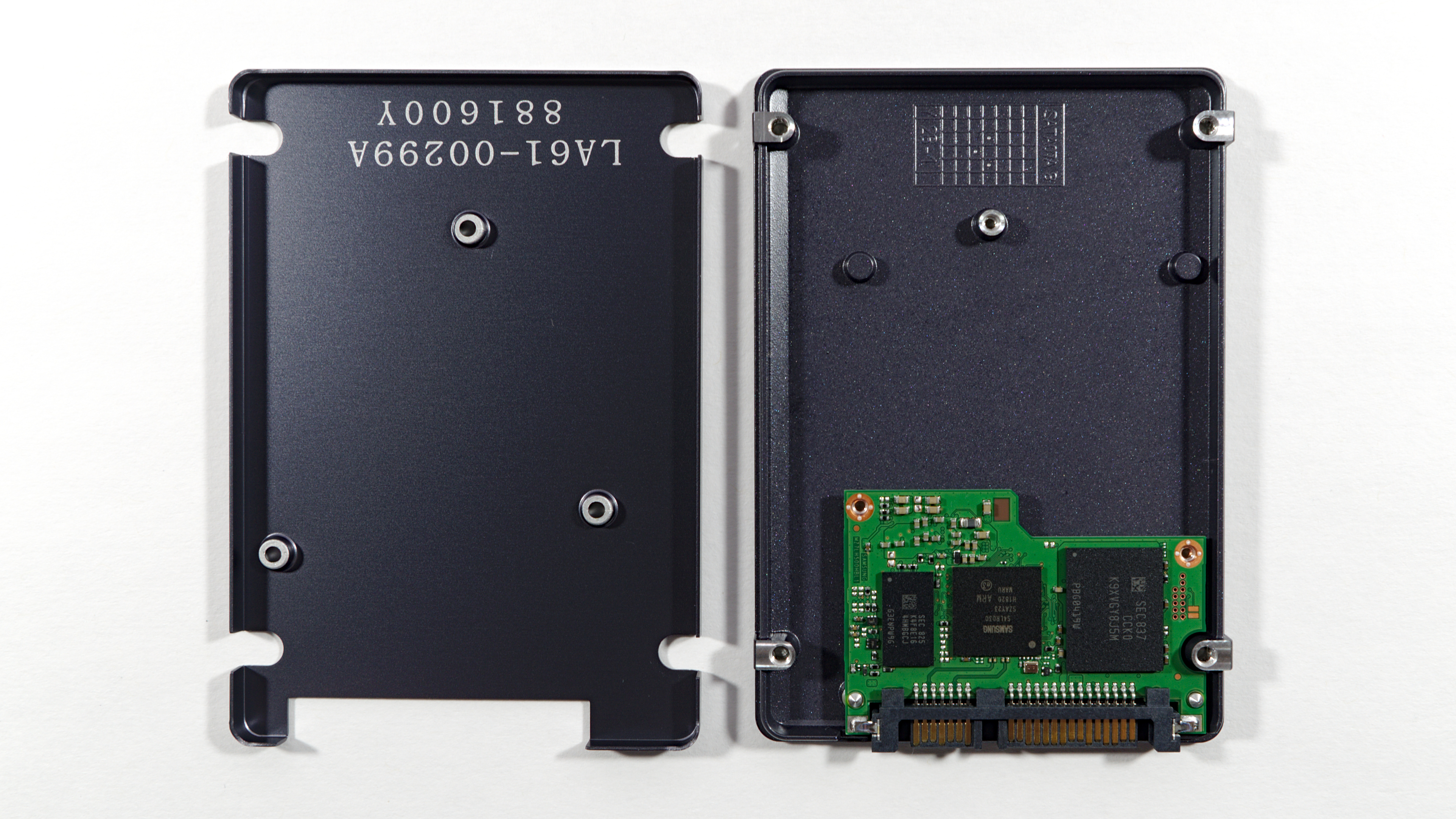
Have you seen inside a 2.5" SSD? Here's the inside of the 1TB SSD I have: https://images.anandtech.com/d...
-
Re:IOPS
I don't know about these new cards but "A1" and "A2" cards have higher IOPS than others. SanDisk Extreme microSD Cards with A2 IOPS are at least 4000 read and 2000 write.
-
Re:Aaaaannd they gimped it with 6gb of ram
The card'll be useless for high end gaming in about 4-5 years
A $280 card that'll be useless for high end gaming in 4-5 years? The horror. Seriously though, this is the first Turing card that's an okay upgrade, according to Anandtech this card is +36% perf, +12% price for a +21% price/perf improvement over the last gen. The RTX cards are a wash, more performance for more money. I really hope AMD can make a Zen-like comeback on the GPU side, right now their Radeon cards are aging as well as Bulldozer did...
-
Re:You mean NOAA
-
15GB cap is not going to replace home Internet att
15GB cap is not going to replace home Internet att much less an $500 modem
-
2nd ed G5 Laser was an enhanced MX518
I've been using a Logitech G5 Laser as my primary desktop mouse for close to a decade now, on an indigo Func Industries Surface 1030 mouse pad of the same vintage (smooth side).
Both remain optimal for desktop work.
Apparently there were some G5 mice that lacked the thumb buttons. Mine has two thumb buttons, and a tilt wheel, and the DPI controls.
I'm right handed, but I switched my mouse to my left hand a long, long time ago to reduce back pain. By doing so I position my mouse hand closer to my midline: my ancient Compaq keyboard has a full numeric keypad on the right hand side, which adds an extra seven full inches to my hand travel distance (6" home-to-mouse on the left side, 13" from home-to-mouse on the right side).
Irony: this makes the "thumb" buttons relatively useless.
Logitech G5 Laser Mouse: When an update is not worthy of a new name — July 2007
While the weight cartridge can be important to some, the heart of the G5 is its 2000 dpi laser engine via a 6.4 megapixels/second image processor.
The ability to customize the dpi and USB polling rates is another huge plus with the G5.
You can configure up to five different dpi sensitivity settings between 400 and 2000 with the ability to set the horizontal and vertical sensitivities separately.
The USB polling rates can be set from 125 Hz to 1000 Hz based on six preset numbers.
The G5 defaults to 500 Hz which is a setting that we found offered the best combination of performance and compatibility across several different chipsets.
Reading more closely, I discover that the my G5 is the second edition of the G5, which is basically an MX518 upgrade product, with the same internal engine.
———
My experience
I'm using maximal ballast weights which for me greatly improves proprioceptive feedback. Because this is a super sensitive mouse, I have my mouse response cranked up almost to ludicrous speed.
I have 45" of horizontal display travel (three 23" monitors, one in landscape, two in portrait). My full-bore mouse flick (45" bezel-to-bezel) measures just under 2" on my mouse pad. My 23" vertical throw on my portrait monitor measures just under an inch. (These are consistent numbers.) When I creep across, my horizontal throw measures closer to 3" instead of 2". (Turns out, I have far more speed and far less acceleration than I believed, prior to making this measurement just now.)
Interesting algebra: 100 dpi screen resolution * 20:1 fast-movement mouse response ratio = 2000 dpi mouse resolution requirement to address single pixels. Three resolutions available on mouse: 400/800/2000. For the 13:1 slow-movement response ratio (usual speed at the landing site), I'd need 1300 dpi for single pixel address. (Meaning that I do have to switch down to slow speed to access individual pixels, but once I do, I have a decent margin.)
I'm using roughly 5 square inches of mouse mobility to manage three 23" screens in text-selection mode, and ranging over all of 2 square inches for window and focus management.
Super important tip: use double-click drag to select text in full-word mode as often as possible. I always aim for the middle of my target word, double-click to select the full word (do not release the double-click) and then drag to select a word region, aiming for the middle of the final word, where I finally release the mouse button.
Sometimes one end of your text selection contains a weird punctuation mark, which makes for a narrow target. There are three solutions for this. The first solution is painfully precise initial aim (down to a single letter). This is bad. Try reversing the selection by starting at the other end (it's fairly rare that both ends are problematic). Painfully-precise final aim is still better than painfully-precise initial aim, because you're usually coming in much slower after starting the selection, and
-
Re:20-40 terabytes?
They have already started to solve this problem, especially for server farms. Imagine a (multi???) petabyte storage array in 1RU.
-
Re:I remember that
Adding to that, it was the famous Celeron 300A: https://www.anandtech.com/show...
-
Re:This is really news!
The thing is, anandtech are seeing the same thing with SPEC and the iPhone's CPU... so, seems pretty accurate.
-
Re:Hopefully the beginning of the end of Lightning
That is a fair point. However, all the USB connectors are made the same way, and I've found lightning to be infinitely more reliable a connector than any of the USB ones, so again I question why you you are singling out lightning.
For example, USB-C is virtually the same as the lightning connector except that it has a shield around it.
https://www.anandtech.com/show... -
Re:Increasingly sub-par? Bullshit.
Bottom line: Apple is doing just fine for people who can't calculate or judge hardware by it's specs. Which is 99% of all people.
Or don't measure their computer's value in twitch game FPS or seconds to compile the Linux kernel. Let's compare the latest i9-9900k to the i7-2600k released in January 2011 thanks to Anandtech bench 1 and bench 2 using the i7-6700k as common reference.
Cinebench R15 Single Threaded: 216 vs 133
Cinebench R15 Multi-Threaded: 2032 vs 617So 7.5 years later single threaded performance is still 62% and multi threaded 30% of what today must be considered ancient hardware. Give it enough RAM and an SSD and for most practical purposes I don't think most people would notice the difference unless it was side-by-side with a stop clock. People use a Mac because of macOS and iApps, not because it runs 20% slower or faster. And maybe because Win10 has jumped off the deep end.
-
Re:Increasingly sub-par? Bullshit.
Bottom line: Apple is doing just fine for people who can't calculate or judge hardware by it's specs. Which is 99% of all people.
Or don't measure their computer's value in twitch game FPS or seconds to compile the Linux kernel. Let's compare the latest i9-9900k to the i7-2600k released in January 2011 thanks to Anandtech bench 1 and bench 2 using the i7-6700k as common reference.
Cinebench R15 Single Threaded: 216 vs 133
Cinebench R15 Multi-Threaded: 2032 vs 617So 7.5 years later single threaded performance is still 62% and multi threaded 30% of what today must be considered ancient hardware. Give it enough RAM and an SSD and for most practical purposes I don't think most people would notice the difference unless it was side-by-side with a stop clock. People use a Mac because of macOS and iApps, not because it runs 20% slower or faster. And maybe because Win10 has jumped off the deep end.
-
Re:AMD
Uhhh I'm afraid he is right as Nvidia is getting chips made by TMSC which means their money is helping fund TMSC's process which is benefiting AMD.
And I'd say its looking more and more like AMD selling off their fabs when they did was the smart move, as they can now go with whomever has the best process while their former fabs (Global Foundry) has given up on hitting 7nm and appears to be intending to just milk whatever money they can make off their 12nm and 14nm fabs making memory chips and working for smaller players.
-
Re:Abandon it
They're not comparable, no. But Intel had healthy 14nm production in 2014, now they're saying late 2019 at the earliest for 10nm so five years with nothing more than enhancements. And TSMC is shipping 7nm in the iPhone Xs right now and has just announced they expect 20% of their 2019 revenue to be from their 7nm process, which is fairly equivalent to Intel's 10nm. Samsung says their 7nm is ready for production too. Basically they've lost their entire lead and is already trailing a bit, they'll be fully competitive if they can launch their 10nm but they no longer get the holy trifecta of a better manufacturing process: Lower cost, better performance and higher power efficiency.
I think the greatest danger to Intel is that Apple finds it's able to produce comparable light desktop/laptop performance on ARM, if Intel can't provide superior chips there's very little reason for Apple to stay. They've done arch changes before from Motorola -> PowerPC -> x86, they know what it's like and with the iPhone/iPad CPU/GPU design in-house you know they'll be lusting for the Mac business. If they do I expect a full volley with new MacBook, MacBook Air, iMac and Mac mini ARM models but to leave MacBook Pro / iMac Pro / Mac Pro on x86 initially. If the rumors are true there'll be a new iPad Pro out soon with a A12X processor, that'll be a good clue as to how far it's off.
-
Re:Desperation...
I'll say. I was able to pick up a new 2700X for $297.68 after tax a few weeks ago from a local retailer. Most online stores list the 2700X at $320 without any specials or discounts. The summary is saying the i9-9900K is supposed to compete with that, but the 9900K's MSRP is a whopping $488. At those prices, the 9900K needs to stomp all over the 2700X. Anything less would be a disaster. Simply trading blows with the 2700X wouldn't be anywhere close to good enough.
But that's probably because it's a silly comparison to make in the first place. The current i7-8700K is already trading blows with/is coming out ahead of the 2700X and is priced much more comparably at $380. It came out ahead of the 2700X in the majority of real world tests I've seen (as it should, given that it's more expensive), but it falls behind in certain workflows and games (i.e. ones benefitting from more cores). I'd be much more interested in hearing how the 9900K compares to the 8700K, since it's a known quantity and not a comparison that they're as likely to rig.
Regardless, I sincerely hope the 9900K is 30-50% faster than the 2700X in real world usage, but that's a tall order. This is Intel's fifth generation at 14nm and their third generation with this microarchitecture. Anandtech even referred to it as "Skylake Refresh Refresh Refresh". The low hanging fruit was culled long ago. They had to toss some more cores in, but otherwise it looks to be more of the same incremental improvements we've been seeing.
-
Re: Content creation is too expensive
If MPEGLA pull their heads out of their arses and makes the codec as cheap to use as MPEG2
The problem is that it's not just the MPEG LA. It's HEVC Advance, it's Velos Media, and it's individual companies that aren't in any patent pool. There's a reason why Leonardo Chiariglione calls HEVC an unusable modern standard.
AV1 will almost certainly be as dead in the water as Theora was
Theora never had the backing AV1 has. Theora wasn't on the roadmap for YouTube and Netflix.
-
For those that don't get the joke...
Eight years ago, when Apple debuted the iPhone 4, they re-engineered the antenna, making it into a stainless steel band running around the edge of the phone. But the antenna was actually two separate antennas, with a very narrow gap between them. If anything, including your hand, created enough of a conducting pathway between the two separate antennas, reception and 3G data quality reduced terribly. As this Anandtech article explained, "Anything conductive which bridges the gap in the bottom left couples the antennas together, detuning the precisely engineered antennas. It's a problem of impedance matching with the body as an antenna, and the additional antenna that becomes part of the equation when you touch the bottom left.
And so, when asked about the problem, Steve Jobs famously said, "Just avoid holding it in that way."
-
Re:It's iPhone 2,659mAh vs. Huawei 3,400mAh.
At least they're honest:
https://www.anandtech.com/show... -
Re:Queen for a day
Qualcomm 845 hammers iPhone X in GPU which means Qualcomm is faster for games. Probably beats the XS too, and the Qualcomm is almost a year older. Apple spent a bunch of transistors in the wrong place.
-
Re:The real loser is Intel
You showed a product announcement, you did not show evidence of product availability. It's clear you are talking out your ass, but that's perfectly understandable because that is where your head is, fortunately a pretty good fit for a weasel. Now see if you can actually buy this NUC.
You can't, even if they do sell to weasels.
-
Re:what I don't even
I guess I'm not trusting ARM on their marketing claim.
So where's the false marketing lawsuit? After all, there's been three years for people to claim fraud versus claims like:
"At the same frequency and process, the A35 architecture (codenamed Mercury), promises to be 10% lower power than the A7 while giving an 6-40% performance uplift depending on use-case. In integer workloads (SPECint2006) the A35 gives about 6% higher throughput than the A7, while floating point (SPECfp2000) is supposed to give a more substantial 36% increase."
You're wrong. It's obvious to all. Stop embarrassing yourself, please.
-
Yeah, but . . .
. . . computer chips with state-of-the-art lithography soon all will be manufactured overseas. Specifically, they will be made by exactly two companies, Samsung and TSMC, with GlobalFoundries' recent announcement that it is stopping development of its 7nm process. GF operated the old IBM facility in Fishkill, NY, and AFAIK was the last company offering state-of-the-art foundry services with a fab in the US.
Intel is still in business, of course, and even has a foundry business, but it cannot seem to successfully operate it -- substantially all of its wafer starts are chips of its own design. With the capital cost of each new-generation fab reaching $20 billion, it's only a matter of time until Intel -- which has only its internal product base of chip designs to fill its fabs, while Samsung and TSMC make chips for the entire industry -- can no longer afford the move to the next generation.
If the rest of the semiconductor industry (or the US DoD) wants high-performance computer chips, there's now nowhere to go except Samsung and TSMC. It will be interesting to see what politicians do when they realize that the best digital chips can no longer be manufactured in the US. The choice seems to be either (1) have our economy -- everything from cell phones to missiles -- dependent on chips manufactured overseas, or (2) subsidize Intel's foundry business and the semiconductor equipment manufacturers to the tune of tens of $billions, just to keep a US source of high-performance semiconductors.
-
Re: Hardware Mitigations?
None of the ARM CPUs in my tablets and smartphones incorporate speculative execution, and thus, are immune to these attacks.
Really? Then you must not have
Any ARM Cortex after A53, which was the first with branch prediction released in 2012 (if you are predicting a branch, then you are executing speculatively). The A57 then bumps this from just branch prediction to full OOO execution.
Any Samsung Exynos after M1. The Qualcomm ones are just warmed over ARMs anyway (with an LTE modem glued on) so nothing new there. Same for MediaTek.
Probably the Apple SOCs too, but they don't really give out slides.
Anyway, if you are running a ARM SOC with no branch predictor (let alone OOO) then you are on a phone/tablet from 2014 or earlier.
-
Re:AMD
FSM knows AMD isn't up to the task
You need to get some of that Vulkan. If I was into VR I would not be trying to optimize my hardware for an obsolete rendering model.
-
Re:DRAM needs it
I disagree with TFA on that. The 3 DRAM makers have shown a very rational approach to increasing DRAM production — they try to prevent oversupply and keep margins up. They don’t have an incentive to change, and even if they did, the new generations of DRAMs are technologically very challenging to make, and DRAM bit density isn't growing very fast.
SK Hynix just announced they are spending $3B on a new fab:
https://www.anandtech.com/show...If NAND is in vast oversupply and it's reasonable to simply convert NAND production to DRAM, then why build new fabs? Answer: because the combination of those two things isn't true enough to make that decision economical.
-
Microsoft will use this
As anti Windows 7 propaganda. All the while Windows 10 is getting worse. I did a clean install of 1803 in a VM today and it came with a dozen pay to win games pre-installed on the start menu and $kype. This was on the pro version as well. The security risks of using Windows 7 outweigh the time wasted de-bloating Windows 10. Intel is even making new motherboards to support Windows 7.
-
Re: Spyware...
Yeah, because I'm sure Microsoft doesn't have their own second CA list built into Windows you can't alter.
Kinda like how you can just block Microsoft's servers in your HOSTS file and it wont just ignore it. Oh wait, they've been doing that since XP. -
Re:Boring
LOL BGR. The second biggest apple dickpuppet next to you.
Ok, I assume all THESE are not "Dickpuppets", Hater:
https://www.anandtech.com/show...
https://www.thestreet.com/mark...
-
Meanwhile, from TSMC ...
Operating frequency, ie 3ghz is not the same thing as faster. Processor speed at completing tasks is a complicated mix of frequency, IPC and several other factors. Even at 200mhz faster the Qualacomm chip could still be significantly faster.
ARM collaborates not only with Samsung.
From https://www.design-reuse.com/n...
"ARM and TSMC announced a multi-year agreement to collaborate on a 7nm FinFET process technology which includes a design solution for future low-power, high-performance compute SoCs"
And on the frequency side of things
From https://www.anandtech.com/show...
"With the CLN5, TSMC will also offer an Extremely Low Threshold Voltage (ELTV) option that will enable its clients to increase frequencies of their chips by 25% "
Taking 2.8GHz as baseline, a 25% increase of frequency would land the new chip at 3.5GHz.
While it is true that the new chip might not be running 25% faster, it still able to run at 3.5GHz, rather than 2.8GHz. -
Re:Increasing Competition, nVidia Falling Behind
Right, Nvidia bought 3dfx after they had bled
By bled you mean they filed a patent lawsuit...which of course happened after 3dfx had done exactly the same thing to nvidia.
them dry
That link points to a lawsuit filed by the trustees of 3dfx's bankruptcy proceedings against nvidia.
with lawsuits.
That link is a lawsuit between nvidia and samsung, it's nothing to do with 3dfx. did you even read it?
It was Nvidia that stole IP knowledge from SGI (Silicon Graphics Inc).
Hang on, first you were saying they stole from 3dfx, which is wrong, then you changed it to be that they just sued them into bankruptcy (which actually was started by 3dfx themselves) and now you're arguing that nvidia stole from SGI which was actually patent infringement (which is not theft) and which is what 3dfx first sued nvidia for.
-
Re:Intel should do an Nvidia
Intel should pull a card from Nvidia's playbook and simply rebrand last years processors with a new number.
They already are. See the i7-8086K for one such example.
-
Re:Increasing Competition, nVidia Falling Behind
Right, Nvidia bought 3dfx after they had bled them dry with lawsuits. 3dfx did throw the first patent punch. It is too bad for 3dfx that their Voodoo 3 (their first attempt at a flagship 2D/3D combo card) was absolutely utter rubbish, and they decided to produce it all by themselves, in Juarez, Mexico (at the STB facility they'd recently purchased). Additionally, they couldn't make a decent AGP 4x card. So, basically, the dropped their current business plan for a completely untested business plan. Or they took a double-barreled shotgun and carefully aimed at first one foot and then the other.
As for the patent lawsuits, I was confused. It was Nvidia that stole IP knowledge from SGI (Silicon Graphics Inc). As part of the settlement with SGI, SGI turned over all their IP and graphic engineers to Nvidia.
Fun factoid: the 'Unix' computer that was used in Jurassic Park was actually an Silicon Graphics Crimson running Irix 6, and that graphical file system navigation tool (FSN) was actually created to help market and sell the Crimson. Sadly, I cannot link to FSN as it appears that the siliconbunny site has gone down.
-
Just a value question
3D XPoint memory is in between NVRAM which is RAM backed by supercapacitators, running some kind of kind of machine/rack-level UPS to ensure RAM is saved to "regular" flash drives or just persisting against NVMe drives before declaring the transaction complete. So there are faster and more expensive options and slower and less expensive options and it also depends on how many components you want involved. But that's always a discussion, if a disgruntled data center worker takes a sledgehammer to your machine it's not really persisted enough until it's hit your hot swap / cluster / backup. So if Intel can deliver the right price-performance value that's great, if they can't... no big deal. There are alternatives, if you need them.
-
everywhere and forever magic wand
That is because advances in technologies for energy efficiency and renewable power, and the accompanying drop in their price, have made low-carbon energy much more economically and technically attractive.
There's a basic stupidity here. By implied extrapolation, the PR wonks are trying to lump energy technology in with Moore's law, as it applies to silicon: a die shrink only ever gets better (which itself is barely true any more, though it certainly enjoyed a stellar half century).
Environmental energy is not like that. Your fancy new solar technology might be cost effective while there is still more of California to exploit, but hardly ready for prime time in frigid "central" Alberta (the same 55th parallel north also runs through Glasgow, Copenhagen, and Moscow, just for starters).
But no problem, Canada's tiny population has a ludicrously unfair share of the world's ground water (and many powerful rivers associated with this). And if that doesn't get us through, we've still got thorium, too. As for wind power, better hope you get that build soon enough for forestall run-away climate change, or your wind forecasts might prove extremely fickle.
The march of progress is good, but this is shaping up as a long war, and today's low hanging fruit shall ever remain in perilous supply.
Yes, the implied metaphor sucks big time. In truth, the problem here is a lot more like optimizing software than optimizing silicon. Your database is the bottleneck, so you optimize a few key queries—and declare permanent victory.
Celebrating Too Early Compilation
But nope, now you've got other fish to fry. The load balancer, OMG PHP, the Intel Spectre BIOS patch, etc.
Dang it! If only Intel would simply give us the 8 GHz chip we've been waiting for since the thermally untenable Pentium 4 teased us horny.
———
As a side note, the legendary inefficiency of the Pentium 4 almost surely lead to the construction of an entire electrical generation station the world desperately did not need. And now all that extra carbon is part of today's problem, too, likely continuing to bear Intel-legacy climate interest for the next hundred years.
Good grief, Charlie Brownout, are we a feckless, stupid species.
———
Global-foresight triple word score if you bought a Prescott and then configured your 24/7 screensaver to run 3D Pipes.
Intel's Pentium 4 E: Prescott Arrives with Luggage — 1 February 2004
Intel also moved to Prescott in order to increase clock speeds, however none of those speeds are available at launch (we're still no faster than Northwood at 3.2GHz) and Intel did so at the expense of lengthening the pipeline; the Prescott's basic integer pipeline is now 31 stages long, up from the already lengthy 20 stages of Northwood.
If you thought that Prescott was just going to be smaller, faster, better — well, you were wrong.
Cuffing Intel upside the head is popular again, lately, but in truth Intel has always been strangely bipolar.
For a while, there, CoreDuo's lurking Spectre saved a lot of carbon (on finite tasks, not counting CPU sinks like 3D Pipes).
Even Steven?
Hard to say.
-
Some specs since linked article sucks
These are 6 core/12 thread CPUs running at 4.0ghz base clock and 5.0 ghz SINGLE CORE boost. Basically it sounds like they are binned 4700K's. Run is limited to 50,000 units. https://www.anandtech.com/show/12875/intel-announces-the-core-i78086k-coffee-lake-at-5-ghz
-
Re:iPhone X Fails
Nobody copies Apple! Well, HTC seems to pretend their next big thing is made of iPhone 6 parts
-
Re:Walking Back Expectations
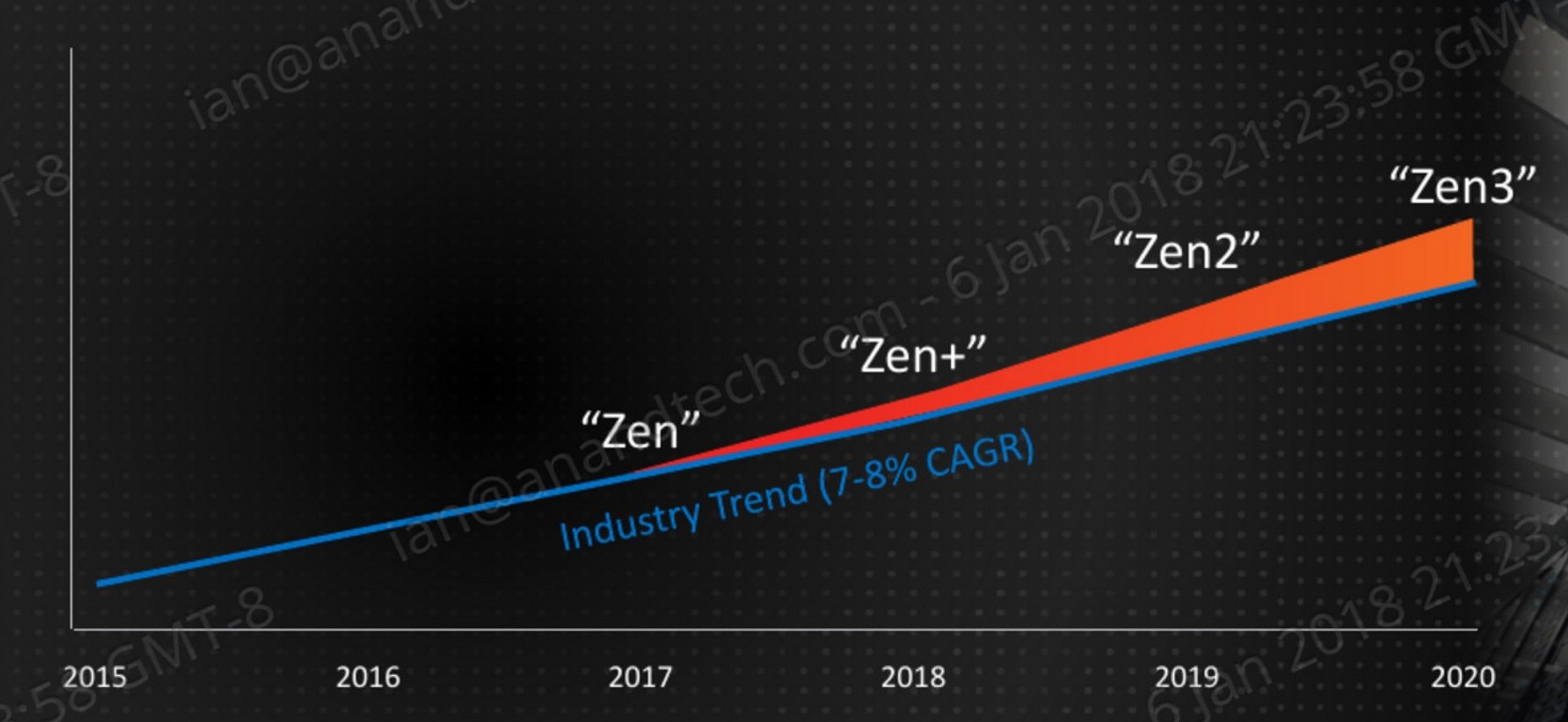
Anyone remember this image from just a few months ago? AMD was throwing stones at Intel's 'mere' 8% average annual IPC improvements, implying they would do much better than that. And then they drop a chip with 3% better IPC than last year's. Hard not to feel disappointed. When the best thing a review can say is "it's faster than last year's chip in every benchmark" that's damning with faint praise.
I still think I'm gonna wait to build a new rig until PCIe 4.0 mobos are out. AMD and Intel are dragging their heels hard on that one, PCIe 5.0 might be out first.
3% better IPC, sure. However, IPC is not everything. When combined with other optimizations, that translates to 16% better performance. I think they hit their mark and then some.
-
Walking Back Expectations
Anyone remember this image from just a few months ago? AMD was throwing stones at Intel's 'mere' 8% average annual IPC improvements, implying they would do much better than that. And then they drop a chip with 3% better IPC than last year's. Hard not to feel disappointed. When the best thing a review can say is "it's faster than last year's chip in every benchmark" that's damning with faint praise.
I still think I'm gonna wait to build a new rig until PCIe 4.0 mobos are out. AMD and Intel are dragging their heels hard on that one, PCIe 5.0 might be out first.
-
Re: Bringing competition back to the market
Plenty of benefits for Intel chips precisely for gaming.
That's were they are leading.Rather than putting it like you do the truth is that you don't need the fastest cpu unless you have a beast of a graphics card or run at settings to maximize frames per second. Because you'll be gpu limited anyway.
But if you aren't then Intel have a lead in games.
Actually, if you turn on XFR2 and if you apply the meltdown patches on Intel (which will be automatically done w/ Windows updates), the AMD processors are now faster for gaming.
Check out Anandtech article here: https://www.anandtech.com/show/12625/amd-second-generation-ryzen-7-2700x-2700-ryzen-5-2600x-2600
The AMD 2700X absolutely kills the top of the line Intel in gaming.
-
Re: Apple vs. Facebook? Seriously?
https://www.anandtech.com/show...
The outside ridge of the iPhone4 is an external antenna. If you hold it in any way that bridges the 2 antennas (see: any way at all, *almost*) the attenuation is measurably terrible. Again, this is why the fix was just a rubber coating around the antenna.
Stop making yourself look like a fucking idiot. It's starting to become embarrassing. -
Re:Well it's clearly not x86
Modern ARM cpus that are actually supposed to be "competitive" with x86 parts like Atoms
Modern ARM cpus overtook Atom some time ago and are closing in on Intel's Core architecture. These are highly superscalar, unlike Atom, which continues to disappoint. E.g. Cortex A75 can issue 8 micro-ops per cycle. These are now being evaluated realistically as server chips. Not quite there yet in per-core throughput but arguably ahead in core count. Only low end ARMs should be compared to Atom these days. Increasingly, Intel's performance edge will just be the FPU. In time that will go away too, just as it did with AMD.
-
I was wondering about this
Since Samsung was the one who engineered stackable V-NAND, I suspected that they could multiply the current market's SSD capacities by the layer-count. Maybe that's not what's happening here, but it sure seems like Samsung will have the edge in increasing SSD capacities.
-
No
For over a year we've been treated to the fantasy that Windows 10 on ARM was the same as Windows 10 on x86.
No one thought that. Microsoft has been very clear from the outset what Windows 10 on ARM offers.
64-bit apps will not work.
Incorrect. 64-bit ARM applications will work, of course. And Microsoft has always said the initial target for x86 emulation was 32-bit applications. That was announced in 2016.
It cannot use x86 drivers.
Of course it can't. Why would anyone think it would?
-
Re:Snapdragon 845 Is King (Of Android Phones For NAmiMoJo said
I'm starting to think that Geekbench scores for the iPhone are bullshit. The A11 Bionic has 2 high performance cores, but somehow out performs chips with 4 high performance cores. Yet iPhones don't appear to be any faster than Android phones, and in fact they are often quite a bit slower in real world use due to having only 2GB of RAM.
Many have criticized the Geekbench processor benchmarks, unbelievably, even Linus Torvalds. But he relented with version 4.0, saying it looks much better. Version 4.2's GPU test fixes put it in line with OpenCL and CUDA results. I don't see any problem.
I've not tried either the SD845 nor the A11 Bionic processors. If you have, you're a better geek than me, which isn't saying very much. I'm sure you're right about the 2GB bottleneck. As I look over their different specs, there are two other things that stand out in the SD845's favor: the GPU, and the core\cache organization.
1) Snapdragon 845's has modest CPU improvements over the SD835, but the GPU upgrade is 32%-40% better, depending on the graphics test. And it beats the A11 in all but two of those tests.
2) The A11 does have a better CPU performance than the SD845, hands down, but there may be more to it than that. The A11 can use all six cores simultaneously, and has AI hardware called a "Neural Engine" that can perform 600 billion operations per second. Some or all of this may help explain why it's a speed demon at multi-core tasks. But not so much at single-core tasks. Just guessing, but maybe that's because it has discrete core clusters and caches. In contrast, the SD845 uses ARM's DynamiQ CPU cluster organization, letting different cores be hosted within the same cluster and cache hierarchy.
That's all I got, except the links below.
http://bgr.com/2017/09/14/iphone-x-vs-iphone-8-a11-bionic-benchmarks-macbook-pro/
https://www.neowin.net/news/qualcomms-snapdragon-845-benchmarks-show-massive-gains
https://www.anandtech.com/show/12420/snapdragon-845-performance-preview
https://www.geekbench.com/blog/2017/11/geekbench-42/
-
Re:Hmm.
Qualcomm doesn't own big.LITTLE. The original implementation was by ARM. In fact Qualcomm stuck to having one Snapdragon core for both high performance and low power tasks until fairly late. E.g. the Galaxy S5 had two models. The Qualcomm Snapdragon one didn't do big.LITTLE/Heterogeneous Multi Processing.
https://www.cnet.com/news/the-...
For some Galaxy S5 models, Samsung will use the Exynos 5422, which also was announced at Mobile World Congress. The processor boasts eight ARM cores versus the four in the Snapdragon 801. Samsung has employed ARM technology that allows for four big cores that run at speeds up to 2.1GHz and four small cores for speeds up to 1.5GHz. When the phone requires heavy computing, all eight cores can run at the same time. The phone can also employ just one of the small cores for minor activities
And companies other than Qualcomm and ARM have patents on various implementations of big.LITTLE
https://patents.google.com/pat...
Also I'm sure Intel could do HMP. E.g. they could have a chip which has some Coffee Lake i5/i7 type 'big' cores and some Gemini Lake/Goldmont Plus Atom type 'little' ones. Sure there are patents but Intel have a patent portfolio of their own. They could just launch, and if they get sued agree on a cross licence.
NVidia sued Intel and got some cash but no x86 licence or the right to make chipsets for newer Intel CPUs.
https://www.anandtech.com/show...
And of course a hypothetical Intel chip with Coffee Lake/Gemini Lake might not work like big.LITTLE. On a big.LITTLE chip you can migrate threads from a big core to a little core quickly because they share the same registers. A Coffee Lake/Gemini Lake chip might not need to do that - you could have cores sharing an L3 cache but not much else and just relying on the OS to do the migration. And if you look at the Lenovo patent the patented thing is not 'having big and little cores on the same chip' but rather the way you decide whether a thread runs on the big or little core. Intel could invent their own scheme. Or just leave it to the OS.
Actually it's not a bad idea. The USP of Windows on ARM is 'better battery life'. Unfortunately that comes with Atom like performance. A Coffee Lake/Gemini Lake HMP design would offer the low power of an Atom when the system is idle but also the high power of a Coffee Lake when it is not. And you can have a whole bunch of Gemini Lake cores in the space taken up by a Coffee Lake one. So you might sacrifice 1-2 Coffee Lake and have 4-8 Gemini Lake in the same space.
If Intel can spend R&D on a package which has Coffee Lake and an AMD GPU on it which is basically just for Apple, I reckon they could spend R&D on a HMP chip to attack Qualcomm with.
Actually another option would be to dumb down the integrated graphics. I bet you could get away with just a frame buffer for most users who are just running a GUI and not doing an 3D. So gate all the 3D stuff with a Mosfet and make sure you can power it down.
Intel clearly cares about power consumption and battery life and Windows on ARM shows they've got some way to go to yet. HMP and more work on optimizing the power consumption of the integrated graphics solution in the lowest power/performance state is the way to go.
-
Netbooks live!
These machines have Apollo Lake Celeron processors
https://ark.intel.com/products...
They're Goldmont cores - the descendent of Atom - though they've dropped the Atom branding. Still they're very much descendants of the chips that powered the original netbooks.
https://www.anandtech.com/show...
The Lenovo machine has a 11.6" 1366 x 768 display rather than the netbook standard of 10.1" 1024*600, but that's probably the minimum viable display.
Apparently it's got a N3450, which Anandtech points out is a 4 core, 4 thread out of order chip clocked at 1.1 to 2.2 Ghz. I.e. it's a bit quicker than the old dual core, in order N570 in my old Asus 1015PX which I stopped using because Chrome run like a dog. You can also get 4GB of Ram compared with 2GB mac on the 1015PX and 128GB of eMMC storage compared to a 160GB 5400rpm ultra low cost and sluggish hard drive.
https://hothardware.com/news/l...
Sitting at the bottom of the stack is the Lenovo 100e. There are two versions, one with Windows and the other a Chromebook. The Windows version sports "up to" an 11.6-inch display with a 1366x768 resolution powered by an Intel Celeron N3450 Apollo Lake processor and up to 4GB of LPDDR4 RAM. It also has up to 128GB of eMMC storage, a reversible HD camera, spill-proof keyboard, and a 45Wh batter that's good for up to 10 hours of battery life.
Windows 10 S can be upgraded to full Windows 10 too. But I'm guessing for an educational environment they want something which is locked down so the little shits can't install malware on it. Then again you could always reimage the machines when they go fubar.
-
Re:Not MediaTek?
The HiSicon Kirin SoCs are basically flagship level. They pretty much match the top Qualcomm SoCs in terms of CPU performance, but lose a bit in terms of GPU (who cares anyways?). As for Huawei Mate series, these are pretty much flagship level smartphones. The year old Mate 9 is a great phone even today, and the greatest thing is that it was not attached to any carrier (I avoid carried branded phones like a plague).