Slashdot Mirror
Domain: eurogamer.net
Stories and comments across the archive that link to eurogamer.net.
Stories · 468
-
Lag Analysis For the PlayStation Move
The $64,000 question about Sony's upcoming motion control system, the PlayStation Move, is how responsive it will be compared to traditional console controllers and its counterparts from Nintendo and Microsoft. Eurogamer slowed down videos of Sony's tech demo software to establish a rough baseline latency that developers will have to work with. Quoting: "While exact latency measurements aren't possible in these conditions, a ballpark idea of the level of response isn't a problem at all. The methodology is remarkably straightforward. Keep your hand as steady as possible, then make fast motions with the controller. Count the frames between your hand moving, and the motion being carried out on-screen. Equally illuminating is to stop your movement suddenly, then count the frames necessary for your on-screen counterpart to catch up. While not 100 per cent accurate, repeat the process enough times and the frame difference becomes fairly evident. Bearing all of that in mind, and recognizing that we don't know how much latency the display itself is adding, I'd say that a ballpark figure of around 133ms of controller lag (give or take a frame) seems reasonable, certainly not the ultra-fast crispness of response we see from games like Burnout Paradise or Modern Warfare, but fine for most of the applications you would want from such a controller." -
How Sony and Microsoft Hope To Crack the Motion Control Market
An editorial at Eurogamer delves into what Sony and Microsoft hope to achieve with their upcoming console motion control systems, despite entering the market several years after Nintendo set the standard. "The cards Sony has placed on the table this week suggest one answer to that question. It sees PlayStation Move as being an upgrade path for Wii owners — an invitation to the tens of millions of consumers who have invested in Nintendo's platform to swim upstream to the more powerful, HD-enabled system. Yet even Sony's most optimistic view of the market will be tempered by a dose of realism here. ... What's more likely — and what Sony are probably quietly hoping to achieve a significant proportion of the Move's success through — is that the technology will expand the appeal of the PS3 in the family setting." The Digital Foundry blog has an in-depth look at the PlayStation Move from Sony's event at the Game Developers Conference, saying, "... if there was one positive you could take away from the event, it was that Move is clearly a far more precise implementation than the Wiimote. Some of the games felt clearly more 'tactile' than the Wii equivalents." -
How Sony and Microsoft Hope To Crack the Motion Control Market
An editorial at Eurogamer delves into what Sony and Microsoft hope to achieve with their upcoming console motion control systems, despite entering the market several years after Nintendo set the standard. "The cards Sony has placed on the table this week suggest one answer to that question. It sees PlayStation Move as being an upgrade path for Wii owners — an invitation to the tens of millions of consumers who have invested in Nintendo's platform to swim upstream to the more powerful, HD-enabled system. Yet even Sony's most optimistic view of the market will be tempered by a dose of realism here. ... What's more likely — and what Sony are probably quietly hoping to achieve a significant proportion of the Move's success through — is that the technology will expand the appeal of the PS3 in the family setting." The Digital Foundry blog has an in-depth look at the PlayStation Move from Sony's event at the Game Developers Conference, saying, "... if there was one positive you could take away from the event, it was that Move is clearly a far more precise implementation than the Wiimote. Some of the games felt clearly more 'tactile' than the Wii equivalents." -
Review: Mass Effect 2
Mass Effect debuted a little over two years ago to almost universal praise, getting high marks for the rich story, endless exploration options, and entertaining gameplay. Despite the game's success, BioWare listened closely to player feedback, promising to revamp the parts of the game that needed improvement while developing the sequel. They didn't hesitate to refine the elements they wanted to keep and do away with the ones they didn't. The result is a familiar, but much more streamlined experience. Rather than being a shooter with a great story added in, Mass Effect 2 a great story that often has you shoot things. Read on for the rest of my thoughts.- Title: Mass Effect 2
- Developer: BioWare
- Publisher: Electronic Arts
- System: Windows, Xbox 360
- Reviewer: Soulskill
- Score: 9/10
The Story
Mass Effect 2 starts off with a bang, immediately putting Commander Shepherd in rather significant peril and setting him to work with Cerberus, an organization of questionable morality that made a brief appearance in ME1. Shepherd often has reason to doubt Cerberus's trustworthiness and stated goals, but has little choice since they're the only ones who seem to be fighting the latest threat to humanity. The conflict between Shepherd and Cerberus's leader, the Illusive Man, is a plot thread that runs through the entire game, and you're given quite a bit of control over how trusting or defiant you want to be. After settling in aboard your ship, you're given a kick in the pants to begin recruiting a new team.
The storytelling in Mass Effect 2 can be divided into three discrete groups of quests — primary plot missions, squadmate missions, and side missions. When you go to recruit a member of your team, you'll do a mission that frees them from whatever they're currently involved with. Later on, each team member will pester you once to solve another problem of theirs, at which point they'll become loyal to you. In fact, after helping a few of them, you'll start anticipating when the next crewmate will come nag you for help. Fortunately, their missions are varied and interesting, and provide good background for the supporting cast. These stories are often quite personal, and in typical BioWare style, aren't afraid of setting up some complex moral dilemmas, which you can choose to solve in several different ways. Shepherd and his team deal with a broad spectrum of emotions, from compassion and regret to contempt and vengeance.
The side missions are minor plot lines you run into while exploring or doing more important things. Some are trivial, like finding a lost item or slapping somebody around; others have more depth, tasking you with determining guilt or innocence, making an arrangement with local criminals, or stumbling across characters you met in the first game. The main story itself follows up on events in ME1, and the scale is just as epic. The Paragon/Renegade system is back, but different. If you respond to an NPC in a typical "good guy" way, you'll gain Paragon points. If you're a jerk to them, you'll gain Renegade points. As you accrue enough of these points, dialog options open up that can allow you to persuade NPCs more strongly, either by appealing to their better nature or intimidating them. You no longer have to spend talent points on it.
Another nice change is the inclusion of quick-time events during cinematic scenes. Normally, I deplore QTEs, but BioWare did it right. At a potential turning point in the story, you'll get a flashing icon on your screen which will allow you to do something particularly good or particularly evil. The decision you're making isn't spelled out for you, but it's often obvious from the situation; for example, if a character you don't trust is inching toward a weapon and the red Renegade icon pops up, clicking it will make Shepherd end the conversation with a bullet. Similarly, the Paragon icon might pop up to give you the chance to stop a friend from doing something they'll regret. There's plenty of time to react to these, and no button mashing involved; it's just a simple way to move the story in the direction you prefer.
Of course, the success of the story rests on the characters, and the strength of the characters comes from voice acting, animation, and dialogue. The writing is very consistent; all of the major characters have distinct personalities and histories, and the different ways in which Shepherd can react to situations all come across as authentic. Some of your lines sound corny, but those are usually the ones that are supposed to sound corny. Far more often, you or your squadmates will sound like action heroes. The voice acting in Mass Effect 2 is excellent. BioWare has proven throughout the years that they take their dialogue seriously and do it well. What struck me was that the actors all sounded more confident in their readings, either through their own familiarity with the games or because BioWare got enough experience with the first game to provide clearer direction. Or both. In addition to the big name talent doing the main characters, there are also a surprising number of familiar voices doing smaller roles (was.. was that Worf?!).
What surprised me most was the quality of the animations. First of all, scenes are framed like you'd expect in a movie, and as any film buff will tell you, good framing makes a huge difference in how a story is viewed. Second, the characters are always doing something, even the ones that aren't talking; leaning against a desk, folding their arms, wincing or shaking their head. They aren't just static props. Third, the body movement and facial animations are quite good. Several times during the game, a character will react to something with only a facial expression, and not necessarily a simple one like shock. I think it's cool that video game characters look more like people than textured stick figures.
Gameplay
Combat in Mass Effect 2 is as simple or as complicated as you'd like to make it. Several of the old game mechanics have been cleaned up. You run around with a shield and a health bar, both of which quickly regenerate if you stop firing and stop getting shot for several seconds. This makes for very little downtime during fights. As you level you get talent points to spend on special abilities. Shepherd and each of your shipmates has a different set of skills — knockbacks, ammo specialties, the ability to hack mech enemies (one character makes a Unix reference) — and you get to choose which ones to level up. You can hotkey special abilities for Shepherd and your squadmates, and you can revive your allies if they fall in battle using medi-gel. Mass Effect 2 uses a cover system, and it's one of the more responsive systems I've played. Hitting your cover button by a corner will make you turn your back to it, and you can peek around with your gun to fire. Similarly, you can crouch behind a low barrier and fire over it. It's an intuitive system, and it almost always does exactly what you expect.
Unlike the first game, you don't have an inventory; just a selection of weapons and abilities. You can still upgrade your weapons and armor, but it's handled differently. As you move through various maps, you'll come across data pads, laptops, and dead foes that you can scan for upgrade information. Once you're back aboard your ship, you can spend resources to research any of these bits of information, and they'll do things like make your machine guns more powerful, or give you extra shielding against certain weapon types. It's much less of a pain to deal with than ME1's inventory. You can also easily control your squadmates, telling them where to go and which abilities to use on whom. The AI is reasonably smart; it can win a lot of fights by itself on the lower difficulties levels. Speaking of which — if you're fairly experienced with other shooters, you'll probably want to bump the difficulty up to the second highest setting in order to make fights interesting. On the other hand, if the fights are just part of the story for you, leaving it on Normal or Casual will let you go through the game with ease.
Ammo (sorry, heat sinks) is plentiful in this game. You'll never be in danger of running out, but you go through it quickly enough that you can't just rely on one weapon all the time. The loadout is pretty standard for a shooter; pistol, shotgun, machine gun and sniper rifle (with variations on each), and also a variety of "heavy weapons," which are fun, but you can only carry one at a time. I didn't find myself using the shotgun too often, but the other guns were fine. One complaint I have about the combat was the layout of the maps. It's always quite obvious when you're about to get ambushed; you'll round a corner and there will be a bunch of low obstacles on the ground, the perfect height for crouching behind. Any time it looks like you're ready to run the 100m hurdles, aliens are about to start shooting at you. The pacing of the combat, on the other hand, was good — another area that showed a director's touch. Individual missions are generally short — 15-30 minutes, perhaps — and the cinematics are interspersed with the combat such that you aren't doing either long enough to get bored.
The UI is well-refined; anything in the environment you need to interact with will be outlined, and extraneous information is kept to a minimum. Your abilities gray out when they're cooling down, and the icons fill in to show you how long is left on the timer. The relevant health bars are always apparent — yours, your team's, and your target's. Your aiming reticle shrinks if you stand still and fire from cover and expands if you continue firing or move around, but either way it's quite easy to see where your bullets are going. You can pause combat to switch weapons, activate abilities or order your squadmates around.
Throughout your missions you'll find bank vaults, doors, and computers that need to be "hacked" or "bypassed." Doing so brings up a short mini-game where you either connect circuits by matching the symbols on them (a la Memory) or match code segments from a scrolling list of lookalikes. These mini-games are cute the first couple times, but they never get harder or more complicated, so they get repetitious. Similarly, the mineral-gathering system is best in small doses. You gather mineral resources by flying your ship to different planets, scanning them, and launching probes. The trouble is that the scanning is done manually. You hold down a button and pass a relatively small scanning area over the entire planet. When you see readings, you press another button to fire a probe, which automatically gathers whatever it finds. Depending on how methodical you are, it can take a few minutes per planet. It's probably not annoying enough to stop the completionists, but anyone who dislikes "grindy" activities will probably get bored quickly.
This brings us to one of the major changes between ME1 and ME2: there's no Mako. BioWare apparently decided that the first game's ground vehicle was not worth keeping, so they excised it completely. Apparently some sort of vehicle will be added in future DLC, but details are sparse. If the Mako was one of your favorite parts of ME1, you may want to wait until that DLC comes out. If you didn't play ME1, you won't notice the lack. You can still find things on unexplored planets — you'll detect an "anomaly" when scanning for minerals, and a shuttle will drop you off, on foot, at the anomaly's location. The space ports and mission maps generally aren't big enough that you'd feel the need to drive around them. Or, if they are, they're sectioned off such that you don't need to traverse the entire area at one time.
Odds and Ends
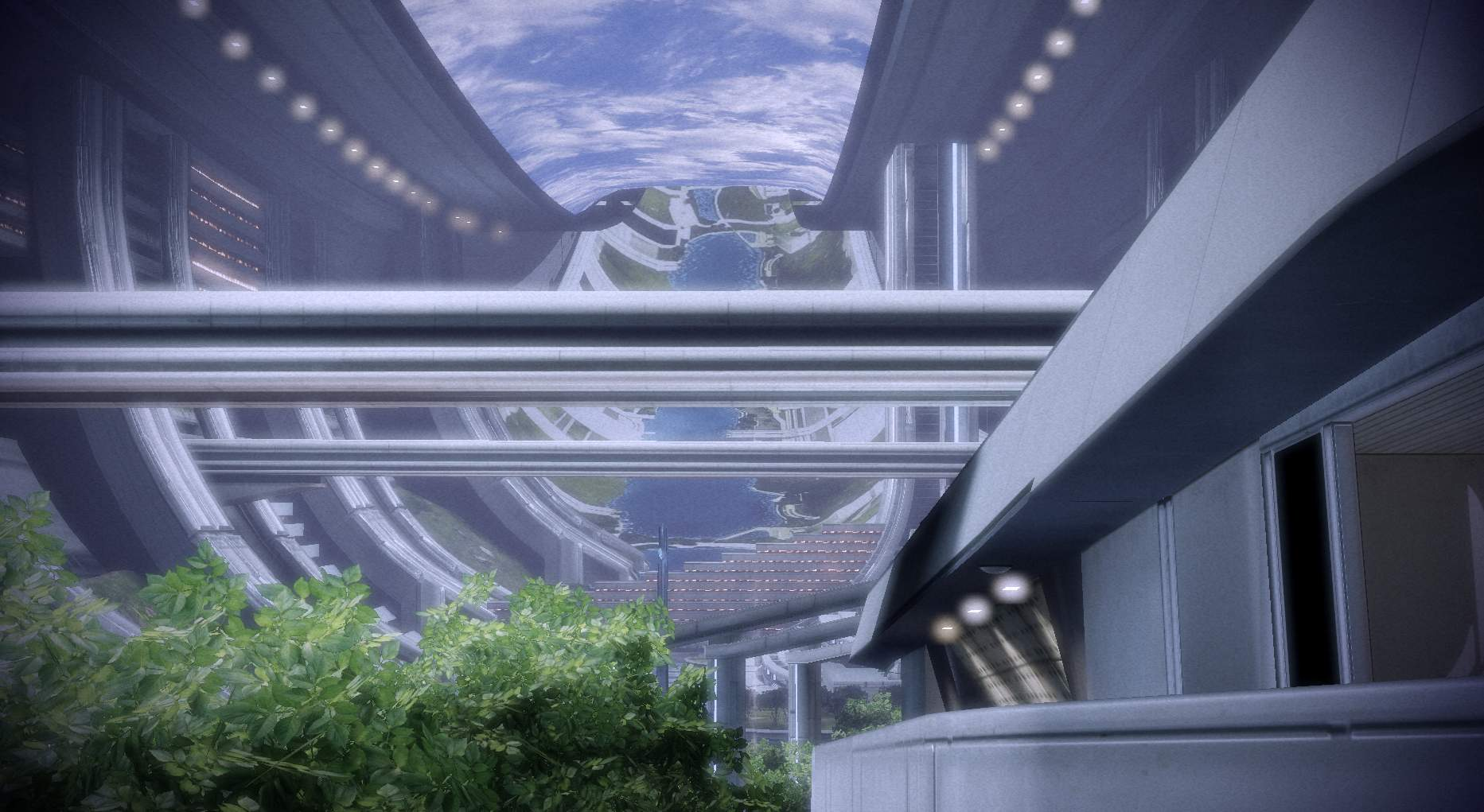
The graphics are fantastic — exactly what you'd expect from a brand new BioWare game, and quite a step up from ME1. The humans look like real humans — fans of the TV show Chuck will immediately recognize one of your female squadmates — and the high level of detail makes the aliens look like something that could actually exist. While you'll pass through your fair share of typical shooter corridors and warehouses, you'll also see some extremely large and impressive environments. On one mission, you find an enormous crashed spaceship that's precariously balanced on the edge of a cliff. As you navigate the shattered vessel to recover some data, it wobbles and teeters, threatening to go over the edge as debris falls all around you. The audio is quite good as well. I find myself wishing I'd grabbed the version of the game that came with the OST. The sound effects are helpful and unobtrusive. You can glean a lot of information about what your squadmates are doing during a fight by just listening for them.
Another neat feature worth mentioning is that if you have a saved game from ME1, you can important your Shepherd into ME2, preserving a number of actions you took in the first game that will now affect how ME2 plays. It's a cool injection of continuity, and they'll be doing the same thing for ME3 in the future. You have a surprising amount of control over the how ME2 ends, so keep this in mind.
The game does have its annoyances. There was one bug I encountered frequently enough to alter my gameplay — walking near corners where textures meet on the ground will occasionally send Shepherd floating straight up in the air, unable to get down. It forces a reload, which sucks, but fortunately between the quick-save and the auto-save, I never lost more than a minute or two. I played the game on my PC, and while the controls were generally excellent, little effort was made to support things like Tab or the mousewheel, which can make menu navigation a small inconvenience.
Conclusion
Mass Effect 2 is not without its flaws, but those flaws are minor and vastly outweighed by its strengths. The story is top-notch, and meticulously plotted and paced to be fun and interesting from the intense introduction to the foreboding yet flexible ending. It's great to see that BioWare was willing to take feedback to heart and make significant changes regardless of ME1's success. While the sequel doesn't seem as novel and innovative as the first game, it instead demonstrates a great deal of refinement and polish. I'll be looking forward to Mass Effect 3.
-
Star Trek Online Open Beta Starts Today
Today Cryptic Studios will begin the open beta of Star Trek Online, opening their test servers to invitees and anyone who has pre-ordered the game. The beta will run through the 26th, and the game will officially launch on February 2nd; head-start players will be allowed in on January 29th. The game is set in the old universe (not the rebooted one from last year's movie), and takes place roughly 30 years after the events in Star Trek: Nemesis. There are two playable factions to start — the Federation and the Klingon Empire — and more may become available later on. There will be conflict between the two factions, but supposedly all PvP will be "optional and consensual." Players will be able to choose from a variety of ships, and they'll see cameos from familiar characters. Eurogamer has a hands-on preview of the game, and fans of the Trek universe will be pleased to hear that "Cryptic is clearly thinking about Star Trek first and MMO convention second." A number of gameplay trailers are available for viewing, and the official forums have a nice collection of facts. -
EVE Online Battle Breaks Records (And Servers)
captainktainer writes "In one of the largest tests of EVE Online's new player sovereignty system in the Dominion expansion pack, a fleet of ships attempting to retake a lost star system was effectively annihilated amidst controversy. Defenders IT Alliance, a coalition succeeding the infamous Band of Brothers alliance (whose disbanding was covered in a previous story), effectively annihilated the enemy fleet, destroying thousands of dollars' worth of in-game assets. A representative of the alliance claimed to have destroyed a minimum of four, possibly five or more of the game's most expensive and powerful ship class, known as Titans. Both official and unofficial forums are filled with debate about whether the one-sided battle was due to difference in player skill or the well-known network failures after the release of the expansion. One of the attackers, a member of the GoonSwarm alliance, claims that because of bad coding, 'Only 5% of [the attackers] loaded,' meaning that lag prevented the attackers from using their ships, even as the defenders were able to destroy those ships unopposed. Even members of the victorious IT Alliance expressed disappointment at the outcome of the battle. CCP, EVE Online's publisher, has recently acknowledged poor network performance, especially in the advertised 'large fleet battles' that Dominion was supposed to encourage, and has asked players to help them stress test their code on Tuesday. Despite the admitted network failure, leaders of the attacking force do not expect CCP to replace lost ships, claiming that it was their own fault for not accounting for server failures. The incident raises questions about CCP's ability to cope with the increased network use associated with their rapid growth in subscriptions." -
Heavy Rain Previews Show Promise
As the February release date for Quantic Dream's Heavy Rain nears, several publications have gotten a chance for some hands-on time with the game and seem to be intrigued by what they saw. Quoting the Opposable Thumbs blog: "The game grabs you during the quiet moments where nothing 'happens.' When you look at a picture your child drew. When you're questioning someone about a crime. When you're trying to figure out how to react to a violent situation. The preview we were sent put me in different situations as I played a small handful of characters, and each one provided a few tiny moments that were surprising in terms of storytelling or subtlety." Eurogamer's previewer had a similar reaction: "To my great delight as well — Heavy Rain isn't a mature game because it has unhappy families and moody lighting, it's a mature game because it anticipates an adult response from the player and is prepared to receive it." -
Modern Warfare 2 Not Recalled In Russia After All
thief21 writes "After claims that console versions Modern Warfare 2 had been recalled in Russia due to complaints from politicians and the gaming public over the infamous airport slaughter scene, it turns out the stories were completely untrue. Activision never released a console version of the game in Russia." Instead, they simply edited the notorious scene out of the PC version. They did this of their own volition, since Russia doesn't have a formal ratings committee. -
Game Retailers Facing Digital Distribution Transition
This editorial at Eurogamer examines how the games industry is dealing with the growth of digital distribution — a transition they're handling better than other entertainment industries, but not without a few stumbling blocks of their own. "The examples from other industries undergoing this transition are not promising, since they tend largely to focus on metaphors involving creeks and a distinct lack of paddles. Bricks-and-mortar retailers of music and movies have largely sat back and grumbled while their businesses were hijacked, first by online retailers of physical product and then by digital distribution services. ... Specialist games retailers who follow that model face little more than a decline into insolvency in their medium-term futures. Worse again, they face competing with far bigger companies to retain their slice of an already shrinking pie — as boxed game retail sales fall off in favor of digital distribution, supermarket chains are increasingly seeing high profile games as a worthwhile loss-leaders." -
Early Look At EVE Creators' DUST 514
CCP Games, the developer behind space MMORPG EVE Online, made waves in August when they announced DUST 514, a console MMOFPS which will tie into the EVE universe. Eurogamer is now running a preview of the new MMO, providing more information on how it will work and the way in which it will interact with EVE and its players. Quoting: "... battles take place on dynamic battlefields about 5 kilometers across. Unlike EVE itself, there will be a cap to the number of players per battle — CCP is 'still playing with numbers' (and presumably watching the development of 256-player MAG with interest), but assures us that this will not be less than 64 players. There will be a command structure, with infantry and squadron leaders on each side led by a player-commander on board the hulking Mobile Command Center airship. The commander will effectively be playing a real-time strategy game with living units, and will have an RTS-style view of the battlefield. He'll be dependent on the situational awareness of infantry players to clear the fog of war. He'll also be the target, with the ultimate aim of a battle — after several, varying sub-objectives — being to destroy the opposing side's MCC." -
Early Look At EVE Creators' DUST 514
CCP Games, the developer behind space MMORPG EVE Online, made waves in August when they announced DUST 514, a console MMOFPS which will tie into the EVE universe. Eurogamer is now running a preview of the new MMO, providing more information on how it will work and the way in which it will interact with EVE and its players. Quoting: "... battles take place on dynamic battlefields about 5 kilometers across. Unlike EVE itself, there will be a cap to the number of players per battle — CCP is 'still playing with numbers' (and presumably watching the development of 256-player MAG with interest), but assures us that this will not be less than 64 players. There will be a command structure, with infantry and squadron leaders on each side led by a player-commander on board the hulking Mobile Command Center airship. The commander will effectively be playing a real-time strategy game with living units, and will have an RTS-style view of the battlefield. He'll be dependent on the situational awareness of infantry players to clear the fog of war. He'll also be the target, with the ultimate aim of a battle — after several, varying sub-objectives — being to destroy the opposing side's MCC." -
An Early Look At Ragnar Tornquist's The Secret World
At the recent Penny Arcade Expo, Funcom revealed a ton of new information on The Secret World, an MMO being designed by Ragnar Tornquist that's aiming to buck several of the genre's common trends. Tornquist also spoke later about several of the game's features and some of the design philosophy that they're working with. The game does not have a traditional class or leveling system. Instead, players gather the powers they want to use and align themselves with various factions of their choosing. "We want you to feel part of a world where the conspiracies are so dense and the politics is so thick that, when you join the secret society as a novice at the very beginning, it's this vast organization, and you'll have no idea how it works initially." PvP will be largely segregated from PvE, and new players will be able to contribute in fights that involve more experienced players. Funcom released some concept art and in-game screenshots for The Secret World to go along with a new cinematic trailer. -
An Early Look At Ragnar Tornquist's The Secret World
At the recent Penny Arcade Expo, Funcom revealed a ton of new information on The Secret World, an MMO being designed by Ragnar Tornquist that's aiming to buck several of the genre's common trends. Tornquist also spoke later about several of the game's features and some of the design philosophy that they're working with. The game does not have a traditional class or leveling system. Instead, players gather the powers they want to use and align themselves with various factions of their choosing. "We want you to feel part of a world where the conspiracies are so dense and the politics is so thick that, when you join the secret society as a novice at the very beginning, it's this vast organization, and you'll have no idea how it works initially." PvP will be largely segregated from PvE, and new players will be able to contribute in fights that involve more experienced players. Funcom released some concept art and in-game screenshots for The Secret World to go along with a new cinematic trailer. -
Police Swarm Bungie Office Over Halo Replica Rifle
sv_libertarian writes 'A panicked person in Kirkland, WA called local police on Wednesday, claiming they saw someone walking down the street with an AK-47. It was actually a Bungie employee carrying an overgrown model of a Halo sniper rifle, which resembles an AK-47 as much as a Volkswagen resembles a Formula 1 racer.' Halo 3: ODST is set to launch on September 22nd, and fans got some new details and early looks at the game during PAX. -
Measuring Input Latency In Console Games
The Digital Foundry blog has an article about measuring an important but often nebulous aspect of console gameplay: input lag. Using a video camera and a custom input monitor made by console modder Ben Heck, and after calibrating for display lag, they tested a variety of games to an accuracy of one video frame in order to determine the latency between pressing a button and seeing its effect on the screen. Quoting: "If a proven methodology can be put into place, games reviewers can better inform their readers, but more importantly developers can benefit in helping to eliminate unwanted lag from their code. ... It's fair to say that players today have become conditioned to what the truly hardcore PC gamers would consider to be almost unacceptably high levels of latency to the point where cloud gaming services such as OnLive and Gaikai rely heavily upon it. The average videogame runs at 30fps, and appears to have an average lag in the region of 133ms. On top of that is additional delay from the display itself, bringing the overall latency to around 166ms. Assuming that the most ultra-PC gaming set-up has a latency less than one third of that, this is good news for cloud gaming in that there's a good 80ms or so window for game video to be transmitted from client to server." -
First Age of Conan Expansion On the Way
Funcom announced today that they are working on the first expansion to Age of Conan, titled Rise of the Godslayer. In addition to high-level content, it contains new objectives for lower levels as well, in an effort to fill out the leveling process. It also introduces new factions that are at war with each other: "Faction gameplay plays a large role in Rise of the Godslayer, presenting the player with choices that earn them both allies and enemies in Khitai. Through questing and adventure players can advance through faction ranks, rewarding them with treasures such as epic new armor and weapons. Players can choose to continue their adventures with existing characters, acquiring new combat abilities and spells through a robust alternate advancement system, or start over again as a Khitan — an all-new culture." A brief trailer has been posted, and Eurogamer has a more detailed preview of the new content. -
The Perseverance of a Trademark Troll
Sockatume writes "Eurogamer has published an article on Tim Langdell's battle against the Edge iPhone game. Langdell, a British entrepreneur, founded Softek (later renamed The Edge, Edge Games and Edge Interactive Media Inc.) in the 1980s as a venture to fund game development, with profits to be split 50/50 with the developers. He moved to California in the 1990s in the wake of accusations of failing to pay his developers. Now a professor in games studies at National University, an IGDA board member, and a former member of BAFTA-LA's board, 'Dr.' Langdell spends his time accusing people of infringing his trademarks and offering to settle. After delivering a settle-or-die ultimatum to Edge publisher Mobigames (detailed in the article), he has convinced Apple to pull the game from the App Store. Mobigames is preparing to strike back: their lawyer believes that his trademarks are 'liable to be revoked.' Langdell has had a spate of bad press lately as other trademark disputes come to light, involving entities ranging from EA Games to Britain's venerable Edge Magazine (source of Edge Games' logo and now registering its own Edge trademark). He has never actually prevailed in a trademark hearing." -
Wipeout HD Loading Ads Scrapped After Uproar
RobotsDinner writes "After Monday's story about intrusive, loading-screen ads being retroactively added to the PSN racing title Wipeout HD, the popular uproar has indeed succeeded in getting Sony to pull them. You can put your pitchforks down; your voice has been heard! A Sony spokesman said, 'The ad has been removed from Wipeout HD and we are investigating the situation to ensure that any in-game advertising does not affect gameplay.'" -
Are Console Developers Neglecting Their Standard-Def Players?
The Digital Foundry blog takes a look at how the focus on high-quality graphics in console game development may be lost on more gamers than people realize. According to Mark Rein of Epic Games, more than half of Gears of War 2 users played the game on a standard-definition television. While you might expect that dropping the graphics quality would correspond to a boost in frame rates, that turns out not to be the case, and running at standard definition can actually be a detriment in some cases. Quoting: "PAL50 is mandatory for SD gameplay on all games on all European PS3s. You can't avoid running at a sub-optimal 50Hz unless you splash out on a high-def screen. The Euro release of Killzone 2 works at SD resolution on any PS3, even if it can only run at PAL50 on a Euro machine. In short, if you're a Euro PS3 owner playing Killzone 2 on a standard-definition display, you're losing around 17 per cent of the frame-rate owing to the lack of PAL60 support in the PS3 hardware. The game itself isn't slower as such (as was often the case in the Mega Drive/SNES era), and you'll note that it's effectively a sustained 25FPS while the 60Hz versions can be somewhat more variable. But Killzone 2 is already somewhat laggy in its control system and this impacts the feel of the game still further. While there is a 17 per cent increase in resolution, this is far less noticeable than the additional numbness in the controls." -
Are Console Developers Neglecting Their Standard-Def Players?
The Digital Foundry blog takes a look at how the focus on high-quality graphics in console game development may be lost on more gamers than people realize. According to Mark Rein of Epic Games, more than half of Gears of War 2 users played the game on a standard-definition television. While you might expect that dropping the graphics quality would correspond to a boost in frame rates, that turns out not to be the case, and running at standard definition can actually be a detriment in some cases. Quoting: "PAL50 is mandatory for SD gameplay on all games on all European PS3s. You can't avoid running at a sub-optimal 50Hz unless you splash out on a high-def screen. The Euro release of Killzone 2 works at SD resolution on any PS3, even if it can only run at PAL50 on a Euro machine. In short, if you're a Euro PS3 owner playing Killzone 2 on a standard-definition display, you're losing around 17 per cent of the frame-rate owing to the lack of PAL60 support in the PS3 hardware. The game itself isn't slower as such (as was often the case in the Mega Drive/SNES era), and you'll note that it's effectively a sustained 25FPS while the 60Hz versions can be somewhat more variable. But Killzone 2 is already somewhat laggy in its control system and this impacts the feel of the game still further. While there is a 17 per cent increase in resolution, this is far less noticeable than the additional numbness in the controls." -
Music Game Genre On the Decline
After enjoying several years of popularity, music games seem to be drawing less and less interest from gamers lately. Guitar Hero and Rock Band titles have been conspicuously absent from a list of the 20 best-selling software titles in the past two months, and one report estimates that revenue from those games has dropped by almost half. Analyst Jesse Divnich suggests that there's no longer much room for dramatic improvements in game play, saying, "it would be erroneous to assume that any franchise or brand can grow unless it brings something new to the table. After a while, utility to the gamer will diminish and he/she will surely move on." Nevertheless, the companies are happy to continue to rely on DLC sales while working on new releases. Harmonix is showing off a trailer and a partial set list for The Beatles: Rock Band, and Neversoft has detailed a number of new features and tracks for Guitar Hero 5. -
Aion Shaping Up For US Launch
One of the most promising MMORPGs in development these days is NCSoft's Aion, a fantasy-based offering built on CryEngine. It makes heavy use of flight as a gameplay mechanic, allowing aerial combat and easy travel around the visually stunning game world. There are four basic classes — Warrior, Priest, Mage, and Scout — each of which have two subclasses. For example, Warriors can be tank-like Templars, or berserker-like Gladiators, while Mages can turn into a scholarly Sorcerer or command the elements as a Spiritmaster. Early previews of Aion almost universally comment on how polished the game seems — this is partly due to the fact that it has been up and running since November in South Korea. "Being stable, scalable, reliable and fuss-free is far from a given in MMOs, but Aion is all those things, and can already stand alongside the genre's usability kings, EVE Online and World of Warcraft. Its expansive, zone-free open-world environments look terrific and run smoothly on a wide variety of systems. It just works." Since the game is already in a relatively complete state, NCSoft has been running closed beta "events," where a portion of the game is opened for testing. MMOGamer has a write-up from the latest such event. Aion is due out in September. -
Gaikai Drawing Interest With Low-Key Demo, Believable Claims
Earlier this week, we discussed news that games industry veteran Dave Perry had posted a demo of his upcoming cloud gaming service Gaikai. Now that people have had time to speak with Perry and evaluate the demo, reaction has been surprisingly positive. Quoting Eurogamer: "What struck me about the presentation was that there was absolutely nothing unbelievable in it whatsoever. There were no claims of streaming 720p gameplay at 60 frames per second — games were running in differently sized windows according to how difficult they were to compress, and video itself runs at the internet standard 30FPS. There was no talk of world-beating compression systems that annihilate the work of the best minds in video encoding today, the demo was using the exact same h264 codec that we use ... And finally, there was nothing here to suggest that we were looking at a technological breakthrough that would make our PS3s and Xbox 360s obsolete... just that this was a brand new way to play games in an ultra-accessible manner." By contrast, OnLive was received with much more criticism, in part due to their dramatic promises. While playing online games with Gaikai will naturally add some amount of latency, the article points out that single-player games need not lag more than you'd expect from a console controller. Meanwhile, unlike OnLive, Gaikai is not trying to compete directly with the major console manufacturers, instead trying to work with them in order to deliver their first-party games to new audiences. -
Gaikai Drawing Interest With Low-Key Demo, Believable Claims
Earlier this week, we discussed news that games industry veteran Dave Perry had posted a demo of his upcoming cloud gaming service Gaikai. Now that people have had time to speak with Perry and evaluate the demo, reaction has been surprisingly positive. Quoting Eurogamer: "What struck me about the presentation was that there was absolutely nothing unbelievable in it whatsoever. There were no claims of streaming 720p gameplay at 60 frames per second — games were running in differently sized windows according to how difficult they were to compress, and video itself runs at the internet standard 30FPS. There was no talk of world-beating compression systems that annihilate the work of the best minds in video encoding today, the demo was using the exact same h264 codec that we use ... And finally, there was nothing here to suggest that we were looking at a technological breakthrough that would make our PS3s and Xbox 360s obsolete... just that this was a brand new way to play games in an ultra-accessible manner." By contrast, OnLive was received with much more criticism, in part due to their dramatic promises. While playing online games with Gaikai will naturally add some amount of latency, the article points out that single-player games need not lag more than you'd expect from a console controller. Meanwhile, unlike OnLive, Gaikai is not trying to compete directly with the major console manufacturers, instead trying to work with them in order to deliver their first-party games to new audiences. -
Sega Not Giving Up On Mature Wii Games
Sega has recently taken a few attempts at developing games for the Wii that were targeted at adults rather than kids. House of the Dead: Overkill and Madworld haven't been incredibly popular, but they've done well enough to turn a profit. In Sega's eyes, this makes mature-themed games for the Wii a successful experiment, or at least one they're willing to continue. Other companies are looking to get into the act as well. EA will be releasing M-rated Dead Space: Extraction for the Wii, and Bethesda has a project in the works too. -
Aliens RPG Cancelled
Giant Bomb notes that Obsidian Entertainment has officially stopped work on the Aliens RPG they had been working on. In a post on their forums, an Obsidian employee confirmed rumors that development was no longer underway, and Sega later indicated that they were looking do so something else with the IP. "The Aliens franchise offers us so much content to choose from that we feel it important to take a step back and carefully consider the type of game we want to release." Aliens: Colonial Marines appears to still be in development, though it won't be out this year. -
A Look At the Tech Behind Burnout Paradise
Eurogamer sat down with Richard Parr and Alex Fry of Criterion Games about the evolution of the technology behind Burnout Paradise , and how they engineered a complex, open world across multiple platforms. "Criterion's method of exacting the most performance from the new architecture isn't so much about threading as such, it's all about parallelization. Rather than lump different game aspects onto different threads (where massive latencies can build as each processor waits for the other to finish its work), game code is highly optimized to make use of what processors are available at any given moment on whatever target hardware, and by choosing the all-important balance points, the experience is like-for-like on all platforms. High-level management code that is unique to each platform then processes the game code according to the hardware that is available." The first part of their Q&A session has also been posted. -
A Look At the Tech Behind Burnout Paradise
Eurogamer sat down with Richard Parr and Alex Fry of Criterion Games about the evolution of the technology behind Burnout Paradise , and how they engineered a complex, open world across multiple platforms. "Criterion's method of exacting the most performance from the new architecture isn't so much about threading as such, it's all about parallelization. Rather than lump different game aspects onto different threads (where massive latencies can build as each processor waits for the other to finish its work), game code is highly optimized to make use of what processors are available at any given moment on whatever target hardware, and by choosing the all-important balance points, the experience is like-for-like on all platforms. High-level management code that is unique to each platform then processes the game code according to the hardware that is available." The first part of their Q&A session has also been posted. -
The Fall and Rise of Motion Control For Games
Eurogamer has a story about how the design of motion-control input devices has evolved over the years, ranging from the Nintendo Power Glove and Sega Activator up to modern devices like the Wii Remote and the upcoming projects by Sony and Microsoft. Now that the technology has caught up with the ideas, EA CEO John Riccitello said he expects motion-control gaming to rapidly expand, eventually occupying half the total games market. He said, "We almost invested to create a platform extension like that for some of the games we're working on. We're very pleased, frankly, that it showed up at Microsoft, because I'd rather them pay for that. They can leverage it better, and we can build software. But I felt the market wanted that technology and I'm glad it's coming." -
Sony Unveils PS3 Motion Controller
Sony confirmed rumors at E3 yesterday by debuting their take on a motion-based input device, set to be released for use with the PS3 in the spring of 2010. The BBC has some entertaining video of the demonstration. "A sensor sits on top of the TV and detects the position, distance and movement of two controllers held in a user's hand. The device can not only measure where the controllers are in relation to each other, but also how close they are to the sensor, meaning you can create true 3D movement within a game. ... During the demonstration, the developers showed what the Sony PlayStation Controller was capable of, enabling users to wield weapons, fire a bow and arrow, write on screen and manipulate objects in a virtual environment. 'One thing that is really difficult to do in a virtual world is drawing,' said Mr Marks. 'And in particular, writing requires extreme precision. [The controller can be measured] to sub-millimetre accuracy.'" -
Nintendo Announces New Mario Bros, Mario Galaxy, Metroid
Nintendo's E3 press conference was an eventful one, with announcements for a new Super Mario Bros. Wii, a sequel to Super Mario Galaxy, and a new entry into the Metroid franchise by Team Ninja. The new Mario Bros. game will be available for the holiday season, and the other two are scheduled for 2010. Nintendo also confirmed an updated version of the Wii Fit, called the Wii Fit Plus (trailer), due out this fall. A full list of Nintendo's announcements is available, which includes more games and new features. Live blogs of the press conference, with commentary and pictures, are up at Engadget and 1Up. -
Xbox To Get Live TV and Massive VOD Update
CNETNate writes "It's a global first for Microsoft, and massive news for Xbox owners. Redmond and the largest pay TV service in the UK — Sky, owned in part by Rupert Murdoch's News Corp — has tied a deal that brings simulcast TV, sports, entertainment shows, pay-per-view movies and back catalogue television to the Xbox 360. It's an entirely streamed service, offering no download-to-own content, and partly rivals the BBC iPlayer, which is available on UK PlayStation consoles and the Nintendo Wii. The service will go live later in the year at no cost to existing subscribers, and screenshots show it fits in seamlessly with the Xbox Live interface." -
The Best Achievements
Like them or not, achievements have become a staple of modern gaming, giving players goals to strive for and a measuring stick with which they can compare themselves to random strangers on the internet. Eurogamer discusses why they've become so popular, and takes a look at some of the most entertaining examples. Quoting: "... we mock Achievement points because they spell out in large numbers what is so pathetic about video games. But we also celebrate them, because, when used in funny, creative or interesting ways, they also spell out what is so compelling and wonderful about video games. Because for every Achievement in which you have to do nothing more than play through a tutorial there's another that subverts convention, rewarding you for skipping it instead. For every fetch quest that has you collecting dogtags for the millionth time, there's another that makes you fight the baddy with your arms tied behind your back. And for every Achievement you earn in jest for pressing the start button, there's another that only rewards the single best player in the world." -
Video Game Adaptation In the Works For A Song of Fire and Ice
On Wednesday, French game development studio Cyanide announced that they will be working with George R. R. Martin to bring his popular fantasy series, A Song of Fire and Ice, to the realm of video games. The press release implies that there will be more than one game, and the games will come out for PCs and "next-gen consoles." Apparently an HBO television series is in the works as well, in addition to board and card games related to the books. -
Spurned Chinese Publisher May Create WoW Knockoff
Earlier this year, Chinese game publisher The9 lost the rights to operate World of Warcraft in China. Now, it appears they are trying to solve their financial troubles by making World of Fight, which bears a suspicious resemblance to World of Warcraft. Others have noted similarities between World of Fight and Warhammer Online. Quoting Eurogamer: "According to the China Journal report, Chinese industry observers 'wonder whether The9 is launching a "shanzhai," or knock-off, World of Warcraft in hopes of keeping WOW players,' with iResearch analyst Zhao Xufeng noting that 'with the topic staying in the centre of attention, The9 can easily attract attention by doing this.'" -
The Sims 3 To Mesh With Social Networks
Electronic Arts has released a good bit of information about the online aspects of The Sims 3, which is due for release in early June. The game will have downloadable content available on launch day that includes a second, separate town called Riverview. They'll also be revamping the game's website to allow the sharing of content and integration with social media. In addition, EA mentioned that the game will make use of micro-transactions, which players can use to buy things like furniture, clothing, and other items. -
The Frontier of the MMO Genre
Eurogamer is running a feature about what they call "frontier" MMOs, games that are on the fringe of a market flooded with attempts to replicate the success of Everquest and World of Warcraft. Many publishers already have more MMO projects than they know what to do with, and often leave the more unusual and unique games out in the cold, preferring to stick with familiar IP or a tried-and-true approach. "Like any gold-rush, the MMO market also attracts a different kind of adventurer: the fearless, inexperienced, determined and solitary dreamer, making a go of it on nothing but their own resources and pluck. The online distribution and direct revenue streams — be they subscriptions or micro-transactions — make it theoretically possible to make a mint in MMOs without any help from the gaming establishment at all." They take a brief look at several such games currently in development, including Earthrise, Gatheryn, and Global Agenda. -
BioShock 2 Interviews and Early Looks
Parz writes with word that new information is emerging about the much-anticipated BioShock 2. Eurogamer has a detailed write-up about the game, saying that it raises curiosity and exhibits plot-depth in a manner similar to the first game. Gamespot has a video interview with some of the developers, in which they talk about some of the new environments and how they're able to do more with the story in a sequel by not having to explain the fundamental characteristics of the setting. In an interview with Gameplayer, Lead Level Architect Hogarth de la Plante said, "You'll see locations in BioShock 2 that are completely flooded interior structures that you can walk through out in the ocean." A gameplay trailer was recently released, and screenshots are available as well. -
BioShock 2 Interviews and Early Looks
Parz writes with word that new information is emerging about the much-anticipated BioShock 2. Eurogamer has a detailed write-up about the game, saying that it raises curiosity and exhibits plot-depth in a manner similar to the first game. Gamespot has a video interview with some of the developers, in which they talk about some of the new environments and how they're able to do more with the story in a sequel by not having to explain the fundamental characteristics of the setting. In an interview with Gameplayer, Lead Level Architect Hogarth de la Plante said, "You'll see locations in BioShock 2 that are completely flooded interior structures that you can walk through out in the ocean." A gameplay trailer was recently released, and screenshots are available as well. -
Hands-on With the Wii MotionPlus
Parz writes "In June, Nintendo will be releasing a peripheral called MotionPlus. This small device attaches to the bottom of the Wii-mote and acts as a more sophisticated motion-sensor to the controller as it currently stands. Its goal is to bring greater parity between a user's movements and the animations that they bring to life on-screen. Gameplayer got some hands-on time with the device, and they are extremely impressed." The MotionPlus will only affect new games; Nintendo has said they have no plans to add support for older titles. Virtua Tennis 2009 will be the first game to support it, and Eurogamer has a look at the game both with and without the MotionPlus. -
Hands-on With the Wii MotionPlus
Parz writes "In June, Nintendo will be releasing a peripheral called MotionPlus. This small device attaches to the bottom of the Wii-mote and acts as a more sophisticated motion-sensor to the controller as it currently stands. Its goal is to bring greater parity between a user's movements and the animations that they bring to life on-screen. Gameplayer got some hands-on time with the device, and they are extremely impressed." The MotionPlus will only affect new games; Nintendo has said they have no plans to add support for older titles. Virtua Tennis 2009 will be the first game to support it, and Eurogamer has a look at the game both with and without the MotionPlus. -
A Look At the Final Fantasy XIII Demo, Early Analysis
A demo for the PS3 version of Final Fantasy XIII was released in Japan this week, and people have had a chance to try it out and report back. In fact, video footage of the demo in its entirety was streamed and then posted on YouTube shortly after finding its way into customers' hands. Eurogamer got a chance to give the demo a test-drive, and they had this to say: "The characters are likeable — Lightning for her mysteriousness, the members of NORA for their banter and camaraderie — the setting is compelling, and the whole thing is as sumptuous visually as you'd expect of a next-generation Square-Enix title. The plot's the only thing that I couldn't get a definite feel for from the demo, beyond the basic set-up of an oppressive regime, a resistance fighting against it and a character with mysterious powers brought to aid them in a twist of fate. But forty minutes with Final Fantasy XIII have left me with nothing but anticipation for what else it has in store." -
Game Developers On Gold Selling
Eurogamer has an article which takes a look at how various game companies deal with gold spammers in their games. Some, like Mythic, take a hard stance, literally telling farmers and sellers to "go to hell." Others engage in an arms race to block such behavior, sometimes to the detriment of normal users. "In fact, a former Jagex source tells me that when Jagex banned all IPs connected to gold selling, 'they lost 10 per cent of their membership, and still haven't recovered in terms of numbers since they did it two years ago. Even though they have almost stopped gold selling in RuneScape, it has cost them two million active accounts; i.e. there were four million players, there are now two million players, of which less than one million actually subscribe.'" Still more companies are experimenting with real money trading (RMT) to at least establish some control and security over the situation. -
Iraq Game Sparks Outrage, Soldiers Have Mixed Reactions
We recently discussed news that Konami will be releasing a video game based on a 2004 battle in Fallujah. Many people have now had a chance to react to the game, and there has been a great deal of criticism voiced over the game's choice of setting. A group of families of soldiers who lost their lives in the war questioned "how anyone can trivialize a war that continues to kill and maim members of the military and Iraqi civilians to this day." Others criticized the game's glorification of the "massacre." Conversely, some soldiers and veterans have responded with optimism, hoping the game can raise awareness of the realities of war. Dan Rosenthal, Iraq veteran and long-time gamer, worries whether Konami will be able to do justice to the experience. Eurogamer posted a related story about the controversy over increasingly realistic war games. -
Iraq Game Sparks Outrage, Soldiers Have Mixed Reactions
We recently discussed news that Konami will be releasing a video game based on a 2004 battle in Fallujah. Many people have now had a chance to react to the game, and there has been a great deal of criticism voiced over the game's choice of setting. A group of families of soldiers who lost their lives in the war questioned "how anyone can trivialize a war that continues to kill and maim members of the military and Iraqi civilians to this day." Others criticized the game's glorification of the "massacre." Conversely, some soldiers and veterans have responded with optimism, hoping the game can raise awareness of the realities of war. Dan Rosenthal, Iraq veteran and long-time gamer, worries whether Konami will be able to do justice to the experience. Eurogamer posted a related story about the controversy over increasingly realistic war games. -
Game Companies Face Hard Economic Choices
Hugh Pickens writes "The NY Times reports that the proliferation of free or low-cost games on the Web and for phones limits how high the major game publishers can set prices, so makers are sometimes unable to charge enough to cover the cost of producing titles. The cost of making a game for the previous generation of machines was about $10 million, not including marketing. The cost of a game for the latest consoles is over twice that — $25 million is typical, and it can be much more. Reggie Fils-Aime, chief marketing officer for Nintendo of America, says publishers of games for its Wii console need to sell one million units of a game to turn a profit, but the majority of games, analysts said, sell no more than 150,000 copies. Developers would like to raise prices to cover development costs, but Mike McGarvey, former chief executive of Eidos and now an executive with OnLive, says that consumers have been looking at console games and saying, 'This is too expensive and there are too many choices.' Since makers cannot charge enough or sell enough games to cover the cost of producing most titles, video game makers have to hope for a blockbuster. 'The model as it exists is dying,' says McGarvey." As we discussed recently, OnLive is trying to change that by moving a big portion of the hardware requirements to the cloud. Of course, many doubt that such a task can be accomplished in a way that doesn't severely degrade gameplay, but it now appears that Sony is working on something similar as well. -
EA Won't Use DRM For The Sims 3
After taking heavy criticism for the use of SecuROM in Spore and other games, EA has made the decision to go back to simple serial code authentication for The Sims 3. EA's Rod Humble said simply, "We feel like this is a good, time-proven solution that makes it easy for you to play the game without DRM methods that feel overly invasive or leave you concerned about authorization server access in the distant future." -
Mass Effect 2 Announced For Early 2010
Bioware has confirmed rumors that development for the sequel to Mass Effect is well under way, and they're planning on a release in early 2010. They mentioned PC and Xbox 360 versions of the game, but no information was given about a possible PS3 version. CVG has a write-up of what we know about Mass Effect 2 so far. Quoting: "In the shooting department the developer's official announcement promises 'intensified combat' and 'expanded weapon options.' We're hoping some of the work goes on improving the game's shooting mechanics, which were solid enough but could certainly do with some polishing to meet 2010 standards — especially in the cover system department. As for 'expanded weapon options,' we can only assume this refers to the in-depth gun tweaking and customisation options available in Mass Effect 1." -
New Champions Online Details
Eurogamer sat down with Bill Roper of Cryptic Studios to discuss Champions Online, their superhero MMO due out in a few months. Roper mentioned that the PC version of the game will be coming out well ahead of any console versions, and he provided some insight into the game's Nemesis system. "When you get around the mid-game, you have the ability to create your Nemesis... Then you start going on these separate Nemesis missions — you'll start getting ambushed by the minions of your Nemesis, and eventually one of these minions will kind of break down, and say 'oh no please don't, I'll tell you I'll you,' and you get a clue off him. You go through a whole series of these very Nemesis-specific quests which revolve around the things you put in about your Nemesis, but it's not always the same path that you take, there's multiple story directions that you could be going through." Examiner also spoke briefly with Randy Mosiondz, lead designer for the game, about the questing and the game environment. IGN got a look at Lemuria itself, and Cryptic posted some of the concept art. -
Sony Bringing RMT To Vanguard
Eurogamer reports that Sony Online Entertainment will be adding the ability to do real money trading to at least some of their Vanguard: Saga of Heroes servers. It's the same service they opened for a pair of Everquest II servers a while back. Quoting: "The service, offered by Live Gamer, allows players to sell items, currency and characters for real cash through a secure channel, authorised by the game operator. Most real-money trading in MMOs is a 'grey' market that doesn't have the operator's consent. ... Sony Online Entertainment recently said that it had no intention to bring its other real-money trading initiative — the Station Cash item shop — to Vanguard."