Slashdot Mirror
Domain: space.com
Stories and comments across the archive that link to space.com.
Comments · 2,905
-
Read Space.Com with a grain of salt
All major news sites are filled with small technical mistakes and oversights. However, just because a website is called 'Space.com' doesn't mean it is any more accurate.
In the text associated with the image of the launch site they state Also take note of a neighboring and comparable launch pad. I assume they are refering to the large tower in the bottom right.
However, if you look closely, there are no tracks going to the tower (tracks have curves, not 135 degree angles). Instead there are a heap of pipes leading to the launch tower.
This second tower should be the LOX processing and storage plant. I'm not an expert, but it's just a little annoying when a 'space' site goes overboard on the tech pr0n. -
Aldrin recommends US and China cooperate
Buzz Aldrin has some comments on how we ought to behave in this article. Also note a new position paper on human spaceflight from the National Space Society, and Congres is meeting this Thursday morning (session to be webcast!) to discuss The Future of Human Spaceflight. Should be an interesting week...
-
Re:Analogies
ya you're right, we should all just give up and cower in the dark.
It will be done, and it must be done. Until we have colonies in other star systems, we have all our eggs in one basket where just one idiot (hmm Dubya comes to mind) could destroy it all.
Re-entry and lift off will be moot once the Space Elevator is in place anyways. -
Re:Life Imitating Art?
It's been a while since I read that book but I think the concept there was more along the lines of this.
-
Another solution in development for a while
Here is a different solution (from back in '99) using a conical mirror to focus a high-powered laser and ignite the air underneath it to generate propulsion. Perhaps not generally useful yet, but perhaps more generally applicable than charging solar-cells with a laser.
-
Re:Interesting Rover dataThe 2005 Mars Reconnaissance Orbiter is supposed to be able to send a lot faster:
In contrasting the huge data output expected from MRO, Graf said while present Mars missions are returning terrific data, "they are sending it over the equivalent of a dial-up modem line." "When we get to Mars, and at the planet's closest approach to Earth, we're going to be able to have the equivalent of two Digital Subscriber Lines (DSL). It's going to be an amazing amount of data coming back," Graf said.
You can get DSL with different speeds, so I think this statement is a bit ambiguous, but it still seems a lot faster than 128kbps dual isdn speed. -
Satellite photo of Launch Site
Most Impressive, I'd say... I can identify the assembly hanger and the launch pad (see the two tall buildings?), but besides that, I don't know enough about it to make a guess. Any thoughts?
http://www.space.com/php/multimedia/zoo mviewer/ind ex.php?display_img=chinaprelaunch -
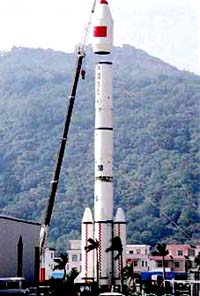
Chinese space program pics
Here is the Chinese space program in all its glory.
The China Space Capsule (space.com)
The China Manned launch vehicle (SpaceDaily.com)
The China Manned Launch vehicle (SpaceDaily.com)
-
Re:Capsules are more efficient
-
Re:Upper-left isn't New
Dont think taxi, think 747 vs Freight train. When a freight train crashes, it usually doesnt make the news unless there was something toxic on board or somone gets hurt.
Anything bigger that a sub-compact re-entering the atmosphere makes the news. Over the last 20+ years, if it's been big and on its way down (Mir, SkyLab, Compton, Cosmos-954, etc) it sure as hell generated a lot of publicity.
What makes the news: Space shuttle blowing up or unmanned rocket blowing up?
Again, any time something CATOs on the pad it makes the news. For one thing, there really aren't that many launches. For another, rocket fuel tends to explode in dramatic fashion. Do manned launch failures stay in the news longer? Yes. But anything that goes ka-boom with a display on par with Vesuvius will grab the headlines. -
These Rocket Scientists are not Rocket ScientistsBah. One thing that separates a really good scientist, engineer, or inventor is that they're really good at communicating and explaining. The late Richard Feynman was the most extreme example -- he always refused to accept any job that didn't include teaching duties. He did this because he understood that being able to explain what you're creating is an essential part of creating new science and technology.
Probably any intelligent person could figure out this convoluted explanation of aerospike engines. But few will bother, because it is convoluted. Perhaps you need all the history and technical background to understand the fine detail. But a good writer would start out with some kind of superficial explanation, so the reader can get some sense of why this material is important and acquire some kind of mental handle before plunging into the hard stuff.
The links in the ScottKin's original submission are even less impressive. Garvey just issues a press release talking about how cool their aerospike engine is, without the tiniest hint as to WTF an aerospike engine is. (Yeah, that will make people take notice!) The "California Space Authority" (someone's read too much Jerry Pournelle) site tries to explain, but utterly fails. And the Boeing site is most pathetic of all, with its pound-feet and square inches. I mean, I can understand that its politically impossible to metricize the U.S. consumer. But these guys are supposed to be the world's leading aerospace engineers! Yet decades after the rest of the world has gone metric, and after screwup after screwup after screwup in metric-English conversion, these "rocket scientists" refuse to modernize their measurements. Is it any wonder the rest of the world thinks we're a bunch of arrogant assholes?
-
The sixth panet on space.com ..
The story is also on space.com. they also have a article showing how to find Uranus in the sky - it is quite close to Mars at the moment. Perhaps we should start calling it the 6th planet at
-
The sixth panet on space.com ..
The story is also on space.com. they also have a article showing how to find Uranus in the sky - it is quite close to Mars at the moment. Perhaps we should start calling it the 6th planet at
-
Re:Linda Ham
Read her side of the spy-satellite picture story and watch for spin.
Click. -
Aerobraking
Aerobraking, similar to that imagined in Arthur C Clarke's 2010: Odyssey 2. I gather the physics is fairly sound, as NASA used it for precisely this purpose a couple of years ago.
-
Re:Leave the flags out of it
The crew size was cut when the X33 program was shutdown. The program lost its budget just as it was ready for full testing when the money was lost. Now there is talk of going back to a capsule for the crew or a crew only shuttle. Too bad Lockheed has reassigned the people working on this.
These kinds of programs are not cheap and they only get more expensive each time they are cancled. We could have been there and done that if a good plan was produced, not meddled with and followed through.
-
Bah!
I STILL say my dish is better than anything you can get. Damn, I can WiFi to my brother's computer all the way in Zeta-Twelve!
-
"Accretion" model is under fire
I agree that the BBC article is woefully short of details, like how much additional energy was released, and the like. But before rejecting the conclusion out of hand, keep in mind that we're not entirely sure about a lot of "core" facts about our own planetary neighbors:
You need that core in standard formation models before you can accrete the hydrogen and helium gas.
According to this space.com article from 2001, extrasolar gas giants are throwing doubt on the "accretion" model of planet formation:
In the traditional view, Jupiter first formed a rocky core several times the size of Earth, which then attracted a still larger outer envelope of gas. This process is known as "accretion."
If this is the case, the large gaseous planet would have taken a very long time -- current estimates range between 10 million and a billion years -- to develop by the gradual build-up of material.
However, recent observations of distant stars suggest that planets have at most a few million years to gather up as much dust and gas as they can before the protoplanetary disk that feeds them disappears. There simply isn't enough time for massive planets like Jupiter to form.
If these new theories (yes, just theories) are correct, then you have a lot of very dense Hydrogen and Helium held together by its own gravity, not a big, rocky core. This makes the gas giants just small, dirty versions of the sun.
Of course, there are those who go the other way... Iron-core Sun, anyone?
It's a great time to be interested in the sky... fewer and fewer of the questions I got "right" on the middle school science test would be correct today. -
On space.com too
Space.com had a nice piece about this too.
-
It won't postpone any manned lunar missions...But, at least in the United States, lack of public interest and the cost will. I think space.com's article on why we need a space program was very insightful.
I also think that this is one those times where my sig fits in nicely.
-
Re:Benefits?
"especially if the lasers used for climbing can be used to defend it - that shouldn't be too difficult."
The lasers they would use are much less powerful than even direct sunlight, and will not pose a threat to human or animal life and/or vision. "The strength of the pulsed laser beam is less than the intensity of the Sun, so birds, airplanes, or human eyes wouldn't be affected, he said." -
Re:Pointless Top 10+5 insightful my ass. Seriously, how the hell do we as a species become so close-minded? Any mod that you got obviously did not read the article.
"Prevention of environmental disaster"
More like monitoring of onngoing environmental disasters. The money would be better spent on preventing them on the ground rather than just watching them from space.How are we to know where to spend the money? Just blindly throw it at problems like the DEA? Naw, let's find the source and what
exactly is causing the problem.
"Creating a global network for modern communications, entertainment and networking"
I thought that was what M$ was trying to do. So our great space program is about being a slave to the telecoms... Why don't we just put a giant Verizon logo on all the rockets from now on?Nice, relate it to M$ and telecoms. After all, they are evil. Wake up mods! It's not even relevant. I'm sure all those in remote environments where satellite are their only options for an uplink (minus dialup) are so discerning. Oh, nevermind, it's cause the telecoms are so bent on 0wnz3r3d joo.
"Global education and health services"
Give me a break. What, are we going to try to broadcast PBS to the entire world? The only people who will benefit the satalites and all the other space based comunications are the people who can afford the devices to tap into those communications. Last time I checked the poor in Africa want food, not TV's. The only people that will be able to afford these devices are the people that don't need these services.Gawd...
seriously, the world does not revolve around your narrow-mindedness. Try reading a few international papers. Expose yourself to the vast world. Read this. There are so many reports similar to that one. Many rural communities team together to get a computer. They share the resources for it's usage. If the people can identify a use for it, it will usually be had.
"Cheap and environmentally friendly energy" Let me guess: widespread use of potatoes to power clocks. They have gone a long way to create operational systems but they still need to develope them and they haven't been put into practice? In other words you have a coupel of ideas but you have done jack shit asbout them.
And you have probably never heard of
Project Prometheus, am I right? Sorry if this shit is way more difficult for people to figure out on the first try. Yeah, something about harnessing the most powerful known power in the universe and humans being able to deal with that. Shit, I'm surprised the ancient Romans weren't able to do it while conquering all of the Mediterranean.
"Transportation safety" This is part of the the satalite argument. As for the rest, space travel will always be inherently unsafe. The only recourse is to deal with it. When your shuttle explodes, be a man! Face the pain! I didn't hear any of the apollo astronauts whining about safety. They flew with what they had and if that wasn't good enough, tough!
I'll somewhat agree with you here. Magellan and Columbus and the like weren't made aware of what dangers they would encounter. They didn't what they would encounter. For all Columbus knew, he could have fallen off the edge of the universe. However, the people going into space now know what they are dealing with. They know the dangers and what will kill them and what won't. It would be like going to investigate a marsh bog. You know marsh bogs sometimes emit large amounts of marsh gas which can be toxic. Of course it may be perfectly harmless and an
adventurer would fearlessly investigate the matter. While
-
Re:For more info on Space Elevators
Here is some more information, with some interesting images.
-
No more starsI think you've discovered an important factor in the downfall of "hard" SF. But I don't think you've described it accurately. Remember, fiction about space travel is not a new thing. One of the very first movies made was George Melies's A Trip to the Moon. In printed literature, people started speculating about travelling to other worlds as soon as they realized that there were other worlds. The earliest example I know about is de Bergerac's "Voyage to the Moon" -- written in 1657!
Things reached a peak in the first two-thirds of the twentieth century. With the growth of science and technology, people began to assume that space travel would happen some day, but not all of them assumed that it would happen soon. In the 30s and 40s, there were writers like Heinlen who had some grasp of rocket technology, and were sure things would get going in their own lifetimes. (I never caught Heinlen's color commentary of Apollo 11, but I'm sure he delivered it with a certain feeling of vindication.) But the mainstream imagination didn't grasp space travel as something that could happen any time soon. The Buck Rogers serials were set 5 centuries in the future. Olaf Stapledon's post-humans don't get around to it for millions of years!
Then the Soviets launched the first artificial satellite and all of a sudden space travel became a means of Soviet-American mutual oneupmanship. With actually rocket ships blasting off, everybody suddenly believed in space travel, aliens, and all the other stuff that used to be marginalized "fantasy".
Then reality set in. Probes of other planets found no ancient Martians or Venusian swamp dwellers. Only nasty environments seemingly devoid of life, or even the ability to support it. Even the old assumption that such an unimaginably huge universe had to have intelligent life somewhere came to be doubted.
Worst of all, the space race turned out to work against space becoming "the final frontier". It had the wrong goals. Instead of working on practical technologies for exploring space, we invented fearsomely expensive vehicles whose only virtue was that they "put a man on the moon" before JFK's deadline. People saw that big expensive Saturn rocket, with its teeny tiny payload, and decided that it was all a big stunt. And despite various half-assed efforts (Skylab, that "Strategic Defense" snake oil, our current limited and unsafe shuttle fleet), and short-lived enthusiasm every time there's some interesting accomplishment, that's still the underlying attitude. And space travel is now back to being "fantasy."
-
An Alternative To OrionWhen you need nukes, nothing else will do.
Well, there's at least one other possibility.
Mind you, an Orion launched from orbit, outside the Van Allen belts, would pose essentially no risk to the inhabitants of Earth, and is fairly cheap and well-studied. The best description of it is in Project Orion by George Dyson, Freeman Dyson's son. A fascinating read.
-
More pictures
Thanks for the Harvard link! Here are some more images from Space.com. This one is a composite photo. of the images picked up by the various types of telescopes.
-
This would be a "RTFA". It *is* sound.Read the Space.com link.
The Perseus cluster is the brightest known in X-rays, making it a good target for study. It has two large, bubble-shaped cavities that extend away from a central black hole. The cavities are formed by jets of material ejected from the black hole's surroundings, and the jets have been suspected of heating the outlying gas. But scientists couldn't see how.
They're not saying that infra-radiation is sound--they used the telescope to see ripples in the gas. That's the sound.
A special image-processing technique was used to bring out subtle changes in brightness that revealed the presence of ripples -- the sound waves.
Fabian and Allen figure the sound waves, observed spreading out from the cavities, heat the gas. The amount of energy involved is staggering, equal to what would be produced if 100 million stars exploded. -
Re:Are you kidding me?The old technology was just as capable of catastrophic disasters.
http://www.space.com/news/spacehistory/greatest_s
p ace_events_1960s.htmlOn January 27, 1967 the crew of the first piloted Apollo mission -- veterans Gus Grissom and Ed White, along with rookie Roger Chaffee -- perished when a flash fire swept through the sealed cabin of their Apollo 1 command module. NASA's investigation of the tragedy revealed numerous technical flaws in the craft's design, including the need for a quick-opening hatch and fireproof materials in the cabin. The fire would ultimately delay the Apollo program for more than 20 months.
-
Re:The Russians figured this one out years ago ...
Don't forget about this from last year. This was a modified Soyuz rocket (not capsule), I think. One soldier was killed on the launch pad. Actually, I stumbled onto a nice chronology of space accidents. To your point--the Russians make good (capsule) and not quite as good stuff (booster). Looking over that chronology, the lesson seems to be that space travel is dangerous.
-
I'll take a stab at it
All the big SF ideas have already been done.
No, really. I pick up the occasional SF book now, and don't see much that wasn't covered in Astounding / Analog back in the 50's and 60's. Robots, AI, nanotech, genetic modification, big scale, small scale, space opera, it's all been done.
It's not all doom and gloom. Stephen Baxter produces hard science fiction, and has the background to pull it off. David Brin does likewise, but he's rather shot his bolt by moving the scope of his work far beyond the human scale. Ian M. Banks is keepin' it real by mixing SF with fantasy by making the technology so sufficiently advanced that the SF part is observing the fantasy part rather than participating, but, hey, Helliconia got there first.
There are others, but it's a few names, producing irregular books. There simply isn't the groundswell of new ideas, because it's becoming harder to come up with new ones, and SF, unlike fantasy, relies on invention rather than re-hashing.
-
Re:Kubrick promised us the Monolith...
gee... sorry you missed the (implied) sarcasm tags there. Although if you think about it, hasn't commercial space flight already begun?
-
Re:creation of the solar systemThey are sending one to have a look around in 2006 but it will take a few years to get there.
This New Horizons mission was hit by a big funding cut early this year, although that decision has now been reversed. However it is still not certain that the mission is going to happen, which is a shame because this really is a mission to go where none has gone before...
-
Re:The Purpose of IR Astronomy
-
Re:There is no incremental development path to orb
From my point of view, you seem to have hit the nail on the head. RLVs are something that our current energy sources just can't dream to achive. We could build the vehicle that could sustain it, but we currently have no way of powering that vehicle.
IIRC, this is the reason behind the space elevator. Thus, we can get into space and dock with something already in orbit. Then we can transfer to some other station where work on space only vehicles can take place. These vehicles can then take advantage of ION Propulsion since it provides a constant acceleration.
My degree isn't in aerospace engineering, neither i have i even attempted to read futher on either of the above concepts other than a quick glimpse, but it seems to me that we are going about things in the wrong direction. I wonder what it will take to bring that revelation that suddenly changes everything?
-
Another article about another asteroid
Please read the news article "Asteroid Might Hit Earth in 2880, Unless it is Painted" about another asteroid that might hit earth. The article suggests that painting the asteroid would deflect it from its course.
-
Re:We already built this. It was called the DCX-10
WASHINGTON -- Dealing with a $4 billion International Space Station budget overrun is the centerpiece of U.S. President George W. Bush's 2002 spending blueprint for NASA released today.
Space station program management would also shift from Johnson Space Center, Houston to NASA Headquarters in Washington under Bush's plan.
This change follows the Feb. 23 ouster of George Abbey as Johnson's director.
Bush's blueprint -- the clearest indication to date of his priorities for the space agency -- stress the administration's commitment to "permanent human presence in space, world-class research in space and accommodation of the international partner elements." The above was from Feb. The prior was March after the NASA admins were being threatened with job loses. It sucked to work in the agency at that time.
Bush killed it, not NASA.
Many inside of NASA wanted it finished, due to so many projects being killed at admin changes. -
Re:We already built this. It was called the DCX-10
Obviously, you are not reading the article, nor have you gone through the NASA site.
When concieved X-33 was to cost 1.5 billion with 1 billion from NASA and
The engines were built and undergoing testing at stennis Likewise, the airframe was basicaly competed.
The only real issue were the fuel tanks.
Those had been changed from composite to metal which forced a slightly slower speed. Not enough to change any charartistic.
The X-33 would have been ready this year for final testing
As to overruns, it was at 10% overrun, of which almost all military and NASA operations suffer incurable overrun of 100-1000%. Had this gotten done in 60% overrun (in fact, it was on tract for 30-40%), then it would have been impressive considering what it was doing.
But no sense letting real facts get in the way of more GWB campaigning. -
Re:We already built this. It was called the DCX-10
Obviously, you are not reading the article, nor have you gone through the NASA site.
When concieved X-33 was to cost 1.5 billion with 1 billion from NASA and
The engines were built and undergoing testing at stennis Likewise, the airframe was basicaly competed.
The only real issue were the fuel tanks.
Those had been changed from composite to metal which forced a slightly slower speed. Not enough to change any charartistic.
The X-33 would have been ready this year for final testing
As to overruns, it was at 10% overrun, of which almost all military and NASA operations suffer incurable overrun of 100-1000%. Had this gotten done in 60% overrun (in fact, it was on tract for 30-40%), then it would have been impressive considering what it was doing.
But no sense letting real facts get in the way of more GWB campaigning. -
Re:We already built this. It was called the DCX-10
politics killed the X-33? NASA was unhappy to have the X-33 cancelled? first off, the bush administration could not by its own right have "killed" the X-33. space.com article. the program was already years behind schedule, hundreds of millions of dollars over budget and would have required huge expenditures in additional research funds to get anywhere near an operational testcraft. no one who had put in over a billion dollars into the X-33 wanted to keep funding it. not NASA, not lockheed. the air force laughed off the suggestion that they step in with the funds to keep the project rolling. the project was an absolute failure. but why let facts get in the way of a good GWB bashing?
-
Re:We shouldn't depend on Government
> It would be MUCH better if the Government
> provided incentives to the various companies who
> are attemping to build space transportation
> systems. Those folks will be in it for profit, and
> their isn't any profit in destroying your launch
> systems to meet a schedule.
Exactly! Government incentives for commercially developed space transportation is definitely the way to go. I mean, what could go wrong? -
Re:Another Application
My question is what happens if space debree/meteorite hits the elevator? Would it have some sort of quick release connector like the Xbox controller? Take a look at this picture and you'll see why.
-
Another Application
You don't suppose this stuff could be strong enough to make a space elevator, could it?
-
Re:Management's decision not to image
You are being slightly cruel to Linda Ham , she could'nt have really intentionally tried to cover her ass putting the astronauts in danger, especially considering her husband is an astronaut himself. Here is her view on things . I think she screwed up, but unfortunately (just like doctors) , her mistakes costs lives.
-
Re:Management's decision not to image
-
Why so excited?
I'm sorry, but if you look at the numbers here you'll see that past perihelic oppositions of Mars to earth are just about as close as this one. Year 2003= 34.6 million miles. Year 1956 = 35.1 mill. = difference of 1.4%. Year 1971 = 34.9 mill. = diff. 0.9%. Year 1988= 36.5 mill = diff. 5.5%
I doubt that such a marginally closer opposition distance significantly improves observations of anything. -
Re:dammit
Space.com is racist!?!
-
What the eye wants to see
Looking at the image, my brain tries to fit it to 'known' continents.
The Terra Meridiani area looks like either the east coast of southeast Asia (Vietnam, etc.), or the Gulf of Mexico.
Arabia Terra could easily be China.
Hellas is in the right place for Australia. -
dammit
I like this caption better.
-
Re:Bad choice for a name?I mean, cities don't fly, it's just silly, eh mate ?
Yes they do...
-
There's a reason for these "accidents"......God doesn't want people to leave earth. Of course, sometimes he doesn't want them to return.