Slashdot Mirror
Domain: af.mil
Stories and comments across the archive that link to af.mil.
Comments · 904
-
In hidden ways, the U.S. government is violent.It's painful to me, but I have had to accept that the U.S. government is corrupt in some ways. United States government agencies, such as the NSA, CIA, and FBI, have become global police that operate mostly in secret, without control or oversight by the people, and mostly without any kind of effective external control. United States citizens are allowed to know about these agencies only what the U.S. government wants them to know. (NSA is National Security Agency. CIA is Central Intelligence Agency. FBI is Federal Bureau of Investigation. These are official U.S. government web sites.)
Hidden elements of the U.S. government have become the most violent force the world has ever known, with a long history of acting in a violent manner and supporting violent dictatorships: The U.S. government has bombed 24 countries in the 58 years since the Second World War. The list below includes only countries bombed, not countries in which the U.S. government was responsible for other violence. The list includes only violence since the Second World War, not the extensive violence before the war. Most U.S. citizens are surprised and skeptical when they see the list, so a few links have been provided to supporting information. For more information, try the Google search engine or see the links below.- Afghanistan, 1998, 2001, 2002, 2003
- Bosnia, 1994, 1995
- Cambodia, 1969-70
- China, 1945-46
- Congo (now Zaire), 1964
- Cuba, 1959-1961 ("Bay of Pigs" invasion)
- El Salvador, 1980s
- Grenada, 1983
- Guatemala, 1954, 1960, 1967-69
- Indonesia, 1958
- Iran, 1987
- Iraq, 1991-2000, 2003 (The U.S. government used radioactive bombs in the first war against Iraq. See United States War Crimes Against Iraq for what appears to be an accurate history.)
- Korea and China, 1950-53 (Korean War)
- Kuwait, 1991
- Laos, 1964-73
- Lebanon, 1983, 1984 (both Lebanese and Syrian targets)
- Libya, 1986
- Nicaragua, 1980s
- Panama, 1989. The U.S. government called it "Operation Just Cause". The link is to a U.S. military web site.
- Peru, 1965
- Somalia, 1993
- Sudan 1998. There are doubts that the pharmaceutical plant that was bombed was making weapons.
- Vietnam, 1961-73 (An estimated 2,000,000 Vietnamese were killed.)
- Yugoslavia, 1999
There are many sources for this information. For example, see this PBS web page: PBS: A Chronology of U.S. Military Interventions (PBS is the Public Broadcasting System in the U.S.) Also see From Wounded Knee to Afghanistan: A Century of U.S. Military Interventions [zmag.org] and The government of the United States is a consistent opponent of international law. [
-
Re:The price of exploration~ $15 Billion is quite a shoestring.
Think so? Let's compare and contrast that amount (the sum total) against 1 (one) B2 Spirit Stealth Bomber.
B2 Info
Hrmmm.. how many bombers do we have at 1.16b a piece? How many do we really need? Keep in mind that this doesn't even remotely account for the support infrastructure like the NASA budget did.
Thus we arrive at the moral dilemna. Let's see, we can fund science and space exploration, learning about our planet and ourselves in the process... or we can produce machines whose only viable purpose is to destroy human life and their surroundings. How much is just -one- of those snappy laser-guided missiles that we seem to be so fond of shooting at other humans?
Cruise Missle
$600,000 a pop to kill a handful of humans? I suppose I should be honored to be senselessly slaughtered by such expensive weaponry! Except I'm too [expletive] dead to appreciate it.
How about this? Let's go for the -BIG- picture for DoD:
DoD Budget
It's a problem of priority. There are some of us that feel that advancing human knowledge is worth more than producing more machines of warfare. What a senseless waste. Perhaps Darwin was on to something. -
Semantics and simulationIt's great to see these issues addressed at all in the popular press-- in the world of artificial intelligence, puzzles like 'how-to-model-diplomacy' are usually classed as 'semantics'... and then swept under the rug!
For at least 100 years, wargamers have understood that to make their models accurate they have to include diplomacy and other subtle sociological factors. [great long history of wargaming]
More recently, when Chris Crawford did his breakthru nuclear-armageddon sim Balance of Power in 1985, he read all the basic texts on international diplomacy and found them almost completely useless-- his model ended up being entirely about 'saving face', which was something the texts hardly ever spelled out. (If you let your enemy get away with anything, you lose face, so to avoid that you have to rattle your nuclear 'sabre'.)
But what's most alarming is that as long as AI's been around (almost 50 years) and as popular as computer games and simulations have gotten, I'm not sure there's any university program yet that surveys how to do this kind of semantics, for games and other simulations. (I've been scouring the Web about this for my timeline.)
-
Re:A time of leaps and boundsThe factsheet for the U2 gives a top speed of Mach
The Valkyrie bomber is simply too cool for words. Six afterburning engines, all in a row, with wing tips that droop down in flight for stability at Mach 3+ speeds. Did you ever see the video of the Valkyrie crash? I think it is Super Sabre that gets sucked up by the Valyries wake causing both planes to go down. All for an effin' PR shoot! Effin' marketers!
-
Re:A time of leaps and boundsThe factsheet for the U2 gives a top speed of Mach
The Valkyrie bomber is simply too cool for words. Six afterburning engines, all in a row, with wing tips that droop down in flight for stability at Mach 3+ speeds. Did you ever see the video of the Valkyrie crash? I think it is Super Sabre that gets sucked up by the Valyries wake causing both planes to go down. All for an effin' PR shoot! Effin' marketers!
-
Mor�n!
Moron !
Andalucia is a part of Spain.
Yes, Morón is in Andalucia. -
GPS is having problems
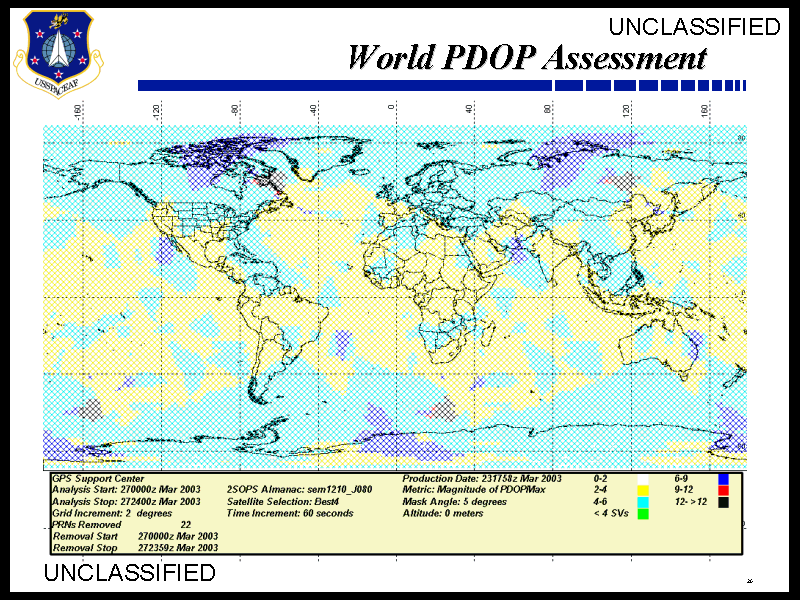
There are many areas in the world that are having problems with GPS but its not due to jaming, its due to the fact that there isn't a full constilation up. PRN 22 went dead a while back and hasn't been replaced. The current plan is to spread out the sats in that orbital ring (the B plane) to help fill up the gap but that will result in more outages in more places for short times compared to the current 1/2 hour outages seen directly in the flight path. The NavCen are recomending that you change your mask angle to 5 degrees if its set higher (many people use 15 degrees).
Right now you can see the problems on this map (mirrored here). The black areas are where GPS isn't going to give a 3d position and the red areas are where it wont get a 4d (3d+time) fix. The dark blue will have issues if any part of the sky is blocked. I don't think I've seen the GPS status this bad for a long time. Maybe its time to launch a few new navstar sats. -
Mirror of the screenshots
I've got a mirror of the screenshots here.
Enjoy!
-
2,000,000 people killed in the Vietnam war.
The U.S. government killed an estimated 2,000,000 people in the Vietnam war. The bombing of Cambodia killed a huge number.
I find the arguments credible that the bombing of Cambodia destabilized the society there, and the U.S. government must take some responsibility for the deaths of millions after the bombing. But only those killed directly are included in the 3,000,000. Note that no one in Vietnam or Cambodia ever directly threatened anyone in the United States. I often heard military people speculating why the U.S. was in Vietnam. Some said oil. Most said that the military was tired of waiting so long to have a war to fight.
There have been many "smaller" killings. The U.S. government killed an estimated 6,000 people in the war in Panama. Remember that? They called it Operation Just Cause.
It always shocks me when I realize that most people have no idea of the extent of the violence of the U.S. government.
For more about this, see a comment in this story by someone else: #5552921. The U.S. has a history of secret interference with the governments of other countries. Note that some of the information is from a U.S. government web site. -
Re:Waiting
Buck up, Airman. It could be worse. You could be living in a tent at Incirlik AFB, Turkey. 'Course, I could be in Kuwait with most of my shipmates from home, so everything is relative.
-
Wrong.GPS satellites are in middle earth orbit, as this site states:
GPS satellites orbit the earth every 12 hours emitting continuous navigation signals on two different L-band frequencies.
I expect it'd be fairly easy to program or command directly individual satellites to turn on or off SA every 6 hours. -
Re:Army's stuff
Actually the US Air Force owns and operates GPS satellites. It is run through the Navstar Global Positioning System Joint Program Office in Los Angeles, a USAF agency.
-
Re:Army's stuff
Actually, it's the Air Force's. The Navy's page is here and this is the Army's page.
-
Re:Try the USCG Navigation Center
Or even www.peterson.af.mil/GPS_Support
sorry about replying to my own posts. -
YAL-1A Highlights
This isn't exactly news; I gave a briefing on this subject, oh, three or so years ago. The highlights:
- The airframe is a Boeing 747-400F, a standard commercial freighter, with modifications to house the laser.
- Testing is slated to begin as early as 2003, with a seven-plane operational fleet in service as early as 2009.
- The laser is to be a multi-megawatt oxygen-iodine system. A multi-hundred-kilowatt system was successfully flight-tested in 1998.
- The system uses "adaptive optics," mirrors which can be deformed to correct for atmospheric effects such as "thermal bloom," the heating of air by the laser, causing distortion (like looking down a hot road).
- The project is run by the Air Force Research Labs Directed Energy Directorate, based at Kirtland AFB, NM, and has been around in some form or other for at least 20 years.
- Contractors include Boeing, TRW Space and Electronics Group (developing laser), and Lockheed Martin Missiles and Space (developing beam- and fire-control systems).
- Boeing and Rockwell competed for a $22 million concept-definition contract, with Boeing winning that contract, and the $1.3 billion Airborne Laser Program Definition and Risk Reduction contract.
- The program call(ed) for destruction of a boosting theater ballistic missile by the fall of 2002. (I haven't heard whether that happened.)
- A follow-on contract of about $4.5 billion to complete engineering, manufacturing, development and production efforts of a seven aircraft fleet will be awarded following successful completion of the initial contract.
There were some really neat pictures of the airplane on the USAF website www.af.mil, as well as a couple of stories, but they've been relegated to the archives. One of those stories, from which most of this information is taken, can be found at http://www.af.mil/news/Jan2000/n20000124_000101.ht ml. Incidentally, the best description I've ever found of the optical technology can be found in Tom Clancy's The Cardinal of the Kremlin.
An additional note: there was mention that a computer would fire the laser, not a person. This is true, at least after a fashion. Yes, the computer actually fires the laser--this is necessary, as there is no human out there who has the timing to hit an object moving at 12,000 miles an hour. The system must first be armed, though, and this is done by a human. While I do understand the concern about a computer controlling the weapon, in this case, there is still a man in the loop.
-
YAL-1A Highlights
This isn't exactly news; I gave a briefing on this subject, oh, three or so years ago. The highlights:
- The airframe is a Boeing 747-400F, a standard commercial freighter, with modifications to house the laser.
- Testing is slated to begin as early as 2003, with a seven-plane operational fleet in service as early as 2009.
- The laser is to be a multi-megawatt oxygen-iodine system. A multi-hundred-kilowatt system was successfully flight-tested in 1998.
- The system uses "adaptive optics," mirrors which can be deformed to correct for atmospheric effects such as "thermal bloom," the heating of air by the laser, causing distortion (like looking down a hot road).
- The project is run by the Air Force Research Labs Directed Energy Directorate, based at Kirtland AFB, NM, and has been around in some form or other for at least 20 years.
- Contractors include Boeing, TRW Space and Electronics Group (developing laser), and Lockheed Martin Missiles and Space (developing beam- and fire-control systems).
- Boeing and Rockwell competed for a $22 million concept-definition contract, with Boeing winning that contract, and the $1.3 billion Airborne Laser Program Definition and Risk Reduction contract.
- The program call(ed) for destruction of a boosting theater ballistic missile by the fall of 2002. (I haven't heard whether that happened.)
- A follow-on contract of about $4.5 billion to complete engineering, manufacturing, development and production efforts of a seven aircraft fleet will be awarded following successful completion of the initial contract.
There were some really neat pictures of the airplane on the USAF website www.af.mil, as well as a couple of stories, but they've been relegated to the archives. One of those stories, from which most of this information is taken, can be found at http://www.af.mil/news/Jan2000/n20000124_000101.ht ml. Incidentally, the best description I've ever found of the optical technology can be found in Tom Clancy's The Cardinal of the Kremlin.
An additional note: there was mention that a computer would fire the laser, not a person. This is true, at least after a fashion. Yes, the computer actually fires the laser--this is necessary, as there is no human out there who has the timing to hit an object moving at 12,000 miles an hour. The system must first be armed, though, and this is done by a human. While I do understand the concern about a computer controlling the weapon, in this case, there is still a man in the loop.
-
Re:Where the
Video Professor for StarOffice, perhaps. I thought A.C. was trying to be funny. When I read his post, I imagined a middle aged housewife who didn't know a Mac from an AWAC giving her testimonial: I popped in the Video Professor cd, and twenty minutes later I was rolling my own kernel and doing the ip chains thing!" Oh, well. I cut my teeth on Slackware, and I still prefer it over all others. What I needed to know, I learned in man pages, README files, and Google/linux searches.
-
Re:And it was so hard for them to make viruses bef
No, the US has various parts of the Air Force, which isn't anywhere near the scale of what China's doing.
-
Who's Looking For Near Earth Objects?That being said, I remember reading an article (wish I could find it and cite it) that said there were only 4 government employees whose job description includes looking for asteroids to hit earth; most of the people doing this are amateur astronomers.
Actually there are about 100 people worldwide searching for NEOs according to NASA's Ames Research Centre Asteroid Coment Impact Hazards Website.
The most productive NEO search program is the USAF/MIT run LINEAR which has discovered more NEOs than all other search programs combined.
Other search progrms include
- NEAT
- Spacewatch
- Lowell Observatory Near-Earth Object Search (LONEOS)
- Catalina Sky Survey
- Japanese Spaceguard Association (JSGA)
- Asiago DLR Asteroid Survey (ADAS)
I haven't been able to read the article because it's slashdotted, but it makes me wonder why they would have something like the Torino Impact Scale if they weren't going to use it to inform the public. So far only one object has ever has ever been classifed a "1" on the tornio scale, but that doesn't look like it's going to a a problem. But with most NEOs still unidentified the most likely warning we will have is none at all.
-
What's so great about this telescope?
And that's not sarcasm. I couldn't figure out from the article what's really new and great about this particular telescope. Comparing it to one I've read about, the Starfire:
this vs. Starfire:
The 40-kHz closed-loop adaptive optics (AO) system adjusted the position of 336 points 941 actuator adaptive optics system on its 640-mm (2.1-foot) 3.5 Meter deformable mirror 550 times per second
"This is the first time that anybody has done adaptive optics with a mirror that is an integral part of the telescope itself" said Lloyd-Hart. Primary mirror has actuators
I'm just a layman who likes reading about telescope technology, but it sure looks like they're making claims of being first when they aren't. Still, the Air Force is funding this, and they have a telescope that can image a basketball at a thousand miles, so there's obviously something good here.
Is it the 550Hz sampling rate? Maybe it's the first one available to civilian astronomers? Does anybody know? -
Laws of armed conflict
What's really interesting about this subject, is to ponder how LOAC (laws of armed conflict) fits into cyberwar. Who is an armed combatant in a cyberwar, if we have civilians fighting behind the computer - delivering hits, but not fighting in the area of conflict? Would they be an unlawful combatant? I think that the geneva conventions will have to be amended, changed, whatever - because technology and information is changing the way we do war. If you don't know much about LOAC, here is a website:
http://www.aetc.randolph.af.mil/ja/loac/000.html(y eah, this site sucks, but it's dumbed down) -
Re:It took me some time but I got there!
Right. 1 is bad.
For added fun, see the Capability Im-maturity model.
-
Difference registry /etc
There's not so much difference between a registry and an
True.
But then there isn't so much difference between a Concorde [>100k] and a "Tante Ju" (aka Iron Annie) Junkers Ju 52 either.Both are a database of settings, the registry is powered by a more powerful searching and indexing engine and not wasting a full disk sector (or cluster) for "keys" only containing five bytes of data, that's all.
True -- however, did you ever try some egrep on the registry?
Both planes are passenger planes. One is very fast, eats fuel like there was no tomorrow, has a very long range, and so on. The other one is small (13 passengers), is much slower, was operational 45 years earlier, some are still flown today, after 70+ years, is a historic milestone, etc.
No, that maps not to registry vs.PS: "a full disk sector" is 512 bytes. You think of a filesystem block ("cluster" in FAT-speak). This would be 1-4k for ext2. And ReiserFS does pack short files, wasting far less than a block -- so your basic assumption is flawed.
-
semi-OT: F22, the military and space exploration
BTW, the F22 can already supercruise, as it's been out for a while now.
Looks like it can supercruise at mach 1.5. While it tops out around 1.8, that doesn't really matter. Top speed in fighters is virtually worthless because of the amount of gas you're going through. The ability to sustain mach 1.5 over long distances is VERY impressive. linkage
I agree with the original poster about how these technologies will help build better space vehicles of tomorrow, while providing immediate benefits to us now.
I'd like to point out that we're in a situation where we can spend $20 billion on space exploration BECAUSE we've spent so much money on defense. I'm not saying it's ALL necessary, or that the current use of it is good, but I would like people to remember that living in a world where your biggest concern is that optimal choice in the latest -
Re:Some Recent Speculation
Are you sure that the US government didn't simply give the material to Israel?
Yes. -
Re:Space Shuttle
We send men and women out every day in 42 year-old aircraft but I don't see anyone getting in a tizzy about that.
The fact is, space flight, like traditional aviation, is risky. We have to accept the risk if we are to continue this program. -
almost howstuffworks.com...
-
Re:Prather, Garcia
Ah, but Molina himself (whose name is actually Mario, and who basically discovered the CFC/ozone problem) has been working with the Air Force on studies related to this very problem. See this newsletter... it looks like there's not much to worry about.
-
Hackers threaten computer security!
-
Re:The ultimate weaponAnother US Air Force paper:
This paper included in Volume II
NOTE: This paper is classified. Personnel with appropriate clearances may request copies by contacting:
-
Re:The ultimate weaponWeather as a Force Multiplier: Owning the Weather in 2025
It's one of the hits from Googleing for weather control.
-
Re:How to End Spam in Four Easy Steps
More info on the AC-130 series:
http://www.af.mil/news/factsheets/AC_130H_U_Gunshi p.html
Thre are two nicknames; "Spectre" and "Spooky". If you can get a chance to see video of these things on TV, I'd recommend it, they can dish out amazing damage in a short period of time. (For those "Mail Call" junkies...) -
Balloon problemsThat's a big balloon, but not totally out of reach. The USAF routinely operates tethered balloons up to about 15,000 feet. Availability is about 98%; they have to come down for a helium refill now and then. Untethered balloons have to come down for refueling as well.
The Japanese Government has a similar project, and it's further along. They want to go up to 60,000 feet. At higher altitudes, there's less wind pressure to fight while stationkeeping.
-
Dayton Ohio
What's in Dayton, Ohio? The US Air Force Museum, which has an absolutely amazing collection of aircraft. Some of the more exotic ones include: an F-117 stealth fighter, an F-22, an xb-70 (the mach 3 bomber, which in my opinion was more of a technical achievement than the SR-71), and a YF-12 (the little known interceptor version of the SR-71...just imagine the look on the soviet pilot's face when he sees a plane travelling mach 3.5+ launch a missle at him). The website is also very well done: http://www.wpafb.af.mil/museum/
-
Champlin is in Mesa
The Champlin Fighter Museum is in Mesa, which is in the eastern part of the Phoenix metro area. Another great aircraft museum is the USAF Museum in Dayton, OH at Wright-Patterson AFB. They have the only surviving XB-70 Valkyrie, an X-15, Apollo 15's command module and a whole wing just for Presidential aircraft that I didn't get a chance to visit.
-
Re:Largest Building in the World!!
Here are some more that I thought of:
The most tempting tech I saw was an open access panel, revealing a ton of CAT-5, in the floor of Caesar's Palace in Las Vegas. To paraphrase Homer Simpson: Hmmmmmm..... networked slot machines... I really would like to know what OS they run.
The USAF Museum has TONS of kick ass tech.
Someone else mentioned walking the Sydney Harbour Bridge.
The Grand St Bernard and Chunnel tunnels are cool.
The Roman Coloseum is very impressive, especially since you can now walk inside of it!
Some way early tech: Stonehenge.
There's an awesome museum full of armor in Innsbruck, but I don't know its name.
Oetzi has some cool old tech too (he looks like shiny beef jerky).
-
Two more worth seeing
USAF Museum in Dayton Ohio.
Arecibo observatory in Puerto Rico. -
Worry not, citizen. It's for your protection.Worry not, citizen.
Total Information Awareness will be used for the security of all American citizens, watching over you with the compassion and leadership of a big broth---er, uh - a favorite uncle.
Our glorious leader will leverage these tools to usher in a new era of safety and prosperity, unfettered by the shackles of complicated and antiquated laws. Never fear, no terrorist will be able to hide behind the The Constitution.
Of course, we rely on your cooperation and your TIPS to ensure our enduring freedom.
Everything is warm and fuzzy. War is peace.
We now return to your regularly scheduled programming.
-
UCMJ Articles 15, 133 or 134
AS they are midshipmen and therfore under the UNIFORM CODE OF MILITARY JUSTICE (UCMJ) per article 2 subsection 2, all the naval academy had to do was cite them as being in violation of any of these three articles of the UCMJ. The highlights are my own.
SUBCHAPTER III. NON-JUDICIAL PUNISHMENT
815. ART. 15. COMMANDING OFFICER'S NON-JUDICIAL PUNISHMENT
933. ART. 133. CONDUCT UNBECOMING AN OFFICER AND A GENTLEMAN
Any commissioned officer, cadet, or midshipman who is convicted of conduct unbecoming an officer and a gentleman shall be punished as a court-martial may direct.
934. ART. 134. GENERAL ARTICLE
Though not specifically mentioned in this chapter, all disorders and neglects to the prejudice of good order and discipline in the armed forces, all conduct of a nature to bring discredit upon the armed forces , and crimes and offenses not capital, of which persons subject to this chapter may be guilty, shall be taken cognizance of by a general, special or summary court-martial, according to the nature and degree of the offense, and shall be punished at the discretion of that court.
Pay particular attention to article 134. This article basicly says that the military can charge you with anything as a crime on the spot. The only differnce between this and article 15 is that an article 15 does not reqiure a court martial. Once accused of being in violation of the UCMJ, the military is allowed to take immediate action. There is no innocent until proven guilty; your CO may take whatever action they see fit as long as it is within regulation ( Note about article 15 -- it is the only one of the articles noted above with set limits on penalties).
You can browse the entire UCMJ here
PFC Gruhn
U.S. Army, Fort Lewis
I Corps -- America's Corps -
Re:the safe may be fireproofEven better, if aliens come and destroy all the major cities, there's no way in hell they're going to bother with Omaha, NE.
Omaha, NE is real close to where SAC operated back in the day. what's the name of the air force base there? i belive Bush flew there during 9/11.
Had the Cold War gone hot, Omaha would have been well within the affected area of a number of nukes. Then again, Washignton would have been, too. Better to keep docs in Your Big City, and then in some Nowheresville.
if you ever drive through NE, check out the SAC museum, off of I-80 in between Omaha and Lincoln (my photos of the musuem). it has a number of beautiful aircraft as well as a lot of historical information. Not nearly as large as the Dayton Museum (my photos), but still worth the stop.
-
Adaptive Optics
The technology used by this telescope to counter the effects of the atmosphere in measurements is called adaptive optics. This is the first application I know of for adaptive optics on a solar telescope.
This technology has been around for awhile, and was first seriously developed by the military at the Starfire Optical Range
Recently it has been used in such telescope projects as the WM Keck Observatory and Gemini Project . I know AO is also used for measurement of eye aberrations, with projects being conducted at several Universities. For more information about Adaptive Optics, I suggest the Center for Adaptive Optics
My personal experience with AO was as an intern for Gemini this past summer. I helped write parallel code for a program that simulates current and future adaptive optics systems planned for the next generation of extremely large telescopes. -
And I thought they could get a patent
for the predator BTW, I wonder if anyone's attached an Hellfire to a kite?
-
Re:Payload
The other thing the shuttle has going for it is the ability to carry a big payload.
It can't carry much more than the Titan IV though, and it's much more expensive.
The Shuttle's max payload to orbit is 63,500 lbs, but in practice the payload capability is between 41,000 & 55,000 depending on the launch azimuth.
The Titan IVB's max payload is 47,800 lbs from FL or 38,800 lbs from CA.
Yes, using the shuttle to launch a telecommunications satellite into orbit would be a waste of money - for much the same reason that using a 24-foot U-haul truck to go pick up milk from the store would be a waste of money.
Right, and that's why they're only used for missions needing a human presence now. If you look at the future planned Space Shuttle missions, you'll notice none of them are strictly spacelift. -
Re:Don;t ask leading questions
I don't know which part of my post it is you are trying to respond to. No effort was made to impugn the Israeli capacity to make war.
But, since you bring up the question of Israeli nukes, you might find this article interesting. Prepared by the U.S. Military, it details how Israel engaged in theft to acquire both the enriched uranium and the technology necessary to first produce nuclear weapons, items that if the Iraqis for instance were able to acquire would guarantee them a nuclear arsenal of their own.
In any case, even if there is controversy over where the technology is being developed, no such controversy exists as to who is paying for it all. -
Re:What
PETA provides direct financial support the ELF, which is a domestic terrorist group.
http://www.au.af.mil/au/aul/bibs/terror/domgrp.htm
http://abcnews.go.com/sections/us/DailyNews/ecoter ror_support020226.html
-
Re:The cost of antimatter...
There weren't a lot of pilots who could have been killed by jet fuel in WWII, were there?
You must not have heard of the Messerschmitt Me 262, or the Gloster Meteor. (There were some other jets in the works at the time, such as the Bell P-59, but the Me 262 and the Meteor are the ones I could find that actually flew in combat during WWII.)
-
Re:lasers on C130s (OT)
I find the fact that the B-52 bomber has been in service for almost 50 years already pretty amazing. It first flew in 1954, and supposedly will still be in service well past 2045 (91 years... wow)
Did a quick google search and got this url: http://www.af.mil/news/factsheets/B_52_Stratofortr ess.html -
Re:CMM Description
The best description is here. It provides a good, concise description of CMM levels 1-5. Highly recommended as the best 1/3 page summary of CMM there is.
It also provides in much more detail a description of levels 0 to -3, the Capability Im-Maturity Model, and that part's hilarious.
-
Re:Quote
Just one?
The Panama Canal.
Lockheed Martin's X-33 single-stage-to-orbit reusable launch vehicle concept.
NASA's Mars Global Surveyor
The NEAR space probe (and it was delivered 9 months ahead of schedule!)
The World Trade Center recovery effort.
The US Navy's Super Hornet (upgrade to the old F/A-18 Hornet Naval strike fighter)
The U2 Spy Plane
Also, I remember hearing from the Discovery Chanel or TLC or Discovery Wings or something that the F-117 Stealth Fighter was developed under budget, but I can't seem to find a reliable link.
Golden Grove Prison at St. Croix in the US Vigrin Islands.
The Grand Staircase-Escalante monument in Utah.
It happens. It's rare percentage wise, but it does happen all the time. With the exception of the last two, which I only found out from google searching for links for the rest, I knew of all of these off of the top of my head, so it's not a big secret or anything. Just think of all the mundane projects that come in under budget too. Government buildings, roadways, etc. -
Re:American Maginot Line
I would hate to have to clean the carrier deck after an SR-71 variant took off from it. The things leaked fuel all over the place till they hit supersonic and the tanks heat expanded closed.
The A-12 was actually the original designation for the CIA variant of the SR-71. The SR-71 is the Air Forces designation. There was never an armed variant to my knowledge.
Bizarrely enough there was a UAV built around an SR-71 engine and wing ( http://www.wpafb.af.mil/museum/annex/an11.htm ).
The F-15 had several variants envisioned from the outset. Some were single seaters, some two. While its main focus was air superiority there was design intended to replace older air-to-ground systems like the A-10. Desert Storm would prove that the A-10's were still the best tank killers out there; but the F-15 was not nearly as deficient in this area as its detractors had suggested. The multi-role F-16 also turned in an impressive performance in AtG operations.
The F-4 (apparently a huge pain in the ass to do maintenance on according to an ex-Navy mechanic friend of mine) was never an awesome fighter plane (it was designed for stand off kills and had poor maneuverability when compared to Russian fighter planes of the time), but it did find its niche killing radar installations and engaging in ECM with the F-4E Wild Weasel variant.
The F-16 is indeed the other plane in our arsenal capable of pure vertical acceleration. One variant of the F-15 could actually out accelerate a Saturn V rocket up to about 60K feet.