Slashdot Mirror
Domain: axios.com
Stories and comments across the archive that link to axios.com.
Stories · 205
-
Are Phone-Addicted Drivers More Dangerous Than Drunk Drivers? (axios.com)
After crunching data on 4.5 billion miles of driving, road-safety analytics company Zendrive concludes there's a new threat which just last year claimed the lives of 6,227 pedestrians: drivers "under the influence of a smartphone."
The study points out that drunk driving fatalities peak after midnight, while distracted driving happens all day, conluding that distracted driving is now a bigger threat than drunk driving. schwit1 shares this report from Axios: "Phone addicts are the new drunk drivers," Zendrive concludes bluntly in its annual distracted driving study. The big picture: The continued increase in unsafe driving comes despite stricter laws in many states, as well as years of massive ad campaigns from groups ranging from cell phone carriers to orthopedic surgeons. "They hide in plain sight, blatantly staring at their phones while driving down the road," Zendrive says in the study.
And it's a growing problem. Over just the past year, Zendrive, which analyzes driver behavior for fleets and insurers, said the number of hardcore phone addicts doubled, now accounting for one in 12 drivers. If the current trend continues, that number will be one in five by 2022.
The report concludes drivers are 10 percent more distracted this year than last -- and that phone addicts have their eyes off the road for 28% of their drive. Yet when asked to describe their driving, 93% of phone addicts said they believed they were "safe" -- or "extremely safe" -- drivers.
One even insisted that they never texted while driving, "but I like to FaceTime my friends while driving since it makes time go by faster." -
The US Just Had the Most Q1 Layoffs in a Decade (axios.com)
The U.S. saw its highest level of layoffs in a first quarter since 2009, data from staffing firm Challenger, Gray & Christmas released this week showed. From a report: Employers cut 190,410 jobs in the first 3 months of the year -- 10.3% higher than the number of layoffs announced in the fourth quarter of 2018 and 35.6% higher than job cuts announced in the same quarter of 2018. It's the highest number of job cuts in a quarter since 2015. The financial industry saw the third highest number of layoffs and the year-to-date total was 239% higher than it was in 2018. -
Cord-Cutting Hits Video Games (axios.com)
Video games are the next entertainment industry undergoing a major disruption, all the way down to the consoles and controllers. From a report: Details: "In the past, you plunked down $60 at GameStop for a copy of Grand Theft Auto or Madden NFL and played it out -- after which you could trade it in or let it gather dust," the AP reports. "Now, you'll increasingly have the choice of subscribing to games, playing for free or possibly just streaming them over the internet to your phone or TV."
New subscription streaming services represent a massive shift from gaming into the cloud, which will make it easier to access games on any device, including mobile. [...] Gamers wouldn't necessarily have to buy individual games anymore -- they could buy them as part of a larger and potentially cheaper package -- and it means that they wouldn't be limited to expensive hardware devices that only work for certain games. -
Amazon Lobbied More Government Entities Than Any Other Public US Company Last Year (fortune.com)
Amazon lobbied more government entities last year than any other public U.S. company, covering issues like healthcare, transportation, defense, and labor regulation. "Across 2018, Amazon contacted 40 different federal entities on 21 different general issue areas," reports Fortune, citing a report from Axios. "The only tech giant to lobby on more issues than Amazon was Google's Alphabet." From the report: In terms of money spent, Amazon's $14.4 million is topped only by Alphabet's $21 million, says Bloomberg. While the tech industry overall spent less than half of the $280 million from pharmaceutical and healthcare products companies in Washington, Amazon has increased spending 460% since 2012, growing quickly within its trade. According to Axios, Amazon lobbied on self-driving car and drone issues, hinting at new methods of delivery. It supported a law allowing pharmacists to tell patients when using their insurance is actually more expensive, aiding Amazon's new investment in PillPack. It also covered the labeling of bioengineered food and a pilot program allowing online shoppers to use the Supplemental Nutritional Assistance Program -- signs of Amazon's emerging grocery business. -
People Are Concerned About Their Privacy In Theory, Not Practice, Says New Study (fortune.com)
A new privacy survey from IBM's Institute for Business Value found that 81% of consumers say they've become more concerned about how companies use their data, while 87% think companies should be more heavily regulated on personal data management. Three-quarters of the people felt like they were less likely to trust companies with data and 89% said companies should be clearer about how their products use data. Given these findings, you'd think people would take actions in response to companies losing or misusing their data -- but they're not. Fortune reports: 71% said that they were willing to give up privacy to get access to what technology can offer. Only 45% have updated their privacy settings on products in response and 16% walked away from a company because of data misuse. It's already been clear that one reasons for big data leaks is because there is little financial risk to companies, as Motherboard reported. This new data suggests that companies have even less to worry about, as most people are willing to keep doing business with them. -
Consumers Kinda, Sorta Care About Their Data (axios.com)
A full 81% of consumers say that in the past year they've become more concerned with how companies are using their data, and 87% say they've come to believe companies that manage personal data should be more regulated, according to a survey out Monday by IBM's Institute for Business Value. From a report: They aren't totally convinced they should care about how their data is being used, and many aren't taking meaningful action after privacy breaches, according to the survey. Despite increasing data risks, 71% say it's worth sacrificing privacy given the benefits of technology. [...] Despite increasing awareness of privacy and security breaches, most consumers aren't taking consequential action to protect their personal data. Fewer than half (45%) report that they've updated privacy settings, and only 16% stopped doing business with an entity due to data misuse. -
Apple Expected To Move Mac Line To Custom ARM-Based Chips Starting Next Year, Says Report (axios.com)
Developers and Intel officials have told Axios that Apple is expected to move its Mac line to custom ARM-based chips as soon as next year. "Bloomberg offered a bit more specificity on things in a report on Wednesday, saying that the first ARM-based Macs could come in 2020, with plans to offer developers a way to write a single app that can run across iPhones, iPads and Macs by 2021," reports Axios. "The first hints of the effort came last year when Apple offered a sneak peek at its plan to make it easier for developers to bring iPad apps to the Mac." From the report: If anything, the Bloomberg timeline suggests that Intel might actually have more Mac business in 2020 than some had been expecting. The key question is not the timeline but just how smoothly Apple is able to make the shift. For developers, it will likely mean an awkward period of time supporting new and classic Macs as well as new and old-style Mac apps. The move could give developers a way to reach a bigger market with a single app, although the transition could be bumpy. For Intel, of course, it would mean the loss of a significant customer, albeit probably not a huge hit to its bottom line. -
Tobacco Use is Soaring Among US Kids, Driven By E-cigarettes (axios.com)
Public health officials Monday said there's a growing epidemic of tobacco products currently used by children -- 4.9 million high school and middle school kids used tobacco products in 2018 up from 3.6 million in 2017 -- mainly due to a growth in e-cigarette usage. From a report: For the fifth year in a row, e-cigs were the most popular product amongst high school students, but in 2018 it reached unprecedented epidemic levels, with the addition of another 1.5 million kids, said Anne Schuchat, principal deputy director of the Centers for Disease Control and Prevention. "Current users" are defined as people who've used a tobacco product in past 30 days. "Frequent users" are defined as people who've used the product for more than 20 out of the past 30 days. -
Adobe is Considering Whether it Wants To Design Its Own Chips (axios.com)
A growing number of technology companies are trying to manufacture their own chips, cutting their reliance on Intel and other chip providers. This week Adobe pondered making a similar move. From a report: At an internal innovation conference on Tuesday, Adobe CTO Abhay Parasnis posed the matter as a question for his colleagues, noting the significant increases in performance from chips designed specifically for specialized tasks, like machine learning. "Do we need to become an ARM licensee?" he said, referring to the company whose underlying chip design is used across a wide range of devices, including computers, servers and phones.
"I don't have the answer, but it is something we are going to have to pay attention to." Later on Tuesday, Parasnis told Axios that there are a range of ways that Adobe could get deeper into silicon. "ARM does afford a model for a software company to package its technology much closer to silicon," he said, adding Adobe could do that without literally making its own chips, including by partnering with an existing chipmaker. -
Record Number of Americans See Climate Change As a Current Threat (axios.com)
An anonymous reader shares a report: More Americans are very worried about global warming and say the issue is personally important to them than ever before, according to a new poll released Tuesday. The polling may indicate that extreme weather events -- coupled with a series of grim scientific findings -- over the past year are starting to change peoples' minds about climate change, which could have significant implications for any significant climate legislation passing Congress. The key finding from the new survey from the Yale Program on Climate Change Communication and the George Mason University Center for Climate Change Communication is that Americans increasingly view global warming as a present-day threat to them, rather than an issue that will affect future generations. Nearly half of Americans (46%) said they personally experienced the effects of global warming -- a 15-point spike since March 2015. -
Berkeley's Two-Armed Robot Hints at a New Future For Warehouses (axios.com)
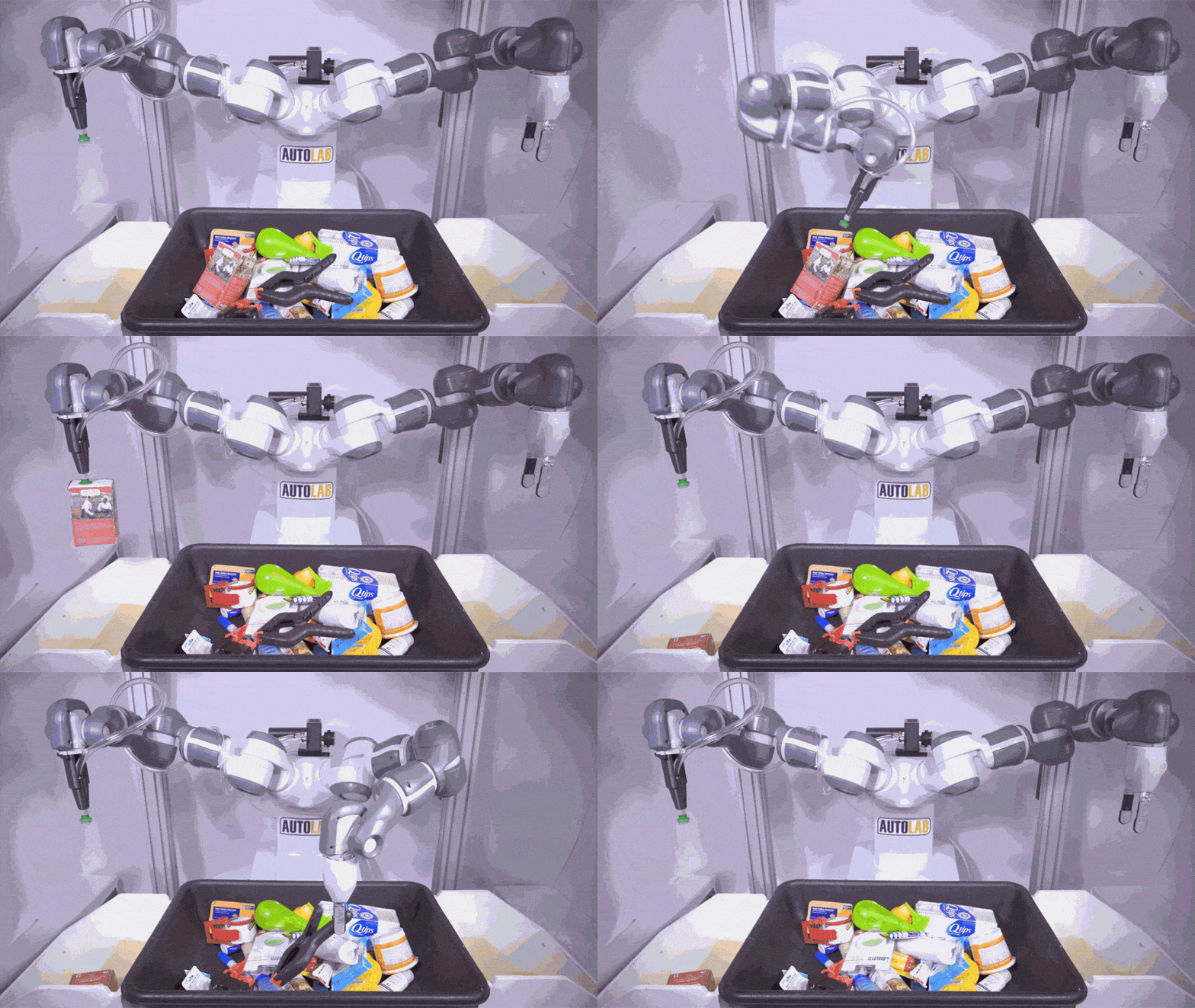
Pick up a glass of water, lift a fork: you automatically figure out the best way to grasp each object. Now researchers at UC Berkeley have developed a robot that makes similar calculation, choosing on the fly whether to grab an object with pincers or lift it with a suction cup. From a report: Berkeley's two-armed robot, seen in this video clip [GIF file], first considers the contents of a bin and calculates each arm's probability of picking up an object. Its suction cup is good at grabbing smooth, flat objects like boxes, but bad at porous surfaces like on a stuffed animal. The pincers, on the other hand, are best with small, odd-shaped items. The system learned its pick-up prowess not from actual practice, but from millions of simulated grasps on more than 1,600 3D objects. In every simulation, small details were randomized, which taught the robot to deal with real-world uncertainty. The bot can pick up objects 95% of the time, at about 300 successful pickups per hour, its creators write in a paper published this week in Science Robotics. Warehouse robots that can move around merchandise are highly sought after. Amazon is reportedly working on its own "picker" robots, as are several robotics companies. -
Berkeley's Two-Armed Robot Hints at a New Future For Warehouses (axios.com)
Pick up a glass of water, lift a fork: you automatically figure out the best way to grasp each object. Now researchers at UC Berkeley have developed a robot that makes similar calculation, choosing on the fly whether to grab an object with pincers or lift it with a suction cup. From a report: Berkeley's two-armed robot, seen in this video clip [GIF file], first considers the contents of a bin and calculates each arm's probability of picking up an object. Its suction cup is good at grabbing smooth, flat objects like boxes, but bad at porous surfaces like on a stuffed animal. The pincers, on the other hand, are best with small, odd-shaped items. The system learned its pick-up prowess not from actual practice, but from millions of simulated grasps on more than 1,600 3D objects. In every simulation, small details were randomized, which taught the robot to deal with real-world uncertainty. The bot can pick up objects 95% of the time, at about 300 successful pickups per hour, its creators write in a paper published this week in Science Robotics. Warehouse robots that can move around merchandise are highly sought after. Amazon is reportedly working on its own "picker" robots, as are several robotics companies. -
Just 5 Percent of Earth's Landscape Is Untouched, Report Finds (axios.com)
A comprehensive new high-resolution analysis of human modification of the planet finds that just 5% of the Earth's land surface is currently unaffected by humans, far lower than a previous estimate of 19%. 95% of the Earth's land surface has some indication of human modification, while 84% has multiple human impacts, the study found. New Atlas reports: The researchers from The Nature Conservancy and Conservation Science Partners used publicly available, high-resolution data from ground surveys and remotely sensed imagery on land use in 1 square kilometer grids to provide a spatial assessment of the impact of 13 human-caused stressors across all terrestrial lands, biomes and ecological regions, including: Agriculture; The physical extent of human settlement; Transportation, including railroads and minor roads; Mining, energy production; and Electrical infrastructure, including power lines.
52% of ecological regions and 49% of countries are considered moderately modified. These regions are highly fragmented, retain up to only 50% of low modified lands and fall within critical land use thresholds. Only 30% of terrestrial ecological regions and 18% of the world's countries have a low degree of land modification and retain most of their natural lands, which are distant from human settlements, agriculture and other modified environments. The study found the least modified biomes tend to be in high latitudes and include tundra, boreal forests, or taiga and temperate coniferous forests. On the other hand, the most modified biomes include more tropical landscapes, such as temperate broadleaf and mixed forests, as well as mangroves. -
It's Getting Hard To Know What is Automated and What Isn't (axios.com)
It's increasingly becoming a challenge to know when -- and if -- AI is at play in things we come across in our daily lives. From a report: Applicants usually don't know when a startup has used artificial intelligence to triage their resume. When Big Tech deploys AI to tweak a social feed and maximize scrolling time, users often can't tell, either. The same goes when the government relies on AI to dole out benefits -- citizens have little say in the matter. What's happening: As companies and the government take up AI at a delirious pace, it's increasingly difficult to know what they're automating -- or hold them accountable when they make mistakes. If something goes wrong, those harmed have had no chance to vet their own fate. Why it matters: AI tasked with critical choices can be deployed rapidly, with little supervision -- and it can fall dangerously short. The big picture: Researchers and companies are subject to no fixed rules or even specific professional guidelines regarding AI. Hence, companies have tripped up but suffered little more than a short-lived PR fuss. -
Apple To Drop iPhone XR Price in Japan Amid Weak Sales (wsj.com)
A month after Apple's new iPhone XR release, the company is set to discount the device in Japan, The Wall Street Journal reports. From the report: Less than a month after releasing the iPhone XR, Apple is moving to offer subsidies to mobile-network operators in Japan to shore up sales of its least expensive new smartphone, people familiar with the matter said. The de facto discount of the handset, coupled with cuts in production plans, are a sign of limited enthusiasm among consumers for the model, which has fewer features than Apple's other two new releases and costs more than still-popular older models like the iPhone 8. -
Most Americans Don't Think Social Networks Are Good For the World, Survey Finds (axios.com)
A new survey from Axios finds that a majority of Americans don't think social networks are good for the world. An anonymous reader shares the key findings: Silicon Valley has a big and growing problem: Americans have rising concerns with its most popular products and a growing majority wants big social media companies regulated, according to new poll conducted by Survey Monkey for "Axios on HBO." In the past year, there has been a 15-point spike in the number of people who fear the federal government won't do enough to regulate big tech companies -- with 55% now sharing this concern. In that same period, there was a 14-point increase in those who feel technology has hurt democracy and free speech. The biggest spike has been among Republicans, presumably because of increased concern about perceived censorship of conservative voices on social media. About 40% of Americans still feel that social media is a net positive for society. Overall, 65% of people say smartphones have made their quality of life better. The study also found that nearly two-thirds (63%) of respondents say they sleep with their phone in or next to their bed; and that jumps to 73% among millennials. Also, "More than half (51%) say smartphones are the hardest technology for most people to live without," reports Axios. "And that jumps to 67% among millennials." -
WannaCry is Still Dominating Ransomware (axios.com)
An anonymous reader writes: WannaCry, once the greatest cybersecurity calamity in history, now doesn't work. A website critical to its function is now controlled by civic-minded security researchers, and the fixed deadline to pay the ransom has long passed. Yet WannaCry still accounts for 28% of ransomware attacks -- the most of any ransomware family. According to a new study by Kaspersky Lab, the defanged North Korea linked ransomware is still spreading uncontrollably. The spreading mechanism that passed WannaCry from victim to victim that was so virulent in the 2017 attack is still active, even if the ransomware itself isn't. The firm discovered that since the WannaCry outbreak in May 2017 has affected 74,621 users across the globe. -
Corporate America's Blockchain and Bitcoin Fever is Over (axios.com)
S&P 500 executives are dropping blockchain buzzwords less on earnings calls and during presentations to analysts and investors. Analysts are also asking about it less. From a report: The hype was just that. The odds of a company turning blockchain "headlines into reality" are slim, as Forrester Research predicts. The prospect of incorporating blockchain technology or cryptocurrency into businesses excited investors and drove up share prices temporarily -- just look at Kodak, beverage company Long Blockchain, or Hooters franchisee Chanticleer Holdings -- so it's no wonder executives wanted shareholders to know that they too might get in on the new technologies. At the peak earlier this year, "blockchain" was mentioned 173 times, according to an analysis of company transcripts by Axios. The number has since fallen as much as 80%. -
Should Comcast Be Investigated For Antitrust Violations? (theverge.com)
The American Cable Association (ACA), an industry group that represents over 700 small and medium-sized cable operators, wants antitrust regulators to investigate whether Comcast-NBCUniversal is abusing its power to hurt smaller television and internet service providers. The group has "asked U.S. Assistant Attorney General Makan Delrahim to 'immediately' open an investigation into Comcast's practices," reports The Verge. Comcast is denying the claims, and while the Justice Department hasn't publicly responded, that may change soon. President Donald Trump tweeted about the ACA's claims earlier this afternoon. From the report: The ACA claims Comcast has a uniquely powerful hold on the U.S. cable industry because it controls a large chunk of "must have" programming like NBC's regional sports channels. The group argues that the Comcast "has shown a willingness to harm rivals" in the past, even while bound by a 2011 consent decree that expired earlier this year. The letter is dated November 6th but was published today, after Fox Business Networks reported on its existence last week.
Contra Trump's description, the letter doesn't seem to describe "routine" violations of antitrust law. It's primarily arguing that there's a huge risk of Comcast abusing its market position, while explaining just how much damage could result if Comcast did so. The ACA has put forward more concrete claims in the past, though -- like a 2017 complaint that Comcast was forcing smaller cable providers to bundle unwanted NBC-owned channels into TV packages, driving up their costs. The ACA's letter also raises concerns involving Hulu, suggesting that Comcast could effectively hold the service hostage. "We have heard from ACA members that they fear that ComcastNBCU may restrict, if it is not already restricting, their ability to access Hulu and make it available to their customers as an alternative to their cable offerings," reads the letter. -
More Than 50 Nations Launch 'Paris Call' To Fix Hate Speech and Cyberattacks; China and Russia Not Among Signatories, Trump Administration Reluctant To Sign (reuters.com)
French President Emmanuel Macron on Monday launched a push to regulate the internet. France and U.S. technology giants, including Microsoft, are pushing for governments and companies worldwide to sign up for a new initiative aimed at establishing regulations for the internet, to fight such online threats as cyber attacks, hate speech and online censorship. A report adds: With the launch of a declaration entitled the 'Paris call for trust and security in cyberspace,' French President Emmanuel Macron is hoping to revive efforts to regulate cyberspace after the last round of United Nations negotiations failed in 2017.
In the document, which is supported by many European countries but, crucially, not China or Russia, the signatories urge governments to beef up protections against cyber meddling in elections and prevent the theft of trade secrets. The Paris call was initially pushed for by tech companies but was redrafted by French officials to include work done by U.N. experts in recent years. [...] In another sign of the Trump administration's reluctance to join international initiatives it sees as a bid to encroach on U.S. sovereignty, French officials said Washington might not become a signatory, though talks are continuing. -
AT&T To Cut Off Some Customers' Service in Piracy Crackdown (axios.com)
AT&T will alert a little more than a dozen customers within the next week or so that their service will be terminated due to copyright infringement, news outlet Axios reported, citing sources familiar with its plans. From the report: It's the first time AT&T has discontinued customer service over piracy allegations since having shaped its own piracy policies last year, which is significant given it just became one of America's major media companies. AT&T owns a content network after its purchase of Time Warner earlier this year, an entity now called WarnerMedia. Content networks are typically responsible for issuing these types of allegations to internet service providers (ISPs) for them to address with their customers. -
Australian Intelligence Knows Huawei Was Used in Espionage, Report Says (axios.com)
According to a report in The Australian, Australia received intelligence reports that Huawei personnel provided Chinese spies passwords to hack a "foreign network." From a report: Though there are many broad allegations that telecommunications equipment providers Huawei and ZTE sabotage products so that spies can conduct espionage, the public is largely in the dark about how and if the nation has ever used that capacity. The Australian report claims: "Chinese espionage services used telecommunications giant Huawei's staff to get access codes to infiltrate a foreign network." The attack took place within the last two years. -
English Has the Scientific Edge -- For Now (axios.com)
For centuries, science was a multilingual affair, powered by French, German, English and other tongues. But since the early 1970s, English has become the undisputed lingua franca of scientific papers, conferences, and discourse. From a report: English-speaking countries now have a huge leg up in technical research, including the current rages -- artificial intelligence and quantum computing. But, while English is highly unlikely to be dethroned, its advantages are eroding due to an increasingly healthy research environment in China, the fast transmission of research papers across the internet, and AI-aided translation technology that is shrinking the language barrier. [...] The dominance of English gives native speakers a huge advantage, says Michael Gordin, a Princeton professor who specializes in the role of language in technological advance. -
Creating the First Quantum Internet (axios.com)
Scientists in Chicago are trying to create the embryo of the first quantum internet. If they succeed, the researchers will produce one, 30-mile piece of a far more secure communications system with the power of fast quantum computing. From a report: The key was the realization of an unused, 30-mile-long fiber optic link connecting three Chicago-area research institutions -- Argonne National Lab, Fermi Lab and the University of Chicago. This led to the idea to combine efforts and use the link for what they call the Chicago Quantum Exchange. David Awschalom, an Argonne scientist and University of Chicago professor who is the project's principal investigator, tells Axios that the concept is difficult to grasp, even for experts. MIT Technology Review elaborates: The QKD approach used by Quantum Xchange works by sending an encoded message in classical bits while the keys to decode it are sent in the form of quantum bits, or qubits. These are typically photons, which travel easily along fiber-optic cables. The beauty of this approach is that any attempt to snoop on a qubit immediately destroys its delicate quantum state, wiping out the information it carries and leaving a telltale sign of an intrusion. The initial leg of the network, linking New York City to New Jersey, will allow banks and other businesses to ship information between offices in Manhattan and data centers and other locations outside the city.
However, sending quantum keys over long distances requires "trusted nodes," which are similar to repeaters that boost signals in a standard data cable. Quantum Xchange says it will have 13 of these along its full network. At nodes, keys are decrypted into classical bits and then returned to a quantum state for onward transmission. In theory, a hacker could steal them while they are briefly vulnerable. -
Automation is Democratizing Experimental Science (axios.com)
New advances are taking automation to the highest end of human endeavors, offering scientists a shot at some of the most intractable problems that have confounded them -- and along the way tipping a global balance to give upstarts like China a more level playing field in the lab. From a report: A combination of artificial intelligence and nimble robots are allowing scientists to do more, and be faster, than they ever could with mere human hands and brains. "We're in the middle of a paradigm shift, a time when the choice of experiments and the execution of experiments are not really things that people do," says Bob Murphy, the head of the computational biology department at Carnegie Mellon University.
Automated science is "moving the role of the scientist higher and higher up the food chain," says Murphy. Researchers are focusing their efforts on big-picture problem-solving rather than the nitty-gritty of running experiments. He says it will also allow scientists to take on more problems at once -- and solve big, lingering ones that are too complex to tackle right now. Starting next year, Murphy's department will offer students a master's degree in automated science, the university announced last week. -
Humans Are Now Monitoring Animals With Facial Recognition Technology (nymag.com)
An anonymous reader quotes New York magazine: Salmon are just the latest entry in a growing cornucopia of animal faces loaded into databases. For some animals, the biometric data gathered from them is being used to aid in conservation efforts. For others, the resulting AI could help ward off poachers. While partly creepy and partly very cute, monitoring of these animals can both help protect their populations and ensure safe, traceable livestock for developing communities...
U.K. researchers are using online resources like Flickr and Instagram to help build and strengthen a database that will eventually help track global tiger populations in real time. Once collected, the photos are analyzed by everyday people in a free app called Wildsense... The mighty lion is being surveilled too. Conservationists and wildlife teachers are using facial recognition to keep tabs on a database of over 1,000 lions... Wildlife experts are tracking elephants to protect them from encroaching poachers. Using Google's Cloud AutoML Vision machine learning software, the technology will uniquely identify elephants in the wild. According to the Evening Standard, the tech will even send out an alert if it detects poachers in the same frame.
The story of whale facial tracking is one of crowdsourcing success. After struggling to distinguish specific whales from one another on his own, marine biologist Christian Khan uploaded the photos to data-competition site Kaggle and, within four months, data-science company Deepsense was able to accurately detect individual whale faces with 87% accuracy. Since then, detection rates have steadily improved and are helping conservationists track and monitor the struggling aquatic giant.
U.S. researchers are trying to protect "the world's most endangered animal" with LemurFaceID, which is able to accurately differentiate between two lemur faces with 97% accuracy. But "In the livestock surveillance arms race China is definitely leading the charge," the article notes, citing e-commerce giant JD.com and its use of facial recognition to monitor herds of pigs to detect their age, weight, and diet.
And one Chinese company even offers a blockchain-based chicken tracking system (codenamed "GoGo Chicken") with an app that can link a grocery store chicken to "its birthplace, what food it ate and how many steps it walked during its life." -
21% of Large Employers Collect Health Information From Employees' Mobile Apps or Wearable Devices, Report Says (axios.com)
An anonymous reader writes: The Kaiser Family Foundation's annual review of employer-based insurance shows that 21% of large employers collect health information from employees' mobile apps or wearable devices, as part of their wellness programs -- up from 14% last year. Wellness programs are voluntary, and so is contributing your health information to them. But among companies that offer a wellness program, just 9% of employers (including 35% of large employers) offer workers an incentive to participate. -
Bill Gates-Backed Social Recommendation App Likewise Now Available for iOS and Android (axios.com)
Bill Gates is not giving up on saving the world, but he is helping launch a new social recommendation engine. Likewise, as the iOS and Android app is known, is designed to be a place to get trusted recommendations on everything from restaurants to books, movies and TV shows. From a report: It won't cure polio or fix the U.S. education system, but Likewise could fill a niche helping people keep track of the books and TV shows their friends recommend as well as to discover new places. The free app, which launches today, began as the brainchild of Larry Cohen, a longtime Gates aide who serves as CEO of Gates Ventures. The Microsoft co-founder is funding the Bellevue, Wash.-based company, which has been working for nearly a year and has about 20 employees. "It's not the next Office, but there's a real need here," Cohen told Axios. Cohen is chairman of Likewise, with his onetime Microsoft colleague Ian Morris serving as CEO. -
SEC Charges Elon Musk With Fraud Over His Statements To Take Tesla Private (bloomberg.com)
U.S. securities regulators have sued Elon Musk for allegedly making false statements related to his abandoned efforts to take Tesla Motors private. Bloomberg News broke the news Thursday, citing docket entry in Manhattan federal court. Last month, Musk had expressed his intentions to take Tesla private, and that he had secured the funding. Taking Tesla private, which would have helped the company avoid making short-term commitments and goals, would be the "best path forward," Musk had said at the time. Even as investors had shown agreement to Musk's move, a few days later, he announced that after further discussions, everyone believes that Tesla should remain public. Amid all of this, some argued that Musk made the "false" claim just to hurt short-sellers. From the lawsuit: This case involves a series of false and misleading statements made by Elon Musk, the Chief Executive Officer of Tesla, Inc. ("Tesla"), on August 7, 2018, regarding taking Tesla, a publicly traded company, private. Musk's statements, disseminated via Twitter, falsely indicated that, should he so choose, it was virtually certain that he could take Tesla private at a purchase price that reflected a substantial premium over Tesla stock's then-current share price, that funding for this multi-billion dollar transaction had been secured, and that the only contingency was a shareholder vote. In truth and in fact, Musk had not even discussed, much less confirmed, key deal terms, including price, with any potential funding source. During a press conference, Stephanie Avakian, co-director of the SEC's division of enforcement, said: A chairman and CEO of a public company has important responsibilities to shareholders. Those responsibilities include the need to be scrupulous and careful about the truth and accuracy of statements made to the investing public, whether those statements are made in traditional forms such as a press release or an earnings call or through less formal methods such as Twitter or other social media. Neither celebrity status nor reputation as a technological innovator provide an exemption from the federal securities laws. In a statement to CNBC, Musk said, "This unjustified action by the SEC leaves me deeply saddened and disappointed. I have always taken action in the best interests of truth, transparency and investors. Integrity is the most important value in my life and the facts will show I never compromised this in any way." -
Is Tech Billionaires' Educational Philanthropy a Bug Or a Feature?
Long-time reader theodp writes: Some education watchers have adopted a wait-and-see response to Jeff Bezos' two-pronged $2B pledge to aid the homeless and to establish preschools for low-income children (Mark Zuckerberg's The Primary School interestingly prefers 'em even younger, noting "we admit students at or before birth"). Not so Audrey Watters, who presents her misgivings in a blog post, titled, "It's Like Amazon, But for Preschool" (tl;dr: read her URL), wondering what a chain of preschools that "use the same set of principles that have driven Amazon" might look like, considering Amazon's own labor practices. She asks, "Are private preschool chains really the path we want to pursue, particularly if we believe that access to excellent early childhood education is so incredibly crucial? Can the gig economy and the algorithm ever provide high quality preschool? For all the flaws in the public school system, it's important to remember: there is no accountability in billionaires' educational philanthropy." Sharing Watters' concerns is author Anand Giridharadas, who argues in his new book Winners Take All that the wealthy pursue social change without uprooting the systems that produce inequality. Bezos has a "a stark opportunity to be a traitor to his class, to actually think about giving in ways that transform the system atop which he stands," Giridharadas said. "It is great to be a winner who gives back. It is even better to be a winner who thinks about how winners can take less." -
Auto, Tech Industries Urge Congress To Pass Self-Driving Legislation (axios.com)
John Bozzella, president and CEO of Global Automakers (a trade association and lobby group of automobile manufacturers), said at an Axios event Thursday that it's "critically important" that Congress pass federal legislation on autonomous vehicles. A year ago, the House approved the Self Drive Act, but it has yet to be passed by the Senate. Axios adds: This delay is set against a growing fear in Washington, Silicon Valley and the auto industry that the U.S. will fall dangerously behind in autonomous vehicle standards and policies while China and Europe leap ahead. "My fear is we fall behind with the rest of the world," said, Congressman Robert Latta (R-Ohio), chairman of the Digital Commerce and Consumer Protection subcommittee. As breakthroughs are happening on the mechanical, computer and engineering levels with regard to autonomous vehicles, "time is running out" on moving policy forward, he added. -
Senators Grill Pompeo on Vulnerable Cybersecurity at State Department (axios.com)
A bipartisan cadre of senators sent a letter to Secretary of State Mike Pompeo on Tuesday calling out the department's poor adoption of multi-factor authentication. From a report: Multi-factor authentication requires users to take an additional protective step when logging into an account -- often a physical key or a biometric scan. Beyond being a good practice for federal agencies, multi-factor authentication is also the law for all high-level government accounts. Sens. Ron Wyden (D-Ore.), Cory Booker (D-N.J.), Rand Paul (R-Kent.), Ed Markey (D-Mass.) and Jeanne Shaheen (D-N.H) pointed to a recent Government Accountability Office (GAO) report that found only 11% of required agency devices had enhanced security. -
Computer Chips Are Still 'Made in USA' (axios.com)
For all the wishful thinking about manufacturing more laptops and iPhones in the U.S., there is one sector of tech manufacturing where America remains a leader: computer chips. From a report: Some $44 billion worth of semiconductors are exported from the U.S. each year, making them America's fourth leading manufacturing export after cars, airplanes and refined oil. There are roughly 80 wafer fabrication plants (aka fabs) in the U.S., spread across 19 states. [...] An even greater share of the world's computer chips are designed domestically and made overseas by companies including Qualcomm, Apple, Broadcom and Nvidia. A bunch of the high-tech gear needed to produce chips is also designed and/or made in the U.S. -
One Year After the Massive Equifax Data Breach, Pretty Much Nothing Has Changed (axios.com)
The Equifax data breach was supposed to change everything about cybersecurity regulation on Capitol Hill. A year ago, Equifax announced that 145.5 million U.S. adults had their social security numbers stolen in an easily preventable breach. If any data breach was going to be able to shock Washington into enacting sweeping privacy reforms, this should have been it. Axios: But that didn't happen: "The initial interest that was implied by congressional actions didn't pan out," said Michelle Richardson, director of the Privacy and Data Project at the Center for Democracy and Technology (CDT). What was supposed to happen: After the first of several hearings involving Equifax, Sen. Chuck Grassley (R-Iowa), chair of the Judiciary Committee, said it was "long past time" for federal standards for how companies like Equifax secure data.
Data security wasn't the only anticipated reform. Congress appeared poised to create a national breach notification law governing how and how quickly companies must notify anybody whose personal information is stolen in a breach. Currently, to the chagrin of national retailers, those laws vary state to state. Several investigations were supposed to penalize the credit bureau for lax cybersecurity, including failing to patch the vulnerability hackers exploited despite government warnings. What actually happened: The bills petered out. Mick Mulvaney took over the Consumer Financial Protection Bureau in November and halted the bureau's investigation. -
West Virginia Offers Free Cybersecurity Training To the Elderly (axios.com)
West Virginia's Attorney General Patrick Morrisey, who's currently running for U.S. Senate, announced Tuesday that he's partnering with two local community and technical colleges to connect senior citizens with college students for free cybersecurity training. The announcement comes amid rising cyber scams, many of which are targeted at elderly. -
Humans To Blame For Most Self-Driving Car Crashes In California, Study Finds (axios.com)
cartechboy writes: Turns out computers are better drivers than humans after all. Axios compiled a study that found the vast majority of crashes in California involving self-driving cars were not caused by the autonomous vehicles themselves. Of the 54 incidents involving 55 companies holding self-driving permits in California, only one crash could be blamed on a self-driving car in autonomous mode. Six crashes were when the self-driving cars were in conventional driving modes, while the majority of the accidents were to be blamed on other drivers or pedestrians. Maybe self-driving cars aren't such a bad thing after all, it's humans that are the problem. -
Startups Ditching Silicon Valley For New Cities (economist.com)
The rising cost of living in Silicon Valley is pushing startups out, the Economist reports, and re-focusing innovation in new cities around the country [Editor's note: the link may be paywalled; alternative source]. From the story: More Americans are leaving the Valley than moving to it. In 2017 several counties in the area saw their largest combined domestic outward migrations in around a decade. In a recent survey by the Bay Area Council, a think-tank, 46% of Bay Area residents said they planned to leave in "the next few years," up from 34% in 2016. This is not just a case of people of more modest means being pushed out by carpet-bagging techies. At this year's "FOO camp," a freewheeling annual gathering of hackers and others, a session called "Should I/you leave the Bay Area?" saw a strong turnout. Participants shared their gripes about the high cost of living, bad traffic and a "toxic" culture obsessed with money. -
Sea Level Rise Already Causing Billions in Home Value To Disappear (axios.com)
Sea level rise may seem like a far-off threat, but a growing number of new studies, including one out this week, shows that real estate markets have already started responding to increased flooding risks by reducing prices of vulnerable homes. From a report: According to a new report by the nonprofit First Street Foundation, housing values in New York, New Jersey and Connecticut dropped $6.7 billion from 2005 to 2017 due to flooding related to sea level rise. Combined with their prior analysis of 5 southeastern coastal states with $7.4 billion in lost home value, the total loss in 8 states since 2005 has been $14.1 billion. A recent slew of studies show how the housing market is responding to the increasing risk of coastal flooding -- with billions in value disappearing as investors wake up to the systemic risk. -
Samsung To Spend Over $22 Billion on AI, Auto Tech and 5G (wsj.com)
The Samsung conglomerate said it will invest more than $22 billion over the next three years to target such areas as artificial intelligence and auto-technology components, as it seeks out growth drivers beyond phones and memory chips. From a report: The bulk of the spending will be earmarked for Samsung Electronics, the conglomerate's crown jewel. The company is the world's No. 1 maker of smartphones, semiconductors and televisions and last year put more toward capital expenditures than any other publicly traded company. Samsung ïsaid it would invest heavily in four key areas through 2020. Auto tech, artificial intelligence and new fifth-generation, or 5G, cellular technology [Editor's note: the link may be paywalled; alternative source] -- all of which that fall under Samsung's umbrella -- will draw funding, as will its nascent drug companies specializing in contract manufacturing and biosimilar medications. Samsung, South Korea's largest business empire, spans 62 affiliates as diverse as life insurance and theme parks. -
How an Ex-Cop Rigged McDonald's Monopoly Game and Stole Millions (thedailybeast.com)
An anonymous reader shares a report: In August 22, 2001, Jerome Jacobson, director of security for a subcontracting company called Simon Marketing, was arrested along with eight co-conspirators for orchestrating a massive scheme to defraud McDonald's Monopoly promotion out of more than $24 million. Jeff Maysh of The Daily Beast tells the inside story in 8,800 words. Between 1989 and 2001, "Uncle Jerry" used his position as the head of the McDonald's Monopoly account to steal winning "pieces" worth between $10,000 and $1 million. He proceeded to gift the pieces to family members and a growing network of associates -- which included "mobsters, psychics, strip club owners, convicts, drug traffickers, and even a family of Mormons" -- in exchange for a cut of the laundered winnings. A former police officer known for his attention to detail, Jacobson was personally responsible for overseeing the printing of paper game pieces, cutting out the winning tickets, and transporting them to McDonald's packaging factories throughout the country. Read the full story here. -
Senate Democrat Floats First Serious Proposals For Regulating Big Tech (gizmodo.com)
On Monday, Senator Mark Warner published 20 proposals on how to regulate big tech platforms. What's interesting is that none of the proposals call for breaking up the pseudo-monopolies. Instead, they aim to start a substantive debate by laying out different paths to address problems posed by the platforms. Gizmodo reports: What may be more important than the individual proposals themselves is that the document is at least trying to organize a holistic way of thinking about the issues now on the table. It breaks down the areas that need addressing into the promotion of disinformation, privacy and consumer protection, and ensuring competition in the marketplace. Just to highlight a few of the good issues on the table, the white paper blessedly brings the conversation back to privacy and data ownership -- something that seems to have been lost as the conversation has turned to content moderation. The easiest recommendation is to implement what it calls "GDPR-like" data protection legislation that would give Americans similar data rights as EU citizens gained in May. The jury is still out on the long-term consequences of those reforms, but they require greater transparency and consent for a company's terms of service, along with many more tools for keeping track of what information a company collects on you.
On the competition side of things, the proposal suggests a data-transparency bill that would give users a more granular idea of how their data is being used and how much its worth to an individual platform. One concern it addresses is that platforms expand how they monetize a person's data while the user is often unaware of how much they're actually giving up, value-wise, when they agree to hand over their data in exchange for a particular service. Another benefit would be that regulators would have a better idea of what they're evaluating in antitrust enforcement cases. The proposals relating to disinformation are a little more worrisome. A requirement that platforms "clearly and conspicuously label bots" wouldn't be so bad, but it's a daunting task and opens up the potential for false positives. Likewise, demanding networks identify a user's true identity is unrealistic, and the option of anonymity online should be protected. Axios was first to publish the list of 20 proposals compiled by Warner's staff. Is there a proposal that resonates with you? If not, how would you regulate the Big Tech platforms? -
GV, Formerly Known as Google Ventures, For Years Has Used an Algorithm That Effectively Permits or Prohibits Both New and Follow-on Investments (axios.com)
Dan Primack, reporting for Axios: When most venture capitalists want approval to make a new investment, they go to their partners. When venture capitalists at GV do it, they go to something called "The Machine." Axios has learned that the firm, formerly known as Google Ventures, for years has used an algorithm that effectively permits or prohibits both new and follow-on investments. Staffers plug in all sorts of deal details into "The Machine" -- which is programmed with all sorts of market data, and returns traffic signal-like outputs. Green means go. Red means stop. Yellow means proceed with caution, but sources say it's usually the practical equivalent of red. It was initially designed and used as a due diligence assistant that could be overruled but, according to three sources, it has evolved into a de facto investment committee. -
Why Startups Aren't Pushing the Feds To Break Up Big Tech (axios.com)
An anonymous reader shares a report: Today's tech startups have largely stayed out of the debate over whether antitrust law should be used to humble -- and possibly break up -- giants like Facebook, Google and Amazon. Startups are often in position to lead the antitrust charge against major competitors. But entrepreneurs face a dilemma: If they go running to regulators, they have to admit they're in danger and tick off a powerful player in their world. If they do nothing, they risk bleeding out.
[...] Tech giants have immense leverage over startups. "The tech hypercaps have never been more powerful relative to startups, including Microsoft in the '90s," said Sam Altman, the president of startup accelerator Y Combinator. "[T]he resources are so mismatched it's an unfair fight." Startups (or larger competitors) can confidentially press their case before staff members at the Department of Justice or the Federal Trade Commission, or the startups can go public with their concerns. With the exception of Yelp, there are no major startups in the U.S. that have turned to regulators to take on today's biggest companies, like Facebook, Amazon, or Google. [...] Why startups don't lodge antitrust complaints: "Running a startup, running a growth company there's so many things to do, and every hour is precious," said Albert Wenger, a managing partner at Union Square Ventures. -
Microsoft Calls on Congress To Regulate Face Recognition (axios.com)
Addressing a growing concern by privacy advocates and users alike over the usage of facial recognition by government bodies, Microsoft urged the US government on Friday to start thinking about what limits should be set on the use of such technologies. From a report: In a blog post, Microsoft also said it is consulting with outside groups to help set its own policies for how it will use and sell such technology. Face recognition can be used for a range of purposes, from reuniting missing kids to mass surveillance. Currently, there are few rules for those using or selling the technology. "The only effective way to manage the use of technology by a government is for the government proactively to manage this use itself," Microsoft president Brad Smith said in a blog post. "And if there are concerns about how a technology will be deployed more broadly across society, the only way to regulate this broad use is for the government to do so." For its own part, Smith said Microsoft is going to move slowly on commercial use of face recognition while it explores what its own policies should be. -
Broadcom Buying CA For $19 billion (axios.com)
Broadcom on Wednesday announced plans to buy IT management software company CA for $18.9 billion in cash, just months after U.S. regulators blocked Broadcom's deal to buy fellow chip-maker Qualcomm.
Some history of CA, via CNBC reporter Ari Levy: 14 years ago CA was called Computer Associates. The former CEO was charged with securities fraud, conspiracy and obstruction of justice. The lead prosecutor was a Deputy Attorney General by the name James Comey. "The investigators in this case went up against highly sophisticated and allegedly corrupt corporate executives who used every means at their disposal to delay, deceive and derail the government's investigation," Comey said. "The Computer Associates story also includes a failed cover-up, replete with lies to government investigators, lies under oath, and the use of attorneys to obstruct and impede the government's investigation of this fraud," he said. -
Access To Major Airport's Security System Offered on Dark Web for $10 (axios.com)
Researchers at McAfee found remote access to a major airport's security system available on the dark web for $10. From a report: The hacked access came from an online market for remote desktop protocol (RDP) accounts, which sell access to hacked accounts in all kinds of systems. "There's a lot of discussion about sophisticated nation-state attacks, but this was a really cheap way anyone could get access to something," Raj Samani, chief scientist at McAfee, told Axios. The RDP market isn't typically about purchasing access to systems to actually use the systems. Instead, buyers pay between $3 and $19 for access to machines based on bandwidth. Those systems are often used for their resources rather than their information. -
Amazon's Alexa is Getting Clobbered (axios.com)
An anonymous reader writes: In the first quarter of 2016, Amazon Echo held 80% of the global smart assistant market, according to marketing research firm Canalys. Chinese companies were so far behind that they registered zero. But just a year later, Amazon has collapsed to a 28% market share, behind Google Home's 36% and ahead of China's Alibaba and Xiaomi with a combined 19%. Amazon had a strong head start with its Echo lineup, which launched in 2014. But now it's losing ground both in the U.S. and China, the leading markets for the devices. -
Silicon Valley Execs Will Meet on Wednesday To Discuss Privacy (axios.com)
An anonymous reader shares a report: Privacy and government affairs officers from a number of the largest tech companies plan to convene in San Francisco on Wednesday to discuss how to tackle growing questions and concerns about consumer privacy online. The Information Technology Industry Council, a Washington trade group that represents major tech companies, organized an all-day meeting to jump-start the conversations. Members include Facebook, Google, Apple, Salesforce, IBM, Microsoft, Intel, Qualcomm, Samsung, Dropbox, and others. ITI expects the meeting to be attended by companies across the industry's sectors, including hardware, software and device makers -- but declined to say which companies would be there. -
America's Chipmakers Go To War vs. China (axios.com)
Chinese raids of U.S. intellectual property have helped China build a solid high-tech economy. But the U.S. semiconductor industry is still far ahead -- and China is desperate to catch up. From a report: Semiconductor manufacturers are fighting to protect IP from the Chinese, fearing that, without coherent action from the Trump administration, Beijing could bulldoze their industries. Three weeks ago, Micron and South Korean chipmakers Samsung and SK Hynix all reported that the Chinese government had launched antitrust probes into their firms, and accused them of setting artificially high prices for memory chips. American companies and the U.S. government have long been suspicious about the link between China's anti-monopoly policies and its industrial goals. "They want access to the intellectual property. They need us to teach them how to do it. Once they have the industry, they want to push us out," an industry source familiar with China's investigation into Micron tells Axios. The price hikes, the source says, are largely due to a boom in demand for memory chips in everything from smartphones to autonomous vehicles. China's investigation is "a clear indication that they're not ready to make [semiconductors] work," says the source. The New York Times has a story which also details the lawsuit of how a Fujian govt-backed chipmaker allegedly stole secrets from Micron. Then Micron got sued for patent infringement in Fujian.
Or as the Times reporter describes it, "This is how you lose a major tech company. First, a Beijing-backed buyout offer. Then friendly Chinese partnership proposals. Then the tech gets stolen. Then when you file a complaint in court, you get hit with investigations in China, your biggest market." -
FTC Will Examine Tech Platforms like Google, Facebook and Amazon as Part of Competition Review (axios.com)
The Federal Trade Commission will examine the questions surrounding powerful tech platforms like Google and Facebook as part of a review of consumer and competition policy issues beginning later this year. From a report: Hearings into these issues, announced by FTC Chairman Joe Simons on Wednesday, could help frame the agency's actions with regards to tech going forward. Simons indicated his examination of tech platforms would be broad and a major part of the review. "It's the network effects," he told reporters on Wednesday. "It's the fact that they're two-sided platforms. It's the interaction between privacy and competition. And it's all new, so it makes it very appropriate to have this be the subject of hearings and for us to get input on that."